



Abstract
In our previous study, a novel class of auxetic warp knitted fabrics were developed and their auxetic behaviors were studied under a single tensile test. However, during daily use, the fabrics are usually subjected to repeating tension rather than single tension. Therefore, the durability of the fabrics’ auxetic performance is of great importance. So far, the auxetic behavior of fabrics under repeating tension has not systematically been investigated. In this paper, we report a study on the auxetic behavior of warp knitted fabrics under repeating tension. All the fabric samples were subjected to a repeating tensile test within a tensile strain of 25% until 100 tensile cycles. The results show that the fabrics can keep their auxetic effect in both course and wale testing directions after 100 tensile cycles, and the auxetic effect in the wale direction is retained longer under higher tensile strains than that under lower tensile strains with the increase of tensile cycles. The results also indicate that auxetic stability in the course direction is much better than that in the wale direction. We hope that this study can offer useful information to improve the auxetic stability of auxetic fabrics for practical use.
The Poisson’s ratio of materials can be negative, and materials with a negative Poisson’s ratio are known as auxetic materials.1,2 Unlike their conventional counterparts, auxetic materials laterally expand when stretched and laterally contract when compressed.3,4 As the auxetic behavior of materials is structure-dependent but scale-independent, auxetic materials from the nanoscale and microscale5–7 to the macroscale8,9 have been extensively studied by researchers in various fields.10–13
In the field of textiles, great interest has been shown in auxetic fabrics and, consequently, many auxetic fabrics have been realized using knitting,8,14–20 weaving,21–23 and non-woven 24 technologies. Due to the auxetic behavior of fabrics, a dome shape can be easily formed, which makes auxetic fabrics quite suitable to fit human body curves to enhance comfort. Potential applications of auxetic fabrics include sportswear, smart bandages, blast curtains, 16 and smart filters. 25 Compared with weaving, knitting technology is more suitable for developing novel auxetic structures due to its flexibility in fabric design and production. Liu et al. 8 studied auxetic weft knitted fabrics based on foldable structures, which are formed by the zig-zag distribution of reverse loops and face loops. When stretched, the foldable fabric structures unfolded, causing an increase in the lateral direction, thus showing auxetic behavior. Hu et al. 14 also proposed auxetic weft knitted fabrics with a foldable structure comprised of alternatively distributed rectangle zones of reverse loops and face loops. In the same research, they also developed another two auxetic weft knitted fabrics based on re-entrant hexagons and rotating rectangles, respectively. All the fabrics they produced were proven to be auxetic under certain extension.
Regarding warp knitting, Ugbolue et al. 26 developed auxetic warp knitted fabrics by introducing elastic yarns into a conventional hexagonal net to form re-entrant hexagons. According to them, the structures could exhibit an auxetic effect under stretch. Based on double arrowhead geometry, Alderson et al. 15 produced various auxetic warp knitted fabrics and studied the influence of the knit pattern on the auxetic behavior. Their study showed that an auxetic effect could be achieved along directions at ±45° to the warp direction. Ma et al. 19 and Chang and Ma 27 fabricated another type of auxetic warp knitted fabric based on a rotational hexagonal structure using single needle bed and double needle bed warp knitting machines, respectively. Different from the above methods, Wang and Hu 16 adopted an in-plane compression and heat setting process to fabricate auxetic warp knitted spacer fabrics to achieve a good in-plane auxetic effect along both the wale and course directions.
Although a number of auxetic fabrics have been developed and studied, most of the researches are limited to auxetic behavior under a single tensile test. Only a few studies have been conducted on the auxetic behavior of fabrics under repeating tension. Wang and Hu 16 first studied the auxetic behavior of warp knitted spacer fabrics under 10 repeating tensile cycles. Their study showed that the auxetic effect decreased in the first several tensile cycles and then tended to remain constant. Kamrul et al. 28 studied the auxetic behavior of woven fabrics based on re-entrant and foldable geometries 29 in five different directions under 20 repeating tensile cycles. They found that the negative Poisson’s ratio decreased with the increase of tensile cycles and the negative Poisson’s ratio in the weft and warp directions showed better resilience to repeating tension. It should be pointed out that the previous studies are only limited within a small range of tensile cycles, which may not completely reflect the auxetic behavior of fabrics in daily use, because when those auxetic fabrics are used in daily life, it is more likely that they will be subjected to more instances of repeating loads. Therefore, study of the auxetic behavior of fabrics in a wider range of tensile cycles is necessary. In the previous study, 20 we developed a novel type of auxetic warp knitted fabric and studied its auxetic behavior in both the course direction and wale direction under a single tensile test. In this paper, we extend our study to the auxetic behavior of fabric under repeating tension within a much wider range of tensile cycles. We hope that this study can offer useful information to improve the auxetic stability of auxetic fabrics for practical use.
Experimental details
Preparation of fabric samples
As described in our previous study, 20 the auxetic warp knitted fabrics were fabricated with three types of yarn: elastic yarn (116 dtex polyurethane (PU) yarn wrapped by polyester yarn); binding yarn (83 dtex polyester yarns); and stiff yarn (108 dtex polyester monofilament). The stress–strain curves of these yarns are shown in Figure 1.

Stress–strain curves of the yarns used: (a) binding yarn and stiff yarn; (b) elastic yarn.
During the warp knitting process, elastic yarns were let-off with tension from the warp beams to the knitting zone. Due to their low modulus, shown in Figure 1(b), they were extended very easily with applied tension during the knitting process. When all the tension was released after knitting, the extended elastic underlaps shrank, causing the rotation of diagonal ribs to form re-entrant structures, as shown in Figure 2(a). When stretched in the wale direction, as shown in Figure 2(b), the diagonal ribs tend to turn along the tensile direction, causing the expansion of elastic underlaps and, as a result, the fabric exhibits an auxetic behavior. Table 1 shows the structure details of the fabric used in this research.
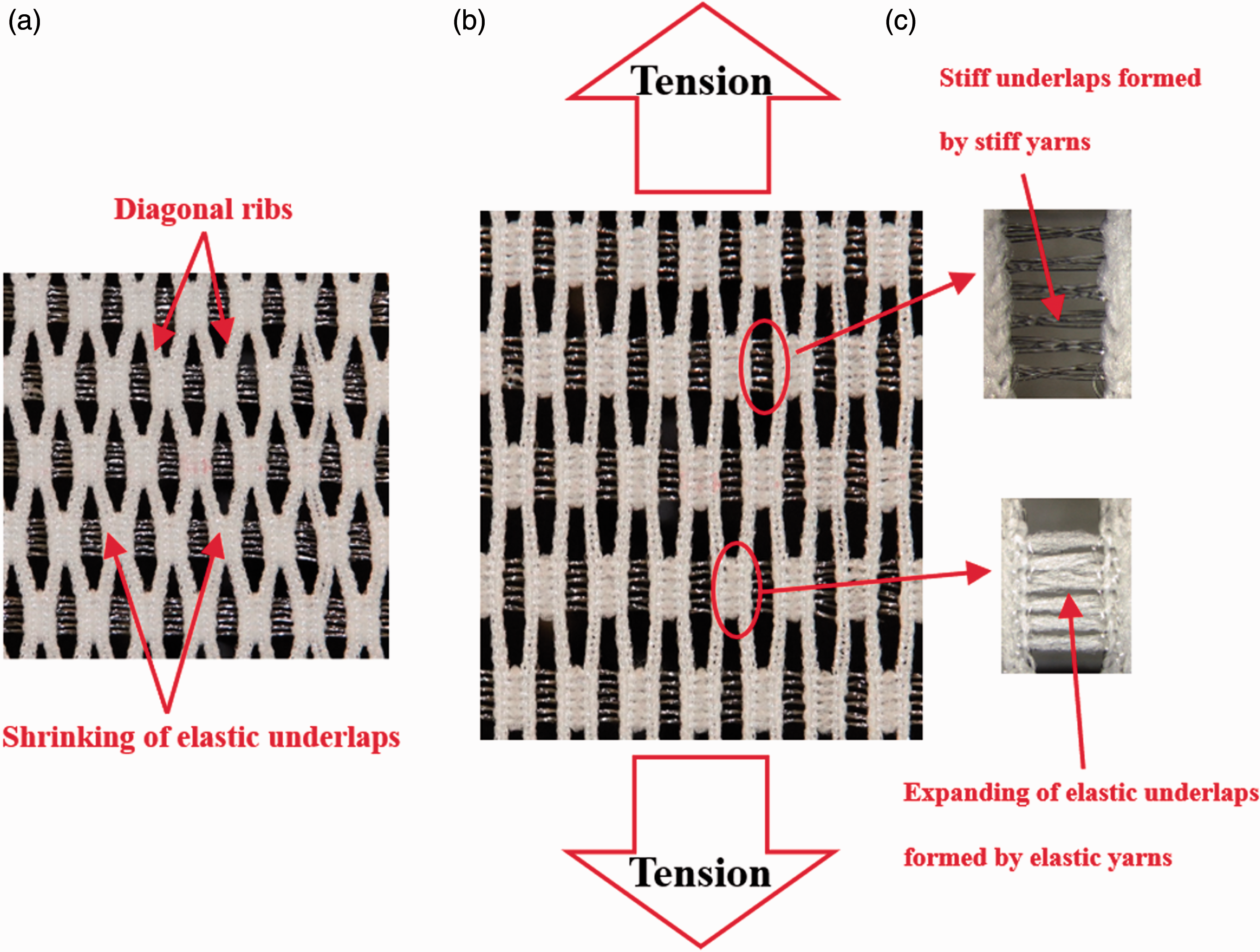
Photographs of the auxetic warp knitted fabric: (a) before the stretch; (b) under tension in the wale direction; (c) amplified underlaps.
Structure details of the fabric used

A: elastic yarn; B: stiff yarn; C: binding yarns; K: unthreading of yarns; CPC: courses per centimeter; WPC: wales per centimeter; GB1: the first yarn guide bar; GB2: the second yarn guide bar; GB3: the third yarn guide bar.
Repeating tensile test and calculation of the Poisson’s ratio
The repeating tensile test was conducted both in the wale direction and the course direction. Three samples were prepared for each direction. All the samples were cut into a size of 250 mm × 50 mm, as shown in Figure 3. Each sample was marked with five black points. The mark at the center of the specimen was used as a reference point and other marks were made along the two sides of the reference point on the central line at a distance of 20 mm from the reference point in the lateral direction and tensile direction, respectively.

Samples prepared for testing: (a) cut along the course direction; (b) cut along the wale direction.
The repeating tensile tests were conducted using an Instron machine with a gauge length of 150 mm. As shown in Figure 4, each specimen was tested for 100 tensile cycles. In each cycle, the specimen was firstly stretched with a speed of 50 mm/min until the tensile strain achieved 25%, then held for 2 s before the clamps returned to the original position at the same speed. Before the next tensile cycle, the sample was held in a relaxed state for 10 s.

Schematic illustration of the repeating tensile test.
During the test, a camera was set up to video-record the real-time deformation of the specimen under each tensile cycle. After the test, photos were extracted from the videos with a time interval of 9 s, corresponding to an interval of 5% tensile strain. A screen ruler was used to measure the lateral length between the two black marks vertical to the tensile direction in each photo.
The lateral strain 
With the calculated lateral strain 
Calculation of residual deformation in each cycle
When the samples are loaded under the abovementioned test conditions, they cannot recover completely in each tensile cycle due to the limited time given for relaxation. So, the term “residual deformation” is used here to demonstrate the nonreversible deformation of the fabrics after each tensile cycle. It only refers to the deformation that cannot be recovered under the abovementioned test condition. To understand the auxetic behavior of fabric, it is necessary to analyze the residual deformation. Figure 5 illustrates a typical stress–strain curve of the repeating cycle, from which it can be seen that during the return process, the stress decreases. When the stress returns to 0 MPa, the tensile strain returns to A rather than its original position O. OA is the residual strain under the test condition, while OB is the total tensile strain. Then the residual deformation can be represented by the ratio of OA to OB.

Stretch and recovery curve of the first cycle.
Results and discussion
Auxetic behavior in the wale direction
When the fabric is loaded in the wale direction, wales will bear the main force. Load exerted on wales will cause the rotation of diagonal ribs, leading to the increase of fabric size in the lateral direction. With the increase of tensile cycles, the auxetic effect of the fabric varies. Figure 6 illustrates the influence of tensile cycles on the auxetic effect of the fabric at different tensile strains. According to the results, the decrease of the Poisson’s ratio mainly occurs during the initial several cycles. Figure 6(a) is plotted using the results from the first cycle to the 10th cycle to show the variation of the auxetic effect at the initial several tensile cycles, while Figure 6(b) is plotted to show the overall results from the first cycle to the 100th cycle. Figure 6(c) shows the decreased rate of the Poisson’s ratio in percentage with the increase of tensile cycles at different tensile strain levels. From Figure 6, the following phenomena can be observed. (1) The auxetic effect of the fabric shows good resilience to tensile cycles. Even after 100 instances of repeating tension, the fabric still shows the auxetic effect at all tensile strain levels. (2) With the increase of tensile cycles, the auxetic effect of the fabric at all given tensile strains shows a decreasing trend. In the first tensile cycle, the largest auxetic effect is found at tensile strain of 15% and the smallest auxetic effect is found at tensile strain of 25%. Within the first several tensile cycles, the auxetic effect decreases with a higher rate. However, after several times of stretching, the decreasing trend of the auxetic effect starts to slow down and the Poisson’s ratio tends to be constant. (3) The influence of tensile cycles on the auxetic effect of the fabric are different at different tensile strain levels. The Poisson’s ratio at lower tensile strain levels is more sensitive to tensile cycles compared to that at higher tensile strains. As shown in Figure 6(c), at tensile strain of 10%, the auxetic effect rapidly decreases and almost 90% of the auxetic effect was lost after 10 instances of stretching. In contrast, at a high level of tensile strains, for example at strain of 25%, after 100 instances of stretching, only about 20% of the auxetic effect was lost. (4) After 20 instances of stretching, the Poisson’s ratio below strain of 10% cannot be measured because the residual deformation of the fabric becomes higher than 10%.

Decreasing of the auxetic effect at different tensile strains when stretched in the wale direction: (a) tensile cycles from 1 to 10; (b) tensile cycles from 1 to 100; (c) decreasing ratio of the auxetic effect at different tensile strains with the increase of tensile cycles.
The decrease in the auxetic effect of the fabric under repeating tension in the wale direction can be explained by residual deformation. Figure 7 shows the residual deformation of the fabric in the wale direction as a function of tensile cycles. It can be seen that the residual deformation shows an obvious increasing trend during the initial tensile cycles and then tends to be stabilized with the increase of tensile cycles. This variation trend is consistent with that of the Poisson’s ratio, as shown in Figure 6. Under repeating tension, the deformation process of the fabric in each cycle can be divided into three stages. In the first stage, the deformation of the fabric mainly comes from the shape change of overlaps, which can be fully recovered after release of the load. With the increase of the load, the second stage starts, where yarns start to transfer from underlaps to overlaps, causing an increase of their length. The deformation of overlaps at this stage is largely prevented by chain stitches formed by the front bar and can be partly recovered after the release of the load. In the third stage, yarns can no longer transfer and start to extend, which cannot be recovered even after the load is released. Figure 8 shows the influence of the above three stages on fabric deformation in one repeating cycle, in which overlaps in one loop formed by binding yarn, as shown in Figure 8(a), were selected as an example. The relative positions of the overlaps are marked in black. When the fabric is stretched, as shown in Figure 8(b), the shape of the overlaps becomes longer and thinner. With a continuous increase of the tensile strain, yarns will transfer from the adjacent loops. As shown in Figures 8(a) and (c), the position of the black mark under the overlaps is different, which means the yarn is transferred and is not able to return to its initial position when the tensile load is released. That is when residual deformation occurs. The increase of residual deformation reduces the rotation of the diagonal ribs and decreases the lateral expansion. As a result, the auxetic effect of the warp knitted fabric decreases with the increase of residual deformation. For a given tensile cycle, although the residual deformation at different tensile strains is nearly the same, it has a different influence on the auxetic effect at different tensile strains. The lower the tensile strain, the larger the influence will be. Therefore, for a given tensile cycle, the lower the tensile strain, the faster the auxetic effect decreases. Due to the increase of residual deformation with the increase of tensile cycles, for a given tensile strain, the auxetic effect shows a decreasing trend with the increase of tensile cycles.

Residual deformation as a function of tensile cycles in the wale direction with repeating tensile strain of 25%.

Deformation of an overlap under repeating tension: (a) before the stretch; (b) under the stretch; (c) after release of the load.
Auxetic behavior in the course direction
When loaded in the course direction, due to the anisotropic property of the fabric structure, the auxetic behavior is different from that in the wale direction. Figure 9 shows the Poisson’s ratio of the fabric as a function of tensile cycles at different tensile strains under tension in the course direction. From Figure 9, the following phenomena are observed. (1) Within the tested tensile cycles, the fabric keeps the auxetic effect at any given tensile strain. After 100 instances of stretching, although the auxetic effect is lower than that in the wale direction, the Poisson’s ratio of the fabric at all given tensile strains remains negative. (2) At any given strain, the auxetic effect of the fabric remains almost unchanged with the increase of tensile cycles. The auxetic effect when stretched in the course direction shows great resistance to repeating tension at almost all given tensile strains, except for the initial several tensile cycles at strain of 20%, where the auxetic effect slightly decreases with the increase of tensile cycles, and when tensile cycles are above 10, whereupon the auxetic effect becomes constant. (3) For a given tensile cycle, the auxetic effect of the fabric shows an increasing trend with the decrease of tensile strain except for strain of 10%, where the auxetic effect is the same as that at strain of 15%.

Poisson’s ratio as a function of tensile cycles at different tensile strains under tension in the course direction.
Under tension in the course direction, the underlaps of the fabric will bear the main force. With the increase of tensile strain, the load exerted on the underlaps increases, causing the extension of elastic underlaps. As stiff underlaps are not easily deformed, the extension of elastic underlaps will lead to the rotation of the diagonal ribs, which results in an increase of fabric size in the lateral direction. As a result, an auxetic effect is shown.
Different from the tension in the wale direction, the fabric has much less residual deformation in the course direction. Figure 10 shows the residual deformation of the fabric as a function of tensile cycles under repeating tension in the course direction. It can be seen that with the increase of tensile cycles, the residual deformation remains below 5%, except the minor variations in the first several cycles. The deformation of the fabric in the course direction can also be divided into three stages. In the first stage, the deformation of the fabric mainly comes from the extension of elastic underlaps, which can be fully recovered after release of the load. When the elastic underlaps are stretched to the same length as the stiff underlaps, the second stage starts where both stiff and elastic yarns will transfer from loops to underlaps, which may not be fully recovered even after the load is released. In the third stage, the yarns cannot transfer any longer and they will be permanently stretched, forming residual deformation.

Residual deformation as a function of tensile cycles in the course direction with repeating tensile strain of 25%.
Figure 11 shows the deformation of underlaps under repeating tension in a repeating cycle. As shown in Figure 11(b), when the fabric is stretched, elastic underlaps are extended from their shrinking state, as shown in Figure 11(a). When the load is released, as shown in Figure 11(c), the extended elastic underlaps return to their original length and no obvious residual deformation is observed. As for the loops, no obvious shape change or yarn transfer is observed either. Therefore, within the strain of 25%, deformation of the fabric mainly comes from the first stage and the other two stages are less likely to happen. As a result, residual deformation remains almost unchanged in the course direction, and its effect on the auxetic behavior is not evident. Therefore, the Poisson’s ratio is almost kept constant under repeating tension in the course direction.

Deformation of underlaps under repeating tension: (a) before the stretch; (b) under the stretch; (c) after release of the load.
Conclusions
The auxetic behavior of warp knitted fabric under repeating tension was studied. Its deformation process both in the wale and course directions was analyzed and the effect of residual deformation on the auxetic behavior of the fabric was discussed. The following conclusions can be drawn from this research.
The fabric proposed shows good auxetic stability under the given test condition. Even after 100 instances of stretching with a tensile strain of 25%, the fabric can still keep an auxetic effect in both the course and wale directions.
The auxetic effect in the wale direction is higher than that in the course direction, but has less auxetic stability. The underlaps formed with elastic yarns contribute to the better auxetic stability in the course direction due to lower residual deformation. The residual deformation mainly comes from yarn transfer among loops and the yarn extension. The use of elastic yarns can reduce the residual deformation of the fabric under given tensile strain and, thus, increase the stability of the auxetic behavior.
Despite good results being obtained in this research with a repeating tensile test of 100 cycles, the long-term durability of the auxetic fabric still remains unknown. Considering that most previous researches on the auxetic property of fabrics mainly focused on a single tensile cycle test, this paper can provide a reference value for the short-term auxetic persistence of fabrics. At the same time, it may also offer a reference for the long-term durability of auxetic warp knitted fabrics in future studies.
Footnotes
Acknowledgement
The authors would like to acknowledge help from the Industrial Center of the Hong Kong Polytechnic University.
Declaration of conflicting interests
The authors declared no potential conflicts of interest with respect to the research, authorship, and/or publication of this article.
Funding
The authors disclosed receipt of the following financial support for the research, authorship, and/or publication of this article: This work was supported by the Research Grants Council of Hong Kong Special Administrative Region Government for the GRF project (grant number: 15209616).
