



Abstract
To alleviate the wastage of resources and environmental pollution caused by waste luminous polyester fibers, glycolysis was found rapidly to degrade luminescent polyester fibers and assist in recovering luminescent materials from the fibers. However, the luminescent performance of recycled luminescent materials is poor. To improve the performance of recovered luminescent materials, this study employs the recovery rate of luminescent materials, initial brightness, and recovery rate of Bis (2-hydroxyethyl) terephthalate as performance indexes. The present study aims at optimizing the alcoholysis process by influencing factors such as the amount of catalyst, amount of ethylene glycol added, and reaction temperature to improve the luminous performance, and explores the mechanism of alcoholysis reaction in the recovery process of luminescent materials. The results showed that, when the catalyst content is 0.1 g, the mass ratio of polyethylene terephthalate:ethylene glycol is 1:10, the reaction temperature is 170°C for 4 hours, the Bis (2-hydroxyethyl) terephthalate conversion rate reaches 61.92%, the recovery rate of luminescent materials reaches 92.53%, and the initial brightness is as high as 5.607 cd/m2.
Luminous polyester fiber is a functional fiber made of rare earth strontium aluminate as the luminous body and polyester (polyethylene terephthalate; PET) as the base material through a special spinning process. It can absorb energy at a fixed wavelength of light and emit light for a few hours at night. It offers advantages such as non-toxicity, no radioactive elements usage, and bright colors. 1 –4 Textiles made of luminous fibers, due to their unique luminescent mechanism and safety, are widely used in functional apparel (firefighting apparel, night work, mining apparel), entertainment and leisure apparel, children’s toys, anti-counterfeiting trademarks, and other fields, 5 which have good application prospects and great added value.
With the rapid development of luminous polyester fibers, various luminous textiles have been created continuously, bringing greater convenience to lifestyle. However, this has also resulted in the production of a large number of waste luminous polyester fibers containing rare earth resources such as strontium aluminate. According to statistics, the current reserves of rare earth resources in China account for 37% of the total global reserves, compared with the previous reserves of 71.1%, showing a drop of 34.1%. 6 –9 Because China exported rare earth products to countries all over the world in the early years, the excessive export volume caused a large loss of rare earth metals and a shortage of resources. Rare earth metals have gradually gained significance for developing new energy metals; 10 therefore, scientists proposed to recover rare earth resources from waste products to achieve the purpose of recyclability and resource conservation.
At the same time, polyester, the base material of luminous polyester fiber, is a material that is difficult to be degraded by microorganisms in the environment. 11 PET itself is not toxic, but it easily accumulates in the environment causing environmental pollution and wastage of resources. Therefore, rare earth luminous materials can be recovered from waste luminous polyester fiber, especially PET base material can be treated to reduce the wastage of resources for recovering rare metals to build a friendly ecological environment. The flow chart of degrading PET and recycling luminescent materials is shown in Figure 1. Zhu et al. 12 found that the glycolysis method could not only degrade the luminous polyester fibers rapidly but can also retain the crystal structure of the rare earth luminescent materials. However, the luminescent performance of the recovered luminescent materials was poor. Considering the key role of reaction conditions in determining the luminescent performance of the recovered materials, the present study attempted to optimize the reaction conditions. The three influencing factors, namely the amount of catalyst, the amount of ethylene glycol, and the reaction temperature, are used to improve the degradation process conditions, and a possible mechanism is proposed. Importantly, the recovery rate of the rare-earth strontium aluminate materials has not been discussed until now, which prompted us to carry out this investigation.
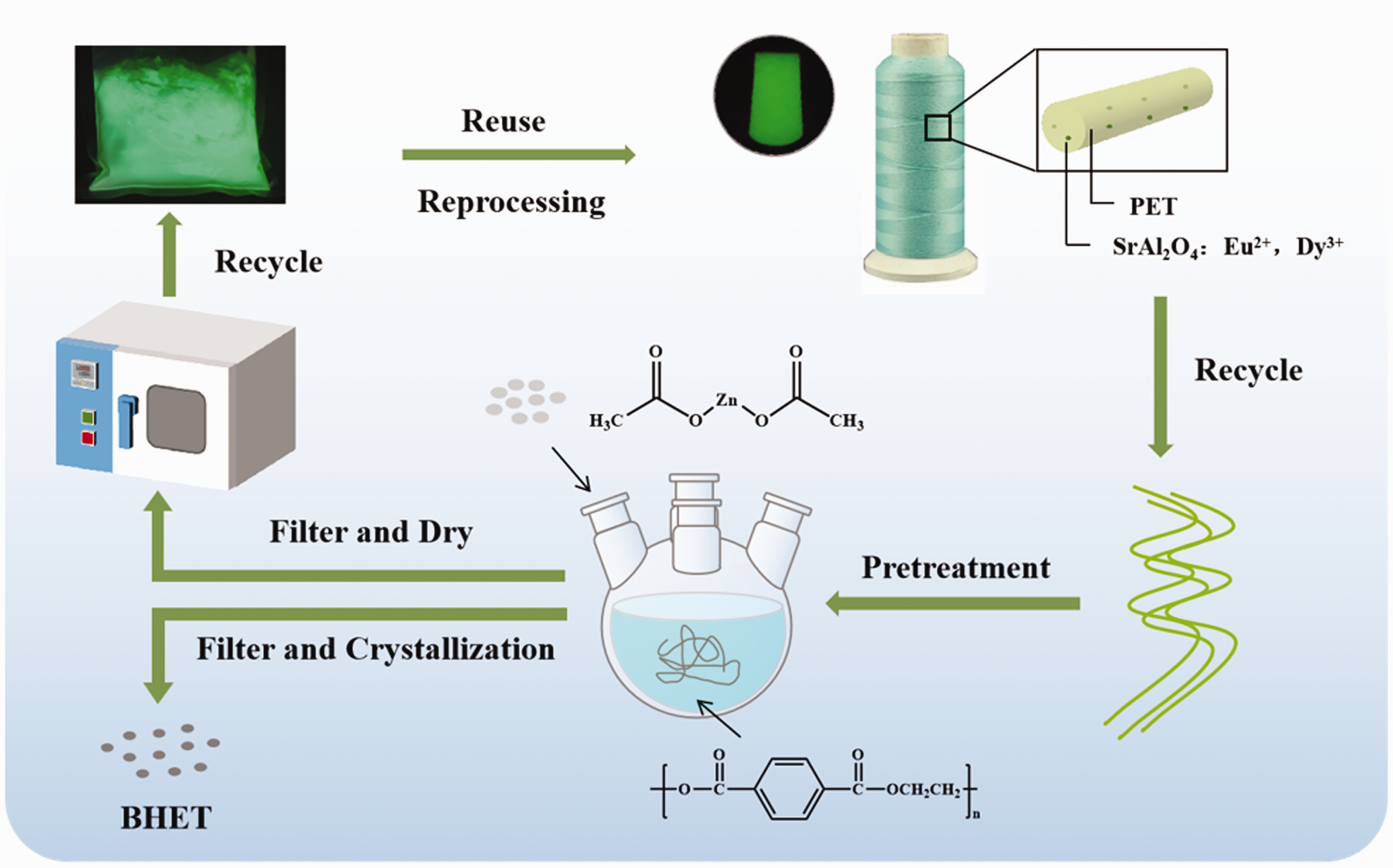
Schematic diagram showing the recycling of luminescent materials.
Experiment
Reagents and instruments
SrAl2O4:Eu2+, Dy3+ (SAOED) luminescent material, luminous polyester fiber (Changshu Jianghui Fiber Products Technology Co. Ltd.); ethylene glycol (EG) and zinc acetate (Zn(AC)2·2H2O) of analytical purity (Sinopharm Chemical Reagent Co. Ltd.); nitrogen (N2), ordinary purity (Wuxi Shengma Gas Co. Ltd.); AR1520/C electronic precision balance (OHAUS International Trade Co. Ltd.); Shenke S212 constant speed agitator (Shanghai Shenke Biotechnology Co. Ltd.); intelligent constant temperature electric heating mantle (Shanghai Jinqi Instrument Co. Ltd.); SHB-3 circulating water type multi-purpose vacuum pump (Zhengzhou Great Wall Technology Industry and Trade Co. Ltd.); 101AS-0 stainless steel electric heating blast drying oven (Shanghai Jinping Instrument Co. Ltd.).
Glycolysis of luminous polyester fibers
Luminous polyester fiber (15 g) and specific amounts of zinc acetate and EG were added sequentially to a 250 ml four-neck round bottom flask, which was connected to a spherical condenser, a stirrer, a heating jacket probe, and nitrogen gas inlet. Then, condensed water was poured with slow stirring to mix the raw materials evenly, and it was heated under the protection of nitrogen. The reaction was kept constant at 150–190°C for 4 hours. After the completion of the reaction, the hot reaction solution was filtered quickly to remove the unreacted luminous fibers. The degraded powder was recovered and dried in an oven at 70°C for 24 hours. The dried powder was ground and weighed. The filtrate contained a mixture of remaining ethylene glycol, zinc acetate, monomers, and oligomers. A large amount of deionized water was added to the filtrate, which resulted in a white flocculent precipitate. The precipitate was cooled to 0°C for 48 hours to obtain white needle-like crystals. The obtained crystals were filtered, dried, and weighed.
The calculation formula of glycol terephthalate (Bis (2-hydroxyethyl) terephthalate; BHET) yield (YB) is as follows:

The weight loss of SrAl2O4:Eu2+, Dy3+ luminescent materials does not exceed 1% within 800°C, and the heat loss is low, indicating that rare earth strontium aluminate luminescent materials have better thermal stability at high temperatures, while most organic compounds will melt and disappear. The recovered luminescent material is calcined in a tubular sintering furnace under N2 at a temperature of 800°C for 2 hours.
The calculation formula of luminescent materials recovery rate (YS) is as follows:

Characterization
The surface morphology of the sample was observed with the SU1510 scanning electron microscope (SEM), Hitachi, Japan, and the accelerating voltage was 5 kV. The crystal structure of the sample was obtained using a D2 PHASER X-ray diffractometer under the test voltage of 40 kV, the current of 40 mA, the scanning range of 10–70°, and the scanning speed of 2°/min. Differential scanning calorimetry (DSC) measurements were performed using a Q200 differential scanning calorimeter (TA, USA), which heated the sample from room temperature to 180°C at a rate of 10°/min under nitrogen protection at a flow rate of 60 ml/min. The samples were heated from room temperature to 600°C at a rate of 10°/min using a Q500 thermogravimetric analyzer (TA, USA). The emission spectra of the samples were measured using a FS5 fluorescence spectrometer (Edinburgh, UK) with a xenon lamp as the source in the range of 250–500 nm for excitation and 400–700 nm for emission. The afterglow decay curves of the samples were measured using a PR350 fluorescence afterglow brightness meter with an excitation brightness of 1000 lx and an excitation time of 15 min. The samples were tested by 1H nuclear magnetic resonance (NMR) using an AVANCE 400 fully digital NMR spectrometer (Bruker, Switzerland).
Results and discussion
Analysis of degradation products
Figure 2(a) shows the thermogravimetric analysis (TGA) curves of the alcoholysis product, in which two significant weight loss curves are observed. The first weight loss is in the range of 200–330°C that can be attributed to the thermal decomposition of the BHET. The second weight loss is in the range of 362–464°C, which is due to the thermal decomposition of PET formed from thermal polymerization of BHET during TGA. As shown in Figure 2(b), there is an endothermic peak at 110°C, which is consistent with the standard melting point of BHET. Therefore, it can be concluded that the main degradation product was the BHET monomer. Thus the main component of the degradation product is confirmed to be BHET.
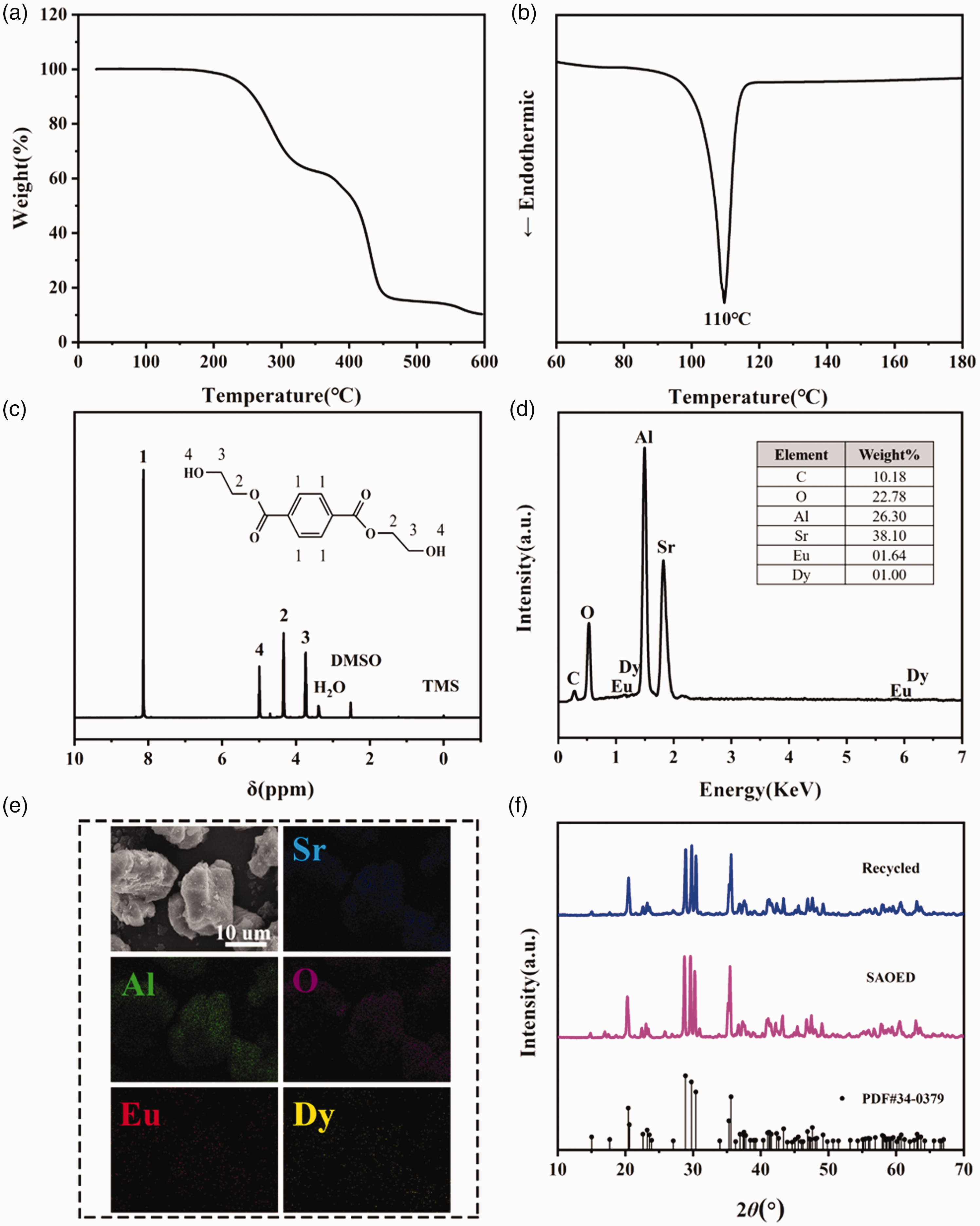
(a) Thermogravimetric analysis (TGA) curve of alcoholysis products; (b) differential scanning calorimetry (DSC) curve of alcoholysis products; (c) 1H nuclear magnetic resonance (NMR) spectrum of alcoholysis products; (d) electron digital spectroscopy (EDS) spectra of the recycled luminescent materials; (e) elemental mapping images of the recycled luminescent materials; (f) X-ray diffraction (XRD) pattern of the recycled luminescent materials.
To identify further the chemical structure of the product, 1H NMR spectroscopy analysis was carried out. Figure 2(c) shows the following signals: δ = 8.13 (s, 4H), 4.95 (t, 2H), 4.32 (t, 4H), 3.72 (q, 4H). The singlet at 8.13 ppm is representative of the four aromatic protons of the benzene ring. The triplet peak at 4.95 ppm corresponds to the two protons of the hydroxyl group. The triplet peak at 4.32 ppm and the quadruplet peak at 3.72 ppm represent the protons attached to the hydroxyl and carbonyl groups of the methylene group, respectively. 13 The NMR spectrum of the product is consistent with that in the literature, indicating that the degradation product is a pure form of BHET.
EDS analysis in Figure 2(d) and (e) revealed that the test sample contains O, Al, Sr, Eu, and Dy elements. The results indicate that O, Al, and Sr elements showed strong peaks in the spectrum, whereas Eu and Dy elements have shown mild peaks as a result of their low content. Therefore, EDS spectra confirmed that the recovered luminescent material is SrAl2O4:Eu2+, Dy3+. The XRD pattern (Figure 2(f)) of the recovered luminescent material shows sharp characteristic diffraction peaks at 2θ = 20.1°, 28.5°, 29.3°, and 35.1°, which is in good agreement with the characteristic peak positions of SrAl2O4:Eu2+, Dy3+ raw materials with no additional peaks. Moreover, comparing the recovered material with the Joint Committee on Powder Diffraction Standards (JCPDS) standard card (PDF#34-0379) supported the theory that it has a physical phase composition of α-SrAl2O4, a monoclinic crystal structure with lattice constants of a = 8.442 Å, b = 8.822 Å, c = 5.160 Å, and good crystallinity. 14 –16 The results suggest that the alcoholysis process does not damage the lattice structure of the luminescent material and preserves the SrAl2O4:Eu2+, Dy3+ crystal form.
In order to investigate further the color performance of the luminescent material after degradation, the chromaticity analysis of SrAl2O4:Eu2+, Dy3+ before and after degradation was carried out. In addition, the chromaticity map is divided according to different color regions. As shown in Figure 3, the two points nearly coincide, and the comparison of the CIE coordinates of the two samples shows that there is no major change, indicating that the degradation process does not change the color of the luminescent material, the luminescent material still emits yellow-green light, which also indicates the value of recycling and reuse. ‘Purity’ in the CIE chromaticity diagram in 1931 refers to the proximity between the color of the sample and the color of the spectrum at the same dominant wavelength. Table 1 shows the color characteristics of the samples. According to the color purity values, it can be seen that the color purity of pure SAOED is 0.57003, and after degradation, the color purity drops to 0.52681, the higher the purity, the closer it is to yellow-green, which means the purity of the yellow-green is higher. The result indicates that the alcoholysis process does not change the luminous color of the luminescent material, but will slightly reduce its color purity. In general, the alcoholysis process does not affect the luminous properties of rare earth luminous materials.

Chromaticity diagram of SrAl2O4:Eu2+, Dy3+ and recycled luminescent materials.
Color characteristics of the samples
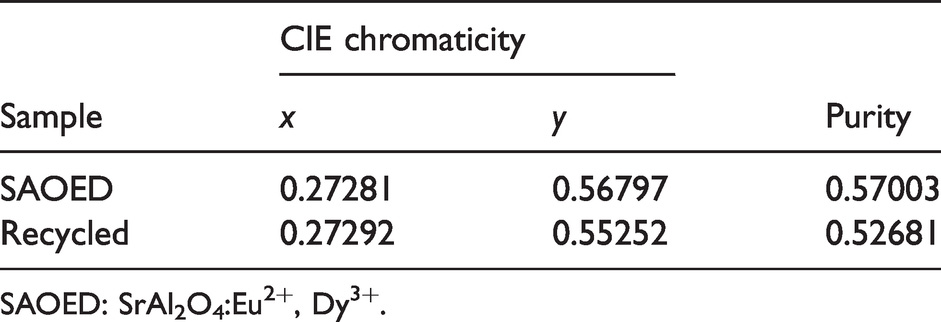
SAOED: SrAl2O4:Eu2+, Dy3+.
It can be observed from Figure 4 that SrAl2O4:Eu2+, Dy3+ is irregular, having a smooth and flat surface with sharp edges and corners. Most particle size distribution is 5–7 μm. On the other hand, the surface of the degraded luminescent material has vertical and horizontal grooves and an agglomeration of fine particles that make the surface rough and uneven. The possible reason for the roughness of the degraded product can be explained as follows. During the degradation process, polyester macromolecules are gradually decomposed into small molecular products, continuously producing oligomers and monomers. 17 Simultaneously, the luminescent materials attached to the surface of the polyester matrix preferentially break away PET leaving it free in the degradation solution. In contrast, the luminescent material wrapped in the polyester is separated slowly. This part of the luminescent material may be covered by oligomers that have not been completely degraded or additives that do not participate in the degradation reaction making the surface rough. After grinding, the particle size after degradation is slightly smaller than SrAl2O4:Eu2+, Dy3+ raw materials. Its average particle size is 6.62 μm that meets the requirement for preparing luminous fiber spinning. However, the surface impurities may affect the luminous brightness of the material.
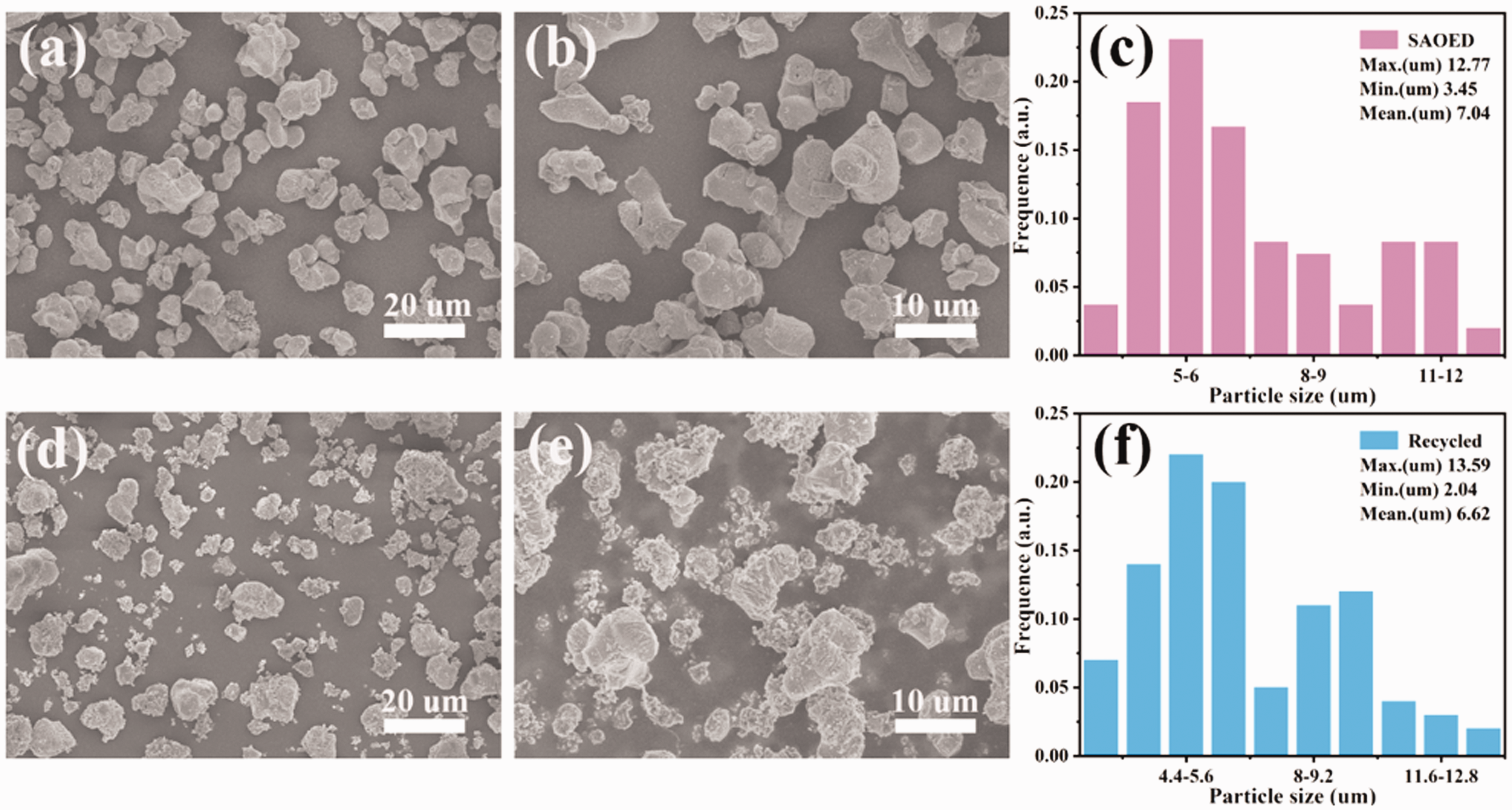
Scanning electron microscopy (SEM) images of (a) and (b) SrAl2O4:Eu2+, Dy3+; (d) and (e) the recycled luminescent materials; (c) and (f) the particle size of SrAl2O4:Eu2+, Dy3+ and the recycled luminescent materials.
Effect of reaction conditions
Effect of catalyst dosage
To investigate the effect of catalyst dosage on the yield of BHET and the recovery rate of luminescent materials, experiments were carried out under the following conditions: the reaction temperature was 170°C, reaction time was 4 hours, PET:EG mass ratio was 1:10, catalyst dosages were 0.05 g, 0.1 g, 0.2 g, 0.3 g, and 0.4 g (the amount of catalyst was between 0wt% and 2wt% of PET), and the comparison sample was pure luminescent material SrAl2O4:Eu2+, Dy3+. As shown in Figure 5(a), the BHET yield increased sharply with the increase of catalyst dosage, especially from the addition of 0.05 g to 0.1 g, and reached a maximum value of 61.92%. The reason could be the acceleration of polyester degradation due to a large number of active sites increasing the degradation rate, and the equilibrium was finally reached. Further, when the catalyst dosage exceeded 0.1 g, the BHET yield decreased instead, indicating a reverse reaction. A high dosage of catalyst decreased the BHET yield slowly and had only little effect on the recovery of luminescent materials. As it possesses a certain environmental risk, therefore, 0.1 g was selected as an optimal choice. According to the recovery curve of luminescent materials, the recovery rate of the material increased as the amount of catalyst increased. The recovery rate was only 65% for 0.05 g of catalyst, which reached 92.53% when the catalyst was 0.1 g. This trend can be attributed to the slower reaction rate in the presence of less catalyst, 18 which leads to incomplete degradation of the luminous fibers resulting in a lower recovery rate of luminescent materials.
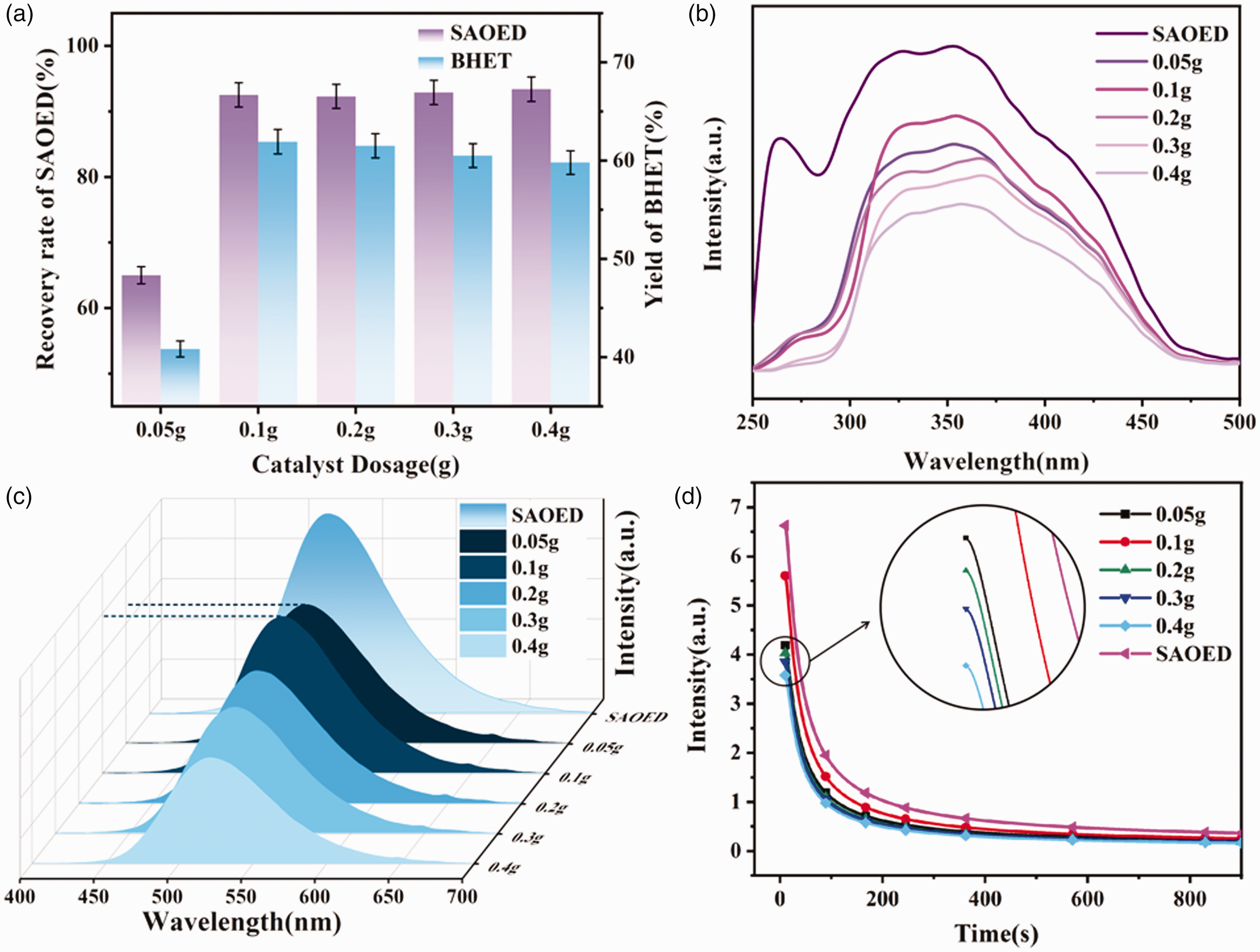
The influence of the amount of catalyst: (a) the influence of the amount of catalyst on the yield of Bis (2-hydroxyethyl) terephthalate (BHET) and the recovery rate of luminescent materials; (b) the excitation spectrum of the samples; (c) the emission spectrum of the samples; (d) the afterglow decay curve of the samples.
To examine the effect of the amount of catalyst on the luminescence performance of the luminescent materials, the excitation, emission, and afterglow performance tests were carried out. Pure SrAl2O4:Eu2+, Dy3+ was used as the comparison sample. As shown in Figure 5(b), the excitation curves of all the samples were similar to the comparison sample, with a wide band around 250–500 nm. The maximum excitation peak was around 365 nm determined by the Eu2+ characteristic spectrum. The electron energy level of Eu2+ underwent splitting, and the generated multiple metastable energy levels absorbed wavelengths resulting in a continuous absorption band. 19,20 However, after the recovery, the excitation intensity of the sample lowered, and the peak between 250 nm and 300 nm became smaller. The oligomer covered on the sample surface absorbed, reflected, and refracted the excitation light when irradiated on the sample. The reflected light has no impact on luminescence because it did reach the luminescent material. A portion of the photons collided with the luminescent material and formed an excitation light source. The remaining photons that did not interact with the luminescent material were directly emitted from the surface of the covering. Therefore, the number of photons absorbed by the sample reduced, and the number of electrons excited decreased resulting in a lower luminescence of the sample. 21 –23 In the figure, the sample with a catalyst dosage of 0.1 g had the highest excitation intensity, indicating its better performance. The emission spectra (Figure 5(c)) shows that the sample had the same peak pattern as pure SrAl2O4:Eu2+, Dy3+ with peaks around 520 nm, indicating that the amount of catalyst did not change the luminescence center. The peak of the recovered luminescent material was a little lower, and the sample with 0.1 g catalyst had the highest emission peak, indicating that a higher catalyst reduced the luminous intensity of the luminescent materials. The afterglow decay curve of the sample (Figure 5(d)) suggests that the initial brightness of the sample was lower than that of pure SrAl2O4:Eu2+, Dy3+, but the afterglow decay pattern was consistent, indicating that the amount of catalyst did not affect the luminescence pattern of the luminescent materials. When the catalyst was 0.1 g the sample had the highest afterglow brightness, followed by 0.05 g, 0.2 g, 0.3 g, and 0.4 g. This was because when the catalyst dosage was low, the surface of the luminescent materials was coated with more oligomers, which blocked the absorption of light and reduced the initial brightness. When the catalyst dosage was increased, the concentration of zinc acetate increased, which affected the brightness of the luminescent materials. Thus, the best catalyst dosage was determined by the above analysis to be 0.1 g.
Effect of glycol addition
To investigate the effect of EG addition on the yield of BHET and the recovery of luminescent materials, experiments were conducted under the following conditions: reaction temperature was 170°C, reaction time was 4 hours, catalyst dosage was 0.1 g. As the process required a large amount of EG, the mass ratio of PET:EG was set to 1:4, 1:10, 1:15, 1:20, 1:30, and the comparison sample was pure SrAl2O4:Eu2+, Dy3+. As shown in Figure 6(a), the yield of BHET gradually increased from 42.64% (mass ratio of 1:4) to 61.92% (mass ratio of 1:10), which was because the higher glycol concentrations resulted in a faster dissolution rate of PET. 24 –26 Moreover, the more the surface contact between PET and ethylene glycol, the faster the degradation reaction rate. When the mass ratio exceeded 1:10, it had little effect on the yield of BHET, indicating that the reaction was close to equilibrium. However, the reduction in the recovery rate of luminescent materials could be due to the excessive amount of ethylene glycol, which partially hydrolyzed the rare earth strontium aluminate and reduced the quality.

The effect of the amount of ethylene glycol added: (a) the effect of the amount of ethylene glycol on the yield of Bis (2-hydroxyethyl) terephthalate (BHET) and the recovery rate of luminescent materials; (b) the excitation spectrum of the samples; (c) the emission spectrum of the samples; (d) the afterglow decay curve of the samples.
The effects of EG addition on the luminescent properties of luminescent materials, excitation, emission, and afterglow performance tests were monitored, with pure SrAl2O4:Eu2+, Dy3+ as a comparison sample. From the excitation spectrum (Figure 6(b)), it can be observed that the peak pattern of the sample and the comparison sample were consistent, indicating that the added EG did not damage the energy level structure of the luminescent materials. When the mass ratio of PET:EG was 1:10, the intensity was higher, but for other mass ratios, as the amount of glycol increased, the excitation intensity was lowered. This may be due to the self-polymerization of EG and the adhering of by-products produced to the surface of the luminescent material, which blocks a part of the light absorption. The emission spectra of the samples showed a consistent peak pattern. The highest emission peak was obtained for the 1:10 mass ratio of PET:EG. Figure 6(d) shows the afterglow decay curve of the sample. The afterglow decay pattern of the sample was consistent with that of pure SrAl2O4:Eu2+, Dy3+, indicating that the addition of EG did not destroy the crystal structure of the luminescent materials. Moreover, the afterglow brightness was the highest when the mass ratio of PET:EG was 1:10. However, the initial brightness of the sample was a little lower, which can be due to the by-products generated by self-polymerization. 27 –29 These by-products increased as the amount of EG increased and adhered to the surface of the sample, which reduced the initial brightness of the sample. The luminous brightness decreased because the luminescent material got hydrolyzed. Based on the above analysis, the best PET:EG mass ratio was set at 1:10.
Effect of reaction temperature
To investigate the effect of reaction temperature on the yield of BHET and the recovery of luminescent materials, experiments were carried out under the following conditions: catalyst dosage was 0.1 g, PET:EG mass ratio was 1:10, reaction time was 4 hours, the reaction temperature was set to 150°C, 160°C, 170°C, 180°C, 190°C, and the comparison sample was pure SrAl2O4:Eu2+, Dy3+. As shown in Figure 7(a), the BHET yield increased as the reaction temperature increased, indicating that the temperature had a greater influence on the PET degradation efficiency. In addition, the high temperature was beneficial to the formation of the BHET monomer. The luminescent material yield curve was consistent with the BHET recovery curve, indicating that the higher the temperature, the better the luminescent materials recovery rate. At higher temperatures, the degradation efficiency was greater; therefore, fewer oligomers were attached to the surface of the material, and more luminescent materials were separated, increasing the recovery rate.To study the effect of reaction temperature on the luminescent properties of luminescent materials, the excitation, emission, and afterglow performance tests were carried out to compare the sample with pure SrAl2O4:Eu2+, Dy3+. As shown in Figure 7(b) and (c), the excitation and emission spectra were consistent with those of pure SrAl2O4:Eu2+, Dy3+ with the excitation bands near 250–500 nm, and the emission peaks around 520 nm. However, the relative intensities of the peaks were lower than SrAl2O4:Eu2+, Dy3. The afterglow decay curve (Figure 7(d)) shows that the initial brightness of the sample decreased with the increased temperature because the luminous efficiency of rare earth strontium aluminate materials at room temperature was better (as shown in Figure 8(b)), while as a result of its heat resistance property, the brightness has decreased at higher temperatures and was even quenched to half of the original brightness. Moreover, it was also possible that the mixture of high polymer and EG can change color to yellow on heating due to partial oxidation of the hydroxyl group to aldehydes, thus affecting the brightness of the light. 30 –33 The CIE 1931 chromaticity diagram coordinates and afterglow images of the samples at different temperatures were also studied, showing that the chromatic purity of the recovered luminescent materials decreases as the temperature rises, as well as the afterglow brightness, indicating that the luminescent properties of the luminescent materials are slightly impaired in the high temperature glycol solution. As the temperature raised, the recovery rate of luminescent materials increased, but the luminescence brightness decreased. In order to ensure that the luminescence material recovery efficiency was improved while taking into account the luminescence brightness of rare earth strontium aluminate, the reaction temperature of 170°C was selected for comprehensive consideration.

The influence of reaction temperature: (a) the influence of reaction temperature on the yield of Bis (2-hydroxyethyl) terephthalate (BHET) and the recovery rate of luminescent materials; (b) the excitation spectrum of the samples; (c) the emission spectrum of the samples; (d) the afterglow decay curve of the samples.

(a) The color the recycled luminescent materials under different recation temperature conditions on the CIE 1931 color chromaticity diagram; (b) afterglow images of samples under different temperature conditions.
Reaction mechanisms
Based on the experimental results and previous studies, Figure 9 proposes a possible mechanism of EG degradation of luminous polyester fibers. The PET degradation reaction initiates when luminous polyester fibers enter the alcoholysis solution. Hydrogen bonds are formed between the anion in zinc acetate and the hydroxyl hydrogen in ethylene glycol, which enhances the electronegativity facilitating the nucleophilic attack of the hydroxyl group. At the same time, the zinc ion is coordinated with the oxygen atom of the carbonyl group in the polyester, which further enhances the electropositivity of carbonyl carbon, making it more susceptible to nucleophilic attack. 34 Then the bonds between hydroxyl hydrogen–oxygen and polyester–ester break. The hydroxyl hydrogen separated from the EG is combined with the hydroxyl oxygen from the polyester, and a new carbon–oxygen bond is formed between the carbonyl carbon in the polyester and the hydroxyl oxygen in the EG. 35 This process of transesterification is continuously repeated by the catalyst to degrade the polyester gradually into an oligomer, then a dimer, and finally BHET monomers. During this process, the reverse reaction of monomers form dimers, which in turn form oligomers that are also observed until the reaction reaches equilibrium. The degradation process does not change the crystalline form of the rare earth strontium aluminate; however, an impact on its luminescent performance is evident. This is because when PET macromolecules were degraded into small molecules, the luminescent materials attached to the surface of the polyester were preferentially separated and have been exposed to the alcoholysis. In the solution, part of the luminescent material is hydrolyzed and corroded by zinc ions impairing its luminescent performance. On the other hand, the rare earth strontium aluminate wrapped in the innermost part of the PET slowly undergoes alcoholysis, and the surface is not completely recovered after recovery. When light is irradiated to the luminescent material, the surface covering shows absorption, reflection, and refraction effects. The reflected light does not come in contact with luminescent materials and thus has no impact on its performance, whereas the absorbed light encounters the luminescent materials. The light emitted by the SrAl2O4:Eu2+, Dy3+ material near the covered surfaces is blocked, resulting in lower brightness. Therefore, the surface coverings content is reduced not only to improve the degradation efficiency, the recovery efficiency of luminous materials, and the recovery rate of BHET, but also to ensure the luminescent performance SrAl2O4:Eu2+, Dy3+ material.
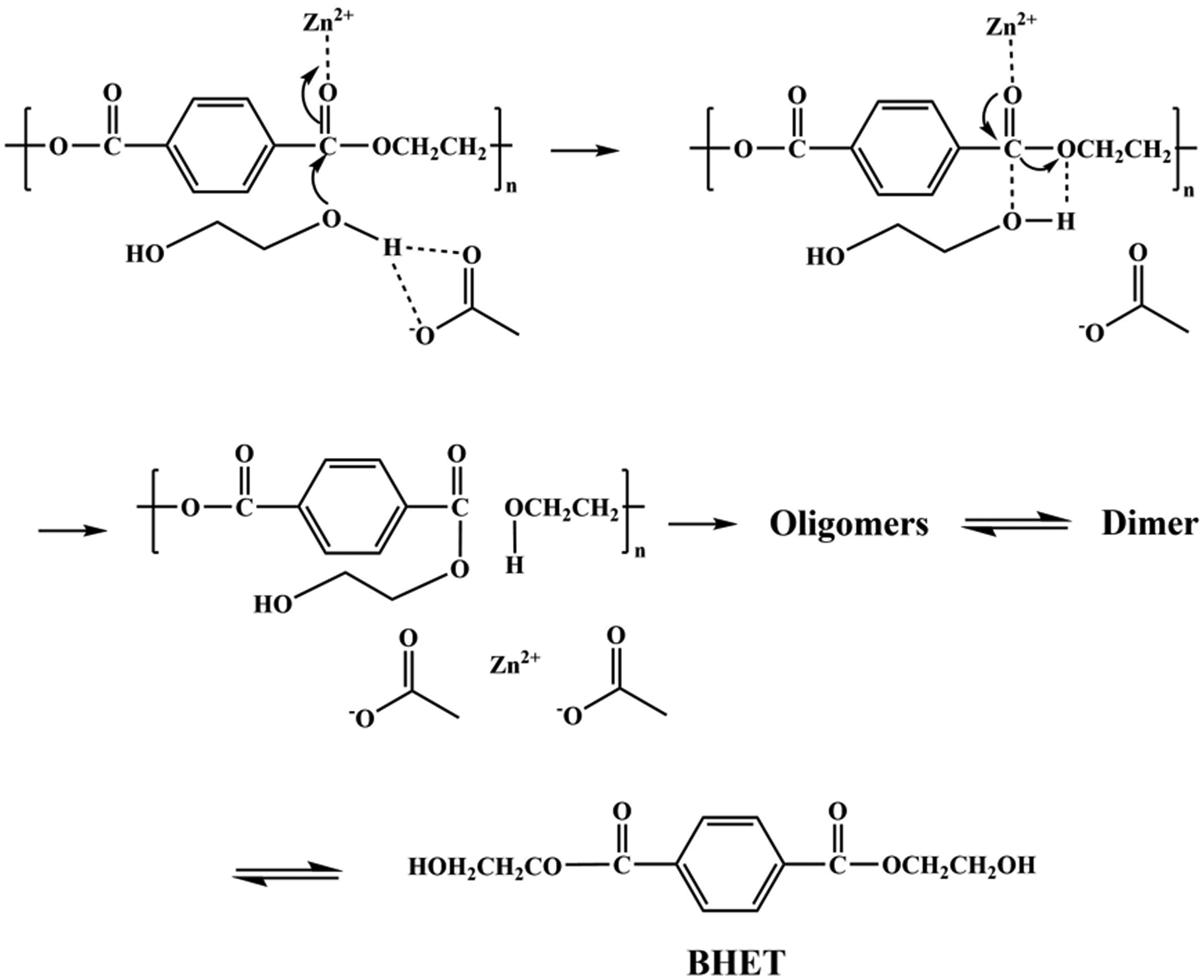
Mechanism diagram of ethylene glycol degradation of luminous fibers.
Conclusion
The present study attempts to improve further the recovery efficiency of waste luminescent polyester fiber and the luminescence performance after recycling by presenting the most suitable conditions for the degradation process in terms of catalyst amount, EG addition, and reaction temperature parameters. It was observed that when the catalyst content was 0.1 g, the PET:EG mass ratio was 1:10, the reaction temperature was 170°C for 4 hours, the conversion of BHET reached 61.92%, and the recovery rate of luminescent materials reached 92.53%. The results obtained from DSC, TG, and 1H NMR spectroscopy confirmed that the degradation product was a BHET monomer. XRD and EDS suggested that the crystal form of the luminescent material was unchanged after the process; it remained as SrAl2O4:Eu2+, Dy3+. It was found that the initial luminance of the luminescent material reached 84.6% of that of pure SrAl2O4:Eu2+, Dy3+. The optimal process conditions that improve the performance of the luminescent material are expected to be utilized for recycling in industrial production, which provides a theoretical basis for the recycling of other functional materials.
Footnotes
Declaration of conflicting interests
The author(s) declared no potential conflicts of interest with respect to the research, authorship, and/or publication of this article.
Funding
The author(s) disclosed receipt of the following financial support for the research, authorship, and/or publication of this article: This work was financially supported by the National Natural Science Foundation of China (no. 51903107), the Natural Science Foundation of Jiangsu Province (grant no. BK20190619), the China Postdoctoral Science Foundation (no. 2019M661724), the Jiangsu Postdoctoral Science Foundation (no. 2019K107), the LVYU Foundation of China Chemical Fiber Association (CCFA-LVYU-2019-03), and the Natural Science Foundation of Jiangsu Province (BK20191165).
