



Abstract
In this project, polyaniline powder was firstly prepared by in situ polymerization using aniline as the monomer, ammonium persulfate as the oxidant, and camphor sulfonic acid as the dopant. Next, polyester-cotton fabrics were used as the base fabrics, polyaniline, cobalt ferrite, and carbon fiber powder as the functional particles, and PU-2540 type polyurethane as the base, and single-layer coated polyester-cotton fabrics were prepared by the textile coating process. Finally, the effects of the polyaniline, cobalt ferrite, and carbon fiber powder doping ratio and functional particle content on the shielding effectiveness, reflection loss, real and imaginary parts of the dielectric constant, and loss angle tangent of single-layer coated polyester-cotton fabrics were focused on using the controlled variable method. The results show that in the frequency range of 0.01–3 GHz, when the doping ratio of polyaniline, cobalt ferrite, and carbon fiber powder is 1:0:3, and when the content of functional particles is 40%, the minimum reflection loss of single-layer coated polyester-cotton fabrics is –22.1 dB at 1.6 GHz, and the effective absorption bandwidth is 1.14 GHz.
With the progress of electronic technology and the development of the electronics industry, the application of electronic and electrical equipment and communication facilities is becoming more and more widespread, bringing convenience to people's daily lives; at the same time, electromagnetic pollution is becoming increasingly serious.1–3 Electromagnetic pollution has become the fourth category of pollution in addition to air pollution, water pollution, and noise pollution. 4 In daily life, long-term electromagnetic radiation can bring serious harm to people's physical and mental health. Electromagnetic radiation may cause nerve disorders, memory loss, heart palpitations, insomnia, and even cancer.5,6 In the military field, electromagnetic shielding, prevention of electromagnetic interference, and electromagnetic leakage are also important. Therefore, the problem of electromagnetic pollution prevention and control has been given attention by all countries in the world, and the preparation of high-performance electromagnetic protection materials has become a hot research topic for domestic and foreign research. 7 Therefore, the development of new high-performance wave-absorbing materials is of great importance in both daily life and military fields.
Polyaniline (PANI) as a “new species” of conductive polymer, with the advantages of simple synthesis, low density, molecular design, diversified structural properties, good stability, etc., a reversible doping mechanism that makes its conductivity adjustable, and high conductivity at room temperature so that it has a good conductive loss capacity, is a research hot spot in the field of wave-absorbing materials.8–10 Liu et al. 11 prepared a PANI-graphene oxide-PANI sandwich structure composite; the minimum reflection loss of the composite with a thickness of 5 mm could reach –41.29 dB at 6.8 GHz, and the effective absorption band was from 4.9 to 18 GHz with a width of 13.1 GHz. Wang et al. 12 prepared ferrite@graphene@PANI composites by hydrothermal and in situ polymerization methods, with flaky graphene and ferrite particles wrapped on PANI nanorods, with a minimum reflection loss of –43.7 dB at 10.7 GHz and an effective absorption band of 6.8–12.2 GHz.
As a typical spinel-type subferromagnetic compound, cobalt ferrite has good mechanical properties and corrosion resistance, large resistivity, and a dielectric constant, and is widely used in electromagnetic fields. 13 Cobalt ferrite can be prepared by the sol–gel method, co-precipitation method, hydrothermal method, vapor phase method, high-energy ball milling method, etc. The properties of cobalt ferrite prepared by different methods are different. 14 Guo et al. 15 prepared cubic structured cobalt ferrite microspheres by the sol–gel method, which combined with polyacrylamide can inhibit carrier complexation and increase the polarizability of the material. Nikzad et al. 16 prepared Nd3+ substituted Gd-Co ferrite compounds by the hydrothermal method; the minimum reflection loss of CoFe1.8Nd0.1Gd0.1O4 was –31.4 dB at 10.2 when the thickness was 2.4 mm, and the effective absorption bandwidth was 4 GHz.
Carbon fiber powder (CF) is a particle made of ground carbon fiber filament, so it is also called ground carbon fiber, with a nearly circular cross-section, which has excellent electrical conductivity, a high modulus ratio, strong design ability, controllable resistance, and low density and high strength, and can be well dispersed in resin, and is quite widely used in wave-absorbing materials and shielding materials. 17 The absorption and shielding effect of CF on electromagnetic waves is attributed to its good electrical conductivity. 18 By adding CF, the wave-absorbing properties of the composite can be effectively improved. Duan et al. 19 used carbonyl iron powder as the functional particle of the matching layer and carbon black as the functional particle of the absorber layer, and doped CF by different doping ratios. The addition of CF changed the input impedance to a certain extent and optimized the impedance matching; with carbon black, it formed a conductive network in the absorber layer, and when microwaves entered the absorber layer, the conductive network generated eddy current loss, thus improving the wave-absorbing properties.
A PANI, cobalt ferrite, and CF composite can optimize impedance matching through conductive, dielectric, and magnetic loss of a variety of loss of electromagnetic waves, so absorbing more electromagnetic waves. Shen et al. 20 prepared M- and W-type ferrites by the citrate sol–gel method and the wave absorption efficiency was significantly improved by doping with short-cut carbon fibers, which acted as electric dipoles and were able to resonate with stray waves independent of the magnetic field, with a minimum reflection loss of –11.0 dB at 13.3 GHz. Movassagh-Alanagh et al. 21 used a modified multi-step electrophoretic deposition process to deposit nano-iron tetroxide particles on the carbon fiber surface, and then polymerized PANI in situ on this surface to obtain PANI@nano-iron tetroxide@carbon fiber composites with a minimum reflection loss of –11.11 dB and an effective absorption bandwidth of about 6 GHz when the thickness was 1.5 mm. The above process is more complex and more difficult to achieve in industrial production, while the coating method is simple and can be produced on a large scale. Moreover, this research is mostly focused on the high frequency band, and research in the low frequency band is also necessary.
Polyurethane can be applied to the formulation of flexible substrate coatings, such as textile printing, ink, leather finishing agents, etc., the sizing treatment of fibers and non-woven fabrics, and can be coated on fabrics to improve the performance of fabrics. Polyurethane has the advantages of being cheap, non-polluting, and suitable for industrial production. Matkovic et al. 22 coated the knitted fabric with polyurethane, thus increasing the heat resistance by 143%. Jahid et al. 23 synthesized a series of shape memory polyurethanes, then coated them on cotton fabric and prepared a waterproof coated fabric with excellent performance. Polyester and cotton fabrics have the advantages of softness and cheapness, which are conducive to industrial production. Therefore, we chose polyester-cotton fabric and polyurethane as the base fabric and base, respectively.
This project used the in situ polymerization method and textile coating process to prepare single-layer coated polyester-cotton fabric, and studied the effects of the PANI, cobalt ferrite, and CF doping ratio and functional particle dosage on the wave-absorbing, electromagnetic shielding, and dielectric properties.
Experimental details
Main experimental materials
Aniline (C6H7N, analytical purity) was purchased from Tianjin Damao Chemical Reagent Factory. Cobalt ferrite (1 μm) was purchased from Hebei Jiangjian Welding Material Co., whose appearance is round ball-shaped. CF (48 µm) was purchased from Nanjing Weida Composite Material Co., whose appearance is cylindrical. Camphorsulfonic acid (C10H16O4S, analytical purity) was purchased from Shanghai Rinn Technology Development Co. Ammonium persulfate (H8N2O8S2, analytically pure) was purchased from Shanghai Rinn Technology Development Co. Thickener (7011) was purchased from the Guangzhou Dengmu Composites Business Department. Anhydrous ethanol (analytical purity) was purchased from Tianjin Windship Chemical Reagent Technology Co. The plain polyester-cotton blended fabrics had a surface density of 140 g/m2, warp density of 96 pieces/10 cm, weft density of 96 pieces/10 cm, and thickness of 0.256 mm. The content of cotton and polyester is 90% and 10%, respectively. This fabric is produced by Baoji Yibo Trading Co., Ltd. PU-2540 polyurethane is a water-based one-component polyurethane, purchased from Guangzhou Goodwill Environmental Protection Material Co., Ltd, with pH of 7.0–9.0, density of 1.04 kg/m3, the appearance of a slightly blue translucent emulsion.
Main experimental equipment
Shielding performance test
A vector network analyzer (ZNB40) from Rohde & Schwarz, Germany, was selected for this experiment to measure the shielding effectiveness. The test band was set from 0.01 to 3.0 GHz, and the coated fabrics were cut into 13 cm diameter discs and placed in the instrument for testing.
Wave-absorbing property test
A vector network analyzer (ZNB40) from Rohde & Schwarz, Germany, was selected for this experiment to measure the reflection loss. The test band was set from 0.01 to 3.0 GHz, and the coated fabrics were cut into a ring with an inner diameter of 33.1 mm and an outer diameter of 76.2 mm and placed in the test instrument for testing.24,25
Dielectric properties test
In this experiment, a BDS50 dielectric spectrometer was selected to test the dielectric constant, referring to the standard SJ20512-1995 “Test methods for permittivity and permeability of microwave high loss solid materials.” We set the test frequency band to 0.001–1.0 GHz, cut the coated fabrics into square pieces of 2 cm × 2 cm in diameter, and put them in the test instrument for testing.26,27
Scanning electron microscopy test
A HITACHI S4800 cold field scanning electron microscope and Carl Zeiss crossbeam 550 focused ion beam electron beam double beam microscope were used to observe the surface and cross-sectional morphology of the samples, in which the cold field scanning electron microscope was used for non-magnetic samples and the focused ion beam electron beam double beam microscope was used for magnetic samples.
Preparation process of single-layer coated polyester-cotton fabrics
Single-layer coated polyester-cotton fabrics were prepared by the fabric coating process with polyester-cotton fabric as the substrate, PU-2540 type polyurethane as the substrate, and homemade PANI, cobalt ferrite, and CF as the functional particles.
(1) Preparation process of PANI powder
PANI powder was prepared by in situ polymerization using aniline as the monomer, ammonium persulfate as the oxidant, and camphor sulfonic acid as the dopant. Firstly, a certain content of aniline was dissolved in water and stirred continuously for 20 min to promote the dissolution of aniline to form a 0.3 mol/L aniline solution. Secondly, 0.3 mol/L ammonium persulfate solution was added to the aniline solution and stirred continuously for 20 min to promote the generation of PANI. Then, 0.45 mol/L camphorsulfonic acid solution was added and stirred continuously for 20 min to promote the doping of PANI. Finally, the PANI solution was extracted and filtered, and the filter cake was washed with a large amount of anhydrous ethanol and water, and then the PANI powder was dried, ground, and sieved to obtain PANI powder.
(2) Preparation process of single-layer coated polyester-cotton fabrics
Single-layer coated polyester-cotton fabrics were prepared by the fabric coating process with polyester-cotton fabric as the base cloth, PANI, cobalt ferrite, and CF as the functional particles, and PU-2540 type polyurethane as the substrate. Firstly, the freshly prepared PANI powder, cobalt ferrite, and CF were dispersed in PU-2540 type polyurethane to form a coating with a viscosity of 25,000–300,000 mPa·s. Secondly, the coating was poured onto the polyester-cotton fabrics, the coating thickness was adjusted to 1 mm, and the coating was evenly coated on the fabrics by using a scraper. Finally, the coated fabrics were dried in the oven at 80°C for 10 min and then dried naturally in air to obtain the single-layer coated polyester-cotton fabrics. The preparation flow chart is shown in Figure 1.

Flow chart for the preparation of single-layer coated polyester-cotton fabrics. CF: carbon fiber powder; PANI: polyaniline.
(3) Process parameters
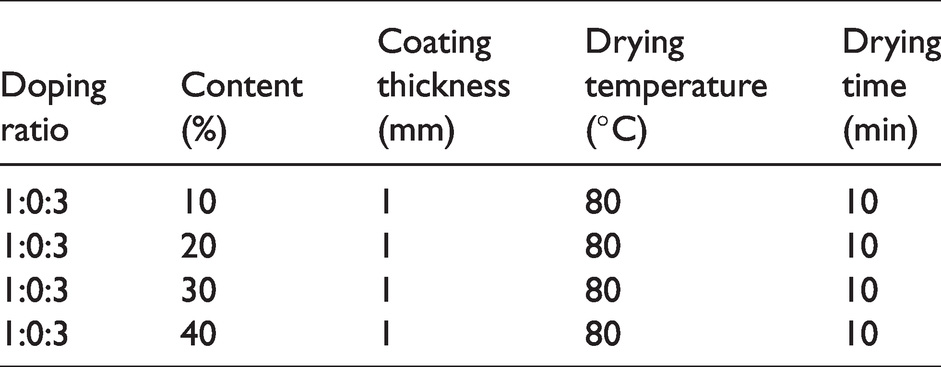
In this thesis, two sets of experiments were conducted, the first set with the doping ratio of functional particles as the variable; the specific parameters are shown in Table 1. The second group takes the optimal doping ratio of the results of the first group, with the percentage of functional particles as the variable; the specific parameters are shown in Table 2, where the doping ratio is the ratio of PANI, cobalt ferrite, and CF, and the content is the mass ratio of functional particles to polyurethane.
Process parameters for the first set of experiments

Process parameters for the second set of experiments
Results and discussion
Effect of the functional particle doping ratio on the electromagnetic properties of single-layer coated polyester-cotton fabrics
It can be seen from Figure 2(a) that in the same applied electric field frequency range, the shielding effectiveness is in descending order for the single-layer coated polyester-cotton fabrics with functional particle doping ratios of 1:0:3, 1:1:2, 1:2:1, and 1:3:0. It can be seen from the figure that the shielding effectiveness of the single-layer coated polyester-cotton fabrics with all four doping ratios is relatively poor. This may be because the functional particles absorb mainly electromagnetic waves and fewer reflecting electromagnetic waves, so the reflection shielding effectiveness is poor. In the range of 0.01–0.055 GHz, the shielding effectiveness of single-layer coated polyester-cotton fabrics is greater than 10 dB when the doping ratio of the functional particles is 1:0:3. With the increase of applied electric field frequency, the shielding effectiveness gradually decreases and fluctuates around 5 dB. When the doping ratio of the functional particles is 1:1:2, the shielding effectiveness of single-layer coated polyester-cotton fabrics decreases gradually and fluctuates around 2 dB with the increase of the applied electric field frequency. When the doping ratios of the functional particles are 1:2:1 and 1:3:0, the shielding effectiveness of single-layer coated polyester-cotton fabrics decreases gradually with the increase of applied electric field frequency and approaches 0 dB. 28
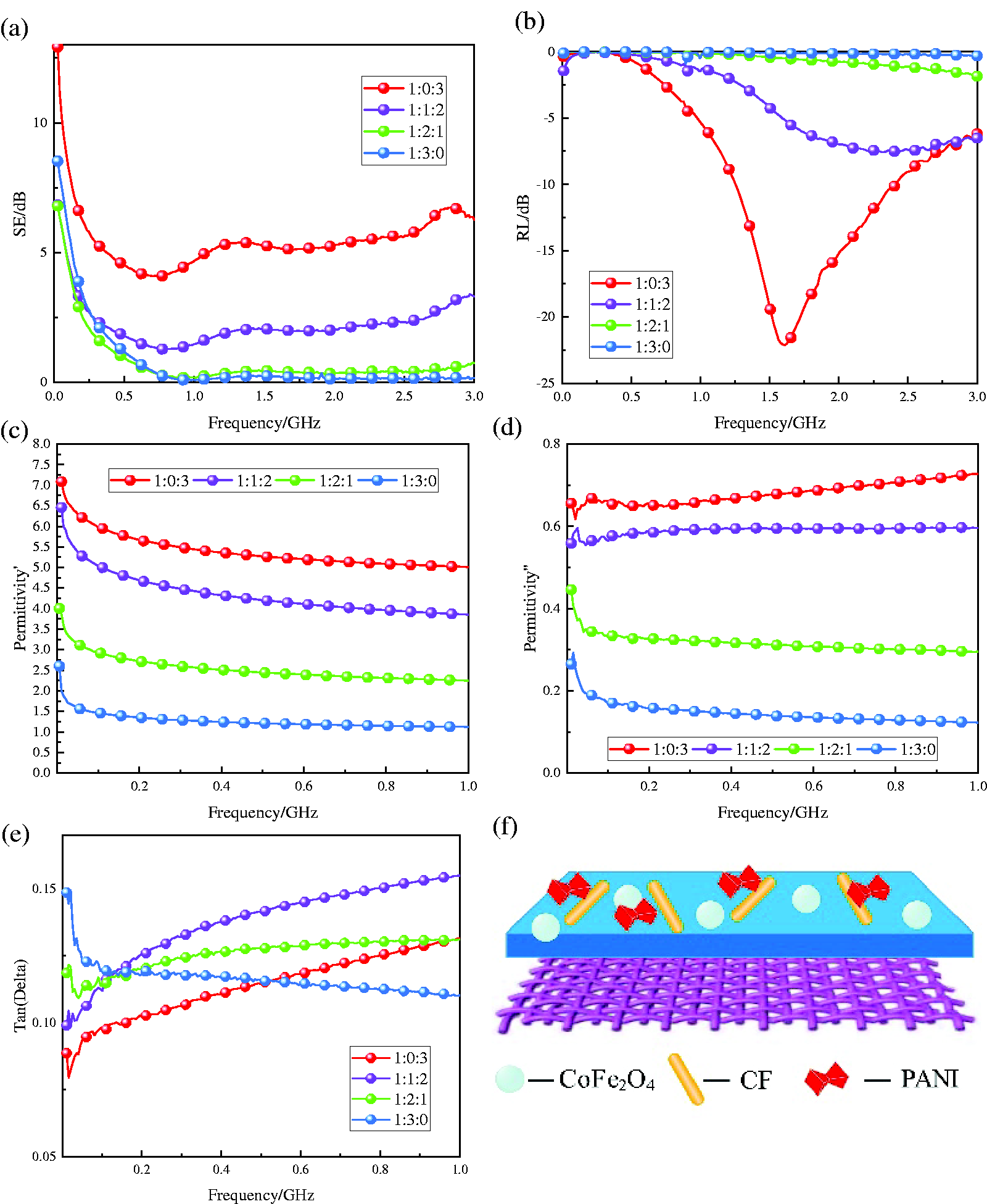
Effect of functional particle doping ratio on the electromagnetic parameters of single-layer coated polyester-cotton fabrics: (a) shielding effectiveness; (b) reflection loss; (c) dielectric constant real part; (d) dielectric constant imaginary part; (e) electric loss angle tangent; (f) model diagram of a single-layer coated fabric. (Total functional particle content of 40%.) SE: shielding effectiveness; RL: reflection loss; CF: carbon fiber powder; PANI: polyaniline.
As can be seen from Figure 2(b), in the frequency range from 0.01 to 3.0 GHz, when the functional particle doping ratio is 1:0:3, the reflection loss of the single-layer coated polyester-cotton fabrics gradually decreases and then increases with the increase of the applied electric field frequency, reaching a minimum value of –22.1 dB at 1.60 GHz, with an effective absorption bandwidth of 1.14 GHz. In the frequency range from 0.01 to 3.0 GHz, the reflection loss of the single-layer coated polyester-cotton fabrics gradually decreased and then increased with the increase of the applied electric field frequency, reaching a minimum value of –7.56 dB at 2.31 GHz when the functional particle doping ratio was 1:1:2. In the frequency range of 0.01–3.0 GHz, the reflection loss of the single-layer coated polyester-cotton fabrics slowly decreased with the increase of the applied electric field frequency, reaching a minimum value of –1.84 GHz at 3.0 GHz when the functional particle doping ratio was 1:2:1. When the doping ratio of the functional particles is 1:3:0, the reflection loss of single-layer coated polyester-cotton fabrics does not change significantly with the frequency of the applied electric field and is basically around 0 dB. Therefore, when the doping ratio of the functional particles is 1:0:3, the wave-absorbing properties of single-layer coated polyester-cotton fabrics are the best. CF has good electrical conductivity, and when randomly distributed in polyurethane, the interaction with the electric field can be seen as an electric dipole or resonator, the polarization produces a depletion current, and the depletion current is attenuated under the action of the surrounding substrate, thus converting electromagnetic waves into other forms of energy and achieving the absorption of electromagnetic waves. 29 PANI and CF form a conductive network in polyurethane, providing more transmission channels for the flow of carriers, generating stronger induced currents, and generating stronger magnetic fields in the opposite direction of the external electromagnetic field under the interaction of the external electromagnetic field, which cancel each other to weaken the electromagnetic wave conduction; the model diagram of the single-layer coated polyester-cotton fabric is shown in Figure 2(f). Cobalt ferrite achieves the consumption and absorption of electromagnetic waves through magnetic loss, but the absorption effect is better in high frequency, so when the doping ratio of cobalt ferrite becomes smaller and smaller and the doping ratio of CF becomes larger and larger, the wave-absorbing properties of single-layer coated polyester-cotton fabrics becomes better and better. The wave absorption mechanism is shown in Figure 3.
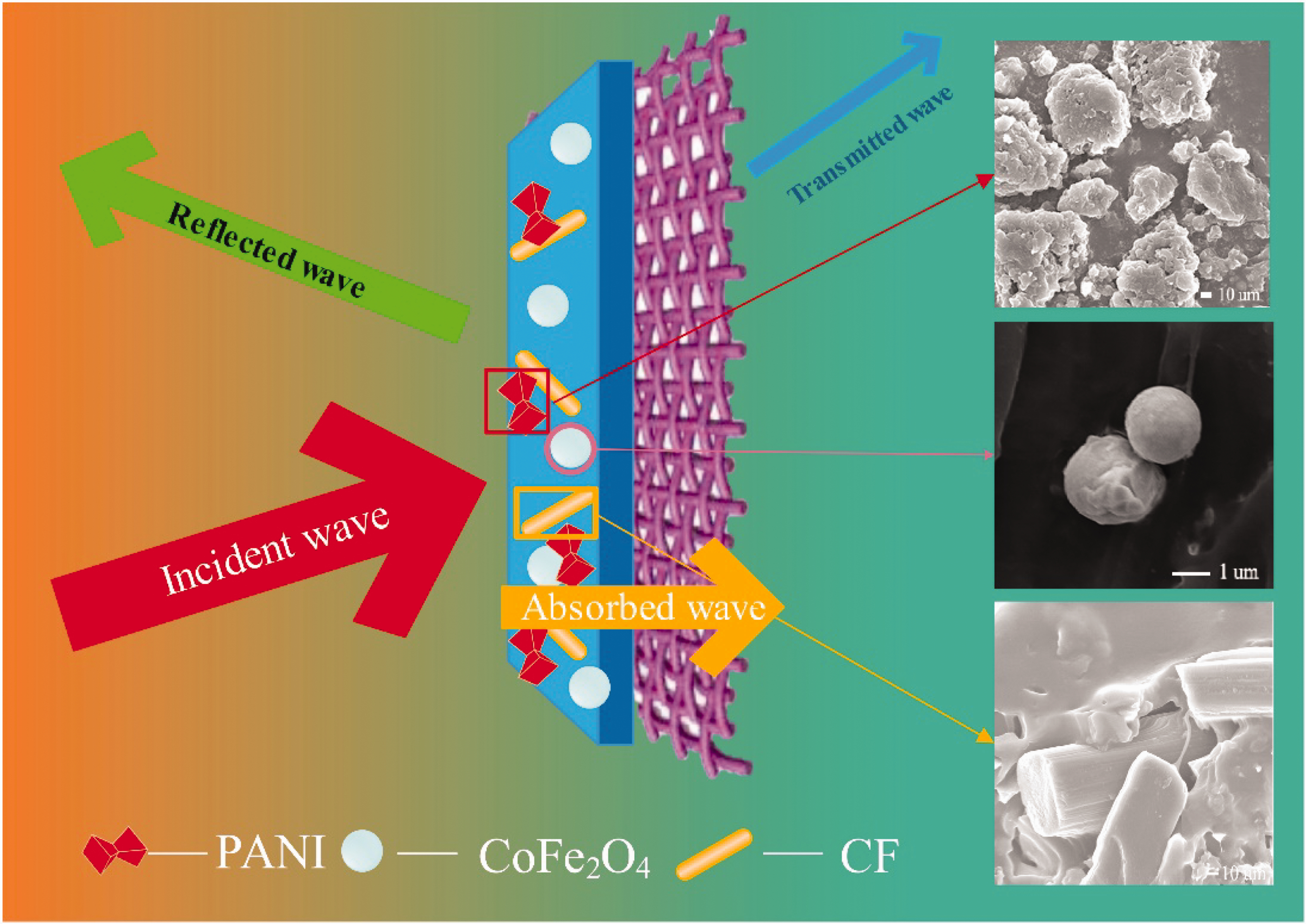
The wave absorption mechanism of single-layer coated fabrics. CF: carbon fiber powder; PANI: polyaniline.
From Figure 2(c), it can be seen that in the frequency range of 0.001–1.0 GHz, the real part of the dielectric constant of the four doping ratios changes with the increase of the applied electric field frequency with basically the same trend, and the real part of the dielectric constant slowly decreases with the increase of the applied electric field frequency, but the rate of decrease becomes slower and slower. That is, the polarization ability of the four single-layer coated polyester-cotton fabrics to electromagnetic waves becomes weaker and weaker with the increase of the applied electric field frequency. In the frequency range of 0.001–1.0 GHz, the doping ratios of the real part of the dielectric constant of the single-layer coated polyester-cotton fabrics are 1:0:3, 1:1:2, 1:2:1, and 1:3:0 in order from large to small, which means that when the doping ratio of the functional particles is 1:0:3, the real part of the dielectric constant of the single-layer coated polyester-cotton fabrics is the largest and has the best ability to polarize electromagnetic waves.
As can be seen from Figure 2(d), in the frequency range of 0.001–1.0 GHz, the imaginary part of the dielectric constant is almost stable around 0. When the functional particle doping ratios are 1:0:3, 1:1:2, 1:2:1, and 1:3:0, the dielectric constant imaginary part decreases in order, and the ability to lose electromagnetic waves decreases in order. The relationship between the imaginary part of the dielectric constant ε″ and the resistivity ρ of the material is
As can be seen from Figure 2(e), In the frequency range of 0.001–0.13 GHz, when the doping ratio is 1:3:0, the loss angle tangent is the largest and the attenuation ability for electromagnetic waves is the best. In the frequency range from 0.13 to 1.0 GHz, the loss angle tangent is maximum when the doping ratio is 1:1:2, and the attenuation ability for electromagnetic waves is the best.
Effect of functional particle content on the electromagnetic properties of single-layer coated polyester-cotton fabrics
As can be seen from Figure 4(a), the shielding effectiveness of the single-layer coated polyester-cotton fabrics with the content of four functional particles decreased with the increase of the applied electric field frequency in the frequency range of 0.01–0.6 GHz. In the frequency range of 0.6–3.0 GHz, the shielding effectiveness of the single-layer coated polyester-cotton fabrics with the content of four functional particles varied less with the increase of the applied electric field. The shielding effectiveness of the single-layer coated polyester-cotton fabrics fluctuated around 5 dB when the content of functional particles was 40%. When the content of functional particles is 30%, the shielding effectiveness of single-layer coated polyester-cotton fabrics fluctuates around 2 dB. When the content of functional particles was 20% and 10%, the shielding effectiveness of single-layer coated polyester-cotton fabrics was close to 0 dB. It can be seen that the shielding performance of single-layer coated polyester-cotton fabrics with the content of four functional particles is poor. The larger the content of functional particles, the better the shielding effect of single-layer coated polyester-cotton fabrics against electromagnetic waves. This may be because under the same coating thickness, the content of functional particles increases, resulting in better conductivity of the coating, and the flow of carriers in the conductive network generates a stronger magnetic field in the opposite direction of the applied electric field magnetic field, thus offsetting the external magnetic field and achieving a better shielding effect.
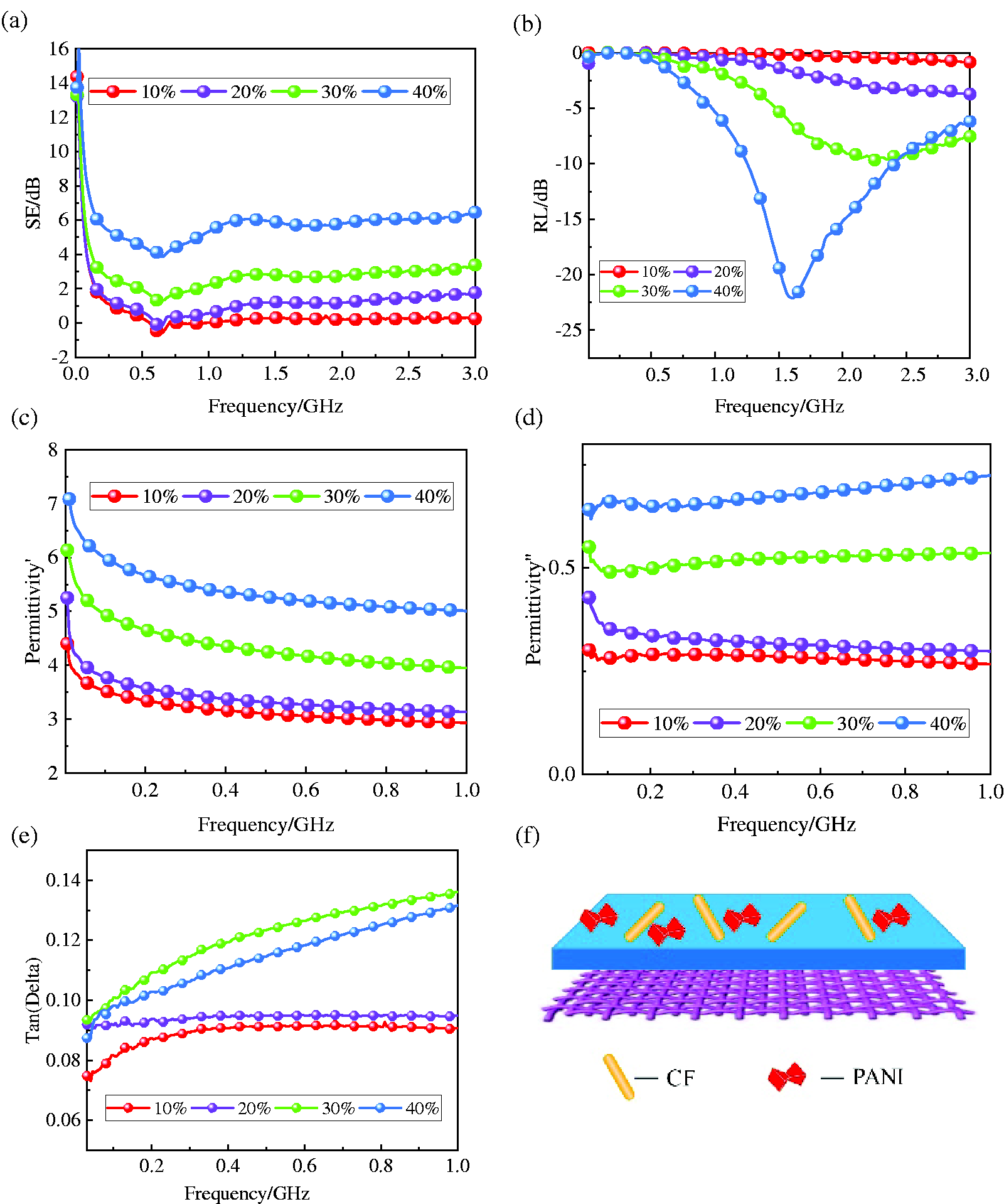
Effect of functional particle content on the electromagnetic parameters of single-layer coated polyester-cotton fabrics: (a) shielding effectiveness; (b) reflection loss; (c) real part of the dielectric constant; (d) imaginary part of the dielectric constant; (e) loss angle tangent; (f) model diagram of a single-layer coated fabric. (The functional particle doping ratio is 1:0:3.) SE: shielding effectiveness; RL: reflection loss; CF: carbon fiber powder; PANI: polyaniline.
As can be seen from Figure 4(b), in the frequency range of 0.01–3 GHz, when the content of functional particles is 40%, the reflection loss of single-layer coated polyester-cotton fabrics gradually decreases and then increases with the increase of the applied electric field frequency, reaching a minimum value of –22.1 dB at 1.6 GHz with an effective absorption bandwidth of 1.14 GHz. In the frequency range of 0.01–3 GHz, the reflection loss of single-layer coated polyester-cotton fabrics gradually decreased and then increased with the increase of the applied electric field frequency when the content of functional particles was 30%, reaching a minimum value of –9.65 dB at 2.25 GHz. In the frequency range of 0.01–3.0 GHz, the reflection loss of single-layer coated polyester-cotton fabrics slowly decreases with the increase of the applied electric field frequency, reaching a minimum value of –3.71 GHz at 3.0 GHz, when the content of functional particles is 20%. When the content of functional particles is 10%, the reflection loss of single-layer coated polyester-cotton fabrics does not change significantly with the increase of the applied electric field frequency and is basically around the level of 0 dB. Therefore, when the content of functional particles is 40%, the single-layer coated polyester-cotton fabrics have the best wave-absorbing properties. This may be because each PANI and carbon fiber particle in the coating can act as a conductive carrier to transfer current, and they can lap each other to form a conductive network and absorb electromagnetic waves by interacting with the electric field. The greater the content of functional particles, the larger the formed conductive network, the more electromagnetic waves will be converted into heat or other forms of energy, the more the absorption of electromagnetic waves, and the better the wave-absorbing properties of single-layer coated polyester-cotton fabrics. The model diagram of the single-layer coated polyester-cotton fabric is shown in Figure 4(f).
As can be seen from Figure 4(c), the real part of the dielectric constant of the single-layer-coated polyester-cotton fabrics with the content of four functional particles first decreases and then flattens out with the increase of the applied electric field frequency in the frequency range of 0.001–1.0 GHz. This is due to the dielectric relaxation phenomenon. When the direction of the applied electric field changes, the structural molecules of the coated fabrics will make an alternating orientation motion with the change of the electric field. When the frequency of the applied electric field is large, the steering motion of the dipole will not be able to keep up with the change of the electric field. The content of functional particles has a large effect on the real part of the dielectric constant of single-layer coated polyester-cotton fabrics. The content of functional particles of 40% had the best polarization ability for electromagnetic waves, followed by 30%, 20%, and 10%, respectively. That is, as the content of functional particles increases, the real part of the dielectric constant of the single-layer coated polyester-cotton fabrics becomes larger and larger, and the polarization ability of electromagnetic waves becomes better and better. This may be because when the content of functional particles is 40%, the functional particles inside the single-layer coated polyester-cotton fabrics lap each other to form a conductive network, which can increase the ability of the coated fabrics to store charge, and under the action of the applied electric field, it can be regarded as the polarization of the electric dipole or resonance, which increases the polarization ability of the coated fabrics to electromagnetic waves. When the content of functional particles in the coating is not enough, they are too far away from each other and cannot lap each other into a conductive network, and the polarization ability of electromagnetic waves is relatively weak. 31
As can be seen from Figure 4(d), the imaginary part of the dielectric constant of single-layer-coated polyester-cotton fabrics with the content of four functional particles remains virtually unchanged with the increase of the applied electric field frequency in the frequency range of 0.001–1.0 GHz. The content of functional particles of 40% has the best loss ability to electromagnetic waves, followed by 30%, 20%, and 10% respectively, that is, as the content of functional particles increases, the imaginary part of the dielectric constant of single-layer coated polyester-cotton fabrics becomes larger and larger, and the lost ability to electromagnetic waves becomes better and better.
As can be seen in Figure 4(e), in the frequency range of 0.001–1.0 GHz, with the increase of the applied electric field frequency, the loss angle tangent of single-layer coated polyester-cotton fabrics with the content of four functional particles increases. The loss angle tangent of single-layer coated polyester-cotton fabrics was the largest when the content of functional particles was 30%, followed by 40%, 20%, and 10%, respectively.
Conclusion
In the frequency range of 0.01–3.0 GHz, the doping ratio of PANI, cobalt ferrite, and CF and the percentage of functional particles have a greater effect on the reflection loss and shielding effectiveness. In the frequency range from 0.01 to 1.0 GHz, the effect on the dielectric constant is larger. As the doping ratio decreases and the dosage increases, the reflection loss decreases; the shielding effectiveness increases; and the dielectric constant increases in the real and imaginary parts. When the doping ratio of PANI, cobalt ferrite, and CF is 1:0:3 and the content of functional particles is 40%, the minimum reflection loss of single-layer coated polyester-cotton fabrics is –22.1 dB at 1.6 GHz, and the effective absorption bandwidth is 1.14 GHz.
Footnotes
Declaration of conflicting interests
The author(s) declared no potential conflicts of interest with respect to the research, authorship, and/or publication of this article.
Funding
The author(s) disclosed receipt of the following financial support for the research, authorship, and/or publication of this article: This work was supported by the Postdoctoral Science Foundation (2019TQ0181 and 2019M661030), the Key Laboratory of Science & Technology of the Eco-Textile, Ministry of Education, Donghua University (2232021G-04), the Key Project of the Natural Science Foundation of Tianjin (18JCZDJC99900), the Consulting Research Project of the Chinese Academy of Engineering (2021DFZD1), and the Tianjin Science and Technology Plan Project Innovation Platform Special (17PTSYJC00150).
