



Abstract
The balanced interlacement of woven structures directly affects the surface effect and production efficiency of woven fabric. If it fails to meet the requirement of balanced interlacement, the manufacturing of woven fabric could be unable to proceed. Under layered-combination design mode, the structure of full-color compound digital jacquard fabric designed in this study is a type of compound structure expressing the effect of single-layer structure. The warp and weft interlacement frequency of compound structure is the key to the balanced interlacement. The fabric expresses balanced interlacement if interlacement frequency in the warp/weft remains relatively constant, if not, then it is unbalanced. Apart from the analysis of the covering effect of adjacent threads, an interlacement frequency statistical program was compiled, the statistical data of warp/weft interlacement frequency were acquired, and then they were visualized in form of tables, figures, or scatter plots for balanced interlacement status comparison and optimal selection of balanced interlacement for full-color compound weaves. The results proved that the visualization of interlacement frequency was not only able to quantify the warp/weft balanced interlacement for basic/joint weaves, full-color compound weaves and compound structures, but also offered potential assistance to predict balanced interlacement status and prevent unbalanced interlacement before weaving. This study outlines how the visualization of balanced interlacement can be applied to the soft proofing of digital jacquard fabrics.
Keywords
During the mass production of woven fabric, warps pass through the heddle eye, setting on the let-off and the take-up mechanism with identical and appropriate tension. 1 As the device to enable each warp obtaining independent warp let-off movement has not been developed yet, cooperating with the weft beating-up movement, the crimp of each warp cannot be adjusted individually during weaving. In the meantime, near the let-off mechanism, the drop wires placed over the warps and the back rest placed under the warps are regarded as the main components for detecting and adjusting warp tension.
What is more, the improper use of woven structures could lead to a nonadjustable difference for the crimp of warps during weaving; therefore, if the back rest of a loom is not capable of regulating the unbalanced tension of warps, warp break or the fall of drop wires could cause an interruption of the weaving procedure. 2
Balanced interlacement represents the crimp of warp and/or weft maintained to be identical when the interweaving of warp and weft is achieved. 3 Zeng, 4 Gao and Li, 5 as well as Liu 6 proposed several solutions to ensure balanced interlacement by optimizing and regulating the structures and parameters of the loom. Seyam et al. 7 mounted MEMS accelerometers on harness wires to avoid the usage of drop wires in passive warp break detection, nevertheless weaving specifications were limited, and it was impossible to predict the location of warp break before weaving. Unlike the former scholars, Zhou and Ng 8 and Chen and Sui 9 proposed analogous ideas of guaranteeing the crimp of yarn to be similar within the warp and/or weft by woven structure optimization; therefore to meet the requirement of balanced interlacement from the perspective of woven structure, which is the nature of the woven fabric.
Interlacement frequency represents the frequency of ‘an interlacement’ occurring in a complete weave repeat, where ‘an interlacement’ represents the change of the interlacing points; that is, from warp weave points to weft weave points and then from weft weave points to warp weave points, or vice versa. 10 According to Li et al., 11 balanced weave-databases were created through the operating of an original self-adaptive equalization algorithm based on warp interlacement frequency. Jacquard CAD software would automatically choose suitable weaves to guarantee balanced interlacement with necessary adjustments, notwithstanding this solution helped avoid warp break before weaving, the fatal flaw was the omission of weaves due to the imperfect color separation operated by the watershed algorithm proposed.
Based on the phenomenon that single-plane design mode has been extensively applied in manufacturing jacquard fabrics so far, 12 a novel layered-combination design mode, which was a method for designing jacquard fabrics that express mixed colors up to mega level by combining several single-layer woven structures, was then proposed for the development of a new variety of digital jacquard fabric. 13 Taking full-color compound weaves and compound structures for example, 14 theoretically, any adjacent warps or wefts for mixed color expression should be juxtaposed and non-backed. However, the backed effect of adjacent wefts emerges in several full-color compound weaves under the weaving specification in this paper, and the devised compound structures caused unbalanced interlacement by jacquard specimen manufacturing.
Moreover, previous studies15–20 focused more on verifying the effectiveness of developing novel full-color digital jacquard fabrics, however, lacking exploration of balanced interlacement of their woven structures. Meanwhile, the interlacing information of yarns is saved in virtual binary form and presented in the CAD software interface, 21 balanced interlacement requires to be maintained during the design and application of the weave-databases, rather than to be modified at any moment during pointed paper drawing as traditional jacquard fabric design, otherwise the weaving process could be interrupted. 22
In this study, six weave-databases were designed, then the weft interlacement frequency statistical data of 42 basic weaves and 84 joint weaves, as well as warp interlacement frequency statistical data of 1176 full-color compound weaves, were acquired by the interlacement frequency statistical program compiled and were visualized. Moreover, 12 optimal full-color compound weaves which satisfied both warp and weft balanced interlacement were selected to verify the effectiveness of quantifying balanced interlacement with interlacement frequency by the simulative effect analysis of gray gradient digital pattern grid specimens.
With the assistance of interlacement frequency statistical data of warps and wefts, it was not only able to quantify the warp/weft balanced interlacement for basic/joint weaves, full-color compound weaves and full-color compound structures, but also offered potential assistance to predict balanced interlacement status and prevent unbalanced interlacement before weaving, avoiding the possibility of manufacturing failure.
Visualization of balanced interlacement
Covering characteristic
The previous study indicates that the covering effect of adjacent threads within the structure influences balanced interlacement. In elementary weaves, the step number (S), which represents the relationship of weave points, dominates the slippage and cover effect of adjacent threads. To be specific, adjacent threads in plain weave and twill weave are fixed on the surface of the fabric, where no-covering effect expresses because the step number is ±1, whereas in satin weave, adjacent threads are overlapping due to the step number not being equal to 1 or –1. 10
Interlacement frequency
The interlacing of straight warps and wefts naturally results in crimp of the threads, as a result, balanced interlacement of woven structures is closely related to the interlacement frequency of warps and wefts. The interlacement frequency of warps and wefts in the weave diagram can be calculated by the occurrence frequency of continuous warp/weft weave points emerging warp-wise/weft-wise within a weave repeat.
Regarding warp, the speed of let-off and take-up keeps constant during weaving; however, if the interlacement frequency in warp possesses large standard deviation, representing a large difference of crimp of yarn within the warp, in this case, the tension of warp with relatively higher interlacement frequency (e.g. the maximum value of warp interlacement frequency) will increase, while that with relatively lower (e.g. the minimum value of warp interlacement frequency) will decline, leading to uneven crimp of yarn within the warp, both status could cause potential warp break that interferes with the high-speed operation of looms. As for weft, the interlacement frequency of wefts merely disturbs the balanced interlacement of weft but helps to evaluate the consumption of weft.
Principle of balanced interlacement
Under the circumstance of maintaining consistent covering characteristics of woven structures in woven fabric, on the one hand, if woven structures applied only to meet the requirement of similar or equal interlacement frequency in warp or weft, indicating balanced interlacement warp-wise or weft-wise, then any structural design can be put into manufacture warp-wise directly or after rotating 90 degrees.
On the other hand, for woven structures employed to satisfy the requirement of similar or equal interlacement frequency both in warp and weft, they feature balanced interlacement both in warp and weft, making it possible to produce woven fabric both warp-wise and weft-wise.
To solve the problem of designing and applying the optimal weave-database with balanced interlacement characteristics under layered-combination design mode, the balanced interlacement principle of full-color compound weave is proposed, which contains two aspects: (a) To apply full-color compound weaves with non-backed compound effect expressing between the adjacent threads from warps and/or wefts; (b) To select full-color compound weaves presenting similar or the same warp/weft interlacement frequency for analogous or identical crimp of yarn, where identical interlacement frequency warp-wise is preferred.
Visualization proposition of balanced interlacement
During the past decades, the balanced interlacement modification for traditional jacquard fabrics has often been inaccurate, tedious, and time-consuming by single-plane design mode, in which one specific woven structure is employed to realize one color in a two-dimensional pattern correspondingly, also known as one-to-one corresponding principle.12,22 On one hand, the modification has been empirically estimated by the tightness of the weave applied, on the other it has been regulated by replacing the weave manually during pattern gird design based on experience.
As for digital jacquard fabric manufacturing, it is impossible to modify a single weave midway if the balanced interlacement is not satisfied, but to re-adjust the weave-database during the programmed structural design process, it is completely different from the weave design and modification of the jacquard fabric under single-plane design mode.
Thus with the employment of an interlacement frequency statistical program compiled, the warps and wefts interlacement statistical data of monochrome pixel bitmaps imported were derived. In addition, to intuitively obtain the correspondence of warp/weft interlacement frequency and location of woven structures, visualization approaches, a term to describe everything from figures to infographics, 23 such as scatter plots, tables, and figures were utilized to estimate and predict how the variation of interlacement frequency influences the balanced interlacement characteristics of woven structures.
Statistics of interlacement frequency
In any weave or woven structure, defining black warp weave point as 1, and white weft weave point as 0, in this case, these woven structures transform into binary information that can be recognized and counted by an interlacement frequency statistical program.
First, transform woven structures into a monochrome pixel bitmap, where individual or vertical continuous black point(s) represents warp weave point(s) or float(s), while individual or horizontal continuous white points(s) represents weft weave point(s) or float(s). In any vertical and horizontal seamless monochrome pixel bitmaps, the interlacement frequency of each warp/weft will be obtained by the occurrence frequency of consecutive black/white pixel point(s) in each column/row of the monochrome pixel bitmap.
Next, recording the change of black/white pixel point(s) by the interlacement frequency statistical program. The following nine pairs of statistical data are output automatically, and their implications and equations are listed as follows:
Twarp/Tweft: The total numbers of warps/wefts.
IFwarpi/IFweftj: The interlacement frequency of warp i/weft j, where i represents the serial number of warp, while j represents the serial number of weft.
TIFwarp/TIFweft: The total interlacement frequency in warp/weft.
Awarp/Aweft: The average interlacement frequency in warp/weft, they are defined by equations (1) and (2), indicating the central tendency of each warp/weft interlacement frequency:




Minwarp/No.i/Minweft/No.j and Maxwarp/No.i/Maxweft/No.j: The minimum/maximum value of warp/weft interlacement frequency and corresponding warp/weft serial number, contributing to the possibility and warp/weft location of potential warp breaks prediction.
RAwarp/RAweft: The range between minimum and maximum value of warp/weft interlacement frequency, and it is calculated by applying equations (5) and (6):


FRwarp/FRweft: The fluctuation range of interlacement frequency in warp/weft, defined by equations (7) and (8). Noting that operator ‘–’ represents ‘from…to…’:


Finally, these interlacement frequency statistics are visualized for the balanced interlacement status analysis.
Application of balanced interlacement visualization
Single-warp double-weft full-color compound weaves were designed by combining basic and joint weave under the weft-wise arrangement ratio of 1:1.
In this study, each weave-databases including 14 grades of basic weaves and 14 grades of joint weaves were designed, then 196 full-color compound weaves were formed, respectively, 1176 altogether for a total of six weave-databases. The influence of warp/weft interlacement frequency calculated by the compiled program on balanced interlacement was discussed, then 12 grades of optimal full-color compound weaves that possess balanced interlacement characteristic were selected.
The procedure before the application of weave-databases are as follows: first, to design basic and joint weave-databases, next, to analyze the balanced interlacement characteristic of basic/joint weaves and full-color compound weaves by visualizing their interlacement frequency statistical data into infographics.
Balanced interlacement design process for full-color compound weaves
The flowchart for single-warp double-weft full-color digital jacquard fabric design consists of three parts as shown in Figure 1. (a) weave-databases design process placed upper left, (b) design flowchart for single-warp double-weft full-color compound jacquard fabric settled below, (c) the requirement of optimal full-color compound weaves selection based on the balanced interlacement principle placed upper right.

Balanced interlacement design flowchart for single-warp double-weft full-color compound jacquard fabric.
To be precise, the weave-databases design process involves the following. To define the weave repeat, step number as well as starting point of primary weaves, then the full-color technical points’ position and numbers are designed accordingly; next, weave-databases are designed and ready to use based on primary weaves and full-color technical points through the definition of transition direction, mode, and speed.
Design flowchart for single-warp double-weft full-color compound jacquard fabric contains as described. Two monochrome images are separated from the digital image designed, by then, to allocate basic and joint weaves into two monochrome images to form two single-layer structures, respectively; next, to develop full-color compound structures by combining two single-layer structures under the weft-wise arrangement ratio of 1:1; finally, to produce full-color digital jacquard fabrics according to the weaving specifications.
The requirement of optimal full-color compound weaves selection based on the balanced interlacement principle includes, as explained: to select optimal full-color compound weaves which possess identical covering effect and lower warp interlacement frequency standard deviation, then separating these optimal full-color compound weaves to basic and joint weaves designed, respectively; finally, applying them into two monochrome images separately for the development of two single-layer structures.
Basic and joint weave-databases design
First, to design full-color compound weaves with single warps and double wefts, 16-thread three-step weft-faced satin weave with the starting point of (1,1) in the lower left was set as primary basic weave, and the primary joint weave maintained the same weave repeat and step number as primary basic weave, but shifting its starting point to (10,1) from the lower left as shown in Figure 2(a) and (c).
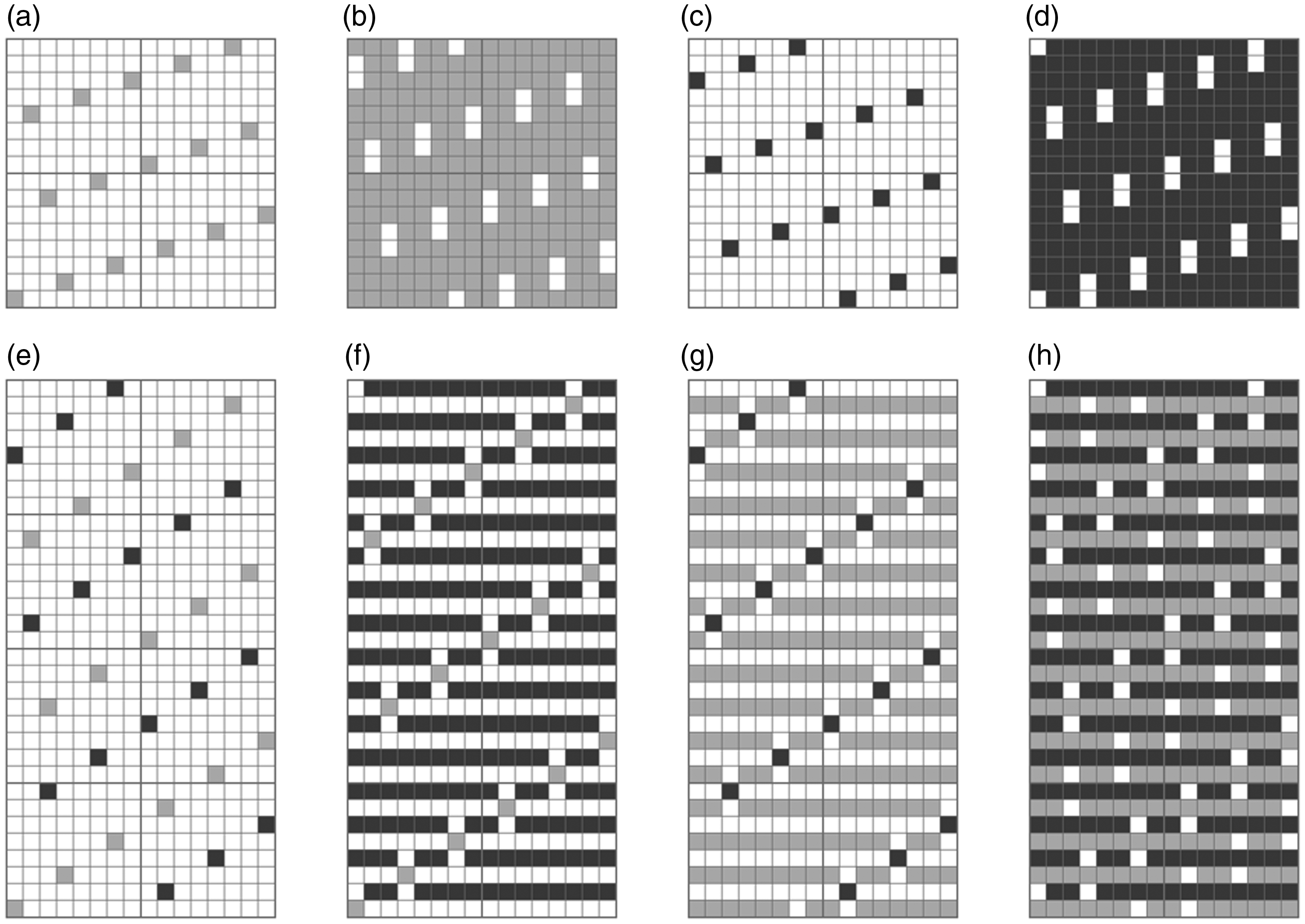
Primary weaves, full-color technical weaves and compound weaves: (a) primary basic weave; (b) full-color technical weave for basic weaves; (c) primary joint weave; (d) full-color technical weave for joint weaves; (e) compound weave of primary basic weave and primary joint weave; (f) compound weave of primary basic weave and full-color technical weave for joint weaves; (g) compound weave of full-color technical weave for basic weaves and primary joint weave and (h) compound weave of full-color technical weave for basic weaves and for joint weaves.
To devise full-color technical points according to the design principle and method of full-color compound weave, 24 see Figure 2(b) and (d), then the verification of full-color compound weaves was accomplished by combining alternatively as shown in Figure 2(e) to (h).
Moreover, under the circumstance of combining basic and joint weaves at 1:1 weft-wise arrangement ratio referring to weft-backed structures, horizontal transition was selected for transiting weft-face based primary weaves, that was to reinforce warp weave points weft-wise.
Next, to investigate how the identical and reverse transition direction of basic and joint weave-databases impacts the interlacement frequency of warp/weft, pairwise transition modes were designed, representing how reinforced warp weave points transit horizontally, for six weave-databases. Meanwhile, all primary weaves avoid full-color technical points during warp points reinforcement.
Three transition modes, representing how shaded interlacing points transit horizontally, were designed for basic weave: (a) reinforcing warp weave points from left to right only, termed ‘R’; (b) reinforcing warp points alternatively from right then left, named ‘R1L1’; (c) reinforcing warp points from left to right, then return to the starting point when encountering a full-color technical point (TP), and then reinforcing warp weave points from right to left, called ‘R-TP-L’. Besides, six transition modes were designed for joint weave, containing ‘R’ and ‘L’, ‘R1L1’ and ‘L1R1’, ‘R-TP-L’ and ‘L-TP-R’ (see Table 1).
Transition modes for weave-databases design

Finally, to arrange the transition speed, which indicates the number of warp weave points reinforced. The number of basic or joint weaves in either basic weave-databases or joint weave-databases are related to primary weave repeat (R) and transition speed (TS), 1 ≤ TS ≤ R. When TS = 1, the number of basic/joint weaves reaches the maximum, that is (R – 3) × (R – 1) + (R – 2); when TS = R, the number of basic/joint weaves is the minimum, that is R – 2.
The transition speed was set as 16, which was equivalent to the primary weave repeat, so the quantity of weaves in either basic or joint weave-databases was R – 2 = 16 – 2 = 14 (see Figure 3), forming 142 = 196 full-color compound weaves, and totally 1176 full-color compound weaves in six weave-databases (see Figure 4).
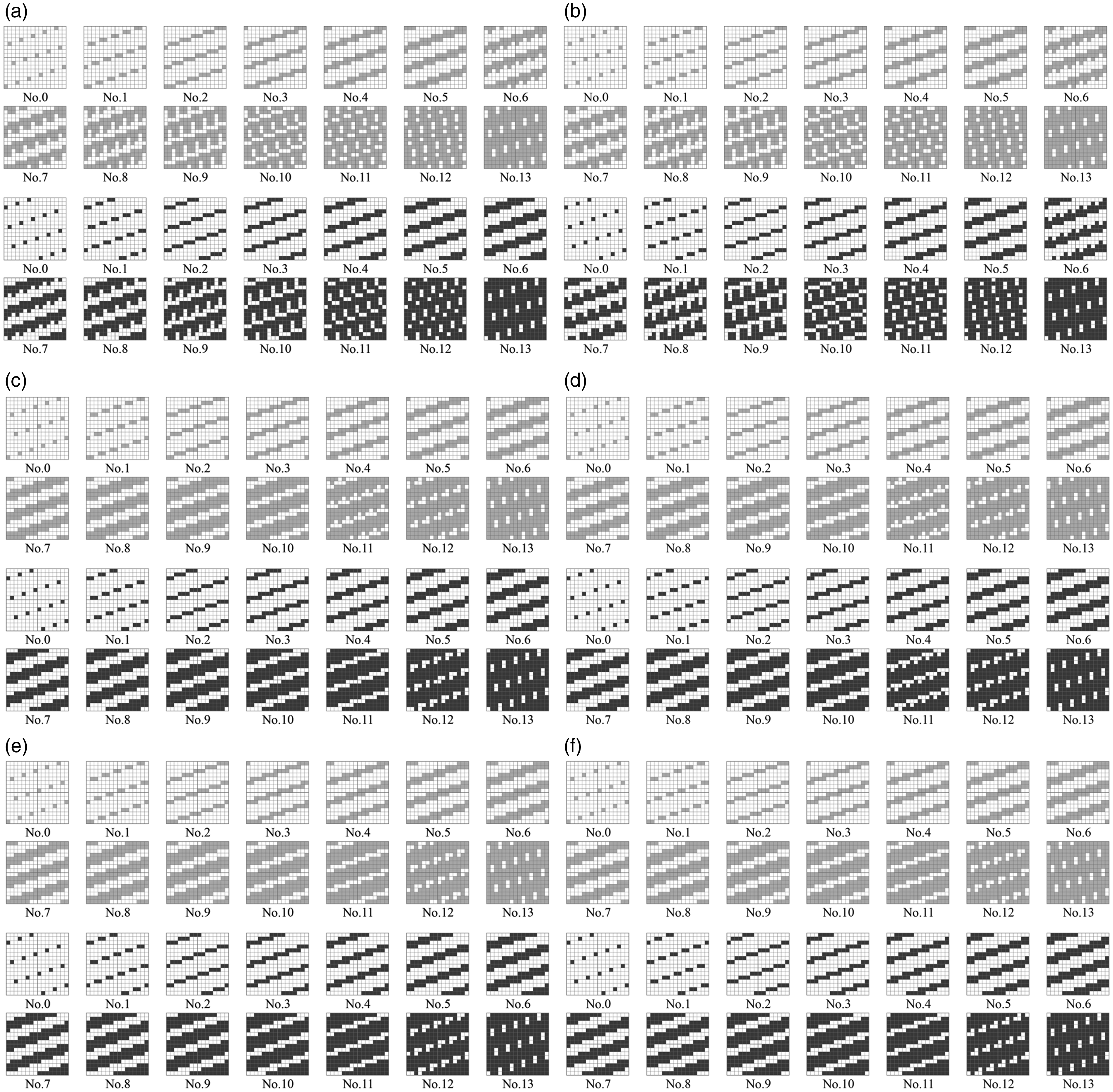
Six weave-databases based on 16-thread three-step weft-faced satin weave. (a) Full-color weave-database I; (b) full-color weave-database II; (c) full-color weave-database III; (d) full-color weave-database IV; (e) full-color weave-database V and (f) full-color weave-database VI.
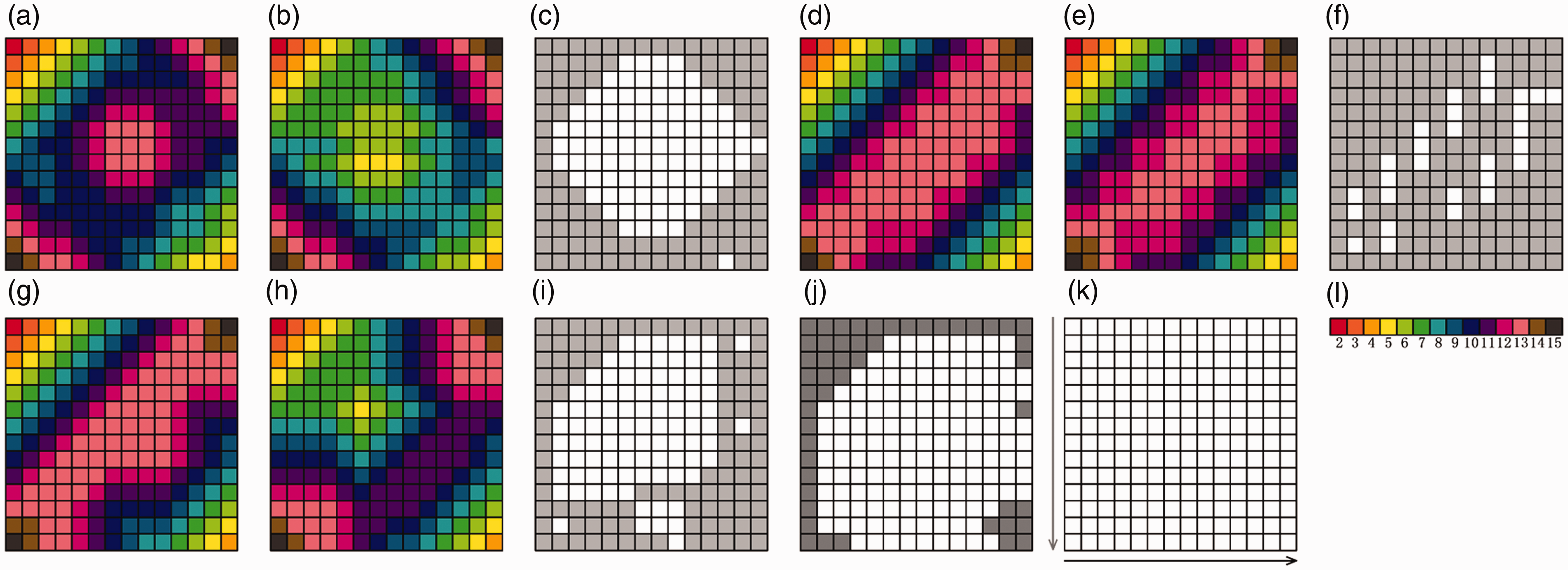
Warp interlacement frequency diagrams for full-color compound weaves from six weave-databases: (a) IFwarp diagram for weave-database I; (b) IFwarp diagram for weave-database II; (c) common components of diagrams (a) and (b); (d) IFwarp diagram for weave-database III; (e) IFwarp diagram for weave-database IV; (f) common components of diagrams (d) and (e); (g) IFwarp diagram for weave-database V; (h) IFwarp diagram for weave-database VI; (i) common components of diagrams (g) and (h); (j) common components of all six weave-databases; (k) grids representing full-color compound weave positions and (l) correspondence between color and interlacement frequency for diagrams (a), (b), (d), (e), (g), and (h).
Visualization and analysis for balanced interlacement
Importing basic/joint weaves and full-color compound weaves from six weave-databases into the interlacement frequency statistical program, based on distinct requirements for balanced interlacement in warp/weft, interlacement frequency data obtained are visualized as figures or tables for the analysis of balanced interlacement of these full-color compound weaves and compound structures.
Weft balanced interlacement characteristic
As two single-layer structures combined weft-wisely in a 1:1 pairing order, it is of significance to investigate the weft balanced interlacement characteristic rather than that of warp for basic and joint weaves by weft interlacement frequency data.
In any weave-databases, the order of basic/joint weaves was set from no. 0 to no. 13, representing the transition from basic/joint weave to full-color technical weave for basic/joint weave (see Figure 3), and interlacement frequency of any wefts in all basic/joint weaves are shown in Table 2.
Weft interlacement frequency of basic and joint weaves in six weave-databases

The transition mode of basic/joint weave influenced the continuation of the warp weave points reinforcing weft-wisely. On the one hand, the weft interlacement frequency remained unchanged when the reinforcement of warp weave points remained uninterrupted, indicating the satisfaction of weft balanced interlacement of basic/joint weaves.
On the other hand, in weave-databases I and II, the Maxweft was 3, and the mode value of interlacement frequency was 1, they occupied 42.86% and 50.00% in the basic and joint weave-database, respectively, the weft interlacement frequency among basic/joint weaves varied a lot. However, in weave-databases III, IV, V, and VI, the Maxweft was 2 among all, the mode value of interlacement frequency was also 1, the weft interlacement frequency among basic/joint weaves was more concentrated.
In addition, the quantity of basic/joint weaves that possessed the same interlacement frequency in all wefts was defined as N, N = R – Nfctp – (S – 1), where Nfctp represents the number of full-color technical points and S represents the step number of full-color primary weaves, under the circumstances of single warp and double wefts, when the transition speed of warp weave points TS = R = 16 and the step number was 3, the full-color technical points on one weft within a weave repeat was 2, so N was 16 – 2 – (3 – 1) = 12.
Thus 12 out of 14 basic/joint weaves own the same weft interlacement frequency in any weft from weave-databases V and VI, providing the possibility of rotating these 12 basic/joint weaves by 90 degrees before applying to weave.
Warp balanced interlacement characteristic
It is full-color compound weaves, rather than basic/joint weaves, that are regarded as the basic structural unit for full-color digital jacquard fabric, so it is noteworthy to discuss warp balanced interlacement according to warp interlacement frequency of all full-color compound weaves.
The interlacement frequency of each warp in any basic/joint weave was equivalent. The sequences of basic weave and joint weave were placed from left to right and from top to bottom, respectively, meanwhile each weave-database contains 14 basic/joint weaves, then 142 = 196 full-color compound weaves are formed and represented by 196 grids in Figure 4(k). The warp interlacement frequency in full-color compound weaves were represented by 14 colors (see Figure 4(l)).
The minimum warp interlacement frequency of an integral full-color compound weave is estimated by the sum of the minimum warp interlacement frequency of basic and joint weaves, in this case, Minwarp = Minbasicwarp + Minjointwarp = 1 + 1 = 2, this full-color compound weave combined both primary basic and joint weaves (see Figure 2(e)). The maximum warp interlacement frequency of an integral full-color compound weave was correlated to the weave repeat of weft, in this paper basic and joint weave repeat was equal. Maxwarp = Minwarp + (Rweft – 2) × 1 = 1 + 14 × 1 = 15, this full-color compound weave combined either primary basic/joint weave and full-color joint/basic technical weave, as shown in Figure 2(f) and (g).
The following results were obtained from warp interlacement characteristic of full-color compound weaves:
When warp weave points increased continuously and weft-wisely in the reinforcement of basic weaves, meanwhile warp weave points decreased consecutively and weft-wisely in the reinforcement of joint weaves, the warp interlacement frequency of full-color compound weaves varied smoothly in the upper left of Figure 4(j). Among six weave-databases, full-color compound weaves from the upper left part of Figure 4(j) possessed equivalent warp interlacement frequency of each warp diagonally when the sum of basic/joint weave sequence number was less than or equal to 5, then 1 to 6 grades of full-color compound weaves were obtained, where their warp interlacement frequency of any warp remained invariant from 2 to 7, respectively. See Figure 4(j), it is the number and position of full-color technical points that directly control warp interlacement frequency of full-color compound weaves. When basic/joint weave no. 0 and the remaining 13 joint/basic weaves were combined according to 1:1 pair order, the warp interlacement frequency of any warp in full-color compound weaves ranged from 2 to 15. Moreover, if full-color technical points are utilized to form full-color compound weaves, the warp/weft interlacement frequency of full-color compound weaves is irrelevant to the transition modes arranged. The consistency of transition direction for both basic and joint weave plays a vital role in the presentation of interlacement frequency warp-wise in full-color compound weaves. According to Figure 4(c), (f) and (i), an identical transition direction for basic/joint weave leading to higher interlacement frequency than that of inverse transition direction when basic/joint weaves with the sequence number in the middle is applied. Under the circumstance of inverse transition direction, warp weave points on adjacent wefts in full-color compound weaves would be continuous warp-wisely quicker, inducing a decrease of warp interlacement frequency. The maximum transition grades for full-color compound weaves are directly determined by the continuity of weft floats during warp weave points reinforcement. Among six warp interlacement frequency diagrams for weave-databases in Figure 4(a), (b), (d), (e), (g) and (h), full-color compound weaves that maintain identical warp interlacement frequency distributed diagonally at 45 degrees from lower left to upper right, the maximum transiting grades for six weave-databases were 8, 6, 11, 10, 12, and 6, respectively, and the warp interlacement frequency for maximum transiting grades was 9, 7, 12, 11, 13, and 7, separately. Weave database V offers the maximum gradient level while maintaining identical warp interlacement frequency for each warp among six weave-databases. Twelve full-color compound weaves met the requirements of balanced interlacement principle from weave-database V, and they were selected as optimal full-color compound weaves for balanced interlacement.
Optimal selection of balanced interlacement for full-color compound weaves
Twelve grades of full-color compound weaves were selected from weave-database V, presenting three characteristics: (a) the interlacement frequency of any warp remained static at 13, while that of weft remained unchanged at 1; (b) the full-color compound weaves possessed 12 levels of gradient; (c) juxtaposed non-backed effect for any adjacent wefts (see Figure 7(d)).
Weaving specifications
According to the full-color compound weaves and compound structures designed and applied in this study (see Figure 3 and Figure 7), the variation of warp interlacement frequency is richer than that of weft (see Figure 4 and Table 2). To fully investigate how warp interlacement frequency impact the warp balanced interlacement characteristic, it is necessary to arrange these full-color compound weaves horizontally and adjacently in the specimens.
In this case, a linear horizontal gray gradient digital image was designed as shown in Figure 5, then 14 and 12 grayscales were indexed to form two grayscale digital pattern grids, in which all conventional full-color compound weaves and optimal full-color compound weaves could be used, noting that the black frame was not included in the pattern grid in Figure 5.
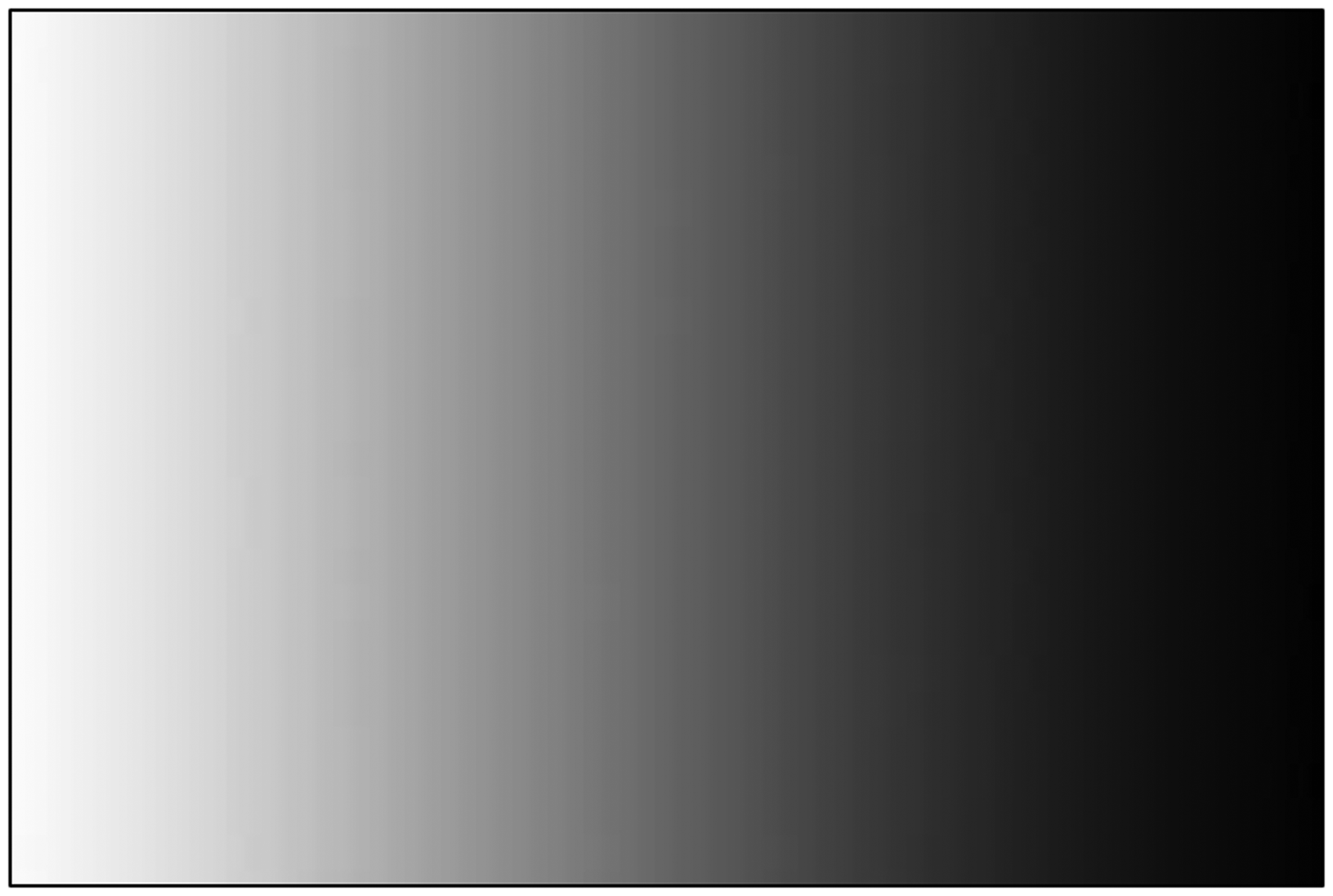
Linear horizontal gray gradient digital image.
Three conventional weave-databases with 14 grades of full-color compound weaves in each were selected from weave-database V, these full-color compound weaves located on the diagonal lines and bottom line in Figure 6(a), see Figure 6(b), (c) and (d) for accurate information, and the conventional full-color compound weaves shown in Figure 7(a), (b) and (c) correspondingly.
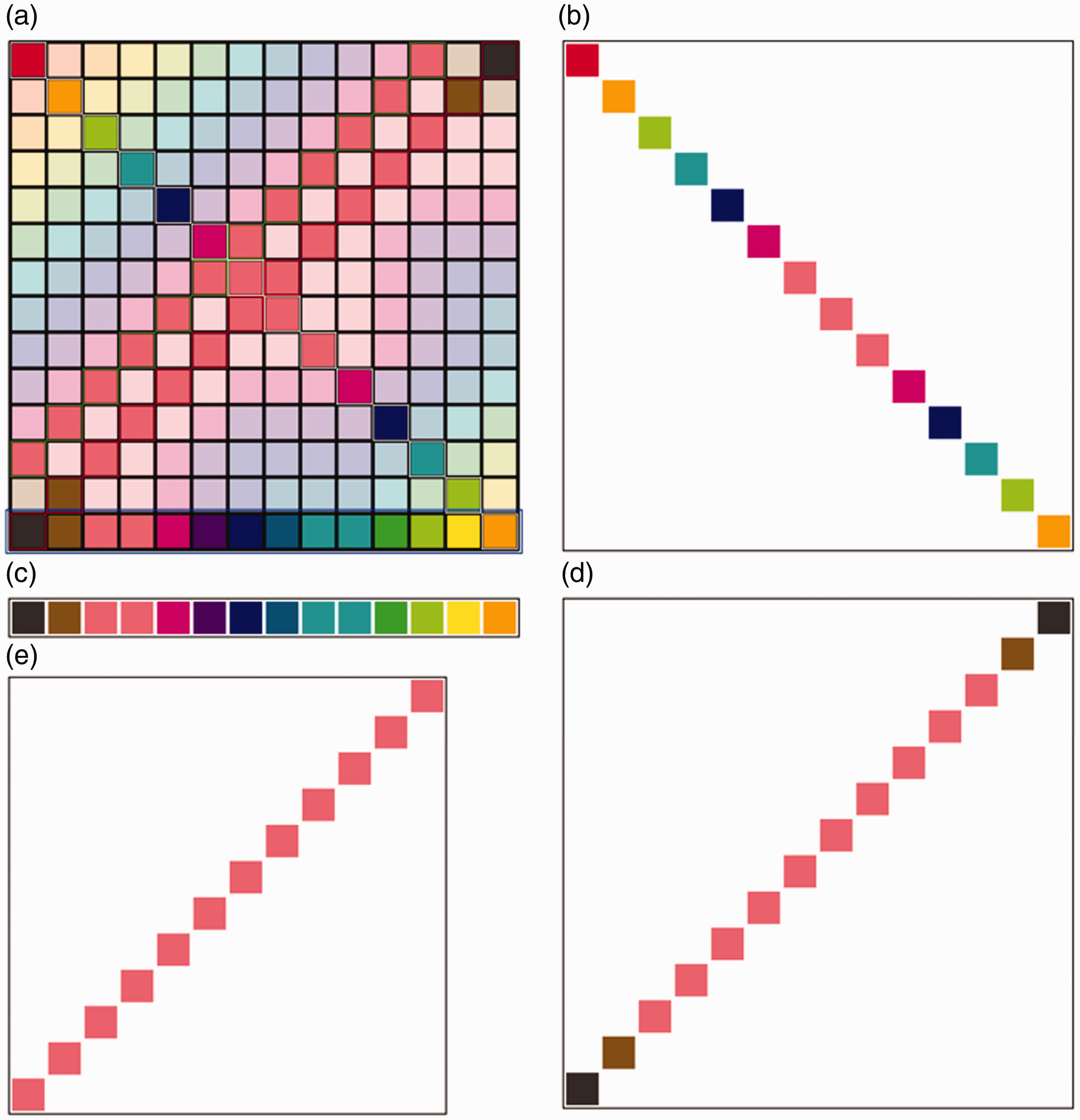
Full-color compound weaves applied from weave-database V: (a) IFwarp diagram for 196 full-color compound weaves from weave-database V; (b), (c) and (d) three series of conventional full-color compound weaves and (e) one series of optimal full-color compound weaves.
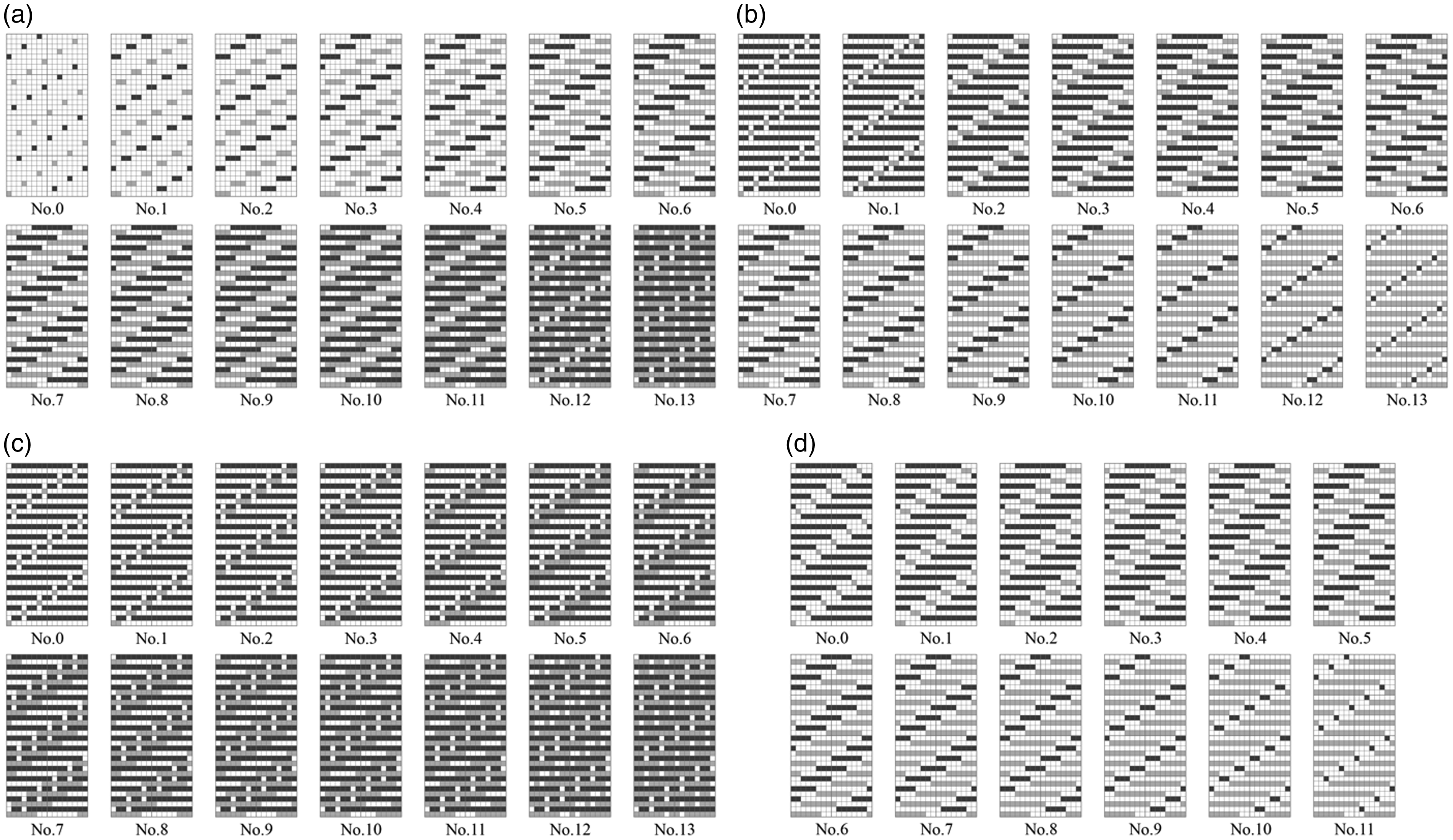
Conventional and optimal full-color compound weaves applied in specimens. (a) Convectional full-color compound structures applied in specimen “H-C-1”; (b) convectional full-color compound structures applied in specimen “H-C-2”; (c) convectional full-color compound structures applied in specimen “H-C-3” and (d) convectional full-color compound structures applied in specimen “H-O”.
As the full-color basic structure layer was formed by interweaving white warps and black wefts, while the full-color joint structure layer was constructed by interlacing white warps and white wefts, then the conventional basic weave arrangement was determined. Full-color technical weave no. 13 and primary weave no. 0 from basic weave-database were corresponding to match pattern grid color white and black, then the remaining 12 weaves were fixed one by one according to grayscale transition.
In the meantime, arrangements for conventional joint weaves were defined: (a) the same weave arrangement as conventional basic weave; (b) reverse weave arrangement as conventional basic weave; (c) full-color technical weave were applied to all gray levels, black, and white pattern grid colors.
Moreover, 12 optimal full-color compound weaves from weave-database V formed an optimal weave-database, these full-color compound weaves located on the line that was parallel to the diagonal line (from bottom left to top right) in Figure 6(a), see Figure 6(e) for accurate position, and Figure 7(d) shows specific interlacement information accordingly.
Meanwhile, the optimal basic weave arrangement was determined: weave no. 11 and no. 0 from basic weave-database matched pattern grid color white and black correspondingly, then the remaining 10 basic weaves were placed one by one according to grayscale transition. Besides, the optimal joint weave could only be defined in a reverse arrangement of optimal basic weave.
Four series of full-color compound weaves were applied to weave specimens ‘H-C-1’, ‘H-C-2’, ‘H-C-3’, and ‘H-O’, where H represents linear horizontal gray gradient, C indicates conventional full-color structures applied, O demonstrates optimal full-color structures utilized, and 1, 2, and 3 represents the arrangement for three series of conventional full-color compound weaves. The weaving specifications are listed in Table 3.
Weaving specifications

Results and discussion
First and foremost, converting full-color compound structures of specimens ‘H-C-1’, ‘H-C-2’, ‘H-C-3’, and ‘H-O’ to bitmap format, then importing them to the interlacement frequency statistical program, seven out of the aforementioned nine pairs of statistical data were listed including ‘Twarp/Tweft’, ‘Awarp/Aweft’, ‘Swarp/Sweft’, ‘Minwarp/Maxwarp/Minweft/Maxweft’, ‘RAwarp/RAweft’, and ‘FRwarp/FRweft’ (see Table 4 and Table 5). In addition, statistical data ‘IFwarpi/IFweftj’ are visualized into scatter plots as shown in Figure 8.
Statistical data of warp interlacement frequency

Statistical data of weft interlacement frequency

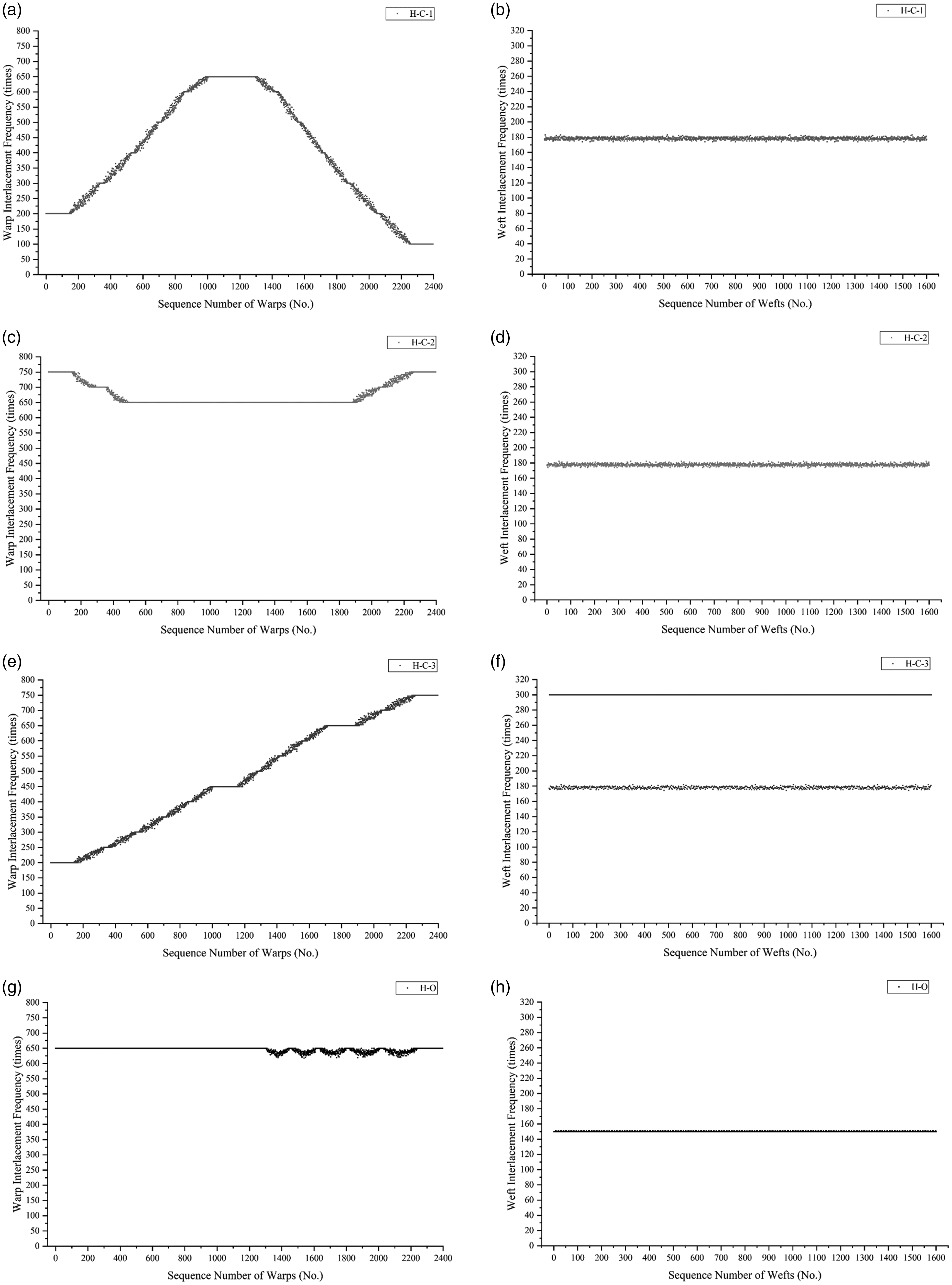
Warp and weft interlacement frequency scatter plots of four specimens. (a) Warp interlacement frequency scatter plot of “H-C-1”; (b) weft interlacement frequency scatter plot of “H-C-1”; (c) warp interlacement frequency scatter plot of “H-C-2”; (d) weft interlacement frequency scatter plot of “H-C-2”; (e) warp interlacement frequency scatter plot of “H-C-3” and (f) weft interlacement frequency scatter plot of “H-C-3”; (g) warp interlacement frequency scatter plot of “H-O” and (h) weft interlacement frequency scatter plot of “H-O”.
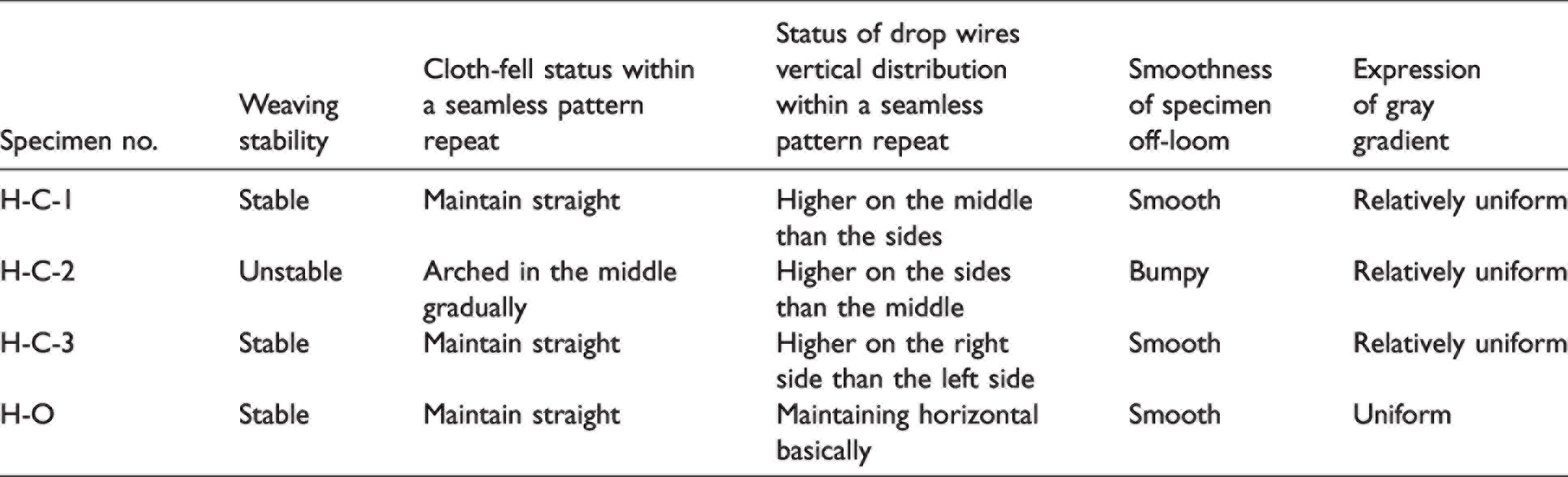
Besides, to observe the status of the specimen’s cloth fell and vertical distribution of drop wires during weaving, and to inspect the smoothness and expression of the gray gradient effect of the specimen off-loom (see Table 6).
Specimens’ characteristics comparisons
Finally, the visualization solution is verified in determining and predicting the satisfaction of balanced interlacement of full-color digital jacquard fabrics based on interlacement frequency statistics and data.
Four specimens were scanned by Microtek MRS-3200A3L scanner as shown in Figure 9.
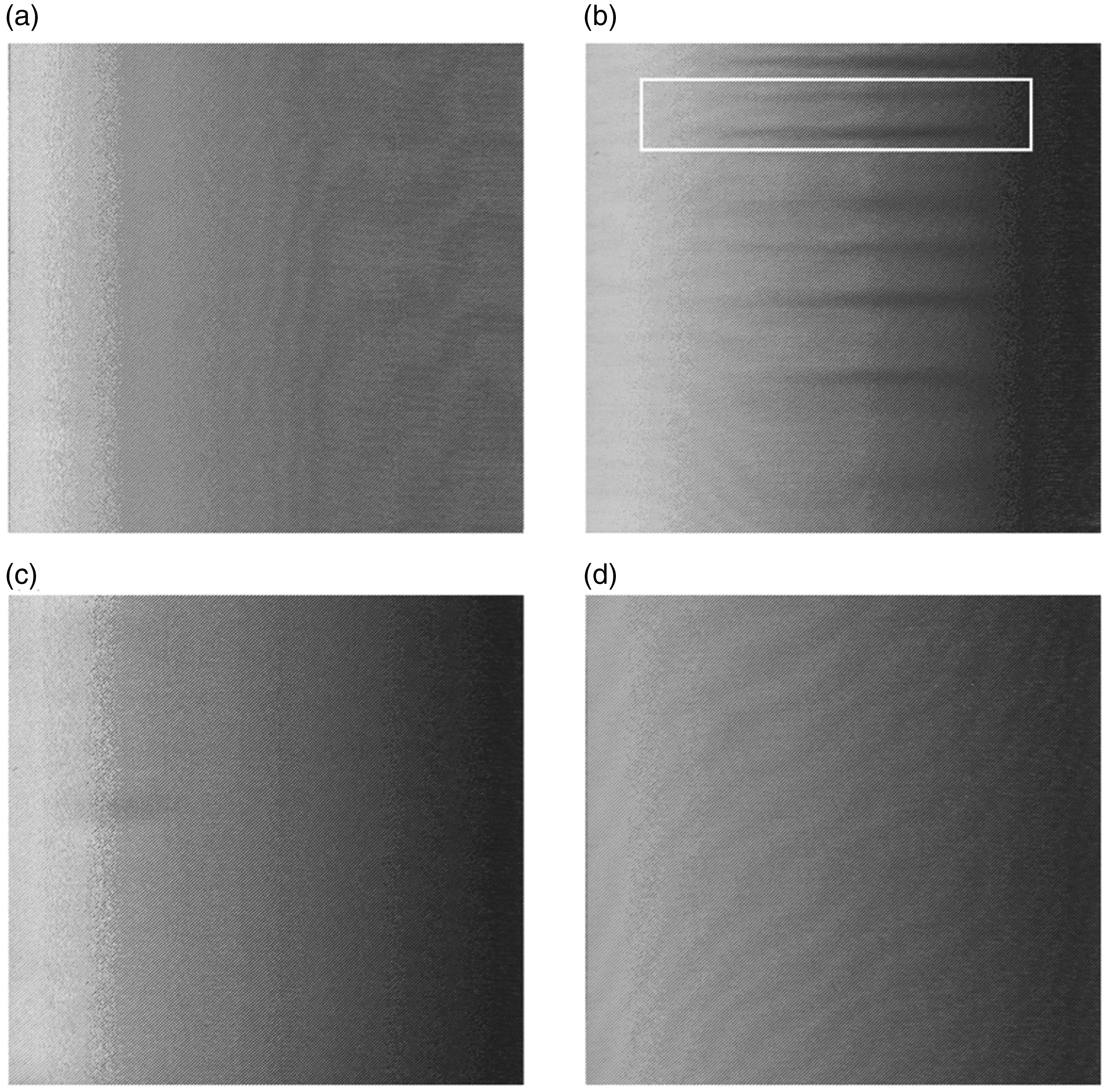
Full-color digital jacquard specimens with single warp and double wefts: (a) specimen ‘H-C-1’; (b) specimen ‘H-C-2’; (c) specimen ‘H-C-3’ and (d) specimen ‘H-O’.
The balanced interlacement status of warp and weft in four specimens are listed as follows.
First, gray pixels were irregularly on the borders of neighboring gray areas due to color separation, causing the break of complete full-color compound weaves, then fluctuations of adjacent warp interlacement frequency emerged. When compared to three series of conventional full-color compound weaves, the S warp and FR warp in specimen applying optimal full-color compound weaves decreased largely, from 184.0637 to 6.8181, and from 550 to 32, respectively (see Table 4 and Figure 8).
In the meantime, warps that endure higher tension will break, while warps that withstand lower tension will sink, both cause interruption of weft insertion. As for the warp interlacement frequency of specimen ‘H-C-1’ and ‘H-C-2’ (see Figure 8(a) and (c)), within the warp, the former exhibited an ‘A-type’ trend, while the latter showed a ‘U-type’ trend.
In addition, the warp interlacement frequency of specimen ‘H-C-3’ illustrated a stepped growth from left to right within a single seamless pattern repeat according to Table 6 and Figure 8(e); besides, the vertical distribution status of drop wires in a seamless pattern repeat of specimen ‘H-C-3’ as shown in Figure 10 represent warps on the right side suffering higher tension than those on the left side.
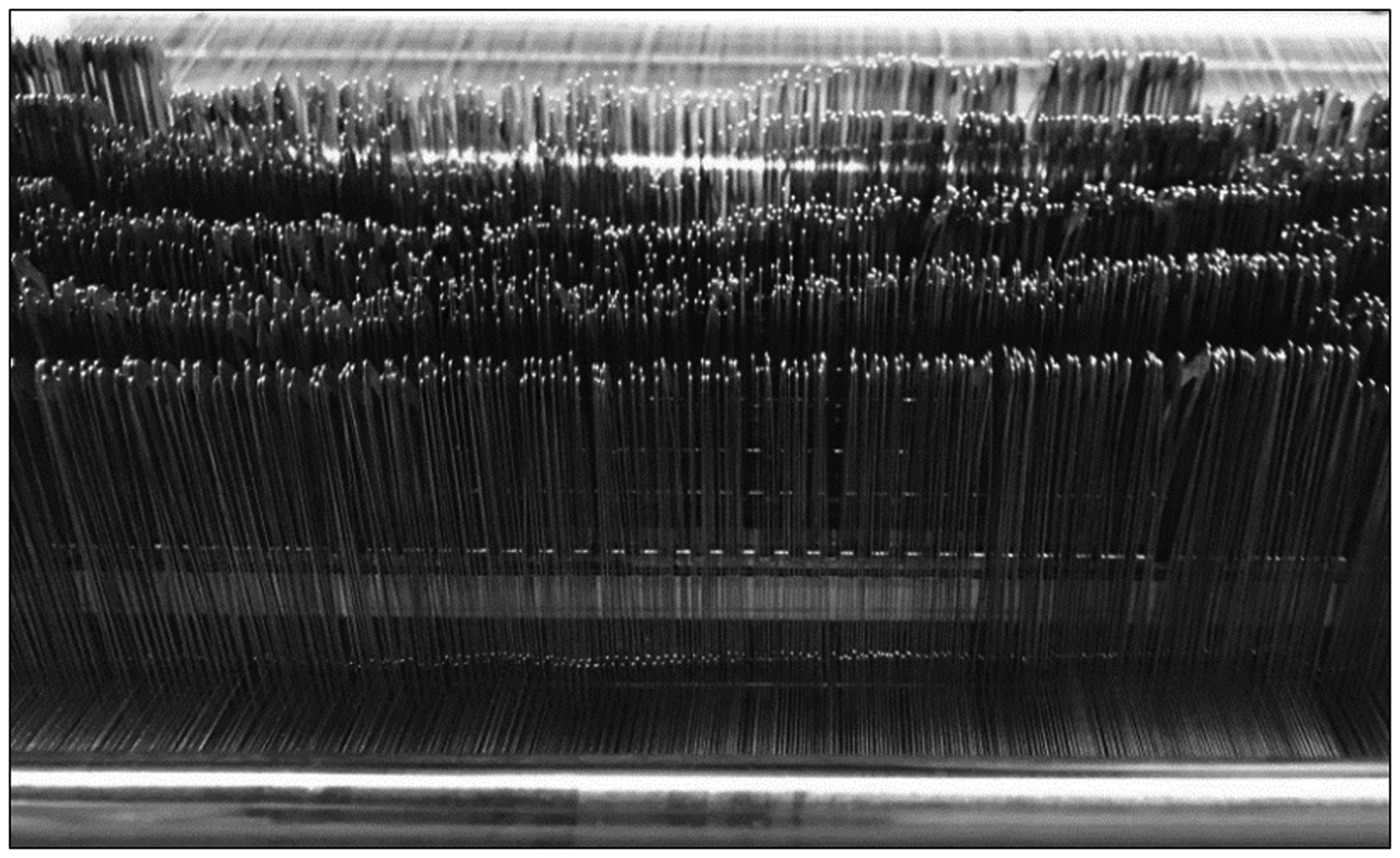
Vertical distribution status of drop wires in a seamless pattern repeat of specimen ‘H-C-3’.
What is more, due to the application of the full-color technical weave in specimen ‘H-C-3’, the weft in even numbers therefore possess a weft interlacement frequency of 2; in addition, the width of pattern grid applied contains 2400 columns, and the warp repeat of any full-color compound weave is 16, thus the interlacement frequency of the weft in even numbers in full-color compound structures of specimen ‘H-C-3’ is obtained by
Moreover, according to Table 4 and Table 6, the specimen ‘H-O’ possessed the lowest S warp , and the vertical distribution of drop wires remain horizontal basically, proving that optimal full-color compound weaves expressed better balanced interlacement status than conventional ones when applied.
Furthermore, the application of optimal full-color compound weaves led to a similar or identical neighboring weft interlacement according to Table 5, providing the possibility for rotating the full-color compound structures at 90 degrees for weaving. The A weft of optimal full-color compound structures was 150.25, which was the lowest among all four series of full-color digital jacquard specimens (see Table 5 and Figure 8(h)), indicating that the optimal full-color compound structures helped to reduce the usage of wefts. Besides, S weft and RA weft deduced dramatically in the weft when applying optimal full-color compound weaves rather than conventional ones, declining from 61.0447 to 0.4331, and from 126 to 1, respectively.
In addition, because the full-color compound weaves applied in the middle of specimen ‘H-C-2’ presented a juxtaposed and no-covering effect of wefts, while the full-color compound weaves no. 0 and no. 1 on the left side, as well as no. 12 and no. 13 on the right side of specimen ‘H-C-2’ showed the partial covering effect of wefts (see Figure 7(b)). And the weft density of two sides was 820 fillings/10 cm, higher than 800 fillings/10 cm of the middle, this specimen gradually arched in the middle in weaving, and became bumpy when off-loom (see the white column in Figure 9(b)). 10
In summary, under the identical circumstance of weaving specifications, optimal full-color compound weaves take more advantages than those of conventional ones when expressing the linear horizontal gray gradient digital image.
Conclusions
The balanced interlacement for compound structures is critical in full-color digital jacquard fabric production under layered-combination design mode. The interlacement frequency statistical program compiled in this paper assists in recognizing the variation of interlacing information of basic/joint weaves, full-color compound weaves and full-color compound structures.
Based on the visualization of interlacement frequency statistical data, comparing to three series of conventional full-color compound weaves, 12 optimal full-color compound weaves were selected and applied to the simulation of the linear horizontal gray gradient digital image, then the visualization analysis of the interlacement frequency statistical data, the status analysis of specimen weaving, as well as the characteristic analysis of specimens off-loom were carried out. The results are as follow: (a) in the case of the identical juxtaposed threads covering effect, the application of interlacement frequency statistical program helps quantify the balanced interlacement efficiently; (b) the visualization of balanced interlacement for digital jacquard fabric is necessary, because it offers assistance to predict balanced interlacement status and prevent unbalanced interlacement; (c) the visualization of balanced interlacement for digital jacquard fabric will be applied to several production scenarios, such as jacquard structure design and simulation optimization, intelligent jacquard fabric design system development, as well as the soft proofing of digital jacquard fabric.
Footnotes
Declaration of conflicting interests
The author(s) declared no potential conflicts of interest with respect to the research, authorship, and/or publication of this article.
Funding
The author(s) disclosed receipt of the following financial support for the research, authorship, and/or publication of this article: Authors are thankful for providing the funds by the 2018 “the Light of Textile” Foundational Applied Research Project, grant No. J201802.
