



Abstract
As far as cloth production is concerned, the dyeing process in textiles forms a bottleneck procedure, as this process consumes a great deal of time and high volumes of water per unit of fabric for processing, which causes depletion of groundwater levels at a high rate. Besides, textile effluents are discharged into rivers or wetlands without proper treatment in many cases. Untreated textile effluent can contaminate groundwater and water bodies, reduce dissolved oxygen in the water, and affect aquatic ecosystems, which may indirectly cause climate change. The waste generated in dyeing is mainly due to the cleaning process. Thus, the dyeing process needs to be improved and optimized to solve the problem and reduce delay. To take effective measures for future improvement, it is essential to develop a nature-inspired tracking system. The amount of emission and the performance can be improved by utilizing scheduling as a tool. In this view, the dyeing process is formulated as a bi-objective optimization model to reduce the tardiness cost and minimize the emission of wastewater during the cleaning process of the dyeing vat. The current problem is of a difficult nature; thus, multi-objective particle swarm optimization in collaboration with the tabu search algorithm has been used to attain good and nondominant results. The tabu search algorithm is used along with ejection chains to focus on the objectives of emission reduction and increase the number of desired solutions. It was found that the total processing time was reduced by 4–5 hours and water was reduced by 500 liters for dyeing 200 kg of yarn daily.
Rapid industrialization has not only provided comforts to humankind but, on the other hand, impacted the environment harmfully. As far as developing countries are concerned, environmental pollution is a significant issue. The textile industry is one of the ever-growing industries. This industry uses dye, a colored substance, for coloring the yarn. It is well known that the dyeing process imparts color to a textile material, whether it be yarn, fiber, or fabric, depending upon the requirement and type of unit. The dyeing is carried out using dyes and specific chemicals mixed in water. As per the current market trend, various colors are required to be processed. Due to the chemicals, the dyeing process can hamper workers’ health in a dyeing department. The use of these dyes results in water and sometimes soil pollution due to the release of untreated dye water from the textiles highlights. 1 The dyeing process is followed by cleaning the vats before processing the next job of different colors, which is responsible for the wastewater being drained. The quantity of wastewater depends upon the color, darkness, and dyeing vat size. It is well understood that the necessary sewage treatment must be provided to this water before letting it out into the environment. Hence, using less water or coloring the textiles without water is a significant concern of researchers so as to have sustainable and cleaner production because of the increasing social, environmental, and consumer requirements. 2 However, as far as the textile industries are considered, most wet processing capabilities are old establishments, and the profit except for a handful units is little; thus, they cannot afford to set up a newly developed treatment process. These units need the solution to their problems in a more affordable way to be implemented without any extra cost.
Moreover, Gendreau et al. 3 suggest that the setup times are significant and need to be considered during optimization. Also, Gomes et al. 4 suggest that the reduction of operational costs and proper management of production needs to be done to face competitiveness. Thus, proper scheduling can be a more effective way to reduce wastewater and curb the related pollution. As far as textiles are concerned, the experience of clean production in the bleaching and dyeing clusters was evaluated 5 and it presented the motivation of the manufacturing units to adopt novel water-saving and pollution reduction strategies along with the elimination of the unwanted process and reuse of water. Also, De Oliveira Neto et al. 6 proposed that implementing cleaner production results in economic benefits and helps achieve sustainable development goals. In this view, cleaner production in the textile industry considers the development of new alternative materials and considers the technical improvements.7–10 The government also promotes cleaner production and sustainability among the manufacturing units.
In textile wet processing, water is used mainly for three purposes: as a solvent for dyes and chemicals, as a medium for transferring dyes and chemicals to fabric, and as a washing and rinsing medium. As far as the textile dyeing process is concerned, the primary source of pollutant emission is the cleaning process of the dyeing vat. This process is carried out before the next job of a different color is taken for dyeing. The amount of pollutants depends on the depth of the color and the size of the dyeing equipment. Thus, proper scheduling can be an effective way to reduce the wastewater being drained into the environment and curb the related pollution. However, the complexity of the recycling process does not allow us to adopt all the techniques on a large scale. A suitable combination of techniques can be suggested. However, to make the process simple, a complete cost-efficient and environment-friendly solution is required to implement water conservation practices at the grass-root level. Even though the available techniques are appealing, they require high investments in machinery and other setups, so it is practical to implement changes in the process to reduce waste as it will be more economical in comparison to recycling and reuse to help the textile industry minimize environmental impacts.
The large-scale industries have used a few water-saving techniques, but these are yet to be developed and have a considerable development gap between cost-effectiveness and commercial scaling techniques for the textile and apparel industry. The high cost, complex problems, and limited infrastructure restrict the work published in this direction. There is a need to fill the gap between researchers' effort and the industry. It is necessary to get the solution for the current study with the help of new and improved algorithms inspired by nature that does not require infrastructural change and thus avoids heavy investment. Hence, to take effective measures for future improvement, it is essential to develop a nature-inspired tracking system that helps in waste minimization, resource optimization, and regenerative. A couple of nature-inspired algorithms are currently being attempted for problem-solving.
One of them is particle swarm optimization (PSO). PSO will help get the desired and better result than any heuristic algorithm, according to the work carried out by Zhang et al. 11 The number of publications and citations in the field of PSO is increasing. Thus, the future of these techniques will be more toward application rather than basics. The current work proposes a new multi-objective PSO algorithm and enhancement using a local search like the tabu search to solve the critical scheduling of the problem. The local search is based on the definite features of the problem and uses ejection chains to enhance the quality of the solution.
The current work addresses two objectives: reducing the delay cost, the conventional objective, and water restoration. The dyeing process is carried out by making a batch of the total jobs. The size of each batch depends on the size of the machine. Hence, each batch is processed on the machine for the desired operation. In this view, the dyeing process can have a parallel batch processing method. Many researchers have worked in batch processing and defined the batch processing machines as capable of handling a large number of jobs at a time as a batch, depending on the capacity of the machines. 12 The batch processing problem is challenging to solve, considering both the batching operations and sequencing. In recent years, heuristic and meta-heuristic algorithms have been widely used to solve batch processing scheduling problems, even though previous studies have particular available solutions. As per Kashan and Karimi, 13 for the scheduling of single batch processing with mismatched families of jobs and random sizes of the job, minimizing the entire completion time with ant colony optimization algorithm is suggested. A considerable amount of work can be found on the multi-objective variations of batch processing scheduling, where classification for the batch scheduling problem and its optimization has been proposed. 14 Allahverdi et al. 15 provided an extensive review of the scheduling literature on setup time models and classified scheduling problems into batching and non-batching considerations, with sequence-independent and sequence-dependent setup times. The scheduling of the batch processing by considering hierarchical criteria is suggested where the first criterion considered was makespan and the number of delayed jobs was the second criterion. 16 A fuzzy goal programming approach was presented to incorporate a loading scheduling in the single batch process machine.
Gupta and Smith 17 proposed a problem space-based local search heuristic and a greedy randomized adaptive search procedure (GRASP) for scheduling a single machine to reduce total tardiness (TT) with sequence-dependent setup times. Mathirajan and Sivakumar 18 also proposed greedy heuristics to reduce the weighted tardiness of diverse parallel batch processing considering active job arrivals, mismatched job families, and dissimilar job sizes. The genetic algorithm (GA) is presented to schedule a set of similar parallel batch processing to minimize the makespan. 19 Zhou et al. 20 describe an ant colony optimization algorithm, GA, and large neighborhood search algorithm to schedule similar parallel batch processing with different job families to minimize TT. They further propose a hybrid algorithm based on discrete differential evolution to solve large-scale parallel batch processing problems by considering the makespan criteria. Jiang et al. 21 propose a hybrid algorithm that combines the GA and discrete PSO to schedule uniform parallel batch processing by batch transporting to reduce the makespan. A meta-heuristic based on Max-Min Ant System (MMAS) combined with the multi-fit algorithm is proposed for solving parallel batch processing problems with the objective of the makespan. 22 A GA is designed to reduce the TT heuristically 23 ; it is a search heuristic that imitates the natural selection law. 24
Hsu et al. 25 propose considering the dyeing process as a mixed-integer programming model and using the GA to solve this model to reduce the tardiness and achieve on-time delivery. Further, a GA was used to optimize the dyeing production schedule. 20 A hybrid nondominated sorting GA was employed to solve the multi-object optimization scheduling model and demonstrated its effectiveness by its application in practice. 26 Many researchers have focused on the optimization of the multi-objective in parallel batch processing. A meta-heuristic algorithm was developed, which is based on the tabu search to schedule distinct parallel batch processing to minimize the TT and completion time taken together. 27 The tabu search and PSO algorithms were proposed by Alharkan et al. 28 for scheduling two identical parallel machines having a single server to reduce the makespan. Huynh and Chien 29 developed a multi-subpopulation genetic algorithm with heuristics (MSGA-H) to reduce the makespan and improve the textile batch dyeing schedule.
From the above cases in the literature, it can be stated that they consider only the makespan and the tardiness cost and neglect the pollution/environmental problems of the dyeing industry. Most of the methodologies are based on general optimization algorithms and do not consider the problem's internal properties. This work uses a neighborhood operator based on the ejection chain, which works on the batch level and not on the job level. 11 They further suggest that the algorithm should include problem definition strategies to ascertain acceptable performance for studying problem cases. Thus, the tabu search is combined with the general PSO framework. There is a visible trend that growing efforts have been dedicated to creating new algorithms (mostly meta-heuristics). The current study considers that focusing on the optimization of the problem is the prime importance, investigating structural properties and formulating novel search mechanisms to improve the algorithm's ability for optimization.
Problem details
From the literature review, it can be mentioned that the problem considered here is complex in the case of batch processing scheduling problems, which consider the various machines, random sizes of jobs, and varied families of jobs. The problem is allocating n number of jobs to m number of parallel batch processing machines. The job is described by the processing time, weight, and delivery date. The machines are described by their volume. The job started on the dyeing machine is not interrupted. The total jobs are divided into families according to the desired colors to be dyed. Based on the literature considered and the study carried out, 11 the time required for job processing depends merely on the necessary color and not on its weight. Hence, the jobs of similar family groups will have the same time for processing. The time for batch processing is equivalent to processing the single job in a batch. The families are called incompatible because jobs belonging to the different families cannot be processed as a batch. A setup operation is required to clean the vat when two jobs of different family groups are processed one after the other, which is associated with setup cost and setup time. The vat is cleaned with the help of a chemical solvent, and the amount of solvent used will be more if the amount of color in the batches is large. This solvent produces toxic substances, and the relevant setup cost is seen in sewage treatment and the prospective pollution to the water system. Also, the cost of solvents is added to the setup cost. As far as a textile firm is concerned, reducing the tardiness cost is a short-term goal, while the long-term goal is to reduce the setup cost. This is the production cost rate for the unit with pollution control. Thus, both objectives are considered together during the scheduling decisions. For the solution, the search for a suitable meta-heuristic algorithm was carried out, and from this, it is concluded that out of the available algorithms, PSO was found to address the optimization problems with more efficiency; this is, in turn, is combined with the tabu search algorithm.
Particle swarm optimization
PSO is an optimization method developed by Eberhart and Kennedy in 1995
30
based on population optimization. The techniques are inspired by bird flocking or fish schooling and their social behavior, which was initially used for single-objective optimization of the problems. This technique has many similarities with other methods, such as the GA. The technique starts with a population of random solutions and looks for the optima. There are no crossover and mutation operators as compared to the GA. The process is started with a population of particles, and their position gives the solution for the problem being considered. The evaluation of the objective function gives the fitness value with its self-velocity that finds out the flying speed and direction. During every iteration, the updating of particles occurs with a tradeoff between the present route of flying and moving toward the best two solutions known. The first solution is the best one, called the personal best position. The next is the best solution attained by the swarm particles, called the global best position. Until the convergence criteria are achieved, the iterations continue, and the best solution is the output of the problem under study. It is observed that PSO gives good results in less time and is lower in cost in comparison with other methods. There are limited parameters to be adjusted in PSO. The slight change in the single version works very well in a large range of problems. It is used in many applications in general and can also be used in specific applications with definite requirements. As discussed by Zhang et al.,
11
considering a search space with D-dimensions, let the space be represented by


Tabu enhanced local search algorithm (tabu search)
Some of the previous studies in the novel computation methods suggest that an inbuilt local search component is important to achieve strong optimization performance.
11
There are two reasons for this: one is that the working style of the local search is assumed to be complementary as compared to a search based on population, and the other reason is that these algorithms can utilize a few of the problems of structural properties that are difficult to be utilized by the algorithm at the population level. There is the double side where, on the one hand, it is assumed that the local search mechanism is complementary to the search based on population; on the other hand, the properties of the problem can be exploited by the local search algorithms that are not possible by the other algorithms at the level of population. The current work uses a tabu-enhanced local search algorithm to be implanted into the multi-objective PSO structure. The basic idea of the tabu search is to obtain and use a compilation of principles of intelligent problem-solving. The tabu search relies on preferred concepts that fuse artificial intelligence and optimization. The basic form of the tabu search is revealed in the ideas presented by Glover.
31
This method is developed on procedures framed to overcome the boundary lines of feasibility or local optimality that are mostly considered as obstruction. The tabu search is a meta-heuristic that guides a procedure for the local search to discover the solution space ahead of local optimality. The local procedure is a search that utilizes an operation named the “move” to describe the neighborhood of any given solution. The important part of this is its adaptive memory, which creates more flexible search behavior. The climbing of the mountain can be a good analogy in which the person climbing remembers the main elements of the traveled path and should be capable of making a choice. The implementation of the procedure is allowed by the adaptive memory that can search for space for the most economical and effective solution. The tabu search is concerned with optimizing the function f(x) subject to x ∈ X. The steps involved in this, as mentioned by Ismail,
32
are as follows:
selection of initial solution x ϵ S (S is the best feasible solution); selecting if else x =
The proposed solution methodology: particle swarm optimization and tabu search parameters
In PSO, the other particle gathers around the good solution once it is discovered. Hence, PSO is unable to skip from the optimal local solution. The merging of the tabu search into the PSO enhances the algorithm. To achieve this, the best solution of the PSO is given as input to the tabu procedure, where neighborhood solutions are defined, and the best is chosen as the current solution and is saved. The process is repeated until the desired criteria are reached. The complete PSO-tabu search method is presented in Figure 1. For solving the algorithm, a suitable numerical software package is used.

Flowchart of the solution process.
The performance and efficiency of the PSO algorithm depend on the selection of parameters. It is a complicated task to set the optimum parameters for the performance. Control parameters, such as the particle number, inertia weight, maximum iteration number, and accelerated constants, influence the algorithm. The initial and end values of the parameters inertia weight (I) = 0.7, and accelerated constants e1, e2 are selected. 11
Further, the below-given values are also referred to from Zhang et al.
11
:
total number of swarm particles = 100; maximum size of the personal best solution = 4; maximum size of the global best solution = 20; percentage of the global best solution from pbest = 20.
Representation of the solution
An arbitrary key-dependent representation scheme is adopted for the proposed work. The desired solution is represented with the vector of m real numbers, say a, where a = (a1, a2, a3,…, am) where ai is restricted to the range defined by the user. In the decoding of the solution, all the jobs are sorted concerning the relative order of the ai values and then converted in the job sequence into a possible solution with the help of a specific heuristic procedure, as below.
A sequence of jobs, denoted by S1 and S2 for Machine 1 (50 kg) and Machine 2 (100 kg), respectively, is as follows.
Let i = 1. Initialization of the production schedule should be empty. Schedule job S[i] (i.e. the ith job in sequence S1), whose family index is
The possible feasible solution for both machine types is as follows.
Machine 1 (M1): [1] [4] [7] [1, 2] [3, 5][6, 7] [7, 8].
Machine 2 (M2): [2] [3] [5] [6] [8] [6, 8].
A scheme of random key-based representation is used in the proposed model where a potential solution is expressed by the vector of real numbers in the range [0, 1] of size equal to several jobs. For example
Solution initialization
The obtained vectors become initial solutions for PSO. The PSO parameters are r,


with

and

Indicating the largest and the smallest of the ith objective values in N, where N is the set number being considered (here 2 vectors are considered), in the considered case

Finding


Machine 1 (M1): {[1], [7], [4], [5, 3]} and Machine 2 (M2): {[8, 6], [2]}
As another example, for the index vector [6, 1, 5, 2, 3, 7, 4, 8]
Machine 1 (M1): {[1], [7], [4]} and Machine 2 (M2): {[6], [5], [2], [3], [8]}
Ejection chain
Ejection chains 32 create composite neighborhood moves for strongly forced combinatorial optimization problems, specifically where conventional operators do not acquire enhancement because of local optima. These create compound moves by joining a series of single moves.
Consider a vehicle routing example where the customers are assigned the routes; applying this method means removing a customer from one route and adding the customer to the other route, at the same time forcefully removing a customer from the route and assigning it a different route, and so on. 33 The ejection and the insertion procedure are repeated until the customer is inserted into a route without forcefully ejecting any other customer. Large neighborhood moves are created when the search is caught in the local optima ejection chain. There are different ways ejection chains can be applied for scheduling problems in the current work. It is decided to consider the batch of jobs to be processed at a time as an entity. When the ejection chains are applied, it means that a batch is ejected from one machine and then inserted into another machine; this is continued by ejecting another batch from the same machine and inserting it into another machine. In this study, the application of these chains to a solution is the ejection of a batch from its current machine and insertion of it into another machine (at the best position), where the chain effect is continued by the ejection of another batch from that machine and insertion into yet another machine, and so on.
Consider here just minimizing the total setup cost (TSC) and not the TT.
For example
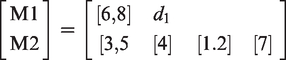
Represent the family for the jobs of the above matrix, and
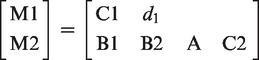
Find the cost of arc when swapping an element between M1 and M2. As an example, consider the arc between A and C1. Now eject A from M2 and find the ejection cost and insert A by replacing C1 in M1 and find the insertion cost. The arc cost is then evaluated by finding the difference between the insertion cost and the ejection cost. To find the ejection cost, find the TSC before ejecting A in M2; the TSC is 280, and after ejecting A it is 150. So, the ejection cost is 280 – 150 = 130. To find the insertion cost, find the TSC before inserting A (replacing C1) in M1; the TSC is 0, and after inserting A it is 0. The insertion cost is 0 – 0 = 0, so the arc cost between A and C1 is 0 – 130 = –130
As another example, consider the arc between C1 and C2. Now eject C1 from M1 and find the ejection cost, and insert C1 by replacing C2 in M1 and find the insertion cost. The arc cost is then evaluated by finding the difference between the insertion cost and the ejection cost. To find the ejection cost, find the TSC before ejecting C1 in M2; the TSC is 0, and after ejecting C1, the TSC is 0. So, the ejection cost is 0 – 0 = 0. To find the insertion cost, find the TSC before inserting C1 (replacing C2) in M1; the TSC is 280, and after inserting C1, the possibility here is inserting C1 before B1, in between B1 and B2, in between B2 and A, and after A. So, the TSC variations before and after insertion for four different possibilities are 120 (
Job assignment procedure
A two-stage job assignment procedure is assigned to attain an entire feasible solution, which assigns jobs to present batches. The aim of Stage 1 is to make sure the probability of the batch-oriented schedule is formed by ejection chains. The arc cost must be 0 for ensured feasibility. Further, Stage 2 focuses on reducing the TT using the tabu search of the final schedule. The necessity is to remove these empty batches and solve the model again until no empty batch survives in the ultimate schedule.
On the execution of the algorithm, different combinations of the results were obtained depending on the size of the job and the type of color out of these; all the best solutions are as plotted in the form of the Gantt chart as shown in Figure 2.
From Figure 2, it was found that the total time for the processing was reduced by 4–5 hours due to the eradication of one setup process. This further resulted in a saving of water of 1.3% daily. As water consumption is reduced, the use of the required solvent is also reduced, which in turn reduces the cost incurred in the treatment. Thus, there will be a considerable amount of reduction in the wastewater generated. Further, the wastewater generated can be treated at the introductory level. The same water can be utilized on construction sites, for agriculture, at vehicle washing centers, or else by further treating the water and removing the color particles it can be reused in the textile industry itself.
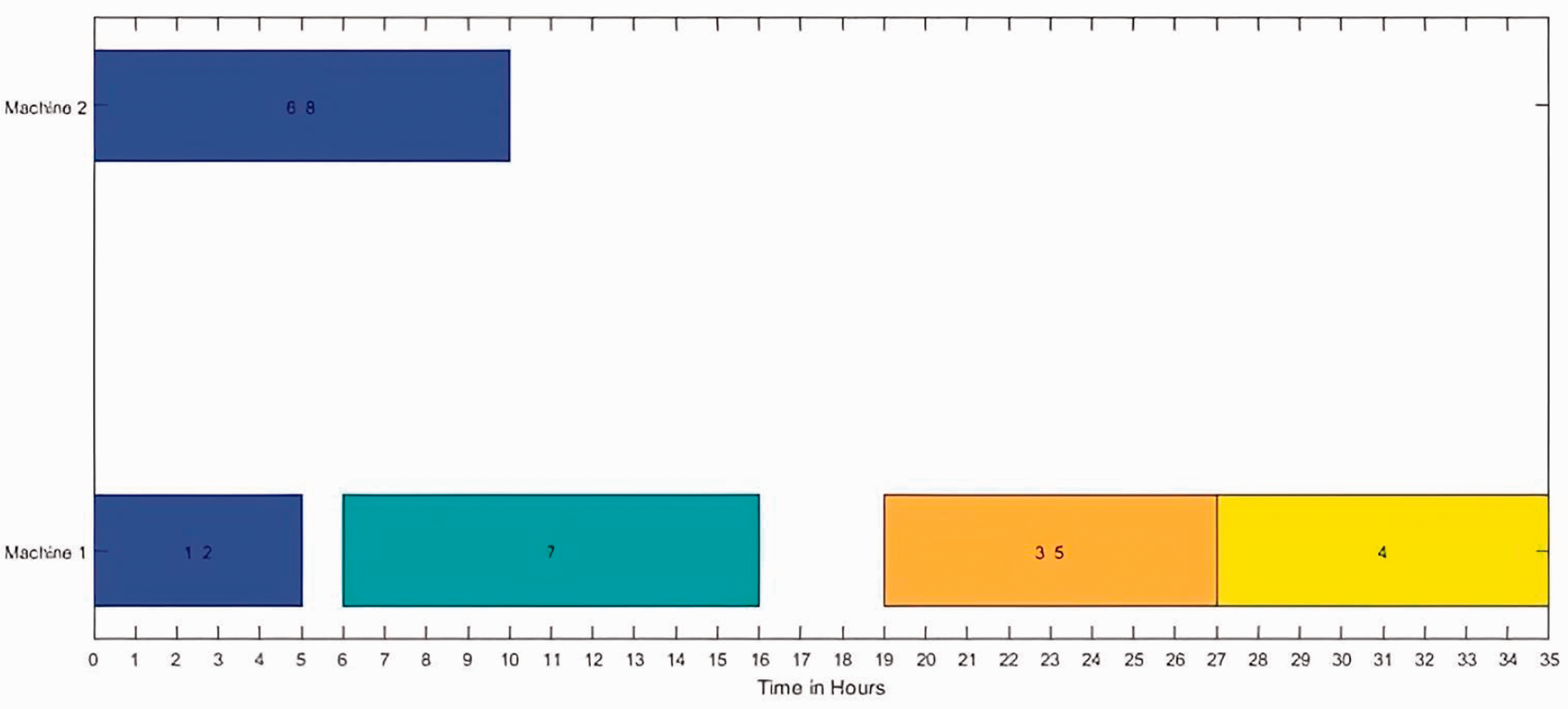
Representation of the obtained solution.
Quality of solution and parameter study
Three performance indicators were selected to check the quality of the results and that the algorithms are working: the overall nondominated vector generation metric (ONVG), C-metric, and tan distance (TD). The ONVG and C-metric quantify the number of nondominated points or solutions generated by an algorithm. A greater value of the overall nondominant vector generation highlights that the algorithm can give more outputs to the concerned person. Similarly, the value of the C-metric decides which algorithm is superior. 34 The TD gives the largest distance from the closest nondominated solution. Also, a higher value of TD means the solutions are distributed evenly, but a smaller value of TD is preferred for the convenience of the decision-making process.
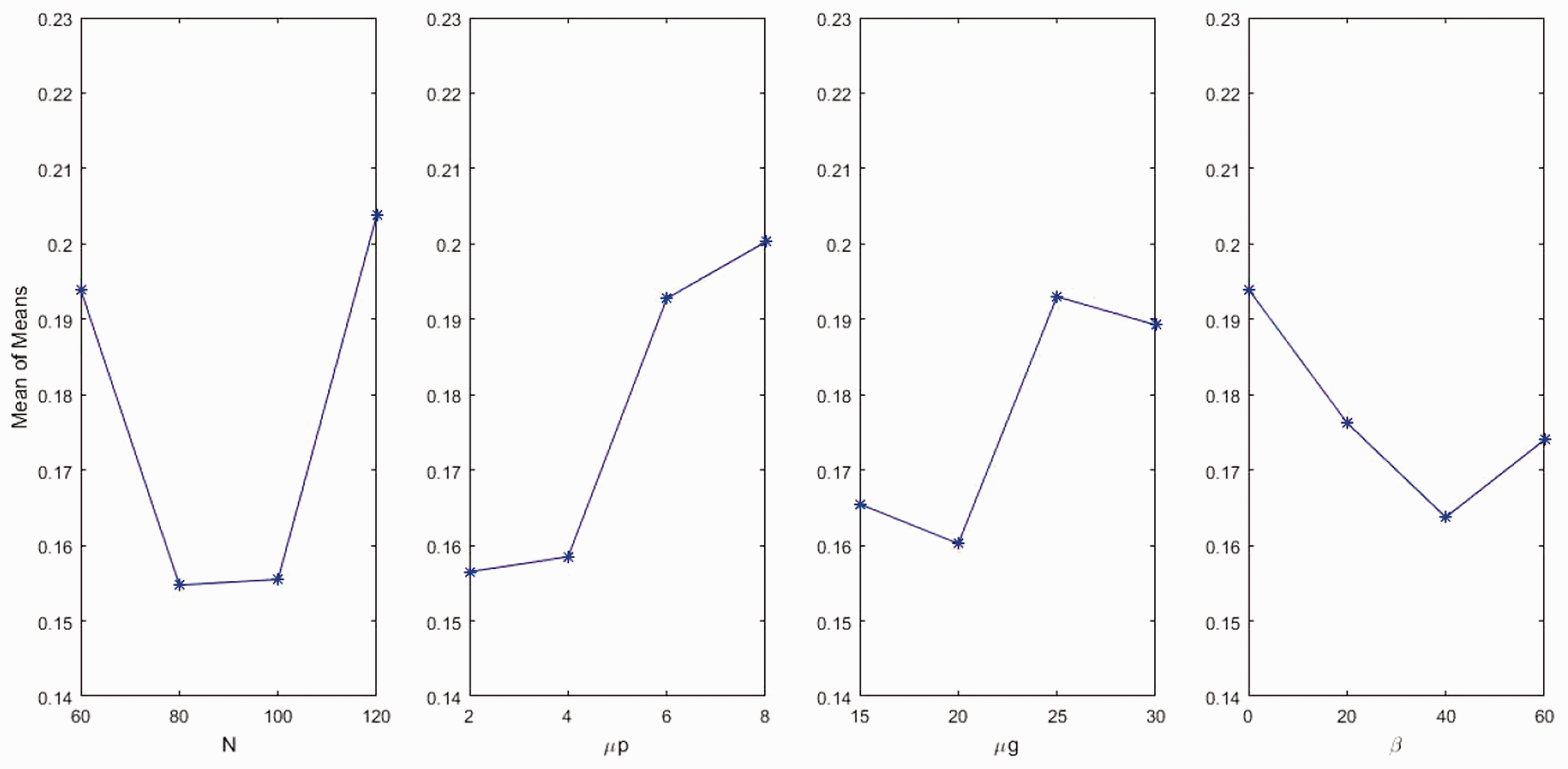
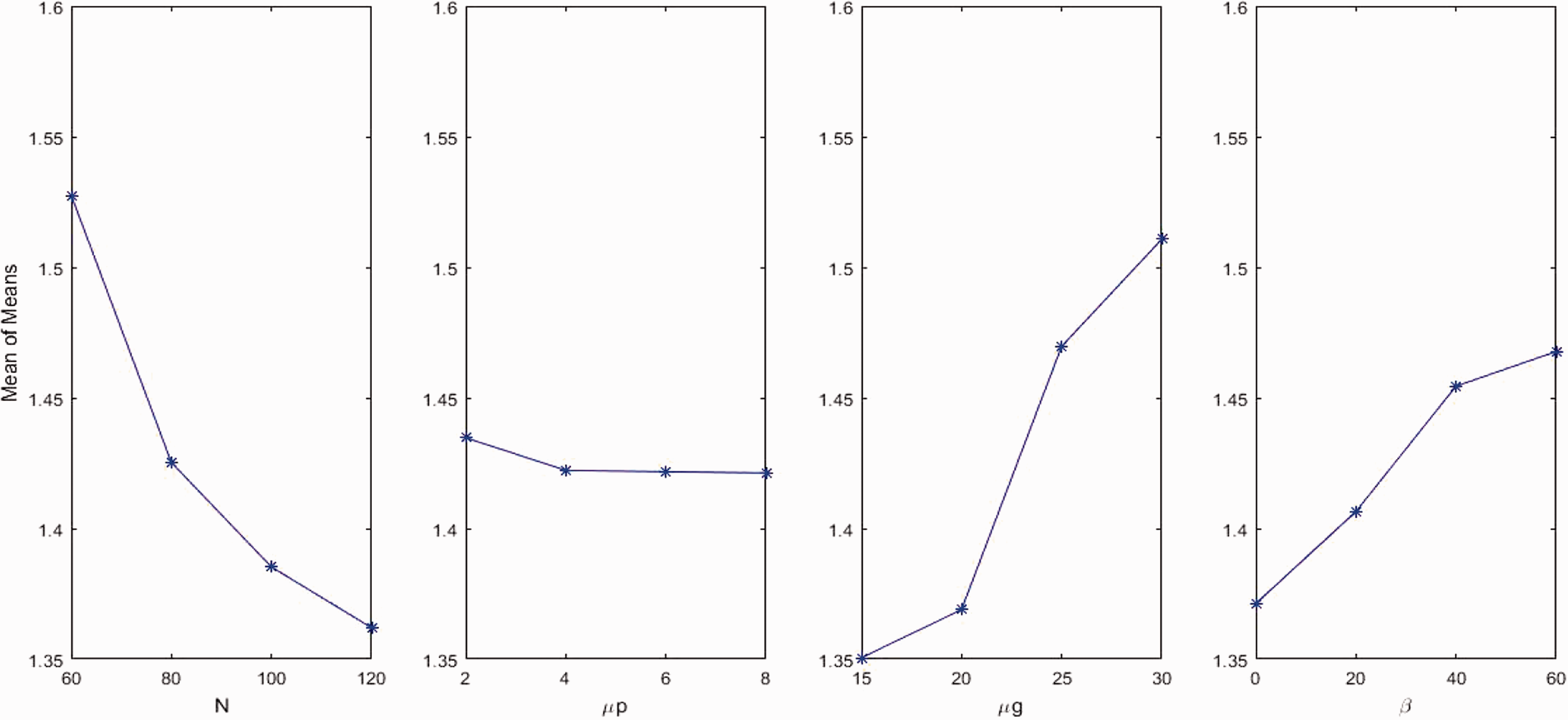
The effect of the number of particles in the swarm (N), the maximum size of the personal best solution (μp), the maximum size of the global best solution (μg), and the percentage of the global best solution for the local search (β) is studied. Results are acquired for the three performance indicators, that is, the ONVG, C-metric, and TD, as shown in Figures 3 –5, respectively.
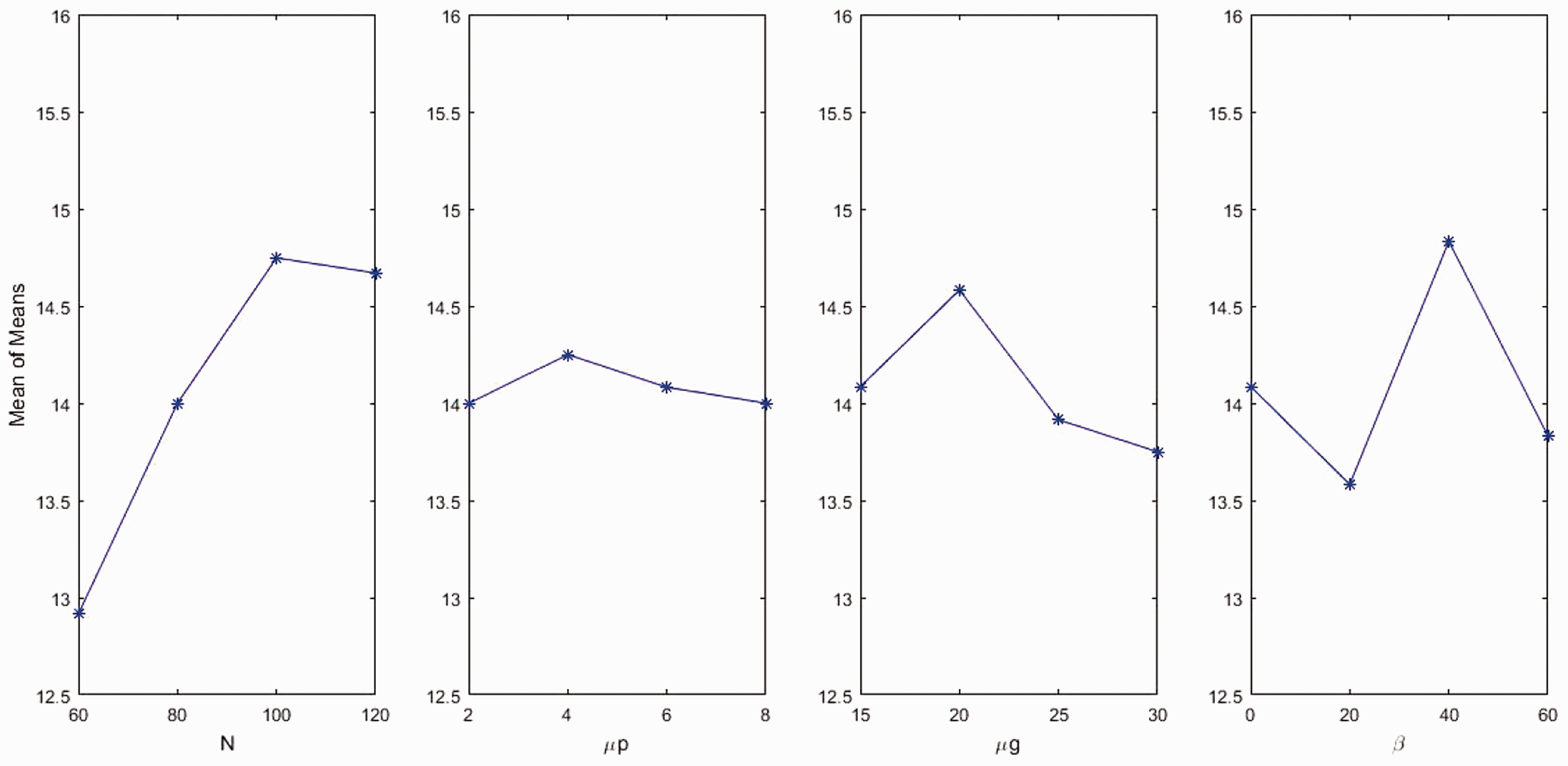
Effect of the parameters on the overall nondominated vector generation metric (ONVG).
Effect of the parameters on the C-metric.
Effect of the parameters on the tan distance (TD).
As shown in Figure 3, the parameter N has a good effect on all three metrics. In general, the increase in N resulted in more solutions. Without a sufficient number of cooperating agents, the algorithm would not be able to converge to high-quality solutions. In contrast, the optimality of the solution gets worse when N is too large.
Figure 4 shows that the parameter μp affects the more C-metric compared to others. The charts also conclude that the value of μp should be small for better performance. Still, if the value is kept low, the solution distribution is not even, thus deteriorating if the ONVG and TD are considered. Hence it is necessary to maintain the personal best solution at a suitable size to have diversified nondominant solutions.
The parameter μg has a specific effect on all the three metrics; for example, for the ONVG, the small value of μg results in fewer solutions, whereas the optimality of the solutions gets worse and, considering the TD, more uniform distribution of the solution is obtained when the μg increases, as shown in Figure 5. The parameter β is the critical one for this algorithm and it affects the quality of the solution. With the increase of β, the number of solutions decreases. Thus, a proper balance must be maintained between the PSO search and the local search for the specific problem.
The above-obtained results are compared with the study carried out by Zhang et al. 11 and it was found that the results are in line with the referred study and they are tabulated in Table 1.
Comparison of the results
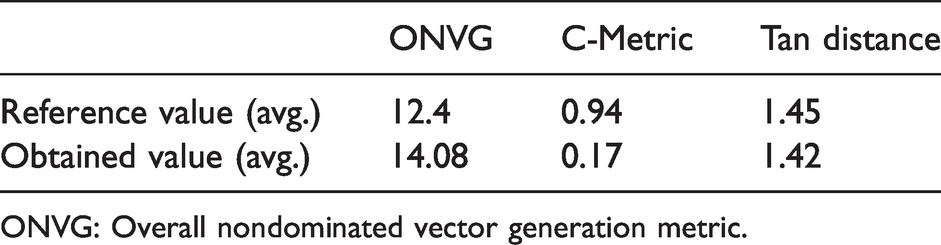
ONVG: Overall nondominated vector generation metric.
From the above solution, it can be concluded that PSO with the tabu search give efficient results. The amount of water used for the setup and the cost incurred will be reduced at the end of this optimization process. Thus, there will be a considerable amount of reduction in the wastewater generated. Further, the wastewater generated can be treated at the introductory level, and the same water can be utilized on construction sites, for agriculture, at vehicle washing centers, and if not, by further treating the water and removing the color particles it can be reused in the textile industry itself.
Conclusion
The current study is carried out with a focus on reducing water consumption and the waste generated during the dyeing process. For this, PSO and the tabu search optimization method was employed. From the study, it is concluded that PSO and the tabu search give efficient results. Few functions, such as maintaining the global best and personal best solutions, are utilized for multi-objective optimization. The ejection chain method is used in the tabu search to increase the elite solutions. The proposed algorithm can work better for scheduling processing machines in parallel batches. It was found that total processing time was reduced by 4–5 hours and further water use was reduced by 500 liters for dyeing 200 kg of yarn daily. Further, on treating the water and removing the color particles, can be reused in the textile industry. This research will serve as a baseline to help the government, funding agencies, industry management, and technologists to analyze the wastewater impact of increased textile production and develop environment-friendly dyeing practices and technologies.
As future research, other ways of pollution prevention can be considered to achieve sustainable manufacturing. In this study, real time unexpected events occurring during the process that can affect normal production are not considered.
Footnotes
Declaration of conflicting interests
The author(s) declared no potential conflicts of interest with respect to the research, authorship, and/or publication of this article.
Funding
The author(s) received no financial support for the research, authorship, and/or publication of this article.
