



Abstract
This study aims to assess the relationship between the surface roughness of cotton plain-woven fabric before and after each pretreatment processing stage. According to the findings of this study, the surface roughness values of desized fabric increased in the warp and weft directions. On the other hand, the roughness of plain-woven fabric reduced in both the warp and weft directions during the scouring, bleaching, and mercerization processes. The weft roughness values of greige, scoured, bleached, and mercerized fabrics are higher than the warp roughness values. Mercerized fabrics provide the smoothest fabric surface compared to other treatment stages. The pretreatment stages have statistically significant impacts on the surface roughness in both the warp and weft directions at a 95% confidence interval. The pairwise analysis reveals that pretreatment of the fabrics in the warp and weft directions is statistically significant for grey with desizing, grey with scouring, grey with bleaching, grey with mercerizing, desizing with scouring, desizing with bleaching, desizing with mercerization, scouring with mercerization, and bleaching with mercerization, but not for scouring with bleaching. Mercerized fabric is highly recommended for producing textile products with unique requirements in terms of tactilely sensitive surface properties.
Keywords
At present, textile and garment producers are being confronted with many issues concerning the hand feel of fabric and clothing. 1 There are no specific standard methods available using which the smoothness of fabric can be measured. Subjective and objective evaluation is completed to judge the feel of the fabric, such as the tensile, shear, bending, compression, and surface properties of fabrics and articles of clothing.2,3 When a customer buys a fabric or piece of clothing, he or she is constantly attempting to select it based on an evaluation technique for a specific end-use. 4
To improve fabric quality, woven cotton fabrics were subjected to various pretreatments, such as desizing, scouring, bleaching, and mercerizing, before dyeing. Cotton fabric is treated with various chemicals and mechanical processes for various end applications in each treatment stage. After these treatments, the feel of the fabric has been changed.5,6 Fabric surface properties depend upon the yarn qualities, weave points of interest, and finally the sort of chemical treatment. Chemical or mechanical treatment modifies the surface properties of the textile fabric. 7 The chemical treatment of cotton to alter the physical properties of fibers without changing their shape is a common practice in the textile industry. 8
Many researchers have studied the surface properties of woven and knitted fabrics made using ring, compact, and rotor yarns.9–13 The effects of washing and drying 14 as well as finishing and dyeing 15 are also investigated. Other authors16,17 stated that the yarn diameter, weave types, crimp%, 18 weft and warp densities, and fabric balance and cover factor are the basic factors for the surface roughness of woven fabrics. In their studies, the combined effect of the weft density and weave type on the surface roughness of the plain-woven fabrics was examined. They found that surface roughness decreased with increasing fabric density and with decreasing yarn diameters.17,19–22 Researchers explored the effect of different blends of polyester-cotton fabrics on the surface property. It was found that a higher presence of polyester fiber in the fabric improves the surface property. 23 Many scholars investigated the effects of weave types on the surface roughness of woven fabrics. A recent study determined the effect of weaves such as plain 1/1, twill 1/3, and sateen 8/3 on the surface roughness of cotton fabrics. The study reported that all levels of the roughness of the fabric surface progressively increased; however, the weft direction has a rougher surface than the warp direction.20,23
Moreover, the effect of the weft yarn twist level on the surface and mechanical properties of 100% greige cotton woven fabrics was studied and the findings showed that tensile, pure bending, and compression properties and the surface roughness of fabrics are increased as the yarn twist levels are increased.24,25 The effect of abrasion on the surface roughness qualities of textured polyester woven fabrics has also been studied. The relationships between fabric surface roughness values and abrasion cycles were investigated using textured polyester woven fabrics with various constructional parameters. 26
Even though many researchers have explored the effects of the yarn structure, count, twist, and weave type on surface friction, the surface roughness and handling, such as tensile, shear, bending, and compression properties, in most of the studies were done at the greige fabric level and comparisons were done based on different fiber types, yarn and fabric structural parameters and spinning methods. In most of the earlier studies, the effect of pretreatment on the surface roughness of the plain-woven fabric was not carefully addressed. Therefore, in this research work, the effect of pretreatment on the surface roughness of plain-woven fabrics is studied. The surface roughness values of untreated (greige) and treated fabrics were compared by determining the surface roughness properties at each stage of the pretreatment process, namely desizing, scouring, bleaching, and mercerization. Fabric surface roughness is determined using the Kawabata Evaluation System-FB4 (KES-FB4). This investigation and analysis assist textile technologies and manufacturers in determining at what stage of the treatment process a smooth fabric surface will be achieved, as well as providing directions for better surface feel during the production of fabric and clothing for various end applications. Following this, we assess which pretreatment process stage is preferable for carrying out a finishing process to provide a smooth fabric surface for specific end applications that may require special surface behavior.
Materials and methods
Materials
Fiber
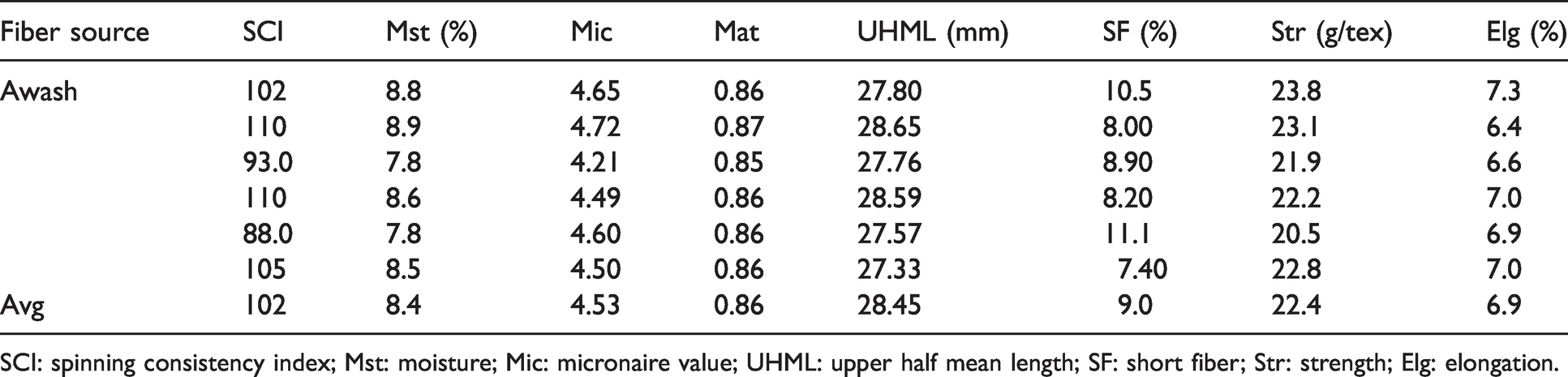
The fiber that was used in this research work was 100% cotton and the fiber-specific characteristics properties from an Uster HVI 1000 in tabular form are shown in Table 1. The fiber characteristics were assessed using the Uster HVI 1000 analyzer.
Properties of cotton fiber from the Uster HVI 1000
SCI: spinning consistency index; Mst: moisture; Mic: micronaire value; UHML: upper half mean length; SF: short fiber; Str: strength; Elg: elongation.
Yarns
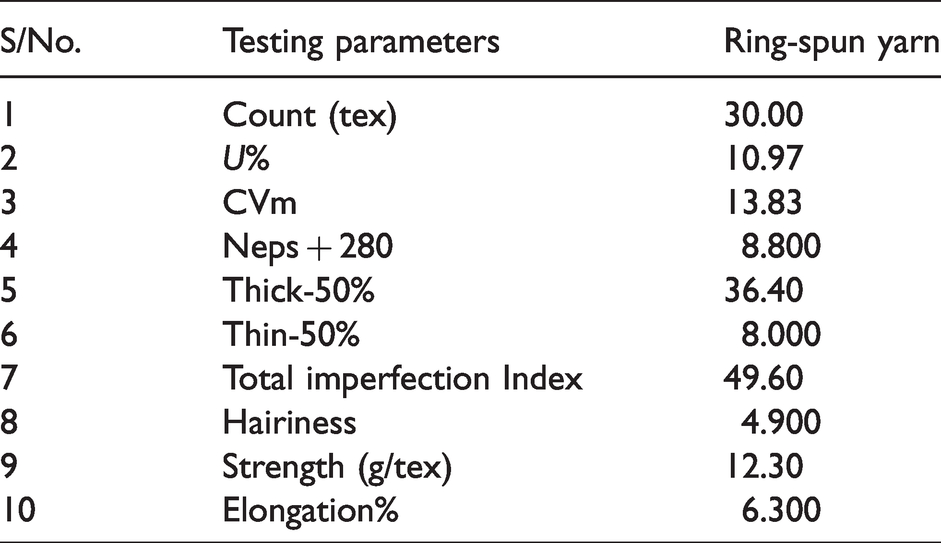
The yarn used in this study was cotton ring-spun yarn with a count of 30 tex. The carded yarns were produced by the Kombolcha Textile Share Company using a ring spinning machine (Reiter R923). The yarn properties were evaluated using an Uster Tester 5 and Uster strength tester. The yarn properties include twist, strength, elongation, coefficient of mass variation (CVm), neps (+280), hairiness, thin places (−50%), uniformity index U%, and thick places (+50%), and are presented in Table 2. The other parameters, such as raw material, blending ratio, speed, relative humidity (RH)%, etc., were kept constant.
Yarn structural characteristics
Fabric
Plain (1/1) woven fabric, 100% cotton, was produced using a Picanol (Model: OMP 800-2-P) air jet loom by the Kombolcha Textile Share Company. The fabric was woven from 28 ends per centimeter (EPC) and 24 picks per centimeter (PPC) thread density and a 30 tex yarn linear density for warp and weft directions was used. The surface mass of the produced plain 1/1 woven fabric was 155 grams per square meter. The warp tension force is 2.00 kN and the speed of the loom is 550 RPM during the production of the sample.
Method
Desizing
Cotton fabrics can be desized in a variety of ways, including physical, chemical, and a combination of the two. However, different methods could be used for desizing a sized woven fabric. In this research work, from the different desizing methods, the oxidative method was used. The fabric and water solutions were prepared for desizing at a material–liquor ratio (MLR) of 1:20 with hydrogen peroxide (35%) 0.3%, caustic soda 5%, sodium silicate 0.5%, magnesium sulfate 0.005%, ethylene diamine tetra acetic acid (EDTA) 0.2%, and wetting agent 0.3% on the weight of the fabric. The fabric is treated at 90°C temperature for 1.5 h at a machine speed of 40 m/min using a jigger machine (Mesdan-Lab model). In addition, after treatment was carried out, the samples were rinsed with hot water at 85°C, followed with a cold wash. After the desizing process, the surface mass of the plain 1/1 woven fabric was 146 grams per square meter.
Scouring
The desized fabric was treated with an alkaline solution to scour it. This process improved the absorbency of the fabric by removing impurities. The fabric and water solutions were prepared for scouring at a MLR of 1:20 with caustic soda 3%, wetting agent 1%, and sequestering agent 0.2% on the weight of the fabric. The fabric is treated at 95°C temperature for 1.5 h at a machine speed of 40 m/min using a jigger machine (Mesdan-Lab model). In addition, after treatment was carried out, the samples were rinsed with hot water at 85°C, followed with a cold wash. The surface mass of the plain 1/1 woven fabric after scouring was 143.4 grams per square meter.
Bleaching
The scoured woven cotton fabric was bleached using hydrogen peroxide to remove the natural coloring. There are different bleaching methods but for this research work hydrogen peroxide (H2O2) was used for bleaching the scoured fabrics. The fabric and water solutions were prepared for bleaching at a MLR of 1:20 with hydrogen peroxide (35%) 4%, caustic soda 0.5%, sodium carbonate 0.1%, sodium silicate 2.5%, magnesium sulfate 0.5%, EDTA 0.3%, and wetting agent 0.3% on the weight of the fabric. The fabric is treated at 90°C temperature for 1 h at a machine speed of 40 m/min using a jigger machine (Mesdan-Lab model). After the treatment was carried out, the samples were rinses with hot water at 85°C, followed with a cold wash. After the bleaching process, the surface mass of the plain 1/1 woven fabric was 139.7 grams per square meter.
Mercerization
Mercerization is the treatment of cotton with concentrated caustic soda for value addition. Mercerization requires higher concentrations of caustic soda (19–26% solutions) at room temperature (RT) for this process. The chemical was used with a concentration (percentage) of caustic soda of 25% on the weight of the fabric. Cotton fabrics will swell if immersed in a strong alkaline solution, such as caustic soda. If the fabrics are placed under stress while swollen and then rinsed with water, the alkali will be eliminated and a permanent silk-like luster will result. 27 The surface mass of the plain 1/1 woven fabric after mercerization was 142.5 grams per square meter.
Surface roughness measurement
At each treatment stage, five test specimens of 20.0 cm × 20.0 cm sample fabric were prepared for measuring the surface roughness to assess the effects of pretreatments on the surface roughness of plain-woven fabrics. Then samples were conditioned at 65 ± 2% RH and 20 ± 2°C for a minimum of 24 h before testing according to the ASTM-D1776 standard. Roughness was measured in the warp and weft directions at each treatment step using the KES-FB4 instrument, as illustrated in Figure 1 for grey fabric as an example.

Measured fabric surface roughness of grey fabric by the Kawabata Evaluation System-FB4 in the warp (a) and weft (b) directions.
Analysis of variance
The data were statistically analyzed and evaluated using the Design-Expert software analysis of variance (ANOVA). The one-way ANOVA analysis was used to determine whether there were variable influences on the response surface roughness in the warp and weft directions of the fabrics by using MATLAB (R2018b) and Statistical Package for the Social Sciences (SPSS) IBM SPSS Statistics v21 software. Tukey's test method was used, which is available in post-hoc analysis. The Tukey test evaluates the differences between each pair of means, with multiple testing appropriately adjusted. Many statistical packages offer Tukey multiple comparison tests as an option when conducting a one-way ANOVA, for example, this test is available in SPSS. 28 Finally, a comparison of surface roughness values in the warp and weft directions of the fabric was done by plotting a graph for each treatment stage of plain-woven fabrics.
Results and discussion
Effects of pretreatment on the surface roughness in the warp direction
It is evident that in Figure 2 the roughness of the plain-woven fabric increases for desized fabric more than for greige fabric and even for other process stages in the warp direction. A treated fabric surface at the stage of desizing has a higher peak height and higher valley in the warp direction, which leads to a rougher surface on the fabric. This is due to, at the grey stage, the starch that was applied to the yarn during the sizing process to make the yarn surface smoother and stiffer. 6 So, during the desizing process, the applied starch paste will be removed and it creates gaps between each yarn in the fabric structure. Since roughness is expressed geometrically, these created gaps in the fabric structure result in a rougher surface. 17 On the other hand, the roughness of the plain-woven fabric decreases at the treatment stages of the scouring, bleaching, and mercerization process. This indicates that the surfaces of the scoured, bleached, and mercerized fabric are smoother than those of greige and desized fabric. This is because, during the scouring, bleaching, and mercerization stage, the starch, wax, and other foreign matters were removed, and additionally the mechanical action that was present during the process, due to which, the open space in the fabric structure is improved. According to Litim et al.’s research, 14 the fabric will become smoother, neater, and more absorbent after each stage of the pretreatment process. The smoothest surface of the fabric is observed for mercerized fabrics compared with the other treatment processes, as seen in Figure 2. During the mercerization process, the fibers in the yarns swell, thereby reducing the gaps between the yarns in the structure of the fabric. This resulted in a compact structure of the yarns as well as fabric that would, in turn, present a more uniform surface, thereby reducing fabric roughness.16,17 This process reduces the geometrical surface irregularities of fabrics in the warp and weft directions. The mercerized fabric sample is smoother than the other treated or untreated samples. It is a well-known fact that when cotton fabric is treated with alkali under tension in order to achieve maximum fiber swelling, the fiber surface becomes smoother. 29

Effects of pretreatment on the surface roughness in the warp direction.
The one-way ANOVA in Table 3 indicates that statistical analysis can effectively be used to describe the surface roughness of the plain-woven fabrics concerning the pretreatment process effects in the warp direction of the plain-woven fabric. The F-value is 295.853 (P < 0.000), which implies that the corrected model is significant for surface roughness based on the pretreatment stages. The P-value is the indicator of the significance level of the tested results of the experiments. 30 The importance of the model terms is indicated by values less than 0.05 (P < 0.05). The pretreatment process effects in the warp direction are statistically significant at 95% of the confidence interval, since they have a P-value of 0.000.
One-way analysis of variance for surface roughness in the warp direction
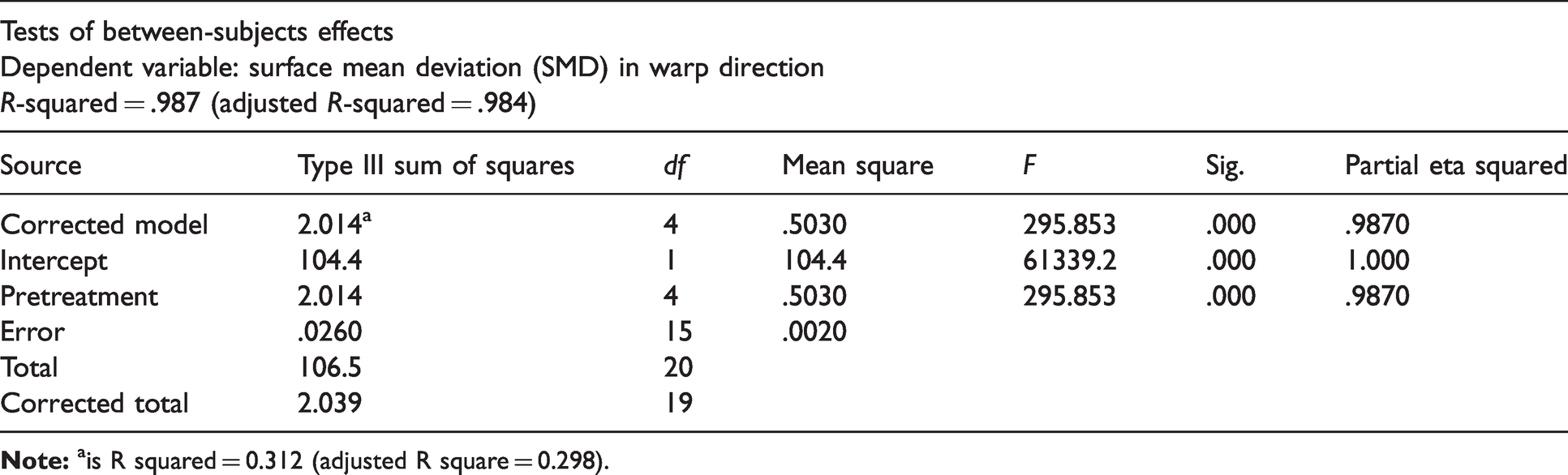
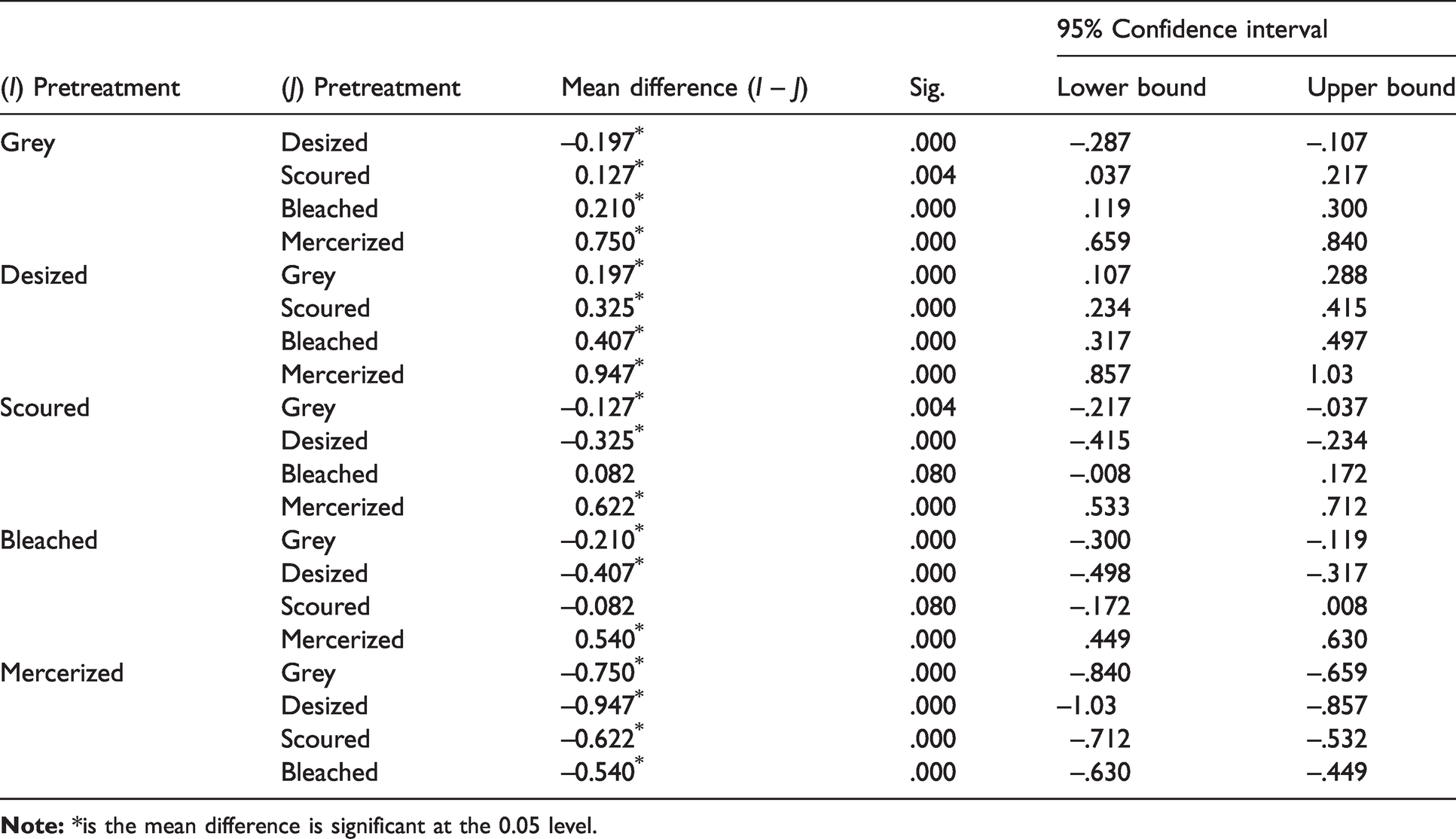
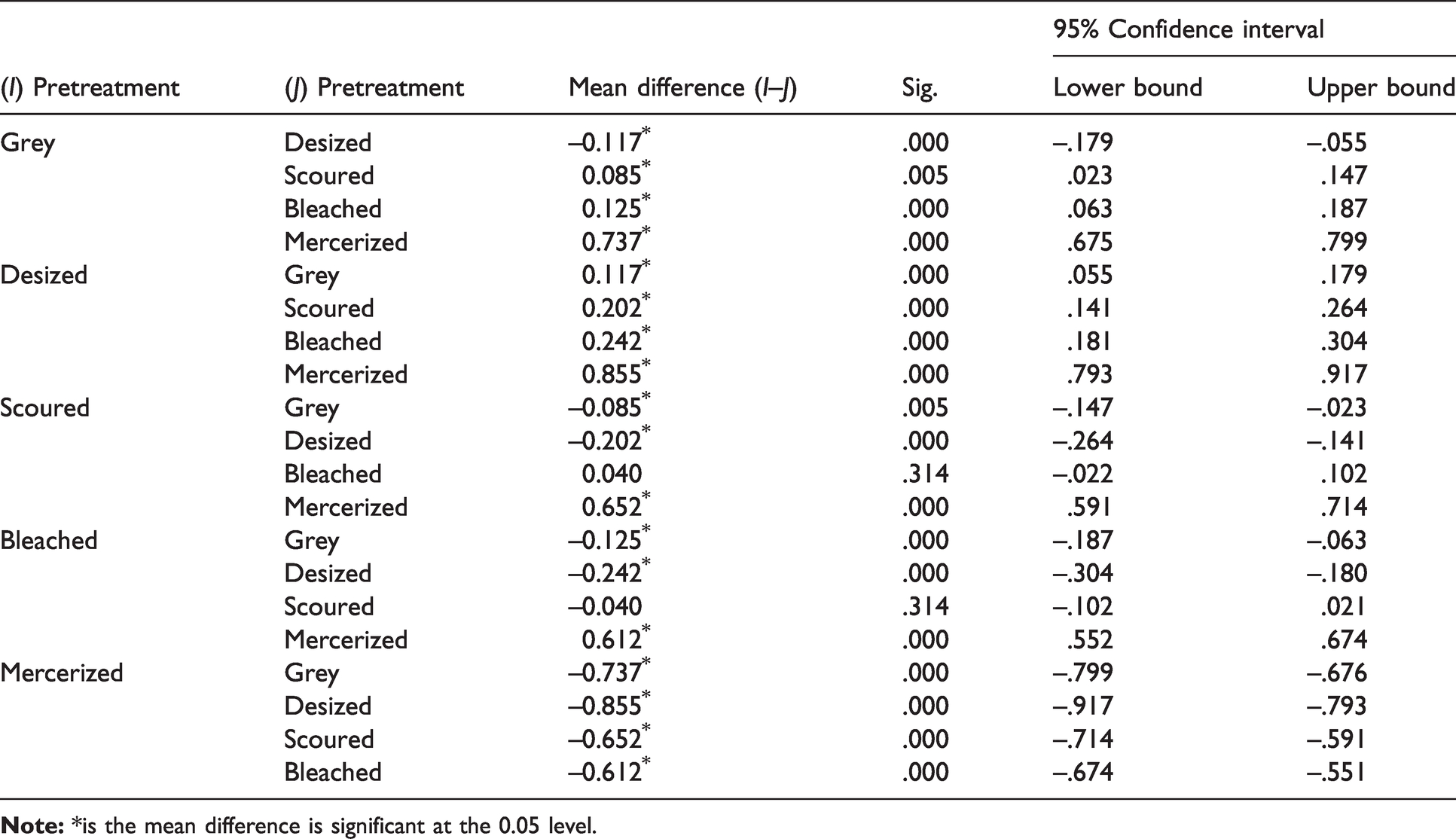
One-way ANOVA is used to evaluate whether there is any evidence that the means of the samples at each stage of treatment differ. The one-way ANOVA for surface roughness value in the weft direction, as shown in Table 3, leads to the conclusion that there is evidence that at least one group of means is different from each treatment process. The mean difference was investigated by using Tukey multiple comparisons.31,32 When the pairwise comparison test results of untreated and treated plain-woven fabrics with different stages of pretreatment are taken into consideration, there is a significant mean difference between untreated and treated plain-woven fabrics in the warp direction. There is a significant mean difference between grey with desizing, grey with scouring, grey with bleaching, grey with mercerizing, desizing with scouring, desizing with bleaching, desizing with mercerization, scouring with mercerization, and scouring with mercerization for plain-woven fabric in the warp direction. Thus, the difference between these averages is statistically significant because this range does not include zero. However, there is not a significant mean difference between scoured with bleached plain fabric in the warp direction, because the P-value is greater than 0.05, namely 0.0825, as seen in Table 4.
Multiple comparisons of surface roughness in the warp direction
Effects of pretreatment on the surface roughness in the weft direction
As shown in Figure 3, the roughness of plain-woven fabric increases in the weft direction for desized fabric compared to greige fabric, as well as for other processed stages. This is because the desizing process has reduced the warp yarn diameter and created higher gaps in the weft direction. This is because, at the desizing stage, the applied starch paste will be removed and create a slack fabric structure. The formed gaps in the fabric structure will have a rougher surface because roughness is quantified by the vertical deviations of a surface from its ideal form. 17 When the roughness of plain-woven fabric is observed at various treatment stages of the scouring, bleaching, and mercerization process, it is reduced in the weft direction. This means that the scoured, bleached, and mercerized fabric surfaces are smoother than those of greige fabrics. The smoothest surface of the fabric is observed for mercerized fabrics compared with other pretreatment process in the weft direction, as shown in Figure 3. Mercerized fabric is smoother than the other treated or untreated samples, because the fiber swells during the mercerizing process to arrange the yarn and fabric structure, resulting in a tight fabric structure. According to the findings of Gupta et al.’s study, 33 the surface characteristics of yarns change after each processing stage. The yarn surface becomes smoother after the pretreatment process, and as a result the treated fabric will be smoother also.

Effects of pretreatment on the surface roughness in the weft direction.
Table 5 shows that statistical analysis can be utilized effectively to describe the surface roughness of plain-woven fabrics in terms of the pretreatment process impacts on the plain-woven fabric weft direction. The adjusted model is significant for surface roughness based on the pretreatment steps in the weft direction, with an F-value of 551.182 (P < 0.000). The P-value is the indicator of the significance level of the test results of the experiments. 30 Values less than 0.05 indicate that the model terms are important (P < 0.05). The effects of the pretreatment process in the weft direction are statistically significant at the 95% confidence interval, with a P-value of 0.000.
One-way analysis of variance for surface roughness in the weft direction

The one-way ANOVA is done to see if there is any evidence that the sample means differ at each stage of treatment. As indicated in Table 5, the one-way ANOVA for surface roughness value in the weft direction leads to the conclusion that at least one group of means is different from each pretreatment stage. This mean difference is investigated by using Tukey multiple comparisons.31,32 Multiple comparisons of untreated and treated plain-woven fabrics with different stages of pretreatment in the weft direction were observed. There is a significant mean difference between untreated and treated plain-woven fabrics in the weft direction. In the weft direction, there is a considerable mean difference between greige and desized, greige with scoured, greige with bleached, greige with mercerized, desized with scoured, desized with bleached, desized with mercerized, scoured with mercerized, and scoured with mercerized. Because this range does not include zero, the difference between these averages is statistically significant. In the weft direction, however, there is no significant mean difference for scoured with bleached plain-woven fabric. Table 6 shows that the P-value is greater than 0.05, namely 0.6525.
Multiple comparisons of surface roughness in the weft direction
Comparison of surface roughness values for each pretreatment stage in the warp and weft directions
Figure 4 shows that the roughness values for greige, scoured, bleached, and mercerized samples are higher in the weft direction than in the warp direction at each stage of the pretreatment process. The reason for this is that there a lower thread density in the weft direction, whereas there is a higher thread density in the warp direction during the sample production. Furthermore, during processing, the warp direction is under tension while the weft direction is not. This reduced waviness in the fabric structure, resulting in a smoother surface in the warp direction than in the weft. Except for the mercerizing process, the surface roughness change from each treatment stage is small in the weft direction and large in the warp direction, because of the removal of starch paste from the warp yarn during the process. According to these findings, the mercerized fabric is highly suggested for the engineering design of many textile and other consumer products that have unique needs in terms of sensitive surface tactile properties since it has a smoother surface than the other treatment process.

Comparison of surface roughness values in the warp and weft directions.
Conclusion
The pretreatment stage affects the surface properties of plain-woven fabrics. When the effect of the pretreatment on the fabric surface was considered, it was observed that the surface roughness values of desized fabric increased, while they decrease for scoured, bleached, and mercerized fabrics. On the other hand, the roughness of the plain-woven fabric decreases at the treatment stages of the scouring, bleaching, and mercerization process. The roughness values for greige, scoured, bleached, and mercerized samples are higher in the weft direction than in the warp direction at each stage of the pretreatment process. Compared to other treatment processes, mercerized fabrics have the smoothest fabric surface. The effects of the pretreatment process are statistically significant at a 95% confidence interval in both the warp and weft directions. According to the pairwise analysis, pretreatment in the warp and weft directions of the fabrics is statistically significant for grey with desizing, grey with scouring, grey with bleaching, grey with mercerizing, desizing with scouring, desizing with bleaching, desizing with mercerization, scouring with mercerization, and bleaching with mercerization, but not for scouring with bleaching. Mercerized fabric is highly recommended for making and designing textile products with unique requirements in terms of tactilely sensitive surface properties.
Footnotes
Acknowledgements
This research was completed with the help of Kombolcha Textile Share Company, located in Kombolcha, Ethiopia. The authors would like to give their heartfelt gratitude to the management and staff members of Kombolcha Textile Share Company for their effort and cooperation.
Declaration of conflicting interests
The author(s) declared no potential conflicts of interest with respect to the research, authorship, and/or publication of this article.
Funding
The author(s) received no financial support for the research, authorship, and/or publication of this article.
