




Abstract
Viscoelastic models are typically employed to investigate the mechanical properties of yarn. In this study, a viscoelastic model was developed to predict the tensile stress–strain relationship of a core/wrapped composite yarn with double filaments. The tensile properties of the yarn were tested, and various stages of the tensile curve were analyzed. Moreover, based on the tensile fracture characteristics, a five-element nonlinear viscoelastic model comprising Kelvin element, Maxwell element, and linear springs was established. Furthermore, the tensile properties of the composite yarns were simulated and calculated using the developed model. Additionally, the stress–strain relationship was fitted using a polynomial on the basis of the established model. The results reveal that the tensile fracture curve of the composite yarn comprises three stages. They are a small strain linear stage, a large strain stage, and a strength fluctuation stage. The viscoelastic tensile model can decently explain the three-stage stress–strain characteristics of the composite yarn tensile curve. The theoretical results were consistent with the experimental results, and the correlation coefficient was greater than 0.999. Based on the results, the proposed model can be employed with high accuracy to predict the tensile properties of a core/wrapped composite yarn with a double filament.
Keywords
At present, filament/staple composite yarns can be produced by a modified ring-spinning system with various forms, such as core spinning, Sirofil spinning, etc. However, yarn structures produced by these two spinning methods exhibit low stability. To be more specific, the staple fibers in the composite yarn tend to slip during the stress–strain process and make almost no contribution to the strength of the composite yarn.1–3 This introduces many restrictions to the subsequent process.
Novel filament/staple composite spinning technology has been rapidly developed to improve the stability of yarn structures. A composite yarn with a three-layer structure comprising double filaments and a staple yarn was proposed in this work. From the inside to the outside of the composite yarn, it is the core yarn layer, core-cover layer, and cover-wrapping layer. One filament was placed in the middle of the staple yarn to form a core layer, the staple fiber formed a core-cover layer, and the other filament was placed on the outside of the staple yarn to form a wrapping layer. The wrapped filament was wound on the surface of the yarn with a spiral structure, which can reduce yarn hairiness and prevent the staple fibers from being pulled out from the composite yarn or worn out, thereby enhancing abrasion resistance and improving yarn strength. In addition, the strength of the composite yarn was also enhanced because the core filament maintained a straight state in the yarn. Overall, this novel composite yarn has broad market application prospects owing to its unique structure and good performance.
The breaking performance of the yarn is not only a critical quality index for evaluating yarns, it is also a crucial aspect that affects the characteristics of fabrics and clothing.4–7 The yarn proposed in this study was composed of a core filament, staple yarn, and wrapped filament. Therefore, the tensile fracture process of this composite yarn was complicated. It is necessary to conduct detailed analysis on the tensile fracture mechanism of this novel type of yarn to provide a theoretical basis for product development and its application.
Yarn can be regarded as a viscoelastic body. Its tensile fracture mechanical property is exhibited as a function of the stress–strain corresponding to time. Generally, the tensile property of the yarn is critically affected by the viscoelastic properties of the fiber and the fiber arrangement in the yarn.8–10 The model commonly used for the research of the tensile fracture mechanism of yarn is a mechanical model composed of a linear spring (Hook’s spring) and a nonlinear dashpot (Newton dashpot), which obeys Newton’s law of viscosity.11–13 Typical representative models are the Maxwell and Kelvin models. The Maxwell model consists of a Hook’s spring and a Newton dashpot in series, whereas the Kelvin model consists of a Hook’s spring and a Newton dashpot in parallel.14–16 With two Hook’s springs and a Newton dashpot, there are two equivalent models. They are a spring and a Kelvin model in series or a spring and a Maxwell model in parallel. These two models can be employed to describe viscoelastic properties of yarns under the condition of small deformation. In addition to rapid elastic deformation and slow elastic deformation of yarn, plastic deformation also exists. Therefore, a four-element model including a Maxwell model and a Kelvin model in series is established. The above two models comprise simple series or parallel connections, which cannot fully illustrate the tensile fracture curves of the yarns. Previous research has also presented other models to enrich the analysis of the yarn-breaking processes. In 1940, a nonlinear spring model was proposed with a variable elastic coefficient.17,18 The Saint–Venant body was introduced as a perfectly plastic solid, which begins to simulate tensile behavior only when the force acting upon it reaches a certain value. 19 These basic models are listed in Table 1.
Viscoelastic models (where
represents stress,
represents strain, E represents spring stiffness coefficient, and
represents viscosity coefficient)
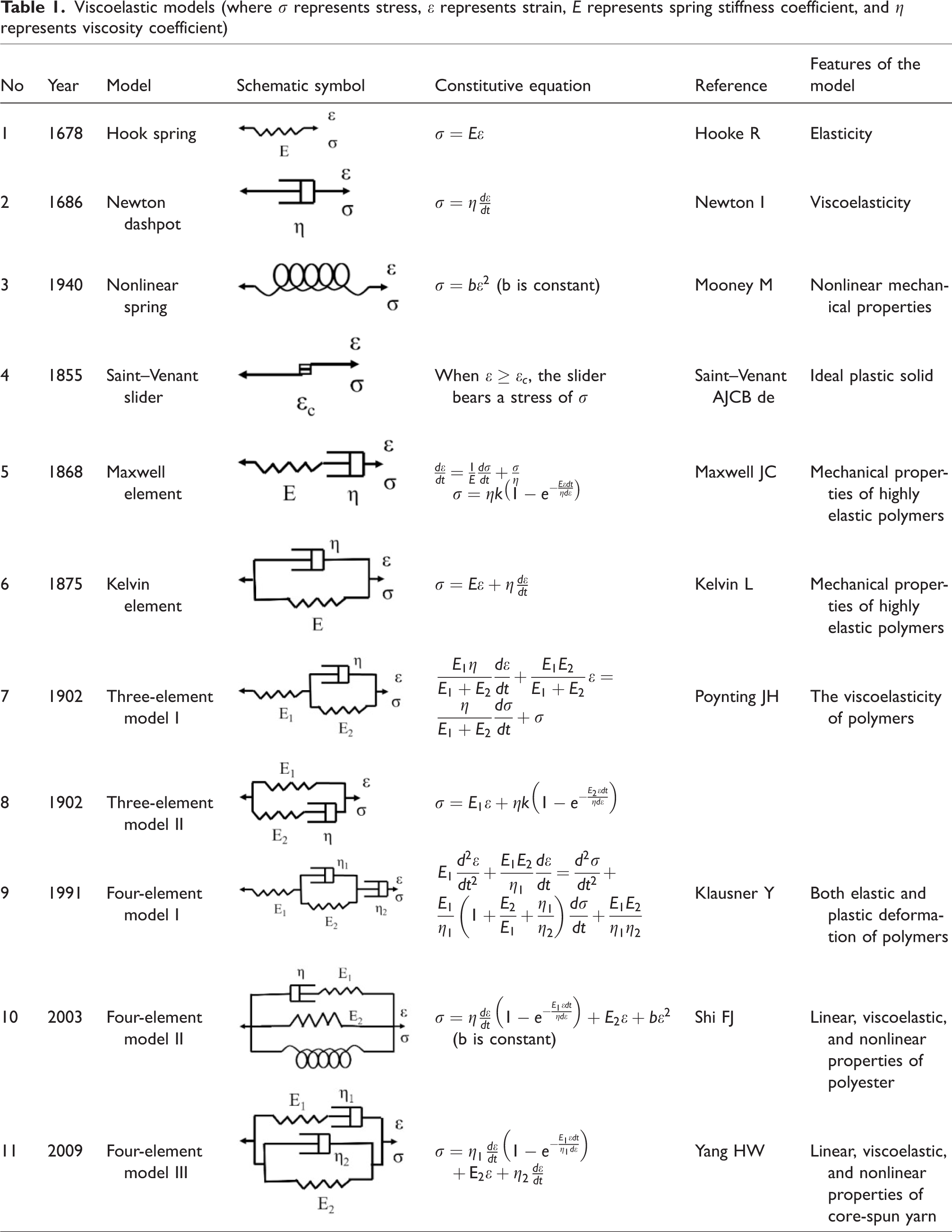
Through different combinations, these models can be employed to obtain a more comprehensive description of viscoelastic behavior of fiber polymers. Some scholars have employed a three-element model composed of a Maxwell model and a nonlinear spring in a parallel form to simulate the tensile stress–strain relationship of various yarns, such as cotton ring-spun yarn and rotor-spun yarn, polyester/cotton-blended yarn, and cotton/spandex core-spun yarn.12,13 Some scholars have predicted the tensile properties of milk fiber, soybean protein yarn and modal/spandex core-spun elastic yarn using a four-element nonlinear viscoelastic model.20–22 It is composed of a Maxwell model, Hook’s spring, and a nonlinear spring in parallel. The theoretical simulation results are in good agreement with the experimental results. Yang et al. 23 established a four-element model with Maxwell and Kelvin models in parallel to predict the tensile properties of core-spun yarn. In addition, the effects of various filament materials (aramid fiber, high-strength polyester fiber, basalt fiber) on the tensile properties of the core-spun yarn were also observed. Fan et al. 24 used three sub-models in parallel including Maxwell model, series model including Maxwell element and Saint–Venant body, and series model including Hook’s spring and Saint–Venant body to study the tensile properties and breaking features of the tri-component filament and staple fiber composite yarns. The three models were in parallel, forming a seven-element model to theoretically simulate the tensile curve of the tri-component filament/staple composite yarn. As the model is based on a theoretical hypothesis and no experiments have been conducted to verify its accuracy, it cannot be quantitatively employed for yarn quality prediction and process parameter design in practical production processes. From simple to complex, the above-mentioned models (listed in Table 1) simulate and analyze the tensile fracture curves of yarns with different components and structures. However, a theoretical model that can directly simulate and predict the tensile stress–strain curve of a core/wrapped composite yarn composed of double filaments and staple yarn remains to be developed.
In this study, the tensile fracture mechanism of a core/wrapped composite yarn with a double filament is investigated using a viscoelastic model. A theoretical viscoelastic mechanical model was developed to predict the stress–strain relationship of composite yarns. The accuracy and rationality of the model were verified by the experimental results. The novelty of this paper is to establish the viscoelastic tensile model of the above-mentioned composite yarn by means of mechanical analysis and experiment. This study has great potential to provide a theoretical and experimental basis for the tensile fracture mechanism of core/wrapped composite yarns with double filaments, which is helpful for developing novel yarns.
Experiment
Experimental materials
The unit weight of the roving combing cotton was 4.6 g/10m. A core/wrapped composite yarn with a double filament was spun onto a TH798 spinning frame. The wrapped filament was placed on the right side of the staple fiber with a gauge of 5 mm. The linear density of the composite yarn was 18.4 tex and the twist factor was 350. The linear density of the staple yarn was 10.26 tex, and that of the nylon filament was 3.3 tex (30D/12f) (Prutex nylon Co., Ltd.).
Test of yarns
In this study, using a tracer fiber technique, the three-dimensional trajectory of both core filament and wrapped filament in a core/wrapped composite yarn with a double filament was tested with the Nikon SMZ80 (Nikon Co., Ltd). Yarns were immersed into a liquid with the same refractive index as that of the cotton for at least 24 hours, so as to be completely soaked. In this way, the white cotton fibers composing the yarn become almost optically dissolved and the colored tracer fibers can be readily seen.
The tensile fracture properties of the composite yarn, filament, and staple yarn were tested using MTS XL-2 V3.0 (MTS Systems (China) Co., Ltd., Guangzhou, Guangdong, China). The tensile speed was 500 mm/min, gauge was 500 mm, and pretension was 0.5 cN/tex. Each sample was tested 30 times according to ASTM D1578: Standard Test Method for Breaking Strength of Yarn in Skein Form and GB/T 3916-1997: Textiles–Yarns from Packages–Determination of Single-end Breaking Force and Elongation at Break.
Spinning of core/wrapped composite yarn with double filament
A core/wrapped composite yarn with a double filament consists of a wrapped filament, core filament, and staple yarn. The spinning process was as follows. The staple yarn entered the long and short apron drafting mechanisms through the feeding mechanism of the spinning frame. The fiber strand was then drawn and fined according to a certain draft ratio. The core and wrapped filaments were fed from the front roller through different paths. The core filament was placed in the middle of the staple fibers, whereas the wrapped filament was fed into the grooves engraved on the surface of the upper roller at a certain distance from the staple yarn. Tri-component fibers are output from the front nipper of the front roller, which forms two twisting triangles, as shown in Figure 1. A small twisting triangle is formed between the staple yarn and the core filament, whereas a large twisting triangle is formed between the wrapped filament and the core-spun yarn. The staple yarn output from the front roller nipper remained flat. Owing to the twisting effect formed by the rotation of the traveler, the core filament was covered by staple fibers, forming a core-spun yarn. The core-spun yarn and wrapped filament with a certain spacing converged to form a composite yarn under the force of a large twisting triangle. Finally, the composite yarn was wound onto the bobbin rotating along the high-speed rotating spindle. Figure 2 presents the longitudinal, sectional, and perspective views of the core/wrapped composite yarn with a double filament.
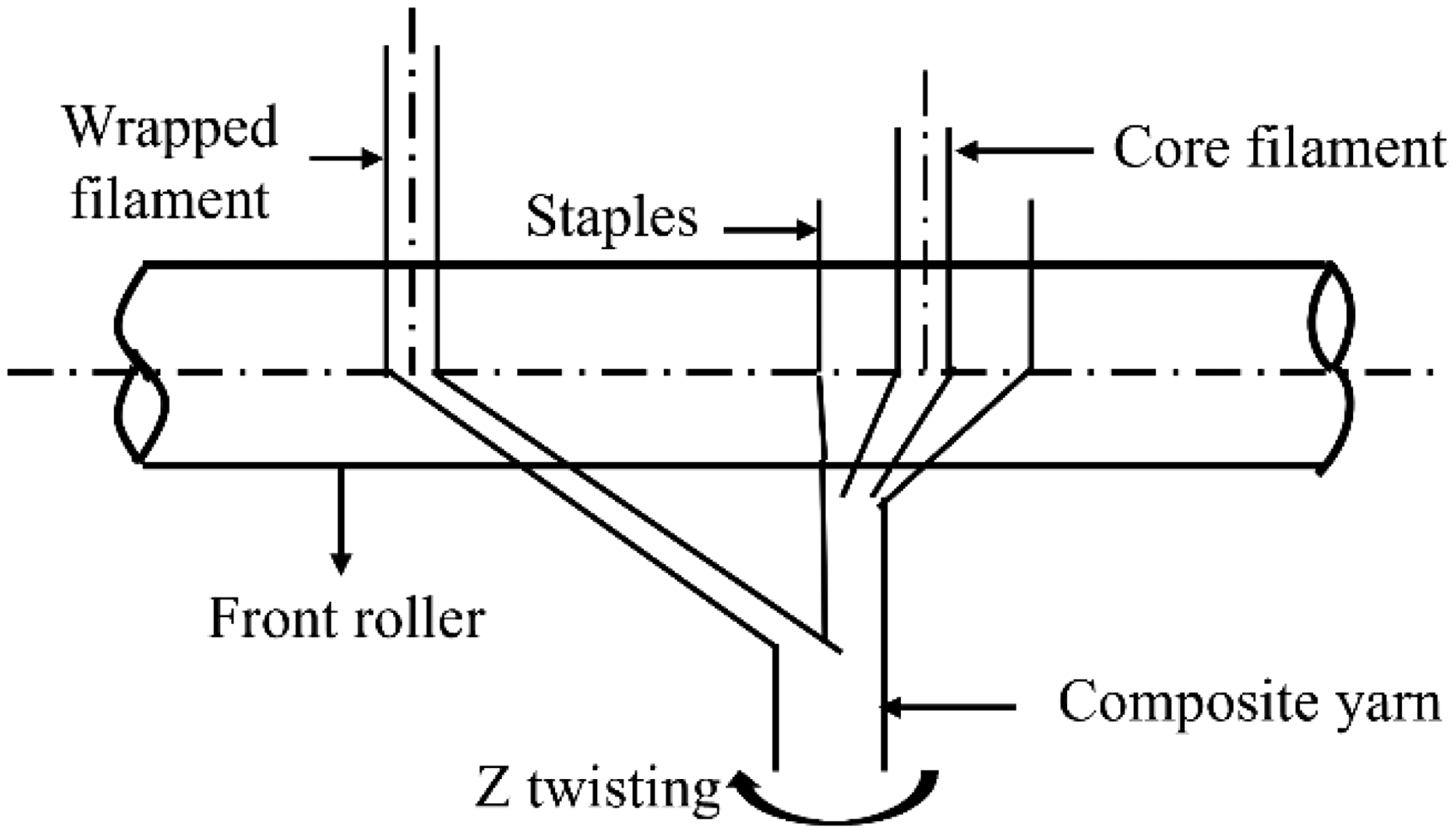
Twisting triangle of the composite yarn.
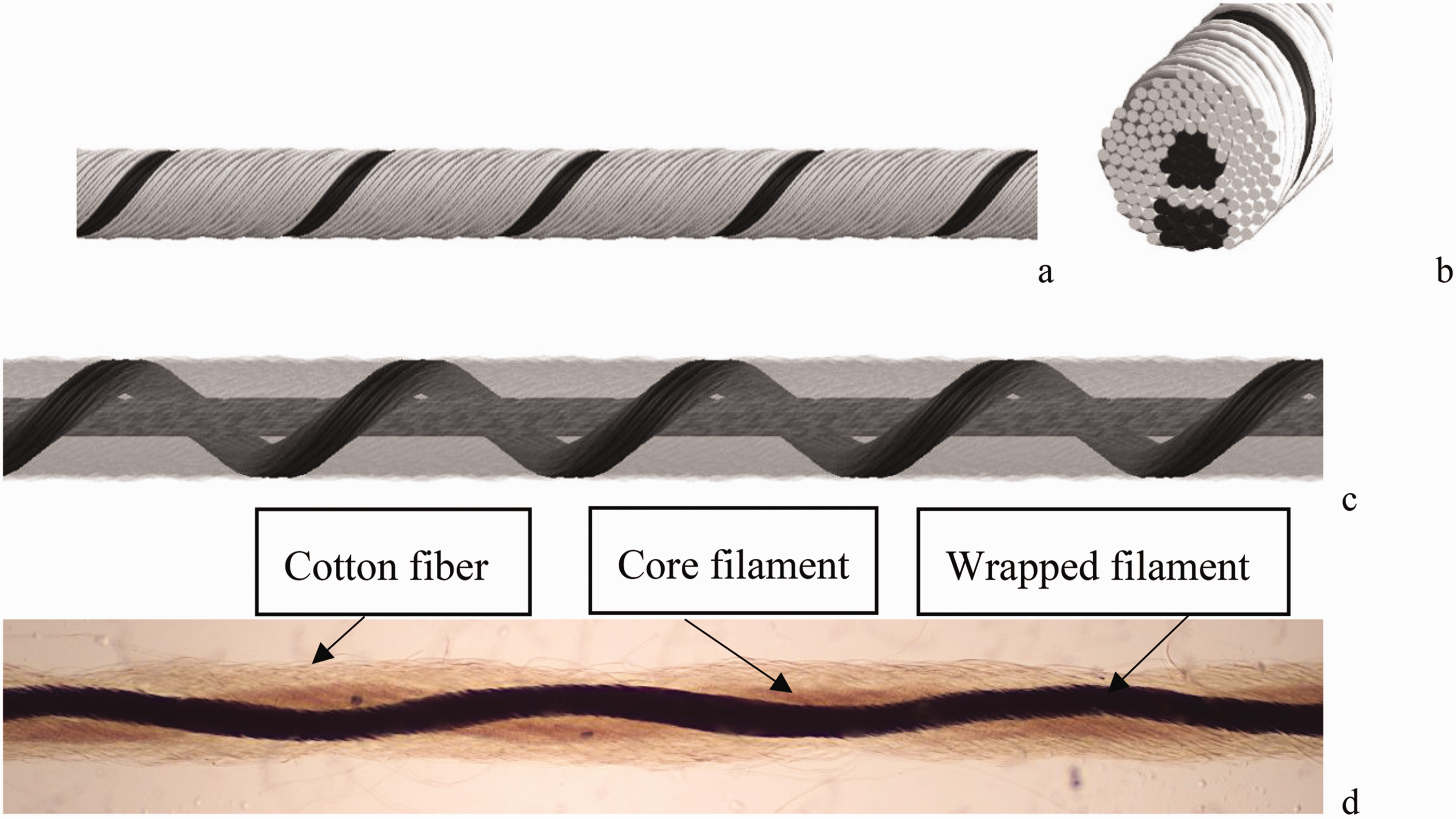
Longitudinal view (a), sectional view (b) and perspective view (c) and photo taken by microscope with the tracer fiber technique of the core/wrapped composite yarn with double filament.
Viscoelastic model
Analysis of tension curve of composite yarn
Figure 3 illustrates the stress–strain curves of the core/wrapped composite yarn with a double filament, nylon filament, and staple yarn. To analyze the tensile process of the composite yarn, A, B, C, and D were marked in the tensile curve of the composite yarn, dividing the curve into three regions. In the initial region, namely curve AB, the stress is approximately proportional to the strain. The tensile behavior of the composite yarn can be regarded as full elastic deformation in this region. With a constant increase in elongation, the composite yarn strength increased significantly in the curved BC region. In the curve CD region, the strength of the composite yarn exhibited a slight fluctuation, and the curve exhibited multiple peaks; however, the overall strength showed an increasing trend. Finally, the yarn broke at point D and the strength suddenly disappeared.
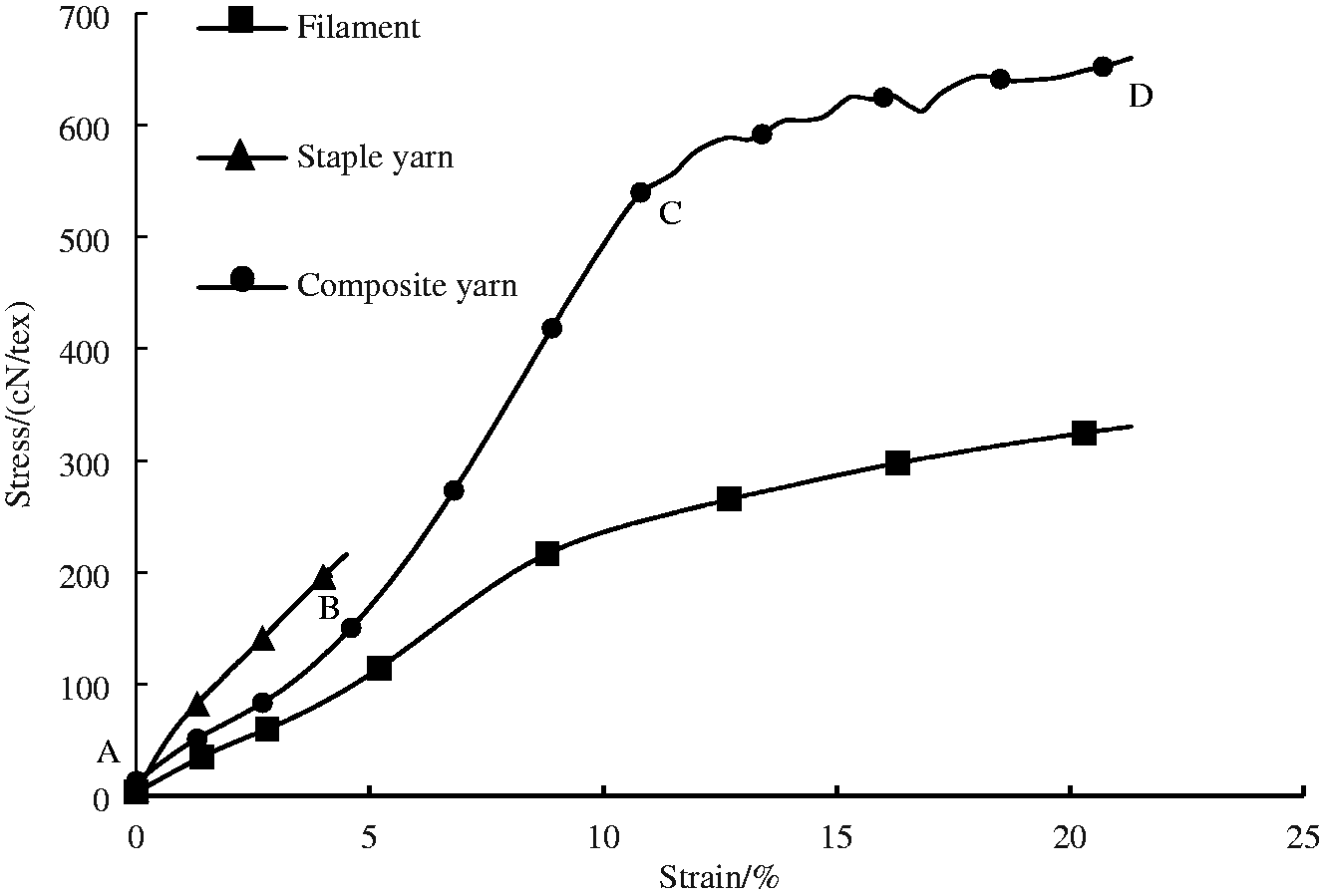
Stress–strain curves of composite yarn, nylon filament and staple yarn.
To summarize the above analysis of the tensile curve of the composite yarn, the tensile process can be divided into three stages: (1) This is the small strain stage. The initial stage of the tensile curve of the composite yarn was similar to that of the nylon filament. This is primarily because at the beginning of the tensile process, the core filament supplies most of the yarn tensile force, whereas the fiber strands and wrapped filament contribute to the strength by the friction caused by the state changing from bending to straight. (2) This is the large strain stage. With an increase in the elongation, the stress increases rapidly. The tensile curve of the composite yarn was similar to that of the staple yarn. This is because the staple yarn and wrapped filament contribute most of the strength after changing from the bent state to the straight state. (3) This is the strength fluctuation stage: some monofilaments break; however, because of the friction between stable fibers and the elastic elongation of the filament, the yarn strength maintains a slight fluctuation and tends to increase continually until the yarn breaks.
Viscoelastic model
A core/wrapped composite yarn with a double filament comprised the core-spun yarn and the wrapped filament, as depicted in Figure 2.
The core-spun part is a core–sheath structure in which the core filament is covered with staple fibers. The core filament can be equivalent to Hook’s spring because it has high modulus low energy dissipation. The stretched staple fibers have elastic deformation and fiber-to-fiber slippage, which can be regarded as viscoelastic body and equivalent to Newton’s dashpot. In the core–sheath structure, the core filament and staple fibers can be regarded as a parallel arrangement. Therefore, this core–sheath structure is equivalent to a parallel combination of Hook’s spring and Newton’s dashpot, namely the Kelvin model.
Furthermore, at the interface of the core–sheath of the core-spun yarn, when the yarn bears tensile force, the fibers slip and dissipate the deformation energy because of twisting, as expressed by the Newton dashpot. In addition, when the tensile force disappears, the orientation change of the fibers during deformation can be partially restored, as expressed by the linear spring. Therefore, the additional effect of the core–sheath structure can be regarded as a linear spring and Newton dashpot in series, namely, the Maxwell model.
The wrapped filament can be considered a complete elastic body, which is equivalent to a linear spring.
Accordingly, the viscoelastic tensile model of the composite yarn can be represented by five elements: a Kelvin element, Maxwell element, and linear spring in parallel, as shown in Figure 4.
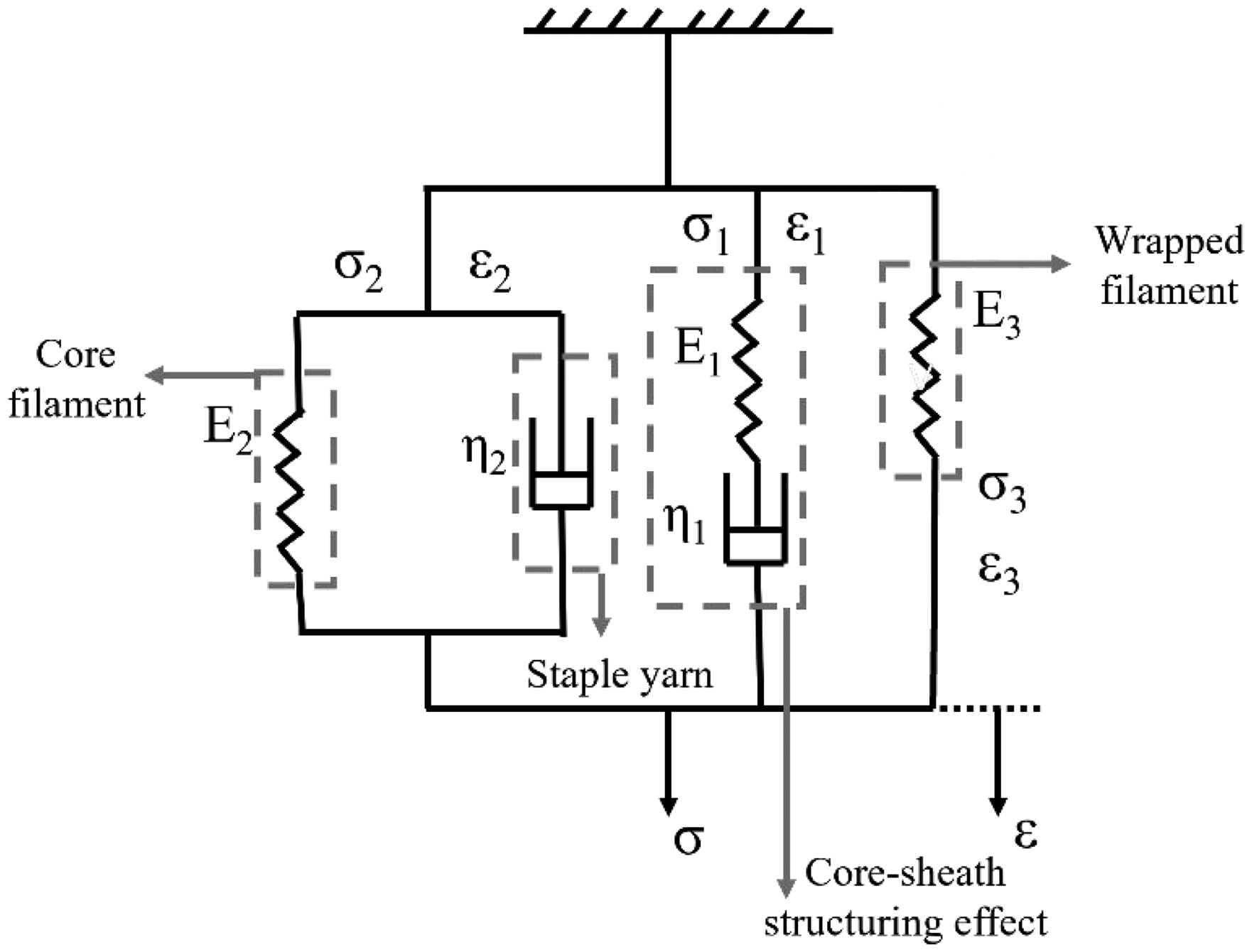
Viscoelastic tension model of composite yarn with five elements.
Wherein the above figure, assuming that E1 denotes the elastic modulus of the core–sheath structuring effect (Maxwell element), 
Let k be the stress–strain rate; equation (2) is obtained when the composite yarn is stretched at a constant speed.

The stress–strain relationship of the core-spun yarn applies the Kelvin model, and its constitutive relationship is expressed by equation (3).

The stress–strain relationship of the core–sheath structuring effect can be regarded as that of the Maxwell model, and its constitutive relation is given by equation (4).

Then by changing the equation form, equation (5) can be obtained.

Integrate both sides of equation (5) to obtain equation (6).

When 
The stress–strain relationship of the wrapped filament is equivalent to that of Hook’s spring, and its constitutive relation is expressed by equation (8).

Equation (9) can be demonstrated according to the parallel relation shown in Figure 3.

Based on equations (3), (7), (8), and (9), the stress–strain relationship of the core/wrapped composite yarn with double filaments can be determined using equation (10).

Model solution
In the yarn tension test, the pretension coefficient was 0.5 cN/tex. The composite yarn fineness was 18.4 tex. Thus, the pretension was 9.2 cN. Substituting pretension into equation (10), equation (11) can be revised as follows:

Simplify equation (11) as equation (12).

To simplify the calculation, we employed the Taylor formula to expand the exponential term, as shown in equation (13).

Substituting equation 13 into equation 12, equation 14. is obtained

Seven equations can be obtained when substituting seven stain values at composite yarn tensile curve, namely 0.1%, 3%, 7%, 11%, 15%, 18%, and 21%, respectively, and the corresponding stress into equation (14). These seven equations can be solved through the scipy.optimize.root function in python (detailed code is shown in the appendix). Accordingly, seven parameters, namely 
Prediction of composite yarn strength
The theoretical tensile curve of a core/wrapped composite yarn with a double filament can be obtained according to equation (15). A comparison between the theoretical and experimental tensile curves is shown in Figure 5.
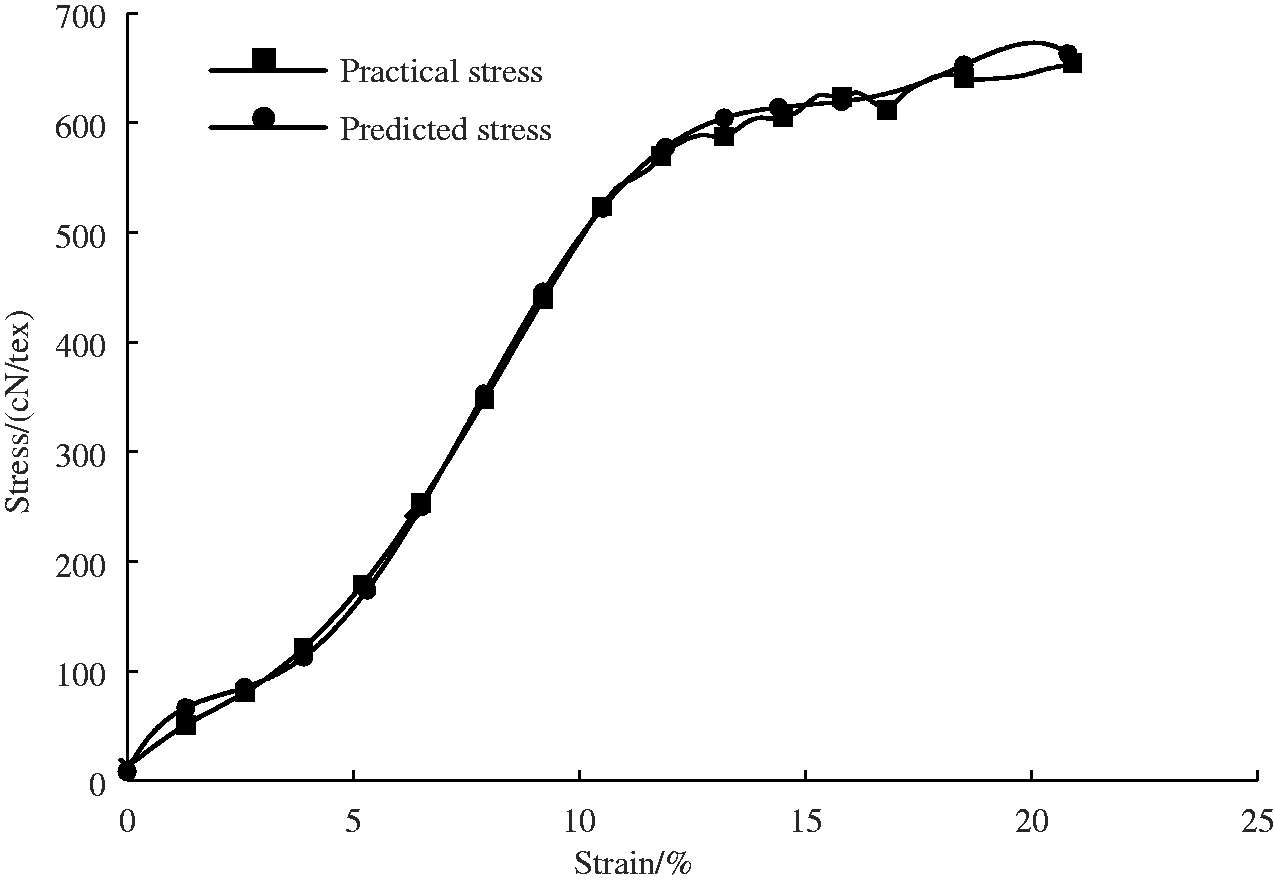
Comparison between simulation and experiment of composite yarn.
The correlation coefficient between the predicted strength and measured strength of the composite yarn is 0.999, according to the correlation simulation model of Excel. A conclusion can be obtained that the data calculated by the model maintained good correspondence with the measured data. Nevertheless, there is a slight distinction owing to experimental errors. It also demonstrates the accuracy and efficiency of the five-element viscoelastic model, which can be employed to predict the tensile properties of a core/wrapped composite yarn with double filaments.
Conclusion
The core/wrapped composite yarn is composed of staple fiber, core filament and wrapped filament. In terms of performance, it has both the good wearability of short fiber and functionality of filament. In the structure, there are core filaments and spirally arranged short fibers inside, and wrapped filaments outside. The structure is compact, which improves the structural stability and abrasion resistance of the yarn and corresponding fabrics. Models to predict the strength of the composite structure are of great significance to improve the further development and characterization of products. However, there is no relevant research. In this paper, a viscoelastic mechanical model was proposed to forecast the tensile properties of a core/wrapped composite yarn with a double filament, according to an experimental and analytical study of the composite yarn. Accordingly, a five-element nonlinear viscoelastic tensile model composed of Kelvin element, Maxwell element, and linear springs in parallel was established. A polynomial function corresponding to the stress–strain relationship of the composite yarn was constructed to analyze and predict the practical tensile curve. The theoretical predictions were consistent with the experimental results. The yield stress derived from the model accurately reflected the different stages of the experimental tensile curve. The proposed five-element viscoelastic tensile model can provide theoretical and experimental reference values for the tensile fracture mechanism of core/wrapped composite yarns with double filaments. Moreover, a novel concept for research on the yarn tensile fracture mechanism is proposed.
Footnotes
Declaration of conflicting interests
The author(s) declared no potential conflicts of interest with respect to the research, authorship, and/or publication of this article.
Funding
The author(s) received no financial support for the research, authorship, and/or publication of this article.
