



Abstract
With the serious impact of fossil fuels on the environment and the rapid development of the global economy, the development of clean and usable energy storage devices has become one of the most important themes of sustainable development in the world today. Supercapacitors, known as ultracapacitors, have been supposed to be one of the most promising candidates to meet the requirements of human sustainable development, due to their advantages such as high capacity, high power density, high charging/discharging speed, long cycle life, and low processing cost. However, the low energy density of supercapacitors limits their large-scale application. Therefore, it is of great significance to develop high energy density supercapacitors and use them as power sources for practical devices. Conductive polymer-based electrode materials have unique advantages such as high theoretical capacitance, good conductivity, and good flexibility, and have high potential in supercapacitors. The research on conductive polymer-based electrode materials has promoted the rapid development of the field of supercapacitors. This review summarizes recent research progress on conductive polymers (including polypyrrole, polyaniline, and polythiophene), conductive polymer-based binary composites, and conductive polymer-based ternary and quaternary composites for supercapacitor electrodes. Furthermore, a summary of the use of conductive polymer-based textiles and fibers for flexible supercapacitors is also presented, along with the current challenges and future perspectives for conductive polymer-based supercapacitors.
With the development of a series of portable electronic devices such as smartphones and wearable devices, how to achieve low-carbon environmental protection has become a big problem in today’s era. 1 In electrochemical energy storage systems, lithium-ion batteries and potassium-ion batteries are widely used in power grids, electric vehicles, and other industries. However, the low power density and unstable cycle life of batteries hinder their practical application.2–4 Supercapacitors also called ultracapacitors or electrochemical capacitors can be fully charged/discharged in only a few seconds, resulting in very high power density uptake or delivery (10 kW kg−1).5,6 Supercapacitors can well fill the power/energy gap between traditional dielectric capacitors with large output power and batteries with high energy storage capacity, which is very important for energy storage and recovery.7–9 In short, supercapacitors have the greatest potential in the field of energy storage devices due to their high power density, long cycle life, and fast charging/discharging speed, which make them widely used in many fields such as smart textiles, electronics, aerospace, and vehicles.10–12
Introduction of the mechanisms of supercapacitors
Supercapacitors mainly consist of electrode materials, electrolytes, current collectors, and separators. 13 The positive and negative electrodes are immersed in the electrolyte solution, separated by a diaphragm to prevent electrical contact, and play a key role in the performance of the supercapacitor. The high performance of supercapacitors is closely related to their energy storage principle, which can be divided into two types: electrochemical double layer capacitances (EDLCs) and pseudocapacitors.14,15
The energy storage mechanism of EDLCs is based on the electrostatic interaction between the ions on the surface of the active electrode material and the electrolyte, namely the rapid adsorption/desorption process,16,17 as shown in Figure 1(a). The much faster charge-discharge process can occur within seconds, and over 100,000 cycles can undergo in EDLC systems. A space charge layer in an electrode, a diffusive layer in an electrolyte, and a compact Helmholtz layer are included in EDLCs, and its thickness is approximately 1 nm.6,18 The performance of EDLCs depends on the electrochemical activity and kinetics of the electrodes. Therefore, when designing high-performance double layer capacitors, electrode materials with high specific surface area, large porosity, and proper pore distribution are required. Carbon-based materials (carbon nanotubes (CNTs), activated carbon (AC), etc.) are considered to be ideal electrode materials for EDLCs because they have unique properties such as controlled porous structure, high conductivity, large surface area, etc. 19 Because of the unique energy storage mechanism of EDLCs, they have better cycle stability than pseudocapacitors. The main drawback of EDLCs is their low energy density.
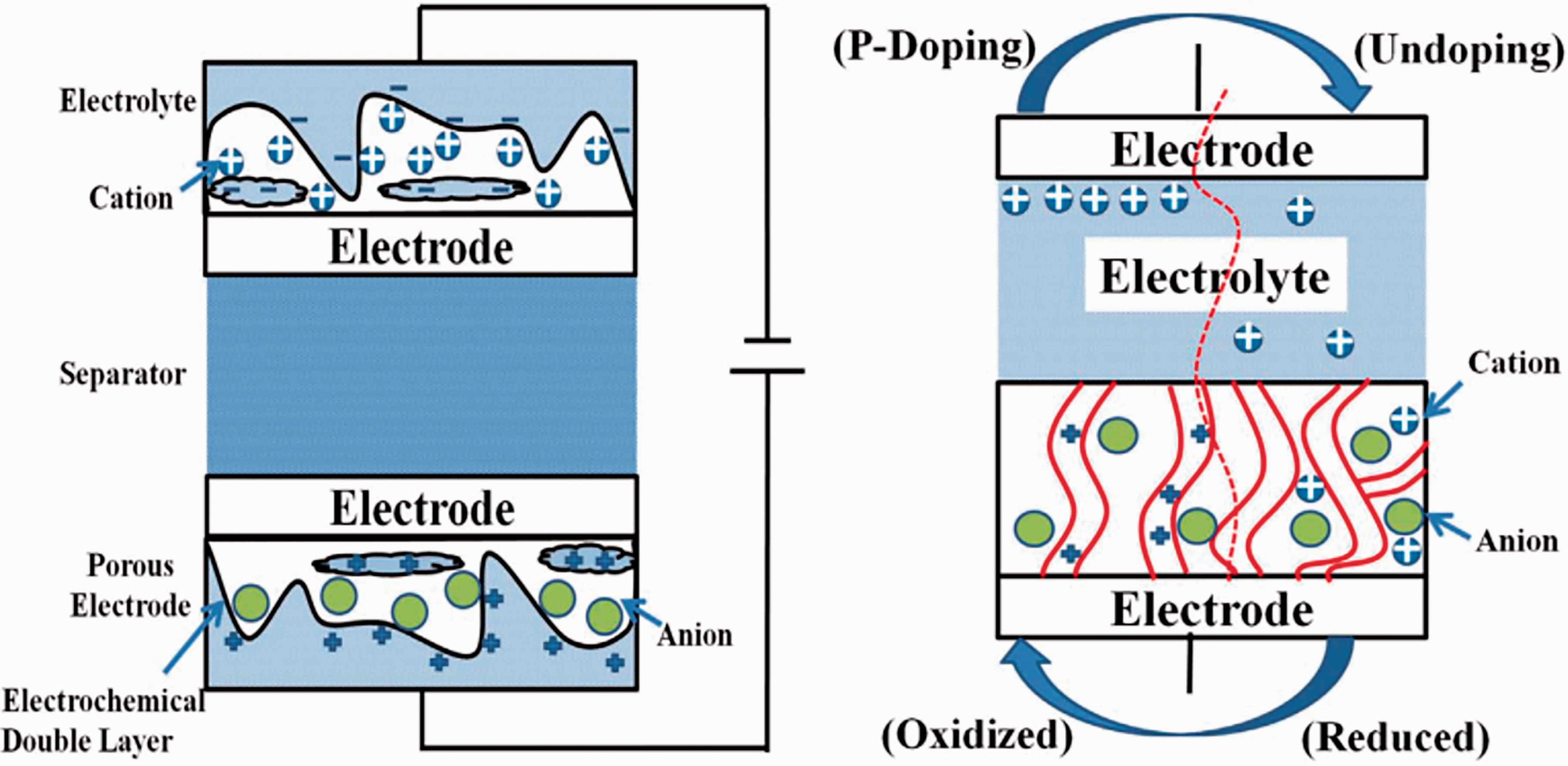
A schematic diagram illustrating the operation principles of: (a) electric double layer capacitor (EDLC) and (b) pseudo supercapacitor (PSC). 23
For pseudocapacitors, the energy storage mechanism is via a quick and reversible Faradaic redox reaction on the surface and bulk at the vicinity of the surface between electrode materials and electrolyte ions, 20 as shown in Figure 1(b). In general, pseudocapacitors can have a larger storage capacity than EDLCs, but their charge-discharge rate is slower than that of EDLCs, as in pseudocapacitors the energy storage process occurs both in the surface of electrode materials and in the bulk of electrode materials, while in EDLCs the charge-discharge process only occurs on the surface of electrode materials. 21 Conductive polymers (CPs) and metal oxides especially transition metal oxides are common materials used for pseudocapacitors. 22
Performance parameters of supercapacitor electrode materials
The electrochemical performance of supercapacitors is mainly characterized by specific capacitance, energy density, and power density, as well as other parameters including equivalent series resistance, self-discharge, and cycle life. 24 Typically, electrochemical performances of supercapacitors are mainly characterized by the following methods: galvanostatic charge-discharge (GCD), cyclic voltammetry (CV), and electrochemical impedance spectroscopy (EIS).
For the GCD method, the specific capacitance can be calculated from the constant current charge-discharge curve with equation (1):
25

For the CV method, the specific capacitance can be calculated from CV curves with equation (2):
26

In recent years, the research on pseudocapacitor electrode materials has mainly focused on two kinds of materials. (a) Transition metal oxides and hydroxides, such as MnO2, Co3O4, Co(OH)2, NiCo2O4, V2O5, etc.; (b) CPs, mainly including polypyrrole (PPy), polyaniline (PANI), polythiophene (PTh) and their derivatives. Compared with transition metal oxides or hydroxides, CPs have attracted much attention because of their theoretical specific capacitance, conductivity, environmental stability, low cost, and ease of mass production.28,29 However, the biggest disadvantage of CPs electrode materials is that their capacitive performance will attenuate significantly in the process of charge-discharge. This is because the CPs in the process of charge-discharge often cause a swelling and shrinkage phenomenon; this phenomenon will lead to CP-based electrodes in the process of recycling, their mechanical properties becoming worse, and capacitance performance decline. 30 To improve the performance of CP-based supercapacitors, researchers try to synthesize binary composite materials such as CP metal oxides, CP carbon materials, and even ternary quaternary composites as active electrode materials of supercapacitors to improve the electrochemical performance of supercapacitors through synergistic effects.
Several reviews on supercapacitor electrode active materials have been published in recent years. For example, Zhang et al. 8 reviewed the important role of flexible supercapacitor electrode materials and device structures in the preparation of energy storage devices with high energy density and high-power density. Du et al. 31 reviewed the advantages and disadvantages of five graphene-based materials for flexible supercapacitors and their recent advances for flexible electrodes, including graphene quantum dots, graphene fibers, graphene films, carbene hydrogels and graphene aerogels. Zhang et al. 32 reviewed the synthesis methods of MnO2/carbon composites as electrode materials for supercapacitors and the research status in recent years. Liu et al. 33 gave a comprehensive review of the design and improvement of carbon cloth as a high-performance electrode for supercapacitors. Cai et al. 34 have made a comprehensive review of the structural characteristics and mechanisms of metal organic framework (MOF)-derived heterostructures, and also reviewed the classification and synthesis strategies of MOF-derived heterostructures and their recent progress in supercapacitors. Luo et al. 35 reviewed the latest developments in the study of supercapacitors based on MXene/CP composites, including material preparation, electrode materials, symmetric supercapacitors, and asymmetric supercapacitors. Meng et al. 6 reviewed the main CP materials used in supercapacitors, including PANI, PPy, PTh, and PTh derivatives, as well as the composites prepared based on these materials. They also compared CPs with other types of ultracapacitor materials and noted that CP capacitors exhibited excellent specific energy but poor cycle life compared with carbon-based ultracapacitors (double-layer capacitors). From what has been mentioned above, it can be seen that although there are some reviews on conductive polymer-based supercapacitor electrodes, only Meng et al. 6 have given a relatively comprehensive review. As we know, recent research progress in this field is very rapid. Therefore, in this work, we selected several typical CPs, such as PPy, PANI and PTh, and summarized the latest research progress of CPs and carbon materials (graphene (GN), CNTs, carbon fibers, metal oxides, etc.) and other materials in the preparation of binary, three-component, and four-component composites, and the application of CP-based textiles and fibers in flexible supercapacitors. Finally, the future challenges and research directions in this field are pointed out.
Conductive polymers
The conductive polymer material is one of the most common electrode materials for pseudocapacitors. The capacitance of a supercapacitor with conductive polymer as the electrode material consists of two parts, one is from the double-layer capacitance, and the other is from the reversible P-type or N-type doping or de-doping redox reaction of the conductive polymer in the process of charge and discharge. At present, the common conductive polymer electrode materials mainly include PANI, PPy, PTh, and so on.
Polyaniline
PANI is composed of an oxidation unit (–B–NH=Q=N–) and reduction unit (–B–NH–B–NH–). B and Q represent the benzene ring and quinone ring, respectively, as shown in Figure 2(a). PANI has good physical and chemical stability, high redox pseudocapacitance characteristics, unique proton acid doping/de-doping mechanism, and cheap and easily available raw materials, which has become a research hotspot of electrode materials for supercapacitors in recent years.36,37 However, with the extension of charge-discharge cycle time, its volume is prone to change, resulting in expansion and contraction of its structure, which makes its cycle stability poor and it cannot meet people's requirements for a more stable molecular structure, higher power/energy density and more N-active centers, 38 which greatly limits its further application as electrode material for supercapacitors. The electrochemical capacitance characteristics of PANI electrode materials can be improved effectively by chemical or electrochemical doping modification and the composite of polyaniline electrode materials with transition metal ions and carbon-based materials, and the relatively poor cyclic stability can be improved.
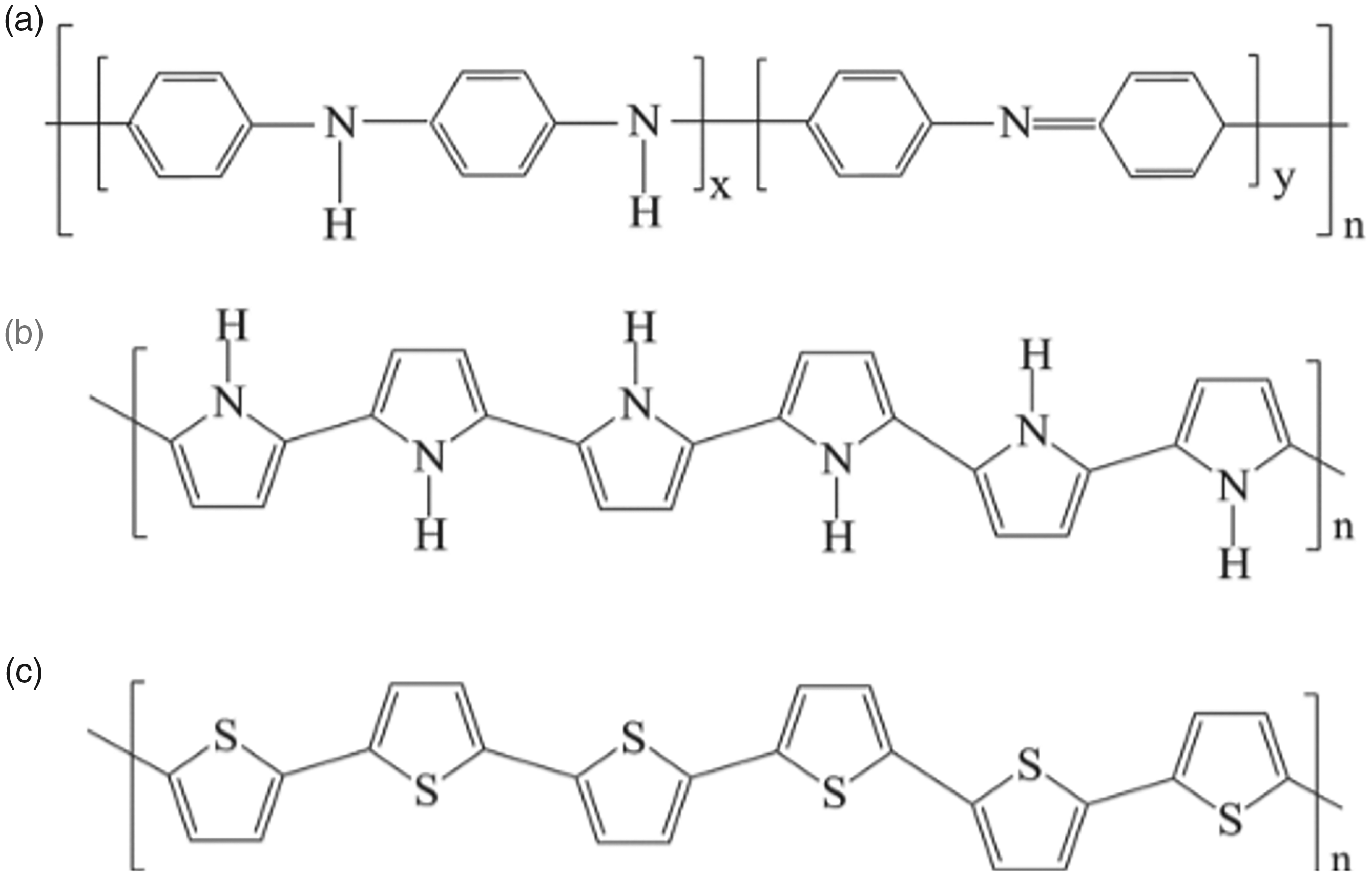
Chemical structure of (a) polyaniline (PANI) (x + y = 1); (b) polypyrrole (PPy); and (c) polythiophene (PTh).
Polypyrrole
PPy consists of the 2, 5-coupled structure of two adjacent pyrrole single rings forming a repeating unit, as shown in Figure 2(b), from the polymerization of pyrrole monomer by electrochemical oxidation or chemical oxidation. 39 PPy has a coplanar conjugated structure with alternating carbon–carbon single and double bonds. It is generally believed that PPy's chain structure is a planar arrangement of pyrrole units in α–α, α–β, and β–β crosslinking. In fact, only part of pyrrole units exists in this ideal form. In most cases, pyrrole monomers grow in three dimensions during polymerization. The surface morphology of PPy is closely related to polymerization conditions such as polymerization temperature, polymerization potential, and molar ratio of pyrrole monomer and dopant. 40 PPy is also a good pseudocapacitor anode material that has the advantages of facile synthesis and high capacitance performance. However, like other pseudocapacitor materials, the rate performance of PPy is not satisfactory due to poor conductivity, and the cycle stability needs to be improved. 41 Materials such as carbon and metal oxides also have various excellent electrochemical properties, which can make up for the lack of PPy performance through synergistic interaction. Therefore, it is necessary to study PPy/carbon composites PPy/metal oxide composites, as well as other PPy-based composites.
Polythiophene
PTh is composed of a plurality of five-membered heterocyclic rings with the same structure as PPy, as shown in Figure 2(c). The electrochemical performance of PTh is affected by many factors, including its synthesis method, substrate, morphology, etc. At present, the performance of PTh-based supercapacitors has been greatly improved, but the electrochemical performance of PTh is still inferior to that of PANI and PPy due to the characteristics of fast power density loss and low specific capacitance. 42 Therefore, to make up for the lack of electrochemical performance of PTh, researchers need to explore other properties of PTh.
PPy, PANI, PTh and their derivatives are synthesized in similar ways. It is usually electrochemical oxidation polymerization and chemical oxidation polymerization. Under the action of an oxidizing agent (ammonium persulfate, potassium persulfate, potassium dichromate, ferric chloride, etc.), the monomer oxidation into cationic free radical, two cationic collisions combined to generate double cationic dimer, through disproportionation to become an electrically neutral dimer, dimer and cationic free radical collision into trimer cationic free radical, after disproportionation to generate electrically neutral trimer. The conjugated long molecular chain polymer is formed by oxidation polymerization. Under the same conditions, the monomer concentration is very low, which is not conducive to chain growth reaction, and it is difficult to generate high molecular weight conductive polymer, and the conductivity of conductive polymer is related to the length of the molecular chain. 43 According to quantum chemistry theory, the longer the conjugated molecular chain is, the lower its electron activation energy will be. Under the action of the electric field, it is easy to form charge carriers. Meanwhile, the longer the conjugated molecular chain is, it is also conducive to the migration of charge carriers along the molecular chain. However, for a certain initiation system, the chain growth reaction will not continue indefinitely with the increase of monomer concentration. When the amount of oxidant is fixed, the molecular chain length of conducting polymer will not continue to increase when the monomer concentration increases to a certain extent, so the conductivity will not continue to increase. When the monomer concentration is too large, it is easy to produce some side reactions, which is not conducive to the formation of high conductivity conductive polymer. Therefore, it is important to select the appropriate monomer concentration for the preparation of conductive polymers with excellent properties. 44 During the preparation of conductive polymer matrix composites, the monomer is adsorbed on the surface of other materials through the interface adsorption of solid and liquid, electrostatic attraction, and hydrogen bond interaction. Then, under the action of oxidizing agent and dopant, according to the mechanism of oxidation coupling, a chain polymerization reaction occurs to produce conductive polymer matrix composites. 45
At present, the conductive polymers widely used in supercapacitor electrode materials are PANI, PPy, PTh and their derivatives. However, in the process of charge-discharge, due to the pseudocapacitance characteristics of CPs, the applied voltage can cause the ions to undergo a redox reaction on the electrode surface or embed/de-embed into the electrode material, which will destroy the physical structure of CPs. Therefore, the conductive polymer generally has the problem of poor cyclic stability. The methods of optimizing the microstructure and preparing binary or multiple composite materials are usually used to balance their electrochemical properties. To improve the electrochemical performance and stability of CP-based supercapacitors researchers try to synthesize binary ternary or even quaternary composites with other active materials (mainly including carbon materials and metal oxides). Table 1 summarizes the advantages and disadvantages of PANI/PPy/PTh-based conducting polymers.
Advantages and disadvantages of PANI/PPy/PTh-based conducting polymers
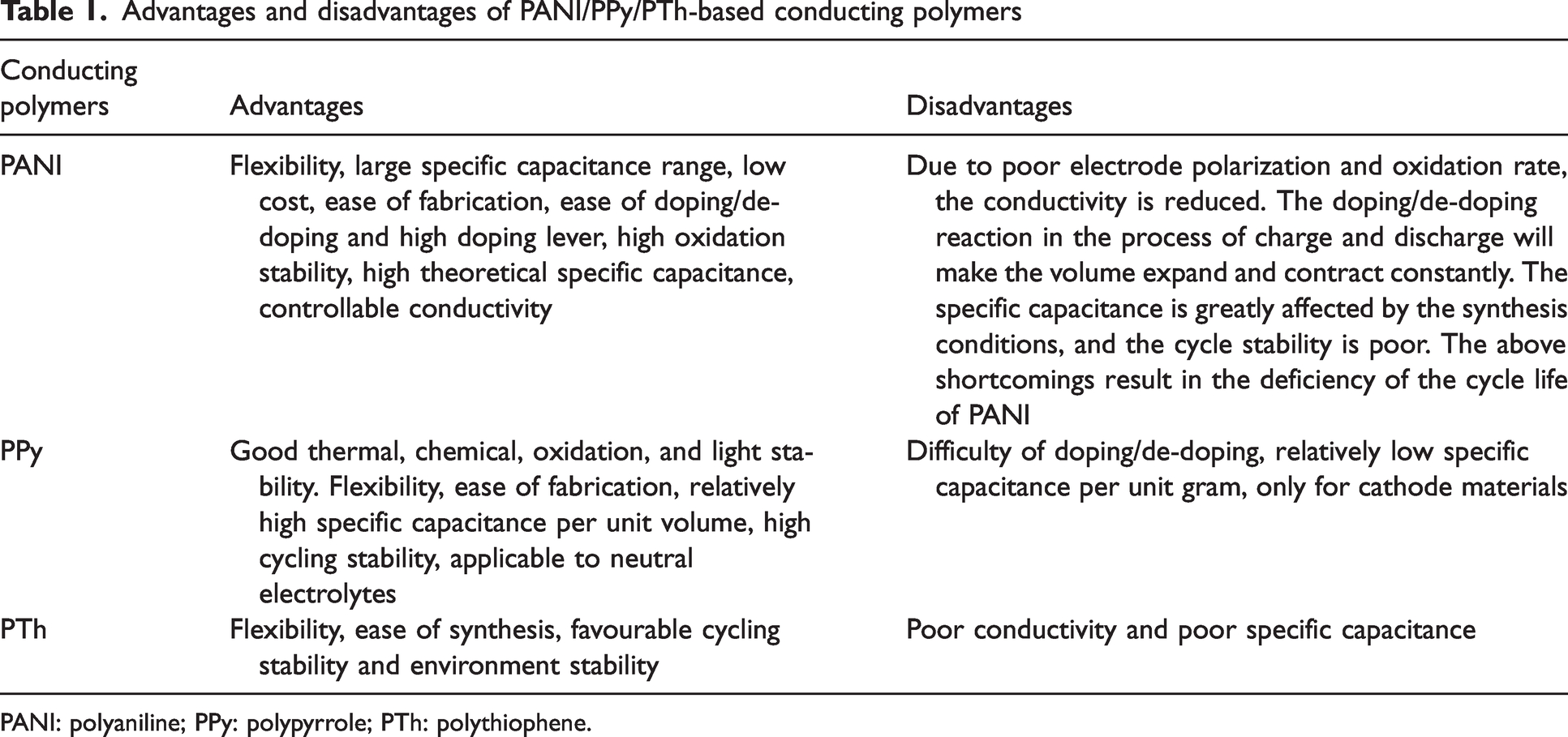
PANI: polyaniline; PPy: polypyrrole; PTh: polythiophene.
Conductive polymer-based binary composites
Faraday pseudocapacitive supercapacitors prepared from conductive polymer electrode materials have the advantages of low cost, simple preparation, and high specific capacitance. However, such electrode materials have the disadvantages of low cycle stability, and the capacitor capacity decays too fast due to the shrinkage and expansion of the polymer during charging and discharging. 46 Carbon materials have the advantages of being cheap, easy to prepare, having good electrochemical stability, high conductivity, and long cycle life, but also have the disadvantages of low specific capacitance value and poor magnification performance. The carbon matrix composites can not only improve the effective utilization rate of active materials but also improve the electrical conductivity and mechanical strength of the composites. Metal oxides as electrode materials for supercapacitors have been widely studied by many researchers because of their high specific capacitance value and excellent multiplier performance. However, they also have their insurmountable disadvantages: they are expensive, and the content of precious metals in them also causes certain pollution to the environment. Moreover, experimental studies have found that their cycle life is lower than that of double-layer capacitors. 47 From the above analysis, we can know that all kinds of materials have their advantages and disadvantages, and there are certain problems when used as electrode materials alone. Composite electrode materials prepared by using the characteristics of different materials can be used in supercapacitors to give play to the advantages of different materials at the same time, and to improve the overall performance of supercapacitors. For example, by combining carbon materials or metal oxides with conductive polymers to prepare binary composites, the cyclic stability and conductive properties of conductive polymer electrode materials can be improved.
Polyaniline-based binary composites
Due to the poor cycling stability of PANI, the electrode material of PANI alone cannot meet its application requirements in supercapacitors. It is a very effective method to combine PANI with other types of materials (such as carbon materials and metal oxides) to prepare electrode materials with better performance through a synergistic effect.
Polyaniline/carbon binary composites
Carbon materials have been used as high-quality materials for preparing supercapacitor electrodes because of their outstanding advantages such as high conductivity, large specific surface area, good cycling stability, and good mechanical properties. Their low capacitance limits their use in this field. As the core material of carbon materials, GN is a promising conductive substrate. To develop a high-performance pseudocapacitor, researchers have combined PANI with GN and have synthesized various GN/PANI composites with noncovalent and covalent interactions, and achieved high capacitance performance. 48 For example, Zheng et al. 49 prepared polyaniline nanorods/graphene fibers (GF/PANI) by wet spinning, hot annealing, and in situ chemical polymerization, as shown in Figure 3(a). The prepared GF/PANI showed a hierarchically porous structure, as shown in Figure 3(b) and (c). The assembled GF/PANI fibre-shaped supercapacitors (FSSCs) had a high capacitance of 357.1 mF cm−2 at a current density of 1.0 mA cm−2 and an extremely high energy density (7.93 µWh cm−2). After 5000 GCD cycles, only 3.8% of the specific capacity of GF/PANI was lost at a current density of 1.0 mA cm−2, showing good cyclic stability, as shown in Figure 3(d) and (e). Lv et al. 50 prepared flexible electrode substrate graphene paper (GP) by one-step reduction of graphene oxide (GO) in HI solution and prepared GP/PANI composite by electrochemical polymerization of PANI and GP. At a current density of 1.0 A g−1, the specific capacitance of the composite could reach 759.0 F g−1. GO and reduced graphene oxide (rGO) are important derivatives of GN, and the composite constructed with PANI can significantly improve the electrochemical performance. In recent years, GO/PANI and rGO/PANI composites have been prepared by chemical polymerization, direct polymerization, and electrochemical polymerization. For example, Ciplak 51 prepared GO/PANI binary nanocomposites by a facile, green, and one-step in situ polymerization approach. GO/PANI nanocomposites showed good electrochemical properties in the application of supercapacitors. At a current density of 1.0 A g−1, the GO/PANI electrode showed a high specific capacitance value of 269.3 F g−1, and the specific capacitance retention of GO/PANI nanocomposites after 10,000 GCD cycles was 81.3%. Xu et al. 52 constructed aniline-grafted graphene oxide/PANI (GONAI/PANI) composites by interfacial polymerization. The prepared GONAI/PANI composite showed high specific capacitance (160.5 F g−1) at 0.5 A g−1 under the wide potential range from 0 to 1 V. At a current density of up to 10.0 A g−1, the capacitance retention was 86.0% after 3000 GCD cycles, as shown in Figure 3(f) and (g).
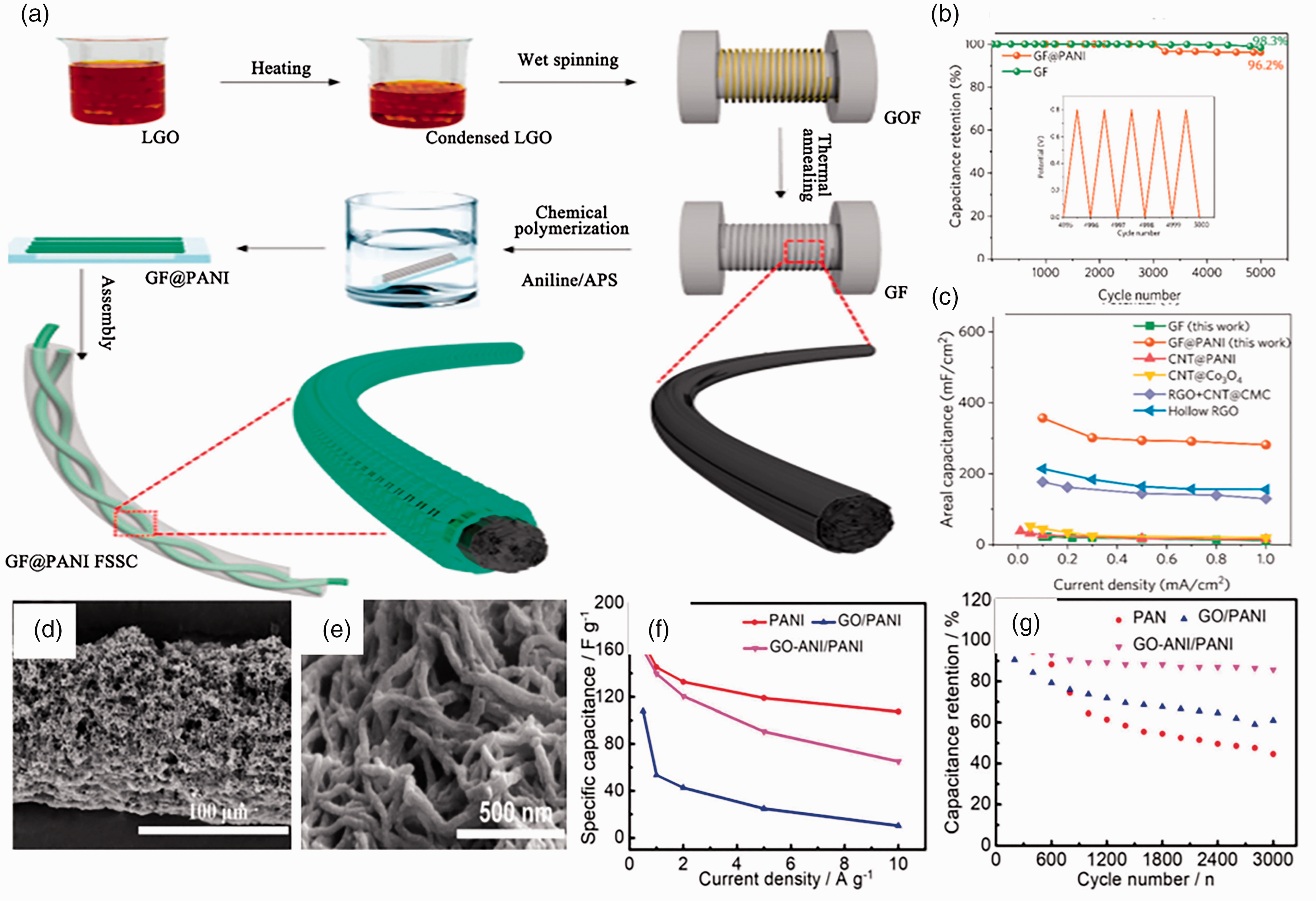
(a) Schematic diagram of fabrication process of graphene/polyaniline (GF/PANI), the assembled fibre-shaped supercapacitors (FSSCs), and the structure of GF/PANI; (b) and (c) Longitudinal scanning electron microscopy (SEM) image of GF/PANI; 49 (d) Galvanostatic charge-discharge (GCD) curves of GF/PANI FSSCs from 4996 to 5000 cycles; (e) Specific capacitance of FSSCs compared with the reported FSSCs; (f) Specific capacitance at different current densities; and (g) Cycle stability at 10.0 A g−1. 52
Shao et al. 48 prepared flexible rGO/PANI composite films by low-temperature chemical oxidation polymerization. In an aqueous symmetric supercapacitor, the rGO/PANI electrode exhibited a specific areal capacitance value of 684.0 mF cm−2 at a current density of 1.0 mA cm−2. Hu et al. 53 successfully prepared flexible free-standing rGO/PANI nanocomposite films by self-assembly and in situ polymerization of aniline in GO sheets, as shown in Figure 4(a). Due to the synergistic effect of two-dimensional rGO and PANI nanoparticles, flexible free-standing rGO/PANI nanocomposite films had good bendability and broad application prospects in flexible energy storage devices. An all-solid-state flexible supercapacitor was further fabricated by tailoring and assembling the flexible free-standing rGO/PANI nanocomposite film. The nanocomposite film showed a high specific capacitance of 0.92 F cm−2 at a current density of 0.5 A g−1 and its specific capacitance exhibited no obvious fading under bending state or after bending 200 times. In addition, at a constant current density of 7.0 mA cm−2, the all-solid-state flexible supercapacitor could maintain a specific capacitance of 80.0% over 2000 GCD cycles, as shown in Figure 4(b). It was concluded that the flexible free-standing rGO/PANI nanocomposite film was an excellent candidate for flexible materials, as shown in Figure 4(c) to (f). Macherla et al. 54 prepared thermal-assisted reduced crushed graphene oxide (rcGO)/PANI nanostructures as a high-quality flexible electrode material by in situ polymerizations of aniline in the presence of crushed graphene oxide. The prepared rcGO/PANI nanocomposites had been used as electrode materials and cast into flexible electrodes to prepare symmetrical supercapacitor devices. The specific capacitance of the flexible rcGO/PANI electrode was 299.0 F g−1 at the current density of 0.5 A g−1, while that of pure PANI was 248.0 F g−1 at the same current density.
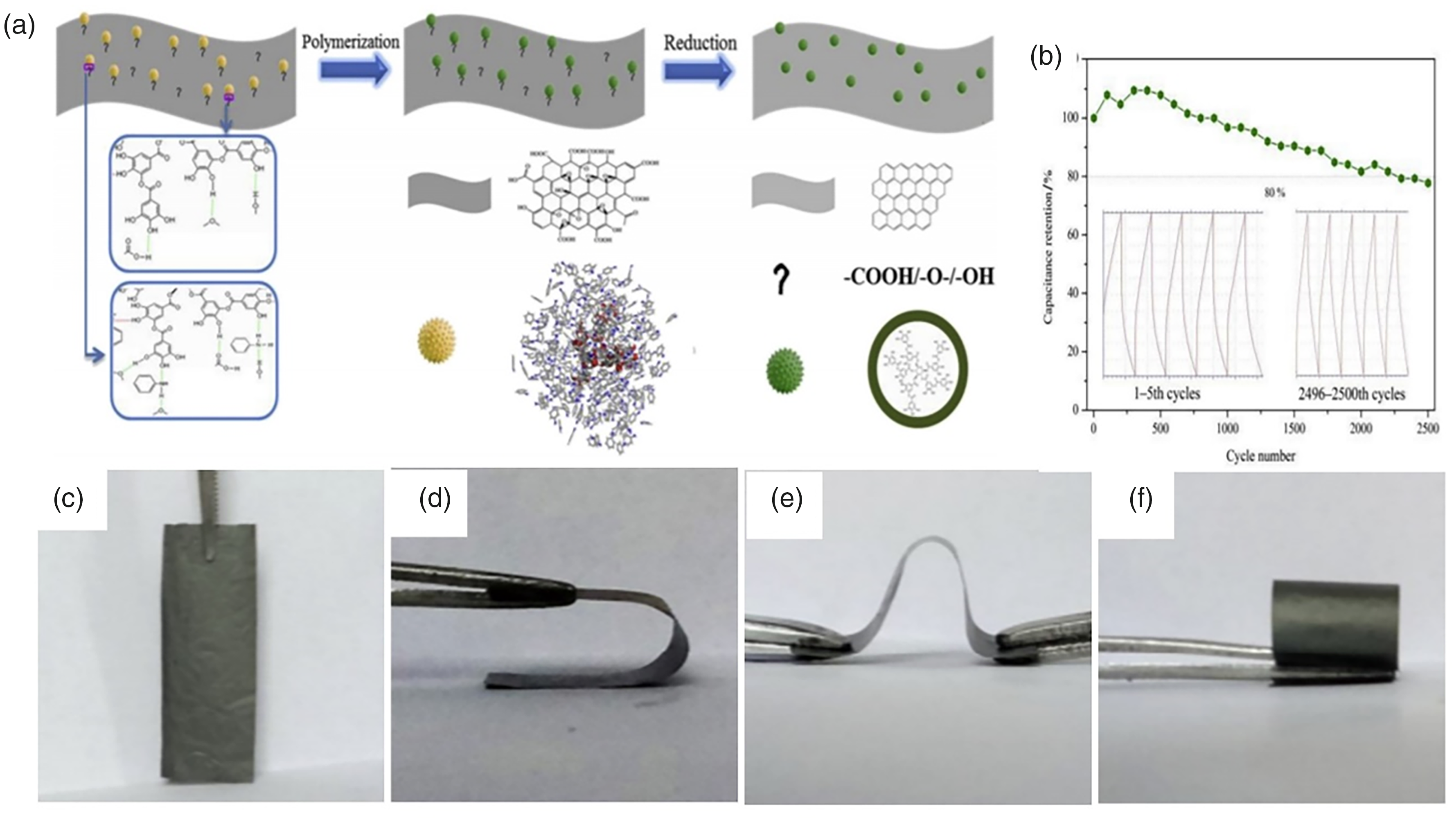
(a) Process flow of the fabrication of flexible free-standing reduced graphene oxide/polyaniline (rGO/PANI) nanocomposite film; (b) Cycling performance of the all-solid-state flexible supercapacitor at a constant current density of 7.0 mA cm−2 in 2500 cycles; (c) to (f) Flexible free-standing rGO/PANI nanocomposite film. 53
As a kind of carbon material, multi-walled carbon nanotubes (MWCNTs) have the advantages of large specific surface area, low cost, low toxicity, high abundance, high cycle stability, and environmental friendliness. The hybrid electrode prepared by the composite of MWCNTs with PANI can significantly improve the power density of a single PANI electrode. Akbar et al. 55 oxidized and sulfonated MWCNTs to generate active groups for in situ grafting of self-suspended polyaniline (S-PANI) on the surface and prepared S-PANI/oxidized carbon nanotubes (OCNTs) and S-PANI/sulfonated carbon nanotubes (SCNTs) composite electrodes, as shown in Figure 5(a). The microscopic appearance is shown in Figure 5(b) and (c). It can be seen that S-PANI presents a two-phase structure as a whole. PANI is a short rod-like morphology with a relatively regular structure, and the diameter of PANI nanorods is in the range of 60–100 nm. Figure 5(d) and (e) are scanning electron microscopy (SEM) images of OCNT and S-PANI/OCNT, respectively. It can be observed from the figure that the diameter of OCNT is about 40–60 nm, and the whole presents a staggering disordered state with suitable porosity. When OCNT and S-PANI were made into a composite, the tube diameter increased, due to S-PANI coating on the surface of OCNT. Besides, S-PANI coating can improve conductivity and associated transportation of charges, hence improving the electrochemical performance. Figure 5(f) and (g) shows the microtopography of SCNT and S-PANI/SCNT, respectively, which are the same as OCNT and S-PANI/OCNT. The S-PANI/OCNT and S-PANI/SCNT electrodes were charged and discharged at a constant current density of 1.0 A g−1, with specific capacities of 316.8 F g−1 and 345.4 F g−1, respectively. When the current density was 5.0 A g−1, the capacitance retention rate was above 92.0% after 5000 GCD cycles, as shown in Figure 5(h) and (i). Pal et al. 56 prepared PANI/MWCNTs composites with different MWCNT doping concentrations (2, 4, 6, and 8 wt%) using a facile chemical oxidation polymerization method. The charge storage capacity of PANI/MWCNTs (8 wt%) was vastly increased to 1412.0 F g−1 with 89.0% of capacitance retention after 10,000 GCD cycles, and its stability increased with the increase of MWCNT doping concentration. Supercapacitors based on PANI/MWCNTs (8 wt%) also exhibited significantly high energy values (about 1382.0 Wh kg−1), and power density (about 49,786.0 W kg−1). Awata et al. 57 prepared PANI/MWCNT nanocomposites with different MWCNT contents by in situ chemical oxidation polymerization, as shown in Figure 5(j). Supercapacitor electrodes based on PANI/MWCNTs (2 wt%) nanocomposites deposited on graphite sheets and nickel foam produced a maximum specific capacitance of 1183.0 F g−1 and 2053 F g−1 at 1.0 A g−1, as shown in Figure 5(k), and energy densities of 183.18 Wh kg−1 and 102.6 Wh kg−1, respectively. The capacitance retention of PANI/MWCNT (2 wt%) supercapacitor electrodes deposited on graphite sheets decreased by 13.0% after 1000 GCD cycles, while the capacitance retention of PANI/MWCNT (2 wt%) supercapacitor electrode deposited on nickel foam reached 100.0%.
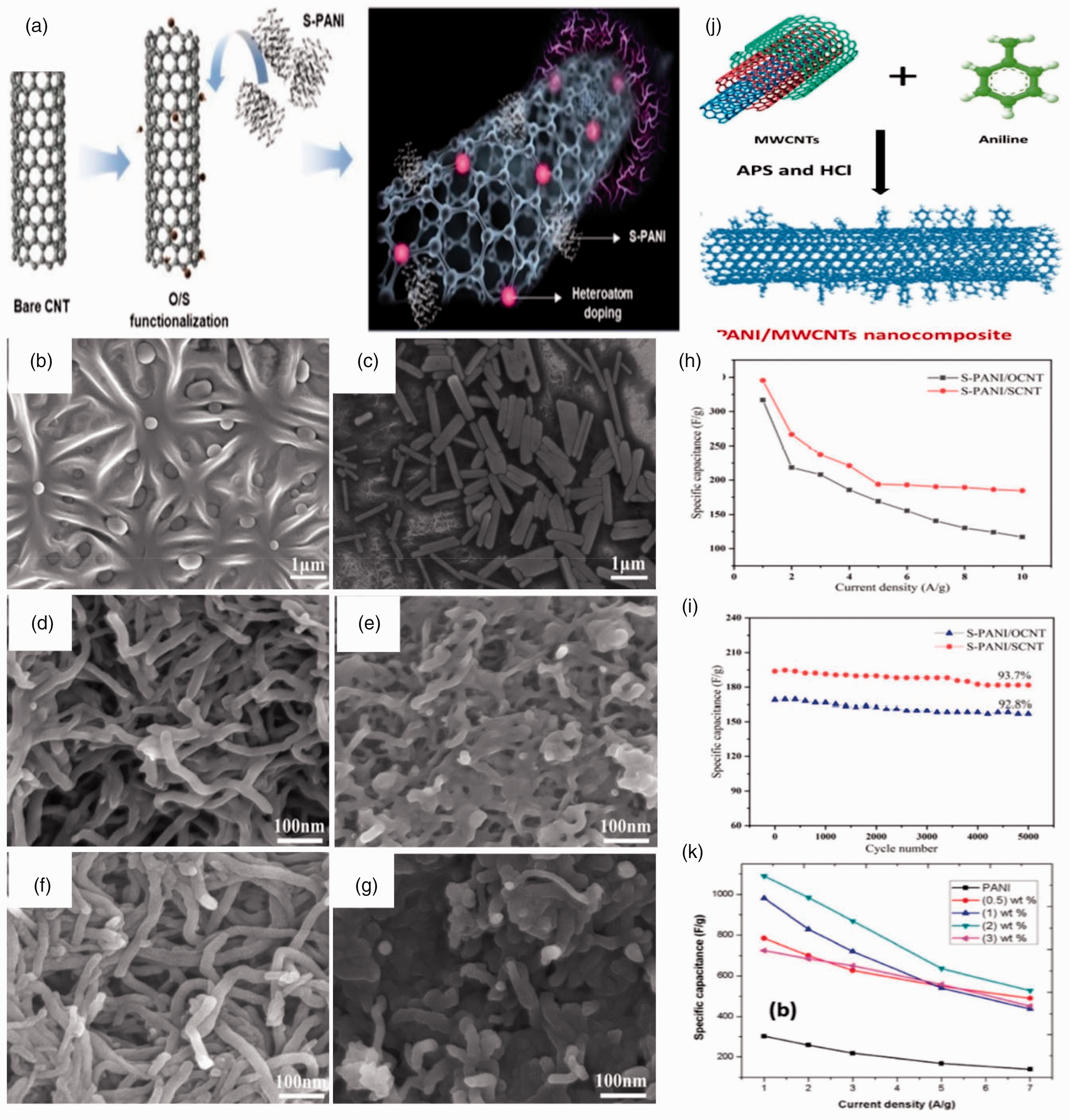
(a) Schematic illustration for preparation of self-suspended polyaniline (S-PANI)-based binary composite electrodes; scanning electron microscopy (SEM) images of (b) and (c) S-PANI; (d) Oxidized carbon nanotubes (OCNTs); (e) S-PANI/OCNTs; (f) Sulfonated carbon nanotubes (SCNTs); and (g) S-PANI/SCNTs; (h) Specific capacitance of S-PANI/OCNT and S-PANI/SCNT electrodes with current density ranging from 1.0 to 10.0 A g−1; (i) Electrochemical stability at a current density of 5.0 A g−1 over 5000 cycles; 55 (j) Schematic diagram of in situ PANI polymerization onto multi-walled carbon nanotubes (MWCNTs) and (k) Specific capacitance of PANI/MWCNT nanocomposites with different ratios at 1.0 A g−1. 57
Prasanna et al. 58 prepared PANI/MWCNT nanocomposites by liquid–liquid interfacial polymerization. At the scanning rate of 2.0 mV s−1 in 1 M H2SO4 aqueous solution, the specific capacitance of PANI/MWCNT nanocomposite electrode was 1551.0 F g−1, and the potential window was 0∼1.2 V. At a constant current density of 5.0 A g−1, the material had a good cycle life (95.0% capacitance retention rate) after 1000 GCD cycles. Hao et al. 59 first prepared MWCNTs/cotton composites as conductive fabrics and then prepared PANI doped with MWCNTs on conductive fabrics to prepare flexible cotton-based supercapacitor electrodes. The doping of MWCNTs could not only provide good conductivity and a large specific surface area of the electrode but also helped to increase the loading capacity of aniline monomer in PANI polymerization. The test results showed that the specific capacitance of the composite flexible electrode was 590.93 F g−1 at a scanning rate of 0.001 V s−1, and the capacitance retention rate reached 89.0% after 3000 CV cycles at 0.1 V s−1. Carbon nanofibers have high electrical conductivity, high porosity, moderate mechanical flexibility, dimensional stability, low cost, environmental protection, and are easy to be integrated into supercapacitors with different shapes and sizes, which have also attracted extensive attention in recent years. 60 Yanilmaz et al. 61 prepared free-standing flexible PANI/carbon nanofiber (CNF) electrodes by sol-gel and electrostatic spinning techniques. PANI coating improved the electrochemical performance of these electrodes. SEM images showed that PANI coating had uniform morphology and hierarchical structure, and the mechanical test showed that the electrode was flexible. In addition, at a current density of 1.0 A g−1, the flexible CNF/PANI electrode had a high capacitance of 234.0 F g−1 and excellent cycle stability with capacitance retention of approximately 90.0%. Ragone plots showed that the flexible CNF/PANI electrode could achieve a high energy density of 32.0 Wh kg−1 at 500.0 W kg−1 power density for 12 h polymerization. Therefore, it could be proved that the prepared flexible PANI/CNF composites could be considered promising electrode candidates for the application of wearable supercapacitors. Kan et al. 62 synthesized interconnected PANI/coated CNF (CNF/PANI) composite nanowires by vacuum-assisted intercalation in situ oxidative polymerization. The interconnected CNF/PANI composite nanowires had a thorn-like hierarchical structure. When used as the electrode of a supercapacitor, CNF/PANI samples with a 40.0% CNF mass fraction showed excellent electrochemical performance with a high specific capacitance of 820.31 F g−1 at 1.0 A g−1 and a specific capacitance retention of 89.7% after 2000 GCD cycles at 10.0 A g−1. Anand et al. 63 prepared a free-standing CNF/PANI hybrid mat by in situ growth of PANI nanofibers on the surface of porous CNF through a facile one-step polymerization method. The CNF/PANI hybrid mat with a large specific surface area showed high gravimetric capacitance (493.75 F g−1) and volumetric capacitance (385.2 F cm−3) at 1.0 mA cm−2. In addition, the hybrid electrode showed good electrochemical cycle stability (after 5000 GCD cycles of 1.0 mA cm−2, the specific capacitance retention rate was greater than 90.0%). Supercapacitor batteries based on this CNF/PANI hybrid electrode had a maximum energy density of 68.6 Wh kg−1 and a power density of 8.3 kW kg−1. Tian et al. 64 fabricated flexible environmental protection CNF/PANI film by simply coating the surface of cellulose nanofiber film with PANI coating. On the one hand, a large amount of bamboo fiber waste could be recycled. On the other hand, the excellent mechanical properties of CNF were fully utilized to improve greatly the machining performance of PANI. The flexible and environmentally friendly CNF/PANI film could be used directly as an electrode without the need for adhesives. SEM and Fourier transform infrared (FTIR) measurements showed a very secure binding between CNF and PANI. CNF/PANI electrodes had good mechanical properties, excellent reversible properties, and good specific capacitance (254.7 F g−1 when the current density was 0.2 A g−1). Some researchers have also studied the electrochemical properties of PANI/porous carbon, PANI/carbon cloth, and PANI/carbon sphere electrode materials. For example, Yu et al. 65 prepared the first wood-derived nitrogen-doped porous carbon/PANI (NKWC/PANI) composite using low-cost, environmentally friendly, and renewable wood waste as raw material, as shown in Figure 6(a). The new NKWC/PANI composite had a maximum specific capacitance of 347.0 F g−1 at 2.0 A g−1, and a maximum energy density of 44.4 Wh kg−1 at 922.0 W kg−1. Ahirrao et al. 66 used a facile in situ chemical oxidation polymerization technique to prepare PANI/highly conductive carbon cloth (CC) flexible electrodes, as shown in Figure 6(b) to (j). Dense and evenly coated PANI on CC substrate performed exceptionally well as a robust flexible electrode for supercapacitor application and achieved maximum specific capacitance of 691 F g−1 at 1 A g−1. PANI/CC-based flexible supercapacitor devices had capacitance retention of 72.0% at a maximum bending angle of 140° demonstrating high charge storage capacity and excellent bending stability. Here, PANI enhanced the charge storage capacity and CC provided conductive support. PANI/CC exhibited improved electrochemical performance over pure PANI due to the synergistic effect between PANI and CC. Zhang et al. 67 prepared a novel hybrid material of PANI nanowire array/three-dimensional hollow graphene balls (PANI-NWA/3D HGBS). The maximum specific capacitance of the hybrid electrode was 635.0 F g−1 when the current density was 1.0 A g−1. When assembled into a symmetric supercapacitor, it had a high energy density of 25.3 Wh kg−1 at a power density of 553.4 W kg−1, and retained 89.0% of its specific capacity after 5000 GCD cycles at 1.0 A g−1.

(a) Formation mechanism of the wood-derived nitrogen-doped porous carbon/polyaniline (NKWC/PANI) composite; 65 (b) Depiction of the synthesis of the PANI/carbon cloth (CC) flexible electrodes; (c) Digital images showing Substrate before polymerization (CC); (d) Digital images showing substrate after polymerization (PANI/CC); (e) and (f) Field emission scanning electron microscopy (FESEM) images for CC; (g) and (h) FESEM images for PANI; (i) and (j) FESEM images for PANI/CC. 66
In conclusion, as a new type of supercapacitor material, PANI/carbon composite electrode material not only overcomes the disadvantages of the small capacitance of double-layer carbon electrode material but also overcomes the disadvantages of poor conductivity and cycle performance of pseudocapacitor electrode material by using the characteristics of double layer capacitor and PANI pseudocapacitor.
Polyaniline/metal oxide binary composites
The electrochemical performance especially the cyclic stability of PANI-based electrodes can be effectively improved by growing or coating PANI on the surface of carbon materials. However, because the specific capacitance of carbon materials is not very high, the improvement of the specific capacitance of composites is limited. Metal oxides with pseudocapacitance characteristics have natural advantages in improving specific capacitance. Therefore, PANI/metal oxide electrode materials have been taken as a key research object and research achievements have emerged in an endless series in recent years.
The electrode material prepared by the combination of PANI and transition metal oxide can effectively improve the energy density of the supercapacitor and is regarded as a promising electrode material for supercapacitors. MnO2 is one of the most popular metal oxides at present. In addition to high reserves, low cost, and environmental protection, MnO2 also has the advantages of high specific capacitance, high energy density, and good cycle stability.68,69 For example, Shah et al. 70 successfully co-deposited MnO2/PANI nanocomposites on the surface of stainless steel by cyclic voltammetry. When the current density was 0.15 A g−1, the specific capacitance was 149.0 F g−1, and the specific capacitance of the composite remains at 67.0% after 400 GCD cycles. Mezgebe et al. 71 prepared MnO2/PANI nanocomposites by in situ hydrothermal polymerization, as shown in Figure 7(a) to (f). When the current density was 1.0 A g−1, the specific capacitance was 665.0 F g−1, and the nanocomposites showed high cyclic stability after 1500 CV cycles (the retention rate was 82.0% at a scanning rate of 100 mV s−1).
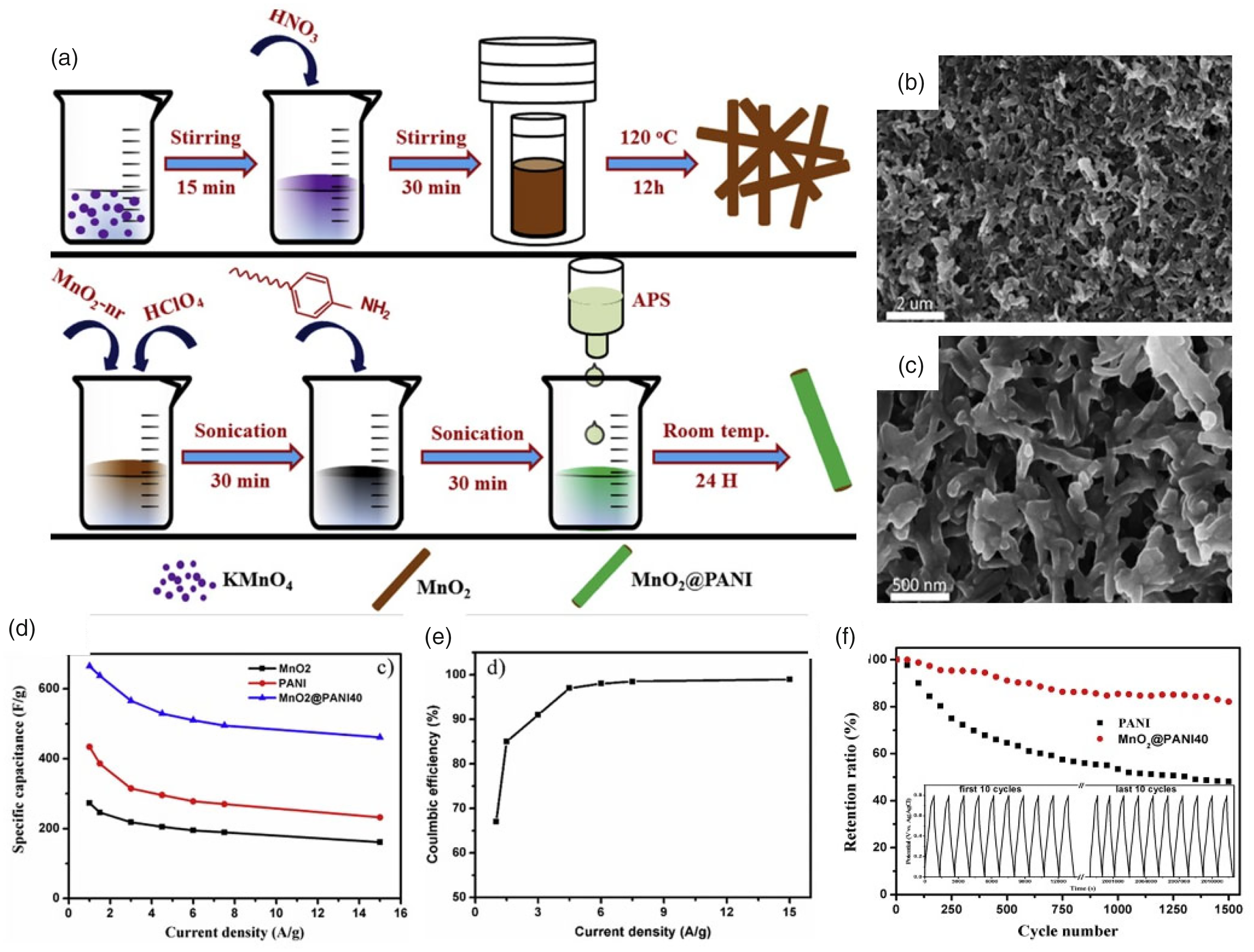
(a) A schematic diagram for the synthesis process of MnO2/polyaniline (PANI) nanocomposite; (b) and (c) Field emission scanning electron microscopy (FESEM) images of MnO2/PANI nanocomposites at low and high magnifications; (d) Specific capacitance of MnO2/PANI-based electrode and its components at various current densities; and (e) Coulombic efficiency of MnO2/PANI-based electrode at different specific current densities and (f) Cycling stability of PANI and MnO2/PANI-based electrodes at 100 mV s−1 scan rate for 1500 cycles. 71
In addition to MnO2, researchers have also studied the electrochemical properties of PANI/other metal oxide composites and made a lot of progress. For example, Athira et al. 72 successfully prepared morphologically tuned Co3O4 anchored PANI binary composites by changing the synthesis temperature. The CO3O4-anchored PANI binary composite (PPCO-253) synthesized at 253 K showed excellent electrochemical activity with a specific capacitance of 1308.0 F g−1 twice that of PANI. The specific capacitance of the prepared symmetric supercapacitor was 435.0 F g−1 at 1.0 A g−1. The capacitance retention was 99.6% after 5000 GCD cycles at 6.0 A g−1. Gao et al. 73 prepared NiMoO4/PANI nanocomposite with skeleton structure by hydrothermal and chemical polymerization methods. The capacitance retention of the nanocomposite was 80.7% after 2000 GCD cycles at 5.0 A g−1, and the specific capacitance was 1214.0 F g−1 at a current density of 1.0 A g−1. Aamir et al. 74 prepared high-performance V2O5/PANI composite material deposited on metal foam nickel substrate by the electrodeposition technique as an electrode of pseudocapacitor. The charge storage voltage window of the V2O5/PANI composite was very wide at 2.5 V. When the current density was 1.0 A g−1, the maximum specific capacitance was 1115.0 F g−1. Panigrahi et al. 75 designed a flower-like VO2 flexible electrode mixed with PANI by adopting a facile synthesis method. Due to the combination of PANI and VO2, the organic-inorganic electrode (VO2/PANI) had a specific capacitance of up to 700.0 F g−1 when the current density was 1.0 A g−1, and the capacitance retention rate was 86.7% after 10,000 GCD cycles. These unique inorganic-organic hybrid systems could meet the needs of developing new energy storage functional materials. Ma et al. 76 reasonably prepared a three-dimensional core-shell Fe3O4/PANI coaxial heterogeneous nanonetwork through magnetic field-induced self-assembly and in situ polymerization. The Fe3O4/PANI nanonets were successfully used as electrode materials for supercapacitors. Fe3O4 nanospheres derived from magnetic fields were used as the framework for PANI growth and strain buffering, and PANI nanofibers were used as the electrochemically active part. These nanonetworks achieved high specific capacitance, long cycle life, and good rate performance. When the current density was 1.0 A g−1, the specific capacitance was up to 620.0 F g−1, and when the current density was 2.0 A g−1, the capacitance retention was 85.0% after 2000 GCD cycles. The better electrochemical performance of these Fe3O4/PANI nanonets compared with other Fe3O4/PANI hybrids was the result of the complementary contributions of the two components in the composite electrode design.
Other polyaniline-based binary composites
In addition to carbon and metal oxides, some researchers have studied composites composed of PANI and other materials such as other organic materials, metal sulfides, and polyoxometalates (POMs), etc. For example, Mahdavi et al. 77 synthesized aniline-melamine copolymer by the interfacial copolymerization method. Electrochemical characterization of the products showed that compared with pure PANI nanofibers obtained by interfacial polymerization the copolymerization of PANI and melamine resulted in a significantly improved supercapacitor performance with a specific capacitance of 720.0 F g−1 at 5.0 mV s−1 with capacitance retention of 83.0% after 1500 CV cycles. In addition, copolymer samples with higher melamine content showed better supercapacitor performance. Ren et al. 78 prepared MoS2/PANI composites with different PANI loading capacities (40, 53, and 70 wt%) using MoS2 nanosheet as the substrate. The obtained MoS2/PANI-53 electrode material showed the highest capacitance performance. The reasonable combination of these two components makes PANI thin layer uniformly cover the surface of MoS2 nanosheets. The synergistic effect of high specific capacitance of PANI and fast ionic conductivity and mechanical stability of MoS2 makes MoS2/PANI-53 an appropriate electrode material for supercapacitors. MoS2/PANI-53 nano symmetric supercapacitors offered high energy density (35.0 Wh kg−1 at 335.0 W kg−1 power density) and excellent cycle stability (81.0% capacitance retention after 8000 CV cycles at a scanning rate of 100 mV s−1).
Chen et al. 79 prepared hybrid electrode materials (MoS2/PANI) by the one-pot hydrothermal method, as shown in Figure 8(a) to (i). MoS2/PANI with 25 wt% MoS2 provides a maximum capacitance of 645.0 F g−1 at a current density of 0.5 A g−1 with good cycle stability (89.0% capacitance retention after 2000 GCD cycles at a current density of 10.0 A g−1).
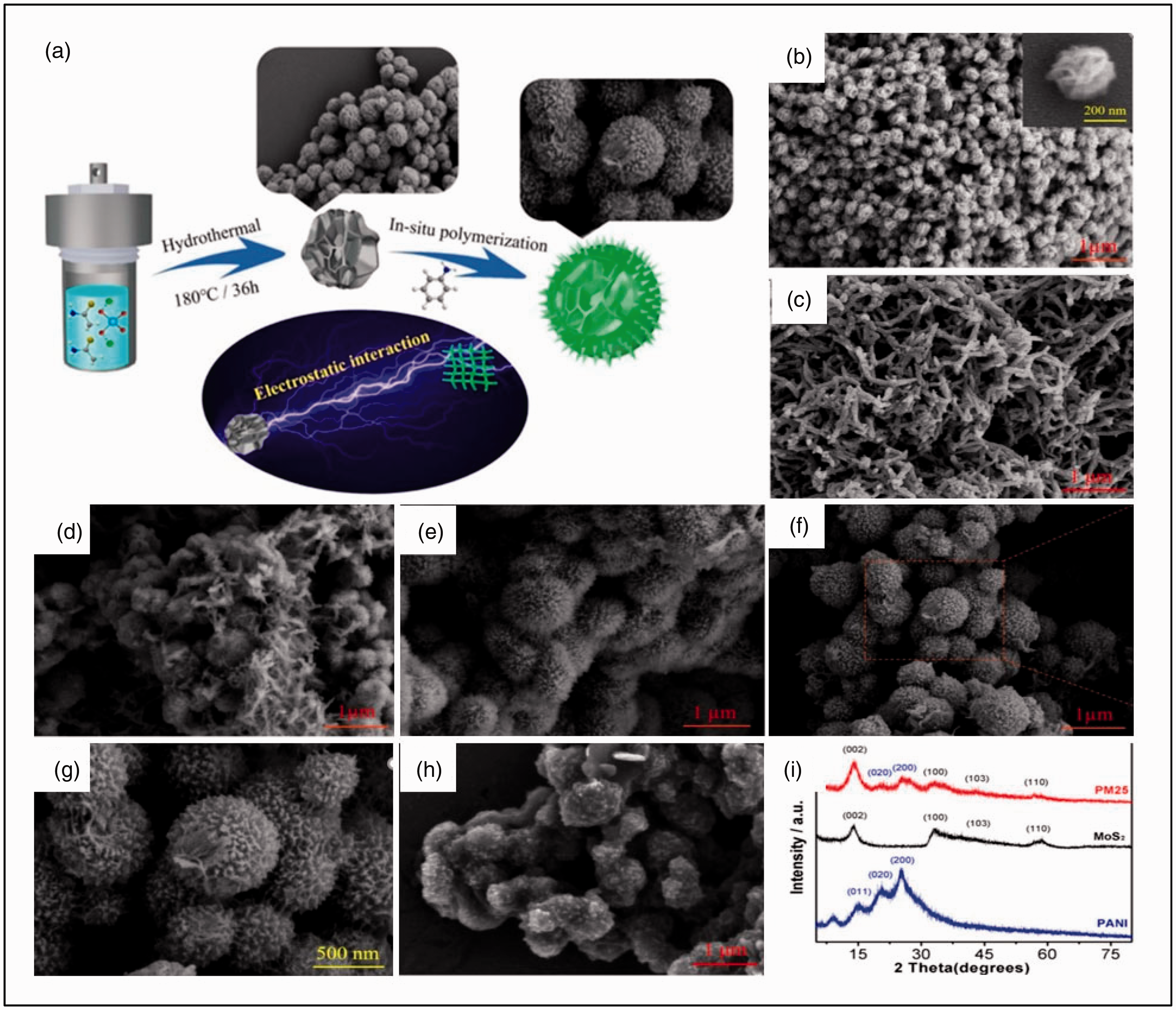
(a) A schematic illustration of the fabrication process of MoS2/polyaniline (PANI) hybrids via in situ oxidative polymerization; (b) Scanning electron microscopy (SEM) images of pure MoS2; (c) SEM images of pure PANI; (d) SEM images of PM15; (e) SEM images of PM20; (f) and (g) SEM images of PM25; (h) SEM images of PM33 and (i) X-ray diffraction (XRD) patterns of PANI, MoS2, and PM25. 79
Shendkar et al. 80 prepared Ni(OH)2/PANI electrodes on a stainless steel substrate by one-step and two-step electrodeposition processes, respectively. Compared with single electrode materials amorphous Ni(OH)2/PANI electrodes had stronger reversibility and stability. Zhang et al. 81 synthesized MoS2/PANI hollow microspheres with excellent electrochemical performance using a template-assisted method for supercapacitor applications. MoS2/PANI hollow microsphere electrodes had a maximum specific capacitance of 364.0 F g−1 at a scanning rate of 5.0 mV s−1. In addition, the specific capacitance reached 299.0 F g−1 at a current density of 10.0 A g−1. After 8000 GCD cycles at 10.0 A g−1, the capacitance retention was 83.4%.
POMs with stable and precise structures possess tunable electron-proton reservoirs and high ionic conductivity in solid state at room temperature. In the past decades, tremendous efforts have been made to prepare traditional liquid electrolyte supercapacitors by depositing POMs on electrode materials. Palacios et al. 82 reported a simple chemical bath deposition method for the synthesis of two POMs (H4[PVMo11O40] and H5[PV2Mo10O40]) impregnated PANI composite (PVMo11/PANI and PV2Mo10/PANI) for electrochemical supercapacitors. The exceptionally high average capacitance of 1371.0 F g−1 was obtained for the composite PVMo11/PANI electrode at a current density of 3.0 A g−1 and 1.0 V potential window with an energy density of 137.5 W h kg−1. The PVMo11/PANI composite electrode showed almost 4.3 times higher energy density than pure PANI and 2.3 times higher than PV2Mo10/PANI. In contrast, the PV2Mo10/PANI composite showed 1.9 times more energy density than pure PANI composite electrodes. Interestingly, high average capacitance, charge-discharge rates, and high energy density with high-level power delivery made them promising electrode candidates for supercapacitors. Cheng et al. 83 developed a novel solid-state supercapacitor with H3PMo12O40 (PMo12) and H3PW12O40 (PW12) electrolytes sandwiched by two PANI electrodes. Investigation of the influence of POMs indicated that matching the redox potentials of electrolytes and electrode materials could optimize the performance of the supercapacitors. The PMo12 electrolytes enhance the electrochemical performance of the PANI electrodes by contributing an eight-electron Faraday reaction to provide pseudocapacitance in a charge-discharge cycle. The largest capacitance of supercapacitors with PW12 and PW12 as electrolytes was 7.69 F cm−2 (3840 F g−1) at a current density of 0.5 mA cm−2.
Polypyrrole binary composites
PPy is a typical CP, and has the advantages of large theoretical capacitance, good conductivity, green pollution, and low cost, is widely used in supercapacitors, fuel cells, and other fields, and is considered to be one of the most promising CPs, but in the long-term charge and discharge process, the volume of PPy may expand/contract, resulting in the collapse of the structure. Poor cyclic stability is also the biggest limitation of the application of PPy materials. 84 PPy/carbon nanocomposite material has a significant effect on improving its cycling stability and many studies have focused on PPy/carbon nanocomposite materials. On the other hand, to improve further the energy storage capacity of PPy electrodes hybrid composite materials composed of PPy and metal oxide two electrically active materials have also attracted the attention of many researchers.
Polypyrrole/carbon binary composites
As CNTs have a high specific surface area, low resistivity, and good thermal, and chemical stability, they are used as an important material for preparing supercapacitor electrodes by researchers. 85 Using CNTs as an additive or template to synthesize composite electrodes with pseudocapacitance material PPy the electrochemical performance especially the cyclic stability of PPy-based electrodes can be improved through a synergistic effect. In recent years researchers have prepared a variety of CNTs/PPy composites. Wang et al. 86 produced a high mass loading and freestanding CNT/PPy electrode (6.07 mg cm−2) using facile vacuum filtration and a low-temperature polymerization method. In addition, because the high conductivity of the CNT fiber network provided a fast electron transport channel the optimized CNT/PPy electrode exhibited a significant areal capacitance value (2.6 F cm−2) and significantly improved mechanical properties (its ultimate tensile strength was 20.7 MPa 23 times that of the pure CNT film). A high-power density of 0.64 mW cm−2 was obtained for a freestanding all-solid-state symmetric supercapacitor based on an optimized CNT/PPy electrode at an energy density of 76.7 µWh cm−2. Han et al. 87 electrodeposited PPy on He plasma etched carbon nanotube film (HCNTF) by the galvanostatic method and prepared HCNTF/PPy electrodes with high flexibility, high stability, and high conductivity (2653.0 S cm−1), which was much higher than the original carbon nanotube film (1570.0 S cm−1) and HCNTF (1242.0 S cm−1), as shown in Figure 9(a) to (g). The specific capacitance of HCNTF/PPy supercapacitors was 414.0 F g−1 at 0.5 A g−1 with the capacitance of HCNTF/PPy supercapacitors maintaining 92.0% of its initial value after 5000 GCD cycles, showing high cycle stability. HCNTF/PPy supercapacitors also demonstrated excellent flexibility and high stability resisting continuous bending with initial capacitance remaining 96.0% after 500 bending cycles. These results indicated that the flexible HCNTF/PPy electrode with high electrochemical performance was likely to be used in flexible energy storage devices. Chang et al. 88 prepared core-shell pseudocapacitance anodes to provide electrochemically pretreated carbon nanotube film (ECNT)/PPy electrodes by electrochemical deposition of high load (3.89 mg cm−2) PPy on individual carbon tubes in an ECNT. ECNT/PPy could retain 75.2% of its capacitance (965.3 mF cm−2 at 1.0 mA cm−2) when the discharge current increased 40 times to 40 mA cm−2. The asymmetric supercapacitor assembled with ECNT/PPy and CNT/MnO2 as anode and cathode could maintain a high volume energy density of 3.63 mWh cm−3 at 13.86 mW cm−3 power density. After 10,000 GCD cycles at 1.0 mA cm−2, the asymmetric supercapacitor could maintain a capacitance of 89.0% showing good cycle stability.
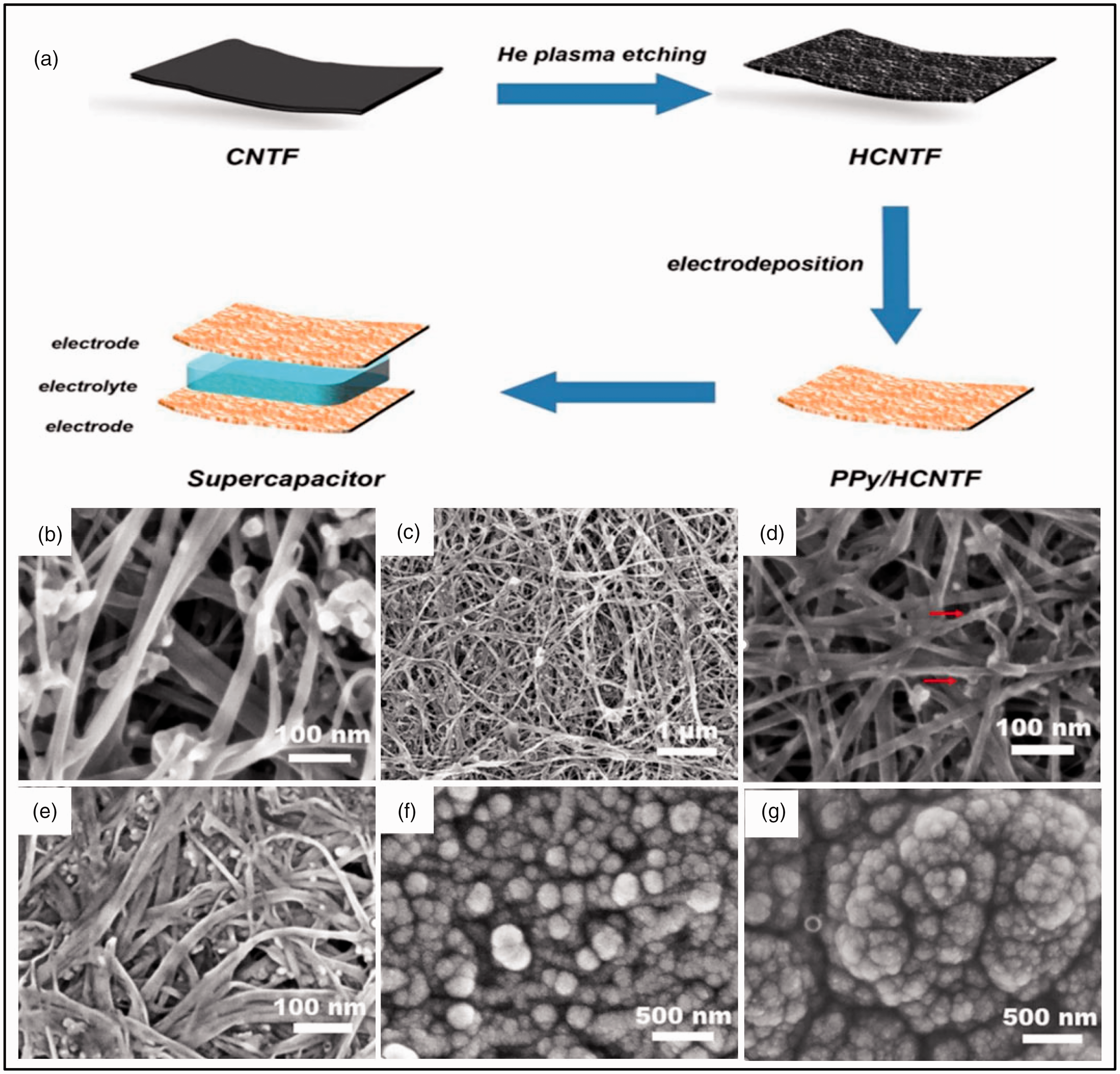
(a) Schematic diagrams of synthesis of He plasma etched carbon nanotube film (HCNTF)/polypyrrole (PPy) electrodes and supercapacitors; (b) Scanning electron microscopy (SEM) images of raw carbon nanotube film; (c) and (d) SEM images of HCNTF; (e), (f) and (g) SEM images of HCNTF/PPy; The electrodeposition time of PPy was kept at (e) 100 s, (f) 200 s, and (g) 400 s, respectively. 87
Lota et al. 89 prepared CNT/PPy composites by chemical polymerization directly on CNT. The PPy composite with only 3 wt% CNTs provided the best electrochemical performance as the electrode material for supercapacitor applications. Kazazi 90 prepared the CNT/PPy composite electrode without a binder and with high performance by an efficient two-step method with CNTs as the support framework. The CNT mesh network with an open porous structure significantly improved the pseudocapacitance performance of the CNT/PPy electrode. The composite electrode had high specific capacitance (292.0 F g−1 at 0.2 A g−1), excellent rate performance, and superior cycle stability (89.2% after 1000 GCD cycles at 1.0 A g−1). This study provided a new method for the development of high-performance and nonbinder electrodes for energy storage devices. Tong et al. 91 successfully prepared a PPy-CNT paper electrode with superior flexibility and good conductivity by using a facile in situ interfacial polymerization method. The PPy/CNT paper electrode had a unique porous structure not only was the specific capacitance up to 8604.5 mF cm−2 at 1.0 mA cm−2 but also it could maintain 107.0% capacitance after 12,000 GCD cycles showing good electrochemical cycling stability. In addition, the prepared electrode exhibited superior flexibility. GN and its derivatives (GO and rGO) are another ideal electrode additive for PPy. To improve the rate performance and cyclic stability of PPy, Ma et al. 92 prepared high-performance self-assembled PPy/rGO composite layers on carbon cloth by electrochemical deposition. At a current density of 0.6 A g−1, its specific capacitance was 490.0 F g−1, and it had good cycle stability with a capacitance retention rate of 5000 GCD cycles of 85.0%. Xin et al. 93 adopted a facile and low-cost method to prepare N,B-co-doped graphene aerogel (NBGA)/PPy composites for asymmetric supercapacitors. Supercapacitors were based on a traditional sandwich structure composed of NBGA/trypan blue doped polypyrrole (PPy-TB) as anode material, polyvinyl acetate-sulfuric acid solid (PVA-H2SO4) as the electrolyte, and PPy-TB as the cathode material. The NBGA/PPy-TB microstructure showed that PPy-TB was successfully coated on NBGA. The three-dimensional cross-linked network structure and heteroatomic composition gave the NBGA/PPy-TB electrode a high specific capacity (566.0 F g−1 at 1.0 A g−1). Supercapacitors showed considerable specific capacity (160.3 F g−1 at 0.5 A g−1).
In addition to CNTs, GN, and their derivatives, other carbon materials have been used to form composites with PPy including PPy/activated carbon,94,95 PPy/carbon cloth, 96 PPy/expanded graphite, 97 PPy/carbon fiber, 98 PPy/lignin, 99 PPy/carbon aerogel, 100 and have made some progress.
In conclusion, because carbon material has many unique advantages, it can effectively improve the electrochemical performance of electrode material by using carbon material as an additive or template to prepare composite material with PPy. PPy/carbon composite material can realize both the pseudocapacitance of PPy and the EDLC of carbon material, and improve the specific energy and power density of the supercapacitor through a synergistic effect. However, due to its conditions, the charge accumulation energy of carbon material is limited, and the improvement of PPy/carbon electrode material on the energy density of the supercapacitor still cannot meet the needs of practical application.
Polypyrrole/metal oxide binary composites
From the introduction to PPy above, we know that PPy has many unique performances, but it also has some shortcomings such as poor rate performance and cycle stability. To improve further the electrochemical performance of PPy-based supercapacitors, especially the specific capacitance, it is a good method to prepare PPy/metal oxides with high specific capacitance as electrode materials. As a transition metal oxide, MnO2 has ideal specific capacitance and low toxicity. It is commonly used as an electrode material, but its low conductivity and ion transfer efficiency limit its practicability. Therefore, MnO2 can be combined with PPy to prepare electrode material to increase its conductivity and ion and electron exchange rate. 101 For example, Bai et al. 102 synthesized three-dimensional MnO2/PPy electrodes on a functionalized carbon cloth (FCC) substrate simply and rapidly. The prepared MnO2/PPy electrode had a large specific surface area, which facilitated the effective contact between the reaction center on the electrode and the electrolyte to store the charge. The MnO2/PPy electrode showed a high specific capacitance of 345.54 F g−1 at a current density of 2.0 mA cm−2. The symmetrical flexible supercapacitor MnO2/PPy//MnO2/PPy assembled with two electrodes could operate at a high operating voltage of 1.2 V and exhibited a high energy density of 37.63 Wh kg−1 at a power density of 830.0 W kg−1. The supercapacitor could power LED bulbs and had good cyclic charge-discharge stability with a specific capacitance loss of less than 3.0% after 10,000 GCD cycles at a current density of 5.0 mA cm−2. Song et al. 41 proposed a two-step method for the continuous synthesis of MnO2/PPy composites with tunable core-shell structures for supercapacitors, as shown in Figure 10(a). MnO2/PPy composite with core-shell structure showed better performance than MnO2, indicating that CP improved the electron transfer efficiency of the material. When the current density was 1.0 A g−1, the maximum specific capacitance reached 109.0 F g−1. Wang et al. 101 synthesized MnO2/hollow polypyrrole (H-PPy) composite for supercapacitors through a facile water bath reaction, as shown in Figure 10(b) to (d). When the current density was 1.0 A g−1, the optimal specific capacitance was 295.0 F g−1, and the capacitance retention was 100.0% after 20,000 GCD cycles. The specific capacitance of the asymmetric supercapacitor based on MnO2/H-PPy (1:4) was 63.0 F g−1 at a current density of 1.0 A g−1, as shown in Figure 10(e) and (f), and the energy density reached 42 Wh kg−1 at 1100 W kg−1.
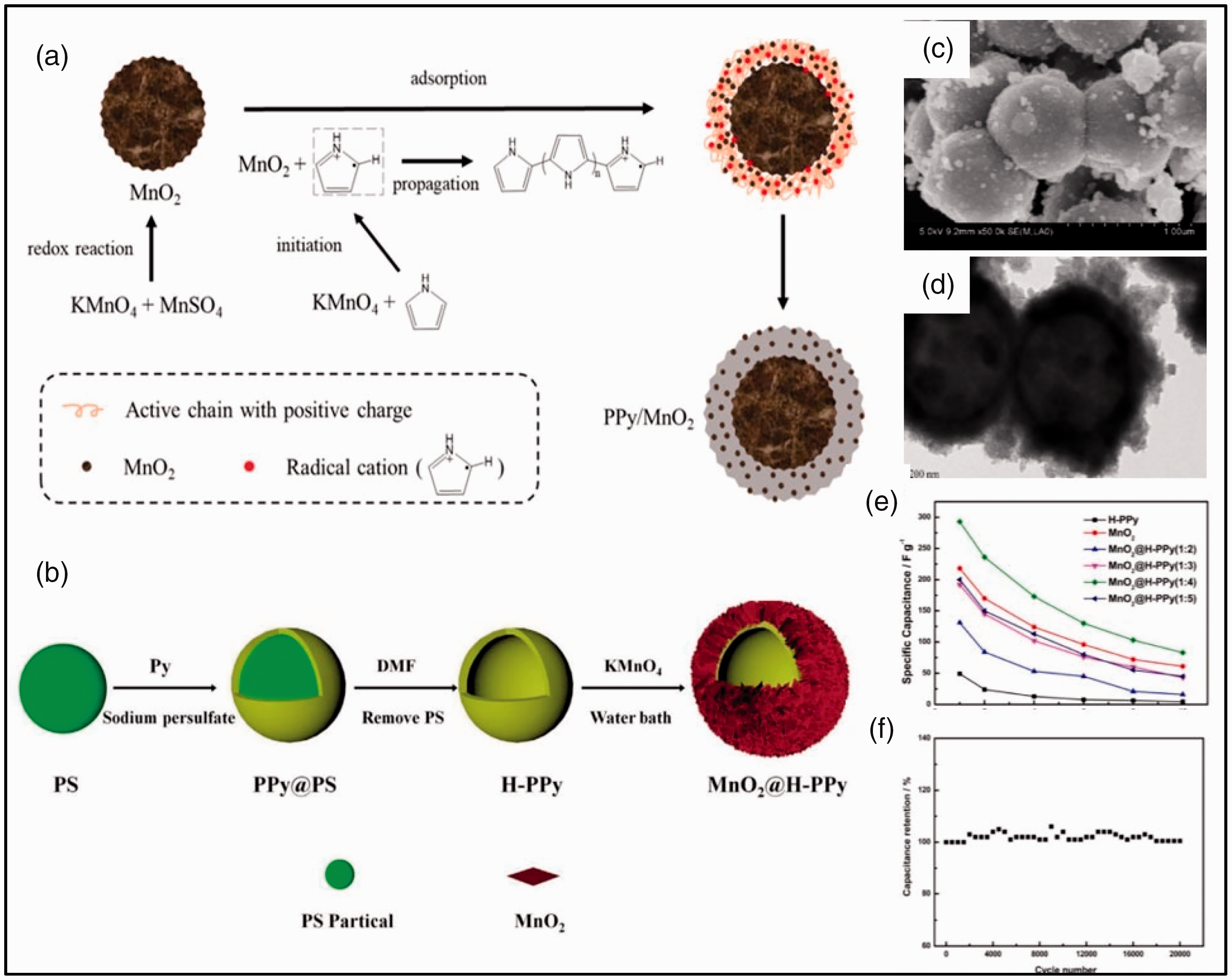
(a) Schematic diagram of the formation mechanism of the MnO2/polypyrrole (PPy) composite with the core-shell structure; 41 (b) Schematic formation of the MnO2/hollow polypyrrole (H-PPy) composites for supercapacitors; (c) The scanning electron microscopy (SEMs) images of MnO2/H-PPy composite; (d) The transmission electron microscopy (TEM) images of MnO2/H-PPy; (e) The specific capacitances of the MnO2, H-PPy and MnO2/H-PPy (1:X) calculated by galvanostatic charge-discharge (GCD) curves at different current densities and (f) Cycling stability of the MnO2/H-PPy. 101
Zhou et al. 68 synthesized PPy core by in situ polymerization and then coated MnO2 on PPy surface by a one-step hydrothermal synthesis method to prepare MnO2/PPy composite material with core-shell structure, as shown in Figure 11(a). The maximum specific capacitance was 614.7 F g−1 at a current density of 1.0 A g−1. The MnO2/PPy//AC was very durable in the voltage range from 0 to 1.6 V reaching an energy density of 34.0 Wh kg−1 at a power density of 317.6 W kg−1, which benefited from the core-shell and mesoporous structure, as well as the synergistic effect of the MnO2/PPy composite. In addition, other metal oxides and PPy composite electrode materials have also been studied by some researchers. Shen et al. 103 prepared three-dimensional CuO/PPy heterojunction nanowire arrays (CuO/PPy-NAs) on Cu foam by anodizing and electropolymerization, as shown in Figure 11(b) to (j). At a current density of 20.0 mA cm−2, CuO/PPy-NAs electrodes had excellent capacitance (675.0 F g−1) and maintained 103.57% capacitance after 8000 GCD cycles. Ponnaiah and Prakash 104 successfully fixed the synthesized CeVO4 nanostructure on the surface of PPy by a facile hydrothermal method to prepare the CeVO4/PPy nanostructure electrode. At a current density of 0.75 A g−1, the specific capacitance of the supercapacitor based on this electrode was 1236.0 F g−1 and the cycle stability of the supercapacitor was 92.6% after 10,000 GCD cycles. In addition, the power density of AC//CeVO4/PPy was 675.9 W kg−1 when the energy density was 52.2 Wh kg−1.
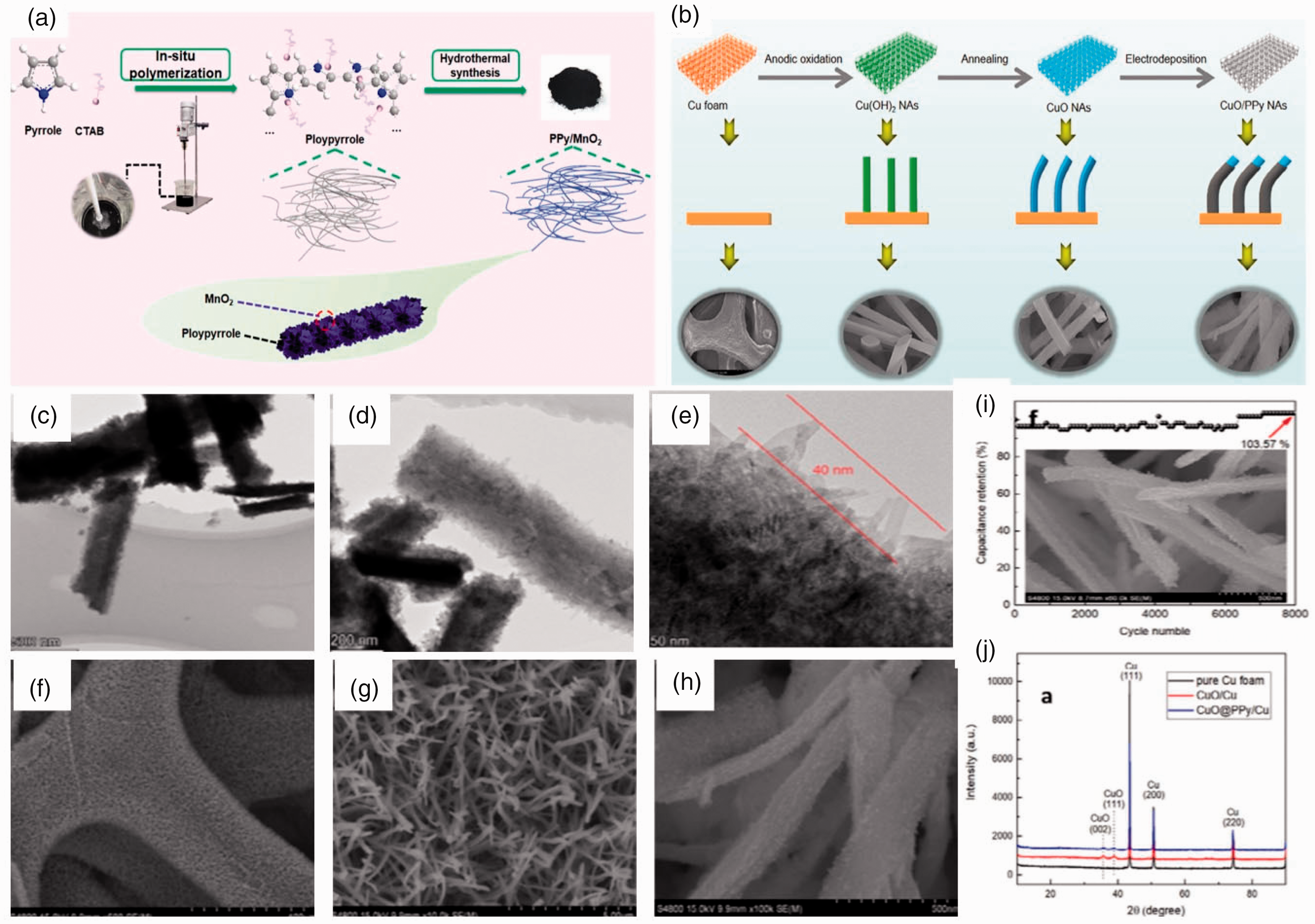
(a) Schematic illustration of the synthesis process of the MnO2/polypyrrole (PPy) composite; 68 (b) Schematic illustration of CuO/PPy nanowire arrays (NAs) electrode preparation. (c) to (e) Transmission electron microscopy (TEM) images of the obtained CuO/PPy NAs; (f) to (h) Scanning electron microscopy (SEM) images of the obtained samples CuO/PPy NAs; (i) Electrochemical stability of the CuO/PPy Nas electrode at 20.0 mA cm−2 and (j) X-ray diffraction (XRD) patterns of Cu foam, CuO NAs and CuO/PPy NAs. 103
In summary, PPy/metal oxide composite electrode materials can significantly improve electrochemical performance, such as specific capacitance, energy density and power density, and cycle stability through synergistic action. In particular, the improvement in power density of the supercapacitor is the most obvious.
Other types of polypyrrole binary composites
In addition to PPy/carbon and PPy/metal oxide composites, many other PPy-based composites (NiCo2S4, MoS2, etc.) have been reported in recent years, which also exhibited excellent electrochemical properties. For example, Barazandeh and Kazemi 105 successfully prepared dandelion-like NiCo2S4/PPy microspheres by the hydrothermal method and their possible application as nonbinder electrodes in supercapacitors. The electrode had low charge transfer resistance and considerable cycle life stability and the specific capacitance was up to 2554.9 F g−1 at the current density of 2.54 A g−1. An asymmetric device with NiCo2S4/PPy/nickel foam (NF) as a positive electrode and rGO/NF as a negative electrode was prepared by using this technique. This asymmetric supercapacitor had a specific capacitance of 98.9 F g−1 at 1.84 A g−1 and an energy density of 35.17 Wh kg−1 at 1472.0 W kg−1. This remarkable performance resulted from the synergistic effect of NiCo2S4 and PPy as well as the direct deposition of composite materials on the collector. Wang et al. 106 prepared a flexible gel electrode composed of phosphomolybdic acid (PMo12) and PPy, and assembled a symmetrical flexible quasi-solid supercapacitor by stacking layers with polyvinyl alcohol (PVA)/H2SO4 as a solid electrolyte and carbon paper as a collector, as shown in Figure 12(a). The assembled solid-state supercapacitor delivered a maximum specific capacitance of 162.1 F g−1 at a constant current density of 0.5 A g−1, a high energy density of 50.66 Wh kg−1 at a power density of 750.0 W kg−1, displayed excellent electrochemical performance exceeding that of other POMs or metal oxide-based systems to the best of our knowledge. Wang et al. 107 successfully prepared flower-like ZnCo2S4/PPy core-shell nanocluster arrays on a carbon fabric substrate by a two-step hydrothermal method combined with electrodeposition, as shown in Figure 12(b). When the constant current density was 1.0 A g−1, the optimized flower-like ZnCo2S4/PPy core-shell electrode exhibited a maximum specific capacitance of 1486.0 F g−1, and retained 72.9% of the initial specific capacitance after 5000 GCD cycles. The corresponding asymmetric supercapacitor containing ZnCo2S4/PPy positive electrode and AC negative electrode achieved a high specific energy of 33.78 Wh kg−1 at 800.05 W kg−1, excellent specific capacitance (112.0 F g−1 at 1.0 A g−1), and high electrochemical stability. In addition, the hybrid device exhibited 90.0% capacitance retention and 100.0% coulomb efficiency after 5000 GCD cycles at 1.0 A g−1. Therefore, the flower-like ZnCo2S4/PPy core-shell nanocluster array had good electrochemical properties and was an ideal electrode material for supercapacitors. MoS2 is a layered material, within the layer was a covalent bond or ionic bond with a strong binding force, and between the layers was to rely on the weak binding force, van der Waals force together, with low cost, easy to synthesize, mechanical and electrical properties, and excellent characteristics. MoS2/PPy is a promising nanomaterial that can be used as a low-cost electrode for supercapacitors. Niaz et al. 108 synthesized MoS2/PPy nanocomposite through a facile hydrothermal process. The layered MoS2 structures were used as two-dimensional conductive skeletons to facilitate protons in and out of nanocomposites making them accessible and shortening the path length of electrolyte ion transport. The MoS2/PPy electrode exhibited a high specific capacitance of 654.0 F g−1 and significantly retained its 95% performance after 500 GCD cycles at a current density of 3.0 A g−1 significantly higher than its pristine counterparts. Tian et al. 111 adopted a facile electrochemical method to optimize MoS2 by spatial-confinement-induced PPy anchoring, as shown in Figure 12(c). The prepared MoS2/PPy (MP) nanocomposites showed remarkable capacitive properties with capacitance up to 613.0 F g−1 when the current density was 1.0 A g−1. Kim et al. 112 adopted a facile and effective method to prepare MoS2/PPy (MPy) hybrid nanomaterials with a high utilization rate (72.5%) by sonochemical exfoliation of the ground block MoS2 in a polar aprotic solvent and chemical oxidation polymerization of pyrrole (Py) onto MoS2 nanosheets, as shown in Figure 12(d). Strong noncovalent molybdenum-nitrogen bonds reduced interfacial resistance and the morphology of PPy could be easily controlled by changing the Py content. The maximum surface conductivity of MPy hybrid nanomaterials was 991.0 S sq, which was very high compared with the original MoS2 nanomaterials (about 3.6 × 10⁻⁷ S sq). When used in supercapacitors, the specific capacitance of the hybrid nanomaterials was 312 F g−1 at a current density of 0.5 A g−1.
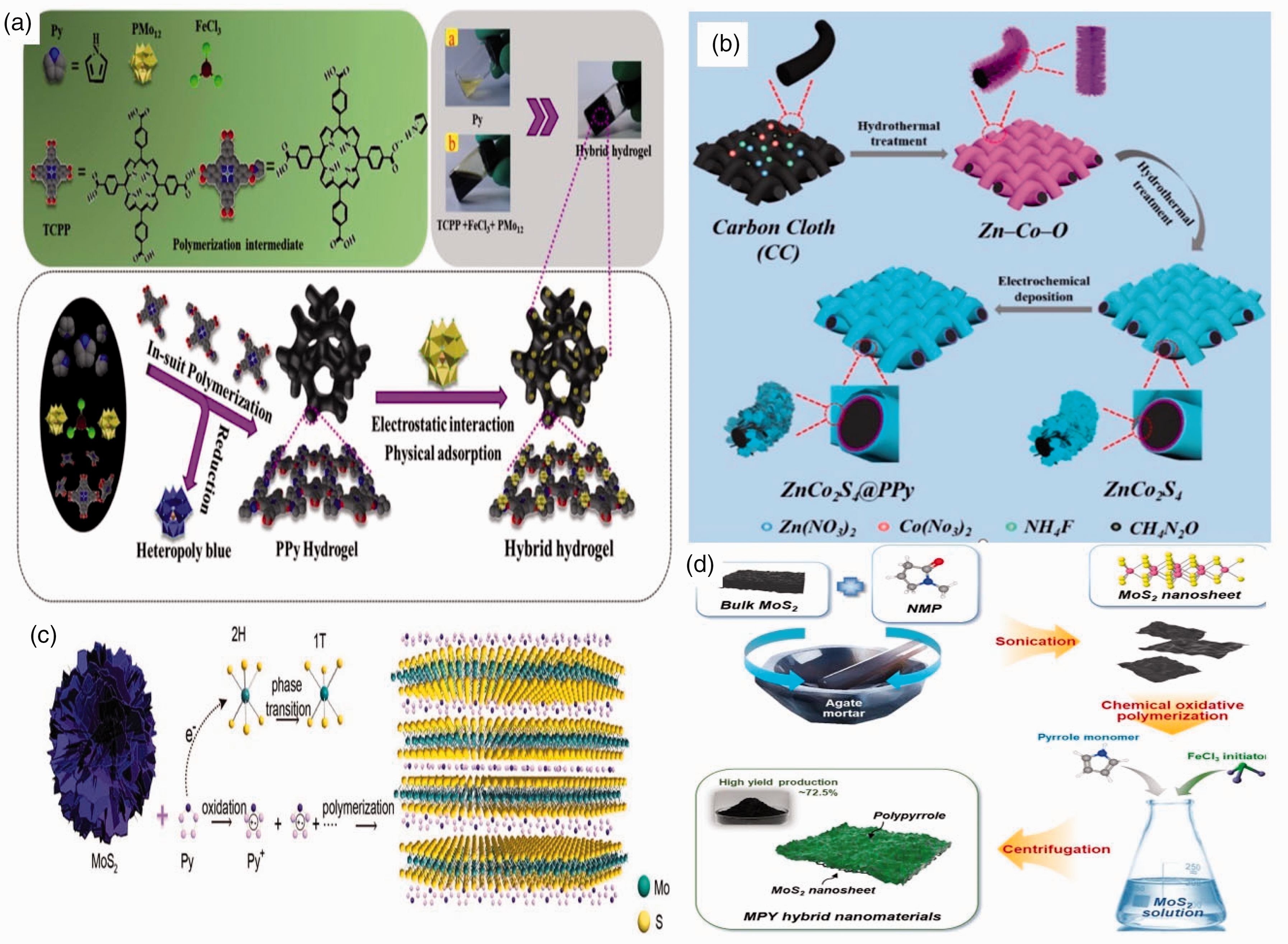
(a) Schematic illustration of the preparation process for the PMo12/polypyrrole (PPy) hybrid hydrogel; 96 (b) Synthesis procedure for ZnCo2S4/PPy; 107 (c) The schematic illustration of the generation of the 1T-MoS2 monolayer by PPy anchoring; 111 and (d) Schematic illustration showing the fabrication of MPY hybrid nanomaterials via grinding, sonication, chemical oxidative polymerization, and centrifugation. 112
In conclusion, in addition to the traditional carbon nanomaterial and metal oxide material, more and more materials have been used to combine with PPy to prepare electrode materials for supercapacitors. The development of PPy-based composites with better electrochemical performance has become a good research direction, and brought great opportunities and challenges to researchers.
Polythiophene-based binary composites
Although PTh has many unique properties, it has not gained an important position in the application field of electrode materials for supercapacitors, probably because the electrochemical performance of PTh is not enough to meet its practical application in the field of advanced electrode materials. To solve this problem, the researchers have tried mixing it with other active materials, such as carbon or metal oxides.
Some researchers tried to combine PTh with carbon materials to obtain electrode materials with excellent electrochemical properties. For example, Azimi et al. 113 synthesized PTh/GO nanocomposites by in situ polymerization and chemical reduction. Electrochemical properties showed that PTh/GO nanocomposites had excellent capacitive properties. At the scanning rate of 5.0 mV s−1, the measured specific capacitance of sample PTh/GO was as high as 28.68 F g−1, which was much higher than that of the original PTh. The good capacitance performance of PTh/GO nanocomposites was attributed to the contribution of EDLC capacitance and pseudocapacitance. Rahman et al. 114 synthesized graphene nanoplatelets (GNPLs)/PTh with different mass ratios through in situ oxidative polymerization. Among the various samples prepared 50% GNPLs/PTh showed a maximum specific capacitance of 673.0 F g−1 at 0.25 A g−1, and showed good cyclic stability after 1500 GCD cycles with a capacity retention rate of 84.9% at a scanning rate of 50 mV s−1. Therefore, 50% GNPLs/PTh with high specific capacitance and good cycle stability could be a suitable electrode material for portable energy equipment. In addition, Qureshi et al. 115 found that the combination of CNT and PTh could enhance the characteristics of components suitable for application in supercapacitors. Compared with a single component PTh/carbon composites exhibited excellent electrochemical properties and cycling stability through synergistic effects. These properties were influenced by a variety of factors including the effective deposition amount of PTh on carbon materials, the type and microstructure of carbon materials, and the synthesis route. Qin et al. 109 synthesized coral-like poly (3, 4-ethylenedioxythiophene)/O-S-doped porous carbon composites (PEDOT/S-PCM) to be used as electrode materials for supercapacitors. The dual doping of sulfur and oxygen could prevent the graphene sheets from collapsing and provide an abundance of active sites. Under the optimized conditions, the PEDOT/S-PCM composite showed a high specific capacitance of 278.0 F g−1 at a current density of 1.0 A g−1 and a significant capacitance retention of 91.0% after 1000 GCD cycles at a current density of 10.0 A g−1. Huang et al. 110 prepared a flexible high-load (over 15.0 mg cm−2) film with three-dimensional hierarchical pores by alternate deposition of carbon nanocoils and poly(3, 4-ethylenedioxthiophene):poly(styrenesulfonate) (PEDOT:PSS). The film electrode showed excellent flexibility and electrochemical properties. It delivered a high areal capacitance of 1402.5 mF cm−2 at 0.25 mA cm−2 and superior stability even at an extremely high current density of 50.0 mA cm−2 after 10,000 CV cycles.
So far, there are few kinds of research on PTh/metal oxide composite electrode materials for supercapacitors. This may be because the electrochemical performance of PTh is not as good as PANI and PPy and there is no effective way to improve its performance. Therefore, the electrochemical properties of PTh/metal oxide composites need to be studied further.
Conductive polymer-based ternary composites
It is difficult for a single CP electrode material to meet its application in supercapacitors. Therefore, the composite of CPs and other materials is considered to construct a ternary composite electrode material. The synergistic effect of different materials can be maximized by adjusting the microstructure and the interaction between components of the composite materials by taking advantage of the differences in physical and chemical properties of different materials. CP terpolymer electrode materials can combine the advantages of various materials, not only having high conductivity and large specific surface area but also further expanding the specific capacitance, good cycle stability, and low cost, which is the future direction of electrode materials for supercapacitors.
Polyaniline-based ternary composites
PANI, metal oxides, and carbon materials are at the forefront of the emerging field of energy storage systems due to their low-cost, superior capacitance performance, and easy preparation. Therefore, the use of different kinds of CPs, metal oxides, and carbon materials to synthesize CP/metal oxides/carbon ternary composites has attracted the attention of many scholars. 68 For example, Yang et al. 116 synthesized MnO2/PANI/nitrogen and phosphorus co-doped carbon nanofibers (NPCNFs) ternary composite by electrospinning technology and chemical oxidation reaction, as shown in Figure 13(a) to (c). When the current density was 0.5 A g−1, the specific capacitance was 578.3 F g−1 and had good cycling stability (about 84.0% of the initial capacitance after 1000 GCD cycles at 10.0 A g−1), as shown in Figure 13(d) and (e). Huang et al. 117 synthesized a ternary nanocomposite composed of MnO2/PANI/MWCNTs by a facile chemical method and used it as an electrode material for supercapacitors. The specific capacitance of MnO2/PANI/MWCNT ternary nanocomposites was 395.0 F g−1, when the current density was 1.0 A g−1. It retained 72.0% capacitance after 1000 GCD cycles at a current density of 1.0 A·g−1. Hekmat et al. 69 directly synthesized MnO2/PANI nanocomposites (MPNCs) on macroporous cellulose fiber network paper by one-step in situ polymerization. At a current density of 1.0 A·g−1, the flexible electrode of MPNCs showed a significant specific capacitance of 190.0 F g−1, which remained at 87.0% after 1000 GCD cycles. Li et al. 118 prepared a new flexible nanostructure (CNT film/Fe3O4/PANI) by the facile electropolymerization of PANI network on Fe3O4 particles grown axially on CNTs of a CNT film for supercapacitor electrode applications, as shown in Figure 13(f). PANI chains were used as protective shells to improve the structural stability of Fe3O4 particles. The resulting supercapacitors showed a high energy density of 28.0 Wh kg−1 and a high-power density of 5.3 kW kg−1 with a specific capacitance of 201.0 F g−1 at a scanning rate of 20.0 mV s−1, which exceeded the performance of many recently reported flexible supercapacitors. In addition, the CNT film/Fe3O4/PANI supercapacitors showed excellent cycling stability. After 10,000 GCD cycles at 1.0 mA cm−2, the initial specific capacitance retention was 96.4%. Upadhyay et al. 119 prepared ternary nanocomposites of rGO/RuO2/PANI-based flexible electrodes. The electrode had a good electrochemical performance with a specific capacitance of 1.5 F cm−2 at a current density of 3.0 mA cm−2. At higher current densities (10.0 mA cm−2), the initial capacitance retention was 80.0%. Some researchers have also researched ternary electrode materials constructed from PANI, CNT, and other materials. Chen et al. 120 developed an environmentally friendly and simple method to prepare ternary flexible electrodes using MoS2, PANI, and CNTs. Supercapacitors constructed from these electrodes had significant energy densities (0.013 Wh cm−3) and power densities (1.0 W cm−3). These results indicated that the exfoliated MoS2-based composite was a promising material for developing high-performance and low cost energy storage devices. Li and Chen 121 introduced PANI and CNTs into activated carbon fiber felt (ACFF) to prepare ACFF/PANI/CNT composite textiles as free-standing and flexible electrodes of supercapacitors. ACFF was an electrochemically active substrate with a double layer capacitance of 2442.0 mF cm−2 at a scanning rate of 1.0 mV s−1, and deposited PANI further provided a large pseudocapacitance. At the same time, CNTs optimized the electrical properties of ACFF/PANI/CNT textiles. Thus, at a current density of 2.0 mA cm−2, the areal capacitance, energy density, and power density of the composite textile were up to 5611.0 mF cm−2, 185.0 µWh cm−2, and 4517.0 µW cm−2 respectively, which were much higher than many flexible supercapacitor electrodes previously reported. ACFF/PANI/CNT textiles had good prospects in wearable and portable electronic products such as flexible supercapacitor electrodes. Ben et al. 122 prepared composite membranes by in situ polymerization of PANI on the surface of PVA/CNT membranes. A PVA/CNT/PANI supercapacitor electrode with excellent electrochemical performance and flexibility was prepared by combining the flexibility and extensibility of PVA, the pseudocapacitance of PANI, and the charge transfer capability of CNT. At a scanning rate of 5.0 mV s−1, the areal capacitance value reached 196.5 mF cm−2, and the capacitance retention reached 71.4% after 5000 CV cycles showing good cycling stability. Dai et al. 123 prepared PANI/MWCNT/rGO ternary composites by the facile hydrothermal method, as shown in Figure 13(g). When the current density was 1.0 A g−1, the specific capacitance was 478.0 F g−1, and the capacitance retention was 64.0% after 3000 GCD cycles. Wang et al. 124 proposed a facile method for the preparation of PANI-rGO/MWCNTs. The prepared PANI-rGO/MWCNTs had high specific capacitance cyclic stability and rate performance. These findings suggest that the covalent functionalization of rGO and PANI may be an effective strategy for preparing advanced electrode materials for supercapacitors in the presence of MWCNTs as interlayer spacers.

(a) The schematic flow chart for preparation of triple-co-axial ternary composites; (b) Scanning electron microscopy (SEM) images of polyanaline (PANI)/MnO2/nitrogen and phosphorus co-doped carbon nanofibers (NPCNFs); (c) Scanning transmission electron microscopy (STEM) image of PANI/MnO2/NPCNFs; (d) Specific capacitance versus current density; (e) Cycling stability profiles at 10.0 A g−1; 116 (f) A schematic illustration of the two-step fabrication process of the carbon nanotube (CNT) film/Fe3O4/PANI electrode; 118 and (g) The schematic diagram of the preparation process. 123
Polypyrrole ternary composite
As mentioned above, combining PPy with carbon or metal oxide to form binary composite electrode materials can effectively improve electrochemical performance. However, due to the limitation of each component, the electrochemical performance cycle stability and other properties of a binary composite electrode are not very good. To improve further the capacitance value and cycling stability of supercapacitors through a synergistic effect, it was an effective method to combine PPy, carbon material, and metal oxide to prepare ternary composites, which have attracted widespread attention. For example, Zhao et al. 125 prepared MnO2 interlinked nanowires on carbon fiber fabric (CFF) by a hydrothermal electrodeposition method. Subsequently, PPy films were deposited on MnO2 nanowires using a facile chemical vapor deposition polymerization method to construct a layered structure PPy/MnO2/CFF. The PPy/MnO2/CFF electrode showed an areal capacitance value of 1.24 F cm−2 at a current density of 1.0 mA cm−2. The supercapacitor assembled with PPy/MnO2/CFF as a positive electrode provided an energy density of 1.93 mWh cm−3 at a power density of 9.8 mW cm−3, and retained 92.6% specific capacity after 10,000 GCD cycles at a current density of 1.0 mA cm−2. Amirul et al. 126 prepared a ternary functionalized carbon nanofiber (f-CNF)/PPy/MnO2 composite. Granular PPy and spherical MnO2 nanoparticles grow randomly on the surface of f-CNF, which provided a unique morphology that could enhance electrochemical activity. f-CNFs/PPy/MnO2 had high specific capacitance (409.88 F g−1 at 25 mV s−1), low charge transfer resistance (3.40 Ω), and sustained cycle stability (capacitance retention of 86.30% after 3000 CV cycles at a scanning rate of 100 mV s−1). Importantly, the ternary f-CNFs/PPy/MnO2 had a maximum specific energy of 42.35 Wh kg−1, maintaining good energy even at higher specific power. Chen et al. 127 successfully synthesized well-designed MWCNTs/MnO2/PPy composites for anodes of asymmetric supercapacitors through three steps, as shown in Figure 14(a). When the current density was 1.0 A g−1, the specific capacitance could reach 806 F g−1. Jyothibasu et al. 128 prepared V2O5/f-CNT/PPy composite electrodes through a facile synthesis method, as shown in Figure 14(b) to (e). V2O5/f-CNT/PPy free-standing negative electrodes showed a high areal capacitance value (1266.0 mF cm−2 at a current density of 1 mA cm−2) and good cycle stability (capacitance retention rate of 83.0% after 10,000 GCD cycles). The excellent performance of the V2O5/f-CNT/PPy composite electrode could be attributed to the synergy between f-CNT with high conductivity and V2O5 and PPy with high energy density. Therefore, V2O5/f-CNT/PPy composite electrodes could effectively alleviate the shortcomings of the low specific capacitance of CNT and the poor cycle life of V2O5.
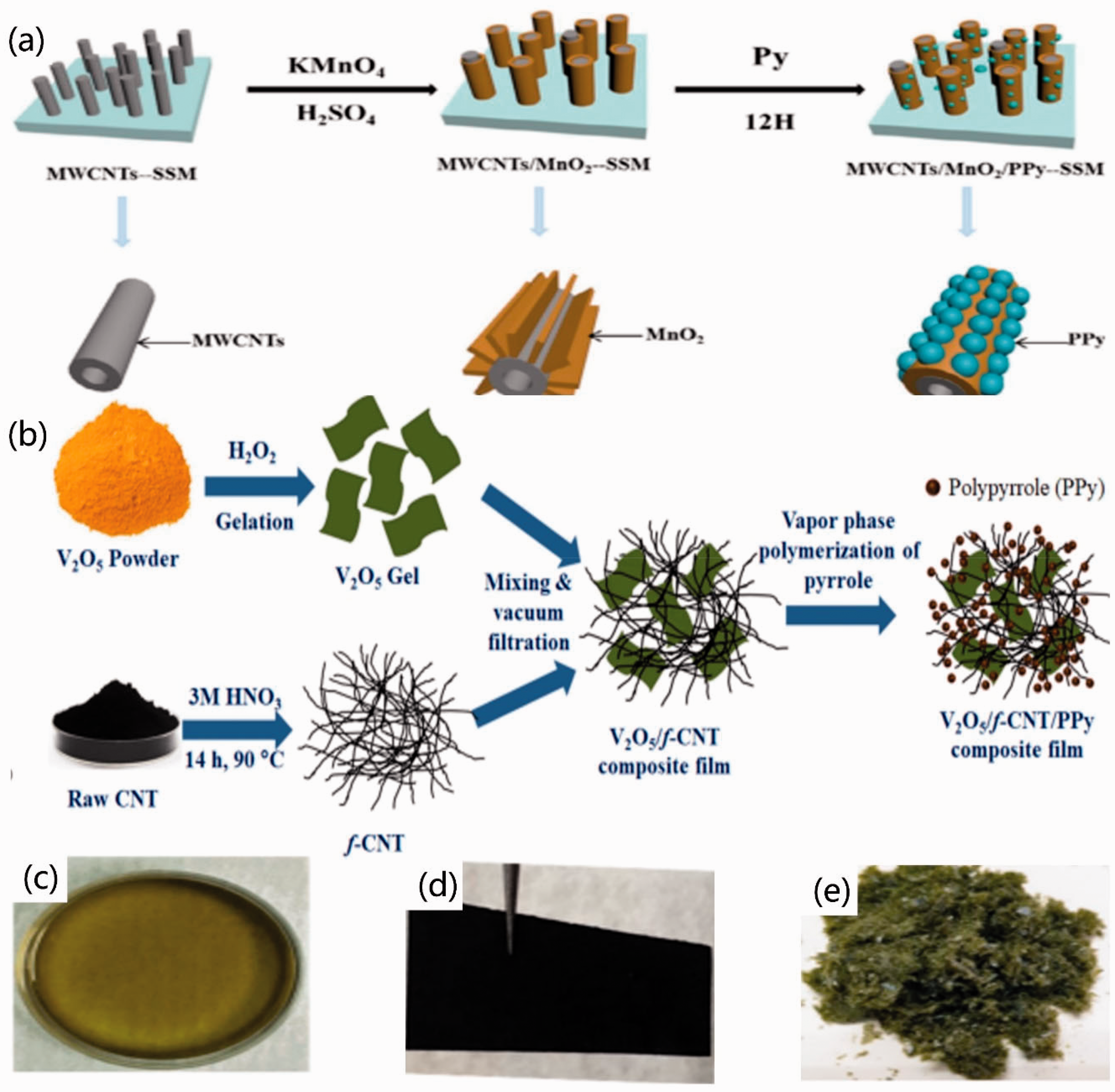
(a) Schematic diagram of the synthesis of multi-walled carbon nanotubes (MWCNTs)/MnO2/polypyrrole (PPy); 127 (b) Schematic diagram of V2O5/functionalized carbon nanofiber (f-CNF)/PPy composite film fabrication process; (c) Photographs of V2O5 gel; (d) Photographs of freeze dried V2O5 gel and (e) Photographs of V2O5/f-CNT/PPy composite film. 128
GN and its derivatives are other important carbon materials in the field of EDLC, and many ternary systems are related to them. For example, Li et al. 129 designed and synthesized WO3/PPy/GO using attapulgite as a hard template, as shown in Figure 15(a). The WO3/PPy/GO ternary composite could be used as the electrode material for supercapacitors successfully. WO3/PPy/GO prepared by the hard template method had regular morphology and porous structure, which could improve electron transfer during the charge-discharge process and shorten the ion diffusion path. In addition, the WO3/PPy/GO ternary composite showed higher specific capacitance and rate capability compared to other tested active materials. The cyclic stability of WO3/PPy/GO was also greatly enhanced due to the introduction of GO with excellent mechanical strength. These results indicated that the WO3/PPy/GO composite may be one of the potential candidates for advanced electrode materials in energy conversion systems. Asen and Shahrokhian 130 used a facile and low-cost electrochemical deposition method to prepare rGO/PPy/Cu2O-Cu(OH)2 terpolymer nanocomposites as electrode materials for supercapacitors. At a current density of 10.0 A g−1, the specific capacitance reached 997.0 F g−1, which was better than GO/PPy (500.0 F g−1), rGO/PPy (685.5 F g−1), and GO/PPy/Cu2O-Cu(OH)2 (750.0 F g−1). The utilization of the EDLC of graphene together with the pseudocapacitive behavior of PPy and Cu2O-Cu(OH)2 led to a maximum energy density of 20 Wh kg−1 at a power density of 8000 W kg−1 and a maximum power density of 19,998.5 W kg−1 at an energy density of 5.8 Wh kg−1 for a symmetric rGO/PPy/Cu2O-Cu(OH)2 supercapacitor. In addition, rGO/PPy/Cu2O-Cu(OH)2 nanomaterials retained about 90.0% of their initial capacitance after 2000 GCD cycles at a current density of 10.0 A g−1. In addition to the PPy/carbon/metal oxide ternary system, other ternary systems have been reported. For example, Peng et al. 131 successfully prepared bacterial cellulose (BC) membranes coated with PPy and CuO as flexible composite electrodes for supercapacitor applications. Supercapacitors using PPy/CuO/BC electrodes had a specific capacitance of 601.0 F g−1 with an energy density of 48.2 Wh kg−1 and a power density of 85.8 W kg−1 at a current density of 0.8 mA cm−2, and a specific capacitance of 385.0 F g−1 after 300 GCD cycles. The introduction of CuO nanoparticles improved the capacitance. Hou et al. 132 prepared sandwich films based on CNF, rGO, and PPy by changing vacuum filtration combined with a chemical reduction process, as shown in Figure 15(b) to (d). The film was self-standing and highly flexible, and it could be directly employed as the electrode material in supercapacitors. Due to the optimized sandwich structure and the synergistic effect of the three components, the sandwich thin film electrode showed a high specific capacitance of 304.0 F g−1 and high capacitance retention of 81.8% after 1000 GCD cycles at 0.5 A g−1. On this basis, a solid-state symmetric supercapacitor had been successfully prepared by using the film, which had a high specific capacitance of 625.6 F g−1 at 0.22 A g−1, an energy density of 21.7 Wh kg−1 at 0.11 kW kg−1, and stable cycle life of 75.4% after 5000 GCD cycles at a current density of 2.0 A g−1, as shown in Figure 15(e) and (f). This integrated approach to the fabrication of free-standing sandwich electrodes can be applied to other electrode materials such as metal oxides and carbon materials providing a new strategy for the design of flexible high-performance energy storage devices.
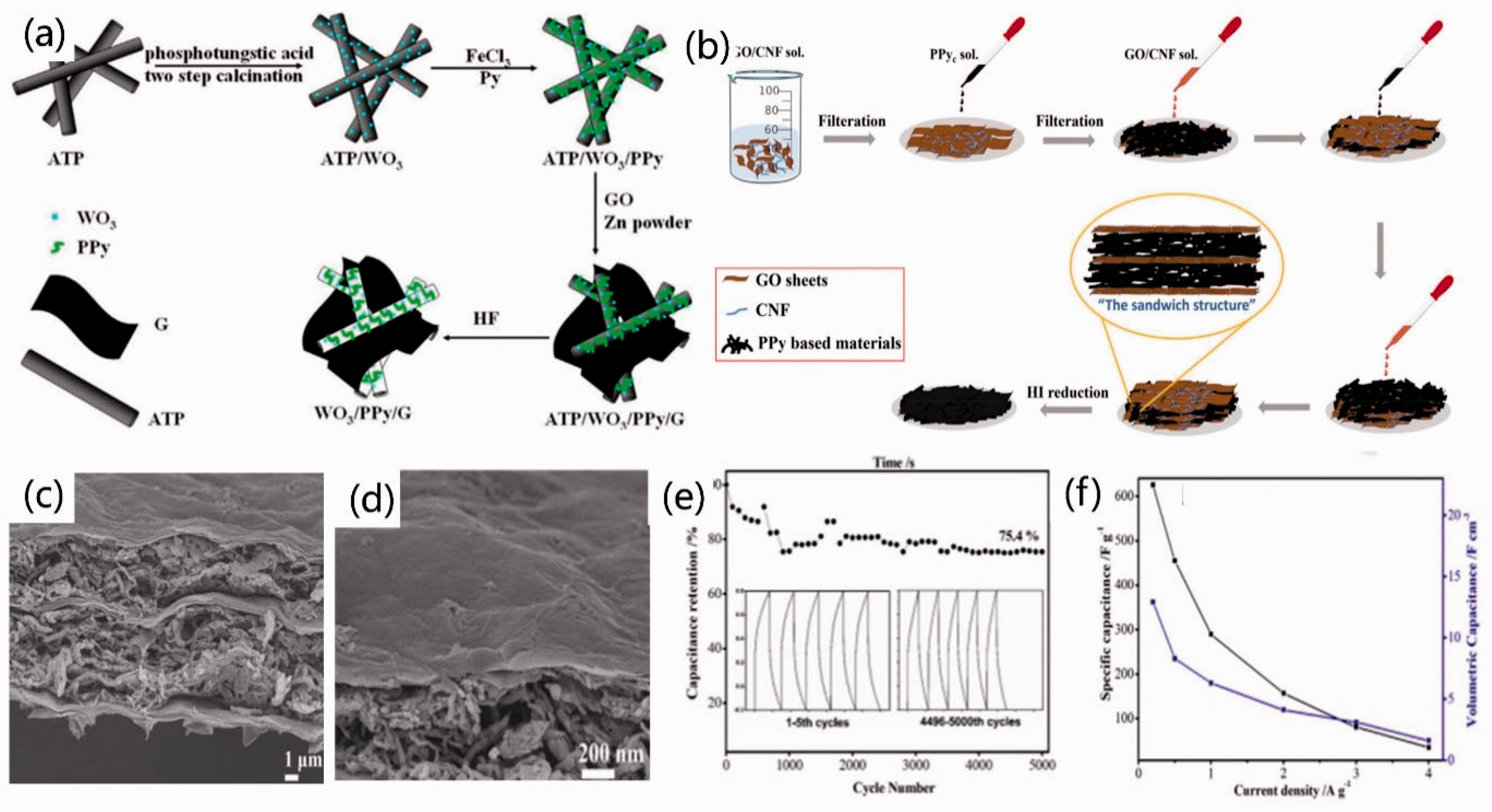
(a) Schematic illustration showing the synthesis of WO3/polypyrrole (PPy)/G129; (b) Schematic diagram of the fabrication process of the sandwich-like structured PPy/RGO/CNF(S-PRC film); (c) Cross-sectional scanning electron microscopy (SEM) image of S-PRC film; (d) The enlarged SEM image for the surface of S-PRC film; (e) Cycling performance of S-PRC based symmetric supercapacitors (SSCs) during 5000 charge/discharge cycles at a current density of 2.0 A g−1 and (f) The gravimetric capacitances and volumetric capacitances of S-PRC based SSCs obtained from : galvanostatic charge-discharge (GCD) curves. 132
Lv et al. 133 prepared bacterial cellulose (BC)/Fe3O4/PPy films by easy co-precipitations and a microemulsion polymerization method, as shown in Figure 16(a) to (e). BC/Fe3O4/PPy film had excellent mechanical strength (tensile strength up to 11 MPa) and excellent electrochemical performance with a maximum areal capacitance value of 5.43 F cm−2. Flexible BC/Fe3O4/PPy films had broad application prospects in supercapacitors and electromagnetic shielding. Shi et al. 134 successfully synthesized NiCoP/CNT/PPy electrode materials using a facile hydrothermal method, as shown in Figure 16(f) to (i). CNTs provided structural support for the electrode material and established a rich aperture structure and a continuous three-dimensional conductive network for the electrode. In addition, PPy further improved electrode conductivity and provided an internal channel for electrolyte wetting and ion diffusion. Based on these advantages the NiCoP/CNT/PPy electrode had excellent electrochemical performance including large capacitance (1807.8 F g−1 at 1.0 A g−1), reversible high-rate performance (1686.3 F g−1 at 2.0 A g−1), and excellent cycle life (75.0% capacitance retained after 8000 GCD cycles at 3.0 A g−1). In addition, the flexible device NiCoP/CNT/PPy//AC asymmetric supercapacitor had a high energy/power density (34.8 Wh kg−1/700.0 W kg−1) and good cycle stability. It could maintain stable working conditions under a wide range of operating temperatures and bending angles, showing great potential in the field of portable wearable devices. Pourfarzad et al. 135 prepared C3N4/PPy/MnO2 ternary nanocomposites by an in situ chemical method. Compared with MnO2/PPy materials, the morphology of ternary nanocomposites was completely different. The specific capacitance of MnO2/Ppy and C3N4/Ppy/MnO2 electrodes was 378.4 F g−1 and 509.4 F g−1 when the current density was 1.0 A g−1. In addition, the energy density of the asymmetric supercapacitor prepared with C3N4/Ppy/MnO2 as the cathode and activated carbon as the anode reached up to 63.9 Wh kg−1 at 2000 W kg−1 power density. Moreover, it had good cycle performance, the capacitance retention rate reached 95.7% after 5000 GCD cycles at 2.0 A g−1, which had a broad application prospect in high-performance supercapacitors.

(a) Graphic illustration of the synthesis process of bacterial cellulose (BC)/Fe3O4/polypyrrole (PPy) film; (b) Capacitance at different PPy conditions and areal current density (insert picture: capacitance comparison of BC/Fe3O4, BC/PPy, and BC/Fe3O4/PPy at 0.1 mol/L PPy concentration); (c) The cycle life of the film electrode at the charge-discharge process. (d) Scanning electron microscopy (SEM) images of BC/Fe3O4/PPy films; (e) Transmission electron microscopy (TEM) pictures of BC/Fe3O4/PPy. 133 (f) The synthesis of NiCoP/carbon nanotube (CNT)/PPy; (g) SEM images of NiCoP/CNT/PPy; (h) The corresponding specific capacitance at different current densities of NiCoP, NCP/CNT, NiCoP/PPy, and NiCoP/CNT/PPy and (i) Long cycle performance of NiCoP/CNT/PPy at a current density of 3 A g−1. 134
Polythiophene-based ternary composites
Because the electrochemical performance of PTh or PTh-based binary composite supercapacitor electrodes is not as good as PANI and PPy, 137 there is no good method to improve its performance at present, so there are few studies on PTh-based ternary supercapacitor electrodes. For example, Ates et al. 136 prepared rGO/Ag/PTh nanocomposites by in situ polymerization and chemical reduction of GO. As an electrically active material, rGO/Ag/PTh nanocomposites exhibited good capacitive properties in acidic electrolyte solutions with high specific capacitance (up to 953.13 F g−1 at the scanning rate of 4.0 mV s−1). The specific capacitance retention rate reached 91.88% after 1000 CV cycles at 100 mV s−1. In addition, the energy density of nanocomposites was higher in 1 M H2SO4 aqueous electrolyte (up to 28.8 Wh kg−1 at 5.0 mV s−1 scanning rate and up to 2843.3 W kg−1 at 1000 mV s−1 scanning rate). This study showed that rGO/Ag/PTh nanocomposite electrode materials could provide stable supercapacitors for portable electronic applications. Xu et al. 42 first prepared ZnS/rGO by the hydrothermal method and doped CPs (PANI, PPy, PTh, and PEDOT) with the same mass ratio (polymer to 70 wt%) on the surface of ZnS/rGO composite by in situ polymerization, and ZnS/rGO/PANI composite had the best performance.
To sum up, ternary composites can exert the advantages of each component through a synergistic effect thus showing higher electrochemical performance cyclic stability and other important properties in practical applications. More and more researchers are focusing their attention on CP-based ternary composites. In particular, through the synergistic action of carbon, metal oxides, and CPs, the construction of terpolymers with better electrochemical performance will become the focus of future research.
Table 2 shows the PANI-based binary and ternary composite electrode materials.
PANI-based binary and ternary composites
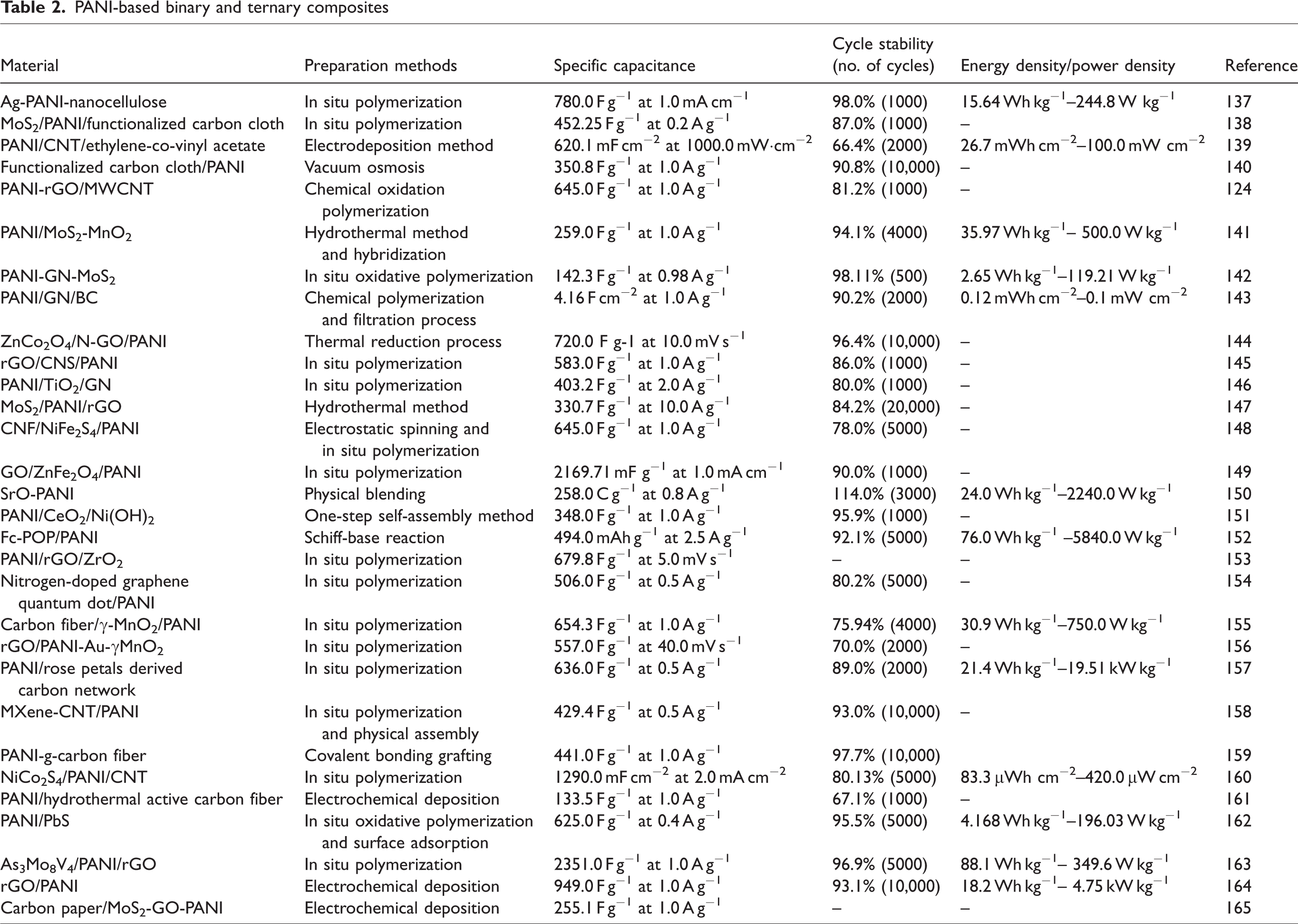
Table 3 shows the PPy-based binary and ternary composite electrode materials.
PPy-based binary and ternary composites
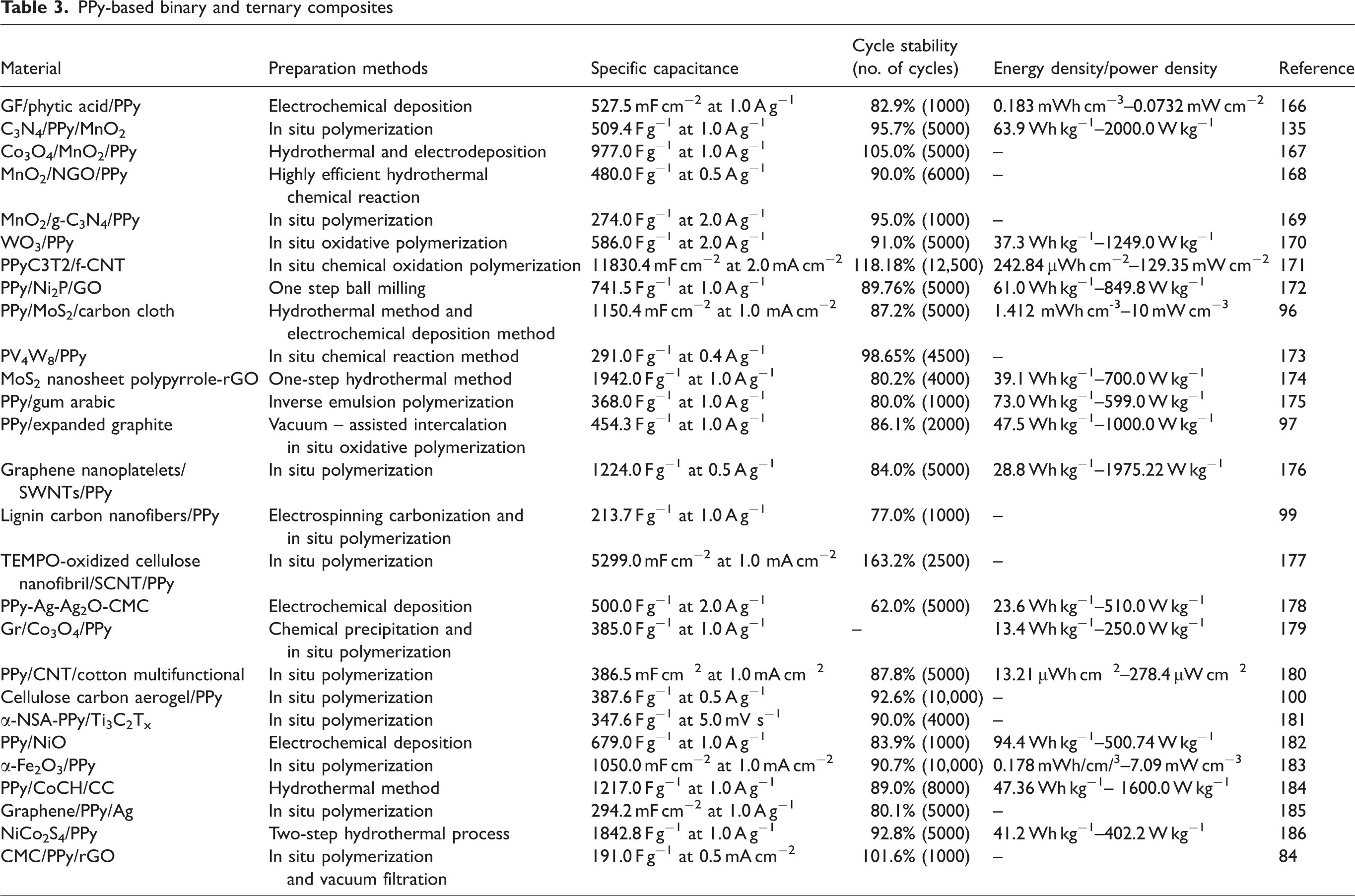
Conductive polymer-based quaternary composite materials
Theoretically, CP-based quaternary composites can improve the performance of all aspects through a synergistic effect. However, due to the relatively complex preparation process and little improvement in the performance of the composites compared with ternary composites, there are few studies on CP-based quaternary composites. For example, Wang et al. 187 successfully prepared ACFC/PANI/CNT/MnO2 hybrid textile electrodes by depositing PANI, CNT, and MnO2 successively on activated carbon fiber cloth (ACFC) through the dipping and drying method and in situ chemical reactions, respectively. In the manufactured ACFC/PANI/CNTs/MnO2 textile electrodes, the ACFC/CNT hybrid framework acted as a porous conductive 7three-dimensional network for rapid electron and electrolyte ion transport. Symmetrical supercapacitors based on textile electrodes provided superior areal capacitance (4615.0 mF cm−2), energy density (157.0 µWh cm−2), and power density (10,372.0 µW cm−2). Ao et al. 188 developed a high-performance supercapacitor by constructing three-dimensional rGO structures on CNT/Fe3O4/PANI films. The porous rGO structure with a large surface area gave the rGO/CNT/Fe3O4/PANI electrode excellent electrochemical performance. When the current density was 1.0 A g−1, the composite electrode exhibited a specific capacitance of 414.5 F g−1. In addition, symmetric supercapacitor devices with rGO/CNT/Fe3O4/PANI electrodes showed significant electrochemical performance with an energy density of 60.8 Wh kg−1, a power density of 45.2 kW kg−1, and excellent cycle life. The results showed that rGO-CNT-Fe3O4-PANI composite was a promising new energy storage electrode, which could be used for rapid and efficient energy storage. Bai et al. 189 prepared PPy/rGO/CNT/BC through vacuum filtration and electric polymerization with good areal capacitance value (715 mF cm−2 at 1 mA cm−2), good rate performance (495.0 mF cm−2 at 30.0 mA cm−2), acceptable cycle stability (86.85% after 5000 GCD cycles), and significant mechanical strength (57.7 MPa). In addition, the flexible symmetric supercapacitor assembled from PPy/rGO/CNT/BC had an energy density (0.0328 mWh cm−2) and a power density (12.0 mW cm−2). Jiao et al. 190 developed a new light-energy feedback strategy, using CNT/Au/PPy/polyethylene terephthalate (PET) as electrochromic electrodes and electrochromic contrast agents as state of charge (SOC) indicators for field quantitative monitoring of the energy storage status of flexible electrochromic supercapacitors (ECSCs). In addition, the flexible high-capacitance electrode and asymmetric device design could cooperatively improve the energy storage performance of the flexible ECSCs resulting in an energy density as high as 4.03 µWh cm−2 with high electrochemical stability under deformation conditions. This work largely explored the potential and advantages of PPy in manufacturing high-performance flexible smart supercapacitors and opened up an alternative approach to enabling convenient, low-cost, and nondestructive SOC self-monitoring capabilities in flexible energy storage devices.
Flexible electrode materials prepared by combining conductive polymer and textile materials
The combination of conductive polymers with textile materials can make them wear resistant, flexible, comfortable, and wearable, so that they can be better applied in the field of smart textiles. Introducing conductive polymers into textiles can give the electrodes of supercapacitors good electrochemical performance and flexibility, which is an effective method to prepare flexible supercapacitors.191–193
At present, there are two main methods to make textiles with energy storage function: one is to coat fibers, yarns, and fabrics with conductive polymers, so that the active substances can penetrate the material or form shells on the surface of the material;194,195 the other is to introduce active materials into the spinning solution to produce composite fibers by wet spinning, electrospinning or other methods.196,197 The coating method is the simplest and most cost-effective way to introduce conductive polymers into textiles. Fibers, yarns or fabrics can be made electrically conductive by coating them with suitable conductive polymers. Generally, textile materials can be put into the reaction solution of aniline, pyrrole and other monomers and polymerize aniline and pyrrole to the material surface by chemical or electrochemical methods, or coated on the material surface after the complete reaction. Electrospinning is a general method for producing nanoscale fibers. Electrospun fibers are widely used in batteries and supercapacitor electrodes because they have a large surface area and can effectively promote ion adsorption and redox reactions. Wet spinning is an effective method to produce long functional fibers. The spinneret was inserted into the coagulation bath to allow the fibers to solidify, and subsequently the fibers were removed from the coagulation bath, dried, and collected continuously to the winder. The electrochemical properties and flexibility of conductive polymer electrodes in the form of fibers, yarns, and fabrics are summarized as follows.
Conductive polymer fiber electrode material
Compared with carbonaceous materials, conductive polymer materials have higher specific capacitance and energy density, so combining conductive polymers with CNT fibers, graphene fibers, and carbon fibers can significantly increase the specific capacitance and energy density of fibers.198–200 For example, Wang et al. 201 grew PANI nanowires in situ on the surface of CNT fibers by chemical polymerization, and the specific capacitance of fibers increased from 2.3 mF cm−2 to 38.0 mF cm−2. In addition, the fibers showed good cycling stability (the capacity remained 80% after 5000 GCD cycling at a current density of 4.0 mA cm−2). Tian et al. 202 first grew nitrogen-doped carbon nanotubes (N-CNTs) on highly aligned CNT fibers, and then deposited PANI on N-CNTs to design a composite fiber with a layered core sheath structure, as shown in Figure 17(a) to (c). PANI/N-CNT/CNT fiber had high specific capacitance, excellent rate performance, and cyclic stability. When the current density was 1.0 A g−1, the specific capacitance reached 323.8 F g−1. The assembled supercapacitor could still maintain 92.1% of the original capacitance after 10,000 GCD cycles at 20.0 A g−1. In addition to excellent energy storage performance, it also had excellent wear resistance and flexibility. After repeating the bending process for up to 10,000 GCD cycles, the capacitance could be maintained at 95.5%. This work provided a new strategy for developing fiber electrodes for high-performance wearable devices. Zheng et al. 203 prepared a new type of nanostructured microfiber with hyaluronic acid (HA), CNTs, and PANI combined with wet spinning and electrochemical polymerization. Compared with HA/CNT fibers, the obtained core-shell HA/CNT/PANI fibers showed an average six-fold increase in specific capacitance, with a capacitance retention rate of about 90.0% after 3000 CV cycles at 100.0 mV S−1. In addition, core-shell HA/CNT/PANI microfibers exhibited excellent flexibility and electrochemical cycling stability under bending and twisting, showing flexibility and wear resistance. Qu et al.204 reported the preparation of PPy/graphene fibers with diameters in the range of 15 ∼ 100 µm by direct wet-spinning, as shown in Figure 17(d) and (e). The fiber diameter could be tuned by changing the diameter of the needles for electrospinning and/or the concentration of GO. Compared with the pristine PPy fiber, the resultant PPy/graphene fibers exhibited a relatively high tensile strength (up to 80 MPa) and capacitance of 95 ∼ 105.0 mF cm−2 (65 ∼ 72.0 F g−1) even after bending for 1000 GCD cycles, indicating excellent electrochemical and mechanical stabilities. The fibers of a 35 µm diameter exhibited the best supercapacitive performance in terms of the energy density up to 6.6∼9.7 µWh cm−2 in both the bending and straight forms. Zheng et al. 205 synthesized graphene/PPy fiber nanocomposites by the solvothermal method. Moved by electrostatic interaction and hydrogen bonding between the tetra-functional NiPcTs and PPy chain, a self-sorting mechanism acted to align the PPy chains to form one-dimensional PPy nanofibers on graphene. The in situ grown nanostructure possessed good interconnectivity and porosity facilities, as shown in Figure 17(f) to (i). The well-designed microstructure of the composites achieved a synergistic effect between the graphene and PPy, showing good electrochemical performance for supercapacitors of 316.0 F g−1 even at a high current density of 5.0 A g−1. Jin et al. 206 deposited PANI nanorods on the surface of carbon fiber by the electrochemical method, which was used as the positive electrode of the supercapacitor. The carbon fiber was oxidized and heat treated, which was used as the negative electrode of the supercapacitor. The energy density could be as high as 2.0 mW h cm−3, and the highest power density was 11.0 W cm−3. Although the specific capacitance and energy density could be increased by growing conductive polymers on the surface of carbon fibers in situ, the loading capacity of pseudocapacitive active materials was limited. High loading capacity would reduce the conductivity of the fibers and deteriorate the electrochemical performance of the fibers. Therefore, the structural design and performance optimization of electrode materials to improve the energy density of fiber supercapacitors and provide energy for high-power wearable electronic devices would be a major development direction in the future.

(a) Schematic illustration for the fabrication of the polyaniline (PANI)/nitrogen-doped carbon nanotube (N-CNT)/carbon nanotube (CNT) fiber composite electrode; (b) and (c) Hierarchical core-sheath structured PANI/N-CNT/CNT fiber at low and high magnifications; 202 (d) Schematic diagram of the hollow RGO/conducting polymer composite fibers (HCF) preparation; (e) Capacitance retention under different bending states; 204 (f) Scanning electron microscopy (SEM) images of hyaluronic acid (HA)/CNT/PANI fiber surface; (g) and (h) Cross-sectional SEM images of HA/CNT/PANI fibers at low and high magnifications and (i) Cycle stability of HA/CNT and HA/CNT/PANI fiber electrodes. 205
As a typical one-dimensional flexible energy storage device, a fiber supercapacitor has the characteristics of spinning and weaving textile fibers. It can increase its output voltage or specific capacitance through series and parallel connections, so it can be used as a flexible wearable energy source alone. In addition, fiber supercapacitors can also be integrated with energy harvesting devices (fabric nanogenerators, solar cells, etc.) to produce self-powered energy fabrics.
Conductive polymer yarn electrode materials
Conductive polymer yarn supercapacitors are usually prepared by coating the electrodes of the yarn with a gel electrolyte. Multiple yarns can be arranged in parallel or intertwined. Similar to various yarns with different physical and mechanical properties in the textile industry, flexible yarn line supercapacitors with excellent electrochemical and mechanical properties should also be developed for flexible energy storage devices in portable and wearable electronic devices.
Wang et al. 201 deposited PANI nanowires on the surface of CNT yarn in situ to form CNT/PANI composite yarn and then coated PVA gel on the surface of pure CNT yarn or CNT/PANI yarn to form yarn electrodes. The capacitor had a specific capacitance of 12.0 mF cm−2 at a current density of 1.0 mA cm−2. Mao et al. 207 reported a novel type of sheath-core polyaniline nanowire array (PANI-NWA) grown on aligned carbon nanofibers/carbon fiber yarn electrode (CFY/CNFs/PANI-NWA) based supercapacitors. The carbon fiber yarn could maintain the yarn electrode with high electrical conductivity and mechanical properties. The introduced PANI-NWAs could expand the specific surface area of the electrode and introduce pseudocapacitance. The assembled supercapacitor had an area-specific capacitance of up to 234.0 mF cm−2 and excellent cycle stability (90% after 8000 GCD cycles) at a current density of 0.1 mA cm−2. Jin et al. 208 prepared a high-performance cotton/graphene/PANI yarn supercapacitor, in which a graphene sheet was used as the fiber core inside the cotton yarn, and then aniline was polymerized in situ to grow the PANI-NWA layer, thus forming the yarn electrode. The three-dimensional graphene conductive network on the yarn electrodes enhanced electron transport, and the small diameter PANI nanowires ensured a high electrochemically active surface area, which endowed the supercapacitor with excellent electrochemical performance. After 3800 CV cycles at 5 mV s−1, it had a maximum area-specific capacitance of 246.0 mF cm−2, capacitance retention of 98.0%, and an energy density of 9.7 µWh cm−2 at a power density of 840.9 µW cm−2. Zhao et al. 209 coated GO nanosheets and polyacrylonitrile (PAN)-GO nanofibers on the surface of nickel-coated cotton yarn (NCY) by the conjugated electrospinning technology, and then chemically deposited a PPy layer. Pyrrole was polymerized in situ to obtain a flexible wearable PPy/GO/PAN-GO/Ni core-spun yarn (PGPG/NCY) electrode. A flexible symmetric all-solid two-strand yarn supercapacitor based on the PGPG/NCY electrode was assembled. The yarn supercapacitors exhibited high area-specific capacitance (28.34 mF cm−2) and high energy density (3.98 µWh cm−2), which was superior to other yarn supercapacitors. The capacitance retention rate of the yarn supercapacitor was 90.2% after 1000 CV cycles at 100 mV s−1. Yarn supercapacitors exhibited high electrochemical performance and cycle stability. Li et al. 210 prepared PAN-coated carbon yarns (CP yarns) by electrospinning based on carbon fiber yarns. PPy nanoparticles were deposited on CP yarns by in situ polymerization to obtain highly conductive yarns (CPP yarns). Finally, Zn was deposited on CPP yarn by electrodeposition to obtain CPP/Zn yarn electrodes, as shown in Figure 18(a) to (e). When the current density was 0.04 A cm−1, the specific capacity could reach 981.3 mF cm−1, and the energy density was 0.18 W h cm−1. After 300 GCD cycles, 87.76% of the original specific capacity could still be maintained. After bending the CPP/Zn yarn electrode 500 times, the specific capacitance could still maintain 86.13% of the original specific capacitance. The yarn electrode has excellent electrochemical stability and flexibility. Cai et al. 211 reported the manufacture of cotton/CNT leather-core yarn deposited with PPy for stretchable wearable electronic products with high function. The measured areal capacitance was 761.2 mF cm−2 at the scanning rate of 1.0 mV s−1. After 10,000 CV cycles, 98.0% of the original specific capacity could still be maintained. The method of spinning technology may lead to new exploitation for CNTs and PPy in future wearable electronic device applications.

(a) Schematic diagram of the preparation of the CPP/Zn yarn electrode; (b) Physical picture of CPP yarn; (c) and (d) Scanning electron microscopy (SEM) of polypyrrole (PPy) particles on the surface of CPP yarn under different magnifications and (e) Surface roughness of CPP yarn. 210
Flexible conducting polymer yarn-type supercapacitors have great potential for development, mainly due to their high specific capacity, stable cycling performance, and excellent wearable performance. In addition, the main development direction of wearable flexible intelligent products is to optimize further the sensitivity and durability of flexible conductive polymer yarns and the combination of textile materials and conductive materials because of the convenience, comfort, washable resistance, and sensitivity required by wearable intelligent textiles.
Conductive polymer fabric electrode material
Fabrics and textiles are considered ideal substrates that are difficult to replace by other substrates because of their high surface area, light weight, good mechanical properties, robustness, and flexibility. However, traditional textiles tend to be nonconductive.217,220 To solve this problem, conductive layers and/or active materials are loaded onto the fabric surface by physical coating 66 or chemical deposition methods. For example, Jin et al. 212 successfully constructed a three-dimensional conductive network of CNTs and graphene sheets on polyester fabric using the ‘impregnation-drying’ process and electrophoretic deposition method, which was helpful to enhance the electron transport rate and shorten the diffusion distance of electrolyte ions. The resulting composite fabric provided a promising substrate for fabricating fabric electrodes for flexible supercapacitors. The PANI/CNT/graphene/polyester textile electrode showed high electrochemical performance after further coating the CNTs with PANI. The composite electrode exhibited a maximum area capacitance of 791 mF cm−2 at a current density of 1.5 mA cm−2. Huang et al. 213 first prepared high concentration graphene ink and then coated the polyester fabric with graphene through repeated soaking and drying processes. Subsequently, PANI/GPT electrodes were prepared by electrochemical deposition of PANI on graphene-coated polyester fabrics. The proportion of PANI in the textile electrode was systematically modified, and the textile electrode obtained had good energy storage performance, the specific capacitance reached 896.5 F g−1 at 2.0 A g−1, and had good rate performance. The assembled flexible supercapacitor also had excellent flexibility, with a capacitance retention rate of 95.1% after bending up to 5000 times at 10.0 A g−1. This high-performance textile electrode and low cost approach could be widely used to develop other wearable energy storage devices. Masumeh et al. 214 obtained a PANI functionalized carbon cloth supercapacitor with a very high energy density (1091.0 Wh kg−1) by using a nanostructured PANI electrode, which had a high-power density of 196.0 kW kg−1. The electrode was extremely flexible and stable, with a capacitance retention rate of 96.0% after 1000 bends at 180°. The capacitance retention rate was 84.0% after 7000 GCD cycles at a current density of 35.0 A g−1. Yoo and Bae 215 directly dispersed PANI-poly (2-acrylamido-2-methyl-1-propanesulfonic acid) in water and deposited it on PET fabric to form a symmetric flexible supercapacitor electrode. The fabric supercapacitor had a specific capacitance of 60.0 F g−1, which showed strong cycle stability and high mechanical durability during the bending test. Leary et al. 216 prepared supercapacitors by electrodeposition polymerization of aniline onto different types of nonwoven CFF substrates. By changing the deposition potential, they found that the deposition potential range of the highest capacitance was 0.744 ∼ 0.777 V. When the deposition time was 20 min, the specific capacitance of 0.5 M aniline solution was the highest.
Devi et al. 217 prepared ZnFe2O4 with PPy nanoparticles directly on a multifunctional flexible CC substrate by in situ oxidation polymerization, as shown in Figure 19. The CC substrate supports the three-dimensional conductive network, flexibility, effective ion diffusion routes, and large surface area of ZnFe2O4/PPy nanocomposites. Thus, the specific capacitance of CC/ZnFe2O4/PPy nanocomposites was increased. The specific capacitance of the flexible CC/ZnFe2O4/PPy electrode was up to 1598.9 F g−1 at a current density of 1.0 A g−1. The installed symmetric supercapacitors using PVA-H2SO4 gel electrolyte as a separator provided good energy and power densities of 32.9 Wh kg−1 and 500.0 W kg−1, respectively. Wan et al. 218 prepared a two-dimensional CP-based fabric electrode by the salt template-assisted vapor polymerization method. The two-dimensional cotton/PPy electrode showed high specific capacitance (902.6 mF cm−2 at 1.0 mV s−1) and good cycle stability (86.5% capacitance retention after 12,000 GCD cycles at a current density of 10.0mA mA cm−2). The capacitance of the flexible symmetric device remains above 90.0% after 1000 180° bending cycles. Zhang et al. 219 successfully fabricated fabric electrodes for flexible supercapacitors by depositing PPy nanotubes and Zr-based MOF (UIO-66) particles on cotton fabrics. Because of their excellent conductivity and one-dimensional structure, PPy nanotubes could be used as conductive connectors to bridge UIO-66 particles. The conductivity of the PPy/UIO-66/cotton fabric electrode was increased to 14.29 S cm−1. The specific capacitance was 565.0 F g−1 at a current density of 0.8 mA cm−2. Alzate et al. 220 prepared flexible supercapacitor electrodes by coating PPy on pineapple-polyester fabric (PAPF) and water hyacinth polyester blend fabrics (WHPFs) through in situ chemical polymerization. The PPy/PAPF and PPy/WHPF composites showed high area capacitance values (86.01 mF cm−2 and 104.31 mF cm−2 at 1.0 mA cm−2, respectively). The PPy/PAPF and PPy/WHPF composites also showed good volumetric power (0.1104 Wh L−1 and 0.1362 Wh L−1, respectively, at 1.0 mA cm−2) and energy densities (12.72 W L−1 and 16.03 W L−1, respectively, at 1.0 mA cm−2). These results indicated that PPy textile composites had good properties as electrode materials for supercapacitors made from natural fiber fabrics. Liang et al. 221 fixed GO nanosheets on cotton fabric (CF) through vacuum filtration, and then adsorbed pyrrole monomer and silver ion (Ag+) onto the GO/CF surface through π–π and electrostatic interaction, respectively, to prepare flexible PPy/Ag/GO/CF electrodes. The flexible symmetric quasi-solid fabric-based supercapacitor based on the optimal electrode also maintains excellent electrochemical performance and excellent mechanical flexibility, which had broad application prospects in wearable energy storage devices.
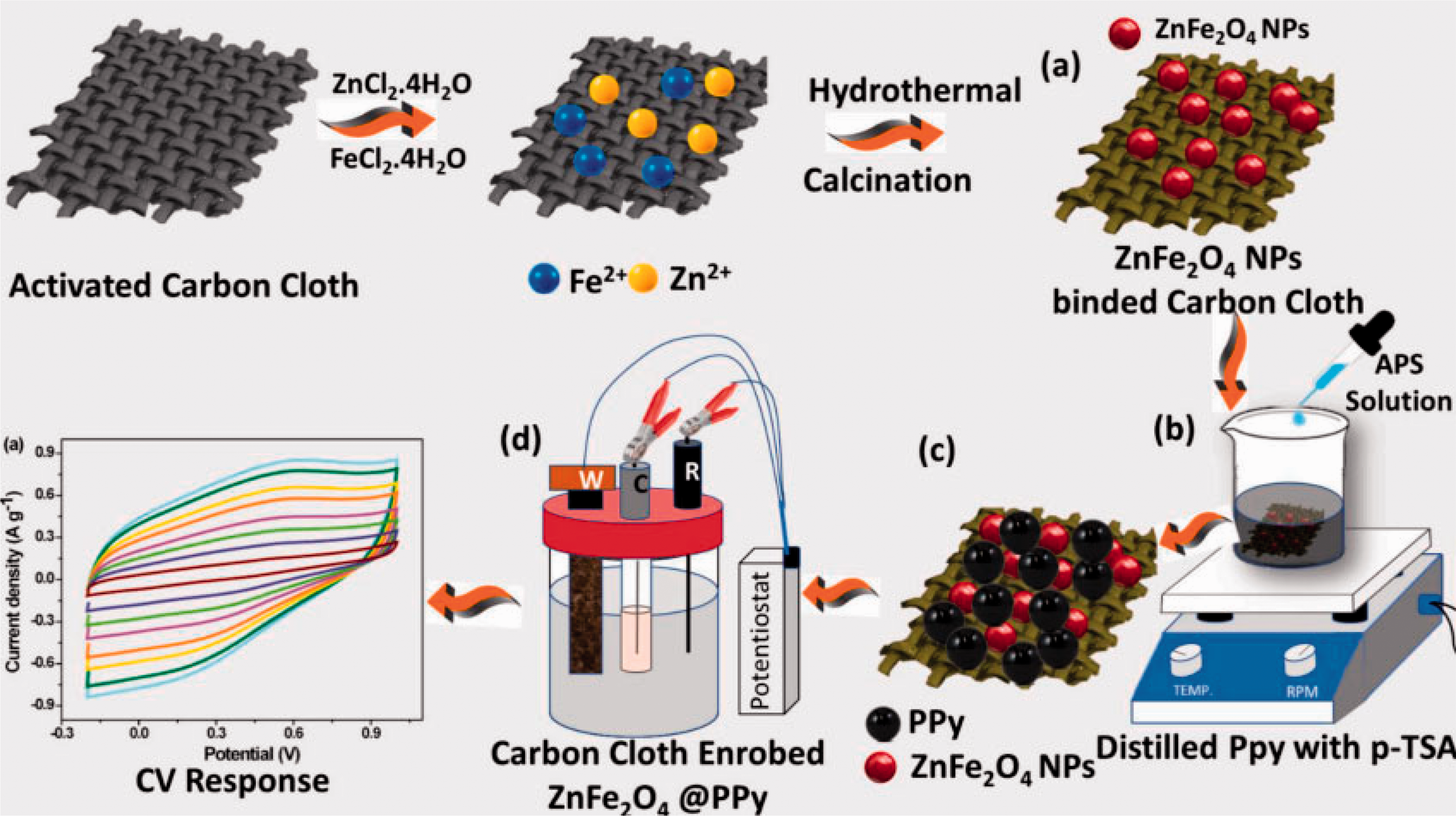
Schematic illustration displaying: (a) Formation of ZnFe2O4 nanoparticles on carbon cloth (CC) substrate; (b) Formation of polypyrrole (PPy) on CC enrobed ZnFe2O4; (c) CC/ZnFe2O4/PPy electrode and (d) Electrochemical performance of CC/ZnFe2O4/PPy. 217
Combining supercapacitors with flexible textile materials not only meets the demand for supercapacitors but also conforms to the development of wearable intelligent textiles, providing more possibilities for the application of intelligent energy storage devices. Compared with other supercapacitors, fiber, yarn, and fabric electrode supercapacitors are highly mechanically flexible, which helps withstand long-term and repeated deformation, can be cut and packaged into various shapes, and can be integrated into textiles, laying an important foundation for the development of wearable smart textiles. However, at present, the combination of supercapacitors and flexible textile materials also faces some challenges. In the future, the electrode size can be expanded to meet the needs of daily production, and the mechanical properties of the electrode can be improved to withstand the mechanical forces in the process of textile manufacturing.
Conclusions and outlook
This paper mainly introduces the latest research progress of CP-inorganic nanocomposite supercapacitors and the application of CP-based textiles and fibers in flexible supercapacitors. CPs mainly include PANI, PPy, and PTh, which have the unique advantages of easy synthesis, good flexibility, and high pseudocapacitance, and are of great significance to solve the challenges of current supercapacitor development. However, CPs have many problems, especially low energy density and power density, and poor cycle stability. At present, there are mainly the following methods to improve their disadvantages:
Combining CPs with EDLC materials with high specific surface area and high conductivity can effectively improve the energy density and power density of supercapacitors. Using the advantages of various electrode materials, CPs, carbon materials and metal oxides are organically combined to construct multi-electrode composite material. The crystallinity, microstructure, and surface morphology of the electrode materials of CP-based supercapacitors can be improved by adjusting the polymerization method, dopant content, oxidation level, type, and content of surfactants, to improve the electrochemical performance of CP-based supercapacitors. Three-dimensional CP-based electrode composites are constructed to improve the spatial order of the materials, shorten the ion transport distance and reduce the electrochemical impedance. At present, the methods for preparing CP-based supercapacitors with stable structure and excellent performance include electrodeposition, interface polymerization, vacuum filtration, and electrospinning. The optimization and improvement of the preparation method is an effective way to prepare excellent electrode materials.
In recent years, supercapacitors have made great progress in terms of specific capacity and cycle stability, but there are still many challenges. Here are some of the challenges and potential directions:
In addition to electrochemical properties, other important properties, including thermal stability, machining capacity, and mechanical properties, should be considered for practical applications. The transparency, self-healing, photosensitivity, and other properties of supercapacitors need to be further studied. This puts forward higher requirements for the comprehensive performance of supercapacitors and makes the research more difficult. With the rapid development of intelligent wearable electronic products and smart textiles, the demand for flexible and lightweight advanced energy storage equipment is becoming more and more urgent, and flexible supercapacitors will become an important research direction. Flexible supercapacitors usually need to work in a bending environment, so more attention should be paid to the bending cycle performance and electrolyte leakage risk. The development of flexible electronic devices has put forward new requirements for the research of flexible energy storage devices. Fiber supercapacitors with foldable and stretchable properties will become a new research trend, and the integration of various flexible devices with different functions will become the most potential development direction. Due to the limitations of production technology, production cost, and industry standards, it is difficult for all kinds of supercapacitors with excellent performance to be applied on a large scale in real life. Researchers should try their best to overcome the problems in the industrialization of high-performance supercapacitors based on reality.
Footnotes
Data availability
The datasets generated during and/or analyzed during the current study are available from the corresponding author on reasonable request.
Declaration of conflicting interests
The author(s) declared no potential conflicts of interest with respect to the research, authorship, and/or publication of this article.
Funding
The author(s) disclosed the receipt of the following financial support for the research, authorship, and/or publication of this article: This work was supported by the Consulting Research Project of the Chinese Academy of Engineering (2021DFZD1), Tianjin Science and Technology Plan Project Innovation Platform Special Project (17PTSYJC00150), 2022 Tianjin Research Innovation Project for Postgraduate Students, International Joint Research Center of Textile Structural Composites of Anhui Province (2021ACTC04), Construction Project of Central University Base of Engineering Research Center of the Ministry of Education for Industrial Textiles, Open Project of Key Laboratory of High Performance Fibers and Products of the Ministry of Education, Key Laboratory of Eco-Textile of Ministry of Education (2232021G-04).
