



Abstract
Electromagnetic shielding (EMS) clothing is mainly studied for its shielding effectiveness (SE) through practical testing at present, which has many problems such as large experimental error and time and labor consumption. This paper proposes a method for constructing a simulation model of EMS clothing based on feature section replacement. Firstly, a human body model based on an elliptical truncated cone is established. A feature section of the key parts is built according to the morphological characteristics of the human body. Then a clothing structure model is established by replacing the corresponding sections in the elliptical truncated cone model with these feature sections. A digital description method for the model is given. The finite integral method is selected to calculate the SE of each test part when the clothing is completely closed, and the clothing contains holes and seams. By comparison with the measured value, it is concluded that the results of the constructed simulation model are in good agreement with the measured values. This paper establishes a new method to study the SE of EMS clothing, which provides a new approach for the design, production, evaluation and related research of EMS clothing.
Keywords
Electromagnetic radiation seriously endangers human health and has been listed as one of the most important pollutions to be controlled in the world. 1 Electromagnetic shielding (EMS) clothing is an ideal product to protect the human body from electromagnetic waves, 2 and it is widely needed in daily life and various industrial fields. However, a series of issues, such as the influencing factors and changing law of the protective performance of EMS clothing, are still unclear, making it difficult to judge the quality of the products in market. Some inferior products are widely used, causing great harm to the human body. Therefore, research on the protective performance of EMS clothing and other related issues is an urgent demand in this field, which is of great significance to ensure that the human body is protected from electromagnetic waves.
The important indicator for measuring the protective ability of EMS clothing is shielding effectiveness (SE). However, the style structure of the clothing is complex and it includes many inevitable seam and hole areas, such as seams, buttons, slide fasteners and openings. The experimental testing conducted to study the influence of these elements on the SE of the clothing is subject to time and labor consumption, high experimental costs and low accuracy. Therefore, it is urgent to adopt a scientific and effective method to study the SE of EMS clothing. With the development of information technology represented by computers, simulation experiments have gradually become a new experimental method that replaces physical testing. They can not only reduce errors and avoid other factors, but greatly save experimental time and cost, becoming an effective approach to avoid the above-mentioned problems of EMS clothing. Therefore, constructing a scientific model of EMS clothing and conducting simulation experiments based on it have important application significance and scientific value. Based on this requirement, this paper carries out the research on the construction of a simulation model of EMS clothing for SE analysis.
There are few literature studies on the simulation of EMS clothing. Researchers simulated the SE of the clothing by the finite element method (FEM) and verified the simulation results by a physical test verification platform. The results demonstrated that the SE predicted by the model was slightly less than the values measured by experiments, but the overall trend presented a higher level of consistency with the experimental results. 3 The model of one-piece protective clothing in the wearing state was established based on the Chinese human anatomy model, and the protective characteristics of good conductor protective clothing on the human body in the microwave radiation environment of 0.3–3 GHz were investigated by the finite-difference time-domain method. The basic law of the electromagnetic leakage from holes in the clothing and its influence on the protective efficiency were analyzed. 4 A simulation model was established using the three-dimensional (3D) electromagnetic simulation software Ansoft HFSS to obtain the SE of the clothing, and the impact of the body shape change of women during pregnancy on the SE of the clothing was analyzed through the simulation model. 5 A parametric graphic method was used to develop a 3D virtual human model during pregnancy. By comparing with the actual body shape of pregnant women, the correctness of the human model was confirmed. At the same time, the authors pointed out that the model could be used in the research of EMS clothing. 6 The SE of the clothing was simulated by the simulation software COSMOL, which confirmed the function of EMS clothing, and the authors pointed out that the opening areas, such as seams and cuffs, significantly reduced the performance of EMS clothing. 7 Researchers studied the calculation method of the SE in the shape of the curved surface of the clothing. 8
These above simulation methods all use the drawing method to establish the structural model of the clothing, and do not digitally characterize any part of the clothing, which makes it difficult to digitally represent each part of the clothing, and the position and the size of the holes, seams and other components cannot be accurately positioned in the model. Moreover, most of models do not consider the surface characteristics of the human body, and many of them are the stacking of the simple geometry, which cannot correctly describe the human body shape. These problems lead to the lack of rigor and scientificity in the follow-up electromagnetic calculation and law analysis, which need to be solved urgently.
Other researches related to EMS clothing mainly focus on the test methods and product performance. Kurokawa and Sato 9 and Yoshimura et al. 10 studied the test method of the SE of clothing using the method of time-domain analysis, and tested the chest area of the manikin. Wang et al. 11 used the same EMS fabrics to prepare and test different structures and styles of the clothing, and analyzed the laws of various influencing factors on the protection effect of the clothing. Scientists analyzed the influence of the neckline and cuff on the SE of clothing, and expounded the influence law of these factors on the performance of the clothing according to the test data.2,12 Researchers studied the comfort of EMS clothing13,14 and explored the performance of the manufacturing materials and their impact on the overall protective performance of the clothing. 15 Wang et al. 16 pointed out that the evaluation of the overall shielding performance of clothing must consider factors such as the clothing surface structure, openings and seams. Moreover, researches on shielding fiber performance, 17 shielding fiber identification and analysis, 18 influencing factors of shielding performance of the fabric, 19 prediction of the shielding efficiency of the fabric 20 and construction of the calculation model21,22 also played an important reference role in the study of EMS clothing.
In summary, the current simulation methods still have some problems. The clothing model has not been digitally characterized, the objects of various parts and accessories are difficult to accurately describe and the model does not conform to the shape of the surface of the human body. All these make it difficult to conduct electromagnetic calculations and accurate analysis in simulation experiments of EMS clothing, resulting in a lack of scientific and rigorous simulation results. Therefore, this paper proposes a new method to build a structure model of EMS clothing based on the replacement of the feature section. A digital structure model of EMS clothing is established by replacing the sections at different positions of the elliptical truncated cone with feature sections. Based on this, the SE of the tested parts is simulated and calculated, and a satisfactory conclusion is obtained by comparing the simulation results with the measured values.
Structure model construction of clothing
Model construction
The style of clothing is extremely complex. In order to use a model for electromagnetic simulation analysis, firstly, the model needs to conform to the characteristics of the human body surface. Secondly, it should be simple and feasible, avoiding overly complex calculations as much as possible. Thirdly, all the key points of the clothing can be accurately described digitally. For this reason, this article considers that the clothing state is ideal for close fitting wear, which is consistent with the human body shape, so that the clothing model can be described by a human body model. Therefore, a new method for constructing a clothing structure model based on feature section replacement is proposed.
Firstly, the body is divided into a combination of multiple elliptical truncated cones, as shown in Figure 1(a). According to the characteristics of the human body, the shapes of the feature sections of the six important positions of the neck (a), shoulder (b), chest (c), abdomen (d), waist (e) and hem (f) are determined, as illustrated in Figure 1(b). Then the corresponding feature sections are used to replace the sections of the elliptical truncated cone at positions of h1, h2, h3, h4, h5 according to the proportion of the human body, as shown in Figure 1(c).

Model construction method of the body.
By studying the proportional features of the human body, we determine the height of the feature section based on the following relationship:

Similarly, the arm is also regarded as the combination of an elliptical truncated cone, as illustrated in Figure 2(a). According to the characteristics of the human body, the shapes of the feature sections of five important positions of the shoulder arm (a), upper arm (b), elbow (c), lower arm (d) and wrist (e) are determined, as shown in Figure 2(b). Then they are used to replace the sections at the heights of the elliptical truncated cone of h1, h2, h3, h4 and h5 in turn, as shown in Figure 2(c).

Model construction method of the arm.
According to the proportion of human body characteristics, there are the following:


Digital description of the model
Only using the digital description of the whole model, the relevant laws of mesh generation, electromagnetic simulation and SE can be studied. Therefore, the size is taken as the initial condition of the human model in this paper, and each feature section corresponds to a specific initial size, such as the chest circumference and waist circumference. The digital description of the model is given.
Suppose that the contour of the nth feature section is divided into Mn key points according to the needs of subsequent electromagnetic simulation, as illustrated in Figure 3. The mth key point is recorded as P (n,m), and its coordinates of x and y can be obtained as follows:


Acquisition of arbitrary key points on the model contour.
According to the needs of the electromagnetic simulation, the model surface contours between any adjacent nth feature section and the (n + 1)th feature section are divided into Kn areas along the Z-axis. The connecting line between the corresponding mth key point P (n,m) and P (n + 1,m) is divided into Kn key points, which are recorded as P (n, m, k), and its coordinates of X, Y and Z can be obtained as follows:


According to Equations (1)–(6), if the key dot matrix Fmodel is used to represent the whole human body model, then:

The above key dot matrix can accurately describe the clothing model, and lay a foundation for grid division, electromagnetic simulation calculation and related law analysis.
Physical model construction of the clothing
Grid partition
The finite integral method was first proposed by Professor Weiland,
23
and its core is to discretize the Maxwell equation in the integral form. The grid is the basic space for iteration of the finite integral method. In this paper, a hexahedron is used to mesh the structure model of the clothing with 25 meshes per wavelength. According to the clothing characteristics and Equation (7), each elliptical truncated cone area is meshed. Within half of the contour of each elliptical truncated cone, the area formed by four adjacent key points is selected as the starting endpoint in turn, and the grid is divided continuously to the opposite side in the direction perpendicular to the Z-axis. The area set G formed by four adjacent key points can be expressed as follows:


Equation discretization
In order to realize numerical calculation, the Maxwell equation must be discretized on each grid surface. As shown in Figure 4, the sum of the edge voltages of the four basic grids is equal to the integral of the electric field intensity on the closed curve S. The basic grid surface surrounded by the four edges represents the partial derivative of the integral of the magnetic field intensity on this surface to time. All the base grid surfaces are discretized according to the above process, and the discretization results are expressed in matrix form. At the same time, a matrix C corresponding to the analytical curl operator, namely the discrete curl operator, is defined. The topological structure of the operator is only related to the structure and boundary, and its elements only contain 0, 1 and –1.

Discrete process of the Maxwell equation.
Boundary condition
According to the needs of simulation calculation in this paper, the free space is simulated outside the calculation space, so the radiation boundary (open and space) is selected. This boundary condition forms the matching size around the clothing model, and some extension spaces are added outside the calculation space, so that the electromagnetic wave will not be reflected when it propagates to the boundary, and are in line with the actual situation of simulation in this paper.
Excitation source and frequency
The plane wave is selected as the excitation mode, the incidence direction (propagation normal) is set as the front incidence and its direction vector is perpendicular to the plane of the front of the human body. A Gaussian pulse is chosen as the wave source of the pulse function, and the frequency is 0.1–3 GHz.
Model validation
Specification of the simulation model
According to anthropometric data of women aged 26–35 of GB 10000-88 Chinese adult body dimensions, the body and arm sizes of the model are listed in Table 1.
Size of the feature position of body and arm

The heights of the feature sections of the body and arm are listed in Table 2.
Height of the feature section of body and arm

According to the data in Tables 1 and 2 and the methods described in Equations (1)–(7), the clothing simulation model of the female upper body can be obtained, as shown in Figure 5.

Front view of the simulation model of the female upper body.
Determination of the electromagnetic parameters
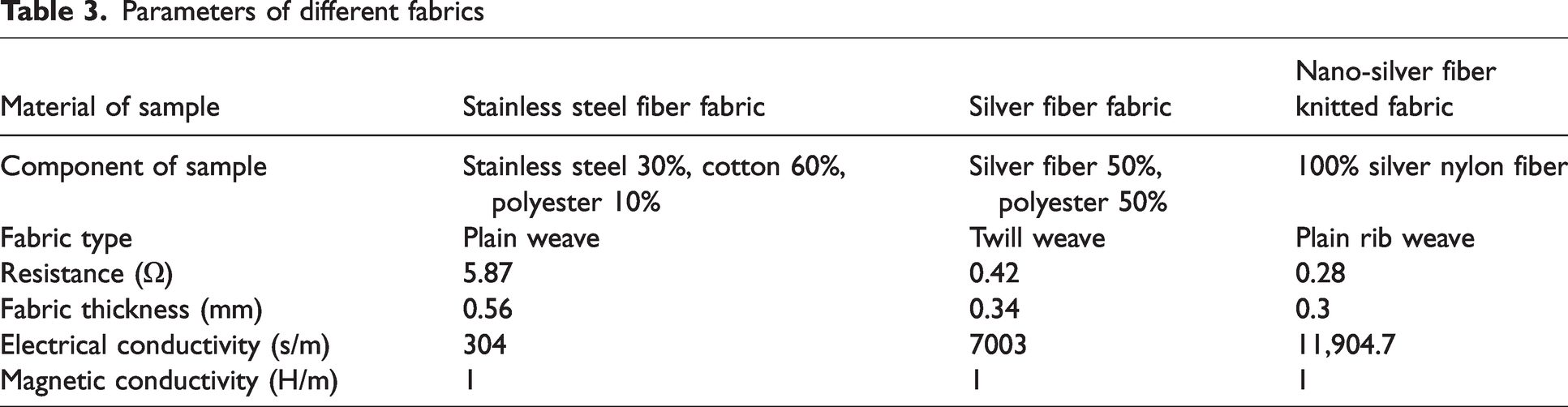
In this paper, the electromagnetic parameters of shielding fabrics measured by Zhang and Chen 24 are used to simulate and calculate the model, as shown in Table 3.
Parameters of different fabrics
SE simulation calculation and verification of the clothing
In this paper, CST electromagnetic simulation software is used to verify the constructed clothing model. According to the need of the actual test, the SE of the chest, abdomen and perineum are tested. The probe positions are illustrated in Figure 6.

Probe positions.
The electromagnetic parameters in Table 3 are substituted into the material properties of the model of EMS clothing, and then an electric field probe is set at the test position of the clothing model to record the electric field intensity of this point in time domain. Let the electric field value at the probe with shielding be E1 (V/m) and E0 (V/m) that without shielding, and the SE of the test point can be calculated as follows:
25

Actual testing methods
A semi anechoic chamber is used for testing. As shown in Figure 7, 25 the electric field probe is placed on the sponge partition in the chest, abdomen or perineum and other areas of the manikin. The manikin is made of high-polymer material transparent to electromagnetic waves, and does not contain any metal material to prevent interference to electromagnetic wave signals.

Diagram of the actual test method.
The testing equipment includes a semi anechoic chamber, manikin, DR6103 broadband double-ridge horn antenna, DR-P01 micro omnidirectional electric field signal receiver, DRA00818 power amplifier, AV3629D vector network analyzer of microwaves, etc. The transmission frequency range is 1–18 GHz. The testing distances are 3 m. The abdomen, chest and perineum positions are selected as the testing positions. The height of the transmitting antenna is consistent with that of the signal receiver. The test angles are selected facing the human model, and the calculation method for the test results of SE is consistent with Equation (9).
Results and discussion
Simulation of the completely closed model
The electromagnetic parameters of the stainless steel fiber fabric, silver fiber fabric and nano-silver fiber knitted fabric listed in Table 3 are substituted into the model to obtain the simulation results when the model is completely closed. According to Equation (9), the SE of each test part of the model with different fabrics is calculated. Table 4 lists the calculation results of the abdominal test area.
Shielding effectiveness (SE) obtained from the model simulation

According to the experiments, the average values of the SE of the three different fabrics used in Table 3 at 0.1–3 GHz are 34.5, 56.3 and 57 dB, while the average values of the SE of the clothing are 35.5, 55 and 59 dB. It can be observed that the SE of the clothing is almost equal to that of the fabric if the fabric is kept strictly closed after being made into clothing.
However, in actual wearing, clothing cannot be in an ideal fully enclosed state, and EMS clothing in any scene certainly has seam areas, holes areas and other areas. Therefore, the fully enclosed clothing model only confirms that the clothing style in the ideal state has no impact on its SE, and its SE is close to that of the fabric used. To really study the performance of EMS clothing, it is also necessary to consider adding seams, holes and other elements to the model in the subsequent work.
Simulation of the clothing model with a single seam
The slide fastener area of the front part of the clothing is regarded as an equivalent seam, and its position and width are illustrated in Figure 8(a). The electromagnetic field intensities of the chest, abdomen and perineum area are selected to calculate the SE of the clothing with this seam. The fabric is 100% silver-plated nylon fiber, and the results are shown in Figure 8(b).

Simulation model with seams and the shielding effectiveness of electromagnetic shielding clothing with different seam widths.
Figure 8(b) shows that the SE displays an overall downward trend when the width of the seam increases, but it is divided into a significant decline area and a gentle change area. When the seam width increases from 1 to 1.5 mm, the SE of the clothing decreases rapidly by about 15 dB, which is the first significant decline area. When the seam width continues to increase to 2.5 mm, the SE of the clothing has no change, which is a gentle change area. When the seam width increases to 3 mm, the SE of the clothing shows an obvious downward trend, which is the second significant downward area. In fact, in further research, it is found that the SE of the clothing undergoes little change when the seam width is less than 1 mm, while the overall SE of the clothing continues to decrease significantly or even lose the shielding effect when the gap width is greater than 3 mm. It is found from experiments that the specific seam widths in the significant decline area and gentle change area are determined by many factors, such as the frequency range, fabric SE and so on. Its law will be explored in the follow-up research.
Simulation of the model with holes
Buttonholes are set on the collar of the clothing model, as shown in Figure 9(a). The size of each buttonhole is 15 mm × 3 mm and the spacing between two buttonholes is 30 mm. The SE of the clothing with holes is calculated by selecting the electromagnetic field intensity in the chest, abdomen and perineum regions. The clothing fabric is 100% silver-plated nylon fiber. The simulation results of the SE of EMS clothing with different buttonholes are illustrated in Figure 9(b).

Simulation model with holes and the shielding effectiveness of electromagnetic shielding clothing with different numbers of holes.
Figure 9(b) shows that as the number of buttonholes in the model increases, the SE of EMS clothing shows a decreasing trend, and the overall downward slope is relatively stable. The overall tested SE of the clothing in the chest is the lowest, followed by the abdomen area, and the SE measured in the perineum area is the highest. This is because the signal leakage point (the buttonhole) is closest to the chest test point. At this time, the attenuation of the incident electromagnetic wave is the lowest, and the electric field strength is highest. According to Equation (9), the SE measured at this time is the lowest. Similarly, the abdomen is further away from the buttonhole, resulting in greater signal attenuation and lower measured SE. The perineum area is the farthest away from the buttonhole area, and the attenuation is the most after the incident electromagnetic wave reaches this point, resulting in the highest measured SE. Further research has found that when the buttonhole area is greater than a certain value, the overall SE of the clothing also significantly decreases or even loses its shielding effect. The specific law is determined by various factors, such as the frequency range and fabric SE.
Comparison with measured values
In most cases, there may be some deviation between the shape of simulation and actual test products. Firstly, the seams and holes of the simulation model are not completely consistent with the actual shape. Secondly, when studying the influence of a certain seam and hole during actual testing, other seam areas cannot be completely closed, while the simulation model can be completely closed. Thirdly, there are too many irregular seams and holes, and the method of obtaining their equivalent seams and holes needs to be improved continuously. Therefore, it is necessary to avoid the above situation to keep the simulation model consistent with the measured products as much as possible when using the simulation model to test actual clothing.
As shown in Figure10(a), to make the simulation model as close as possible to the measured products, the neckline, cuff and hem area of the clothing are regarded as closed, and the equivalent seam width is obtained according to the front seam. 26 Based on this, the shoulder, side seam and placket of the model in Figure 10(b) are slit to form a simulation model close to real clothing. During the testing, the frequency is chosen to be 2 GHz, and the testing location is chosen in the abdomen. The measured values of the sample in Figure 10(a) are compared with the simulation results of the SE of the corresponding clothing model in Figure 10(b). As shown in Figure 10(c), it is observed that the general trend of the simulation result is consistent with the measured value and the specific SE is consistent with the measured value, but the overall characteristic presents that the simulation result is slightly larger than the measured value. This is consistent with the actual situation.

Comparison of simulation results with measured values. SE: shielding effectiveness.
The simulation calculation is less affected by other external factors, such as electromagnetic wave reflection and electromagnetic interference. When studying the influence of the seam area shown in Figure 10 on the SE of the clothing, other collar, cuff and hem areas can be fully sealed through the model settings in this article. The actual testing value is greatly affected by external electromagnetic reflection and interference. When studying the influence of seams on the SE, even if any methods are used to tie and cover the neckline, cuffs and hem, and there is still a certain leakage to the electromagnetic wave. Therefore, the overall simulation results are larger than the actual test results.
Comparison with other methods
The proposed method in this paper is compared with reported researches on the simulation of EMS clothing, as indicated in Table 5.
Comparison with the reported researches on the simulation of clothing
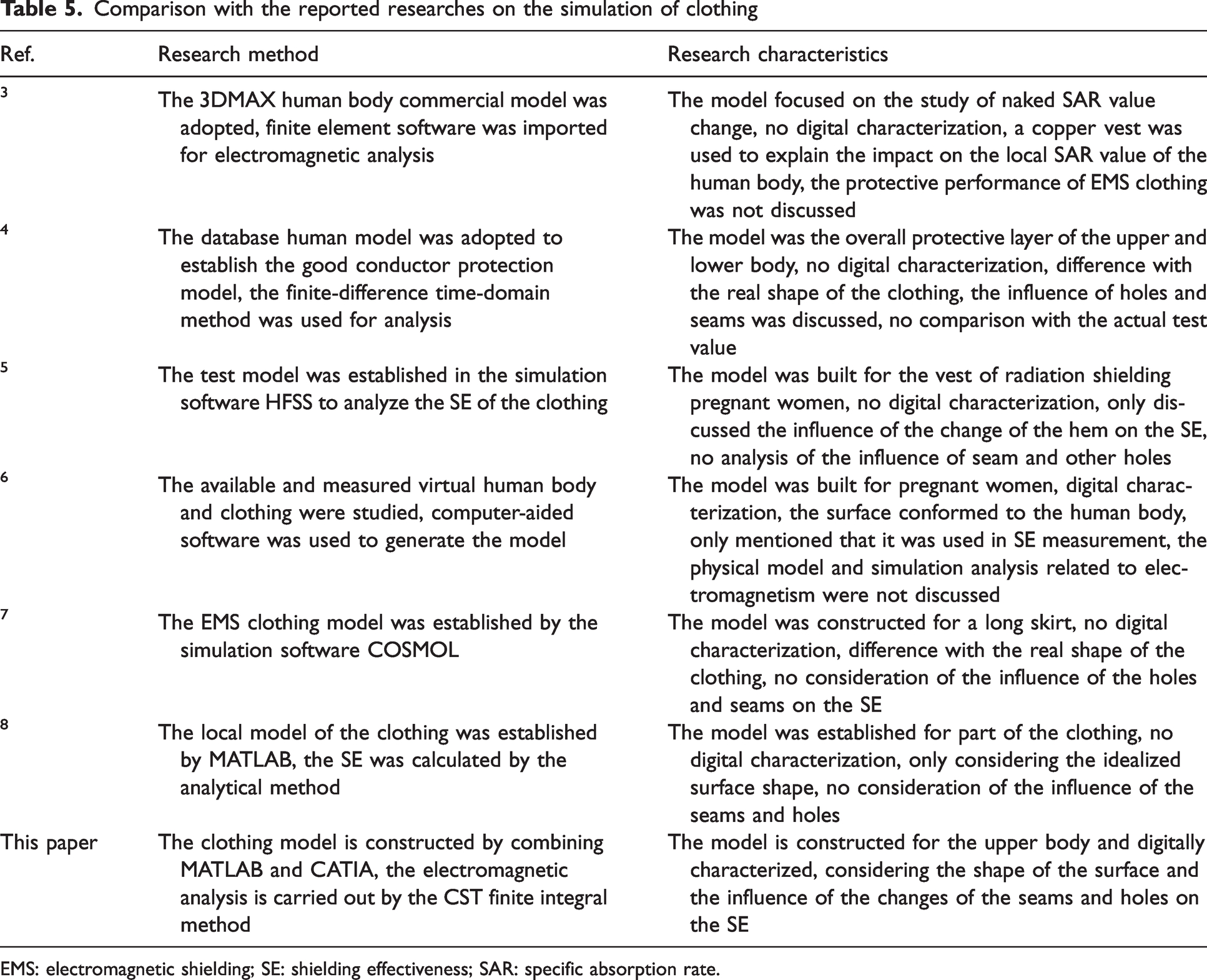
EMS: electromagnetic shielding; SE: shielding effectiveness; SAR: specific absorption rate.
From Table 5, it can be seen that the structure and physical model of EMS clothing for simulation constructed in this paper can well describe the clothing characteristics and carry out digital characterization, which provides support for accurate meshing and subsequent related law analysis.
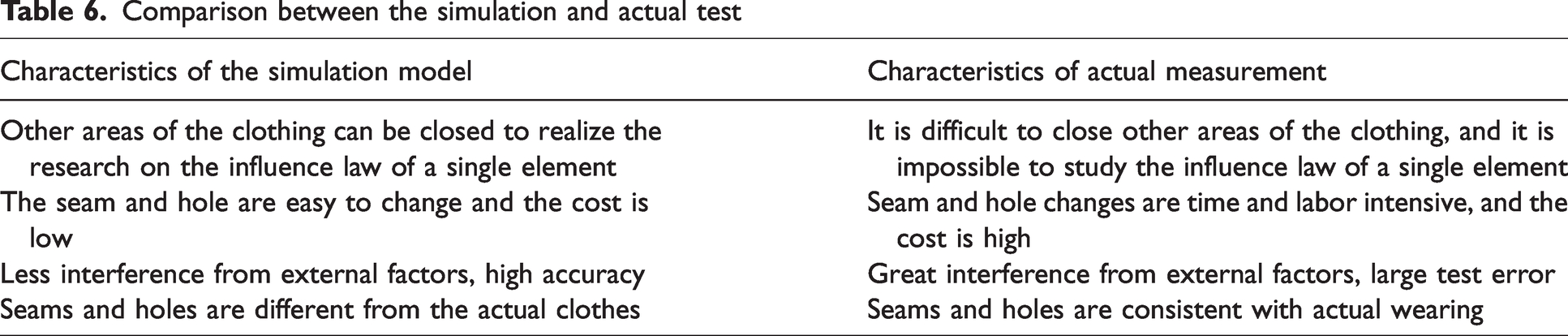
Compared with the actual clothing test, it also shows the advantages of the simulation method constructed in this paper, as indicated in Table 6.
Comparison between the simulation and actual test
Conclusion
This paper provides a new method for the simulation model construction and the SE research of EMS clothing, which can provide valuable auxiliary approach for the design, production, evaluation and related scientific research of EMS clothing.
The construction method of the structure model of the clothing based on the replacement of the feature section of the elliptical truncated cone can well represent the surface shape of the human body. The proposed calculation method based on the feature section can digitally represent each key point of the model, which lays a foundation for subsequent grid partition, electromagnetic simulation and related law analysis. The simulation results of the constructed model can obtain the electromagnetic field strength of each test position of EMS clothing after an electromagnetic wave incident, and the SE of these positions can be obtained through calculation. Compared with the SE of the actual test of the clothing, its consistency is satisfactory. The simulation model and SE calculation method can easily and flexibly obtain the relevant data of the SE of EMS clothing, save a great deal of experimental time and cost and reduce the error caused by the experiment, which provides a new path for the scientific and rigorous study of the problems related to EMS clothing.
Footnotes
Declaration of conflicting interests
The author(s) declared no potential conflicts of interest with respect to the research, authorship, and/or publication of this article.
Funding
The author(s) disclosed receipt of the following financial support for the research, authorship and/or publication of this article: This work was supported by the National Natural Science Foundation of China (No. 61771500) and the Key Research and Development Plan Project of Shaanxi Province (No. 2022GY-277).
