



Abstract
In this paper, the tensile models of the negative Poisson’s ratio yarn with incompressible component yarn and compressible component yarn are constructed. The theoretical Poisson’s ratio curves exhibit the same trend as the experiment. Compared with the theoretical model of incompressible component yarns, a 14% reduction was found in the maximum negative Poisson’s ratio value in the compressible component yarns model. Additionally, the modified theoretical model was established to improve further the accuracy of the model. Both the variation trend and Poisson’s ratio value of the theoretical curves are highly consistent with the experimental results, and the average difference rate of the maximum Poisson’s ratio value is below 10%, which proves the effectiveness of the corrected theoretical model in predicting the auxetic behavior. Our theoretical model not only considers the initial helical path of the wrap yarn could not be completely horizontally straightened when it is just subject to an axial tensile force but also takes the influence of component yarn sectional shape changes into account. The as-constructed theoretical model is more realistic and can guide the design of negative Poisson’s ratio yarn and optimize the theoretical modeling method.
Keywords
With the emergence of more and more negative Poisson’s ratio textiles, negative Poisson’s ratio yarns (NPRYs) with various structures and compositions have been proposed one after another. How to screen out NPRYs that are suitable for large-scale production without losing the essential properties of textiles among the existing NPRYs is particularly important. As one of the effective methods, theoretical modeling and performance prediction analysis of the auxetic properties of different structures of NPRYs have gradually attracted widespread attention.1 –5 With the help of theoretical modeling methods, the essence of the negative Poisson’s ratio phenomenon and the principle of auxetic deformation of yarns can be clarified. Also, the numerical relationship between the auxetic performance index and the textile structural parameters can be established via theoretical deduction. All of this can provide a guide for predicting the performance of NPRYs in advance so that researchers can optimize and adjust the design scheme in time before production.
As early as 1907, Gegauff 6 proposed a coaxial helix model similar to the yarn structure and studied the relationship between the structure of the twisted filament yarn and the tensile modulus. After that, more and more research on yarn theory began to emerge.7 –15 As a type of new structural yarn was proposed in the 21st century, the theoretical modeling research on the structure and performance of NPRY has also attracted widespread attention from scholars.16 –19 Du et al. 16 gave a Poisson’s ratio calculation formula of NPRY at different stretching stages with known component yarn diameter, axial strain, and yarn helix angle through geometric modeling. Gao et al. 19 also deducted the outer contour diameter of the helical auxetic yarn under different stretching states through geometric calculation. Different from the modeling method mentioned above, according to the principle of minimum energy, Sibal and Rawal 17 predicted and analyzed the auxetic behavior of the double-helix auxetic yarn, and established that the Poisson’s ratio of the yarn changes from positive value to negative value occurring in the normalized energy of bending is greater than that of stretching. At the same time, under the same helix angle, the critical point (that is the Poisson’s ratio value equal to 0) of the auxetic yarn is reached when the torque normalized energy is equal to the corresponding shear normalized energy, all the results lay the foundation for further optimization of the structure parameters of yarn. Liu et al. 18 established the constitutive equation of the two-component NPRY by using the three-element mode; meanwhile, the optimal yarn constitutive equation, the relationship between the initial helix angle and the constitutive equation, and the theoretically predicted stress–strain curves of the negative Poisson’s ratio yarn with different helix angles were further obtained. Additionally, by considering the normal force between the component yarn, the yarn cross-sectional trajectory, outer contour diameter, and Poisson’s ratio of the NPRY are deducted under different tensile strains. The effectiveness of the model was also demonstrated by comparing it with experiments and geometry results. 20 Razbin et al. 2 analyzed and predicted the maximum negative Poisson’s ratio value of the helical auxetic yarn using the semi-empirical model and the artificial neural network model, respectively. By comparing the theoretical prediction results with the experimental results, it is found that the artificial neural network model has a lower error compared with the semi-empirical model, while the accuracy of the semi-empirical model is better than that of the geometrical model. Subsequently, on the basis of the existing theory, they further proposed a geometrical model for predicting the Poisson’s ratio of the double-core helical auxetic yarn. 1 With the diversification of NPRY, the research on the theoretical model of NPRY for various structures is also developed rapidly, such as rope-like plied21,22 and multi-component NPRYs.4,23,24 However, most of the currently existing theoretical models of the NPRYs focus on the yarn tensile modeling based on the geometry of composite yarn itself, while little attention is paid to the effects of either the initial helix path of the wrap yarn or the effects of component section shape change which result from its compressibility, while these two aspects are inevitable in the actual yarn stretching process.
In this paper, the NPRY tensile theoretical models are constructed based on the deformation properties of different component yarns, and the tensile deformation behavior and the auxetic mechanism of the NPRYs are clarified. Moreover, the comparative results suggested that the compressible component yarns model is in good agreement with the experimental results, and compared with the theoretical model in which the component yarns are incompressible, there is a 14% reduction in the maximum negative Poisson’s ratio value. This demonstrated that the theoretical model results of the NPRY would be influenced by the compressibility of the component yarns. Meanwhile, a revised theoretical model that is highly consistent with the experiment was also successfully established based on the theoretical analysis, the validity and applicability of the model are further demonstrated by comparison with experiments. It is expected that this work can guide the design of NPRYs and optimize the method for theoretical modeling, which can further create considerable potential for more scalable manufacturing.
Tensile modeling of NPRY
See Table 1 for the tensile modelling of NPRY.
The main symbol of the negative Poisson’s ratio yarn theoretical model
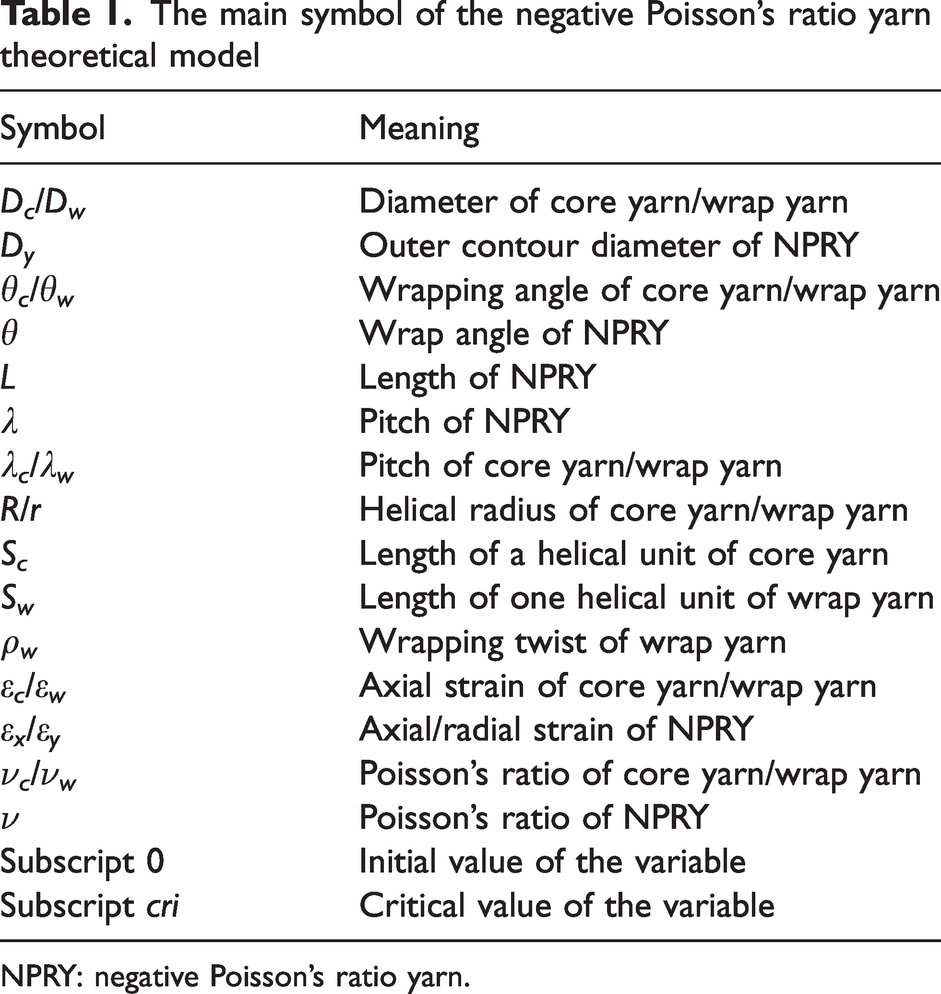
NPRY: negative Poisson’s ratio yarn.
Tensile model based on the incompressible component yarn
Composite yarn structure and deformation assumptions
To facilitate the theoretical calculation process, the following assumptions are made about the composition and structure of the NPRY (composite yarn):
The rigid wrap filament yarn (wrap yarn) and the elastic core filament yarn (core yarn) that constitute NPRY (composite yarn) always obey the principle of volume invariance
7
during the tensile process, and the Poisson’s ratios value of the component yarns is unknown and changes with tensile strain. The initial section shape of component yarn is circular, and the cross-sectional shape remains circular during the entire axial stretching process. During the stretching process, the compression and friction between the component yarn are negligible. The helical structure of the NPRY is uniform. Herein, one helical unit is used to construct the theoretical model in this section to analyze and calculate the deformation behavior of the composite yarn during axial stretching. The deformation process of NPRY is divided into two stages. In the first stage, the helical state of the wrap yarn changes without elongation and thinning, that is, the wrap yarn is gradually transferred from the helical state of the outer surface to the inner surface of the composite yarn, and its helical radius gradually decreases but it does not elongate (the length and diameter of the wrap yarn are constant and equal to the initial value in the first stage). Correspondingly, the core yarn is gradually transferred from the initial straight state of the inner surface to the outer surface of the composite yarn and presents a helical state. Its helical radius gradually increases. Meanwhile, due to the core yarn being easy to deform with a lower modulus, so both its length and diameter change during the first stage. In the second stage, the outer profile diameter of the composite yarn changes which is dominated by the further stretching of the component yarns, both the core yarn and the wrap yarn are elongated and thinned within this stage until the component yarns break. Considering the high modulus of the wrap yarn, the wrap yarn in the initial state can be regarded as a helical spring. During the stretching process of the composite yarn, there only exists the axial tensile force without the twisting force opposite to the winding direction of the wrap yarn. Thus, due to the initial spiral path of the wrap yarn, it still retains some twist after it is transferred to the inner surface of the composite yarn. Assuming that when the helical radius of the wrap yarn is equal to its initial radius,
2
the wrap yarn begins to elongate, and the strain of the composite yarn at this time is called the critical strain.
Theoretical modeling of deformation processes
The initial state
The geometric structure of a complete helical unit of the NPRY, the geometric relationship between the outer contour diameter of the composite yarn and the diameter of the component yarns, and the helical unfolding diagram of the wrap yarn4,25 in the initial state are shown in Figure 1, respectively.
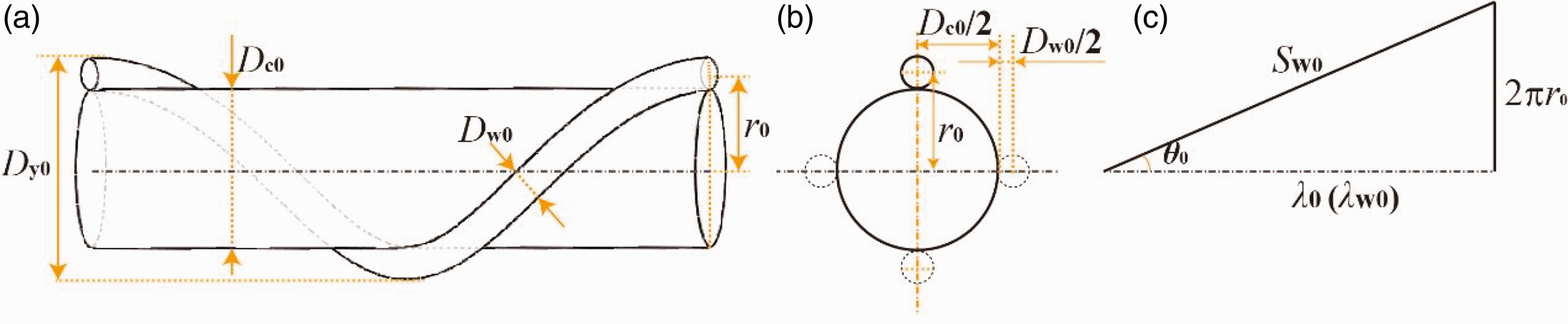
The constitution and structure of negative Poisson’s ratio yarn at the initial state. (a) One complete helical unit; (b) the geometric relationship between the composite yarn and the component yarn and (c) the triangular relationship between the helical length and helical radius of the wrap yarn.
Owing to the fact that the production mechanism of the auxetic behavior is mainly sourced from the change of helical shape and position of the component yarns, 25 that is, the helical radius of the wrap yarn gradually decreases, which is caused by its position transfer from the outer to the inner surface of the composite yarn during the stretching process, while the helical radius of the core yarn gradually increases with a reverse position change. Thus, the theoretical analysis of the composite yarn is mainly developed from the change in the helical radius of the component yarns.
As shown in Figure 1(a), in the initial state, the core yarn is straightened horizontally and located in the center of the composite yarn, and its axis coincides with the yarn axis, while the wrap yarn is helically around the outer surface of the core yarn, so, there is:


Here, R and r are the helical radii of the core yarn and the wrap yarn, respectively; correspondingly, Dw0 and Dc0 are the diameters of the wrap yarn and the core yarn.
Thus, as can be seen from Figure 1(b), the outer contour diameter (Dy0) of the composite yarn in the initial state can be expressed as:

Additionally, in order to facilitate the subsequent analysis of the theoretical model of the composite yarn, except for the outer contour diameter of the composite yarn and the helical radius of the component yarns, the pitch and the length of the component yarn within a helix unit were also given in Figure 1(c), that is:


Herein, Sw is the length of the wrap yarn in a helical unit, λw and θ0 are the pitch and initial helix angle of the wrap yarn, respectively, and λ is the pitch of the composite yarn.
The first stage
Figure 2 shows the representative geometric structure of the composite yarn in the first stage, the geometric relationship between the outer profile diameter of the composite yarn and the diameter of the component yarns, and the helical unfolding diagram of the component yarns. It can be seen from Figure 2(a) that both the position and helical radius of the component yarns and the diameter of the composite yarn change once the axis strain is applied. And the helix radius and its variation trends were also different for each component yarn.
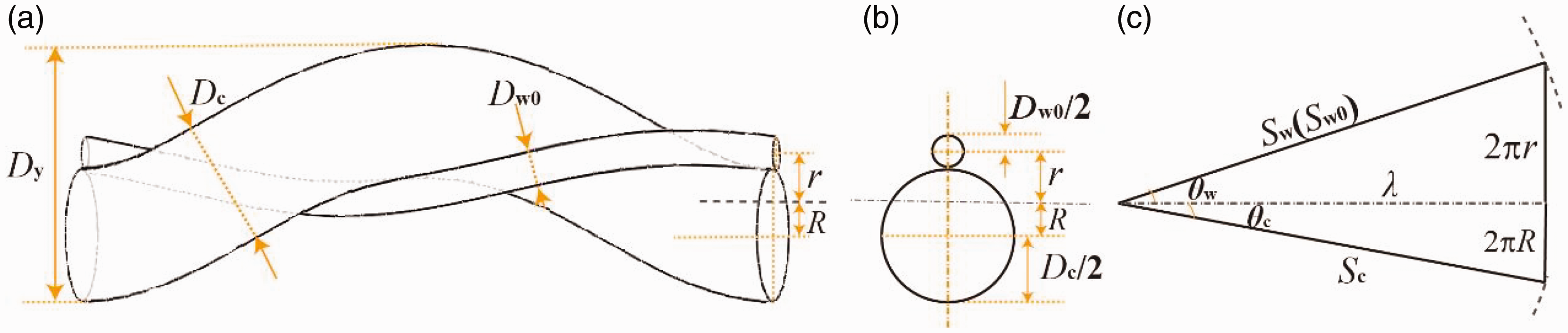
The constitution and structure of negative Poisson’s ratio yarn at the first stage. (a) One complete helical unit; (b) the geometric relationship between the composite yarn and the component yarn and (c) the triangular relationship between the helical length and helical radius of the component yarn.
Helix radius of wrap yarn (r)
Similar to the initial state, there is a trigonometric function relationship between the helix length (Sw) and the helix radius (r) of wrap yarn (Figure 2(c)), that is:

As the wrap yarn does not elongate in the first stage, that is, its strain is equal to zero, its diameter and length do not change in this stage, and only the helical shape changes, thus the following equations can be obtained:



Herein, εw and εwr are the axial and radial strain of the wrap yarn, respectively.
At the same time, the pitch of the wrap yarn (λw) can also be calculated by:

In that: εx is the axial strain of the composite yarn.
Thus the helix radius of wrap yarn (r) can be obtained by substituting equations (4), (5), (8) and (10) into equation (6):
2. Helix radius of core yarn (R)
It can be seen from Figure 2(b) that the center line of the composite yarn is not a straight line within a helix unit, but at any certain position the helix radius of the component yarns always satisfies:

So the helix radius of core yarn can be written as:

It can be seen from equation (13) that the diameter of the core yarn and the wrap yarn are the necessary parameters to calculate the helical radius of the core yarn. For the diameter of the wrap yarn, as it does not elongate in the first stage, its diameter satisfies equation (9). Therefore, only the core yarn diameter needs to be further solved.
3. Diameter of core yarn (Dc)
Considering that the core yarn begins to elongate when the axial strain is applied, combined with its isometric deformation characteristics, it can be written as:

Also,


Here, εc and εcr are the axial and radial strain of the core yarn, respectively.
Meanwhile, according to the principle of the constant volume of yarn,
7
the following equation can also be obtained:

Similarly, from the helical unfolding structure of the core yarn in Figure 2(c), we can get:

To sum up, both the diameter and the helix radius of the core yarn can be obtained under a given axial strain through the above formula.
Finally, based on the geometrical structure in Figure 2(a) and the deformation properties of the NPRY, the outer contour diameter of the composite yarn (Dy) in the first stage can be further given as:

The critical state
The geometric structure, cross-sectional structure, and the helical unfolding diagram of a complete helical unit of the NPRY in the critical state are plotted in Figure 3. It can be seen from Figure 3(a) that when the composite yarn is in the critical state, the wrap yarn is transferred to the inner surface of the composite yarn without elongation and thinning, and its helical radius is equal to its initial radius. The core yarn is transferred to the outer surface of the composite yarn and spirally wrapped on the wrap yarn. Meanwhile, the center line of the composite yarn is thought to be parallel to the axis of the wrap yarn, that is:


The constitution and structure of negative Poisson’s ratio yarn at the critical stage. (a) One complete helical unit; (b) the geometric relationship between the composite yarn and the component yarn and (c) the triangular relationship between the helical length and helical radius of the component yarn.
As can be seen in Figure 3(b), according to the geometric relationship of the composite yarn at the critical state, we can get:

Furthermore, the critical strain of the composite yarn (εcri) can be obtained:

As the wrap yarn has no elongation in the first stage, combined with the initial parameters, the critical strain of the composite yarn can be further expressed as:

Therefore, if the Dw0, r0, and θ0 of the NPRY are known, the critical strain value can be calculated.
Finally, similar to the first stage, the outer contour diameter of the composite yarn can also be expressed as:

The second stage
Figure 4 displays the geometric structure of a complete helical unit of NPRY deformed in the second stage, the geometric relationship between the outer contour diameter of the composite yarn and the diameter of the component yarns, and the helical unwinding diagram of the component yarns. Different from the previous two stages, it can be seen that both the wrap yarn and the core yarn stretched in this stage, the diameter of wrap yarn begins to decrease from its initial diameter as the tensile strain increases at this stage, while the diameter of the core yarn continues to thin during the continuous stretching process. Moreover, as shown in Figure 4(a), herein, it is thought that the wrap yarn finally would be helical around its axis instead of completely straightened due to its initial helical path until the wrap yarn breaks and the composite yarn fails.

Negative Poisson’s ratio yarn structure at the second stage. (a) One complete geometry unit; (b) the geometric relationship between the composite yarn and the component yarn; (c) the triangular relationship between the helical length and helical radius of the component yarn.
Helix radius of wrap yarn (r)
First of all, according to the deformation assumption of wrap yarn,
2
it can be determined from the deformation structure of the composite yarn (Figure 4(a) and (b)) that the helical radius of wrap yarn at this stage satisfies:

Therefore, to obtain the helical radius of the wrap yarn, first, the diameter of the wrap yarn must be solved.
2. Diameter of wrap yarn (Dw)
For the wrap yarn, different from the first stage of deformation, the diameter of the wrap yarn begins to decrease when subjected to axial strain, so its axial strain is no longer equal to zero, and the diameter Dw also changes with the elongation of wrap yarn, and it obeys the volume constant principle:
7

In the formula, εw is the axial strain of the wrap yarn and εwr is the radial strain of the wrap yarn.
Accounting for the fact that the helix of the wrap yarn at this stage is mainly caused by its initial helical path, the axis of the composite yarn (the axis of the center of the section of the wrap yarn) is approximately parallel to the axis of the wrap yarn (the center line of its helix), so the axial strain of the wrap yarn can be approximated given as:

Meanwhile, the length and the diameter of the wrap yarn can be obtained by:


Thus, the diameter of wrap yarn can be solved based on the above formulas when the axial strain of the composite is given. Meanwhile, the length of the wrap yarn can also be obtained by:

Finally, combined with the initial parameters of the composite yarn, the diameter and the corresponding helical radius of the wrap yarn in the second deformation stage can be solved.
3. Helix radius of core yarn (R)
Obviously, from the geometric relationship of the composite yarn at this stage in Figure 4(b), the helical radius of the core yarn can be obtained by:

It can be seen from equation (31) that except for the diameter of the wrap yarn, the diameter of the core yarn at this stage also needs to be solved for calculating the helical radius of the core yarn.
4. Diameter of core yarn (Dc)
As for the core yarn diameter, as it is continuously elongating throughout the whole stretching process, it still satisfies equations (14)∼(18). That is, the calculation method in the first stage for the helix radius, diameter, and axial strain of core yarn is still valid in the second stage. Thus, the following equations can be deduced:

Therefore, if the axial strain of the composite yarn is given, the corresponding diameter of the core yarn at this stage can be calculated. Then the helical radius of the core yarn at this stage also can be calculated based on equation (31).
In summary, both the diameters of the core yarn and wrap yarn become smaller in the second stage. For the core yarn, the diameter decreases continuously during the entire stretching process, while the diameter of the wrap yarn only decreases in the second stage.
Similar to the previous stages, the outer contour diameter of the composite yarn at this stage is also related to the diameter of the component yarns in the initial state. To ensure the accuracy and applicability of the theoretical model, the outer contour diameter of the composite yarn in the second stage adopts the same calculation formula as that in the first stage, which is:

Also, it can be further written based on equation (31):

Finally, according to deformation analysis and calculation results of the outer contour diameter of the composite yarn at the above stages, the theoretical Poisson’s ratio value (νt1) of the composite yarn during the entire stretching process can be uniformly calculated by the formula:
25

Thus, according to the diameter of the composite yarn before and after tensile modeling at different deformation stages, the relationship between the theoretical Poisson’s ratio value and the axial tensile strain during the entire stretching process of the NPRY can be obtained.
Tensile model based on the compressible component yarn
Composite yarn structure and deformation assumptions
In an actual stretching process, the compressibility deformation properties can directly affect the diameter, the section shape, and the relative position of the component yarn, which can directly determine the outer profile diameter of the composite yarn. Therefore, the deformation properties of the component yarn are essential to the auxetic behavior analysis.
When the component yarns are all compressible, the cross-sectional shape of the two components is a circle in the initial state and would change when the tensile force is applied. It is assumed that both the deformation of component yarn satisfies the principle of volume invariance, and their cross-section is all ellipse in a deformed state. At a given axial tensile strain, the elliptical cross-sectional area is equal to the circular cross-section area of the component yarn at the same strain. Additionally, the deformation process of the composite yarn still satisfies the structure and deformation assumptions of 3–6 in the above section on composite yarn structure and deformation assumptions.
Theoretical modeling of deformation processes
When the component yarns constituting the NPRY are compressible, their cross-sectional shape will change when stretched. Figure 5 shows the relative position of the component yarns during the different stages of the whole tensile process and the change process of their respective cross-sectional shapes. The deformation process can be simply described as follows: first, In the initial state, the relative position and cross-sectional shape of the component yarns are all circular which is consistent with those in the section above on the tensile model based on the incompressible component yarn (Figure 5(a)). As shown in Figure 5(b), when the tensile strain is applied, the core yarn first bears the main axial tensile force and elongates accompanied by its cross-sectional changes from circular to elliptical. While the cross-section of the wrap yarn keeps circular due to only the helical unfolding process occurring until the axis of the NPRY coincides with that of the wrap yarn or the positions of the wrap yarn transfer to the center of the composite yarn. At the same time, the critical state is reached and the corresponding position of the component yarn is given in Figure 5(c). After that, as the tensile strain continues increasing, the deformation of the composite yarn enters into the second stage, and the wrap yarn begins to suffer the main tensile force and stretches, thus its cross-section also gradually changes from circular to elliptical, as plotted in Figure 5(d). The detailed modeling and calculation process is given through stage-by-stage analysis.
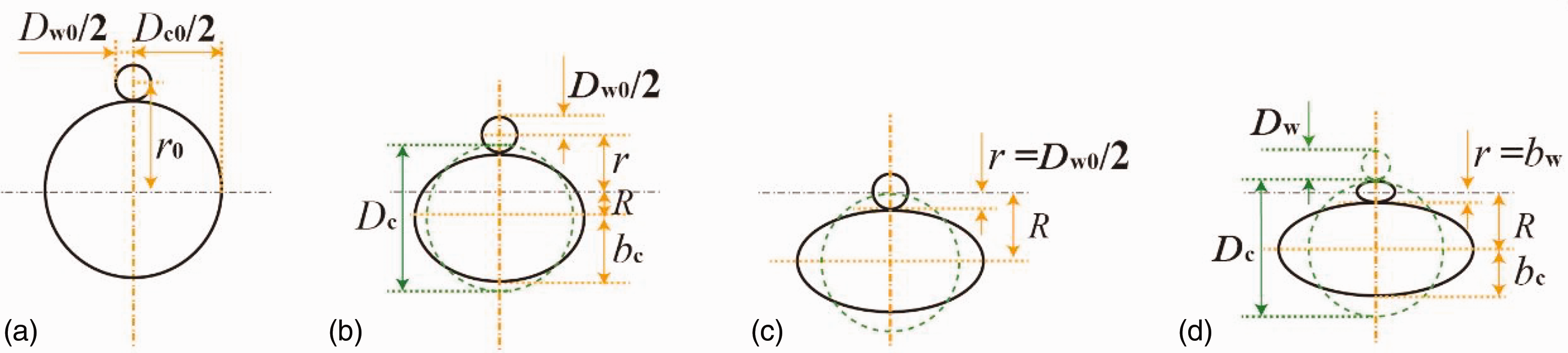
Schematic diagram of the change process of the negative Poisson’s ratio yarn structure and the cross-sectional shape of the component yarn at different deformation stages. (a) Initial state; (b) first stage; (c) critical stage and (d) second stage.
The initial state
Except for the different deformation characteristics of the component yarns, the initial parameters of the NPRYs and the helical unfolding structure diagram of the component yarns are in agreement with those of the NPRYs in the above section on the tensile model based on the incompressible component yarn.
The first stage
Helix radius of wrap yarn (r)
Similar to the tensile model of the incompressible yarn, wrap yarn does not elongate in the first stage, only the helical unfolding process occurs in this stage, so there are:





To sum up, the helix radius of wrap yarn at this stage can be obtained.
2. Helix radius of core yarn (R)
As for the core yarn, its cross-section becomes elliptical during the deformation process of the first stage. Assuming that the major and minor axes of the ellipse are ac and bc, respectively, and in the tensile deformation process, it always satisfies:





Herein, εcrx and εcry are the strains of the core yarn along the major axis (ac) and the minor axis (bc), respectively, Dc is the equivalent circular section diameter of the component yarn under the same strain, and its value can be obtained from the theoretical calculation results of the NPRY in the above section on the tensile model based on the incompressible component yarn.
Additionally, the strains of the component yarns in three directions satisfy:

Also, from the helical unfolding geometric relationship of core yarn, it can be obtained:

Furthermore, for the helix radius of core yarn, there are:

For ease of calculation, let R=x0, ac = x1, bc = x2, εcrx = x3, εcry = x4, εc = x5, the equations (41)∼(48) can be transformed into the equation:
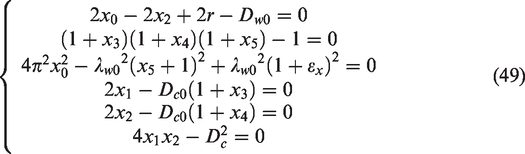
By solving these equations, the corresponding parameter values of R, ac, bc, εcrx, εcry, and εc of the core yarn during axial stretching can be solved.
Furthermore, the outer contour diameter of the composite yarn can be expressed as:

The critical state
Similar to the above section on the theoretical modeling of deformation processes, the composite yarn in the critical state satisfies:




According to the equations mentioned above, the parameter of the composite yarn at the critical state also can be obtained.
The second stage
In the deformation process of the second stage, the core yarn and wrap yarn elongate at the same time and the diameter becomes smaller. And among that, the wrap yarn is stretched from a zero strain while the core yarn continues to elongate based on the previous stage by a continuous stretching process. Thus, for the core yarn and the wrap yarn, the following equations can be given:
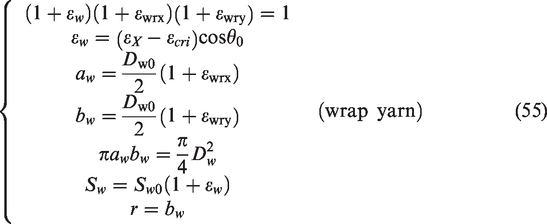
Here, εwrx and εwry are the radial strains of the wrap yarn in the direction of the major axis and the minor axis of the elliptical cross-section, respectively; and Dw is the equivalent circular section diameter of the component yarn under the same strain.
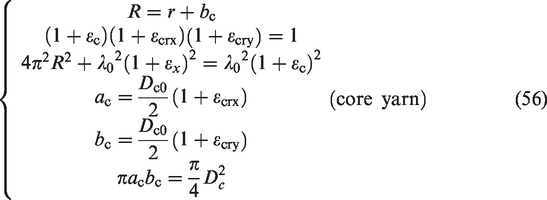
With these equations, the corresponding parameter values (R, ac, bc, εcrx, εcry, εc, Sw) of the core yarn and wrap yarn under the given axial strain in this stage can be calculated; also, the outer profile diameter of the composite yarn at this stage is:

Finally, the theoretical Poisson’s ratio value (νt2) of the composite yarn based on the compressible component yarn during the entire stretching process can be calculated.
Results and discussion
Analysis of theoretical model results
Theoretical model results of the incompressible component yarn
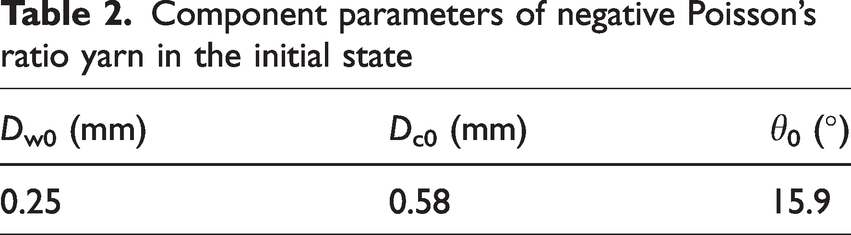
According to the theoretical model of the composite yarn deformation process in the above section on the tensile model based on the incompressible component yarn, the theoretical curve of the auxetic performance during the axial stretching process of the NPRY can be calculated under the condition that the initial diameter and the initial wrapping angle of the composite yarn are known (as shown in Table 2).
Component parameters of negative Poisson’s ratio yarn in the initial state
The theoretical calculation curves of the NPRY are depicted in Figure 6. First, as can be seen in Figure 6(a), when the component yarns are all incompressible, the helical radius of the core yarn and the wrap yarn are negatively correlated as the tensile strain increases. In that, the helical radius of the core yarn increases rapidly from 0 to a maximum value of about 0.404 mm in the first stage, while the helical radius of the wrap yarn decreases rapidly in this stage. Afterwards, as the stretching continues, the elongation of the component yarns makes the helical radius of both the core yarn and the wrap yarn decrease, but the change rate decreased sharply compared with that in the first stage.
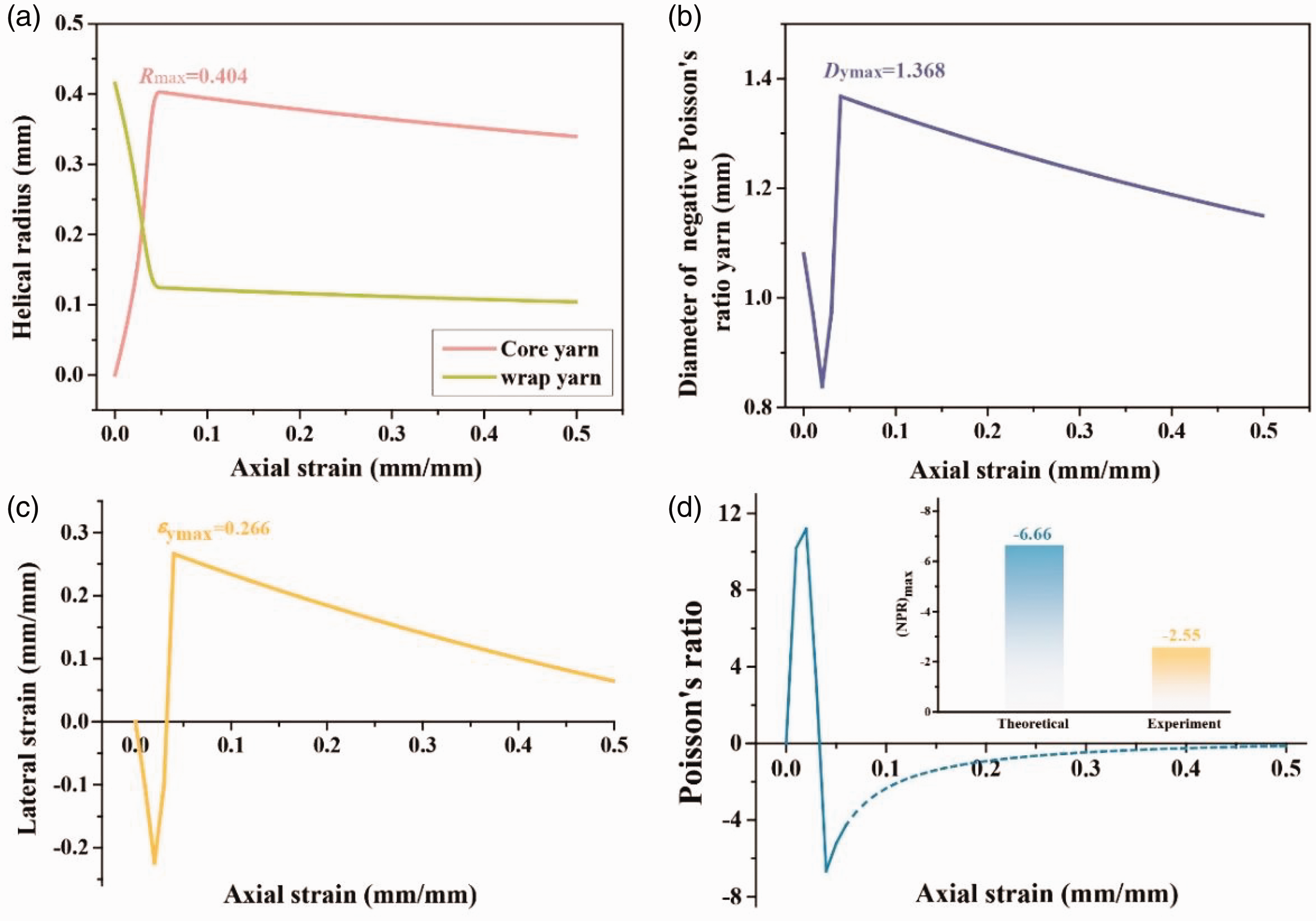
Theoretical calculation curves of negative Poisson’s ratio yarn (NPRY). (a) Radius–axial strain curves of wrap yarn and core yarn; (b) diameter of NPRY; (c) lateral strain–axial strain curve and (d) Poisson’s ratio–axial strain curve.
Besides the helical radius, the change curves of the outer profile diameter and transverse strain of the composite yarn are also plotted in Figure 6(b) and (c). it can be seen that corresponding to the helical radius variation of the component yarn after the first stage, the outer profile diameter and transverse strain of the composite yarn also reached the maximum value of 1.368 mm and 0.266 mm, respectively, with the exchange of component yarn positions. Figure 6(d) shows the theoretical Poisson’s ratio–axial strain curve of the composite yarn in the whole tensile process, the results proved that the changing trend of the theoretical Poisson’s ratio curve first increases from 0 followed by decreasing to the maximum negative Poisson’s ratio value, and finally return to 0. The theoretical maximum negative Poisson’s ratio value can reach –6.66. What is more, from the illustration of Figure 6(d), the difference rate (δ1) between the theoretical and experimental maximum negative Poisson’s ratio value here can be further calculated by:

Theoretical model results of the compressible component yarn
According to the theoretical model calculation process of compressible component yarn in the above section on the tensile model based on the compressible component yarn. When both the component yarns are compressible, the corresponding theoretical curves of the auxetic performance during the axial stretching process of the NPRY are plotted in Figure 7. It can be seen that the variation trend of the component yarn helix radius, composite yarn outer profile diameter, transverse strain, and the Poisson’s ratio value of the composite yarn is kept consistent with those of the theoretical curves obtained from the tensile model of incompressible component yarn (as shown in the above section.
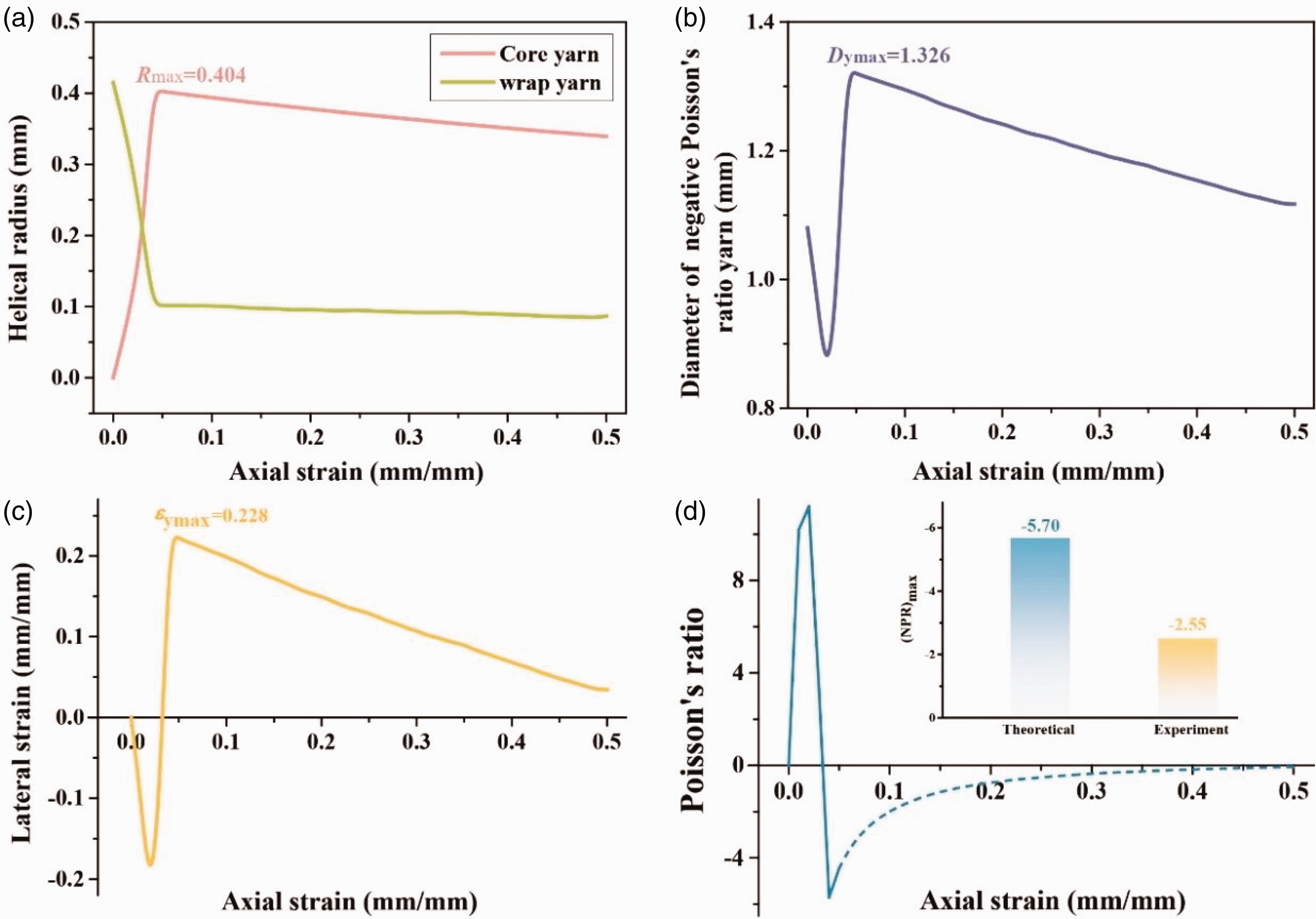
Theoretical calculation curves of negative Poisson’s ratio yarn (NPRY). (a) Radius–axial strain curves of wrap yarn and core yarn; (b) diameter of NPRY; (c) lateral strain–axial strain curve and (d) Poisson’s ratio–axial strain curve.
As can be seen in Figure 7(a), the maximum helical radius of the core yarn is 0.404 mm which is equal to the value of Figure 6(a). While the calculated theoretical maximum outer profile diameter (Figure 7(b)) and the maximum transverse strain (Figure 7(c)) of the composite yarn are 1.326 mm and 0.228 mm/mm, respectively, which were smaller than those in Figure 6(b) and (c). Furthermore, Figure 7(d) gives the theoretical maximum negative Poisson’s ratio value of the composite yarn as –5.70, which decreases by about 14.4% compared with the NPRY theoretical model where the component is all incompressible. All of these results demonstrated that the theoretical model results of the NPRY would be influenced by the compressibility of the component yarns.
Correspondingly, the difference rate (δ2) between the theoretical and experimental maximum negative Poisson’s ratio value is:

The above theoretical results suggested that the compressible properties of the component yarns, that is, the cross-sectional shape change of the component yarns will have an impact on the results of the theoretical model of the NPRY, indicating that the compressibility properties of the component yarn that constitute the NPRY or the variation of the yarn’s cross-sectional shape during the stretching process will affect the auxetic properties of the NPRY. Therefore, as for constructing the tensile theoretical model and calculating the auxetic performance of NPRYs, the influence of the cross-sectional shape of the component yarns is a nonnegligible factor.
Comparative analysis of tensile models and experiment of NPRYs
Figure 8 shows the comparative results of Poisson’s ratio–axial strain curves of NPRYs with incompressible and compressible component yarns as well as the experiment curve. The experiment curve is obtained by the same parameters of the theoretical in Table 2. It can be seen that theoretical Poisson’s ratio curves of the composite yarn calculated by the different models have consistent trends with the measured curve, which proved that the proposed theoretical model is effective for qualitative analysis of the auxetic behavior of the NPRY during the stretching process. Further comparing the curves of the two theoretical models in Figure 8, it is not difficult to find that the theoretical Poisson’s ratio curve obtained by the component yarn being compressible yarn is closer to the experimental curve, and with the axial strain increasing it still keeps a higher consistency with the experimental value. This comparative result means that the accuracy of the theoretical model can be further improved by the means of modifying the cross-sectional shape of the component yarns.
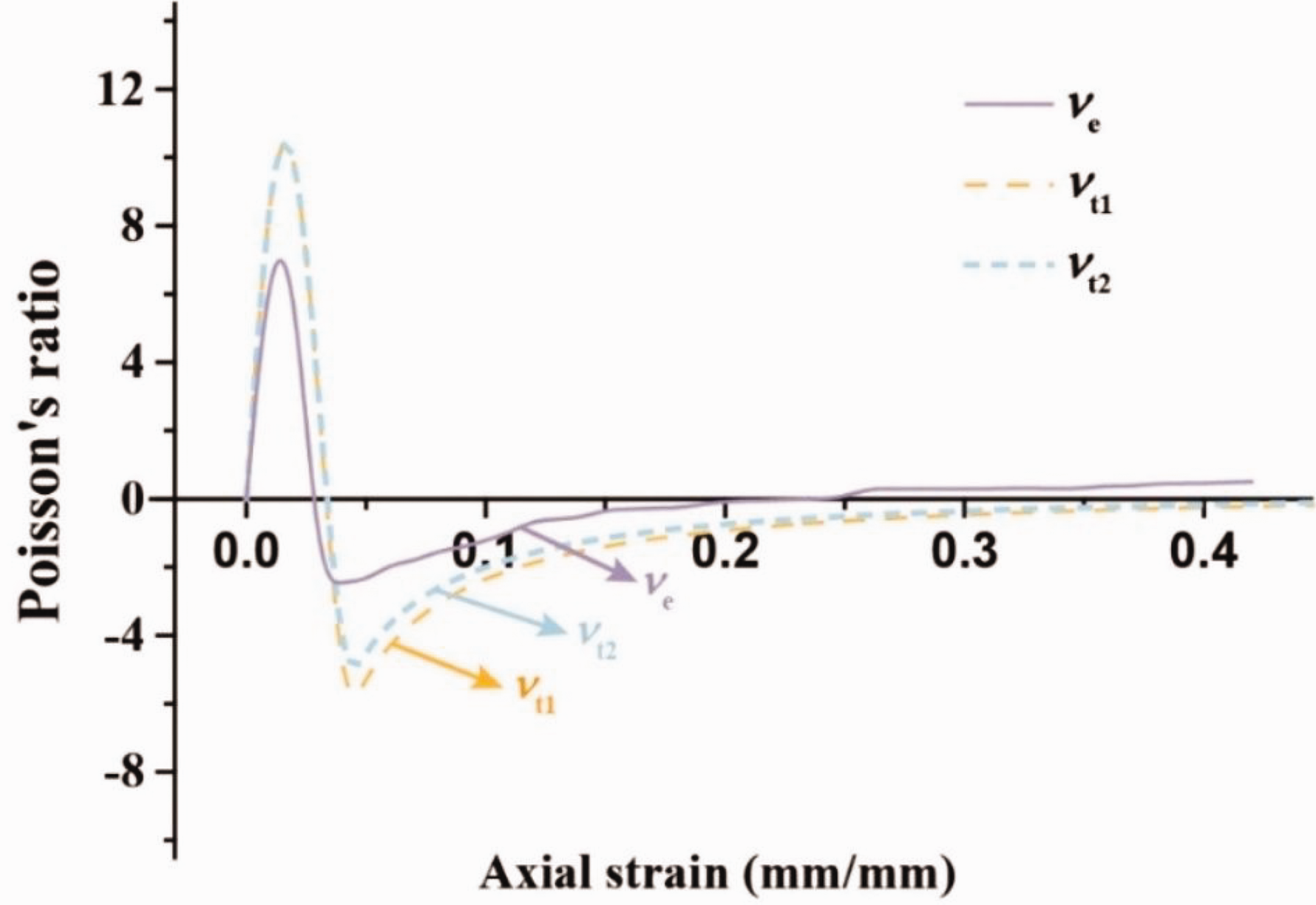
Comparison curve of negative Poisson’s ratio yarn.
In summary, the theoretical model based on the fact that the component yarns are compressible has a good agreement with the actual deformation trend of the yarns, but there are still large errors in the numerical values. From the above theoretical comparison results, it can be seen that the cross-sectional shape of the component yarn has a great influence on the theoretical calculation results. Thus, the difference between the experiment and theory can be attributed to the following main reasons: on one hand, the component yarns of the NPRY are filament, and their actual initial cross-section is generally noncircular, which can cause the Poisson’s ratio value calculated from the theoretical model to be larger than the actual value. On the other hand, the component yarns have different modulus and deformation properties, the high deformation and low modulus characteristics of the core yarn, as well as the weak bond force of the fibers within the core yarn, make it easy to deform and present a noncircular shape. All of these can be the sources of the error in the experiment and theoretical model.
Summarizing the above reasons, to improve further the prediction accuracy of the theoretical model, a correction factor α is introduced here to the initial diameter of the core yarn to improve further the results of the theoretical model based on the compressible component yarn, then, the corrected initial diameter of the core yarn can be expressed as:

When α = 0.7, there was a highly consistent result achieved between the theoretical and experimental results. The corresponding comparison diagram of the theoretical correction curve of the composite yarn and the three sets of measured curves is shown in Figure 9, where νe1, νe2, νe3 are three measured Poisson’s ratio curves, and νm1′, νm2′, νm3′ is the theoretically corrected Poisson’s ratio curve after introducing the core yarn diameter correction factor. The design of the experiments is shown in Table 3. It can be seen that both the variation trend and Poisson’s ratio value of the theoretical curves are highly close to the experimental results, which proves the effectiveness of introducing the initial shape correction coefficient of the core yarn in improving the accuracy of the theoretical model.
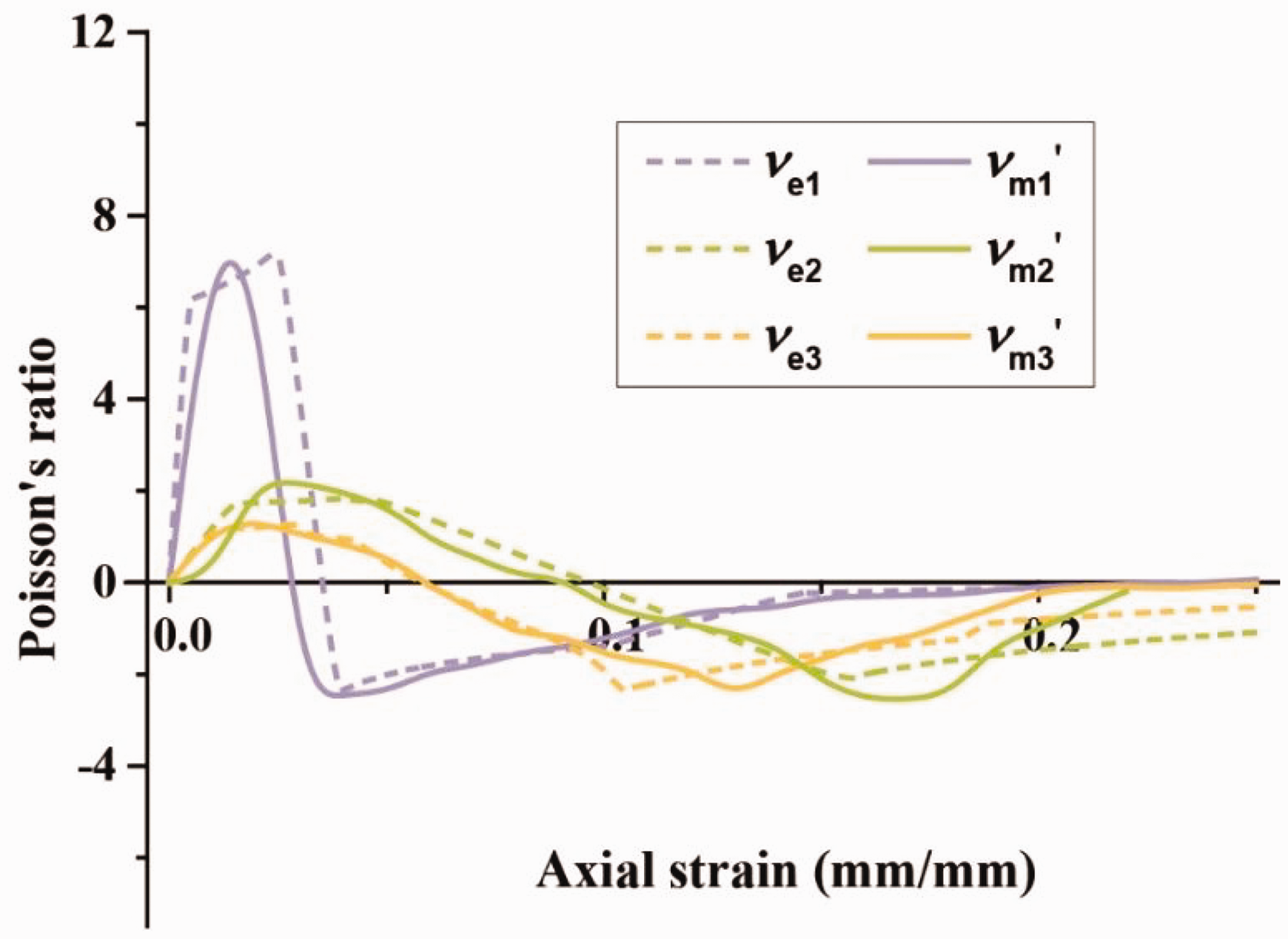
Modified and experimental Poisson’s ratio–axial strain curves of negative Poisson’s ratio yarn.
The experiment parameters of negative Poisson’s ratio yarn
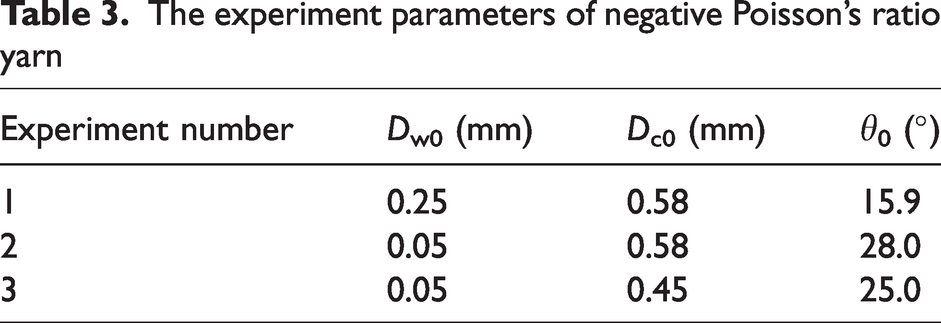
As shown in Figure 9, the three groups of the theoretical Poisson’s ratio curves will experience the process of the Poisson’s ratio value change from a positive value to a negative value and finally tend to 0. This variation trend of Poisson’s ratio agrees with the experimental results. Meanwhile, by introducing the correction factor of core yarn diameter, the theoretical maximum Poisson’s ratio value of the composite yarn has good consistency with the experimental value with the average difference rate below 10%, which demonstrates the effectiveness of the corrected theoretical model in predicting the maximum negative Poisson’s ratio of the prepared composite yarn. As for the slight difference between the final corrected and experimental values, it can be explained by the interaction forces, friction, and slippage between the component yarns during the deformation process. In addition, in the actual stretching process, the unfolding process of the wrap yarn in the first stage would also be accompanied by a certain elongation that yields its diameter decreasing.
In summary, the proposed theoretical model can satisfy the qualitative prediction of the changing trend of the auxetic performance of the composite yarn in the case of known component yarn parameters, which is convenient for designers to orientate adjusting the scheme to improve the production efficiency of the yarn, it can guide the design of the negative Poisson’s ratio yarn. In addition, the accuracy of the theoretical model can be improved by importing shape-correction coefficients.
Conclusions
With the account of the wrap yarn not being able completely to straighten along horizontally during the practical axial stretching due to its initial helix path, and also most currently existing NPRY models paying little attention to the effects of the component yarn cross-sectional shape changes which result from its compressibility. Thus, in this paper, the theoretical models with different component yarn deformation properties were constructed for predicting the auxetic behavior of NPRYs and clarifying the influence of component yarn deformation on the theoretical results. Meanwhile, the effectiveness of the model in predicting the variation trend is confirmed through comparative analysis. The following main conclusions are finally obtained:
The deformation process of NPRY was theoretically modeled and calculated, and the theoretical helical radius change of the component yarn and the yarn outer contour diameter under the axial tensile load was deduced. Meanwhile, the whole theoretical Poisson’s ratio curve of the composite yarn was obtained. A tensile model of NPRY was constructed in which the component yarns were incompressible. The helical radius of the core yarn and the wrap yarn are negatively correlated as the tensile strain increases in the first stage. Afterwards, the elongation of the component yarns makes the helical radius of the core yarn and the wrap yarn both decrease at a lower decreasing rate. The outer profile diameter of the composite yarn reached the maximum negative Poisson’s ratio value when the component yarn exchanged position. For clarifying the influence of the component yarn deformation characteristics on the theoretical results, the NPRY tensile model based on the compressible component yarn was constructed. The results proved that the variation trend of the component yarn helix radius, composite yarn outer profile diameter, transverse strain, and Poisson’s ratio value of the composite yarn model is consistent with those of the theoretical curves of incompressible component yarn, but there exists a 14% reduction in the maximum negative Poisson’s ratio value. Thus, the variation of the cross-sectional shape (or compressibility) of the component yarns would affect the auxetic properties of the NPRY, which can be a nonnegligible factor for constructing the tensile theoretical model of NPRY. A predicted theoretical model was further established by introducing a correction factor to the initial diameter of the core yarn. Both the variation trend and Poisson’s ratio value of the theoretical curves are more consistent with the experimental results with the average difference rate of the maximum Poisson’s ratio value below 10%, which proves the effectiveness of the corrected theoretical model in predicting the auxetic behavior of the NPRY.
To conclude, based on the composite structure of wrap yarn and core yarn, this paper established the tensile modeling of NPRY. The deformation process, the mechanism of the auxetic effect, and the influence of the component deformation on the auxetic behavior were systematically investigated. Furthermore, the corrected theoretical model of NPRY is constructed and compared with experimental results. Our theoretical model can be helpful for the early prediction of the changing trend of the auxetic properties of NPRY under the condition of known component yarn parameters but also can provide design guidance for yarns with stable structure and auxetic effect.
Supplemental Material
sj-pdf-1-trj-10.1177_00405175231203398 - Supplemental material for Tensile theoretical modeling and auxetic behavior analyzing of negative Poisson’s ratio yarn
Supplemental material, sj-pdf-1-trj-10.1177_00405175231203398 for Tensile theoretical modeling and auxetic behavior analyzing of negative Poisson’s ratio yarn by Junli Chen, Xiaojing Wen, Xiang Liu and Zhaoqun Du in Textile Research Journal
Footnotes
Acknowledgements
This work is jointly supported by Major scientific and technologic project of Fuzhou Science and Technology Project Plan (2022-ZD-007), by Jiangxi Provincial Administration for Market Regulation(GSJK202221), by Natural Science Foundation Project of Shanghai “science and technology innovation action plan” (22ZR1400500, 20ZR1400200), and supported by Project (52173218) supported by National Natural Science Foundation of China, supported by the Key Research and Development Program of Science and Technology Bureau of Ningbo City (2023Z082).
Declaration of conflicting interests
The author(s) declared no potential conflicts of interest with respect to the research, authorship, and/or publication of this article.
Funding
The author(s) received no financial support for the research, authorship, and/or publication of this article.

References
Supplementary Material
Please find the following supplemental material available below.
For Open Access articles published under a Creative Commons License, all supplemental material carries the same license as the article it is associated with.
For non-Open Access articles published, all supplemental material carries a non-exclusive license, and permission requests for re-use of supplemental material or any part of supplemental material shall be sent directly to the copyright owner as specified in the copyright notice associated with the article.
