



Abstract
This study developed compression leggings (CLs) with a support panel for foot progression angle (FPA) correction to improve the fit without restricting the user's movement while providing an appropriate external force. This study aimed to examine the effects of FPA correction concerning the functionality and usability of the support panel of CLs that ensure low pressure. Clothing pressure (CP), FPA, skin blood flow (SBF), perceived strength, and usability of OCLs during treadmill walking were compared with the normal leggings (NLs). Differences in CP, FPA, SBF, and user evaluation results were analyzed according to different wearing conditions. Despite the low CP generated by the support panel (≤3.21 mmHg), there was a significant positive orthotic effect with an 11.6–18.0% increase in FPA for external rotation and a 10.5% increase in SBF. The users felt pressure and support around the thigh where the support panel was placed and directional tensile strength throughout their lower extremities while recognizing the usefulness in gait correction. Pressure and support provided by the support panel assured appearance satisfaction, dimension satisfaction, compression satisfaction, ease of movement, and safety. This study demonstrated that the support panel of CLs provided an FPA correction effect concerning functionality and usability.
Keywords
Foot progression angle (FPA), which refers to the transverse plane rotation inward (in-toeing) or outward (out-toeing) during gait, is a spatiotemporal parameter of gait associated with musculoskeletal problems in the lower extremities. 1 The symptoms of in-toeing gait are related to not only the problems with the foot, but also the transverse plane rotation of the lower extremities according to the alignment of the lower extremities, such as tibial/femoral torsion.1 –3 The most common causes of in-toeing gait are excessive femoral anteversion and abnormal internal rotation of the hip joint due to abnormalities in the muscles that rotate the hip joint during gait.2,4,5 The muscles that cause in-toeing gait include the gluteus medius,6,7 gluteus minimus, 7 hip adductors,8,9 and hamstrings.10,11
Surgical intervention, which is an effective intervention for in-toeing gait, is attempted only when symptoms of torsional deformity in the lower extremities or abnormal FPA are severe enough.12,13 Accordingly, conservative intervention is the only option for mild cases of in-toeing gait. Orthoses for FPA correction include casts,14 –16 splints such as the Denis-Browne bar,17,18 counter rotators for legs such as twister cables,19 –21 and orthotic shoes.14,16,22 The Denis-Browne bar, orthotic shoes, and twister cables can improve internal tibial torsion, while evidence of improving femoral anteversion has not been reported.15,19,21,23 Thus, almost no orthoses can be used to correct hip internal rotation, which is a key cause of in-toeing gait. Rigid orthoses raise concerns about overcorrection and severely restrict movement. Consequently, they are difficult to wear during the daytime and are worn while only sleeping.20,24 Such disadvantages show the inadequacies of rigid orthoses, which are based solely on the principle of applying a strong external force for traction. 20 Therefore, there is a need to propose a new soft orthosis that can apply an appropriate amount of external force with enhanced wearability and that does not restrict users’ movement.
A dynamic elastomeric fabric orthosis (DEFO) can be proposed as a soft orthosis that meets such requirements. The DEFO is a soft orthosis that can reduce the risk of overcorrection and allow adequate control of stretching according to the dynamic movement of the user, owing to the characteristics of its elastomeric fabric.24,25 The DEFO shares the advantages of enhanced blood flow and fatigue recovery effects that are typically observed when using compression garments.26,27 Conventional DEFOs had been proposed with the focus on improving the correction of static posture, as well as the proximal stability and balance ability.28,29 However, studies on the development of DEFOs for FPA correction have not been conducted. The DEFO offers many advantages as an orthosis, but the problem that may appear from the pressure applied by the elastomeric fabric, which is the main principle, must be resolved first. Even though the DEFO has demonstrated excellent functionality, some have reported poor compliance with wearing the DEFO due to donning and doffing difficulties and poor comfort. 24 In other words, when choosing an orthosis, the lack of comfort due to compression significantly outweighed the key functions.30,31 The DEFO has superior usability to a rigid orthosis,24,25 but its usability still needs further improvement. Accordingly, applying an appropriate level of pressure to reach a balance between functionality and usability is an important factor.
Clothing pressure (CP) refers to the vertical pressure that a garment applies to the skin. Skin blood flow (SBF) is an indicator of blood flow expressed in the perfusion unit (PU). The consensus on the threshold capillary pressure considered safe for the human body based on blood flow is 30.0 mmHg.32 –34 In a previous study, 35 the calf CP threshold was 17.8 mmHg, and the thigh and waist CP threshold was expected to be lower than 26.8 and 10.2 mmHg, respectively, by allowing SBF reduction. Such criteria allow a certain level of blood flow reduction; thus, an appropriate pressure level was re-evaluated. In a study that applied the DEFO to pediatric patients with cerebral palsy, applying a mean level of 13.8 mmHg resulted in a 32% decrease in blood flow in 75% of patients. 36 Such results implied the possibility of blood flow reduction at pressure levels below the existing tolerance. The appropriate range of the CP level was suggested to be 9.8–17.3 mmHg based on the perception of wearing in previous studies on user evaluation of wearability.37 –40 Thus, the perception-based threshold could be assumed to be approximately 17 mmHg. The appropriate pressure level based on the perception of wearing was lower than the tolerance level for blood flow reduction. Therefore, it is necessary to revise and lower the existing pressure tolerance through examining whether a low-pressure level is valid for functionality and usability. If a low-pressure level can increase user comfort and still provide functionality, then suggesting an orthosis that can support daily long-term wear could be meaningful for users who need correction.
Accordingly, this study developed the first compression leggings (CLs) for FPA correction for women as a garment-type DEFO. The reason for selecting only women as participants was because sex differentiation is essential in designing leggings that fit the human body well and also because in-toeing gait caused by problems in the hips is more prevalent among women. 41 This study aimed to test whether the support panel of CLs that can induce the external rotation of FPA has an FPA correction effect with respect to functionality and usability. For this objective, the investigation was performed using CP as an independent variable. FPA and SBF were used as objective indicators, and perceived strength and usability were used as subjective indicators for dependent variables.
Materials and methods
Experimental garment conditions
The support panel proposed in this study is based on the principle of reducing the contraction of muscles and fascia responsible for hip internal rotation through a technique that restricts muscle movement by controlling the tension of an elastomeric fabric.42 –47 The proposed support panel was permanently attached to the leggings rather than wrapped around (Patent No. 10-2021-015133). The %stretch of the power-net fabric used in the support panel (Course: 148.54%, Wale: 97.97%) was lower than the ground fabric (Course: 168.35%, Wale: 117.00%). Available %stretch is expected to be the main property of fabric that affects provision of low pressure for FPA modification. ASTM D2594–04 48 presented the concept of available %stretch that can be generated by wearing clothes. They defined available %stretch as the available percentage range that the fabric material expands when the tension of 350 N/m (2 lbf/in) is provided. Though the two fabrics have the same thickness (0.59 mm), the %stretch of the power-net fabric used in the support panel (Course: 148.54%, Wale: 97.97%) was lower than the ground fabric (Course: 168.35%, Wale: 117.00%) (Table 1). Consequently, the support panel region was compressed and supported relatively more to reduce the contractile actions of muscles and fascia responsible for internal rotation of the lower extremities during gait. The clothing construction strategy consisted of aligning the support panel region with the hip internal rotation muscles (gluteus medius, tensor fasciae latae, hip adductors, and medial hamstrings) that were reported to cause in-toeing gait6 –11 first; subsequently, aligning the wale direction of the power-net fabric with much lower %stretch than ground fabric parallel to the direction of muscle contraction (Figure 1). The paralleled arrangement means using the available %stretch in the wale direction. This study aimed to identify the effect of the lower available %stretch of the support panel in the wale direction for FPA modification. In addition, it is expected that the lower available %stretch of the support panel in the course direction will increase pressure.
Properties of the fabric materials

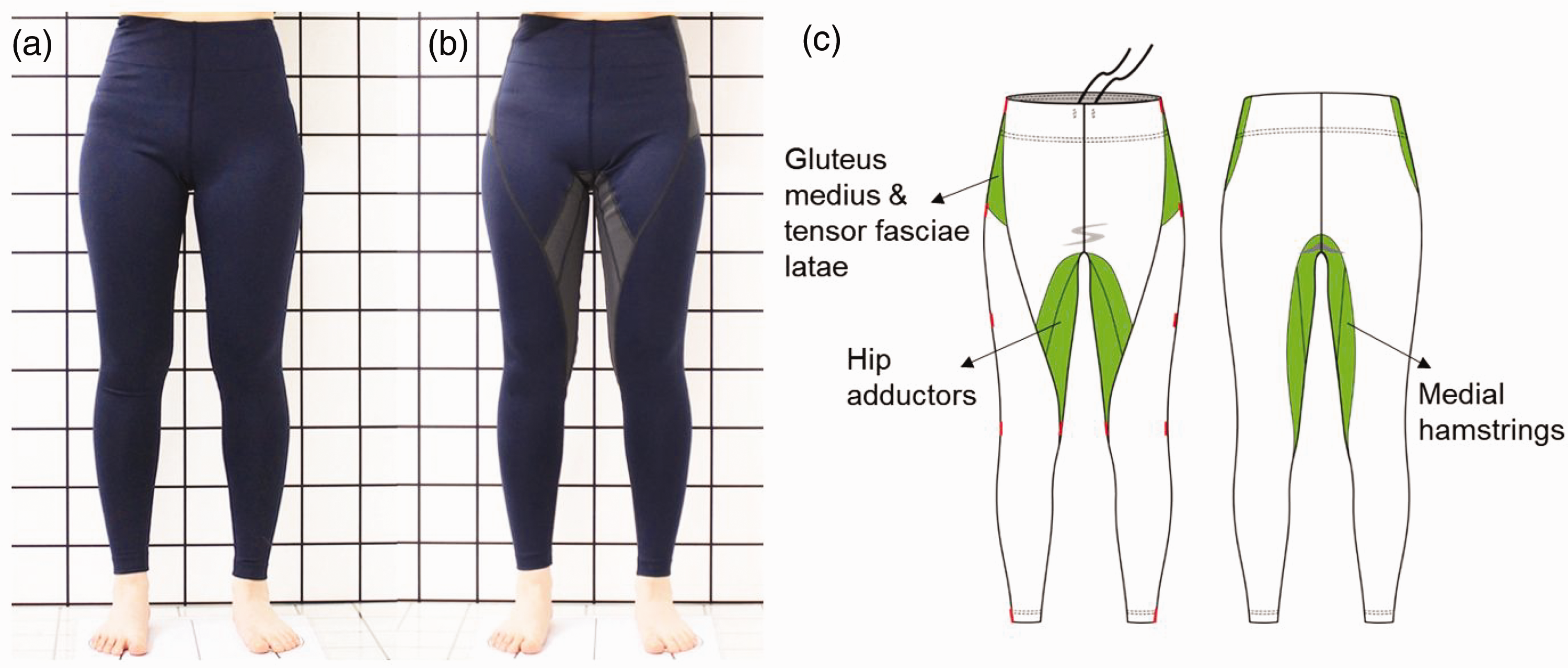
Experimental prototype leggings and support panel design: (a) NLs, (b) CLs, (c) The support panel design of CLs. Green is the support panel region made of power-net fabric.
Automatic three-dimensional (3D) anthropometric measurements of 208 women 20–29 years of age who participated in the 6th Size Korea Survey 49 were collected. The data normality was tested based on skewness and kurtosis. 50 From the mean values, outliers exceeding the ±3z score were excluded; 51 after that, the average body dimensions of women 20–29 years of age were derived from the data of 196 women. Two types of experimental leggings that fit the average body dimensions of women were produced. Using the same size and pattern, the normal leggings (NLs) and CLs were manufactured using double-sided jersey fabric (Polyester 74%/Polyurethane 26%) containing elastomer as the ground fabric. The common pattern for the two leggings was based on the drafting method by Armstrong 52 for female leggings and was drafted by modifying the pattern reduction method by Ziegert and Keil 53 for tight-fitting garments in accordance with the tension (350 N/m) specified in ASTM D2594-04. 48 In Ziegert and Keil 53 ’s pattern reduction method, the pattern was reduced proportionally by applying the available %stretch after the ease allowance was removed to draft the same block pattern as the body dimension. The NLs did not have any support panels, whereas the CLs had support panels made of power-net fabric (Nylon 80%/Polyurethane 20%) sewn into the lateral waist and medial thigh regions. The seams of the NLs and CLs with the sewn in support panel were sewn using a 4-needle 6-thread cover stitch technique 54 (Figure 1).
Participants
A total of 10 participants (24.2 ± 2.2 years) were recruited for the experiment. Selecting participants with weak walking ability or disabilities for the initial study to validate the first prototype of the assistive leggings carries inherent risks. This study aimed to address these risks by initially focusing on healthy adults for validation purposes. After confirming safety with healthy adults, subsequent research will involve studying individuals with in-toeing gait disabilities. The inclusion criteria consisted of healthy women 20–29 years of age with FPA within the normal range during gait whose body dimensions, including stature, crotch height, waist girth, and hip girth 57 were within the ±z score range of the average body dimensions of women 20–29 years of age in the 6th Size Korea Survey 49 to ensure that they can wear the experimental prototype leggings that were produced to a set size. Supplementary material Table S1 presents the mean and standard deviation (SD) values of age, stature, crotch height, waist girth, hip girth, body weight, and body mass index (BMI) of the participants. Women with a history of musculoskeletal surgery, musculoskeletal disorders, taking medications that may influence musculoskeletal functions within the past 6 months, and drug addiction, as well as pregnant women, were excluded from the study. The study protocol was approved by the Institutional Review Board (IRB) of Seoul National University (IRB No. 2104/004-038). All participants provided voluntary consent to participate in the study.
Clothing pressure measurement and functionality assessment
The experimental procedures were as follows. The CP was measured on day 1, and after 3 days, FPA and SBF were measured during treadmill walking. To ensure that the wire used to connect and the stickers used to attach the CP sensor do not influence the gait correction function of the CLs, the CP was measured separately from FPA and SBF. The reason for the 3-day interval between measurements was due to a previous study that revealed that the fascia has a plasticity that recalls tension due to an external force45 –47 and another study reported that the fascial tension release effect from an elastic taping intervention lasts up to 3 days. 58 For the CP measurements, the measurement was performed first in NLs, which provide a lower CP due to fascial plasticity, followed by that in the CLs, with 10 min of rest in between different wearing conditions (Figure 2).
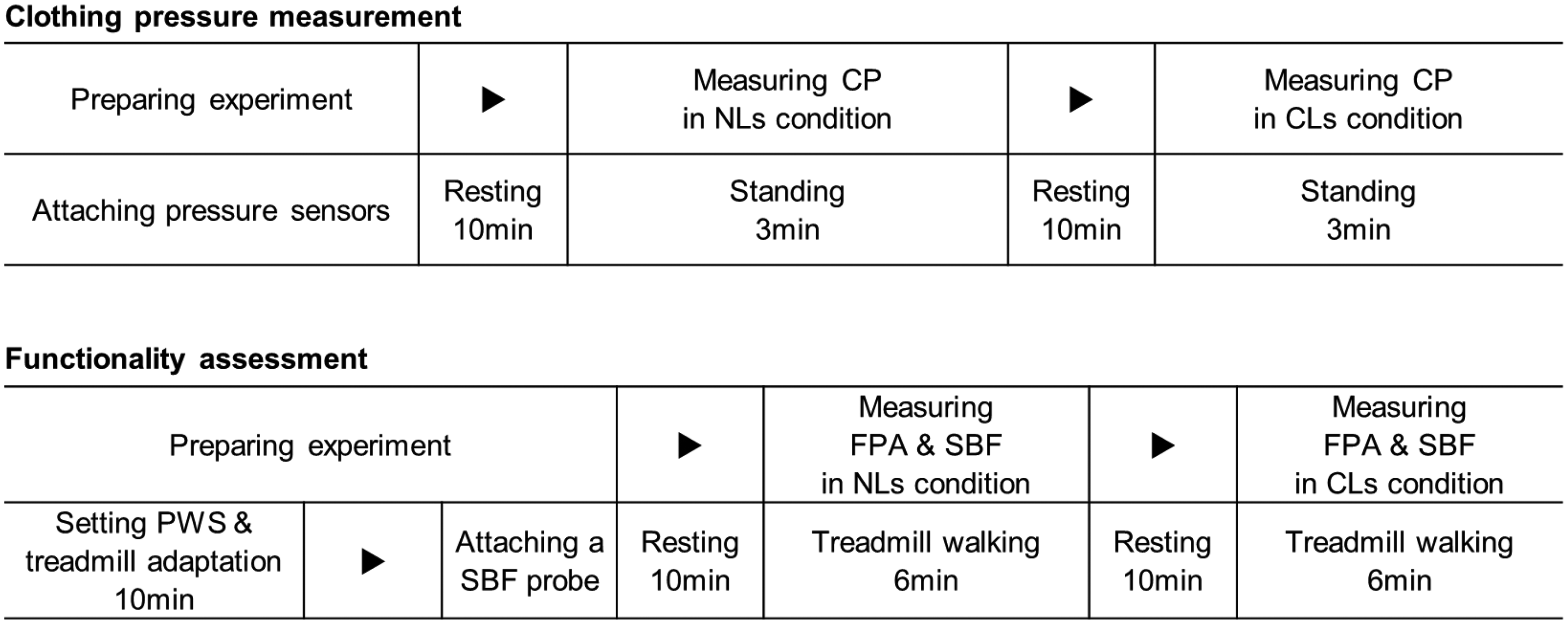
Experimental protocol.
To measure the CP applied to the participants while wearing the two types of experimental leggings, pneumatic CP sensors were attached to the skin covering the area where the support panels were located (gluteus medius (GM), hip adductors (AD), medial hamstrings (MH), and gastrocnemius (GA)). The CP was measured in 0.5 s intervals for 3 min using the AMI 3037-10 (AMI Techno Co. Ltd, Japan) with the participants standing while wearing the leggings. The first and last minutes of the collected CP data were regarded as noise and excluded from the analysis. 59
After setting the 10 min preferred walking speed (PWS) and treadmill adaptation, the SBF probe was attached to the third fingertip on the right hand of the participants.35,59 Subsequently, FPA and SBF were measured while the participants performed level walking on a treadmill for 6 min under different wearing conditions. FDM-TS 30-3i (Zebris Medical GmbH, Germany), a pressure-pad-embedded treadmill, was used to measure the ground reaction force generated on the participants’ soles while walking at 100 Hz unit. The coordinates of the toes and heels for each step were recorded in the XML format. FPA, which is the angle formed by the long axis of the foot relative to the line of body progression, was calculated from these coordinates. SBF was measured and recorded in a 0.5 s unit using the moorVMS-LDF (Moor Instruments Ltd, UK), a laser-doppler blood flow monitor. From the collected FPA and SBF data, the first and last minutes were regarded as noise and excluded from the analysis. 59
User evaluation
The body part-user evaluation questionnaire (BUQUE) to evaluate DEFOs for different body parts, was developed based on the technology acceptability model 60 and usability standard, 61 along with previous studies on garment fit evaluation, 62 compression garment comfort evaluation,40,59,63 and orthosis/wearable user evaluation.64 –67 The questionnaire consisted of three sub-evaluation criteria for perceived strength (compression strength, support strength, and directional tension strength) and seven sub-evaluation criteria for usability (usefulness in gait correction, ease of movement, ease in donning and doffing, safety, appearance satisfaction, dimension satisfaction, and compression satisfaction) (Table 2). Most questions were designed to evaluate four body parts (waist, hip, thigh, and calf),40,59 while excluding parts that are difficult to evaluate separately. Accordingly, questions regarding the ease in donning and doffing, safety, and appearance satisfaction evaluating overall lower body were administered; directional tension strength were evaluated for three body parts (hip, thigh, and calf); and ease of movement was evaluated for two body parts (thigh and calf).
Body part-user evaluation questionnaire
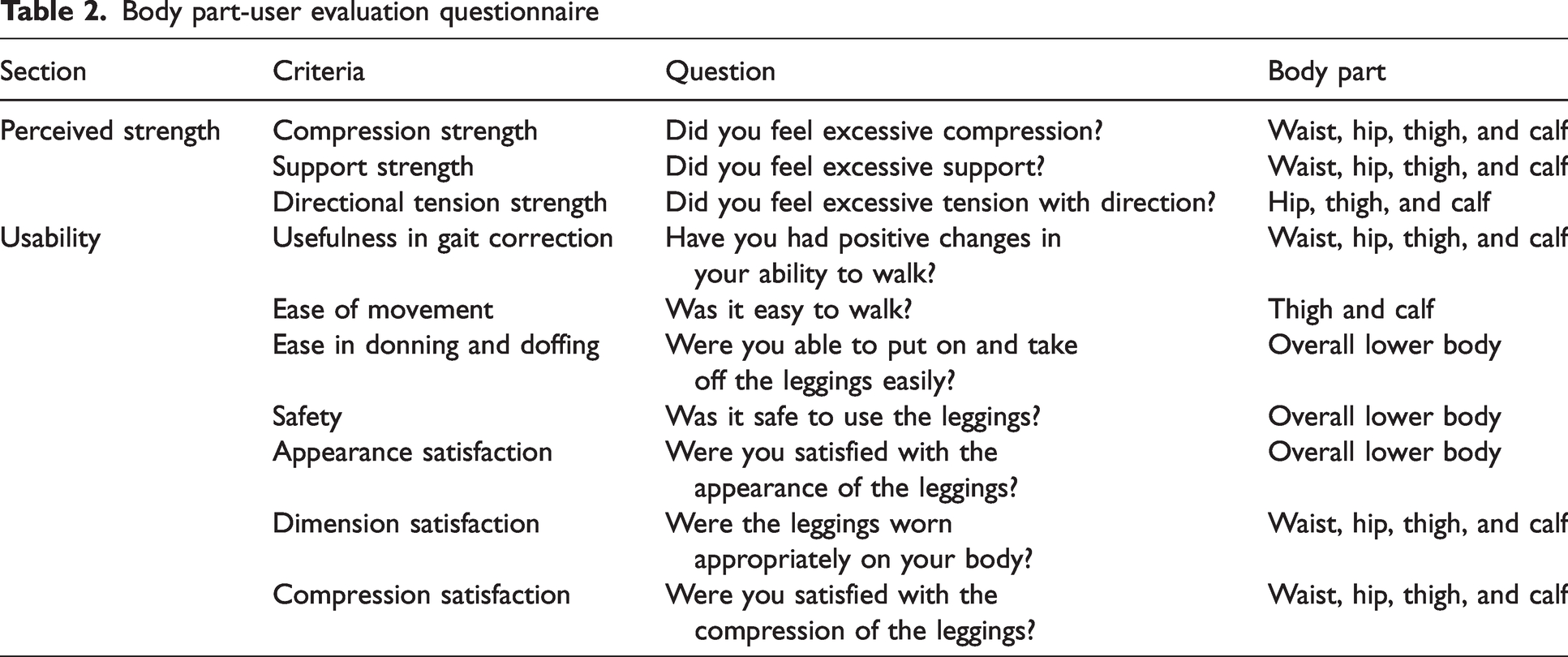
Upon completing the experiment, the participants took part in the user evaluation interviews regarding the two types of experimental leggings. The participant responses were scored on a 5-point Likert scale (1: Strongly disagree, 2: Disagree, 3: Neutral, 4: Agree, and 5: Strongly agree).
Statistical analysis
CP, FPA, SBF, and user evaluation scores were analyzed by descriptive statistics. Since the data normality could not be established for most items (Supplementary material Table S2), a nonparametric Wilcoxon signed-rank test was performed to examine the differences between the two wearing conditions based on the presence or absence of the support panel. All statistical analyses were performed using IBM SPSS Statistics version 26.0 (IBM, USA) with the significance set to α = 0.05.
Results and discussion
Difference in the clothing pressure between the normal and compressions leggings
Functional compression garments exhibit their functions by controlling the CP, the independent variable. The Wilcoxon signed-rank test was performed to investigate the difference in the CP according to the support panel, that is, the condition of the CP generated by the support panel. The results revealed that the CP in the GM, AD, and MH was significantly higher in the CLs than in NLs (GM: z = 23.804, p = 0.000; AD: z = 29.046, p = 0.000; MH: z = 12.996, p = 0.000) (Figure 3) (Supplementary material Table S3). The difference in CP values (ΔCP: CLs value ‒ NLs value) indicated the change in pressure generated by the support panel, which is the only difference between the NLs and CLs. In the GM, AD, and MH, such difference was 1.44, 3.21, and 0.74 mmHg, respectively, which indicated that the support panel significantly increased the CP. Therefore, it was found that the presence of the power-net support panel that does not stretch well in course direction for leggings worn around the same leg is a variable that increases pressure. The available % stretch at a tension of 350 N/m is a main property to increase CP when selecting a support panel material in functional compression wear.
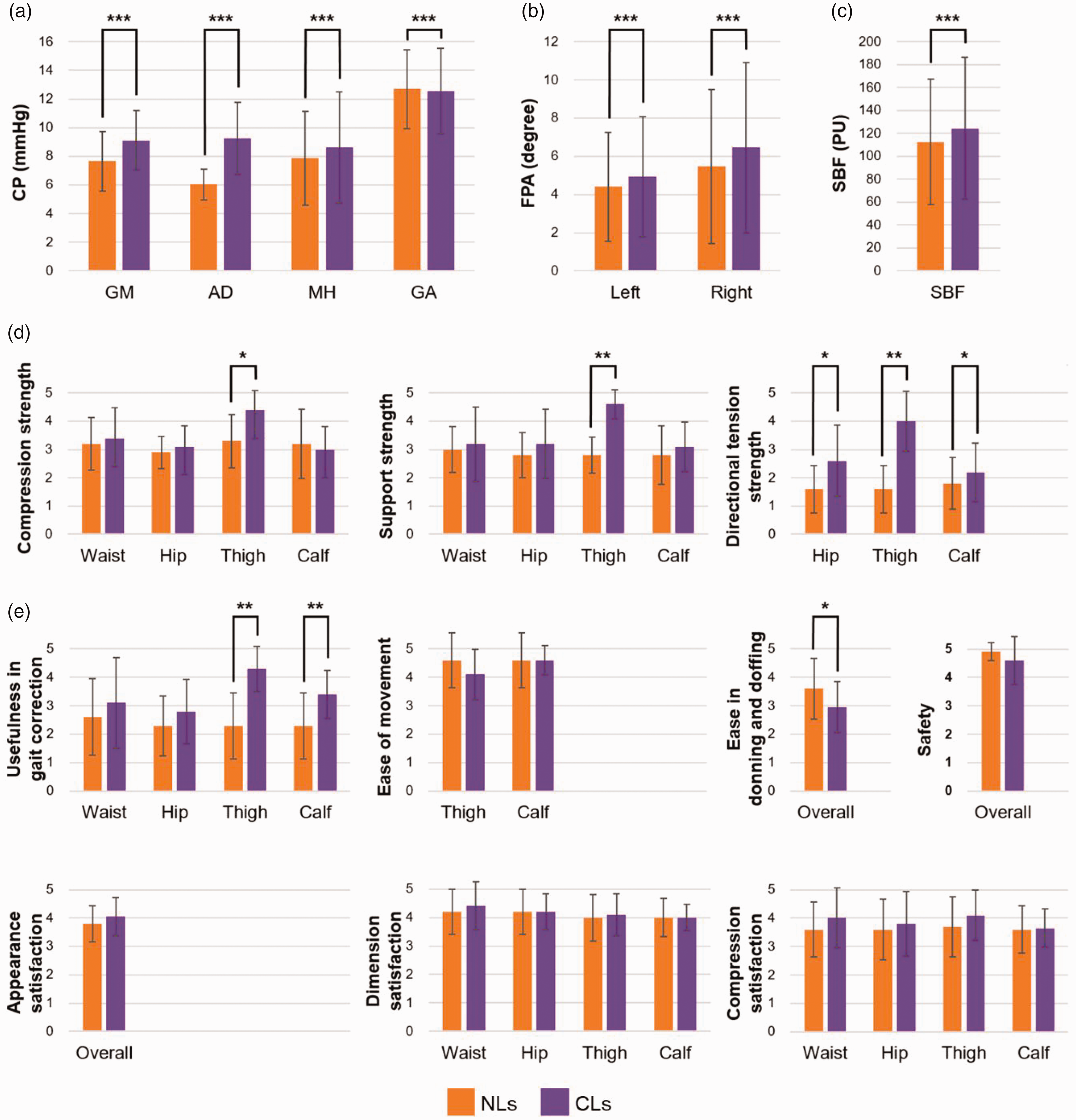
The results of CP, FPA, SBF, perceived strength, and usability: (a) CP, (b) FPA, (c) SBF, (d) perceived strength, (e) usability. Perceived and usability were rated on a 5-point Likert scale. The users rated on a 5-point Likert scale. Data are mean ± SD (95% CI). Data were tested by Wilcoxon signed-rank test. Error bars shown are SDs. ***: p < 0.001; **: p < 0.01; *: p < 0.05.
In addition, the Wilcoxon signed-rank test results revealed that the CP in the GA, which did not have a support panel in both the NLs and CLs, was significantly higher in the NLs than in the CLs, with ΔCP of −0.15 mmHg (z = −4.073, p = 0.000). The area with the highest-pressure value was the GA, with 12.70 and 12.55 mmHg in the NLs and CLs, respectively, which were lower than the blood flow-based threshold of 30 mmHg and the perception-based threshold of 17 mmHg reported in previous studies.32 –34,37 –40
Difference in FPA between the normal and compression leggings
Left and right FPA were significantly higher in the CLs than in the NLs (left: z = 7.120, p = 0.000; right: z = 12.656, p = 0.000) (Figure 3) (Supplementary material Table S3). The mean difference (CLs value ‒ NLs value) was 0.51° and 0.98° in the left and right FPA, respectively, with an increase of 11.6% and 18.0% in the CLs relative to the values in the NLs. The significant difference in FPA between the NLs and CLs demonstrated that the support panel used in this study had a correction effect on the external rotation of FPA despite applying a low-pressure level. For FPA modification, the paralleled arrangement of the power-net support panel was correlated to the lower available %stretch than ground fabric in wale direction. It was analyzed that a lower available %stretch reduced muscle contraction during walking and reduced internal rotation of the FPA.
Difference in SBF between the normal and compression leggings
SBF was significantly higher in the CLs than in the NLs (z = 18.816, p = 0.000) (Figure 3) (Supplementary material Table S3). The mean difference (CLs value ‒ NLs value) was 11.86 PU, with an increase of 10.5% in the CLs relative to the values in the NLs. The significant difference in SBF between the NLs and CLs indicated that SBF could be increased significantly by increasing the CP by the support panel. Campion et al. 33 reported that external pressure applied by plastic splints could reduce blood flow. This study showed that an increase in SBF was possible because the orthosis used was a compression garment made of elastomeric fabric and that SBF can be improved by only adding a low CP generated by the support panel.
Examination of SBF per minute between 1 and 5 min after the start of walking showed that SBF was 102.63, 110.13, 115.30, and 122.11 PU in the NLs and 111.68, 115.65, 128.77, and 141.45 PU in the CLs, indicating a continuous increasing trend in both the NLs and CLs. Since it is determined that SBF may increase until it reaches a stable phase, it may be necessary to extend the SBF measurement period when designing future studies.
Difference in perceived strength between the normal and compression leggings
The Wilcoxon signed-rank test results on perceived strength in each body part showed that the compression strength and support strength of the CLs were significantly higher in the thigh, as compared with those of the NLs (compression strength: z = 1.964, p = 0.049; support strength: z = 2.842, p = 0.004). With respect to perceived compression strength in the AD, which showed a large ΔCP, the participants perceived compression strength to be higher by 1.10 due to ΔCP of 3.21 mmHg between the NLs and CLs. Such findings indicated that the participants can sufficiently recognize even a small change in the CP due to the support panel. However, applying such a CP did not significantly differ in compression satisfaction. Except for the compression satisfaction for the waist and thigh in the CLs (waist: 4.00, thigh: 4.10) being superior and higher than those in the NLs (waist: 3.60, thigh: 3.70), similar results were obtained in a study by Lee and Nam 41 reporting that girdles with a higher CP were associated with less fatigue and discomfort and in a study by Lee et al. 43 reporting that there is no correlation between the CP and pressure preference (R = −0.150, p = 0.390). Moreover, in the CLs, the CP in the AD (9.25 mmHg) was lower than that in the GA (12.55 mmHg). In the CLs, however, the perceived compression strength was 3.00 points in the GA and 4.40 points in the AD, while the compression satisfaction was 3.65 points in the calf and 4.10 points in the thigh (Figure 3) (Supplementary material Table S4). The results indicated that users’ perceived CP in each body part varied from quantitative CP values and that the users may show preference despite feeling a strong compression strength. Such findings were consistent with a study by Kim and Nam 68 on pants reporting that the allowable CP levels sensed varied for different body parts.
It should be noted that the directional tension strength throughout the lower extremities, meaning the hip, thigh, and the calf, was significantly higher in the CLs than in the NLs in the Wilcoxon signed-rank test results (hip: z = 2.060, p = 0.039; thigh: z = 2.821, p = 0.005; calf: z = 2.000, p = 0.046). Although compression strength and support strength were higher in CLs than in NLs, with the exception of compression strength in the calf, the body part where a significant difference was observed in the Wilcoxon signed-rank test results was only the thigh. Such findings were supported by the participants stating in the interviews that they felt a change in directional tension in the hip, thigh, and calf and perceived external rotation in the thigh and calf when walking while wearing the CLs, and that the CLs were useful for walking (Figure 3) (Supplementary material Table S4). It is presumed that, in contrast to compression strength and support strength being localized only in the thigh, the participants could sense the effect of tension by the support panel on the thigh fascia throughout the lower extremities. Such results perceived by the participants indicate the possibility of the FPA correction effect of the support panel being associated with the transverse plane rotation of the entire lower extremities. Such findings are supported by previous studies on the transverse plane rotation of the lower extremities and changes in FPA.1,2,4,69
Difference in usability between the normal and compression leggings
The Wilcoxon signed-rank test results on usability showed that the ease in donning and doffing was significantly lower in the CLs than in the NLs (z = −2.181, p = 0.029), while usefulness in gait correction in the thigh and calf was significantly higher in the CLs than in the NLs (thigh: z = 2.820, p = 0.005; calf: z = 2.598, p = 0.009). The results showed no significant difference in appearance satisfaction, dimension satisfaction, compression satisfaction, safety, and ease of movement. Meanwhile, ease of movement and safety scores were lower in the CLs than in the NLs; appearance satisfaction and dimension satisfaction scores were similar between the CLs and NLs; and compression satisfaction scores were higher in the CLs than in the NLs (Figure 3) (Supplementary material Table S4). Therefore, the support panel was determined to be a factor that can significantly improve usefulness in gait correction and can reduce the ease in donning and doffing. Ease in donning and doffing, ease of movement, and safety, the scores for which can be lowered by the support panel, should be considered carefully to ensure they do not hinder the development of a DEFO.
From the perspective of the entire orthosis, the items with scores of ≥4 points in the CLs were appearance satisfaction, dimension satisfaction in all body parts, ease of movement in all body parts, compression satisfaction in the waist and thigh, and usefulness in gait correction in the thigh (Figure 3) (Supplementary material Table S4). In addition, the scores for ease of movement and safety in the CLs were ≥4 points, despite being lower than those in the NLs, which indicated that the CLs allowed ease of movement and are safe. Therefore, it can be concluded that, except for a moderate level of ease in donning and doffing, the CLs demonstrated high usability scores in appearance satisfaction, dimension satisfaction, compression satisfaction, ease of movement, usefulness in gait correction, and safety.
One thing to consider for upgrading the orthosis is that. despite the scores of ≥4 points for all items in the thigh, the scores for usefulness in gait correction and compression satisfaction in the calf were at moderate levels. The participants stated that the low perception in the calf was due to the relatively high pressure on the thigh. Therefore, the garment circumference in the calf area may be reduced in the CLs, or an additional support panel may be applied to achieve a balance with the support panel. In contrast, considering that the score for ease in donning and doffing was only at a moderate level in the CLs, caution should be taken when attempting to increase the pressure. Because the participants were ordinary women who wore a compression garment for the first time, they were more likely to show resistance against compression than athletes. However, since patients or individuals with a disability may be even more resistant than healthy individuals, careful consideration should be given to setting the CP level during the development of CLs for specific disorders.
Conclusions
This study proposed a new support panel of the CLs that can provide low pressure on the regions around the thigh for FPA correction. The quantitative functionality of the support panel in the CLs showed that the support panel provided a low pressure but significant difference in the CP, indicating a significant effect on FPA correction and increase in SBF during treadmill walking. The perceived directional tension strength throughout the entire lower extremities showed the FPA correction effect of the support panel placed around the thigh, influencing the entire lower extremities, which warrants further study. The support panel was identified as a factor that significantly improved usefulness in gait correction, but it also significantly reduced the ease in donning and doffing. The usability factors that require caution during the development of a DEFO were identified as ease in donning and doffing, ease of movement, and safety.
Orthoses are typically produced as rigid orthoses, while soft garment-type orthoses remain an unexplored field. The significance of this study is that it suggested available %stretch as the main property of the fabric for the functional support panel, providing a low pressure for FPA modification. The support panel with available %stretch lower than the ground fabric was found to generate pressure and support, which can induce changes in muscle contraction. These findings can be used to develop clothing-type orthosis. In addition, the CP data in this study, showing significant changes in gait patterns by providing only a low-pressure level, are significant in that they provide the criteria for threshold values to be used to design customized CLs.
Previous gait analysis studies have focused only on quantitative functional measurements for providing scientific evidence. Because usability determination is subjective, user evaluation results in this study could be easily dismissed since they are difficult to quantify. However, it is an essential factor for users choosing an orthosis product and complying with the usage. Therefore, user evaluation in this study is a significant attempt to make the user-centered evaluation more systematic. In addition, the prominent perception results that appeared around the thigh region suggested that the BUQUE for a DEFO specified for each body part can be useful for evaluating major stimulation regions.
A major finding from the user evaluation was that users perceived strength and usability more sensitively than expected. The fact that the CP level preferred for different body parts was different revealed that evaluation was not sufficient with quantitative measurement of the CP alone. In addition, whether the CP level is appropriate or not can only be determined by confirming pressure and garment fit satisfaction. These facts indicate the need for user-centered evaluations, together with quantitative functional measurements, in the product-testing stage.
The limitations of this study included the fact that the participants consisted of only women who did not have any physical disability. The study also did not examine long-term effects that may appear from continuing with gait training while wearing the CLs. Therefore, additional testing for long-term effects is needed. This study was the first to develop an leggings prototype for the external rotation of FPA. There are plans to conduct follow-up studies to investigate the changes in FPA with modifying CP levels and distribution by increasing the area of the support panel to enhance the correction effect.
The developed CLs can be customized to correct pathological in-toeing gait 41 that may appear in combination with neuromusculoskeletal diseases such as cerebral palsy and spina bifida. The developed CLs can be used to replace conventional rigid orthoses to provide an FPA correction effect with improved functionality and usability. Wearing the CLs can lower the risk of osteoarthritis that may occur due to in-toeing gait. 70 However, it should be kept in mind that an intervention using the CLs is not an alternative to surgical therapy. The significance of the developed CLs is that they can be applied during rehabilitation for gait adaptation after corrective surgery for severe cases of in-toeing gait. For mild cases in which surgery is not even considered, they can provide an opportunity for correction while ensuring freedom of movement in daily life.
Abbreviations
hip adductors body mass index body part-user evaluation questionnaire compression leggings clothing pressure dynamic elastomeric fabric orthosis foot progression angle gastrocnemius gluteus medius Institutional Review Board medial hamstrings normal leggings perfusion unit preferred walking speed skin blood flow standard deviation
Footnotes
Declaration of conflicting interests
The author declared the following potential conflicts of interest with respect to the research, authorship, and/or publication of this article: HSK is the inventor of the patent (KR Patent No. 10-2021-015133), which was applied to the Korean Intellectual Property Office by SNU R&DB Foundation.
Ethics approval
This study was approved by Seoul National University Institutional Review Board (Ethics Code: 2104/004-038). All participants provided written informed consent prior to enrolment in the study. This research was conducted ethically in accordance with the World Medical Association Declaration of Helsinki.
Funding
The author received no financial support for the research, authorship, and/or publication of this article.

Supplemental material
Supplemental material for this article is available online.