



Abstract
Dye wastewater has attracted great attention due to high pollution and toxicity which can cause harm to the living environment. It is common for azo-disperse dyes to be used to dye hydrophobic fibers. A reduction clearing method is used to eliminate the dye particles on the fabric after dyeing. However, when azo disperse dyes on the fiber surface are eliminated by the reduction clearing process, this can give rise to an effluent discharge due to the presence of sodium hydrosulfite. The introduction of carboxylic ester groups into dye molecules can effectively avoid this issue. Six novel environmentally friendly alkali-clearable disperse dyes, containing cyano and carboxylic ester groups, were readily synthesized by a diazo coupling reaction with various diazo components. Their dyeing properties on polyethylene terephthalate fabrics were respectively measured and compared with those of commercial reference dyes. It was indicated that some fastness properties of the synthesized dyes on polyethylene terephthalate fabrics after the alkali clearing were improved compared with those of the reference dyes due to the existence of the carboxylic ester group. Moreover, the chromaticity of dye wastewater can be further reduced by recovering hydrolyzed dyes.
Many studies about azo disperse dyes have been investigated to increase color fastness and develop environmentally friendly disperse dyes on polyethylene terephthalate (PET) fabric.1–4 It is well known that the reduction clearing of dyed fabrics is needed to eliminate the dye particles on the fiber after dyeing in order to improve color fastness of the dyed fabrics. 5 But, in this case, sodium thiosulfate is used as a reducing agent to eliminate dye particles on the fabric and the azo dyes are converted to toxic and carcinogenic aromatic amine compounds, 6 which can cause great harm to the living environment.7,8 In our previous studies, it was found that the introduction of carboxylic ester groups into dye molecules can effectively avoid this issue.9,10 The azo disperse dyes containing carboxylic ester groups can be hydrolyzed by alkali clearing and converted to water-soluble dyes without producing toxic compounds. 11 Meanwhile, it has been proved that these environmentally friendly alkali-clearable disperse dyes possess good alkali-clearable ability at the lower alkali concentrations on polyester fibers and can also further reduce pollution. 12 However, there are still some problems to be resolved in terms of waterwaste post-treatment in the practical application of alkali-clearable dyes. 13
In addition to adopting ecological post-treatment clearing methods to reduce the use of reducing agents (alkali-clearing instead of reduction clearing), some sustainable issues are also related to the properties of the dye itself and the interaction force of the dye with the fiber.14–16 Dyes with poor fastness may be discharged into water resources due to weak adsorption of dyes to fiber surfaces under washing or external force.17,18 In the dyeing process, additives are often added to the aqueous dye solution to improve the washing and light fastness of the fabric. Still, some additives are generally considered to be toxic and can cause significant pollution. Generally, by increasing the polarity or molecular weight of the molecular structure of the dye, the binding force between the dye and the fiber can be hugely improved, 19 and the use of other additives to improve fastness can also be avoided. Poor dyeability and low washing fastness are mainly attributed to lower dye-fiber affinity. 20 Introducing the polar groups into the dye molecules can enhance the intermolecular force between dyes and PET. 21 Herein, the design of the molecular structure of the new dye not only refers to several commercial dyes with good light fastness but also introduces the carboxylic ester group and cyano group to impart environmentally friendly alkali-clearable performance and better light fastness to new dyes. We applied them to PET to investigate the differences and relationship between the dyeing performance and structures compared with the reference dyes. For this purpose, two coupling components with ethyl 3-((2-cyanoethyl)(phenyl)amino)propanoate and ethyl 3-((5-acetamido-2-methoxyphenyl)(2-cyanoethyl)amino)propanoate were synthesized firstly (Scheme 1) and then reacted with various diazo components to prepare some red and blue dyes (Scheme 2). The spectral properties in solution and dyeing performances as well as color fastness on PET fabric of these novel alkali-clearable disperse dyes were investigated and compared with those of the reference dyes. This article also discusses the difference in UV-Vis absorption spectra before and after adding BaCl2 to the hydrolysis solution, which intuitively reveals the application effect of the BaCl2 precipitant (Scheme 3).

Synthetic route of coupling components 1a and 1b.
The water-soluble hydrolysates of alkali-clearable disperse dyes with various types of Chromophore can be discharged into the environment when azo disperse dyes containing carboxylic ester groups are hydrolyzed by alkali clearing, which is toxic to living ecosystems.22–25 Azo disperse dyes 4c–4h containing carboxylic ester groups have considerable advantages in the application and post-treatment of dyeing effluents.26,27 For example, salting out can be used to recover the hydrolysates of dyes 4c–4h after the alkali clearing is finished, which can significantly reduce pollution. 28 The UV-Vis absorption spectra of the solution can be decreased by the recovery experiment of the hydrolysate dye, solving the problem of environmental pollution caused by dye products in wastewater.
Experimental details
Materials and instruments
N-cyanoethylaniline and 3-(N-cyanoethyl)amino-4-methoxyacetanilide were purchased from Hubei Xinkang Pharmaceutical Chemical Co., Ltd and Hubei Jusheng Technology Co., Ltd, China, respectively. 2-chloro-4-nitroaniline, 2,6-dichloro-4-nitroaniline, 3-amino-5-nitrobenzisothiazole, 2-cyano-4-nitroaniline, 2-amino-6-nitrobenzothiazole, and 2-bromo-4,6-dinitroaniline were provided by Zhejiang Longsheng Group Co., Ltd, China. Ethyl acrylate, hydroquinone, sodium nitrite, and barium chloride were obtained from Aladdin Chemical Co., Ltd, Shanghai, China.
Infrared (IR) spectra (4000–400 cm−1) were recorded using an FT/IR-430 spectrophotometer. 1H NMR spectra were measured with a Varian INOVA 400 NMR spectrometer at room temperature in CDCl3. Electrospray ionization mass spectra (ESI-MS) were performed on a Thermo Fisher LCQ Fleet. Ultraviolet (UV)-visible (Vis) spectra were measured by using a Shimadzu UV-2600 spectrophotometer.
Synthesis
The synthetic scheme for two coupling components 1a and 1b is shown in Scheme 1. The synthetic scheme for dyes 4c–4h is shown in Scheme 2.
Synthesis of 1a
N-cyanoethyl aniline (14.6 g, 100 mmol), ethyl acrylate (23 ml), and hydroquinone (0.30 g, 2.7 mmol) were added to a 100 ml three-necked flask, and the mixture was stirred and dissolved at 50°C for 20 min. The aluminum chloride (4.5 g, 33.7 mmol) was slowly added to the reaction solution at room temperature. The mixture was heated at 85°C to reflux for 3 h and monitored by TLC. Finally, the excess solvent ethyl acrylate was recovered by distillation to obtain an oily liquid. ESI MS (m/z, %): 247.2 [M + H]+. Yield: 80%.
Synthesis of 1b
3-(N-cyanoethyl)amino-4-methoxy acetanilide (23.3 g, 100 mmol), ethyl acrylate (85 ml), and anhydrous aluminum chloride (24 g, 180 mmol) were added to a 100 ml three-necked flask. Other synthesis of coupling component 1b was similar to that of 1a. Oily liquid. ESI MS (m/z, %): 334.9 [M + H]+. Yield: 95%.
Typical preparation of environmentally friendly alkali-clearable dyes 4c–4h
As a general procedure for the synthesis of azo disperse dye 4c, 3-amino-5-nitrobenzisothiazole (4.10 g, 21.0 mmol) was slowly added to the concentrated sulfuric acid (6.72 ml) and nitrosyl sulfuric acid (6.70 g 22.5%) at 0–5°C for 6 h. The reaction solution was diluted with ice water and filtered to remove impurities. Then the diazo salt solution was obtained for coupling. The prepared diazo salt solution was added to the coupling component 1a (ethyl 3-((2-cyanoethyl)(phenyl)amino)propanoate solution, 5.19 g, 21.0 mmol) at 0–5 °C and pH 5.5 for 3.5 h. The disperse blue 4c was filtered and dried at 60°C. Crude yield: 7.92 g (87.6%). 1H NMR (400 MHZ, CDCl3): δ 9.26–9.27 (d, J = 4 Hz, 1H, Ar-H), 8.27 (s, 1H, Ar-H), 8.08–8.10 (d, J = 8 Hz, 1H, Ar-H), 7.84–7.87 (d, J = 12 Hz, 2H, Ar-H), 6.86–6.88 (d, J = 8 Hz, 2H, Ar-H), 4.21–4.26 (m, J = 20 Hz, 2H, CH2), 3.95–3.99 (m, J = 16 Hz, 4H, CH2), 2.77–2.80 (m, J = 12 Hz, 4H, CH2), 1.05–1.10 (t, J = 20 Hz, 3H, CH3); 13C NMR (400 MHZ, CDCl3): 171.39, 162.26, 150.74, 144.62, 144.43, 128.05, 127.32, 123.07, 122.59, 119.52, 117.66, 112.25, 99.98, 61.21, 47.36, 47.22, 32.60, 16.21, 14.22; ESI MS (m/z, %):453.1 [M+H]+; FT-IR (KBr, cm−1): 2965, 2922 (CH3, CH2), 2249 (CN), 1734 (C=O, carboxylic ester), 1549, 1348 (NO2).
The synthesis of dyes 4d–4g was similar to that of 4c. The synthesis of the diazo component of the dye 4h was the same as that of 4c. The coupling reaction was conducted by adding the above diazo salt solution to the coupling component 1b (ethyl 3-((5-acetamido-2-methoxyphenyl)(2-cyanoethyl)amino)propanoate, 9.99 g, 30 mmol) at 0–5°C and pH 5.5 for 3.5 h. The characterization of dyes 4d–4h is shown below.
4d
71.9% yield, red solid. 1H NMR (400 MHZ, CDCl3): δ 8.83 (s, 1H, Ar-H), 8.38–8.41 (d, J = 12 Hz, 1H, Ar-H), 8.20–8.23 (d, J = 12 Hz, 1H, Ar-H), 8.12–8.14 (d, J = 8 Hz, 2H, Ar-H), 6.84–6.87 (d, J = 12 Hz, 2H, Ar-H), 4.20–4.25 (m, J = 20 Hz, 2H, CH2), 3.97–4.01 (m, J = 16 Hz, 4H, CH2), 2.84–2.87 (m, J = 12 Hz, 4H, CH2), 0.89–0.94 (t, J = 20 Hz, 3H, CH3); 13C NMR (400 MHZ, CDCl3): 171.36, 156.40, 151.68, 145.31, 143.80, 134.45, 128.28, 124.08, 122.65, 121.70, 118.69, 118.61, 117.51, 111.91, 111.38, 61.27, 47.35, 32.55, 16.18, 14.18; ESI MS (m/z, %): 453.1 [M+H]+; FT-IR (KBr, cm−1): 2968, 2922 (CH3, CH2), 2248 (CN), 1726 (C=O, carboxylic ester), 1515, 1332 (NO2).
4e
90.0% yield, orange solid. 1H NMR (400 MHZ, CDCl3): δ 8.33 (s, 2H, Ar-H), 8.00–8.02 (d, J = 8 Hz, 2H, Ar-H), 6.83–6.86 (d, J = 12 Hz, 2H, Ar-H), 4.21–4.25 (m, J = 16 Hz, 2H, CH2), 3.93–3.97 (m, J = 16 Hz, 4H, CH2), 2.74–2.77 (m, J = 12 Hz, 4H, CH2), 0.91–0.94 (t, J = 12 Hz, 3H, CH3); 13C NMR (400 MHZ, CDCl3): 171.51,153.57, 150.25, 145.37, 144.24, 127.94, 127.86, 126.39, 124.53, 124.23, 117.85, 111.86, 111.63, 61.08, 47.33, 47.13, 32.50, 16.06, 14.21; ESI MS (m/z, %): 464.1 [M+H]+; FT-IR (KBr, cm−1): 2965, 2854 cm−1 (CH3, CH2), 2244 (CN), 1735 (C=O, carboxylic ester), 1535, 1349 (NO2).
4f
96.1% yield, red solid. 1H NMR (400 MHZ,CDCl3): δ 8.45 (s, 1H, Ar-H), 8.21–8.24 (d, J = 12 Hz, 1H, Ar-H), 8.03–8.05 (d, J = 8 Hz, 2H, Ar-H), 7.82–7.84 (d, J = 8 Hz, 1H, Ar-H), 6.82-6.84 (d, J = 8 Hz, 2H, Ar-H), 4.21–4.25 (m, J = 16 Hz, 2H, CH2), 3.93–3.96 (m, J = 12 Hz, 4H, CH2), 2.74–2.77 (m, J = 12 Hz, 4H, CH2), 0.90–0.94 (t, J = 16 Hz, 3H, CH3); 13C NMR (400 MHZ, CDCl3): 171.53, 152.44, 149.96, 147.32, 144.89, 134.32, 126.77, 125.94, 122.53, 117.95, 117.9 111.86, 111.7, 61.07, 47.28, 47.08, 32.51, 16.06, 14.21; ESI MS (m/z, %): 430.9 [M+H]+; FT-IR (KBr, cm−1): 2960, 2938 (CH3, CH2), 2244 (CN), 1720 (C=O, carboxylic ester), 1550, 1349 (NO2).
4g
92.3% yield, red solid. 1H NMR (400 MHZ,CDCl3): δ 8.70 (s, 1H, Ar-H), 8.51–8.53 (d, J = 8 Hz, 1H, Ar-H), 8.10–8.12 (d, J = 8 Hz, 3H, Ar-H), 6.84–6.86 (d, J = 8 Hz, 2H, Ar-H), 4.21–4.26 (m, J = 20 Hz, 2H, CH2), 3.94–3.99 (m, J = 20 Hz, 4H, CH2), 2.76–2.79 (m, J = 12 Hz, 4H, CH2), 0.93–0.95 (t, J = 8 Hz, 3H, CH3); 13C NMR (400 MHZ, CDCl3): 171.40, 156.88, 150.96, 146.59, 144.62, 128.95, 128.22, 127.51, 117.88, 117.74, 115.37, 112.45, 112.05, 111.93, 61.14, 47.30, 47.16, 32.50, 16.12, 14.20; ESI MS (m/z, %): 421.2 [M+H]+; FT-IR (KBr, cm−1): 2967, 2930 (CH3, CH2), 2248, 2231 (CN), 1735 (C=O, carboxylic ester), 1526, 1346 (NO2).
4h
40.0% yield, blue solid. 1H NMR (400 MHZ,CDCl3): δ 9.04 (s, 1H, Ar-H), 8.76 (s, 1H, Ar-H), 7.56 (s, 1H, Ar-H), 7.37 (s, 1H, Ar-H), 4.17–4.22 (m, J = 20 Hz, 2H, CH2), 3.88 (s, 1H, OCH3), 3.85–3.87 (m, J = 8 Hz, 4H, CH2), 2.80–2.85 (m, J = 20 Hz, 4H, CH2), 2.25 (s, 3H, CH3), 0.92–0.94 (t, J = 8 Hz, 3H, CH3); 13C NMR (400 MHZ, CDCl3): 171.57, 169.53, 149.22, 147.17, 146.93, 145.71, 140.65, 137.86, 133.85, 130.96, 126.72, 119.07, 118.80, 118.1, 117.69, 105.31, 73.77, 60.89, 55.65, 49.41, 33.29, 25.14, 18.62, 14.16; ESI MS (m/z, %): 606.1 [M+H]+; FT-IR (KBr, cm−1): 3408 (NH), 2968, 2930 (CH3, CH2), 2250 (CN), 1722 (C=O, carboxylic ester), 1660 (C=O, amide), 1617, 1562, 1329 (NO2).
Dyeing procedure
The dye dispersion solution was prepared by grinding the mixture of dyes 4c–4h (0.5 g), dispersant naphthalene sulfonic acid/formaldehyde condensation product (NNO), 1 g, and water (15 ml) in a laboratory miniature quartz tube equipped with zirconium beads (Φ0.2 mm, 12 g) and mechanical stirrer. A sample of pre-weighed PET fabric was dyed at a 100:1 liquor-to-goods ratio and pH at 5.5 (using acetic acid/sodium acetate buffer solution), then raised to 130°C for 60 min.
Dye exhaustion
The dye exhaustion was calculated based on

Post-treatment method after dyeing
After dyeing, excess dye particles on the fiber surface were removed by conventional reduction clearing or alkali clearing. Three post-treatment methods were carried out to compare the differences in the dyeing performance: no treatment, reduction clearing (using 1.7 g/l Na2S2O4 and 1 g/l NaOH), and alkali clearing (using a certain concentration of NaOH).
Color assessment
The K/S, L*, a*, and b* values of dyed PET fabrics were obtained from dyed samples at maximum wavelength by using a Datacolor SF 600X spectrophotometer. The K/S value was calculated on the basis of the Kubelka-Munk equation:

Determination of colorfastness level
Colorfastness tests were conducted according to international standards: rubbing fastness according to ISO 105-X12: 2016, washing fastness according to ISO 105-C06: 2010, and light fastness according to ISO 105-X12: 2013.
Analyses of the recovery effect of hydrolyzed dyes by UV-Vis absorption spectra
BaCl2 was used as a precipitating agent and dissolved to the carboxylate at the end of the alkali clearing. Carboxylate (1.37 × 10⁻² mmol) and BaCl2 (5.48 × 10⁻² mmol/ml) were dissolved in an aqueous solution and stirred for 12 h. Meanwhile, the same concentration of the carboxylate not containing BaCl2 was prepared to compare the difference of the UV-Vis spectrophotometer before and after precipitation.
UV irradiation assessment
The prepared polyester samples dyed with each dye were exposed to the UV aging machine for 1–8 h respectively, and the K/S value and color difference (ΔE) of each group of polyester samples before and after UV irradiation were tested through the data-color and the fading rates (W) of the K/S calculated according to

Results and discussion
Design and synthesis of environmentally friendly alkali-clearable dyes
The new dye structure was designed based on the following principles: taking commercial azo dyes with high light fastness as a template in order to obtain the same chromophore structure as commercial dyes. Meanwhile, by introducing the carboxylic ester group and cyano group of the strong electron-withdrawing group into the molecular structure of the azo dyes, this structure can impart environmentally friendly alkali clearable ability and recovery of hydrolyzed dyes performance, as well as improved light fastness to new disperse azo dyes.
The dyes 4c–4h with deep and bright colors ranging from orange to red to blue were designed and readily synthesized. The color parameter and fastness properties of these dyes were also affected by the various diazo components of the fixed coupling components. To further investigate the relationship between the dye structure and properties, this study also evaluated the spectral performance in acetone, build-up on fabrics, and light fastness of synthesized dyes compared with the reference dyes with similar structures (Figure 1), and 4f is the reference dye of the 4g. These weakly basic amines of diazo components with more than one strong electron-withdrawing group need to be diazotized in concentrated sulfuric acid and nitrosyl sulfuric acid to obtain excellent yields. 29 During the synthesis of the coupling components with almost no by-products and simple procedures, it can be seen that the acrylate acts as both a reactant and a solvent for the reaction, which ensures the purity of the subsequent preparation of dyes in the coupling reaction, and also reduces the pollution of organic solvents and lower energy consumption. All crude dyes were recrystallized from ethanol.

Structures of the reference dyes.
The comparison of the UV-Vis absorption spectra for the dyes
The UV-Vis absorption spectra for the synthesized dyes and the reference dyes in acetone are described in Figure 2, and the maximum absorption wavelength (λmax) and molar extinction coefficients (ε) are summarized in Table 1. It is well known that the color of dyes is influenced by the introduction of additional electron-withdrawing groups into the diazo component. 30 These newly synthesized dyes containing aniline azo derivatives are a typical electron-donating (D) and electron-accepting (A) conjugated system, which consists of electron-donating ester-containing aniline derivatives and electron-accepting nitro, halogen, cyano groups, or nitro-benzothiazole moiety connected by an azo π-bonding. This D-π-A molecular structure can be beneficial to the intra-molecular charge transfer effect and reduce the HOMO-LUMO energy gap by modifying or selecting the electron donating and accepting functional groups or structures of different polarities to achieve desirable optical properties. 31 The λmax of the synthetic dyes occurred in the 416–568 nm band. It can easily be deduced from Figure 2 that the presence of the cyano group and ethyl ester group with electron-withdrawing in the coupling component of 4c and 4d showed a blue shift of 22 nm and 9 nm respectively when compared with the reference dyes B148 and R145. Comparing 4e and O30, the very small polarity difference between the -COOC2H5 and -OCOCH3 moieties in the 4e and O30 resulted in little change in the λmax. A similar phenomenon was also observed in the 4f and R54. The bathochromic shift effect (499 nm, 4g) was obtained using 2-cyano-4-nitroaniline as a diazo component in comparison with the corresponding 2-chloro-4-nitroaniline (472 nm, 4f). This bathochromic shift effect can be attributed to the stronger electron-withdrawing effect of the cyano group in the diazo component of 4g. As expected, the dye 4h presented a blue shift of 7 nm compared with its reference dye B79. The reason for the blue shift is that the electron-withdrawing strength of -CN in the coupling component of dye 4h was stronger than the -OCOCH3 in the coupling component of the reference dye B79. It is clear that for azo disperse dyes, the bathochromic and blue shift effects depend on the electron-withdrawing and donating strength of the substituted group in the diazo or coupling component of azo dye.
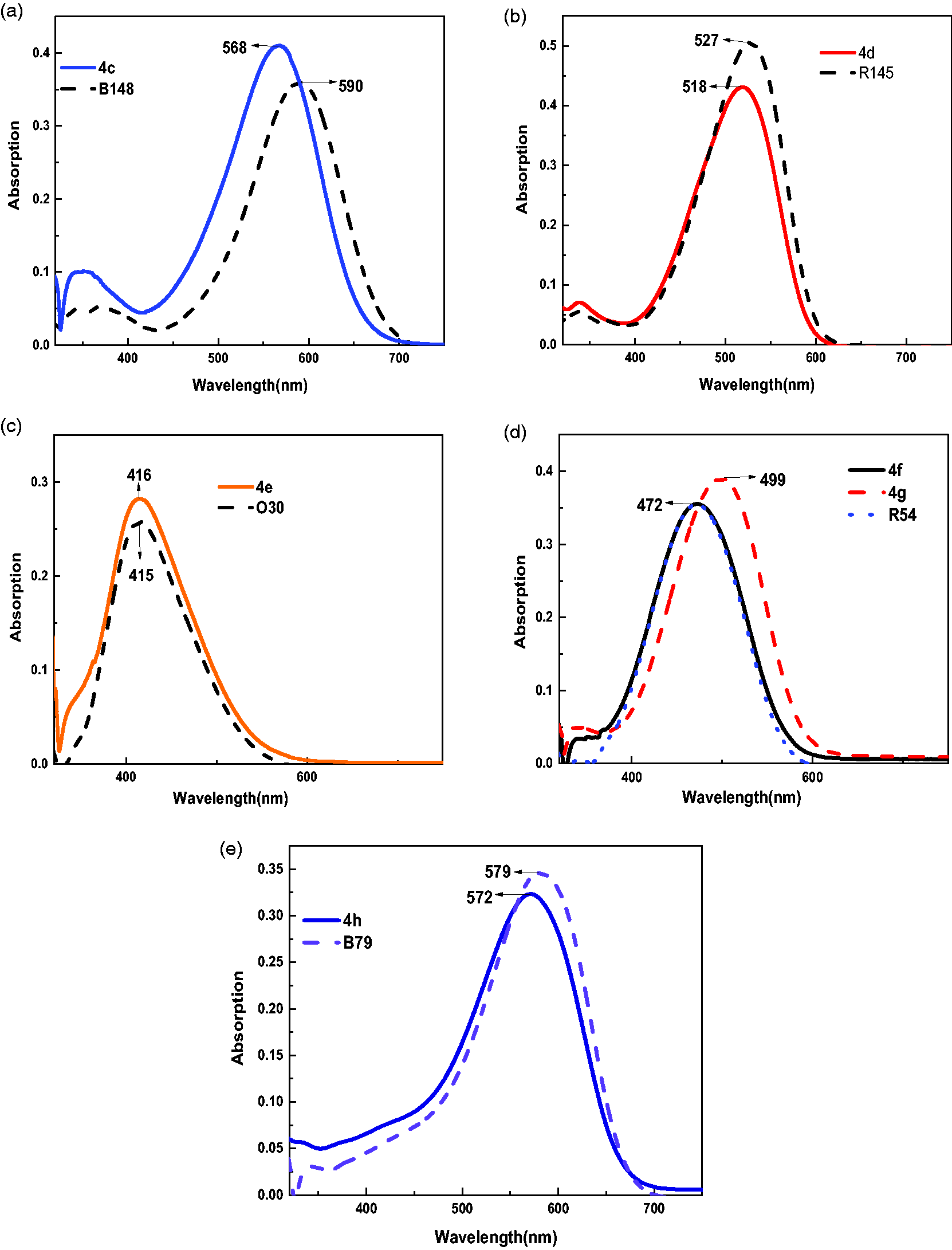
Ultraviolet (UV)-visible (Vis) absorption spectra of 4c–4h and their reference dyes in acetone (1 × 10⁻⁵ mol/l): (a) 4c and B148; (b) 4d and R145; (c) 4e and O30; (d) 4f, 4g, and R54; (e) 4h and B79.
Photophysical properties of dyes 4c–4h and B148–B79 in acetone
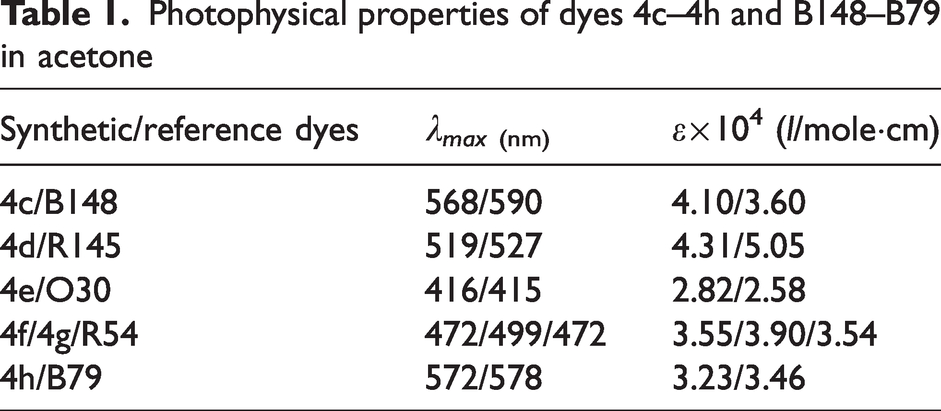
The ε values of the synthesized dyes are similar to or higher than those of the reference dyes in the case of 4d. The ε values of the synthesized dyes are all higher than 28,200 l mol−1.cm−1. The ε values of synthetic dyes 4c and 4d with heterocyclic structure are even higher than 41,000 l mol−1.cm−1. This may be attributed to the effect of the heterocycle structure of 4c and 4d on conjugated plane properties of dyes and the enhanced π-π effect, which can lead to increased dye polarity and stronger chromophores, and a lower dosage of the dye. 32 The ε values of synthesized dyes 4c, 4e, and 4f are all higher than 28, 200 l mol−1.cm−1, which are more outstanding than those of the reference dyes.
Dyeing performance
The dye exhaustion (%E) of the synthesized dyes is compared with the %E values of the reference dyes (Figure 3). The %E values of the synthesized dyes are all higher than 70% and those of dyes 4c, 4d, 4e, and 4f are even higher than 80% using traditional high-temperature dyeing under pressure. The high exhaustion of the dyes is attributed to the incorporation of the carboxylic ester and cyano groups of dye molecule structures by enhanced dye-fiber affinity and force. The build-up performances on the PET are given in Figure 4. It can be seen that the build-up performances of synthetic dyes were similar to that of their reference dyes and all dyes indicated excellent build-up performances on PET fabric. For dyes 4e, 4f, and 4g, when the concentration of dyes in dyebath was lower than 2% owf, the K/S values of the dyeing increased with increasing dye concentration. The K/S value of dyes 4c and 4d with heterocyclic structure increased with increasing dye concentration when the concentration of dyes in the dyebath was lower than 4% owf. These novel synthesized dyes can be also suitable for dyeing deep colors. The K/S value of the dyes became stable without obvious change when the dye concentration reached 4% (owf). It was shown that the adsorption saturation for all dyes had been achieved.

The exhaustion of 4c–4g and the reference dyes.

Build-up curves of the synthesized dyes and the reference dyes: (a) 4c and B148; (b) 4d and R145; (c) 4e and O30; (d) 4f, 4g, and R54.
The color values are listed in Table 2 and match the spectral data of the dyes. The a* values of dyes 4d, 4f, and 4g are significantly greater than those of dye 4e, indicating that the color hue of dyes 4d, 4f, and 4g tends to red more than dye 4e. The b* values of dyes 4d, 4e, 4f, and 4g are considerably greater than those of dye 4c, implying that the color hue of dye 4c tends to be purer blue than dyes 4d, 4e, 4f, and 4g. Therefore, dyes 4e are orange, and dyes 4d, 4f, and 4g are red. Our preliminary dyeing experiment of fabrics led to a range from orange to red and blue shades with excellent color uniformity (Figure 5). In this article, the color change of dying fabrics is closely related to the substitution group and structure of the diazo component. The synthetic dyes 4c and 4d showed blue and dark red, respectively, probably due to the stronger polarity of the diazo component containing nitro-benzothiazole moiety than other electron-accepting groups substituted. The changes in the λmax and color of 4e, 4f, and 4g are attributed to the diazo components containing electron-withdrawing substituted groups with different polarities and numbers.
The color values of dyed samples for disperse dyes 4c–4g


Digital photos of the dyed polyethylene terephthalate (PET) fabrics under D65 illuminant.
Color fastness assessment and alkali-clearable properties
The colorfastness to washing, sublimation, and rubbing with different post-treatment methods for all the dyes is presented in Table 3. The samples of all the dyes treated by clearing imply better color fastness than those of the untreated samples, which demonstrates the advantages of the clearing processes. For the synthesized dyes containing ester group structures, the fabric treated by alkali clearing display the same fastness as the fabric treated by reduction clearing (all the ratings are approximately 4 or 4–5). This result demonstrates the reduction clearing method containing reducing agents can be replaced by alkali clearing with less pollution to decrease the problem of the dyeing effluent. In our previous research on the alkali-clearing disperse dyes, the hydrolyzates of these alkali-clearing dyes hydrolyzed by sodium hydroxide can be easily recovered by salting out. 28 The chroma of the solution can be effectively decreased by the recovery experiment of the hydrolysate dye, which can be beneficial for environmental protection.
Comparison of the color fastness of the synthesized dyes and the reference dyes on PET fabrics

AC: alkali clearing; RU: reduction clearing; UC: uncleared.
The synthesized dyes all demonstrate excellent color fastness. It is clear that the synthesized dyes 4d, 4e, and 4f containing ester groups show better washing fastness properties on the PET fabrics than the reference dyes. According to the principle of dissolution in similar structures, suitable and hydrophobic ester groups on the dispersed dye molecules may be helpful to facilitate the dye penetrating and diffusing smoothly on the fiber surface and inside, which leads to an increase of the dye-fiber affinity and imparts excellent washing fastness to the dyed fabric. Both dye 4c with a relatively large molecular weight and the dye 4g with electron-withdrawing substituent cyano group of diazotization moiety displayed better fastness properties (rates 4–5) compared with other dyes. Halogen, nitro, and cyano substituent groups introduced into the dye molecule with varying numbers and stronger polarity as well as relatively large molecular weight reinforce van der Waal’s force and hydrogen bonding between dyes and PET, which may be beneficial for all fastness improvements of synthesized dyes. In addition, the synthesized dyes and the reference dyes showed excellent light fastness (rates ≥6), which is less prone to photo-fading. The reason may be that the chromophore skeleton and heterocyclic structure also endow the dye molecule with good planarity, including conjugated substituent groups, which may enhance the π-π stacking interaction and improve the force of dye-dye and dye-fiber.
Analyses of the recovery effect of hydrolyzed dyes by UV-Vis absorption spectra
In this part of the study, the previous recovery method was used to recover the hydrolyzed dyes of dye 4c–4h. The hydrolysates of dyes 4c–4h include hydrolysates 5i–5n (see Scheme 3) and ethanol. The recycling reaction mechanism of the hydrolysates 5i–5n is similar to our previously published papers. Figure 6 shows the UV-Vis absorption spectra of hydrolysates 5i–5n and 5i′–5n′ before and after adding BaCl2. It can be seen from the change in the UV-Vis absorption spectra of Figure 6 that after adding BaCl2, the UV-Vis absorption spectra of hydrolyzed dyes 5i′–5n′ were significantly lower than those of 5i–5n. This indicates that the Ba2+ can precipitate with hydrolyzed dyes, resulting in fewer dye chromophores in the hydrolyzed solution. This result is consistent with the images in Figure 7 before and after the precipitation of the hydrolyzed dye. This recovery experiment demonstrates that BaCl2 can also be used to recover dye 4c–4h hydrolyzate, which is consistent with our previous experimental results.

The comparison of ultraviolet (UV)-visible (Vis) absorption spectra of hydrolysates 5i–5n and 5i′–5n′ before and after adding BaCl2.

The chromaticity change of the hydrolysates solution 5i–5n and 5i′–5n′ before and after the addition of BaCl2.
Resistance assessment to UV
When testing the light fastness of the synthesized dyes and the commercial reference dyes with a xenon light source, there are problems with the longer test time and the difficulty of testing samples with similar fastness using the AATCC test method. In order to further evaluate the influence of the molecular structure of dyes on light resistance, this article uses a UV aging lamp with stronger light intensity to expose polyester fabrics for 1–8 h and compares the relationship between the light resistance and the color difference ΔE as well as the K/S of dyes. It is well known that the larger the color difference ΔE and the fading rate of K/S, the more serious the fading of the fabric, which also means the worse the light resistance of the dyed fabric.
Some studies suggest 33 that the fading of azo dyes is mainly attributed to the decomposition of the -N=N- moiety through the influence of oxidation, reduction, or photolysis. In this article, polyester fabric is used as the dyed substrate. It is possible for the fading process to happen by oxidation. 34 The happening of oxidation of azo linkages depends on the influence of electron density, which means the fading rate increases with the electron-donating substituents and decreases with electron-withdrawing groups of the chemical structure. This is consistent with the observed results.
The results of the change k(ΔE) in color difference and the rate of change in color depth after exposure to UV for 8 h for the synthesized dyes and the reference dyes are summarized in Table 4. The color difference (ΔE) of dyes corresponding to different UV irradiation times is summarized in Figure 8. The fading rate of K/S and color difference (ΔE) of the polyester fabric of the reference dye B148 (0.159, 0.89) after being exposed to UV light for 8 h is much greater than that of the synthesized dye 4c (0.0155, 0.19), which means the light resistance of 4c containing cyano group in the coupling component is better than that of B148 when the diazo components are the same. On the other hand, when the coupling components contain the same number of cyano groups, the fading rate of K/S, and color difference (ΔE) of the polyester fabric of synthesized dyes 4d–f and their reference dyes are not much different, which means the light resistance of these dyes is similar. Meanwhile, the synthesized dye 4g showed that the introduction of the cyano group in the diazo component did not significantly increase the light resistance of dyes compared with the synthesized dye 4f. These results relating to light resistance indicated that the cyano substituent in the coupling component would be suitable for increasing the UV resistance of dyes. In order to further prove this point, the fading rate of K/S and color difference ΔE of the synthesized dye 4h and the reference dye B79 under the same experimental conditions were also compared in this study. Figure 2(e) shows the UV-Vis absorption spectra of 4h and B79. The same results also show that the light resistance of the synthesized dye 4h with the cyano group in the coupling component is better than that of reference dye B79, which is consistent with our expected results.
The change k (ΔE) in color difference and the fading rate in color depth of the dyed polyethylene terephthalate (PET) fabric after exposure to ultraviolet (UV) for 8 h


The color difference (ΔE) of dyes corresponding to different ultraviolet (UV) irradiation times.
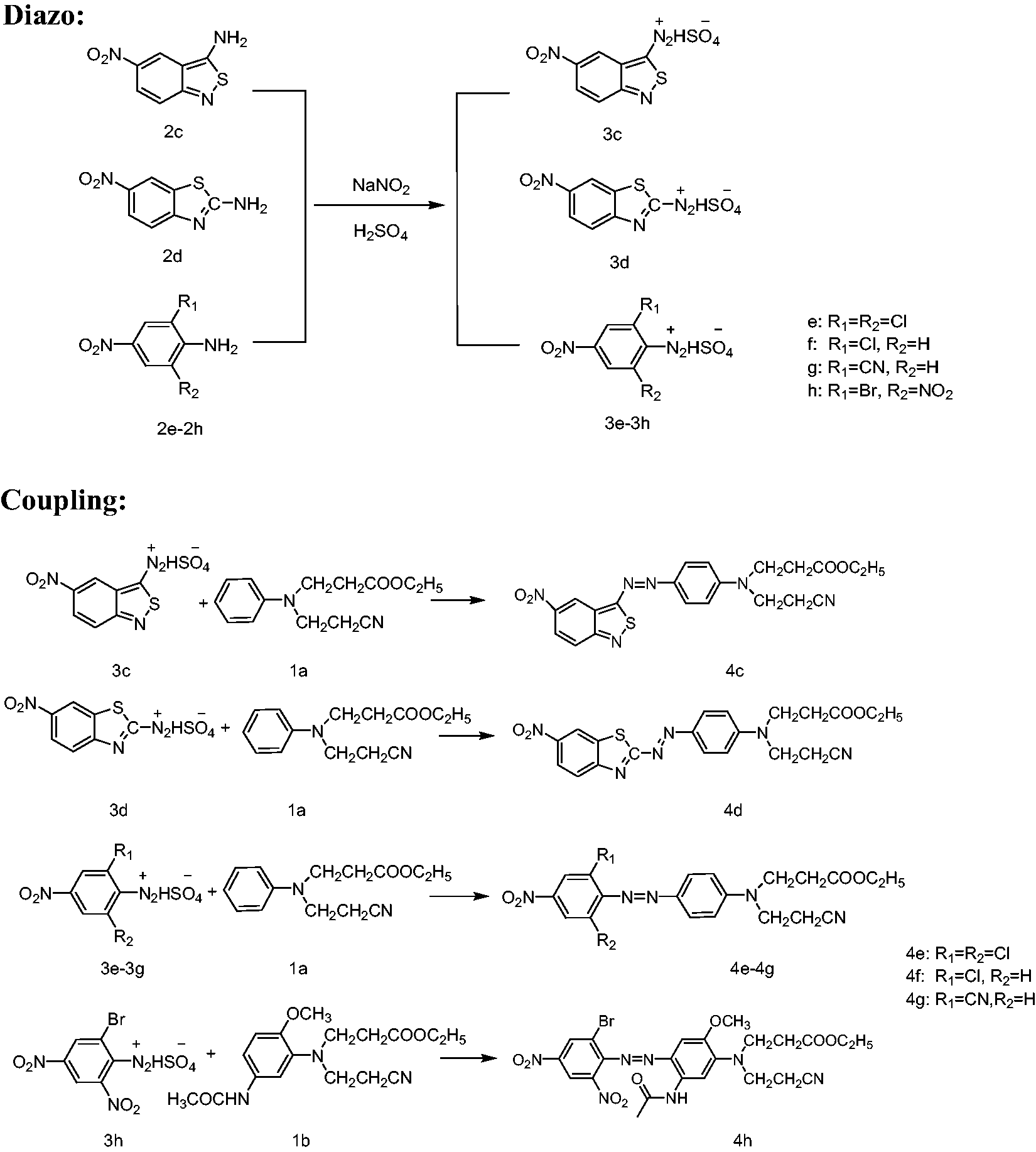
Synthetic route of alkali-clearable disperse dyes 4c–4h: diazo and coupling.
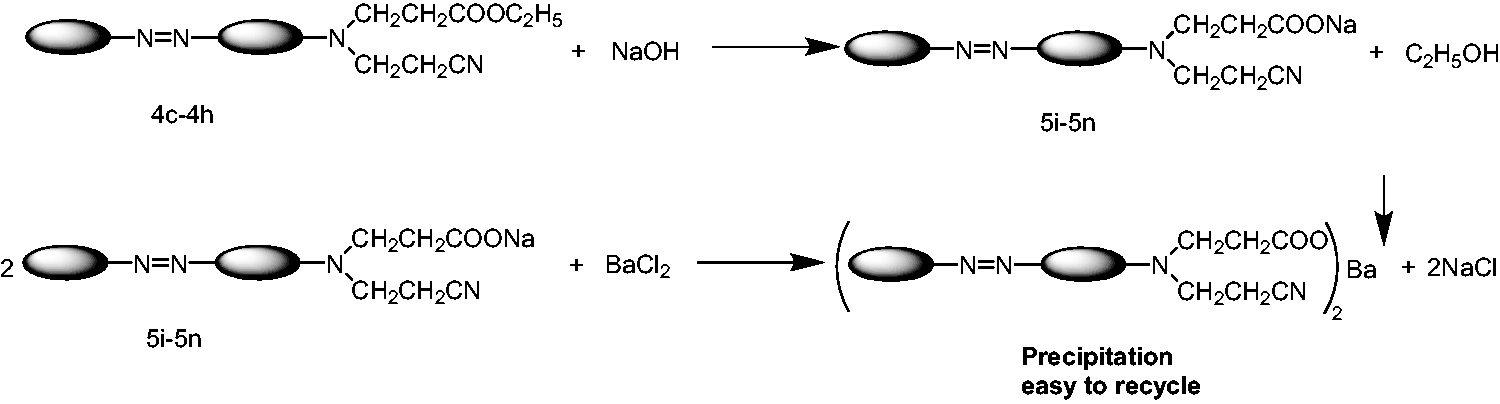
The alkaline hydrolysis of alkali-clearable azo disperse dyes containing a carboxylic ethyl ester moiety and the recovery of their hydrolysates.
Conclusion
A new series of environmentally friendly alkali-clearable disperse dyes with various diazo components containing cyano and ester groups have been synthesized in a simple preparation procedure. The synthesized dyes show higher molar extinction coefficients and excellent dyeing properties as well as better light resistance on polyester fabrics. Meanwhile, the alkali-clearing post-treatment could also be applied to the synthesized dyes 4c–4h to eliminate the dye particles on the surface of the fiber, which can avoid the discharge of toxic aromatic amines and biological oxygen demand (BOD) into the sewage by using a reduction clearing. In addition, it was confirmed that Ba2+ could precipitate with hydrolyzed dyes, resulting in fewer dye chromophores in the hydrolyzed solution, which is beneficial to the living ecosystem. This work demonstrated that the reaction of coupling components introducing both cyano and ester groups with various diazo components can impart dyes with deep and bright colors ranging from orange to red to blue and environmentally friendly alkali-clearable performance as well as recovery of hydrolyzed dyes while improving the light resistance and color fastness of dyes.
Footnotes
Declaration of conflicting interests
The author(s) declared no potential conflicts of interest with respect to the research, authorship, and/or publication of this article.
Funding
The author(s) disclosed receipt of the following financial support for the research, authorship, and/or publication of this article: This work was supported by the Zhejiang Provincial Key Research and Development Program of China (2023C01096, 2021C01058), “Ten Thousand Plan”- Zhejiang Provincial High Level Talents Special Support Plan (2020R52023), National Natural Science Foundation of China (NSFC) under Grant no. 22278344.
