



Abstract
The increasing worldwide use of different kinds of clothes with ultraviolet protection in recent years, in particular employing titanium dioxide nanoparticles, is driving the researchers’ attention to the possible environmental problems due to titanium release. This study aims at determining the amount of titanium released from seven ultraviolet-protective garments into the wash water employing total reflection X-ray fluorescence spectrometry. For this, a wash protocol was designed based on the international standard ISO 105-C06:2010 and the literature. Pieces (4 cm × 10 cm) of textile were sampled from the garments and submitted 30 times to the wash protocol. The wash water produced in each wash was then prepared for total reflection X-ray fluorescence analysis. Results showed that the titanium released in 30 washes was between 8.6 ± 1.3 µg/L and 168 ± 3 µg/L. Every sample released titanium in the first to third wash, except sample 1, which first released titanium in the 18th wash. The greatest titanium release in one single wash was also the 18th wash of sample 1, which released 77 ± 2 µg/L. These results showed the good performance of total reflection X-ray fluorescence spectrometry in quantifying low titanium amounts in wash water, which is a hard task even for well-established analytical methods.
Adherence to sports practiced under the sun, such as street running, cycling and sport fishing, has grown a lot among Brazilians. Data from Abraciclo (Brazilian Association of Motorcycle, Moped, Scooter, Bicycle and Similar Manufacturers) and Anepe (National Association of Ecology and Sport Fishing) attest to the growth of these sectors in the last decade, 24% and 30%, respectively.1,2
Due to exposure to the sunlight during the practice of these sports, it is extremely important to wear specific clothing with sun protection in order to avoid erythema and more serious problems, such as skin cancer, which corresponds to 27% of all malignant tumors in Brazil.3
The Associação Brasileira de Normas Técnicas (ABNT) definition of clothing includes shirts, hats, shoes and fabrics that have protection against ultraviolet (UV) radiation properties.4 These items are classified according to their ultraviolet protection factor (UPF), which is the ratio between sunburn-causing UV measured with and without the protection of the fabric.
Several factors that may affect the UPF of a garment have already been studied, such as the fiber from which the fabric is made, natural pigmentation, the yarn structure of the fabric, the type of weft and warp, whether plain or knitted fabric, fabric weight and thickness, and fabric dyeing and fabric tension.5–13
The Brazilian Regulatory Standard 16695 establishes that, for labeling purposes, clothes meant for sun protection must be classified according to the UPF range shown in Table 1.14
Ultraviolet protection factors with their respective absorptions, transmissions, protection category and UPF on the label

UPF: ultraviolet protection factor.
Adapted from Associação Brasileira de Normas Técnicas4 and Gies et al.14
The UPF ratings are achieved through titanium dioxide (TiO2) nanoparticle incorporation, which is used as a coating on the fabric or inserted into the composition of the yarns. The advantage of nanoparticles is to provide functionality without changing comfort.15 These functionalized materials must integrate seamlessly into clothing, be flexible, comfortable and non-allergenic. A major challenge for the textile industry is that the functionalization of fabrics does not achieve permanent effects, losing its properties through the washing cycles.
The production of TiO2-functionalized textiles which present stable and durable coatings that may retain their highly effective functionality even after repeated washing is crucial for the applicability of functional textiles, and is one of the major challenges in this area. The way it has been explored is through the chemical modification of the textile substrate or the TiO2 nanoparticle chemical modification in order to improve the adhesion power to the textile fibers. Other techniques to enhance durability were also applied, for example, the use of binders like polysaccharides, increasing the life of nanoparticles in the textile with the cost of losing the inherent characteristics of the textiles. However, the nanoparticle immobilization at the textile surface remains a challenge, especially after several wash cycles.16–18
Considering the requirement of quality control and evaluation of the nanoparticle release, the present study intends to contribute to fill the gap regarding the wash resistance of commercial functional TiO2 textiles.
Studies by Windler et al. (2012),19 Mackevica et al. (2018)20 and Ferreira et al. (2020)21 have shown that the TiO2 present in the UV-protective clothes is released into the water during washing.
In 2012, Windler et al.19 used a 550 ml container to perform 10 washes of 30 min each, with 150 ml of water at 40 rpm. Six samples underwent this washing protocol and ICP-OES was used to determine the concentration of titanium released, which was between 0 and 0.7 mg.L–1 in all samples, except in sample 6, which was slightly above 5 mg.L−1.
In 2018, Mackevica et al.,20 using ICP-MS and single-particle ICP-MS, determined the amount of titanium released by five samples. The washing process was performed using a polyethylene container with 200 ml of water and rotating at 150 rpm for 24 h. The amount of titanium released in the five samples was between 0.05 and 3.13 µg/g with deviations around 50%.
In 2020, Ferreira et al.21 used total reflection X-ray fluorescence (TXRF) to determine the amount of titanium released by six UV-protective clothing samples and scanning electron microscopy (SEM) – energy dispersive spectrometry (EDS) to analyze the textile samples. The samples went through a washing protocol (designed based on ISO 105-C06)22 in which they were washed 10 times for 30 min, at 40 rpm and with 150 mL of water (ISO 3696).23 The quantification process was conducted adding galium as the internal standard into the wash water samples. The concentration of titanium released in the water, after 10 washes, was between 0.028 and 0.337 mg.L–1 with less than 3.5% deviation. This result captures only the behavior of the first 10 washes of a garment. SEM images determined the studied fabrics to be weft knitted fabrics, made of yarns of approximately 250 µm width and fibers’ width between 9 and 13 µm. An EDS map of the titanium distribution on the fibers showed that titanium was present throughout all the fiber.21–23
In the previous studies, the wash water collected was resumed with a few washes, for example, one single wash during 24 h, the water from the first 10 washes was analyzed as a single sample, and the first, the second and the 10th.19–21 In the present study the wash waters from the first 30 washes were analyzed one by one. So a wider range was considered, which better represents the life-cycle duration of the UPF protection in the textile.
TXRF spectrometry is a mature analytical method that performs a multi-elemental and simultaneous analysis allowing quantification in the range of parts per billion, with low instrumentation cost when compared with ICP-MS. The technique has been used to measure trace elements in different kinds of media, such as fish gill and kidney, and also saliva and gingival crevice fluid.24–26 Thus, TXRF spectrometry is a suitable technique to determine trace amounts of titanium in UV-protective textile wash water.
TXRF spectrometry also benefits from a small to no sample preparation, low cost of acquisition and operation, attends to green chemistry, while being able to measure really small titanium amounts at trace levels with low deviations compared with the ICP-MS and ICP-OES techniques cited above.
The objectives of this study were (a) to determine whether titanium is released or not from UV-protective textiles in a sequence of 30 wash cycles employing TXRF spectrometry to quantify the titanium amount; (b) evaluate the releasing behavior throughout the 30 washing steps, a behavior that has not yet been explored.
Materials and methods
Seven sun protective clothes were purchased in the Brazilian market. All of them were produced with synthetic fibers with high ultraviolet protection (labeled UPF 50+), different colors, sizes and fabrics, and intended for different audiences, such as men, women and children. The detailed description is presented in Table 2.
Description of the seven textiles used in this study

PA: polyamide; EL: elastane; PES: polyester; UPF: ultraviolet protection factor.
Intended for children.
Intended for female audience.
The samples had their fibers’ composition analyzed by SEM EDS in a previous work. SEM images determined that the fabrics were weft knitted with yarns composed of around 20 fibers. Each yarn width was approximately 250 µm and the fibers’ widths were between 9 and 13 µm. An EDS map for titanium distribution determined that the presence of titanium was homogeneous throughout the fibers.21
The wash protocol
The wash protocol was designed based on the literature about the topic and on the international standard ISO 105-C06:2010, procedure A1S without steel balls, for color fastness to domestic and commercial laundering. The protocol designed and applied in Ferreira et al. (2020)21 was now modified to approach the problem better.
Each one of the seven garments had a piece of 4 cm × 10 cm sampled, which was submitted to the wash protocol.
The first step of the protocol consisted of placing the textile sample in a 600 mL beaker filled with 150 mL of water grade 3.23 Then, the beaker was put in an incubator shaker at 40 ± 2 rpm for 30 min at 40 ± 2°C. After that, the 150 mL of water used in the wash was saved to be measured by TXRF. The textile sample was submitted to this process 30 times, generating 4.5 L of water in aliquots of 150 mL, which were stored individually.
Sample preparation and TXRF spectrometry measurement
Each textile sample was submitted to the wash protocol 30 times and after each wash the water was reserved and stored. Therefore, 210 wash water samples and the blank wash water sample had a 10 mL aliquot taken into a falcon tube and shaken in a vortex. The blank sample corresponds to the water samples submitted to the complete wash process but without the textile sample.
Galium was used as the internal standard in the quantification process. Then, 10 µL of a gallium solution was added in each tube, reaching a gallium concentration of 1 µg/L. This solution was shaken again in the vortex. Then, 10 µL of the sample with internal standard was pipetted three times onto the same spot of an acrylic support specific for TXRF spectrometry. After each drop, the acrylic support was brought into an oven for 1 h at 45°C. The PTXRFIAEA11 certified reference material was prepared and measured in the same conditions to attest the quantification procedure.
A benchtop TXRF spectrometer, S2 PICOFOX, with an air-cooled X-ray tube, Mo target, 50 W, a multilayer monochromator (17.5 keV), a Peltier-cooled XFlash Si-drift detector with detection area of 60 mm² and energy resolution of 149 eV at 100 kcps (Mn Kα) was used to measure the wash water samples after preparation. Each measurement took 2000 s with 50 kV and 602 µA.
The software Spectra (2010), version 7.2.5.0, was used for data acquisition and quantification. The detection limit (DL) and the quantification limit (QL) were calculated as
Results and discussion
Trueness evaluation
The trueness evaluation of the TXRF method was ve with the PTXRFIAEA11 standard and the recovery was 91%. The certified value was 13.33 ± 5.08 µg.L−1 and the measured value was 12.13 ± 0.37 µg.L−1. The DL and the QL were 0.55 and 1.65 µg.L–1.
Figure 1 shows an illustrative spectrum from wash number 22 of the sample 1. The titanium Kα is the peak of interest and the gallium Kα peak is from the internal standard. In this case, the titanium concentration was 30.7 ± 1.7 µg.L–1. The other elements are due to the acrylic support.
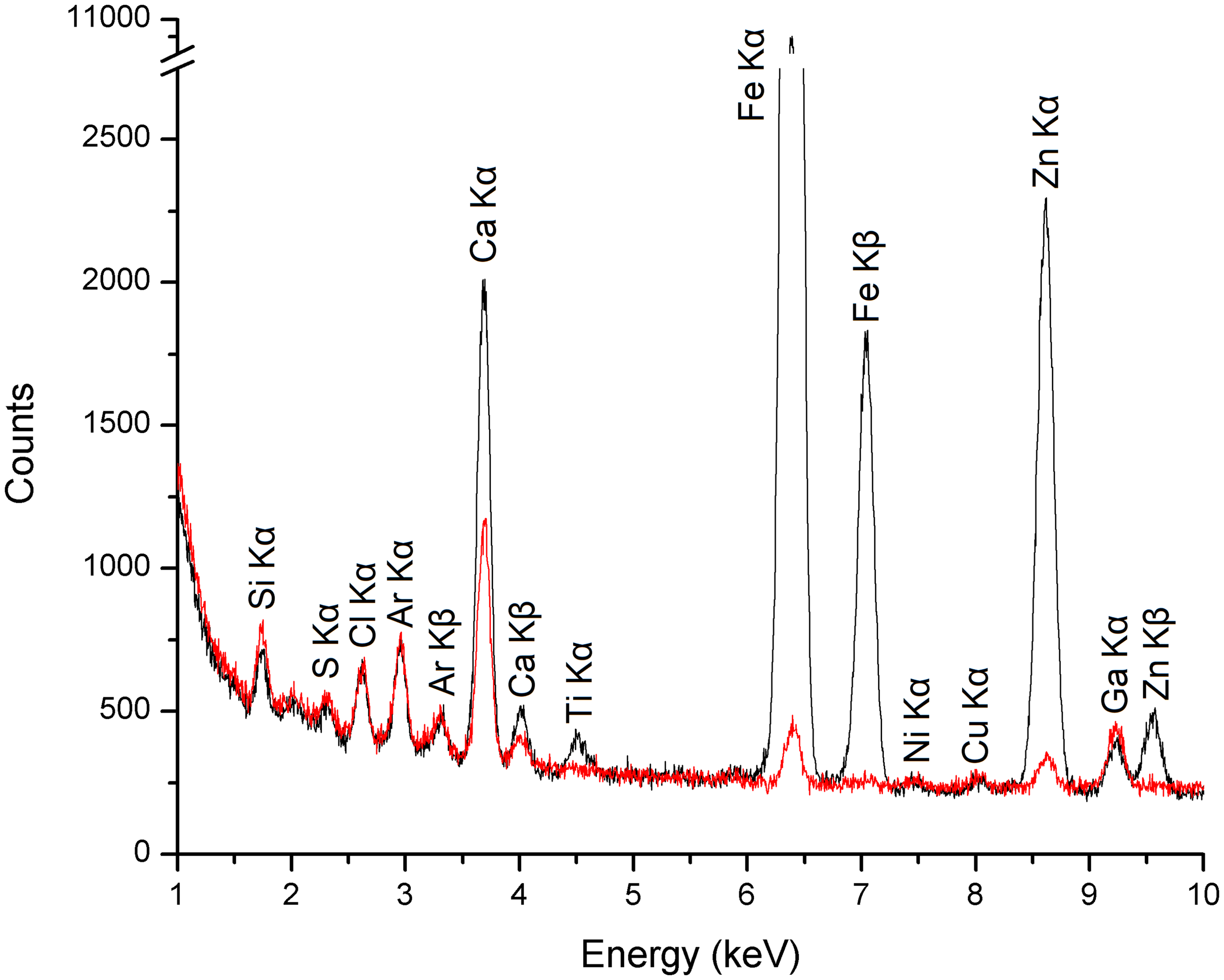
Total reflection X-ray fluorescence (TXRF) spectrum of wash water from sample 1 22th wash and the blank sample, black and red line, respectively. This is an enlarged part of the whole spectrum so the small titanium peak can be better visualized.
Release of TiO2
The titanium release behavior in each sample during the 30 washes is shown in Figure 2(a) to (g). The average DL and QL, in µg.L–1, ranged from 2.63 to 5.49 and 8.76 to 18.30.
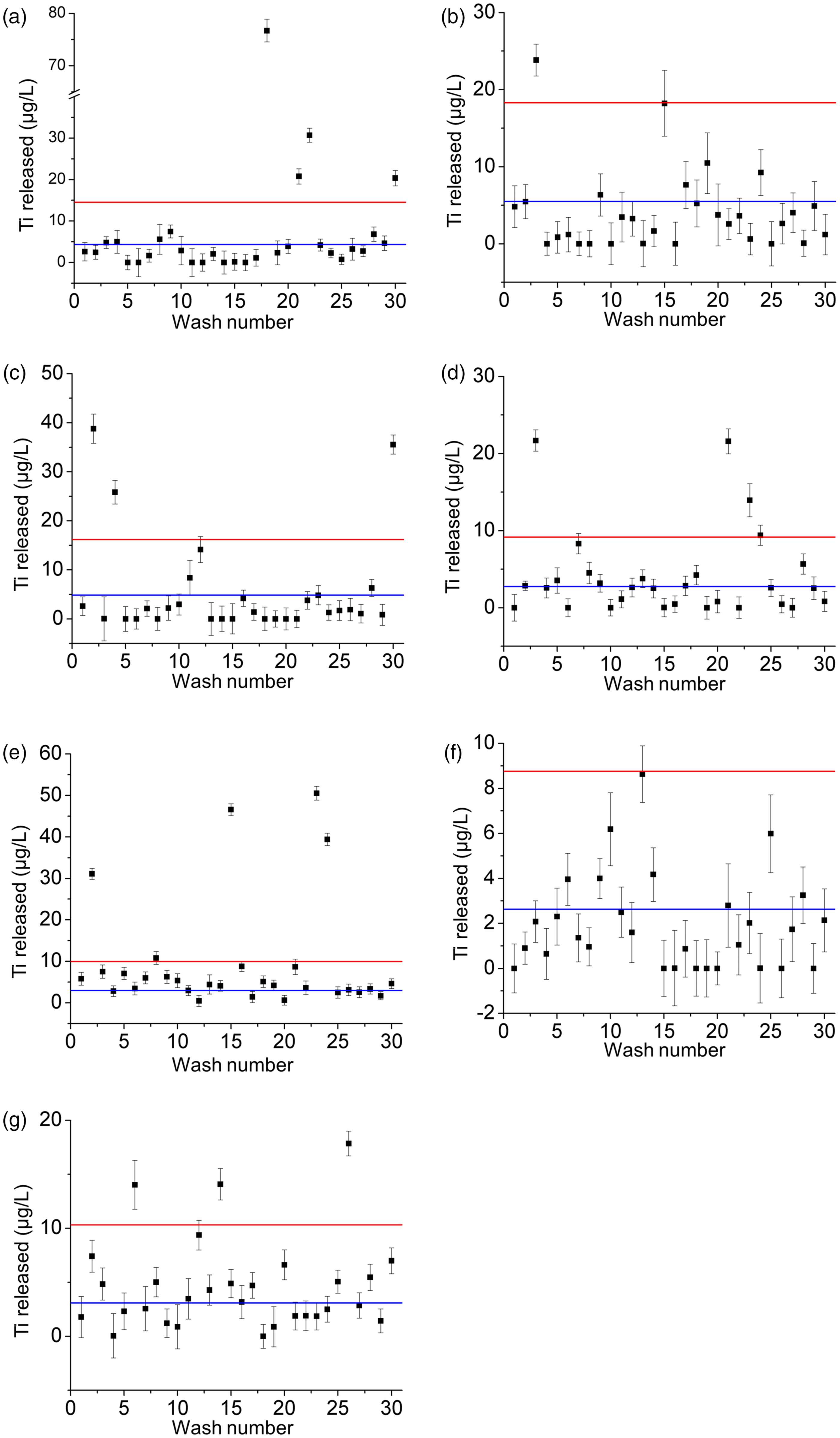
Amount of titanium released by the textile samples 1 to 7 (a) to (g) in each of the 30 washes with their respective deviation bars. The red and blue lines represent the quantification limit and the detection limit, respectively.
Figure 2(a) shows the amount of titanium released in each one of the 30 washes in textile sample 1. The amount of titanium released was above the quantification limit, displayed as the red line in Figure 2, in four of the 30 washes, all of them in the second half of the washes; and clearly above the detection limit, displayed as the blue line, in only six washes. The 18th wash was the one with the most titanium released by the textile sample, representing 51.7 ± 1.5% of the total 148 ± 4 µg/L released, considering solely the washes above the quantification limit.
Figure 2(b) shows the amount of titanium released in each of the 30 washes of textile sample 2. The third wash was the only one in which the amount of titanium released surpassed the quantification limit, with a total of ± 2 µg/L. For sample 2, four washes were above the detection limit: wash numbers 3, 15, 19 and 24.
Figure 2(c) shows the amount of titanium released in each of the 30 washes of textile sample 3. The second and the last washes released the greatest titanium amounts in this textile sample, 39 ± 3 µg/L and 35.6 ± 2.0 µg/L, respectively. Five washes surpassed the determination limit, with only three washes above the quantification limit.
Figure 2(d) shows the amount of titanium released in each of the 30 washes of textile sample 4. With statistically the same amount of titanium released, wash numbers 3 and 21 released, respectively, 21.7 ± 1.4 µg/L and 21.6 ± 1.6 µg/L. Nine washes had amounts of titanium released above the detection limit and only three of those were above the quantification limit.
Figure 2(e) shows the amount of titanium released in each of the 30 washes of textile sample 5. With amounts of titanium released above the detection limit in 17 washes, and above the quantification limit in four washes. The textile sample number 5 was the one that released the greatest titanium amount during the 30 washes. It released 168 ± 3 µg/L, considering only the amounts above the quantification limit, with most of it released in wash number 23, 50.5 ± 1.6 µg/L.
Figure 2(f) shows the amount of titanium released in each of the 30 washes of textile sample 6. This textile sample released amounts of titanium above the detection limit in six of the 30 washes, but in none of them the amount of released titanium surpassed the quantification limit.
Figure 2(g) shows the amount of titanium released in each of the 30 washes of textile sample 7. This textile sample released amounts of titanium above the detection limit in 13 of the 30 washes, surpassing the quantification limit in three of them. The most releasing wash was wash number 26, which had 17.9 ± 1.1 µg/L of titanium released from the total 55 ± 3 µg/L, considering solely the washes above the quantification limit.
The lack of adhesion of the nanoparticles to the substrate is attributed to the absence of chemical bonding between the nanoparticles and the textile fibers.17 Regarding the reasons for the TiO2 release it may be suggested that mechanical stirring produces distensions in the fiber as well as electrical charge neutralization and chemical crosslink breaks reducing the covalent bonds which ends in the nanoparticle release.
Considering the information shown in Figure 2(a) to (g), a titanium retaining behavior was noted in most of the 30 washes for all textile samples, with some titanium releasing washes varying between none and four depending on the textile sample. No textile sample released any titanium in the first wash. In general, they first released titanium in the second or third wash. Sample 1 released in the 18th wash an amount of 77 ± 2 µg/L, which was the greatest amount of titanium released in a single wash. Textile sample 1 had the best retention and the greatest release at the same time.
Table 3 shows the amount of titanium released within the 30 washes of each textile sample, considering washes that statistically surpassed the quantification limit.
Amount of titanium released after 30 washes for each textile sample, in decreasing order, with their respective deviations
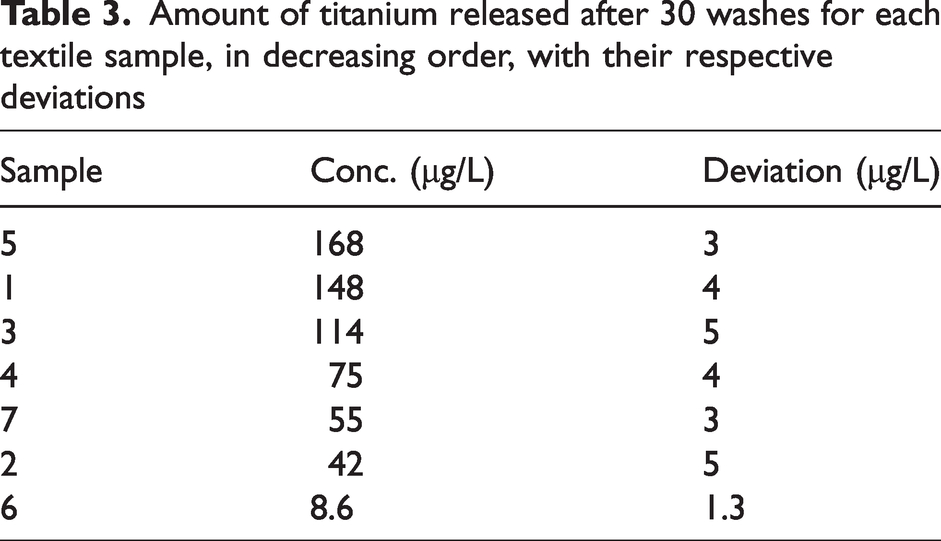
Textile samples 1, 4 and 5 had the most releasing washes in the second half of the total 30 washes, while samples 2, 3, 6 and 7 had them mostly in the first half of the washes. These samples, which released greater titanium amounts in the first 15 washes, tended to release a lower titanium amount overall, if compared with the ones that released greater amounts of titanium after the 15th wash.
Therefore, in general the results reached in this study indicate that in 30 wash cycles the release is not gradual, but some releasing peaks were identified.
The low titanium concentration was the greatest difficulty encountered. Even with TXRF being applied at its detection and quantification limit, the results obtained were very good and in line with the literature results. The total titanium amount released after 30 washes was between 8.6 and 168 µg/L. The levels of concentration found in the present study are in accordance with those obtained by Windler et al. (2012),19 Mackevica et al. (2018)20 and Ferreira et al. (2020).21
The wash protocol used in this study was a modified version of the one designed and used in Ferreira et al. (2020).21 Rinses were removed to avoid overdiluting of the water sampled, which decreased the titanium concentration resulting in an even more difficult detection. Wrings were also removed with rinses. After 10 washes, with rinses and wrings, the titanium released ranged from 28 µg/L to 337 µg/L (Ferreira et al., 2020),21 which is two to three times more the titanium amount released after 30 wash cycles without rinses and wrings, showing that although we did not dilute the samples with rinses, the concentration of titanium released decreased, and the cause might be the lack of wrings.
Conclusions
The behavior of the textile samples in the titanium releasing was evidenced as a retaining behavior in most of the wash cycles. The titanium releases are not gradual but occur sporadically. It was not possible to infer a release pattern based on the results.
Even though only titanium concentrations at trace level were released into the wash water, TXRF was able to measure them, showing good results and posing itself as a good alternative to the more established methods, such as ICP-OES and ICP-MS. TXRF presented an average detection limit of 3.7 µg/L, one order of magnitude lower than the detection limit presented by Windler et al. (2012)19 using ICP-OES. In addition, the TXRF average deviation was 6.7%, much smaller than the average deviation of 53% presented in the Mackevica et al. (2018)20 results employing ICP-MS. Thus, the TXRF methodology proved to be an advantageous analytical method to quantify traces of titanium in solutions with TiO2 nanoparticles.
The next step is the study of the UPF behavior during washes, measuring the UPF factor of the textile sample after each wash with UV-Vis spectroscopy. It will also allow the determination of the life cycle duration for these UV-protective textiles.
Footnotes
Acknowledgements
The author(s) would like to thank Instituto Nacional de Ciência e Tecnologia: Física Nuclear e Aplicações (INCT-FNA – Brazil) project 464898/2014-5, Coordenação de Aperfeiçoamento de Pessoal de Nível Superior (CAPES – Brazil) and Financiadora de Estudos e Projetos (Finep – Brazil) for financial support of this work and also thank professor Dr Admilton Gonçalves de Oliveira Jr. from LABIM - UEL for his prompt help.
Declaration of conflicting interests
The author(s) declared no potential conflicts of interest with respect to the research, authorship, and/or publication of this article.
Funding
The author(s) received no financial support for the research, authorship, and/or publication of this article.
