




Abstract
How does political theology, with its eschatologically themed commitment to both critique and constructive transformation of the social, economic, and political in the light of the Gospel, break through to a distressed Western polis focused on the immediate and the short-term, with almost no sense of a “future”? I suggest discipleship-as-performance and a temporal and sacramental “natural theology of desire,” in tune with the revelation of the grace of God in Christ in time, as ways of addressing this conundrum and seconding Pope Francis’s insight that “time is greater than space.”
Keywords
Let’s begin in an appropriate way: with a tweet. It comes from the site NeinQuarterly, a “Compendium of Utopian Negation,” created by former professor of German literature and critical theory and self-declared “failed intellectual” Eric Jarosinski. 1 His aphoristic style is modeled on that of Nietzsche and Theodor Adorno (his iconic visage is Nein’s logo) and fits Twitter’s character limit perfectly. The initial tweet published in Jarosinski’s book Nein. A Manifesto might serve as a portal into political theology’s future: 2
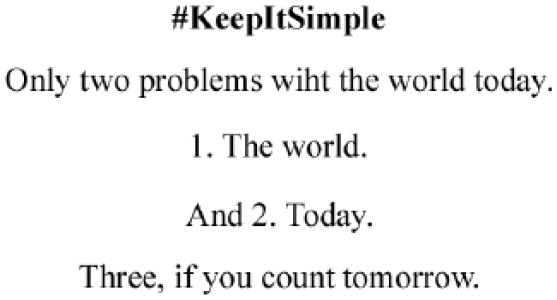
But that seems hopelessly vague, doesn’t it? Are there any more specific details about our time and place? Thank goodness another tweet begins to describe the “today” that “the world” inhabits: 3
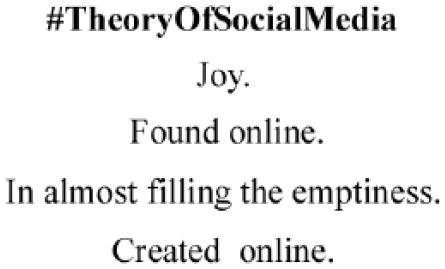
The “polis” in my title—once the old city-state, now defined as the community of those sharing goals, interests, experiences, and a worldview—is the social, cultural, and economic world under the canopy of globalization, to whom much of our political theology is addressed. Joy? Not so much. Affectively and morally (always closely linked), it is a world running on empty, almost to the point of dystopia.
Keep It Timeless
One reason for the “emptiness” is what I have called elsewhere “digital immediacy,” the exhilarating shock that the digital media storm creates, where we can encounter everyone and everything at close range, and yet at the same time we are isolated in a space of disconnected present moments. 4 Digital immediacy is only one contributing factor to a much deeper conundrum regarding temporality and its impact on theology. In a world inundated by a tidal wave of images, Facebook pages, blogs, text messages, and personal soundtracks—in other words, in a world governed by the aesthetic, both visual and aural—we appropriate “once-distant images and texts seemingly without mediation.” The result? An ambiguous mix of positives and negatives, true—but a negative aspect of major proportions is the collapse of time and of distance that delivers “the ‘closeness’ that we crave, the immediacy of access to apparently autonomous aesthetic objects [that] confirms their isolated authority as absolute, their ability to ‘be’ and to ‘mean’ on their own,” without needing or even hinting at any origin or history from which they have developed. 5 They provide a flicker of interest or a rush of adrenaline and then we move to the next click.
By the “collapse of time,” I do mean its elimination. I want to analyze here this truncation of temporality that has become one of the default characteristics of the contemporary world. And then I want follow up by discussing the foundational impact this has on the future of political theology which, as Johann Baptist Metz has reminded us, relies on an experience of time that extends both forward and backward: a deep sense of eschatological hope along with the strange transforming power of “dangerous memory.” 6 Theology, in Metz’s view, must push back against attempts at “timeless” interpretations of Christian faith claims (claims that are indeed “temporal to their very core”). 7 That will be my penultimate section: a pushback against the evacuation of time with a theological counter-response. And so, strange to say, the present essay moves in the opposite direction of the original topic of the symposium to which it was a contribution, “the authority of the Church in politics.” 8 That implies an intentionality ad extra, a focus beyond the specifically ecclesial in order to transform the social, political, and economic culture that ecclesial communities encounter. (I don’t want to hold too rigorously to this “inside-outside” approach, and later I will explain why.) My concern is ad intra, with the background infrastructure of theological reflection itself and the effects that the dominant culture has on the sheer possibility of theology’s message being heard.
Digital Immediacy and Social Acceleration
“Digital immediacy” is the term I first used to describe a situation occasioned by the theological overinterpretation of a lower-level magisterial statement made by Pope John Paul II. A one-off papal allocution in 2004 positing the necessity of nutrition and hydration for unresponsive patients was interpreted by some theologians as a statement that up-ended a long tradition of Catholic medical moral teaching on the use of extraordinary means of prolonging life. 9 The magisterial force of the allocution was widely debated, but all along a crucial issue was left unthought: the supposed absolute character of the statement rested on the force of the media presentation of it that blotted out its obvious context—the long tradition of interpretation behind official medical moral statements—and turned the allocution into a free-floating, quasi-infallible statement.
My analysis borrowed insights from Walter Benjamin’s famous essay “The Work of Art in the Age of Mechanical Reproduction.” 10 He argued that reproducibility bestows upon a work a spatial “closeness” that obliterates the “aura” of uniqueness and authenticity of a work that is only revealed at a distance. With the loss of distance comes the decay and dispersal of authenticity, due to the reproduction as well as to the acquisitive desires of its consumer. The work becomes in effect a homeless and tradition-less object, self-interpreting and self-authenticating, infinitely repeatable in an infinite number of contexts. The historical tradition from which it comes is “shattered,” in Benjamin’s words, resulting in “the liquidation of the traditional value of the cultural heritage.” 11 “The instant the criterion of authenticity ceases to be applicable to artistic production,” he concluded, “the total function of art is reversed. Instead of being based on ritual, it begins to be based on another practice—politics.” 12
Elements of Benjamin’s analysis apply to the kind of all-consuming media storm that we experience every day, such as the digital immediacy of incessant cable news, political tweets, YouTube, blogs, and quickly updated institutional websites. His argument takes on additional urgency in our aestheticized Western culture where image equals reality. 13 The shock of immediacy has an even farther-reaching impact in a world where electronic media create seemingly unfiltered access to information and images by their producers and consumers. Digital immediacy, and the collapse of time and distance that it provokes, constitutes the “norm” of our aestheticized contemporary Western culture, our “polis.” Closely linked to commodification, this norm is the grid through which heart-rending images of dead refugee children washed up on beaches, celebrity pitches for cars, clothes, and casinos, instantly broadcast stomach-churning acts of terror, and bogus “reality” shows are all displayed on the same plane of reference and given the same emphasis. In the midst of the image storm, this norm bestows on any digital event an absoluteness that represents an inevitably authoritative yet merely momentary fait accompli that, in a very real sense, disallows any real reception history. Immediacy equals authenticity equals authority.
However, digital immediacy is only one facet of a larger issue, the disturbing eclipse of time and narrative in contemporary culture. The everyday experience of the polis is already positioned by cultural, economic, and technological factors that threaten to overwhelm our narrative imagination, which is the key element to the constitution of self-identity and Christian faith-identity in terms of discipleship.
Recent cultural studies have shown that the accelerated pace of contemporary life leads paradoxically to its “de-temporalization.” We complain about “having no time” to get things done, “running out of time,” about being “squeezed for time”—all this despite the promise of digital technologies to help us control the constant onslaught of fragmentary waves of information. But, as media theorist Douglas Rushkoff argues, this hope is a false one: “For not only have our devices outpaced us, they don’t even reflect a here and now that may constitute any legitimate sort of present tense. They are reports from the periphery, of things that happened moments ago.” 14 Postmodern culture, he says, suffers from “narrative collapse” due to the loss of optimism about the future—an attitude brought on by overwhelming events like terrorism or the implosion of the economy. That collapse is mirrored in the “presentist” popular culture that shapes much of how we understand the world. For example, while goal-directed narrative arcs still drive many television dramas, they sit alongside many wildly popular shows “characterized by frozenness in time, as well as by the utter lack of traditional narrative goals.” 15 Without a telos, the search for meaning looks instead to drama generated by disconnected spectacles of attention-grabbing behavior, such as reality TV’s stock-in-trade of humiliation and personal tragedy. As Rushkoff puts it, “Without the traditional narrative arc at their disposal, producers of reality TV must generate pathos directly, in the moment. . . . What images and ideas can stop the channel surfer in his tracks?” 16 The loss of narrative is also mirrored in contemporary politics, which is mostly crisis management trying to appear authoritative, but is lost in ramped-up displays of outrage, or chaotic, hair-on-fire decision-making and the inability to construct or even envision long-term goals. 17
The social theorist Hartmut Rosa has a name for the proximate cause of such “now-ism”: social acceleration. He argues that this is the temporal structure of contemporary society. Social acceleration has three elements: technical acceleration (“the intentional . . . acceleration of goal-directed processes”), the acceleration of social change (where past experiences no longer meet present expectations, causing the present as a time-span of social stability to “contract”), and acceleration of the pace of life (where we experience the contraction of the present as “the scarcity of time resources” and the anxious compulsion to “keep up”). 18
A closer look at this last element will help us understand the connections among all three. The acceleration of the tempo of life has both objective and subjective components. The objective component is the “shortening or condensation of episodes of action”: not only is the time allotted to events condensed (e.g., shortening mealtimes or amounts of sleep), but so is the total duration of all events by shortening “the stretch of time between the ending of a previous activity and the beginning of the next one,” either by “a direct increase in the speed of action (eat or pray faster)” or by “a decrease in rests and empty times between activities.” This latter can be accomplished by “stacking up” activities (multi-tasking). 19 The subjective component is “the growing sense that one lacks time or is pressed for time and in a stressful compulsion to accelerate as well as in anxiety about ‘not keeping up’. . . . Moreover, the scarcity of time resources presumably constitutes here . . . the main cause for the feeling that time itself is going by faster.” 20
The objective component (shortening episodes of action by compression or by multitasking) is helped along (and in many cases caused) by the “introduction of new techniques” that help us produce and deliver goods faster or brew coffee faster or get where we’re going faster. The technical solution to the scarcity of time in turn leads to the realization that “the more scarce time resources become, the greater is the need for techniques and technologies of acceleration and hence the faster the pace of life becomes too.” 21 The second component, the acceleration of social change, is also affected: if “our relationships to space, time, things, and other actors” change as a result of technical acceleration, then “practices of socialization and subjectivation, and hence patterns of identity and personality structures” change as well. Finally, if the accelerating tempo of individual life demands more technical acceleration, and the latter causes social acceleration, then the cycle is completed when one sees how social acceleration affects the tempo of individual life: “the heightening of the pace of life in view of newly scarce time resources is thus a direct (and in the end unavoidable) consequence of the acceleration of social change.” 22 When sedimented experience no longer works because it no longer meets accelerated expectations, individual actors and organizations alike are already down the slippery slope of constantly revising actions and expectations to meet the rapidly changing circumstances. What occurs, according to Rosa, is “an erosion of all conceivable resting places: standing still inevitably becomes a form of falling behind not only in the economy but in all dimensions of social life.” 23
What also occurs seems counterintuitive: the collapse of time, the “de-temporalization” of both the individual and the social. “Life is no longer planned along a line that stretches from the past into the future,” but rather is governed by short-term decisions in response to constant waves of “unforeseeable contingencies” and the overwhelming needs and desires of the moment. The result, Rosa argues, is an “incapacity to engage in long-term commitments,” which in turn leads to “a paradoxical backlash in which the experience of frantic change and ‘temporalized time’ give way to the perception of ‘frozen time’ without (a meaningful) past and future and consequently of depressing inertia.” 24 This “de-temporalization of time” affects not only individual identities; social identities and political decisions are also pervaded by directionless inertia masquerading as frantic change, resulting in the “disappearance of politics.” 25 We are left with an apparently unsolvable dilemma: social acceleration reveals a range of human possibilities that is wider than ever, but our abilities to survey these possibilities and decide among them remain as truncated as before. We are overwhelmed and can’t keep up. The result is ominous: the pace of everything around us (“increasingly contingent and revisable”) accelerates, while our own “loss of direction, priorities, and narratable ‘progress’” causes us to decelerate into inertia. 26
It is this squeezed, truncated contemporary situation in which Christian discipleship is embedded and within which political theology operates, at least where consumer capitalism and its technologies prevail. For example, various forms of contemporary Catholic dogmatism—in other words, attempts to reduce Catholicism to a single identity-marker or a “brand”—are capitulations to this inertia, even while claiming to resist the culture that provokes it. They are anxiety-prone reactions to the accelerated speed of social change and overwhelming difference. While dogmatist construals of religious identity make a show of resisting a so-called “culture of relativism,” they are implicated in postmodern inertia when they equate a temporally contingent synthesis with the “essence” of the Christian tradition, and then go on to claim that synthesis as perennial (a temporal claim) or absolute (a metaphysical claim). This minimizes the foundational practices of discipleship—living a Jesus-like life—as a theological locus, and ignores how these practices reveal the truth of the Gospel over time.
Imagining Otherwise: Time, Performance, Desire
If Christianity is indeed “temporal to [its] very core,” as Metz insists, how then does the liberating Gospel message even get acknowledged in a digital presentist culture? If the dangerous memory of Jesus Christ truly leads to freedom lived out in eschatological anticipation, how does political theology break through the persistent “now-ism” that structures the North Atlantic polis?
In offering a different way to imagine the patterns of our experiences, it is important to recall a point that Stephan van Erp has made: that fundamental theology must become less driven by intellectualist apologetics and more devoted to being a politically and eucharistically oriented reflective witness to the drama of salvation already occurring in the world. “The sacrament makes manifest that it is not merely the natural that forms the foundation of theology, but the salvific in the secular, God’s becoming in the world, of which we can become sign and instrument.” 27 While I cannot completely agree with his critique of apologetics (which I believe still plays a critical role), I wholeheartedly endorse his claim that “this world that we share is itself already always a political event . . . a political theology that is incarnational.” 28 This extends in a political key what I have called elsewhere Catholicism’s essential incarnational and sacramental imagination and its necessary emphasis on the particular as a locus of revelation and grace. 29 And it also fleshes out Edward Schillebeeckx’s classic argument “that extra mundum nulla salus, there is no salvation outside the human world. . . . Salvation from God comes about first of all in the worldly reality of history, and not primarily in the consciousness of believers who are aware of it.” 30
However, in acknowledging the world as a theological locus, we haven’t yet addressed the problem revealed by our earlier cultural diagnosis: How does political theology make these faith claims understandable in an ahistorical accelerated culture of digital immediacy? How does it break through the de-temporalized inertia? In order to retrieve the possibility of historical consciousness and a temporal narrative, we need a more contemporary (and indeed “old-fashioned”) fundamental theological reflection, one in an anthropological key that moves in the direction of a theological aesthetics grounded in desire.
A Performance Hermeneutic
First, we need an interpretation that retrieves and explicates the inherent temporality of the Christian life. A performance hermeneutic, a method that sees the practice of Christianity as analogous to musical performance, is my attempt to do that. This steers us away from interpretations that rely on metaphors such as “framework,” “foundation,” or “essence” when discussing the traditions of Christian life; they are grounded in either a literary understanding or a visual or mechanical metaphor, and thus are too static. They work against what the Tübingen philosopher Manfred Frank has called “the unforseeability of interpretation” that arises from the encounter between a guiding structural form and personal freedom. The result of this encounter is a particular “style” determined neither by form nor subjectivity alone, one that could never be coerced or rigidly codified in a system of rules or discourse. 31 If anything, the diversity of historical responses to the risen Lord demands an explanation that allows for more flexibility, more flow, more temporally saturated elements. 32
In making my argument for a performance hermeneutic, I rely on two of Hans-Georg Gadamer’s cardinal rules of hermeneutical understanding. First, the moment of understanding is the moment of interpretation is the moment of application. 33 Understanding and interpretation are ontological; they pertain to the actualization of the interpreter’s temporally situated possibilities-for-being. The truth of any text, work of art, or musical work—and, for our purposes, the truth of the kingdom of God as preached and lived by Jesus—can only be understood when applied to the interpreter’s own lived experience and possibilities, when there is a fusion of the horizon of the historically situated catalyst with the horizon of the historically situated interpreter. A fusion of horizons does not erase the temporal distance between them, the “pastness” of the past; rather, the temporal distance remains and is productive. 34 The second rule is that any tradition is a “history of effects” (Wirkungsgeschichte), and that all understanding is a consciousness effected by history. 35 To be part of a tradition means that one is, so to speak, standing in a stream with its origins far upstream. What constitutes the stream and flows past one’s ankles—that is, what influences the interpreter’s pursuit of understanding—is all the material that had originally entered upstream in time. One can accept, reject, or vary that material, but one is always already formed and influenced by it. Thus a double hermeneutic ensues: not only is it necessary to interpret works against the background of their own historical horizon of expectations, but the interpreter has her or his own horizon of expectations against which she or he needs to be interpreted as well. 36
Discipleship is the Christian applicative moment—embodied, tradition-situated, and temporally saturated. The New Testament expresses it in many ways: following Jesus, imitating Jesus, living in Christ, remaining in Jesus, being members of the body of Christ, following the example of Jesus, and so forth. There is no grasp of how God’s salvation is revealed in Christ without the applicative moment of one living a Jesus-like life and imagining one’s possibilities in light of the values of the kingdom of God. As the philosopher and theologian Bernhard Welte puts it, “Salvation can only be salvation when it is our salvation; redemption is only redemption when it redeems us.” The person affirms the power of revelation by the concrete actualization of grace—only by grasping already-occurring revelation’s true meaning from within. Therefore, theoretical assertions about faith and salvation are always derivative, since they are grounded on the original lived appropriation of salvation by faith. 37 Schillebeeckx, sounding very much like Welte, puts it this way: “God’s absolute saving presence as such is only an offer and a gift; by that very fact it is still not a presence that is assented to or received. No one will ever be saved against his or her will. As experienced reality, salvation is always accepted or appropriated.” 38
A paradigmatic New Testament case is the pericope of the blind Bartimaeus in the Gospel of Mark (10:46–52). The question-answer ping-pong effect of his concluding dialogue with Jesus (10:51–52) directly equates “faith” with “sight,” with spiritual insight. It is with both physical sight and spiritual insight, then, that Bartimaeus, at the close of the episode, “followed him on the way” (10:52)—the way that leads to Jerusalem, to suffering, to the cross, and to resurrection. Authentic discipleship for Mark and his community, then, is embodied in Bartimaeus and in his faith that following in the steps of Jesus, who in the previous pericope had defined his mission in terms of service rather than power (10:42–45), is the way to experience God’s saving presence. The key is praxis, living a Jesus-like life, and the responsibility of the Gospel’s audience as faithful disciples is to spread the good news of salvation. Or perhaps we can use Rowan Williams’s more contemporary idiom: “Christianity is a contact before it is a message. . . . If the risen Jesus is not an idea or an image but a living person, we meet him in the persons he has touched, the persons who, whatever their individual failings and fears, have been equipped to take responsibility for his tangible presence in the world.” 39
The diverse performed responses to the risen Lord developed and continue to develop into various lived traditions. These responses demand a theological explanation that acknowledges their dynamism, their revelatory potential, and their temporally saturated character.
This is why it is productive to say that Christianity is like music. There is a close analogy between, on the one hand, a musical work and musical performance, and on the other, a deeper understanding of the truth of Christian identity as it develops in history. A performance hermeneutic is the most adequate way to discern the truth and the underlying logic of the Christian tradition, since it is an ensemble of practices, beliefs, and reflections. Christianity is like music for at least two reasons: first, following its own incarnational logic and the New Testament’s logic of discipleship, it needs to be performed/interpreted in space and time in order for its intended salvific truth to be fulfilled; second, each performance carries with it the history that has preceded it. The comparison works because the “intentional object” that is the musical work is already both a multilayered interpretation of a previously sedimented tradition and an improvisation within a historically constituted genre, both of which require duration over time.
40
The intended truth and identity of the musical work occurs in its authentic fulfillment only when realized in particular and therefore varied performances in space and time. Right here is the inescapable dialectic of identity and difference. Any written score is a historically situated schematic identity (either more or less detailed) that needs to be filled in and concretized by uniquely varied moments of performance. Performances are never identical, even if performers were to aim for rote repetition (“just like the recording”), because performances are varied by many factors, such as the acoustics of the space, the mood of the performers and the audience, the physical state of instruments and voices, and so on. Experiencing the truth of the Christian tradition is a similar process: as a three-dimensional temporal truth it unites a past (that is always already interpretive) with future possibilities, all at the moment of their incipient realization in the always different present. The key here is temporality. And this is the background to Pope Francis’s own tweet-worthy observation from Evangelii Gaudium: “Time is greater than space.” He continues with this comment: Giving priority to time means being concerned about initiating processes rather than possessing spaces. Time governs spaces, illumines them and makes them links in a constantly expanding chain, with no possibility of return. What we need, then, is to give priority to actions which generate new processes in society and engage other persons and groups who can develop them to the point where they bear fruit in significant historical events.
41
In its various forms, the Christian tradition brings its past—that is, its origins, the lived experiences of discipleship which effectively and affectively respond to those origins, and the effects of those effects—into a relationship with an ever-changing present by means of temporally projected participative acts. With one’s performative interpretation of the elements of that tradition in the present, one discloses the past’s future possibilities so that they may be discerned, actualized, and made effective, while anticipating fulfillment in the future.
The truth of Christian life thus depends on its continual incarnational impetus that is never isolatable in theory “as is” but available only in particular embodiments. Discipleship-as-application is a necessity, as Jesus tells the lawyer at the close of the Good Samaritan pericope: “go and do likewise” (Luke 10:37, NRSV, emphasis added). The primordial reason for the Christian tradition is to incarnate this participation; it does so by a series of provocations and receptions: a history of effects. Christian life is therefore best viewed as the embodied performance of discipleship over time, built on the underlying logic of the Incarnation and its sacramentalizing of particularity, and applied in diverse historical and cultural contexts as an ensemble of practices, beliefs, and reflections. The tradition never loses sight of its origins in the practices of Jesus of Nazareth and his followers, and indeed presents them through the means of performative receptions that occur further “downstream.” This means that Christianity is always more than “What would Jesus do?,” since every present receptive performance responds to all of its pasts, whether overtly or covertly. At the same time, the performers of the tradition also can never ignore the current context of discipleship where the truth of the salvific tradition is being applied.
As I emphasized earlier, the crucial aspect is temporality. That is why the musical work and its interpretation offer the most adequate analogy for understanding the Christian tradition, because only musical performance conveys the combination of unity, variety, and duration that helps explain the authentic diversity of Christian praxis and its ecclesial expressions. The musical work is temporally saturated in two ways: always historically situated—coming out of a particular epoch and interacting with that epoch’s genres—but also inherently an arrangement of time: it takes time to perform the work’s unique configuration and sequencing of tonal and rhythmic events. 42 We could use words like “concretized,” “articulated,” and “embodied” to express the historical particularity of Christian lives and to make the necessary connection between those lives and divine revelation’s incarnated particularity. 43 But those valid descriptions fail to fully acknowledge that embodied discipleship is constituted and developed individually and communally only over real time. The ecclēsia is simultaneously its past, the appropriation of this past through performances in the present, and its eschatological liberative praxis. The ensemble of temporally saturated practices and reflections that constitute the tradition as a history of effects guided by the Spirit unfolds and accumulates receptions in and over time. The synthesis we make of these practices and reflections—seeing them as an “ensemble”—can be experienced only from particular points in the temporal horizon. Of necessity it is a limited synthesis, much like our experience of any piece of music: we grasp its identity without being able to synthesize all of its performances. So by its very nature the church’s incarnational logic and its exhortation to follow Jesus “on the way” are expressed in the temporal dialectic of unity and diversity. Difference and temporality are not theological problems to be solved and dismissed, but rather the necessary ways we have access to the plenteous grace of the life of Christ and the Paschal Mystery that confirms our share in it.
Desire
But we still confront a major problem: How does theology break through the cultural bubble of de-temporalized immediacy?
Political theology’s usual way of bringing temporality to the fore is to insist on an eschatological interpretation of God’s salvific justice as the response to suffering, oppression, and hopelessness. 44 The longed-for reversal of unjust situations mirrors the reversal of negative situations depicted in the narratives of Jesus’s parables, as with the “prodigal son” being raised to the status of an honored guest by the forgiving father (Luke 15:11–32), or with all the laborers in the vineyard being paid a full day’s wage, no matter when they began to work (Matt 20:1–16). As important and as moving as this insight has been, though, it can no longer alone do the job of engaging a presentist culture of anxious inertia.
What would do the job, then? I want to turn to theological anthropology, almost a “natural theology” in the way Walter Kasper has defined that term: discerning “the natural access-point of faith.” 45 Along the lines of Schillebeeckx’s attempt to identify “anthropological constants,” 46 I want to insist that unless there is an appeal to some kind of fundamental structure of human experience that reveals a deeply resonant temporality, the theological call to orthopraxis—political responsibility as participation in God’s salvific activity—will not be heard.
What I turn to here is desire—not in its postmodern guise, but rather a medieval employment closer to political theology’s starting point. Anselm is our unexpected resource. Most people read and teach his Proslogion (written in 1078–79) merely for the so-called “ontological argument” (chapters 2–3), bypassing Anselm’s crucial set-up of his argument in chapter 1. 47 That chapter is a long prayer, a meditative preparation made by one who seeks a clear understanding of God, and it has three stages. In the first, the seeker is invited to withdraw into contemplative solitude and set off on a journey of discovery, beseeching God for help in finding God. But in the second stage, the journey appears utterly impossible: God dwells “in light inaccessible” (240/22), beyond the reach of the understanding of the “wretched” seeker who is burdened by sorrow, desire, ignorance, and sin: “I was my own impediment” (242/93). The seeker expresses sentiments much like those of Pseudo-Dionysius’s negative theology: the distance between God and any human understanding of God seems infinite and unbridgeable: beyond terms like “being” and “goodness” and more like “the brilliant darkness of a hidden silence.” 48 Imploring God for guidance, Anselm’s seeker prays that the desire for God, which at first seemed to be a burden, an unfulfillable hunger, be transformed into something positive that directs him toward an understanding of God. The moment of the transfiguration of this desire, the third stage, occurs when the seeker realizes that this desire does not spring up from nowhere, but is sparked by a dim understanding of God that he already possesses: “I cannot seek you unless you show me how, and I will never find you unless you show yourself to me” (243/136–38). Feelings of emptiness and exile from God begin to dissipate in the knowledge that there is “a little of your truth which my heart already believes and loves” (244/153).
Let us say that Anselm here is making a transcendental argument, sketching a desire for ultimacy in a phenomenological mode. Desire and its transfiguration are key, both to the possibility of the ontological argument (which relies on a strong imago Dei theology) and of the whole enterprise of fides quaerens intellectum (faith seeking understanding) that Anselm announced at the outset.
There are two points to be made here. First, there is temporality embedded in desire, a nagging historical consciousness that pervades every experience, the ache of frustration, even in a radically presentist culture: the present is not the future—we want what we don’t have now, we suffer a lack now. This temporal ache pervades every desire, even the desire for ultimacy. There is a gap between one’s present unsatisfactory state of unfulfillment and the anticipated fulfillment in the future, a fulfillment that can only occur within a succession of moments of action. An insight from Maurice Merleau-Ponty can help clarify this point. He argues that time, as “the order of co-existences as well as that of successions, is a setting to which one can gain access and which one can understand only by occupying a situation in it.” 49 In discussing how the body and its operations are saturated with time, he highlights a crucial aspect of our perception of the world: we treat those perceptions and our knowledge of the world as completed syntheses and therefore true, and yet there is no way such a “completion” should be possible: “How can any thing ever really and truly present itself to us, since its synthesis is never a completed process, and since I can always expect to see it break down and fall to the status of a mere illusion? Yet there is something and not nothing.” The contradiction disappears when we acknowledge “the ultimate conditions of our experience,” namely, that “we operate in time [and] understand time as a measure of being. The synthesis of horizons is essentially a temporal process . . . it merges with the very movement whereby time passes.” 50 And so while digital immediacy can blot out awareness of the temporal flow of desire and its fulfillment, that flow persists as desire’s driving intentionality—indeed, as a fundamental structure of incarnate subjectivity. The particular is the new universal: the most particular experience of a desire fulfilled within a temporal flow also reveals the universal temporal structure of all desires, an anthropological constant.
Second, there is the seeker’s specific desire for ultimacy that Anselm demonstrates is the desire for God. Despite the eventual “intellectualist” resolution of the seeker’s journey in “the being than which nothing greater can be thought,” the prayer makes it clear that the catalyst for the search is an affective state with its roots in a theology of the imago Dei. The transfiguration of desire into fulfillment, surpassing what the seeker calls his “wretched” despair, is not due in the first place to the seeker’s own strivings, but rather to the dimly perceived image of God “which my heart already believes and loves,” which will be filled out in the hermeneutic circle of faith and understanding: “I do not seek to understand so that I may believe, but I believe so that I may understand; and what is more, I believe that unless I do believe I shall not understand” (244/154–57). The seeker already has a relation to God, even before the search has begun. This, in fact, gets the search started in the first place: a response to the initiative of God in creation, stretched out over time until it finds fulfillment.
Notice that the imago Dei already present and operative sets off the search for ultimacy, without having to be recognized as such. Thus the metaphysical pivot on which the classic transcendental anthropology of twentieth-century Catholic theology turned can be transposed into a more praxical and phenomenological key. This “natural theology of desire”—really, the root of a theological aesthetics—thereby can confirm Schillebeeckx’s insistence that “God and his initiative of salvation are a reality independent of human consciousness, and independent of our expression of God in experience. But our expression of God and his saving initiative is dependent both on that divine initiative and on the historical context in which human beings express him.” 51 And it also supports van Erp’s strong suggestion that theology be informed by “the critical power of the Church’s sacramental practice,” that is, seeing all of “drama of human history” as itself sacramental. “The sacrament makes manifest that it is not merely the natural that forms the foundation of theology, but the salvific in the secular, God’s becoming in the world, of which we can become sign and instrument.” 52 If sacramental discernment is one catalyst that drives political theology, then a spirituality of desire is another, perhaps even more fundamental since it articulates the performative temporal structure upon which the Gospel’s “already but not yet” view of salvation rests.
The Conundrum
The mismatch between political theology’s eschatologically themed message and the de-temporalized inertia that is the default attitude of contemporary Western culture creates a conundrum. How does political theology, committed to both critique and constructive transformation of the social, economic, and political in the light of the Gospel, break through to a polis focused on the immediate and the short-term—fixated on a “now” that is rapidly narrowing under the pressure of digital immediacy?
It is a dilemma not easily resolved. The limited range of our active attention is simply overwhelmed by fragmentary events, messages, and visual cues all at the same pitch of intensity and all demanding immediate attention. And, as Douglas Rushkoff notes, they are reports from the periphery—this recognition of pressure from “outside” is important. I’m at a loss to provide any sort of super-duper, one-size-fits-all solution, and I doubt that there is one. Most likely it will not be found in standard critiques of late-capitalist society, since there is no assurance the critique will even be heard.
But I do think that van Erp is correct to begin and end his argument with examples of Pope Francis challenging the default culture. The first example is the pope’s 2013 homily at the Lampedusa refugee camp, where he asked, “Today, has anyone wept in our world?,” while asking forgiveness for the pervasive “globalization of indifference.” 53 The other is a sermon the pope preached during his 2015 visit to the United States, where he remarked that “the rapid pace of change” makes us ignore all those whom society judges to have “no right to be part of the city.” Despite this attitude, “Jesus still walks our streets” and “God is living in our cities,” and so we continue to have “a hope which liberates us from the forces pushing us to isolation and lack of concern for the lives of others.” 54 In these and other examples, the pope challenges the indifference and isolation brought on by a presentist culture by means of affective appeals to convert to an alternative construal of reality, a reawakening of desire for life lived under the sign of grace, and the salvific transformation of the social world through the unfolding possibilities of mercy that is performed.
The pope has often emphasized that Christian life is a journey. “Journey” implies time, duration, and performance. He points to the Emmaus story (Luke 24:13–35) as a key for interpreting the church’s future. The disillusioned disciples travel back to what is probably their home village after the stunning collapse of the narrative they had embraced about Jesus of Nazareth. They appear, according to the pope, “utterly vanquished, humiliated, even after the third day.” Their situation also reflects “the difficult mystery of those people who leave the Church,” because for various reasons their expectations of the church collapsed and they now “set off on the road alone, with their disappointment.” 55 But the road leading the Emmaus pilgrims to the supposed certainty of a known past took an unexpected turn: when accompanied by the risen Jesus, it became a journey into a surprising salvific future commencing with an interpretation of Scripture (a hermeneutics) and the shared breaking of bread (a praxis of hospitality; Luke 24:27, 30–31). The pope urges all in the church to learn this “art of accompaniment.” 56 In order to warm hearts just as “Jesus warmed the hearts of the disciples of Emmaus,” the church must accompany those “disillusioned by a Christianity now considered barren, fruitless soil, incapable of generating meaning.” It must be “a Church unafraid of going forth into their night.” To do so, it is necessary to share in their dislocation: “We need a Church . . . which accompanies them on their journey; a Church able to make sense of the ‘night’ contained in the flight of so many of our brothers and sisters from Jerusalem.” 57
Who, then, is the polis addressed by political theology? It is primarily a culture in distress; after all, as Hartmut Rosa argues, in an anxious, decelerated society politics seems on the verge of disappearing. The pope’s use of “dislocation” seems to be a counterintuitive description, since de-temporalized inertia is stubbornly “located” in one spot, viewing fractured digital storms from a fixed, unsheltered point. But the digitally immediate self is dislocated precisely by its distemporal stasis. The desire that is an anthropological constant means that one’s “location” is more authentically a performative journey through time, moving from a dissatisfying status quo to something better, from incompleteness to fulfillment, from what is dehumanizing to what promises human flourishing. It is a journey of “the restless heart” (as Augustine notes) toward an ultimacy experienced personally, an absolute love that responds to our desire for love with none of the misleading shortcomings of other loves.
58
To have desire transfigured, to recognize the temporal movement of desire and its divine catalyst, means that one undergoes a conversion, where one’s intentionality shifts from time as a narrowing space to the possibility of being fully human as it is stretched out over time. Political theology’s credibility as a transforming Gospel witness, and the possibility of it being heard as that authentic witness, depends on two things: a rootedness in the Christian tradition of discipleship-as-performance—thus Christianity as music, the realization and thus the revelation of the unifying underlying “harmonic” logic of the grace of God in Christ in diverse cultural settings with myriad applications—and the conversion of members of the polis to see their own lives structured by desire both temporally and sacramentally, in tune with the duration of divine revelation in time. In other words, Time is greater than space —#KeepItSimple
Footnotes
1.
https://twitter.com/NeinQuarterly; see also  .
.
2.
Eric Jarosinski, Nein: A Manifesto (New York: Black Cat, 2015), 3.
3.
Jarosinski, Nein, 6.
4.
Anthony J. Godzieba, “Quaestio disputata: The Magisterium in an Age of Digital Reproduction,” in When the Magisterium Intervenes: The Magisterium and Theologians in Today’s Church, ed. Richard R. Gaillardetz (Collegeville, MN: Liturgical, 2012), 140–53.
5.
Godzieba, “Quaestio disputata,” 147.
6.
See Metz’s classic argument: Johann Baptist Metz, “The Future Seen from the Memory of Suffering,” in Faith in History and Society: Toward a Practical Fundamental Theology, trans. J. Matthew Ashley (New York: Herder & Herder, 2007), 97–113. See also his remarks in the same work on the category of apocalyptic as the antidote to timelessness: “The point of stressing the element of expectation in Christian hope is to bring Christian praxis—in short, discipleship—under the pressure of time” (156).
7.
Metz, “The Future Seen from the Memory of Suffering,” 159.
8.
“The Authority of the Church in Politics: The Future of Political Theology,” Katholieke Universiteit Leuven, November 3–5, 2016.
9.
For a summary of the allocution and the competing interpretations of it, as well as my critique of what those interpretations left unthought, see Godzieba, “Quaestio disputata.”
10.
Walter Benjamin, “The Work of Art in the Age of Mechanical Reproduction,” in Illuminations, ed. Hannah Arendt, trans. Harry Zohn (New York: Schocken, 1969), 217–51.
11.
Benjamin, “The Work of Art in the Age of Mechanical Reproduction,” 221, 223.
12.
Benjamin, “The Work of Art in the Age of Mechanical Reproduction,” 224.
13.
See Richard Kearney, The Wake of Imagination: Toward a Postmodern Culture (Minneapolis: University of Minnesota Press, 1988), 2: “Now the image precedes the reality it is supposed to represent. Or to put it another way, reality has become a pale reflection of the image. . . . At the level of artistic culture there is a growing awareness that images have now displaced the ‘original’ realities they were traditionally meant to reflect.”
14.
Douglas Rushkoff, Present Shock: When Everything Happens Now (New York: Current, 2013), 74.
15.
Rushkoff, Present Shock, 31.
16.
Rushkoff, Present Shock, 37.
17.
Rushkoff, Present Shock, 47: “Policy, as such, is no longer measured against a larger plan or narrative; it is simply a response to changing circumstances on the ground, or on the tube. . . . What used to be called statecraft devolves into a constant struggle with crisis management. Leaders cannot get on top of issues, much less ahead of them, as they instead seek merely to respond to the emerging chaos in a way that makes them look authoritative.”
18.
Hartmut Rosa, Social Acceleration: A New Theory of Modernity, trans. Jonathan Trejo-Mathys (New York: Columbia University Press, 2013), 71–80 at 71 (goal-directed), 76 (contraction of the present), 79 (scarcity); Rosa, “Social Acceleration: Ethical and Political Consequences of a Desynchronized High-Speed Society,” Constellations 10 (2003): 3–33 at 6–10, . In citations from Rosa, all italics are original.
19.
Rosa, Social Acceleration, 78–79, 152; emphasis original.
20.
Rosa, Social Acceleration, 79; emphasis original.
21.
Rosa, Social Acceleration, 152; emphasis original.
22.
Rosa, Social Acceleration, 156; emphasis original.
23.
Rosa, Social Acceleration, 155 emphasis original. See also Rosa’s discussion of the “circle of acceleration” (156–59). This circle “turns out to be largely immune to individual attempts to interrupt it,” he argues, since the person who attempts it falls behind, “loses opportunities,” and “must drop out of some contexts of interaction” (157).
24.
Rosa, “Social Acceleration,” 19–20; see also 25: “The inability to control social change has brought an overwhelming sense of directionless change in an ‘iron cage’ that itself has become fundamentally inert.”
25.
Rosa, Social Acceleration, 20–22.
26.
Rosa, Social Acceleration, 27. See also Social Acceleration, 80–93.
27.
Stephan van Erp, “World and Sacrament: Foundations of the Political Theology of the Church,” Louvain Studies 39 (2015–16): 102–20 at 119.
28.
Van Erp, “World and Sacrament,” 120.
29.
See, e.g., Anthony J. Godzieba, “‘Stay with Us . . .’ (Lk. 24:29)—‘Come, Lord Jesus’ (Rev. 22:20): Incarnation, Eschatology, and Theology’s Sweet Predicament,” Theological Studies 67 (2006): 783–95, ; Godzieba, “The Catholic Sacramental Imagination and the Access/Excess of Grace,” New Theology Review 21 (2008): 14–26.
30.
Edward Schillebeeckx, Church: The Human Story of God, trans. John Bowden (New York: Crossroad, 1990), 12.
31.
Manfred Frank, “Toward a Philosophy of Style,” trans. Richard E. Palmer, Common Knowledge 1 (1992): 54–77 at 54–55, 76.
32.
The following section borrows material from my article “Ut Musica Christianitas: Christian Tradition as a History of Performances,” in The Shaping of Tradition: Context and Normativity, ed. Colby Dickinson, Lieven Boeve, and Terrence Merrigan (Leuven: Peeters, 2013), 91–99. See also a fuller discussion in Godzieba, “‘. . . And Followed Him on the Way’ (Mark 10:52): Unity, Diversity, Discipleship,” in Beyond Dogmatism and Innocence: Hermeneutics, Critique, and Catholic Theology, ed. Anthony J. Godzieba and Bradford E. Hinze (Collegeville, MN: Liturgical, 2017), 228–54.
33.
Hans-Georg Gadamer, Truth and Method, 2nd rev. ed., trans. Joel Weinsheimer and Donald G. Marshall (New York: Crossroad, 1989), 307–41, esp. 308.
34.
Gadamer, Truth and Method, 306.
35.
Gadamer, Truth and Method, 341–79.
36.
On the “double hermeneutic” and its inevitability in theology, see Francis Schüssler Fiorenza, Foundational Theology: Jesus and the Church (New York: Crossroad, 1984), 291–92. This can be extended mutatis mutandis to all understanding.
37.
Bernhard Welte, “Die Wesenstruktur der Theologie als Wissenschaft,” in Auf der Spur des Ewigen: Philosophische Abhandlungen über verschiedene Gegenstände der Religion und der Theologie (1955; repr. Freiburg: Herder, 1965), 351–65 at 354; also in Welte, Gesammelte Schriften, vol. 4/3: Zur vorgehensweise der Theologie und zu ihrer jüngeren Geschichte, ed. Gerhard Ruff (Freiburg: Herder, 2007), 167–83 at 171 (my translation).
38.
Schillebeeckx, Church, 11.
39.
Rowan Williams, Tokens of Trust: An Introduction to Christian Belief (Louisville: Westminster John Knox, 2007), 92–93.
40.
For “improvisation,” see Bruce Ellis Benson, The Improvisation of Musical Dialogue: A Phenomenology of Music (Cambridge: Cambridge University, 2003); Benson, “The Improvisation of Hermeneutics: Jazz Lessons for Interpreters,” in Hermeneutics at the Crossroads, ed. Kevin J. Vanhoozer, James K. A. Smith, and Bruce Ellis Benson (Bloomington: Indiana University Press, 2006), 193–210. For the difference between the “intentional” and “real” existence of musical works, see Roman Ingarden, Ontology of the Work of Art: The Musical Work, the Picture, the Architectural Work, the Film, trans. Raymond Meyer and John T. Goldthwait (Athens: Ohio University Press, 1989), 27–46, 90–94.
42.
This holds true for any musical work, from unmeasured chant to Beethoven’s Ninth Symphony to any pop or rock song.
43.
44.
See Metz, Faith in History and Society, 112: “Looking at the connection between the Christian memoria passionis and political life, then, it becomes evident that in the memory of this suffering, God appears in God’s eschatological freedom as the subject and the meaning of history as a whole. . . . Considered theologically the Christian memory of suffering is an anticipatory remembering; it holds the anticipation of a specific future for humankind as a future for the suffering, for those without hope, for the oppressed, the disabled, and the useless of this earth.”
45.
Walter Kasper, An Introduction to Christian Faith, trans. V. Green (New York: Paulist, 1980), 20; Kasper, The Gospel of Jesus Christ, Collected Works of Walter Kasper 5, trans. Katherine Wolff, ed. George Augustin and Klaus Krämer (New York: Paulist, 2015), 17.
46.
Edward Schillebeeckx, Christ: The Experience of Jesus as Lord, trans. John Bowden (New York: Crossroad, 1981), 733–43.
47.
Anselm of Canterbury, Proslogion, in The Prayers and Meditations of Saint Anselm, trans. Benedicta Ward (1973; repr., New York: Penguin, 1986), 238–67 at 239–44. References in the text are to pages/lines in Ward’s verse-format translation.
48.
Pseudo-Dionysius, The Mystical Theology, in The Complete Works, trans. Colm Luibheid and Paul Rorem, the Classics of Western Spirituality (New York: Paulist, 1987), 135.
49.
Maurice Merleau-Ponty, Phenomenology of Perception, trans. Colin Smith (London: Routledge and Kegan Paul, 1962), 332; emphasis original.
50.
Merleau-Ponty, Phenomenology of Perception, 330.
51.
Schillebeeckx, Church, 13.
52.
Van Erp, “World and Sacrament,” 118–19.
53.
54.
55.
57.
Francis, address to the Bishops of Brazil on World Youth Day, 3.
58.
See the concluding chapter of my A Theology of the Presence and Absence of God (Collegeville, MN: Liturgical, 2018).