




Abstract
This article examines the relationship between children and the Eucharist at Trent by studying the Acta of Sessions XIII and XXI and by historically and theologically contextualizing Session XXI. It argues that Trent’s teachings on children and the Eucharist are motivated more by concerns about what is necessary for salvation than by reflection on children’s spiritual growth or membership in the church. While the council adequately articulates the requirements for salvation, it does not offer a comprehensive eucharistic theology, which could lead to deeper reflection on children’s relationship with the Eucharist.
Keywords
A number of decrees issued by the Council of Trent touched upon the role of children in the church and on the relationship between children and ecclesial structures. While all of these decrees deserve further attention, this article focuses on the relationship between children and the sacraments, and more particularly between children and the Eucharist, as discussed at Trent. The council’s answer to the central question, “Should little children receive communion?” was influenced by the contemporary understanding of childhood, as well as by Trent’s operative sacramental theology, the lens through which it primarily answers this question. In Session VII, on March 3, 1547, Trent upheld the legitimacy of infant baptism, condemning the Anabaptist position that one must wait until adulthood to receive the sacrament. With regard to the Eucharist, however, in Session XXI, Trent built on earlier discussions (in Session XIII) and anathematized anyone who “says that eucharistic communion is necessary for children before they reach the age of discernment.” 1
This article aims to provide an in-depth look at the council’s statements about children and the Eucharist by putting Session XXI into several related contexts. First, it examines the historical relationship between young children and the Eucharist by briefly treating the practice and theology of the early church before delving into the separation between young children and the Eucharist that occurred during the Middle Ages. Next, it places Trent in its late medieval context by examining the variety of views towards children that arose in the sixteenth century. In light of the humanist movement and the Protestant reformation, a wide variety of approaches to the relationship between children and the sacraments had developed. Moving into the council itself, the article places Session XXI in the context of earlier sessions, with particular attention to Session VII’s decree on baptism and the discussions leading up to Session XIII about children and the Eucharist. 2 Although Session XIII eventually postponed the question regarding children to a later date, the conversations that took place in the congregation of theologians before Session XIII set the stage for Session XXI’s decree on the Eucharist. Ultimately, the article argues that Trent’s teachings on children and the Eucharist are motivated more by theological concerns about what is necessary for salvation than by theological reflection on the spiritual growth of children and their role within the ecclesial body. While the Council Fathers adequately articulate the minimum requirements for salvation, they do not offer a comprehensive or robust eucharistic theology, which may have led to deeper reflection on the relationship between children and the Eucharist.
Children and the Eucharist in the Early Church
According to Richard DeMolen, “The Christian Church in the first few centuries after Christ administered Baptism, Confirmation, and the Eucharist to infants immediately following birth. The church recognized the spiritual equality of all its members, whether children or adults.” 3
While contemporary scholarship has nuanced DeMolen’s understanding in recent decades, his claim that infants received the Eucharist in the early church is still accepted by liturgical scholars. As Maxwell Johnson states, “Third-century sources . . . show that infant baptism, including infant communion, was being practiced widely.” 4 In the early church, the sacraments of initiation were not seen as distinct from one another, but as a complete rite, through which a person is born anew as a Christian and fully incorporated into the church. David Holeton observes that for patristic authors “baptism without its completion in the reception of communion was not considered full admission into the Church.” 5 Johnson cites Cyprian of Carthage in the third century as “the first undisputed witness to the practice of baptized infants—like adults—also receiving communion both at the conclusion of the baptismal rite (i.e., as their ‘first communion’) and as a subsequent and regular practice as they participate in the ongoing liturgical life of the community,” and also includes Augustine as a witness to infant communion in early Christianity. 6 Johnson notes importantly that “such a practice and theological understanding . . . continues still today in the churches of the Christian East and was maintained in the Latin West as well for at least the first millennium.” 7 While a deeper dive into the early sources would be informative, there is not space for it here.
Children and the Eucharist in the Middle Ages
In Christian Initiation: Baptism in the Medieval West, J. D. C. Fisher traces the steps that took place in the Middle Ages that led to the gradual separation of the sacraments of initiation in Roman Catholicism. The first step in the gradual separation occurred, according to Fisher, with the separation of confirmation from the other two sacraments of initiation, baptism and the Eucharist. Because the ordinary minister of confirmation was the bishop, and because of the growing distances between the bishop and the parishes in his diocese, newly baptized infants had to wait increasingly longer periods to be confirmed. Fisher writes of the twelfth century, “While it had . . . become impossible to make confirmation available to all infants on the day of their baptism, there was still no question of the indispensability of communion, even at the initiation of infants.” 8 Indeed, he observed that “in all the Churches of the West those who were granted Paschal initiation, whether or not they then received confirmation, were all, irrespective of age, communicated at the mass which formed the climax of the rite.” 9
In the eleventh century, “doubts began to arise about the propriety of communicating infants and sick persons,” though “Canon Law up till the eleventh century continued to insist that those who were sick, including infants, must not be allowed to die without having received communion”—their salvation would be at risk. 10 As evidenced by the Berengar controversy, sacramental theology in the eleventh century became “further focused . . . upon the eucharistic elements themselves” 11 and less focused on the role of the Eucharist in incorporating individuals into the ecclesial Body of Christ. People were increasingly fearful of desecrating the body and blood of Christ by dropping it on the ground or by spilling the precious blood. This fear, according to Fisher, affected pastoral practice: “The first step taken to obviate the grave risk involved in communicating infants was to give them communion sub specie sanguinis only” (under the species of the consecrated wine only—not the consecrated bread). 12 This practice is attested to by a letter from Pope Paschal II (d. 1118) to Cluny and to William of Champeaux (1121), the School of Anselm of Laon (1117), and Robert Pulleyn (1146). Bernard, bishop of Saintes (1141–1166) went so far as to require the baptized to receive communion “at least in sanguine” as soon as possible after baptism. 13 As Fisher writes, “While John 6:53 seemed to make the receiving of communion indispensable for all, nevertheless in the case of infants reverential scruple dictated that the consecrated host should be withheld.” 14
A second step that completed the separation of communion from infant baptism occurred as the chalice became increasingly withheld from the laity in general. Fisher writes, The doctrine of Realism led in time also to a growing disinclination to permit any of the laity ever to communicate from the chalice, a development which discouraged and eventually brought to an end the practice of communicating newly baptized infants sub specie sanguinis. It became increasingly common in the West during the thirteenth century for the laity to be communicated sub specie corporis only.
15
Since infants were often communicated only sub specie sanguinis, the withholding of the chalice from the laity meant that infants lost their only remaining opportunity to commune. By the Fourth Lateran Council, the practice of communicating infants had evidently died out, as Lateran IV’s requirement for yearly confession and communion only applied to those who had reached the age of discretion, and the council said nothing about those below the age of discretion. As Johnson writes, “By the thirteenth century, in general, the practice of infant communion at baptism was rapidly disappearing in the West.” 16 In place of communion, the practice of giving children pain bénit (blessed, but unconsecrated, bread) arose. The custom of giving pain bénit to infants was permitted by the Synod of Bordeaux in 1255 but “was frequently denounced in the thirteenth century,” as was giving communion to infants. 17
Numerous authoritative documents in the thirteenth and fourteenth centuries suggested that the appropriate age at which to commune children was the “age of discretion,” but what age this refers to ranges from 7 to 14. “Clearly some latitude was allowed in defining the meaning of the celebrated phrase ‘years of discretion.’” 18 Holeton observes that the shift in liturgical practice away from communicating young children was accompanied by a shift in biblical warrant: until the thirteenth century, John 3:5 and John 6:53 “were considered a couplet that weighed in favor of the practice of communicating all the baptized; after that, 1 Cor 11:27ff, with its emphasis on worthiness and discerning, became the text used to legitimize the discontinuation of the communion of infants and young children.” 19 As will be seen, these verses are referenced during Trent’s discussion of the issue. In summary of the shifts in practice that occurred during the medieval period, Johnson writes, “What the earlier churches of both East and West kept together in a unitive and integral rite, the Western Middle Ages, to paraphrase the marriage rite, rent asunder into four separate and distinct sacraments,” namely baptism, first confession, first communion, and confirmation. 20
Late Medieval Understandings of Children
In his essay “Childhood and the Sacraments in the Sixteenth Century,” Richard DeMolen provides an overview of various philosophies towards children and the sacraments in the Reformation era. Although DeMolen’s scholarship is sometimes self-contradictory, and occasionally tends towards oversimplification and generalization, his organization of the various perspectives on children and the sacraments in the sixteenth century provides a helpful framework for understanding the diverse views and practices by different Christian confessional traditions.
According to DeMolen, each of the theologians and traditions included in Table 1 associated each of the sacraments listed with a particular stage of maturity. The early church recognized the “spiritual maturity” of infants and integrated them fully into the ecclesial Body of Christ through the sacraments of baptism, confirmation, and Eucharist. Eastern Christians continue this practice today: Throughout the early church, and still today in the Eastern Orthodox Church, infants received the three sacraments of Baptism, Confirmation, and the Eucharist, within a few minutes of each other, and in that order . . . The older tradition emphasized the innocence and inequality of children with adults, in the eyes of the church, by granting them full participation in the liturgy. Children did not have to prove their worthiness to receive the sacraments by mastering the catechism or by testifying to their belief in Christian dogma when they attained the age of discretion. The early church had identified full participation with the spiritual maturity conferred by baptismal regeneration. Membership in the church was spiritual. It had nothing to do with physical age or intellectual or physical maturity.
23
DeMolen’s categorizations of the various Christian approaches to children and the sacraments. 21
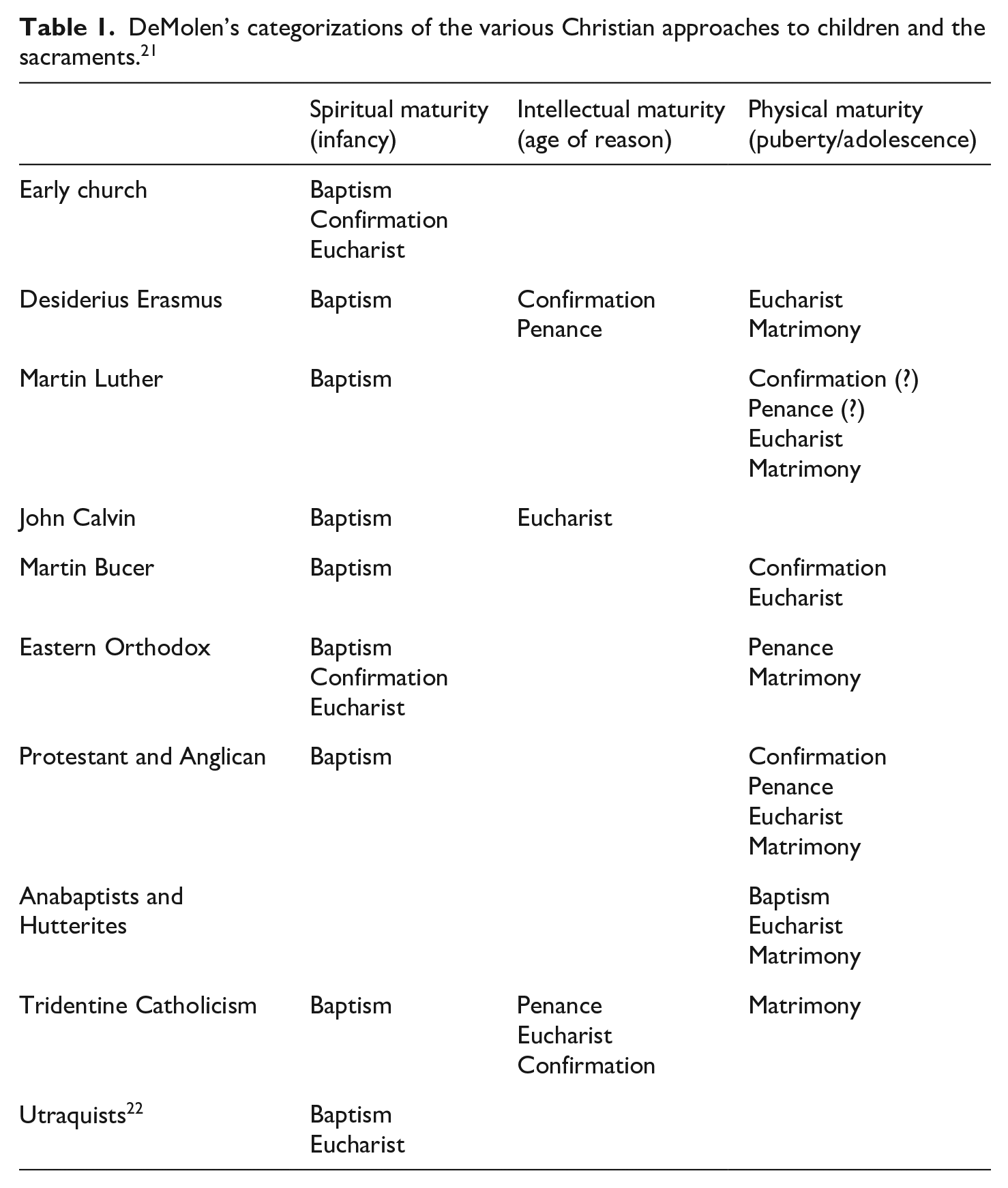
By the time of the sixteenth century, however, Christians had begun to associate the sacraments with other stages of maturity, namely “intellectual maturity,” marked by the “age of discretion,” and “physical maturity,” marked by puberty. DeMolen relies largely on statements by church councils to explain the evolution of this view from the early church to the sixteenth century. According to DeMolen, Lateran IV rejected the early church’s tradition of communing infants “and forbade infants from receiving the Eucharist until they had reached the age of discretion.” 24 DeMolen overemphasizes Lateran IV’s limitation on infant communion, however; Lateran IV does not explicitly forbid infants from receiving the Eucharist. It simply does not require children to receive communion once per year during the Easter season, as it does for those who have reached the age of discretion. 25 DeMolen similarly overstates the contribution of the Council of Trent. He writes, “Finally, in 1563, the Council of Trent deprived infants of the sacrament of Confirmation, insisting that only children who had attained the age of discretion were entitled to it. Infants who had enjoyed full membership in the church in times past were reduced to catechumen status by the actions of the Lateran Council and the Council of Trent.” 26 He continues, “Abruptly in 1563, the Council introduced a reordering of the sacraments. Confirmation no longer had to precede Penance and the Eucharist. The council decreed that it could be postponed until the child reached the age of twelve.” 27
While DeMolen is correct in the essentials here, his treatment is careless for a few reasons. First, he attributes to the Council of Trent an abrupt shift, while in reality Trent reaffirmed a shift that had already taken place over the course of several centuries. Second, DeMolen seems to rely largely on the Catechism of the Council of Trent in his discussion. The Catechism was published in 1566, three years after the close of the council, and was commissioned but not written by the council; to cite the Catechism as “Trent” is misleading. Although his treatment of the historical progression of the relationship between children and the sacraments is not as helpful as that of Fisher, DeMolen provides a generally accurate snapshot of the various views present during the sixteenth century.
While the Roman Catholic Church in the sixteenth century had moved away from the Eastern Christian and early church practice of administering baptism, confirmation, and Eucharist to infants, it had not gone as far as the Anabaptists, or even the Protestants and Anglicans. In its decrees on original sin (Session V) and the sacraments (Session VII), Trent affirms the practice of infant baptism. It associates penance and Eucharist, however, with the age of reason, and reiterates Lateran IV’s requirement for annual confession and reception of communion.
28
Though the age of confirmation is not addressed directly by Trent, DeMolen refers to the Catechism of the Council of Trent when he states, “Instead of administering Confirmation within the first few years of life, Trent delayed it until after the reception of Penance and the Eucharist.”
29
This description is stronger than his earlier, more accurate statement that “apparently the only requirements of Trent with regard to sequence were that Baptism must precede Confirmation, that Penance must precede the Eucharist, and that the recipient of the latter three sacraments must have attained the age of discretion.”
30
DeMolen again confuses the Catechism of Trent with Trent itself when he writes, “Beginning in 1563, however, the Council of Trent determined that twelve was the ideal age for conferring Confirmation, and that no child under the age of seven should be admitted to that sacrament.”
31
While Christian perspectives on children and the sacraments vary widely in the sixteenth century, DeMolen is right to point out that, at least to some extent, all Christian traditions retain a respect for children that has differentiated Christian society from other societies since the early church: Unlike the Roman empire where infanticide and the exposure of infants were commonly practiced, Christianity throughout its long history affirmed through Baptism and the other sacraments that children possess both dignity and worth. In providing the children with godparents, the church acknowledged its responsibility to care for and protect them from harm.
32
According to DeMolen, the various ages of administering the sacraments betray diverse perspectives towards children regarding their spiritual, intellectual, and physical capacities, as well as their innocence, worthiness, and social relationship to adults. DeMolen’s tendency to read in worldviews taken towards children by each confessional Christian tradition, however, relies on little evidence outside of the ages at which these traditions administer the sacraments. While there may be some truth to DeMolen’s interpretations, his conclusions also betray his own understanding of what receiving the sacraments (particularly baptism, confirmation, and Eucharist) at certain ages communicates about the status of the recipient. A deeper examination of how the authors DeMolen cites interpret the practices of administering the sacraments at particular ages would shed further light on sixteenth-century perceptions of childhood. While DeMolen’s central point that sacramental practices illuminate conceptions of childhood in the sixteenth century holds some weight, I would argue that, at least in the case of Trent, the decisions regarding children and the sacraments stem less from particular understandings of children than from the particular lenses through which the Council Fathers viewed the theological decisions of Trent. More specifically, Trent’s delaying of communion until the “age of discretion” is primarily due to its overemphasis on what is absolutely necessary for salvation. 33 In fact, had it given more attention to the spiritual, intellectual, and physical developmental stages of children, the council might have moved towards consideration of a different set of questions regarding how the sacraments benefit children and aid them in their spiritual growth and incorporation into the ecclesial Body of Christ. 34
Session VII of Trent—Infant Baptism
One might think that Trent’s upholding of infant baptism would correspond to a similar openness towards the reception of communion by children. However, an investigation into the rationale behind Trent’s support of infant baptism reveals that the conciliar position relies more on its theological understanding of the sacraments than on a particular view of children. As noted above, the primary lens through which Trent approaches the sacraments of initiation has to do with the necessity of the sacraments for salvation. In the council’s own words, “If anyone says that the sacraments of the new law are not necessary for salvation but are superfluous, and that people obtain the grace of justification from God without them or a desire for them, by faith alone, though all are not necessary for each individual: let him be anathema.” 35 The council does not ask whether the sacraments are beneficial for children but rather whether they are necessary. Said another way, the council seeks to provide the minimum requirements for salvation rather than a holistic or robust account of the sacramental economy.
In its decree concerning the sacraments, Trent affirms infant baptism, anathematizing anyone who says that little children, because they make no act of faith, should not after the reception of baptism be numbered among the faithful; and that, therefore, when they reach the age of discretion, they should be re-baptised; or that it is better that their baptism be omitted than that they be baptised while believing not by their own faith but by the faith of the church alone.
36
The council’s affirmation of infant baptism is rooted in its treatment of original sin. Session V on original sin, Session VI on justification, and Session VII on the sacraments can be treated together as a whole. Because baptism’s primary purpose is understood by the council to be the removal of the stain of original sin, anyone who “says that recently born babies should not be baptised even if they have been born to baptised parents” is anathematized. 37 “Even small children, who could not yet of themselves have committed any kind of sin, are truly baptised for the remission of sins in order that what they contracted by generation may be cleansed in them by regeneration.” 38 John 3:5 is quoted by the Council Fathers both here in Session V and again later in Session VI’s decree on justification: “Unless a person is born again of water and the holy Spirit, he cannot enter the kingdom of God.” 39 Baptism is the “instrumental cause” of justification; even infants are saved through this magnificent sacrament. 40 Through mortal sin, the saving grace of baptism can be lost, but through the sacrament of penance a person “can recover the lost justice.” 41 In the context of Sessions V and VI then, on original sin and justification, Session VII’s affirmation of infant baptism can be understood as rooted in the council’s view of the sacraments as instruments of personal salvation given by Christ to the church. As we will see, since infants cannot fall out of the state of grace until the “age of discretion,” when they can begin to commit mortal sins, the Eucharist is not determined to be necessary for children below the age of discretion.
Session XIII of Trent—Children and the Eucharist: Part 1
Session XIII of the Council of Trent, held on October 11, 1551, lasted 48 hours and addressed questions pertaining both to the Eucharist and to ecclesial reform. Four articles on the Eucharist were postponed in order “to allow the Protestants to be heard on them,” including three questions pertaining to communion under both species and the question, “Should little children receive communion?” 42 As will be seen, the parallel questions of communion for young children and communion under both species remain together throughout their treatment by the council. This is most likely because these questions were raised in the first place by the same constituency, the “Utraquists” in the Czech lands. The Utraquists, named for their practice of administering the Eucharist under both species (sub utraque specie), were also known to commune small children. 43 The council scheduled the four articles on the Eucharist to be addressed on January 25, 1552, with the hope that a significant number of Protestants would be present. Unfortunately, by January 25, only six Protestant theologians had arrived at the council sent by Maurice, the Duke of Saxony and Sleiden, and two envoys from Württemberg. Though few in number, the Protestants made significant (and unrealistic) demands, which included (1) that they be given equal voting rights to the bishops, (2) that decisions previously made by the council be reopened, (3) that the council elect its own president, and (4) that the pope be subject to the council’s decrees, thus “implicitly demanding the council declare its authority superior to the pope’s.” 44 As O’Malley puts it, “this episode makes absolutely clear that, thirty-five years after the outbreak of the Reformation, the problem was no longer disagreement over this or that doctrine. The Protestants had developed and appropriated an operational paradigm that was incompatible with the corresponding paradigm of the bishops and theologians at Trent.” 45 At Session XVI, on April 28, the council solemnly ratified a suspension for two years, which would in fact last ten. Although the question about children and communion was not officially answered until 1562 in Session XXI of the council, the discussions leading up to Session XIII are substantial and set the foundation for the decree published in Session XXI. Therefore, the discussions preceding Session XIII are worth treating here in some detail.
On September 1, 1551, a list of ten articles, based on the theological positions of Protestant reformers, was submitted to the congregation of theologians for evaluation. Article 8 raised as a prospective thesis the question of whether the communion of children (parvuli) younger than the age of discretion was necessary for salvation, along with the question of communion under both species: “It is of divine right to communicate the people under both species and (to communicate) children, and whoever compels the people to use one species sins.” 46
In the discussion of the thesis among theologians, Alphonsus Salmeron denied that communion of young children was necessary for salvation because (1) young children cannot yet have faith and (2) they cannot examine themselves before receiving communion, as Paul demands in 1 Corinthians 11:28. On September 8, he stated, “but this sacrament should in no way be given to little ones, either under two or under one species, since they have neither faith nor understanding of what they are doing, nor can they examine themselves, as Paul enjoins them. And as the Lateran Council has maintained: (They should wait) until they have arrived at the age of discretion.” 47 During the discussions that took place over the next several days, several other theologians, such as Juan Arze of Spain, Jacob Ferrusius, Martin Olave, Melchior a Vosmediano, Francisco de Heredia, Antoine Arras, and Petrus Frago, agreed with Salmeron without much further comment on the matter.
Several others also agreed and offered further commentary. Juan de Ortega stated that article 8 “is also heretical because the church is bound to communion under both kinds, but not with respect to all—only with respect to priests; the laity are excluded. It is to be given to children neither under both nor under one [species].” 48 The comments here by Ortega echo the discussion by Fisher of the connection between the withholding of the chalice from the laity and the recission of infant communion during the late Middle Ages. 49
Francisco de Toro goes even further and maintains that article 8 “is also heretical in all respects. For a precept would follow that baptism of children is not sufficient for salvation, contrary to the third Council of Carthage. Furthermore, the Lateran Council states that [communion] is to be taken when one arrives at the age of discretion, and therefore not by children, who are not capable of other things which are required for this consumption, such as faith, self-examination, etc.” 50 Like that of Salmeron, de Toro’s commentary highlights Trent’s continuity with previous councils, particularly Lateran IV. It also demonstrates that, while Lateran IV did not prohibit infant communion, it was understood at least by some to imply that children should not receive communion. De Toro’s reference to faith and self-examination (probatio) calls attention to the words of Paul, referenced often at Trent in debates about the Eucharist: “Whoever, therefore, eats the bread or drinks the cup of the Lord in an unworthy manner will be guilty of profaning the body and blood of the Lord. Let a man examine himself, and so eat of the bread and drink of the cup. For anyone who eats and drinks without discerning the body eats and drinks judgment upon himself” (1 Cor 11:27–29 RSV, used throughout). Ambrosius Pelargus of Hesse also agrees that article 8 is heretical but acknowledges the attestation of Cyprian and Augustine to the communion of young children in the early church: “8 similarly [is heretical]. Communion under both [species] belongs only to the priests who confect [the Eucharist]; the laity, however, ought to communicate under only one. This sacrament should not be given to infants who are unable to discern the body of the Lord, nor to examine themselves, although, according to Augustine and Cyprian, it is sometimes given to infants.” 51
As far as I can tell, none of the theologians present argues that article 8 is not heretical. Although all theologians who speak on article 8 deem it to be heretical, the article is not ultimately addressed in Session XIII’s decree. Nevertheless, the comments from the discussions leading up to Session XIII reveal several important points. First, the question of communing parvuli is always tied to the question of communion under both species. As has been shown, this makes sense historically, since lay reception of the cup and infant communion receded in a similar time period. In fact, the decline in lay reception of the cup played an important factor in the decline of infant communion, as shown by Fisher. As mentioned previously, the dual Utraquist practices of communion under both species and infant communion lie behind the connection of these two issues at Trent. These two issues are also related scripturally, since John 6:53, “unless you eat the flesh of the Son of man and drink his blood, you have no life in you,” is the verse that has to be reckoned with in both cases, and it is quoted extensively at the council. Second, faith and the intellectual ability to examine oneself and to recognize Jesus’s presence in the elements are seen as requirements for reception of communion, even for someone like Pelargus who acknowledges instances of infant reception of communion in the early church. Ultimately, while not promulgating an official decision regarding article 8, Session XIII does require everyone above the “age of discretion” to communicate once per year, implying that this obligation does not apply to children. In canon 9 of Session XIII, the council decrees that “each and all of Christ’s faithful of both sexes, when they have reached the age of discretion, are bound in accordance with the commandment of holy mother church to receive communion every year, at least at Easter time,” thus reiterating the teaching of Lateran IV. 52 Canon 11 of the same session “establishes and declares that, granted the availability of a confessor, those burdened by an awareness of mortal sin, however much they may feel themselves to be contrite, must first [i.e., before reception of communion] avail themselves of sacramental confession.” 53 The question posed by article 8 of whether the communion of children younger than the age of discretion is necessary for salvation will not be addressed officially until Session XXI of the council in July of 1562.
Session XXI of Trent—Children and the Eucharist: Part II
Chapter IV and canon 4 of Session XXI pertain directly to the question of children and communion. Canon 4 anathematizes anyone who states “that eucharistic communion is necessary for children before they reach the age of discernment.”
54
Like Session VII (on baptism) and Session XIII (on the Eucharist), Session XXI’s primary question is whether the sacraments are necessary for salvation—what is the minimum requirement in terms of sacramental reception for salvation to be obtained? Chapter IV goes into slightly more detail regarding the rationale behind canon 4: Children under the age of discernment are not bound by any obligation to sacramental holy communion, seeing that after rebirth by the water of baptism and incorporation in Christ they are not at that age able to lose the grace they have received of being children of God. Nor are times past to be condemned if they sometimes observed that custom in some places. For those holy fathers had good reason for their practice in the situation of their time, and we must certainly believe without dispute that they did not do this for any necessity of salvation.
55
Together, the sacramental decrees of Sessions VII, XIII, and XXI form a theologically coherent (though incomplete) whole: baptism, which removes the stain of original sin from the soul (see also Session V), is necessary for the salvation of all, and should therefore be conferred even to infants. The grace of baptism can be lost by grave sin, which can only be done by one who has attained the “age of discretion.” The Eucharist, a source of grace (paired with the sacrament of penance), is only “necessary” for those who have the ability to lose the grace bestowed at baptism and is therefore unnecessary for those below the “age of discretion.” Chapter IV acknowledges that examples exist in antiquity in which infants were communed under “acceptable ground(s)” but claims that even the patristic fathers who communed infants “regarded it as not necessary to salvation.”
A few overarching observations are worth making here. First, as Johnson notes, “By the inclusion of this statement and canon it is quite obvious that still in 1562, in some places in the West at least, infant communion was being practiced on occasion, and the concern of Trent was not really to abolish it altogether but to point out that it was not a necessary practice.” 56 Second, theologically speaking, this chapter is about justification, sin, grace, and the necessity of the Eucharist for salvation. Third, because of the focus on what is necessary for salvation, the idea of the “age of discretion” plays a major role. Before the age of reason, one cannot commit a mortal sin, so therefore does not need the grace of communion for salvation. Fourth, this chapter and canon pertain to the practical question of the requirement to receive communion (as well as the sacrament of penance) once per year. While adults and older children need communion and penance for salvation, children below the age of reason do not, since they are not yet capable of committing grave sin. Fifth, this canon and chapter, as is typical of Trent, offers a minimalistic, least-common-denominator view of the Eucharist—what is the minimum necessary or required for salvation. It does not attempt to provide a robust or holistic theological treatment of the Eucharist, but rather attempts to answer particular practical and theological questions that have been raised both by reformers and by shifts in the liturgical praxis of medieval Catholicism. 57
The discussions leading up to Session XXI, although brief, shed further light on the rationale of the bishops and theologians. On July 14, 1562, a list of four canons and chapters were proposed to the general congregation concerning communion under both species and the communion of children. As was noted in the discussion on Session XIII, these two topics are consistently treated together and are connected both by historical development and by scriptural argumentation. Canon 4 and chapter IV are the most relevant to the present discussion. The draft of canon 4 is identical to its final form, and reads, “If anyone says that communion is necessary for children before they reach the age of discernment: let him be anathema.” 58 The draft of chapter IV is identical to its final form except for the final sentence (see above), which was slightly different in the draft: “For whatever reason, it is evident that this was done at that time, yet it is not to be believed that it was done because of the necessity of salvation.” 59
Many responses to the four chapters and four canons presented pertain to John 6, and whether Jesus’s words there ought to be understood as referring to sacramental eating and drinking. 60 Though brief, several responses do explicitly address canon 4 and chapter IV regarding the communion of children. Bishop Castella of Cava, for instance, says, “Let the accounts of St. Thomas be added.” 61 Bishop Tomasso Stella of Capodistria also mentions St. Thomas: “Let the account of St. Thomas or the apostle be added.” 62 Though the allusions to Thomas are brief, they may refer to Question 80, Article 9 of the tertia pars of the Summa Theologiae, which deals with the question of whether communion should be given to those who lack the use of reason. 63 Thomas sees the ability (current or past) to demonstrate some (if only rudimentary) level of devotion as a requirement for receiving communion. Before children have attained reason enough to demonstrate some level of devotion towards the Eucharist, it should not be given to them. St. Thomas, St. Paul, and Jesus’s words in John 6 are the three most often referenced authorities throughout the discussion.
Bishop Albertus Duimius suggests adding Paul’s rationale in chapter IV: “Let the account of Paul be added concerning judgment.” 64 A footnote reveals that Duimius and others who reference Paul are referring to 1 Corinthians 11:29, which in the Vulgate reads, “For he who eats and drinks unworthily eats and drinks judgment for himself, not recognizing the body.” 65 The use of 1 Corinthians 11:29 highlights Holeton’s observation, referenced earlier, that the theological rhetoric about communion for young children has shifted away from an emphasis on John 3:5 and John 6:53 and towards an emphasis on 1 Corinthians 11:27ff. as the church has moved away from infant communion. Bishop Andreas Cuesta of Spain also promotes the use of Paul, writing, “In chapter IV, let it be said ‘infants are not bound,’ etc. and let it be called ‘custom’ by ecclesial consent and let it be called ‘divine precept’ by sacred Scripture, and the words of John 6 are pleasing, and the authority of Paul remains beneficial.” 66
Bishop Ioannes Suarez suggests a minor wording change, which is not ultimately taken up: “In place of ‘communion’ let it be said ‘actual consumption of the Eucharist’; let the same be said in the canon.” 67 Another minor word change (not adopted) to chapter IV is suggested by Bishop Horatius Graecus, who says, “In place of ‘in quibusdam,’ add ‘ecclesiis.’” 68 Bishop Antonius Augustinus of Spain also suggests a word change (again not adopted): “In 4, delete ‘ratione’ for the sake of time.” 69 Bishop Iacob Gilbertus Nogueras writes enigmatically, “4 is pleasing, but some things could be changed.” 70
Bishop Dominicus Bollanus of Brescia interestingly favors a stronger wording of chapter IV and proposes that the council prohibit the granting of communion to children: “In chapter IV, that which was previously proposed was better, which prohibited giving the sacrament to children.” 71 The bishop of Città di Castello supports Bollanus’s proposal: “The canons are pleasing, as well as the doctrines with the notations of [the bishop from] Brescia.” 72 Bishop Andreas Dudith of Knin, Croatia also supports Bollanus’s suggestion: “It pleases [me] with [the additions suggested] by [the bishop from] Brescia.” 73
At Session XXI on July 16, the final draft of canons and chapters was approved (as described above). In the final draft of the chapter, the last sentence, “For whatever reason, it is evident that this was done at that time, yet it is not to be believed that it was done because of the necessity of salvation,” 74 was replaced by, “For those holy fathers had good reason for their practice in the situation of their time, and we must certainly believe without dispute that they did not do this for any necessity of salvation.” 75
Conclusion
Ultimately, while Trent denies that communion is necessary for the salvation of children, it did not accept the proposal of some to ban children from receiving the Eucharist. 76 Technically speaking, whether or not children are given communion was left open and could be understood as a juridical rather than a theological question. Practically speaking, however, Trent reaffirmed a shift in liturgical practice that had taken place throughout the Middle Ages in which the frequency of eucharistic communion by young children slowly dwindled until it was nonexistent. 77 Trent essentially formalized the practice of withholding communion from infants that continues in Roman Catholicism today.
What did the Fathers of Trent think of children? Did they have a sense that children could grow spiritually? Did they consider the role of the sacraments in helping a child grow in faith and holiness? Unfortunately, even with the Acta of the council, it is challenging to understand how the Tridentine Fathers conceived of young children. Rather than discussing childhood spirituality and how the sacraments might communicate grace to young children, the Council Fathers addressed the question from a technical and juridical standpoint, focusing on the minimum necessity for salvation rather than on a fuller vision of the sacraments as participation in the life of the Trinity. One can hardly fault the Council Fathers for the limitations in their perspectives; the council was a product of its own time, and as such, it answered the questions of its own time using the means and frameworks available to it. As Christians of the twenty-first century, however, we must view Trent not as the final word, but as a step along the church’s pilgrimage towards the eschaton. Trent’s decrees from the point of view of what is necessary for salvation are not wrong but neither are they complete. Contemporary sacramental theology, with its focus on the sacramental economy as ecclesial participation in the life of the Trinity, can and should build on the decrees of Trent by reconsidering the relationship between children and the sacraments, and between children and the Eucharist. 78
Footnotes
1.
Council of Trent, Session 21, “Teaching on communion under both kinds and of children,” Canon 4, in Decrees of the Ecumenical Councils, vol. 2, ed. Norman P. Tanner (New York: Sheed & Ward, 1990), 727. “Si quis dixerit, parvulis, antequam ad annos discretionis pervenerint, necessariam esse eucharistiae communionem.”
2.
For an earlier discussion of Trent’s treatment of the Eucharist of young children, see Ferdinand Cavallera, “La Communion Des Parvuli Au Concile De Trente,” Bulletin de Littérature Ecclésiastique 36 (1935): 97–131. Cavallera provides a simple, but detailed walk-through of the discussions regarding children and the Eucharist at Trent, including a closer look at Session VII than is offered here. This article differs from Cavallera’s in that it contextualizes and analyzes the decrees and discussions of Trent and puts them into conversation with contemporary sacramental theology.
3.
Richard DeMolen, “Erasmus on Children,” Erasmus of Rotterdam Society Yearbook 2 (1982): 29.
4.
Maxwell Johnson, “The Apostolic Tradition,” in The Oxford History of Christian Worship, ed. Geoffrey Wainwright and Karen B. Westerfield Tucker (Oxford: Oxford University Press, 2006), 42. Paul Turner adds, “The early Church offered Communion to infants, a practice that remained widespread until about the thirteenth century” (in the West) and further, “The Communion of infants has a long pedigree in the Church, both East and West.” Paul Turner, Ages of Initiation: The First Two Christian Millennia (Collegeville, MN: Liturgical Press, 2000), 51.
5.
David R. Holeton, “Welcome Children, Welcome Me,” Anglican Theological Review 82, no. 1 (2000): 93–111 at 103.
6.
Maxwell Johnson, The Rites of Christian Initiation: Their Evolution and Interpretation, revised and expanded edition (Collegeville, MN: Liturgical Press, 2007), 92. On Cyprian’s view, also see David Holeton, Infant Communion—Then and Now, Grove Liturgical Studies 27 (Bramcote: Grove Books, Ltd., 1981), 5.
7.
Johnson, Rites of Christian Initiation, 93. Johnson nuances his claim about infant communion in Eastern churches by observing, “While the immediate post-baptismal reception of first communion is theoretically the case . . . praxis does not always follow theory”; while immediate post-baptismal infant communion is the liturgical norm in the East, exceptions include Maronite, Assyro-Chaldean, and some Byzantine practices in Greece. Johnson, Rites of Christian Initiation, 303.
8.
J. D. C. Fisher, Christian Initiation: Baptism in the Medieval West, Alcuin Club Collections 47 (London: SPCK, 1965; repr., Chicago: Hillenbrand, 2004), 114.
9.
Fisher, Christian Initiation, 114.
10.
Fisher, Christian Initiation, 114.
11.
Fisher, Christian Initiation, 115.
12.
Fisher, Christian Initiation, 115. Methods of communicating infants sub specie sanguinis included using a leaf or the priest’s finger to convey a drop of the precious blood into the child’s mouth. Johnson adds that “Balthasar Fischer . . . sees the modern custom of giving silver spoons for baptismal or baby gifts as remnants of this older communion practice.” Johnson, Rites of Christian Initiation, 263.
13.
Fisher, Christian Initiation, 115–16. While some churches communicated infants immediately, it seems that this was not the practice in the church of Rome.
14.
Fisher, Christian Initiation, 116. As will be seen, John 6:53 is referenced often at Trent in the discussions and decrees regarding children and the Eucharist.
15.
Fisher, Christian Initiation, 117. Johnson adds, “It is not so much the doctrine of transubstantiation that led to the decline of infant communion. More important reasons were the changes occurring in communion practices themselves prior to the promulgation of this thirteenth-century doctrine. Such changes included the lack of frequent communion participation on the part of the laity in general, the growing clericalization of the Eucharist due, in part, to developments in the theology of priestly ordination, a growing and increasing scrupulosity about the Eucharistic elements themselves . . . and, especially, the withdrawal of the cup from the laity, and the concomitant development of a Eucharistic piety centered almost exclusively on devotion to the Host. When the cup was withdrawn from the laity, previous practices of communing infants even from the chalice alone naturally disappeared as well.” Johnson, Rites of Christian Initiation, 264.
16.
Johnson, Rites of Christian Initiation, 263.
17.
Fisher, Christian Initiation, 117.
18.
Fisher, Christian Initiation, 118.
19.
Holeton, “Welcome Children, Welcome Me,” 103n15.
20.
Johnson, Rites of Christian Initiation, 265.
21.
 includes baptism, confirmation, Eucharist, penance, and matrimony. While these were all considered “sacraments” by Roman Catholics, the degree to which Protestant traditions saw these rites as sacraments varied. Luther, for example, understood baptism, Eucharist, and (in some of his writing) penance to be true sacraments, initiated by Christ. Confirmation and matrimony, on the other hand, were important moments in one’s Christian life but were not sacraments in the proper sense. He saw matrimony in particular as more properly an institution of the state than of the church.
22.
One lacuna in DeMolen’s article is the position of the Utraquists, which I include here. When the question of whether it was necessary to commune infants was addressed at Trent, it always accompanied the question of whether it was necessary for the laity to commune under both species (sub utraque specie). Both of these questions were most likely raised at Trent in an attempt to respond to the Utraquist position. For a detailed study of the relationship of the Utraquists to both Catholics and Lutherans, see Zdenek V. David, Finding the Middle Way: The Utraquists’ Liberal Challenge to Rome and Luther (Washington, DC: Woodrow Wilson Center Press, 2003). For a detailed treatment of Utraquist arguments for infant communion, see David, Finding the Middle Way, 121–126. For another source connecting infant communion to Utraquism, see Holeton, “Welcome Children, Welcome Me,” 93–94: Holeton writes of the Jena Codex, a late fifteenth-century Utraquist manuscript that includes “a series of polemical illuminations depicting the ‘pure’ practices of the primitive Church and the ‘corrupt’ practices of the contemporary Roman Church.” These images include a pair of pictures, “one of which portrays a celebration of the eucharist, and the other a battle during one of the Roman crusades against the Utraquists.” Holeton writes, “In the illumination of the eucharist, which portrays the moment of communion, it is two infants held in their mothers’ arms who are depicted in the act of communicating, with one receiving the host and the other the chalice. In the battle, it is the infants who constitute three of the four visible victims . . . infants are the first victims of a war waged to suppress the practices of communion under both kinds . . . and the communion of all the baptized.” In another article, Holeton describes the manner in which communion was administered to infants according to the Utraquist Synod of 1418: “The priest is instructed first to place a crumb of bread into the mouth of the infant then to hold the child’s mouth shut (so that the bread would be swallowed). Then the priest was to take a drop of wine from the chalice on his finger and place it in the infant’s mouth.” David R. Holeton, “The Communion of Infants and Hussitism,” Communio Viatorum 27, no. 4 (Winter 1984): 222n39.
23.
Richard DeMolen, “Childhood and the Sacraments in the Sixteenth Century,” Archiv für Reformationsgeschichte 66 (1975): 54–55. DeMolen’s broad use of the term “confirmation” would be nuanced by more recent liturgical scholarship, which would point out (1) that “confirmation” is a Western term—Eastern Christians tend to use the word “chrismation” for the post-baptismal anointing that takes place during Christian initiation, and (2) that early Christians would not necessarily have conceived of baptism and confirmation as two completely distinct sacraments but rather as two integrally related parts of the process of initiating a new Christian. For a more complete discussion, see Dominic Serra, “Baptism and Confirmation: Distinct Sacraments, One Liturgy,” Liturgical Ministry 9 (Spring 2000): 63–71.
24.
DeMolen, “Erasmus on Children,” 30.
25.
See Lateran IV, Canon 21, in Decrees of the Ecumenical Councils, vol. 1, 245.
26.
DeMolen, “Erasmus on Children,” 30.
27.
DeMolen, “Erasmus on Children,” 30. In fact, Trent’s decree on confirmation was approved on March 4, 1547. Perhaps DeMolen cites 1563 since this was when the council came to a close and all of its documents were signed and promulgated by Pope Pius IV.
28.
On penance, see the Council of Trent, Session 14, “Teaching concerning the most holy sacraments of penance and last anointing,” chap. 5, Decrees of the Ecumenical Councils, vol. 2, 707: “The precept of confession should be discharged by one and all at least once a year on their reaching the age of discretion.” On the Eucharist, see Council of Trent, Session 13, “Decree on the most holy sacrament of the Eucharist,” canon 9, Decrees of the Ecumenical Councils, vol. 2, 698: “If anyone denies that each and all of Christ’s faithful of both sexes, when they have reached the age of discretion, are bound in accordance with the commandment of holy mother church to receive communion every year, at Easter time: let him be anathema.” Canon 11 of the decree on the most holy sacrament of the Eucharist connects penance with communion, requiring confession before communion for those who have committed mortal sin.
29.
DeMolen, “Childhood and the Sacraments,” 68.
30.
DeMolen, “Childhood and the Sacraments,” 57.
31.
DeMolen, “Childhood and the Sacraments,” 56.
32.
DeMolen, “Childhood and the Sacraments,” 70.
33.
And again, Trent does not really “delay communion”—it simply states that communion is only necessary for salvation for those who have reached the age of discretion.
34.
Twentieth-century writers who consider childhood in such light include Sofia Cavalletti, Gianna Gobbi, and Maria Montessori. Montessori’s development of what has become widely known as “Montessori” education begins from a scientific understanding of the developmental stages of childhood, combined with a recognition of the deep spiritual life children are capable of as creatures endowed with dignity and made in God’s image. See, among her many works, Maria Montessori, The Absorbent Mind, 3rd ed. (Adyar, India: Theosophical Publishing House, 1961). Cavelletti and Gobbi built on Montessori’s work to develop the Catechesis of the Good Shepherd, a catechetical model that applies Montessori’s pedagogical method to religious education. For their thought, see Gianna Gobbi, Listening to God with Children: The Montessori Method Applied to the Catechesis of Children, trans. Rebekah Rojcewics (Loveland, OH: Treehaus Communications, Inc., 1998) and Sofia Cavalletti, The Religious Potential of the Child (Chicago: Liturgy Training Publications, 1992).
35.
Council of Trent, Session 7, “First decree [On the sacraments],” canon 4, Decrees of the Ecumenical Councils, vol. 2, 684. “Si quis dixerit, sacramenta novae legis non esse ad salutem necessaria, sed superflua, et sine eis aut eorum voto per solam fidem homines a Deo gratiam iustificationis adipisci, licet omnia singulis necessaria non sint: a.s.”
36.
Council of Trent, Session 7, “First decree [On the sacraments],” canon 13 on the sacrament of baptism, Decrees of the Ecumenical Councils, vol. 2, 686. “Si quis dixerit, parvulos eo quod actum credendi non habent, suscepto baptismo inter fideles computandos non esse, ac propterea, cum ad annos discretionis pervenerint, esse rebaptizandos, aut praestare omitti eorum baptisma, quam eos non actu proprio credentes baptizari in sola fide ecclesiae: a.s.”
37.
Council of Trent, Session 5, “Decree on original sin,” canon 4, Decrees of the Ecumenical Councils, vol. 2, 666. “Si quis parvulos recentes ab uteris matrum baptizandos negat, etiam si fuerint a baptizatis parentibus orti.”
38.
Council of Trent, Session V, “Decree on original sin,” canon 4, Decrees of the Ecumenical Councils, vol. 2, 666–67. “Etiam parvuli, qui nihil peccatorum in semetipsis adhuc committere potuerunt, ideo in remissionem peccatorum veraciter baptizantur, ut in eis regeneratione mundetur, quod generatione contraxerunt.”
39.
Council of Trent, Session 6, “Decree on justification,” chap. 4, Decrees of the Ecumenical Councils, vol. 2, 672. “Nisi quis renatus fuerit ex aqua et Spiritu sancto, non potest introire in regnum Dei.”
40.
Council of Trent, Session 6, “Decree on justification,” chap. 7, Decrees of the Ecumenical Councils, vol. 2, 763. “Instrumentalis item.”
41.
Council of Trent, Session 6, “Decree on justification,” canon 29, Decrees of the Ecumenical Councils, vol. 2, 681. “Amissam iustitiam recuperare.”
42.
John W. O’Malley, Trent: What Happened at the Council (Cambridge, MA: The Belknap Press of Harvard University Press, 2013), 147.
43.
See Tomas Cernusak, “Relations of the Apostolic See to the Czech Lands during the Reformation and Confessionalisation (1526–1620),” in Tomas Cerusak et al., The Papacy and the Czech Lands: A History of Mutual Relations (Rome/ Prague: Institute of History/ Istituto Storico Ceco Di Roma, 2016), 147–84. After the second period of Trent (1551–1552) had failed to address these questions, Emperor Ferdinand I (emperor 1556–1564) sought to reconcile the Utraquists with the Catholic Church. While Ferdinand sought an acknowledgement from the Catholic Church “that communion under both kinds for the laity be considered valid, which was a fundamental liturgical and theological standpoint of the Utraquists,” he also asked the Utraquists, as a compromise, to “abandon certain of their other specific traits—this primarily was the Utraquist practice of small children receiving the Eucharist.” Cernusak, “Relations of the Apostolic See,” 148, 152. Eventually, Pope Pius IV entrusted these issues to the council, and they were finally dealt with officially in Session XXI. For a detailed account of the background and negotiations at Trent on communion under both species, see Gustav Constant, Concession à Allemagne de la Communion Sous le Deux Espèces: Étude sur les Débuts de la Réforme Catholique en Allemagne (1548–1621), Bibliothèque des Écoles françaises d’Athenes et de Rome, fascicule 128, vol. 1 (France: E. de Boccard, 1923), 212–342.
44.
O’Malley, Trent, 155.
45.
O’Malley, Trent, 156.
46.
Concilium Tridentinum. Diariorum, Actorum, Epistularum, Tractatuum nova collectio, Edidit Societas Goerresiana (Freiburg im Breisgau: Herder, 1901–2001), VII, vol. I, 113. Hereafter cited as CT. “De iure divino esse sub utraque specie etiam populum et parvulos communicare et propterea peccare eos, qui cogunt populum altera specie uti.” Translations from CT are my own, unless otherwise specified.
47.
CT VII, vol. I, 121–22. “Parvulis autem hoc sacramentum nullo modo dandum est neque sub duabus neque sub altera specie, cum non habeant fidem neque intelligant, quid faciant, neque possint se probare, ut Paulus praecipit. Et habetur ex concilio Lateranensi: Cum ad annos discretionis pervenerint.”
48.
CT VII, vol. I, 127. “8 etiam <haereticus est>, quia ecclesia obligatur ad communionem sub utraque, sed non quoad omnes, sed tantum in sacerdotibus; <layci autem excluduntur. Parvulis vero neque sub utraque neque sub una danda est>.”
49.
A contemporary analogue is the withholding of the cup from the laity during the COVID-19 pandemic and the challenges this poses for those who cannot receive the host, for example due to a gluten intolerance. For a discussion of the chalice in the contemporary situation, see Brian Roewe, “As Pandemic Eases, Will the Communion Cup Ever Make a Comeback?,” National Catholic Reporter, March 23, 2022, .
50.
CT VII, vol. I, 130. “8 etiam haereticus est <quoad omnes partes>. Parvulis enim si esset praeceptum, sequeretur, quod eis non sufficeret baptismus ad salutem contra concilium Carthaginense tertium. Praeterea concilium Lateranense statuit esse sumendum, cum ad annos discretionis pervenitur, <ergo non a pueris, qui etiam non sunt capaces aliorum, quae in hac sumptione requiruntur, ut fides, probatio etc.>”
51.
CT VII, vol. I, 132. “8 idem. Communio enim sub utraque convenit tantum sacerdotibus conficientibus; layci autem sub una tantum communicare debent. <Neque parvulis hoc sacramentum dandum est, qui non possunt discernere corpus Domini neque se probare, licet secundum Augustinum et Cyprianum parvulis aliquando sit datum.>”
52.
Council of Trent, Session 13, “Decree on the most holy sacrament of the Eucharist,” canon 9, Decrees of the Ecumenical Councils, vol. 2, 698. “Omnes et singulos christifideles utriusque sexus, cum ad annos discretionis pervenerint, teneri singulis annis saltem in paschate ad communicandum iuxta praeceptum sanctae matris ecclesiae.”
53.
Council of Trent, Session 13, “Decree on the most holy sacrament of the Eucharist,” canon 11, Decrees of the Ecumenical Councils, vol. 2, 698. “Statuit et declarant . . . illis, quos conscientia peccati mortalis gravat, quantumcunque etiam se contritos existiment, habita copia confessoris necessario praemittendam esse confessionem sacramentalem.”
54.
Council of Trent, Session 21, “Teaching on communion under both kinds and of children,” canon 4, Decrees of the Ecumenical Councils, vol. 2, 727. “Parvulis, antequam ad annos discretionis pervenerint, necessariam esse eucharistiae communionem.”
55.
Council of Trent, Session 21, “Teaching on communion under both kinds and of children,” chap. 4, Decrees of the Ecumenical Councils, vol. 2, 727. “Parvulos usu rationis carentes nulla obligari necessitate ad sacramentalem eucharistiae communionem, si quidem per baptismi lavacrum regenerati et Christo incorporati adeptam iam filiorum Dei gratiam in illa aetate amittere non possunt. Neque ideo tamen damnanda est antiquitas, si eum morem in quibusdam locis aliquando servavit. Ut enim sanctissimi illi patres sui facti probabilem causam pro illius temporis ratione habuerunt, ita certe, eos nulla salutis necessitate id fecisse, sine controversia credendum est.”
56.
Johnson, Rites of Christian Initiation, 365.
57.
I would characterize Trent’s overall treatment of the Eucharist, including Sessions XIII, XXI, and XXII (decree concerning the sacrifice of the Mass), less as developing a comprehensive theological description of the Eucharist than as responding to various particular questions and disputes regarding practices or doctrinal questions. This is simply a result of Trent’s methodology and purpose, which was to clarify questions raised by reformers, as well as to implement institutional reform in the Catholic Church. Important theological lenses that are largely absent from Trent include an understanding of the Eucharist as a healing remedy for sin and an understanding of the Eucharist as the event in which the church is constituted and re-constituted, and in which those who commune are incorporated and reincorporated into the Body of Christ. For the latter concept in contemporary theology, see, for example, Henri De Lubac, The Splendour of the Church (New York: Sheed and Ward, 1956), and Paul McPartlan, The Eucharist Makes the Church: Henri de Lubac and John Zizioulas in Dialogue (Fairfax, VA: Eastern Christian Publications, 1993).
58.
CT VIII, 687. “Si quis dixeri, parvulis, antequam ad annos discretionis pervenerint, necessariam esse Eucharistiae communionem: anathema sit.” Translation from Decrees of the Ecumenical Councils, vol. 2, 727.
59.
CT VIII, 687. “<Nam quavis causa eo quidem tempore probanda id illa fecerit, non tamen aliqua salutis necessitate id fecisse credendum est>.”
60.
A section about John 6 was indeed added into the final draft.
61.
CT VIII, 688. “in 4. Addantur rationes divi Thomae.”
62.
CT VIII, 689. “in 4. Additur ratio divi Thomae vel Apostoli.”
63.
64.
CT VIII, 689. “in 4. Cap. Additur ratio Pauli de diiudicatione.”
65.
“Qui enim manducat et bibit indigne iudicium sibi manducat et bibit non diiudicans corpus.”
66.
CT VIII, 690. “In 4. Cap. Dicatur parvulos non teneri etc., et ecclesiae consensum [1] dicatur consuetudinem, et sacris Litteris, dicatur divino praecepto, et verba Ioan. 6. placent, et auctoritas Pauli bene manet.”
67.
CT VIII, 689. “In 4. Loco communionem dicatur actualem Eucharistiae sumptionem; idem dicatur in canonibus.”
68.
CT VIII, 689. “Ibi in quibusdam additur ecclesiis.”
69.
CT VIII, 690. “[2] pro illius temporis ratione deleatur.”
70.
CT VIII, 690. “Placet; sed quaedam mutari cupit.” My assumption here is that Bishop Iacob Gilbertus Nogueras’s remarks went beyond this vague statement, but his precise suggestions were not recorded.
71.
CT VIII, 690. “4. Caput Melius erat, quod prius propositum fuerat; in quo prohibeatur, ne hoc sacramentum detur parvulis.”
72.
CT VIII, 690. “Canones placent et doctrina cum notationibus Brixiensis.”
73.
CT VIII, 691. “Cum Brixiensi placet.”
74.
CT VIII, 687. “Nam quavis causa eo quidem tempore probanda id illa fecerit, non tamen aliqua salutis necessitate id fecisse credendm est.”
75.
CT VIII, 699. “Ut enim sanctissimi illi patres sui facti probabilem causam pro illius temporis ratione habuerunt, ita certe, eos nulla salutis necessitate id fecisse, sine controversia credendum est.” Translation from Decrees of the Ecumenical Councils, vol. 2, 727.
76.
Johnson writes, “It should be noted that the Council of Trent actually left open the possibility that Roman Catholics could at some future point reconsider this issue. That is, by saying that little children ‘are not by necessity bound to the sacramental communion of the Eucharist,’ this statement did not say that baptized children before the ‘age of discretion’ can not, ought not, or even must not receive communion; only that they need not. While that itself certainly contradicted the theologies of Cyprian and Augustine, as well as the common tradition and interpretation in both East and West for centuries, its rather careful language provides an interesting loophole for those who might seek to restore the authentic tradition of the Western church in this regard.” Johnson, Rites of Christian Initiation, 365–66.
77.
It is worth noting, however, that, as David writes, “the communion of infants and other Utraquist deviations from the contemporary Roman Church would continue until the end of Utraquism in 1621.” David, Finding the Middle Way, 156.
78.
There are many contributions contemporary sacramental theology can offer to this discussion. Already mentioned was the notion of eucharistic ecclesiology, promoted primarily by Henri de Lubac: “The Church produces the Eucharist, but the Eucharist produces the Church,” and further, quoting Thomas Aquinas, “we must all be molten in that crucible of unity which is the Eucharist, the ‘sacrament of sacraments,’ ‘the noblest of all,’ which ‘consummates’ them all and to which they are all ‘ordered.’” De Lubac, Splendour of the Church, 92, 103. To this I will add: (1) Louis-Marie Chauvet, who describes the sacraments, and particularly the Eucharist, as a mutual exchange of gifts between God and the Church. See Louis-Marie Chauvet, Symbol and Sacrament: A Sacramental Reinterpretation of Christian Existence (Collegeville, MN: The Liturgical Press, 1995) and Louis-Marie Chauvet, The Sacraments: The Word of God at the Mercy of the Body (Collegeville, MN: The Liturgical Press, 1997, 2001); (2) Kevin W. Irwin, who describes ten complementary “models” of the Eucharist that, when seen together, shed light upon “the different aspects, facets, and contours” of the Eucharist, which is “the jewel in the crown of Catholicism.” See Kevin Irwin, Models of the Eucharist (New York: Paulist Press, 2005), xiii–xiv; and (3) Kimberly Hope Belcher, who uses methods from ritual studies in her study of infant baptism to illuminate the dynamic action of the Trinity and to weave together baptism’s spiritual, ritual, physical, and social effects. See Kimberly Hope Belcher, Efficacious Engagement: Sacramental Participation in the Trinitarian Mystery (Collegeville, MN: Liturgical Press, 2011). These theological frameworks are among those that can be built upon in a reconsideration of the relationship between children and the Eucharist.