




Abstract
In her article, “Three Approaches to Practical Theology, Theological Education, and the Church’s Ministry,” Kathleen Cahalan develops Paul Lakeland’s three models of pastoral ministry for the changing landscapes of the late-modern, counter-modern and radical post-modern societies: interpreter, practitioner and cultivator. In this article, I develop a fourth model of pastoral ministry, recognizing the post post-modern landscape as described by Bert Roebben and Alan Kirby, a model of pastor as “signifier” amid a fragmented landscape.
Keywords
Introduction
Ten years ago, in the wake of Hurricane Katrina, I spoke with a Presbyterian pastor about ministerial identity in the midst of tragedy. He said: everything changed. Called to a New Orleans church prior to Katrina, his job description changed overnight after the storm, Now I am a community organizer, a construction site manager, a volunteer coordinator and an advocate for the voiceless. I realize now that should have been my job description all along.
1
Four descriptions of the pastoral vocation. Partial material for this chart drawn from the work of Kathleen Cahalan, Paul Lakeland and Bert Roebben.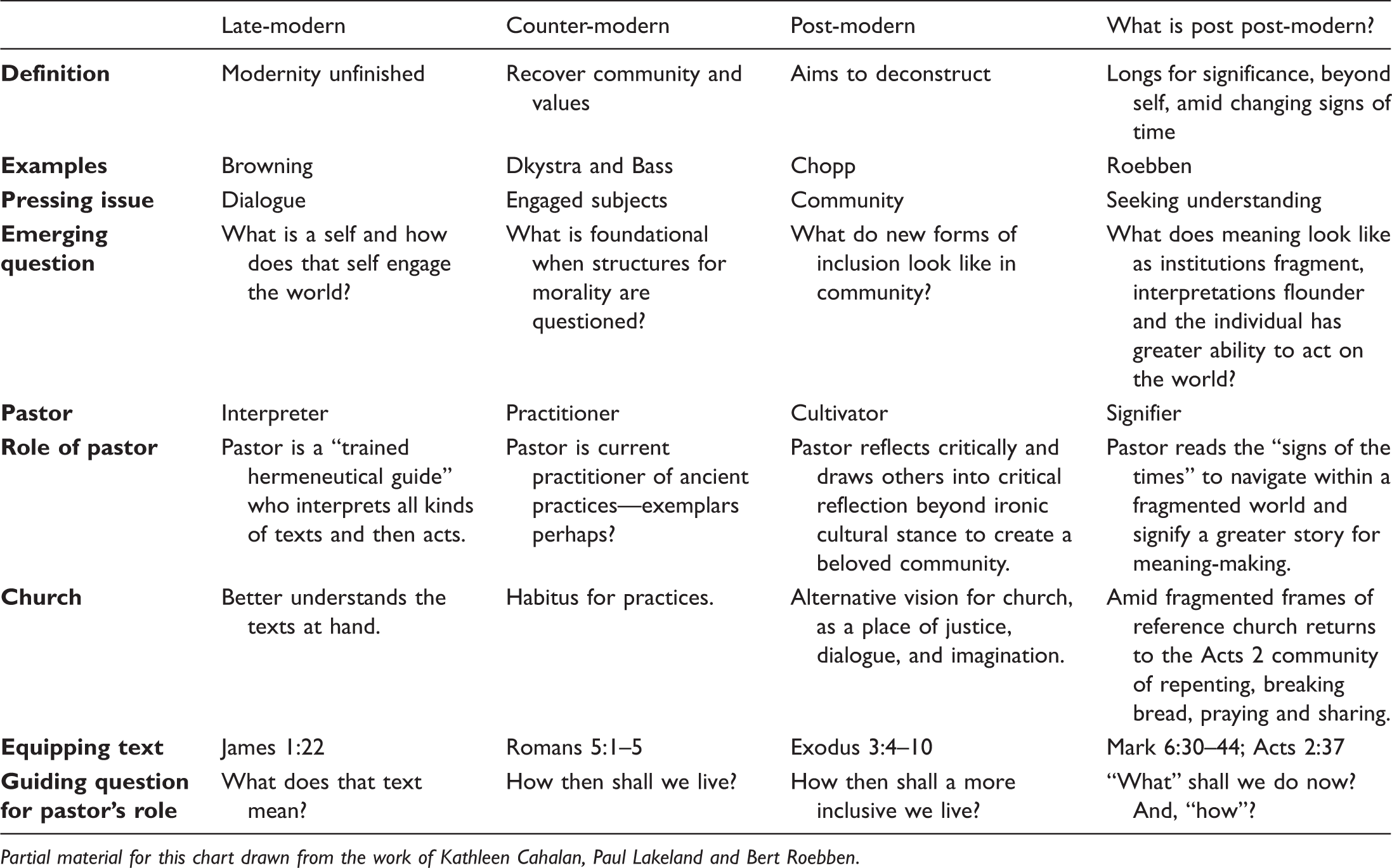
Pastor as interpreter: The role of the pastor in the late-modern landscape
Textual interpretation may seem far removed from the daily routine work of the pastoral vocation. However, Cahalan looks at the role of pastor as interpreter in the late-modern era. Here, the minister served as “trained hermeneutical guide”
10
who helped the congregation read all the texts the world confronted them with and then responded in action. Cahalan interprets here the work of Don S. Browning who offered a “revised correlational method” for practical theology. Browning suggested a revised method in the vein of David Tracy noting texts of “revelation,” texts of our lived “reality” and the ultimate questions each pose have a conversation yielding to and from each other. Browning described the method this way, Christian theology becomes a critical dialogue between the implicit questions and the explicit answers of the Christian classics and the explicit questions and implicit answers of contemporary cultural experiences and practices.
11
This may sound like an abstract job description for a local pastor on any given Main Street, but this pastoral guide helps “selves” freed from Enlightenment objectivity be viable subjects seeing, reading and acting within the world as whole selves capable of reflection, comprehension and action, to arrive at their own “truth.” This form of study produced a “community of engaged subjects in dialogue seeking understanding.” 13
The education of pastors for this kind of “textual” work involved immersion in all kinds of texts: descriptive, historical, systematic and strategic forms of practical theology.
14
This training equipped the pastor to live into a robust meaning of James 1:22, “But be doers of the word, and not merely hearers who deceive themselves” (James 1:22, NRSV). Listening to the text, with a trained hermeneutical guide, fostered a deep listening and a more authentic living into its fullest meaning without deception. To be clear here, “text” emerges from lives, newspaper headlines, scripture references, community issues, and cultural phenomena. The pastor as hermeneutical guide navigated the “reader” through this complicated world to “read,” to “really” listen, and to “ready” themselves for a faithful lived response to the texts they encountered. Schreiter clarifies by helping us consider cultures where written texts are not the norm. He offers, We certainly are not arguing against literacy, but the point we are making is an important one: we cannot presume written texts – with all they in turn assume about argumentation – as the sole form of communicating cultural meaning, and therefore theology … The use of poetry in Japan, the singsing in Melanesia, movies and music among the young in the United States – these all suggest local theologies will often reach to local media for the communication of religious meaning.
15
Cahalan’s critique of this trajectory for pastoral vocation is surprising. Even though Browning advocated for hearty education in the theological disciplines of historical, descriptive, systematic and strategic theologies, Cahalan still maintains that a critique of this role is that it is not “theological” enough. Browning in his description of this role cared about “phronesis” (practical reason) aimed toward transformed social ethics. In other words, as interpretations of varying texts are made through practical reason and then responded to in action, there will be a changed social ethic. Cahalan maintains that despite his focus on transformation, he failed to deeply explain how God acts as “an agent of transformation.” 17 She argues his system relied heavily on anthropological and philosophical concepts at the risk of not fully articulating what the theological implications of this system entail. A strength of this pastoral approach is the pastor’s call to “interpret” the real and unique needs of the “texts” of individual members in the congregation. This pastor reads the internal stress of a congregation member while helping them understand the external duress causing such strain. This pastor is an “interpreter of maladies” as well as the one who offers new interpretations for local theology. 18
If the role of pastor as interpreter in the late-modern period is one that engages a community of subjects in a dialogue seeking understanding, one must ask, what happens when the “dialogue” is no longer enough? For the pastor faced with ministerial identity in the midst of tragedy, dialogue must give way to the experience of the sacred amid suffering. One then must ask, what practices—both ancient and modern—can lead us when the text is not enough? The interpreter cannot act alone. This pastoral guide needs the aid of a practitioner wherein practicing the faith in community creates a deeper community of engaged subjects beyond the text and now standing in the presence of the holy.
Pastor as practitioner: The role of the pastor in the counter-modern landscape
Dorothy Bass and Craig Dykstra reshaped the landscape of the pastoral vocation in the return to fundamental practices of Christian faith. Practices are forms of Christian “virtue” that shape character and communal life. This way of life is less concerned with affecting the larger society, and more with prayer about shaping an alternative society. Awash in the rush of societal pressures, the pastor as practitioner models another way of life. Patterns lost to the moderns emerge from the ancient practice of faith. Cahalan notes these practices shape, the way we cook and eat our meals, care for our bodies, the speed at which we live, how we make decisions, encounter strangers, care for the sick and bury the dead, and, of course, worship in a local community.
19
[Christian practice] points beyond the individualism of the dominant culture to disclose the social (i.e., shared) quality of our lives, and especially the social quality of Christian life, theology, and spirituality. Our thinking and living take place in relation to God and also to one another, to others around the world and across the centuries, and to a vast communion of saints. I remember a line that got cut from Practicing Our Faith: “This is not a self-help book but a mutual-help book.”
20
How then shall we live? is a question the pastor as practitioner lives into through practices shared together over time. Pastors may ultimately be exemplars, but that is not expected first and foremost. Instead, a willingness to be “tangled up with the things God is doing in the world” and to “share in the mysterious dynamic of fall and redemption, sin and grace” is the starting point for Christian practice. 21 One hears here the echo of Romans 5:1–5. Shared practice, over time, allows the emergence of perseverance, character, hope, and, ultimately, the change of hearts through the work of the Holy Spirit. This text is helpful for the discussion of pastor as practitioner in that practices are not character forming in the vein of works righteousness. Instead, there is a foundational knowledge of God’s justification of our lives in Christ through grace alone. Grace precedes and supersedes these practices.
Cahalan notes in critique that this approach could still be considered “too individualistic” because it fails to take on “social ethics, the common good and public theology.” 22 She sees how transformed community is implied in this approach, but still more claims need to be made regarding the impact on larger society. Here, Cahalan engages Browning’s “five dimensions of practical reason” and how they play out in a descriptive theology. 23 The problem with the practitioner in this manifestation is the failure to move beyond a “visional” and practice-oriented approach toward the full fivefold schema. The pastoral vocation, called beyond practice, might help the congregation live into the obligational, tendency–need, environmental–social and rule–role transformations that would occur with further development. The pastor as cultivator will live into a more robust appreciation of these possibilities within the broader culture as they deepen and broaden those included in this community of engaged subjects.
If the role of pastor as practitioner in the counter-modern period is one who engages a community of subjects in practices seeking understanding and an experience of the holy, one must ask, what happens when the “community of subjects” becomes too exclusive? The pastor as cultivator will provide alternative visions for the church as a more inclusive community and foster the imagination to become that vision.
Pastor as cultivator: The role of the pastor in the radical post-modern landscape
The third description of the pastoral vocation emerges from Cahalan’s engagement with “liberating praxis” and the radical post-moderns. Liberation theology, contextual theologies, and feminist theologies all model the “inductive” theological method, deemphasizing traditional power structures and drawing in those often found in the margins. 24 Cahalan highlights the work of Rebecca Chopp and her book, Saving Work: Feminist Practices of Theological Education. 25 Chopp is incisive in her critique of theological education in this context. All dogma, doctrine and didactics of the past need to be shelved in order to make room for various perspectives of ministry. Chopp puts forth a “critical theory” approach to pastoral training that advocates situational models of specific times and places amid a wide range of social locations. Key to her approach is narrative and the shaping of personal narrative in the community of the ekklesia and this is formed by a rhetorical approach to theology relying less on “unchangeable foundations” and “cognitive truths” and highlighting instead “reconstruction” and “transformation.” 26 Three threads form this new tapestry for the pastoral role and the requisite education: justice, dialogue and imagination. 27
The task of the pastor is to ask how then within new structures of power does a community form internally, and then witness externally to the larger society? Cahalan, in her exploration of Chopp’s works, notes several tasks of the pastor-theologian who:
Acknowledges social location, affirms experience and upholds justice Creates communities of narrative agency Reconstructs symbol systems to affirm human flourishing Nurtures and sustains patterns of moral agency to overcome oppression Fosters understanding of the “ordinary” as a revelatory place Bridges distance between church and society offering justice and liberation
28
The task of cultivation is as large as the greatest need in society and as close as the person on the nearest street corner. For the pastor as cultivator the job description would seem overwhelming without this helpful coda: The minister is attentive to the ways theological reflection can inform the community’s practice, but the minister never ‘applies’ theological ideas to the situation.
29
With this quiet addition, the pastor as cultivator is rescued from “savior” and instead is a witnesses to the saving grace of a God who works alongside, over and against our best efforts.
The pastor, in this vision, is the cultivator then, cultivating seeds of justice, cultivating honest dialogue and cultivating the imagination. While the culture maintains a stance of irony in this radical post-modern age of deconstruction, the pastor moves beyond the ironic to the irenic, putting before the congregation and the society the possibility of a peace that shapes dialogue, community, the imagination and even alternative forms of justice. Herein is the hope for socio-political transformation where new power structures are “imagined,” new dialogues in the national conversation are imagined and a justice beyond our current capacities is imagined. This is a high calling for the pastor; one that was first offered to Moses as leader in the theophanic vision of the burning bush and which is now set before the pastoral office as one who might “see the shrub on every side street as sacred.” 30 The dialogue between Moses and God in Exodus 3:4–10 shows the congruence of the three roles of cultivator: sacred dialogue takes place at an ordinary intersection that changes everything, substantial justice is envisioned with an eye toward radical liberation, and suddenly a whole new imaginative view toward the individual calling and the collective transformation emerges. The question that unfolds moves beyond the individual, “How then shall we live?” to a radical new “How then shall a more inclusive we live?” Ministers for the post-modern are called to “nurture and sustain patterns of moral agency aimed at overcoming oppressive structures.” 31 There is a socio-political consequence for this role in pastoral ministry that overturns structures devoid of justice, imagination or fair dialogue.
For the pastor-theologian who denounces hierarchy, engages life critically and thrives on cultural differences, the role of cultivator is natural and enlivening. This is the pastor who thrives on breaking boundaries, not for the sake of transgression but for the sake of incarnation. The God who breaks boundaries by entering the world in the flesh as Jesus the Christ and then creating dialogue along all other boundary lines is the one at the root of this cultivation. This pastor is the prophet of justice, the poet of imagination and the priest who engages the deep dialogue of God living and active in the conversations of the world today. The strength of this approach is its creativity lived out in specific contexts with the hope of change in the greater community. The challenge for this approach, according to Cahalan, is its tendency toward contextual claims stripped of the universal and absolutizing claims of the Christian tradition. 32 This is precisely the point where the pastor as signifier offers not only a helpful corrective, but also possibilities for a church in peril.
If the role of pastor as cultivator in the post-modern period is one who engages a broader and more inclusive community of subjects in both dialogue and practices seeking understanding, one must ask, what happens when the society fragments in such a way that even “understanding” seems impossible? This will become the role of the pastor as signifier who, amid exponential change and the loss of institutional authority, must ask: What then shall we do? And, how?
Pastor as signifier: The role of the pastor in the post post-modern landscape
Cahalan clearly understands the deep challenges of the pastoral roles of interpretation, practitioner and cultivation. Engaging “texts,” practicing new patterns for living and cultivating seeds for dialogue, justice and imagination is beyond challenging amid the varying expectations and demands of pastoral work; and yet, a fourth framework is needed. The pastor as interpreter emerged as “self” trumped Truth with a capital T and allowed individuals to engage varying texts on their own terms and to develop their own theology accordingly. When the “traditional” appeared to be lost in this new subjective realm, practitioners reclaimed the ancient practices for a contemporary society longing for new patterns of living. Then, amid rapid globalization and ever-increasing numbers of worldviews and new contexts for understanding, the pastor as cultivator practiced new patterns of engaging subjects in community with an aim toward societal transformation. What does the world beyond this “world” look like and what are the gifts of the pastor who will serve a post post-modern community? Founder of Facebook, Mark Zuckerberg recently announced the first book of his newly founded book club: Moises Naim’s, The End of Power. 33 Here, global peacemaker and journalist Naim outlines the exponential change facing institutions and their leaders in the twenty-first century as conceptions of authority continue to fragment and leaders experience an unprecedented loss of power. Pastoral leadership in this new season will rely less on the authority to interpret texts, facilitate practices and even to broaden community. Instead, pastoral authority will be challenged in its ability to continue “signifying” beyond itself the power of the gospel for a world no longer recognizable to many. This was the problem which that pastor in New Orleans faced post-Katrina. What happens when the dialogue seems meaningless, the practices helpless to the overwhelming task at hand and when the community is overwhelmed by crisis? Here, understanding fails and ministerial identity either flails or resurfaces amid the fragments, providing a new frame of reference.
This pastor must be a signpost in a complex framework wherein everyone has power to impact their world, all authority has receded to nostalgia, and the quest for understanding is all too often lost amid the noise. Alan Kirby argues the death of post-modernism which calls for a new paradigm of authority, which, surprisingly, is the individual who can now act on and impact a complex and global world. He explains, Postmodernism conceived of contemporary culture as a spectacle before which the individual sat powerless, and within which questions of the real were problematized. It therefore emphasized the television or the cinema screen. Its successor, which I will call pseudo-modernism, makes the individual’s action the necessary condition of the cultural product. Pseudo-modernism includes all television or radio programmes or parts of programmes, all ‘texts’, whose content and dynamics are invented or directed by the participating viewer or listener (although these latter terms, with their passivity and emphasis on reception, are obsolete: whatever a telephoning Big Brother voter or a telephoning 6-0-6 football fan are doing, they are not simply viewing or listening). By definition, pseudo-modern cultural products cannot and do not exist unless the individual intervenes physically in them.
34
In place of the neurosis of modernism and the narcissism of postmodernism, pseudo-modernism takes the world away, by creating a new weightless nowhere of silent autism. You click, you punch the keys, you are ‘involved’, engulfed, deciding. You are the text, there is no-one else, no ‘author’; there is nowhere else, no other time or place. You are free: you are the text: the text is superseded.
35
Roebben offers the word “signifier” as he describes a central task of religious education for young people, in order for them, to cope meaningfully and consciously with the reality that surrounds them and color their ‘narrative identity.’ In this claim, however, they are also confronted with their own existential quest, with their own trials and errors, their own moments of lucidity and involvement, of aridity and ‘living in passivity.’
36
Since the self is no longer novelty (late-modern), nor yielding to practice (counter-modern), nor shaped within the context of a liberating community (radical post-modern); the self must “find” itself again through story grounded in a specific landscape under the sky of a God who is both transcendent (beyond trance) and immanent (closer than any given television screen).
Here, the pastor as signifier has another monumental challenge as well. In this world, the institution of the church is crumbling and fragmented. Even when the pastor reaches out to the individual “you” to offer a salvation story and a life of significance, to where then does the pastor draw in the individual out of the nowhere of their liminal existence? The church institution of the past is dead and gone. Roebben wonders, Is what is happening to a modern community of faith comparable to the sinking of the Titanic, a fortress of power that is perishing and desperately casting lifeboats from where one wistfully looks back at what is gone forever? Or is it something else: is today’s culture more like a sea of meaning on which many drift about without any sense of orientation, in search of a perspective of meaningful life; as an open space of discovery of meaning out of whose depths the Christian story emerges next to other fragmented frames of reference; as a collection of disparate pieces of wreckage, that remind us of a rich and dynamic past, to which the meaning-seeker can cling?
37
What shall we do now? And, how?
Two texts guide this approach. First is the feeding of the five thousand when the disciples are asked by Christ to pick up twelve baskets of broken crumbs. For a church caught up in the “miraculous” years of yore where church membership prospered, pews were filled and budgets met, this story offers an important detail for what happens after the miraculous. The disciples get to work picking up the crumbs. The lesson learned here for the disciples will not be understood until further fragmentation after the cross and the power of the resurrection. These crumbs will emerge with new meaning, and a greater understanding for those engaged as subjects in this new community will break through amid the other powers at play in the world. The fragments will be picked up at the communion table and a new power with boundless authority will be unleashed in the world. One role of pastor as signifier is simply to invite those seeking new understanding to the sacramental understanding at the table.
After Christ’s death, the disciples despaired. But when the Holy Spirit released its power, new energy and commitment created a new community formed in the Spirit’s power. Those touched by its power heard the message of Peter and experienced the “cutting” open of their hearts. In response they asked the incredible, “What shall we do?” (Acts 2:37, NIV). The verses that follow, the depiction of the simple acts of the early church—breaking bread, praying, sharing all things in common, repenting and believing—answer that question with a remarkable, “And how.” Amid the failure of the institutions, the interpretation of all previous biblical texts about the coming of the Messiah, and perhaps even what seemed to them then like a failure of the incarnation, became instead a starting place for the breaking open of a new community. The breaking open of all these texts and institutions allowed another “breaking” to occur within the actions the community chose to engage together. Peter, here as pastor-theologian, is the signifier of the very signposts this despairing community needed to regroup and regain significance. They had done back-breaking work before in the picking up of crumbs; they can do that back-breaking work once again as they pick up the fragments of the first Christian community. This group became locus theologicus to the early church as they grounded the individual in a particular world and elevated the ground of being from the personal “trance” of grief to a deep sense of the transcendent among them, even in the breaking of bread.
The pastor who is signifier is part artist and part forensic scientist as she is the one who picks up the pieces, collects the remnants, remembers the tradition and gathers up those who are grieving. Their work is part mosaic and much collecting of the bones. Their call is not to “collect” the past but to gather the fragments of those who no longer know community, no longer know the possibility of miracle and no longer believe in a story greater than their own. In picking up the fragments, as the disciples did, this pastor meditates and give thanks for great provision in the past while at the same time leaning into the future, knowing that there will come an Acts 2 “Pentecost” moment when the pieces will have greater meaning, perhaps a whole new revelatory understanding, in the light of resurrection faith and a practicing church.
I wonder if that conversation a decade ago was perhaps a signpost: Now I am a community organizer, a construction site manager, a volunteer coordinator and an advocate for the voiceless. I realize now that should have been my job description as a pastor all along.
These are not tasks easily done through conceived pastoral roles of the past; they are, instead, the role of the pastor to be signpost and signifiers in a landscape where all is adrift. This pastor knew the crumbs he picked up in the “past” would look different at the water-drenched rebuilt communion table of this new “present” time. What will be signified in the pastoral work of this logicus theologicus moves from the ironic to the irenic, from the trance to the transcendent, from a blank screen to a sacrament broken open as sign for all. Now, the pastor as signifier shapes a diverse community of newly engaged subjects in deeper dialogue and practices seeking understanding when their understanding of their world fails and they need understanding of their significance amid the gospel story still at play even in this complicated new world.
Footnotes
1

2
Cahalan draws on the work of Paul Lakeland in offering this threefold schema. See Paul Lakeland, Postmodernity: Christian Identity in a Fragmented Age (Minneapolis: Augsburg Fortress, 1990), 12.
3
Kathleen A. Cahalan, “Three Approaches to Practical Theology, Theological Education, and the Church’s Ministry,” International Journal of Practical Theology 9 (2005): 63–94, (63).
4
Kathleen A. Cahalan, “Integration in Theological Education,” Wiley-Blackwell Companion to Practical Theology, ed. Bonnie J. Miller-McLemore (Malden, MA: Wiley-Blackwell, 2011), 396.
5
See Edwin Van Driel, “Church and Covenant: Theological Resources for Divided Denominations,” Theology Today 65 no 4 Jan 2009, 449–461.
6
For example, Colleen Mary Mallon, “Globalization at Large: Approaching the Ecclesial Question of Tradition in the Twenty-First Century,” New Horizons in Theology, Fiftieth Anniversary Volume of the College Theology Society, ed. Terrence Tilley (New York: Orbis, 2005), 135–61.
7
Nicholas Carr, “Is Google making us stupid?” The Atlantic Monthly July/August (2008), pp. 56–63.
8
Moises Naim, The End of Power: From Boardrooms to Battlefields and Churches to States, Why Being In Charge Isn’t What It Used to Be (New York: Basic, 2014), 4–5.
9
Ibid., 1.
10
Cahalan, “Three Approaches to Practical Theology,” 73.
11
Don S. Browning, A Fundamental Practical Theology: Descriptive and Strategic Proposals (Minneapolis: Fortress, 1991), 46.
12
Ibid., 221.
13
Cahalan, “Three Approaches to Practical Theology,” 65.
14
Ibid., 72–4.
15
Robert J. Schreiter, Constructing Local Theologies (Maryknoll, NY: Orbis, 1985), 31.
16
Ibid, 16–21.
17
Cahalan, “Three Approaches to Practical Theology,” 77.
18
Jhumpa Lahiri, The Interpreter of Maladies (New York: Mariner, 1999).
19
Cahalan, “Three Approaches to Practical Theology,” 77.
20
21
Cahalan, “Three Approaches to Practical Theology,” 78.
22
Ibid., 91.
23
Ibid., 91. Here, she cites Browning’s A Fundamental Practical Theology, 111.
24
Cahalan, “Three Approaches to Practical Theology,” 81.
25
While Cahalan highlights this, I am grateful for Chopp’s introduction to Nancy Eiesland’s, The Disabled God: Toward a Liberatory Theology of Disability (Nashville: Abingdon, 1994).
26
Cahalan, “Three Approaches to Practical Theology,” 83–4.
27
Ibid., 84.
28
Ibid., 85.
29
Ibid., 86.
30
I am grateful to Ralph Hawkins for this phrase from a sermon on Exodus 3.
31
Cahalan, “Three Approaches to Practical Theology,” 85.
32
Ibid., 92.
34
35
Ibid.
36
Bert Roebben, Seeking Sense in the City: European Perspectives on Religious Education (Berlin: LIT Verlag, 2009), 100.