



Abstract
This article examines the predictors of overall congregational vitality in the United Church of Christ (UCC), a US mainline Protestant denomination of approximately 5,000 churches and 800,000 members. This analysis is based on data from the UCC version of the Faith Communities Today survey, which surveyed all UCC congregations in early 2020. An overall congregational vitality scale was created from survey questions; factors associated with congregational vitality were tested to see which ones had a statistically significant relationship with a congregation's level of overall vitality. Aspects of congregations that were significantly associated with overall congregational vitality included the fit between the pastor and congregation, innovative worship, racial diversity, and total number of participants, while the percentage of young adults, contemporary worship, founding year of congregation, percentage change in worship attendance over the past five years, current financial health of congregation, and percentage of female participants did not influence overall congregational vitality. This research may be useful for congregations seeking to maintain or increase their vitality and for researchers interested in identifying the components and predictors of congregational vitality.
Introduction
Congregational vitality is an enduring topic of interest for faith communities as they seek to remain vibrant amid demographic trends that have contributed to long-term declines in congregational participation. What exactly defines congregational vitality and what corresponds to congregational vitality have accordingly been topics of interest for researchers who have sought to give guidance to congregations seeking to maintain or increase their vitality. Moreover, congregational vitality comes in many forms, including community, internal-relational, organizational, and spiritual. This study examines overall congregational vitality—inclusive of different aspects of vitality—within congregations in the United Church of Christ (UCC) and seeks to explore in-depth some of the strategies congregations have pursued, such as attracting more young adults and creating a more contemporary worship experience, as well as predictors of vitality that have been explored in previous studies both within and beyond the UCC, including the impact of clergy and congregational growth.
Background and Literature Review
Faith Communities Today and Congregational Vitality
This study of UCC congregations was part of the broader 2020 Faith Communities Today (FACT) study that received survey responses from 15,278 congregations across more than twenty faith traditions, including a random sample of congregations from traditions not participating in the study. The FACT survey has been conducted five previous times since the first one in 2000 and continues to be a key ongoing source of information about congregational life in the United States.
Spiritual vitality within congregations was a special focus of the 2015 FACT survey. Linda Bobbitt 1 analyzed responses to questions about spiritual vitality in the 2015 FACT survey and further explored the topic through interviews with leaders in different faith traditions. While Bobbitt found that different faith communities have different ways of enacting spiritual vitality, she found overall that “[s]piritually vital congregations are those that come together for a divine common purpose in ways that are transformative to the people within them and to their communities.” 2 Moreover, “ [l]eadership, relationships, and practices were described as key to creating and sustaining a vital congregation.” Notably, reports from congregations of having the highest level of spiritual vitality in the overall FACT survey have not returned to the levels of 2005, with 42.8 percent in 2005 reporting this, with just 26.6 percent in 2015, and 33 percent in 2020. While spiritual vitality is just one of the components of overall vitality studied in this article, these findings help to inform what might be important to overall congregational vitality.
The UCC and Congregational Vitality
The UCC is a mainline Protestant denomination founded in 1957, although some of the constituent traditions that comprise the UCC have been present in the USA as early as the seventeenth century. As of 2020 (the year the most recent FACT survey was conducted), the UCC was comprised of nearly 5,000 congregations and just over 800,000 members. Congregations can be found throughout the USA but are largely concentrated in the Middle Atlantic, Great Lakes, and New England regions. Congregations are generally led by clergy, the majority of whom are ordained (84 percent of active clergy in 2020), but clergy may also hold different types of standings, including licensed, dual standing, ordained ministerial partner, commissioned, and lay ministerial standing. Among ordained UCC ministers, 3,112 were serving local churches (either UCC or non-UCC) in 2020. 3
Previous research on congregational vitality specifically within the UCC has looked particularly at the relationship between congregational vitality and ministerial excellence. The UCC's Center for Analytics, Research, and Data (CARD) 4 conducted a study in 2014 to look specifically at this relationship, drawing on previous work from Woolever and Bruce 5 as well as Bobbitt 6 to define congregational vitality. This study generally found that while there was a relationship between congregational vitality and ministerial excellence, there was not a relationship (and possibly an opposite one) between vitality and congregational growth. 7 Additional research on UCC congregations has not found much of a relationship between age of congregation and congregational growth, similar to findings from an analysis conducted using previous FACT data on mainline Protestant congregations. 8 Given that this analysis of the UCC responses to the 2020 FACT survey was examining the same population as this previous work, predictors were included in the model for this article that provided another look at these factors, including the fit between the congregation and pastor, change in worship attendance over the past five years, and the year of congregational founding.
Other Research on Congregational Vitality
There have been a variety of previous characterizations of congregational vitality, strengths, or flourishing that have been tested in an array of religious settings. Some of these address specific types of vitality, while others have created schemes that include multiple types of vitality, such as organizational, internal-relational, and community vitality along with spiritual vitality, such as in Woolever et al.'s work. 9 Research on vitality has focused increasingly on aspects of congregational life and less on using congregational growth as the main measure of vitality, particularly as church membership has continued to broadly decline, a pattern also seen within the UCC. 10
While there has not been one universally used definition of congregational vitality, the operationalizations of the definitions often share much in common. For instance, Bobbitt's work suggests vital congregations are those that connect with God, each other, and the world. 11 Woolever et al.'s work on congregational vitality using the US Congregational Life Survey focuses on ten aspects of congregational life to assess vitality, which include growing spiritually, meaningful worship, participation in the congregation, sense of belonging, caring for young people, focusing on the community, sharing faith, welcoming new worshipers, empowering leadership, and looking to the future. 12
Other research on congregational vitality has examined the relationship between congregational characteristics and whether a congregation was vital. Woolever et al. looked specifically at gender ratios in congregations in the USA given that a higher proportion of women generally tend to be active in congregational life than men, 13 and found that in some aspects of congregational vitality, a more uneven gender ratio had a dampening effect, but increased another aspect and had no statistical relationship to other aspects. The gender ratio in a congregation also had no impact on congregational growth. 14 Woolever et al. examined congregational identity among conservative and mainline Protestant congregations and found that having an identity that is positive and focused on the future was associated with a higher level of involvement in a congregation for worship participants; in conservative Protestant congregations, this identity was associated with greater spiritual vitality while in mainline Protestant congregations, this identity was associated with higher levels of community involvement for worship participants. While this is not an exhaustive list of congregational vitality, a more extensive list, particularly with regards to how congregational vitality has previously been studied in the UCC, can be found in Lizardy-Hajbi's report, “Congregational Vitality and Ministerial Excellence.” 15
Data and Methods
The UCC portion of the 2020 FACT survey was carried out between February and April 2020. This data collection notably occurred during the initial unfolding of the global COVID-19 pandemic, so the data collection timeline was extended as many congregational buildings were not readily accessible during this time frame, which was necessary in some cases to access the records needed to accurately answer these questions. Respondents who completed the survey after the start of the pandemic were asked to report pre-pandemic information. The survey was filled out by a key informant at the congregation, such as a clergy person, staff person, or lay leader. Every UCC congregation was included in the survey effort. Most surveys were sent to the email on record for a congregation with a link to complete the survey online. Congregations for which there was no email address on record were sent a paper copy of the survey, as well as a group of congregations whom their middle judicatory offices identified as having unreliable or no internet access. Congregations who received the paper survey had the option to complete the paper survey or the online version. The survey was offered online in English and Spanish; the paper survey was printed in English with instructions in Spanish on how to access the Spanish-language version online. Overall, surveys were sent out to all 4,852 congregations in the UCC and 1,445 usable responses were received, resulting in a 29.8 percent response rate.
Measures
Outcome Variable
The 2020 FACT survey asked congregations a series of eight questions regarding mission and identity, which heavily overlapped with a number of the factors used in previous studies to identify overall congregational vitality, addressing areas of community vitality, internal relational vitality, organizational vitality, and spiritual vitality. While these items were examined individually, a factor analysis revealed that these items loaded heavily onto a single item, suggesting that these items were each addressing a component of a single underlying factor. These items were then combined into a scale that added each of the responses to the following items listed below that congregations rated on a scale from 1 to 5, with 1 = strongly disagree and 5 = strongly agree. Congregations that did not respond to one or more items were excluded from the analysis. The Cronbach's alpha for this scale was 0.917, which indicates a very high level of internal reliability. This scale variable was used as the outcome variable in the model and is referred to here as overall congregational vitality, given that the scale items address aspects of congregational vitality that are consistent with previous research. The items comprising the scale are listed below:
Our congregation:
Has a clear mission and purpose Is striving to be diverse (e.g. racially, ethnically, socio-economically) Is good at incorporating new people into the congregation Is spiritually vital and alive Is willing to change to meet new challenges Is actively involved in our local community Is actively looking for new members Participates actively in the wider UCC
Predictors
To assess the predictors of congregational vitality, various congregational characteristics and aspects of congregational life were included in the model. The model included items that congregations may pursue as “silver bullets” to achieve congregational vitality as well as measures of congregational size, clergy fit, financial health, and member demographics.
Independent Variables
Given that some churches focus on increasing the proportion of young adults into their congregation as a way to increase congregational vitality, the percentage of participants who are young adults was included, defining young adults as between the ages of 18 and 34. Focusing on contemporary worship is another strategy some congregations have used in order to attract new members and pursue congregational vitality. Congregations rated how well “contemporary” described their congregation's primary worship service on a scale from 1 to 5, with 1 = not at all to 5 = very well. Innovation in worship is another way congregations may attract newcomers or increase congregational vitality. Congregations rated how well “innovative” described their congregation's primary worship service on a scale from 1 to 5, with 1 = not at all to 5 = very well.
With previous research in the UCC speaking to the relationship between ministerial excellence and vitality, a variable was included that measured the goodness of fit between the congregation and their clergyperson. This was a self-rated measure where respondents were asked “To what extent is there a good ‘fit’ between the pastor of this congregation and the members?” and responded on a scale from 1 to 4 where 1 = not good to 4 = very good. Congregational age was assessed through inclusion of the congregation's founding year in the model; this was included given the prior examination of congregational age and growth in the UCC and also because some congregations may be concerned that congregations must be newer in order to be vital or attract more worshippers. With previous explorations of the relationship between congregational growth and vitality in the UCC and the common use of growth as an indicator of vitality, this was included in the model as the percent change in worship attendance over the past five years.
Control Variables
Congregational Characteristics
Congregational size was measured through total participants, which congregations reported as the number of persons, including children, who participate once a month or more in worship or other religious activities in the congregation. Congregations’ current financial health was assessed through a self-rated item, asking, “How would you describe your congregation's financial health today?” on a scale of 1 to 5, with 1 = in serious difficulty and 5 = excellent. This item was used rather than money received and spent given the correlation between congregation size and revenue/expenditures.
Member Demographics
The racial/ethnic diversity of a congregation was assessed using a dichotomous variable that indicated whether 10 percent or more of a congregation's regular participants are people of color. While this represents a minimal level of racial/ethnic diversity in a denomination where 83.8 percent of congregations identify as having a primarily white/Euro-American membership, this level was chosen so as to have the most even distribution possible in the dichotomous variable while also having the potential to yield meaningful results. Finally, with the proportion of women in a congregation having some relationship to congregational vitality in previous studies, the percentage of regularly participating adults (18 and older) in the congregation who are female was included in the model.
Analytical Strategy
The impact of the predictors on overall congregational vitality was assessed through an Ordinary Least Squares (OLS) regression model in SPSS. Missing data were handled through listwise deletion. The collinearity tolerance of the independent variables in the model were all at 0.7 or above, indicating a low level of multicollinearity (i.e. the variables in the model are not too closely related). Statistical significance is reported at a p < .05 level or lower.
Results
Descriptive Statistics
The descriptive statistics for the congregations in this study can be viewed in Table 1. Out of a possible 40 on the vitality scale, the mean score was about 30 (29.89). The mean proportion of young adults was 8.47 percent, while congregations on average said that “contemporary” described their primary worship service between “slightly” and “somewhat” and that innovative described their primary worship service “somewhat.” Congregations overall generally described the fit of their pastor as between “good” and “very good.” The mean congregation was founded in the 1870s and experienced about a 4 percent decrease in worship attendance over the past five years. Also, congregations had on average just under 100 participants (98.24) 16 and described their financial health today as being between “tight, but we manage” and “good.” Finally, congregations reported an average of 62.26 percent female members and 30 percent reported having 10 percent or more participants who are people of color.
Descriptive Statistics Overall Congregational Vitality Model (n = 546; listwise deletion used for cases with missing data).

Overall Congregational Vitality
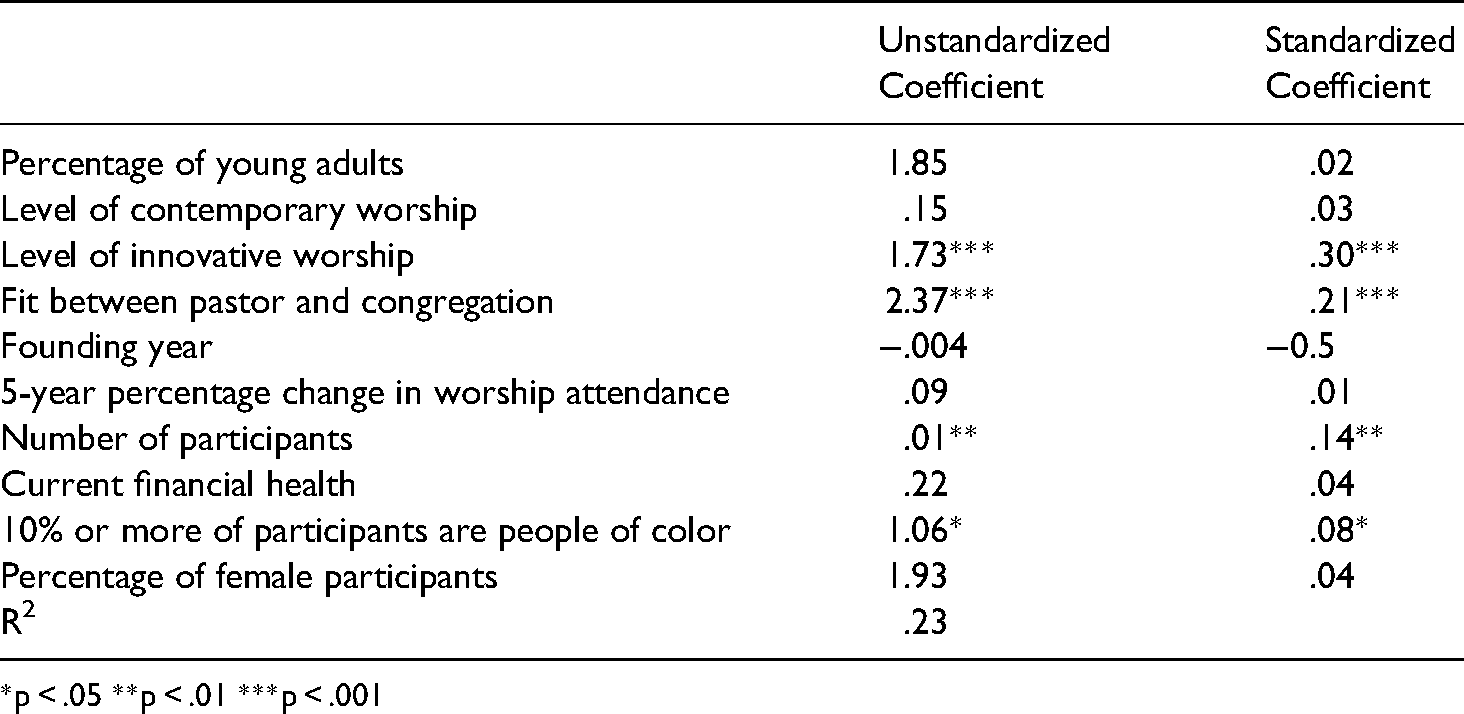
Table 2 shows the results for the regression model. The percentage of young adults in a congregation did not have a statistically significant impact on overall congregational vitality, nor did the level of contemporary worship of a church's primary service. The level of the primary worship service's innovation, however, was highly significant, which suggests that churches that are intentional in finding new and different elements to include in their worship services are more likely to be congregations that are experiencing overall congregational vitality. The lack of significance of contemporary worship, though, suggests that these innovations do not necessarily have to include contemporary worship to be effective.
OLS Regression of Predictors of Overall Congregational Vitality (n = 546; listwise deletion used for cases with missing data).
*p < .05 **p < .01 ***p < .001
Consistent with earlier findings on research on vitality in the UCC, the level of fit between the pastor and congregation was also highly significant, indicating that churches with a good fit between their pastor and congregation also tend to be those that are experiencing the most overall vitality. The founding year of a congregation had no effect on overall vitality, however, which may be encouraging to congregations that a congregation of any age can potentially be a vital congregation. Interestingly, the five-year change in worship attendance also did not have a significant impact on overall congregational vitality; this may come as a relief to congregations who have seen their attendance numbers decline over time to know that the most vital congregations are not inherently those that are growing.
Finally, in examining the control variables, the total number of participants was significantly associated with overall congregational vitality; thus, while growth was not associated with congregational vitality, larger congregations tend to be those that are more vital. A congregation's self-reported current financial health was not significantly associated with overall congregational vitality. The percentage of female participants did not have a significant impact on overall congregational vitality, though congregations with 10 percent or more participants who are people of color were more likely to have increased overall congregational vitality at a statistically significant level.
Discussion and Conclusion
While this analysis by no means offers definitive evidence for factors that influence overall congregational vitality in UCC congregations, it does offer some indications of areas of focus that might be productive for congregations seeking to increase their overall level of vitality. First, some of the common “silver bullets” and areas of concern for congregations did not have an impact on overall congregational vitality in this particular model. The percentage of young adults in a congregation and level of contemporary worship did not significantly impact overall congregational vitality across congregations. While seeking to increase the participation of young adults in congregational life and changing styles of worship might be good strategies or authentic to the missions of individual congregations, these should not necessarily be leaned on as the solutions to low congregational vitality. Similarly, increasing worship attendance over time does not necessarily seem to be associated with overall congregational vitality, although it should be noted that congregations with more participants did tend to experience more vitality, though independent of whether their participants specifically in worship grew or declined over time. This is consistent with previous research on the UCC that also did not find congregational vitality to be associated with congregational growth, though the model here did not find an inverse relationship between growth and vitality, as suggested in a previous study.
In addition, similar to previous research on UCC congregations, the age of a congregation was not significantly associated with overall congregational vitality, indicating that both the newest and oldest congregations have many gifts that can create a vital community for their participants. Current financial health, too, was not associated with overall congregational vitality. While churches in financial difficulty are likely experiencing increased stress and difficult conversations regarding budget, it may be helpful to know that even churches experiencing financial challenges may have a path toward overall congregational vitality. Also, the proportion of female participants did not have an impact on overall congregational vitality, which contributes to the line of research from Woolever et al. that found mixed results on the relationship between gender ratios in congregations and vitality. 17
Factors that do appear to be important to congregational vitality included the fit between the pastor and the congregation, innovation in worship, racial/ethnic diversity, and as mentioned previously, congregational size. This information may be particularly helpful to congregations that are entering the “search and call” process, who might be well served to pay close attention to the level of fit between their Pastoral candidates and their congregation. Also, congregations may find benefit in experimenting with worship style given the connection between innovation and overall congregational vitality found here, although it should be noted that innovation may manifest differently depending on the setting, and not one type of innovation may necessarily work for any one church, which the lack of correlation between contemporary worship and overall vitality may corroborate. Even minimal levels of racial/ethnic diversity appear to be positive for congregational vitality, which suggests that diverse congregations are vital congregations. While a congregation's ability to be inclusive and diverse is important regardless of implications for vitality, these findings suggest that congregations which are able to engage in meaningful work to create an inclusive and diverse congregational setting are also the congregations who experience overall vitality.
While this research offers some insights, it does also include some limitations. First, the data are obviously specific to the UCC and its findings may not be applicable across all faith communities. Further research that looks at these factors in other faith community settings may yield valuable insights about what factors are consistent across faith communities and which may be specific to particular settings. Additionally, the UCC FACT data set is still in the process of having extensive regional and setting (e.g. urban, suburban, and rural) data added to it and the inclusion of this in models may help to further explore whether these factors influence congregational vitality or mitigate elements in this model that contribute to congregational vitality. Furthermore, the presence of geographic variables will enable a survey weight to be developed; however, it should be noted that the overall characteristics of this data set are generally reflective of known UCC congregational characteristics. Finally, this survey was conducted at a time when COVID-19 was just starting to reshape congregational life, the full impact of which will not be known for years. The data here represent a specific point in time that may or may not be relevant to the congregational realities of the future.
Despite these limitations, ultimately this study may help congregations rethink how they assess their own vitality. The findings here suggest that congregations that have invested in increasing their overall vitality might want to shift their focus away from questions of how to increase the size of their membership, worship participants, budget, and income, and toward questions that consider vitality along the lines of Bobbitt's conceptualization as encompassing connections with God, with each other, and with the world. 18 While people and dollars are relatively easy measures and certainly describe important elements of congregational life, a deep consideration of vitality is likely to require reflection on questions whose answers are less readily measurable, but more indicative of how the congregation is actually faring. Considering the findings presented here, congregations may want to ask questions internally such as, How does a potential pastor fit with the way we seek to develop our mission and identity? Are we engaging in innovative worship and doing so in a way that is authentic to our congregation? How do we actively work to be welcoming and inclusive? Do we go beyond our words and intentions to meaningful action? While the findings on congregational size may, on the surface, look like a numbers-based question, this could reflect capacity more than numbers. For instance, if a congregation needs at least two-to-three people to run a program regardless of program size, this proportionally requires more engagement from members of a smaller congregation than a larger one. Thus, a congregation may want to ask what proportion of participants are engaged in supporting church life rather than looking strictly at how many people are attending worship each week. Overall, however, this research hopefully represents a step in the right direction to understand the underpinnings of overall congregational vitality and can be the basis for future research on this topic, as well as a source of conversation for congregations seeking to cultivate their own vitality.
