



Abstract
This meta-analysis of 51 studies examines the relationship between various kinds of parental involvement programs and the academic achievement of pre-kindergarten-12th-grade school children. Analyses determined the effect sizes for various parental involvement programs overall and subcategories of involvement. Results indicate a significant relationship between parental involvement programs overall and academic achievement, both for younger (preelementary and elementary school) and older (secondary school) students as well as for four types of parental involvement programs. Parental involvement programs, as a whole, were associated with higher academic achievement by .3 of a standard deviation unit. The significance of these results is discussed.
Keywords
Review of the Literature
Background of the Problem
Over the past four decades educators have been increasingly concerned about the degree to which parents are involved (or uninvolved) in their children’s education (Ferrara, 2009; Gibson & Jefferson, 2006; Mapp, Johnson, Strickland, & Meza, 2008). The presence of more parents in the work force, the fast pace of modern society as a whole, and the declining role of the family have all been reasons that some social scientists have pointed to, to explain an apparent decline in parental involvement in education (Jeynes, 2006, 2010; Mapp et al., 2008). Educators also realize that children in urban areas may be influenced by these realities as much or more than any group in the country (Jasis & Ordonez-Jasis, 2012; Lightfoot, 2007; Mapp et al., 2008).
As delineated by the United Code of Law (USCS 7801 (32), parental involvement is defined as “the participation of parents in regular, two-way, and meaningful communication, involving student learning and other school activities.” Parental involvement programs are school-sponsored initiatives that are designed to require or encourage parental participation in their children’s education. Joyce Epstein (2001) has defined six different types of parental involvement that include parenting, communicating, volunteering, learning at home, decision making, and collaborating with the community. Nevertheless, subsequent research has indicated that Epstein’s rubric is probably too simplistic (Jeynes, 2005, 2007, 2010).
Purpose of the Study
Many educators have highlighted the importance of parental involvement, if children are to do well in school (Ferrara, 2009; Gibson & Jefferson, 2006; Mapp et al., 2008). However, there has never been a meta-analysis published in a journal that is focused specifically on the efficacy of parental involvement programs. A meta-analysis statistically combines all the relevant existing studies on a given subject to determine the aggregated results of said research. Consequently, the research community has clearly determined that the voluntary expression of parental involvement is strongly related to school outcomes. In contrast, however, social scientists can really offer no genuine consensus about the effectiveness of school-based parental involvement programs. As a result, the academic community cannot even give guidance to schools about whether they should even initiate family involvement programs at all. Without this knowledge, it is not clear whether schools should attempt to enhance parental engagement or whether such activities should be left up to with parents with schools practicing a more laissez faire approach to parental participation (Jeynes, 2010). To be sure, it is vital to determine whether schools should be actively engaged in sponsoring such programs. Moreover, it is also important to determine whether specific types of parental involvement programs work. To the extent that it is apparent that there is no real consensus in the scholarly community about whether these school-based system work, there is also virtually no agreement about what programs work best. As much as academics have tried to alleviate the achievement gap that often exists between urban and suburban students, it is unacceptable to not know if school-based family engagement programs can help alleviate this gap (McKenzie, 2008).
There have been isolated attempts to assess the effects of parental involvement programs to some degree. Mattingly, Prislin, McKenzie, Rodriguez, and Kayzar (2002) conducted a research synthesis. This study, however, suffered from the weaknesses of being nonmathematical in nature, using a “vote-counting” approach to analyzing the data rather than conducting an actual meta-analysis. In addition, the Mattingly study did not include a complete a list of parental involvement programs. In fact, the Mattingly study omitted some important studies that should have been included in their research synthesis. In spite of the fact that Mattingly and her colleagues used a vote-counting approach rather than a mathematical approach, that is, a meta-analysis, and did not include a number of highly regarded published studies, they concluded that parental involvement programs demonstrated virtually no influence on student academic achievement.
Chad Nye and his colleagues (2006) also undertook what might be called a mini-meta-analysis, which, unlike the Mattingly study, was never published in a journal. This study, however, did not meet the methodological level of the Mattingly study, except that it did include an attempt to quantify the results. For reasons that are unclear, it was limited overwhelmingly to doctoral dissertations, and although it was done 4 years later than the Mattingly study, it included even fewer high quality published studies than did Mattingly’s work. Most of the studies included in their meta-analysis are not listed in their reference section. Nye’s study also includes some studies that have reciprocal peer tutoring (RPT), in which this variable cannot be disentangled from the parental involvement variable. Therefore the Mattingly study is still the research that is cited much more often.
The Mattingly (2002) study attempted to build on a previous relatively simple meta-analysis undertaken by Fan and Chen (2001). The Fan and Chen study concluded that parental involvement, as a general construct, was associated with higher academic outcomes. However, the Fan and Chen study made no attempt to specifically address the influence of involvement programs, and therefore can offer little guidance to schools or parents regarding their efficacy.
Importance of determining if parental involvement programs work
Resolving the issues of whether school-based parental participation programs work is particularly important because various social scientists believe that parental engagement is one of the most puissant forces that can improve the school outcomes of urban youth (Hara, 1998). Many educators and sociologists have argued that in modern society, in particular, parental involvement may be especially salient due to elevated family dissolution rates, numerous two-parent working families, and unique sociological pressures on children. These variables are apparent in the United States as a whole, but they are especially obvious in urban areas and among many families of color (Ferrara, 2009; Gibson & Jefferson, 2006; Sy, 2006). It is one thing to assert that voluntary parental participation yields, on average, higher educational outcomes than would otherwise be the case. Indeed, the evidence for this conclusion is strong and consistent, especially when one includes more subtle components of parental involvement (Jeynes, 2005, 2007, 2010). However, it is quite another thing to conclude that school-based parental involvement programs work (Jeynes, 2003a). In fact, it is quite possible and even reasonable to conclude that while voluntary expressions of such family engagement work, school programs might be quite ineffective.
The fact is that there has never been an academic article primarily dedicated to using a meta-analysis to determine if parental involvement programs work. This fact largely not only demonstrates a dearth of knowledge that exists regarding the utility of these programs but also what types of parental involvement programs would help student achievement the most (Christian, Morrison, & Bryant, 1998; Epstein, 2001; Henderson & Mapp, 2002). Both parents and teachers need specific information to determine whether only voluntary expressions of family involvement work, or if school-initiated programs can work as well (Jeynes, 2005). In addition, teachers, parents, and principals need guidance to maximize the efficacy of parental involvement programs, if in fact they work at all (Jeynes, 2007; Mapp et al., 2008).
Although numerous studies have been done that examine the effects of school-sponsored parental involvement programs, many of these studies examine only particular aspects of parental involvement, examine parental involvement only in a specific context, or are interested in the effects of parental involvement only on particular groups (Sy, 2006). Even when researchers address parental engagement generally, they have used small samples to address the effects of parental involvement (Crouter, Helms-Erickson, Updegraff, & McHale, 1999; Ferrara, 2009). As a result of the specific nature and size of these studies it is difficult to make generalizations to the general population and to urban residents specifically (Gibson & Jefferson, 2006). There are now a sufficient number of studies that have been done examining these programs so that a meta-analysis can supply information regarding their overall effectiveness.
Theoretical Framework
With the above considerations in mind, it is clear that the theoretical framework for assessing the utility of parental involvement programs is quite different from that of addressing the effectiveness of voluntary expressions of parental involvement. In the case of voluntary expressions of mother and father participation, the primary issues really come down to the degree to which parents can make a difference in raising the grades and test scores of their children (Jeynes, 2003a, 2005, 2007). On the issue of voluntary parental involvement, generally social scientists on both sides of the debate are in agreement that parents can make a difference along these lines. In the case of addressing formal programs for such involvement, however, there is much less consensus. The debate instead rests on whether schools can help parents, even perhaps previously unmotivated parents, to improve their children’s outcomes. The essence of this theoretical debate was laid out in a recent article in Teacher’s College Record, in which the questions were asked as to whether schools can effectively teach parents how to become involved, and whether they can effectively motivate parents that may have not demonstrated any previous inclination to become involved (Jeynes, 2010). The contents of this article really set the stage for this meta-analysis that follows.
Based on the article mentioned above (Jeynes, 2010), the theoretical framework really comes down to a debate between those who believe that parental involvement must be voluntary to be effective and those who assert that schools can teach parents how to become involved, and that they can motivate parents who might otherwise have no inclination to become involved (Gensheimer, Ayers, & Roosa, 1993; Hughes & Black, 2002; Jeynes, 2010; McGhee & Waterhouse, 2002). Some social scientists assert that parental expressions of support, like similar human expressions of love, self-discipline, and loyalty, can really only successfully operate when they are voluntary acts (Gensheimer et al., 1993; Hughes & Black, 2002; McGhee & Waterhouse, 2002). They assert that on this basis, parents either will or will not be involved, based on their own individual voluntary decisions (Hughes & Black, 2002; McGhee & Waterhouse, 2002; Pugh, 1985). That is, schools cannot successfully force parents to be involved any more than one can force one person to love another or be loyal to someone against his or her will (Barber, 2004; Batson, Armad, & Stocks, 2004). In contrast to this perspective, other social scientists opine that it is possible to teach fathers and mothers how to become more fully engaged in their children’s education (Epstein, 2001; Henderson & Mapp, 2002; Mapp et al., 2008). Those who maintain this position often have perspectives either founded in, or consistent with, Social Learning Theory or Behaviorist Theory, but they do not necessarily hold to the edicts of theories (Epstein, 2001; Henderson & Mapp, 2002; Mapp et al., 2008). Instead, they may espouse an alternative perspective based on the notion that behavior can be modified (Shumow & Lomax, 2002; Smith & Sterns, 1997).
Although the Teachers College Record article (Jeynes, 2010) lays out the basis for this theoretical debate just described, it adds another ingredient to the debate, which makes resolving the issue of the efficacy of parental involvement programs even more interesting (Jeynes, 2010). The author asks a question that leaves room for a middle ground on this theoretical framework debate. That is, even if one assumes that at least some components of parental involvement are teachable, are the most salient components of parental involvement able to be passed on to others? The answer to this question may, more than anything else, determine the extent to which parental involvement programs help students. Nevertheless, it is also true that this last question introduces a second research question. That is, even if parental involvement programs work, which are the types of programs that are most effective? Both questions are vital for academics to answer if they are to be able to give guidance to teachers, principals, and parents about how to inaugurate a school-based parental involvement program (Jeynes, 2003a, 2005, 2007).
The Need for a Meta-Analysis for Urban Students
As insufficient as the Mattingly study might seem, the reality is that there has been no meta-analysis that has been published in a journal since then that has dedicated an article to resolving the question of whether parental involvement programs are effective. In addition, no meta-analysis or research synthesis has ever been undertaken that distinguishes between the various types of parental involvement programs. Knowing which programs work best is as important as knowing whether programs help overall. Most teachers and parents have a sense that their engagement in their children’s schooling will ameliorate academic outcomes. They may or may not believe that involvement programs work, but they likely have no notion about which of these programs work best. Given the importance of urban education and the potential that parental involvement has to help scholastic outcomes, it is vital to ascertain the extent to which specific involvement programs can raise urban student achievement.
Two Research Questions Addressed in this Study
Two research questions, therefore, emerge, and are especially pertinent to parents and educators. First, do school programs of parental involvement positively influence prekindergarten through 12th-grade students? Second, what types of parental involvement programs help those students the most? The types of parental involvement are defined on the basis of those most frequently by Epstein (2001) and other researchers to help obtain insight about whether particular kinds of programs appear to work better than others. The practice of particular kinds of programs generally reflects the views of the initiators of these efforts, regarding which aspects of parental involvement are most important. To answer these two key questions, it is imperative to know what the overall body of research indicates. A meta-analysis statistically combines all the relevant existing studies on a given subject to determine the aggregated results of said research. This study utilizes meta-analysis to examine the effects of parental involvement programs on prekindergarten through 12th-grade children, addressing each of the two research questions listed.
Method
Analytical Approach
Research Methods and Data Analysis Plan For the Meta-Analysis on the Achievement Gap
This meta-analysis examined the relationship between parental involvement programs and pre-kindergarten-12th-grade school student achievement. This meta-analysis first addressed whether there is a statistically significant relationship between school-based parental involvement programs and student academic outcomes (Research Question No. 1). The second analysis determined what specific types of parental involvement programs help those students the most (Research Question No. 2).
The procedures employed to conduct the meta-analysis are outlined under the heading “Analytical Approach,” and the following headings are listed below: Data Collection Method, Statistical Methods, Study Quality Rating, and Effect Size Statistics, and Defining of Variables.
Each study included in this meta-analysis met the following criteria:
It needed to examine parental involvement in a way that could be conceptually and statistically distinguished from other primary variables under consideration. For example, if a school implemented a program that involved nine key features, including parental involvement, and the influence of parental involvement could not be statistically isolated from the other features, the study was not included in the analysis.
It needed to include a sufficient amount of statistical information to determine effect sizes. That is, a study needed to contain enough information so that test statistics, such as those resulting from a t test, analysis of variance, and so forth, were either provided in the study or could be determined from the means and measures of variance listed in the study.
If the study used a control group, it had to qualify as a true control group, and therefore be a fair and accurate means of comparison. Moreover, if the research utilized a control group at some times but not others, only the former comparisons were included in the meta-analysis.
The study could be a published or unpublished study. This was to reduce the likelihood of publication bias. The databases that were searched and the types of studies that were found are listed in the appendices.
Due to the nature of the criteria listed above, qualitative studies were not included in the analysis. Although qualitative studies are definitely valuable, they are difficult to code for quantitative purposes and any attempt to do so might bias the results of the meta-analysis.
Data Collection Method (Coding and Rater Reliability)
To obtain the studies used in the meta-analysis, a search was performed using every major social science research database (e.g., Psych Info, ERIC, Dissertation Abstracts International, Wilson Periodicals, Sociological Abstracts, and so forth), totaling 60 databases, to find studies examining the relationship between parental involvement programs and the academic achievement of children from Grades pre-kindergarten-12. The search terms included parental involvement, parents, schools, family, education, parental support, partnership, programs, communication, expectations, reading, attendance, homework, household, rules, and parental style. Reference sections from journal articles on parental involvement programs were also examined to find additional research articles. E-mails were also sent to each of the Education department chairs of the more than 100 Research 1 universities in the United States, asking them if there were any faculty in their department who had either recently completed or was just about to complete a study examining the effects of parental involvement programs. Although this comprehensive search yielded hundreds of articles and papers on parental involvement programs, nearly all of these articles were not quantitative in nature. The research team obtained a total of 73 studies that addressed the relationship under study, and found 51 studies that had a sufficient degree of quantitative data to include in this meta-analysis. Among the 51 studies that possessed a sufficient degree of quantitative data, the total number of subjects was approximately 13,000.
A number of different characteristics of each study were included for use in this study. These characteristics included (a) report characteristics, (b) sample characteristics, (c) intervention type, (d) the research design, (e) the grade level or age of the students, (f) the outcome and predictor variables, (g) the length (in weeks) of the parental involvement program, (h) the attrition rate, and (i) the estimate of the relationship between parental involvement and academic achievement. Two coders, who had been coding for at least 10 years, coded the studies on these characteristics, and had 96% agreement on their coding of the following study characteristics:
Report characteristics
Each study entry began with the name of the author of the study. Then the year the study was recorded, followed by the type of research report. Research reports were defined either as a journal article, book, book chapter, dissertation, master’s thesis, government, school, or private report, conference paper, or other type of report.
Sample characteristics
These included the number of students sampled, their locations, and how they were selected, for example, via random selection, stratified random selection, or via advertisement.
Intervention type
The experimental or procedural manipulation used, if any, was recorded to determine the effects of parental involvement programs on student achievement.
Research design
The studies in this meta-analysis were categorized into three basic types of design. First, it was noted which studies employed some type of manipulation to assess the effects of parental involvement programs.
The second type of design included studies that took cross-sectional measures of the effect of a parental involvement program, without utilizing any type of manipulation. The third type of design involved the calculation of a correlation coefficient between the parental involvement program and student educational outcomes.
For studies that employed a manipulation to measure the effects of a parental involvement program, the following were recorded: (a) the length, frequency, duration, and total number of training sessions; (b) the method of training (workshop, individual meetings, phone calls, videotape, email communication, newsletter); (c) the type of behavioral or achievement-related outcome measure (e.g., standardized achievement test; nonstandardized achievement test; or class grades); (d) the unit of analysis (individual student or classroom) at which the effect size was calculated; and (e) the magnitude of the relationship between parental involvement and student achievement.
For the cross-sectional studies and correlation studies, if it was available, the following were also recorded: (a) the socioeconomic status of participants in the sample; and (b) the types of behavioral and academic measures that were used.
The length (in weeks) of the parental involvement program, which was particularly important because secondary analyses were performed to determine if there was a relationship between the length of the parental involvement program and the effects that emerged in various studies.
The grade level or age of the students was coded, including means and standard deviations when they were available.
The outcome and predictor variables from each study were coded to include the different ways that achievement was measured.
Attrition rate
When available, the attrition rate of each study was coded.
The estimate of the relationship between parental involvement and student achievement
The process of the effect size estimation is described in the next section.
Statistical Methods and the Effect Size Statistic
Effect sizes were computed from data in such forms as t tests, F tests, p levels, frequencies, and r-values via conversion formulas provided by Glass and his colleagues (Glass, McGaw, & Smith, 1981). When results were not significant, studies sometimes reported only a significance level. In the unusual case that the direction of these not significant results was not available, the effect size was calculated to be zero.
For studies with manipulations, I used the standardized mean difference to estimate the effect of parental involvement. The d-index (Cohen, 1988) is a scale-free measure of the separation between two group means. Calculating the d-index for any comparison involved dividing the difference between the two group means by either their average standard deviation or by the standard deviation of the control group. In the meta-analysis, I subtracted the experimental group mean from the control group mean and divided the difference by their average standard deviation. Hence, positive effect sizes indicated that various factors were successful in reducing the achievement gap. As a supplement to these analyses, the Hedges’ “g” measure of effect size was used (Hedges, 1981). Since it employed the pooled standard deviation in the denominator, it customarily provided a more conservative estimate of effect size. Hedges also provided a correction factor that helped to adjust for the impact of small samples.
For studies that involved cross-sectional measures of the relationship between parental involvement and achievement, the following procedures were undertaken. For those studies that attempted to statistically equate students on other variables, the preferred measure of relationship strength was the standardized beta-weight, β. These parameters were determined from the output of multiple regression analyses. If beta-weights could not be obtained from study reports, the most similar measures of effect (e.g., unstandardized regression weights) were retrieved.
For studies that involved cross-sectional measures but included no attempt to statistically equate students on third variables, the results from the t tests, F tests, and correlation studies provided by the researchers in the study were used. Probability values were used as a basis for computation only if the researchers did not supply any of information on the test statistics just mentioned.
Calculating average effect sizes
A weighting procedure was used to calculate average effect sizes across all the comparisons. First, each independent effect size was first multiplied by the inverse of its variance. The sum of these products was then divided by the sum of the inverses. Then, 95% confidence intervals were calculated. As Hedges and Vevea (1998) recommend, all the analyses were conducted using fixed-error assumptions in one analysis and applied random-error assumptions in the other.
If there was more than one effect size presented in the results section, the effect size that was chosen was based on that which referred to (a) the overall sample, and (b) the purest measure of parental involvement. In the case of results that included clear statistical outliers, the presence of these outliers was acknowledged and then supplemental analyses were run without such an outlier to estimate the degree to which the presence of an outlier might have affected the results.
Tests of homogeneity were completed on the parental involvement programs to gain a sense of the consistency of specific parental involvement measures across studies.
Analyses were also undertaken to address a variety of important questions that provided social scientists with more insight into the relationship between parental involvement and academic outcomes: (a) the effect sizes for parental involvement programs using both standardized and nonstandardized academic measures; and (b) the effects of parental involvement programs in cases in which parental involvement was the only independent variable considered versus when it was part of a broader intervention.
Study Quality Rating
Two researchers coded the studies independently for quality, the presence of randomization, and whether both the definitional criteria for parental involvement and specific aspects of parental involvement were met. Study quality and the use of random samples were graded on a 0 (lowest) to 3 (highest) scale. Quality was determined using the following:
(a) Did it use randomization of assignment? (b) Did it avoid mono-method bias? (c) Did it avoid mono-operation bias? (d) Did it avoid selection bias? (e) Did it use a specific definition of parental involvement?
We calculated interrater reliability by computing percentage of agreement on the definition of parental involvement, the specific components examined in each study, issues of randomization, and quality of the study. Interrater reliability was 100% on whether a study examined parental involvement, 97% for the specific components of parental involvement examined in a given study, and 91% for the quality of the study. For the specific components of quality, interrater agreement percentages were 94% for randomization, 94% for avoiding mono-method bias, 94% for avoiding mono-operation bias, 90% for avoiding selection bias, and 97% for using a specific definition of parental involvement.
Two supplementary analyses were done to include first, only those studies with quality ratings of 2 and 3, and second, only those studies with quality ratings of 1 to 3.
Defining of Variables
For the purposes of this study, parental involvement was defined as parental participation in the educational processes and experiences of their children. The specific parental involvement programs, defined below, were those most frequently applied by the researchers (Deslandes, Royer, Turcott, & Bertrand, 1997; Epstein, 2001). That is, the types of parental involvement programs were based on the components of parental involvement as described by Epstein (2001) and others. Theorists such as Epstein aver that such expressions of parental engagement such as reading with children, communication both within the family and between the family and the school, checking homework, and so forth, were the primary expressions of parental involvement. In addition to this consideration, several parental involvement researchers have argued that there are certain classifications of students that often do not perform well scholastically that therefore especially need parental involvement programs (Henderson & Mapp, 2002; Mapp et al., 2008). Consequently, many educators believe that it is imperative that social scientists determine whether disadvantaged- and ESL-students benefit from these programs. Therefore, such programs were also considered separately.
General parental involvement program
Included the overall measure of parental involvement programs, as defined by the researchers of a particular study. If a study did not have an overall measure of the parental involvement program, the effect size of this variable was determined by combining all its discrete measures.
Shared reading program
This was any program that encouraged parents and their children to read together either material required by the school, recommended by the school, or independently determined by the parents and their youth.
Emphasized partnership program
This included any effort that was designed to help parents and teachers collaborate with one another as equal partners in any attempt to improve children’s academic and/or behavior outcomes. It involved parents and teachers working together to develop common strategies, rules, guidelines, and expectations that were thought be necessary, appropriate, and constructive to help the youth live up to their full potential.
Checking homework program
This included any school-based parental involvement initiative that was designed to encourage mothers and fathers to become engaged more actively in their children’s schooling by checking everyday whether their youth had completed their homework. Schools generally then required the parents to sign a statement each day indicating that they had fulfilled this duty.
Communication between parents and teachers program
This program incorporated efforts by schools to foster increased communication between parents and teachers. This emphasis was frequently initiated to maximize teamwork, layout curricular and behavioral direction for children, and to minimize misunderstandings.
Head start program
This set of studies combined the effects of all the Head Start programs that placed a special emphasis on parental involvement.
ESL teaching program
This included school-based efforts to raise parental involvement levels by teaching parents English via ESL programs. By enabling parents to master English, it empowered them to realize higher levels of parental participation than has ever been accomplished by these parents.
Results
Overall, the results of the meta-analysis indicate that there is a relationship between pre-kindergarten-12th-grade school parental involvement programs and the academic success of students. The results presented here are using analyses based on random-error assumptions. The rationale for presenting these results rather than those using fixed-error assumptions is to utilize analyses that will yield more conservative effect sizes. As one would expect, the analyses based on fixed-error assumptions yielded somewhat larger effect sizes. The finding indicating a relationship between these programs and educational outcomes held first for the parental involvement programs overall, and for most of the specific programs, as well. Results of this study indicate the overall parental involvement program variable yielded a statistically significant outcome of .30 of a standard deviation. Table 1 lists the effects sizes of the 51 studies in descending order. All but two of the effect sizes were in the positive direction and ranged from 1.91 to –.21. The number of elementary school programs (with or without the inclusion of prekindergarten and kindergarten programs in this category) far outnumbered such initiatives at the secondary school level. The studies with the smallest samples produced the most extreme effect sizes on either end, consistent with the “funnel” pattern ideal in effect sizes (Greenhouse & Iyengar, 1994). About 65% of the studies (33 of 51) produced effect sizes between .20 and 1.00. This indicated that most of the effects that emerged were not small. Beginning with parental involvement programs in general, the effect sizes were quite similar for the studies that used sophisticated controls, like race, socioeconomic status, and gender, and those that did not.
List of Studies Used in the Meta-Analysis for Parental Involvement, the Year of the Study, and the Effect Sizes for the Various Studies

Note: a. = Effects sizes are in standard deviation units
Table 2 summarizes the studies by average-year of the study, sample size, quality of study, and the quality of the definition of parental involvement. The average year of the study was 1992.4; that is, between 1992 and 1993. About 69% of the studies took place from 1989 and afterward. The average sample size was 262.65. Among the categories listed, the largest number of studies had a sample size of between 1 and 99, although an almost equal number of studies had sample sizes of 100 to 499. The average quality of the study and the definition of parental involvement in each of the studies were each toward the middle of the midpoint of the range of ratings allowable, 0 to 3. The mean quality of the studies was 1.63, with most (about 62%) of the studies being rated either 2 or 1. The mean quality of definition for parental involvement for the studies was 1.90, with most (about 65%) of the studies being rated either 3 or 2. Therefore, most of the studies were reasonably high in quality. Among the most important correlations, there were no statistically significant relationships between effect size and study quality, year of the study, or randomization.
Means for Measures Assessing the Quality of Study, whether a Random Sample was used, Year of Study, and Sample Size for the 51 Studies Included in the Meta-Analysis

Research Question No. 1—Effect Sizes for Parental Involvement Programs Overall
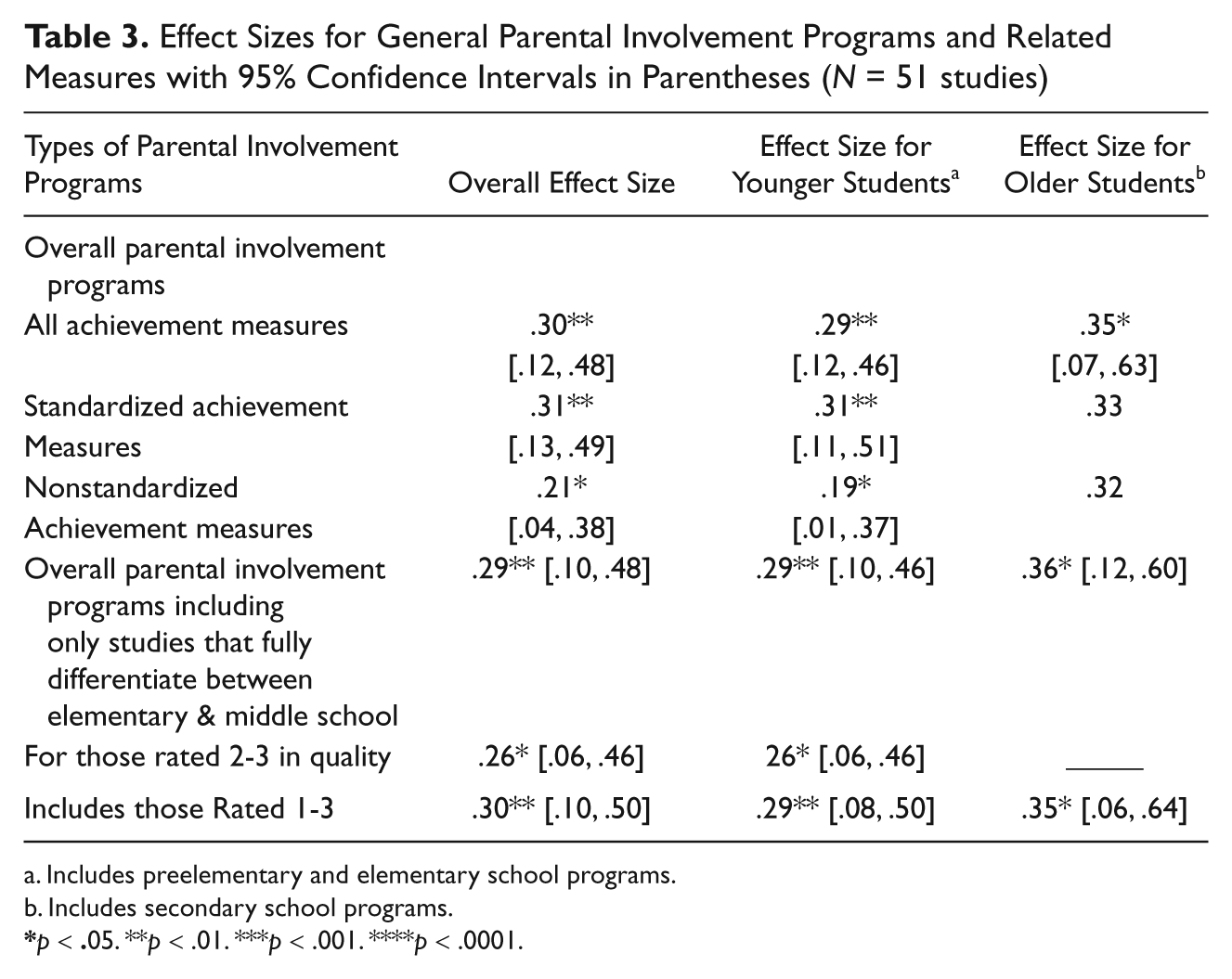
Table 3 lists the effect sizes that emerged for parental involvement programs as a whole, addressed under Research Question No. 1. By definition, therefore, these results do not assess the influence of parental involvement which already exists, but attempts by schools to improve parental practices along these lines. Statistically significant effect sizes emerged for parental involvement school-based programs generally, as well as for both younger (preelementary and elementary school) and older (secondary school) student programs specifically. The effect size for the overall parental involvement programs variable was .30 (p < .01) of a standard deviation, which was statistically significant at the .01 level of probability. This precise effect size held not only for parental involvement programs overall, but also for programs for both younger (preelementary and elementary school), .29 (p < .01), and older (secondary school) students, .35 (p < .05), specifically. These results essentially held even when two studies were removed from consideration that included analyses for both elementary and secondary school students, and therefore were not exclusively included in either the younger or older student category.
Effect Sizes for General Parental Involvement Programs and Related Measures with 95% Confidence Intervals in Parentheses (N = 51 studies)
Includes preelementary and elementary school programs.
Includes secondary school programs.
p < .05. **p < .01. ***p < .001. ****p < .0001.
The relationship between parental involvement programs and educational outcomes was a little stronger for standardized outcomes, for example, standardized test scores, than they were for nonstandardized measures such as GPA and teacher ratings. The effects for the standardized measures were .31 (p < .01) both for parental involvement programs overall and these programs at the preelementary and elementary school level. The effects were .33 (p > .05) for secondary school level, but this was not statistically significant. In every case, in terms of absolute numerical value, the results for the nonstandardized assessments were smaller than for the standardized measures. The effects were .21 (p < .05) of a standard deviation for the parental engagement programs overall, .19 (p < .05) for the preelementary and elementary school programs, and .32 (p > .05) for the secondary school programs.
There was a slight positive association between the length of the parental engagement program and positive academic outcomes. The correlation coefficient between the length of the study (in weeks) and the effectiveness of the parental involvement program, as measured in overall standard deviation units) was .07. This result, however, was not statistically significant. The regression coefficient measuring the relationship between the length of the parental involvement program and their effectiveness (in standard deviation units) for older students was .09 and for younger students it was .05. Neither of these results was statistically significant.
Test of Homogeneity
For most of the parental involvement variables herein the homogeneity tests were not statistically significant, indicating the researchers tested about the same aspect of parental involvement. The specific aspects of parental involvement that did indicate homogeneity included Shared Reading (χ2 = 1.55, ns), Emphasized Partnership (χ2 = 3.77, ns), Checking Homework (χ2 = 0.97, ns), Communication between Parents and Teachers (χ2= 3.28, ns), Head Start Program (χ2 = 2.89, ns), and ESL teaching (χ2 = 2.72, ns).
Study Quality
In the secondary set of analyses that adjusted for the average quality rating of the study, the effect sizes were slightly different than when no quality adjustments were made. These analyses considered studies that were rated high in quality. The goal was to determine if when only higher quality studies were included or the lower quality studies were removed, if there was any difference in the pattern of results. When only those studies rated 1 to 3 (on a 0-3 scale) were included, the effect size was .30 (p < .01). When studies rated 2 to 3 were included, the effect size was at .26 (p < .05). These results were very similar to those that arose for all the studies combined. Therefore, study quality was not a particularly major factor in explaining the variety of effects that emerged in the studies.
Research Question No. 2—Effect Sizes for Specific Parental Involvement Programs
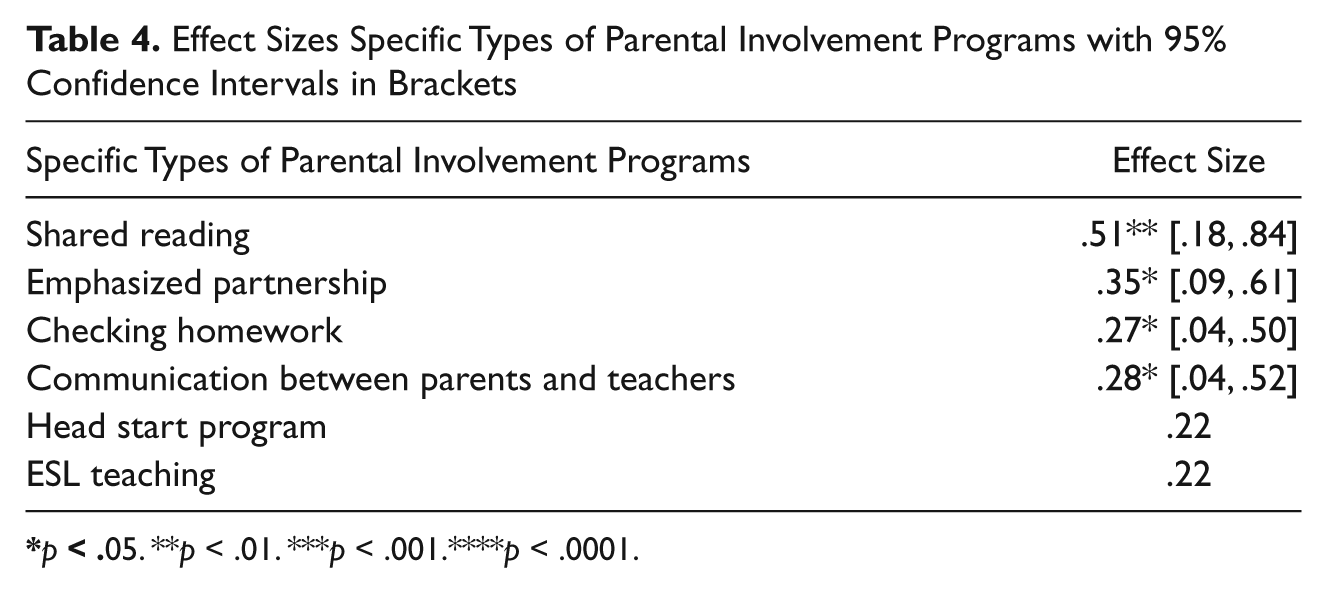
Table 4 lists the effect sizes that emerged for the various types of parental involvement programs, addressed under Research Question No. 2. The effects for different kinds of parental involvement were .51 of a standard deviation for shared reading, p < .05, .35 for programs that emphasized a partnership between parents and teachers, p < .05, and .27 for checking homework, p < .05. Another statistically significant effect also emerged for communications between parents and teachers, .28, p < .05. The effect sizes for Head Start programs, .22, p > .05, and ESL training programs, .22, p > .05, were in the positive direction, but fell short of statistical significance.
Effect Sizes Specific Types of Parental Involvement Programs with 95% Confidence Intervals in Brackets
p < .05. **p < .01. ***p < .001.****p < .0001.
A closer examination at the programs that yielded statistically significant results follows:
Shared reading program
This type of parental involvement program yielded the highest effect size, .51 (p < .01), of all the programs included in this meta-analysis. The Discussion section examines why it is that this type of program has the strongest relationship with educational outcomes.
Emphasized partnership program
This type of program produced an effect size of .35 (p < .05), and included any effort that was designed to help parents and teachers collaborate with one another as equal partners in any attempt to improve children’s academic and/or behavior outcomes. It involves parents and teachers working together to develop common strategies, rules, guidelines, and expectations that were thought be necessary, appropriate, and constructive to help the youth live up to their full potential. This was the second largest effect size of the variety of parental involvement school-based orientations examined in this study.
Communication between Parents and Teachers Programs yielded an effect size of .28 standard deviation units.
Checking homework program
This program produced an effect size of .27 (p < .05), which was smaller than for the other programs that produced a statistically significant result. Because the studies that examined this program yielded very similar results, which meant there was a low variance, a statistically significant result emerged.
Head start programs
The results were not statistically significant although the effect size was technically in a positive direction.
ESL teaching
As with the results for the Head Start programs, ESL Teaching did not yield a statistically significant outcome in one direction or the other. The effect size was in a positive direction, although not to a statistically significant degree.
Overall, meta-analytic results indicate that most of the parental involvement programs examined herein yielded statistically significant relationships with their practice and school outcomes.
Discussion
Research Question No. 1: Is there a statistically significant relationship between school-based parental involvement programs and student academic outcomes?
This study supports the notion that school-based parental involvement programs have a positive relationship with the academic achievement of youth. The fact that most of the programs were at the elementary school level rather than the secondary school level reflects the fact that (a) people tend to emphasize the value of parental participation more at the lower grades than at the higher grades and (b) for a variety of reasons, it may be easier to schools to arrange parental engagement when students are in elementary school than when they become older. Two of the most substantial findings emerging from this study indicated that (a) parental involvement programs quite consistently were related to high educational outcomes and (b) a variety of these programs was associated with higher scholastic achievement than without them.
Research Question No. 2: What specific types of parental involvement programs help those students the most?
This study is very important because it not only supports the notion that parental involvement programs may have an impact, but it specifies which elements of these programs may have the most impact. This information is especially important for parents and teachers to know. If educators are aware of which elements of parental involvement programs are most effective, they can instruct parents accordingly.
It is apparent that parental involvement initiatives that involve parents and their children reading together (i.e., engaging in “shared reading”), parents checking their children’s homework, parents and teachers communicating with one another, and partnering with one another have a noteworthy relationship with academic outcomes. In addition, situation specific parental involvement efforts such as Head Start and ESL training for parents yielded effect sizes in the expected direction, albeit falling short of statistical significance. These results, coupled with past meta-analyses that have focused on voluntary parental engagement, indicate that not only do mother-and father-initiated parental involvement have an impact but also school-initiated programs may as well (Jeynes, 2003a, 2005, 2007). That is, not only are voluntary acts of parental participation associated with positive educational outcomes but also involuntary parental behaviors are as well, ones that are spawned by the encouragements of the school. It should be duly noted that the effect sizes that emerge for parental involvement programs are not as great as the ones found for voluntary acts of this involvement in other meta-analyses (Jeynes, 2003a, 2005, 2007). Nevertheless, the sizes of the numerical results are worthy of one’s attention and were generally statistically significant.
As has been mentioned earlier in this article, in a recent journal article appearing in Teacher’s College Record, a social scientist asked the important question of whether the most salient components of voluntary parental involvement are sufficiently teachable so that they are also the most vital components of school-based parental involvement programs (Jeynes, 2010). Based on the results of this study, the answer to that question appears to be mixed. In previous meta-analyses, the components of parental involvement that are the most salient are the voluntary expressions of this engagement, that is, they have the largest effect sizes. But they are not the same parental engagement components that have the highest effect sizes for parental involvement programs. The reasons for this may vary, but the primary reason is simply because it has only been in the last half-dozen years that social scientists have discovered that the most influential aspects of parental involvement are subtle (Jeynes, 2005, 2007, 2010). And nearly all of the studies included in this meta-analysis were undertaken before these breakthroughs were made. Therefore, to the extent that the meta-analyses of the past several years indicate that the components of parental involvement that have the greatest influence are subtle, one would not expect that the same trends would emerge in this meta-analysis, because the programs included were not based on this paradigm. Although no meta-analysis can therefore provide much insight on the degree to which the subtle aspects of parental engagement are teachable until there is a rubric shift, it can give insight about the teachable nature of other expressions of parental participation.
However, whatever the reasons may be, it is important for teachers and parents to be aware of how the most efficacious components of programs differ from the most effective expressions of voluntary parental involvement. These results may indicate that our society ought to place an emphasis on parental involvement programs in order to raise the academic achievement of youth. These results appear to support the findings of Fan and Chen (2001) and other meta-analyses, which indicate that there is a strong relationship between parental involvement and academic outcomes (Jeynes, 2003a, 2005, 2007).
A closer look at Research Question No.1: The influence of parental involvement programs overall. An important finding of this study is that programs meant to encourage parental support in their child’s schooling are positively related to achievement for children. As expected, the effect sizes that emerged from these analyses were typically not as large as those in other studies that examine voluntary parental involvement (Jeynes, 2003a, 2005, 2007). This is because parents already enthusiastic about supporting the educational progress of their children will, on average, tend to help their children more than parents whose participation is fostered by the presence of a particular program. The positive association between parental involvement programs and educational outcomes also suggests a direction of causality. That is, academic achievement would not influence the presence of parental involvement programs; rather, the reverse would be true.
Although fathers and mothers who initiate high levels of support are more likely to have an ameliorative effect than those parents responding to a particular parental support initiative, it is nevertheless important to discover if parental involvement programs benefit students. For years, teachers and others have opined that many of the scholastically weakest students suffer from a dearth of parental support and engagement. As a result, inspiring parents to become involved, through various programmatic means, could spawn a considerable improvement in educational outcomes among these students.
The results of Research Question No. 1 run contrary to claims by Mattingly and her colleagues (2002) that parental involvement programs are not associated with positive academic outcomes. The results that emerge from the parental involvement programs are noteworthy for a variety of reasons. First, they indicate that encouraging parental support of student academics is generally associated with higher scholastic results. This finding will indubitably reassure myriad teachers attempting to abet additional parental involvement. Second, the findings suggest the benefits of teachers encouraging a higher level of parental participation in their child’s education. Multitudinous teachers claim that reaching out to parents will yield little fruit because parents either cannot or will not become involved (Jeynes, 2004). However, the examination of parental involvement programs in this meta-analysis suggests otherwise, that reaching out to parents may produce positive results.
A closer look at Research Question No. 2: Specific components of parental involvement programs. In addition, most of the individual components of parental involvement were positively and significantly related to educational outcomes. The fact that the various aspects of parental involvement programs yielded statistically significant results highlights the extent to which parental involvement programs are associated with higher student achievement. Much of this meta-analysis examines the specific aspects of parental involvement programs. These findings are particularly helpful in that they indicate which kinds of parental involvement programs have the strongest relationship with academic success.
One of the most fascinating aspects of the results is that although overall the effect sizes for these school-based parental involvement were lower than the effect sizes for voluntary parental involvement from other studies, the effect sizes for certain components of these school-based initiatives equaled or surpassed those found for voluntary expressions of involvement in other studies. The most obvious case is that of shared reading, which was over half a standard deviation unit in this study, but has generally been in the .25 to .35 range in studies addressing voluntary parental involvement. This could indicate that teacher guidance may help parents get the most out of their children in their shared reading experiences. For example, a number of the studies on shared reading programs included explicit questions that parents could ask their children in the process of reading. These types of questions may facilitate the emergence of tangible results in home reading, that otherwise might not have been present.
These results could even point to even a more significant possibility, and that is the importance of teachers doing more to support the values and practices of parents. Myriad parents often complain that schools, rather than support their values and practices, often undermine them. The results of this particular part of the study suggest that teachers should take these parental impressions seriously and do more to back what parents are already doing at home.
This possibility gains even more credence when one considers that the same trend is ostensible for checking homework. That is, the effect sizes for checking homework were greater for school-based programs than what is usually found for voluntary parental checking of homework in other studies. Here is evidence again that parents and teachers working together produce something more than either working alone in isolation. On this basis, one can conclude that the last thing parents and teachers need is an adversarial relationship. Indeed, there are a plethora of teacher education textbooks that will instruct preservice teachers about how to get parents on their side, but there may even be a greater need to begin instructing preservice teachers about how to be on the parents’ side.
The results of the study are significant in the sense of providing an estimate of how much family engagement programs may benefit student achievement. Beyond this, however, from these findings one gets a sense of what “value-added” school-initiated parental involvement programs may provide. There is some indication from these results that, especially on such practices as shared reading and checking homework, school-initiated involvement efforts, when added to existing expressions of parental support, will indeed produce beneficial outcomes. Therefore the results of this meta-analysis should not only be examined in isolation but also viewed in the wider context of the even greater effects of voluntary parental involvement.
Limitations of Study
The primary limitation of this meta-analysis, or any meta-analysis, is that it is restricted to analyzing the existing body of literature. Therefore, even if the researcher conducting the quantitative integrations sees ways the studies included could have been improved, there is no way to implement those changes. A second limitation of a meta-analysis is that the social scientist is limited to addressing the same research questions addressed in the aggregated studies. For example, it would be advisable to have parental expectations measures from all the studies included, but one can only aggregate the existing results.
Recommendations for Further Research
The results of this study are particularly important given the people’s growing cognizance of the salience of parental involvement to maximize student educational outcomes (Bronstein, Stoll, Clauson, Abrams, & Briones, 1994; Hampton, Mumford, & Bond, 1998). Further research should examine the “value-added” nature of school-based parental involvement initiatives. That is, now that various meta-analyses have determined what the overall body of research indicates about the effects of voluntary parental involvement, and now school-based family initiatives, additional research should examine what the impact of involvement is when these two modes are expressed concurrently. These prospective studies should especially focus on the specific shared reading programs and checking homework initiatives that are presented in this article. There is little question that, overall, voluntary parental involvement has a considerably greater impact than school-based family involvement. Nevertheless, the additive feature of programs, when joined to existing expressions of parental engagement, could mean that parents may have even a greater impact on their children’s school outcomes than was previously believed.
Further research is needed to examine why certain parental involvement programs have more of an influence than others. In addition, some of the greatest breakthroughs in parental involvement research over the last 5 years indicate that some of the more subtle aspects of parental involvement have the greatest impact on academic achievement (Jeynes, 2005, 2007, 2010). These subtle components of parental involvement include such expressions as maintaining high expectations of one’s children, having open communication with them, and demonstrating a style of parenting that includes maintaining a loving, but structured home environment (Jeynes, 2005, 2007, 2010). However, the overwhelming number of programs included in this meta-analysis were undertaken before these advances. Consequently, none of the studies in this meta-analysis have included subtle facets of parental participation in their programs. It is essential that parental involvement programs be initiated that include these subtle components and that social scientists assess the effectiveness of these programs. Research assessments such as these are essential to maximize the efficacy of these programs. Such an examination would provide a needed broadening of the array of variables that academics consider when they reflect upon how to foster higher levels of educational attainment (Jeynes, 1999, 2002, 2003b). Additional research should assess the effectiveness of these programs.
Footnotes
Appendix A
List of Search Engines Used in the Meta-Analysis
| Abstracts in Social Gerontology | E-Journals | NetLibrary |
|---|---|---|
| Academic Search Complete | EBSCO Ejournals | Newspapers |
| ACLS Humanities E-BOOK Project | EconLit | Oxford Journals Online |
| ACM Digital Library | Education Index Retrospective: 1929-1983 | Oxford Reference Online |
| Alt-Press Watch | Education Line | Primary Search |
| American Indian Experience | ERIC | PsycARTICLES |
| Annual Reviews | Factiva | PsycINFO |
| Anthropology Plus | Family and Society Studies Worldwide | Public Administration Abstracts |
| AnthroSource | Handbook of Latin American Studies Online | Public Affairs Index |
| AP Images (formerly AccuNet) | Historical Abstracts | Rand California |
| Association Unlimited | Latino Literature | SAGE Premier Journals Online |
| ATLA Religion Database | Lexis Nexis Academic | Science Citation Index (SCI) see Web of Science |
| Black Studies Center | Library Literature & Information Science (H.W. Wilson) | Social Science Citation Index (SSCI), see Web of Science |
| Brill’s New Jacoby Online | Library, Information Science & Technology Abstracts | Social Services Abstracts |
| Business Monitor Online | MAS Ultra – School Edition | SocINDEX |
| Chicano Database | MEDLINE (via OVID) | Sociological Abstracts |
| CINAHL Plus With Full Text | Military & Government Collection | SpringerLink Journals Online Collection |
| Communication & Mass Media Complete | Natural Standard Professional Database | SPORTDiscus |
| Dissertation Abstracts International | NetLibrary | Wiley InterScience (including Blackwell Synergy journals) |
| Dissertation & Theses | Newspapers | WorldCat |

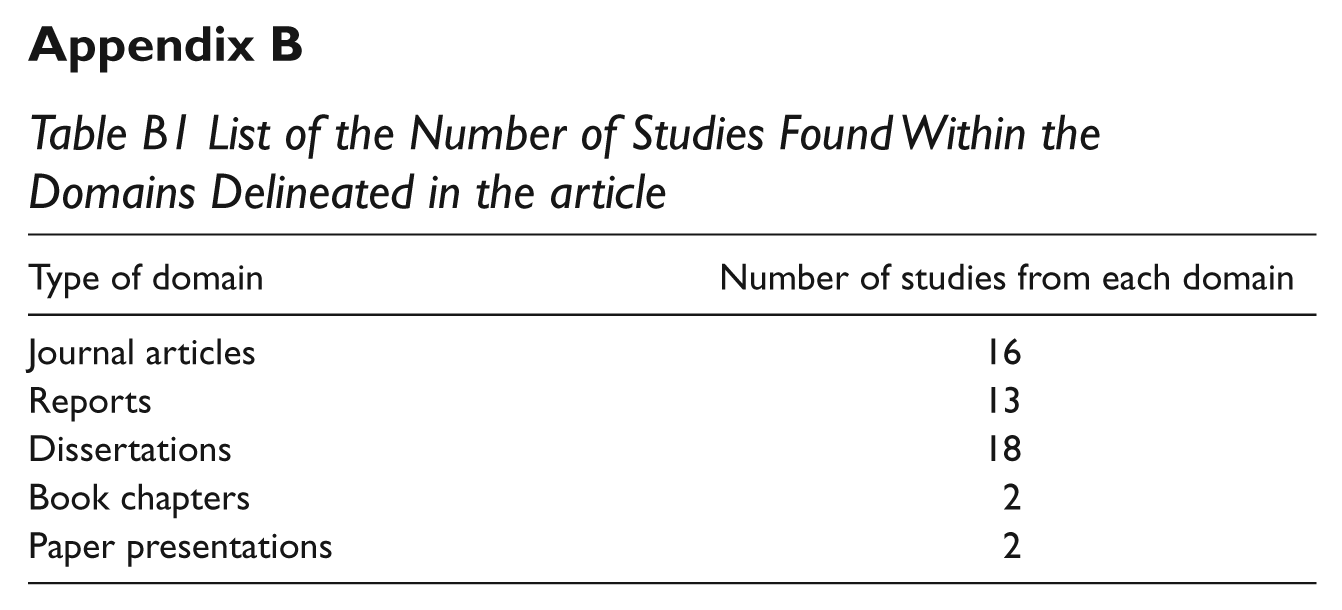
Appendix B
List of the Number of Studies Found Within the Domains Delineated in the article
| Type of domain | Number of studies from each domain |
|---|---|
| Journal articles | 16 |
| Reports | 13 |
| Dissertations | 18 |
| Book chapters | 2 |
| Paper presentations | 2 |
Declaration of Conflicting Interests
The author(s) declared no potential conflicts of interest with respect to the research, authorship, and/or publication of this article.
Funding
The author(s) received no financial support for the research, authorship, and/or publication of this article.
Bio
References
Supplementary Material
Please find the following supplemental material available below.
For Open Access articles published under a Creative Commons License, all supplemental material carries the same license as the article it is associated with.
For non-Open Access articles published, all supplemental material carries a non-exclusive license, and permission requests for re-use of supplemental material or any part of supplemental material shall be sent directly to the copyright owner as specified in the copyright notice associated with the article.
