




Abstract
White flight from urban public schools has been well documented, but little attention has been paid to middle-class reinvestment in urban schools. This article combines findings from interviews with middle-class parents of Boston Public School students with demographic data from the city’s public elementary schools to examine the motivations of these parents and assess the potential ramifications of their decisions. While providing their children with a diverse school environment is a major consideration for these families, the process by which they select schools may, in the aggregate, contribute to an increase in racial segregation across the district as a whole.
Keywords
The departure of the middle class from urban public schools has been a major concern of social scientists and municipal officials for decades (Coleman et al., 1966; Logan, Oakley, & Stowell, 2008; Rossell, 1976). The loss of financial, social, and cultural capital associated with the movement of middle-class families out of city schools and into suburban districts or private institutions is frequently cited as a contributing factor to the troubled state of many urban school systems (Kahlenberg, 2001; Wilson, 1987). The abandonment of inner city schools is such a familiar narrative that it is easy to assume that all families with the financial means to do so reflexively opt out of urban public schools. Only recently have scholars begun to turn their attention to middle-class families who make the opposite choice—that is, to remain in the city and send their children to local public schools (Butler & Robson, 2003; Cucchiara & Horvat, 2009; Posey, 2012).
Given that their decisions to stay and educate their children in the city are atypical, it would be tempting to dismiss these families as “deviant” cases whose actions have minimal consequences. However, a well established body of literature on residential segregation cautions against such assumptions. Building on Schelling’s (1971) seminal article demonstrating how small preferences (“micro-motives”) could produce dramatic levels of segregation (“macro-behavior”), numerous scholars have analyzed how individual racial preferences influence residential decisions—and, by extension, help to explain the persistence of racially segregated communities (Charles, 2006; Farley, Schuman, Bianchi, Colasanto, & Hatchett, 1978; Ihlanfeldt & Scafidi, 2004).
Similarly, we argue that an understanding of the preferences and decisions of urban middle-class parents can help to elucidate broader trends in racial and socioeconomic school segregation. In particular, we focus on the attitudes of a sample of middle-class parents in Boston toward diversity in their local schools. We demonstrate that these parents’ desire for a diverse school environment coexists—and ultimately competes—with two other dominant factors influencing their selection of a school: (a) a strong attachment to neighborhood schools, and (b) the reassurance that other parents “like them” are also making a similar choice.
There is nothing inherently contradictory about these three criteria. In fact, by embracing their local public school, our respondents and their like-minded peers have succeeded in securing an educational experience for their children that is far more diverse than it would have been had they followed the well-worn path to the suburbs or private school. But as we explain, these individual choices are not made in a vacuum. In the context of segregated residential neighborhoods, the decisions of individual parents—even though they represent a numerical minority—may have unintended consequences for the school system as a whole. Despite the fact that individual middle-class parents express a preference for a diverse educational environment, the way in which they settle on a school ultimately produces a “clustering” effect in a small number of city schools, potentially amplifying intradistrict segregation by race and class.
Middle-Class Flight From Urban Neighborhoods and Schools
The postwar years witnessed the large-scale exodus of the middle class from many U.S. cities. While scholars have debated the causes of suburbanization (Mieszkowski & Mills, 1993), few dispute the size and impact of this demographic shift (Hanlon, Short, & Vicino, 2010; Jackson, 1985). At the heart of concerns over middle-class flight is the concomitant depletion of financial, social, and cultural resources believed to amplify the social isolation of poor urban neighborhoods, effectively deepening the concentration of poverty and undermining key local institutions (Small, 2004; Wilson, 1987).
The desire to provide their children with a high quality education is a common trigger for middle-class relocation, as parents seek to avoid urban public school systems that frequently suffer from inadequate resources, low achievement rates, and unfavorable reputations (Bayoh, Irwin, & Haab, 2006; Holme, 2002; Lauen, 2007). This quest often leads middle-class families to exercise “school choice” by moving out of the city altogether to enroll their children in higher performing suburban public schools, or by pursuing private alternatives within the city. As a result, the disappearance of the middle class from urban neighborhoods has historically been mirrored—and even exacerbated—in urban public schools (see Arum, 2000). Furthermore, the movement of middle-class students out of inner-city schools and into suburban districts has been tightly bound up with court-mandated racial desegregation efforts. In the latter decades of the 20th century, interdistrict segregation within metropolitan areas actually rose as White families sought out racially homogeneous suburban schools in an attempt to escape urban schools experiencing a substantial minority encroachment (Logan et al., 2008; Reardon, Yun, & Eitle, 2000). Meanwhile, the removal of public school desegregation orders in many cities has frequently led to a noticeable resegregation (see, for example, Glenn, 2011). While an extensive literature has focused on the patterns and consequences of racial segregation in the American educational system, school segregation is multidimensional in nature. Specifically, racial segregation tends to go hand-in-hand with socioeconomic segregation: nearly 9 out of 10 high minority schools are also high poverty schools (Orfield & Lee, 2005, p. 16).
Racial Attitudes and Residential Segregation
Previous research on racial preferences and residential segregation has highlighted the links between micro-level behavior and macro-level consequences. Drawing inspiration from Schelling’s (1971) models of segregation concerning the relationship between individual actions and collective results, numerous scholars have sought to explain how residential segregation has remained at stubbornly high levels despite increasing levels of racial tolerance in the United States. Studies have repeatedly demonstrated that the preferred neighborhoods of Whites are considerably less integrated than the preferred neighborhoods of non-Whites. Specifically, Whites tend to be willing to allow some Black 1 presence in their neighborhood, but unwilling to move into neighborhoods with significant proportions of Black residents (i.e., more than about one-third). Meanwhile, Blacks prefer neighborhoods with a more balanced mix of Whites and Blacks (Charles, 2006; Emerson, Chai, & Yancey, 2001; Farley et al., 1978; Ihlanfeldt & Scafidi, 2004). Such disparities in the conception of what constitutes “integration” or “diversity” have, in the aggregate, consequences for racial segregation in neighborhoods. The same may very well be true for schools.
Racial Composition and School Choice
Given that public school assignment is typically determined by residence, racially segregated schools are a logical byproduct of racially segregated communities. As Saporito and Sohoni’s (2006) analysis of the 22 largest American school districts demonstrates, however, urban schools tend to be more segregated than the neighborhood catchment areas that surround them. In the era of school choice, efforts to account for racial segregation in schools must consider not simply the assignment patterns devised by school district bureaucracies, but also the decision-making power of parents. While some scholars maintain that increasing educational options should decrease racial segregation by empowering non-Whites to reject substandard schools (see Archbald, 2004) a number of studies indicate that greater choice effectively provides another mechanism by which Whites can (and often do) opt out of schools or districts on the basis of their racial composition (Renzulli & Evans, 2005; Saporito, 2003; Sikkink & Emerson, 2008). Thus, some argue, increasing the number of school choice options may ultimately exacerbate racial segregation in schools (Lankford & Wyckoff, 2001). While this research (based largely on quantitative analyses) establishes an important relationship between racial composition and school choice outcomes, it provides less insight into how parents actually select a school, leaving open the question of to what extent the schooling decision is a function of racial attitudes versus other criteria. 2
The Countertrend: Middle-Class Families in Urban Public Schools
Several recent qualitative studies have focused attention on middle-class families who choose to stay in the city and send their children to local public schools (Butler & Robson, 2003; Cucchiara, 2008; Cucchiara & Horvat, 2009; Karsten, 2003; Posey, 2012; Reay, 2004; Reay, Crozier, & James, 2011). While this research seeks primarily to explore the attitudes, beliefs, and motivations of such actors, an understanding of how individual middle-class parents evaluate and negotiate their local school system can also provide a window into broader demographic trends in urban schools and districts. As Posey (2012) demonstrated, for example, one neighborhood group’s efforts to strengthen the appeal of its local public school to middle- and upper-middle-class parents had meso-level consequences, evidenced by the marked shift in the school’s demographic profile over time.
Similarly, this study examines the relationship between the attitudes of urban middle-class parents toward diversity in the school environment and intradistrict segregation. On the basis of previous research, it would be easy to infer that the association between racial composition and the exercise of “school choice” reflects an underlying racial prejudice on the part of White parents. Thus, one might expect that success in identifying and attracting racially tolerant middle-class families to urban schools would ultimately reduce levels of racial segregation. Yet as we illustrate, even when a diverse school environment is one of the key factors prompting middle-class parents to embrace urban education, intradistrict levels of segregation do not necessarily decrease. In fact, by highlighting the broader context in which such parents make schooling decisions, we explain how the opposite outcome may occur.
Research Setting
Perhaps more than any other American city, Boston has exemplified the often violent struggles that have surrounded attempts at school desegregation. Its collection of tight-knit low-income Black, Irish, and Italian neighborhoods bristled against Judge Garrity’s 1974 decision in Morgan v. Hennigan, which mandated that the city forcibly desegregate the schools. The busing of Black students into schools in White ethnic neighborhoods and of Whites into Black neighborhoods triggered a wave of protest, violence, and White flight from the city’s public school system (Formisano, 1991). Federal control of school assignment continued until 1989, when Garrity gave control over school assignment back to the school committee, with the express instruction that the schools must not become resegregated (Bordas, 2006).
That year, a policy of “controlled choice” was introduced in the public school system to determine school assignment. This arrangement divided the city into three large geographic zones, each spanning more than 10 square miles, and structured to incorporate both predominantly White and predominantly Black neighborhoods. A group composed primarily of White students sued the school system in 1999, however, claiming that the plan denied White students the right to attend schools in their own neighborhood (Bordas, 2006). The use of race as a criterion in public school assignment ended officially in Boston that year, yet remnants of the Garrity desegregation plan can still be seen in the current assignment model, which continues to rely heavily on buses to transport students to schools far across town.
Today, the city maintains the three large assignment zones begun during the “controlled choice” era. Each family’s home is located within a specific assignment zone, but also within what is known as a “walk zone,” a circle that extends out from the family’s house to a radius of one mile for elementary school students, 1.5 miles for middle school students, and two miles for high school students. Families can choose any school within their assignment zone, as well as any school in their walk zone, even if it falls outside the boundaries of the assignment zone. Moreover, several middle schools and K-8 schools, as well as all high schools, have citywide access, so that any family can apply.
A series of assignment priorities determines which students get which slots. First priority is given to students with siblings already in the school. Next, 50% of the remaining seats are reserved for walk-zone students. Finally, lottery numbers are given to nonsibling, non-walk-zone applicants (Boston Public Schools, 2010). Despite a wide array of choices, controversy continues to surround the school assignment process. Consternation regarding the lottery and its perceived inefficiencies and injustices, hand-wringing over long bus commutes, and perpetual appeals for a return to neighborhood schools resonate in Boston (Russell, 2011; Vaznis, 2011). These concerns play out in a city that remains one of the more segregated in the United States. 3
Boston’s public school district is overwhelmingly non-White. At 41%, Hispanics comprise the largest single racial or ethnic group in the city’s schools. A little over one third of the students (36%) are Black, while Whites (13%) and Asians (9%) are represented in considerably smaller numbers. 4 The student population is largely low-income, with roughly three quarters of the children qualifying for a free or reduced lunch (see Table 1 for a comparison of socioeconomic characteristics of the school district as a whole and the subset of schools relevant to this study).
Socioeconomic Composition of Boston Public School District and of Schools Attended by Respondents’ Children, 2010-2011.
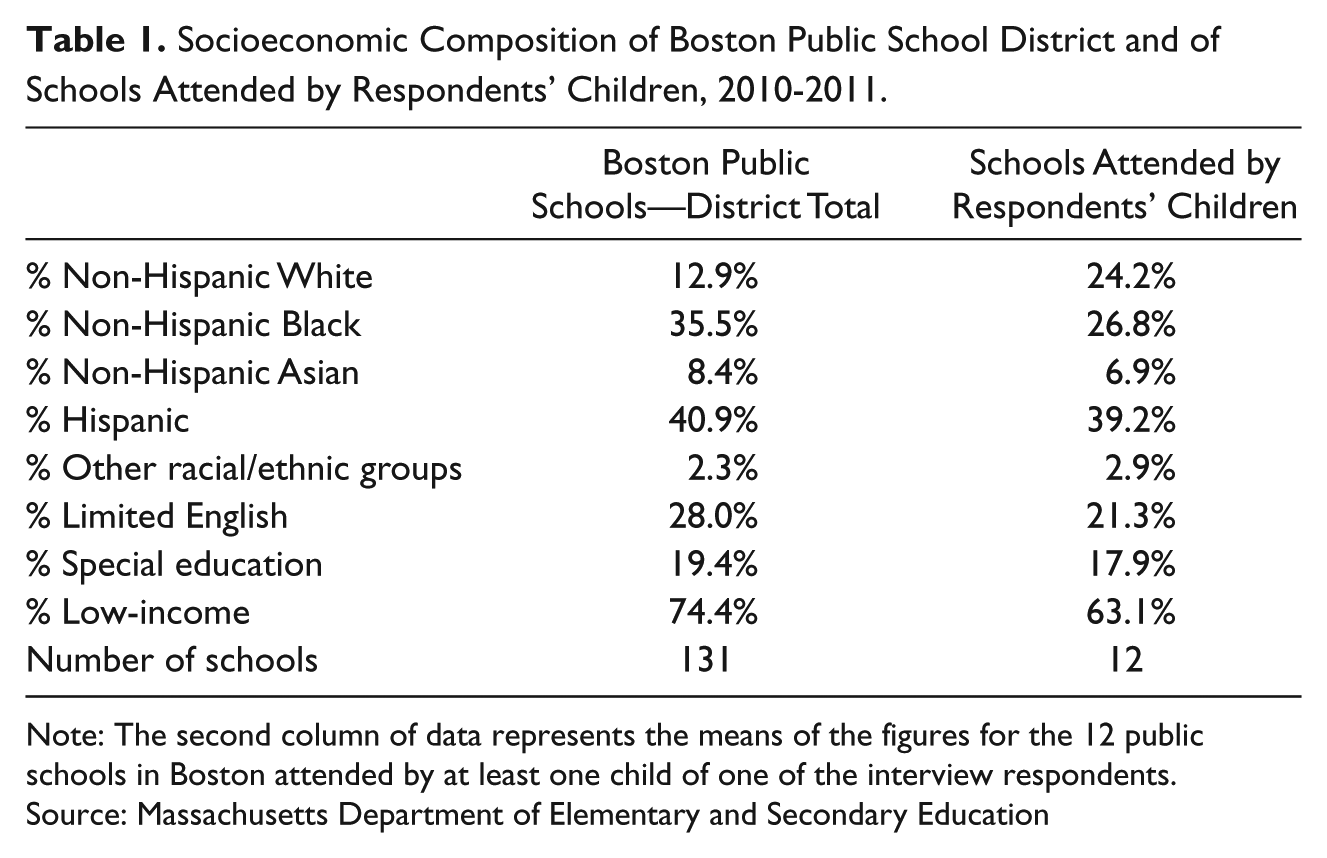
Note: The second column of data represents the means of the figures for the 12 public schools in Boston attended by at least one child of one of the interview respondents.
Source: Massachusetts Department of Elementary and Secondary Education
Data and Method: Qualitative
In 2009 and 2010, we conducted 32 interviews with middle-class parents living in Boston. To recruit subjects, we contacted the organizers of several local online discussion forums dedicated to the topic of parenting. With permission from the moderators, we posted advertisements soliciting volunteers to participate in a study on school choice. From there we developed a snowball sample comprising parents who had responded to the advertisements and others who were referred to us by previous respondents. Potential participants were required to live within the city of Boston, have at least one child at or nearing school age, and have at least seriously considered enrolling their children in the Boston Public Schools (BPS) system.
Each interview took place at a location of the respondent’s preference; most were in respondents’ homes or neighborhood coffee shops. The interviews lasted between 60 and 90 minutes on average, and followed a semistructured format. Questions focused on participants’ own schooling backgrounds, their methods for finding, evaluating, and selecting schools for their children, and the ways in which their housing decisions related to their schooling decisions. Each interview was recorded with the permission of the respondent and transcribed.
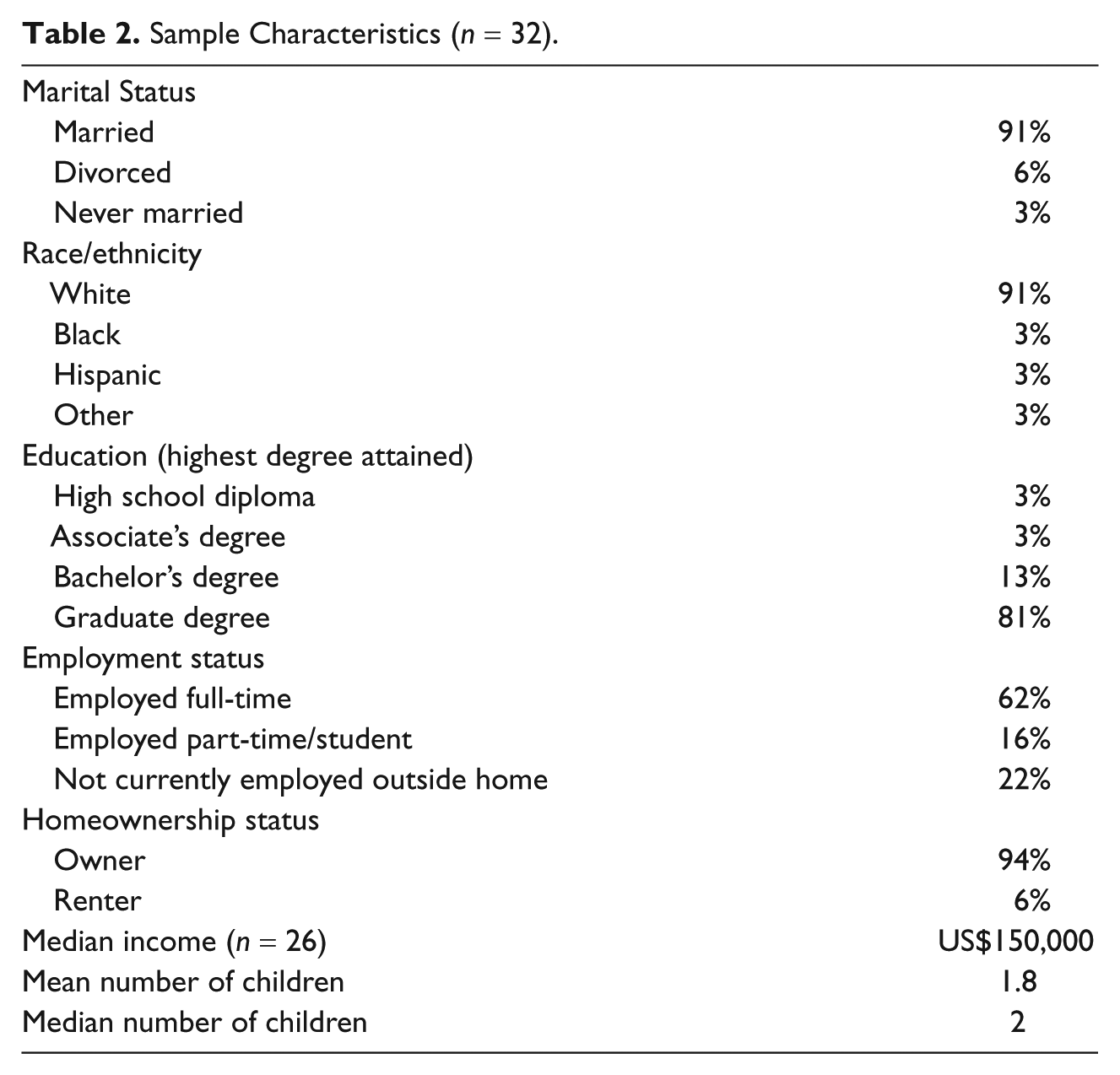
Table 2 highlights some key respondent characteristics. All of the volunteers were women. 5 This was not surprising, given that the discussion boards from which we solicited subjects were targeted at “moms,” and given the fact that women overwhelmingly lead the decision-making process when it comes to school choice (André-Bechely, 2005; DeSena, 2006). All respondents fit the profile of either the middle- or upper-middle class. Participants were highly educated—all but two had completed a bachelor’s degree, and the majority had earned a graduate degree. Family incomes ranged from US$33,000 to US$350,000. 6 Among the women who worked, all held professional or managerial jobs. Roughly one quarter of the women were currently staying home with their children full-time, but nearly all of these women were employed in professional positions before leaving the paid workforce (and all had spouses who were well-paid professionals). With the exception of one Latina, one Black woman, and one Cape Verdean woman, all respondents were White. All but three were currently married.
Sample Characteristics (n = 32).
Data and Method: Quantitative
We obtained data from the Massachusetts Department of Elementary and School Education (ESE) for the academic years 1993-1994 through 2010-2011. 7 Using these data, we analyzed enrollment trends across the entire district and within individual schools, examining changes in the racial and socioeconomic composition of each school’s student body. We then calculated indices of dissimilarity between the different pairs of racial and ethnic groups for each of the academic years. The index of dissimilarity is a commonly used measure of the evenness of the distribution between two groups, represented by a score ranging from 0 (least segregated) to 1 (most segregated). For the purposes of this study, we focused our analysis primarily on elementary schools, given that we were interested in understanding the demographic shifts in the very schools most relevant to our respondents, almost all of whom had young children.
Enrollment Patterns and Racial Segregation in Boston Public Elementary Schools
As in many large urban school systems nationwide, Boston’s public schools lost students over the past decade (see Figure 1). During the 1990s, the district’s total enrollment mostly held steady between 63,000 and 64,000 students, but beginning in the 2000-2001 school year, enrollment declined every year through 2010. By 2010-2011, the total districtwide enrollment was 56,037 students. Elementary schools (i.e., schools offering kindergarten instruction) 8 accounted for roughly half of the total decline, as enrollment dropped from 34,000 students in 1996 to just over 27,000 in 2005, a loss of 20%. 9
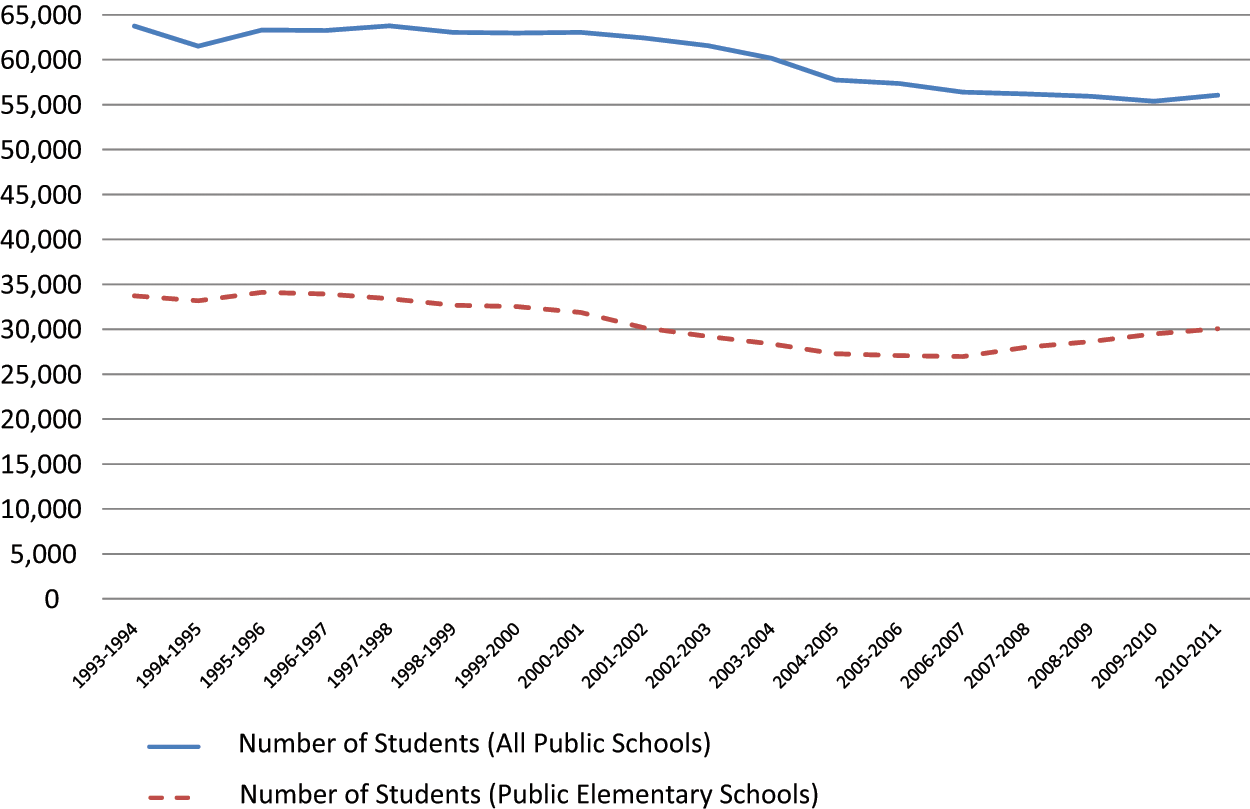
Enrollment in Boston Public Schools, 1993-2011.
The steady declines resulted primarily from the exit of Whites and Blacks from the public school system, and they would have been significantly worse without the substantial influx of Hispanic students. Between 1993-1994 and 2010-2011, Hispanic enrollment in elementary schools increased by 68%. Meanwhile, Black elementary enrollment in 2010-2011 was 37% lower than in 1993-1994, while White enrollment was 40% lower. The number of Asian students also fell, but less dramatically. Recently, however, enrollment in Boston’s elementary schools has started to rebound, increasing by more than 500 students per year between 2006-2007 and 2010-2011. 10 While most of the rise is due to the increase in Hispanic enrollments, the number of White students in elementary schools also climbed (albeit slowly) every year since 2005 (see Figure 2).
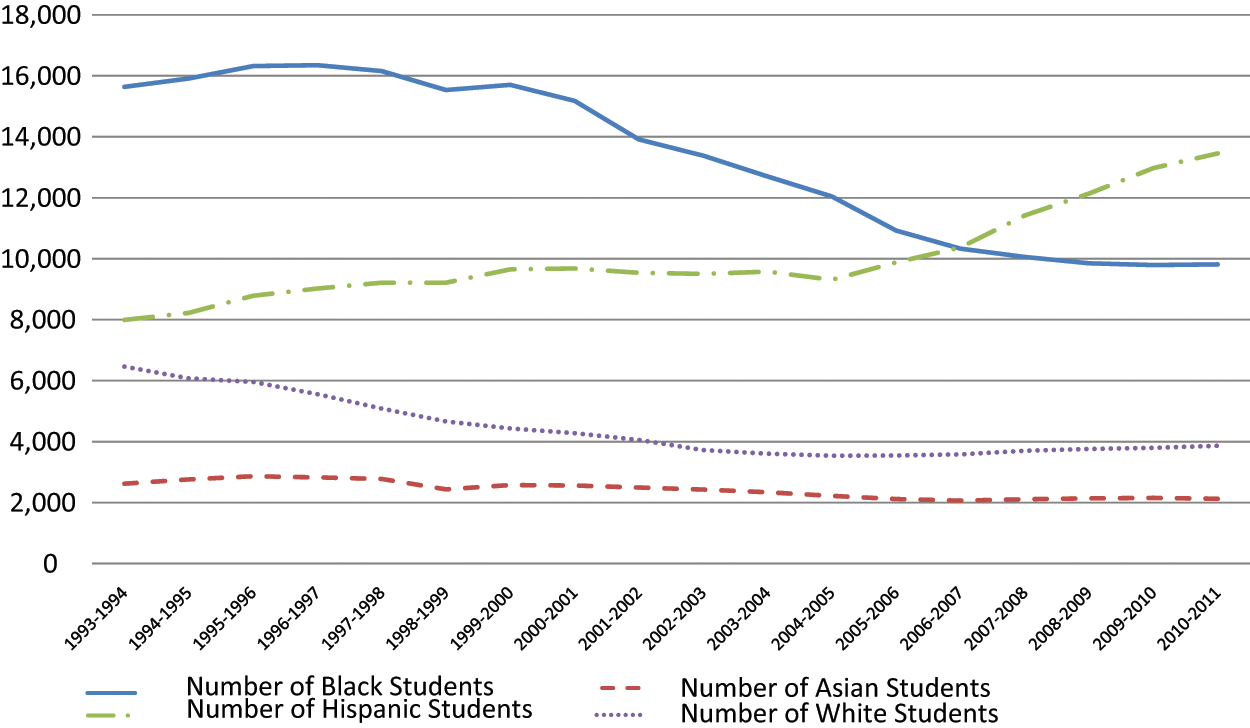
Enrollment in Public Elementary Schools in Boston, 1993-2011, by Race and Ethnicity.
However, no such directional shift is evident in the data on racial and ethnic segregation. Figure 3 presents data on the school-level index of dissimilarity between different pairs of racial/ethnic groups enrolled in Boston’s public elementary schools. Segregation between most racial and ethnic groups changed little over the past two decades. The index of dissimilarity between Hispanic and non-Hispanic White students remained fairly constant, despite the diverging enrollment trends of the two groups. Segregation levels between non-Hispanic Black and Hispanic students, between Black and Asian students, and between Hispanic and Asian students fell, while the segregation level between Asians and Whites rose moderately.

Index of Dissimilarity for Public Elementary School Students in Boston, 1993-2011.
The most noteworthy exception is the Black-White index of dissimilarity, the one which has garnered by far the most attention from scholars. Just like the segregation indices of all other pairs of racial/ethnic groups, the trendline in the Black-White index has not fluctuated greatly as enrollment patterns have changed; instead, the index has undergone a steady increase, equally evident in years when Black and White enrollment fell and in years when enrollment of those groups rose.
By the 1993-1994 school year, two decades of deliberate attempts at desegregation appeared to have made progress toward that goal (whatever other ramifications those efforts may have caused). The Black-White dissimilarity value of 0.362 in that year placed the level of segregation among the elementary schools toward the low end of the “moderate” range (Massey & Denton, 1993, p. 20). Over the next 17 years, though, the Black-White index of dissimilarity climbed steadily. As of 2010-2011, the index had reached 0.582, approaching the upper bound of what Massey and Denton (1993, p. 20) called “moderate” segregation, and very near the “high” end of the segregation scale.
When compared with the indices for all other pairs of racial/ethnic groups, the continual increase in Black-White segregation levels is striking. It is also noteworthy in light of its apparent imperviousness to enrollment trends; segregation rose over the years, regardless of whether the White or Black student populations increased or decreased. Thus, the monotonic rise in Black-White segregation cannot be attributed simply to White or Black flight from the school system as a whole.
These aggregate data, however, mask differences in the enrollment patterns at individual schools. For example, while total White enrollment grew districtwide after the 2004-2005 school year, only 27 of the 75 schools in existence in both 2004-2005 and 2010-2011 saw any rise in their White enrollments; the majority continued to lose White students. Most importantly, of those 27 schools that increased White enrollment, 21 experienced simultaneous declines in their Black enrollment. Meanwhile, of the 12 schools that increased their Black enrollment during that period, seven saw declines in White enrollment.
Enrollment trends reflect in part the racial and ethnic patterns of local neighborhoods, yet comparisons of schools in close proximity to one another (and thus unaffected by local demographics) reveal striking differences. In one neighborhood, for example, the Baxter School and the Havenwood Elementary School stand less than half a mile apart, yet their trajectories have diverged widely. 11 Between 2004-2005 and 2010-1011, Baxter added 118 White students (the second highest figure among all elementary schools). By contrast, Havenwood lost 20 White students over the same period. Consequently, the Baxter school saw its White student enrollment increase by 24%, while the nearby Havenwood experienced a 31% drop in its White population.
Two schools in even closer proximity in a different neighborhood—the Armstrong K-8 School and Pine Elementary School—demonstrated a similar trend. At the Armstrong School, White enrollment rose by 38 students between 2004-2005 and 2010-2011, while Black enrollment dropped by 57 students; by comparison, at the nearby Pine School, White enrollment dropped by 14 students. As a result, despite similarly low proportions of White students in 2004-2005, the Armstrong saw a 150% increase in its White enrollment over the next several years, while the Pine lost 57% of its White population.
These school-level changes in racial composition have been accompanied by changes in socioeconomic composition, pointing to the close association between race and class in American society. Between the 2004-2005 and 2010-2011 school years, the proportion of students classified as low-income at Baxter dropped from 69.2% to 51.5%; over the same period, the Havenwood School, just blocks away, saw its low-income proportion increase slightly, from 90.2% to 92.9%. Meanwhile, across town, the Armstrong School witnessed a decline in its low-income population, from 80.6% to 71.4%, while the share of low-income students at the Pine School increased from 90.6% to 94.0%. These shifts do not necessarily imply a deliberate displacement of minority or low-income students. Still, an indirect process of displacement is inevitable; as better-informed (usually wealthier) families increasingly pursue these popular schools, there are fewer seats available for those less well-informed (usually lower-income) families who would otherwise have been assigned to those schools. This latter group of families (who may not list any preferred schools, and thus are assigned randomly to a school with an open seat) tend more frequently to be relegated to the city’s other (generally underperforming) elementary schools.
Similar divergent trends among proximate schools abound in Boston, suggesting that parental choice, and not merely neighborhood demographic shifts, has played a key role in racial and ethnic student redistribution in the city’s public school system. In the next section, we draw on interviews with a sample of Boston parents to examine the choice process for urban middle-class families whose financial and cultural resources allowed them to consider multiple schooling options for their children.
Attitudes Toward Diversity and School Choice in Boston
Not surprisingly, respondents frequently spoke of their desire to find a school that would provide a quality education for their children in a safe and nurturing environment. Yet unlike many of their peers, for whom pursuit of this goal necessitated a move to the suburbs or enrollment in one of the area’s many private institutions, our respondents saw another option—the Boston Public Schools.
There are many plausible explanations as to why these families chose a route that befuddled and concerned many in their social circle: an ideological commitment to public schools, a fierce attachment to city life, different ideas about where and how to spend their money, and so on. The purpose of this section is not to test such hypotheses, or to determine precisely why our respondents made the choice they did while so many others in their position opt out of Boston Public Schools. Rather, the objective is to explore how these parents thought about one factor in particular—the role of diversity in Boston Public Schools—as they weighed various educational options. Specifically, we examine how the generally positive attitudes these parents hold toward a diverse school environment must be understood in the context of other criteria that were central to the decision-making process.
Making the Choice: The Role of Diversity
All respondents were acutely aware that the demographic composition of BPS is far less White and much poorer than what they would find in nearly any suburban district or private school setting. Furthermore, they largely saw this as a good thing, an attribute that made the urban public school option more attractive to them. These parents—most of whom considered themselves “city people”—appreciated the diversity in their living environments and saw the classroom as another opportunity to provide a diverse environment for their child. Specifically, the appeal of a racially heterogeneous school reflected at least three different motivations: (a) the desire to give their children an educational experience that differs significantly from the homogeneous experience of their own childhood; (b) the belief that it is important that a child’s classroom reflects the “real world”; and (c) the idea that a diverse learning environment has an instrumental value.
When evaluating potential schools for their children, many respondents clearly used their own educational experience as a reference point. As Carla 12 reflected on her own private school education, where one of the only two Black students was “friends with Bill Cosby,” she noted that “one of the reasons that we want Gina to go to Boston public school is that we want her to be in a racially diverse environment. Ben [Carla’s husband] and I went to schools in artificially racially diverse environments.” Carla reported being happy that her daughter’s best friend at preschool was Black, because “Ben and I never experienced that . . . but we really want Gina to have a different experience that way.” Similarly, Beth, who was raised in a small Midwestern city, highlighted the lack of diversity in Boston’s wealthy suburbs as a drawback, explaining, “I don’t need the [homogeneity]. I grew up in that. I was joking with a friend of mine. I said, ‘Yeah, I went to a parochial school . . . and in high school we had one Black student, and he was adopted by a White family, so he didn’t count.’” While Carla and Beth both characterized their preference for diversity in racial terms, pointing to the few Black students they had encountered in their childhood schools, by questioning whether these students were, in fact, “really” Black, their comments demonstrate how perceptions of race are bound up with other forms of diversity (e.g., socioeconomic).
This lack of exposure to peers from other backgrounds was something many of our respondents felt had been detrimental to them. As Janice put it,
. . . I would like Eli to not have the same kind of hang-ups I do, just by virtue of what my experience was as I was raised, you know? And just not really having experience with anybody that [thought or acted or talked] differently than I did until I was 19.
Amanda echoed this sentiment, recalling,
I was in that kind of [homogeneous] environment, but I spent a lot of time in my adolescence and in my twenties finding ways to supplement that with diversity, and so that was, like, a lot of work that I put in, you know, to intentionally get there.
In these parents’ eyes, the dearth of students unlike themselves was not simply regrettable; it had real consequences that they felt compelled to rectify as adults. 13
The appeal of a diverse school environment, however, was more than simply a visceral reaction to these parents’ own educational upbringing. Rather, it also reflected their beliefs about how best to prepare their children for adulthood. Some of the core lessons parents sought to inculcate were ideologically motivated. As a microcosm of the “real world,” for example, the local public school helped these parents teach their children to recognize the many advantages afforded them by their family’s social position. Touting the local elementary school which her three children attend, Beth explained, “There’s so much more diversity, and for me that’s important. I don’t know if it’s important for you, but for me it’s very important that my kids get exposed to what the real world is.” As Helen put it,
I think it’s important for them to be in a more diverse student body. So that was a big strike against the private schools, because they are very homogeneous when you go and look at them. And I think that it’s a disservice to have children learning in an environment where everybody is much like themselves and then they grow up thinking maybe that the world is much like themselves.
Many of these parents spoke at length about the inequities in their communities, and saw it as their parental duty to ensure that their children were not blind to the disparities that shape the experiences and opportunities of their peers. Even those who believed that the area’s wealthy suburban and private schools might benefit their children were turned off by what they perceived to be an artificial social environment that projected a worldview inconsistent with their own. Diane, herself the product of an elite secondary school, discussed how she wrestled with this tension when considering options for her two children:
You go there [private schools] and it’s like, it’s like an alternate universe. . . . It just makes clear the have-and-the-have-not reality. . . . I went to a private school, so I know, like, what it means, and I know the resources, and I know the whole networking thing and that, you know, you’re best friends with the son of so-and-so and you get a job, and you know, because you do an internship . . . And so I think that knowledge kind of plays into my decision and also makes me agonize over this maybe a little bit more than someone that doesn’t have that information. And so—but, by the same token, I was like, “I don’t want my kids here because this is not our reality.”
Other parents, however, described their preference for a diverse educational environment in instrumental, rather than ideological, terms. Specifically, they viewed the ability to understand and relate to peers who are different racially, ethnically, or socioeconomically as simply another skill—like reading or math—that their children needed to learn in order to become successful adults. As Amanda asked, rhetorically,
Can my kid gain value from the experience of being in a place where there’s various languages spoken, kids are coming with all kinds of different experiences in life? . . . [W]e’re more concerned about her having an experience that’s going to prepare her for life. I don’t think being in a very sheltered, homogeneous educational environment prepares somebody for life.
Similarly, Joan saw the opportunity to learn in a diverse classroom as a perfect chance for her children to master the skills they would need to compete and thrive in an increasingly globalized world:
I was sitting in a room the other day in a meeting, but I was the only American. . . I work in high-tech, which attracts a lot of, you know, very multi-national employee types. . .And I had just gotten off the phone with, like, a group of people . . . and we had just gone in circles for an hour, and I was just like, “OK, if these people, if the people I had just been trying to work with, had developed the skills that are being developed here [in her daughter’s classroom] on how to work with [diversity]”. . . . In my workplace, it’s absolutely critical that you can understand, you know, that everyone’s not sitting there, you know, sort of middle class, you know, White.
While these rationales for embracing diversity are not necessarily mutually exclusive—indeed, some respondents expressed both ideological and instrumental reasons for wanting their children to learn in a heterogeneous environment—they represent two distinct types of lessons that parents hoped to impart to their children.
It is important to note that these parents may have different conceptions of what the term “diversity” implies (Bell & Hartmann, 2007; Berrey, 2005). For example, some respondents were wary to enroll their children in schools where they would be in the numerical minority. Pat reported being initially quite nervous when her son enrolled at his local public school: “Jared is the only White kid in his class, which we thought would be an issue, because we were looking for diversity, but we were looking for diversity, not being the only kid.” But she happily noted that this ceased to be a concern after a successful few months at the school. Olivia likewise cited her own fears about being a racial minority as a primary reason for not sending her son to one of the city’s highest performing schools, where the majority of the students are Asian: “If I went to some parent meeting and everyone was speaking Chinese, and I don’t speak Chinese . . . would I not, you know, fit in?”
Many respondents seemed to desire something approaching true diversity—that is, an equal mix of students from different backgrounds. As Evelyn described it, in their search for diversity, she and her partner sought a school that was “as even as possible. . . . And I think where [her kids] ended up was pretty much 30/30/30, which was nice.” However, few parents acknowledged that given the current profile of BPS—recall that only 13% of students are White—such balanced demographics cannot possibly be the norm in most schools.
Making the Choice: The Role of Neighborhood Schools
In most large segregated cities, the notion of “neighborhood schools” inevitably conjures up questions about race (see, however, Pride & May, 1999). As Joe, the husband of one of our respondents, observed,
I think that when you talk about neighborhood schools, it’s really—the unsaid question in Boston is, “Do you want a neighborhood school because you like the idea of your child walking to school, or . . . because you don’t like the idea of your child going to school with students, other students whose color doesn’t match yours?”
The rhetoric surrounding neighborhood schools has a long and controversial past in many urban public school systems, but perhaps nowhere more so than in Boston. During the height of the 1970s busing crisis, there was little question that a preference for neighborhood schools reflected, for a sizable and vocal number of residents, a preference for segregated schools. Years later, our respondents echoed the desire for their children to attend a neighborhood school. Yet in a departure from the narrative of past decades, they largely discussed their preference for local schools in the same breath as their desire for diversity. Some, like Joe, were cognizant of the connotations of the term “neighborhood schools,” and were adamant about distancing themselves from what they perceived to be overtly racist motivations. Other respondents perhaps did not see, or did not wish to discuss, the potential tension between a quest for neighborhood schools and a quest for diversity.
As dissatisfaction with the current school assignment model has grown (in part due to the severe financial strain that busing has imposed), many in the city have championed the idea of a return to school assignment based on neighborhood residence, even as they are quick to distance themselves from its racialized heritage. In fact, given the racial composition of the district as a whole, even schools in majority White neighborhoods tend to have significant non-White populations. (In only three elementary schools did non-Hispanic Whites make up a majority of students in the 2010-2011 school year.) While it is unlikely that the idea of “neighborhood schools” will ever entirely shed its racialized connotations, it seems that as long as these local institutions still contain the diversity our respondents purport to value, middle-class parents’ desire to educate their children close to home serves to mitigate the lingering stigma attached to the term.
The strong preference our respondents expressed for local schools is closely related to the transportation options available to them, and the meaning they ascribe to those different modes of transport. Parents simultaneously evinced a fondness for walking to school and an opposition to the idea of putting their children on a school bus. These attitudes had their roots in political ideology, beliefs about the importance of community, as well as practical concerns.
In part, the appeal of walking their children to school reflected broader political views. Nearly all of our respondents described their political beliefs as “left,” “liberal,” or “progressive.” These orientations influenced their lifestyles and consumption patterns, in particular their decision to maintain an urban residence. Along with reflecting personal preferences, such choices were, for many, political statements that illustrated, among other values, their commitment to walking and their opposition (often rooted in an environmentalist ethos) to reliance on automobiles. A large proportion of the parents cited “walkability” as a favorite feature of their neighborhoods, and one of the most important hallmarks of an urban lifestyle. When possible, they preferred walking to local amenities, including stores, restaurants, and parks; this preference for pedestrian-friendly destinations extended, in many cases, to their children’s schools as well.
Many respondents also reported that walking to school provided important opportunities for community building. Kimberly lauded the sense of belonging that walking to school engendered: “Here it’s like a big community thing. I mean, you see all your families that you know. Everybody goes to school every morning. So all the parents walk their kids in. It’s like a meeting place.” Similarly, Millie, whose children were somewhat older, highlighted the ways that the daily routine of walking to school had helped her and her daughter establish networks of friends:
I think it’s wonderful that she was able to walk to school and that she got to meet kids in the neighborhood. And . . . she met not only other kids but parents of kids and teachers and all the people who came and helped out at the school. And I just think that is really, really wonderful.
Many middle-class parents treasured their neighborhood schools because the connections that they and their children developed there facilitated the strengthening of community ties. Carrie highlighted the wide-ranging friendships among children, and the mutual responsibility that parents feel toward one another’s children, all of which blossomed within their neighborhood school:
I love that Sunday afternoon we’ll go down to the high school track to ride our bikes and we’ll see three kids from school there. I really, really like that. And if you’re stuck, someone else can pick him up [from school] that day.
Proximity to the local school, and the opportunities families had for frequent casual interaction, nurtured a sense of trust and camaraderie that increased their attachment to other parents and to the school itself. As Millie noted, “it was also great to have Jocelyn go to a neighborhood school because she would know more people in the grocery store than I would.” From local stores to Boys’ and Girls’ Clubs to youth sports leagues, parents enrolling their children in neighborhood schools consistently cited the school as the hub of neighborhood activity and the origin of social ties.
While respondents spoke nearly universally about the benefits of walking to a nearby school, many simultaneously spoke disapprovingly about the cross-town busing system that has characterized BPS for decades. Most of our respondents expressed extreme discomfort at the prospect of putting their young children on a bus. Justine’s comment is representative of this sentiment: “That’s why I want a neighborhood school . . . I would never, ever, ever put my four-, five-, six-, seven-year-old on a bus. People do. There are problems that I just can’t believe people put up with.” Similarly, as she reflected on the contested meaning of busing in Boston, Samantha noted,
[W]hen you think of your five-year-old commuting an hour to get to school, it has nothing to do, quite frankly, with being racist. . . . It just is fundamentally that you don’t want a five-year-old on a bus for two hours a day.
Samantha and Justine, like other middle-class parents with whom we spoke, questioned the appropriateness of putting a kindergartener or first-grader on a bus by themselves, particularly given the time required to reach many of the city’s schools.
It is important to note that not all respondents voiced opposition to busing. Indeed, several parents did send their children to school on the bus every day, or alternated the bus with other forms of transportation, and expressed no misgivings about doing so. But for others, like Amanda, concerns about the safety of their children on the bus were simply too great to overcome:
That’s one thing I can’t do, as crazy-liberal-progressive [as] I am, I can’t put them on a bus. . . . I’ve just seen, like even sitting in my car . . . waiting for a red light, I’ve seen way more on a bus than I’d want my kid to see. And I’ve heard too many either horror stories of, like, violence or bullying or things like that happening on the bus, or, like, families standing on corners for 45 minutes to an hour waiting for a bus.
While noting that her stance against busing was perhaps inconsistent with her self-image as a “crazy-liberal-progressive,” Amanda believed that school buses posed a legitimate danger to her child, one that she was simply not willing to risk.
Some parents did acknowledge the connection between busing and diversity, noting that while they would not want their own children to travel across town by themselves, the fact that other children were bused supplied the very diversity that they appreciated in their local public school. As Justine admitted, this reality could sometimes be difficult to reconcile: “I like that kids are bused here. I would never put my kid on a bus, but I like that there’s some diversity from busing.” Similarly, Allison, whose daughter walks to school in their mostly White neighborhood, described how the presence of children from other areas of the city in her child’s school made it more attractive to her:
That was another huge factor for us in sending her there is we wanted her to be with kids from other neighborhoods. So, there, I think it’s a 50% walk zone and a 50% other neighborhoods, which I think is really important, that they let kids—I think the school choice is huge. So I love the fact that there are kids from lots of different neighborhoods. There are kids that look different from the kids that live in the neighborhood.
As the above quotations demonstrate, a preference for neighborhood schools is not necessarily incompatible with the desire for a diverse student body. Furthermore, while the immediate neighborhoods in which the majority of our respondents live are Whiter and wealthier than the typical Boston neighborhood, the school district’s large catchment areas deliberately cut across demographic boundaries, making racially and socioeconomically mixed schools at least theoretically possible.
Making the Choice: The Role of Peers
Given the district’s expansive school zones, our respondents had a large number of public schools available to them. Despite this fact, the frequency with which the same few schools were mentioned was striking. Notably, these were not always the schools that were closest to their homes (though most were in or near their neighborhood), nor were they necessarily the schools with the highest test scores (though few were very low performing). Rather, the schools that commonly emerged were those that had achieved a positive reputation among these parents’ peers, schools that were heralded on online discussion boards and in social circles. Previous research on homophily (see McPherson, Smith-Lovin, & Cook, 2001 for a review) indicates that homogeneity among individuals’ social networks restricts the amounts and types of information circulated, thus constricting the range of options that actors consider and among which they ultimately decide. In the context of school choice, the importance of homophily may have macro-level ramifications. As Moody (2001) demonstrated, heterogeneity is positively related to “friendship segregation”; similarly, White middle-class families negotiating the very diverse BPS system might also be expected to share information on schools and ultimately cluster together in a few schools.
Indeed, while all respondents discussed how they attended open houses and conducted site visits before settling on a particular school, it is clear that the “word of mouth” recommendations and subjective approval of similarly situated peers and acquaintances carried a great deal of weight. As Olivia explained,
It was just word of mouth. I have a few friends who have older kids who I kind of bump into a lot. . . . The kids who are older are good role models. [I asked them]: “Do you know anything about this?” And people had told me the Redding and the Dryer, but those names, it was somewhat more word of mouth, those names seemed to come up.
Similarly, Pat recalled, “[E]verybody we’d talk to—because we were very active at [nursery school], and very active in our play group—and according to most of the other parents, ‘Oh, you can only choose the Spencer and the Arnold.’” The advice of trusted and respected peers—complemented by individual research on websites and at school fairs—served as the primary means by which most of our parents narrowed the range of schools that they deemed acceptable.
Data and testimonials were generally not enough, though, to convince parents to commit to a school. Rather, the piece of evidence that was ultimately most persuasive to many respondents was the dedicated and persistent presence of a “critical mass” of families like their own within the school. Parents wanted to know, before making an educational decision that many of their peers and family members considered “risky,” that a core group of active parents of similar class and status background would share that risk with them, thereby presumably mitigating the risk for all. Olivia expressed the relief she felt when she observed that other professional families had enrolled in her son’s elementary school:
I’ll be honest, that it was helpful that, like, when I went to the open houses . . . that there were people who were more like me. I think there is this natural inclination, just to be completely honest, you know, you kind of relate to people who you’re most like. And so if I walked into a school and every single person was on welfare, yeah, I probably wouldn’t relate as much. And it’s funny. I have to be honest too, even though there is this diversity at Brett’s school I guess the people I tend to relate to are the people most like myself. So am I really being diverse or not?
Olivia’s comments illustrate the dilemma that these parents faced, wanting to provide their children an education in a diverse urban environment, while simultaneously hoping that their chosen schools had other middle-class families with whom they could easily relate.
In a school system where such families are relatively scarce, this can be a difficult task. Still, for many, even the presence of a small group of dedicated middle-class families was enough to set their minds at ease. Describing the “critical mass” of parents with whom she collaborated in choosing an elementary school, Joan explained the importance of that solidarity: “We had this group of five, or I think there may have been six of us . . . five or six families. It was enough to, to make a difference.” Even in a school with unimpressive test scores and high poverty rates, the visible commitment of a small group of like-minded peers seemed to offer hope to these parents that together they could effect change. When embarking on the selection process for her child, Pat recalled, she had eyed the underperforming school just down the street from her home, hoping to replicate the kind of transformation implemented in other neighborhoods: “And we were thinking, gosh, if everybody in our play group chose the Baker, then at least that incoming class of kindergartners would have very involved parents.” To her chagrin, this plan did not come to fruition, and Pat enrolled her son instead in a highly rated, but nearly all-Black, elementary school near her home.
Pat’s willingness to “go it alone” was an exception among the parents we interviewed. Far more common was the tendency to find reassurance in the presence of at least a few other peer families in the school. As Millie described, “Maybe I would have been OK with just one other family that I felt Susie would be very comfortable with. But I think four seemed like a critical mass to me of similarly situated kids.” When pondering whether to send her daughter to the racially diverse, predominantly low-income public school in her neighborhood, Millie felt that a handful of other children from a similar background would put her daughter—and Millie herself—more at ease in this new environment.
In sum, our interviews reveal that, rather than prompting these middle-class parents to seek out alternatives in the more homogeneous suburbs or private school circuit, the diversity found in Boston’s public schools was a feature most respondents praised as a benefit of those institutions. Such attitudes help to illuminate why these parents were drawn to BPS. Comprehending why they ultimately selected the specific school that they did, however, requires attending to the other preferences parents pursued simultaneously: the desire for a neighborhood school, and the need for a critical mass of other middle-class families to commit to that school with them. In the section below, we discuss the relationship between these three factors, and reflect on how the experiences of these parents can contribute to our understanding of the school district’s recent segregation trends.
Discussion
In this study, we sought to understand the role that a diverse educational environment played in our respondents’ selection of an urban public school. On the one hand, it is possible that middle-class parents might choose BPS in spite of its diversity—that is, that other aspects of the schools might be so appealing as to outweigh any concerns these parents have about the district’s demographic profile. Alternatively, racial and socioeconomic diversity might itself be a draw, rendering urban public schools more attractive in the eyes of parents who have a number of schooling options available to them.
While few parents pointed to diversity as the sole or even the primary reason why they considered their local public schools, it seemed clear that nearly all appreciated the racial and socioeconomic mix of students in the BPS system, and saw it as both important and advantageous for their children. Using their own backgrounds as a reference, many parents described wanting something markedly different for their children. Respondents also felt they had a parental duty to expose their children to the “real world,” and criticized the limited or false worldview implied in more privileged educational settings. Lastly, respondents believed that learning alongside students from different backgrounds would impart tangible, valuable skills that their children could draw upon in later years, particularly in their future employment.
As with any qualitative research—particularly featuring highly educated subjects—the potential for social desirability bias is a concern. It is possible that these parents merely assumed that lauding the diversity of the district was the politically correct thing to do. While we cannot discount such concerns, it is important to recognize the consistency between these parents’ words and actions. The children of our respondents do, in fact, attend schools that are far more racially and socioeconomically diverse than what they would find in most suburban or private institutions in the area. Furthermore, in light of the fact that these parents have chosen a path that is largely at odds with the “conventional wisdom” concerning middle-class families and urban public schools, it seems unwarranted to dismiss their statements as purely conformist. Similarly, it would be tempting to conclude that although these parents claim to want diversity, in practice they simply seek out the most White and most privileged of the local public schools available. But while it is certainly true that few respondents considered the most disadvantaged, least well-performing schools in the city when conducting their search, the school names that surfaced most often in our interviews were not necessarily those with the highest test scores, nor those with the Whitest student bodies.
Given the methods used to recruit potential subjects, ours was not a representative sample. Scholars have highlighted issues that must be taken into consideration with online sampling techniques and snowball sampling, both of which were employed in this study. For example, the use of the internet to recruit study participants can produce bias by excluding from the potential sample individuals who lack the access or skills required to use a computer (Best & Krueger, 2002; Couper, Kapteyn, Schonlau, & Winter, 2007). While unfamiliarity with the internet is likely not a significant concern for the population of interest in this study, other scholars have emphasized that even in a technologically savvy community, all members of the target population may not have the same exposure to the invitation to participate (Brick, 2011). In our case, middle-class parents who do not regularly visit local online discussion boards may not have seen the advertisement seeking study volunteers. Similarly, while the use of “snowball samples” is well accepted in exploratory social science research, relying on the networks of respondents to generate additional respondents means that individuals who are less well connected, or whose social networks are smaller or not locally based, will typically be underrepresented (Heckathorn, 1997).
As a consequence, it is reasonable to assume that the parents in our sample are a particularly informed, networked, and active group. Thus, our findings cannot and should not be generalized to all BPS parents, or even to all middle-class parents. Nevertheless, while the attitudes and experiences documented here are not representative, we believe that they are instructive for two reasons. First, these parents are extremely engaged in the school choice process—they think about it, talk about it, and actively seek out venues for sharing information with other parents. In other words, they are much more likely to actually choose a school than are parents who either do not list any preferences, or who default to the school that is closest to their home. Thus, if we want to understand the decision-making processes of the highly resourced families that many cities are pointedly trying to attract to their school districts, this sample offers a good place to start.
Second, as a growing body of research suggests, these parents’ intense engagement does not end once they have selected a school. Rather, it is itself an indication of the outsize influence that this group of parents has on the schools that their children ultimately attend. Families with more resources tend to be more present and active in schools, thus likely shaping and/or monopolizing whatever benefits do result from involvement (Cucchiara & Horvat, 2009; Lareau, 2003; Posey, 2012). Their ability to affect school policy and to transform their local schools makes it critical to understand these parents’ motivations and the potential structural ramifications of their actions.
In many respects, these parents represent precisely the type of people whom educational and municipal leaders see as a panacea to urban schools that are suffering from disinvestment and neglect. Attracting racially tolerant middle- and upper-middle-class Whites to a district that is largely non-White and low-income is intuitively appealing as a strategy for reducing segregation and its attendant challenges. Yet we argue that attitudes toward diversity must be understood within the broader decision-making context. Our respondents, for instance, desired a diverse schooling environment, but also wanted their children to attend neighborhood schools close to home. Likewise, they appreciated the mix of students from different racial and socioeconomic backgrounds in the Boston public schools, but were generally not comfortable sending their children to those schools unless at least a handful of like-minded families from similar backgrounds were willing to make that leap with them.
To meet these multiple objectives, then, our respondents tended to cluster in a relatively few socially vetted schools, despite the fact that many options were available to them. Importantly, doing so did not require them to sacrifice their desire for a diverse educational environment. To the contrary, given the relative scarcity of families like them in the district, even when such families tend to enroll in select schools en masse, the result is often a school population that is more “truly diverse” (in the sense of balanced demographics) than it was before (when it was nearly all non-White and low-income).
While producing more integration within a few individual schools, however, this clustering behavior may contribute to increasing levels of segregation across schools in the district. As the quantitative data from BPS show, levels of Black-White segregation have actually worsened at the same time that Whites have been increasing their presence in the system. Our objective in highlighting these trends is not to proffer a causal argument—that is, that the parents we interviewed, or White middle-class parents in general, are directly responsible for increasing levels of segregation. Establishing causality would require statistical models that, at a minimum, take into account other trends occurring in the district at the same time (e.g., the rise of charter schools which attract students from BPS). Rather, we aim to elucidate some mechanisms by which micro-level schooling decisions may be related to macro-level outcomes (e.g., segregation trends in a school district).
To do so, we made use of two very different datasets—in-depth interviews and enrollment data from BPS. This approach allowed us to view the same phenomenon—the dynamics of change in an urban institution—from two distinct perspectives. Much has been written about the stubbornly high levels of segregation in many urban school districts, yet attempts to explain them often rely on macro-level factors, such as district policies, residential segregation patterns, or middle-class flight from urban centers. Missing from most studies to date are the attitudes and behaviors of individual decision makers.
The tension between structural forces and consumer preferences is not unique to the issue of school choice. Yet we argue that attention both to districtwide data and to the on-the-ground experiences of individual families is necessary to understand the likely consequences of an increased presence of the middle class in urban school districts. Analyzing these two datasets simultaneously encourages us to look past the facile explanations that might be implied by either alone. For instance, it would be easy to conclude that increasing levels of Black-White segregation reflect racial intolerance on the part of White middle-class families entering the school system. Conversely, interview data highlighting middle-class parents’ appreciation for school diversity could lead to the expectation that segregation levels would fall as more of these parents opt for city public schools. Clearly, the story is much more complex than either of these interpretations suggests.
Specifically, our findings support recent research concerning the need for municipal and educational leaders to be cognizant of the potential implications, both positive and negative, of campaigns to attract and retain middle- and upper-middle-class families in inner-city schools (Cucchiara & Horvat, 2009; Posey, 2012). For the individual schools that such families choose to attend, the influx of financial and social resources can be substantial, effecting dramatic improvements in the physical infrastructure, as well as curricular and extra-curricular offerings. But efforts to attract certain types of people to urban school districts will be limited in their utility, and may even be counterproductive, if officials do not understand the broader context within which people select schools. Indeed, the process by which these parents decide on a school suggests that any benefits that accrue to the system will likely be restricted to a select number of schools, not shared equally throughout the district.
In fact, rather than reducing segregation across schools, the actions of middle-class parents may actually set the stage for deepening intradistrict segregation. As a few select schools gain a positive reputation among the middle class, they become even more attractive to this population, likely prompting intensified efforts on the part of parents to secure placement for their children in these schools, thereby reducing the number of slots available to other (non-White, lower-income) families. While our data did not allow us to document the degree of such displacement, it is inevitable that the continued influx of White middle-class families into the city’s more popular elementary schools will mean fewer seats for low-income students, unless those schools expand and add more seats (Posey, 2012). Future research should attempt to measure the extent to which the entry of middle-class families into select urban public schools results in the exclusion of other demographic groups from those institutions.
Finally, it is important to acknowledge that attitudes toward diversity are likely to play a role not only in the decision to enroll a child in an urban public school, but also in the decision to keep a child in an urban district as he or she grows older. Given that most of the parents in our sample had young children, we can only speculate about the influence that a school’s demographic profile wields in the choice process once a child reaches the higher grades. Preliminary evidence, however, suggests that the characteristics that middle-class parents look for in a school change in meaningful ways as their children approach secondary school. Specifically, when discussing their future plans, parents indicated that they were less willing to take a “risk” with their child’s schooling when college loomed on the horizon. To the extent that schools with high proportions of non-White, low-income students are perceived to be of lower academic quality than Whiter, more affluent schools (Goyette, Freely, & Farrie, 2006; Saporito, 2003), we might expect the diversity of a school to be viewed as more of a liability, and less of an attraction, in the middle- and high-school grades.
Similarly, when asked how they might evaluate potential high schools, some parents expressed concerns about school size, orderliness, and safety that did not emerge in their descriptions of the elementary school choice process. Given what the sociological literature suggests about the influence of neighborhood racial composition on perceptions of disorder and safety (Quillian & Pager, 2001; Sampson & Raudenbush, 2004), as well as the degree to which discourse about child safety may serve as a proxy for parental unease with racial or socioeconomic difference (Martin, 2008), it would be instructive to examine whether middle-class parents’ attitudes toward school diversity shift or morph as they attempt to negotiate these new concerns. By seeking to expand our understanding of such issues, future research can help to determine whether the presence of the middle class in urban public schools is best thought of as a temporary stage (i.e., largely restricted to the elementary grades), or indicative of a long-term commitment to the city and its educational institutions.
Footnotes
Acknowledgements
The authors would like to thank Matthew Hunt, Annette Lareau, Steven Vallas, and two anonymous reviewers for their helpful comments on earlier drafts of this manuscript. We are also grateful to Rachael Gorab for her work on this research project, and to the Boston parents who gave generously of their time.
Declaration of Conflicting Interests
The author(s) declared no potential conflicts of interest with respect to the research, authorship, and/or publication of this article.
Funding
The author(s) received no financial support for the research, authorship, and/or publication of this article.