




Abstract
This article presents 7 years of qualitative research into the emerging understandings of a population of 456 beginning 7 to 12 urban teachers who supplied 130 participants who were enrolled in a total of 26 MSEd English Language Arts courses over 7 years. These were interviewed while teaching in urban schools focused primarily on testing and accountability systems, and their class writings were used to present seven of their voices in this study. The study investigates participant engagement in two theoretical frameworks emphasized in the courses: first, the neoliberal ideology of testing and accountability; second, the transactional tradition of aesthetic education. The study finds that education students need not passively acquiesce to neoliberal reforms, but can reclaim a culturally critical stance in their teaching.
Keywords
Mussolini wanted all the trains to run on time. He thought that would be a marker of progress for his 1930s Roman empire. Now, to create such a feat he really did not need any free and critical thinkers; all he needed were loyal mindless types, men and women who were good at following instructions and even better at not questioning orders. What does this have to do with something as “trivial” and “ethereal” as aesthetic education? If aesthetic education allows educators to not only validate the thoughts and perspectives of students, but it also allows us to develop the critical thinking skills of our students, then a fascist society could never afford to have aesthetic education in its classrooms.
Introduction
This article presents 7 years of ethnographic research into the developing thoughts, feelings, and understandings of 456 beginning urban teachers who enrolled in a total of 26 MSEd courses in 7 to 12 English Language Arts (ELA) in an urban public teacher education program. Before this study began in 2003, such teaching candidates struggled primarily with learning to teach in urban schools that are generally overcrowded, under-resourced, and serve communities that are primarily poor or working class, nonnative English speaking, immigrant, or of color. Since The Elementary and Secondary Education Act (U.S. Congress, 2001), commonly called No Child Left Behind (NCLB), however, these beginning teachers have encountered the realities of urban schools focused almost exclusively on testing regimes and accountability systems (Costigan, 2008a). It is fair to say that test preparation and adhering to curricular mandates have become the overwhelming factor in these new urban teachers’ socialization into teaching (Crocco & Costigan, 2007; Hursh, 2007). This study investigates what happens when these teachers experience two education courses that forefront two divergent theoretical frameworks directly related to the testing regimes and accountability systems they experience: First, the externally imposed neoliberal ideology that drives the testing and accountability movement that has taken over the public and political discourse of educational reform (Berliner & Biddle, 1995; Gabbard, 2003; Hursh, 2008a); second, the internal or developmental understanding of their educational/professional practice using the discourse of the aesthetic tradition as grounded in the works of Bruner (1990, 1997), Dewey (1938/1977), and Greene (2001), among others.
For the purposes of this study, the aesthetic tradition is similar to constructivist, student-centered, or inquiry-based conceptions of teaching and learning presented in content areas located in many research-based schools of education. The aesthetic approach emphasizes the processes of a student’s transactions with the text of literature (Rosenblatt, 1978, 1983), rather than focusing on the acquisition of facts and information, as required by tests in light of current educational reforms. The aesthetic/transactional paradigm in this study extends the notion of text not only to literature and critical texts of the ELA curriculum, but also to the larger text of the academic discipline. The emphasis is on the transaction the learner has with these intellectual texts and the process by which she incorporates—or resists incorporating—new understandings into her ongoing narrative about the world (Bruner, 1997; Rosenblatt, 1978). Testing and accountability systems, however, equate learning with the acquisition of depersonalized and decontextualized information as defined by the political and economic elite (Bruner, 1990; Hill, Macrine, & Gabbard, 2008).
In the United States, it is the ELA curriculum that is the chief focus of educational reforms (Kaufman et al., 2002; Fleischer & Fox, 2004; Rex & Nelson, 2004; Rigsby & De-Mulder, 2003), and this research seeks to find out of beginning ELA teachers: (1) to what degree these beginning teachers appropriate aesthetic educational practices as suggested by, and demonstrated in, their educational coursework, or to what extent are these theories and practices washed out (Zeichner & Tabachnik, 1981) by the realities of teaching in schools that are driven by the testing and accountability cultures; (2) to what extent do new teachers personally and professionally engage with the larger political and theoretical issues grounded in both aesthetic and neoliberal conceptions of teaching and learning.
Two Theoretical Frameworks
Neoliberalism
The term neoliberal describes the discourse of educational reform that has achieved supremacy since NCLB and that continues with the Race to the Top (RTTT) grant initiative. This term is used to describe how current educational reforms are guided by the values of the corporate marketplace. This paradigm of corporatocracy (Saltman & Gabbard, 2003; Sleeter, 2008) values concepts such as performance objectives over authentic engagement with learning, and it values competition for resources among individuals and institutions over education for democratic practices (Gabbard, 2008; Taubman, 2009). In this paradigm, education is not focused on shaping critical and original thinkers in the service of democracy, as Dewey and others have advocated (Ross, 2008, p. 370; Shor, 1992, p. 136). Rather, it focuses on generating workers who have acquired the standardized skills and the sanctioned types of information necessary to compete in the global economy (Friedman, 2009; Hursh, 2008b).
The term neoliberal is used for the political and economic worldview or paradigm that is allied with, but essentially different from, the more socially reactive neoconservatism. Neoconservatism can best be understood as both an ethical and social movement engendered as a reaction to the perceived social chaos and moral relativism of the 1960s and 1970s (Berliner & Biddle, 1995, pp. 132-137). Neoliberalism, however, is primarily an economic discourse whose stance holds no moral values except those of an enhanced marketplace. As Harvey explains, neoliberalism,
[I]s in the first instance a theory of political economic practices that proposes that human well-being can best be advanced by liberating individual entrepreneurial freedoms and skills within an instructional framework characterized by strong private property rights, free markets and free trade. The role of the state is to . . . guaranteed the proper functions of the markets [and] if markets do not exist (in areas such as education, health care, social security, and environmental pollution) then they must be created by the state if necessary . . . [It ] seeks to bring all human action into the domain of the market. (Harvey, 2005, p. 2)
To the Classical Liberalism propounded originally by Adam Smith (1723-1790) and many other European thinkers, neoliberalism adds the active intervention of the state to enhance and sustain market competition. The neoliberal movement in educational reform can be seen as being born, and reaching childhood during the President Reagan years with the publication of A Nation at Risk (National Commission on Excellence in Education [NCEE], 1983), to have moved through its adolescence in the President G. W. Bush years, to have began adult life with the implementation of NCLB, and to have reached its adulthood in President Obama administration’s RTTT grant initiative.
Similar to the original presentation in A Nation at Risk (NCEE, 1983), neoliberalism maintains that schools are in a crisis, that the teachers and students in them are engaging in self-destructive and delusional practices, and that the nation’s educational system is essentially failing. In this way of thinking, students are intellectually unchallenged and their future is economically disadvantaged by a weak curriculum taught by teachers who are at best misguided, and at worst, deficient. The true significance of this so-called crisis is that it jeopardizes the economic ascendency of the United States. That these conclusions may rest on absent or misinterpreted data in no way diminishes the rhetorical power of this view in public discourses of educational reforms (Taubman, 2009). Even the recent so-called Great Recession can be linked to an inadequate and uncompetitive workforce that has been hindered because of bad schools (Friedman, 2009). Objectives and standards from the corporate world are seen as the best models for school reform. The rewards for students, and the goal of becoming educated, are promises for them to become entrepreneurs of themselves so that they can reap maximally the economic rewards of the global economy (Foucault, 1979, in Hursh, 2008b, p. 65; Friedman, 2005).
Aesthetic Education
The term aesthetic education (AE) is used in the ELA context and is strongly identified with conceptions of learning grounded in the works of Dewey (1938/1977), which emphasizes that the learner is an active construer of knowledge. AE is related to constructivist, student-centered, or inquiry-based conceptions of learning found in other subject areas and advocated in many schools of education (Bruner, 1997). In the ELA curriculum, the term aesthetic is defined by Rosenblatt (1983) as a paradigm that emphasizes the learner’s transaction with the text of literature, and, by extension, to in the subject matter of the content area. It is distinguished from an efferent (from the Latin effere, or to take away) approach to texts of literature, and, by extension to the texts of information in various content areas (Rosenblatt, 1978). The efferent approach encounters the text of a content area primarily for information or facts and is the type of knowledge found on standardized tests promoted by neoliberal educational reformers (Grey, 2011). The aesthetic/transactional approach, however, focuses on qualities and kinds of transactions a learner has when encountering the text of the content area. As used in this research, AE is the approach that is most similar to reader response criticism in the literature curriculum (Dickson & Costigan, 2011), and it is related to other constructivist understandings of learning in that it maintains that the learner is an active construer or meaning-maker of the content area (Bruner, 1997).
Divergence of Frameworks
Neoliberal reforms seek to have students and teachers conceptualize learning as gaining facts and information that are presented and framed by the political and economic elite though textbooks, curricular materials, scripted lessons, and standardized tests largely created by for-profit multinational corporations and with the support of well-funded neoconservative foundations (Grey, 2011). This educational paradigm takes no interest in the thoughts, feelings, and cultural discourses of teachers, students, or the local community. In fact, the educational community is viewed by those with economic and political power as at best misguided, and at worst deficient, or even defective (NCEE, 1983). Nor do neoliberal reforms take into the consideration any student engagement with the content area. Rather, learning exists primarily to enhance individual readiness to compete in the global economy (Friedman, 2005). In contrast, aesthetic approaches focus directly on the transactions students have with the academic content, and AE seeks to enhance their engagement with it (Greene, 1995). This engagement leads to critical awareness of the issues embedded within the content areas. Greene states, “The enterprise of schooling too often emphasizes the need to accede to the world as ‘given’, as officially and expertly described” (Greene, 2001, p. 30). The purpose of neoliberal reforms, on the contrary, is precisely to accede to the rules of the global marketplace (Friedman, 2009).
Pedagogical Framework
One participant, Kit, illustrates how aesthetic transactions are enhanced in the ELA classroom. Kit reported frustration teaching Jamaica Kincaid’s Girl (Kincaid, 2000
1
), a short story which is essentially a monologue of a list of instructions told by a Caribbean mother to her daughter. Kit found that the students just did not understand the literary devices or engage with this story in any way. In response, in the next semester, Kit designed a lesson where she asked the students to write a story similar to Girl, which was a monologue or a narrative that was essentially a list of prescriptions. They were to title it with one word of their choice such as Student, Teacher, Parent, Cop. Kit wrote in the final paper for an ELA course with a strong AE component:
The results were astounding to me, both in terms of process and product. This time the ninth graders put their lives and hearts into the assignment. I hadn’t used the term dramatic monologue with them, but, as Anderson and Rubano (1991) discuss, this assignment led them to understand form rather than just content. They all wrote successful dramatic monologues . . . Then, most amazingly of all, before I asked them to, they spontaneously shared them and commented on one another’s work. We went on to discuss the story in some of the terms I had tried the first [semester], but because I started the discussion of this book with an aesthetic lesson, I believe the resulting discussions of the text were deeper, better, and more genuine.
Anderson and Rubano (1991) define these practices as unarticulated responses; that is, they enhance student engagement or transactions with literary, critical, or content-area texts, to avoid the traditional summative and reductive analysis, or the forms of articulation required in many ELA classrooms, as well as in all classrooms focused on test preparation. Rather than focusing on such so-called mechanics as plot, theme, and literary devices, AE emphasizes reading and writing activities that enhance the participants’ responses, engagements, or transactions with texts of literature, as well as with the informational and critical texts of the content area.
One simple example of the unarticulated, aesthetic, or transactional response given by Anderson and Rubano (1991) is to avoid analyzing Hamlet’s behavior, which according to many critics is demonstrably irrational anyway (Eliot, 1922/1980), and instead simply to rate him in successive journal entries on a sane to insane scale. This activity does not articulate the meaning of Hamlet, but rather serves to enhance personal aesthetic engagement with the text to enhance class discussions. Janine’s vignette in the Data Analysis section gives a more complex example of the type of unarticulated or aesthetic response to poetry that contrasts with a focus on the poem’s mechanical or literary devices and predetermined summative theme.
In the classes, students used a theoretical and pedagogical text by the Principal Investigator (PI) that addresses how ELA teachers can engage in AE practices in an era of testing and accountability (Costigan, 2008b). Other theoretical texts typically included in the course were selected chapters from books by Rosenblatt (1978, 1983) and Greene (1995, 2001). One text used in all courses was Anderson and Rubano’s (1991) Enhancing Aesthetic Reading and Response, which is designed specifically to introduce AE theory and practices. A text that addressed issues of both transactional teaching and teaching for social justice was Gaughan’s Teaching in the Contact Zone (2001).
Method
This study is based on a population of 456 education students who were each enrolled in two ELA courses as part of an MSEd program in 7 to 12 English education from 2003 to 2009. Table I of this article indicates that a total of 26 courses were taken, which were both undergraduate (UG) and graduate (GR) and both during clinical teaching for initial certification (IN) and in full-time teaching while seeking professional certification (PR). A total of 130 participants were interviewed over 7 years, and this article offers the voices of seven participants to articulate themes that emerged during the study: Janine, Chris Marissa, Stephanie, Charlene, Deidre, Keri, and Geoff.
Disbursement of Participants
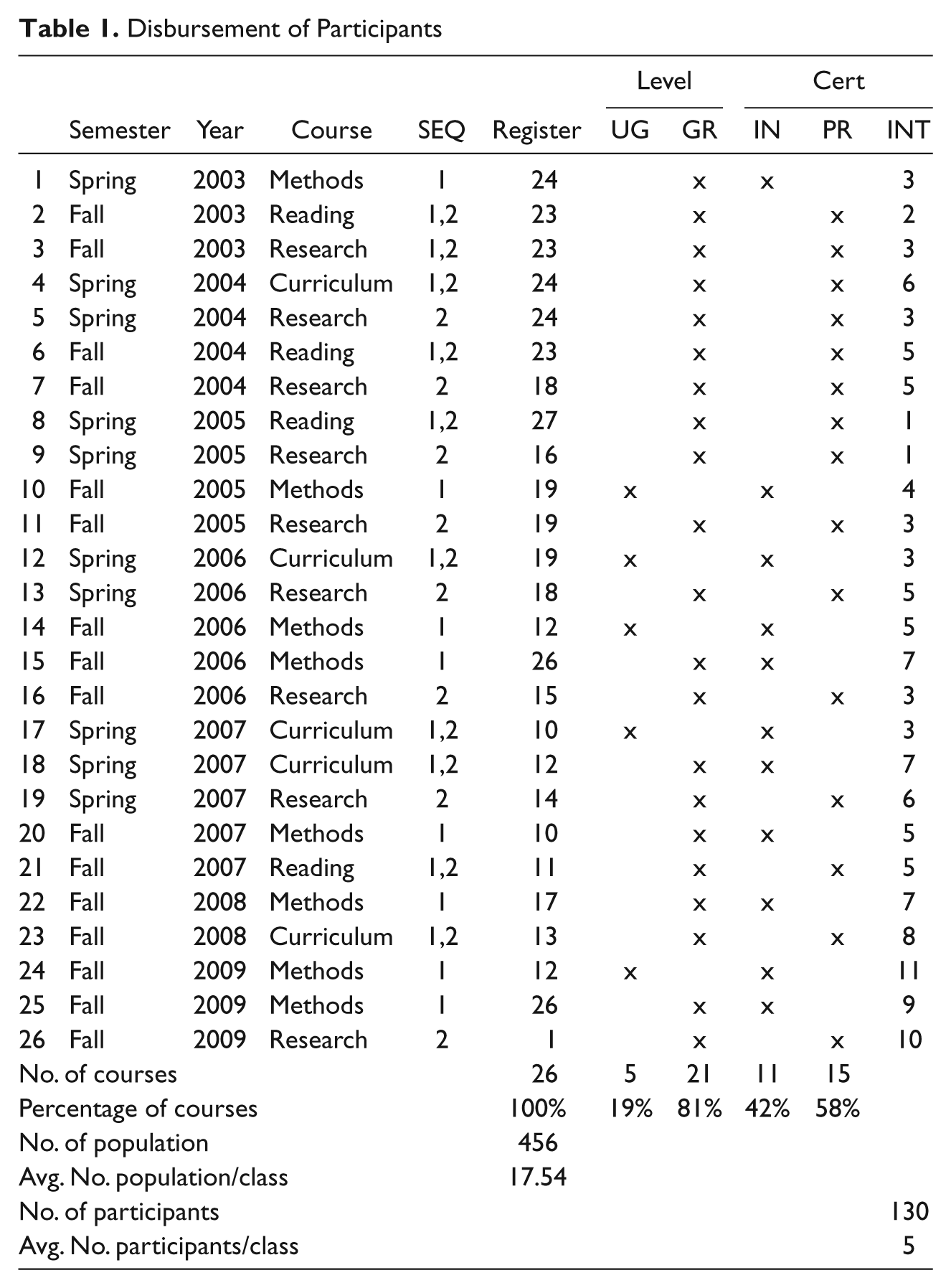
The courses were offered in a sequence. The first course was either a methods course during a teaching internship, a course in reading, or an ELA curriculum course taken during the first 2 years of teaching; the second course was either a second reading or curriculum course, or it was a required research seminar during the first 4 years of teaching. Data were from the two assigned papers in each course, as well as interviews with an average of five participants per semester, totaling 130 interviews (INT). In this article, the narratives of participants with the pseudonyms of Chris, Geoff, Janine, Keri, and Marisa, among several others, were found to be the most articulate representations of themes found overtime among all the participants in their coursework, as well as in interviews over time.
This study uses qualitative methodology and focuses on three written papers produced in each of two classes taken by participants, and also on personal interviews recorded in the PI and the coresearcher’s notes. Both sets of data were coded for developing and recurring themes, process codes, or constructs to create understanding. Process codes are coding words or phrases used to define key points or transition points made by participants in the passage of significant autobiographical journeys, including careers (Bogdan & Biklen, 1992, p. 169). Similarly, Kelly (1963) describes mental constructs as the mental representations or understandings by which humans construe meaning in the ongoing flow of experienced events. Mental constructs can be expressed as statements that order, label, and define current experiences in light of past understandings, which in turn are tested for trustworthiness as new experiences are encountered. Data were gathered in two stages in this study using a type of ongoing or constant comparative method (Glaser, 1978, in Bogdan & Biklen, 1992), both research conducted before this study, which led to the current research agenda that informed this study, and also research directly represented here. First, beginning in 2001 when the effect of NCLB were first being implemented, research was conducted into new teachers’ experiences, which revealed the central importance of a then new testing and accountability culture in the socialization of new teachers. In this phase, about 200 preservice and beginning teachers participated in ongoing research through individual and group interviews, which are represented in published research (Costigan, 2004, 2005, 2008a; Crocco & Costigan, 2006, 2007). Since 2003, in the second phase of research presented here, data were collected that focus specifically on the experiences of these new teachers using the theoretical framework of neoliberalism and AE in the context of educational courses, over time.
In each of the 26 course sections, the population of students were asked to reflect in writing, in at least three uniform ungraded reflective assignments, on their emerging thoughts, feelings, and understandings about: (1) their personal development as educators; (2) their understanding of professional practice and theory, including AE and neoliberal paradigms; (3) their understanding on how these theories and practices influence their curricular decisions in their own classes; and (4) what impact class readings had on their emerging theories and practices. The final self-assessment (appendix) provided these categories for the two earlier assignments. After the courses were completed and after consent forms were signed and collected, the PI initially read all the course-reflective assignments at least twice and coded for emerging constructs. In the last 5 years, the coresearcher assisted in identifying papers that best represented emerging themes.
Over the 26 semesters of this study, 130 participants were interviewed, an average of 5 per course (see Table, INT). In the last 5 years of the study, the interviews were also used to confirm the trustworthiness of the two researchers’ emerging understandings. The interviews were conducted after the courses were completed and consent forms signed and collected, and lasted from 20 min to an hour, averaged 30 min, and focused on the following areas: (1) How do you conceive of the basic way you go about teaching in your day-to-day practice? What choices do you make? What do you do? (2) What is your understanding of the theory and practice of AE in what you do in your teaching? (3) Given the nature of neoliberal educational reforms, what specifically have your tried, or what have you felt you did not want to try, to address the testing and accountability measure you encounter in your teaching?
This study used non-graded assignments as data, and coded these documents and interviewed participants after the second course was taken with the PI and the grade given. Interviews which also checked for the trustworthiness of the researchers’ understandings were done after the participants had completed their MSEd. As the PI was the instructor of the courses, interviews were conducted when the participants would not have the PI again for any other course. As the PI and coresearcher believe that the written assignments present a more focused and coherent presentation of participants’ understandings, the narratives presented in this article are from student writings, as supported by the interviews. The use of a coresearcher who taught similar courses not directly presented in this study further served as a check for trustworthiness (Dickson & Costigan, 2011). Students who did not volunteer and sign consent forms are not a part of this study.
The participants described themselves overwhelmingly as White, native born, and middle or working class. While the participants came from the same city-sized area as the schools in which they taught, their homes were located in different neighborhoods, which they described as urban-residential or suburban, and safe. The mean annual family income of the area is US$55,120 per year (Queens Public Library, undated), and the participants largely came from areas on the higher end of the range of that average, while the schools were located in areas on the lower end of the range of that average. The participants attended local public schools which they described as “good schools” (Lightfoot, 1983), and two or three participants in each class in this study attended local parochial schools also serving working class communities. They described their schools as overwhelmingly traditional, and stated that AE was something new for them. Almost all participants expressed that there was a dichotomy between the nature of the schools they had experienced as students and the ones in which they were now teaching, most of which had been rated as poor by the Department of Education. Participants also state that there were clear differences between the esteem in which they placed education as a means of economic and social mobility and the lack of these values in many of their students who come from communities which are largely poor or working poor, immigrant, nonnative English speaking, or of color (Costigan, 2004).
The neighborhoods in which the participants taught were located in what is well documented as the most diverse area in the United States (Colangelo, 2009). In the large city-sized area, residents are 35% White, 25% Hispanic, 19% African American, and 17% Asian. In the local community, 46% are foreign born, and of these, 50% came from Latin America. Fifty-three percent of the population speaks a language other than English at home, and 14% of the population considers themselves poor speakers of English. Twenty percent of the population was under the poverty level (Queens Public Library, undated).
As interns and untenured new teachers, the participants were under high levels of supervision, and most were held accountable by school authorities through weekly, daily, and even hourly surveillance for compliance in presenting exclusively information-based content instruction to enhance student-test scores. Sixty percent were mandated to spend at least some time in instruction teaching prepackaged scripted lessons, and of these participants, about 20% were mandated to use parts of a literacy program designed by a for-profit educational publisher. These new teachers also frequently operated under threats of punishment for noncompliance with mandated standardized test-based teaching, and these sanctions included loss of a teaching position, the withholding of tenure, or the permanent loss of a teaching license (Costigan & Crocco, 2004).
Data Analysis
After several years of conducting research, the two researchers asked themselves: What is the story of the participants’ engagement with these two theoretical frameworks? What impact did these frameworks have on the participants’ conceptions of, and implementation of, their teaching? The researchers found that the narratives of the eight participants Janine, Chris Marissa, Stephanie, Charlene, Deidre, Keri, and Geoff provide the richest description of themes that present the experiences and understandings of all the participants as they attempted to implement in their classes the aesthetic theories and practices as introduced in the coursework. The first emerging theme is that these participants are able to transition from the transmissive or commonsense traditions (Mayher, 1990), which, in turn, is grounded in Dewey’s understanding of the anesthetic in education (Noppe-Brandon, 2004). The anesthetic in education is found when the curriculum does not actively engage learners at the personal level, but presents them with predetermined facts to be acquired.
Moving From the Anesthetic to the Aesthetic
Janine’s narrative illustrates the transition from an anesthetic, commonsense, unengaging poetry curriculum centering on literary devices, and a summative theme, one that is common and commonsense in the majority of ELA classrooms (Costigan, 2008). Janine was trying to teach William Carolos Williams’ poem, This is just to say (Williams, 1985
2
) to a class of tenth graders who came from African American, and immigrant East Asian, Caribbean, and Latin American backgrounds. At first, Janine tried a test preparation curriculum by focusing on the so-called literary devices that were likely to be used on tests, such as implication, inference, image, tone, and speaker of the poem (Costigan, 2008b). Janine found that she had trouble engaging the students with a poem where nothing seems to happen and which elicited comments of “So what?” from her students. Concerned about focusing on these technical aspects, Janine wrote in a reflection paper, “This was just a purposeless exercise. The students just wouldn’t or couldn’t apply these literary tools to how the poem worked . . . they just didn’t ‘get’ the poem.” She further explains:
What I realized that this efferent, or fact-based, reading of the text was just work. So I asked the students to focus on the key words, “This is just to say, I have eaten the plums in the icebox,” by asking them not to think abstractly, but to physically write a note explaining a personal behavior to someone who deserved an explanation. I dropped all the notions that the students had to somehow summarize the meaning of the poem. On reflection, I couldn’t summarize the poem myself, nor could I analyze it in any way. Why would I want to?
Here Janine is arriving at an understanding that is not readily apparent to teachers. Only a very limited type of poetry is applicable to testing, those that tell some kind of a story, have some kind of definable character as a speaker, and can be reduced to a one line theme or summative message (Costigan, 2008b). As this was not such a type of poem, Janine decided to take a different and transactional/aesthetic approach and have her students write their own This is just to say notes or messages to someone who had an impact on their life. She then had the students convert these texts to an original poem patterned on the rhetoric used in William’s poem (Koch, 1973). Janine stated that she found the results “amazing.” “One student wrote a poem to a friend who got shot in his crime-ridden neighborhood”:
This is just to say I am sorry you are no longer here. I have visited that corner Many times. Forgive me, If I am selfish. The streets and buildings here Are shouting bullets at us.
Janine came to discover that this type of student transaction with the ELA curriculum was the antithesis of the type of knowledge demanded on standardized ELA tests that reduce a poem to literary devices and depersonalized summative statements (Costigan, 2008). However, the importance of Janine’s narrative is that she realized that her poetry lesson was not just a good type of ELA teaching in that it enhanced her students’ transactions with the text. She found that the poem engendered discussions to take the poem to a further step of politicizing the text of their own experience, as grounded in the rhetoric of the poem, to the social and political realities of the students’ own lives. Janine discovered that the poem opened a conversation into why this specific neighborhood was so violent, and what that implied about social inequities.
Janine, however, found that she had to negotiate her aesthetic/transactional practice in the content of the school culture of testing and accountability:
I’m a bit hard pressed how to present these amazing results to the AP [Assistant Principal], but they were so engaged in the poem by recreating the poem. We had never talked about creative writing, and I don’t have experience in that area, but they were sharing their poems with each other as if they were their best kept secrets and it was hard to move on to the next topic in my class. Many students wanted to keep writing these types of poems, and several kept writing them on their own.
Once Janine established that aesthetic/transactional approaches engaged her students, she then had to negotiate this practice in the context of testing mandates in her schools, as well as to build on her realization that the ELA curriculum is not necessarily implementing decontextualized material for authorized tests, but that it is a source of opportunity for critical awareness of social issues.
Stages of Engagement
As Janine’s narrative suggests, there were four broad stages in appropriating AE theories and practices. These stages were present in all the participants to a degree, and the narratives presented here are from participants who best articulate these stages. However, there was no shortage of representative narratives in the overall data set and the researchers had difficulty choosing among the many articulations of the stages of appropriating aesthetic conceptions about education. The stages are progressive, but they also are gained through layered and recursive processes. The stages identified over time in the participants are (1) transitioning from the information-based curriculum to one enhancing aesthetic engagement; (2) dealing with the external prohibitions against AE practices; (3) addressing personal and professional resistances; and (4) coming to see AE as a theory and practice that creates possibilities for a critical awareness of issues of social justice, particularly in contrast to neoliberal-based conceptions of the curriculum. Janine’s narrative, above, represents the full scope of four stages in which the participants appropriated AE practices. Most participants were able to present the first three stages, but only about 20% of participants over time were able to fully apprehend the fourth stage.
Transitioning From the Getting It Curriculum
The participants at first had to try on the practices in their own classrooms, reflect on these practices, and come to believe that these practices were more effective at enhancing deeper learning. The participants stated that they themselves came from a traditional curricular backgrounds, ones in which the teacher has a predetermined meaning for a work of literature, based on a fixed, predetermined, reductive, and summative meaning of a work of literature. One participant called this the getting it curriculum. The first implication of AE practices was for the teacher to let go of predetermined meanings and allow the students to explore their transactions with literature. Chris explains,
I am going to stop asking questions in am guilty as charged of setting up questions that I know the answer to. I read all the text before the students this manner. I learned that it’s best to ask as many open ended questions as possible, take the information from the students and build my lesson around their prior knowledge. In the process I can even learn from them.
Another participant, Marissa, calls this “dislocating myself from efferent reading.” The primary importance for engaging students with the ELA curriculum was that it simply was better engaged learning. Enhancing student engagement ranged from the simple to complex. Different participants enhanced this engagement in different but related ways. For example, one participant had her students keep literature logs where they jotted their reactions to the text by first labeling their transaction with an electronic message emoticon, a different participant had her student write text messages to reflect their transactions with the material at hand, and another one had students write letters to a character, and one additional one had students write their own endings to stories. Several had students generate their own poems, narratives, or stories based on the content and rhetoric of the work of literature under consideration (Anderson & Rubano, 1991; Koch, 1973). What is more important than the simple or complex pedagogical techniques used was their growing realization that they could enhance students’ aesthetic transactions with the texts. Chris, who early on appropriated transactional practices in his teaching relates:
As a teacher I drilled my students with reading skills because I thought that was the way that people learned to read. Now that I have something to compare my strategies to, I really think that what I was doing was fake teaching. After trying aesthetic reading I can see the difference in my students. They seem more excited and confident about what they are doing. Students with poor work habits surprised me because they were into the lesson more than students that participate on a regular basis . . . I believe it works so well because the students are able to make connections to the lesson before even tackling the text.
“But They Won’t Let Me!”
Even when the participants began to implement AE paradigms in their classes, they still had to face external prohibitions from administrators, and, to a lesser extent colleagues, because aesthetic practices varied radically from a test preparation curriculum that seemed to be the only acceptable option in their schools. These prohibitions were of two types, specific and anticipatory. Specific prohibitions could be being forced to use parts of scripted or preprogrammed lessons. The first phase of this study finds that scripted lessons are implemented idiosyncratically in urban schools in the study, with different teachers at the same school struggling with different elements of a scripted program, having to use unauthorized photocopies, or having to implement only certain elements of a scripted lesson such as mini lessons on grammar, or 10 min of direct instruction on the presupposed meaning of a work of literature (Costigan, 2008).
Nevertheless, the data presented here reveal a clear ongoing chorus of the refrain, “But They won’t let me!” As sanctions and withholding of tenure was a possibility, this fear was very real. However, as with most fears, the most powerful fear was predictive or anticipatory. The participants were mostly worried about the sanctions and punishments that would happen if they implemented AE practices, rather than relating specific incidents of what happened when they actually did implement transactional/aesthetic approaches in their classes. As one participant stated, “Could aesthetic education help kids on tests? Sure. Probably. But if I’m not allowed to do this, then what’s the point?”
The participants, however, did find that AE implementation was also a process of negotiation in conversations with authorities and their peers. Stephanie explains:
I have experienced an ever increasing pressure to conform my lessons to a dry and rigid structure that is purported to increase standardized test scores . . . I do not feel that those who support these curriculums truly understand what it means to teach English. I feel that if the administration had its way I would be a test preparation teacher, rather than a teacher of reading and writing. Through our readings and class discussions, I have made significant headway in convincing my principal and department chair that aesthetic education is not only more interesting and valuable to teachers and students, but actually increases test scores more rapidly than so-called drill programs.
The participants did, however, find a source of empowerment in conversations with authorities. They discovered that their suspicions were confirmed, namely that the school administrators themselves do not particularly like test-driven lessons and curricular mandates. Practitioners could also articulate to others that AE practices were a better preparation for student-test preparation than direct instruction for success on tests. Stephanie explains:
During a department meeting in September, I brought up a quote from Anderson and Rubano, “The misconception persists that one cannot read aesthetically until one can read analytically for comprehension of the text” (Anderson & Rubano, 1991, p. 4). Many of my colleagues supported me when I argued that reading for comprehension is not necessarily the most basic of reading skills . . . Once the department meeting took place, I found myself in a position of relative freedom within my school. My administrators were willing to permit me to deviate from the strict test preparation curriculum that had been designed for eighth grade English teachers.
This study indicates that, contrary to a strand in some published research, teachers are not simply and automatically resistant to educational reforms, but that the reforms they are asked to implement are simply unsustainable and ineffective (Kennedy, 2005; Ravitch & Maris, 1995). These new teachers found that AE was an acceptable new way to approach teaching because it worked by engaging students in a way that direct test-focused instruction could not. Stephanie describes addressing a colleague’s resistances by explaining two positive effects of AE, increased student engagement and better results on tests:
I have also encountered some resistance from other English teachers in my department . . . One woman in particular told me that I was spending too much time on “what those kids feel rather than what they know.” When I explained that this was my goal, and a starting point from which to delve further into reading, she told me that I should be careful, and to test my students frequently to make sure they maintained their high reading comprehension grades. She was quite surprised when I told her that my students’ reading comprehension grades had not only been maintained, but improved.
It is essential to note, however, that the appropriation of AE theories and practices was always situational and in almost all schools a juggling act. Chris, a participant introduced above in this article, was mandated to teach a scripted curriculum. He explains this tension:
My floor assistant principal [sic] hates the curriculum and only pushes us to do it because he is forced by the [District] to continue the program. However, after I explained what I am learning about aesthetic reading, he quickly jumped on board. He said the curriculum is failing the students and something must be done. What little I know about aesthetic approaches, I explained to him and he wants me to practice it in my class. However, to save my skin he asked that I practice it two or three times a week and do the mandated model the rest of the week. When visitors are expected I will be on notice to go back to the mandated model.
Research, however, indicates that there are problems with this type of dual curriculum, one test-focused and one which the teacher finds meaningful. While new teachers tend to think a dual curriculum is a reasonable solution to curricular issues, the situation may lead to less effective student learning and to more confusion about teaching effectiveness (Applebee, 1993).
Personal Resistance and Professional Engagement
The participants had to address their own internal, personal, and professional resistances to AE. The efferent or fact-based curriculum has a long history in the United States and has existed long before the current testing and accountability movement, so much so that it is accepted as the Commonsense model of education (Mayher, 1990). However, it is this curriculum that stands at the ready for neoliberal conceptions of educational reform, and this is the only educational paradigm either known or acknowledged by educational reformers, or valued by corporate models of reform (Gabbard, 2008; Grey, 2011; Sleeter, 2008).
There is also a fairly long history of research indicating that teachers, long before current test and accountability reforms, tend to replicate their educational autobiographies and tend to recreate their largely traditional educational backgrounds with their own students (Britzman, 1986; Lortie, 1975). There has also been a long debate among educational researchers about the extent to which constructivist, student-centered, inquiry-based, or in this case aesthetic, practices get washed out by the quotidian nature of teaching (Calderhead & Robson, 1991; Zeichner & Tabachnik, 1981; Zeichner, Tabachnik, & Densmore, 1987). In this study, the participants spent much of the time in their reflective writing assignments, pondering the types of personal and professional transformation they were engaging in appropriating AE practices and theories. Charlene explains:
I wanted to use what I was learning in my own classroom. But I was still unsure of what aesthetic approaches to reading and works of art were or how effective it would be. In order to understand aesthetic approaches, it was important for me to first learn what it is not. It is not critical analysis, judgments and interpretations. It is not homework assignments, response sheets, and skill-focused activities. This is mostly the way most English teachers and I have been teaching. (In fairness it was the way we were taught!) However, it is this traditional style that has been least successful and that has turned many students off to English. Yet, it was difficult for me to surrender my habits. It was a risk to start teaching in a way I was not entirely confident I had a firm grasp on understanding. Therefore, I started with what I did know. I knew that I could no longer be the knowing other. Meaning, I could no longer stand in front of the classroom and provide the answers and all of the information. I understood that if my students were really going to learn that they have to make discoveries on their own. My new role was as a facilitator.
An early misunderstanding was seeing AE as bringing art as a form of aesthetics into the classroom. In a graduate curriculum course specifically entitled AE, Deidre works through an initial conception to a more accurate understanding:
When I signed up for this course, I thought that I would be learning how to incorporate Art in the form of paintings, sculptures, and photographs, into my eighth grade English Language Arts curriculum . . . However, as I have read about aesthetics [sic], studied the concepts and developed my own aesthetic sense, I have come to believe that aesthetic education is more of a state of mind, or a perspective, than it is a certain type of lesson.
In her final self-assessment, Adriana explains how she evolved into seeing that AE was not just teaching gimmicks, but grounded in theory:
I realize that I was just merely trying to mimic the ideas in our class and trying to incorporate them into my classroom. I didn’t understand what aesthetic education meant and certainly did not understand how it was tied with reading . . . I was missing the larger picture of how the philosophy and practices are supposed to be used in the classroom. I do, though, realize that there is a lot more that goes into the philosophy and practice . . . But there are still certain concepts that remain a mystery and I do not understand how these ideas can be practiced in a classroom, not to mention a . . . city classroom.
However, the trying on of these practices as modeled by their professor in their education courses did lead them to working out, not without some effort, how AE was grounded. A clear stage of development for the participants was trusting the work of literature to enhance student engagement precisely because it was a work of literature and not a means of delivering so-called literary devices. Furthermore, many participants also realized that they could trust that the urban students, many with scant history of traditional academic success, to engage meaningfully with works of literature, particularly without the apparatuses of workbooks, tests, an emphasis on summative predetermined meanings. In commonsensical, traditional approaches to the curriculum, and the neoliberal reforms that have appropriated them, mistrust of students and teachers is taken for granted (NCEE, 1983; Phelps, 2005; Ravitch, 2000), as is a mistrust of the power of literature itself to authentically engage readers (Applebee, 1993; Mayher, 1990). Once the participants began to trust themselves and their own abilities to craft a curriculum, and to trust their students to become authentically engaged with reading and writing, this understanding opened up possibilities for a conversation about the political and critical implications of the curriculum.
Critical Learning and Social Justice
A significant minority of participants in two AE classes, roughly 20%, came to understand that this AE was not simply about creating a better curricular technique to enhance student engagement and learning, but had political and social justice implications for themselves, their students, and ultimately what the curriculum of schooling is supposed to do. Keri’s final paper indicates that she realizes that AE articulates for her why the problematic traditional information-based curriculum she experienced as a student is found wanting:
[This class] has opened up a discussion I was already having with myself about how I learn, how my students learn, and what exactly my relationships are with [literature and] the arts. I have returned to my pre-teaching ideal that the most important thing to teach my students is how to learn to learn, how to have faith in themselves, and from there, enjoy reading and learning for its own sake more as an artist would who will not only take from reading, but also put something back that will enrich the work and the world in ways that it wouldn’t had he or she never read, gestured, drawn, acted, written, sung, or spoken.
It is important to note that neoliberal reforms not only do not want to hear the thoughts, feelings, and critically informed opinions of teachers, students, and local communities, they positively prohibit such discussion. These are seen as touchy-feely and nonrigorous things which should be avoided in schools (Phelps, 2005).
Geoff, whose statement begins this article, was found by the researchers to be one of the most articulate and pro-AE participants. In his final paper for the course, he articulates the potential AE holds for him for empowering himself and his students for political action toward social justice:
Where am I now as a result of your [second] course? I am made more certain that not only must we as teachers take on active roles as educators in the fight to truly educate the children of our country, but that we as citizens must fight for a society where real education can take place. Today we find ourselves existing in a country where critical thinking is becoming rarer and rarer by the day, and as a direct result of this lack of critical thought, we find ourselves fighting in a war which has more to do with oil, money, water, and power than it has to do with freedom and democracy. What do such things have to do with the role of aesthetic education in the classroom? In my opinion it has everything to do with its role. If aesthetic education allows educators to not only validate the thoughts and perspectives of students, but it also allows us to develop the critical thinking skills of our students . . . I am made more certain in the belief that we must make every moment we have with our students count for more than just a time to prepare for more and more tests.
Geoff is a particularly articulate spokesperson for other participants who came to understand that AE has two aspects that fly in the face of neoliberal reforms: First it validates that students should have their own thoughts and perspectives about the curriculum and the world. Second, as Dewey was careful to point out, this is just the beginning; these thoughts and perspectives must not be simply indulged on the part of teachers, but be developed carefully into critical thinking skills (Dewey, 1900/2001). Ultimately, this critical thinking can be applied to the structures of war, poverty, sexuality, religion, and the inequities present in contemporary society (Gaughan, 2001). Neoliberalism, however, only offers to create the type of uncritical workers whose ultimate meaning in life, we are continuously told, is to be productive members of the global economy, and whose reward is only the means to acquire and consume the rewards of the market (Friedman, 2009). In this paradigm, well-being is equated with well-having (Foucault, 1979, in Lemke, 2002).
It is important to note that the stages in accessing AE theories and practices are progressive, while still being layered and recursive. The final stage of developing AE in which the political theoretical implications of curricular choices become conscious still contain within itself previous stages of engagement with (1) the continued struggle to find ways to enhance transactions with the content area, (2) negotiating a curriculum with authorities which is seen as personally rewarding and beneficial for students, and (3) dealing with the strong personal history of experiencing an overwhelming traditional information-based curriculum. However, with some exceptions noted below, once the understanding of the political and theoretical aspects of the divergent frameworks of neoliberalism and AE were embedded in the participants’ thinking, it seems that these thinking patterns were steadfast after five years of teaching.
During the writing of this article, one of the last participants in this study gave the PI a business card from his principal who was one of the first participants. The note said, “John Dewey and student centered transactions—the beat goes on!” At the writing of this article, the concept of differentiated instruction has become the watchword in most schools in the area. What is important to note here is that the way the participants encounter differentiated instruction in their schools varies from how differentiated instruction is conceptualized in educational research literature (Tomlinson & Imbeau, 2010). The approach in the participants’ schools reduces this educational concept to writing correct lesson plans that providing alternative exercises or supplemental materials for variously labeled students to understand the predetermined material of the lesson. In the local schools this limited understanding of differentiated instruction has come to assume that teaching is essentially about the passing on of facts and the exercising of discreet skills, all for the goal of increasing test scores. If the beat of AE goes on for these participants, so too does the beat of neoliberal educational reforms.
Discussion
Engagement With AE Theories and Practices
The initial question this study asks is to what degree educational coursework is washed out by the realities of day to day teaching (Zeichner & Tabachnik, 1981). This longstanding strand of educational research implies that the efforts of educational programs to instruct, or even to indoctrinate, education students into constructivist, student-centered, or aesthetic strands of curricular thinking are weakened or even eliminated by the strong tradition of commonsense or information-based schooling in the United States (Calderhead & Robson, 1991; Lortie, 1975; Mayher, 1990). As neoliberal reforms exclusively emphasize this traditional fact- and information-based conception of schooling, this study was originally designed to investigate how contemporary educational reforms intensify these longstanding curricular issues. However, this study reveals that washing out, when it occurs, is neither a simple nor inevitable process. Overall, the participants did find that AE practices were both an appealing and a better way to engage students with the ELA curriculum. The participants did want to implement AE, and they began experimenting with it in their teaching. Neither their internal prohibitions caused by their years of being traditional students experiencing what traditional teachers do (Britzman, 1986), nor their experience of the imposed mandates of neoliberal reforms, prohibited their consideration of, and appropriation of, aesthetic understandings and practices. Most participants relatively easily situated their understanding of curricular possibilities in the context of the terms and mental constructs of neoliberalism and AE. They then sought ways to implement this understanding.
This study is clear that there were coherent and progressive stages in understanding, appropriating, and implementing aesthetic theories and practices, particularly as they conflicted with the information-based curriculum as intensified by neoliberal reforms. However, there are several difficulties in presenting these processes in a summative or quantitative way. One reason for this difficulty is simply that it is the nature of qualitative data to be process-oriented, multilayered and situational, which in turn appears to its detractors to be soft (Ely, Anzul, Friedman, Garner, & Steinmetz, 1991). A second difficulty is the chaotic nature of teaching in poor urban districts where the imposition of test- and accountability mandates are implemented idiosyncratically from teacher to teacher in the same school, or from semester to semester for the same teacher, or even from class to class in context of the same teacher’s daily schedule—where, for instance, one class period may be implementing a minute-by-minute scripted lesson for low-testing high school freshmen under high levels of supervision, and the next class period an almost completely unsupervised advanced placement creative writing elective for seniors (Costigan, 2008). A third difficulty in summarizing data in any quantitative way is that, as Kelly (1963) indicated, it is not only possible, but probable, that any given human being at any given time holds two or more conflicting mental constructs about any important human phenomenon. Humans literally are of two minds about complex human issues such as friendship, jobs, politics, diversity—a situation that also holds true for conceptions of teaching and learning. A fourth difficulty for a summative presentation of the data in this study is the shifting nature of the research instruments of reflective writings and personal interviews. For instance, a participant may state in one reflective writing paragraph, or in the context of an interview, that she will never try AE practices, and in the next paragraph, or in the next moment in the conversation, reconsider her thinking and admit that she is at least tentatively open to it.
Through the duration of the study, and represented in the data gathered, the following best summarizes the overall appropriation of AE practices by the participants: (1) Twenty percent find AE practices appealing but feel they are generally prohibited in practicing it by authorities; they state they will seek to implement it as one of many elements in their teaching if and when allowed. (2) Sixty-percent find AE practices appealing and are able to understand and implement it to some significant degree in the context of prohibitions by authorities; they state they will find a way to continue these practices as a significant part of their practice, despite these prohibitions. (3) Twenty percent find AE practices appealing and are able to understand it not only as enhancing better student engagement, but as a curriculum with implications for practices of democracy and social justice; they state that they will implement it in opposition to, or to overcome, neoliberal educational mandates. Again, these statistics are fluid in that participants continue to reflect on AE in active mental processes, but they do present a representational view of where any cohorts of participants are likely to stand at any time.
As the signing of the consent forms was voluntary, data necessarily came from participants who were to some degree able to articulate engagement with AE practices. Based on the overwhelming number of participants who were engaged to some degree with AE theories and practices, it may be that some small percentage—perhaps 10%—of the participants initially rejected AE, or only complied with the use of this terminology for success in class writing assignments. These participants probably did not volunteer for interviews and cannot be presented in the data. This resistance could be a source of further research.
Engagement With Political and Theoretical Issues
The second initial question of this study was to ask to what extent do new teachers personally and professionally engage with the larger political and theoretical issues grounded in both aesthetic and neoliberal conceptions of teaching and learning. It seems clear that the almost all of the participants understood that the testing regimes and accountability systems they encounter are not just neutral pedagogical mandates, but are ideologically based. For the participants, this was a new understanding. The use of the two terms aesthetic and neoliberal gave the participants a name for the very real phenomenon they were experiencing in their professional lives. Simply finding a name for new teachers’ experiences is, in and of itself, a powerful means of comprehending, and thus taking ownership, of the confusing ebb and flow of the phenomena of schools and schooling, and teaching and learning (Costigan, 2004)
The participants understood that there were political realities at play behind the curricular mandates imposed on them, as well as behind the choices they made. They came to realize that both the testing- and accountability-based reforms, as well as their longstanding understanding of the ELA curriculum, were not entities that were neutral, apolitical, or devoid of values. They came to understand that the choices they made, or were allowed to make, had political implications about the role of the teachers, how the processes of learning are perceived and defined, how students are best engaged by the ELA reading and writing curriculum, and ultimately about the purpose of schooling for teachers and students in a country where virtually all discussions of educational reform have been subsumed under the hegemony of neoliberal ideologies (Gabbard, 2008; Hursh, 2007).
Not only do neoliberal reforms interfere with teacher–student relationships, they interfere with the relationships students and teachers have with the ELA curriculum of reading and writing. Virtually all the participants saw that good teaching enhanced student engagement, or their aesthetic transactions with the material (Rosenblatt, 1978, 1983), and that neoliberal educational reforms interfered with those transactions. However, a significant finding of this study is that many participants realized that the information-driven educational reforms forced themselves and their students into an impoverished understanding of the ELA curriculum itself. For a significant minority of participants, the concepts presented in the two courses they took allowed them to realize that there were issues of empowerment, democracy, and social justice embedded in aesthetic conceptions of teaching and learning, and that consideration of these issues were prohibited by the agenda of neoliberal educational reforms.
This is not to say that the participants considered these social and political implications a strong practical motivation to do so. What first engaged them was the fact that AE practices simply were better at engaging their students with literature and writing. It was because this was much more effective than test preparation curricula that the new teachers were led to consider the political implications of the contrasting AE and neoliberal conceptions of teaching and learning. During the study, many participants in the initial certification stage of their studies asked for a course to continue this investigation on the graduate level for professional certification, and a course, Contemporary Issues in the ELA Classroom, was designed in the last third of the study.
Conclusion
The study finds that education students need not passively acquiesce to neoliberal reforms, but can reclaim a culturally critical stance in their teaching. Most of the participants came to realize what educational writers and researchers have come to understand about the political and social implications that lie behind the surface of these seemingly commonsense reforms. In regard to the ELA curriculum, these participants began to see that these reforms are not really concerned with the intellectual processes and critical understandings of any academic area (Hursh, 2008a). Rather, they began to see that, in the neoliberal paradigm, the purpose of academics is solely to enhance individual competitiveness in global markets by having them acquire the requisite skills and authorized information, which then can help them compete with other individuals to reap the rewards of the global market. This competition of sufficiently trained individuals is seen to be both necessary and sufficient for keeping the United States globally completive. In fact, one can read any text propounding neoliberal values, from A Nation at Risk (NCEE, 1983) to NCLB (2001) to Thomas Friedman’s editorials in the New York Times (2009), to the current discussions of Race to the Top in the media, and not see any concern with the inherent value of any content area.
Most of the participants rejected neoliberal conceptions of the curriculum and many became angry when they realized the implications that these reforms have for the ELA curriculum; namely, that the neoliberal paradigm maintains that the meaning of a work of literature resides not with the critical thinking processes of students or teachers, but is reduced to generic, and even simplistic, summative statements and literary devices that are found in textbooks and on tests, typically generated by large for-profit corporations. Reading and writing, in the neoliberal paradigm, are not about processes; they are about accepting preapproved bits of informational content. This impoverished understanding of the ELA curriculum is owned by the elites of textbook and test publishers, and must be uncritically acceded to by teachers and students. For example, a test cannot test the meaning of Hamlet, or any complex work of art; indeed, the richer and more layered is a text, the less can it be tested (Costigan, 2008). However, a works of art is defined by the multiple meanings it engenders (Greene, 2001). Similarly, test-based writing is reduced to a generic formula that prohibits individuality, creativity, intellectual complexity, elegance of expression, and a critical stance by the author. In writing test-based essays, expressions of complexity and depth of meaning are a positive detriment to success (Smagorinsky, Lakly, & Johnson, 2002; Smagorinsky, Gibson, Bickmore, Moore, & Cook, 2004). Test-based reforms effectively create a curriculum where reading and writing look nothing like reading and writing in the real world, a situation that exacerbates a fundamental problem of school-based learning discussed by Dewey over a century ago (Dewey, 1900/2001).
As Anderson and Rubano (1991) noted a decade before the political implementation of neoliberal reforms, it is an incorrect assumption that students must read for test-ready comprehension before they read for aesthetic engagement. Yet, this information first strategy found in test-preparation classrooms, and the information only conception of learning found in the neoliberal paradigm, is simply not the way humans learn in the real world (Bruner, 1990, 1997). In ELA, efferent or information-based reading does not precede aesthetic/transactional reading in any way. In fact, the situation is quite the opposite. Readers in the real world are aesthetically engaged as a precondition of understanding information and critically interpreting this information (Greene, 1995, 2001; Smith, 2004). In fact, almost all reading, even one’s reading of a daily newspaper or electronic text of a blog, are primarily aesthetic acts. It is only out of this aesthetic transaction that information is acquired and autobiographically organized, a process which in turn allows for a critical understanding of such information. Likewise, writers engage in the aesthetic processes of writing, and it is through these processes that meaning emerges. Writers in the real world do not have complete and organized thoughts and then simply record them on paper, except that is in the types of formulaic writing demanded by standardized tests.
The experiences of the ELA teachers in this study suggest that aesthetic apprehension may be essential in other content areas as a condition of understanding. Indeed, aesthetic engagement may always precede the retention of information (Bruner, 1990, 1997). This lack of concern with aesthetic engagement, a hallmark of all writings of neoliberal educational reformers, has political implications for the curriculum. In social studies, for instance, Ross (2008) explains that neoliberal reforms create a curriculum where testing regimes prohibit deep discussions on the contradictions and inequalities of contemporary democracy. This is a condition where individuals accede to the so-called facts about democracy, which are presented as existing in a decontextualized, mythical, and theoretical state, a phenomenon that Ross (2008) calls spectator democracy. This prohibits an understanding of democracy as the active and messy participation of individuals and groups with differing political and economic agendas. Similarly, in math and science, neoliberal reforms hold that mathematical and scientific knowledge also exist as decontextualized formulas, fact-based information, and static processes, which exist independently of the autobiographical and social realities of culture, class, geography, language, and economic background. Other content areas such as art, music, and physical education, subjects that are seen to be primarily aesthetically based and which do not directly lead to students’ increased economic competiveness or usefulness to the global marketplace have largely been eliminated in current educational reforms. In fact, it may be that the devaluation of the critical abilities of students, along with the denial of teachers’ intellectual engagement with the curriculum, as well as the devaluation of the political and social implications of the intellectual disciplines themselves, is the primary goal, objective, and intent /of neoliberal reforms (Hursh, 2008a; Saltman & Gabbard, 2003).
Footnotes
Appendix
Acknowledgements
Data analysis and coding of narratives for this article and research project was conducted with the collaboration of Randi Dickson.
Declaration of Conflicting Interests
The author declared no potential conflicts of interest with respect to the research, authorship, and/or publication of this article.
Funding
The author received no financial support for the research, authorship, and/or publication of this article.