




Abstract
This mixed methods study focused on adolescents who rejected conventional singular racial/ethnic categorization by selecting multiple race/ethnicities or writing descriptions of “Other” racial/ethnic identities in response to a survey item asking them to identify their race/ethnicity. Written responses reflected eight distinct categories ranging from elaborative descriptions of conventional race categories to responses refusing the construct of race/ethnicity. Students’ endorsement of multiple or “Other” ethnicities, and the resultant categories, differed by gender, grade, school type, and school compositions. Findings support scholars’ concern that common conceptualizations of race may not capture the complexity of self-identified racial categories among youth.
Race is not a psychological construct, but rather a sociopolitical construct shaping one’s socialization experiences in society (Helms, 2007). Scholars consider race/ethnicity 1 identity to be one of the more salient dimensions of an individual’s identity (C. S. Brown, Alabi, Huynh, & Masten, 2011), with some researchers and theorists arguing that race/ethnicity is the master-status that eclipses all others when making self-judgments (Herman, 2004). Racial/ethnic identity is a component of one’s broader social identity and self-concept (Phinney & Alipuria, 1996). As the U.S. population becomes increasingly diverse, existing classification schemes (e.g., White/Black, Hispanic/non-Hispanic, and or the five race/ethnicity categories of White, Black, Asian/Pacific Islander, American Indian/Alaskan Native, and Hispanic) fail to hold meaning for an increasing portion of the population; this is especially true among adolescents (Jones & Smith, 2001). According to the 2010 Census, more than 9 million people identified as belonging to two or more races, and more than 19 million people reported that they belonged to “some other race” outside the traditional five categories (Humes, Jones, & Ramirez, 2011). Such identification was twice as common among individuals age 18 or younger (Jones & Smith, 2001).
Given this reality, understanding how individuals conceptualize their racial identities has become increasingly salient for researchers and demographers (Gullickson & Morning, 2011). How individuals construct—and by extension, report—their racial identities has implications not only for theories of identity formation but also for how researchers design studies to detect group differences. The present study explored adolescents’ self-construction of multiracial identity by examining how they reported their racial/ethnic identity and how these reports varied by individual and group characteristics. Through this exploration, we will better understand ways in which youth build racial and ethnic identities and how those may vary by school environment. This study is grounded in Waters (1999) conceptualization of racial/ethnic identity, which theorizes that racial/ethnic identity is contextually based, socially constructed, and dynamic.
Racial Identity Development
Awareness of one’s race/ethnicity emerges in childhood and intensifies in adolescence (French, Seidman, Allen, & Aber, 2006) through the effects of differential socialization experiences in specific sociocultural contexts on youths’ psychological development (Helms, 2007). Scholars often discuss adolescence as a critical time of ego identity formation (Erikson, 1968), and as a period of cognitive and social development leading individuals to consider the various roles and “selves” they might adopt (Harter, 1998). Scholars also conceptualize the formation of one’s racial/ethnic identity as a salient milestone (French et al., 2006), emphasizing the transition to high school in particular as a “race/ethnicity consciousness-raising experience” (French, Seidman, Allen, & Aber, 2000, p. 1). Phinney (1989, 1990) conceptualized racial/ethnic identity development as proceeding from an unexamined identity to exploration followed by an achieved ethnic identity. Umaña-Taylor and Shin (2007) proposed a similar model based on Erikson’s ego identity theory featuring racial/ethnic exploration, resolution, and affirmation. Some scholars consider individuals’ racial/ethnic identity to be firmly established by young adulthood, although some contemporary theorists suggest that identity development proceeds throughout the life course as individuals navigate social interactions (Doyle & Kao, 2007). In addition, Waters (1999) argued that racial/ethnic identity is dynamic, socially constructed, and contextually based such that individuals may hold multiple identities simultaneously.
Although conventional race categorization systems may influence individual’s self-identification, many people’s self-defined race/ethnicities may differ from externally defined conceptualizations. For instance, scholars proposed a more complex process of identity formation among multiracial individuals as they integrate multiple group memberships rather than a singular identity (Doyle & Kao, 2007). In particular, Jacob’s model of multiracial identity suggests that awareness and identification are first based on skin color and eventually encompass ancestry, social norms, and choice (Herman, 2004). Furthermore, the Marginal Man Framework indicates that multiracial individuals may not identify with any racial/ethnic group because they do not experience full acceptance by either group, although the contrasting social identity theory suggests that individuals’ identities simplify as they age, perhaps in response to social pressure for conformity (Doyle & Kao, 2007). More generally, Helms, Jernigan, and Mascher (2005) noted that race lacks consensual meaning in both the research and lay communities, thus undermining its use as a common independent variable in research. Instead, Helms argued, racial/ethnic identity should be the focal variable because it better reflects individual experiences and traits. However, to do so, scholars must understand racial/ethnic identity as a construct and the variability in individuals’ self-perceptions of racial/ethnic identify, as opposed to merely imposing researcher-defined categories on research participants (Helms et al., 2005). In general, we need more research to understand identity development among multiracial individuals and those who reject traditional race/ethnic descriptors. By examining self-definitions of youth, we might better understand ways in which they build racial and ethnic identities and how those may vary by the school environment in which they are developing.
Individual and Contextual Influences on Self-Perceptions of Race
Racial identity formation is a dynamic, socially based process shaped by a variety of internal and external forces. Researchers have begun to explore the ways in which individual and ecological factors relate to identity (Phinney, 2005). Individual characteristics associated with identity—particularly multiracial identity—include age, gender, and minority/majority group status. Gender relates to self-identification, such that girls are more likely to endorse multiracial/ethnic identities than boys (Lopez, 2003). Furthermore, minority groups tend to develop their racial/ethnic identities earlier in life than their majority group counterparts, and these identities tend to be more salient and emphasize multiple group memberships (C. S. Brown et al., 2011). Another source of individual differences is ethnic heritage, which tends to predict the likelihood that multiracial individuals will endorse multiracial identities. For instance, children and youth of Asian ancestry have been found to be more likely to identify with multiple categories than Black, Hispanic, or Native American children and youth (Gullickson & Morning, 2011). Intelligence, self-esteem, and appearance may also relate to individuals’ self-identification and perceptions of others’ categorization of their race/ethnicity (Herman, 2004; Hitlin, Brown, & Elder, 2006). Parent socioeconomic status (SES) also correlates with self-identification, with mother’s education level predicting the consistency of children’s self-categorization (Hitlin et al., 2006).
Context also relates to emerging racial identities. For instance, adolescents are more likely to report multiracial identities when asked in the school setting than at home (Harris & Sim, 2002). Youth in racially congruent settings—that is, where the student enrollment is reflective of an individual’s group membership—tend to have higher racial self-esteem. Conversely, in diverse settings, White students’ identity is on average more salient than in less racially heterogeneous settings. Given that the student population of the United States is becoming comprised of individuals from racial/ethnic minority groups and multiracial backgrounds, it is import to understand the factors shaping self-identification and the implications for research and practice.
Measuring Race/Ethnicity and Self-Identification
The question of how to capture individual race/ethnicity adequately has long challenged scholars and institutions (Bayer, 1972; Helms, 2007), with some scholars suggesting that typical measurement and research practices bias empirical findings (J. S. Brown, Hitlin, & Elder, 2007). In surveys and research, more and more respondents choose to write a response in the “Other” category rather than endorse one of the White, Black, Asian, Hispanic, or Native American/American Indian options frequently provided (Humes et al., 2011). Individuals endorsing non-standard racial categories—that is, those marking the “Other” category—have often been removed (e.g., Spencer, Icard, Harachi, Catalano, & Oxford, 2000) or recoded (e.g., Phinney, 2005) prior to analyses in research. Attempting to improve upon such practices, the U.S. Census was modified in 2000 to include 5 ethnicities and 16 races and to allow respondents to select more than 1 race in an attempt to reduce “Other” responses (U.S. Census Bureau, 2000). Results revealed that in 2011, 9 million people, or 2.9% of respondents, selected 2 or more races, and more than 19 million people, or 6.2%, indicated “Other” races, which were increases of 24% and 32%, respectively, from the 2000 Census (Humes et al., 2011). Likelihood of responding with multiple or “Other” races was twice as common among individuals below 18 years of age (Jones & Smith, 2001).
As a result of the increasing variability in self-identification, some scholars argue that race categorization should be eliminated entirely, while others stress the importance of collecting such data to monitor and address race/ethnic inequities (Krieger, 2000). J. S. Brown and colleagues (2007) argued that common measurement techniques misrepresent how individuals conceptualize and experience social membership in racial/ethnic groups and do not accurately capture how individuals delineate their social groupings. This call for change parallels the increasing concern among identity development theorists, some of whom regard opportunities for such self-categorization as a developmentally significant act reflecting acceptance or rejection of social norms (Hitlin et al., 2006). As the U.S. population becomes more diverse, it is possible that existing models and means of race and ethnic classification fail to adequately capture the realities experienced today’s youth.
Present Study
To better understand the ways adolescents conceptualize their racial/ethnic identity and how that might vary across context, we chose to analyze how race/ethnicity was indicated by high school students, with a focus on the individuals who rejected conventional unitary descriptors by indicating multiple identities or writing in a response. Our goals were (a) to characterize the responses of students who checked multiple ethnicity boxes or wrote a response for the “Other” category, and (b) to ascertain how response patterns varied by respondent and school characteristics to extend the existing literature on adolescents’ self-identification patterns and the relation to individual and contextual variables.
Method
Data Source and Procedure
We conducted a secondary analysis of data from the High School Survey of Student Engagement (HSSSE). Since 2003, this survey has been one of the most comprehensive studies on student engagement and school climate issues in the United States. The anonymous survey consists of 31 multiple choice and write-in questions. The survey was originally modeled after the National Survey of Student Engagement (NSSE) survey, a research-based survey of college students that has been administered in over 1,500 colleges since 2000. More than 400,000 students in more than 40 states have participated in the HSSSE survey; for results, see http://ceep.indiana.edu/hssse. The data analyzed in this study came from the 2004 HSSSE.
Participating high schools registered and paid a fee for HSSSE (US$300 registration fee plus US$2 per student). Survey administration took about 15 min and occurred school-wide during a predetermined class time. Students with special needs were provided appropriate accommodations. Students recorded responses on Scantron forms with space available for written responses if they selected the “Other” race/ethnicity option (see Figure 1). An automated computer scanner recorded all responses in electronic format. Trained research assistants transcribed the handwritten responses from the database of scanned forms.
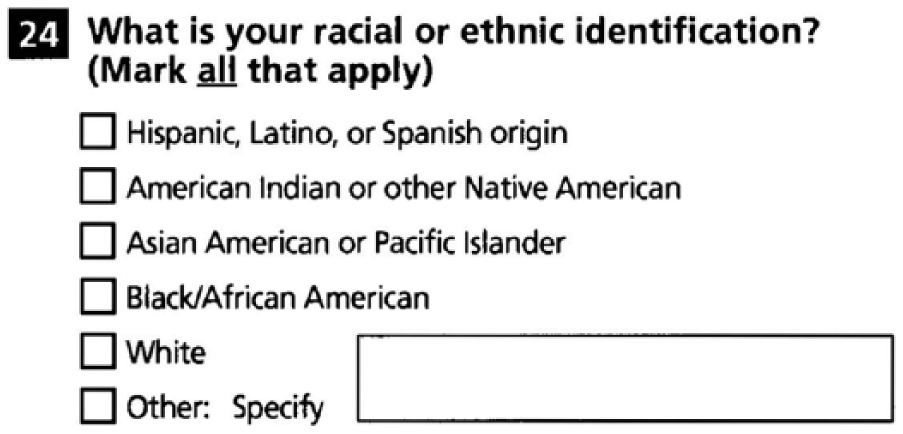
HSSSE survey question regarding racial or ethnicidentification.
Sample
The sample consisted of 90,378 U.S. high school students enrolled in 103 schools across 26 states. These respondents closely resembled the national profile of high school students based on 2004 U.S. Department of Education statistics (HSSSE, 2004). Students submitted 6,047 handwritten responses for the “Other” race/ethnicity option. After excluding those responses that were illegible (n = 89) or unrelated to the item (e.g., “hello,” n = 56), the final number of handwritten responses was 5,757.
Instrumentation and Variables
HSSSE is a short, paper-based survey. Although the survey collected information about a range of topics, we utilized only students’ self-reported age, grade level in school, gender (male or female), and racial/ethnic identity. In addition, school officials provided information about their school’s urbanicity and racial composition. We categorized schools as either low- or high-minority schools using a median split. For the entire sample of 90,378 students, the median percentage of minority students was 20.6%. We coded schools with student populations that were 80% to 100% White as low-minority schools and student populations that were 0% to 79% White as high-minority schools.
Analysis
We employed a sequential mixed method design to code and subsequently categorize qualitative data for statistical analysis (Creswell, Plano Clark, Guttmann, & Hanson, 2003; Greene, Caracelli, & Graham, 1989). Using a constant comparative approach (Strauss & Corbin, 1990), we generated an empirically derived protocol for coding the handwritten responses instead, imposing preset coding systems or hypotheses. Initially, we grouped conceptually similar handwritten responses and gave them preliminary category labels. We treated similar spellings (e.g., Mexico, Mexican, Mexicano, Mexicana) and phrasings as identical responses. Next, the first and second authors discussed each handwritten response and refined coding categories until they agreed upon a final coding system. Then, they independently coded each handwritten response by identifying all the applicable coding categories. We calculated intercoder agreement as the number of coding agreements divided by the sum of agreements and disagreements, which yielded an agreement rate of 86.7%. We conducted concordance analysis, using Concordance software (http://www.concordancesoftware.co.uk/contact.htm) to identify the most frequently occurring terms within each thematic category.
We used chi-square tests to examine differences in categories by gender, grade level, school urbanicity, and school minority composition. Alpha was set at .001 due to the number of tests conducted. Comparisons between categories could not be conducted because many students were coded in multiple categories.
Results
Of all 90,378 respondents, 86.8% indicated a single racial/ethnic category (by checking one racial/ethnic box), 5.4% indicated multiple racial/ethnic categories, and 7.8% did not check any of the racial/ethnic options. Just under 6,000 respondents (n = 5,757, 6.7%) made some type of written response in the racial/ethnic text box. A portion of those responses (n = 89) were illegible or uncodable (e.g., “5,” “eh”), resulting in 5,612 codable write-in “Other” race/ethnicity responses. Below, we describe the results of the chi-square analyses testing for gender, grade, and school differences within the subsample of students indicating multiple race/ethnicities. Next, we describe the results of the chi-square analyses for differences between students providing handwritten responses from those students who selected from the provided racial/ethnic identities. Finally, we describe the categories that emerged through the qualitative analysis of the open-ended responses.
Characteristics of Students Reporting Multiple Race/Ethnicities
Equal proportions of male and female students selected multiple race/ethnicity categories, χ2(df = 1, n = 89,847) = 0.106, p = .744. We found significant differences in response proportions by grade level, with the percentage of students indicating multiple race/ethnicities decreasing with each successive grade from 9th through 12th grades, χ2(df = 1, n = 90,087) = 157.2, p = .001. School type was also related to endorsement of multiple race/ethnicities, with a greater proportion of students in high-minority settings selecting multiple categories than their peers in low-minority schools, χ2(df = 1, n = 88,414) = 215.5, p = .001. Students in urban schools were most likely to indicate multiple race/ethnicities than those in suburban, town, or rural schools, χ2(df = 1, n = 90,378) = 200.8, p = .001. Students in high-minority settings were also more likely than those in low-minority schools to indicate multiple ethnicities, χ2(df = 1, n = 88,414) = 215.5, p = .001.
Characteristics of Students Reporting “Other” Race/Ethnicities
Males were more likely than females to describe “Other” race/ethnicities via the open-ended item, χ2(df = 1, n = 89,847) = 283.5, p < .001. With each successive grade, students were significantly less likely to provide handwritten responses, χ2(df = 3, n = 90,087) = 71.4, p < .001. Differences existed for school urbanicity, with handwritten responses more common among students in urban schools (7.2%) than students in suburban (6.2%), town (5.8%), or rural schools (5.3%), χ2(df = 3, n = 90,378) = 66.663, p < .001. Students in high-minority school settings were more likely (than those in low-minority schools) to include a handwritten response, χ2(df = 1, n = 88,414) = 267.914, p < .001.
Categories in Self-Identified “Other” Race/Ethnicities
Eight thematic categories characterized the handwritten responses provided by participants: elaboration, mixed ethnicity, geographic ethnicity, heritage, physical, slang/jargon, transcendent identity, and nonsensical. We provide descriptions and examples of each category in Table 1. Frequency data across thematic categories is provided in Table 2. Geographic ethnicity was the most frequent category, with derivatives of Italian (n = 354, 11.6%), American (n = 324, 10.7%), Indian (n = 314, 10.3%), and Irish (n = 308, 10.1%) being the most common responses within that thematic category. Responses for the mixed ethnicity category were the next most common and generally included use of and, hyphenation, or ratios, or some derivative of mixed or multiracial to describe race/ethnicity. Among students providing heritage-themed responses, the third most common category, Caucasian was the most common term used (n = 157, 30.5%), followed by Jewish (n = 100, 19.5%) and Eskimo (n = 59, 11.5%). Although Caucasian is sometimes used interchangeably with White (Lee, Mountain, & Koenig, 2001), the authors included it under the heritage category because respondents often indicated an explicit distinction from the White racial category (e.g., “Caucasian, not White” or “Caucasian, don’t like being called White”). Furthermore, the origins of the term Caucasian, although controversial, include references to multiple geographic regions that do not lend itself to a geographic ethnicity categorization (Painter, 2003). Responses in the slang/jargon category used alternative, non-standard terms that were racial or ethnic in nature. Responses in this category were typically pejorative. The most common responses in this category were “cracker” (n = 31, 13.0%), “nigger” (n = 25, 10.5%), and “redneck” (n = 22, 9.2%). In 57 cases, students referred to physical features in their response. These typically involved responses indicating a specific color, the most common being “brown.” A small number of students indicated a shade of skin (i.e., “dark skin,” “light skin”), and several students mentioned hair color (i.e., “redhead”).
Thematic Categories of “Other” Responses.

Frequency Data of Thematic Categories of “Other” Responses (n = 5,757).
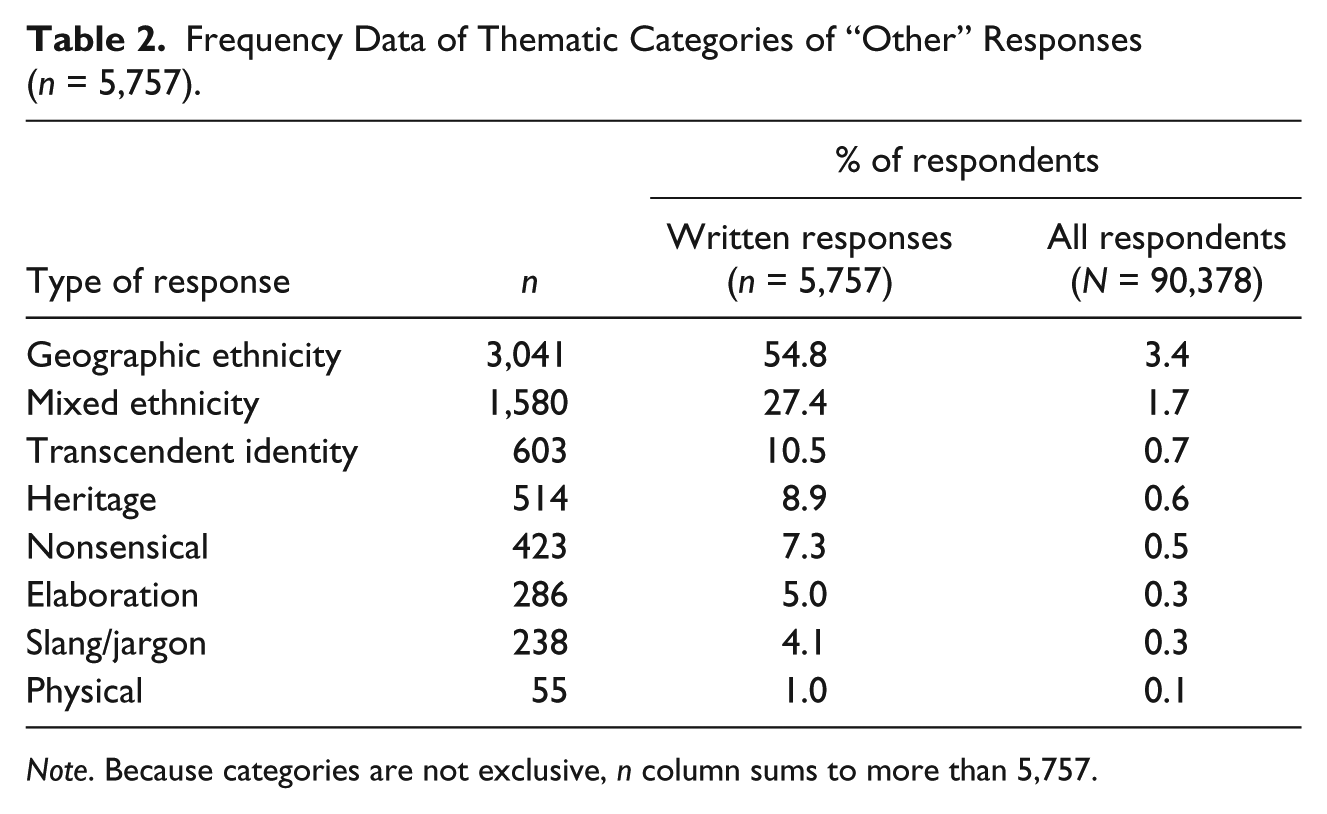
Note. Because categories are not exclusive, n column sums to more than 5,757.
One in 10 students who provided handwritten responses explicitly refused the notion of race/ethnicity, resulting in the transcendent identity category. The term transcendent identity is taken from Rockquemore and Brunsma’s (2002) research on the different ways that biracial individuals self-identify. They use this term to describe those who discount race and racial categorizations completely. The concordance analysis identified the words matter, it, does, human, and why as most common in these responses (e.g., “Why does it matter you racist pigs?” “This shouldn’t matter,” and “I’m a human!”).
Characteristics of “Other” respondents across categories
Among students self-identifying as “Other” race/ethnicities, females were more likely than males to provide responses reflecting geographic ethnicities, χ2(df = 1, n = 5,684) = 72.4, p < .001, and multiple ethnicities, χ2(df = 1, n = 5,684) = 89.2, p < .001. Males were more likely to provide responses coded as heritage, χ2(df = 1, n = 5,684) = 42.6, p < .001, nonsensical, χ2(df = 1, n = 5,684) = 91.7, p < .001, or slang/jargon categories, χ2(df = 1, n = 5,684) = 60.6, p < .001. No significant gender differences were seen for the physical, transcendent identity, and elaboration categories. Geographic ethnicities and multiple ethnicities were more common among 9th graders than students in higher grades, χ2(df = 1, n = 90,087) = 40.4, p < .001, and χ2(df = 1, n = 90,087) = 51.4, p < .001, respectively. In contrast, transcendent identity responses were more common among 11th and 12th graders than 9th or 10th graders, χ2(df = 1, n = 90,087) = 72.8, p = .001. Students in urban schools were more likely to provide geographically themed responses than their peers in suburban, town, or rural schools, χ2(df = 3, n = 90,378) = 56.9, p < .001. Urban students were also more likely to provide responses reflecting multiple categories, χ2(df = 1, n = 90,378) = 162.8, p < .001. Students in town and rural schools were more likely to provide slang/jargon responses, χ2(df = 1, n = 90,378) = 10.3, p = .001. No significant differences by school urbanicity were seen in the other categories. Students in high-minority schools were more likely provide responses coded as geographic ethnicity, χ2(df = 1, n = 88,414) = 182.7, p < .001, and multiple ethnicity, χ2(df = 1, n = 88,414) = 191.3, p < .001, compared with those in low-minority schools. Students in low-minority schools were more likely to provide responses within the transcendent identity category, χ2(df = 1, n = 88,414) = 11.9, p = .001. Additional data regarding student characteristics and thematic categories is presented in Table 3.
Proportion of Respondents Reflecting Coded Categories by Student and School Characteristics (n = 5,757).

Note. Percentages represent the percent of respondents within each demographic group who provided a write-in comment coded as that thematic category. Rows do not necessarily add up to 100% because comments could be coded into more than one category.
Low indicates schools with a lower than average proportion of minority students. High indicates schools with a higher than average proportion of minority students.
Discussion
Advancing scholarship in racial/ethnic identity requires not only exploring commonly accepted categorizations (e.g., Black racial identity, White racial identity) but also the racial identity of individuals who do not adhere to common conceptualizations. Population studies suggest that singular racial/ethnic categorization is no longer relevant for a growing proportion of the U.S. population (Herman, 2004), particularly adolescents (Lopez, 2003). In this mixed methods study, we describe the characteristics of students selecting multiple race/ethnicities or describing unconventional “Other” ethnicities on a common survey item. In addition, we investigated the categories reflected in the students’ handwritten “Other” responses, which are often omitted in research. We engaged in qualitative and statistical analysis of these responses to shed light on the ways students describe their race/ethnicities when rejecting conventional unitary definitions. Our purposes were to explore first the nature of these responses on their own merit through a qualitative constant comparative method and then to investigate possible differences by gender, grade level, and school racial composition. Based on prior research and literature, we expected that race and ethnicity would be a more salient issue for students in more diverse settings, and therefore race/ethnic self-description responses of those students might be less likely to fit into a single standardized classification system than students in less diverse settings.
Altogether, 5.4% of students indicated multiple racial/ethnic identities, and 6.2% of students wrote something to specify an “Other” race or ethnicity. Students’ endorsement of multiple racial/ethnic categories varied by gender, grade, school type, and school composition. This is consistent with earlier research (Harris & Sim, 2002; Lopez, 2003) and supports the conclusion that self-identification is associated with both individual characteristics and students’ educational environment.
Specifically, students in schools with a higher proportion of minority students, as well as those in urban schools, were more likely to check multiple race/ethnicity than other students. Likewise, students in high-minority and urban schools were more likely to include a handwritten response than other students. Students in earlier grades were more likely to mark multiple categories, and also to write in a handwritten alternate race/ethnicity response. This finding seems consistent with developmental models (e.g., Erikson and Phinney among others), in which adolescents begin to explore race and ethnic possibilities, and hopefully eventually move toward a more consolidated self. From this viewpoint, the higher number of multiple and write-in identifications among younger students could simply reflect initial exploration or even confusion regarding racial and ethnic identities, whereas older students responses reflect more developed racial/ethnic identities that are therefore more in-line with standard category schemes. The finding may also be seen as consistent with a social identification perspective, in which group affiliation is a strong force and plays a strong role in self-concept. From this perspective, adolescents may experience pressure to adhere to racial/ethnic expectations and standards as they age, and in turn may shed potentially meaningful (but more individualistic) identities in moving toward conformation to more stable social norms. Future research might further examine identity development by analysis of open-ended race and ethnic self-identification across the life span as well as explore how school environments and peer networks relate to individuals’ conceptualizations of racial identity and behavior and affect in various academic and social domains.
Eight thematic categories emerged from our analysis of students’ handwritten responses and might be thought of as representing two broader meta-categories. First, a large set of students identified with a particular group or combination of groups by listing multiple common racial/ethnic categories, elaborating on identification with a conventional racial/ethnic category, providing a slang/jargon description of a conventional category, or describing a group identity based on geography or physical features. A second set of students seemed to resist identification of race/ethnicity by writing explicitly opposing racial categories or providing nonsensical responses. Future research might seek to better understand these cases, as it may inform theories of racial identity development.
It is particularly interesting that transcendent identity and nonsensical responses were more common in schools with low-minority enrollment than schools with more diverse student populations. French and colleagues (2000) suggested race/ethnicity is more salient in racially diverse environments (Umaña-Taylor, 2004), so nonsensical and resistant responses may reflect the passive, “cultureless” attitude Perry (2001) described among students in relatively homogeneous settings, particularly given that the most common response in these categories was that race does not (or should not) matter. These findings seem similar to Lewis-Charp’s (2003) finding that some high school students held on to a “generic belief in . . . fundamental ‘sameness’” that she considered molded by “broad principles of fairness and egalitarianism” and made them feel they should avoid distinguishing by race or ethnicity (p. 279). Some proportion of transcendent identity responses we say might alternately reflect adolescents’ view that they did not fit into a race category because they saw themselves as “a little bit of everything,” or just “human,” reflecting an attitude that Brunsma and Rockquemore (2002) found among some of the biracial college students in their study. Researchers should study the intersection of intraindividual and environment factors in the development of such attitudes, particularly within the unexamined or exploration stages in existing identity development models (Phinney, 1990).
More generally, the degree and diversity of responses provided by adolescents in our study underscores the complexity of racial/ethnic identity construction among adolescents and the need to consider these students in research rather than systematically omitting them. The finding that such a large proportion of students (6.7%) wrote an alternate race comment could be seen as support for concerns that traditional methods of assessing race identification in U.S. surveys fail to capture self-identity as experienced by a large number of today’s youth (Herman, 2004). Given that selection of alternate race/ethnicities is becoming increasingly common, scholars risk biasing their research by doing so. Lopez (2003) questioned whether it is possible to attain high levels of reliability in measuring race/ethnicity when the population consists of mixed-race adolescents. Researchers should examine the differences between multiply- or self-defining students relative to those adhering to traditional singular categories. In addition, identity theorists must consider this diversity as they reconceptualize existing frameworks. This line of research will inform measurement and use of racial/ethnic identity in research, ultimately improving research design and interpretation (Helms et al., 2005). Decades of research suggest that race is important to numerous educational (e.g., achievement, discipline, school engagement), psychological (e.g., depression, self-efficacy), and health (obesity, cardiovascular disease) outcomes, and social and psychological experiences (e.g., discrimination; for example, O’Connor, Hill, & Robinson, 2009; Smedley, Stith, & Nelson, 2003). Improved understanding of racial/ethnic identity and resultant research will provide insight into how self-identity relates to these experiences and outcomes and may illuminate potential responses to observed disparities. Given the salience of adolescence in the development of self-identity and as a key transition time in psychological and social development broadly, clearly, more research is warranted.
Limitations
Although this study contributes to the literature on adolescent self-identification, it is not without its limitations. We relied on secondary data analysis rather than interviews or observations, and are thus limited by our own interpretation of the text responses. Because we did not review the original surveys, we may be missing some contextual information from the responses (such as additional markings). Also, generalization may be limited by the sample being non-random. The sample size is extremely large, which can increase possibility of finding significant group differences in statistical tests (Daniel, 1998). Because these data are not longitudinal, we cannot consider developmental processes, which is particularly valuable when considering potential refinement of identity theories. Furthermore, our data set did not include important information about student characteristics (e.g., parent racial/ethnic background, SES). Finally, the categories we identified are only one possible way of viewing the data. Future qualitative work may help to elucidate more clearly the nature of students’ self-identification when they reject conventional categories.
Conclusion
Sofaer (1999) noted that one potential of qualitative research is to “allow people to speak in their own voice, rather than conforming to categories and terms imposed on them by others” (p. 1105). In analyzing adolescents’ multiple and handwritten responses to a traditional race item, we found that one subset of students chose to express their ethnic and/or racial identity by moving beyond a single check box and sometimes writing in their own description. These cases were most common in schools with a high number of minority students, in urban settings, and among earlier grades. A second subset of students wrote in responses that seemed to either express opposition to the use of race and ethnic categories, or minimized its relevance, particularly within school settings with limited diversity. By revealing the complexity of adolescents’ self-constructed descriptors, the study points to the importance of attending to youth voices in studies of racial/ethnic development.
Footnotes
Declaration of Conflicting Interests
The author(s) declared no potential conflicts of interest with respect to the research, authorship, and/or publication of this article.
Funding
The author(s) received no financial support for the research, authorship, and/or publication of this article.