



Abstract
Despite reform efforts to involve parents, parent–school relationships in urban districts are rare. This qualitative study used a constructivist grounded theory approach to gain an understanding of how parent social networks, specifically relationships with other parents in the school, influence parent perceptions of their role in the educational process and their efficacy to fulfill perceived roles. Findings suggest that parents have differing perceptions about their role and differences in efficacy for involvement; however, relationships with other parents are important resources for role construction and efficacy, and may serve to lessen the disconnect between parents and schools in high-poverty districts.
Introduction
Parent involvement in education has captured the attention of researchers, policy makers, and educational leaders for decades. In the past 40 years, “US policy makers, scholars, and government officials have sounded a call to reestablish parent’s involvement in their children’s education” (Stitt & Brooks, 2014, p. 76). For example, the Goals 2000: Educate America Act distributed funds to schools for the establishment of partnerships with parents, and the No Child Left Behind Act of 2001 included parent involvement mandates for K-12 schools. These mandates have forced schools to include parent involvement initiatives in school reform efforts as a means to enhance student achievement (Stitt & Brooks, 2014).
Although there is some disagreement in the literature concerning the positive effects of parent involvement (Lareau & Shumar, 1996), research generally supports the understanding that parent involvement in a child’s education can lead to enhanced student outcomes (Jeynes, 2012). Positive outcomes of parent involvement include the promotion of self-regulatory skills, academic achievement gains, overall grade improvement, and higher graduation rates (Henderson & Mapp, 2002; Hill & Tyson, 2009; Xu, Kusher Benson, Mudrey-Camino, & Steiner, 2010). In addition, parents’ support of learning has been associated with more positive student attitudes toward school, better school attendance, increased self-esteem, and increased motivation to learn (Gonzalez-DeHass, Willems, & Doan Holbein, 2005; Kreider, Caspe, Kennedy, & Weiss, 2007; Sheldon, 2007; Tan & Goldberg, 2009; Topor, Keane, Shelton, & Calkins, 2010). As a result, parent involvement in education has become a vital component in virtually all comprehensive school reform efforts. In addition, Lareau (1989) suggests that parent involvement has become such a popular notion in the United States that it has become an “institutional standard.”
However, policy changes and enhanced emphasis upon parent involvement initiatives in school reform efforts have not led to consistently successful parent–school partnerships. Changes in American society such as the declining role of family, the “fast pace of modern society as a whole,” and presence of more parents in the workforce have been cited by social scientists as reasons to explain a decline in parent involvement in education (Jeynes, 2012, p. 707). These changes, coupled with the institutionalization of American educational systems (Morris, 2009; Peressini, 1996; Stitt & Brooks, 2014), have led to current conditions that inhibit collaboration between parents and schools. Stitt and Brooks (2014) explain that “one of the original aims of public education was to minimize parent’s influence on their children’s education” in meeting the social efficacy goals of the Industrial Era (p. 76). In addition, in 1996, Henry referred to the separation between parents and schools as a “walling out” of the community in response to the professionalization of the teaching process (p. 15).
Other obstacles to parent involvement have been linked to parents’ and students’ race/ethnicity with marginalized groups, such as African American parents, more alienated from schools than White parents (Abrams & Gibbs, 2002). Williams and Sánchez (2012) note, “African American parents reported feelings of isolation, alienation, disengagement, and an array of other negative feelings regarding interactions with personnel at their child’s school” (p. 629). They further suggest that African American parents are reluctant to become involved because they often had negative school experiences as students. Challenges experienced in Latino populations may include greater numbers of immigrant families who struggle to overcome language barriers and power gaps between themselves and school administration or personnel (Jasis & Ordoñez-Jasis, 2012). In addition, Haynes, Phillips, and Goldring (2010) find that, for immigrant families, parent perceptions about education are greatly influenced by their generational status. Second-generation parents benefit from having access to personal educational attainment, enhanced income opportunities, and social and information networks (Haynes et al., 2010). Furthermore, language fluency can also be a hindrance to parent involvement; this problem is lessoned with second-generation parents as compared with those classified as first generation (Haynes et al., 2010).
The apparent disconnect between parents and schools is typically not a reflection of parent desire or lack of desire to be involved or parent value of education. Research suggests that parents across all ethnic groups and income levels want to help their children experience success in school (Henderson & Mapp, 2002; Johnson, 1997), value education as a means of economic and social mobility (Delgado-Gaitan, 1992; Goldenberg & Gallimore, 1995; Scott-Jones, 1995), and rate involvement in their children’s education as very important (Drummond & Stipek, 2004; Tekin, 2011; Wong, 2006). Furthermore, Jeynes (2012) concludes that most parents and teachers believe that parent involvement is important for enhanced student outcomes.
Problem Statement
Given the widely accepted fact that parent involvement leads to positive effects for students, extensive efforts by policy makers and educational leaders to encourage stronger partnerships, and the desire of many parents and educators for involvement, a better understanding is needed of the factors that influence parent actions and attitudes toward their child’s education. In the few cases where parent perspectives have been considered in the literature (Williams & Sánchez, 2012), they are often viewed through a very school-centered approach as a way to understand parent responses to school-generated initiatives (Auerbach, 2007; Herrell, 2011; Lareau & McNamara-Horvat, 1999) rather than considering parents’ own beliefs about ways they should be involved. Research has addressed parent perceptions of the meanings of parent involvement (Reynolds, Crea, Medina, Degnan, & McRoy, 2015) and has examined parent and teacher perceptions of parent involvement from school-centric, home-centric, and community-centric lenses (Lawson, 2003; Williams & Sánchez, 2012). However, what is missing from the literature is an understanding of parent perceptions of their own involvement (Williams & Sánchez, 2012) and parent perception of factors, relationships with other parents, which could potentially influence and facilitate effective parent–school partnerships.
This perspective is important because, even with the best intentions, if educational leaders and teachers do not understand parent perspectives, they may misunderstand efforts of parents, and their efforts to encourage the involvement of parents may prove ineffective. In addition, understanding parent perspectives is important because findings in the literature indicate that parents often have a broader perspective of what it means to be involved whereas teachers tend to have a narrower, school-centered perspective (Ladner, 2006). This understanding is supported by the findings by DePlanty, Coulter-Kern, and Duchane (2007), who found that parents rated themselves as more participatory than did their children’s teachers.
Purpose of the Study
The purpose of this study was to understand parent perceptions of their own involvement efforts, parent perceptions of their role and efficacy for involvement, and the influence of parent social networks, specifically, parent relationships with other parents in the school, on parent involvement. Because social forces are important predictors of parent role construction and efficacy, we seek to understand the influence of social networks on parent perceptions of their role in education and their efficacy to fulfill that role in an urban district.
Sheldon (2002) and Curry and Adams (2014) find statistically significant, positive relationships between the size of parent social networks and parent choice for involvement. These findings suggest that relationships among parents in the school may be an important factor in determining the actions that parents take to fulfill their roles in the educational process and in their efficacy to fulfill their roles. However, how social connections between parents in schools affect parent choices for involvement is not well-understood. Studies examining parent role construction and efficacy have primarily been quantitative in nature (Rodriquez, Collins-Parks, & Garza, 2013). This qualitative study uses a constructivist grounded theory approach to gain in-depth understanding of how relationships with other parents in the school influence parent perceptions and their choices of action. Because not all parents construct their roles in ways that are recognized by schools as effective involvement (Stitt & Brooks, 2014), understanding parent perspectives can potentially help educators and policy makers in their quest to develop effective partnerships with parents.
The Need for Understanding of Parent Perspectives in the Urban Context
Most parents and teachers “have a sense that parent engagement in their children’s schooling will ameliorate academic outcomes” (Jeynes, 2012, p. 711). However, societal factors that may inhibit the formation of effective parent–school partnerships “are especially obvious in urban areas” (Ferrara, 2009; Gibson & Jefferson, 2006; Sy, 2006, as cited in Jeynes, 2012, p. 709). These factors include “elevated family dissolution rates, numerous two-parent working families, and unique sociological pressures on children” (Jeynes, 2012, p. 709). In addition, Jeynes (2011) explains, “educators are often unaware of how they come across to low-income families” with lower income families perceiving that schools are primarily “takers,” and they are expected to be “givers” (p. 39). In addition, research suggests that, when schools demonstrate concern for needs and interest of parents, parents are likely to respond positively (Lopez, Scribner, & Mahitivanichcha, 2001). This finding suggests that, instead of acclimating to certain preconceived ideas of parent involvement, parents had favorable perceptions of schools that met family needs and recognized family values and concerns.
Milner recognizes three categories of urban education: urban intensive, urban emergent, and urban characteristic. These descriptors are largely based on community size, population density, and access to resources (Table 1). Milner (2012) argues that schools are often classified as urban because of “their perceived shortcomings of students and parents in the school” (p. 558) and that, too often, schools with high minority and low socioeconomic status (SES) are classified as “urban.” Therefore, this study will address parent involvement in an urban district, with “urban” defined as urban emergent (Table 1). These urban schools can include various income levels and White students. This definition is not to be confused with schools defined as inner-city which “tend to be public and serve largely poor students of color” (Williams & Sánchez, 2012, p. 630).
Definitions of Urban Education.

Source. Milner (2012, p. 560).
Conceptual Framework
The conceptual framework for this study was developed using research on how and why families engage in their children’s education (Hoover-Dempsey & Sandler, 1995, 1997; Mapp, 2003) and, because we are interested in understanding how social factors influence parent choice for involvement, we turn to social network theory to explain the influence of parent social networks on parent role construction and parent efficacy.
Studies examining why parents become involved in their child’s education have led researchers to conclude that positive motivational beliefs, specifically parent role construction and parent efficacy for involvement, lead to enhanced involvement efforts (Hoover-Dempsey et al., 2001; Sheldon, 2002; Walker, Wilkins, Dallaire, Sandler, & Hoover-Dempsey, 2005). Research conducted by Hoover-Dempsey and Sandler (1995) provides a framework to understand why parents become involved in their children’s education. Hoover-Dempsey and Sandler identify three key factors that influence parent choice for involvement: parent role construction, parent efficacy, and parent perceptions of invitations for involvement.
Parent Role Construction
Role construction, parents’ perceptions of what they should do concerning the education of their children (Hoover-Dempsey & Sandler, 1995, 1997; Walker et al., 2005), is an important predictor of parent actions concerning the education of their children. Parents who view their role as helping their child experience success in school are more likely to become involved in their children’s education than are parents who view their role differently (Hoover-Dempsey & Sandler, 1995, 1997).
It is noted in the literature that discrepancies in actual parent practices exist because individuals construct their roles as parents differently, and the extent to which this role includes active involvement in their child’s education varies widely across parents (Hoover-Dempsey & Jones, 1997; Peressini, 1996; Reed, Jones, Walker, & Hoover-Dempsey, 2000). The difference is evidenced in the finding that some parents believe that they are responsible for day-to-day management of educational progress; conversely, others feel that the school and teachers are almost completely responsible for children’s progress (Sheldon, 2002). Still others perceive the relationship to be one of shared responsibility with the school and parents as equal partners in the educational process. In addition, parent perceptions of their role in the educational process can be manifested in a variety of ways. Some actions that parents take are very obvious and observable. For example, attendance at parent–teacher meetings, open house events, and other school-sponsored events is likely to gain the attention of educators. Other actions or attitudes are not as observable. According to Jeynes (2011), subtle aspects of parent involvement, such as parent expectations, parenting style, and communication, may be even more important than overt expressions of involvement for enhancing student success. Understanding parent perceptions of their role may help explain which actions a parent chooses to take.
Parent Self-Efficacy
Self-efficacy, or an individual’s belief that he or she can be successful in an endeavor (Bandura, 1989), has also been identified as key determinant of parent actions or attitudes toward involvement (Green, Walker, Hoover-Dempsey, & Sandler, 2007; Hoover-Dempsey & Sandler, 1995, 1997; Walker et al., 2005). According to Hoover-Dempsey and Sandler (1995, 1997), parents will become involved if they believe that they possess the skills and knowledge to help their children, believe that they can teach or assist their children, and believe that they can find necessary resources to help their children succeed. Parent self-efficacy is especially important in social environments that provide additional challenges for involvement. Hectic work schedules, negative prior experiences with schools (Walker et al., 2005), and parent perceptions regarding demands and expectations of schools (Jeynes, 2011) can influence a parent’s efficacy for involvement. In addition, the significance of role construction and efficacy can be found across racial, ethnic, socioeconomic, and student-grade level (Hoover-Dempsey, Walker, & Sandler, 2005).
Parent Sense of Invitation for Involvement
According to Hoover-Dempsey and Sandler (1995, 1997), parents are more motivated to be involved when they receive clear invitations from the school and their children. These invitations communicate that their involvement is expected and welcomed. Hoover-Dempsey and Sandler (1997) conclude that student invitations for involvement may be more influential than school invitations because of personal relationships between parents and children; however, school invitations communicate an openness of schools toward parent participation and can be influential to parents because of perceived authority and power of school in a child’s life. Findings in the literature suggest that teachers and schools that consistently offer invitations for involvement can influence more positive parent attitudes toward school and, therefore, encourage enhanced parent involvement in a child’s education (Eccles & Harold, 1993; Hoover-Dempsey & Sandler, 1997). What is not known, however, is how invitations from other parents for involvement influence parents’ actual involvement efforts. As a result, we turn to parent social networks as an explanation for parent motivation for involvement.
Social Networks and Parent Motivation
An area that is not as prevalent in the literature concerning parent motivation for involvement is consideration of social influences on parent involvement. The consideration of social context is essential due to the well-documented understanding that self-efficacy and role construction are socially constructed (Hoover-Dempsey et al., 2005). According to the role theory, roles are a socially constructed set of duties, rights, obligations, and expected behaviors corresponding with varied positions carried out in multiple contexts (Biddle, 1986; Hoover-Dempsey et al., 2005; Maccoby, 1980; Wheelan, 1994; Whitaker & Hoover-Dempsey, 2013). These roles are constructed by individuals in the context of their relationships with others (Whitaker & Hoover-Dempsey, 2013), with society (Biddle, 2001), and with the culture in which they live (Delgado-Gaitan, 1992). In addition, roles in education are largely learned through observation and modeling of others in the educational environment.
Similarly, self-efficacy is influenced by social forces. Bandura (1997) emphasizes that efficacy can differ with respect to individualistic and collectivistic cultural characteristics. In other words, social influences in the educational environment can alter a parent’s efficacy to take action. For example, as parents view the actions of other parents, they gain or lose confidence based on the success of other’s actions. In addition, as parents receive encouragement from others to take action, their efficacy is potentially enhanced, and mastery experiences provide impetus for continued involvement.
An additional understanding of social network theorists is that social networks are an important source of social capital (Daly & Finnigan, 2010). Social capital consists of “the resources embedded in social relations and social structure which can be mobilized when an actor wishes to increase the likelihood of success in purposive action” (Lin, 2001, p. 24). Social capital is distinguished from human capital because it represents an investment in social relations in a system “through which the resources of other individuals can be accessed, borrowed, or leveraged” (Daly & Finnigan, 2010, p. 115). Therefore, social capital is concerned with the resources that exist in social relations between individuals rather than resources or characteristics of specific individuals (Wasserman & Faust, 1998). Findings in the literature suggest that ties in a social system create a structure that supports transfer of complex knowledge (Hansen, 1999; Reagans & McEvily, 2003), enhances joint problem solving (Uzzi, 1997), and provides opportunity for coordinated solutions (Uzzi, 1997). The influence of network structure on factors such as organizational performance, socialization, communication, knowledge transfer, innovation, and productivity has been termed “communal social capital” (Daly & Finnigan, 2010) and accrues “collectively as a result of the maintenance of positive relations between different groups, organization units, or hierarchical levels” (Ibarra, Kilduff, & Tsai, 2005, p. 360).
According to Coleman (1988), social capital is a resource that is important in children’s educational development, and social capital is a natural result of social relationships that parents maintain with other adults including networks of parents within schools (Sheldon, 2002). Parent social relationships have the potential to offer important benefits such as encouraging the exchange of information, helping to shape beliefs, and enforcing norms of behavior that are important for educational success (Coleman, 1990; Morgan & Sorensen, 1999; Portes, 1998; Sheldon, 2002; Stanton-Salazar, 1997).
Research Questions
Five research questions were the focus of this study:
Method
This qualitative study used a constructivist grounded theory approach (Glaser & Strauss, 1967) to gain an understanding of the meaning that parents in six elementary schools in a large, urban district in the Midwest have constructed about their role in the educational process, their efficacy to fulfill that role, and the role that social networks play in developing those perceptions. Purposeful sampling was used. This qualitative study is a follow up of a 2010 study that identified six schools in this district as having higher parent role construction, parent efficacy, and stronger connections between parents within the school as compared with other schools in this district (Curry & Adams, 2014). The district is the second largest district in this Midwestern State with a student population of 40,111 in the fall of 2014. District demographics indicate that 49% of the students are female and 51% are male. Demographics also indicate a student population of 30.42% Hispanic, 27.01% Caucasian, 26.14% African American, 5.98% Native American, 1.36% Asian, and 8.77% Mixed Race. The district consists of 18.46% English language learners, and 79.9% of the students qualify for free or reduced lunch. The district has a high-mobility rate; therefore, population statistics are reported at a specific point in time. Demographics change as students move in and out of the district. The district employs 6,837 employees, and 2,978 of those employees are certified to teach. The district includes three early childhood schools, 53 elementary schools, 12 middle schools, nine high schools, and nine alternative schools. The six schools identified for this study were elementary schools. These schools became the focus of this study, and focus groups were conducted at each location. Table 2 presents the demographic data on these schools.
Demographic Data.
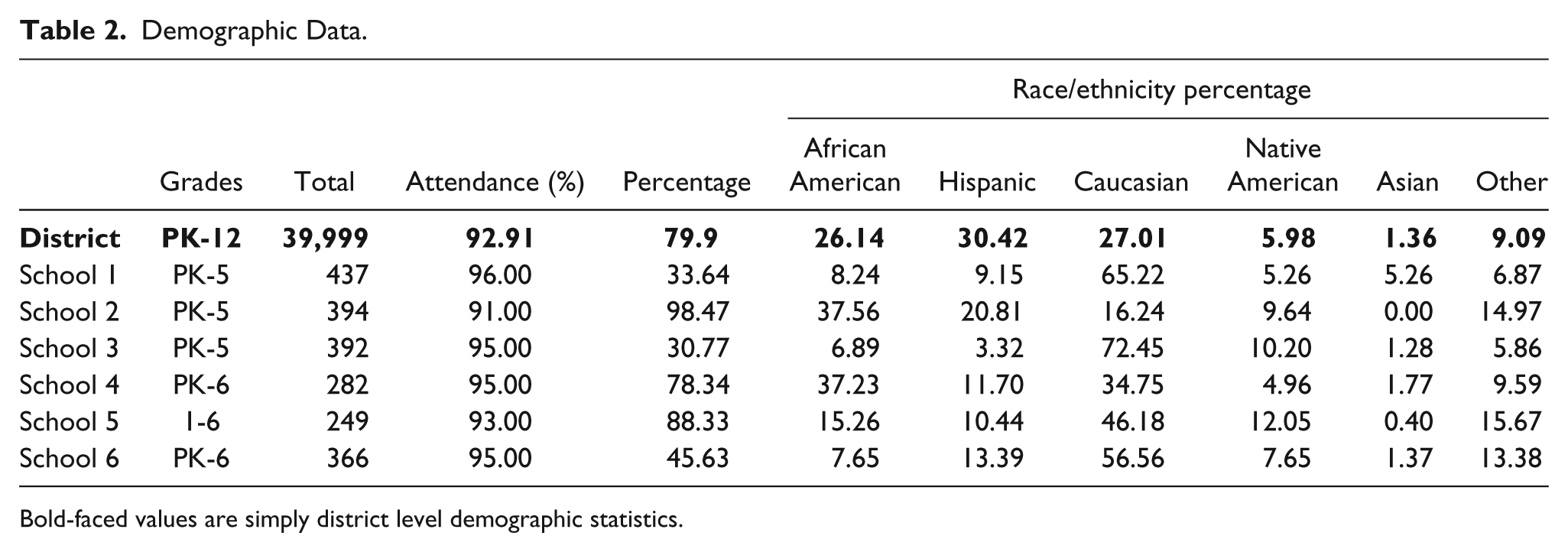
Bold-faced values are simply district level demographic statistics.
Patton (2002) suggests, “the logic and power of purposeful sampling lies in selecting information-rich cases for study in depth” (p. 230). The six identified schools provided an opportunity to collect rich data because of their unique levels of role construction, efficacy, and connections between parents in these schools. In addition, research suggests that parent involvement diminishes as students move from elementary school to middle school (Barnard, 2004; Connors & Epstein, 1994; Dauber & Epstein, 1993), making elementary parents an important source of information for this study.
For a grounded theory study, criterion sampling is done from the research population. Criterion sampling ensures that all participants experience the phenomenon being studied, in this case parent involvement, thereby supporting the development of the theory (Creswell, 2014). Research suggests that educators do not always recognize the parents who consider themselves as most involved (Stitt & Brooks, 2014); therefore, we depended upon the aspect of voluntary participation and our recruitment efforts through the school to encourage those parents who are involved in their child’s education to participate in this study. We argue that those parents who choose to participate in a parent involvement study have some interest in the phenomenon being studied. Therefore, it is likely that those parents who participated are among the most involved parents in the school. Including involved parents helped researchers to understand the perspectives of involved parents concerning their involvement efforts and their relationships with other parents. In an attempt to include the most involved parents in the schools, efforts were made to contact parents through fliers distributed in student backpacks and posted on school bulletin boards, announcements made during parent meetings and school assemblies, and principal and teacher invitations to parents. Fliers were translated into Spanish to encourage the participation of Spanish speaking parents. No incentives were offered in return for parent participation.
Twelve focus groups were conducted (two at each school) with sizes of focus groups ranging from three to 15 parents, with most focus groups containing four to five parents each. Because the focus of this study is parent social networks, focus groups allowed us to hear the perspectives of parents as well as to observe interactions among parents. Focus groups were held during the daytime (the hour before school dismissed) and in the early evening (to attract working parents). Only two focus groups (at separate schools) contained three parents, and only one focus group contained 15 parents. Most attendees were mothers; however, two fathers and three grandmothers attended separate meetings. Spanish speaking translators were provided so that Spanish speaking parents could actively participate. Of the 59 parents who attended focus groups, three parents depended completely upon translators for participation in discussions. In addition, three parents attended both focus group opportunities at two separate schools making the total attendance at focus groups 62. Repeated comments from these parents were identified in transcripts to eliminate unrepresentative weighting of their responses in findings. A semi-structured interview protocol was used for each focus group. Focus groups lasted approximately 1 hr, and all focus groups were recorded with the signed permission of parents attending. After focus groups, recordings were carefully transcribed into computer files. Document analysis consisted of careful inspection of bulletin boards in each building, letters sent home to parents, Parent–Teacher Association fliers, and school websites to further assess school–home communication and school-supported parent involvement opportunities.
Analysis
All focus group transcripts were read and coded in the style of the grounded theory approach to data analysis (Corbin & Strauss, 1990). Open code procedures were used to create information categories from data collected during parent focus groups based on meaning that emerged from the data. Examples of participant’s words were recorded and properties of each code were identified. After the completion of open coding, selective coding techniques were used to identify relationships among the codes and to develop coherent categories of major and minor themes that emerged (Strauss & Corbin, 1998). Finally, theoretical coding was used to identify core ideas that linked all codes together (Charmaz, 2014). Five category headings were generated from the data, and under these headings, all the data were accounted for. Triangulation of data sources was also used. For example, observations of parent behavior and interaction during on-campus assemblies, pick up and drop off times in the parking lots and hallways, and school-sponsored community outreach initiatives were carefully documented. These observations allowed researchers to gain a better understanding of parent interactions within each school. Document analysis consisted of careful reading of letters sent home to parents, bulletin boards and announcements within the buildings, Parent–Teacher Association fliers, and school websites. These documents helped researchers to understand school initiated invitations for involvement and helped provide a more thorough understanding of parent responses during focus groups.
In accordance with Mertz and Anfara’s (2006) work on using theory in qualitative research, parent motivation (i.e., role construction and self-efficacy) criteria were applied ex post facto to the findings. Role construction and self-efficacy explain parent perspectives of their involvement efforts. In addition, social network theory provides a framework to understand how parent belief systems are influenced by social factors, such as social networks.
Findings
Parents described involvement in a variety of ways, and participants expressed a strong belief in the importance of their involvement in their child’s education. All parents involved in focus groups described themselves as “very involved.” Parents enthusiastically described helping their children with homework, walking their children to and from school, interacting with teachers, participating in parent–teacher organizations, and involvement in children’s extracurricular activities, such as sports or music. These parents considered their involvement a priority, and parents in each focus group provided details about their efforts to make changes in their schedules to allow for involvement in their children’s education. For example, because these schools are neighborhood schools, several parents believed that it was important to pick their children up from school each day; therefore, they planned their daily schedules to allow them to arrive just before their child was dismissed from school. One parent explained how she walked to school each afternoon, as weather permitted, to pick up her child. This walk of several blocks to and from school with her daughter allowed her to talk with her child about her day at school. She explained that she “had her daughter’s undivided attention” and could gain a better understanding of her experiences during the day. Other parents indicated that, because of inflexible work schedules, they planned evening activities and responsibilities in ways that allowed them to help with their child’s homework. One parent described encouraging her children to work on homework while she prepared the evening meal so that she could supervise homework efforts. Many parents emphasized the importance of reading with their children, setting aside important time each evening for this activity. Still others described volunteering to help with activities in the classroom, or, for those whose working schedules did not allow, they described trying to find ways to volunteer in school activities that they could do from home or during times that they were not working. Findings from this study indicate a variety of perspectives among parents about what it means to “be involved.”
Parent Role Construction
Despite shared perceptions concerning the importance of involvement efforts, parents expressed differing views concerning their role in the educational process. Approximately half of the parents in the study, including three Spanish speaking parents, expressed the belief that their role was to prepare their child for learning that would take place at school. These parents emphasized making sure the child’s physical needs were met such as making sure children were fed, clothed, well-rested, and equipped with needed supplies for school. One parent stated, “it is my responsibility to make sure they are fed, clothed, and that they complete their homework. I bring them here to get the education.” Teaching their children social skills, such as respect for the teacher and developing healthy relationships with friends at school, was an important responsibility identified by these parents. A parent stated, “I think that my role is to promote friendships . . . especially social skills and how to interact and get along with one another. That’s important so they can learn.” These parents perceived social skills as a necessary foundation for the learning process.
In contrast, approximately the same percentage of parents described their role as a “combined effort” between the home and the school. Parents who shared this perspective often used the word “responsibility” when describing their role, and they emphasized that the school and home share responsibility for the child’s learning. For example, a parent stated, “my responsibility is to serve as an extension of what they are learning at school.” Similarly, another stated,
My role as a parent is to try and help, not only to reinforce concepts, but also to help my child understand how those concepts apply in the real world. They need to know why it is important to learn those things.
Additional shared responsibilities described by parents included communication of expectations to their children, encouraging completion of homework, and participation in student goal setting. One parent stressed, as other participants nodded their heads in agreement, that she “knows her children best” and that she knew creative ways to help her children understand concepts taught at school. In addition, another parent stated,
Classroom sizes are getting larger every day, and I don’t expect the teacher to have enough individual time with my child to make sure she is understanding every concept thoroughly. That’s why homework is important . . . it gives us (parents) the opportunity to see what they are understanding and what they are not understanding.
For these parents, homework served as a means to reinforce concepts taught at school and as a way for parents to monitor student progress in learning those concepts.
Parent Efficacy
Participants in all focus groups expressed confidence in their ability to help their children experience success in school through statements such as “I am very involved, and I know how to help my child.” A common concern expressed among parents in each focus group involved helping students with homework in subjects that they perceived as challenging. Math was the subject that caused parents the most challenge as expressed in statements such as “I am confident to help with homework except for when math problems come that I haven’t done in thirty years.” Technology was also an area where parents in three separate focus groups expressed less confidence. In addition, parent confidence was enhanced when teachers treated them as partners in the educational process. One parent stated, “The teacher sends home, at the beginning of the school year, a homework key and an explanation of how to explain math concepts. It gives us a way of working together.” Conversely, another parent stated, “When there’s no communication, I feel like I am floundering, and I don’t have enough information to help my child.” Two to three parents in each focus group expressed more confidence in activities that they could do at home, such as helping with homework or reading with their children, than with in-school activities such as volunteering in the classroom. Spanish speaking parents expressed particular discomfort with in-school activities citing language barriers as a deterrent to their involvement. One Spanish speaking parent stated (as translated), “I am here at school, but I don’t speak up. I don’t speak English (very well), so that’s a problem.” Despite the concerns that parents expressed about challenging subject areas and language barriers, all parents expressed confidence in their abilities to help their child experience success, and these parents expressed high motivation to help their children succeed.
Parent Connections With Other Parents
Researchers observed friendly interaction among parents in the hallways, in parking lots, and during focus group meetings. One school, in particular, had a group of approximately 20 parents, primarily mothers, who arrived 15 to 20 min before the afternoon dismissal bell. These parents conversed freely in groups on the walkway outside of the school. Parents in three of the schools waited either in the hallways, on the walk outside, or in their cars for students. Parents in these schools seemed to be more isolated from each other; however, it was common for them to exchange friendly greetings that were not followed by additional conversation. In two schools, parents waited for their children in cars with very little interaction at the end of the school day. During focus groups, familiarity differed significantly among parents with some parents exhibiting friendship behavior (laughter, hugs, and friendly greetings) and others recognizing each other through the identity of their children through statements such as, “Oh, you are (name of student)’s mom.”
The most enthusiastic responses in focus groups came from parents when asked about their relationships with other parents. Parents described their relationships with other parents as “very important” to them, and it was common for parents to talk over one another when describing the importance of relationships. One parent’s response was very similar to opinions expressed by many other parents in focus groups when she stated, “On a scale of one to ten, I’d say about nine or ten.” The size of parent networks varied greatly. Five parents expressed that they knew between 10 and 15 parents in the school, and 11 parents stated that they knew between five and nine parents. The vast majority of parents (31 parents) indicated that they knew between two and four other parents, and 12 parents indicated that they knew only one other parent in the school. None of the parents in any of the focus groups stated that they did not know any other parent indicating that each participant had at least one relationship with another parent at the school. Regardless of the size of the network, parents referred to these relationships as a “lifeline” or a “lifesaver.” For example, a parent with a very small network (only one parent) described her reliance on that relationship. She stated, “I speak to my friend every day. I do not know what I would do without that relationship.”
When asked why the relationships were so important to them, parents indicated a variety of reasons. Several parents, at least two from each focus group, suggested that these relationships serve as a support system when they faced difficult situations. It was common for a parent to speak about the support that he or she received from those relationships, and while that parent was speaking, for another parent to join the discussion with a supportive statement. For example, one parent described looking for support when she had a conflict with a teacher or administrator. Another parent supported her by stating, “You need that support system to keep it going when your frustrations are high . . . I talk with (other parent) about what to do.” Parents also viewed relationships with other parents as a means to encourage relationships among students. Statements such as “I maintain friendships with other parents so that my child can maintain friendships” were common. Parents also referred to shared parenting responsibilities such as relying on other parents to help with transportation or other services. One parent, in the school where parents congregated each afternoon, explained, “Their kids are like our kids. It’s like a village type mentality of ‘everyone looks out for everyone else.’” Another parent supported her by stating, “We are eyes and ears for the other parents. It’s good to have open communication because you would want the same thing coming home to you.” Parents in each focus group also indicated that their relationships with other parents helped them stay informed about homework, assignments, and upcoming school events.
Parent Networks and Role Construction
Common statements such as “I learned from seeing other parents when we started coming to (name of school)” and “I didn’t know what to do, so I asked (name of friend) to help me” illustrate that parent social networks influence the way these parents perceive their roles. Parents indicated that they depend on other parents to learn how to interact with teachers and administrators. A parent statement, “It’s a networking thing. I rely on these women and guys to help me (know what to do)” was made to describe how she learned to interact with her child’s teacher.
Another finding from this study was that, often, role construction was influenced by examples that these parents experienced during childhood, the ways that their own parents were involved in their education. However, when these parents did not have strong parental examples of their own, interaction with other parents in the school became very important to them in helping them define their role. For example, a parent stated, “My mom wasn’t involved in our school, so I don’t want my kids to go through that. So I’m very, very involved with my kids, and these other parents help me know what to do.”
Parent Networks and Parent Efficacy for Involvement
Findings indicate that relationships between parents influence parent efficacy for involvement in a variety of ways. Parents who expressed concern about helping their child with homework expressed particular reliance on relationships with other parents to help them. One parent illustrated a situation by stating, “We’ll call another parent or student in the same class and say, ‘Hey, did you get stuck on this problem?’ They (parents) are always willing to help.” Relationships with other parents helped parents navigate challenges that they faced regarding interactions with the school. For example, one parent stated, “If they (other parents) have had a difficult experience, and we’ve had something similar, (that parent can say) ‘This is what worked for me, you might try it.’” Parents also indicated that connections that they have with other parents had an influence on their participation in formal school activities such as Back to School Night or school assemblies. A parent stated, “Connecting with other parents makes it (attending Back to School Night) a little more comfortable.” Another parent agreed by stating, “It (knowing other parents) makes me want to come.”
Invitations for Involvement
Observations made during the school day and careful inspection of bulletin boards, school websites, and communication coming from the school to parents led the researchers to conclude that school outreach and inclusion of parents was varied across schools. Bulletin boards in each school included information for parents concerning their rights to access information, services that were available to them, and announcements concerning upcoming parent association meetings. However, the information was typically not given a prominent location. Effort was made to communicate the information in both Spanish and English.
Another important finding from this study was that school policy decisions affected parent perception of school invitations for involvement. For example, one of the schools changed its policy to restrict parents from leaving their vehicles during “pick up” time. Parents expressed resentment concerning this decision because they were in the habit of meeting in front of the school, and they valued this time as an important time to visit with other parents. The message that was communicated to parents was that they were not welcome on campus after school. Despite the difficulty imposed on them by the policy change, they persisted in their efforts to communicate. One parent illustrated this point by stating, “We all got smart and park outside of the stop signs. We always find a way to communicate.” Another factor that influenced parent perceptions of invitations for involvement was that, at three of the school sites, parent association meetings were allowed only at the end of the school day. Although several parents attempted to join the meetings, they were often distracted by “end of day” responsibilities including taking care of younger children and needing to leave the meeting to meet their older children when school dismissed. When asked about the scheduling of these meetings, parents indicated that they knew other parents who wanted to attend but could not because of other commitments and inflexible work schedules.
Parent-to-parent invitations for involvement
Parent-to-parent invitations provided motivation for these parents to become involved. A parent confirmed the effectiveness of invitations from other parents by stating, “(name of parent) kept on me and kept on me until finally I did it. I’ve been volunteering now for three years.” Other comments made by parents included “If you can catch (the other parent) and say, ‘This is what I’m doing. I need your help. Can you come do this?’ They’ll do it!” and “It starts off like talking about homework and moves into, ‘I’m on this committee. Do you want to be registered and come and help with this?’”
Evidence from an observation made at one of the schools emphasizes the importance of parent invitations. During a small focus group of five parents, a parent invited another parent who was walking down the hall to join the discussion, which she hesitantly accepted. During the focus group meeting, the invited parent stated, “I haven’t been able to get into the volunteering yet. Nobody’s really put me into anything, but I am waiting for them to say otherwise. I’ll be there if they need me.” The parent who extended the invitation to join the discussion spoke up immediately with an invitation to help her sell popcorn on Fridays. The invited parent readily accepted and said, “I’ll come this Friday!” Before the parents left, they exchanged telephone numbers, and the more involved parent stated, “I guess I have a new helper with popcorn!”
Parents stressed that demanding and inflexible work schedules sometimes hindered their own involvement and the involvement of other parents that they knew. They indicated that a wide range of opportunities at varying times during the day could potentially connect those parents who are not as involved. Parents were in agreement that invitations from the school for involvement were generally less effective than an invitation from another parent whom they knew personally. They suggested that parents respond well when parents extend invitations to other parents.
Discussion
Although these parents considered themselves to be highly involved, their involvement efforts varied considerably. Some of these actions were clear representations of actions that are commonly recognized by schools as parent involvement, such as help with homework or attendance at school activities (Lawson, 2003). However, some of the activities that they described as “involvement” were not actions that are typically described in parent involvement literature as “involvement” (Auerbach, 2007). For example, parents placed emphasis on talking with their child about school, being present when school dismissed, maintaining relationships with other parents (so that they could stay informed), encouraging relationships among students, and making sure that their children were prepared and ready to learn when they arrived at school. These actions differ significantly from school-designed programs concerning “parent involvement.” However, these actions may be equally, or more, important for fostering student success because they align with what Jeynes (2010) describes as the more “subtle aspects” of parent involvement. These types of actions indicate sustained attitudes and actions that serve to guide students on a daily basis as compared with attendance at school events which happen only several times each year. In addition, these actions represent actions that most parents can take regardless of the social and cultural resources that are available to them (Lareau & Shumar, 1996). This finding is important because “parents approach family-school interactions with different sets of expertise” (Lareau & Shumar, 1996, p. 25) and with different resources for involvement.
These findings support previous studies (Auerbach, 2007; Ferrara, 2009) that indicate the need to broaden the definition of “parent involvement” to include parent efforts that may not be recognized by schools. Doing so may shift the research lens away from a deficit lens of parent involvement, where schools set the involvement “agenda” and specify what it means “to be involved,” to understanding ways in which parents perceive themselves as involved and what they consider their roles to be in the educational process. For example, Lareau and Shumar (1996) suggest that differences in social resources are invisible to educators, and parents are often misunderstood as being unconcerned about their child’s education when, actually, those parents are very motivated to help. In addition, Wu (2004) explains that many parents do not fit within the expected role of involved parents, yet they contribute substantially to the overall education of their children. Broadening the lens of parent involvement is needed so that parent efforts that are not commonly recognized are included within the conceptualization of parent involvement.
Significantly, this study began with the intent of understanding how connections between parents influence parent choices for involvement. However, findings from the study suggest that contact between parents may not merely be a way to enhance parent involvement. For these parents, contact between parents actually IS parent involvement. These parents perceived their connections with other parents as their connections to the school. This finding further emphasizes the need to broaden the definition of parent involvement, and it indicates the need for schools to provide opportunities for parents to make connections with other parents as an important step in partnership efforts. This understanding is especially important in reaching those parents who do not have access to social resources. Lareau and Shumar (1996) indicate that middle-class families often are situated within social networks that connect them with other families in the school. However, working-class or lower-class parents are typically located in weak social networks, with few connections with the school (Lareau & Shumar, 1996). Schools may have the unique opportunity to enhance the social resources of parents by providing opportunities for parents to connect with each other.
Concerning parent roles in the educational process, findings from this study support previous studies documenting discrepancies in parent perceptions of their roles in the educational process (Hoover-Dempsey & Jones, 1997; Reed et al., 2000; Whitaker & Hoover-Dempsey, 2013) with some parents perceiving themselves as sharing responsibility for student learning and others perceiving the school as having primary responsibility for student learning (Lareau & Shumar, 1996). This finding indicates that, because of the variety of understandings among parents about their roles, the programs and strategies that schools use may not actually align with a parent’s perception of his or her role. For example, if a parent perceives her or his role to be that of shared responsibility for learning, such as helping the child understand what is taught at school, frustrations might develop if the school does not provide opportunities for parents to assist with what is being taught in the classroom. Conversely, if parents feel that it is their role to “prepare” children for learning, and the school’s role is to teach children, misunderstandings may result when schools send assignments home that include parent participation. Lareau and Shumar (1996) explain that social class differences influence parent perceptions concerning their role in education. Typically, working-class parents believe that they are most helpful when they turn responsibility for education over to educators. In contrast, middle-class families see their role as “supervising, monitoring, and intervening in their child’s schooling” (Lareau & Shumar, 1996, p. 30). The answer for more effective partnerships may depend upon open communication between parents and schools about parent and school roles. Developing shared understandings may result in more effective and authentic partnerships.
Given what we know about the influence of role construction and efficacy on parent choices for involvement (Hoover-Dempsey & Sandler, 1995, 1997), the findings about the influence of social networks on parent role construction and efficacy are important. Connections between parents were extremely important to these parents. Parents saw these connections as vitally important for helping them fulfill their roles. From a social network lens, parent connections with other parents provided access to valuable resources. Parents turned to relationships with other parents to gain confidence, to address difficult issues, and to try new volunteering experiences. They also gave parents access to valuable resources such as support for handling difficult situations, information about upcoming schools events or assignments, or help with transportation or monitoring of their children. In addition, parents expressed tremendous reliance on connections with other parents to foster the confidence they needed to advocate for and assist their child. Findings by Lareau and Shumar (1996) indicate that parents with limited or weak connections with other parents do not have access to the same resources as parents with stronger connections. Connecting parents with other parents may be an important way to facilitate involvement as parents gain access to resources and gain confidence for involvement through their social networks.
The finding that parents responded positively when other parents invited them to join focus groups and when they invited them to help them on parent committees suggests that even those parents who consider themselves to be “involved parents” may find new opportunities for involvement through social relationships. These parents indicated that they felt more comfortable attending school events when they knew at least one other parent in attendance. This finding expands the understanding of the importance of invitations for involvement advanced by Hoover-Dempsey and Sandler (1995, 1997) by suggesting that invitations from other parents are important as a motivating factor for involvement. These invitations may lead to different types of involvement that even involved parents may not have considered previously.
Summary
According to Yosso (2006), “educators most often assume that schools work and that students, parents, and community need to change to confirm to this already effective and equitable system” (p. 75). Assuming that parents will conform to school expectations without understanding a parent’s perception of his or her role in the educational process may lead to disappointing results in partnership efforts. Broadening the lens of “parent involvement” to include actions and attitudes that parents perceive as “involvement” is necessary for the promotion of truly collaborative efforts between parents and schools.
Additional research is needed to understand ways to facilitate contact among parents as a means to connect parents and schools. Because of the established understanding that parent involvement enhances student outcomes, finding ways to build bridges between parents could, potentially, enhance fulfillment of educational goals. This effort may be especially important to gain a better understanding of how to draw in parents who have no other, or very limited, connections with the school. Although parental involvement has been an interest of researchers and there have been “multiple strategies suggested for ways to involve parents in the education of students” (Herrell, 2011, p. 14), understanding parent perspectives and broadening the lens of parent involvement may be a step in effectively connecting schools and families.
Limitations
There are several limitations that must be addressed in this study. First, in qualitative research, positionality of the researcher is important and can influence the collection and analysis of data. The researchers live in an area adjacent to this school district. Their familiarity with the district has the potential to influence results of this study. Both researchers have had experience working in other urban districts in both teacher and leadership positions. This previous experience caused the researchers to feel comfortable in the data collection process; however, this previous experience is a limitation that must be acknowledged. The presence of the researchers in focus groups could also, potentially, influence participant responses to the questions asked. Researcher bias concerning the role of parents in the educational process could also influence results, especially because one of the researchers is a parent. Researchers were aware of these limitations, and researchers were careful to listen to the voices of these parents in an attempt to accurately portray the perspectives of these parents about their roles, their efficacy for involvement, and their perceptions about their connections with other parents in the school.
Another limitation that must be addressed is the demographics of these schools as compared with the demographics of the district. As indicated in Table 2, three of the six schools had a lower percentage of students who qualify for free and reduced lunch, and three had equal or higher percentages than the district as a whole. What is not known is differences in social class among the parents who participated. This is a limitation that must be acknowledged because evidence in the literature suggests class differences in child rearing practices (Lareau, 2003) that may influence a parent’s efficacy for interactions with school or a parent’s perception of his or her role in the educational process. In addition, Lareau and Shumar (1996) indicate that differences in social class explain differences in social resources available to parents. It is not known, in this study, how class differences explain differences in parent’s perception of their roles or of the size of their networks. However, the purpose of this study was not to explain differences in parent perceptions but simply to discover whether differences exist. Because participants in this study identified themselves as “highly involved,” and the focus of this study was to understand the perspective of involved parents concerning their role in the educational process, their efficacy to fulfill their role, and their perception of their connections with other parents, we argue that participants at these schools provided valuable information concerning parent perceptions in this highly diverse, urban school district. Additional research is needed to understand whether class differences among parents influence social connections of parents in the school.
Footnotes
Declaration of Conflicting Interests
The author(s) declared no potential conflicts of interest with respect to the research, authorship, and/or publication of this article.
Funding
The author(s) received no financial support for the research, authorship, and/or publication of this article.