



Abstract
This article examines the perceptions of young migrants (and non-migrants), their parents, and teachers to discuss whether the school is a device of inclusion or a device of exclusion that produces inequalities. It presents qualitative and quantitative data collected in the urban areas of Lisbon and Porto. First, we analyze data from 14 focus groups, involving 94 participants, and 12 interviews. Second, we consider survey data from a sample of 1,010 youngsters of Portuguese, Angolan, and Brazilian origin. Findings suggest the school plays an ambivalent role; however, participants emphasize mostly its discriminatory and segregating role.
Keywords
Introduction
Migration is an increasingly relevant phenomenon in our societies. Recognizing the widespread interest in migration, Pat Cox (2012a) points out that “[m]igration is the social issue of this age” (p. 35). It is in this context that the integration of immigrants remains one of the main challenges in Organisation for Economic Co-Operation and Development (OECD) countries, mainly in Europe. The impact of high rates of unemployment currently faced by several European countries, due to the economic crisis, affects particularly the young migrants. In this respect, a recent OECD (2012) report identifies precisely the vulnerability of young migrants, highlighting that “[t]he increase between 2008 and 2011 in the share of young people not in education, employment, or training (NEET), an indicator which captures the “joblessness” of young people, has been especially marked among migrants” (p. 23). This situation seems to corroborate the notion that cultural differences underlying migration contexts “challenge the normative societal and educational assumptions held by receiving nations” (Cox, 2012a, p. 35). In fact, there has been growing international concern regarding the undeniable cultural diversity in European countries, and stressing the importance of the school in the effective integration of young immigrants. For instance, the Commission of the European Communities draws attention, in its Green Paper (Commission of the European Communities, 2008, p. 2), to the important challenge facing education systems today, a challenge which, while not new, has in recent years intensified and become more widespread—the presence in schools of large numbers of children from a migrant background who are in a weak socio-economic position.
Reinforcing this concern about young immigrants, the European Commission has asked the Eurydice (2009) network “to update a part of the survey that it produced in 2004 on school integration of immigrant pupils in Europe” (p. 3). In the same vein, the OECD (2010) emphasizes the importance of closing the gap for immigrant students, referring that very little research has focused on the integration of immigrant children into school and, in that sense, it is important to compare education outcomes of immigrant students to those of their native peers and, where gaps exist, to determine what actions policy makers could take to close the gaps. (p. 11)
Taking into account this social and political concern, this article intends to address the role played by the school in the promotion of social justice (cf. Bell, 1997) and inclusion (cf. Bernstein, 1996) of students with immigrant and non-immigrant background in Portugal. In accordance with European guidelines, Portuguese policies emphasize the need for an inclusive and intercultural education to respond to an increasingly diverse society, ethnically and culturally. Recent international assessments of Portuguese policies have confirmed this concern, recognizing that immigration policies promoting the inclusion of young immigrants have been implemented. The UN Human Development Report 2009 (United Nations Development Programme, 2009), for example, gives Portugal the best score regarding immigrants’ access to rights and services; likewise, the 2010 World Migration Report (International Organization for Migration, 2010) underlines the experience of National Immigrant Support Centres (CNAIs) as an example of a coordinated and coherent action among several levels of the Portuguese Government. Specifically with regard to educational policies, the international evaluation is also very positive, with the Migrant Integration Policy Index III (Huddleston, Niessen, Chaoimh, & White, 2011) concluding that with the implementation of policies slightly favorable, Portugal goes further than other new countries of immigration in the promotion of social integration in education, an area that still has some weaknesses in the integration policies of most countries, including Portugal. (p. 29)
Despite these significant positive international assessments, this article intends to analyze original empirical data regarding the perceptions not only of young people with immigrant and non-immigrant background about the school but also of their parents and teachers, which have a crucial impact on the school integration and academic performance of the students. As the literature has emphasized, elements such as family and parental involvement in the school, the positive relationships between teachers and students, and “responsive teaching” (e.g., Boutte & Johnson, 2014; Gay, 2014; Jeynes, 2014; Noguera, 2014) are essential for pupils’ success. Thus, this article intends to deepen the knowledge about the role of the school in the integration of young people with immigrant and non-immigrant background. Plus, it presents some recommendations to promote a systemic change concerning a more inclusive educational and social environment.
Theoretical Background
Recent studies have repeatedly stressed that young immigrants in Portugal have worse school performance than the nationals (e.g., Pires, 2009; Seabra, 2012), a situation that has also been reported in other European countries (e.g., Govaris & Kaldi, 2012; Hackett, 2012) and also outside Europe (e.g., Darmody, Byrne, & McGinnity, 2014; Nicolas, DeSilva, & Rabenstein, 2009; Zufiaurre, 2006). Despite this identification of cultural and ethnic specificity as a main cause for the academic underperformance of young immigrants, several studies have emphasized that the families’ social condition has a significant impact on the results of immigrant pupils (e.g., Darmody, Smyth, Byrne, & McGinnity, 2012; Seabra, 2012), namely the socioeconomic status (Nicolas et al., 2009). This fact points to the classical idea in “Cultural Reproduction and Social Reproduction” (Bourdieu, 1977): the denunciation that equal opportunities are an illusion given that the school, instead of ameliorating the social and cultural conditions of young immigrants, reproduces conditions of inequality (cf. Riegel, 2012). This led us, in turn, to another classical aphorism, namely that “education cannot compensate for society” (the title of a piece by Bernstein, 1970), that is, “schools fail to meet the potential of their effectiveness through lack of resources, methods, management, or parental/community rapport” (Bernstein, 2003a, pp. 105-106). Criticizing the concept of “compensatory education,” Bernstein (2003b) argues that it serves to direct attention away from the internal organization and the educational context of the school, and focus our attention upon the families and children. The concept “compensatory education” implies that something is lacking in the family, and so in the child. As a result the children are unable to benefit from schools. It follows then that the school has to “compensate” for the something which is missing in the family and the children become little deficit systems. (p. 48)
More recently, in the same vein, Boutte and Johnson (2014) argue that we may rethink our efforts toward the logical, ethical, and policy mandates to engage families and communities. This is a massive undertaking and current thinking and trends will not change overnight since they are also deeply embedded in societal structures. While multiple avenues and trajectories exist, educators should go beyond the simple rejection of deficit perspectives which assume that urban students [as other groups at risk of exclusion such as the immigrants] enter school culturally deprived or disadvantaged because of deficiencies in their homes and communities. (p. 182)
In addition, the ways in which the school has been dealing with intercultural education to address the growing cultural diversity of our societies has been subject to criticism. Stoer and Magalhães (2005) sum up how the West has dealt with difference. They present four heuristic models: ethnocentric, tolerant, generous, and relational. The ethnocentric model, which rejects inter/multicultural education, is grounded on the idea that the “Other” is different due to cognitive and cultural development. Therefore, it is necessary to educate the “Other” according to the Western culture, postulated as superior. In the education field, this is the “monocultural approach” (Stoer & Cortesão, 1999). The tolerance model, based on the notion of a cultural handicap that should be tolerated through the action of inter/multicultural education, merely recognizes difference without interfering in the conditions of inequality of children and young people. In the education domain, this amounts to what Stoer (2008a, 2008b) criticizes as a “benign multiculturalism,” that uncritically accepts that the others have norms and values different from those of the dominant society, and thus naturalizes their disadvantaged condition. In fact, this model links up with the classical idea that lower levels of distribution and appropriation of socially valid, academically transmitted knowledge lead to educational failure and exclusion. Regarding this level of discrimination, Michael Young (2008a, 2008b, 2009) claims that the schools’ curricula should consider the acquisition of “Powerful Knowledge” 1 to take young people beyond their everyday experience. In other words, not doing this could result in yet another form of discrimination and exclusion. The model of generosity, in its turn, proposes a “critical inter/multicultural education” to fight the “folkloric” 2 component of “benign” inter/multiculturalism. Stoer and Magalhães (2005) argue that this model promotes “the development of pedagogical differentiation devices capable of including as fully as possible those who have been excluded by school action” (p. 140). Finally, the relational model is grounded on the assumption that “the difference is us.” This implies thinking difference in its incommensurability, transforming “Us” into one of “Them”—In other words, it is our own otherness that is exposed in the relationship. According to this model, our difference is expressed in inter/multicultural education not as enlightenment (as the model of generosity presupposes), but rather as a sign of otherness. Inter/multicultural education can involve the management of difference, but never its domination (Stoer & Magalhães, 2005).
Despite the impressive amount of research recognizing processes of social reproduction in schools, Monkman, Ronald, and Théramène (2005) stress that “[a] recent resurgence of interest in social and cultural capital acknowledges the reproductive tendencies of schools but also looks to processes of change and equity” (p. 5). In fact, the literature seems to emphasize two different perspectives: On one hand, it recognizes the capacity of schools to promote social justice but, on the other hand, it also recognizes their role in the reproduction (and even in the production) of inequalities. In this context, we can identify some recent studies that stress the importance of the school/education in the integration of young immigrants (e.g., Bekerman & Tatar, 2012; Cox, 2012b; Darmody et al., 2012), advocating, in broad terms, the idea that “[e]ducation is one of the most important vehicles by which the integration of minorities into mainstream society can be promoted” (Bekerman & Tatar, 2012, p. 231). However, there are studies that emphasize the school as a context of discrimination and exclusion (e.g., James, 2012; Milner & Lomotey, 2014; Noguera, 2014; Nunn, 2011; Riegel, 2012; Vaught, 2009). These highlight, for instance, racism/discrimination as a major factor affecting the achievement of migrant students (e.g., Darmody et al., 2014; Oller, Vila, & Zufiaurre, 2012) and as a structural and institutional problem contributing to the dropout of young people from ethnic minorities (e.g., Araújo, 2007; Carlile, 2012; Gillborn, 2009; Vaught, 2009). In sum, we could say that there is an ambivalent perception about the school, shifting between the understanding of the school as an exclusion device 3 and as a device that promotes inclusion and equal opportunities for all.
Purpose of the Current Study
Like other South European countries, Portugal had a long tradition of emigration (Grillo & Mazzucato, 2008). After the April Revolution of 1974, which restored the democratic regime in Portugal 40 years ago, the process of decolonization began. Although emigration still exists in the country (a phenomenon nowadays increasing due to the economic crisis and the consequent rise in unemployment), since the late 1990s, Portugal experienced a significant flux of migrants coming into the country. The majority of this migratory flow was coming from Portuguese-speaking countries, such as Angola and Brazil (e.g., Baganha, 2009; Carvalhais, 2010; Góis & Marques, 2009; Peixoto, 2007). This article presents results from a research project with young people of Portuguese, Angolan, and Brazilian origin, and their parents and teachers. Its aim is to discuss whether the school is a device of inclusion and social justice, or a device of exclusion and discrimination that reproduces and produces inequalities. The data presented here were collected by the Portuguese team of the European study PIDOP—Processes Influencing Democratic Ownership and Participation, financed by the European Commission, Seventh Framework Programme. PIDOP investigated civic and political participation and engagement in nine European countries (Belgium, Czech Republic, England, Germany, Italy, Northern Ireland, Portugal, Sweden, and Turkey), and was focused especially on the participation of youth, women, minorities, and migrants, groups that have been identified as being at risk of exclusion (e.g., Burns, 2007; Norris, 2002; Paxton, Kunovich, & Hughes, 2007; Vogel & Triandafyllidou, 2005).
The research presented in this article was developed in three stages. In the first stage, focus groups were conducted to explore young people’s perceptions of citizenship and participation across a wide range of different life contexts. In the second stage, we carried out interviews with parents and teachers, as they were the most frequently cited sources of influence in the focus groups. Finally, a quantitative survey was conducted in the third stage. The quantitative questionnaire was designed taking into account the findings that emerged from the focus groups and interviews.
Data and Method
First, this article will analyze data from the qualitative study of the PIDOP project, which involved focus group discussions and interviews with parents and teachers of the youngsters involved in the study. Focus group discussions involved three national groups: Portuguese, Angolans (the majority of which are second- and third-generation immigrants), and Brazilians (the majority of which were not born in Portugal), aged from 16 to 26 years old. Participants were organized by nationality and age, and balanced in terms of gender. In total, 14 focus groups were conducted involving 94 participants (44 male, 50 female): five groups of Angolan origin, five groups of Brazilian origin, and four of Portuguese origin. A purposive sampling in diverse contexts was used to integrate a wide range of opinions and backgrounds. Participants were recruited from immigrant associations, youth organizations, religious associations, secondary schools, and through informal contacts; most were students attending secondary or higher education, in spite of many having part-time jobs. We decided use the purposive sample to consider a more extensive set of data in the analysis—promoting a deeper understanding about the types of experiences fostered by different contexts of participation—but also for practical reasons, such as the engagement of young people especially with immigrant background, which are not so easy to reach as young people from the majority. The contacts and resources provided by the institutions and associations involved in the PIDOP project helped us in achieving the necessary conditions to carry out the focus group discussion. To facilitate the discussion and to focus participants’ attention on certain topics, we used a script (Tonkiss, 2006) which was divided into different blocks: relevance of civic and political participation for young people, sources of information and knowledge, personal and group experiences, and proposals for inclusion. The interviews, in their turn, involved 12 individuals—two parents and two teachers of the young participants for each group—and examined their conceptions of citizenship, their perceptions of young people’s patterns of civic and political participation, their perceptions of young people’s motivations for participation, their perceptions of the obstacles to young people’s participation, their strategies to enhance young people’s participation, and their suggestions to encourage young people’s inclusion and civic and political participation. All interviews and focus groups were audio-taped, transcribed, and inserted on NVivo8 Program to codify the content for a deep analysis. Data were analyzed using “Thematic Analysis” following the principles and the procedures described by Braun and Clarke (2006). In short, Thematic Analysis consists of a qualitative analytic method that provides a flexible approach for “identifying, analyzing and reporting patterns (themes) within data. It minimally organizes and describes [the] data set in (rich) detail” (Braun & Clarke, 2006, p. 79). In this article, we will focus our attention in the perceptions of young people, and of their parents and teachers, about the role of school on their inclusion or exclusion. To protect the anonymity of the participants, all the names are fictional.
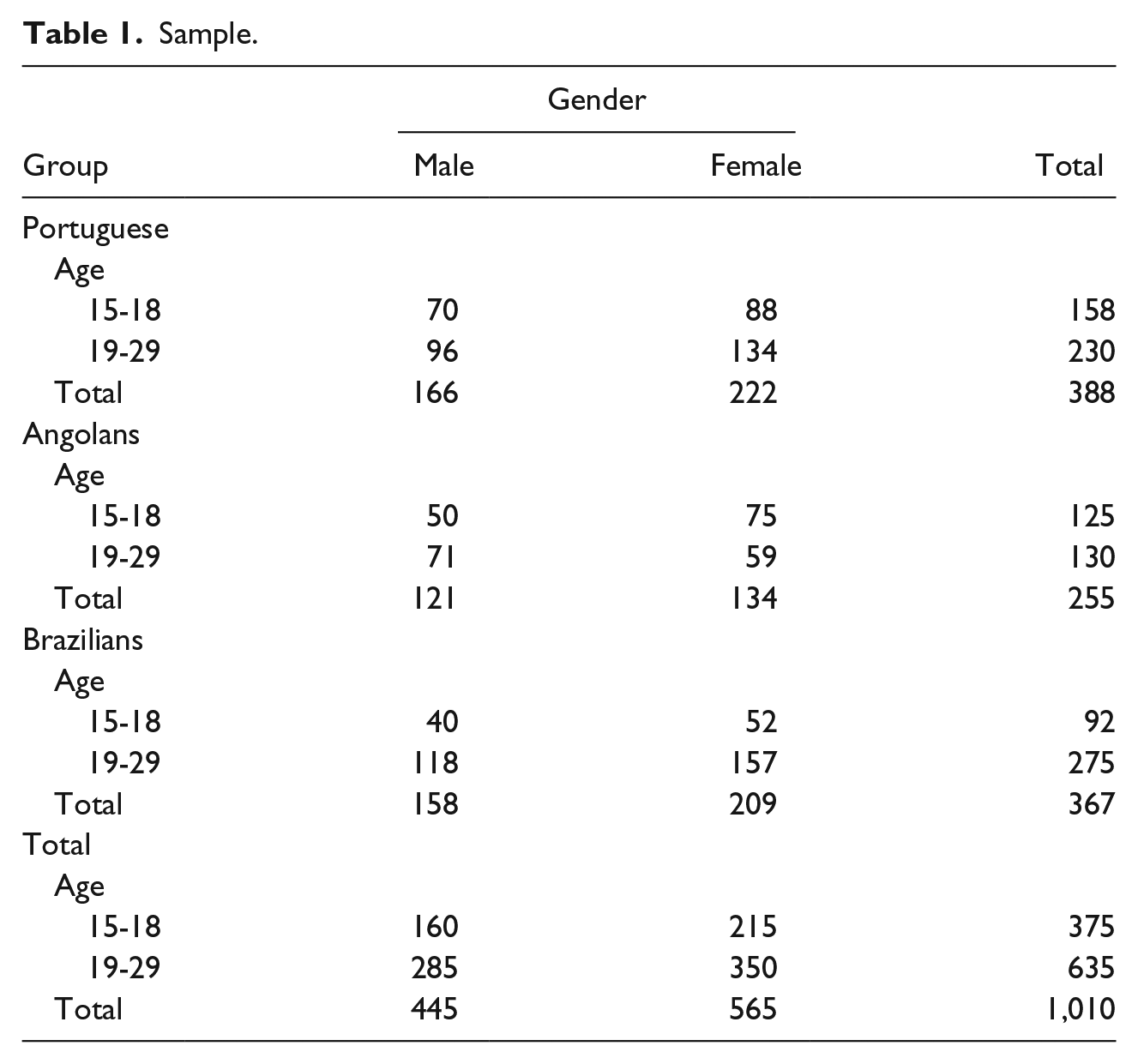
Second, this article will also consider a survey with a sample of 1,010 youngsters of Portuguese, Angolan, and Brazilian origin, divided by two age groups (15-18 and 19-29) and balanced in terms of gender (see Table 1).
Sample.
The instrument used in data collection was a self-administered questionnaire focused on the factors, processes, and practices that can, in general, hinder or promote young people’s civic and political participation. Most participants were recruited in the Metropolitan Areas of Lisbon and Porto (the two bigger urban areas in Portugal; Lisbon is the capital), and from a variety of contexts, such as immigrant associations, regular and vocational schools, higher education institutions, religious associations, youth organizations, National Centres of Immigrant Support, and through informal contacts. An online version of the questionnaire was also used to diversify even more the data collection process. There was a wide set of variables included in the questionnaire, such as bio-socio-demographic variables, participation variables, and also variables concerning a range of factors that are already described in the literature as predictors of civic and political engagement and participation. This article focuses on the item regarding how often the respondents felt discrimination and exclusion. Responses could range from 1 = never to 5 = very frequently: “Have you ever felt excluded or discriminated against? Please circle the appropriate number.” The items concerning the motives underlying discrimination and exclusion and the places where it happens are also examined. The IBM SPSS Statistics 20 Program was used for data analysis.
On the whole, this article intends to address the following research questions: What are the perceptions of young people and of their parents and teachers, about the role of school on their inclusion and citizenship? Do young people of migrant and non-migrant origin feel discriminated and excluded? Are these feeling affected by gender, age, and origin? What are the motives underlying the perceptions of discrimination? In what contexts do these experiences occur? In sum, is school perceived as a device of inclusion and social justice, or as a device of exclusion and discrimination?
Main Findings
Focus Group Discussions
In general, young people point to the ambivalence of the school as a context that simultaneously promotes inclusion and exclusion. Young Angolans, for instance, recognize the importance of the school as a context that provides opportunities for civic and political participation, such as the possibility to participate in students’ associations and demonstrations, as well the possibility to access new technologies and, consequently, to online participation (blogs), fostering their critical consciousness in issues like human rights and environment. At the same time, however, they mentioned that they are discriminated by their peers in school: “In school they call me nigger, the nigger, but I do not care,” and also by the teachers: Ana (Angolan female, 25 years old): I had a law professor in the first year . . . at the time I was not in the classroom . . . he, after receiving a paper, called me. My colleagues said that I was not there, and then he said: “she has a good paper.” In the next day I was in the class and I asked him what was my score . . . he looked to me and: “Are you Ana?” “Yes, I am,” “Your work is very rich, very personal, it’s excellent . . . but you have 12 (out of 20),” “Sorry professor . . . how much is the paper worth?” . . . He looked at me and: “Your score is 12.” However, it was the lowest score in the class and my work was excellent! Rui (Angolan male, 24 years old): Talking with some colleagues and teachers, for example, is something that is very personal. I had a teacher that thought that I was dumber than others because I was black.
In face of that discrimination, they emphasized that “[African kids] lose immediately their will to do anything, to be someone at school” (Sofia, Angolan female, 25 years old). In school, as another participant mentioned, “Sometimes it is better not to complain!” (Ana, Angolan female, 25 years old). In addition, they pointed out that the school does not consider their culture, suggesting that it contributes to the lack of identification and to the school disaffection of young people: Sofia (Angolan female, 25 years old): Portugal is not a culturally deep-rooted country. There is too much mixing. I think this is one of the things we have to pay attention to. Due to that lack of deep roots, these guys feel misguided, also because of the often contradictory influence of parents, who teach some things at home, and of teachers, who teach other things at school. It is a great shock!
This lack of identification and school disaffection leads, in turn, to “aggressive behaviors” because, as Sofia also mentioned, “all the world rejects them, at home parents do not understand their behavior, in the school is also a behavior that no one wants to deal, joining themselves in groups, gangs, kids aged 12.”
Portuguese youths also recognize the potential of the school in providing information, knowledge, and opportunities of civic and political participation that fosters their critical awareness. In this regard, they consider that the school could play an important role in combating racism through the education of students: Alberto (Portuguese male, 17 years old): Of course we are not talking about extreme cases of racism, but for example people who are educated in this way, through educators in school and other influences, such as television, tend to change their opinions [related with racism].
However, they also consider the school as context of discrimination: “In this school, for example, if a person who is a little bit different shows up, he/she is immediately denigrated” (Maria, Portuguese female, 17 years old); “I’ll even give you an example, even my nephew who is six years old, has two Brazilian in his class at school and he says he does not like them” (Paula, Portuguese female, 19 years old). Moreover, they stress that the school has limitations, mainly regarding the school curriculum, which does not explore enough the civic and political formation of the youngsters: “We have Civic Formation in school! But we do nothing related to civic issues”; “We should explore Civic Formation, which supposedly we have until the ninth year, instead of discussing truancy . . . ” (Carla, Portuguese female, 18 years old). To contextualize and better understand these perceptions, it is important to note that Civic Formation, taught by the head teacher, is a subject frequently contaminated with administrative and disciplinary issues.
Young Brazilians are the exception concerning the ambivalence of the school. Although they mentioned that education is important to “think and discuss” civic and political issues, they strongly emphasized the discrimination experienced in school, suffering “a lot of xenophobia”; especially Brazilian girls, as the following statements suggest: Teresa (Brazilian female, 18 years old): They said I was a bitch: “go to your country, you bitch.” Sorry for the strong word. “Go to your country, you are here stealing our money” . . . some people wanted to get me, and I was very protected by the school. Cátia (Brazilian female, 18 years old): It happened here in this school three years ago, a boy who did not like me for being black, yelled at me, always insulting me, but I was always in my corner, always quiet and he was always insulting me, until one day I almost cracked his head open because I felt tired. It was a humiliation for me, always insulting me, and the teacher seeing what he was doing and did nothing! I rebelled and almost cracked his head open. Ni (Brazilian female, 16 years old): As I was saying, I think this school has people that comes from everywhere, of all colors, but at my old school I felt that. I was the only Brazilian girl and there was also another Brazilian boy who had been there for a long time which, by chance, was black, and we suffered a lot. He didn’t take the situation seriously, but because we were the only Brazilians in a small school, everybody knew and everyone spoke badly. Cátia (Brazilian female, 18 years old): I have been in school for two years, nobody has ever treated me badly, but there are always people who criticize me for being a Brazilian woman.
In sum, Portuguese and Angolan participants’ perceptions about the school are ambivalent as they consider the school not only as a context that provides opportunities for the exercise of their citizenship but also as a context where they feel discriminated on the basis of their personal characteristics, be it age, lifestyle, or race. In addition, the statements of Angolan and Brazilian participants seem to be in line with previous research that suggests that schools are “racist institutions” (see Carlile, 2012; Vaught, 2009), and also that there are racialized dynamics in the classrooms that may “contribute to persistent patterns of inequality in academic achievement” (Nunn, 2011, p. 1250). The lack of identification with the school was specifically emphasized by the Angolan participants. This perception seems to be problematic as identification with school, according to Honora (2003) in a study about American youth, “is sanctioned as one of the many explanations for discrepancies in school achievement” (p. 58). However, the same author also refers that the “propensity toward disidentification among African American youth is heightened as students matriculate through school” (Honora, 2003, p. 61). In the same vein, Ford, Grantham, and Whiting (2008) highlight the achievement gap between black and white students, emphasizing, for instance, that too many Black students have internalized negative perceptions of achievement and intelligence . . . Too many Black students, often adolescents, appear to equate achievement with acting White; too many do not believe they can do well in school settings; and too many believe that others, particularly White American educators and adults, have low expectations of them academically, intellectually, and socially. (p. 224)
Therefore, it is not surprising that on “all of the indicators of academic achievement, educational attainment, and school success, African American males are noticeably distinguished from other segments of the American population by their consistent clustering in categories associated with failure” (Noguera, 2014, p. 114).
Moreover, Brazilian participants’ perceptions emphasized specifically that Brazilian women are more victims of stereotypes and discrimination, reinforcing once again previous research (Fernandes-Jesus, Ribeiro, Ferreira, Cicognani, & Menezes, 2011).
Interviews With Parents and Teachers
Parents’ perceptions about the school are similar to those of youngsters, in a sense that they consider that “the school has a fundamental role in the formation of the young” (Pedro, Portuguese father), being crucial to ensure the permanence of their children in school and their academic success. At the same time, they also consider that the school provides some experiences of discrimination to the students. In this regard, migrant parents pointed out discrimination by peers: “You cannot feel inferior, even if you are poor, you need to show your personality for not to be trodden [by the other girls]” (Rosa, Angolan mother). They also mentioned discrimination regarding access to school material (e.g., computers
4
), available only to the Portuguese students, as consisting in a form of discrimination based on their citizenship status: “at the school education level, they have no rights, for example, they do not have access to the computers yet, and everyone else already has. Why don’t my children have access?” (Filomena, Angolan mother). Despite the fact that the legislation does not make any distinctions based on the students’ citizenship status for accessing computers, the Angolan mother suggests that there are educational practices within the schools which are explicitly discriminatory. At the same time, they also criticize some teachers who try to keep the students “silent and punish them if they ask too many questions” for disturbing the classroom environment (Isabel, Portuguese mother), and the school that seems “not to do what it should do,” leading to the lack of information about how to participate and its benefits (Juliana, Brazilian mother). Complementing their criticisms, both migrant and non-migrant parents suggest that schools should promote values and practices related to citizenship and be more open to society and intercultural experiences: Carlos (Portuguese father): Everyone should have the same rights, duties and equalities, either the President of the Republic or someone who does not know how to read, should have the same rights . . . in this point, the school has an important role, there must be respect for others, knowing how to live in a community, where my freedom begins and where it ends. Filomena (Angolan mother): It is currently better, because young people who are, were in schools, for example, my colleagues, of my age, look at them in a different way, that is, we already see Africans or children with African or immigrant background, say, holding political positions, managing position of leadership and this I think it was a gain.
Parents also present an ambivalent perception about the school. However, they put more emphasis on the idea of school as a context of discrimination. One of the recommendations suggested by parents to overcome this obstacle is to involve more the family in the educational processes. This is in line with research that emphasizes that the “[p]arent involvement in children’s education has been found to be a strong predictor of students’ academic achievement and other positive school behaviors” (Ji & Koblinsky, 2009, p. 687).
Teachers’ perceptions are not so ambivalent as those of young people and their parents. In general, they stress that schools actually promote the integration of immigrant students. In extreme cases, as some teachers reported, the school provides social assistance: The board of directors tries to help in these cases, either in terms of food, clothing and medical assistance . . . The other day we did a campaign to buy a pair of glasses for a student, in which I and many other teachers participated. (Manuela, teacher)
There is an emphatic rejection of the idea that the school discriminates migrant students, as the following statements show: Rita (teacher): Inside school I do not see any kind of selectivity, discrimination, even among [students]. I do not see differentiation in the behavior of teachers towards the students, as I do not see among them . . . there is always the school’s concern to support them as much as possible. If there is discrimination, it is positive discrimination, maybe they even have more benefits than nationals, but the goal is always to integrate them as best as possible so that they do not feel these differences. I remember there was a case of an Angolan who was living here alone with an allowance, he was 18, but I think he came here still underage, and therefore was in a situation that touched me and I know that the school did everything to help. They have no reason to feel negatively discriminated . . . when they do not achieve success it is because they do not want or another reason that beyond me at this moment; Hugo (teacher): As a head teacher I never felt that they were not allowed something. Inside the school they have the same rights as other students. Outside the school they also have the same rights as other students. The school assistance covers them too.
Furthermore, they recognize their important role in promoting young people’s civic and political participation, especially in what concerns the promotion of critical thinking: What I intend is exactly to build up critical beings . . . we go to Lisbon in the context of a European project to discuss controversial issues . . . what interests me is that they have the capacity of argumentation and critique. (Tiago, teacher)
In this sense, they mention the importance of civic education, suggesting that it should be valued and enhanced: Tiago (teacher): The subject of Civic Formation, for most teachers, unfortunately, is neglected. Usually this subject is attributed to the head teachers, who do not have much time to deal with the problems [related with the scholarly dynamic of the class, as well as other bureaucratic issues], and then deal with those issues in the Civic Formation classes . . . [that] is where they send their messages to parents, preparing the dossier . . . it is a neglected subject. First, does not count for passing grade, and when the State itself underestimates the subject, teachers and students also do not engage . . . citizenship is under-valued.
5
Notwithstanding, teachers acknowledge some obstacles to their practice, namely the rigidity and intensity of the national curricula that makes it difficult to look with the necessary attention for civic and political issues, like the integration of young immigrants: “all teachers are struggling with problems of time to comply with the program . . . the curricula are very [intensive and rigid]” (Cristina, teacher). In addition, as one teacher criticizes, there is lack of stimulus and stability to develop consistent work, as “younger teachers have no career prospects in terms of wages and status” (Tiago, teacher). This scenario leads to conformism inside schools, affecting teachers’ motivation, with negative implications for students.
Regarding the influence of immigrant students’ characteristics in the process of integration, some teachers also suggest that the experience of migration might act as a positive mediator, to the extent that migrant students sometimes seem to be better informed than nationals: “the fact of being in a foreign country requires them to manage the situation. And I think sometimes they know more [than the nationals . . . ], some debates give such impression, that they are more informed” (Cristina, teacher). Also, the migrant condition associated with the cultural capital of parents, economic difficulties, and family needs (such as taking care of younger members of the family and other domestic responsibilities) results in school disinvestment.
In general, the discourses of teachers tend not to make distinctions between migrant and non-migrant young people, and this, as we said in another place, could raise some important issues: On one hand, it could mean that the school curricula, and the strategies used to promote youth participation, do not take into consideration the existence of minority groups in the schools and, consequently, their differences. On the other hand, it could mean that the teachers believe that migrant youth must have the same opportunities and, therefore, there is no need to make any distinctions. Either way, migrants seem to inhabit a blind-spot for teachers, who commonly appear to adopt a universalistic approach to their students, thereby rendering migrants invisible. (Ribeiro, Almeida, Fernandes-Jesus, Neves, Ferreira, & Menezes, 2012, p. 212)
However, teachers’ perceptions also seem to suggest that their practices are based on a “generous model,” that is, on a permanent interest in promoting an effective academic success of the students with immigrant background, using to this end an interplay of multiple factors (e.g., material, pedagogical, didactic, and human). Despite the fact that teachers’ perceptions do not suggest (positively) “ethnocentric” and “tolerant” (or “folkloric”) pedagogical models which contribute to the perpetuation of discrimination and exclusion, they also do not refer to the importance of a “relational model” based on the social and academic valorization and integration of the culture of the other which is different from us—which would be crucial to achieve a real inclusion of the students with an immigrant background (see above the heuristic models proposed by Stoer & Magalhães, 2005).
Survey Data
The findings presented involve the analysis of the items regarding feelings of discrimination and exclusion, the motives underlying them, and the places where it happens. In general, feelings of exclusion and discrimination for the three groups are not very extensive (M = 2.03, SD = 1.29, on a 5-point Likert-type scale, ranging from 1 = no, never to 5 = very frequently). Nevertheless, a univariate ANOVA shows that there are no significant gender differences, F(1.952) = 1.42, p = .232, but there are age, F(1.952) = 8.37, p = .004, and group differences, F(2.952) = 54.34, p ≤ .001, as well as significant interaction effects between gender and group, F(2.952) = 3.90, p = .021; if we look at the strength of the effect of the different variables, it is clear that group is the most important (η2 = .101), explaining slightly over than 10% of the variance in feelings of being discriminated against; age and Gender × Group have a verifiable effect (η2 ≤ .008). To mention only the most important effect, young people from Brazilian origin (M = 2.56, SD = 1.42) feel more discriminated than young people of Angolan (M = 1.79, SD = 1.23) and Portuguese origin (M = 1.57, SD = .92).
Looking at the motives underlying discrimination and exclusion, the young Portuguese tend to select other reasons (21.6%), age (8.5%), and economic status (8.5%) as main motives. 6 The reason most often mentioned both by young Brazilians (55.3%) and Angolans (19.6%) is ethnicity (Figure 1). Regarding the places where it happens, school was clearly the context most often referred. For Portuguese and Angolans, 7 discrimination and exclusion occurs mainly at school (26.3% and 18.8%, respectively), while Brazilians mention public spaces (37.1%), followed by school (30%) and work (22.6%; Figure 2).
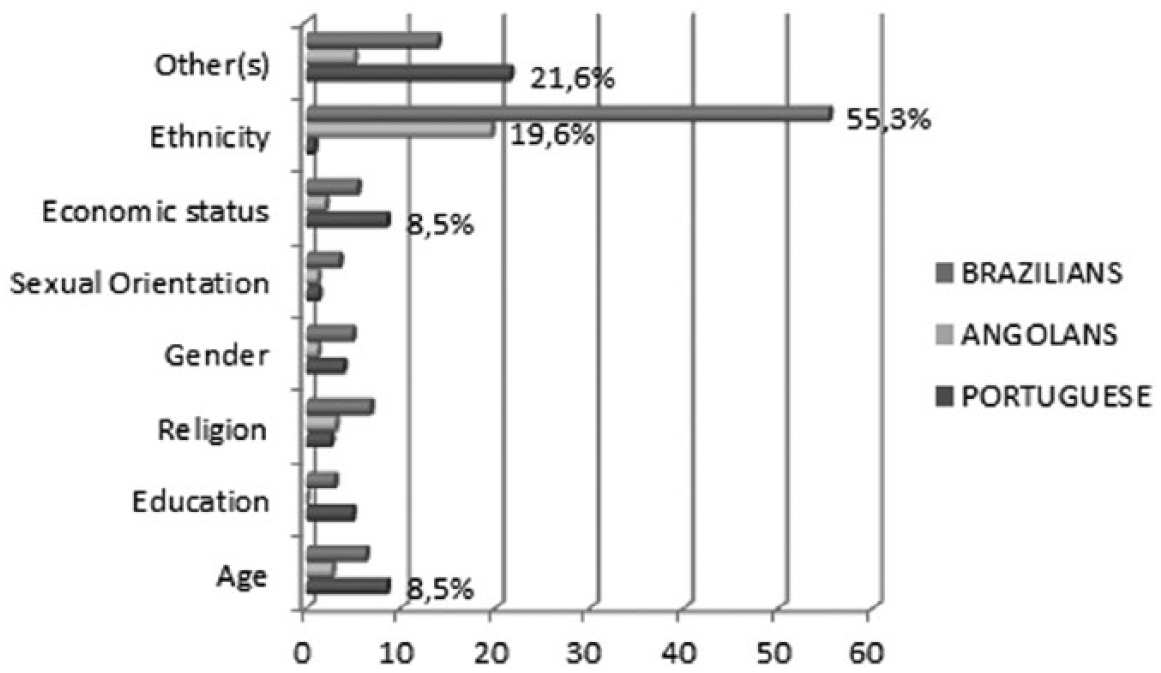
Main motives underlying discrimination and exclusion.
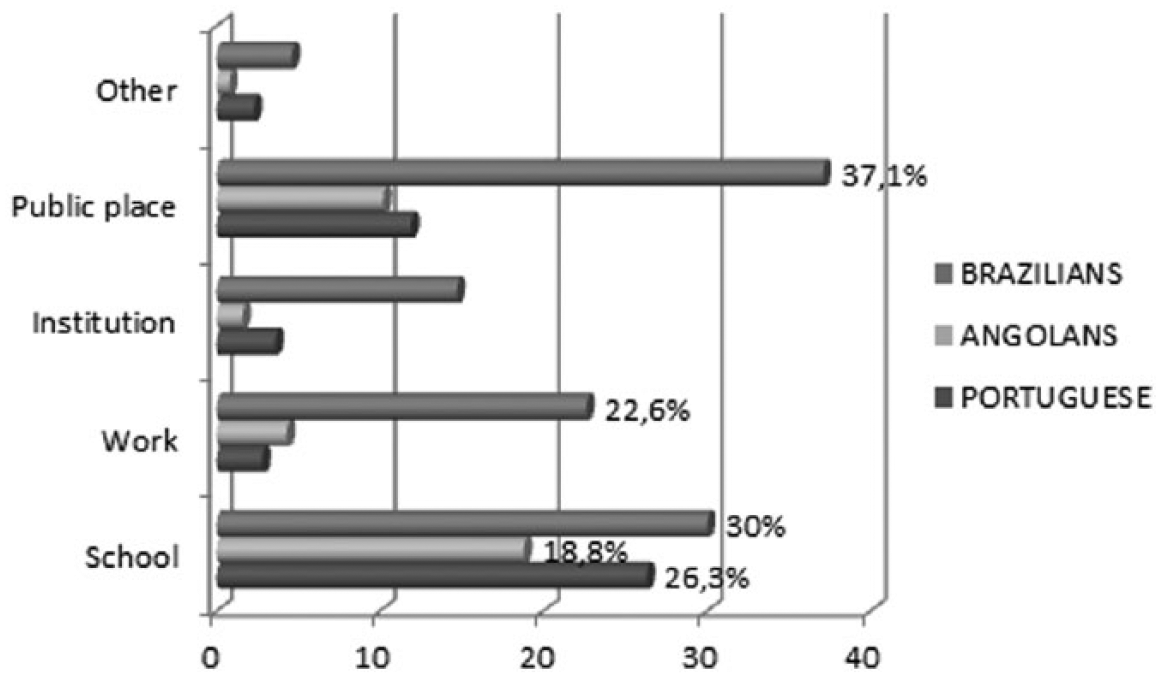
Main contexts where discrimination and exclusion occurs.
Findings from the survey seem to reinforce results from both the interviews and focus groups, as well as previous research that underlines the idea of the school as a context of discrimination and exclusion (see, for instance, Milner & Lomotey, 2014; Nunn, 2011; Vaught, 2009, inter alia). It is important to note that both national and migrant students mentioned the school as a context where they feel discriminated, which might mean that the discriminatory nature of the school operates in a transversal way, affecting all students to greater or lesser extent—but the discrimination based on ethnicity is experienced only by youth of migrant origin. However, it also seems important to note that specific groups tend to perceive discrimination in diverse ways—as young migrants of Brazilian origin experience more feelings of discrimination and clearly feel even ethnicity more strongly as a motive for discrimination. Several reasons can account for this, including the fact that migrants of Brazilian origin are a more “recent” minority group in Portugal when compared with youth of Angolan origin (cf. Peixoto, 2009). This has implications in terms of access to citizenship: In our sample, approximately 44% of youngsters of Angolan origin are Portuguese citizens, while the same only happens with 14% of youth from Brazilian origin—and access to citizenship plays an important role in the inclusion of migrants, both symbolically and in practical terms (cf. Fox, 2005; Morales, 2009). Finally, as the Nigerian writer Chimamanda Adichie (2009) warns us (http://www.ted.com/talks/chimamanda_adichie_the_danger_of_a_single_story.html), there is clearly the danger of looking at migrants as “a single story,” not recognizing “diversity within diversity” (Trickett, 1994) and the need to take into account context-specific meaning making processes in the way individuals and groups construct discrimination and exclusion (Ferreira, Coimbra, & Menezes, 2012).
Conclusion
In a context marked by the economic crisis, unemployment, and increased migration, the integration of young migrants has been regarded as one of the main challenges schools face today (cf. Commission of the European Communities, 2008; Cox, 2012a; OECD, 2012). However, the ways in which the school has been dealing with the growing cultural diversity have been criticized (cf. Stoer & Cortesão, 1999; Stoer & Magalhães, 2005). Existing research recognizes, on one hand, the capacity of schools to promote social justice (e.g., Bekerman & Tatar, 2012; Cox, 2012b; Darmody et al., 2012) but, on the other hand, their role in the reproduction of inequalities (e.g., Darmody et al., 2014; James, 2012; Nunn, 2011; Riegel, 2012; Vaught, 2009). Considering qualitative and quantitative data collected under the PIDOP project, this article presented data on the perceptions of young migrant (and non-migrants), parents and teachers concerning the role that has been played by the school.
Regarding the views of young people, the data confirm the trend observed in previous research by suggesting the ambivalence of the school, presenting it as simultaneously inclusive and discriminatory. However, immigrant youths in this study seem to place more emphasis on the discrimination and racism that they experience in school (especially Brazilian women) than on the role of the school in the promotion of inclusion and equal opportunities for all. Parents, in general, consider that the school is an important device for social promotion, and that it is crucial to ensure the permanence of their children in the school and their academic success. However, especially parents of young immigrants also tend to emphasize that the school discriminates, and that it could be more intervening and effective in promoting inclusion and equal opportunities for all. Teachers, in their turn, emphasize mainly the role that the school has played in promoting the inclusion of young immigrants, legitimizing the importance of their professional role and blaming the intensity and rigidity of the curricula as an obstacle to investing more time to foster the civic and political skills of young people. Teachers’ statements suggest, therefore, that the school is a device that seeks to ensure greater social justice. Last, survey data suggest that young immigrants (Brazilians and Angolans) tend to consider the school more as a context of exclusion and discrimination than as a context that promotes inclusion and equal opportunities for all. Ethnicity seems to be an important explanatory factor of the feelings of discrimination reported by young immigrants, particularly young Brazilians.
Concluding, this article suggests that there is an ambivalence regarding the school in the perceptions of young migrant (and non-migrant), parents and teachers in the sense that they are moving between an understanding of the school as an exclusion device and the consideration of the school as a device that promotes inclusion and equal opportunities for all. However, despite the ambivalent character of the school, its discriminatory nature was more widely emphasized. In summary, our data seem to suggest that the school still needs to adjust its action to ensure that it is, in fact, a device that promotes greater social justice.
To achieve this task, schools must be aware of some features that could help overcome the discrimination and exclusion imposed on young people, especially on young immigrants. The following points present some clues and recommendations to promote a systemic change concerning a more inclusive educational and social environment:
First, it is important to implement a balanced school curricula that avoids extreme positions based, for instance, on ethnocentric or “folkloric” models that imply the perpetuation of inequalities among young people from ethnic minorities. Instead, the school curricula should be based on “generous” and the “relational models,” promoting inclusion as fully as possible of those who have been excluded by school actions—using to this end an interplay of multiple factors (e.g., material, pedagogical, didactic, and human)—and valuing the cultural heritages, experiences, and perspectives of students from ethnic minorities (see Stoer & Magalhães, 2005, inter alia). As Bernstein (2003b) suggests, “we should stop thinking in terms of ‘compensatory education’ but consider instead most seriously and systematically the conditions and contexts of the educational environment” (p. 149), because “[t]he introduction of the child to the universalistic meanings of public forms of thought is not compensatory education—it is education” (Bernstein, 2003b, p. 154, emphasis in original). Njue and Retish (2010) underlies, however, that the school may run the risk of a double-bind situation, as tensions do exist between the mainstream curricula and the students’ experiences in and out of school.
Second, the school needs to be aware that the minority groups’ conditions and experiences in society can influence their attitudes toward school (cf. Honora, 2003; Ogbu, 1991), especially the “aspects of students’ life that have the potential to negatively influence the experiences of students in school” (Njue & Retish, 2010, p. 368)—the school can be a significant context where these experiences can be openly discussed and analyzed in a pluralistic and diverse climate, thus creating the conditions for the emergence of new and more complex meanings (Ferreira, Azevedo, & Menezes, 2012). For this purpose, it is important to acknowledge that “children do not exist in a vacuum and neither do the schools they attend. More often than not, environmental conditions present in the local context have an impact on the performance of schools and on child development” (Noguera, 2014, p. 126). Thus, it is essential to develop an integrated and holistic policy that fosters parental involvement in the schooling of young people to promote their academic success and effective inclusion (e.g., Boutte & Johnson, 2014; Noguera, 2014). However, as Noguera (2014) also suggests, this relationship needs to go beyond the “obvious” (p. 157). In order to produce the most efficacious parental involvement programs [we] must rethink family practices in education . . . One vital implication of this fact at the school level is that teachers need to be cognizant of these facts so that they can direct parents to practice the most efficacious kind of engagement. (Noguera, 2014, p. 159)
Third, it is necessary, consequently, to adapt the educational curricula and teaching style to support young immigrants in a more efficient way. In that sense, it seems important that teachers have the training and skills to engage with an increasingly multicultural school, where different educational strategies are required for different students with different needs (see Nicolas, DeSilva, & Rabenstein, 2009; Noguera, 2001). Lander (2011), for instance, proposes that “[t]eacher education needs to develop a framework for supporting student teachers beyond their initial training and into their first and subsequent years as teachers to revisit and analyze issues related to race, culture and ethnicity” (p. 363). To this end, it seems also important to consider the positive effects of ethnic-matching in schools (i.e., the presence of teachers of ethnic minorities as a variable which has a positive influence in the outcomes of young people with ethnic background). This means that it is critical “to develop effective strategies for retaining ethnic minority teachers” (Easton-Brooks, 2014, p. 109), and to support more principals with ethnic background “with a focus on the ethno-humanist role identity/culturally relevant education” to reduce the disenfranchisement of students with ethnic or immigrant background and improve their academic performance levels (cf. Lomotey & Lowery, 2014, p. 346).
Finally, teachers have to be conscious of their crucial role on the implementation of these educational guidelines, because they are, as Monkman et al. (2005) well illustrates, “the gatekeepers of whether the resources that parents and students have and exhibit can be activated in ways that will bring benefit to them. They can close or open those gates” (p. 29). However, our data seem to reveal that teachers are not aware of this central role, and educational policies in the last decades have also played an important role in this lack of conscientization, marked by trends of school evaluation, teacher control, and emphasis in “the core curriculum” that has resulted in significant signs of teacher disempowerment. Therefore, educational policy makers and educational policies must actively support the school’s role as an institution that fosters social justice and inclusion. Teachers play a crucial role in effectively supporting pupils’ academic success and positive cultural identities. As Landson-Billings (2014) illustrates very well, “teachers are no more the source of the problem than an umbrella is the cause of the rain” (p. 444). It is important to acknowledge that teachers are part of the solution and there is evidence that many teachers are successful in doing this. Those teachers, as Landson-Billings (2014) emphasizes, are identified by several characteristics; particularly, for instance, their Persistence: “they are unwilling to give up on students”; their Pedagogy to So-Called At-Risk Students: “effective teachers have a planned strategy for dealing with the academic needs of students who are likely to struggle”; and their Effort Not Ability: “effective teachers do not predetermine students’ potential and help them realize if they are willing to put in more effort they will reap more rewards” (pp. 445-447). Nevertheless, effective teaching should not be viewed as individual characteristic or variable: Effective teachers collaborate with colleagues who are equally committed to inclusive schooling, work in schools that support and value their efforts toward the educational success of all students, and are praised by their communities that recognize the need for a profound change in societal structures (cf. Boutte & Johnson, 2014) if schools are to become contexts that value diversity, promote inclusion, and fulfill their fundamental mission in contemporary democracies.
Footnotes
Declaration of Conflicting Interests
The author(s) declared no potential conflicts of interest with respect to the research, authorship, and/or publication of this article.
Funding
The author(s) disclosed receipt of the following financial support for the research, authorship, and/or publication of this article: The data presented here was collected by the Portuguese team of PIDOP, a multinational research project supported by a grant received from the European Commission 7th Framework Programme, FP7-SSH-2007-1, Grant Agreement n8: 225282, Processes Influencing Democratic Ownership and Participation (PIDOP) awarded to the University of Surrey (UK), University of Liège (Belgium), Masaryk University (Czech Republic), University of Jena (Germany), University of Bologna (Italy), University of Porto (Portugal), Örebro University (Sweden), Ankara University (Turkey) and Queen’s University Belfast (UK).