



Abstract
Black male teachers tend to enact culturally relevant pedagogical practices that support the academic achievement, cultural competence, and critical consciousness of Black male students. Using critical race theory, culturally relevant pedagogy, and life history methodology, we explore the life history and work of a Black male middle school teacher to examine ways in which his historical, societal, institutional, and communal and personal experiences have shaped him to become a culturally relevant teacher and advocate for Black male students. In doing so, we provide implications and recommendations for preservice teacher education programs to retain and better support Black male middle school teachers.
Keywords
Introduction
The narratives of Black male teachers, their cultural pedagogy, and community traditions and influence are critical to the discussions, discourses, and debates on teacher education and preparation (Lynn, 2006). However, a paltry 1% of Black male teachers in K-12 schools translate into a limited number of research studies on this population of public school teachers (Bryan & Browder, 2013; Lewis & Toldson, 2013). One of the most pervasive issues in the field of teacher education is the dearth of research on Black male teachers, and the endeavor to recruit and retain them at all educational levels, specifically middle school. Research studies are even more scant on Black male teachers in urban schools (Lynn, 2006; Milner, 2007; Pabon, Anderson, & Kharem, 2011). We conceptualize urban education by considering the interconnections between schools and community (Milner & Lomotey, 2013). Moreover, we believe that Black male teachers provide teacher education counternarratives that include the interactions and experiences from their life history. We offer urban education a lens through which to inform families and communities by way of Black male teacher pedagogy.
Foster (1997), Ladson-Billings (2009), and Noguera (2003) contend that the recruitment and retention of Black male teachers have a positive impact on Black children. By positive impact, we mean that Black male teachers can present themselves to students as professionals who are respectful and self-disciplined, which is a counternarrative to majoritarian narratives that construct Black males as “thugs,” and “uninvolved and uncaring fathers”. With this in mind, we recognize that not all Black male teachers are role models or have a positive impact on students. Moreover, teacher shortage concerns lead the discussion to teacher recruitment and ways in which teacher education programs can attract and keep Black male teachers. Pabon, Anderson, and Kharem (2011) cite challenges such as a lack of effective models of good teaching practices and culturally responsive curriculum when preparing Black male teacher candidates to remain in the profession. To retain Black male teacher candidates, education programs should provide resources such as culturally responsive coursework, monthly workshops for test preparation, and supportive internship experiences (Pabon et al., 2011).
Although Black male teachers tend to provide social support and encouragement to Black students, particularly Black boys (Brockenbrough, 2012; Foster, 1997; Rezai-Rashti & Martino, 2010), it is not always the case. It is important to recognize the culturally responsive pedagogical insights that Black male teachers bring to their classrooms. Ladson-Billings (2009) posits that the culturally relevant practices of Black women teachers established the foundation for support and encouragement by ensuring academic success, cultural competence, and critical consciousness between both Black male and female students. Examining the transferability of effective culturally responsive teaching practices of Black male teachers of urban students could positively affect teacher education programs.
Even so, what is undertheorized in extant educational research is the role culturally relevant Black male teachers play in Black children’s collective academic performance and achievement (Brown, 2009; Lynn, 2006). Furthermore, Brown (2009) argues for more studies on culturally relevant Black male teachers who demonstrate direct influence on the academic success, cultural competence, and sociopolitical awareness of Black male students. Lynn (2006) presents a central question relevant to this study: To what extent do Black male teachers, who express a commitment to serving African American youth, embody the characteristics of culturally relevant teachers? Results showed the passion and commitment of Black men and their important role in the lives of their urban students through their pedagogical practices. With this in mind, our research questions are as follows:
The purpose of this article is to give a Black male pedagogical perspective while introducing a cultural continuum of pedagogy based on the lived experiences of the participant. This cultural continuum allows a critical examination of the life history of a Black male middle school teacher and the ways in which his historical, societal, institutional, communal, and personal experiences have shaped him to become a culturally relevant teacher. Hence, we aim to add to the emerging discussion on Black male teacher pedagogy and culturally responsive practices while adding to the advancement of urban education in the area of families and communities. More specifically, we contribute to urban education within the context of building on the assets of families and their communities (Milner & Lomotey, 2013).
As such, this article unfolds by first exploring critical race theory (CRT, henceforth) and culturally relevant pedagogy as theoretical frameworks. Second, we provide a review of literature that focuses on Black male students in education. Third, we describe a methodology section followed by findings, discussion, and conclusion sections. Finally, we provide implications and recommendations to preservice teacher education programs on culturally responsive practices and the traditions teachers incorporate within their pedagogy.
Theoretical Framework
Because there is not a single race framework that can adequately depict, explain, and/or examine the life history of a Black male middle school teacher, we use a multidimensional theoretical framework (Leonardo, 2013). Leonardo (2013) contends that multidimensional frameworks are also essential to providing analytic complexity in race work. Collectively, CRT and culturally relevant pedagogy offer a critical, yet holistic perspective on the life history of a Black male middle school teacher. Prior to CRT, culture, not race, was typically referenced in discussions regarding students of color; furthermore, early discussions did not focus on race or racial realities in the classroom (Howard & Navarro, 2016). Evolving research on culture and race has allowed various frameworks for learning about the experiences of students of color. Culturally relevant pedagogy values personal narrative and reflective of the community of learners and has a social justice undertone. For this reason, we conclude that CRT and culturally relevant pedagogy will be adequate interworking frameworks for this study.
CRT
Drawn from critical legal studies, CRT has been embraced in teacher education as a vehicle to centralize structural and institutional racism in schools and society (Ladson-Billings & Tate, 1995). CRT suggests an illusion of standard treatment across racial and ethnic groups, making racism ubiquitous and difficult to see particularly for those perpetrating it. Educational scholars (Cook, 2013; Solorzano & Yosso, 2002) use CRT in research as a method and a framework to critically analyze the various issues in educational research. Critical race theorists generally subscribe to the following propositions: (1) ingrained nature of race, (2) interest convergence, (3) challenging dominant ideology, (4) uplifting voices of color or narratives, and (5) commitment to social justice (Carter, 2008; Delgado & Stefancic, 2001; Dixson & Rousseau, 2005; Ladson-Billings & Tate, 1995; Yosso, 2005). CRT as a theoretical framework can push boundaries in educational research and advance teacher education to move us toward social justice. Henceforth, teacher educators are able to identify, acknowledge, and critically reflect on the tenets as we experience them. Teacher educators who comprehend all CRT tenets can help preservice teachers think about race, racism, and privilege as well as how to address challenging issues within their classes.
The first tenet of CRT recognizes that racism is engrained into the very thread of American society (Bell, 1992; Ladson-Billings & Tate, 1995). Race is prevalent in the everyday routine of society, and it has become normalized and accepted, both of which are seldom challenged (Delgado & Stefancic, 2001; Ladson-Billings & Tate, 1995; Milner, 2007; Solorzano & Yosso, 2002). Examining power structures and how they affect people of color is critical to impart change. Race and racism are inherent in the everyday routine of society that they have both become normalized (Milner, 2007). If race and racism were isolated acts, there would be a better chance that society would recognize what they are and the effects they have on individuals and groups.
Second, Bell (1992) introduced the concept of interest convergence, meaning that the interests of African Americans in achieving racial equality will be accommodated only when that converges with the interests of Whites who are in policy-making and other decision-making positions (Delgado & Stefancic, 2001). Buras (2013) suggests that interest convergence also plays itself out in schools, school reform, and school-related initiatives. For example, most White people theoretically support the recruitment and retention of Black male teachers to K-12 classrooms largely because they view it as benefiting the school as Black male teachers are traditionally expected to “discipline” and “control” Black children for most White teachers who are unable to do so (Jackson, Boutte, & Wilson, 2013).
Milner (2010) asserts that among dominant ideologies that maintain White supremacy are colorblindness and meritocracy. Colorblindness is the refusal to see race and other identity factors (Bonilla-Silva, 2006). Colorblind teachers do not possess the knowledge necessary to connect with diverse students (Milner, 2007). Similarly, colorblindness is a liberal ideology that clearly insists that due to significant racial progress, laws and policies are objective and race-neutral, while race and racism are reified through these institutional policies and practices (Ladson-Billings & Tate, 1995; Milner, 2010). Meritocracy implies that the reward for hard work is success for everyone, not just the privileged, yet it does not take into account inequality caused by systemic racism (Decuir-Gunby, 2007). Like colorblindness, meritocracy plays itself out in classrooms and leads to unconscious biases between students and teachers in school discipline and student–teacher relationships.
CRT scholars (Cook, 2013; Solorzano & Yosso, 2002) prioritize the voices of people of color through narrative or storytelling and counter-storytelling. Naming one’s own reality gives the individual value in his or her own story as well as being able to see the ways he or she has been mistreated by the dominant groups (Solorzano & Yosso, 2002). Because of their different histories and experiences with oppression, people of color may be better able to communicate issues/matters of which Whites have no knowledge or experience (Delgado & Stefancic, 2001). Duncan (2002) underscores this sentiment as he forwards that CRT can be a mediator for researcher reflexivity. He states,
The significance of reflexivity is in its contribution to making visible the invisible relationships that characterizes racial oppression by redirecting the focus on our own perspective and to fostering a consideration of the multiple viewpoints that may come to bear in the social construction of reality. (Duncan, 2002, p. 96)
CRT not only mediated reflexivity in the interpretation and organization of the data regarding the participants’ daily realities around the social construction of race, but it also assisted in validating the narrative tradition of storytelling in the African American community (Banks-Wallace, 2002). Historically, the discrimination and exclusion of the voices of African American males in public schools creates a challenge for teacher recruitment (Bianco, Leech, & Mitchell, 2011; Goings & Bianco, 2016).
The commitment to social justice includes transforming our practices as educators as we engage in dialogue. Social justice is a research agenda that empowers minoritized groups and leads toward eliminating racism, sexism, and poverty (Solorzano & Delgado Bernal, 2001). On the whole, social justice embraces ways of examining and makes visible issues of race, culture, and privilege to gain richer fuller experiences of the world knowledge used for social change. The following section discusses culturally relevant pedagogy.
Culturally Relevant Pedagogy
We acknowledge that there are other pedagogical frameworks including critical race pedagogy (CRP; Lynn & Jennings, 2009) that could be suitable in this exploration of the life history and work of a Black male middle school teacher. According to Lynn and Jennings (2009) and L. Johnson (2014), CRP encourages teachers to situate race in the pedagogical practices of the classroom, while also disrupting issues relating to White supremacy and racism. Furthermore, Jennings and Lynn (2005) adhere that teachers who use CRP “must recognize and understand the endemic nature of racism” (p. 25); “must be intimately cognizant of the necessary intersection of other oppressive constructs such as class, gender, and sexual orientation” (p. 26); and “must recognize the importance of understanding the power dynamics inherent in school” (p. 26). Similarly, these teachers “must emphasize the importance of . . . reflexivity . . . [and the] exploration of one’s place within a stratified society” (p. 27) and must encourage the practice of an explicitly liberatory form of teaching and learning. However, although our research participant understands the pervasive nature of race, racism, and its intersections and engaged in self-reflexivity around him, addressing issues of race and racism was not explicit and intentional in his pedagogical practices. Hence, we incorporate CRT and culturally relevant pedagogy as substantial frameworks for this study.
Ladson-Billings (1995) posits that culturally relevant teaching is a concept that positions the student and his or her cultural background at the center of teaching. This type of instruction is important for students of all ethnicities, religions, and backgrounds as it gives them a chance to incorporate themselves into their own learning process. Ladson-Billings (1995) conducted a 3-year study of successful teachers of African American students in an effort to describe CRP. She maintained that CRP must meet the following standards: developing students academically, nurturing cultural competence, and developing critical consciousness. To disrupt the educational inequities faced by African American males, the need for well-prepared, culturally responsive teachers, regardless of race or gender, is great; however, the need for well-prepared, culturally relevant African American male teachers is desperate (Bianco et al., 2011; Lynn, 2006).
In 2001, Tyrone Howard conducted a qualitative study of four elementary school teachers and the ways in which their culturally responsive pedagogy affected their everyday teaching and understanding of students. Three major pedagogical strategies proved effective as a means of culturally relevant instruction. The strategies included the following: holistic teaching, skill building strategies, and culturally consistent communicative competencies. Each strategy was an extension of culturally responsive pedagogy and incorporated core values of what the teachers thought were vital to their students’ education. Howard (2001) notes, “Teachers’ belief in student capability also has cultural connections” (p. 198). One finding of this study is focused on how the participants incorporated their individual ways of extending CRP and making sure that their teaching was not limited to academic achievement alone.
Gay (2010) includes caring in the form of culturally responsive caring in her discussion of culturally responsive teaching. She maintains, “When combined with pedagogical competence, caring becomes a powerful ideological and praxis pillar of culturally responsive pedagogy for students” (Gay, 2010, p. 75). Caring is powerful in that it can invoke success with students by relationships that are both demanding and supportive with students.
Review of Related Literature
We recognize that there are studies that discuss the commitment of success between Black male teachers and Black students (Brockenbrough, 2012; Brown, 2009; Noguera, 2003; Pabon et al., 2011). However, we acknowledge that this is not true for all Black male teachers. To understand fully the life histories, the complexities, and challenges associated with the recruitment and retention of Black male middle school teachers to the teaching profession, we must first understand the experiences of Black males in society writ large and K-12 schools. In this review of literature, we present the following themes: Black male students in education, cultural connections to Black students and teacher practices, higher education and Black male teachers.
Black Male Students in the Classroom
Considering the disparity in education between Black and White students, Ford (2013), Kunjufu (2013), and Losen (2011) suggest that Black boys are more likely to drop out of school, are disproportionately suspended and expelled from schools, and are assigned to special education classrooms. Recent graduation statistics indicate that Black boys drop out of school at 3 times the rate of their White male counterparts (Schott Foundation for Public Education, 2012). Elias (2013) and Ladson-Billings (2011) point out that Black boys are the targets for subjective classroom discipline that cause disproportional suspension and expulsion rates and assignments to special education classrooms. They are disproportionately sent out of the classroom for minor disciplinary infractions as a result of breaking capricious school and classroom rules, including arriving late to class, hat wearing, and/or wearing sagging pants in comparison with their White male counterparts (Elias, 2013; Ladson-Billings, 2011).
Scholars (Howard, 2014; Howard & Reynolds, 2008; Hucks, 2011; Kunjufu, 2007; Losen, 2011) contend that another reason for the dearth of Black male teachers across all educational levels in public schools and their virtual nonexistence in middle schools is undeniably and directly connected to their poor and negative schooling experiences as Black male students in public schools and in higher education. Ford (2013), Harper and associates (2014), Hucks (2011), and Kunjufu (2013) explain that public schools and many colleges and universities still are not welcoming nor nurturing spaces for Black males.
Boutte and Hill (2006) and the Schott Foundation Report (2012) contend that Black males experience day-to-day bias and ostracism against them in the classroom. King (2005) and Ladson-Billings (2011) proclaim that such bias and ostracism occur because most preservice teacher education programs rely upon research studies, trade books, and curricular resources that consistently demonize and mischaracterize Black boys. Furthermore, they describe Black boys in culturally deprived and deficient instead of dynamic ways. Khalifa (2011) suggests that teachers’ negative views of Black boys affect the way they interact with them and further explain why they engage in what he calls “deal-making” with them. Khalifa (2011) describes deal-making as the act where White teachers agree to ignore and leave Black males to their own demise without much encouragement to engage academically, if Black males agree to allow them “to do their job.” This type of negative interaction and bargaining in most classrooms serves to help us understand that most teachers do not understand their role in the collective achievement of Black males (Hucks, 2011). Hollins (2011) asserts,
[t]eaching is a complex and multidimensional process that requires deep knowledge and understanding in a wide range of areas and the ability to synthesize, integrate, and apply this knowledge in different situations, under varying conditions, and with a wide diversity of groups and individuals. (p. 395)
Black students are in need of teachers who are genuinely vested in their success and achievement in the hope that they have culturally responsive practices.
Cultural Connections to Black Students
Boutte and Hill (2006) and Ladson-Billings (2009) contend that the lack of culturally responsive teaching styles disrupts and disregards the ways of knowing and the ways of understanding Black boys and girls. Teachers must begin to move away from the traditional teaching practices as the diverse population grows. In addition, Wilder (2000) finds that African American students and White students seldom experience teachers with culturally relevant knowledge who bring a wider point of view to the learning community. Whereas Boutte and Hill proclaim that teachers who depend on and apply culture-blind and colorblind teaching strategies cause a huge negative impact on the daily academic and social performance of Black boys and girls in schools. Milner (2010) also proposes that culture blindness and colorblindness produce cultural conflicts in classrooms. When cultural conflicts occur, most teachers are rarely prepared to deal with them (Kunjufu, 2013; Milner, 2010).
Ware (2006) uses the term “warm demander” to describe effective culturally responsive teachers. All of the teachers displayed strong cultural/racial identities that embraced Black children. Price-Dennis and Souto-Manning (2011) suggest changes in preservice teacher education programs because White (and Black) teachers are seldom prepared to teach and manage students in culturally relevant ways and mitigate cultural conflicts in most teacher education programs.
Matias (2013) and Price-Dennis and Souto-Manning (2011) note that when White teachers are provided these opportunities, they oftentimes are not successful because they do not explore their White privilege. This can result in the ways in which they teach and interact with Black boys (and girls) in their classrooms. A cultural modeling framework, designed by Carol Lee (2007), illustrates the impact culture has on knowledge and extends from the practices of various ethnic groups and takes culture into account when designing instruction. Cultural modeling “offers a framework for thinking about these problems in the design of instruction in ways that help students see generative connections between prior knowledge and the new problems they will meet in the academic domain” (Lee, 2007, p. 44). Cultural modeling recognizes the core knowledge students obtain from their environments that is often ignored or devalued in the classroom.
Milner (2010) and Siwatu, Frazier, Osaghae, and Starker (2011) indicate that White teachers may also lack self-efficacy in embracing culturally relevant teaching because they may not have been taught to feel efficacious in doing so. White teachers have to tap into their individual cultural norms and traditions to understand their positions in the class. Implementing this model can help White teachers explore their privilege and its impact on their teaching and the connections they make between content and students’ culture and experiences.
Teacher Practices, Higher Education, and Black Male Teachers
Harper (2009) acknowledges that the higher educational experiences of Black males are similar to their negative schooling experiences in K-12 classrooms. This is particularly true at Predominantly White Institutions (PWIs) where R. Johnson (2013) and Warren (2013) contend that Black males are negatively stereotyped in ways that question their intellectual ability and potential to matriculate through these institutions. Similarly, they describe PWIs as microaggressive spaces where their presence as Black males is constantly under surveillance. Bryan and Browder (2013) suggest that such surveillance causes Black males to become hyper-visible in predominantly White college classrooms. In addition, Warren (2013) asserts that Black males face particular challenges in colleges academically. Moreover, Bryan and Browder (2013) note that one challenge in particular is White college professors potentially grading Black males unfairly in preservice education classrooms. Similarly, they posit that Black males may face challenges passing bias teacher certification examination including Praxis I and II, which can potentially delay or deny their access to K-12 classrooms.
Some Black males who become teachers can be more proficient in meeting the needs of diverse learners applying culturally relevant identities and strategies (Brown, 2011; Howard, 2001, 2014; Lynn, 2006). They can display passion and commitment to Black youth who are extremely special; they use the lives of their students to inform the curriculum (Lynn, 2006). Furthermore, Black male teachers who are committed to the success of Black male students generally have diverse thoughts, perspectives, and experiences that allow them to relate more directly to Black male students (Brown, 2009). High demands placed on Black males in the teaching profession make recruiting difficult. P-16 challenges deny them access to K-12 classrooms, their presence and the need for their positive influence on Black students, particularly Black males, is exceptional .
Research Design
Researcher Positionality
As Black female and male teacher educators and researchers, we have been able to reflect over our life histories and experiences, to realize and understand how they shaped who we are as educators. As previous classroom educators, there has always been a strong connection between the African American male students in both our experiences. Throughout these years in the classroom, we realized that we were not only teachers but also mentors. Our experiences working with these young men have afforded us the opportunity to see beyond what they present in the classroom. Although we acknowledged our roles as researchers, it is also essential that we did not devalue the thoughts, ideas, and perceptions of Marcus, our research participant, in the study.
Jansen and Peshkin (1992) argue, “Researchers should bring biases to consciousness, understand them as part of one’s methodology and acknowledge them when drawing conclusions” (p. 706). Life history allows both participant and researcher to connect to various parts of their lives that have shaped what they do now. Atkinson (1998) asserts,
A life story interview is a highly personal encounter; an analysis of a life story is highly subjective and may have as much to do with the quality and depth of the interpersonal exchange itself as with any theory that might be applied to the content of the narrative. (p. 59)
As we acknowledged our biases of Black males and their role in urban schools, we came to better understand how culturally responsive and relevant practices are inclusive of community and families.
Life History
Life history methodology captures how individual experiences play into the broader scope of reality and how individual lives are shaped by society (Foster, 1997). Within narrative-based research, life history was specifically used as a method for this study to underscore the complexities of Marcus’s lived experiences as a Black male teacher. Life history research connects the lives of individuals to society by offering and exploring critical insights of the culminating experiences (Foster, 1997). In addition, we seek to provide another research tool in which to better analyze and investigate teacher education within urban education research (Milner, 2012).
The data shared in this article come from a larger study, which looked at the life history of five African American teachers from three different middle schools. Marcus’s life history was chosen for analysis as his story provided insight on the ways in which his community, family, and teachers shaped his role and pedagogy. As a Black male, his story was similar but in key ways different and very compelling from the female participants’ stories. Given the shortage of Black male teachers and the surrounding literature (Brown, 2009; Lewis, 2006; Lynn & Jennings, 2009), Marcus’s experiences provide insight regarding his cultural teaching and the connections with his community. Marcus reflects on his experiences teaching urban youth throughout his interview, which offers another dimension to his life history and culturally responsive pedagogy.
The perspectives of the participant are the focus of life history as stated by Cole and Knowles (2001): “Both narrative and life history research rely on and depict the storied nature of lives; both are concerned with honoring the individuality and complexity of individuals’ experiences” (p. 20). Sikes and Everington (2001) note, “Life history is a story that someone tells about his or her life, the account that they give about things that have happened to them, set within a wider context” (p. 9).
Life histories share the intricacies of an individual’s real experiences, emotions, and identities over sociocultural and historical changes over time. In James’s (2010) study, life history study and findings on a single participant provide a comprehensive and robust perspective to the discussion on teacher education. Similarly, because we focus on only one participant, we are able to provide a thorough analysis of his experiences of teaching urban students and how community traditions inform his pedagogy. Life history methodology necessitates small samples or individual subjects because the approach involves protracted observation or extensive interviewing (Dhunpath, 2000).
Setting/Context
The setting for the study was done in one of the top five largest cities in North Carolina. The population of the city is 47% White and 53% non-White. This city has a stable rate of graduation compared with other urban areas, and the high rate of attainment for college reflects the number of colleges and universities in the area. Located in a diverse setting, with 971 students, the middle school would be described as urban emergent (Milner, 2012). Milner (2012) defines urban emergent as schools typically located in large cities though having fewer than 1 million people in them and may have similar challenges to larger cities such as resources and qualified teachers.
Participant and Participant Selection
Purposeful selection, according to Maxwell (2005), is “a strategy in which particular settings, persons, or activities are selected deliberately in order to provide information that can’t be gotten as well from other choices” (p. 88). Criteria on which Marcus was chosen include having taught for at least 8 years, teaching a core subject area in middle school, having taught in an urban area, and an interest in sharing his life history. Marcus’s primary experience as a teacher was at an urban emergent school in a predominantly Black community (not his current school), and he frequently reflected on those experiences during his interview.
Marcus self-identifies as Black and is in his early 40s. He grew up in this particular city and has been teaching for 17 years, and currently teaches social studies and coaches football and track for students in eighth grade. He is also active with his family, church, and community. He attended both a Historically Black College/University (HBCU) and a PWI.
Data Collection
Data collection for this study spanned over a period of 6 months and began with three semistructured in-depth separate interviews, and each lasted approximately 60 to 90 min. Semistructured, open-ended interview questions can be fully expanded by both the participant and researcher by probing questions (Schensul, Schensul, & LeCompte, 1999). Analyzing each interview was an iterative process: first, listening to each interview with a fresh ear (at least 1 day after the interview was held). Next, note taking on follow-up questions, then multiple readings of the typed transcriptions while looking at keywords and phrases for later discussion and noting potential relationships, then sharing our analytic notes with one another and a colleague for further questions and perspectives. Marcus was included in this process as he read over each transcript to ensure truth and clarity for his story. He agreed with the transcripts and had nothing to add to them. Finally, we considered next interview topics before proceeding anew with each second and third interview with him. This process was repeated after each of the three interviews (see Table 1).
Life History Interview Protocol.
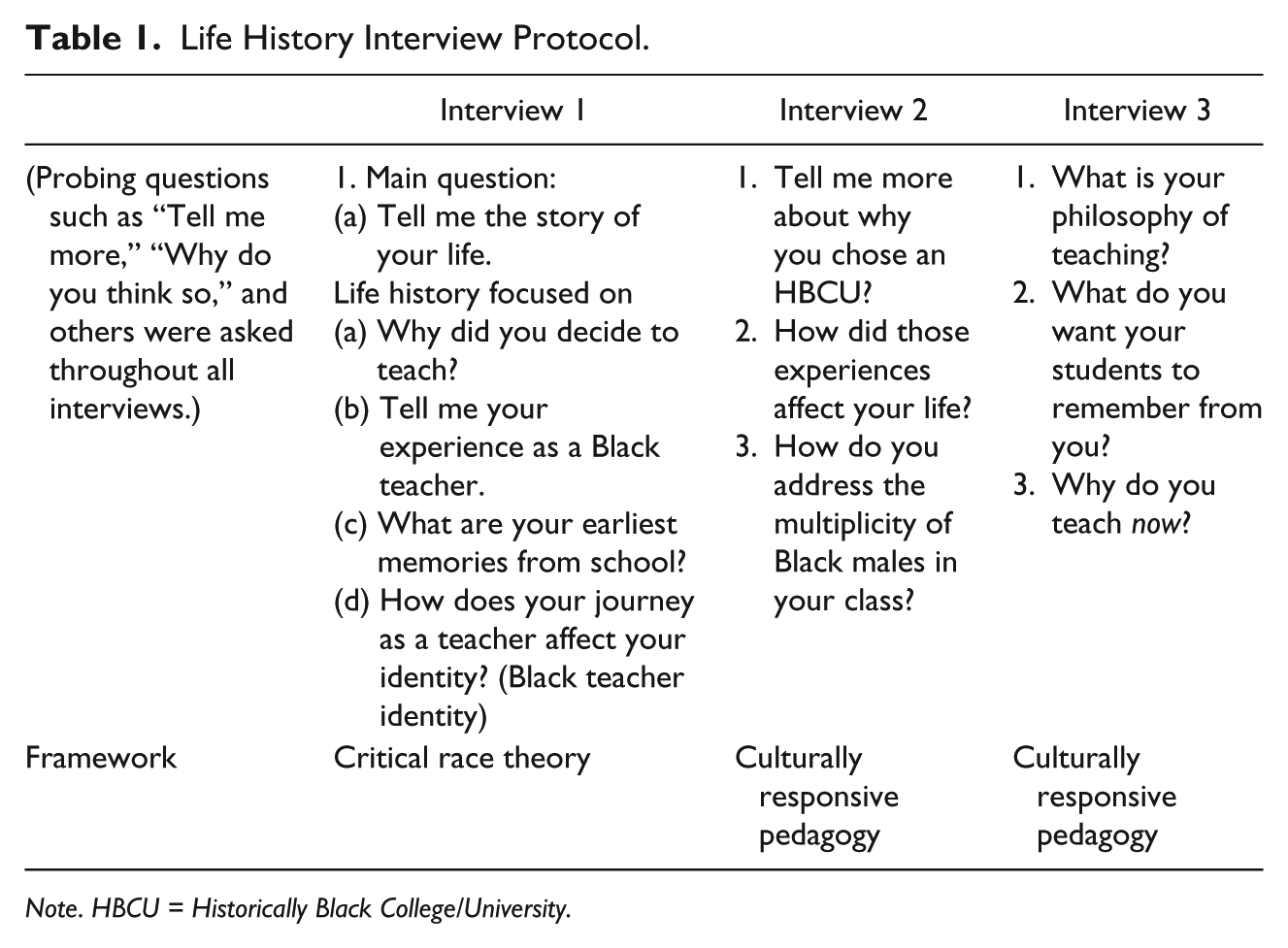
Note. HBCU = Historically Black College/University.
Data Analysis
Taking an interpretive approach, in which we looked at meanings Marcus made over time in specific social settings (Schensul et al., 1999), was valuable to improve the understanding of identity formation and the role of race as a way of recognizing African American male teachers and their cultural pedagogy. Hence, using the interpretive approach allows for the constructed reality of Marcus to emerge as we read over transcripts. Atkinson (1998) further asserts, “The storyteller tells his or her story through interpretive eyes to begin with” (p. 60). As researchers, we attempted to bring his words to life on paper while recognizing and capturing the essence of what he shared.
Riessman (1993) recommends reading from the inside from the meanings encoded in talk and moving outward, which privileges the experience of the participant. Interacting with the data in various ways permitted us to read past the perceptions of what was being said initially. It was imperative to note themes such as expectations, responsibility from family, responsibility for students, and developing relationships that arose from the narratives that connected discourse about Black students and professional identity. Connecting themes from each category provided an understanding of the experiences of Marcus, and the ways in which he perceived his role in the lives of African American students.
Maxwell (2005) suggests putting analysis into the following categories; organizational or issues established prior to interviews, substantive or descriptive based on the participants’ own words, which represent the researcher’s theoretical concepts. Therefore, the pattern for analysis began with organizational issues such as (a) education, (b) family history, (c) Black teachers, and (d) Black students. Descriptive themes based on the participants’ (Marcus’s) words were as follows: (a) community and family influences, (b) relationships with students, (c) faith, and (d) expectations. Finally, theoretically we placed them under the frameworks of CRT and culturally responsive pedagogy.
Limitations
Admittedly, there were factors that neutralized the study in a variety of ways. First and foremost, the absence of Marcus’s classroom observations affected how much of his story that could be shared. It was essential to take notice of the emotions and body language emitted from Marcus while making notes of the walls of his classroom (Bryan & Browder, 2013). We were able to look into the window of Marcus’s world of teaching by listening to his words while hearing his story. The central idea of narrative analysis is to offer especially translucent windows into cultural and social meanings. Despite this, we believe that Marcus’s story acts as a window and mirror into his history. Life history is an authentic means of understanding how practices reflect intimate intersection of institutional and individual experiences (Dhunpath, 2000).
Results
The findings of this particular portion of the study reveal that Marcus was a part of what we call a “Cultural Continuum of Black Male Pedagogy.” Figure 1 provides an overview of the continuum. The continuum was developed from the descriptive themes of the initial data from this study that include the following: Drawing From Family and Community Wealth, Responsibility of Keeping the Tradition, and Role Modeling and Mentoring Black Males. Each category provided an understanding of the situations Marcus has encountered throughout his life and the ways in which he perceived his role in the lives of Black students in culturally relevant ways.
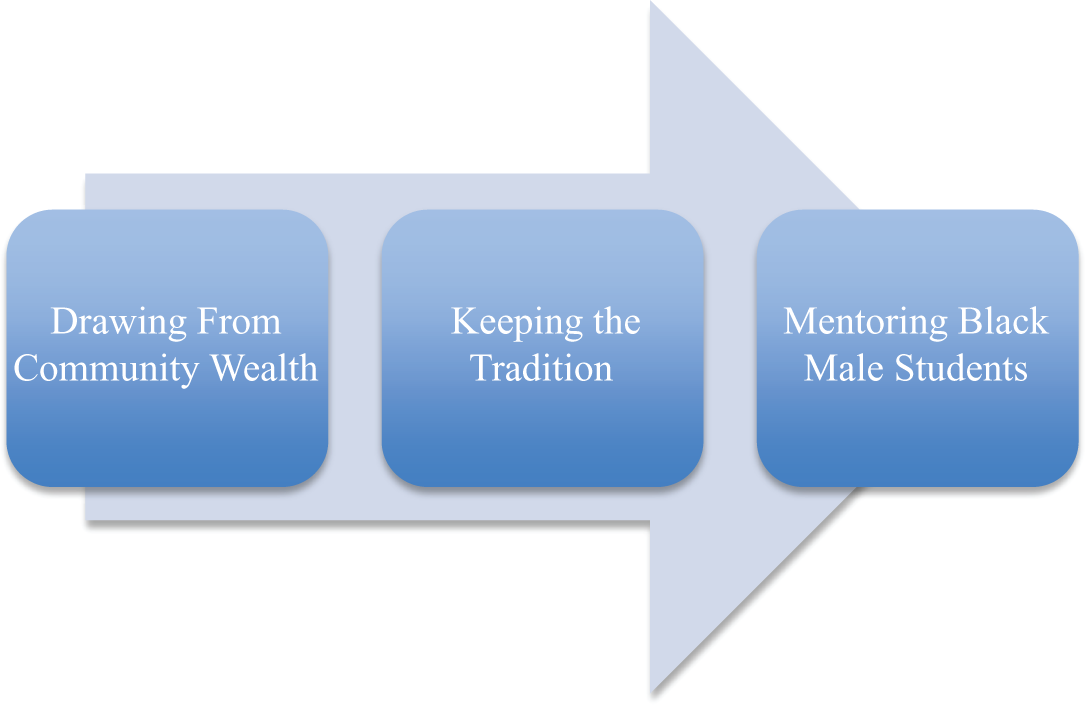
Cultural continuum of Black male pedagogy.
This continuum is used to identify critical stages that one progresses through to examine culturally responsive pedagogy within one’s own teaching. To begin with, teachers can reflect on their own community wealth to explore how individual interactions within their communities are revealed through current teaching practices. Eventually, examining individual traditions and expectations gained from communities and connecting interactions with students can assist teachers to determine culturally responsive practices within their own pedagogy. Finally, teachers can consider the ways in which they think of all-inclusive mentoring, specifically mentoring Black male students. Urban educators can use the continuum to help acknowledge and assess the advantages they have gained from communities and families demonstrated in their pedagogy while gaining an understanding of culturally relevant practices they may or may not incorporate.
Drawing From Family and Community Wealth
Family and community are the foundation of the dedication Marcus has to teaching and are inclusive of parents, teachers, and college professors. Lynn’s (2006) study of African American males’ culturally relevant pedagogy found that their cultural competence came from the community, not from teacher education programs. Marcus discussed one or more ways in which the community and his family had played a role in his development. He recalled how family and community members encouraged, pushed, and imparted values in him, mainly emphasizing the importance of education in various situations throughout his life. He realized the importance of community and family connections, role models and relationships. He stated,
African American children that I teach don’t always have the proper role models in their community and maybe even at home, so I want to try to set an example to show students that they can be quality individuals when they become adults. (Interview 2)
Marcus’s interactions and closeness with community members and teachers led to a consciousness of the dynamic impact of the cultural values learned from his community, ultimately portrayed in his professional life. This myriad of individuals fostered a kinship with Marcus that helped him to become an insightful, caring teacher. He acknowledges and accepts his charge as a role model for Black males:
So, yeah I have different expectations. Why? I can see myself in them. If you can’t see yourself in them as a Black male teacher when you’re teaching Black males then you just have blinders on or you just really shouldn’t be teaching. (Interview 2)
Tolerance enhances teachers’ ability to relate to Black males and become understanding of the complexities they may face. Marcus’s interest in Black males beyond the classroom was based on the connection and involvement his family and community had on his achievement, and he had the same connection and dedication for his present classroom community.
Marcus understood the complexities of teaching that included ways of interacting with Black males who come to his class distracted. He found that calming them down and connecting with them and then discussing the issue worked for him and the students. In Marcus’s words,
I don’t try to stress them out or jump on them or try to embarrass them in front of their classmates, if I have to talk to a student I tell them to go outside. I want to talk to them face-to-face, one-on-one.
Marcus went on further and recalled teachers from early in his education who contributed to his foundation of teaching and learning. He stated, “Probably the best teachers I had in my elementary experience, really set the foundation [for my] teaching.”
The next section will highlight how these relationships shape his pedagogical style by demonstrating the importance of each relationship. Traditions may continue to be a part of culture; however, the way they are enacted will vary from generation to generation. Marcus’s experiences and traditions influence his pedagogy, relationships, and ways of interacting with African American males.
Passing the Dream; Keeping the Tradition
Another important finding from this study is Marcus’s convictions about passing the dream and keeping the traditions he adopted from his family and community. He expanded on it through his teaching and dedication to students while remembering what the community and family traditions passed along to him. Marcus lived by the words of his grandfather who spoke of each generation taking care of and building up the younger: “My grandfather used to have a saying that, each generation has to build one another, you have to do more to encourage children, if you do that, your children have to achieve more, and they will.” Marcus felt strongly that to have opportunities and choices in life, Black males should be given a standard to uphold.
In the same way, teaching the whole child is an element of culturally responsive teaching just as caring has to take place beyond the classroom. Marcus went on to share the advice from his mother when he began teaching: “You know what, the curriculum doesn’t really matter as long as you go into the classroom with love and respect and they will give it back” (Interview 2). The advice from his mother has stayed with Marcus throughout his career, thus keeping the tradition. He even referred to a specific teacher who gave him what he needed as a young Black male:
Ms. Groves and so to make sure I was alright and she also gave me a kind of love for reading because she would read to us EVERY afternoon and she would read books that BOYS want to hear. (Interview 1)
He goes on to describe her expectations of him:
She NEVER would let me SETTLE and that’s the key she did not want me to settle for being less than the person I could be and that’s very significant, it’s what I want for my Black males. She was always encouraging me to do the best I can, and to be a leader. (Interview 1)
In his teaching, Marcus used strategies learned from his family, community, and role models to pass along what and how he had been taught. He expanded on the dream by fulfilling the responsibility he felt for all of his Black male students: helping them negotiate misperceptions about their identities, and supporting them in sustaining a strong sense of their racial and cultural selves. In this manner, Marcus acted as a dreamkeeper (Ladson-Billings, 2009)—role model and mentor—for new generation of students. Marcus was devoted to making sure that his African American students understand the importance and value of education. He wanted his Black boys to realize that life was more than playing sports or hustling on the streets. He was deeply concerned about the well-being of the Black male students in his eighth-grade social studies class, throughout high school and past graduation. He explained,
I would not accept anything less from those students, I don’t care if they came from the poorest section of town to the most affluent and they knew I cared. (Interview 1)
Marcus gave his students the same push that he received from teachers in his community. He reflected on the importance of having that push as a student from his teachers:
And Ms. Richmond, she didn’t take any mess. She was like Marcus, you’re going to make As or Bs in my class. So a lot of times I had to stay after school because she would make me stay after and do the work and you know make sure I got all my work done. (Interview 1)
Gay (2010) explains, “Teachers who genuinely care for students generate higher levels of all kinds of success than those who do not. They have high performance expectations and will settle for nothing less than high achievement” (p. 49). Marcus recognized the potential in the African American males he taught whether they worked to their potential or not:
These boys can be brilliant, BRILLIANT but at the same time some of them kind of want to HIDE it, can’t be too smart. Some of them don’t care, some of them are just brilliant period. I taught African American males who were the smartest in the class, and they know they’re the smartest but I’ve also taught some who just, who just don’t see the value of education and I try to impart on them, I say, “Where you going to go without an education?” (Interview 2)
So often in the African American community, students and young children “rise to the occasion” because the community will accept nothing less than one’s best effort (Siddle Walker, 1996). Siddle Walker (1996) demonstrates this idea through her account of Caswell County, before the integration of schools. She notes the commitment of the community to the success of all children. The community also expressed personal concern for the students and felt responsible that the children were accomplishing goals and met expectations. Marcus’s experiences demonstrate how traditions of African American communities and their relationship to teaching are critical in understanding the foundation of relationships between Black students and teachers.
Delpit (2006) advises, “We risk failure in our educational reforms by ignoring the significance of human connectedness in many communities of color” (p. 95). Communities of color are a means of support, encouragement, and understanding, and they create essential dialogue for Black students. Marcus was not solely motivated by his individual family but by the community of teachers that he has carried into his classroom through his pedagogy.
Mentoring Black Students
Mentoring was significant to Marcus as he preserves the positive Black male image through his teaching. Perry, Steele, and Hilliard (2003) explain, “The success of Black students may depend less on expectations and motivation—things that are thought to drive academic performance—than on trust that stereotypes about their group will not have a limiting effect in their school world” (p. 122). Marcus’s role as a teacher and mentor is based on mutual respect, then an authentic connection is established:
I mean I think all teachers should be mentors to some degree so yeah I try to be, especially to the males and specifically to the young Black males. They definitely need it and they seek it out. I mean I don’t try to force it on them but I try to live—well I try to live by example you know and I don’t try to portray any image that I don’t think is going to be positive. (Interview 2)
Marcus had high expectations for all of his students, particularly of his African American males. He commented, “I would like to see African American males go that little extra mile, [which they don’t want to do] and make sure their work is in [on time] and make sure they’re organized” (Interview 2). He went on to add,
When I deal with them (Black males) I just try to be very honest but at the same time respectful and they know that I care about them and they know that I’m not going to sit there and lie to them. If they are messing up, I’m going to tell them, if they are not doing their work, I’m going to get on them but at the same time I’m going to encourage them to do better. (Interview 2)
Marcus had a passion to encourage Black males in his classes; at the same time, he recalled being commended for his impact on Black females:
Just something a lady told me when I was leaving Franklin Middle, and I’m never going to forget this she said, “Marcus, I know you do a lot for these Black boys around here. They need a role model, you know they look up to you, you’re their coach, their mentor, but you really don’t realize what you’ve done for the Black girls.” And that didn’t really register to me then because I really didn’t think about having an affect on these young Black girls. She said, “You have and it also gives them somebody to look up to because some of them, it’s just not the boys that don’t have fathers in their lives.” (Interview 1)
Throughout his interviews, Marcus often referred to the students in his first few years of teaching at a predominantly Black middle school: “I mean it’s been wonderful, I love the students at Washington middle, but it’s in me to go back to inner city schools” (Interview 2). Marcus felt that he made more a difference where he began teaching, and he also feels that is where he needs to be. He stressed further, “As an African American teacher, I feel I HAVE to give back to if I’m going be HALF the teacher I think I need to be before I retire. It’s just something in me.” Being in an urban environment gave Marcus a deeper insight and dedication regarding his role as a teacher and mentor.
Discussion
Life histories are more than just the story of one’s life. They are complex stories made up of substories, themes, and experiences from the lives and contexts of others. They are intertwined with the hopes, conflicts, and dreams of others. They are inextricably linked to the environment created by the internal and external factors that shape human lives. The results of this study suggest particular implications for urban education. Marcus demonstrated how he connected with Black students based on bonds with teachers in his community. The admonishments Marcus received growing up have channeled the ways he speaks to Black students and the ways in which he nurtures them. Marcus demonstrates what Ware (2006) describes as a cultural transmission of a unique African American teaching style known as warm demander pedagogy, thereby creating a classroom culture to support African American students. The lessons he learned as a child are innately a part of how he has become a teacher.
Close examination of the life stories of teachers of all ethnicities is important in understanding the interactions between students and teachers. CRT has created a space to challenge racism in everyday actions and ways of speaking as a Black male educator working toward a society guided by equity and social justice. Marcus’s counternarrative and commitment to social justice were evident as his presence, alone, provided a counterimage for what is traditionally expected of Black males. That is, Black males are traditionally expected to contribute to the demise, instead of the uplift of Black boys (Brown, 2011). Rather, Marcus provided a positive image as a teacher while nurturing young Black males and females.
Marcus’s personal and professional identity began with his family and neighborhood communities: “Our identities, overdetermined by history, place, and socially, are lived and imagined through discourses or knowledge we employ to make sense of who we are, who we are not, and who we can become” (Britzman, 2003, p. 54). His parents and grandparents were all college educated, and all pushed him to school and instilled in him pride and value of an education. A variety of teachers throughout his life as early as elementary school help set the foundation of learning in Marcus, which has shaped him and the ways in which he teaches and relates to African American students.
Counternarratives and storytelling have had a long history in the Black community (Foster, 1997; Siddle Walker, 1996). CRT has also been useful in examining the experiences of teachers and students of color, as well as the implications of systemic and institutional racism. Solorzano and Yosso (2002) argue for including “multiple faces, voices, and experiences” in the CRT discourse on education based on the institutional power of racism that permeates all aspects of schooling. Each step of the Cultural Continuum of Black Male Pedagogy suggests critical reflection and self-actualization. Below we provide implications and recommendations for the field of urban education.
Implications
Cultural practices and pedagogy
Marcus’s life history illustrated the importance of Black teachers and the richness that their experiences bring to teacher education. Overwhelmingly, Black students are being taught by middle-class White women, who may not have similar cultural knowledge and background to that of Black students (Gay, 2010; Goodwin, 2002). Acknowledging the attitudes that preservice teachers carry will allow teacher education to develop an exploration of the importance of the needs of students in the classroom. Milner (2007) describes the goals of this process:
Teachers from any ethnic, cultural or racial background can be successful with any group of students when the teachers possess (or have the skills to acquire) the knowledge, attitudes, dispositions, and beliefs necessary to meet the needs of their students. (p. 336)
Ladson-Billings (2005) explaines the value in reflection on life experiences:
African American teacher educators’ biographies and backgrounds may create for them a dual existence within and beyond the academy. They know that although the two spaces are different worlds, they are both very real. The idea that the work of teaching is preparing students for the “real” world stands in opposition to a notion of multiple worlds that are complex, nested overlapping, and messy. (p. 18)
Teachers do bring their values into the classrooms (Nieto, 2003), and as the underpinnings of these values are acknowledged, the participants’ life histories will take on real meaning and power in the fight for educational justice and opportunity.
The education system has to adapt to the various ways of teaching that attract and retain African American male teachers and teacher candidates. Equally important are strategies that include screening teacher education candidates on cultural sensitivity and the development of a clear cultural and ethnic self-identity. Teachers transmit information subconsciously about culture and society through their behavior and interactions with students (Enciso, 2007; Nasir & Hand, 2006). Marcus’s ideas of teaching were shaped through various opportunities for communication with his teachers. There is value and potential for classroom achievement and connecting outside knowledge to content when teachers know about the communities in which they teach. The wisdom Marcus offered through his life stories enhanced his understanding about the ability and needs of Black male students. Quintessential are new ways of thinking, learning, and collaborating for the sake of African American male teachers.
Community traditions
Sonia Nieto (2003) explores why dedicated teachers continue to teach, and notes that the number of teachers of color is declining. While teaching is a very demanding job and many teachers are enthusiastic about being in the classroom, this enthusiasm soon dissolves. Thus, for a profession with a scant amount of teachers of color, particularly Black male teachers, the number will continue to get smaller.
Joplin (2006) maintains, “If educators plan to close the achievement gap between African American students and White students, academic instruction needs to focus on how to harness the many African American cultures of students and teach to their worlds” (p. 282). Developing collaborative relationships with school administration, the community, and colleagues to form a network to support Black male teachers would encourage teachers to share their stories, which could influence professional development led by Black male teachers.
As a result, the following best practices for programs of teacher education and for the support of teachers of color in schools are suggested. Professional development with university faculty and staff to unpack cultural and racial diversity while exploring the mind-set of teachers and teacher educators (Milner, 2012) is a starting point. Next, introducing CRT to teacher educators and teacher candidates can serve as a foundation to have challenging and critical discussions within the school setting. Changing mind-sets, outlooks, and outcomes is imperative to social justice while challenging the norms of the dominant discourse in teacher education. Furthermore, considering the individual life history accounts provides an opportunity for urban education to tap into these lived experiences to engage in “open access learning for all”.
Conclusion
Marcus’s critical race consciousness of his story also reinforces the “Cultural Continuum of Black Male Pedagogy.” Serving in the capacity of a mentor, Marcus is an educator who gracefully demonstrates how to make connections with students through actions or words and by his culturally responsive pedagogy. He does this with dignity and respect because of his experiential communal and cultural knowledge that grants him unique ways to empower students of color. Similarly, he draws from the wealth of the Black community, while also becoming a keeper and a passer of the dream. CRT provides the platform to not only make learning transitional and engaging but to teach students to become active observers and change agents in their classrooms and for teacher education. Culturally responsive pedagogy provides the foundation for both students and educators to learn various cultural perspectives and norms both in and out of the walls of the class toward creating justice in education.
Footnotes
Declaration of Conflicting Interests
The author(s) declared no potential conflicts of interest with respect to the research, authorship, and/or publication of this article.
Funding
The author(s) received no financial support for the research, authorship, and/or publication of this article.