




Abstract
Research indicates that principal turnover is increasing and urban districts are struggling to retain their principals. This study used multiple regression analysis to examine seven independent variables and their relationship to principal turnover in Colorado urban schools. This study used longitudinal data from the Colorado Department of Education from 2010-2015. The findings indicate that the percentage of students of color is the only variable predictive of principal turnover, with a higher percentage of students of color in a school resulting in higher principal turnover. In addition, Colorado urban schools experience a change in leadership every 2.5 years and only 23.70% of principals stay at the same school for 5 years. The findings suggest there is an opportunity to reenvision principal retention practices, with an emphasis on schools with a high percentage of students of color.
Keywords
Introduction
Urban school districts can make a substantial impact on student lives, yet they also face complex challenges. Large cities traditionally have more children that live in poverty, and urban schools are often associated with low student achievement, high student dropout rates, and poor student attendance (Hanushek, 2014; Noguera, 2003). Often the majority of students attending an urban school are below grade level in reading and mathematics, and are frequently taught by less experienced teachers (Hanushek, 2014; Langford, Loeb, & Wyckoff, 2002; Noguera, 2008). However, urban schools often provide the only source of stability for students, who may experience instability outside of school through homelessness, poverty, and gang violence (Noguera, 2008). In addition, schools in urban areas experience more frequent principal turnover than nonurban areas (Béteille, Kalogrides, & Loeb, 2012). An average of 22% to 30% of principals leave their schools each year in urban areas (Béteille et al., 2012), compared with an average 20% of principals who leave their schools each year nationally (Battle, 2010; Goldring, Taie, & Owens, 2014).
Given the challenges within an urban district, it is crucial to retain principals to promote school stability and advance student success. Research suggests that principals can prevent teacher attrition (Boyd et al., 2011; Brown & Wynn, 2009), and indirectly contribute to positive student achievement (Brockmeier, Starr, Green, Pate, & Leech, 2013; Coelli & Green, 2012; Louis, Leithwood, Wahlstrom, & Anderson, 2010). As school leaders, principals have the opportunity to powerfully engage parents and their community (Ishimaru, 2013), and create job satisfaction for their employees (Johnson, Kraft, & Papay, 2012). Research indicates that principals may drive school culture (Branch, Hanushek, & Rivkin, 2013), coach, evaluate, and engage the school in reform work, including hiring reform-minded teachers and staff (Leithwood & Seashore-Louis, 2012; Li, 2017). However, research has shown that in recent years principal turnover has increased (Fink & Brayman, 2006; Fuller, Orr, & Young, 2008), and that principal tenure in a single school is an average of 3 years (Fuller et al., 2008; Mascall & Leithwood, 2012) with 50% of principals leaving during their third year as principal (Superville, 2014).
Principal departures can have a negative impact on schools and their districts. Studies have shown that the departure of a principal from a school can have a negative impact on student achievement, causing test scores to decrease during the following academic year (Miller, 2013; Superville, 2014). In addition, principal turnover can have a substantial financial impact on a school district (Superville, 2014). Research has also indicated that for schools in reform periods, it can take at minimum 5 years before large scale change occurs, which is more than the 3-year average tenure of principals today (Fuller et al., 2008). Replacing a principal during this period can slow reform efforts, as reform work is built upon trust and relationships within the school and community (Fuller et al., 2008) and principals that are only in their schools for 2 to 3 years are unlikely to get beyond the stage of early implementation in reform work (Mascall & Leithwood, 2012). Fink and Brayman (2006) found in their study that the “revolving door principalship” decreases staff morale and impedes school improvement as subsequent principals often lack the time to learn the staff’s culture and micropolitics. In addition, in schools with frequent principal turnover, teachers learn to resist or ignore a subsequent principals’ school improvement efforts (Fink & Brayman, 2006), and develop cynical attitudes about school improvement (Mascall & Leithwood, 2012). If urban school districts are going to make progress, it is imperative that they retain their leaders.
Extant studies on principal turnover have indicated that urbanicity is a predictive factor of principal attrition (DeAngelis & White, 2011; Gates et al., 2006; Podgursky, Ehlert, Lindsay, & Wan, 2016), but these studies have not been designed to examine principal turnover in a localized, urban context. Researchers have used large state-wide longitudinal data sets that included urbanicity as a variable within their study (DeAngelis & White, 2011; Gates et al., 2006; Podgursky et al., 2016), but these studies did not specifically examine which factors may be predictive of principal turnover exclusively in urban districts. Schools are influenced by their unique local context (Hogrebe, 2012; Holme, Diem, & Welton, 2014), such as urbanicity. Due to this unique context, relationships between variables will vary by the district’s geographic location (Hogrebe, 2012), and extant studies predicting principal turnover using state-wide data may not accurately represent the unique relationship between local variables and principal turnover in an urban context. Localized information about attrition is needed to inform practices of recruitment and retention, which helps to reenvision and revitalize school leadership in an urban context.
The purpose of this study is to understand the relationship between a school’s characteristics and principal turnover in an urban school district in Colorado. Using multiple regression, this study examined seven school-level independent variables to determine the average tenure of an urban principal and the predictability of urban principal turnover within this district.
Conceptual Framework
This study will use Bronfenbrenner’s (1977) ecological system theory to understand how school-level factors are related to urban principal turnover. Bronfenbrenner’s (1977) ecological systems theory describes the process of human development as the interaction of a person and their environment consisting of four different structures: the microsystem, mesosystem, exosystem, and macrosystem (Bronfenbrenner, 2005). Bronfenbrenner’s (1977) ecological systems theory is a nested system, where each structure is hierarchically contained within the subsequent structure (Bronfenbrenner, 1977). Bronfenbrenner (1977) defined the first structure, the microsystem, as the relationship between a person and the environment in their immediate setting, such as their workplace. The next structure, the mesosystem, encompasses the microsystem, and can be defined as the interaction of multiple immediate settings (Bronfenbrenner, 1977). The subsequent structure, the exosystem, encompasses the mesosystem and microsystems, and consists of social structures that indirectly influence a person (Bronfenbrenner, 1977). Finally, the last structure, the macrosystem, refers to cultural norms and systems that exist in society that indirectly influence an individual (Bronfenbrenner, 1977).
Bronfenbrenner’s (1977) ecological systems theory has been used to understand teacher attrition (Brownell & Smith, 1993; Heineke, Mazza, & Tichnor-Wagner, 2014) and it can also be applied to urban principal turnover. The components within each of the four structures are related to each other, and these environmental factors work to influence an urban principal’s decision to stay or leave their job. As Bronfenbrenner’s (1977) ecological systems theory is a nested system (Figure 1), the microsystem must be examined first before the subsequent structures of the mesosystem, exosystem, and macrosystem can be examined. Therefore, this study will focus specifically on factors in the microsystem as the starting point for examining urban principal turnover.
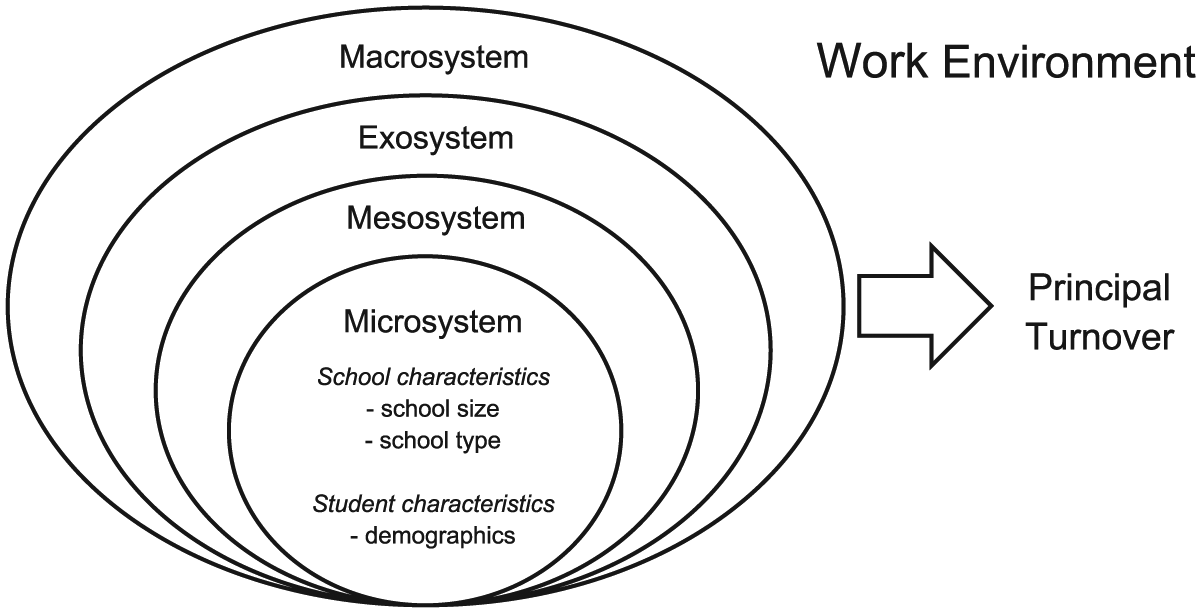
Conceptual framework for understanding the work environment and principal turnover.
Although there are many variables that can exist within a principal’s microsystem, this study will focus on categories school characteristics and student characteristics, two categories found frequently in extant literature on principal turnover. The term school characteristics in this study refers to factors that occur within a principal’s occupational environment (Tekleselassie & Villareal, 2011), such as school size. The category student characteristics is defined as composite student demographics within a school. School and student characteristics describe components of a principals’ microsystem as principals are responsible for managing and leading schools (Leithwood & Seashore-Louis, 2012; Li, 2017; Robinson, Lloyd, & Rowe, 2008) and interact with both school and student characteristics on a daily basis. This framework will help provide this study with an understanding of how environmental factors in a workplace within the microsystem may predict urban principal turnover.
Research Questions
This study sought to answer the following research questions to further understand urban principal turnover:
Literature Review
Extant literature on principal turnover has focused primarily on variables related to a principal’s personal demographics and a school’s context to understand principal attrition. Prior studies indicate that the personal demographics of a principal, such as race, gender, and professional characteristics, such as a principal’s preparation program, certification exam scores, and educational degree, are not significant predictors of principal turnover (Akiba & Reichardt, 2004; Fuller, Young, & Orr, 2007; Tekleselassie & Villareal, 2011; Young & Fuller, 2009). However, a review of principal turnover literature indicates that many school characteristics are significantly associated with principal turnover. Several studies utilizing state longitudinal data have examined variables occurring in a principal’s microsystem, such as school size, school type, and percentage of students of color enrolled, and the results indicate there are relationships between these variables and principal turnover (Akiba & Reichardt, 2004; Baker, Punswick, & Belt, 2010; Battle, 2010; DeAngelis & White, 2011; Fuller et al., 2007; Gates et al., 2006; Papa, 2007; Partlow, 2007; Tekleselassie & Villareal, 2011; Young & Fuller, 2009). Based on the existing research, this study will review specific variables within the microsystem that may affect principal turnover in an urban setting.
School Characteristics
Urbanicity
Research has indicated that principal turnover is higher in urban school districts when compared with nonurban school districts (DeAngelis & White, 2011; Gates et al., 2006; Podgursky et al., 2016). Gates et al. (2006) conducted a study examining school-level factors that affect the probability of a principal leaving a job, changing schools, or leaving their career as a principal in Illinois and North Carolina. In Illinois, Gates et al. (2006) found that the probability of principals changing schools was higher for principals in urban areas of Chicago; these principals were approximately 50% more likely to change schools than principals in suburban areas. Gates et al. (2006) also found that principals in urban schools in North Carolina were more likely to leave their career as a principal or change schools than principals in nonurban schools. In addition, DeAngelis and White (2011) conducted a study on principal turnover in the Illinois public school system to determine which school-level characteristics could be related to principal turnover. Using data from 7,075 principals, they concluded that principals were more likely to leave their job in the Illinois public school system if they were a principal in an urban area than if they were a principal in a suburban or rural area. Finally, in Podgursky et al.’s (2016) study of 2,313 principals in Wisconsin, the researchers found that urban principals were significantly more likely to leave their schools than principals in suburban or rural areas. Similarly, the Colorado Department of Education’s data on employee turnover indicate that urban school districts in the state of Colorado experience the greatest percentage of principal turnover (Colorado Department of Education, 2017).
School size
Several studies have also been conducted on the size of a school and its relationship to principal turnover, however, the results have been mixed. Several studies found that principal turnover occurs more frequently at small sized schools (Baker et al., 2010; Berry, 2014; Gates et al., 2006; Podgursky et al., 2016). In contrast, Blazer (2010) found that principals in a Florida school district were more likely to leave schools with larger student enrollment. Papa’s (2007) study supports Blazer’s (2010) findings; he found that schools with fewer students were more desirable to principals in their job search, indicating a principal’s preference to work at smaller schools. However, Tekleselassie and Villareal (2011) and Partlow (2007) presented evidence that school size was not a significant factor in principal turnover.
School type
Research has also indicated that school type, defined as whether a school is categorized as a traditional public school or a charter school, can be related to principal turnover (Ni, Sun, & Rorrer, 2015; Superville, 2014; Young & Fuller, 2009). Young and Fuller (2009) found that in Texas, charter schools that were located in urban areas had higher principal turnover rates compared with traditional public schools. They found that after 1 year of employment only 50% of urban charter school principals returned to work at the same school the following year compared with 80% in traditional public schools (Young & Fuller, 2009). Superville (2014) also found that charter schools have more principal turnover than traditional public schools with 29% of charter school principals leaving their job each year nationwide. Furthermore, Ni et al. (2015) noted that on average charter school principals remain in one school for 2.95 years, compared with traditional public schools principals who remain in one school for 4.02 years. Torres (2014) found in his study that educators working in charter schools are more likely to leave their school due to more responsibilities and a larger workload than they would have in a traditional public school.
Racial composition
Many empirical research studies have found that schools with higher percentages of students of color experience more principal turnover than schools with lower percentages of students of color (Béteille et al., 2012; Gates et al., 2006; Papa, 2007). Gates et al. (2006) found that the racial composition of the students in a school is a significant predictor of the probability that a principal changes jobs or changes schools. Baker et al. (2010) found that increases in the Black student population of a school result in an increase in principal turnover. In addition, DeAngelis and White (2011) found that principals in Illinois leave the Illinois public school system at higher rates when they work in a school with a high percentage of students of color compared with principals at schools with a low percentage of students of color. Given that urban school districts have more concentrated minority populations than rural or suburban districts (Noguera, 2008), it is possible that the percentage of students of color might also predict urban principal turnover.
Poverty level
Urban schools tend to have higher concentrations of poor students (Noguera, 2008) and principal turnover occurs more frequently in schools serving more students living in poverty (Béteille et al., 2012; Fuller et al., 2007; Goldring et al., 2014; Superville, 2014; Young & Fuller, 2009). Fuller et al. (2007) examined principal turnover in Texas, and found that schools with more than 25% economically disadvantaged students had higher principal turnover rates than schools with less than 25% socioeconomically disadvantaged students. In a subsequent study, Young and Fuller (2009) also found that principals working in high poverty schools have a shorter average tenure in a single school than principals in low poverty schools. In addition, the 2012-2013 national Principal Follow-up Survey indicated that out of 114,330 principals approximately 30,870 or 27% leave high poverty schools and 22,866 or 20% leave low poverty schools (Goldring et al., 2014; Superville, 2014). Finally, Podgursky et al. (2016) found that the percentage of students living in poverty was statistically significant in predicting principal mobility in Minnesota.
Additional subgroups
Other factors within student populations include the percentage of ELLs, the percentage of students with disabilities, and the percentage of students identified as gifted and talented. Studies have indicated there is a relationship between principal preferences for employment conditions and the percentage of ELLs in a school. Papa (2007) found that schools with lower percentages of ELLs are more desirable to principals in their career search, while schools with higher percentages of ELLs are less desirable to principals. Similarly, Loeb, Kalogrides, and Horng (2010) also found in their study of principal career preferences that principals find schools with low percentages of ELLs more preferable than schools with high percentages of ELLs. However, there is limited research on the relationship between gifted and talented students, students with disabilities, and principal turnover. Additional research needs to be conducted to determine if these student characteristics are related to principal attrition.
Principal attrition and retention are pressing issues facing education today. There seems to be a call to reenvision school leadership in urban settings, but to understand the challenges facing principals and the factors that influence them to leave their schools, additional research needs to be conducted. Education leaders need to learn more about school and student-level factors that may affect principal turnover to address underlying causes. Without this information, urban school districts may not able to accurately design principal retention policies or succession plans, and principal transitions could continue to disrupt school stability (MacNeil, Prater, & Busch, 2009), negatively affect student achievement (Miller, 2013), slow school improvement efforts (Holme & Rangel, 2012), and cost urban school districts millions of dollars annually (Superville, 2014).
Method
Participants
The participants for this study are schools from one urban school district in Colorado. This district was selected based on its size, to create the largest sample size possible using data from only one school district. Participating schools were selected from this district based on the following criteria: (a) the school must have school and student-level data from the 2010-2011 school year to the 2014-2015 school year available, (b) the school must enroll students in any subset of grades K-12, (c) the school must be either a charter or public school, and (d) the school district must be in an urban area, defined as a place with 50,000 or more people (U.S. Census, 2015). Based on this criteria, 139 schools were identified as eligible for participation in this study out of 199 schools in the district.
Data Sources and Procedure
This study utilized publicly available data from the Colorado Department of Education. First, a data set containing the list of the districts, their schools, and the school’s principal was obtained for the past 5 years from the Colorado Department of Education via a data request form. The data were subsequently analyzed based on summation to determine the number of principals each school has had during the 5-year time period to create the dependent variable.
Next, data were entered on each school’s enrollment size, school type (public or charter), the percentage of students of color, the percentage of students that qualify for FRL, percentage of students with disabilities, percentage of ELLs, and percentage of gifted and talented students at the school from publicly reported data from the Colorado Department of Education based on the average of the percentage reported for the years 2010-2011 to 2014-2015. A dummy variable was used to represent the categorical variable of school type. Variables are defined in Table 1.
Variable Definitions.

Data Analysis
This study used both descriptive statistics and multiple regression for its data analysis strategy. First, data on principal mobility were analyzed based on the employment pattern of a principal beginning at their 2010 to determine the average tenure of a principal at a school within this district. Each principal who was employed in 2010 was tracked for 5 school years, and put into one of three categories: stayed, changed, or left. Principals in the “stayed” category were principal at one school within the district from 2010-2015. Principals in the “changed” category left the school they were employed at in 2010, but took a position as a principal at a different school within the district. Finally, principals in the “left” category left the school they were employed at in 2010 and did not take a different position as a principal within the district. These data were used to determine the average tenure of a principal at a school within this district.
Next, the study used multiple regression as the primary data analysis strategy, with principal turnover regressed on school size, school type, the percentage of students of color, the percentage of students that qualify for FRL, the percentage of students with disabilities, the percentage of ELLs, and the percentage of gifted and talented students. The regression equation utilized in this study was:

The critical value to evaluate the coefficients in this regression model was p < .05.
Model Assumptions
The regression analysis was run initially to test the assumptions of linearity, homoscedasticity, normality, independence of error terms, and multicollinearity using SPSS statistical analysis software package. The scatterplot of standardized residuals against the standardized predicted values indicated there was no relationship between the standardized residuals and the standardized predicted values, meeting the assumptions of linearity and homoscedasticity. A P-P plot of standardized residuals indicated a normal distribution and the Durbin–Watson statistic indicated an independence of error terms, d = 2.01. There was one outlier within the data, but it was not removed as it was not significantly affecting the model.
The VIF values indicated there was significant multicollinearity between the variable percentage of students of color, VIF = 11.13, and the variable percentage of FRL students, VIF = 15.14. According to Cohen, Cohen, West, and Aiken (2013), multicollinearity is a risk in multiple regression analysis because it may lead to unstable regression coefficients. It may also affect the ability to create a model that accurately depicts the relationships between the predictor and independent variables (Cohen et al., 2013). To determine the level of multicollinearity, a correlation analysis was run, revealing a significant correlation between these two variables at r = .95. To reduce the threat of multicollinearity, the variables were centered (Cohen et al., 2013) and the correlation analysis was rerun. However, centering did not reduce the multicollinearity of the two variables, with the correlation remaining at r = .95. Next, the variable FRL was recoded in an attempt to reduce multicollinearity without removing the variable from the regression equation. The variable FRL was recoded into dummy variables by quartiles, but when the regression equation was rerun the VIF between percentage of students of color and percentage of FRL students was 9.46. The variable FRL was then recoded into dummy variables by deciles, when the regression equation was rerun the VIF between the percentage of students of color and the percentage of FRL students was 11.99. In this data set, high multicollinearity between these two variables exists regardless of how the data are entered.
Subsequently, the percentage of students that qualify for FRL was removed from the regression model based on Cohen et al.’s (2013) assertion that eliminating a variable from the equation will also eliminate the multicollinearity. The percentage of students that qualify for FRL was eliminated because of its lower unique variance at –.09, compared with the variable percentage of students of color which had a unique variance at .18. The multiple regression analysis was rerun without the variable percentage of FRL for the final model.
Findings
Descriptive Statistics
Of the 139 schools included in this sample, 115 are traditional public schools, while 24 are charter schools. The average school size is 528.62 students with a standard deviation of 311.06 and the average number of principals at one school during 2010-2015 is 2.01 with a standard deviation of .77. Percent averages for student-level variables are listed in Table 2.
Descriptive Statistics of Schools, 2010-2015 (n = 139).

Other represents American Indian, Asian, Native Hawaiian or other Pacific Islander, and two or more races.
Principal employment status was tracked for 2010-2015 based on if a principal stayed, changed, or left their school (Table 3).
Principal Mobility Frequencies, 2010-2015.
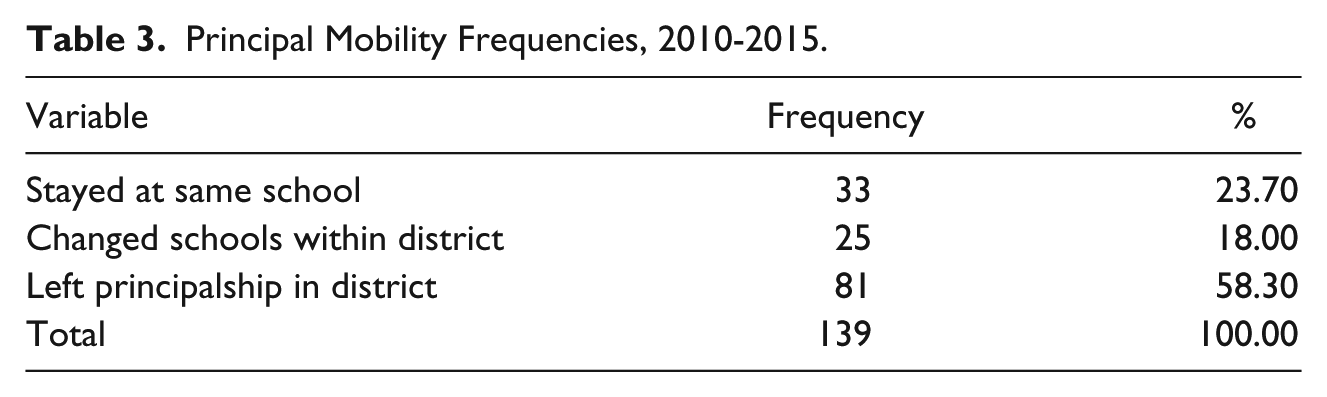
These mobility statistics indicate that 23.70% of principals in this urban school district stayed at their school for 5 years, 18% of principals left their school and became employed as a principal at another school in the district, while 58.30% of principals left the principalship within the district. Further analysis of characteristics of each subgroups schools are indicated in Tables 4-7.
Descriptive Statistics: Stayed at Same School, 2010-2015 (n = 33).
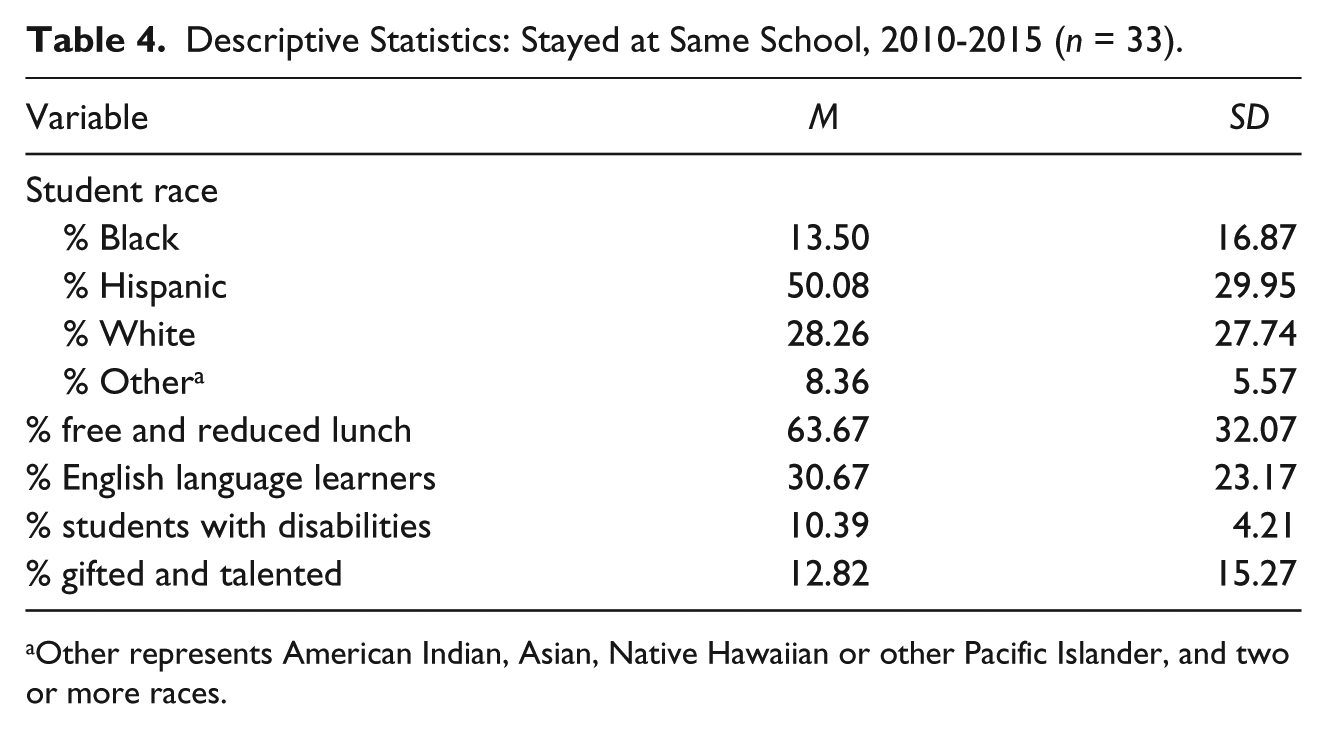
Other represents American Indian, Asian, Native Hawaiian or other Pacific Islander, and two or more races.
In the category “stayed,” there were 33 principals that stayed all 5 years. Of these schools, 84.60% were public schools, and 15.40% were charter schools, with an average school size of 555.57. When compared with the descriptive statistics for all the participants in this study (Table 2), schools where principals stayed all 5 years have lower percentages of students of color, FRL, ELLs, students with disabilities (Table 4). These schools also have more gifted and talented students when compared with the descriptive statistics for the all the participants in this study. The school type and school size are approximately the same for this subgroup compared with the sample.
In the category “changed,” there were 25 principals that changed schools within the district (Table 5). All principals in this subgroup only made one move during 2010-2015. Of the 25 original schools, 88% were public schools and 12% were charter schools, with an average school size of 484.08. In addition, the average number of principals in 5 years at these original schools was 2.24. The principals’ new schools were 88.90% public, and 11.10% charter with an average school size of 525.03. The average number of principals in 5 years at the new schools was 2.75. The data indicate that the principal moved from a school with a lower percentage of students of color, FRL, students with disabilities to a school with a higher percentage of students of color, FRL, and students with disabilities. Principals also moved from a school with a higher percentage of ELLs and gifted and talented students to a school with a lower percentage of ELLs and gifted and talented students. Principals moved from a smaller school to a larger school, but the school type remained approximately the same for both the original and new school.
Descriptive Statistics: Changed Schools, 2010-2015 (n = 25).
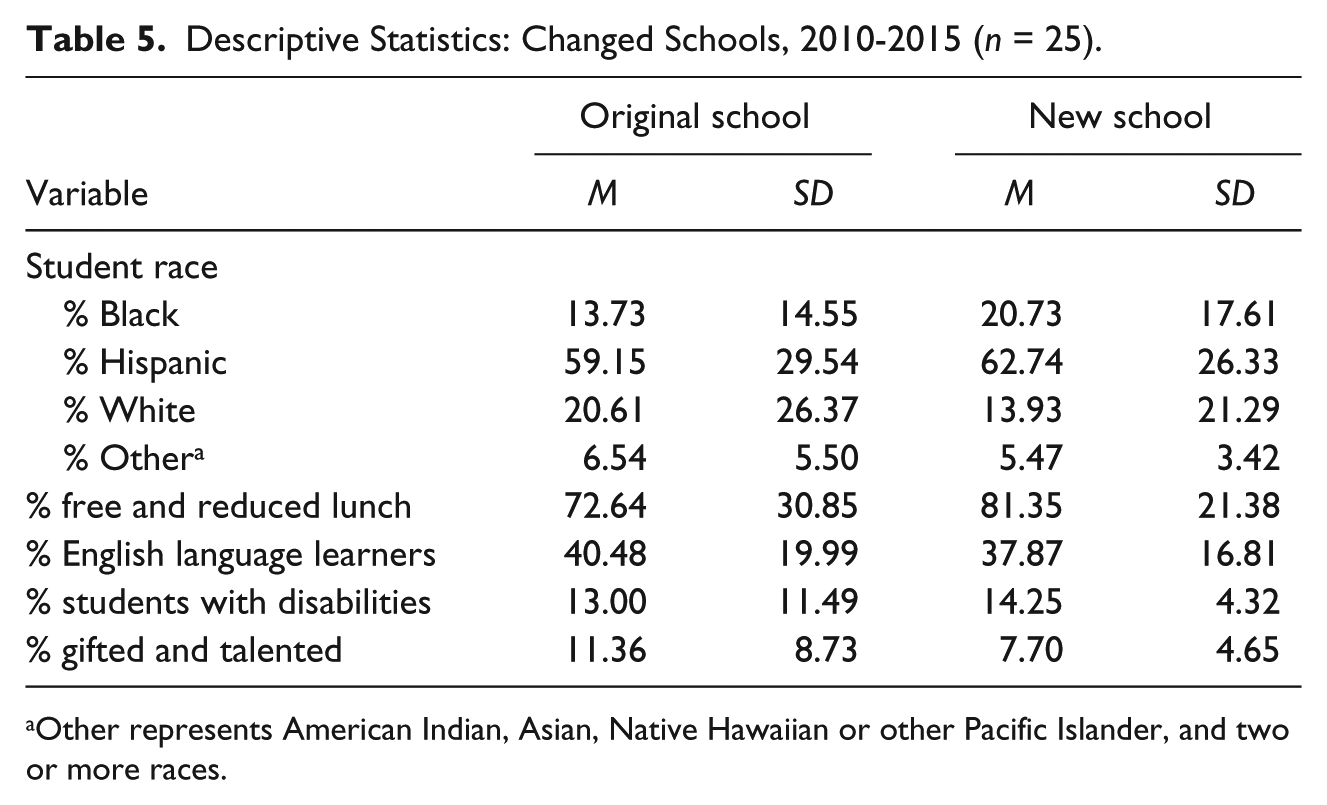
Other represents American Indian, Asian, Native Hawaiian or other Pacific Islander, and two or more races.
Finally, in the category “left,” 81 principals left the principalship within the district (Table 6). The schools where the principal left the principalship in the district were 77.8% public schools and 22.2% charter schools with an average school size of 518.77. The average number of principals at these schools was 2.36. The schools in this subgroup had a higher percentage of students of color and FRL compared with the entire sample (Table 2), while the percentage of ELLs, students with disabilities and gifted and talented students are approximately the same.
Descriptive Statistics: Left Principalship in District, 2010-2015 (n = 81).
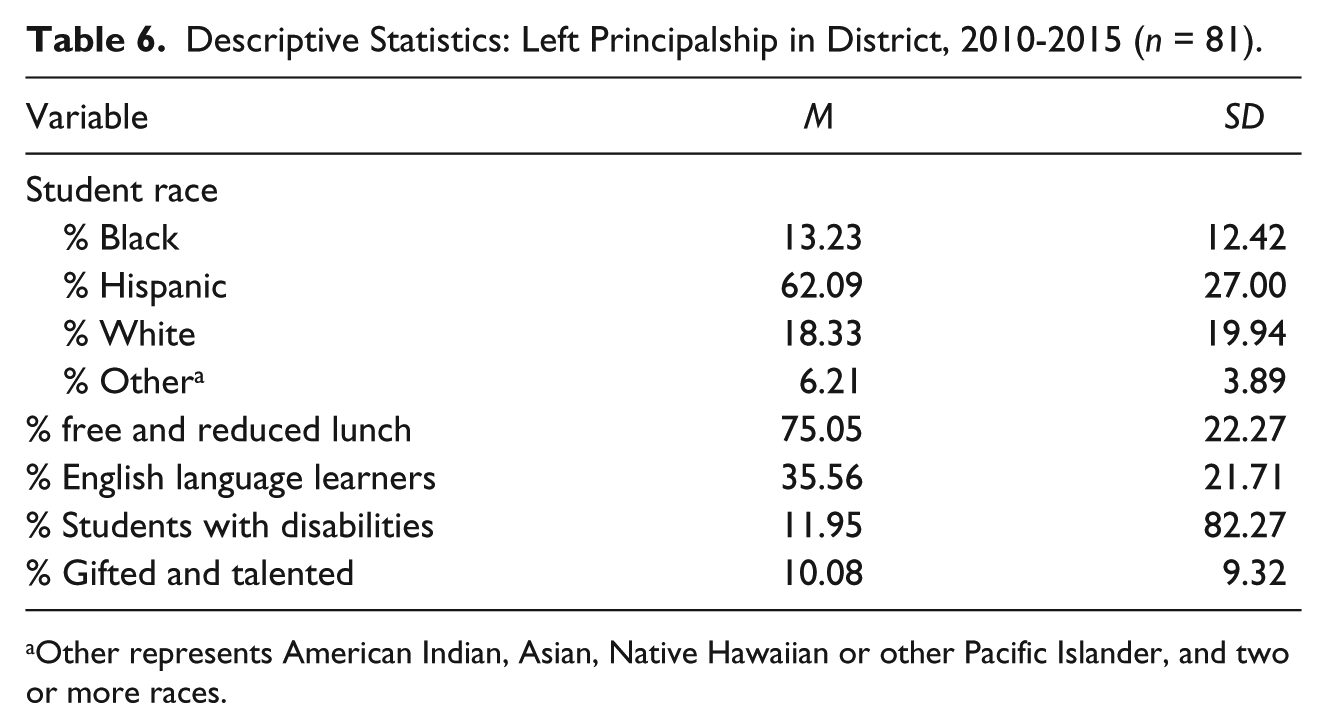
Other represents American Indian, Asian, Native Hawaiian or other Pacific Islander, and two or more races.
Multiple Regression Analysis of Principal Turnover (n = 139).
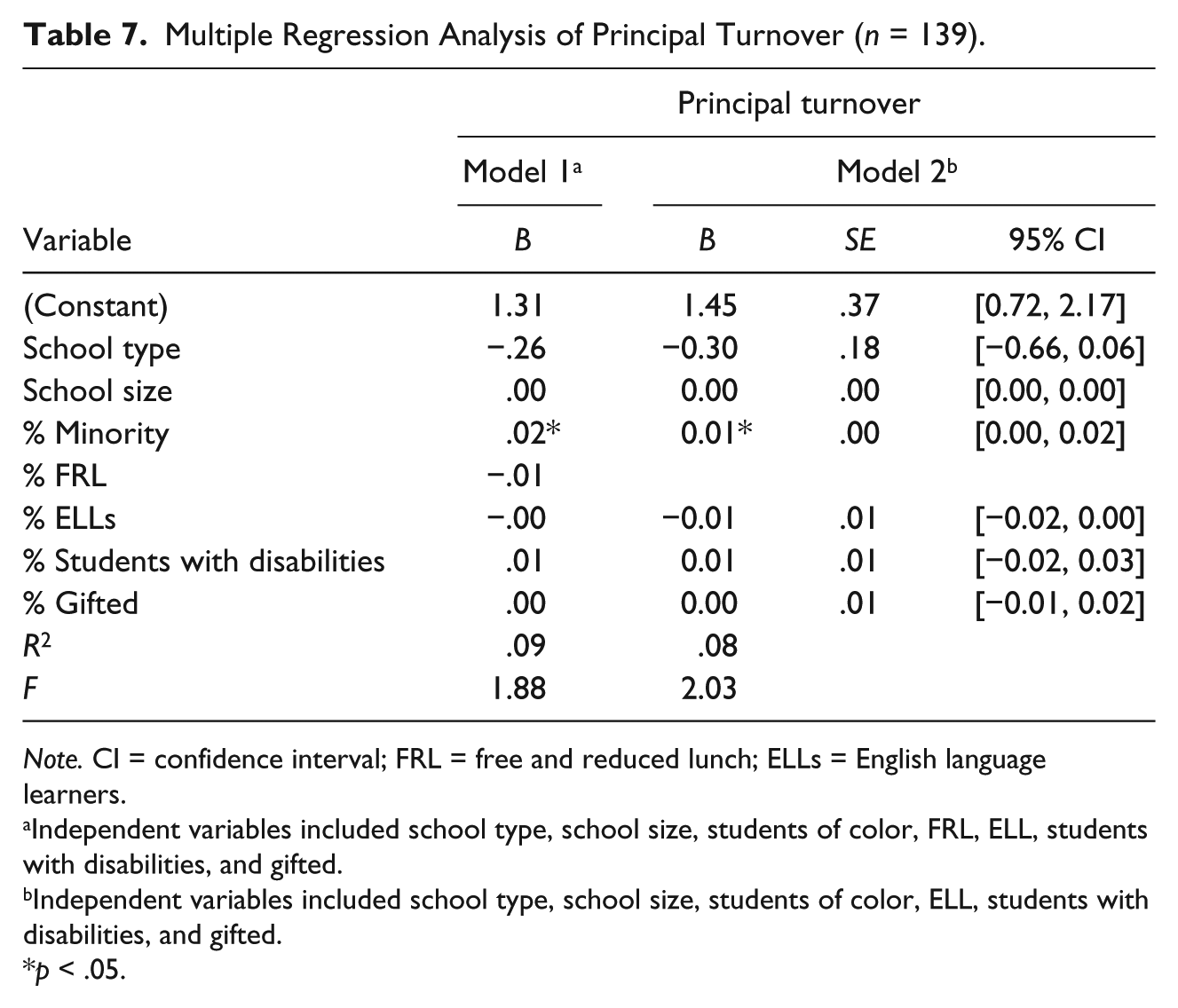
Note. CI = confidence interval; FRL = free and reduced lunch; ELLs = English language learners.
Independent variables included school type, school size, students of color, FRL, ELL, students with disabilities, and gifted.
Independent variables included school type, school size, students of color, ELL, students with disabilities, and gifted.
p < .05.
Multiple Regression Models
The final multiple regression model used in the analysis included principal turnover regressed on school type, school size, students of color, ELL, students with disabilities, and gifted and talented students, after the variable FRL was dropped due to multicollinearity (Table 7). The R-squared value for this model was .08, with 8% of principal turnover being accounted for in this regression model. The multiple regression analysis revealed that the only statistically significant variable in this model is the percentage of students of color, at .01, p < .05. The multiple regression equation suggests that for every unit increase in the percentage of students of color there is an 0.01 increase in principal turnover.
Conclusion
Discussion
According to Mascall and Leithwood (2010, 2012), principals need to stay in their school for 5 to 7 years to create large scale change and move past the stage of early implementation in reform work. The findings from this study indicate that schools in this district experienced principal turnover every 2½ years, which is 5 months shorter than the average principal tenure cited in previous research (Fuller et al., 2008; Mascall & Leithwood, 2012). In addition, only 23.70% of principals in this district stayed at their school for 5 years, while the majority of principals, 76.30%, left their schools during the 5-year period. The mobility statistics further highlight that 18% of principal mobility is due to changing schools within the district, while 58.30% of principals left the principalship within the district, indicating the majority of principals in the district are leaving the principalship within the district.
The data also reveal trends in principal mobility regarding school characteristics. The data indicate that principals leaving the principalship in this district leave schools that have higher percentages of students of color and FRL, while principals that stay at their schools have higher percentages of White students and lower percentages of FRL. In regard to principals that change schools within their district, these principals move to schools with higher percentages of students of color, FRL, and students with disabilities. The data also reveal that principals that are changing schools are moving to schools that have more frequent principal turnover.
Given the information from the descriptive statistics on principal mobility patterns, Bronfenbrenner’s (1977) ecological systems theory can then be used to help interpret the findings and to help understand how specific variables are related to principal turnover within an urban area. This study examined a principal’s microsystem, focusing specifically on school characteristics and student characteristics. Although previous research has found that the variables of school size and school type were related to principal turnover (Baker et al., 2010; Gates et al., 2006; Ni et al., 2015; Young & Fuller, 2009), the variables in the category school characteristics were not significant in this model. In the category of student characteristics, the variables of ELL and students with disabilities were not significantly predictive of principal turnover in this model. Although extant literature has indicated that the percentage of ELLs in a school may influence a principal’s career preferences (Loeb et al., 2010; Papa, 2007), there is no significant relationship in this study between the percentages of ELLs in a school and principal attrition.
Although several of the variables in this model were not significant, the results from the regression analysis did find that the percentage of students of color in a school is significantly predictive of principal turnover. Previous research that included rural, suburban, and urban districts in their sample found that the racial composition of the student body is associated with principal turnover (Béteille et al., 2012; Gates et al., 2006; Papa, 2007). This study indicates that the percentage of students of color is not only associated, but significantly predictive of principal turnover within an exclusively urban setting, while other variables found in extant literature are not predictive in an urban area.
Ecological systems theory explains interaction between a person and their environment (Bronfenbrenner, 1977), and in the principal’s microsystem, the interactions between a principal and student characteristics are more predictive than fixed school characteristics. This suggests that principal turnover is related to more of the relational aspects of the job, such as interacting with students, than fixed characteristics, such as school type. In addition, the data suggest that not all aspects of student characteristics are predictive of principal turnover. There may be correlations between a student’s race and other variables within a principal’s microsystem not examined in this study, such as the number of students disciplined. Students of color are often disciplined at higher rates than White students (Losen & Martinez, 2013; Morris & Perry, 2016), so it is possible that schools with higher percentages of students of color may also have a higher numbers of students disciplined, which could increase a principal’s workload within the microsystem. However, this cannot be conclusively stated from this study, and future research needs to be conducted to determine these potential correlations, and examine how other variables related to student characteristics in the microsystem may also be predictive of urban principal turnover.
Limitations
Although this study provides a look at one urban school district, it is difficult to generalize the findings to all urban school districts within the United States, given the unique context of each urban area. This study also did not provide definitive causation regarding principal turnover, an area where qualitative research would prove invaluable for future research. Furthermore, the correlation analysis indicated that there was a significant intersectionality between a student’s race and class, but FRL was not included in the final model due to high multicollinearity between student race and FRL. It is possible that FRL is also a predictor of urban principal turnover, given the high collinearity between the two variables, and may be an additional variable in the microsystem that explains principal turnover. This study did not use other measures for student socioeconomic status, such as median household income, to determine if a student’s socioeconomic status can accurately predict urban principal turnover. This study is also reliant upon school-reported data based on the annual October 1 count, which may not be an accurate representation of the overall yearly student population and membership from the beginning to end of the school year.
Implications and Recommendations
The findings regarding principal mobility patterns and student characteristics related to principal turnover lead to several recommended actions educational leaders in districts and universities could take to improve principal retention in urban districts. Although previous research has suggested that increasing principal salary may be an effective way to increase principal retention (Baker et al., 2010), this may not be a realistic option for urban school districts facing budget cuts or low funding. Instead, urban districts could turn the focus of their existing leaders to examine current hiring practices, incentives, and recognition opportunities for leaders in schools with high percentages of students of color. To reenvision school leadership, districts need to strongly consider the impact working with students of color has on principal retention, especially as students of color are often concentrated in urban areas (Noguera, 2008).
Urban school district leaders could reach out to their principals working in schools with high percentages of students of color to begin the conversation about challenges and opportunities that exist in serving this population to better inform district practices and policies. Districts could also include community members and students in these discussions to provide additional perspectives on this issue. Interviewing current urban school leaders, students, and community members may reveal gaps within current district policies that affect the persistence of principals in schools with high percentages of students of color. These interviews would help inform actionable steps that may help increase principal retention within the district, and provide the district with additional information on how to create targeted professional development designed to support principals working in schools with high percentages of students of color.
In addition, urban districts could further examine their data on principal attrition in their district to determine if they have a practice of principal rotation (Fink & Brayman, 2006), and closely examine the impact this practice is having on the schools enduring frequent leadership changes. The data in Table 5 suggest that principals that are changing schools are moving from a lower need to a higher need school, potentially as part of a district policy that moves high-performing principals to a high-needs schools (Fink & Brayman, 2006). Although moving an effective principal to a school in need of improvement may help improve student success, principal turnover also comes with the associated costs of decreased test scores (Miller, 2013) and a negative impact on school culture and stability (Fink & Brayman, 2006; Mascall & Leithwood, 2012). Based on the findings from this study, district offices should reconsider current practices that may move a principal from one school to another, or hire a principal for a district office position, before the principal has been at the same school for 5 years, the minimum number of years a principal needs to be at a school before large scale change can occur (Fuller et al., 2008; Mascall & Leithwood, 2012).
In addition to district level practices, universities involved in principal preparation programs can examine their current programming to determine if they are adequately preparing principals to enter a school with high percentages of students of color. Principal preparation programs should consider if the principal preparation program’s coursework truly emphasizes the real-world skills a principal needs to lead a school with diverse students (The Wallace Foundation, 2016). Principal preparation programs could also examine the retention of program graduates in district partnership schools. The Wallace Foundation provides a toolkit that principal preparation programs can use to examine the retention of their program graduates in schools (King, 2013), and this tool may serve as a starting point for determining patterns within graduate retention within schools with high percentages of students of color. This analysis may indicate a need for programmatic adjustment to better serve the needs of the partner district and increase principal retention rates in schools with high percentages of students of color.
Universities can also thoughtfully leverage their alumni network to help their current students create a peer network before they begin their first job as a principal. Superville (2014) highlights the importance of peer networks for new principals, and university programs are uniquely poised to reach out to local alumni working as principals in schools with high percentages of students of color, and connect them to students that will become new principals working in similar environments. This peer network can provide new principals with additional mentorship and decrease feelings of isolation as graduates transition from the classroom to school leadership.
The predictability of these findings raise questions about how districts can reenvision the leadership of schools with high percentages of students of color, as well as the role district leaders can play in examining current practices and policies to provide additional incentives for principals leading in schools with high percentages of students of color. Future research could apply Bronfenbrenner’s (1977) ecological systems theory as a conceptual framework and look at additional variables that may occur within an urban principal’s microsystem with an emphasis on student characteristics to determine if there are other predictors of turnover than a student’s race, such as student discipline or student achievement scores. Future quantitative research could focus on using additional measures of socioeconomic status to determine its impact on principal turnover, while qualitative research would prove invaluable in determining the specific policies and practices that contribute to principal retention in urban school districts. With further examination, school districts could be poised to create systemic change that allows for more stability in urban schools and provides students of color a more equitable opportunity for success.
Footnotes
Declaration of Conflicting Interests
The author(s) declared no potential conflicts of interest with respect to the research, authorship, and/or publication of this article.
Funding
The author(s) received no financial support for the research, authorship, and/or publication of this article.