




Abstract
The purpose of this study was to explain secondary physical education (PE) teachers’ positioning regarding teaching English language learners (ELLs) in urban schools. PE teachers may be fearful of looking inward to examine and share their beliefs and values of hidden conscripts of race, ethnicity, class, and languages. This study found that PE teachers sought ways to include ELLs socially, academically, and culturally, but that they desired more opportunities for professional development on working with ELLs. This study encourages school districts and PE teachers to implement effective, culturally relevant instructional methods, and to develop a positive learning atmosphere for all students.
Introduction
English language learners (ELLs) represent a rapidly growing population in urban schools. According to a report by the National Center for Education Statistics (2017), school districts in urbanized areas have a higher proportion of ELLs (ranging from 10.3% in small cities to 16.8% in large cities), compared with towns (6.2%) and rural areas (3.5%). Furthermore, increasing numbers of ELLs even in schools outside large cities illustrate what Milner (2012) calls an “urban characteristic” (p. 560).
Despite this prevalence, many content area teachers in urban schools are unprepared for teaching linguistically and culturally diverse students (Johnson, Bolshakova, & Waldron, 2016), and content area instruction for ELLs represents a growing area of instructional need (Szpara & Ahmad, 2007). Successful inclusion of ELLs in the classroom creates opportunities for all students to engage with multiple languages and learn new cultures, backgrounds, history, and aspects of diversity that help them strengthen their overall cognitive abilities (Sato & Hodge, 2009). In particular, sport and physical education (PE) have the potential to be a universal language that can be a powerful tool to promote peace, tolerance, and understanding by bringing people together across boundaries, cultures, and religions by promoting the concepts of teamwork, fairness, discipline, and respect for the opponent in a game or activity (United Nations, 2017).
PE is of particular relevance to schools in urban areas, where residents may show greater physical inactivity, higher rates of childhood obesity, and culturally influenced dietary habits such as increased consumption of sweet snacks or carbonated beverages, which increases the importance of developing healthy physical and dietary habits among children (Hodge & Vigo-Valentín, 2014). However, many urban schools, particularly high-poverty and low-performing schools, may have equipment shortages or inadequate school facilities for PE (Hodge & Vigo-Valentín, 2014).
In schools, ELLs may encounter conflicts between the linguistic, social, and cultural values of education systems and their own backgrounds (Cone, Buxton, Lee, & Mahotiere, 2014). In mainstream PE classrooms, ELLs may encounter linguistic and cultural challenges arising from differences in terminology used in PE instruction, as well as cultural and religious differences. It is important that PE teachers understand ELLs’ challenges as well as their available linguistic, social, and cultural resources, to create partnerships among ELLs, their families, and their schools (Sato & Hodge, 2016; Sato & Sutherland, 2013; DaSilva Iddings, Combs, & Moll, 2014). In addition, different from many other classroom settings, misunderstandings due to linguistic challenges can result in safety concerns for ELLs in PE classes (Sato, Walton-Fisette, & Kim, 2017).
Teachers from a variety of academic subjects (e.g., PE, math, and science) often serve as both language teacher and content specialist when ELLs are enrolled in their classes (Reeves, 2006). One of the critical attributes of effective classrooms for ELLs is teachers’ social justice and diversity leadership (Theoharis & O’Toole, 2011). Such leadership involves teachers and school leaders advocating in their classrooms, schools, and communities to facilitate long-term academic and social success for ELLs. Teachers need to demonstrate leadership for ELLs by promoting social justice and diversity in classrooms (Shields, 2004), raising issues concerning equity (Cambron-McCabe & McCarthy, 2005) and supporting inclusive practices to meet the needs of a diverse student population (Riehl, 2000). Therefore, PE teachers must engage in reflective action, which involves first identifying and then critically challenging their initial assumptions about teaching ELLs (e.g., stereotypes regarding culturally popular sports, physical attributes, and beliefs toward ELLs’ national, cultural, and ethnic backgrounds). However, Erickson (2001) found that many teachers displayed a mismatch with ELLs in terms of cultural understanding. In essence, PE teachers are charged with including ELLs into the curriculum and implementing socially relevant pedagogies (Hodge & Faison-Hodge, 2010).
Author and Colleague (2017) suggest that to encourage involvement of all students in socially inclusive lessons, teachers should use self and social responsibility training (Hellison, 1995) embedded in PE classes (Andreouli, 2010). Based on key elements of the Society of Health and Physical Educator’s (SHAPE) secondary school PE curriculum (SHAPE America, 2013), middle school students should apply tactics and strategies to modified game play, demonstrate fundamental movement skills in a variety of contexts, design and implement a health-enhancing fitness program, participate in self-selected physical activity, and accept individual differences and demonstrate inclusive behaviors. At the high school level, students should plan and implement different types of personal fitness programs and demonstrate competency in two or more lifetime activities and describe key concepts associated with successful participation in physical activities. PE scholars assert that PE teachers need to engage in culturally relevant pedagogy and focus on five dimensions—attitudes, learning, climate, curriculum, and family involvement—through effective intercultural communication and the infusion of social justice content and concepts into secondary PE curricula (Burden, Hodge, & Harrison, 2012). However, PE teachers may be concerned that these PE concepts and practices do not match ELLs’ linguistic, social, and cultural experiences and knowledge (Sato & Hodge, 2016; Sato & Sutherland, 2013). Previous research has found that ELLs face increased challenges due to the unique linguistic demands of a particular subject area (e.g., social studies, mathematics; de Oliveira, 2012, 2013; Wong Fillmore, 2004), and this is also the case in PE.
Author and Colleague (2016) studied six elementary PE teachers’ initial experiences and challenges in teaching newly arrived ELLs in American public schools. They found that although previous research suggested that when ELLs learn new technical terms in certain subjects, they often adapt by switching or translating between new and past (from their native countries) language discourses (e.g., Canagarajah, 2002), this was more difficult in PE class, where many ELLs had culturally and linguistically disparate experiences between the new and past language discourses. Author and Colleague (2013) studied eight secondary PE teachers’ experiences teaching ELLs. They found that PE teachers struggled to teach normative American activities and sports (e.g., American football or baseball) due to technical language of physical activities and sports, communication barriers, gender roles, positions, and religious restrictions and associated concerns about coeducational PE classes. Similarly, Ernst-Slavit and Mason (2011) asserted that ELLs had limited exposure to the specialized language of content areas, and that the prevalence of opaque terms (e.g., homophones, idioms, technical terms) can hinder ELLs’ understanding. Such communication differences may have important implications for teachers and ELLs in PE environments (Burden, Columna, Hodge, & Martínez de la Vega Mansilla, 2013; Columna, Foley, & Lytle, 2010).
Purpose and Theoretical Framework
The purpose of this study was to describe and explain certain secondary PE teachers’ positioning of ELLs and of themselves as teachers of ELLs. The research questions guiding the study were as follows:
Framed in positioning theory, we focused on PE teachers’ views about teaching ELLs of diverse backgrounds, as positioned and articulated in their own interpretations.
Positioning Theory
The study was grounded in positioning theory (Harré & van Langenhove, 1999). This is a theory of social behavior that explains the fluid patterns of dynamic and changing assignments of rights and duties among groups of social actors (Varela & Harré, 1996). The term positioning means to analyze interpersonal encounters from a discursive viewpoint (Hollway, 1984). Davies and Harré (1990) wrote, Once having taken up a particular position as one’s own, a person inevitably sees the world from the vantage point of that position and in terms of the particular images, metaphors, story lines, and concepts which are made relevant within the particular discursive practice in which they are positioned. (p. 46)
This framework allows researchers to explore the capacity of teachers to position themselves and, in this case, to describe how teachers negotiate and implement secondary PE curricula with ELLs and native English-speaking students. Positioning theory helps us understand what the PE teachers in this study might or might not do based on their experiences, which influence their thoughts, feelings, and perceptions about teaching students from culturally, ethnically, and linguistically diverse backgrounds, especially ELLs. Positioning theory can help contribute to our understanding of how PE teachers create or constitute knowledge and their experiences teaching ELLs. Positioning theory, thus, provides a framework for analyzing teacher discourse, that is, the saying, doing, being, valuing, and believing combinations produced by teachers’ experiences.
Reflective positioning
One perspective of positioning theory is intentional self-positioning (Yoon, 2008). Davies and Harré (1990) use the term reflective positioning to explain how teachers position their own values and actions, explaining that teachers view reality from a certain conscious position. Teachers’ reflective positioning shapes how they perform their roles, assignments, and duties in education (Yoon, 2008). Teachers’ reflectivity is determined by “indexing one’s statements with the point of view one has on its relevant world” (Harré & van Langenhove, 1999, p. 62). This means that teachers’ experiences and backgrounds influence their positioning (beliefs and thinking) and, in turn, their actions in teaching (Yoon, 2008). Because teachers participate in diverse discourses, they must combine different positions and roles such as teacher, facilitator, or helper (Jones, 1999).
Interactive positioning
According to Davies and Harré (1990), interactive positioning is “how one person positions another” (p. 48). Teachers’ positioning of others limits or extends what they can say or do (Adams & Harré, 2001) and inhibits or provides a choice of speaking forms, actions, and thoughts (Harré & van Langenhove, 1999). Interactive positioning helps to identify teachers’ positioning based on interaction among teachers themselves, ELLs, and other students (e.g., students who are native speakers of English) in PE. More specifically, it can explain teachers’ decision-making processes (e.g., how PE teachers choose teaching techniques, lesson content, or materials such as handouts or task cards) that contribute to positive academic and social experiences for ELLs or lead to cultural dissonance. Cultural dissonance may erupt from tension between conflicting values or norms on the part of the teacher and student(s) (Cone et al., 2014). In such cases, a teacher may reject or accept students as a function of the teacher’s positioning (Harré & Moghaddam, 2003). Through their pedagogical approaches, teachers intentionally or unintentionally position ELLs in more positive or negative ways (Yoon, 2008). For example, Yoon (2008) describes a teacher using American football games as the basis of a class discussion as having the unintentional consequence of positioning ELLs as “powerless and isolated” (p. 510).
Howie (1999) asserts that “teachers’ positive actions in response to needs” (p. 58) are crucial in teaching ELLs. Thus, this study investigates how secondary PE teachers position themselves and their ELLs as they work to take positive actions in teaching students with diverse cultural and linguistic backgrounds.
Method
Research Design
This study’s methodology was descriptive–qualitative, using an explanatory case study design (Yin, 2003). Typically, qualitative studies focus “in depth on relatively small samples, even a single case (n = 1), selected purposefully” (Patton, 2002, p. 169). The main aim of the case study method is to better understand complex educational and/or social phenomena—while retaining the holistic and meaningful particularities of real-life circumstances (Yin, 2003). As such, the multiple explanatory case study method was judged appropriate for examining PE teachers’ experiences in teaching ELLs of ethnically, culturally, linguistically, and socioeconomically diverse backgrounds at urban schools.
Setting and Participants
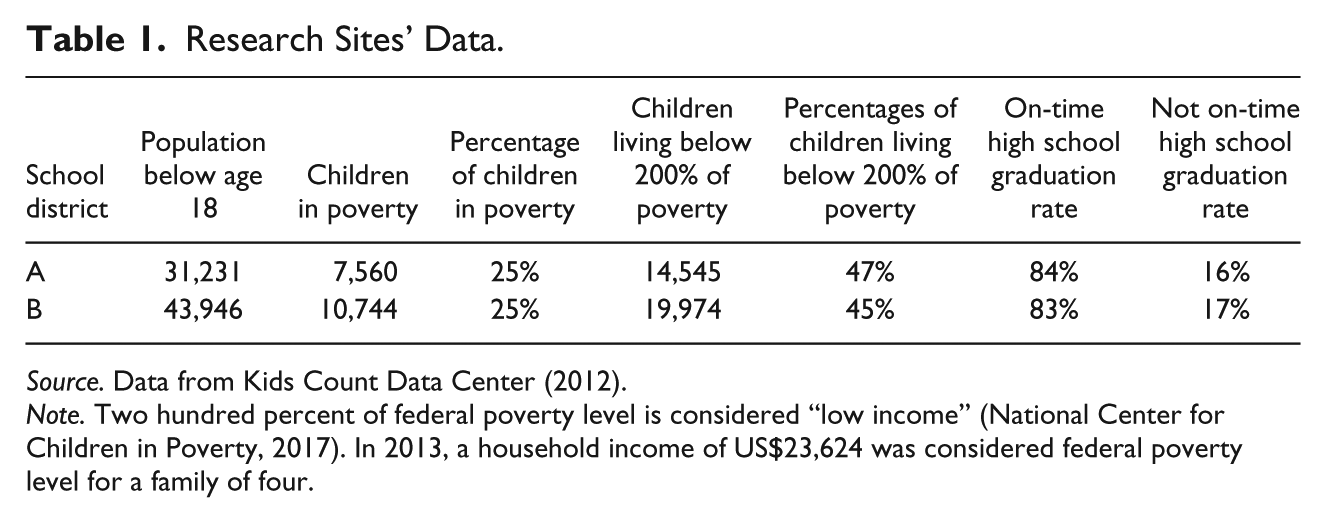
Research sites for this study were determined by the nomination and selection of PE teachers who were teaching ELLs across two urban, inner city school districts in an eastern coastal state within the United States. The school districts in this study are considered high-poverty, low-performing schools. Teachers face several challenges including budget deficits, PE equipment and supply shortages, inadequate PE gym facilities, and overcrowded classes (Hodge & Vigo-Valentín, 2014). Many students lived in poverty (see Table 1), and socioeconomic issues were significant concerns in these school districts.
Research Sites’ Data.
Source. Data from Kids Count Data Center (2012).
Note. Two hundred percent of federal poverty level is considered “low income” (National Center for Children in Poverty, 2017). In 2013, a household income of US$23,624 was considered federal poverty level for a family of four.
The primary researcher identified and selected all PE teachers from both school districts. This process involved submitting an institutional review board (IRB) application and receiving approvals from the researcher’s university and both school districts to conduct the study. Each school district was contacted to discern the number of ELLs within the school and assess the interest of the PE teachers in participating in the study. Next, we contacted the school district’s curriculum and instruction division to ask them to send the research recruitment letters to all PE teachers who were teaching ELLs. In the state where the study was conducted, the population of ELLs had increased by more than 200% in recent years, and there were approximately 500 to 1,000 ELLs (top five countries of origin: China, Sudan, Mexico, India, and Brazil) attending public schools in each district. A total of eight PE teachers (males = 2, females = 6) from one public high school (n = 4) and three public middle schools (n = 4) voluntarily participated in this study (see Table 2; pseudonyms for the participants are used). Although Mr. Cannon, Mrs. Winston, and Ms. Ann had 6 to 10 years of experience teaching ELLs at urban school districts, they previously taught PE for ELLs at suburban schools in a different state. They relocated to urban school districts due to their spouses’ military duties and services. There was no special support or services (e.g., paraeducators or language assistants) available to these PE teachers’ classes.
Teacher Demographic Information.

Note. PE = physical education; ELL = English language learner.
Data Collection
Data were collected using a demographic questionnaire, face-to-face interviews, and email follow-ups. Data collection occurred over a period of 18 months, including 6 months of a pilot study followed by 12 months of formal data collection. A full 12 months of data collection was necessary because PE teachers focus on an annual curriculum, including seasonal sports and physical activities (fitness and wellness) such as individual and team sports. In this study, 35% of the ELLs had to return to their home countries within 6 to 8 months of arrival, because of their (ELLs) parents’ contracts and/or immigration visa regulations and, thus, did not maintain enrollment at their schools. Before the data collection, all participants (teachers) were asked to send their signed consent forms, demographic questionnaire, and interview protocol for this study.
Demographic questionnaire
The survey scale titled English as Second Language Students in Mainstream Classrooms: A Survey of Teachers (Reeves, 2002, 2006) was modified (e.g., the term “Second Language Students” was changed to “ELL”) and used to collect descriptive data of the participants. This instrument is designed to assess teachers’ experiences in teaching ELLs. It consists of three sections: (a) teachers’ level of agreement or disagreement with statements about teaching ELLs, (b) teaching behaviors, and (c) benefits and challenges of teaching ELLs (see Reeves, 2002, 2006).
Face-to-face interviews
Interviewing is undoubtedly a powerful way to gain insight into educational and social phenomena experienced by individuals in educational contexts (Seidman, 1998). Interviews allow the researcher “to acquire data not obtainable in any other way” (Gay, 1996, p. 223). There are some things that cannot be observed, such as a teacher’s past experiences, events that occur outside the researcher’s sphere of observation (e.g., a teacher’s reflection on and recall of past events) and mental processes (e.g., a teacher’s views on teaching ELLs). Thus, this study used face-to-face interviews as a medium for the PE teachers to reflect on and speak about specific situations, opinions, people, places, and events associated with teaching ELLs. Each participant was interviewed at his or her respective school. The 15-question interview protocol was developed by Reeves (2002), and modified for the present study based on results from a pilot study. The semistructured protocol included questions that focused on the PE teachers’ positioning, experiences, and views about teaching ELLs in PE. In the pilot study, two professors of teaching English as a second language (ESL) who were familiar with positioning theory also reviewed the interview questions. Each face-to-face interview took approximately 120 min to complete.
Email follow-ups
Email messages were used to ask follow-up questions and/or to seek clarification of previous responses (see Meho, 2006). When there was a need to clarify the contents of the interviews in written format, the researcher and peer debriefers asked each participant to respond by email. In this study, five to 10 email messages were sent to each of the eight participants, which included inquiries about their ethical and unethical behaviors of teaching ELLs in PE and dealing with ELLs during recess, physical activity events (such as field trips or sport events).
Data analysis
A constant comparative method (Boeije, 2010) was used to interpret the data. The basic strategy of this analytical process is to do what its name implies—that is, constantly compare pieces of data. More specifically, each potentially meaningful piece of data within the transcripts from the first set of interviews with each participant was coded independently by the first author and peer debriefers, and the differences were discussed until agreement was reached. The second set of interviews, follow-up emails, and demographic information were initially coded by the lead author and then checked by the peer debriefers. These peer debriefers reviewed the codes to avoid potential researcher bias. Further coded data from both sets of interview transcripts, follow-up emails, and demographic questionnaire from each participant were compared to identify similarities and differences. The researchers grouped the codes into thematic categories, which were then refined into recurring themes (Boeije, 2010).
Trustworthiness and data analysis
Trustworthiness in this study was established through triangulation, member checking, and peer debriefing. Triangulation involved the use of multiple perspectives, including data from interviews, demographic questionnaire responses, and email follow-ups, all of which were interpreted through the lens of positioning theory. Use of triangulation is intended to judge the accuracy of the data, rather than to seek universal truth (Merriam, 1998). Member checking was used to reduce the impact of subjective bias (Patton, 2002). The lead researcher mailed all copies (saved disks) of the demographic survey data, transcribed interview data, and email follow-ups to the postal mailing address of the individual participants. The participants’ acknowledgment of the accuracy of the data and the researchers’ interpretations of the data ensured that trustworthiness was established (Merriam, 1998). Peer debriefing is a process of exposing oneself to a distinguished peer in a way paralleling an analytic session, with the purpose of exploring aspects of inquiry that might remain only implicit in the inquirer’s mind (Patton, 2002). For this study, three graduate assistants known by the primary researcher and with experiences in qualitative research agreed to serve as peer debriefers. They judged the interpretations of the data as accurate and representative of the participants’ statements.
Results
Explainable in the logic of positioning theory (Harré & van Langenhove, 1999), four interrelated themes emerged from the PE teachers’ demographic surveys, interviews, and email responses. The first theme, social and ethnolinguistic practices in PE, described how participants felt about the language acculturation of social and ethnolinguistic practices among their ELLs and local students in PE classes. The second theme, PE teachers’ teaching and corrective positioning, explained that the participants felt that their corrective feedback and interventions were the only opportunities to interact with their ELLs in PE classes. The third theme, individualism versus collectivism, described that the participants felt that the ELLs showed active learning when they created collective or team positioning with other ELLs. The fourth theme, PE teachers’ professional development needs, described that the participants felt that they need professional development opportunities to better teach ELLs. In addition, they felt that their school districts should provide professional development in how to utilize students’ background and demographic information in their lessons and units, as well as a network system that allows all teachers in the school districts to access such information. Below, we describe each theme together with illustrative excerpts from the data.
Theme 1: Social and Ethnolinguistic Practices in PE
All participants experienced eye-opening, positive learning experiences during their teaching of secondary ELLs in PE. However, they also described struggles in helping their ELLs to learn standard and social English language as well as relevant ethnolinguistic communication skills in PE. There were large African American student populations (55%-60%) in each of the school districts, and the teachers believed that it is important that their ELLs learn the ethnolinguistic practices, that is the speech codes, language, and dialects of ethnic or geographic groups, that help them understand cultural behaviors in these urban schools. Although the ELLs may show a variety of degrees of proficiency in standard American English, they were often unfamiliar with the ethnolinguistic practices that local students used. The PE teachers felt that from learning these practices, the ELLs would be able to more easily integrate with the local students.
For example, Mrs. Winston explained her experiences teaching ELLs in her PE class, saying that ELLs struggled to learn local social and ethnolinguistic practices and struggled to communicate with classmates. She mentioned that My ELLs struggled to study how to use social and ethnolinguistic practices when they communicated with local students. I think this language may be much more important in PE classes. For example, many African American students used the term ain’t. This is a contraction of am not, also used for have not or has not. Many ELLs did not capture the meaning of language. They use the expression, because many African American students did not know how to use proper grammar. In PE class, local students showed their frustrations when they could not communicate with ELLs in PE class. I think my students began to respect the ELLs when the ELLs learned how to use social and ethnolinguistic language. (Mrs. Winston, interviews)
Mrs. Winston wanted to secure a positive social situation (positive and caring learning environment) in her classroom, but she needs to find a way that carries her own expectations about how local students should show their caring behaviors that lead to their positive evaluations of ELLs’ cultural differences in PE. Similarly, Ms. Baker said that many local students have nicknames using only the initial of their first or last names, which may have been unfamiliar to many ELLs, resulting in interruptions to game play. For example, When I taught handball games, many local students used louder voice tones and told ELL teammates where to pass the balls. I saw one of the local students said “Pass the ball to D (Darrell)!!” to one ELL teammate from Sudan, then he passed the ball to another teammate. His name was Tyron and his nick name was “T.” The local student said to him “oh man, I told you pass the ball to D not T. You ain’t paid attention.” After the class, I told him to bring a player change board (that has other names written on them) from the equipment room. I thought player change board communication may be good way to avoid miscommunication during the game. (Ms. Baker, interviews)
Ms. Baker believed that the way local students position ELLs in PE is important, because positioning has consequences for interaction and communication that lead to negative or positive learning environments. By introducing the player change board, Ms. Baker sought to change a situation where ELL students were being positioned negatively as a result of noncomprehension of an ethnolinguistic practice, and, in the process, drawing on ELL students’ other language skills.
In high school, fitness and wellness classes are an essential part of the PE curriculum. However, many students were not motivated to participate in cardiovascular lessons such as jogging long distances. Mr. Cannon, Mr. Black, and Ms. Baker presented fitness and wellness materials in a lecture format; however, their ELLs were not familiar with the specialized vocabulary of fitness and wellness used in the lecture. Mr. Black found that instead of relying on such specialized language, it was more effective to use social language and basic communication patterns, which were easier to understand and were familiar to some ELLs, and also helped facilitate communication between ELLs and local students. This was important to create a safe learning environment. He said that Before I taught the . . . fitness and wellness concepts, I had to teach how to express “I need water,” and “I am tired.” “I do not like or enjoy.” . . . This language is important. I did a Google search how to translate their native language to English language. I need to know because I found that some ELLs kept running when they were not feeling well in the cardiovascular endurance. I think my local students and ELLs need to communicate with each other and make sure they are OK. I found that some local students used a gesture of “drinking.” That helps ELLs develop social language. I feel bad that I still cannot explain and help my ELLs gain the concepts of fitness and wellness lectures. They still do not understand why they need to run 2-3 miles during PE classes. I feel bad, but I focus on social and survival language and reduce lecture content activities. (Mr. Black, interviews)
Mr. Black felt that as a PE teacher, he not only needed to position himself as a teacher of specialized concepts relating to fitness and wellness but also needed to avoid life-threatening situations that could result from miscommunication with his ELLs during PE class. He also said that “I am learning about how to ask lower-level questions such as ‘are you tired?’ or ‘are you happy?’.” Such social language helps him to engage with ELLs in PE class.
Theme 2: PE Teachers’ Teaching and Corrective Positioning
Reflecting on their teaching experiences, all PE teachers described difficulty in finding a balance between positioning themselves as corrective instructors and as supportive teachers of their ELLs. Participants described that when the ELLs misunderstood the concept of an activity or lesson, they corrected their ELLs’ performance. However, they mentioned that some ELLs were afraid of making mistakes and avoided eye contacts with them and other students. These participants felt that when the ELLs did something incorrectly in the class and the teacher offered correction, other local students began to make fun of the ELLs or teased their actions and behaviors during the PE class. Thus, they also desired to position ELLs in ways that helped avoid such situations. They understood that they had to create a positive learning environment, but because they taught large number (an average of 35-50 students) in one class, it was difficult to control students’ behaviors. Mrs. Anderson (a beginning teacher) explained that she struggled to seek culturally relevant pedagogy and emotional inclusion for all students in the class. She said that I thought I would be able to do a better job when I taught my ELLs. When I taught the baseball unit, we did tee batting practice. One boy from Kenya stood on the left side of the batting tee and held a bat with his left hand above his right hand. I said “No, No, No, No!!!” I touched his hands and corrected his hand positions. One of local students said “have you played baseball in your country? No baseball?” I said “stop it!!,” but they laughed . . . I hated to be in the position that I interacted with ELLs when they were embarrassed. Correcting batting forms was important, because of safe practices, but at the same time, I have the dilemma that I have to handle other students and create a respectful learning environment. (Mrs. Anderson, interviews)
Mrs. Anderson explained that although teachers need to help ELLs protect themselves, her effort adversely affected ELLs’ learning experiences, resulting in teaching conflicts and struggles. Teachers’ interactive positioning is about power, and students’ learning changes depending on how teachers use it to influence all students (Blase, 1991). Here, Mrs. Anderson’s efforts to correct the ELL student’s hand positions inadvertently positioned the student negatively. Similarly, Ms. Hick said that When I taught sportsmanship and caring behaviors to all students, I really struggled to teach the content. I assumed that my local students initiated and demonstrated these behaviors to ELLs, I could see positive results, but I did not see [them]. I’ll give you an example, when I taught basketball passing and dribbling units, one African American boy and one ELL from Thailand practiced various skills. I intentionally found the African American boy, because he was quiet, but showed good caring behaviors. I thought it was good match. After the closure of my class, the boys shook hands, but then, the ELL wiped his hand with his T-shirt. The African American boy did not see, but I asked the ELL “why did you wipe you hand with your T-shirt?” He did not say anything . . . He did not understand what I was saying in English. I came home and studied moral behaviors of Thailand. People place the palm of their hands together with their fingers extended at chest level close to their body and bow slightly. I was hurt that I pushed him to follow an American way of sportsmanship without knowing his culture and respectful behaviors. I felt bad about both students. (Ms. Hick, interviews)
Ms. Hick found that learning more about her ELLs’ cultural backgrounds and cross-cultural experiences can be useful for understanding her ELLs. What she thought of before as a simple corrective intervention or instruction could become a question of ethical or unethical behavior, and interactively positioned her ELLs into positive or negative learning environments. She evaluated her own moral behaviors, action, and judgment between what is right and what is wrong.
Mr. Cannon shared a similar experience. Before the end of his lessons, he has a routine in which he brings all students together, asks questions about the lesson, and checks for students’ learning. He shared his experience that When I did a check for understanding, I had eye contact with one of my ELLs before closing the PE sessions. I really wanted to help him to speak English language in front of other students, because his classmates may view him in positive ways. I rephrased the questions and tried to pull the answers from his mouth, but he did not speak out. The student was from one of the East Asian countries. He was hesitant to speak English in front of other students. I think I pushed him to speak independently. That benefits him greatly, but I made the mistake that I pushed [on] him my social norm as being American. I felt bad for him. (Mr. Cannon, interviews)
To Mr. Cannon, being a good student meant becoming an independent learner and sharing one’s knowledge and skills with others. This belief lead to Mr. Cannon’s effort to position the ELL students positively by pushing them to speak in front of the other students, even though they were not used to speaking in front of other students as it may not be part of the students’ social and cultural norms. This, again, creates a situation where the PE teacher must find a balance between positioning himself or herself as a corrective teacher and a supportive teacher.
Theme 3: Individualism Versus Collectivism
This theme indicates that all participants experienced that when they interactively positioned ELLs or helped them develop friendships with other ELLs from similar backgrounds, the ELLs learned better. Both local students and other ELLs influenced the teaching experiences. The participants observed that one or two groups of ELLs belonged to local student groups. The ELLs from Asian countries and African countries showed their desire of dependency on and attachment to local students and teachers. However, the participants felt that all students, including ELLs, must develop more independent (individualistic and reflective) learning in the class rather than interdependent (collectivist and interactive) learning. The participants found that, for the ELLs, becoming independent caused social isolation and marginalization in the class. For example, Mrs. Ann found greater academic and social success among her ELLs when three to four ELLs developed their friendship and a comfort zone within the group.
I think that my ELLs were always anxious to be in PE classes. One time all students had to take sit-and-reach tests when other classmates were watching. They were so nervous and they were sweating and their faces were pale. I found that they were not comfortable to show their performance and were not independent demonstrators. Then, another day . . . I allowed them to participate in free play for 10 minutes before ending the class. I found that there was one group of ELLs and one group of local students who were interacting with each other. I thought that the ELLs may learn better [when they work in a group]. They did not want to be in the position that others paid attention [to them]. I thought, becoming independent means personal maturity in my country. It seems that social bonds with others may indicate personal maturity in other countries. (Mrs. Ann, interviews)
Mrs. Ann mentioned that many ELLs showed their anxiousness (such as trembling hands and sweating) when they were in an isolated position in PE classes. Similarly, Mrs. Carter experienced that many ELLs were hesitant to ask for help. She observed that her ELLs avoided eye contact with their classmates and had trouble finding comfortable positions and spaces. Therefore, in this case, she used modeling to teach ideal forms of kinetic motions. Mrs. Carter showed a willingness to work with her ELLs to help them create a physically, socially, and emotionally safe learning environment.
I see that many ELLs struggled to ask for help. Sometimes, some of my ELLs were very competitive and did not want to be embarrassed, so they never asked for help, but some other ELLs would like to receive extra care from me. There was one strategy to get to know the ELLs better. That is I as the PE teacher joined in the ELL groups in the PE class and explained rules and routines from the positions. I was pleased to spend time with them. I think this was only time I got to know my students’ backgrounds, culture, and habits. I think my ELLs felt comfortable when I joined, because it seemed that they realized I protected them well in the class. I asked the ELL groups to serve as the volunteers of activity demonstration during the PE classes. (Mrs. Carter, interviews)
Mrs. Carter believed that conversations must involve an exchange of views through open dialogue in the groups. However, she also respects independent learning that leads to students’ own challenges, discipline, and growth. She has to find a neutral position between collectivism and individualism.
Theme 4: PE Teachers’ Professional Development Needs
The participants felt that they needed professional development opportunities for teaching ELLs in urban schools. They felt that a network among all teachers in the school districts would be helpful to organize lecture material and prepare communication strategies. They may be able to better understand the ELLs’ language support services, religious practices, eating habits, athletic experiences, family structure, community involvement, and life and educational assistance. They suggested that if the school districts sent them new ELLs’ enrollment updates with demographic and background information before the first day of teaching, they would be better able to develop an appropriately welcoming atmosphere in the PE classes. They also requested a professional development series on ELLs’ academic and social adjustments in urban communities. Building their professional community of inquiry through exploration of values, goals, and the aims of teaching ELLs in PE may help the participants reconsider student diversity, not as a deficit, but rather as a generative foundation for instructional planning, assessment, and curriculum development in PE. These opportunities may expand their professional knowledge of teaching in PE, and help them to position themselves as culturally sensitive and welcoming teachers, and position their ELLs in ways that are conducive to their learning. Ms. Black shared her experiences, stating that I think that this school district should and must actively send updates of ELLs’ demographic and background information through e-mail communication. I have been shocked when I received the ELLs without notification. I would like to mentally prepare and develop a welcoming class atmosphere for new ELLs. I would like to have professional workshops about how to use ELLs’ backgrounds and demographic information and apply it to academic subjects. I think this professional workshop is simple, but I am sure there are many teachers who do not know. As the PE teacher, I think first the day of class sets the tone and allows them to understand my expectations and standards. They do not fully need to understand, but they need to sense. (Ms. Black, follow-up emails)
Ms. Black also suggested that small group discussions (with PE colleagues) may be more interactive and allow teachers the opportunity to express their ideas, thoughts, and challenges in teaching ELLs in PE. Such small group discussions are efficient because they remain cohesive in collaborative efforts, which results in positive interaction.
Discussion
The findings indicate that these eight PE teachers experienced a range of challenges and opportunities when teaching secondary-aged ELLs in PE. They worked to enact strategies to include ELLs socially, academically, and culturally to overcome communication challenges and minimize learning gaps resulting from exclusion or isolation. The PE teachers learned various collaborative or innovative strategies from analyzing ELLs’ behaviors and learning patterns. Participants were all seeking best practices (lessons and curriculum) to effectively teach ELLs in PE, including practices for inclusion of ELLs as well as their own professional development.
Each of the PE teachers found that many ELLs faced challenges resulting from their unfamiliarity with specialized English language (including technical terms) of PE (e.g., locomotor, object control skills), as well as the ethnolinguistic practices that indicate the complexities of the overall meaning of the discourse. Ethnolinguistic here refers to speech codes, languages, and dialects spoken by various ethnic or geographic groups of people (Burden et al., 2013). In this study, the PE teachers struggled to organize their classes to promote social interaction between their ELL and local students in urban schools for improving cross-cultural relationships and understanding (see also Sato & Hodge, 2016; Sato & Sutherland, 2013). The PE teachers can require all students, including ELLs, to use a limited amount of terminology (e.g., pass, dribble, or shoot) of students’ native or ethnolinguistic languages when they play games and activities. They can ask each other to pronounce those words appropriately (Sato & Burge-Hall, 2010; Sato & Hodge, 2017). In this way, the teachers can create reachable social short-term goals with all students. Using positioning theory of personality and culture (Hermans, 2001), we see that the PE teachers and local students frequently used social language (e.g., language of age groups or generations, and passing fashion) for producing unique utterances and shaping individual voices. Simultaneously, students and teachers alike developed their utterance positions through the voices of others (Bakhtin, 1973). The ELLs’ social and academic positions were governed and organized by PE teachers’ and local students’ expectations, definitions, and norms, as reflected in their utterances (Hermans, 2001). Therefore, ELLs received their positions from the particular ways in which local students organize their own learning and communication. PE teachers should focus on intercultural language and communicative teaching that emphasizes ethnolinguistically relevant pedagogy, so that their ELLs find their own style of learning, and possibly gain the ability to understand the language and behaviors of the urban school community.
The PE teachers also discussed how their own power was used, how it influenced their ELLs, and how it protected their duties as educators. However, they found conflict and struggle as they worked to academically and socially include their ELLs in PE classes. They understood that, as teachers, they should pay attention to positive student cues and students’ needs. However, they experienced difficulty in guiding their ELLs and providing clear explanations that focused on reasons for the errors of motor performance because of communication difficulty (see also O’Brien, 2011; Tan, 1996). Furthermore, the PE teachers acknowledged that they must understand a complex system of cultural values and ways of thinking and acting in PE (see also Sato & Hodge, 2016; Sato, Ellison, & Eckert, 2018). Cultural factors relating to biculturalism (LaFromboise, Coleman, & Gerton, 1993) and multiculturalism (Fowers & Richardson, 1996) can contribute to misunderstandings. When ELLs are educated in one culture and migrate to another, they experience two or more heterogeneous internal positions through interacting with external factors (e.g., teachers, students, policy, and practices; Hermans & Kempen, 1998). Such positions may cause cultural conflicts, and ELLs may need to develop a new learning position of multiple identities. In this study, for example, PE teachers had beliefs about Asian ELLs’ (from Chinese and Brazilian Japanese) tendencies toward neurotic perfectionism in the sense of unrealistic expectations about achieving excellence in their academic and language proficiency (Nilsson, Butler, Shouse, & Joshi, 2008). This means that although Asian ELLs may behave appropriately based on their cultural norms, the teachers’ interactive positions may possess conflicting values and norms on the part of teachers and ELLs. Therefore, they experienced high levels of situational anxiety, which led to a fear of failure (e.g., social distance from local students coupled with academic and language challenges) about achieving their goals. Therefore, there were several occasions when PE teachers misunderstood their ELLs’ cultural background and involvement in the process of acculturation and reorganization of their self-system; this is a process in which ELLs and PE teachers could share cultural elements in the classes (Bhatia & Ram, 2001). Therefore, the PE teachers were concerned that they inadvertently used their own power to limit the ELLs’ opportunities to develop a sense of themselves as learners (Harré & Moghaddam, 2003). The PE teachers should mitigate ELLs’ fear of failure. They need to let all ELLs understand that instead of focusing on their students’ perceived deficits, they should focus on what they can do. Mentoring may become a strategy that ELLs can practice on academic tasks, continue opportunities for verbal interaction, and receive feedback of academic responses (Arreaga-Mayer & Greenwood, 1986).
This study found that PE teachers perceived that the ELLs had faced challenges adjusting to cross-cultural differences, namely, moving from a collectivist culture (being an interdependent learner) to one of individualism (being an independent learner) in their new academic and social environment (see also Sato & Hodge, 2015a; Sato & Hodge, 2015b). Therefore, they benefited from spending more time in social engagement (collectivism) with other ELL groups, so as to reduce academic and social uncertainty and anxiety associated with intercultural encounters between individualism and collectivism (Gudykunst & Hammer, 1988). Individualism and collectivism are cultural syndromes and central themes of the culture around which various social and psychological process are organized (Triandis, 1995). However, these PE teachers believed that when they positioned their ELLs as the powerless or voiceless, from the perspective of individualistic culture, that students can expose their preferences, needs, goals, and objectives to other students and teachers (Hermans, 2001). ELLs’ social positions are governed and organized by PE teachers’ instructional standards, definitions, and expectations, whereas ELLs felt oppressed or inferior compared with other students. These PE teachers have strong beliefs about how all students academically and socially demonstrate their learning outcomes. However, there are some occasions that ELLs refuse or oppose the teachers’ expectations implied by teachers’ academic standards. This study found that these PE teachers valued their ELLs’ cultural, linguistic, and social uniqueness that benefits other students (Kim & Markus, 1999). However, many ELLs focused on social harmony. Interactive positioning of ELLs occurs in the moment of social (rather than academic) interaction, but it also contextually tied across interaction or scale of inclusive class activities (Kayi-Aydar, 2014). Therefore, the ELLs had learning goals and objectives through social interdependence, and their psychological process of conformity, holistic attention, or self-criticism became more prevalent in collectivism in the classrooms. Triandis, Bontempo, Villareal, Asai, and Lucca (1988) explained the meaning of these constructs within the American dominant school culture and found that individualism is reflected in (a) self-reliance with competition, (b) low concern for in-groups, and (c) distance from in-groups. This cultural normality is the opposite of collectivism, which is more typical of the class climate at American urban schools (Nelson Laird, Bridges, Morelon-Quainoo, Williams, & Holmes, 2007).
These PE teachers believe that professional development opportunities for teaching ELLs at secondary schools would enhance academic and social inclusion practices. Workshops on teaching ELLs in PE may help PE teachers position themselves as critical consumers of knowledge, and in doing so, they minimize their own discomfort and fear when learning new teaching tasks and learning strategies of teaching practices (Harré, Moghaddam, Pilkerton Cairnie, Rothbart, & Sabat, 2009). In professional development in PE, PE teachers are seeing a shift in interest aligned with classroom conditions, school contexts, and teachers’ daily experiences (Coulter & Woods, 2012). Armour and Yelling (2004) described that in-service PE teachers defined effective professional development as practical, relevant, and applicable. In this study, PE teachers report being able to utilize useful ideas delivered by good presenters who understand real-world teaching and problem-solving techniques, create challenging and thought-provoking materials, and offer time for reflection and collaboration (Keay, 2006). Professional development for teaching ELLs must be designed to address the particular needs of in-service teachers and be based on the idea that there are significant differences in learning characteristics (Knowles, 1989). In the adult learning model of professional development, PE teachers must (a) be active agents in their knowledge acquisition, (b) realize that the educator is no longer the single individual who holds the knowledge, and (c) take responsibility for their own learning and become active consumers (Knowles, 1975, 1980). These PE teachers have life and professional experiences that prove valuable in a class. Therefore, formal and informal networking among PE teachers across secondary school districts plays a vital role in professional engagement. In this collaborative effort, PE teachers who assume responsibility and authority for work may become session organizers, meeting facilitators, and leaders of brainstorming sessions sharing their opinions, expertise, and vision (Terehoff, 2002). Depending on the role, they may take charge of mentoring and coaching less experienced teachers or working in teams designing and developing an integrated curriculum and self-evaluation. Mutual planning offers the promise and potential to facilitate development and growth not only of competencies but also of the capacity to learn from a collaborative effort of teamwork (Terehoff, 2002).
Study Limitations
This study has certain limitations. First, the sample consisted of PE teachers who were purposefully selected by their school districts. These administrations might have had an unconscious bias in their selection of teachers with mostly positive or negative views on teaching ELLs. Second, the participants comprised a small sample. In line with the logic of small sampling (Patton, 2002), our intent was to uncover common themes reflective of these secondary PE teachers’ positions in teaching ELLs in PE. A last limitation was that only a few face-to-face interviews were conducted with each participant. Unfortunately, the researchers were not permitted by the school districts to conduct longitudinal (multiple years) interviews with each teacher. Ideally, longitudinal interviews and field notes over an extended period of time should be used to analyze more fully the complexities of integration and teaching of ELLs. That would be a logical replication and extension of this study.
Recommendations and Conclusion
PE teachers are concerned that they often face instructional challenges that exacerbate difficulties in including ELLs and adjusting to the academic, social, and cultural backgrounds of ELLs. Although the results of the present study are based on a relatively small sample size and this must certainly be taken into account when interpreting the results, we include below some recommendations to help PE teachers have meaningful and successful teaching experiences with ELLs.
First, PE teachers should emphasize “guided interaction,” in which teachers and students structure lessons and work together to understand what they read, and speak collaboratively about academic concepts of texts (Burden et al., 2013). In PE, this may help ELLs learn about a particular movement concept, watch a series of demonstration, modeling other students with multiple practices, and ethnolinguistic concepts of movement (Burden et al., 2013). Bremer and Smith (2004) recommend a few steps to create a positive, socially inclusive climate, such that PE teachers (a) encourage all students to learn and use students’ names and know something about each student and (b) provide opportunities for all students to participate in cooperative activities and noncompetitive activities in PE, so that all students know that they are valued and respected members of the learning community. PE teachers and students can hold reflective closure at the end of every class to help build a sense of belonging and have opportunities for conversation among students.
Second, these PE teachers need to develop perceptual cues that include their ELLs’ needs, involvement, instructional strategies, and skills performance rather than only providing corrective feedback of ELLs’ skill performance and behaviors. Tan (1996) explains that experienced PE teachers can interpret their environment and connect cues with an extensive network of secondary and tertiary cues, so that they would be able to understand how they influence pedagogical actions. Understanding the relationships and link between PE teachers’ thoughts and behaviors would help their ELLs comprehend and appreciate learning of PE. For example, the teaching personal and social responsibility model (Hellison, 1995) may contribute to increase students’ social interactions among ELLs, local students, and teachers in PE. Hellison’s (1995) model is a humanistic approach, which empowers students’ responsible decision making about behavioral involvement in PE as well as their personal lives beyond urban schools.
Third, PE teachers should encourage and help their local students develop and maintain attitudes of multicultural openness through relationship-building initiatives and opportunities for networking with ELLs, which might lessen the dangers of experiencing isolation, cultural conflicts, and academic and/or social dilemmas (Yakunina, Weigold, Weigold, Hercegovac, & Elsayed, 2013). All students must be taught how to take initiative and how to reframe cross-cultural stressors as opportunities for personal growth of social justice and diversity. Further research indicates that active coping strategies are valuable mechanisms for ELLs (e.g., Burden et al., 2013; Sato & Hodge, 2016). PE teachers can facilitate the process of ELLs finding and connecting with English conversation partners and host families, which would permit them to practice ethnolinguistic and social language learning with supportive others. Moreover, school districts should develop or identify existing multicultural retreat events that all local students can join in, for example, to participate in workshops on cultural, social, and academic adjustment strategies that would help the ELLs overcome barriers to a successful transition into American education.
These PE teachers are seeing a shift of interest in teaching ELLs aligned with classroom conditions, school contexts, and teachers’ daily experiences (Coulter & Woods, 2012). Armour and Yelling (2004) described that PE teachers defined effective professional development as practical, relevant, and applicable. School districts need to organize professional development workshops that provide useful ideas delivered by good presenters (e.g., professors of linguistics, ESL teaching, or cross-cultural communication) who understand real-world teaching and problem-solving techniques, create challenging and thought-provoking materials, and offer time for reflection and collaboration. Furthermore, formal and informal networking among teachers and presenters across school districts may play a vital role in professional development, because networking breaks down isolation and provides an authentic process of posing problems, deliberating solutions, and constructing new knowledge, that is grounded in classroom-based inquiry, experimentation, and reflection (Darling-Hammond & McLaughlin, 1995).
Fourth, physical education teacher education (PETE) programs should require early field experiences for preservice teachers. Field experiences must allow preservice teachers to better understand the ELLs’ cultural and linguistic background experiences to address them effectively in their PE classes (Jobling & Moni, 2004). Engaging preservice teachers in multiple field experiences at different urban school sites (e.g., diverse schools) and school districts has been regarded as a positive strategy of teacher preparation. This opportunity might help minimize preservice teachers’ own challenge of the “washout effect,” which is when new ideas and beliefs appear to be developed in teacher education courses, but preservice teachers have difficulty applying and demonstrating what they learned from the course contents to practices during real teaching experiences (Zeichner & Tabachnick, 1981).
To better prepare PE teachers for implementing relevant instruction of secondary ELLs, this study encourages school districts and PE teachers to implement effective instructional methods; to understand academic, cultural, social, and linguistic issues of ELLs; and to develop a positive learning atmosphere for all students.
Footnotes
Declaration of Conflicting Interests
The author(s) declared no potential conflicts of interest with respect to the research, authorship, and/or publication of this article.
Funding
The author(s) received no financial support for the research, authorship, and/or publication of this article.
