



Abstract
This study evaluated five teachers from a middle school with a history of low-performances and high teacher turnover. This school participated in a reform program, Pay-For-Performance, where they received financial bonuses to increase performances on literacy and mathematics assessments. Additional requirements included participation in workshops, and planning and data discussions. Despite appreciation for incentives, teachers credited these professional development opportunities and district’s growth model as the impetus for their changing practices. Participants’ instructional practices became student-centered as they promoted engagement by building stronger relationships with students and by offering them choices with how they demonstrated their understanding of the curriculum.
Keywords
Introduction
Enticing teachers to attain higher test scores by offering financial incentives raises uneasy questions regarding the positioning of teachers by educational reformers. Will such incentives increase work ethic by causing teachers to demonstrate more effort? Or will incentives, coupled with other professional development activities, lead teachers to work harder while also adopting new instructional practices? If so, what practices do reformers want to promote in diverse schools? Do their expectations match teachers’? How do their preferred practices compare with teachers’ past behaviors?
We attempted to answer these questions by studying five teachers (three of whom taught mathematics, two of whom taught language arts), who were recruited to participate in the project, Pay-For-Performance, in an urban middle school with a tradition of below-average test scores and high teacher turnover. While financial bonuses served as the project’s main recruitment strategy—teachers received two payments, one for participating and another if their students’ test scores increased—teachers also were required to enroll in professional development activities—workshops, attend weekly planning sessions, and participate in regularly scheduled data-discussion meetings. Our overall research question was, “How did teachers negotiate the expectations of their district’s Pay-For-Performance incentive program?”
Review of the Literature
Financial incentives received brief attention in A Nation at Risk (National Commission on Excellence in Education, 1983), as this report mainly encouraged higher educational standards, lengthier school days, professional development, demanding graduation standards, and more rigorous teacher education programs (National Commission on Excellence in Education, 1983). Following this report, school districts implemented these recommendations as reform tools to improve achievement. By the end of the millennium, however, with the reauthorization of the Elementary and Secondary Education Act (ESEA) in 2001, better known as No Child Left Behind, and a persistent achievement gap between rich and poor students and between white students and students of color, state lawmakers were encouraged to use financial incentives as one of their reform strategies, particularly for the lowest performing students who came from families with limited economic resources (U.S. Department of Education, 2001). In recent years, the “Race to the Top” reform efforts focused on connecting student test data to teacher evaluations (U.S. Department of Education, 2009), financially rewarding states that implemented such practices, making assessments even more “high stakes.” This effort brought to many states the opportunity to give Pay-For-Performance incentives another try and to reward individual teachers financially for student test scores, particularly those teachers that might be teaching in schools with traditionally low test scores and/or high teacher turnover. Despite their frequent use, however, evaluating the effectiveness of financial incentives as a primary reform tool is difficult because school districts distributed incentives in a variety of ways. Some linked them to a proficiency model (e.g., % of students at grade level), whereas others implemented a growth model (e.g., # of students who demonstrate a year’s growth); the amount of the reward offered differed markedly; and, at times, schools required teachers to participate in professional development activities or other programs (Kelley, Heneman, & Milanowski, 2002; Kelley & Protsik, 1997; Marsh et al., 2011; Springer & Balch, 2009). Such variances in implementation make it difficult to identify a set of best practices. Regardless, this practice of providing financial incentives to teachers for producing higher test scores, particularly in schools designated as high-need, continues as a critical component in the authorizations of the Every Student Succeeds Act of 2015 and 2017 (U.S. Department of Education, 2017).
Another difficulty with evaluating the effectiveness of financial rewards as a reform tool relates to the lack of a sophisticated theoretical base for its practices. To the extent an underlying theory exists to guide reformers in the use of financial incentives, researchers have referenced expectancy theory, albeit a dated and simplified one, as a basis for their intended actions (Vroom, 1964). We view this theory as inappropriate because it fails to consider various home, community, and student variables, which have been shown to influence teacher behaviors and attitudes as well as students’ achievement and levels of engagement (Eccles & Wang, 2012; Nolan, Ward, & Horn, 2011). Regardless, one can assume that those who adopt or promote this theory see it as a necessary antidote to the problem of low or stagnating test scores. Quite simply, this form of expectancy theory (Graham & Weiner, 2004) views individuals, in this case, teachers, as engaging in certain behaviors, when they expect and value the intended monetary rewards; their engagement, in turn, increases the likelihood that test scores will increase because teachers have been rewarded. When incentives fail to increase scores, researchers have examined communication patterns among teachers—their understanding of the clarity of the rewards, or whether competing influences, for example, the stress to increase achievement, caused them to focus on levels of risk instead of potential benefits (Heneman & Milanowski, 1999; Marsh et al., 2011).
Attention to issues of communication underscores this theory’s efficiency orientation: rewards increase effort, leading to more instruction, thereby raising test scores. If rewards fail to produce results, it is likely due to teachers’ misunderstandings regarding the rules-of-the-game. With this theory, teachers are assumed to already know what to do but will only do so with the appropriate rewards in place. This focus on teachers’ understanding of the rules-of-the-game ignores the possible influence of the engaging-in-certain-behaviors side of this version of expectancy theory.
Regarding this engaging-in-certain-behavior perspective, research describes how teachers in high-stakes accountability schools, when faced with high-stakes accountability pressures, adopt a particular set of instructional strategies (Delpit, 2012; Ravitch, 2010; Tough, 2012). For example, in Cuban’s (2009) work examining teaching and accountability in urban classrooms, he discussed how assessment reform efforts are often faulted because they cause teachers to focus primarily on tested subjects, while minimizing time spent in nontested subjects. Similarly, Au (2007) described how many teachers responded to such pressures by narrowing the curriculum and by increasing their use of teacher-centered practices, instead of focusing more directly on the needs and interests of students.
As teachers in urban schools ascribe to this school of thought, students’ interests are not viewed as central to their academic success. That is, while they crave supports that provide them with a sense of agency and engagement (Brion-Meisels, 2015), teachers, in response to high-stakes testing, often enact practices misaligned with these expectations. Milner (2014) documents this approach as a common approach in urban schools. This approach also has been critiqued in educational research because it is often used with urban, low-income students, particularly when they attend urban schools where most students come from families with minimal economic resources (Delpit, 2012; Ravitch, 2010; Tough, 2012).
In addition to offering financial incentives, the Pay-For-Performance initiatives’ professional development opportunities, quite surprisingly, contrasted with those practices, which were described by Au (2007). They promoted student-centered practices by emphasizing the need for teachers to understand culturally relevant pedagogy, differentiated instruction, and collaborative learning.
Pay-For-Performance Project
The Pay-For-Performance program was federally funded and developed by district officials because test scores of the “lower performing” students, who primarily attended high-poverty urban schools, had stagnated for the several years prior to the implementation of this incentive program. District officials also expressed concern with teacher retention and hoped the program would help to retain the most qualified teachers at their lowest performing urban schools. This study was conducted during the 4th year of this project, allowing us to obtain the teachers’ perspectives, after their extended involvement in the program. In the first year, 70.8% of the students were proficient at this school and by the end of year 4, 77.6% of the students were proficient; moreover, teacher turnover in the first year was at 28%; by the end of year 4, it decreased to 16%. Such changes contributed to the district’s high levels of optimism at the time of this study.
Teachers received two financial incentives: a monthly allotment for participating in the program and a bonus at the end of the year, if their students demonstrated more than average growth, defined as at least one standard error above the district’s mean. English Language Arts teachers could receive US$6,500, a US$250 increment for 10 months for their participation and an extra US$4,000 bonus at the end of the year based on test scores. Math teachers could receive US$14,000, US$1,000 increments for 10 months for their participation and a US$4,000 bonus at the end of the year based on test scores. Differences between the awards by discipline were based on the difficulty of recruiting and retaining math teachers.
During the first 2 years, teachers participated in workshops. Year 1 workshops were labeled “Cooperative Learning” and “Undoing Racism.” Year 2 workshops were labeled “Differentiated Instruction” and “Teacher Expectations and Student Achievement.” After this period, teachers could select their professional development workshops and receive reimbursement from the project. These professional development activities increased teachers’ knowledge of curricula and students’ cultural backgrounds, emphasized the need for teachers to confront any of their discriminatory beliefs, stressed the need of collaboration among students and teachers, and stressed the importance of students’ engagement in activities of interest to them. Instead of narrowing the curriculum to focus on tested subjects, as described by Au (2011), these activities focused on promoting critical thinking skills and sophisticated self-regulatory behaviors and attitudes (Allington, 2009; Miller, 1995; Baker et al., 2010; Ravitch, 2010; Zoch, 2017).
These workshops, along with weekly planning sessions and quarterly data meetings, reflected the successful components for professional development, in that they enhanced teachers’ content and pedagogical knowledge, provided sufficient time and other resources, promoted collegiality and collaboration, included procedures for evaluation, aligned with other reform initiatives, and modeled high quality instruction Birman, Desimone, Porter, & Garet, 2000; Gibson & Brooks, 2012; Guskey, 2009; Hunzicker, 2011; Ingvarson, Meiers, & Beavis, 2005.
Theoretical Framework
This study is grounded in a sociocultural perspective with school activities viewed as social practices, imbued with certain norms and values, each of which influences how participating teachers responded to various accountability directives (Lave & Wenger, 2011; Nolan et al., 2011; Vygotsky, 1978; Wertsch, 1993). Instead of school officials’ dictates leading to predictable outcomes, as is assumed with the previously referenced expectancy theory, a sociocultural perspective evaluates how teachers negotiate district directives, as well as broader norms of related social networks, given their personal goals, expectations, opportunities for participation, and surrounding contexts (Hickey & Granade, 2004; Nolan et al., 2011; Roth & Lee, 2007). In this instance, we viewed the incentive side of the program as rewarding effort, whereas the workshops, which were spaced across the 4-year project, required teachers to attempt to raise test scores from their first days of participation, even though they had not received fully what the district deemed as the necessary professional development content. Furthermore, as stated earlier, the district’s focus on developing student-centered activities differed markedly from teacher-centered practices, what Au (2007) described as a narrowing of the curriculum. Thus, we believed a sociocultural perspective would help us to understand how teachers negotiated these somewhat contradictory and evolving, yet overlapping, expectations (Nolan et al., 2011; Wells, 2012). Similarly, in discussing school-based practitioners in the accountability era, Fisher-Ari, Kavanagh, and Martin (2016) asserted that as education researchers, we must “honor the experiences, voices and realities they encounter in their daily practice” (p. 13). A sociocultural perspective also allowed us to examine their negotiations via these dimensions.
Throughout their participation, teachers were working to negotiate accountability standards and their beliefs about children and teaching, given what they received from professional development activities and their ongoing interactions among themselves and with various administrators. Their negotiations, in turn, influenced how they adapted or modified their instructional practices to align with students’ cultural backgrounds and interests (Zoch, 2013); thus, the “rules-of-the-game” changed, based on context and teachers’ goals, thereby influencing teachers’ receptivity to the presence of financial incentives and other district directives (Hickey, 2011).
The changing rules-of-the-game were intended to improve teachers’ understandings of students’ cultural backgrounds by encouraging them to get to know students’ interests, both inside and outside of school. Teachers were encouraged to increase their use of student-centered activities through the use of various cooperative grouping activities. A final emphasis was placed on the importance of student engagement as a way to improve students’ overall achievement. How teachers negotiated these messages through a sociocultural lens provided a more nuanced view of teachers’ beliefs and behaviors than was represented with the previously discussed expectancy theory.
Given this framework, the following general research question and two subquestions guided our study:
Methods
Context
The participating school, Garden Middle School (pseudonym), located in the southeastern part of the United States, had 430 students, 59.8% of whom qualified for the free or reduced breakfast and lunch program. The school was located in the middle of a low-income area in the city and was part of the third largest school district in the state, whose website described their nearly 130 schools as being located in urban, suburban, and rural areas. Based on Milner’s (2012) typology for urban education, this school district would likely fall under the category of “urban characteristic” experiencing increasing “diverse populations including immigrant families, families from lower socioeconomic backgrounds, and families whose first language was not English” (p. 531). At the school, most students (57%) were African American, followed by European American (27%), Hispanic (7%), Asian and Pacific Islander (5%), or multiracial (4%). Average class size at grade 6 was 26 and at grades 7 and 8, it was 24.
The first author of this study previously taught at the school before the incentive began and during the time of its initial implementation. During her tenure at the school, she had the opportunity to work with the participants as they navigated the changes associated with the new incentive and observe firsthand their instructional strategies and creation of classroom contexts. After leaving the school district, she decided to revisit as a researcher and examine more closely how the pay-for-performance incentive program influenced teachers’ perspectives regarding how they should navigate the expectations of the program and promote achievement in their classrooms.
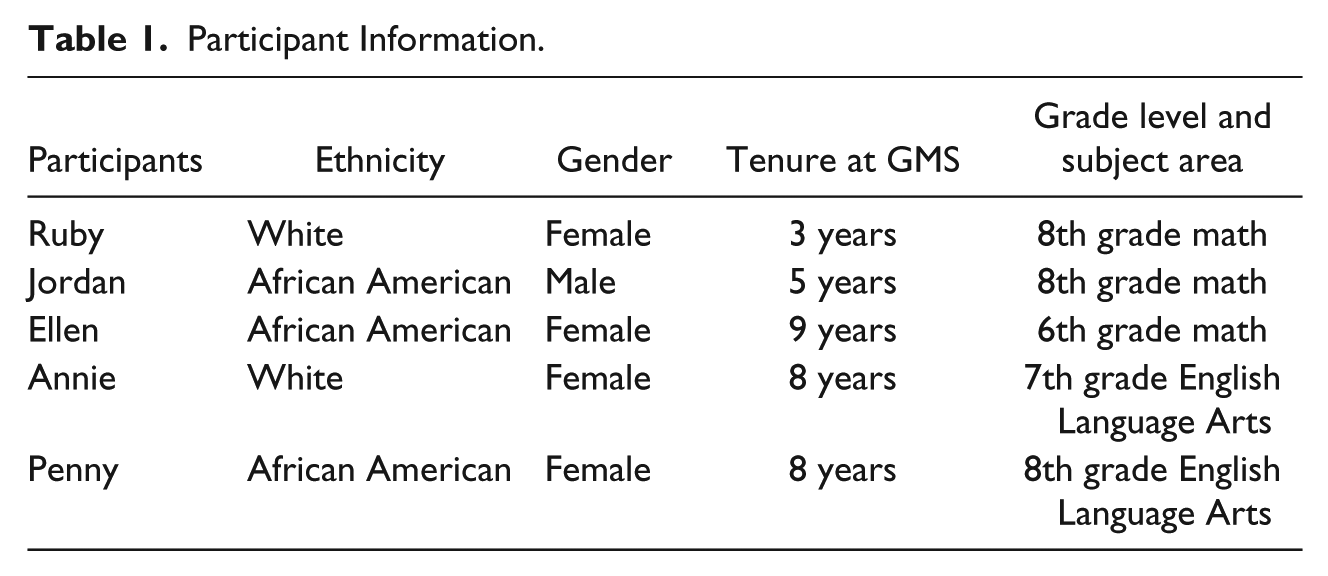
The school was unique in that, in recent years, it had lost Title I status when it became a magnet school with the hopes of expanding beyond a “neighborhood school.” At the time of the study, there were a total of six teachers in the school that met the criteria of teaching a tested subject (Math or English Language Arts) and were eligible for the incentive the previous year. Five of those teachers agreed to participate. As shown in Table 1, participants included two English Language Arts teachers and three math teachers. Information on each teacher is provided at the start of the section “Results.”
Participant Information.
Data Collection and Analysis
The school report card with information about assessment scores for the previous 4 years was analyzed and included in memo data to provide an extensive understanding of the academic achievement and context of the school. These data were used to understand achievement levels in the school during the incentive.
When developing interview questions, one qualitative research expert reviewer and one expert in the field of motivation were consulted. Based on feedback from the reviewers, the interview questions were revised to more precisely address the research questions. These questions were designed to amplify the voices and experiences of teachers in an urban school as they negotiated the expectations of the incentive program. The interviews focused on what it meant to be a teacher in a pay-for-performance (PFP) school, motivation for teaching at the school, and the perceptions of teachers regarding expectations in the school. Sample questions included (a) How has the possibility of getting extra incentive pay affected your teaching? (b) Have your views toward standardized testing changed since you began working in a PFP school? If so, how? (c) How are your specific teaching practices related to student performance? (d) What are the benefits of the PFP model? (e) What does a typical day in your classroom look like in respect to the types of tasks and activities your students participate in? All five participants were interviewed after school hours at a location of their choice. All interviews were audiorecorded while handwritten notes were taken.
In an effort to recognize emerging themes, data were transcribed, and analysis began as data were collected. In Maxwell’s (2005) discussion of validity, he asserts that interviews allow for the collection of rich data. Specifically, he stresses the importance of the use of verbatim transcripts in interview studies, opposed to notes on what the interviewer thought was important. For this reason, interviews were audiorecorded and verbatim transcripts were created and used for data analysis by both researchers. These interview data were analyzed in depth over time by the two authors, who coded these data independently, using researcher memos to organize information (Maxwell, 2005). At the conclusion of each interview, researchers conducted independent open coding of the interview. Upon analysis of initial codes, the researchers met to discuss the emerging themes of each interview and to conduct a cross-interview analysis. During this phase of the coding, nine separate topics were identified. They included (a) uses of assessment as a means for instructional planning and student feedback, (b) changing views of assessment with an increased emphasis on formative assessment, (c) views of the public regarding incentives, (d) an increased understanding of students, (e) the promotion of student agency and trust, (f) how incentives influenced participants’ personal lives, (g) how incentives influenced their teaching, (h) collaboration with peers, and (i) views toward different components of professional development.
Following this step, Miles and Huberman’s (1984) recommendations for reducing, displaying, and drawing conclusions from data, as well as Boeije’s (2002) steps toward constant comparison, were implemented. Themes were identified within single interviews as well as across participant interviews. The data reduction, display, and conclusion method allowed researchers to sort, focus, discard, and organize these data in a way to draw and verify final conclusions (Miles & Huberman, 1984). The final conclusions are explained in three major themes, each of which will be discussed in the next section.
Results
Throughout this study, teachers discussed how their participation in a PFP accountability system influenced their beliefs and instructional practices regarding assessment and instruction. Three of the major themes that emerged in this study were (a) the influence of financial incentives and related activities, (b) teachers’ shifting views toward assessment and instruction, and (c) promoting student engagement by building relationships and offering choice. To provide the reader with a sense of individual teacher’s voices as well as an understanding of their common experiences, teacher’s experiences will be presented through the lens of three major themes.
The Influence of Financial Incentives and Related Professional Development
During interviews, none of the teachers made any distinction between the two components of the incentive program (pay for participation and pay for student growth). Instead, they tended to view the incentives as one payment based on their ability to improve their teaching. Teachers had varying views of the financial incentives. Some of them felt it was beneficial and something they deserved for their hard work, while others were reluctant to say they appreciated it because of fear of how it might be perceived by the community. Ruby, an eighth grade math teacher, who was known for her success with student growth on standardized testing, hard work, and dedication to student success, was very clear about her position. She supported the incentive pay program because it increased her motivation and attitude about teaching.
I think the biggest difference is the incentive as a math teacher was so large, so financially, I was a little bit more comfortable, so I was able to do things in the classroom that I maybe wouldn’t have been able to because of [a lack of] materials and supplies. I was a little more financially secure and it made me, or that aspect of my life less stressful, which I think in turn affects your classroom in a positive way . . . being recognized for your hard work, it helps to build that motivation, and keeps you going.
Another eighth grade math teacher, Jordan, clearly supported the program because it offered financial incentives, collegial support, and professional development opportunities. In particular, he liked how the program promoted a competitive environment for teachers. The incentives and support made him more aware of what he was doing. He stated, People get paid. You deliver. You’re willing to be in the hot seat. You’re okay with pressure and all of that. You reach the goal, you get paid, and that’s why we do it . . . Working here means having access to more training, more support. Some people look at it like a strain, but I like to learn stuff, so that’s okay to me. Then, I’m able to get to know things and get monetary rewards.
Sixth grade math teacher Ellen viewed incentives as a benefit for teachers and students, and she hoped the public would not misinterpret why anyone would view incentives as important, particularly in the present context, where teachers had not received raises for several years.
More money is always a positive thing and given the recent economy and the lack of receiving an increase in our salaries for several years, the program was a bonus and made me want to attempt to work harder to get the extra money.
Incentives were a double-edged sword: The money helped her because she had not had a raise for several years, but she feared her perspective might be misinterpreted, particularly if scores increased, because the community would think that she was not already working as hard as she possibly could for her students.
The two English Language Arts participants expressed similar responses to the financial incentives. Annie discussed the need to expand the program so that all subject-area teachers could receive incentives. She did not want the extra pay to cause conflict with her peers. Like Ellen, Annie discussed how she did not want to be viewed as someone who worked harder because of the money, but she did discuss how the incentive changed her perspectives on teaching. She described herself as a hard worker before the incentive, but now believed that the incentive, coupled with the professional development opportunities, reshaped how she viewed teaching and assessment. Annie stated, “Maybe even subconsciously it is about the money, because I know that if they do well, I get extra money, then I’m making for darn sure they’re doing super well.” She believed the program helped her to analyze her teaching practices more closely. Annie viewed herself as a good teacher, but the program simply “reshaped how you look at teaching.” This reshaping came as her views of assessment and learning shifted to a student-centered approach, as she engaged in data discussions with her peers and attended professional development opportunities, where she gained more knowledge about her teaching and the learning process.
When asked about the impact of the incentive, Penny, an eighth grade English Language Arts teacher, had a slightly different stance about the financial aspect of the program. She discussed how the amount of money was not high enough to be too influential and repeatedly stated how money was not the main reason for her participation in the program. “We teach because we love teaching. We were here before it, and we’re going to be here after it.” While the financial aspect of the initiative did not drastically impact Penny, she did discuss how this initiative gave her opportunities to gain new knowledge through professional development, which changed her instructional practices.
While everyone appreciated the financial incentives, teachers cited professional development—workshops, weekly planning meetings, and data analysis days, as critical to their involvement. Financial incentives motivated teachers to work harder, as discussed by Ellen, Ruby, Annie, and Jordan, but it was not the only driving force; the driving factor, instead, professional development activities gave teachers the knowledge and support to change their assessment and instructional practices.
Teachers discussed how professional development provided a space for reflection. Ruby described how district professional development workshops “were a good opportunity to challenge your way of teaching and learning.” She credited each session with changing her perspective and practices because they provided her with strategies that she could use daily to engage her students. Similarly, Penny stated, “I had to come out of my own comfort zone. I just did literature circles and that was brand new to me, not that I hadn’t heard of it, I was just scared to do it.” These opportunities gave teachers the necessary supports to share new ideas, focus on student-centered practices, and meet the needs of individual students. This shift in practices from a teach-to-the-test with a focus on immediate results was based on the professional development under which teachers developed greater agency to try new things and share their perceptions and insights with colleagues.
Penny examined and reflected upon her needs as a teacher in choosing her professional development workshop in the third year. “I saw the need, and what I focused on was the lower level students. I also focused on black males and lower level readers.” She realized that some of her students were struggling academically and she needed support to reach their needs. “Most of my kids were on a 3rd grade level. I didn’t know how 3rd graders learned to read.” In addition, she also sought out professional development workshops to reach her advanced learners, whom she described as “stagnant in their growth.”
Annie discussed how she used workshops as an opportunity to reflect on both her needs as well as her students’.
When I get to choose my professional development, I always try to pick something that I feel like I need more work on. I felt like my use of assessment data was not—I looked at it, but I wasn’t following through with it, so that’s why I went to the conference on assessment.
She discussed how this opportunity helped her to follow through with student assessment data and to bring students into a conversation regarding their overall performances.
It changed the way I thought about teaching. . . . It’s made me more conscious about my teaching and what I’m teaching and how I’m teaching and how the students are moving. So it’s really helped me to analyze my students on a deeper level.
Annie reflected on her practices, determined what her professional needs were, and sought out support through professional development opportunities that were provided by this initiative. When able to select a professional development workshop, Ellen chose sessions to help her students with reading math problems: “I focused on reading in math sessions in order to improve my students’ reading skills because the test is a lot of word problems and reading comprehension is an area where they struggle.” She also discussed specifically seeking out professional development that would help her to focus on her low performing students. “This year my focus was on our Exceptional Children population and I did different workshops to help me with my inclusion kids. I learned different methods to address the diverse populations.”
Professional development opportunities widened teachers’ views of instruction and assessment to help them see beyond their current practices. Now, they set goals for learning by reflecting on their different practices. Professional development was an opportunity for them to seek new knowledge and to achieve goals with support from their colleagues. While financial incentives were important, teachers welcomed opportunities to improve their teaching through different professional development workshops and activities.
Shifting Views Toward Assessment: Teaching Beyond the Test!
When discussing their appreciation for professional development opportunities, it became apparent how changes in the teachers’ instructional and assessment practices became more aligned with their district’s expectations for improved student achievement. Two major differences occurred with this realignment: Teachers now looked beyond simply teaching test content to considering students’ engagement as it related to their personal and social development, and they placed more emphasis on the lowest achievers because their improved achievement now was considered with the new growth model. Ellen’s statement on how teachers and students benefited from these opportunities summarized this change. “Students are positively affected because they have teachers who have gone through professional development to make them better teachers and then they’re exposed to lots of different strategies and methods that help them attack the curriculum.”
“Data days” enhanced professional development by providing a collaborative learning community where teachers discussed and shared ideas. On these occasions, content teachers came together across grade levels: Together, they analyzed student benchmark test data and determined how they could move forward in helping students with specific standards and goals. Teachers with high scores in one area shared what they had attempted to help students achieve success and, together, they brainstormed ideas for remediating students and excelling students. During these meetings, some teachers decided to co-teach to give the students extra support. In data sessions, teachers learned effective strategies from each other and discovered more tools for engaging students. The end result of these opportunities was greater sharing and collaboration as they changed in their teaching practices.
Discussions of planning lessons and assessing students went beyond examining traditional test scores to include more formative assessment data, for example, students’ interactions with teachers and classmates as well as their interests and expectations (William, Lee, Harrison, & Black, 2004). By expanding their beliefs regarding what should be considered as assessment data, teachers put more of an emphasis on students’ engagement during daily instruction. They were less inclined to “teach to the test” and repeatedly stated the need now to “teach beyond the test.” For example, Ruby stated, I would say that there was a shift in my philosophy, where the test wasn’t necessarily the end-all-and-be-all. I still have to remember that it is just a test and there’s way more involved. You have to find the right balance and, in the end, if you teach like you’re supposed to, and you build relationships, then your test scores are going to be good anyway.
She discussed the importance of regular, informal assessments as a means for students showcasing their knowledge. She reflected, “I will say it makes you more data driven and data focused because that’s what everyone is looking at and that’s what you’re being evaluated on.” Ruby used many data sources to evaluate student learning. Activities such as culminating projects, student choice menus, and observing students during group work became the center of teachers’ attentions. Ruby stated, Students work out problems on whiteboards and share their answers. Also, having students come up to the board and work out problems and having other students partner up with someone who may be struggling. There is a teaching and learning process through each other and it’s a great way to see a student’s strong points and weaknesses. Also having students write as they’re solving problems, not just being able to write, but being able to explain their thinking, that shows huge strengths and weaknesses and their mastery of a topic.
Teachers discussed how they gained a more expansive view of learning as students’ engagement and growth became primary concerns as their practices became more student-centered. As teachers expanded their views of learning, they used observations of students’ engagement to design activities where students were given choices as to how they might showcase their knowledge. Jordan reflected on math activities he promoted in his classroom: They (students) get to choose what they will do . . . they get to work at their own pace. They have to answer the questions and they earn credit. They have choices and they start to make connections as they learn.
Similarly, Penny discussed how as an assessment, her students selected a topic to study, organized and highlighted strategies related to the topic and taught it to classmates. Through the incentive program, all participants discussed shifts in thinking and teaching practices. Annie learned to look at assessment data in new ways and believed this perspective made a difference in her instructional practices. She discussed how she admittedly felt the pressure to use more standardized testing and look at data and analyze it, but she also came to understand the importance of using a variety of assessments and understanding that assessments were “one piece of the puzzle, not the whole thing.” Engaging with students, getting to know them, and helping them grow as learners were pieces of the puzzle as well.
The district’s use of a growth model increased the likelihood of teachers receiving incentive pay because the expectation was for students to demonstrate yearly growth, even if they still were below grade-level proficiency standards. This switch in focus from a proficiency mindset to one centered on students’ growth helped teachers to look beyond their previously adopted teach-to-the-test approach to increasing achievement. Teachers, in turn, applied this emphasis to their expectations for student learning. Annie summarized this new perspective: I use the growth model [with students] so they know what they’re doing and we can chart what they’re doing. That way it’s not always “the class average is this” I know where each specific student is and what they need to help them . . . I tell my students, they’re more to me than just test scores. I feel like we’re treating them like humans and not numbers.
In addition, as Penny stated, “I push everyone . . . I’m going to push them beyond their limit because I want their best. I want them to do their best.” The district’s focus on a growth model helped teachers to understand how the need to increase test performance did not have to limit the nature of their instruction to low-performing students or to those who were close to achieving grade-level standards. “My advanced students, they’re focused on this idea that they have to pass and do well.” Annie explained her transformation by stating, My expectation is that it’s not good enough to pass, you actually have to do better, that’s very different for them. With my lower performing students, it’s the same way, they’re like “I just want to pass” and I’m like maybe you don’t pass, but you doubled your score and that’s awesome . . . I expect all of them to do well.
Similarly, Jordan explained how the setting of a higher bar caused students to set their own expectations: “They start not to look to me after a while for expectations, they start to set their own and they are high.” Instead of talking about teaching-to-the-test, teachers now emphasized the need to teach beyond the test. Ultimately, teacher’s expectations became more aligned with students and both supported district accountability goals for higher achievement for all students.
Promoting Student Engagement Through Relationships and Choice
Building relationships with students allowed teachers to develop a better understanding of their needs and interests, information that they used to design more learner-centered instructional activities. Such approaches put students first and valued student voices in the process of learning (Cholewa, Amatea, West-Olatunji, & Wright, 2012; McCombs, 2010). This supports the notion that through providing learner-centered environments, teachers can meet the needs of students as well as policy requirements. Ruby took this approach to meeting the needs of students, by first getting to know them. McHugh, Horner, Colditz, and Wallace (2013) assert that in building relationships with students, one of the most important processes is when the teacher takes “intentional actions so as to engage or connect with their students” (p. 31). In math, Ruby stated, “I try to get to know each student, about their lives, what they could bring to the table, and then what they need help with.” She then discussed the importance of “knowing where your different students stand and knowing what they’re fully capable of and then creating assignments to reach them.” Similarly, Jordan stated, “If I don’t know them, I take a while to get to know their whole story, understand their behaviors.” The importance of relationships led to greater trust and caring between teachers and students. Ellen explained, “The students have to trust you and know that you’re there to help them and then I think once that trust is established, then the kids will do just about anything for you!” Ellen summarized the connection between relationships and trust and caring by stating, I think the relationship is at the heart of everything because if I have a good relationship with my students, first of all, that means I know them well enough to adjust things to what they need so then they’re more willing to work hard for me if they believe in me in the same way I believe in them. So I think the relationship helps with teaching and learning and just being more connected with the students because the more connected you are, the better you are at knowing what their needs are and what they’re good at or need help with.
Positive relationships initially helped teachers to design engaging instructional activities because it increased their knowledge of students’ needs and interests; subsequently, it lead to greater trust and caring, thereby increasing students’ efforts to improve their learning in an effort to meet teachers’ expectations.
One example of how teachers’ attempted to engage their students was with the implementation of cooperative learning groups. Language arts teachers used cooperative learning opportunities through literature circles. Annie explained, “I do a lot of reading in groups where they read together and analyze together as a group so they can see things they didn’t see when they read it themselves.” She elaborated further, Sometimes we have interest grouping, sometimes we have ability grouping and sometimes it’s mixed so that they’re exposed to different people at different levels and everybody has the chance to be good at something. I think that’s important to help everybody have a chance to do well.
Penny used cooperative learning as a way to motivate students by having them teach each other different strategies from their class activities. She believed these activities strengthened leadership abilities. She stated, “We saw growth with them understanding the different concepts because they weren’t always receiving a lecture, and they weren’t always whole group.” Language arts and math teachers used cooperative grouping to promote their instructional goals and believed it promoted both engagement and learning for all students.
Student choice was an important factor as teachers attempted to make students more responsible for their learning and by implementing student-centered practices in the classroom. After having participated in the collaborative learning professional development opportunity, Penny explained how giving students choices for their literature circle books was a difficult shift for her, but she made this change in her practices, and it turned out well.
I had to let go, and hope for the best . . . It turned out well, but trying to get them to choose which book and which project they wanted to do and then figure out how they were going to present it, that took a lot. Some things I wanted to tell them no, but they had to make that choice.
She shared how her students enjoyed and learned from the activities when they became responsible for learning new information and sharing it with their peers. Penny made this shift because she knew from her professional development activities that cooperative learning opportunities were important in student-centered classrooms and that giving students choices and autonomy within those groups were important as well.
Jordan provided opportunities for choice through technology, and Ellen provided “choice boards” for students where they could choose how they would showcase their knowledge.
They have to choose how they want to show me they’ve mastered a topic. I try to include fun things like a poem, a rap song, or create a game or come up with some creative way to make a poster.
Instead of taking sole control of the classroom, teachers provided students with opportunities to take ownership of their learning and provided opportunities for them to learn from each other. Professional development activities provided choices for teachers, and, in turn, they allowed students to make similar types of choices in the classroom.
Discussion
The question of whether teachers can raise test scores if districts provide financial incentives oversimplifies the complexities faced by this study’s teachers as they attempted to negotiate a variety of accountability demands. Teachers welcomed additional pay, but expressed equal, if not greater, appreciation for opportunities to improve their instructional practices through professional development activities. Research suggests policy makers and teacher educators should provide generic preparation for teachers in regard to working in urban schools (Ng & Peter, 2010); however, the approach taken by this incentive is specific to diverse students, and the goals of individual teachers, as they were able to choose professional development to address their students’ needs. Such opportunities helped teachers to step outside of their comfort zones to adopt new practices; as a result, they acquired a growing appreciation for a more expansive view of learning and teaching; for the importance of building trusting, caring, and positive relationships with students; and for the need to collaborate with colleagues to increase the quality of their teaching. Instead of teaching simply to the test, as documented by Au (2007), through professional development opportunities, teachers adopted new perspectives on the instruction and assessment, which shifted their views on student learning and motivation.
Their changing practices during the PFP program was a reciprocal process, whereby teachers became more engaged as they set goals, shared progress with colleagues, and interacted with students on a more individualist and personal manner. Their engagement was sustained because they had continuous opportunities to act autonomously with high levels of support from both school- and district-level support systems. Such engagement provided insights regarding the connotation of the phrase working harder. In this reform effort, working harder related to the adoption of assessment and instructional practices rather than to simply putting in more hours. In fact, teachers did not have any time in their days to work harder because they already came to school early, stayed until early evening, and planned on weekends.
Instead, working harder mainly referred to the conditions under which the PFP program promoted greater teacher expertise. First, the availability of financial incentives lessened teachers’ tensions about having enough money to meet daily costs, particularly as they related to family expenses. Without these tensions, teachers believed that they were less frustrated and worried as they went about their daily practices. Second, teachers collaborated frequently with colleagues around the setting of instructional goals and developing activities to meet them. Such collaboration led to greater teacher and student engagement and further aligned their daily activities with the district’s goals for higher achievement. Third, teachers no longer operated under a proficiency model for accountability: Instead, teachers received rewards for growth, even if students failed to reach grade-level standards. Instead of becoming disheartened by lack of students’ readiness, the growth model increased teachers’ commitment to all students. Each of these factors, alone or interactively, underscores the potential for teachers to adopt more student-centered practices throughout when they receive adequate supports and encouragement. Increases in both students’ achievement and teacher retention data support the potential for such changes to positively influence the expected outcome measures.
Such changes also affected the nature of how teachers communicated with students in regard to their achievement, in that participants discussed how they now brought students into the conversation regarding their performance as teachers talked to them about setting goals, gave them choices as to how they might demonstrate their understanding, and offered them more frequent opportunities to collaborate with classmates. Such changes are recommended by various researchers (Comer, 2010; Delpit, 2012; McCombs, 2010; Ravitch, 2010; Wells & Claxton, 2002) as a way to promote 21st century goals in the classroom.
Our findings challenge the simplistic expectancy theory (Vroom, 1964), which was referenced in prior studies of the influence of financial incentives on students’ test performances. With this theory, as stated earlier, if teachers lacked commitment, the fault related to a lack of efficiency or communication. No evidence was found in this study for either of these two conditions. If future reform efforts continue to use financial rewards and professional development activities to promote higher achievement, we believe a more multidimensional motivation theory might be more appropriate.
Such a theory needs to move beyond concerns of efficiency and communication to identify the conditions under which teachers would become more agentic as they develop necessary expertise. Self-determination theory (Deci & Ryan, 1985), whereby learners, in this case, both teachers and students, become more engaged when they have opportunities to improve their competencies, act autonomously, and develop relationships with others or self-regulation models with strong motivational components (Patrick & Ryan, 2005; Wolters, Pintrich, & Karabenick, 2005) would be likely candidates. Otherwise, educators might limit student learning by continuing to underestimate the benefits of engaging teachers as the primary actors in a reform effort (Hoffman & Duffy, 2016; Vaughn, Parsons, Gallagher, & Branen, 2016).
The main implication of our findings relates to how the potential negative effects of an incentive program were mollified by administrators’ call for teacher autonomy and collaboration. We believe it is a misnomer to label PFP as a primary influence because too many other avenues existed for teachers to develop expertise. Instead of adopting those traditional practices of many high-stakes reform efforts (Au, 2007; Baker et al., 2010; Kelley & Protsik, 1997; Misco, 2008), this program offers a viable instructional alternative to such one-size-fits-all models by encouraging teachers to actively adapt their instruction based on their growing knowledge of students (Hoffman & Duffy, 2016).
Throughout this study, we, as researchers, questioned the district’s decision to develop this program because previous reform efforts focused more on issues of teachers’ fidelity to implement lessons developed by central administration, accompanied with pacing guides, which specified what topics to cover and the amount of time allocated to each one. Teachers now had choices as to how they would approach instructional goals; they were asked to modify their instruction based on students’ reactions; they selected workshops to further their professional knowledge; and they received sizable increases in salary for their participation.
Further research might look at situations where teachers just received professional development without financial incentives to understand the multiple influences of this reform effort on teachers’ beliefs and practices. As stated earlier, our teachers did not mention this distinction. Additional studies might also try to look at reform efforts where the financial efforts are based solely on merit or participation. As stated earlier, none of the teachers in our study mentioned how the two components of this project—an incentive for participation and one for merit—influenced their instruction. Instead, their references to incentives were singular in focus, in that teachers wanted to receive both rewards. Finally, we did not interview building- or district-level administrators and believe their perspectives could help to understand more fully the rationales for such actions.
In summary, despite the limitations of using only interviews at one site, this reform included many components, which singularly and in combination allowed teachers to develop greater expertise and agency in their efforts to better understand their students’ interests and needs. Test scores and retention data supported administrators’ initial rationale for seeking external funding to support this endeavor. Unfortunately, this effort ended the year after this study when the funding stopped. Regardless, it provides important insights into the need for educators to consider how they combine financial incentives with opportunities to improve teachers’ professional development when designing reforms.
Footnotes
Declaration of Conflicting Interests
The author(s) declared no potential conflicts of interest with respect to the research, authorship, and/or publication of this article.
Funding
The author(s) received no financial support for the research, authorship, and/or publication of this article.