




Abstract
Recognizing the pressing problem of low teacher retention in urban schools, this qualitative study explores how two post-baccalaureate teacher education programs at the same university prepare candidates to persist in the profession. Through data analysis, it became clear that graduates of the Urban Teacher Residency program approached their students with an asset-based perspective, whereas graduates of the Master’s of Science in Teaching program often used deficit language to describe their students. We explore potential reasons for these varying approaches and consider how these perceptions relate to persistence. We conclude with recommendations for program design and delivery that emphasize asset-based approaches.
Keywords
The significance of teacher turnover and the related difficulty in staffing urban schools has gained increasing attention in both scholarly research (Ingersoll, 2001, 2003; Ingersoll & Smith, 2003) and media reports (Barnwell, 2015; Moir, 2014; Rich, 2015). In fact, rates of leaving for first-year teachers grew from 9.8% in 1998 to 13.1% in 2008 (Ingersoll, Merrill, & Stuckey, 2014). Although researchers have investigated the connection between student demographics and teacher attrition (Hanushek, Kain, & Rivkin, 2004; Scafidi, Sjoquist, & Stinebrickner, 2007), as well as working conditions and teacher attrition (Boyd et al., 2011; Hughes, 2012; Loeb, Darling-Hammond, & Luczak, 2005; Simon & Johnson, 2015), few studies have considered what impact teacher preparation programs may have on encouraging teachers to remain in the profession. Moreover, as Howard and Milner (2013) point out, “the literature regarding teacher preparation/education and urban education is not well developed” (p. 199). This case study, situated at a midsize state university, adds to the current conversation about teacher persistence and urban teacher preparation by examining two different initial teacher certification programs offered at the university’s College of Education and considering their impact on teachers who persist into their fourth year in urban schools.
This study aimed to identify fourth-year teachers in urban schools who graduated from one of the university’s two post-baccalaureate teacher education programs in 2011. These programs included a Master’s of Science in Teaching (MST) program, a 1-year pathway to certification, and an Urban Teacher Residency (UTR) program, a 2-year program that led to a Master’s of Education in Teacher Leadership funded by a U.S. Department of Education Teacher Quality Partnership grant. We sought to examine which, if any, elements of their preparation pathways helped new teachers in each program persist in the profession. While locating and recruiting graduates proved challenging, the study enrolled seven participants. As data were analyzed to identify general programmatic factors that contributed to persistence, we noted specific differences in the ways in which graduates of two of the programs approached their students. In particular, we found that graduates of the “urban cohort” of the MST program often spoke about their students from a deficit-based perspective. In contrast, graduates of the UTR program took a more asset-based approach. Therefore, a second research question emerged: What differences, if any, between the MST and UTR programs could account for the different stances their graduates take toward students in urban districts?
This article begins by defining key terms and proceeds to a review of literature that addresses teacher retention, particularly as it relates to different elements of teacher preparation programs. From there, we outline our conceptual focus, describing what an asset-based approach to teaching should look like and why it is important to share this approach with pre-service teachers as they prepare to work in urban schools. Next, we discuss the research context, specifically the differences between the MST and UTR programs, as well as the research methods employed in this study. Finally, we share our findings in detail, identifying programmatic features that fourth-year teachers cited as the most impactful elements of their preparation, as well as describing differences in how MST and UTR graduates perceive their students. Potential reasons for—and implications of—these different program outcomes are taken up in the conclusion of the article.
Definitions
Given the various ways that “urban” has been used pejoratively in popular discourse and even in educational literature, often as shorthand for schools that struggle academically or that serve primarily marginalized student populations, it is important to note upfront that this study draws on Milner’s (2012) evolving typology to define “urban education.” We use the term “urban” to encompass all three categories in Milner’s (2012) typology, including urban intensive, urban emergent, and urban characteristic. Given the geography of the state in which this study occurred, many program graduates work in “urban characteristic” settings, teaching in schools that are not located in big cities but “are beginning to experience increases in challenges that are sometimes associated with urban contexts,” including lack of economic resources, low academic achievement, and increasing numbers of English-language learners (Milner, 2012, p. 560). We used the Teacher Cancellation Low-Income (TCLI) index, which designates low-income schools for federal loan forgiveness programs, to determine whether a school qualified as urban in the broadest sense that Milner describes. This is the measure used by the UTR program to determine eligible placements for students after graduation.
We characterize teachers who remain in the profession into their fourth year as “persistent.” In general, research that addresses teacher turnover explores the issue in terms of attrition (when teachers choose to leave the profession entirely) or migration (when teachers move to different schools; Ingersoll, 2001). However, in this study, we focus on teachers who choose to remain in urban schools—often despite a variety of institutional obstacles (e.g., low pay, lack of administrative support, etc.)—and, therefore, we frame their decision to stay as a matter of persistence. We use 4 years as a measure of persistence because research demonstrates that the highest attrition rates occur during the first years of teaching (Guarino, Santibañez, & Daley, 2006; Hughes, 2012; Ingersoll & Smith, 2003).
It is important to note that we did not require participants to teach at the same urban school for all 4 years. For the teachers in this study, movement between schools or districts was the result of administrative-level decision-making and not reflective of the teachers’ desire to continue teaching in an urban setting. Of the seven teachers we interviewed, four were teaching in the schools in which they were originally hired. Of the remaining three, two were transferred within their district due to staffing changes imposed by administrators, and one moved to another urban district after he was laid off in the urban district in which he was first hired (he cited low school-wide test scores as the reason for layoffs). In all three of these cases, the teachers expressed a commitment to remaining in an urban setting, despite the unpredictability of their placements from year to year.
Finally, we also chose 4 years as a measure of persistence because the UTR participants in the study were contractually required to remain in an urban school for 3 years; thus, the decision to stay into their fourth year represents more of an independent choice for UTR graduates. We acknowledge a potential limitation of our study is that the UTR program offered a strong financial incentive for persistence in the form of a US$30,000 stipend that would have to be repaid if graduates did not remain in an approved school for 3 years. However, we address this limitation by recruiting participants who remained in their districts beyond the time frame that financial incentives would compel them to stay.
Literature Review
While some degree of teacher turnover is natural and even healthy, high rates of teacher attrition may have a negative impact on schools (Ingersoll, 2003). For instance, teacher turnover can hinder the continuity of instruction (Loeb et al., 2005), result in more inexperienced and, thus, less effective teachers in classrooms (Rockoff, 2004), and take away from the overall organizational stability of schools (Ingersoll, 2001; Ronfeldt, Loeb, & Wyckoff, 2013). For these reasons, it is of concern that researchers have documented high rates of teacher attrition, particularly in schools with large percentages of low-income and minority students (Borman & Dowling, 2015).
Although researchers have investigated the connection between student demographics and teacher attrition (Hanushek et al., 2004; Scafidi et al., 2007), as well as working conditions and teacher attrition (Boyd et al., 2011; Hughes, 2012; Loeb et al., 2005; Simon & Johnson, 2015), few researchers have considered what impact teacher preparation programs may have on encouraging teachers to remain in the profession. That said, there are some studies that explore the retention rates of graduates of specific programs, and these studies provide insights regarding which aspects of teacher preparation contribute to persistence. In particular, researchers have identified the following elements as being particularly helpful: field experiences closely linked to academic course work, strong professional networks, and a recruitment process that screens for a commitment to urban education.
Field Experiences Linked to Course Work
Some studies have found a connection between engaging pre-service teachers in academically grounded fieldwork and their later persistence in urban schools. For example, Freedman and Appleman (2008, 2009) follow graduates of the University of California at Berkeley’s Multicultural Urban and Secondary English (MUSE) program, to determine which elements of this credential and master’s program contribute to retention in urban schools. The researchers track one cohort of 26 teachers through their first 5 years of teaching. They find that after 1 year, 96% were still teaching in urban, high-needs settings, and after 5 years, 69% of program graduates remained in urban, high-needs schools. The researchers argue that one key feature of Project MUSE is the opportunity it provides for candidates to engage in practice in the field, receive feedback on their practice, and then reflect on that feedback through their course work. Through this process, candidates are able to develop their teacher identities in a supportive environment.
Researchers have also examined Center X, an urban teacher preparation program at the University of California at Los Angeles, whose graduates have higher-than-average retention rates in urban schools. Quartz and the TEP Research Group (2003) collected data from more than 300 graduates of the program and report that after 5 years, 70% of Center X graduates remain in high-needs classroom settings. The study highlights programmatic elements that contribute to retention, including an academic focus on building on the strengths of urban communities and preparing candidates to become “change agents.” In a qualitative study of 15 Center X graduates, Olsen and Anderson (2007) suggest that high retention rates may reflect the Center’s emphasis on helping secure placements in schools where the graduates’ ideals and practical training mesh with the schools’ pedagogical approaches. The Center is able to make these matches because they have ample opportunity to observe pre-service teachers in the field. Moreover, some faculty advisors are current or former administrators at partner schools; as such, they are able to provide insights and guidance tailored to the needs of particular schools.
In a study exploring beginning teachers’ orientations toward socially just teaching, Whipp (2013) finds that pre-service teachers who engaged in critical course work—in addition to their fieldwork—were more likely to challenge deficit-oriented perspectives about students in urban schools during their first year of teaching. While this research did not explore the persistence of the teachers beyond their initial year, the study argues that beginning teachers who appreciated the social justice orientation of their teacher preparation program were more likely to engage in culturally responsive teaching practices. Quartz and the TEP Research Group (2003) contend that culturally responsive teachers are more likely to persist in the profession because they do not blame their students for challenges they encounter in their classrooms; rather, they are more likely to consider ways to improve their own practice and, thus, experience a greater sense of agency, which, in turn, may lead to more longevity in urban schools. On a related note, Brown (2004) asserts that novice teachers with a theoretical grounding in culturally responsive pedagogy are more likely to implement effective classroom management strategies, which also contributes to their persistence in urban schools.
Professional Networks
In addition to citing the importance of field experiences linked with course work, researchers have also emphasized the role of strong professional networks in teachers’ ability to persist in urban schools. Freedman and Appleman (2008) argue that the use of a cohort model in teacher preparation programs creates “a space for teachers with different backgrounds, levels of experience, and professional stances to support one another, both during the program and in the ensuing years” (p. 122).
Research investigating the impact that UTR programs have on teacher retention has also emphasized the importance of helping teacher candidates to develop professional networks. In a study of UTR programs in Chicago and Boston, Berry, Montgomery, Curtis, Hernandez, and Wurtzel (2008) report that after 3 years, 90% of Boston UTR graduates remain in the field, and 95% of Chicago UTR graduates are still teaching. The authors argue that these high-retention rates can be attributed, in part, to the ongoing support provided through the program, as participants work closely with “mentors, principals, university professors, university liaisons, and UTR staff members” (Berry et al., 2008, p. 18). Likewise, Solomon (2009) describes the Boston teacher residency program and argues that the cohort model contributes to its success by helping teachers develop a variety of supportive communities that remain beyond graduation.
Selective Recruitment
Researchers have also noted the importance of focused recruitment and admissions, and they report higher rates of persistence in candidates who reflect the diversity of the students they teach and who have an expressed interest in urban education (Berry et al., 2008; Freedman & Appleman, 2008; Quartz & the TEP Research Group, 2003; Solomon, 2009). In fact, in studies of graduates from an urban-focused teacher education program, Taylor and Frankenberg (2009) and Frankenberg, Taylor, and Merseth (2010) find that the candidates’ initial commitment to teaching in urban schools is the most important factor in predicting which graduates will choose to work there after graduation. Likewise, Stotko, Ingram, and Beaty-O’Ferrall (2007) argue that urban school districts would retain more teachers if they screened candidates for particular dispositions, including “tenacity, flexibility, a sense of efficacy, and a belief in students’ abilities to achieve high levels of academic performance” (p. 48).
In sum, the limited results suggest that graduates of teacher education programs are more likely to remain in urban schools when they have field experiences closely linked to their academic course work, develop strong professional networks, and exhibit a commitment to urban education from the start. The findings from this study support these claims while also highlighting the value of providing opportunities for pre-service teachers to develop asset-based perspectives regarding students in urban schools.
Conceptual Focus
In their review of the literature about teacher recruitment and retention, Guarino et al. (2006) note that few studies consider the connection between retention and teacher quality or effectiveness. In part, the authors argue this lack of research can be attributed to the difficulty in establishing a clear definition of “teacher quality.” While this article does not aim to create such a definition, we do argue that one important attribute of effective teachers is that they hold an asset-based perspective of their students. Indeed, researchers have noted the pervasiveness of deficit-based perspectives among teachers of low-income and minority students, and they argue that these beliefs make it difficult for teachers to maintain high expectations and shape instruction that values their students’ backgrounds (Paris & Alim, 2014; Ullucci & Howard, 2015). Moreover, scholars who draw on different theoretical frameworks have highlighted the importance of asset-based approaches to working with marginalized students and their families. This study draws on some of these frameworks to paint a clear picture of what an asset-based approach to teaching entails.
To start, this study draws on the work of scholars such as Yosso (2005) who uses the lens of Critical Race Theory to critique deficit-thinking and traditional interpretations of cultural capital that devalue forms of capital that exist in marginalized communities. Yosso explains that deficit-thinking occurs when teachers and other school officials blame any poor academic performance of minority students on their background, specifically parents/guardians who do not value school and do not adequately prepare their children to succeed. In outlining a new theory of Community Cultural Wealth, Yosso identifies forms of cultural capital “that marginalized groups bring to the table that traditional cultural capital theory does not recognize,” which include aspirational, linguistic, familial, social, navigational, and resistant capital (p. 77). In this way, Yosso explains that minority students and their families can draw on their own culture as a means of empowerment.
This study is also informed by culturally responsive pedagogy. Because our research focuses on teacher perceptions rather than their practices, we draw on aspects of culturally responsive pedagogy that emphasize the importance of teachers’ beliefs about their students. In particular, proponents of culturally responsive pedagogy stress the importance of recognizing the strengths that students bring with them to the classroom. For instance, Ladson-Billings (1995) argues that teachers who employ culturally relevant pedagogy believe that all students can succeed academically. Describing teachers who employ culturally relevant pedagogy, Ladson-Billings found that “absent from their discourse about students was the ‘language of lacking’ . . . Instead, teachers talked about their own shortcomings and limitations and ways they need to change to ensure student success” (p. 479).
Other scholarship on culturally relevant pedagogy has also emphasized the necessity of holding positive perceptions of one’s students. In articulating a conceptual framework of culturally relevant pedagogy based on recent literature, Brown-Jeffy and Cooper (2011) stress that effective instruction must value students’ own cultural and social capital. Similarly, Villegas and Lucas (2002) outline six characteristics that culturally responsive teachers must possess, one of which is “an affirming attitude toward students from culturally diverse backgrounds” (p. 23). Villegas and Lucas argue that teachers must view their role as building on the multiple strengths that students bring with them to the classroom. Moreover, as Howard (2003) notes, culturally relevant pedagogy provides a way to increase the academic achievement of low-income and minority students, in part, by disrupting the deficit-perspectives of pre-service teachers through engaging them in critical reflection about their beliefs and perceptions. Paris and Alim (2014) take these arguments a step further, arguing in favor of a culturally sustaining pedagogy—that is, an approach that values both the complexities and contributions of various demographic groups, with the recognition that developing all students’ cultural competence is necessary to ensure their success in society.
Thus, as this article examines the connection between persistence and two different teacher preparation programs, it also considers how each program prepared—or failed to prepare—candidates to take an asset-based perspective toward their students. Drawing on literature from a variety of theoretical frameworks, this article defines an asset-based perspective as one that values the myriad of resources that students bring with them and encourages pre-service teachers to question their own biases about the populations with whom they work.
Research Context and Method
Research Questions
For this case study of two preparation programs, we relied on qualitative methods—including interviews of alumni, faculty, and staff, as well as document analysis of program guides and grant evaluations—to explore the following research question: What elements, if any, of their preparation programs do fourth-year teachers in urban schools identify as helping them persist in their profession? As data analysis was conducted, a clear pattern emerged wherein MST graduates discuss their students from a deficit perspective, and the UTR graduates take a more asset-based approach (described in detail below). Therefore, a second research question was developed during our cross-case analysis: What differences between the MST and UTR programs account for these different stances? Before describing the methods employed in this study, it is necessary to discuss the two preparation programs in more detail.
Program Overviews
Offered at the same university, both the MST and UTR pathways are full-time post-baccalaureate programs that provide the opportunity to earn state certification in elementary or secondary teaching and a master’s degree simultaneously. While the nuances of the two programs are described below, a few key differences are helpful to mention before proceeding. First, in 2011, the MST program was well-established, with 40 students enrolled in the elementary and secondary education tracks. However, the UTR program was in its pilot year and enrolled five students (the target number of students as outlined in the grant proposal). In addition to earning certification in elementary or secondary education, UTR graduates also received certification in English as a Second Language (ESL). Potential UTR applicants were selectively recruited, as one of the goals detailed in the grant proposal was to enroll underrepresented and academically motivated candidates who demonstrated a commitment to teaching in urban areas. In fact, to receive a stipend of US$30,000 during their residency year, UTR candidates had to sign an agreement to teach in an urban school for 3 years after completion of the program.
Although the MST program in general did not have a specific focus on preparing teachers for urban schools, during 2011, the MST program expanded to include two cohorts: one at the main campus (the “main campus cohort”), and one at a branch of the campus in a nearby city (the “urban cohort”). According to a 2011 MST program administrator, this urban cohort was created to increase the size of the program, extend the university’s presence on its nearby urban campus, and to begin more outreach to urban schools (Interview, July 29, 2015). This study focuses on the MST urban cohort, as—similar to the UTR program—one of its goals was to prepare students to work in urban schools.
While the MST and UTR programs had some similar objectives, there were logistical differences between them. The MST program took 13 months to complete and included 36 semester hr of course work. Students generally took all of their classes with the other students in their cohort. In addition to course work, the candidates enrolled in 2 semesters of clinical internships (student teaching). During the fall semester, candidates spent 3 days per week in the field and took on limited teaching responsibilities; during the spring semester, candidates worked 5 days per week in the field and took over full-time teaching duties in their classrooms. As part of the urban cohort, candidates were placed in schools in the city or in other nearby high-needs districts. The urban cohort only existed for 1 year and was discontinued for reasons unknown to the program administrator (Interview, July 29, 2015).
The UTR program was an initiative funded by the Teacher Quality Partnership Grant that—like the MST urban cohort—was initially offered at the university in 2010-2011. However, unlike the MST urban cohort, this program continued to be offered through 2014, when the grant funding concluded. The UTR program took 18 months to complete and included 34 semester hr of course work for a Master’s of Education in Teacher Leadership. As part of their course load, the UTR candidates were required to take a series of classes in ESL to receive additional certification in that area. UTR candidates also took eight noncredit modules to satisfy licensure requirements. Like the MST program, there were 2 semesters of student teaching. However, candidates spent 4 days per week in the field, during both the fall and spring semesters. As noted above, UTR candidates received a stipend of US$30,000 during their teaching residency. For more details about each program and a side-by-side comparison, see Table 1.
Program Characteristics.

Note. MST = Master’s in the Science of Teaching; UTR = Urban Teacher Residency; ESL = English as a Second Language; MEd = Master’s of Education.
Required ESL course.
Required MEd core course.
Participants
First, it is important to note our positions as the researchers in this study. As a faculty member and the dean of the College of Education, we had some familiarity with the programs under review, though neither of us was employed at the university during 2011 and, therefore, did not personally know any of the graduates of the two programs. Thus, we followed standard university protocol to obtain the names of alumni to identify potential participants. First, we submitted a request to the university’s Office of Institutional Effectiveness for a list of 2011 MST and UTR graduates, and then we cross-checked these names against a list of current teachers supplied by the state department of education. Using the Teacher Cancellation Low-Income (TCLI) index, we narrowed our original list of 45 graduates to 21 teachers who were currently working in urban schools. From there, we contacted the Division of University Advancement, again with a standard data request form, to obtain the most up-to-date contact information for these graduates. In cases where this information still was not current, we conducted Internet searches to find phone numbers or e-mail addresses. We recruited participants via e-mail and phone calls and offered a US$25 gift card for participation in the study. We interviewed eight teachers total: three UTR graduates, four MST graduates from the urban cohort, and one MST graduate from the main campus cohort. Only data from the UTR graduates and MST urban cohort graduates are included in this article. For specific details regarding participants, including race/ethnicity, gender, and age range, see Table 2.
Program Graduate Interview Participants.

Note. UTR = Urban Teacher Residency; MST = Master’s in the Science of Teaching.
Participating teachers were each interviewed once, and most interviews ranged from 20 min to 1 hr. Each interview was conducted by a graduate assistant at a location chosen by the participant for his or her convenience. Interviews were semistructured and consisted of questions asking participants to describe why they became teachers and now remain in the field. In addition, participants were asked to identify elements of their preparation programs that they found particularly useful (for the complete interview protocol, see the appendix). The graduate assistants who conducted the interviews then completed verbatim transcriptions, which they shared (along with the original audio files) with the researchers.
The lead author also interviewed both MST and UTR faculty and staff to gather their perspectives regarding the overall strengths and weaknesses of each preparation program. For specific details regarding faculty and staff participants, see Table 3.
Faculty and Staff Interview Participants.
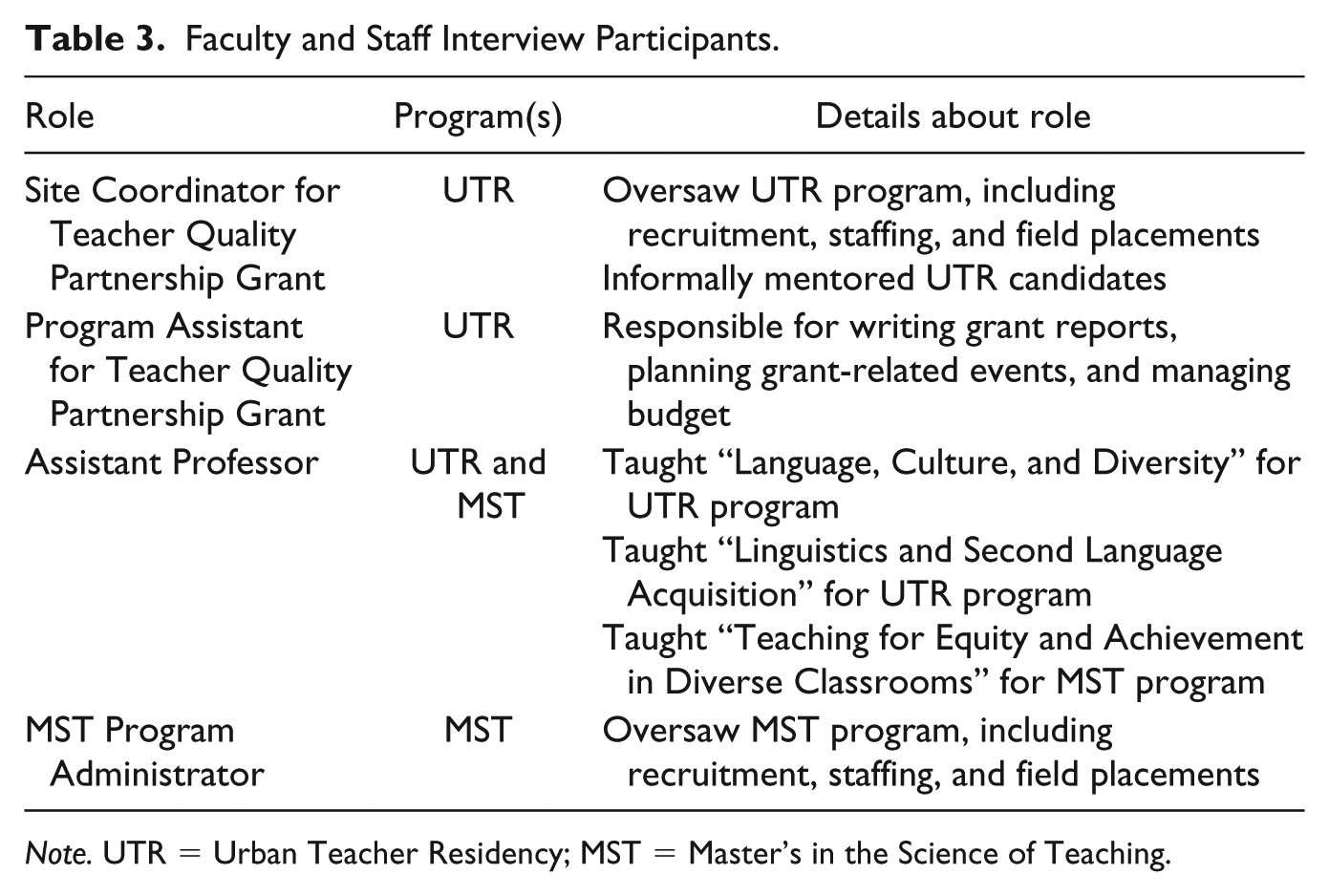
Note. UTR = Urban Teacher Residency; MST = Master’s in the Science of Teaching.
While it certainly would have been helpful to speak with a larger number of faculty to learn more about their approaches to teaching and their perspectives of the programs, this proved difficult, as many of the instructors were adjuncts who are no longer with the university. Despite this limitation, we were able to speak with one tenure-track professor who taught in both the UTR and MST program during 2011. This professor was mentioned by both UTR and MST graduates during interviews as being instrumental in their success as classroom teachers. Moreover, because she taught “Language, Culture, and Diversity” for the UTR program and “Teaching for Equity and Achievement in Diverse Classrooms” for the MST program, she was able to discuss how a core course in each program addressed teaching marginalized students.
Analysis
We analyzed the two cases by first reading these data and identifying initial themes in participants’ responses—both within and across the two programs—and we grouped these themes into categories (Creswell, 1998). These five major categories included most helpful elements of preparation programs, least helpful elements of preparation programs, personal factors that contribute to persistence, school factors that contribute to persistence, and examples of deficit language. Following this stage of aggregation, we refined our categories into specific codes that were applied in two rounds of coding (Hamersley & Atkinson, 1995; Maxwell, 2005).
We relied on a process of collaborative coding, following a procedure detailed by Smagorinsky (2008), in which the first author employed a graduate student as a second coder. We discussed the codes and definitions in detail, and then we coded these data independently. After our individual coding was complete, we met again, going through the interview transcripts segment by segment to come to agreement on how each portion should be coded. Instances where we disagreed on relevant codes provided the impetus to scrutinize our data in relation to the categories we developed, talking through nuances of both participants’ statements and our various codes.
We triangulated our results by consulting additional sources to further investigate participants’ descriptions of their programs. We interviewed faculty and staff from each program, consulted program guides, and in the case of the UTR program, drew on program artifacts, such as the grant application, all the annual reviews conducted by external grant evaluators, and other program materials (e.g., communication documents, website, etc.). Even with efforts to validate our data, there are still limitations to our study. Recruiting participants proved to be exceptionally difficult, as contact information was frequently outdated or potential participants did not respond to requests for interviews. In this respect, our sample size is limited, and one important implication of this study, which we discuss below, is the need for better systems to track program graduates.
Another potential limitation stems from our roles at the university. Certainly, as a faculty member and the dean of the College of Education, we are invested in the success of our programs. However, we believe that our programs can only be successful if we are willing to review our work through a critical lens. Moreover, the programs under study were developed before our (relatively recent) arrivals at the university. While our newcomer status meant that we had to consult a variety of resources to understand the dimensions of each program, it also means that we are exploring programs that we did not develop, giving us a degree of emotional distance.
Findings
The data demonstrate many similarities in how the fourth-year teachers explain their persistence in urban schools. This section begins by reviewing shared elements of the UTR and MST programs that the teachers cited as most impactful to their teaching practice. While aspects of the two programs were the same, the graduates’ perceptions of their students in urban schools demonstrate a marked contrast according to preparation pathway. Thus, the second half of the section “Findings” uses data to illustrate these viewpoints and explores differences between the two programs that may account for these differing perspectives.
Similar Programmatic Elements That Contribute to Teacher Persistence
In reviewing these data, we identified four aspects of the preparation programs that the teachers in both programs found particularly significant in preparing them to teach—and persist in teaching—in urban schools, including the length and quality of field experiences, the cohort model, their professors and course work, and the rigor of the programs. This section explores these factors in more detail.
Length and quality of field experiences
All three UTR graduates discussed the value of their field experiences. While they each praised their collaborating teachers, they spoke in even greater detail about how the year-long duration of their residency allowed them to develop as teachers. For instance, Maurice (all names are pseudonyms) appreciated that he could make immediate connections between course work and his teaching: “You know, I learned something on a Monday, hey, next Monday, I’m trying it” (Interview, March 16, 2015). Theresa also cited the year-long residency as “the most important” element of her preparation, noting that the UTRs “were part of those schools that we were in, and therefore we realized that it wasn’t as easy as you might think . . . you learn the ins and outs of being in a school” (Interview, February 7, 2015).
The MST graduates also discussed the value of their field experiences; for example, Kevin appreciated how his cooperating teacher helped him learn to create “a student-centered environment” (Interview, February 15, 2015). Likewise, Suzanne found “the most valuable aspect [of the program] was the fact that we were in the classroom so much.” She argued that the experience of spending an entire year in the field equipped her to deal with the “overwhelming” nature of her first year of teaching (Interview, March 17, 2015).
Cohort model
All of the teachers interviewed cited their program cohort as a particularly helpful source of support during and after their studies. In both the UTR and MST programs, the candidates took the majority of their face-to-face classes with the same group of students (their “cohort”). The graduates discussed the value in “having colleagues to lean on” (Theresa, UTR, Interview, February 7, 2015) or people to call “when you’re ready to give up” (Anita, UTR, Interview, December 10, 2014). In addition to gaining moral support from their cohort, the candidates looked to their peers for help with course work. Robert, an MST student, explained that when he or his peers were “lost” with an assignment, they “would network and just work things out together” (Interview, March 21, 2015). Even 4 years after the program, the teachers discussed keeping in touch with other graduates from their cohort. For UTR graduates, there are formal meetings organized by the grant coordinator at the university that take place once or twice a year. Maurice explained that these get-togethers help the graduates in terms of “keeping up with each other, and . . . putting all these ideas together to find out what works” (Interview, March 16, 2015). While the MST graduates do not have formal meetings, Kevin explained that he still communicates with many of his peers, often asking, “‘Oh, what would you do for this lesson?’ And, or, ‘How would you approach this?’” (Interview, February 15, 2015).
Professors and course work
Six out of the seven teachers interviewed cited their professors and course work as valuable elements of their preparation programs. UTR and MST graduates discussed specific professors whom they found “helpful” and “supportive” (Robert, MST, Interview, March 21, 2015), and whom “I probably couldn’t have got through the program without” (Maurice, UTR, Interview, March 16, 2015). These graduates described receiving assistance from professors in terms of navigating relationships in the field, developing lesson and unit plans, and securing employment after graduation.
Across both programs, graduates specifically noted the value of working with professors who spent time in urban settings. For example, Maurice (UTR) and Robert (MST) described working with the same professor-in-residence at the school where they both student-taught; this professor encouraged them to engage in interactive science activities with students, and he was available to provide daily support. As Robert explained, this professor modeled biology lessons that the classroom teachers were reluctant to enact, as the teachers “were too busy” to incorporate hands-on activities (Interview, March 21, 2015). Similarly, both Theresa (UTR) and Aimee (MST) described courses they took with an assistant professor (who was interviewed for this study) who taught classes in ESL and diversity. Specifically, Theresa appreciated that this professor had prior experience as an ESL teacher, and Aimee noted it was helpful to learn from someone who “practiced what she preached” in terms of delivering lessons designed to challenge and engage all members of the class (Interview, February 4, 2015). In all of these examples, the professors modeled what rigorous instruction could and should look like in an urban environment.
Rigor
Four of the seven teachers interviewed cited the rigor of their preparation programs as contributing to the success they later experienced in their classrooms. All three of the UTR graduates emphasized how the challenges they faced as students at the university prepared them for the challenges they would encounter as full-time teachers. Anita explained, “Any new thing that was thrown at me [at my school] wasn’t a shock to me. I’m like, I kind of knew [it already]” (Interview, December 10, 2014). Similarly, Maurice found that “the trials and tribulations of the program early on, and the late nights, staying up ‘til three getting lessons done” helped him feel “ready to go” when he stepped into his classroom (Interview, March 16, 2015). Theresa summed up these sentiments, noting, “What made . . . or broke us [was] we were able to very quickly, in this 18-month period acquire many different skills” (Interview, February 7, 2015). In the MST program, Aimee also found the program to be “intensive” and argued that “the fact that everything was more accelerated . . . was really beneficial” in that it kept her engaged and challenged (Interview, February 4, 2015).
In sum, graduates of both programs described a variety of elements that they believe contributed to their ability to persist in the urban schools where they are employed. Although not without their critiques, the majority of the teachers interviewed valued the length and quality of their field experiences, the support they received from their cohort, specific professors or courses that provided necessary knowledge and skills, and the rigorous nature of the programs.
Different Programmatic Elements That Contribute to Teacher Perspectives
One striking difference between the UTR and MST graduates emerged from these data. The MST graduates all discuss their students from a deficit perspective, detailing the perceived problems their students bring to school with them or the lack of the support they may have in their homes. In contrast, the UTR graduates generally describe their students using more asset-based language. Thus, this section first presents data to illustrate these opposing perspectives. From there, this section considers what differences between the programs contribute to the dissimilar approaches their graduates take toward their students.
Deficit- versus asset-based perspectives
Many of the comments of the MST graduates illustrated deficit approaches toward the students with whom they work in urban schools. For example, in discussing his student-teaching experience, Robert explained that he did not want a placement in “some cushy, suburb,” preferring to be “on the front lines . . . [to] see how hard it really can be” in terms of “the students and their background and what they’re bringing to school everyday” (Interview, March 21, 2015). Although Aimee chided her friends for their “jaded” questions about whether it was safe to drive to her urban placement, she found that her experiences in the school confirmed some of the “crazy things . . . you read about and hear about,” such as finding two students having sexual intercourse in an elevator and witnessing a teacher hit a student. She worried that “areas like this who really need quality educators are having people who are hitting kids . . . who might already be getting hit at home” (Interview, February 4, 2015). In these quotes, both Robert and Aimee emphasize negative experiences that they believe their students carry with them into their classrooms, citing difficult “backgrounds” and abusive parents, respectively.
In a similar vein, other MST graduates explained that they were able to provide the students with forms of support that their families do not provide. Suzanne emphasized the importance of making connections with students. She explained that forming positive relationships is “a huge thing, because they might not have it at home or anywhere else, so if you can get them to be on your side, and you can get them to know that you care about them, they’ll do anything” (Interview, March 17, 2015). Similarly, Kevin noted that his job is particularly rewarding because of the difficult environment in which he perceived his students to live: . . . you put your blood, sweat, and tears, no matter, any district, creating a lesson and trying to teach it to your kids . . . [but here] you got kids that just, they don’t have food in the morning and they didn’t get a breakfast, so they can’t concentrate because the parents are going through terrible things, or they don’t have parents, you know? So, there’s so many disjoined families . . . to reach a kid, any kid, in those circumstances, it just, it makes a job that much more worth it. (Interview, February 15, 2015)
Kevin went on to speak about the importance of integrating “character education” into his curriculum, as a means of “get[ting] kids going in the right direction” (Interview, February 15, 2015). In each of these quotes, the teachers position themselves as the only adults who develop positive relationships with their students. While the students—and their families—may, indeed, face economic hardships, the teachers assume that these difficulties are manifested in a lack of support for students’ emotional and academic well-being.
Although the MST graduates often used deficit language, they also described having high expectations for their students, and at times, they reflected on their own shortcomings as teachers. For instance, Kevin noted that after lessons that do not go as he expected, he asks himself, “Did I do this wrong? Should I group them differently?” placing the onus for improving the classroom environment on himself and not his students (Interview, February 15, 2015). Aimee, while acknowledging the challenges her students faced, also pointed out that her students are “achieving higher than a lot of their [nearby] county peers” (Interview, February 4, 2015). Still, taking these comments into account, by and large, the graduates of the MST program who participated in this study repeatedly referenced what their students were lacking, particularly in terms of family support. While it is essential for teachers to acknowledge and understand challenges that their students encounter, the MST students tended to focus exclusively on these difficulties, often positioning themselves as the only adults able to make positive contributions to their students’ lives.
In contrast, graduates of the UTR program took a more asset-based approach to their students. Rather than describing the lack of support that their students have in their homes, they shared ways in which they work with students’ families or discussed how their own background mirrored that of their students. For example, Maurice explained that he enjoyed his field placement as part of the UTR program, saying, “I feel like being at that school, being in that urban environment, it was a good thing because I was from an urban environment . . . I knew a lot of their parents. So I found that was really beneficial” (Interview, March 16, 2015). Similarly, Theresa noted that she worked closely with parents, explaining that her job encompassed everything from being “a teacher, to being a translator, to being some kind of counselor.” Although she felt overwhelmed at times, she explained, “I’m an immigrant. I’ve been there, I get it. I understand, absolutely!” (Interview, February 7, 2015).
In addition, when the UTR graduates talked about making a difference in their current positions, they did not focus on “improving” their students; rather, they talked about changing the public’s perceptions about urban schools or opening people’s minds to a variety of cultures. For example, Maurice explained that he wanted to share his “love of science” with his students, but he also wanted to contribute to the teaching profession more generally: “Especially in my city, considering the state of the education in the city and the negative kind of stigma it has . . . [I] wanted to be part of the solution” (Interview, March 16, 2015). For Theresa, being part of the solution meant exposing her diverse group of students to a variety of perspectives as a World Cultures teacher. She said of her classroom, This is where you feel at home, if any other place is not, this is where you feel it. [People say,] “Woah, she talked about Eid, the Muslim holiday, she talked about Diwali for some South Asian kids, she talked about, you know, et cetera, et cetera.” It’s mentioned, and it’s practiced, and people—the children—see it. (Interview, February 7, 2015)
Anita described challenging the mindset of another teacher at her school who wondered how Anita was able to keep the attention of what other teachers considered her “troubled” students. Anita explained, “I have . . . classroom management techniques that I stick with, [if] it doesn’t work, I don’t give up, I keep at it, I follow that, and I show them respect” (Interview, December 10, 2014). In this case, Anita’s asset-based approach enabled her to be an advocate in the district for her students by challenging mindsets of other teachers.
It is important to acknowledge that just as the MST graduates did not solely approach their students from a deficit-perspective, neither did the UTR graduates have entirely positive perceptions of their students. In particular, Anita talked about respecting her students’ background and experiences; however, she also said she “kind of wanted to be their savior. I wanted to be their advocate,” just as her ESL teacher had been for her (Interview, December 10, 2014). Indeed, all of the interviews with the program graduates illustrate the multifaceted nature of teacher-student relationships and demonstrate the ways in which identity, personal experiences, and pre-service training intersect to shape how teachers feel about their students. Thus, as we turn to elements of the MST and UTR programs that contribute to deficit- and asset-based perspectives, respectively, we do so with the recognition that teaching, and preparing teachers, are complex endeavors, and even among graduates of the same program, there will be some variation in how they approach their students.
Programmatic difference #1: Recruitment and screening of candidates
One obvious difference between the MST and UTR participants in this study is that all of the MST graduates with whom we spoke are White, whereas the UTR graduates are all people of color. Indeed, the racial background of the UTR candidates may certainly be a contributing factor when considering why they hold asset-based perspectives regarding their students. As such, it is essential to consider how each program went about recruiting and screening candidates.
In terms of baseline requirements for admission, the two programs were the same. To be eligible, candidates had to possess a bachelor’s degree from an accredited institution, a cumulative grade-point average (GPA) of 2.75 (on a 4.0 scale), and passing scores on all necessary Praxis exams. However, there were significant differences in the way in which the two programs recruited and screened their candidates.
As noted above, the MST urban cohort was created both to increase the size of the overall MST program and as an effort “to begin the outreach to urban setting schools” (Program administrator, Interview, July 29, 2015). Although the program aimed to prepare candidates to work with diverse student populations, there was no mandate to recruit diverse candidates for the MST program itself. Recruitment occurred primarily through the program’s website and open houses for the college’s graduate programs. A program administrator conceded that not enough was done to “actively recruit a diverse cohort of students,” noting that “students of color . . . were few and far between” (Interview, July 29, 2015). In addition, applicants did not have to demonstrate a passion for nor a firm commitment to working in urban schools. Rather, applicants simply had to be willing to take courses in the nearby city and agree to complete their fieldwork in an urban setting. The program administrator explained the screening process that occurred during interviews: We did two things. One, we asked them: Were they willing or interested [to participate in the urban cohort]? We had among the applicants about five or six who specifically said, “I would like to be placed in the [urban] cohort because I see my future in high-needs district.” The rest were not opposed to going to the [urban] program, and for some, it really was a matter of, “If it gets me into the program, I will, and I will be perfectly happy to be in that setting.” (Interview, July 29, 2015)
Indeed, in discussing benefits of the MST program, some of the graduates shared that they chose that program, at least in part, for reasons of convenience. For example, Suzanne explained that she chose the urban cohort “because it was closer to where I was working at the time” (Interview, March 17, 2015).
In contrast, a major objective of the UTR program as outlined in the grant proposal was to “select men and women from underrepresented populations who are . . . committed to teaching in urban schools.” With this goal in mind, program staff engaged in a recruiting process designed to attract diverse candidates. Advertisements were placed on Craigslist and in local newspapers, including a Spanish-language newspaper, and interested applicants were contacted personally by program faculty or staff to discuss the program. In addition to seeking diverse candidates, the program staff also sought applicants who “understood the urban environment” (Interview, UTR Program Assistant, July 15, 2015). Program staff evaluated this understanding through interviews and short essays submitted by applicants. Finally, applicants to the program had to demonstrate more than a theoretical commitment to teaching in urban schools, as accepted candidates were required to sign an “Agreement to Serve,” indicating their commitment to teach in a low-income school for 3 years after the program. If graduates failed to meet criteria outlined in the agreement, they would have to repay the US$30,000 stipend they received during their residency. Indeed, we cannot underestimate the impact this financial incentive had on UTR candidates’ persistence in the field. In part, we address this issue by focusing on teachers in their fourth year (1 year beyond the graduates’ required term of service). However, we also acknowledge the need for future studies that explicitly address how financial incentives impact teachers’ staying power, particularly research that considers how loan payoff programs interact with state tenure laws to encourage teachers to remain in schools where they are close to receiving tenured status.
Programmatic difference #2: Course work addressing diversity
With respect to course work, the MST and UTR students took two distinctive sequences of classes, which differed in terms of length, form, and content. Although there are a variety of differences, the most striking disparity relates to course work addressing diversity. While the MST students were required to take one class that explored issues of diversity, the UTR students took a series of classes throughout their program that addressed linguistic and cultural diversity because they were required to pursue certification in ESL.
MST students were required to take one class that focused on diversity during the fall semester of their program, “Teaching for Equity and Achievement in Diverse Classrooms.” According to the catalogue description, this three-credit course focused on “issues and concepts in critical multicultural education and their implications for teaching and learning in diverse school settings.” In an interview, the assistant professor who taught this class in 2011 explained that “the class covered all different areas of diversity: gender, sexual orientation, race, language, socioeconomic[s]” and argued, “we just kind of jammed too much . . . into one class.” Moreover, she explained that students were not particularly invested in the subject, noting, “[with] the MST students, I always felt like the diversity class was kind of a requirement for them that they just didn’t quite buy into” (Interview, August 11, 2015). The MST graduates did not explicitly address their experiences in this course during interviews, although some general comments regarding course work indicate that students in the program did not internalize an asset-based perspective of their students. For example, Suzanne explained, “Our whole focus was on urban population kids, and everything we read was on lower-income kids, and how they perform in school, and all the struggles they have” (Interview, March 17, 2015).
In contrast, the UTR students received an ESL endorsement in addition to their first area of licensure; as such, they took a series of classes throughout their program that addressed linguistic and cultural diversity. During each semester of the 18-month program, UTR candidates took one or two 8-week courses in ESL education, such as, “Issues of Language and Cultural Diversity in ESL/Bilingual Programs,” “Language, Culture, and Communication,” and “Integrating Language and Content in ESL/Bilingual Education.” While these courses specifically addressed ideas relating to second language acquisition, they also encouraged students to explore issues of race, identity, and culture more broadly. In an interview with one of the professors of the ESL courses—the same professor who taught the MST course in diversity—she explained how she approached classes in the two programs differently. In the UTR courses, she said she did “more academic, research-oriented work with them, because they just were more interested and motivated” (Interview, August 11, 2015). In addition, because she worked with the UTR students in more than one class, she was able to explore a variety of topics, such as culture, immigrant families, and language-learning in greater depth. One of the UTR program assistants, who was enrolled in the ESL endorsement program at the same time as the 2011 cohort, explained that the ESL courses helped the students gain a “deeper understanding of urban environments” and introduced conceptual frameworks such as Critical Race Theory. She found that ESL courses focused on “looking at yourself as a teacher and . . . [examining] who you are in your race and culture” (Interview, July 15, 2015). At an annual UTR back-to-school meeting hosted by the program administrator at the university, graduates from all cohorts of the program spent time reflecting on the value of their ESL courses. They found that these classes challenged their assumptions about their students, encouraged them to act as advocates, and pushed them to change negative perspectives of other teachers or administrators in their schools (Field notes, October 9, 2014).
Discussion and Implications
In sum, we contend that the opposing perspectives of the MST and UTR graduates regarding their students can be traced to the different recruitment and screening processes, as well as the emphasis (or lack thereof) on diversity in the programs. We certainly acknowledge that teachers’ perceptions of their students are complex and nuanced, and neither the MST nor the UTR graduates held entirely deficit- or asset-based perspectives. However, the general trends we identified in the two groups of graduates are compelling. Moreover, because the two programs shared a great deal in common—they were offered at the same university, during the same year, with the same stated goal of preparing students for urban schools—it is possible to hone in on specific programmatic differences. Thus, while we argue for building on the shared strengths of the two programs to improve teacher persistence, we also consider how to implement specific practices from the UTR program to develop persistent teachers who also value their students’ assets.
In many respects, our findings are similar to previous studies that explore particular aspects of teacher preparation programs that help graduates persist in urban schools. Like other scholars, we find that graduates identified the following programmatic elements as useful: a year-long student teaching experience (Berry et al., 2008; Ronfeldt et al., 2013; Solomon, 2009), a cohort model that provides continued support even beyond graduation (Berry et al., 2008; Freedman & Appleman, 2008, 2009; Solomon, 2009), committed faculty who share pedagogical expertise (Ingersoll, Merrill, & May, 2012; Ronfeldt et al., 2013), and rigorous requirements that challenge candidates and prepare them to balance all the demands of teaching (Freedman & Appleman, 2009). We acknowledge the limitations of the study due to the small number of participants. However, we believe there is a strong case to be made for teacher educators to incorporate these elements into their program design.
In addition, we identify two specific elements of the UTR program that we contend help develop asset-based perspectives in future teachers. This asset-based perspective leads to more effective instruction, as it encourages teachers to develop high expectations for their students and to reflect critically on their own practice to improve student outcomes (Gay, 2010; Howard, 2003; Ladson-Billings, 1995; Paris & Alim, 2014; Ullucci & Howard, 2015; Yosso, 2005). First, we argue that by engaging in a concerted effort to recruit diverse candidates and developing an admissions process that screens for strong commitment to urban schools, the UTR program was able to identify and admit pre-service teachers with a strong predisposition to look for the strengths of their students. Second, the UTR program integrated course work that addressed diversity throughout the curriculum by requiring all participants to receive certification in ESL. Indeed, it is not surprising that more courses in diversity made program graduates more sensitive to the assets that their students bring with them into the classroom. However, we argue this specific form of training in diversity—ESL certification—is particularly helpful. First, UTR graduates found the ESL endorsement made them more marketable when applying for jobs. Even more important, however, it provides a clear model for how to systemically integrate issues of diversity throughout the candidates’ course work at the university. As Villegas and Lucas (2002) argue, piecemeal approaches to addressing diversity in pre-service teacher education (e.g., adding a course or two that explores multicultural education) are largely ineffective, as prospective teachers may easily dismiss new ideas that conflict with their own experiences when these ideas are not reinforced consistently throughout the curriculum.
While we maintain that an asset-based approach is an important perspective to instill in pre-service teachers because it leads to more effective instruction, other research suggests that encouraging this stance in teacher education programs may actually also lead to increased retention. For instance, in a study of program graduates of an urban teacher education program at Harvard University, Donaldson (2009) finds that program graduates who left their teaching positions often cited “lack of community support” as a major factor (p. 363). Donaldson argues that given that White teachers were the most likely to leave, “this finding may reflect a cultural mismatch between teachers and the community” (p. 363). In this sense, by developing “cultural competence” in pre-service teachers, these same teachers may develop more positive relationships with students and parents once in the field, which could impact their desire to stay in their schools. On a similar note, Quartz and the TEP Research Group (2003) credit Center X’s asset-based approach as a factor that leads to high rates of retention of their graduates. They explain that because pre-service teachers are taught to appreciate the strengths of the communities where they work, they “locate their frustrations within society’s broader structures of inequality” (p. 105). Rather than leaving the community when faced with difficulties, graduates of Center X work to be agents of social change. Thus, the benefits of working with pre-service teachers to challenge deficit-thinking appear to be multifold. Indeed, in this study, the UTR graduates who persisted into their fourth year not only viewed their students from a positive perspective, but they also described a variety of ways that they served as advocates for their students and their families.
Ultimately, additional research should be done to consider the connections between teacher education programs and persistence, particularly with respect to the significance of cultivating asset-based perspectives in teacher candidates. At the same time, colleges of education cannot wait to enact new policies to attract diverse teacher candidates and to provide course work that asks candidates to challenge assumptions and approach their students in ways that value their cultural capital. To that end, our college of education has implemented new recruitment strategies and programs in response to the findings from this analysis. First, the college has hired a “Teacher Education Recruiter” in an effort to increase the diversity in our teacher education programs, both by targeting candidates from underrepresented groups and by developing pipeline programs through creating partnerships with local secondary schools that serve linguistically and culturally diverse populations. Second, the college has designed a program aimed at increasing the representation of males from racially and ethnically diverse backgrounds in teaching. Participants in this program, who are all male students of color, complete an urban education-focused teacher preparation program while receiving academic, extracurricular, and financial support from the college. The goal of the program is to facilitate the students’ completion of their education degrees, with reduced cost, such that the graduates will be well-equipped to positively impact the lives of diverse P-12 learners.
As the college implements these programs, we plan to gather a variety of additional data about the participants and develop systems to track graduates over the long term to study program impact in meaningful ways. Recruiting participants for our study proved difficult, as there was no college-wide system in place to follow our graduates. In fact, our most up-to-date information came from the state department of education, not college records. As our final recommendation, we suggest that colleges of education develop an administrative position that focuses exclusively on alumni relations, to maintain accurate records of graduates across different programs. The information these contacts can provide is invaluable, and the stakes—improving the quality of instruction and the persistence of our graduates in urban schools—are high.
Footnotes
Appendix
Declaration of Conflicting Interests
The author(s) declared no potential conflicts of interest with respect to the research, authorship, and/or publication of this article.
Funding
The author(s) disclosed receipt of the following financial support for the research, authorship, and/or publication of this article: This research was funded in part by the American Association of Colleges for Teacher Education Research Fellowship in Educator Preparation.