



Abstract
In this article, we describe the development of a survey intended to assess teachers’ perceptions on teaching mathematics to African American students. Research on productive and unproductive mindsets that affect teachers’ ways of being in the classroom guided the design of the survey. We share results from three-survey administrations with two cohorts of teachers participating in a professional learning initiative designed to address historic and systemic inequities in the experiences and opportunities of African American students in mathematics classrooms, schools, and society more broadly. We discuss how the survey results can inform professional learning opportunities for mathematics teachers.
Introduction
Researchers who examine the experiences and opportunities of African American students in mathematics classrooms identify certain mindsets and dispositions of teachers that can be productive or unproductive in supporting students’ learning of mathematics (Milner, 2010; Ladson-Billings, 2009). For example, the beliefs teachers have about their students as learners, and their students’ families and communities, have a direct impact on the type of instruction and tasks teachers present in the mathematics classroom. Teachers with positive views of their students enact high-quality instruction that engages students in ambitious and active instructional tasks, has clear standards, utilizes multiple teaching modalities, and provides effective feedback (Morris, 2016). Oftentimes, teachers’ beliefs reflect deficit views of students different from themselves, and teachers struggle to relate to their students. Many ways of being in the classroom, for certain types of students, are viewed as counterproductive to learning mathematics. The participation of marginalized students is sometimes interpreted as off-task, unproductive, or distracting, even though it may be culturally significant to a student (Rubel, 2017). According to Morris (2016), the academic performance of African American students is directly related to their teacher relationships, which can be problematic when teachers view these students’ behaviors as less conforming, confrontational, and/or overactive.
With regard to teaching mathematics, teachers need to have a profound understanding of and belief in their students’ ability to achieve in mathematics to provide students with full and robust experiences in learning mathematics. This belief becomes evident in the pedagogy and efficacy of instructional strategies in the mathematics classroom, as “(t)eachers’ views about students’ mathematical capabilities play a central role in their task selection and in the mathematical opportunities they provide” (Rubel, 2017, p. 71). Furthermore, Rubel argues, “Teaching for understanding demands that teachers view their students as possessing the prerequisite mathematical skills, literacy abilities, and problem-solving dispositions, a direct challenge to prevalent constructions of Black and Latinx youth” (pp. 70–71).
Hence, teachers’ perceptions of historically marginalized students can influence the opportunities for learning afforded to students. In this article, we describe the development and initial utilization of a survey to assess teachers’ perceptions on issues surrounding the teaching and learning of mathematics for African American students. While we continue to engage in ongoing development and validation, we share initial findings from administering the survey to two cohorts of mathematics teachers (n = 48 overall) participating in a professional development initiative with issues of race, equity, and equitable mathematics teaching as core components. The project, Designing for Equity by Thinking In and About Mathematics (DEbT-M), sought to engage mathematics teachers in a large urban school district in critically examining the historic and systemic inequities faced by African Americans in schools, classrooms, and society more broadly, and in considering how rich mathematics teaching and learning could play a role in minimizing some of those inequities. Accordingly, we focused the survey explicitly on African American students, utilizing current research and theories on productive and unproductive mindsets held by teachers of African American students to construct the survey items and dimensions. We intend to contribute to the conversation around issues affecting African American students’ opportunities to learn mathematics in urban school systems; however, our work can generalize to other historically marginalized populations of students and a variety of school settings.
Theoretical Foundation
Foundational to our work is a rich body of research and theories on teachers’ unproductive and productive mindsets regarding African American students. We focus specifically on the ways in which teachers’ mindsets influence teachers’ instructional practices and students’ self-perceptions in ways that can affect African American students’ opportunities to learn mathematics.
Teachers’ Beliefs Influence Instructional Practice
Teachers’ perceptions of the successes and challenges of African American students in the mathematics classroom affect instructional decisions; hence, Martin (2012) cautions about mindsets based upon beliefs about African American students’ cultural differences or deficits, limited mathematical knowledge, problem-solving skills, family background and socioeconomic status, and oppositional orientations to schooling. For example, Martin (2007) coined the term “missionary” to refer to the mindset of saving African American children from themselves and their culture (p. 13). Similarly, Milner (2010) identifies instructional consequences associated with the constructs of (a) color-blindness, (b) cultural conflicts, (c) meritocracy, (d) deficit mindsets, and (e) context-neutral mindsets. Furthermore, Howard (2010) expresses the backlash of normalizing certain cultures’ ways of being and viewing the ways of being of students of color as deficient and counterproductive in the classroom. One of the eminent dangers of operating out of a deficit mindset is that teachers begin to focus on the problems that need to be “fixed” (Souto-Manning et al., 2019). This is evidenced when teachers provide rudimentary lessons that do not challenge and increase the critical thinking of students, which causes teachers to lose sight of teaching to transform and empower.
Delpit (2012), in her discussion of the so-called achievement gap, states, “What happens when we assume that certain children are less than brilliant? Our tendency is to teach less, to teach down, to teach for remediation.” Teachers’ perceptions of students’ mathematical capabilities influence the quality of mathematics instruction in the classroom (Jackson et al., 2017; Rubel, 2017). In studying the instructional practices of 112 middle-school mathematics teachers, Jackson and colleagues (2017) found that teachers’ views of students’ capabilities, including how teachers attributed students’ difficulties (Wilhelm et al., 2017), was significantly associated with teachers’ enactment of ambitious mathematics instruction (e.g., mathematics instruction aligned with the National Council of Teachers of Mathematics [NCTM], 2014). Research indicates that African American students themselves perceive differences in instructional quality in mathematics classrooms (Boston, Parke, & Thomas-Browne, 2019) and express feelings of inequitable treatment particularly in classrooms where the cognitive demands of instructional tasks (e.g., the opportunities for thinking, reasoning, and problem-solving) are removed or reduced by the teacher (Munter & Haines, 2019).
Furthermore, Delpit (2006) examines the fact that deficit mindsets may even be supported in teacher education programs. She writes, “We say we believe that all children can learn, but few of us really believe it.” She laments that teacher education programs may not adequately prepare teachers for the task of teaching students of color because the research often links failure to other variables such as socioeconomic status, culture, and household types. In some cases, it becomes challenging for teachers to enter the field with genuinely positive beliefs about the success and capability of certain student groups. Souto-Manning and colleagues (2019) found in their study on equity and inclusion with preservice teachers that the preservice teachers housed ideas about students of color that caused them to operate out of raceless, monocultural, and monolingual spaces that helped to perpetuate the status quo. In turn, this predicts the type of education that some students will receive.
Regarding productive mindsets, Ladson-Billings (2009) describes teachers’ ways of being and the relationship teachers seek to form with African American students as critical in fostering growth in students’ learning. She describes culturally relevant teachers as possessing characteristics that empower themselves to positively affect students: believing all students can succeed, seeing themselves within the school community and the community surrounding the school, celebrating students’ cultural identities, establishing relationships and connectedness with students, encouraging a community of learners and collaborative learning, and believing in developing knowledge by scaffolding students’ learning. However, Matias (2013) warns that practicing culturally responsive teaching is more than a pedagogical methodology for fighting racism, but it is allowing access to knowledge that was “withheld” due to racism. To effectively practice culturally responsive teaching requires teachers to self-assess and examine their position and place in society as it relates to understanding the evolution of racism in society and ultimately the classroom.
Teachers’ Beliefs Influence Students’ Self-Perceptions
In addition to affecting instructional strategies and expectations, teachers’ perceptions about students as learners also affect students’ perceptions of themselves as learners (Rubie-Davies, 2006). Research identifies how teachers’ beliefs and mindsets influence students’ perceptions of themselves as individuals and as members of marginalized groups. If teachers’ beliefs reflect unproductive or deficit mindsets, such beliefs can set into motion self-fulfilling prophecies (Lopez, 2017), stereotype threat (Steele & Aronson, 1995), and low motivation (Brophy, 2004). In contrast, teachers’ productive mindsets have been shown to exert a positive influence on students’ perceptions of themselves as learners. Specific to mathematics classrooms, teachers’ positive beliefs relate to increased student self-efficacy, motivation, and achievement (Muis & Foy, 2010). Teachers’ asset-based pedagogical beliefs influence teacher behaviors and ways of communicating with students that positively relate to enhanced student achievement and students’ identities as learners and as members of ethnic groups (Lopez, 2017).
While conducting a study, Delpit (2012) interviewed African American students to determine the characteristics of a good teacher. Students felt that the best teachers inspire, push, and have an interest in learning about them, similar to characteristics of the “warm demander” described by Bondy and Ross (2008). In the professional development initiative in the project in this study (name removed for blind review), students recognized mathematics teachers who maintained high-level cognitive demands (e.g., opportunities for thinking and reasoning) and held richer discussions as being more caring and providing overall more supportive learning experiences (Boston et al., 2019). These teachers likely viewed students as capable of engaging in rich mathematical activity (Jackson et al., 2017), and so they provided opportunities for rich mathematical learning experiences in their classrooms.
Hence, a rich body of current research and theory delineates both productive and unproductive mindsets and suggests that teachers’ mindsets can affect their instructional practices, expectations of students, and students’ self-perceptions—which in turn affect students’ opportunities for learning. In the next section, we describe how this research informed the development of the Assessment of Equity in Beliefs and Practices of Teaching Mathematics to African American Students survey.
Development of the Survey
The Assessment of Equity in Beliefs and Practices of Teaching Mathematics to African American Student (hereafter, referred to as the Equity Survey) is a survey designed to assess the mindsets of mathematics teachers at the middle and high school levels in teaching mathematics to African American students. The purpose of the survey is to provide an indication of (a) teachers’ mindsets that may be productive or unproductive in supporting the mathematical learning of African American students; (b) teachers’ awareness of and attribution for success and challenges in African American students’ learning of mathematics; and (c) teachers’ feelings of self-efficacy and/or support in enacting equitable instruction. The intention is that survey results from groups of teachers (e.g., from the same school, district, or professional development initiative) could be used to indicate productive mindsets and to identify areas where targeted professional learning experiences may help to enhance unproductive mindsets. The survey might also be used by individual teachers for personal reflection and growth. The survey is not intended to pass judgment or be evaluative of a group of teachers or an individual teacher.
In developing the survey, we sought to establish construct validity in three ways. First, we read relevant literature from experts in the field. The notion of teachers’ mindsets affecting students’ opportunities to learn was prevalent in seminal pieces (e.g., Milner, 2010; Ladson-Billings, 2009; Martin, 2009) and research reviews (e.g., Jackson & Wilson, 2012), with consistent descriptions of mindsets that are productive and unproductive in supporting the mathematical learning of African American students. Based on the literature, we developed categories and survey items that reflected productive and unproductive mindsets. Second, experts in the field reviewed the survey, and we adapted survey categories and items based on their feedback. Third, we conducted cognitive interviews with three experienced mathematics teachers and/or instructional coaches with success in teaching mathematics to African American students and further refined the survey items based on their responses.
The survey utilizes a Likert-type scale where teachers evaluate their beliefs on statements with one of five responses including (1) strongly agree, (2) agree, (3) neither agree nor disagree, (4) disagree, and (5) strongly disagree. The current version of the survey contains 105 questions spanning eight dimensions designed to capture the components of culturally relevant pedagogy described by Ladson-Billings (2009, 2014) and the mindsets identified by Milner (2010) and Martin (2007). The eight dimensions of the survey include the following:
Beliefs About Student Achievement and Motivation: Teachers’ beliefs about African American students’ desire to be successful in the mathematics classroom and whether African American students value performing well and being learners and doers of mathematics.
Culturally Responsive Teaching: Teachers’ self-reported efforts to include the backgrounds of students in their teaching, connect mathematics to the lives of African American students, and understand the various cultural backgrounds that students bring to class.
Perceptions of Challenges of African American Students in the Classroom: Teachers’ attributions of the challenges African American students may face in the mathematics classroom, and why African American students may fail to succeed in the mathematics classroom.
Perceptions of Success of African American Students in the Classroom: Teachers’ beliefs about the tools and components necessary for African American students to be successful in their classroom.
Civil Rights: Teachers’ beliefs about access to high-quality and high-level mathematics courses being a civil right of African American students, and teachers having a civil responsibility to support African American students’ access to high-quality mathematics instruction.
Missionary Beliefs: Extent to which teachers feel the need to practice a “savior” role in the mathematics education of African American students, including the perception that expecting too much from African American students can be detrimental to students’ learning of mathematics, and whether the teacher feels the need to “save” African American students from themselves and their backgrounds.
Beliefs About Critical Thinking: Teachers’ beliefs about African American students’ ability to think critically about mathematics.
Student Behavior: Teachers’ beliefs about the frequency and degree of discipline of African American students and how the behavior of African American students in the classroom affects their learning of mathematics.
In the next section, we describe the testing and use of the survey in the context of the DEbT-M project.
Method
The work reported herein occurred within the larger DEbT-M professional development initiative that engaged mathematics teachers in summer workshops, school-year cohort meetings, and mathematics colloquia over a 2-year period. Mathematics teachers in the project taught within the same large school system, but in a variety of middle schools (Grades 6–8) or high schools (Grades 9–12). The school system would be considered “urban emergent” because it is situated in a large city, though not of the capacity of New York or Chicago, and suffers from the same ills, such as poverty and lack of resources (Milner, 2012a). The professional development initiative included mathematics immersion experiences, explorations of the historical inequities faced by African Americans, and self-reflection sessions for teachers to examine their understanding of the cultures and backgrounds of the African American students in their classrooms. 1 Hence, the decision to focus the Equity Survey on African American students reflects the focus of the larger professional development initiative.
The authors served as the external evaluators of the project. As such, we collected and analyzed a variety of data to provide ongoing, formative feedback to project leaders regarding teachers’ beliefs and practices around equitable and ambitious mathematics instruction. We developed the Equity Survey to provide data to project leaders on teachers’ perceptions regarding the main equity constructs highlighted by the readings, speakers, and experiences throughout teachers’ participation in the project (e.g., the eight dimensions shared previously). In this report, we addresses the following research questions:
RQ1 examines the technical quality of the survey to date. In RQ2, we are particularly interested in seeing which dimensions exhibit overwhelmingly productive responses and which dimensions exhibit overwhelmingly unproductive responses, with specific attention to whether the survey can identify unproductive perceptions. Strong productive responses might not indicate truly productive perceptions, if teachers answer in ways deemed socially acceptable or if teachers do not recognize implicit biases (Reinholz et al., 2019). Conversely, strong unproductive responses would be likely to indicate unproductive perceptions, as these responses (a) might not be considered reflective of “good” teaching, “good” teachers, or socially acceptable mindsets or (b) might reflect a color-blind perspective (Milner, 2012b), or a belief in classrooms as raceless, monocultural, and monolingual spaces (Souto-Manning et al., 2019). Hence, the survey’s ability to identify unproductive responses could make an important contribution to research and practice by highlighting areas of focus for teacher development or teacher education. In RQ2, we are also examining any changes in survey responses over time and across cohorts as teachers engaged in the professional development initiative.
Sample
The sample for this study consisted of two cohorts of middle and high school mathematics teachers (n = 48 overall) in an urban-emergent school district participating in a professional development initiative focused on mathematics, issues of equity in general, and equitable mathematics teaching and learning. For Cohort 1, 23 teachers completed the survey in spring 2015 (Cohort 1, Year 1), and a subset of 19 of these teachers completed the survey in spring 2016 (Cohort 1, Year 2). For Cohort 2, 25 teachers completed the survey in summer 2016 (Cohort 2, Year 1), and a subset of 23 of these teachers completed the survey in summer 2017 (Cohort 2, Year 2). Teachers in the project selected a “focal class” as the center of their work and reflection during each school year, and teachers were asked to consider their focal class when responding to the survey. Demographic data for Cohort 1 and Cohort 2 teachers are provided in Table 1.
Demographic Data Reported by Mathematics Teachers Completing the Equity Survey.

The Equity Survey was initially administered in spring 2015, during Cohort 1 teachers’ participation in the first year of project activities. Cohort 1 teachers completed the survey again in spring 2016 at the completion of all project activities. Similarly, Cohort 2 teachers completed the survey in summer 2016 (prior to participation in any project activities) and summer 2017 (following participation in all summer project activities). For each survey administration, teachers completed the survey electronically onsite during a professional development meeting.
Analyses
Quantitative analyses were conducted on the eight dimensions of the Equity Survey. For six of the dimensions, teachers’ responses were examined as a set: Beliefs About Student Achievement and Motivation, Culturally Responsive Teaching, Student Behavior, Missionary Beliefs, Beliefs About Critical Thinking, and Civil Rights. In the remaining two dimensions, Perceptions of Challenges of African American Students and Success of African American Students in the Classroom, results were analyzed item by item (e.g., percentages of agree vs. disagree for each item) in 2015, and then as a set in subsequent years.
The options for each item ranged from 1 to 5, indicating (1) strongly agree, (2) agree, (3) neither agree nor disagree, (4) disagree, and (5) strongly disagree. Scores closer to 1 represent more productive perceptions (e.g., reflective of the characteristics and approaches identified by Ladson-Billings, 2009) and scores closer to 5 represent unproductive perceptions (as described by Martin, 2012 and Milner, 2012b). Based on our literature review, some survey items, particularly those aligned with well-intentioned but unproductive mindsets discussed in the literature (e.g., color-blindness or meritocracy), were worded by the survey development team to reflect common or dominant narratives. We refer to these items as “negatively worded” or “reverse-coded” items. For regular items, a score of 1 or strongly agree represents a productive perception on that item and a score of 5 or strongly disagree represents an unproductive perception. In contrast, for negatively worded items, a score of 1 or strongly agree represents an unproductive perception, and a score of 5 or strongly disagree represents a productive perception. Hence, to determine the overall rating for the dimensions, responses to negatively worded items were reverse-coded (e.g., 1s were interchanged with 5s, 2s were interchanged with 4s, and 3s remained unchanged).
For each survey administration, teachers completed the survey online and onsite during a professional development workshop. Each teacher used a code for which only the lead external evaluator (the second author) had access, and so teachers could be assured a high level of confidentiality and privacy. Results were downloaded from the online survey tool into an Excel sheet, and SPSS was used to conduct the statistical analyses. Cronbach’s alpha coefficient was obtained for each dimension to determine internal consistency, with the goal of obtaining a coefficient of .70 or higher in each dimension (Nunnally, 1978). In the initial Equity Survey results from spring 2015 provided in Table 2, most survey dimensions exhibited only moderate consistency (.4–.7). Reliability ranged from .491 for Beliefs About Student Achievement and Motivation to .828 for Culturally Responsive Teaching. The Civil Rights dimension was problematic, where the reliability coefficient could not be produced due to model assumptions not being met. Two dimensions, Perceptions of Challenges of African American Students in the Classroom and Student Behavior, were analyzed item by item (e.g., percentages of agree vs. disagree) rather than as a set, and so no reliability coefficient was produced for those dimensions in spring 2015.
Analysis of Equity Survey’s Internal Consistency in Spring 2015 (n = 23).

Note. In 2015, (a) Dimensions C and H were analyzed by item rather than as a set; (b) model assumptions were not met in Dimension E.
After the initial administration of the survey in spring 2015, and again after the second administration in spring 2016, dimensions having internal consistency below 0.7 were investigated item by item (e.g., wording of items, percentages of agree vs. disagree for each item) to inform revisions to the dimension prior to subsequent survey administrations. Descriptive statistics were used to analyze survey results, and t-tests and McNemar tests were used to make comparisons over time.
Results
RQ1: Internal Consistency
Using data from the initial administration of the Equity Survey in spring 2015, we engaged in a process of revising the overall survey and specific items prior to the second administration of the survey in spring 2016. Each dimension was increased to at least seven items, and Dimension B (Culturally Responsive Teaching) with 32 items overall was divided into subcategories with seven to nine items each: (B1) Participation (who participates/who is asked to participate); (B2) Understanding students’ cultural backgrounds; (B3) Classroom community and school community; and (B4) Teacher self-perception. Using item-by-item analysis, we identified items that did not appear to align with the intended construct of the dimension, contained subjective language, and conflated or combined two separate ideas or issues. Based on research and existing surveys (e.g., Milner & Mark, 2013), we reworded existing items and created new items to better reflect the constructs underlying each dimension. For example, “The school system is designed for all students to be successful” was modified to explicitly focus on race, “The school system is designed for African American students to be successful.” Other revisions included removing subjective language and separating into two questions when an item contained (or conflated) two separate issues or ideas. These revisions improved internal consistency to strong (above .7) or what we considered to be moderate to strong (.6 to .7) in four dimensions (see Table 3); however, internal consistency still remained low (below .6) in four dimensions: 2 Success of African American Students, Civil Rights, Missionary Beliefs, and Student Behavior.
Analysis of Equity Survey’s Internal Consistency in Spring 2016 (n = 19).
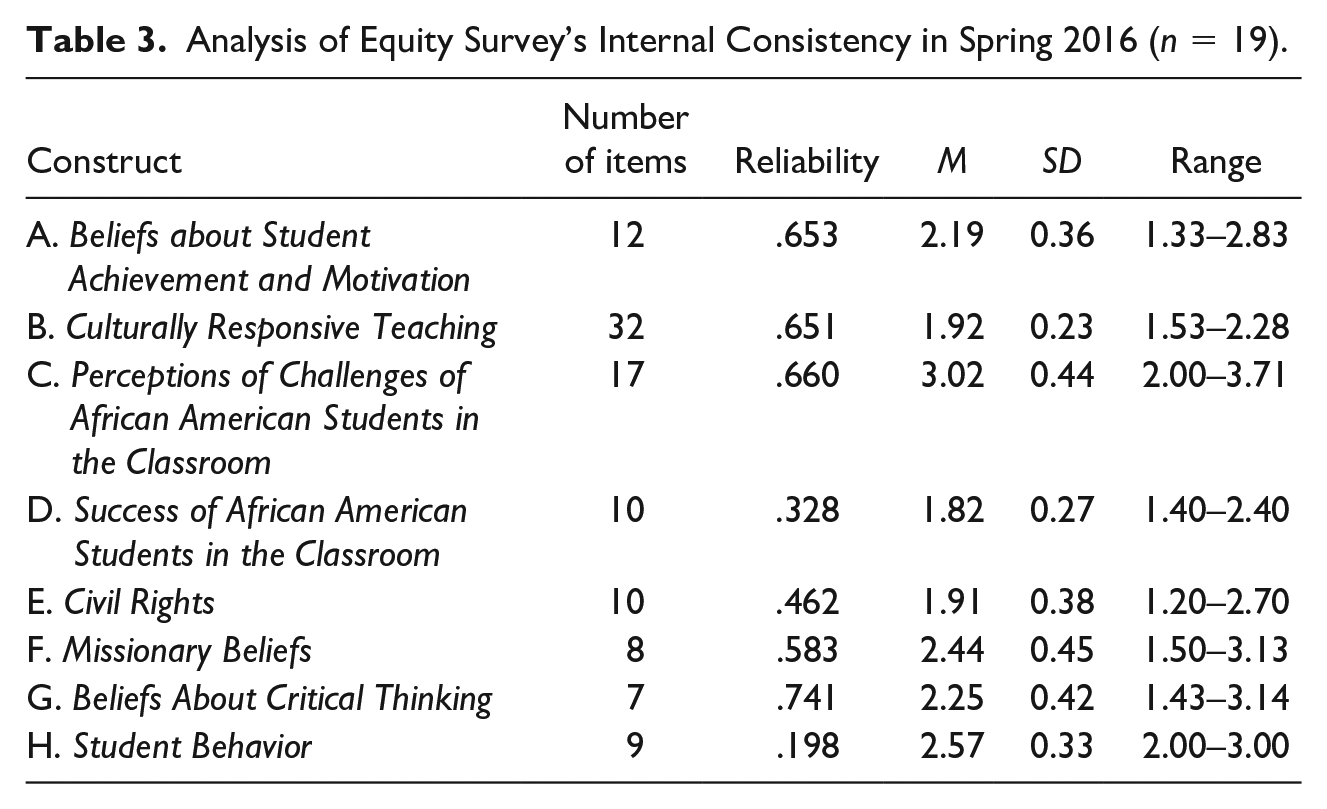
Based on these results, we made further revisions to the wording of items within these four dimensions before administering the survey to Cohort 2 in summer 2016 (prior to their participation in the summer 2016 workshop; n = 25). Table 4 provides the internal consistency data for the current version of the Equity Survey. Civil Rights continues to be low (<.6), though all other dimensions exhibit moderate to strong (>.6) or strong (>.7) internal consistency. In ongoing work, we continue to revise the Civil Rights dimension. Note that although the Culturally Responsive Teaching dimension is reported here as a set of 32 items, we have also engaged in analyzing the four subdimensions (of seven to nine items each) individually and are considering separating this dimension into a stand-alone survey.
Analysis of Internal Consistency of Final Equity Survey, Spring 2017 (n = 25 Teachers).

RQ 2: Findings on Teachers’ Perceptions
In this section, we present results on teachers’ productive perceptions, unproductive perceptions, and patterns or trends of change over time detected by the survey.
Examples of productive perceptions
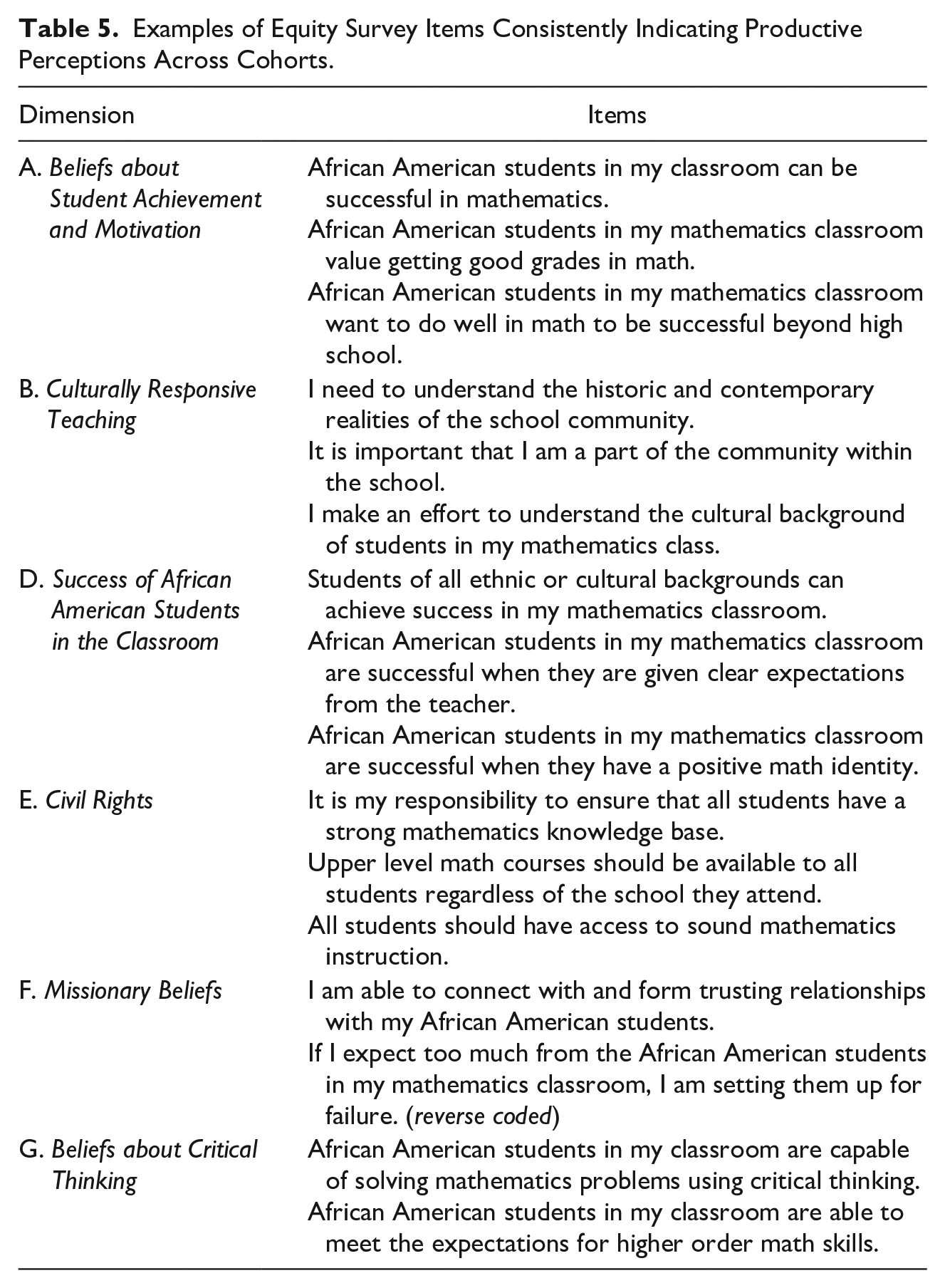
A number of results for teachers in Cohort 1 and Cohort 2 indicate productive perceptions and recognition of classroom or systemic issues facing African American students. Results in Tables 2 and 3 showed that on average, Cohort 1 teachers expressed relatively positive perceptions, with mean values ranging from 1.90 to 3.02 in spring 2015 and 1.82 to 3.02 in spring 2016 (on a scale from 1 to 5, where 1 represents the most productive perceptions). Similarly, data in Table 4 show that Cohort 2 teachers also expressed overall productive perceptions, with means ranging from 1.79 to 2.97. Table 5 provides examples of items in the six dimensions consistently reflective of productive perceptions across Cohorts 1 and 2. Items chosen represent two to three items with consistently high percentages (>85%) of teachers selecting agree or strongly agree.
Examples of Equity Survey Items Consistently Indicating Productive Perceptions Across Cohorts.
Examples of unproductive perceptions
Interestingly, both cohorts expressed similar patterns of unproductive perceptions. In both Cohorts, the dimensions of Perceptions of Challenges of African American Students and Student Behavior tended to have the highest means and maximum values, indicating the least productive perceptions, and had a larger split between productive versus unproductive perceptions than other dimensions.
Perception of challenges of African American students
In the Perception of Challenges of African American Students dimension, teachers responded to a set of 17 sentence completers for the item stem: “The challenges faced by African American students in my mathematics classroom are due to __.” The options to complete the item stem fall into three subcategories: characteristics of students (six items), characteristics of teachers (three items), and characteristics of the learning environment (eight items). Across cohorts, teachers expressed productive responses to the set of items attributing the academic challenges faced by African American students to characteristics of the learning environment (e.g., limited school resources). However, two patterns in this dimension around characteristics of students and characteristics of teachers were particularly striking and resilient over time.
First, teachers agreed or strongly agreed with the set of items attributing challenges to characteristics of students (e.g., disinterest in mathematics, lack of effort; see Table 6). This finding was consistent across cohorts and relatively stable over time. In Cohort 1, only one item in this set, “lack of mathematical ability,” was selected as agree or strongly agree by less than half of teachers (6 of 23; 27%), with the majority of teachers indicating agreement with the other five items. In spring 2016 (Cohort 1, Year 2), these results remained relatively stable for Cohort 1, with four of the six items continuing to reflect unproductive perceptions from approximately half of teachers (47%–58%), “lack of mathematical ability” becoming slightly less productive at 37% agreement compared with 27% in spring 2015, and one additional item (“lack of effort in mathematics”) with more productive perceptions at 26% agreement versus 57% in spring 2015. However, while nonsignificant, a trend of more productive responses can be seen on five of the six items, with fewer Cohort 1 teachers indicating agreement and attributing challenges to characteristics of students from spring 2015 to spring 2016.
Percentages of Teachers Strongly Agreeing or Agreeing With Characteristics of Students in Response to the Stem: “The Challenges Faced by African American Students in My Mathematics Classroom are Due to __.”
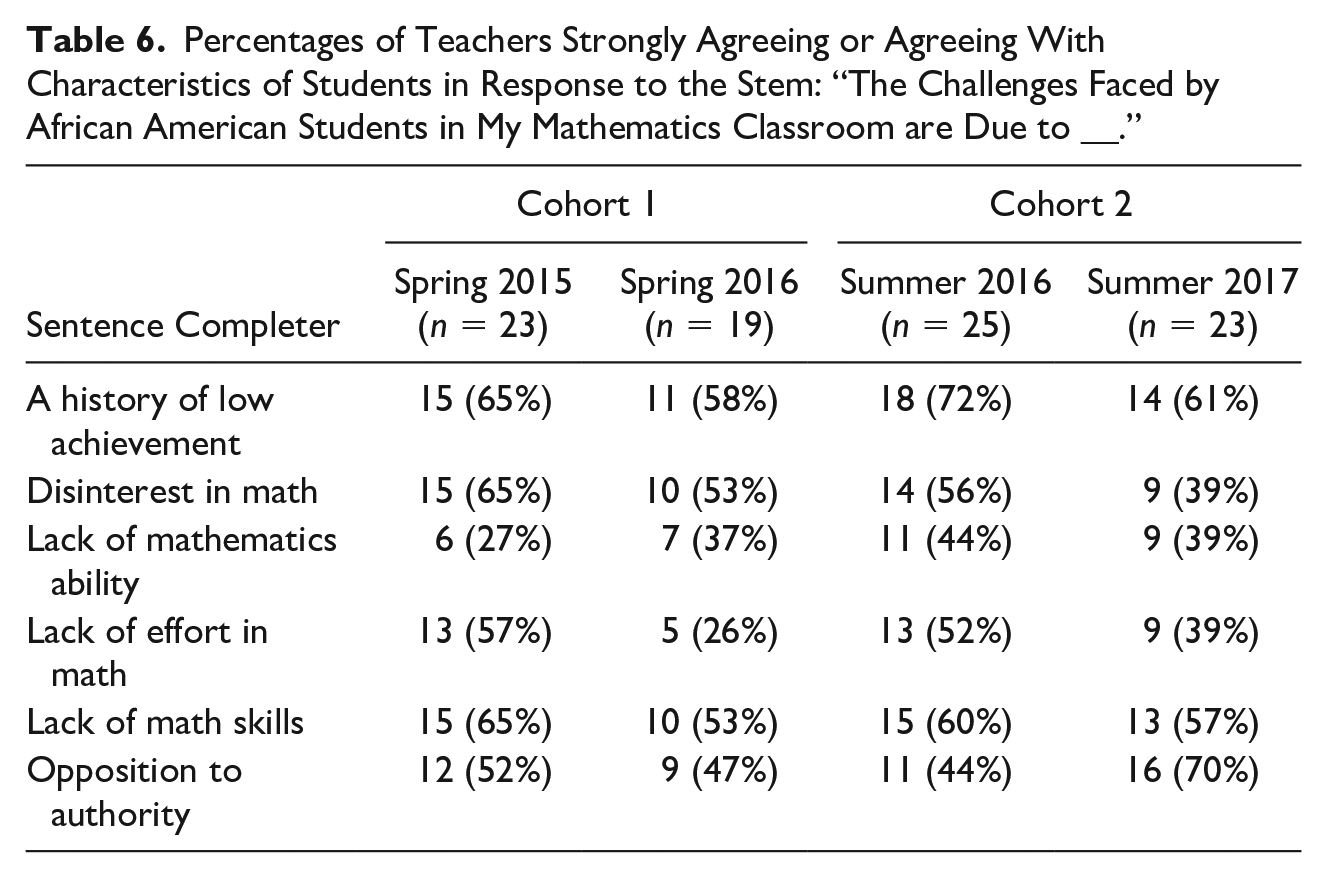
For Cohort 2, two items in summer 2016 (Cohort 2, Year 1) were selected as agree or strongly agree by less than half of teachers (44%), “lack of mathematics ability” and “opposition to authority.” Similar to Cohort 1, changes in Cohort 2’s responses from summer 2016 to summer 2017 represent a nonsignificant shift toward more productive perceptions. Fewer Cohort 2 teachers in 2017 than in 2016 attributed challenges to characteristics of students on five of six items. Only three items were selected as agree or strongly agree by more than 50% of teachers, compared with five items in 2016. Hence, both cohorts overwhelmingly tended to attribute challenges to characters of students in “Year 1” of their participation in the project and demonstrate small, nonsignificant shifts toward more productive responses in “Year 2,” at the end of their participation in the project.
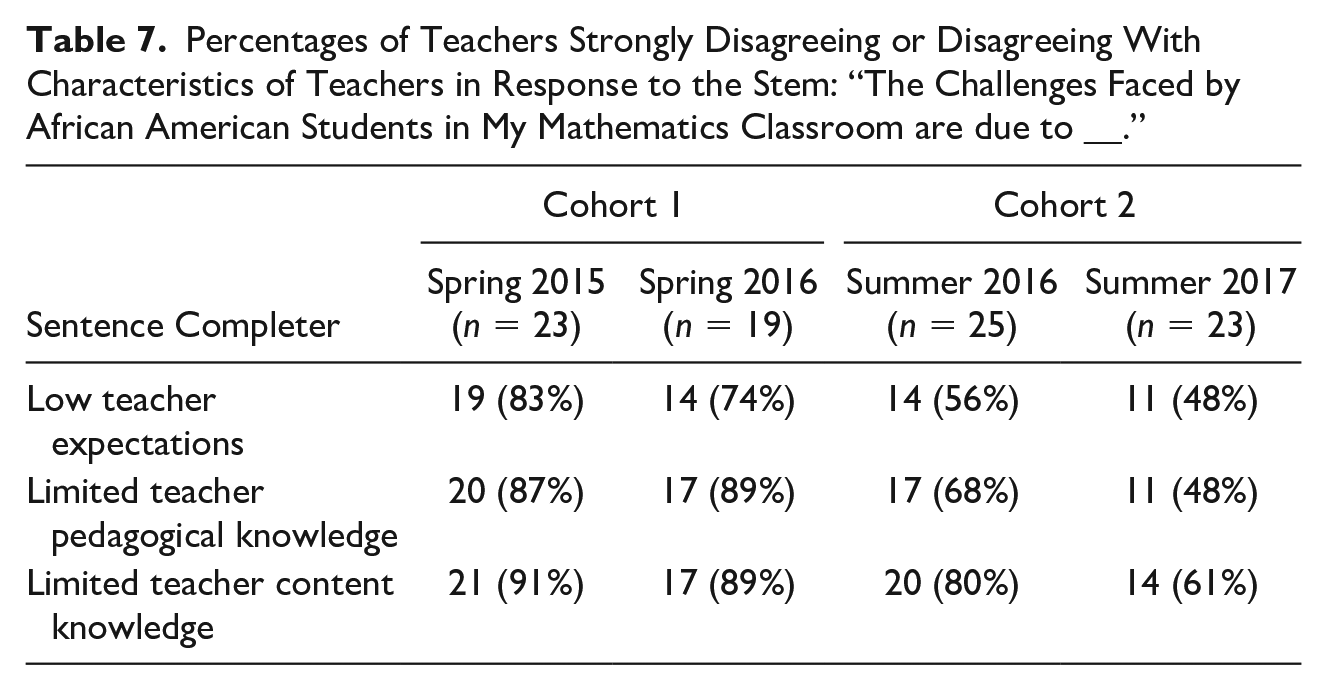
Second, teachers in both cohorts tended to disagree with items attributing academic challenges facing African American students to characteristics of the teacher (e.g., low teacher expectations, limited teacher pedagogical knowledge, limited teacher content knowledge; see Table 7). An overwhelming majority of Cohort 1 teachers selected disagree or strongly disagree for this set of items in spring 2015 (83%–91%) and maintained similar percentages of disagreement in spring 2016 (74%–89%). Although at lower percentages than Cohort 1, the majority Cohort 2 teachers expressed disagreement in summer 2016 (56%–80%) and remained at approximately half of teachers expressing disagreement in summer 2017 (48%–61%). Across cohorts and over time, the majority of teachers did not attribute academic challenges facing African American students to characteristics of teachers.
Percentages of Teachers Strongly Disagreeing or Disagreeing With Characteristics of Teachers in Response to the Stem: “The Challenges Faced by African American Students in My Mathematics Classroom are due to __.”
Student behavior
In the Student Behavior dimension, teachers in both cohorts and over time did not indicate decisively productive or unproductive perceptions. Rather, teachers selected the neutral response for the nine items in this dimension more so than other dimensions, and there was not a clear majority of teachers indicating agreement or disagreement with most of the items. In spring 2015 (Year 1) for Cohort 1, only three of nine items had approximately half of the teachers (12–13 out of 23) at one end of the scale (agree/strongly agree or disagree/strongly disagree). Although approximately half of teachers (e.g., 39%–56.5%) expressed productive perceptions on six of the nine items, approximately half of teachers remained neutral or indicated unproductive perceptions on items in this dimension overall. These results remained consistent for Cohort 1 in spring 2016 (Year 2), and Cohort 2 exhibited similar patterns across both years of their participation, as well.
Changes over time
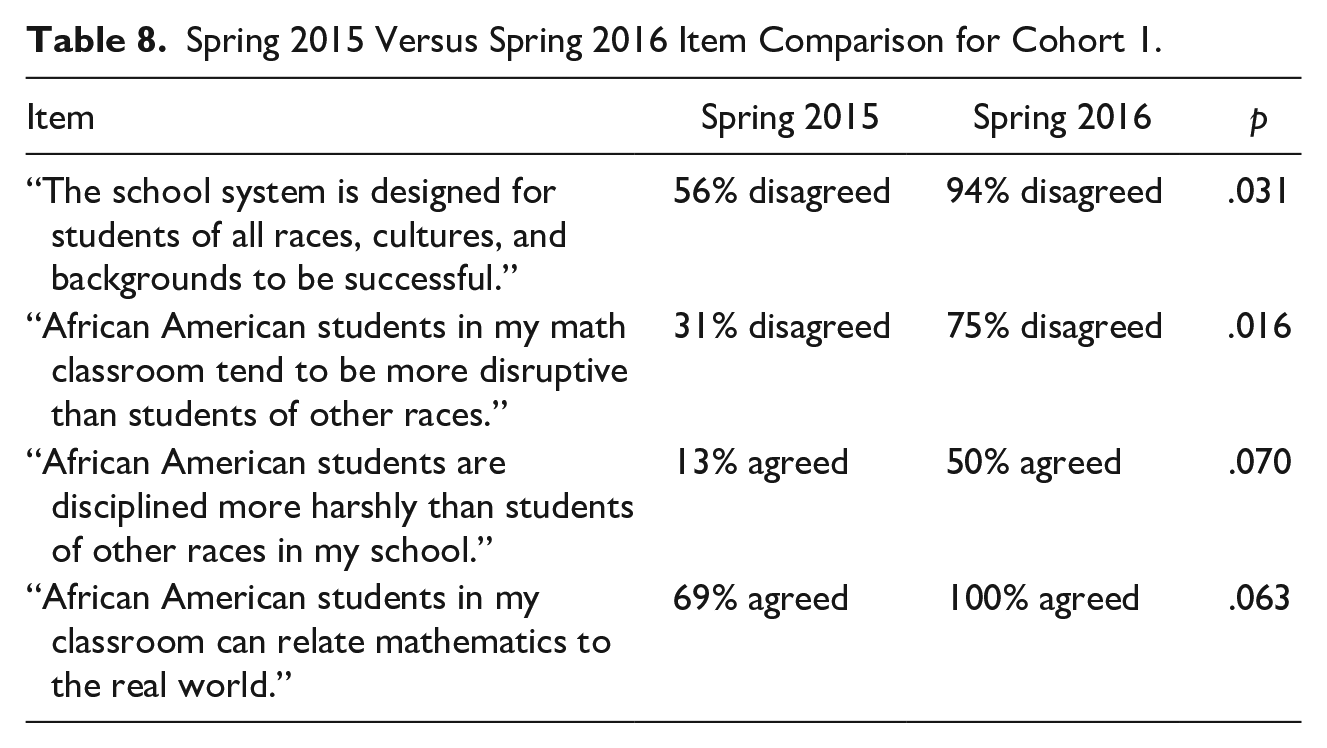
In general, both cohorts exhibited small, nonsignificant productive shifts between Years 1 and 2 of their participation in the project. In both cohorts, dependent t-tests indicated no significant difference in means between Years 1 and 2 for any of the dimensions (e.g., between spring 2015 and spring 2016 for Cohort 1; between summer 2016 and summer 2017 for Cohort 2). We also examined the common items from spring 2015 (Cohort 1, Year 1) and spring 2016 (Cohort 1, Year 2) using McNemar tests to determine whether the percent of agreement (or disagreement) changed over time. The items in Table 8 showed significant (or almost significant) differences. Taken together, these items indicate a shift in teachers’ perceptions of the ways in which African American students engage in mathematics class specifically and experience school more generally.
Spring 2015 Versus Spring 2016 Item Comparison for Cohort 1.
Discussion
To summarize the results, the data show productive mindsets in most dimensions and productive shifts or trends in teachers’ acknowledgment of systemic issues affecting the mathematical learning of African American students. The results provide an example of the type of information the survey can indicate about teachers’ perceptions of issues surrounding the teaching and learning mathematics for the African American students in their classrooms. Survey results are not intended to evaluate a teacher or group of teachers; rather, to show how the survey can be used to inform professional development initiatives, guide school-wide growth, or promote self-reflection. Our survey does not identify teaching strategies that promote equity in mathematics classrooms, nor does it provide data to suggest effective or practical instructional strategies for teaching mathematics in urban or urban-emergent school systems. Rather, by providing a tool to identify productive and unproductive perceptions, we intend to add to the conversation around issues affecting African American students’ opportunities to learn mathematics in urban or urban-emergent school systems. Based on current literature, we contend that teachers’ perceptions affect students’ opportunities to learn mathematics by influencing instructional practices, expectations of students, and in turn, students’ self-perceptions and identities as mathematics learners. In this discussion, we particularly highlight results that connect to prominent themes in research and theory regarding equity in mathematics teaching and learning.
Productive Mindsets
The overall results of the Equity Survey indicate teachers’ productive mindsets regarding issues surrounding the teaching and learning of mathematics for the African American students in their classrooms, even prior to their participation in professional learning experiences. Overall, teachers in both cohorts expressed perceptions consistent with productive mindsets identified as important in current literature, such as (a) the importance of being a part of the community within and surrounding the school (Ladson-Billings, 2009); (b) recognizing students’ unique and cultural ways of being, in contrast to expressing color-blind or culturally neutral perspectives (Milner, 2012b); and (c) recognizing the assets of the African American students in their classroom, rather than indicating deficit or missionary perspectives (Milner, 2010; Martin, 2012). For ongoing professional learning for teachers, these data might suggest a pathway of engaging teachers with readings and discussions that continue to promote the brilliance of Black children (e.g., Leonard & Martin, 2013) and feature positive narratives of African American students in mathematics (e.g., Berry et al., 2014).
We also consider two caveats to the productive results identified by the survey. First, teachers in this study self-selected to participate in a professional learning initiative specifically focused on issues of race in the teaching and learning of mathematics. While we only intend for the results herein to serve as an example of the type of data the survey is capable of providing, survey results for groups of mathematics teachers, in general, may not reflect the extent of productive perceptions expressed by this specific group of teachers. Second, we acknowledge that productive responses might appear to be the “default” response on many survey items. In other words, for several items, teachers may have provided the responses they felt were socially acceptable, politically correct, or pleasing to the project leaders and researchers.
However, we contend that both of these caveats make the dimensions and items with unproductive, neutral, or a range of responses in this study even more insightful.
Unproductive Mindsets
In our results, unproductive mindsets appeared mainly in the dimensions of Perception of Challenges of African American Students and Student Behavior. Unproductive results in the Perception of Challenges dimension occurred within sets of responses that overwhelmingly attributed challenges to characteristics of students themselves and not to characteristics of teachers. These results reflect “the more widespread view that inordinate achievement disparities stem from deficiencies in the child and/or child’s culture” (Lopez, 2017, p. 193). Placing the onus for challenges in learning mathematics on students and not the teacher reflects a meritocratic mindset, or the idea that “hard work breeds success,” where teachers perceive that African American students can overcome academic challenges by working harder, extending more effort, or enacting more compliant behavior (Milner, 2010; Martin, 2009). Meritocratic perceptions are unproductive because they serve to maintain inequities by justifying status differences as the result of individual effort, talents, and merit (McCoy & Major, 2007). Research in psychology (Ledgerwood et al., 2011; McCoy & Major, 2007) and specific to mathematics teaching and learning (Mijs, 2016) has shown that members of low-status demographic groups will accept ideas of meritocracy to downplay discrimination, justify disadvantages faced personally and by their demographic group, and stereotype themselves and their demographic group into negative dominant narratives. These types of adverse thought processes have the potential to perpetuate failure of Black students in the mathematics classroom. In fact, many students of color are maladjusted in school overall and reject the notion that school is a place where they can actually obtain knowledge and succeed.
Hence, disrupting meritocratic mindsets can better position mathematics teachers to acknowledge and act upon their role in creating equitable and rich learning environments for African American students. Howard (2010) remarked of his experience in working with White teachers who are successful in teaching and reaching African American students. He stated that their effectiveness was rooted in the fact that they were willing to disrupt the “status quo” ideology about the skills of African American students and focus on the strengths that they bring to school. He furthers his discussion by expressing the need for adequate training for both preservice and in-service teachers. As an example of a pathway for ongoing professional development to support teachers, mathematics teachers in the DEbT-M professional learning initiative in the study reported herein engaged with readings and expert speakers that began to challenge their perceptions of meritocracy (e.g., Milner, 2010; Nasir, 2011). In Year 2 of Cohort 2, project leaders also instituted a process of reflection and change in practice that began with teachers “acknowledging” the inequities faced by African American students in their schools and classrooms (Badertscher, 2019). These acknowledgments occurred within a safe space of addressing what actions teachers could take within their context and role. In this study, we identified small productive shifts in both cohorts within the Perception of Challenges dimension, and fewer percentages of Cohort 2 teachers attributing challenges to characteristics of students and not attributing challenges to characteristics of teachers. However, as these shifts were not statistically significant, we also acknowledge the need for further work or additional time to disrupt teachers’ mindsets regarding their role in working against inequities and optimizing students’ opportunity to learn mathematics.
Why might teachers, even after professional learning experiences, continue to place the onus on students and be reluctant to acknowledge their own role in perpetuating inequities? We offer two conjectures. First, deep personalization of issues of inequity is difficult (Badertscher & Boston, 2019). Anecdotally, we saw this difficulty materialize as teachers in the project wrestled with including unintentional actions in the project’s shared definition of racism and in discussing readings around implicit bias. Conversely, we also saw teachers begin to internalize and acknowledge their role in promoting inequities as they developed action plans for their classrooms (Gates, McDowell, & Badertscher, 2019). For example, teachers acknowledged shifting from statements such as “African American students in my classroom do not complete their homework,” to questioning, “What is my role in supporting the African American students in my classroom to complete their homework,” and seeking input from their African American students to develop action plans 3 (Neely, et al., 2019). Similarly, at the systemic level, teachers’ initial observation that African American students were late to school more frequently than White students resulted in consideration of the possible contributing factors (e.g., bus schedules and bus reliability in neighborhoods where African American students live, more African American students relying on bus transportation to school than White students) and the emotional and instructional implications of lateness on students (e.g., confrontation, detention, or other disciplinary measures; absenteeism when students chose not to come to school to avoid confrontation or disciplinary measures for being late; students feeling unwelcome or uncomfortable entering the school or classroom late; and missed opportunities for learning). Hence, the onus for lateness shifted from students themselves to the systemic issue of access to reliable transportation, and the conversation shifted to the impact on students’ opportunities to learn.
Second, in the current culture of teacher evaluation, teachers might be reluctant to acknowledge areas in need of professional growth for fear of job security or negative reactions by administrators, especially around issues of racial inequities. With school systems often serving as systemic structures that maintain inequities and the status quo, identifying areas where the system needs to change might not be received well by district leaders. Teachers might fear retribution or lack support for suggesting or making changes in their schools and classrooms. This powerlessness to enact change could generate the results we saw in the survey, where teachers place the onus for inequities in learning on the school system and on students, but not on themselves.
We find it important that the survey identified the Student Behavior dimension as an area of unproductive mindsets. National data indicate that African America students are disciplined more often and more harshly than students of other races (cf., data used by Bottiani et al., 2017). This dimension contained more neutral responses than other dimensions, which we interpret as teachers’ lack of recognition of inequitable disciplinary practices enacted toward African American students. Together with a majority of teachers responding unproductively to items regarding African American students’ oppositional behavior, the results for this dimension signal the need to support teachers to examine and identify aspects of the school and classroom environment contributing to behavioral issues or confrontation. Gholson et al. (2012) describe two axioms in dire need of disruption: (a) the “axiom of criminality” (p. 4), particularly against Black male adolescents and (b) the “axiom of standardization” (p. 5), where “Black children’s test scores, behavioral and socioemotional patterns, as well as their dress and speech are subject to comparison of a fictitious, normalized White child” (p. 4). Hence, the survey identified an important need to support teachers to develop productive mindsets (and practices) regarding the behavior and ways of being of the African American students in their classrooms. In the professional learning experiences for Cohort 2, project leaders increased the focus on micro-aggressions and used the language of color-blind racism rather than color-blind perspective to further promote productive mindsets toward African American students in teachers’ classrooms.
Regarding the unproductive mindsets identified by the survey in the dimensions of Perception of Challenges and Student Behavior, research indicates that teachers with productive views of students’ mathematical capabilities and sources of students’ difficulties provide richer opportunities for students to learn mathematics (Jackson et al., 2017; Rubel, 2017; Wilhelm et al., 2017). In teachers’ planning and enactment of cognitively demanding mathematics lessons, equitable opportunities to engage in mathematical thinking and reasoning are related to teachers’ views of students (Jackson et al., 2017; Rubel, 2017) and explanations of sources of students’ difficulty in mathematics (Wilhelm et al., 2017). Hence, attributing African American students’ challenges to their own characteristics or behavior could serve to sustain racial gaps in students’ opportunities to learn mathematics. Identifying these unproductive mindsets as areas for teachers’ professional growth and reflection serves as an important contribution of the Equity Survey.
Conclusion
The work in developing the Equity Survey has scholarly significance in its timely and important focus on improving the mathematics learning opportunities of African American students, by providing data on teachers’ productive and unproductive perceptions that affect the teaching and learning of mathematics and can serve to inform professional learning experiences. We continue to engage in refining the survey to meet benchmarks for internal consistency, with the intention of contributing to the field a valid and reliable tool that fosters critical reflection and awareness on a personal, school, program, or district level. Given our results on teachers’ productive and unproductive perceptions based on the initial survey administrations reported herein, we are optimistic that the survey can provide data to draw attention to sources of differences or gaps in historically marginalized students’ opportunities to learn mathematics, rather than gaps in their mathematical achievement. We extend great appreciation, respect, and gratitude to the teachers who courageously participated in this research with the goal of strengthening the learning outcomes of African American students in mathematics.
As we continue to use the survey on a variety of populations of teachers, we look to this future work to continue to improve the survey in a number of ways. The survey may benefit from fewer questions, particularly if certain items or dimensions continue to reflect only productive perceptions (e.g., scores of 1 and 2) regardless of the population. Further investigation into the high occurrence of neutral responses for the Student Behavior dimension is also warranted and may improve the dimension’s internal consistency. Finally, making connections between survey results and observations of teaching could also provide further data for survey validation, particularly around teachers’ perceptions of challenges faced by students and the extent to which teachers provide rich opportunities for students to learn mathematics.
In conclusion, we posit that the most valuable use of the survey is to identify critical foci for professional learning experiences for teachers. Our findings indicate that professional learning experiences should target teachers’ perceptions of the source of African American students’ challenges in the mathematics classroom and teachers’ perceptions of African American students’ behavior. Based on the rich body of research connecting teachers’ perceptions to teachers’ practices and students’ self-perceptions, targeting these two unproductive perceptions (surfaced by the Equity survey) has potential to impact African American students’ opportunities to learn mathematics and identities as mathematics learners.
Our findings around productive and unproductive mindsets lend further evidence to the importance of teachers understanding the students and contexts in which they teach. Understanding students’ contexts—including systemic inequities and students’ (often negative) self-perceptions perpetuated by dominant narratives—can help teachers identify and address the factors contributing to African American students’ challenges in the mathematics classroom, rather than placing the onus on students themselves. The trend of more productive mindsets in Cohort 2 than in Cohort 1 provides an initial indication of how feedback from the survey could support the development of enriched professional learning opportunities, and the small positive shifts in teachers’ unproductive mindsets in both cohorts serve as an existence proof that professional development specifically focused on issues of equity can support growth in teachers’ productive mindsets.
Footnotes
Acknowledgements
The authors would like to thank Charles Munter (University of Missouri), Rich Milner (Vanderbilt University), and graduate research assistant, Joseph Frollo (Duquesne University) for their contributions to early versions of the instrument.
Declaration of Conflicting Interests
The author(s) declared no potential conflicts of interest with respect to the research, authorship, and/or publication of this article.
Funding
The author(s) disclosed receipt of the following financial support for the research, authorship, and/or publication of this article: This material is based upon work supported by the National Science Foundation Grant No. 1321216, Designing for Equity by Thinking In and About Mathematics (DEbT-M), PI Eden Badertscher (Educational Development Center [EDC]) and co-PIs Al Cuoco (EDC), Michael Young (Iowa State University), and Deb Dankmyer (Pittsburgh Public Schools).
