



Abstract
This qualitative study was a critical race analysis of Advanced Placement criteria and under-enrollment of African American males in two midwestern urban high schools. Analysis of faculty interviews and documents generated four themes. AP criteria and enrollment were implemented through formal and informal practices, and key roles of individual faculty and collaboration with faculty and families supported AP structures. However, assumptions about African American males, and color and gender-blind dialogue contributed to disproportionate African American male enrollment in AP courses.
Advanced Placement (AP) courses were created in the 1950s to expose high school students to college level curriculum and increase college readiness (Kolluri, 2018). Benefits associated with AP course enrollment include access to the best teachers, rigorous curriculum, and academically motivated peers; admission to selective colleges and universities, and reduction in college costs (Hallett & Venegas, 2011; Kolluri, 2018). Students who take AP courses are in a better position to be accepted into college, be awarded scholarships, and earn college credits while still in high school (Scott et al., 2010).
The popularity of AP courses has increased over time. The percent of high school graduates who received AP course credit on their transcript increased from 12 percent in 1990 to 39 percent in 2013 (Malkus, 2016). This increase is largely attributed to the expansion of AP courses beyond elite students for which it was originally intended. Courses are now ostensibly open to all students who are academically prepared, and there are increased offerings in schools, including those that serve traditionally marginalized students (College Board, 2014). However, questions about equity in AP course enrollment remain, such as whether racial subgroups such as African American males have equitable access (James et al., 2017; Kolluri, 2018; Solorzano & Ornelas, 2004).
Many African American males thrive in rigorous academic courses (Kumah-Abiwu, 2019; Strayhorn, 2009). Research about their educational experiences and post-secondary outcomes contribute to a counternarrative that disrupts stereotypical, deficit-laden views of their existence (Greer et al., 2018; Harper, 2015; Johnson, 2017; McGee & Pearman, 2014). At the same time, African American students are underrepresented in AP courses and the associated college and career benefits of taking AP courses (Archbald et al., 2009; James et al., 2017). In 2013, African Americans had the lowest AP course-taking rate (27%) among Hispanic (36%), White (41%), and Asian (70%) public high school graduates; a consistent pattern since 1990 (Malkus, 2016).
This disproportionality continues in post-secondary careers. According to the Bureau of Labor Statistics (2016), African American males represented 12% of the U.S. population in 2015, and comprised 4.4% of attorneys and 7.5% of physicians and surgeons. Yet, they accounted for 68.7% of professional football players (Lapchick & Robison, 2015). These trends are troubling. When resources are invested in African American males’ athletic abilities rather than academics, opportunities to build academic skills may be ignored. This results in potential barriers for African American males in securing diverse and viable career options (Morris & Adeyemo, 2012).
A focus on African American males’ experiences in urban schools is particularly important given the need to increase educational opportunities while upholding asset-based approaches for addressing educational inequities. Although there is not a universally accepted definition of “urban education,” scholars tend to define urban based on a range of factors including: geography, population size, and density; “outside of school factors” (Milner, 2012, p. 559) such as poverty, housing and other socioeconomic factors; or challenges to resources needed to serve students and families, including those with culturally, economically, and linguistically diverse realities (Darling-Hammond, 2014).
Racial demographics are often associated with the concept of urban, whether explicit or coded. Welsh and Swain (2020) found that “the percentages of students who are Black or Latinx are, all else equal, important predictors of whether a district is urban in every definition” (p. 97). This underscores the dynamic nature of the term, in part due to multiple demographic characteristics, and the increasing rejection of deficit perspectives about urban students, families, and communities.
Given the educational and financial capital that AP course completion and test achievement yields (Hallett & Venegas, 2011; Scott et al., 2010), examination of selection and enrollment criteria, particularly for African American males in urban schools is important because the classes are a gateway to the aforementioned opportunities. An examination of how AP criteria are applied through a critical lens wherein we consider the extent to which criteria and selection are equitable, presents an opportunity to explore how institutional processes, executed by adults, impact students (Allen, 2015).
After visiting a school where educators used deficit language to describe a school they characterized as urban, Milner (2012) pointed out that there were likely inequitable policies and practices in place over which the educators had some control. He asserted, “Such responsibilities, related to policymaking and instructional practices, for example, are those that the adults in the district should be reflecting on and about as they work with the students and parents they serve” (p. 558). Enrollment and selection criteria are two such processes that are the responsibilities of adults—thereby making an examination of what adults can do, rather than focusing on deficits of students and families—a necessary area of investigation (Johnson, 2017).
Purpose and Significance of the Study
The purpose of this study was to compare AP enrollment trends of African American males to enrollment criteria and the selection process, to identify patterns that might explain the disproportionate underrepresentation of African American males in two urban high schools in a midwestern state. Our definition of urban most closely aligns with Milner’s (2012) concept of urban emergent. The population of both cities in which the schools are located are large, but less than one million people. However, the magnitude of challenges regarding resources and allocation to traditionally underserved groups are on par with very large cities. In this regard, we agree that definitions of urban schools are not static (Welsh & Swain, 2020).
A broad scope of factors contribute to the disproportionate underrepresentation of African American male enrollment in AP courses (Archbald et al., 2009; Bonner et al., 2009; James et al., 2017; Solorzano & Ornelas, 2004). Kolluri (2018) recommended, “In addition to research on individual students, studies at the school level can enhance our understanding of the challenges of AP” (p. 703). This study contributes to this gap in the research. Additionally, Solorzano and Ornelas (2004) conducted a study of Latinx and African American enrollment in public schools. While they investigated aggregate enrollment by race, we contribute to the research by examining data disaggregated by race and gender.
Two research questions guided the study: (1) How do written policies and commonly used practices guide the implementation of AP enrollment criteria in two urban high schools?
(2) What patterns are revealed regarding decision making, enrollment criteria, and African American male enrollment in AP courses in two urban high schools?
Review of Literature
We begin with a summary of research about issues relevant to the enrollment of African American students in gifted education, as scholars have noted connections between AP and gifted course enrollment (Ford et al., 2008). This is followed by an overview of literature about African American males, AP courses, and enrollment criteria. Then, we present critical race theory and its relation to our study.
African Americans in Gifted Education
Although African American students have been underrepresented in gifted education for many decades, “little progress has been made in reversing underrepresentation” (Ford et al., 2008, p. 289). Ford (2014) revealed that African American students are the most underrepresented racial group in gifted education. For example, in 2011, they comprised 19% of students but comprised 10% of gifted students. She asserted that white privilege, colorblind ideology (the suppression or denial of race and cultural differences), and deficit thinking (the belief that culturally diverse students are inferior) are barriers to addressing underrepresentation.
Scholars have investigated whether and how recruitment and retention by educational professionals contribute to increased representation of African Americans in gifted education (Ford, 2014; Ford et al., 2008). Recommendations toward this end include developing alternative ways to identify gifted Black students, combatting deficit thinking among educators, eliminating microaggressions, developing strong school-family relationships, engaging in data analysis to determine equity goals, and improving educator preparation in gifted education (Ford, 2014). Although access to AP courses is not limited to gifted students, issues regarding underrepresentation of African Americans in gifted education are particularly concerning related to this study because AP courses are a “main venue for gifted education at the high school level” (Ford et al., 2008, p. 290).
African American Males and High School AP Courses
African American males are underrepresented in AP courses (Scott et al., 2010; Solorzano & Ornelas, 2002). Yet, as noted earlier, many African American males demonstrate academic success and potential. This fact leaves those not blinded by deficit-laden thinking to forego questioning whether it is a question of talent and wonder instead, about what systemic inequities contribute to this concerning reality.
Research on the underrepresentation of African American males in AP courses has focused on race, racism, pedagogy, culture, and the overrepresentation of African American males in special education, suspensions, and expulsions (Klopfenstein, 2004). Irving and Hudley (2008) identified “cultural mistrust,” “oppositional cultural attitudes,” and an “inverse relationship with outcome expectations” (p. 677) as key variables that impact African American males’ academic success. In contrast, Tyson (2002) found that oppositional attitudes could be applied to any group of adolescents. Other researchers asserted that these gaps were directly related to a student’s academic or classroom experience rather than culture (Harris, 2006), what Tyson (2002) referred to as the “ability show” (p. 1170). Further examination of African American males from an anti-deficit lens by Greer et al. (2018) revealed that taking AP courses influenced African American males’ perceptions of school climate and achievement.
Academic Tracking, Racial Segregation, and Advanced Coursework
Academic tracking of students from middle to high school plays a key role in determining access to advanced coursework (Anderson & Oakes, 2014). Historically, tracking was used to place students on a particular path of academic coursework, assuming that past school performance and/or assignment was a sound predictor of success. There is a direct relationship between academic tracking and racially segregated schools. Oakes et al. (1997) shed light on how the construction of intelligence and race contributed to racially segregated classrooms. Beliefs about intelligence as a fixed trait justified support of academic sorting. For example, teachers who resisted detracking perceived the cultural deficits of African Americans as the reason why they were not academically successful.
These beliefs were also tied to maintaining privilege as a result of sorting. Despite arguments that tracking benefits students because teachers can better teach to homogenous student groups, Anderson and Oakes (2014) asserted, “below this superficially sensible explanation are troubling cultural and historical patterns that connect school-level labeling and sorting to the social construction of race, class, and ability and the maintenance of competitive advantage for members of the dominant group” (p. 112). Furthermore, assumptions that homogeneously grouped students can learn better are challenged by the reality that many times student placements are done in error or influenced by parents.
Suggs (2010) explained that students were identified and placed on advanced academic tracks for gifted and talented programs based on a set of predetermined criteria while in elementary and middle school. This early identification directly impacted opportunities for taking AP courses once students were enrolled in high school. African American students were disproportionately overrepresented in lower academic tracks and were two-and-a-half times less likely to be enrolled in gifted and talented programs at the elementary and middle school levels. This laid the groundwork for underrepresentation in high school AP courses (Archbald et al., 2009). AP enrollment criteria, written policies and commonly used practices are attached to a legacy of inequities that are historically rooted in racism. These patterns are revealed when analyzed through critical race theory (Delgado & Stefancic, 2000; Ladson-Billings & Tate, 1995; Solorzano & Ornelas, 2004).
Theoretical Framework
Critical race theory (CRT) was developed by legal scholars who foregrounded race in their analyses based on the assumption that racism is normal in the United States (Crenshaw, 2011). Particular attention to the social and historical legacy of racism is needed to understand the root of racial inequality (Delgado & Stefancic, 2000; Ladson-Billings & Tate, 1995). In her overview of the origins of CRT, Crenshaw (2011) explained, “Activists’ demands that elite institutions rethink and transform their conceptions of ‘race neutrality’ in the face of functionally exclusionary practices engendered a particularly concrete defense of the status quo” which produced “apologia for institutionalized racial dominance” (p. 1260). She explained further that CRT “continues to be constituted through a series of dynamic engagements” (p. 1260), in that it is not a static theory and rejects post-racialism. Therefore, CRT rejects notions of colorblindness as evidence of race equality.
CRT has been applied to education to confront and analyze issues of race and racism in schools. For example, Bell (1980) concluded that the unsuccessful implementation of mandatory school desegregation immediately after the Brown decisions was the result of interest convergence between African American rights and white political interests. His analysis served as a bridge between legal scholarship and education.
CRT in Education
Ladson-Billings and Tate (1995) introduced CRT in education in their seminal article which centered race in an historical and contemporary analysis of society to explain educational inequities. Building upon the work of earlier scholars who examined race as part of multiculturalism and education (Howard & Navarro, 2016), Ladson-Billings and Tate (1995) identified three CRT tenets. First, racism is endemic and permanent in American life. Racism does not operate in isolation, is more than individual acts, and is institutional. Second, a reinterpretation of ineffective civil rights law as a result of Brown v. Board of Education of Topeka, Kansas (1954) revealed that in the aftermath of this ruling, school desegregation resulted in increased White flight and a loss of African American teachers and administrators due to redistricting issues. Third, challenging claims of neutrality, color-blindness, and meritocracy honors the voices of traditionally marginalized people. Other scholars have expanded upon these tenets to include analyses of the intersections of race with other identities and forms of oppression, and connections with other disciplines.
To date, the article by Ladson-Billings and Tate (1995) has been cited over 6,000 times according to Google Scholar—a testament to the value placed on this theoretical lens. To mark 20 years of CRT in education, several scholars contributed literature reviews which included ideas for how CRT should shape future research (Capper, 2015; Howard & Navarro, 2016; Ledesma & Calderón, 2015; Stovall; 2016). Unique aspects of these reviews ranged from a focus on educational leadership (Capper, 2015); interlocking identities or intersectionality, teacher preparation, and education reform (Howard & Navarro, 2016); the genealogies of race-specific critical race theories (Stovall, 2016); and higher education and community engagement (Ledesma & Calderón, 2015). Since the complexities of CRT have been explored elsewhere, we turn to a brief summary of how researchers have interrogated race and its relationship to African American males in education.
Racial Ideologies and Educational Opportunities of African American Males
Stovall (2005) stated, “Understanding racism as endemic to American life, Critical Race Theory becomes integral to the complex, intricate, and discrete functions of racism in the urban school setting” (p. 96). This includes an examination of how the racial ideologies of educators contribute to racialized systems that exclude African American students from advanced coursework (Allen, 2015). Rogers and Brooms (2020) revealed that White male teachers’ beliefs in meritocracy influenced their deficit thinking about African American male students, which became a rationale for the barriers to academic success the students encountered. Deficit thinking also reinforces implicit and explicit biases that inform individual and institutional barriers to equitable representation, such as under-referrals in gifted programs (Ford, 2014).
Similarly, educators in a low-performing high school in the mid-Atlantic region blamed African American males for the achievement gap. Those educators who did care about the success of African American males did not find the school to be a safe space (Lynn et al., 2010). In contrast, Allen (2015) found that teachers of African American male students enacted agency to contest structural inequities in schools on their behalf. In particular, teachers suspended judgment and consciously treated students with respect.
Educators can create racial discourses that affirm and inspire African American males, thereby disrupting negative discourse about their identity and potential (Harper, 2015). Johnson (2015) examined how African American educators operationalized this by enacting critical place pedagogies at a majority African American urban middle school. These educators created a counternarrative of African American identity by posting signs, pictures, and affirmations to promote positive school culture throughout the school. Johnson (2015) surmised that by creating this space, the educators “enacted critical pedagogies to subvert the negative narrative that suggests Black boys do not belong in school” (p. 917).
Another way that racial ideology is enacted among white teachers is through the absence of discussion about race, as Ford (2014) revealed. While considered a lofty expression of anti-racism by some, colorblindness promotes racial oppression because it denies the acknowledgment of race or cultural differences (Capper, 2015; Ledesma & Calderón, 2015). This often contributes to an inability or unwillingness to examine data disaggregated by race and associated inequities.
Although not all researchers who write about race do so under the explicit umbrella of CRT, they often include an examination of race, whiteness, and power aimed at dismantling privilege and inequities. To explain the concept of colormute, Pollock (2004) asserted that colorblindness “can often be more accurately described as a purposeful silencing of race words” yet as a result, “deleting race words can actually help make race matter more” (p. 3, italics original). This is relevant to our study because it highlights how race and privilege can contribute to bias and avoidance of race when educators try to explain the underrepresentation of African American males in AP courses.
Solorzano and Ornelas (2004) examined how school structures and practices contributed to inequitable enrollment patterns of Latinx and African American students in AP courses. They found that there was low enrollment in AP courses in schools that served low-income Latinx and African American students. They also described a phenomenon labeled “Schools within Schools” (p. 22) wherein Latinx and African American students were underenrolled in AP courses, even in schools where there were high student enrollments. To address this disproportionality, they recommended that schools implement an “AP School Equity Index,” (p. 24) to monitor such trends. This is calculated by the number of a students within a subgroup enrolled in AP classes divided by the number of students within that subgroup enrolled in the school.
Relatedly, Ford (2013, 2014) developed an equity index that incorporates a 20% allowance when determining underrepresentation. Her formula acknowledges exact proportional representation is not always possible, yet determines a minimal threshold, under which underrepresentation must be addressed. This is calculated by determining the composition of a subgroup in the general school population (C) then multiplying that number by a 20% threshold (T). The result of C-T is the equity index. If a subgroup is less than the percentage indicated by the equity index, schools should be obligated to address the underrepresentation.
Research Methods
The design for this study was a general qualitative approach so that meaning was created in a social context through exploration and rich description of data. Merriam and Tisdell (2016) explained that these are “probably the most common form of qualitative research found in education” (p. 24). Through this general approach to qualitative inquiry, data collection occurred through interviews and document analysis.
Site Selection
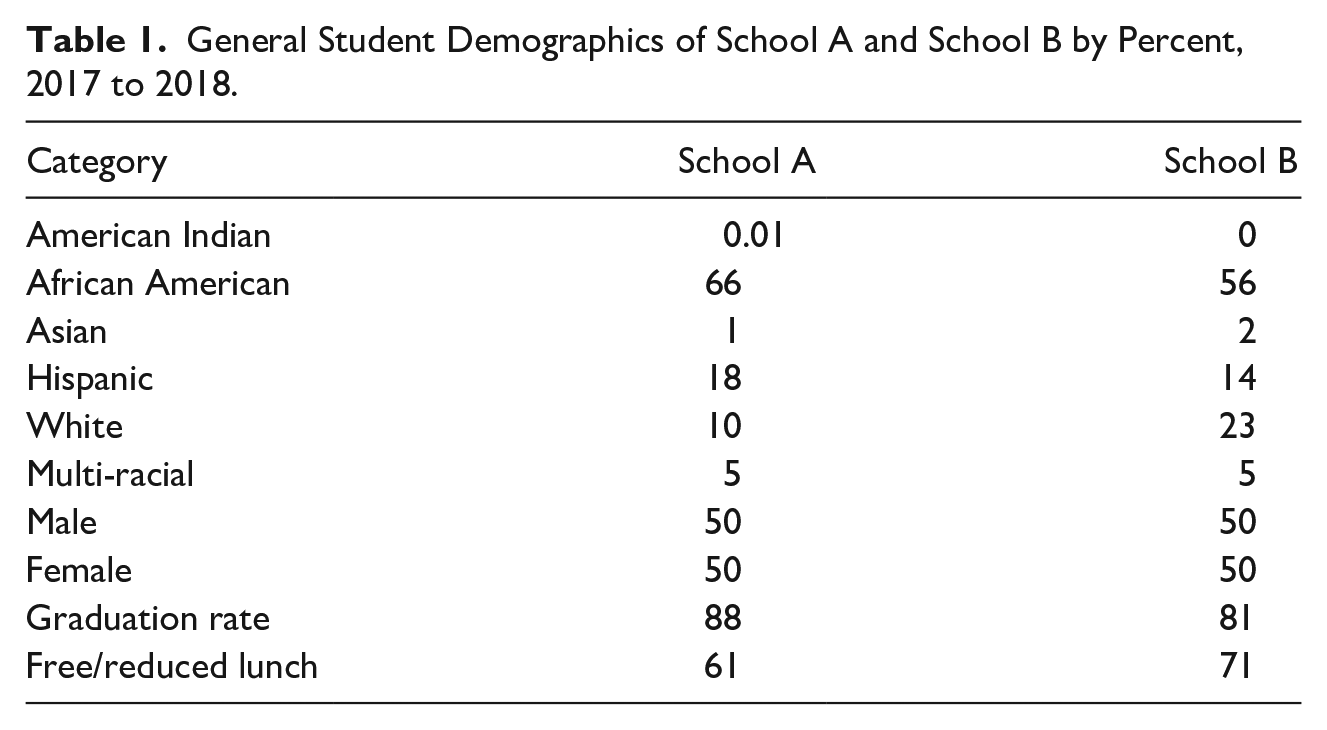
The first author was familiar with School A because of his administrative role in the school district. We sought to find a school comprised of similar demographics and scope of AP course offerings to seek a more robust understanding of the processes of AP course enrollment beyond the school with which he was familiar. School B was selected after examination of demographic information found on the State Department of Education website (Tables 1 and 2). In both schools, at least 55% of the student population was comprised of non-white students and a minimum of 60% of the students received free and reduced lunch. The schools had similar graduation rates and offered a similar number of AP courses. Both schools also demonstrated disproportionate underrepresentation of African American males in AP courses.
General Student Demographics of School A and School B by Percent, 2017 to 2018.
Comparison of Percent School Enrollment by Race and Gender to Percent Enrollment by Race and Gender Enrolled in at Least 1 AP Course, 2017 to 2018.

Note. % rounded to nearest whole number, which explains why School B adds up to less than 100%.
School A
During the 2017 to 2018 school year, School A enrolled 2,183 students. Sixty six percent of students were African American, 18% Hispanic, 10% White, 5% Multiracial, 1% Asian, and 0.01% American Indian. The graduation rate was 90% and 63% of the students received free and reduced lunch.
School B
During the 2017 to 2018 school year, School B’s student enrollment was 3,480. Fifty-six percent of students were African American, 23% White, 14% Hispanic, 5% Multiracial, 1% Asian, and 0% American Indian students. The graduation rate was 81% rate and 71% of students received free and reduced lunch (Table 1).
AP Course Offerings and Enrollment
School A offered 11 AP courses and School B offered 15 courses. The schools offered eight identical classes: AP calculus, chemistry, English language and composition, English literature and composition, macroeconomics, psychology, U. S. history, and U. S. government. School A offered biology, microeconomics, and statistics. School B offered computer programming, music theory, physics, world history, Japanese, Latin IV, and Spanish V.
Table 2 reveals the disproportionality of African American males in AP courses. The percent student enrollment by race and gender compared to the race and gender subgroup’s enrollment in at least one AP course is displayed by school. In School A, African American males were 32% of the high school population, but were 16% of AP enrollment. In School B, African American males were 27% of the student population, and only 12% of AP enrollment. African American males constituted the largest gap between their representation in the high school overall and their representation in AP classes. Finally, it was puzzling that School B, while over 1,200 students larger in enrollment, enrolled approximately half as many students in AP.
Participant Selection and Recruitment
Criteria for participant selection included faculty who were responsible for implementing and monitoring AP enrollment processes. The principal, guidance counselor, and two AP teachers at each school were interviewed because they were identified as having a role in AP enrollment. After approval from the Institutional Review Board, each district’s superintendent was asked to identify a principal who was involved in the AP enrollment process. Based on those recommendations, the first author contacted the principal to explain the study and seek consent for their participation. Once building principals agreed to participate in the study, they identified faculty members to be interviewed based on the above criteria.
Summary of Participants
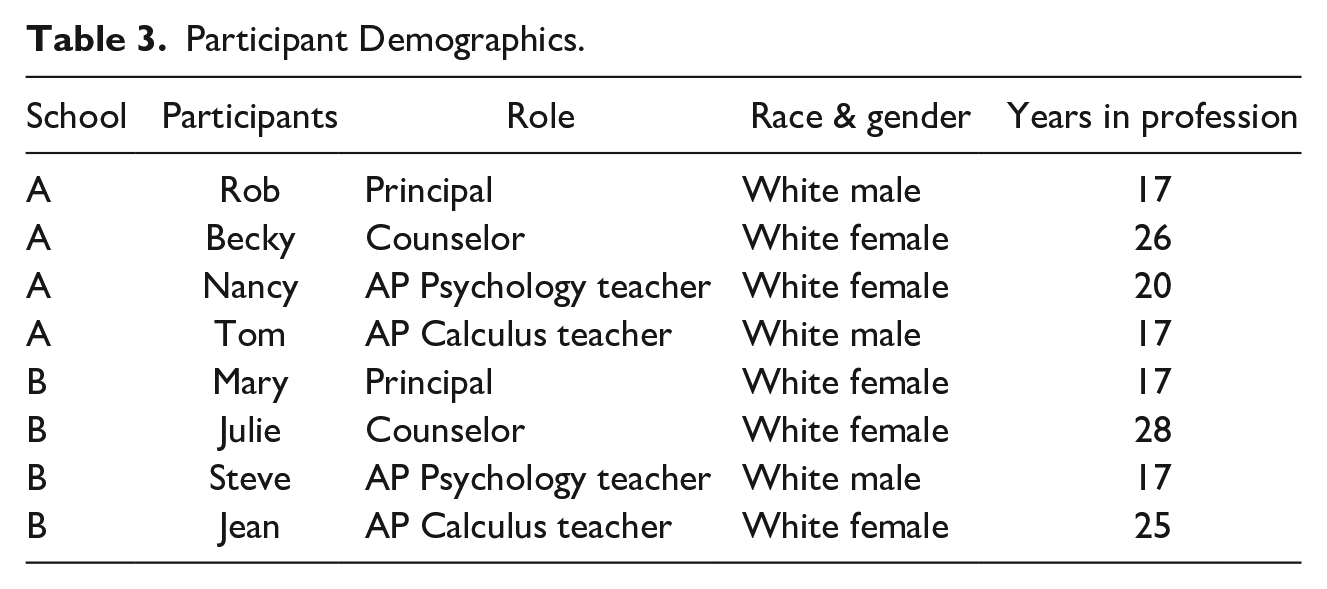
Four participants from each school included a principal, guidance counselor, AP psychology teacher, and AP calculus teacher (See Table 3). There was no request made for the two AP teachers in each school to teach psychology and calculus. This was a coincidence based on principal recommendations and who consented to participate in the study. Pseudonyms were assigned to all participants and participants self-identified their race. The principals were Rob, a White male from school A and Mary, a White female from school B. Both had 17 years of experience in education. The guidance counselors from both schools were White females, Becky from school A and Julie from school B. Both had over 25 years of experience. The two AP psychology teachers were Nancy, a White female with 20 years of experience from school A, and Steve, a White male with 17 years of experience from school B. Lastly, the AP calculus teachers were Tom, a White male from school A, and Jean, a White female from school B. Both had 17 years of experience.
Participant Demographics.
Data Collection
School documents were analyzed that showed AP course offerings, enrollment criteria for AP courses, protocols that explained how enrollment criteria were implemented, the roles of various staff members in carrying out these practices, and who was responsible for monitoring and evaluating them. This included information from student handbooks, electronic, and printed materials. Sources accessed included the state Department of Education’s website to identify AP courses offered, class rosters that reflected the race and gender of students in AP courses, and school websites. Student documents were viewed with administration permission and included non-identifiable student data.
Interview Data
Individual interviews lasting approximately one hour each were conducted with each participant, for a total of eight interviews. Generating interview questions, discerning which questions will be most appropriate, and effective facilitation skills are important for quality interviews. Interviews were conducted in person because they had the potential for providing the most rich data (Corbin & Strauss, 2015). This approach allowed for observation and documentation of body language, in addition to verbal responses. As part of the interview protocol, participants were presented with their school data regarding African American male enrollment in AP courses.
Data Analysis
Interviews were recorded and transcribed by a professional transcriber. Data were coded by hand. This was an ongoing process that consisted of individual analysis, conversation between the two of us, and revision. In the first cycle of coding, descriptive and in vivo coding were used. Descriptive coding involves describing content with nouns, and in vivo coding involves selecting words or phrases directly from the text that captures the essence of their content (Saldaña, 2016). Initially, we read the transcripts individually and wrote analytic memos and initial codes. Then, we jointly developed categories by discussing our memos and categories. In places where we coded a similar passage but used different language to explain a similar phenomenon, we discussed and agreed upon language that was the most descriptive. After our initial conversations, the first author transferred chunks of interview data to a large sheet of poster paper with space to record memos. Then, as more interview data were collected, we discussed our analysis as we reviewed the poster board of data and memos. Through this ongoing process, codes and categories were developed and revised, and chunks of data were collapsed into larger buckets of data until the themes emerged.
Positionality Statements
Both authors are African American. The first author is male and the second is female. We acknowledge that our race, genders, and professions largely influenced our interest in this topic. We shift to first-person narrative to explore our positionalities.
Danny: My education began in the late 1960s at a time when I observed and experienced how racism and poverty impacted academic and career expectations for me and other students of color. Representing less than five percent of the population, students of color in my high school were almost invisible, from the lack of pictures of African Americans on the school walls to lack of representation in the curriculum. These experiences influenced my choices regarding relationships, where to live, employment, and my educational aspirations.
My experiences influenced my choice to use Critical Race Theory. Despite the increasing numbers of students of color attending and graduating from the school district in which I work, the underrepresentation of African American males in AP coursework has persisted. I wanted to explore AP enrollment criteria by bringing attention to the systemic structures that support these disproportionate outcomes for African American males. Being aware of how my “blackness” may have affected interview responses involving an all-white staff when addressing the underrepresentation of African American male students was important during data collection and analysis. Questions about race in this context can create discomfort, especially if the person asking the questions is an African American male. As a result, interview data may have been impacted by my presence because participants may have been hesitant or reserved in their answers in an effort to not demonstrate outrage when responding to their school’s data out of allegiance to their colleagues. I also acknowledge that as an African American male, my passion about this research topic influenced how I analyzed the data. Because I could relate to the students who were the ultimate focus of my study due to my race and gender, I was empathetic. At the same time, I took needed breaks and reflected, letting the data tell the story. Finally, I was a district administrator over one of the schools. Therefore, in order to mitigate possible discomfort, participants were selected with whom I did not have a personal.
Kendra: Racism and race equity have been personal and academic interests of mine since I was young. My father’s civil rights activism influenced my decision to study race and education as an academic. Prior to becoming a professor, I was an education practitioner in various roles, some of which were dedicated to increasing academic success of non-White students, and African Americans in particular. I also taught AP courses and witnessed discussions among my colleagues about student placement. I became aware of the ways in which educator practices influence enrollment, largely through recommendations (or not) to students and families.
Because of my personal and professional position, although an African American woman, I can relate to Danny’s passion and interests and nurtured his commitment as a researcher and advocate for African American male excellence. Our conversations about the data invited many personal reflections about my background, professional experiences, and individual students. I wondered about the educational trajectory of some, who with a stronger advocate, might have been different. These reflections underscored the importance of applying the implications of this research to practice. At the same time, our conversations about the codes, categories, and themes helped to continually draw my attention to make meaning of the participants’ experiences based on their narratives.
Findings
Data analysis yielded four themes regarding the selection criteria and enrollment of African American males in AP courses. First, there were informal and formal routes for accessing AP courses. Second, key faculty roles and collaboration with faculty and families supported AP structures. Themes three and four illuminated barriers: faculty assumptions about African American males and color and gender-blind analysis of disproportionality contributed to the underenrollment of African American males.
Theme One: Various Routes For Accessing AP Courses
There were various formal and informal structures that created access for students and families to enroll in AP courses.
Formal structures
Formal structures involved the identification of eighth grade or younger students in gifted and talented programming for enrolling in honors courses beginning in ninth grade. When students were in eighth grade, middle school honors teachers typically made AP recommendations to the high school guidance counselor for a student’s ninth grade year. Rob, the School A principal, explained, “that kind of puts them [the students] in a position to be recommended eventually in their junior year for AP Literature and their senior year for AP Language.” This process was confirmed by Becky, an AP Psychology teacher, who explained, “Typically, the kids are already in an honors program and that feeds up through our middle school.” In school B, Jean, an AP calculus teacher, shared the same understanding of this route to AP courses.
Other formal structures involved high school guidance counselors meeting with eighth graders at a designated time of the school year to begin the scheduling process. They reviewed the high school course guide and engaged students in conversations about their interests to identify relevant course selections.
When enrolling students in AP courses, the guidance counselors reviewed student transcripts, standardized test scores, and teacher recommendations. Tom and Nancy, AP teachers at School A, shared their understanding of this process. Tom stated, “It’s kind of a fluid movement from the eighth grade up. As freshmen, they sit down with their counselors and plan out their high school career.” Nancy explained, “the course guide lays out the descriptions of all our courses which are in compliance with [state] courses that are available.” Both appeared to have a superficial understanding of the counselor’s role in the scheduling process. Although they taught AP classes for several years, neither teacher invested in understanding details regarding access to those classes. Therefore, they were not able to reflect deeply about areas in these systems where inequities for African American males could occur. In some ways, this is indicative of dysconscious racism. King (1991) explained “dysconsciousness is an uncritical habit of mind. . .that justifies inequity and exploitation by accepting the existing order of things as given” (p. 135).
Faculty confusion about formal processes was evident in other ways. In School B, there was confusion surrounding the specifics of the counselor’s role in the AP enrollment process and AP criteria. For example, regarding how students were identified for AP courses, Jean stated, “I can’t think of what it’s called [the course guidebook]. You’d have to ask the guidance department. I’m not a part of that process. . .I don’t want to give you misleading information.” There was also a lack of knowledge regarding AP recommendations from middle to high school. Steve from school B shared, “Now what we don’t know at the high school is how these students are identified for accelerated classes at the middle school.” Steve also confirmed the use of a common class as the vehicle for scheduling student courses. He stated, “I believe they meet in their English classes. . .They start with the juniors, which will be the seniors and move on to the sophomores and then the freshmen.”
Informal structures
The informal process of accessing AP courses was manifested largely through conversations and relationships among school staff, parents, and students, whereby those responsible for implementing AP programming used their professional judgment. This was evidenced by how AP teachers and guidance counselors described their conversations with students about past academic performance, standardized test scores, and student interest. In school A, Tom shared, “Performance in previous calculus classes like Pre-Calculus and Algebra II don’t always determine how well you’ll do.” He emphasized the importance of looking at other student attributes that may not be reflected in previous grades. Steve from school B recounted how he provided insight to counselors when considering a student for AP Psychology. He explained, A counselor will email me and ask, “Do you think this person will make a good candidate for an AP student?” And based on some of the things I’ve seen in class as far as just their ability to attend, turn in work on time, I mean those are just some of the basic stuff.
It becomes clear how student access is based on the perceptions of the teacher. Without a clear rubric or written policy about the criteria for AP enrollment, a single teacher can influence the decision-making about a student’s access. Further, Steve’s approach to assessing a student based on performance in his class, contradicts Tom’s belief that previous performance is not necessarily a predictor of future performance in an AP class. If nothing else, these examples demonstrate a lack of consistency in making judgments about students, which can lay the groundwork for inequities.
From a guidance counselor’s perspective, Julie highlighted efforts she made to work around prerequisites for AP courses so they did not become a barrier for student access. She emphasized how counselors tried not to eliminate students because they were not able to participate in AP English summer readings, a prerequisite for AP English. Instead, she considered AP English placement after assessing the student’s situation.
Some faculty had conversations between students and parents as encouraged by Mary, School B’s principal. She shared, “So if there is a teacher or student or parent that desires to have that conversation, then we’ll have that conversation and look at the composite of the student as opposed to just test scores or grades.” A compelling argument regarding the value of providing informal access to AP coursework for students came from Nancy, the guidance counselor from school A, who explained, Sometimes a lot of kids just want that challenge. I’ve even had special education students in low grade courses take an AP History class. My philosophy has always been that a kid has a right to be successful but they also have the right to fail so why not try. The only way you’re going to learn is through experiences. So that particular student, although he survived, he had 2 Bs and a C in AP History.
Nancy’s perspective illustrates that possibilities for taking these courses for students is often dependent upon the teacher. Such a teacher-dependent avenue does not generally create equitable access for students.
Theme Two: Key Faculty Roles Shaped Student Access
Specific roles were assigned to key faculty, including counselors, administrators, and AP teachers, to educate students and parents about how to access those courses. Participants indicated that the guidance counselor’s role was central to overseeing the AP enrollment process. This required reviewing student transcripts to ensure all prerequisites were met, receiving AP recommendations from teachers, academic scheduling, and engaging with parents regarding questions about course choices. Nancy, School A’s guidance counselor, valued communicating with students and parents in a manner that created understanding about scheduling and AP enrollment criteria. Likewise, Julie, the guidance counselor in school B, explained that high school counselors talk to students in the eighth grade. Further, Steve, an AP Psychology teacher in school B, shared, “The counselors are really the filter that looks at grades, examine grades, examine maybe past performance.”
Principals were responsible for overseeing AP processes through the adoption of curriculum to promoting AP programming to students, families, and community organizations. Rob in School A and Mary in School B tried to ensure that all students and parents had access to academic resources, including the school course guide. The principals supported guidance counselors scheduling all students and improving student access to AP courses. Mary explained the purpose of the course guide as helpful because “it’s a little more detailed. . .It helps the counselors. It helps parents and students kind of see where they fit in with a natural flow chart.” Mary’s explanation rests on the assumption that the rationale for the sequence of courses is the only choice to be made and that all students are aware of this flow of courses that lead to AP enrollment. This is problematic, given that not all faculty are aware of all aspects of the AP process. Therefore, it is less likely that students and families know how to access this information.
AP teachers collaborated with counselors to recommend, schedule, and seek parent approval to enroll students in AP coursework. Becky, the AP Psychology teacher from school A, explained, “So with Psychology. . .the guidance counselor will come to me, we sit down, we talk about if it’s going to work [recommendation to take AP psychology] for them or not.” Another example of collaborative efforts was shared by Tom, “The teacher can sit down and discuss it [accessing AP calculus] with the student and parent and counselor.” Conversations about the benefits of taking AP coursework were encouraged. Jean recollected, “They [students] may say, ‘I don’t want to take it.’ Then we’ll talk about the role calculus will play in college.” Tom, the AP calculus teacher in school A, expressed concern about students who do not understand the value of taking AP calculus. He shared that sometimes students believe that AP calculus is too hard. He saw his role as assuring students that it is a rigorous course but if they are willing to persevere and work hard they can be successful. Tom also emphasized to students that this course will prepare them for college work.
Barriers to equitable access to AP classes reveal themselves when taking a critical look at how AP programming is implemented, monitored, and evaluated. Faculty assumptions about African American male students and color and gender-blind analysis are discussed next.
Theme Three: Faculty Assumptions: “We Don’t Want Them in Classes That Are Too Hard. . .”
The assumptions made by staff about student readiness, parent priorities, values, and cultural influences regarding student educational choices were barriers to student enrollment. Staff members struggled to explain their thoughts about the disproportionate enrollment of African American males in AP courses. Some perceived a student’s level of maturity, confidence, previous academic preparation, poor parent support, and priorities, or not valuing education, as factors in a student’s readiness to take AP courses. These concerns were echoed in school B by Jean who said, “I just don’t know how to get to them. To the point where they recognize the importance, they recognize the value of education.” Likewise, Steve asked, Why are we seeing that disproportionality? Why are so few African American males signing up for a class that they are capable of doing, that they are certainly capable of doing and doing well in? So why are they not signing up for that course when they do have access?
Julie, school B’s guidance counselor, reflected on an issue that she believed contributed to this disproportionality: I made a list last year. I have six African American males who were asked to drop an AP or honors class by a parent or a coach. They are great athletes and we don’t want them in classes that are too hard because we want them to either meet [state athletic eligibility requirements] so they can play Division I sports or again we want the G.P.A higher for whatever reason.
The dilemma that she described brought attention to a perceived conflict between academics and sports for some African American males. Additionally, her misguided compassion for her students is a racist ideology that reifies the athletic/academic paradox explained by Morris and Adeyemo (2012). They noted that the paradox was borne from the perception that African American males are natural athletes and is rooted in “the perceived lack of opportunities that poor black families and communities face in traditional or academic careers….[it] undermines the academic achievement of black male students by inflating athletic careers as a viable future” (p. 29).
Steve and Jean shared concerns regarding student and parent choices and student readiness for AP coursework. Jean stated, “Some of that comes down to their choices and parents and the kids making their own decision to be an idiot. You know what I’m saying. Because most kids aren’t mature enough.” Steve also commented, “Perhaps the mindset of having an AP course and the confidence it takes to say, ‘I’m going to sign up for AP, I’m going to do this.’ The confidence may not be there for them as much.” Steve’s comment brings attention to the messages, direct or implied, that African American males may receive about their ability to be successful in AP courses.
These assumptions revealed the deficit perspectives the educators maintain about African American males. As with previous studies, the educators placed the burden to improve academically on the students without reflecting on how they contribute to a negative race and gender ideology. As Rogers and Brooms (2020) pointed out, ideologies “inform how teachers position themselves in relation to students and how they work to ameliorate the challenges they face (or not)” (p. 463). The deficit-laden beliefs teachers had about how academic success or failure manifests itself influenced the level of expectations they upheld for African American males. That is a testament to the responsibility that teachers, from a critical race perspective, must take to ensure they unpack racial and gender biases, relate to, and support all students.
Theme Four: Color and Gender-Blind Analysis of Disproportionality
Faculty lacked knowledge about the disproportionate numbers of students by race and gender enrolled in AP courses, largely because they lacked experience analyzing data from a racialized perspective, and certainly not an intersectional lens of race and gender. The AP teachers had some knowledge about the trends in their subject area but had little to no knowledge of how AP students were being impacted at the district level. When faculty were presented with data that showed the disproportionate underrepresentation of African American males in AP courses, most were surprised and some appeared visibly distraught. Tom from school A said, “That’s crazy. I guess I don’t know what I was thinking when I responded to that. I was just looking at what I’m used to seeing in my class.” In response to viewing disproportionate numbers for her school, Jean from school B said, “That is interesting and that is low. Across the board it’s not good. . . Horrifying, how do we fix it? I don’t know how we fix this.”
Another barrier was the inability of faculty to directly respond to being asked what they would change about AP enrollment criteria to address the disproportionate underrepresentation of African American males. Many of the ideas generated from their responses would require implementation prior to high school. Rob, the administrator from school A, said I think a lot of it is informing and encouraging from a very young age of what a great opportunity it is to take AP. . . I guess just more education from the lower level is where I’d look at to start.
The same belief was shared by Jean who asserted, “You have to start early. You’re going to have to back it up at least to middle school. And try to do something different with kids across the board to recognize potential and recognize kids who are motivated.” Educators were willing to suggest changes in earlier years with little engagement or reflection about what they as individuals or collectively, could do differently. It is unclear if this reveals a lack of knowledge about how to make changes, a lack of efficacy, or both.
Participants also generated ideas about making AP criteria more flexible and going beyond traditional actions such as reviewing academic grades, standardized test scores, and automatically enrolling students from elementary and middle school gifted and talented programs into high school AP courses. Some participants advocated for focusing more on qualitative attributes such as student interest, motivation, and effort. This included educating students and families about AP courses earlier and presenting them as being accessible, rather than selective or out of reach. Even when sharing these ideas, participants did not indicate these were actionable steps that they could champion, again revealing a lack of information and/or efficacy regarding implementation. It is possible that a lack of experience analyzing data and discussing race and gender was a root cause.
It was evident that participants were not engaged in conversations about race and/or gender and disproportionality in other facets of their work. This was not surprising given extant literature. For example, Pollock (2004) asserted that talking about race creates a dilemma for people who do not know when and how to talk about race. However, despite their discomfort, school leaders must continue to engage in these conversations so that inequities can be dismantled for the benefit of African American males. When interpreting the content of participants’ responses through the lens of equity, race and gender were crucial in answering the study’s research questions.
Discussion
Question #1: How do written policies and commonly used practices guide the implementation of AP criteria in two urban high schools? As described above, formal and informal practices focused on systemic processes involving key staff members, such as guidance counselors who are responsible for student course enrollment. Advanced Placement teachers not only taught AP courses but also promoted the courses with students and parents at various events. Administrators were responsible for monitoring AP processes and often interfaced with guidance counselors to support these systems. Faculty expectations of students were often based on past academic performance, and completion of pre-requisites. Teacher recommendations were based on student interest, motivation and effort, and parent requests. Faculty responsible for AP implementation and oversight supported student access by providing relevant information and guidance. The implementation of enrollment criteria appeared to be colorblind, gender, and class neutral yet school data showed that AP enrollment outcomes were not. This refutes the notion of colorblindness (Crenshaw, 2011) and leads to the second research question.
Question #2: What patterns are revealed regarding decision making, enrollment criteria, and African American males’ enrollment in AP courses in two urban high schools? Data from both high schools revealed disproportionate trends based on gender and race, reflecting a significant underrepresentation of African American males. AP enrollment data in both schools aligned with national data and extant literature (James et al., 2017; Solorzano & Cornelas, 2004). An analysis of the implementation of enrollment practices through the lens of CRT reveals race-based patterns and participants did not readily acknowledge the possibility of race and gender bias at minimum, during reflection about their practices and student outcomes.
The application of AP enrollment criteria appeared to be neutral, but outcomes clearly demonstrated that those practices perpetuated inequitable access for students. These outcomes were consistent with Delgado and Stefancic (2000) who highlighted how socially constructed norms are determined by the dominant culture, making it more challenging to identify potential bias and inequities in an institution. Written policies and practices for accessing AP courses for both schools were similar and provided clear pathways for student access. The criteria primarily focused on student academic performance but also took into account other attributes that acknowledged a student’s potential. Some faculty responsible for implementing and overseeing AP programming demonstrated flexibility in interpreting criteria and created non-traditional or informal pathways for some students to access AP coursework.
Faculty in both schools developed materials and enrollment processes for accessing AP programming, but neither communicated a process for retrieving student and parent feedback in a comprehensive and data-driven manner. Doing so would have allowed students and parents, particularly those of color, to have more of a voice in this process based on their lived experiences, one of the tenets of CRT. As Ledesma and Calderón (2015) pointed out, “Communities of color understand the need to reform schools that are not serving them” (p. 212). Such feedback from families would have provided the staff with a means to gauge the cultural responsiveness of their processes. For example, student and parent input about the usefulness of the high school course guide, parent availability for times and dates set for college and career events, and the AP enrollment process could be informative. Equitable parent input will also decrease the likelihood that AP access is based on informal, unclear guidelines, and parental influence from a select few (Anderson & Oakes, 2004).
Patterns in AP enrollment and decision-making revealed a lack of monitoring of student enrollment for proportionality based on race and gender. Because this was not being done, it created a barrier to asking critical questions about student disproportionalities in AP enrollment. Both schools had access to disaggregated data by race from the College Board and in their schools. The problem was not data availability but a lack of priority in collecting and analyzing this data as a part of monitoring AP programming for equitable student access. Participants avoided speaking directly about the underrepresentation of African American males and what might need to change in the enrollment criteria/process to address it.
Further exploration into participants’ avoidance of directly discussing the disproportionate outcomes for African American males centered on their discomfort, as expressed in their body language during the interviews. This is in contrast to the participants in Allen’s (2015) study who openly reflected about race. Instead, the dialogue focused on strategies that would improve AP access for all students but would not directly target African American males. If the two schools remain focused on strategies that impact all students and are not targeted, AP enrollment practices will likely continue to perpetuate the same exclusionary practices (Crenshaw, 2011).
The self-identified whiteness of all participants was likely a contributing factor to their inability to address racial disproportionality. Critical race theorists assert that when those responsible for setting the norms are from a dominant group, positions of privilege create blinders that can lead to assumptions and bias, resulting in barriers to creating more authentic strategies for addressing inequities (Crenshaw, 2011; Ladson-Billings & Tate, 1995). This inability to discuss African American males at the intersection of race and gender while also allowing for the distinct individual characteristics that make them each unique, is complex. The complexities of understanding interlocking oppressions (Capper, 2015; Crenshaw, 2011; Howard & Navarro, 2016) likely contributed to the educators’ color and gender-blindness when asked about disproportionality. Furthermore, a discussion of African American males illuminates why constructs such as colorblind or colormute (Pollock, 2004), do not adequately help shape dialogue around intersecting identities.
Segall and Garrett (2013) argued that “white teachers ignore race and work hard to maintain that ignorance in the form of colorblind discourses” (p. 266). Their interview participants rarely discussed race or they conflated race with class. The researchers asserted that teacher preparation faculty can develop teachers who are better prepared to discuss race if candidates understand how they make meaning of race and “the other.” Castagno (2008) explained that teachers’ silence regarding issues of race was borne out of an effort to maintain and legitimize whiteness - a culture of minimizing racism and inequities based on race, allowing for some teachers to buy into the belief that race isn’t a relevant factor. Furthermore, the use of coded language to avoid authentic discussions about race (Capper, 2015), confusing culture with race, and equity with equality is common practice in school discourse.
Our findings underscore previous findings about racial disproportionality in AP courses and gifted education (Ford, 2014; Ford et al., 2008). Therefore, our recommendations are borrowed in part, from scholars in that field. Additionally, our focus on African American males reveal that further exploration of representation beyond a singular racial or gender lens is needed to increase access for this subgroup. This focus on race and gender informs our recommendations.
Recommendations for Practice and Research
Educators should engage in ongoing discussions that center race and gender, as they envision how to create equitable access to AP courses (Capper, 2015; Greer et al., 2018; Howard & Navarro, 2016; Segall & Garrett, 2013). Ongoing collaboration and professional development, including authentic dialogues and critical self-reflection about systemic and institutional racism could remove barriers to equitable student outcomes (Delgado & Stefancic, 2000; Ford, 2014; Ford et al., 2008), including increased representation of African American males in AP courses. Yet, educators must have the will to start and sustain these discussions, particularly in inter-racial contexts. In practice, educators can follow specific race conversation protocols during purposefully scheduled opportunities that identify and interrupt deficit-laden thinking and discourse about African American males (Johnson, 2017). Relatedly, teacher preparation faculty must consider how to make anti-oppressive practices a central part of the learning experience (Ford, 2014).
Investment in African American males ought to be targeted and data-driven (Greer et al., 2018) through a lens of race and gender (James et al., 2017; McGee & Pearman, 2014). Changes made to recruitment and enrollment patterns should be based on data analysis of proportional representation of student subgroups, keeping a minimum threshold of representation in mind (Ford, 2014). Regarding an Equity Index (Ford, 2014; Solorzano & Ornelas 2004), we recommend gender be included in addition to race to assess and monitor disproportionality. Finally, to create affirming spaces that create counternarratives to deficit views of African American males, schools should invest in transforming the physical space to include visual representations of culturally relevant, positive African American male imagery and liberatory pedagogies (Harper, 2015; Johnson, 2015).
Future research should explore barriers to equitable access to AP courses for African American males at points earlier than eighth grade. The scope of this study was limited in recognizing other educational pathways to AP coursework at the secondary level. In kindergarten through 12th grade, select students are often identified for pathways such as preschool enrichment programs and gifted and talented programs at the elementary and middle school levels. These pathways allow students to enter AP courses well before they enter high school. As a result, a number of these students are automatically enrolled in AP courses when they move to the secondary level (Suggs, 2010). Examining how enrollment criteria are defined, implemented and monitored would help to identify factors that may support AP participation for African American males in one school and create barriers in others. Finally, an exploration of same-race gender gaps in AP enrollment is important. While African American males in the two schools were underenrolled, African American females were more equitably represented in AP classes (see Table 2). This phenomenon is something to explore further and will likely draw upon race, gender, and intersectionality to frame research in this area (Howard & Navarro, 2016).
Conclusion
Examination of the processes for AP enrollment through a critical race lens will unveil inequities in how the process is carried out, but may also challenge assumptions about academic achievement upon which AP courses are maintained. The troubling of assumed systems and patterns is a necessary outcome of critical race analysis. A problem arises when there is no process in place to assess, monitor, evaluate, or reflect on how AP enrollment criteria is experienced by the students and families served. Both schools lacked ways to gauge how AP criteria impacted student enrollment outcomes, and neither focused on strategies to remove barriers to equitable access for all students.
Educators need to become aware of how their racial and gendered ideologies influence their perceptions and actions in order to effectively interrupt the underrepresentation of African American males in AP classes. Ongoing professional development that allows for authentic conversations about race and gender and exploration of inequities are important. Most importantly, this work develops faculty’s advocacy to dismantle those educational inequities. Professional learning about their ideologies and practices with “Black male students offers insight into how teachers can serve as change agents. . .which is necessary for sociopolitical transformation within and beyond the classroom” (Rogers & Brooms, 2020, pp. 465–466).
Footnotes
Declaration of Conflicting Interests
The author(s) declared no potential conflicts of interest with respect to the research, authorship, and/or publication of this article.
Funding
The author(s) received no financial support for the research, authorship, and/or publication of this article.
