



Abstract
Urban schools are becoming increasingly linguistically diverse. However, principals are not adequately prepared to address linguistic variation, and in particular, issues related to African American Language (AAL). This study explores the language ideological voices of urban school administrators. Focus group sessions were conducted with 15 administrators of predominantly African American schools about the function of AAL in their students’ lives. Participants demonstrated variation in views toward AAL and struggled to name the language. These discussions were mediated by multiple, even competing, language ideologies, as they attempted to converse about the use of AAL in schools.
Introduction
The cultural and racialized meaning of urban, urban spaces, and urban education have been debated and discussed in a variety of ways (Rotenberg & McDonogh, 1993). While it generally signifies large cities with high density population in contrast to rural and suburban areas, within the United States the term has come to signify the experiences of non-dominant populations, students of color, and high poverty communities (Breggin & Breggin, 1994). For decades, leadership and administration in public schools have equated the term “urban” with poor students of color and a narrowing of the curriculum in their schools (Russell, 1986). It has come to serve as an indirect and often deficit proxy to describe Black people, their communities, schools, histories, culture and linguistic experiences. In working with urban schools and their administrators, it is clear that they identify the term “urban” with Black students (Milner, 2012). Thus, for many administrators, particularly self-identifying White administrators, the topic of urban education represents curricular practices that support the needs of Black students. One critical aspect of this is understanding the socio-linguistic needs of Black students and the complexities of African American Language (AAL; King, 2020). The purpose of this study is two-fold. First, we aim to “answer the call” for education administrators to be more conscious, mindful, and proactive in the fight for linguistic justice (Baker-Bell, 2020). Second, in response to developing school leaders with an explicit anti-racist stance (Welton et al., 2019), we make explicit the tacit beliefs of urban school administrators about the nature, function, and purpose of language and learning in Black communities.
Understanding the complexities of race and language has long been a focus of urban education studies. In language education, African American Language 1 (AAL) has been eclipsed by bilingual education despite the volume of work that argues for AAL as a sovereign language. National languages are afforded status and privilege at the expense of non-dominant languages. Bilingual education, for example, may refer to Spanish and English, but not varieties of Spanishes or Englishes. The recognition of translanguaging (Williams, 1994)—which recognized the dynamic interplay of linguistic resources in the languaging of bilingual and multilingual students—and the development of translanguaging pedagogy (García & Wei, 2014) has allowed for the challenging of monoglot perspectives in schools and allowed debates of language varieties to reemerge. Recently, Bauer et al. (2020) noted how translanguaging theory is a useful framework to understand the full linguistic repertoires of African American and LatinX students in dual language classrooms. Additionally, the sub-field of raciolinguistics (Alim et al., 2016; Flores & Rosa, 2015) has pressed for the inextricable link between language and race. Thus, as the literature on language education continues to become more nuanced with intersectionality, it brings up newer questions for the role of language policies and pedagogies in schools, particularly as influenced by school leaders. School leaders need to be active participants in shaping debates about language especially as it relates to Black communities and this work contributes to the emerging raciolinguistics literature.
Debates about the nature, function, and purpose of African American language have been at the root of American history and its relationship with the black diaspora (Baldwin, 1997). Ambiguity and ambivalence about its status points to a fundamental issue within America’s unresolved racial tensions. It bubbled up to the public consciousness in the late nineties in the infamous “Ebonics” debates in Oakland. Questions about its legitimacy as a bona fide language points to a deeper question about the humanity of Black people in the Americas. More importantly, Black English is the creation of the black diaspora as they came here “chained to each other” and “neither could speak the other’s language.” (Baldwin, 1997, p. 5). Conventional approaches to language and linguistics fall terribly short of understanding its emergence and continued sustainability. Thus, one should not expect to categorize it simply with the more neutral conventions of dominant national languages but with an ethos of enslavement and oppression. Baldwin states, This was not, merely, as in the European example, the adoption of a foreign tongue, but an alchemy that transformed ancient elements into a new language: A language comes into existence by means of brutal necessity, and the rules of the language are dictated by what the language must convey. (Baldwin, 1997, p. 5)
While language is sometimes discussed in the multicultural literature, how school leaders view AAL specifically is nearly non-existent (Smitherman, 2011, Personal Communication). Two notable studies used the African American English Teacher Attitude Scale developed by Hoover et al. (1997) to measure the attitudes of high school principals. McClendon’s (2014) study of 22 high school principals indicated that there was a neutral-to-mild set of attitudes held among the principals. In 2018, McClendon and Valenciano found a similar pattern among 44 principals in Houston. The interpretation of the scale categorizes attitudes in deficit, difference, or excellence as an ordinal approach, which may not be able to parse out the nuances that may occur within these categories. Eighteen and twenty-two percent, respectively, of participants indicated that AAL could be harmful to one’s career and mildly preferred students not use it. McClendon pointed out, further training is needed on AAL is needed both to become aware of their expectations of AAL, but also in regards to the impact they have on faculty and school culture.. Specifically we ask: How do urban school administrators view and name African American Language (AAL) and its use in schools?
Literature Review
Anti-Racism and School Leadership
While much of school policy is set at the state or district level, front-line building management is critical in setting up school wide practices to promote an instructionally sound and socially just education. Administrators in urban schools, specifically principals, bear a large portion of the burden in setting policies and shaping school culture. A principal’s position is powerful and includes a variety of roles, including the public face of the school, management of staff, and instructional leadership (Lortie, 2009). Beyond management abilities, a principal must have an understanding of the linguistic and cultural contexts of their school communities. Stovall (2004) noted that the position of school leader is contested as the role stands in the space between teachers, the public, and higher administration. While administrators may receive some education on cultural diversity, it is not guaranteed. Survey data collected and analyzed by Haar and Robicheau (2008) noted that a vast majority of principals and superintendents thought that institutions of higher education should provide more training on cultural diversity for administrators, although nearly two-thirds had received some training through their districts.
In 2019, Urban Education published a special issue entitled “Negotiating the politics of anti-racist leadership: The challenges of leading under the predominance of whiteness” (Welton et al., 2019). In this issue, several papers were published describing the ways in which school leaders confront White Supremacy and Whiteness in policies that affect schools. A major implication of these studies was to include explicitly anti-racist instruction in school leader education (Diem et al., 2019) and for school leaders to be self-critical (Allen & Liou, 2019). How school leaders may develop anti-racist language policies within their school, though, merits further exploration.
In New York City schools, it was found that widespread dismantling of bilingual programs following a shift to more restrictive US language policies appeared to be tied to lack of formal training in linguistics or language diversity (Menken & Solorza, 2014). If administrators in linguistically diverse schools have not been prepared well for the linguistic diversity they will encounter, then it would seem that specific education on AAL is likely also absent from administrator development. Administrators need to be equipped with the knowledge of linguistic practices and histories of African American students in order to understand how linguistic racism continues to play a role in the marginalization, discrimination, and the blatant killing of unarmed African Americans (Baugh, 2015) and how language is vital to achieving educational equality and an education system in which Black Lives Matter (see Garza, 2014).
Language Attitudes toward AAL
While there is little information on the attitudes of administrators toward AAL, a brief look at the literature on AAL over the past three decades reveals much about how teachers view AAL. A dominant approach taken up by researchers to study language attitudes has focused on the individual and group reactions to AAL language structures (Bowie & Bond, 1994; Labov, 1968; Mitchell-Kernan, 1972). A number of dissertation studies (Boyd, 1996; LeMoine, 2003; Mackey, 1999) sought to explicitly elicit teachers’ and preservice teachers’ views of AAL by drawing on the language attitude scale (LAS) by Taylor (1973). Overall, these studies reported slightly negative views toward AAL, though results were mixed. Champion et al. (2012) used the LAS to measure the attitudes of 132 preservice teachers toward AAL, revealing that 85% of the students held negative attitudes and noted a significant effect of race of respondent on the attitude.
While some studies have found that multicultural or linguistics classes had little impact on teachers’ attitudes (Abdul-Hakim, 2002; Boyd, 1996; Mackey, 1999), others reported that specific training in AAL could have an impact on teachers’ attitudes (Bowie & Bond, 1994; LeMoine, 2003). One study notably mentioned the correlation of school philosophy or school culture to teachers’ language attitudes (Blake & Cutler, 2003).
In a scalar interpretation of attitudes, the nuance of language ideological stances are lost. Within the context of robust qualitative responses, language ideological stances can be inferred to establish whether participants align with deficit, difference, resource, or language rights perspectives toward AAL. With this study extending the notion of attitudes to school philosophy and policy, a deeper understanding needs to be gathered about attitudes and practices of those who help mold the philosophies and policies of particular schools, namely school leaders. School leaders are critical in setting the policies and structuring practices in schools. They not only set school-wide policies, but they also are integral in community building, deciding curricula, hiring faculty and staff, and instructional leaders (Darling-Hammond et al., 2007). Thus, understanding the language ideologies of school leaders may yield helpful information for education and professional development practices.
Use of AAL in Schools
Numerous scholars have called for the use of AAL in classroom practice (e.g., Alim & Baugh, 2007; Baker-Bell et al., 2017, Young et al., 2018). AAL scholars continue to echo the calls made decades ago for student’s rights to their own languages (Baugh, 2015; Smitherman, 1995), and have begun to document the important role AAL plays in the construction of communication and identity across ethnic lines in vastly changing urban schools (Paris, 2012). Baker-Bell et al. (2017) show how teachers understanding of Black Language can be enhanced using contemporary topics such as the Trayvon Martin killing along with linguistic concepts that develop Black Language consciousness. Unfortunately, these practices have rarely been entrenched in principal preparation. Often speakers of AAL are assumed to have a language disorder or a deficit because of the linguistic differences (Seymour et al., 1998). The speech-language pathology literature has noted an over representation of African Americans in special education because of the linguistic differences (Baugh, 1995, 2015; Robinson & Stockman, 2009). The use of AAL is often viewed as a deficiency of the speaker in particular because of the standard language ideology (Lippi-Green, 2000a).
Conceptual Framework
Language Ideologies
Language ideologies (LI) have been defined as “any sets of beliefs about language articulated by users as a rationalization or justification of perceived language structure or use” (Silverstein, 1979, p. 193). They may be explicitly stated or tacitly underlie the decisions we make regarding language. They are manifested and enacted through social practices, including educational policies as well as in classroom learning activities (Razfar & Rumenapp, 2013). LI, as research, is not focused on the structure of language as such, but rather on the way those structures are viewed and how they organize society. This can be seen in competing interpretations of the linguistic features of AAL. Different ideological stances would presume AAL is a slang, dialect, or language depending on the ideological footing. If the form is viewed, as it often is, as “incorrect” or “non-academic” in relation to a presumed standard, it is seen as a deficit of the speaker. Other interpretations of the same form of language could, on the other hand, be viewed merely as a code that differs from another code such as a dialect, a potential resource to facilitate social interaction, or an essential demonstration of a human right to have personal autonomy in linguistic choices. Each of these orientation play a role in the way our data is interpreted below. LI necessarily includes the broadest levels of context within the unit of analysis in which some ideologies may be considered hegemonic but not determinant. In any given context there are often competing ideologies (Razfar, 2012). For example, teachers are often aware of the sociopolitical implications of such practices as school reform (Gitlin & Margonis, 1995) and mandated literacy curricula (Pease-Alvarez et al., 2010) and can assert agency to resist or negotiate these political acts.
LI, as the common sense view of language, mediate policy decisions and national talk about language (Gonzáles & Melis, 2000, 2001). Lippi-Green (2000b) points out that the definition of AAL is highly contested. For instance, she explains that AAL is used as a marker of resistance to mainstream White culture or to build solidarity with fellow African Americans, yet some notable African Americans reject it as a failure to fully engage in the social and political structures of the United States. Speakers of AAL are often cast in an inferior position, no doubt reinforced by the intersection of language and race. The issue of linguistic hegemony is often a proxy for wider racial inequalities.
Society’s common sense notions of language tend to view the issue of language diversity as a neutral inhibitor to social progress or unity and veil a racialized society. Hill (2000) writes “Contemporary racist culture, however, is reproduced especially through practices which are never condemned as racist-practices, which appear (at least to many Whites) to constitute mere common sense” (p. 246). This is also seen in “standard language” ideologies in which a person or institution in authority frames a certain “form” of language as “correct” or “standard” and the myth that language policy is truly about only “standard language” and not the cultural aim for the monoglot ideal (Silverstein, 1996), of which schools and school policy is an important tool for policing.
Given the unique role of school administrators who are managers that influence local school policy and often serve in roles in establishing practices, such as the role of instructional leader (Lortie, 2009), we assumed that part of their role, whether recognized explicitly or not, would be to administrate language policy. To the extent that the administration sets the policies, programs and pedagogies likely follow. We also assumed that school leaders play a large role in setting up school culture and influencing classroom practices. School leaders are often the ones who evaluate teachers, weigh in on curriculum, and even decide professional development. Their role is uniquely situated as a policy maker and practitioner.
At the time of our initial conceptualization, the term raciolinguistics (Flores & Rosa, 2015) had not been popularized, but the literature on language and race was extensive. From a policy standpoint, it has long been noted that institutions recognizing discrete linguistic codes as merely “different,” would inevitably result in a deficit positioning of one language under another (Smitherman, 1995)—no doubt due to White Supremacist ideologies (Shedd, 1969). Indeed, Baker-Bell (2020) elaborates on this point in her framing of Antiracist Black Language Pedagogy. She outlines three different orientations to pedagogy—eradicationist, respectability, and antiracist. It is only the last set of pedagogies that “critically interrogate white linguistic hegemony and Anti-Black Linguistic Racism” (p. 28) which holds the power for transformative change in schools. Therefore, the framing of this research adopted a lens sensitive to not only linguistic difference, but how through that difference language is raced and how race, on the converse, is languaged (Alim et al., 2016). We, therefore, seek to understand how urban school administrators view AAL and the use of AAL in their schools. Administrators hold positions of power in the schools, often setting language policy both tacitly and explicitly. These questions will lead us in addressing more complex issues of multiculturalism and linguistic diversity in urban schools, specifically in regards to how school leadership is conceptualizing the issue.
Methods
This study uses a form of discourse analysis with the assumption that language is used to construct reality through a variety of speech forms being used for different functions (Gee, 2011; Razfar & Rumenapp, 2013), and analysis is needed to look at the “form,” “function,” and the relationship between them. This study is composed of five “local” focus groups in which language use is situated; however, those focus groups are embedded in and connected to other social, political, and institutional structures, which must be considered in the analysis. Focus groups provided an ideal space to produce and observe metacommentary on AAL. Therefore, the “micro” forms of language, embedded in discourse, are analyzed with the assumption that they have wide reaching societal implications.
Data Collection
Participants were recruited from a local doctoral program at an urban university. The Doctor of Education (EdD) program has an explicit focus on social justice and a commitment to developing administrators, thus provided an appealing population from which participants were drawn. Students in this program are administrators in urban schools. One of the research assistants video-recorded semi-structured focus group interviews at a local university campus. Questions were prompted from a list of protocol questions and follow-up with probing questions and dialog among participants. Focus group interviews lasted between 45 min and 1 hr.
Participants
Each focus group ranged from two to five participants each with a total of 15 participants included in the study. The focus groups were created as participants responded; therefore, they were unintentionally divided by race. Three focus groups included 11 participants, all identifying as White, with one identifying as White and of Hispanic descent. The other two focus groups included four participants identifying as African American, with one identifying as a Black immigrant African American. Most of the administrative experiences of all participants were centered in majority Black or Latinx schools. Online Appendix 1 shows the position and educational background of participants. All participants were enrolled in the EdD program at the time of the study. Since these students were assumed to have been exposed to topics including English Learners (ELs), race, culture, and class issues, as well as to have had experience in diverse classrooms and/or schools, the dynamics provided a unique context to conduct focus group interviews. Many of the participants had previously had classes together and were, therefore, familiar with each other’s schools and interests. Others, however, were meeting for the first time. Pseudonyms are used for participants’ confidentiality.
Data Analysis
Developing codes and analytical tools for explicit focus group data, proved to be challenging since administrators stand in the crux between policy and practice. From a policy perspective, Baker (2011) and Ruiz (1984) discuss the language as a problem, right, or resource categories. Similar to deficit, language as a problem indicates a negative viewpoint, though it may be applied as either an individual or a social problem. The categories of a right, resource, and problem had been applied to semi-structured interviews in social work (Harrison, 2007), and thus were adopted as an initial conceptual tool. We approached the data with an understanding that when White people in professional and public settings talk about language, especially at the intersection of race, they may attempt to shift toward an assumed political correctness (Jackson, 2008) or attempt to not be viewed as racist since “Whites are more likely to be penalized (primarily by other Whites) for bringing race up in a social justice context than for ignoring it” (DiAngelo, 2011, p. 63). Thus, we allowed for a category of “language as difference” to capture this metalinguistic move and then interpreted it within the sociopolitical context of educational administrators in a setting of peers.
We analyzed the focus groups to derive themes about which the administrators discussed, specifically looking at the different relationships the administrators considered (Lortie, 2009). Administrators discussed a variety of different relationships, including their relationship with students, parents, and teachers. Additionally, we decided to employ discourse analysis to examine how the participants talked about AAL its use in schools.
Once these instances were identified (111 instances), they were coded as “deficit,” “difference,” “resource,” or “right.” AAL has been noted to be the basis for negative judgments of the speaker, hence a “deficit view.” A “difference view” would indicate the recognition of structural differences between AAL and White Mainstream English (WME), but not necessarily carry a homogenous value judgment negatively or positively. Language as a “resource” view would indicate that the participant saw AAL as a positive, value-added language structure. That is, that by using AAL it afforded access to cultural or social capital. The language as a “right” view implies advocacy in which AAL should be allowed and be used since it’s a fundamental human right. Joseph and Zayoni coded using these a priori categories across the data set yielding 67% agreement. After recalibrating and redefining the categories with the definitions in Table 1, the entire set was recoded independently and 96% agreement was achieved. Table 1 displays the coding definitions and examples.
Coding Definitions.
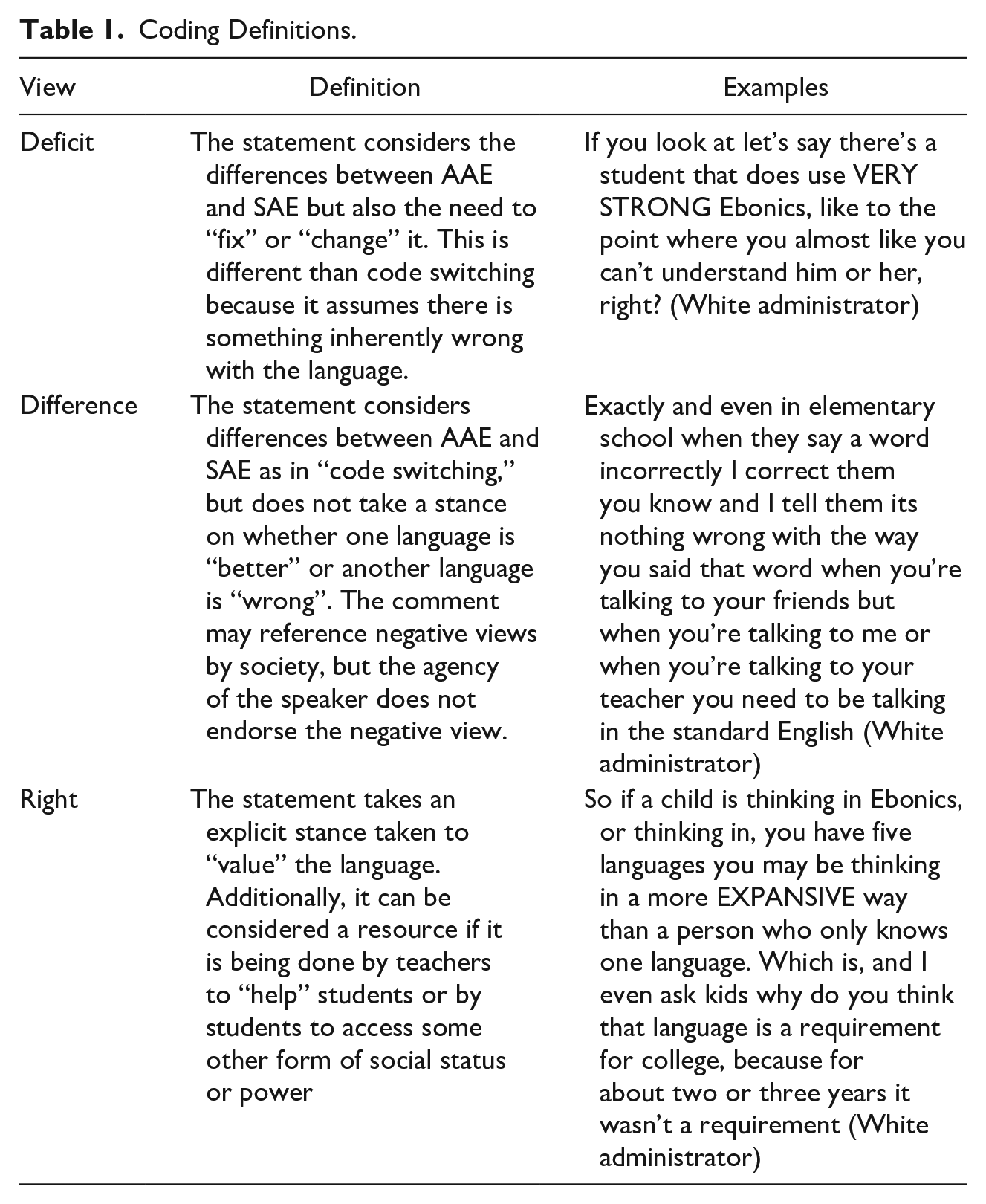
It is important to note that a “difference” viewpoint may be part of a larger deficit model, thus we coded the instances recognizing that one participant may have an overall deficit view but may also express a “difference” view for part or majority of the time. Even though a statement was considered a “resource view,” the attitude of the participant could overall be deficit. For example, if the participant claims that it is good for students to be able to speak AAL to communicate with their families then the statement would be coded as a “resource view.” However, this same participant could have a derogatory attitude toward speakers of AAL in general. By coding for both constituent group and language attitude, we were able to understand if the administrators viewed the use of AAL by certain speakers differently.
After analyzing different views of AAL, we coded the names administrators gave to AAL and WME. The focus group was prompted with the term “African American Vernacular English” and the interviewer attempted to be consistent using this term, unless elaborating on the possibility of other names or responding to one of the participants who used another name.
Next, we coded for discourse markers that demonstrate a type of epistemic modality (Lyons, 1977), or discomfort around the naming practices. Building off of Lyons (1977), we defined these particles as: “Any utterance in which the speaker explicitly qualifies his[/her] commitment to the truth of the proposition expressed by the sentence he utters, whether the qualification is made explicit in the verbal component (. . .) in the prosodic or paralinguistic component, is an epistemically modal or modalized utterance” (p. 797).
We closely analyzed the transcript around each of the instances in which AAL or WME were named. We looked for qualifications of the naming vis a vis a truth proposition. The nominalization of the language indicated a definitive stance, and any qualification would indicate some uncertainty.
Here are examples of instances of modal shifts indicating uncertainty (underlined):
(1) “they know they are not speaking the King’s English
(2) “Well, grammatically correct English
*example regards WME not AAL.
Researcher Positioning
Aria was the principal investigator for this project and worked closely with a graduate assistant (Joseph) to conceptualize the study and to develop the interview prompts. Aria identifies as a non-dominant Middle Eastern “White” male although he questions whether his kind should be classified as such and prefers the more historically accurate Afro-Asiatic.
Joseph identifies as a White male. At the time of the study, he was a PhD student. Through the initial participant recruitment and data collection phases, he interacted as a peer with students in the EdD program. In general, the EdD students understood their focus and purpose was in building data based leadership in urban schools, while PhD students produced new research. We established rapport by discussing similarities and differences across the programs. In the first three focus groups all participants identified as White. This shared racial identity with Joseph seemed to allow for the conversation to flow as it would among White peers discussing issues about race, which, in professional settings, can often be euphemized so as not to appear racist (DiAngelo, 2011). In the second two focus groups, all participants self-identified as Black or African American women. Since the participants in these two focus groups also had extensive understanding of the research process and, along with Joseph, were students, participants seemed forthcoming in the discussions of race in ways that may not occur outside of a controlled research environment.
Zayoni identifies as female, LatinX and was a PhD student at the time of the study. Her background is in feministic perspectives to explore ideological stances. Her role was to assist with the analysis of the data set. Given the shared and varying experiences between her and Joseph, this allowed for fruitful discussions around coding and analysis of the data corpus.
Limitations
While this study attempted to solicit diverse perspectives of educational administrators toward AAL, the sample was selective. We recruited at one university’s EdD program with an urban mission. Participants were invited through e-mail, faculty, and short recruitment presentations. The perspectives presented here represent a sampling of progressive educators with an urban focus rather than the general population of educational administrators. This sample represents educational leaders who have experiences, affinities, and coursework that include some reflection and thinking about the topics under investigation.
Findings
Two major findings emerged through the focus group interviews that answer the question “How do urban school administrators view AAL and its use in schools?” The first finding reveals that administrators’ views of AAL differ depending on the constituency group under consideration, demonstrating that views are not monolithic, but participants often oscillated among viewpoints. Among participants, no major difference was observed among the different groups nor between Black and White administrators due to limitations of data, however there was a noticeable difference in how personal and professional narratives were offered. The second finding answers the question by analysis of the naming practices. While the variation of naming WME was much less than the variation in naming AAL, the difference in naming practices differs when considering the modality. There was no observable difference in the variety of names used for AAL between Black and White administrators, but there was a difference in how naming occurred. The second finding reveals that views toward AAL are not concretized, but are in flux.
Administrator Views of AAL
Administrators negotiate multiple roles in schools. Often, they are instructional leaders as well as managers. Many administrators come from the classroom themselves and consider themselves teachers at heart. Thus, as we investigated the participants’ views of AAL, there was high variation within the way AAL was perceived. All statements about AAL being used by a person were coded (N = 111) and we found that 26 (23.4%) were negative and affirmed a deficit viewpoint. Another 45 (40.5%) statements presented a view that AAL was different than WME, but not necessarily because of deficiencies of the speaker. Twenty-four (21.6%) instances were coded as a “resource” view, and the final 16 (14.4%) statements could be considered advocating the right for a speaker to use whichever language he or she wanted. Due to the scope of the data set, it was not possible to observe any major differences between Black and White administrators in regards to these general views.
Ideological stances not monolithic
The difference, deficit, resource, or right views are not monolithic, but rather may be varied in explicit statements about AAL. While a participant may have had an overall deficit view of AAL, he or she may shift viewpoints in different contexts. However, more significantly than individual views of AAL was the relationship between the view of AAL and the constituent group that may speak AAL. There was high variation within participants.
Since administrators must consider different stakeholders, namely teachers, students, and parents, we looked at how these different views changed depending on the constituent group being considered. This revealed some notable results. Table 2 displays the frequency and percentages of each instance coded as a particular constituent group in a matrix relationship with each view. Here, N = 119 because in some statements the participant may have talked about multiple constituencies, thus the coded view would count one instance for each constituent group.
Frequency Counts of Constituency Groups.

African American language as a resource
Clearly the principals talked about students more frequently, but there was variation in the views they held toward each constituent group’s use of AAL. For adults, specifically parents and teachers, the use of AAL was considered a deficit. It was associated with low education and poverty. More than a fifth of the time (21%), however, participants considered it a resource to speak AAL since it could be used to develop relationships with students. Note that AAL, here, is allowed as a tool and in that sense is a “resource,” but this is not the same as the political stance of language as a right, which emerged only twice. While the participants talked about parents 10 times (none of the Black participants talked about parents’ use of AAL), 70% of the time it was negative.
On the other hand, 47% of the time participants considered students’ use of AAL, it was associated with a difference view, that is, it was not necessarily constructed negatively, but rather was simply different from WME, and only 12% of the time it was considered a deficit for a student to speak AAL. This is significant because it indicates that while AAL is acceptable if used by students, they should be moving toward WME, unless for specific purposes. For example, one of the principals recognized the advantage for students to have a command of both language forms: “I would say that if they only know the vernacular that they are at a disadvantage if they’re able to code-switch in their proper settings than they’re actually at an advantage I believe because they need to be able to relate to their peers in their neighborhood but they also need to be able to speak with standard English in the workplace, at school, in order to get jobs so if they can do both I think they’re at an advantage.” (Margaret, Black administrator)
By the time they reach adulthood, AAL should not be used outside of specific relationship contexts, like families. One White principal, while talking about a teacher, explicitly stated “it’s ok if [the students are] doing it but it’s not ok if you’re doing it .. if the adults are doing it.” Seven times the participants reflected on their own use of AAL or its use by another administrator (both Black and White administrators), in four of those it considered a resource, indicating perhaps taking a moral stance toward their own use.
It is interesting, also, to note that out of the 17 instances coded as a “right” view, in which political implications were considered, 15 (88%) were in the context of students. That is, language as a right, emerged in the context only of student’s rights to language and culture, which, not surprisingly, also indicates that the participants did not have an overall view that speakers of AAL should have language rights or political recognitions, only that in the context of schooling student speakers should. The following is an example of language as a right in regards to students’ use of AAL: “I deeply believe that a child should be able to express their selves in more than one language other than the mainstream language and ah for, a child who speaks EBONICS for example it should be a PLUS. It’s a cognitive uh, effective, it’s cognitively effective for a child to speak a different LANGUAGE.” (Shaya, Black administrator)
To embrace or not embrace AAL?
This distribution sheds light on the ideological view of AAL. AAL is considered an uneducated form of English by administrators, with WME being preferred. Even in the instances where AAL was considered a resource by teachers, it was solely for the purpose of relating to students. For students, it was a resource to connect to their roots or families, but had no standing or benefit outside the home or community. AAL, itself, was not recognized to have value. The language seemed to be considered an abstract form or structure for the majority of the instances, detached from culture.
There were a couple of instances where AAL was considered to be a part of the speaker’s “culture,” though the participant still devalued it. For example, Vicky, a White administrator who had corrected teachers for speaking AAL in the classroom before. She recounted a story about conducting an evaluation of a teacher. During the observation, she took notes about the teacher’s language use and then told her that she needed to use a more academic and standard variety of language in front of students. She stated, “I mean it was almost like I felt like I was STABBING someone you know” and continued a few seconds later with “It’s just you know how they speak, you know? How do you change something that is about you?” Vicky underwent a shift during the focus group. This was one of the first times she had an explicit conversation about AAL, and began to struggle with what it meant. Initially, she very clearly stated that she corrects teachers, but by the end of the focus group she began to struggle with what it means to correct someone when language is so closely tied to their identity.
The participants tended to view AAL as an acceptable linguistic form that was allowed to be used while learning WME. Teachers could, in some cases, leverage AAL to help scaffold WME. On the other hand, AAL was not seen as an acceptable language in its own right. It was a lesser variety of English and had no currency in mainstream US society. Their perception of its major benefit was for building relationships with less educated and economically disadvantaged African Americans.
Black administrators sharing personal narratives
One exception was when one African American principal discussed her own learning of AAL (and her son’s learning of AAL) to build desired relationships with African American peers. She told this narrative: “So I went to an elementary school that was on the north side that was majority White, so I had to take the bus about an hour and fifteen minutes each way and when I would come home like on the block of the neighborhood the kids would make fun of how I spoke. And they used to say that I wasn’t really Black, and I was an Oreo. I was a braniac. Like I had lots of names, and so it was then that I learned that I needed to learn to use the language of the block so that I wouldn’t be called names and I specifically worked on being able to use Ebonics very well. Even as I got into high school I got even better at it because I wanted to be able to hang out with Black kids, because in elementary school I didn’t have any Black friends. And so I learned that way because I think it was identity issues because I wanted to be able to relate to my peers and to have friends who look like me, because I haven’t had that impact. And I thought I was like really cool. ‘Oh, I gotta get my hair done’ all that kind of stuff because this is how all the other black girls look. So I learned that early on I didn’t want to be called names and you learn it. You look at movies you listen to people in the neighborhood and you learn how to talk slang you know.” (Margaret, Black Administrator)
Though Margaret dominant language was WME, she consciously sought to learn AAL in order to reaffirm her Black identity. Social forces led to valuing AAL and the relationships it nurtured. While birthed out of a social need, it blossomed into a vibrant stance toward embracing AAL fully.
While Margaret’s narrative demonstrated AAL as a transformative agent of identity affirmation, she also recounts a “shocking” story where using AAL in professional spaces generated a deficit response suggesting a “but you’re so articulate” linguistic microaggression: I used to work in the math department. I was new, and they partnered me with a veteran White teacher. And he heard me speak like in the lunch room. Like with African Americans we don’t, I use the vernacular all the time. I go back and forth all the time. Like I’m not conscious of it. So then when he was paired with me, then after the presentation he was like “you speak better English than I do. I can’t believe it.” And he was shocked and it was, you know in the past he had judged people, and so, even adults have to know that you are being judged by how you express yourself orally, you know, and the kids need to know that. [Researcher: “How did that feel to you?] Um, I don’t know if you have seen the Chris Rock specials except for um, he has one stand up and he said us “Don’t you hate when white people say ‘and oh, he is so eloquent and speaks so well. He speaks so well.’” And so I was a little insulted because I’m thinking, well, I’m a math teacher, what did you expect me, how did you expect me to speak? I’m really good friends with him still, but I was put off because I wasn’t sure what he expected. I wasn’t sure why he was so shocked.
The other focus group participant, also a Black administrator, looked at Margaret and they laughed at the mutual experience. These Black administrator narratives point to the tensions surrounding AAL in predominant WME spaces. While we are limited in making statistically significant claims about differences between White and Black administrators, our narrative analysis shows qualitatively significant differences. Of 11 personal AAL narratives, 8 were told by Black participants (73%). Of the 49 total professional narratives, 28 came from Black administrators (58%). Personal narratives are a powerful purveyor of language ideologies and consciousness (Razfar, 2012).
After analyzing the content of the focus groups and addressing administrators explicit stances toward AAL, we found that while the frequency count of deficit, difference, resource, or right statements were negatively skewed, there was complex variation within groups and qualitatively significant differences between Black and White administrators.
Naming Practices of AAL
Variation of names for AAL and WME
A frequency count of the number of times participants named AAL and WME revealed that AAL was much more contested than WME. That is, there was more variety in the way AAL was named. Table 3 lists the names given to AAL, the frequency counts, and the percentage of use.
Frequency Counts of Naming Practices.
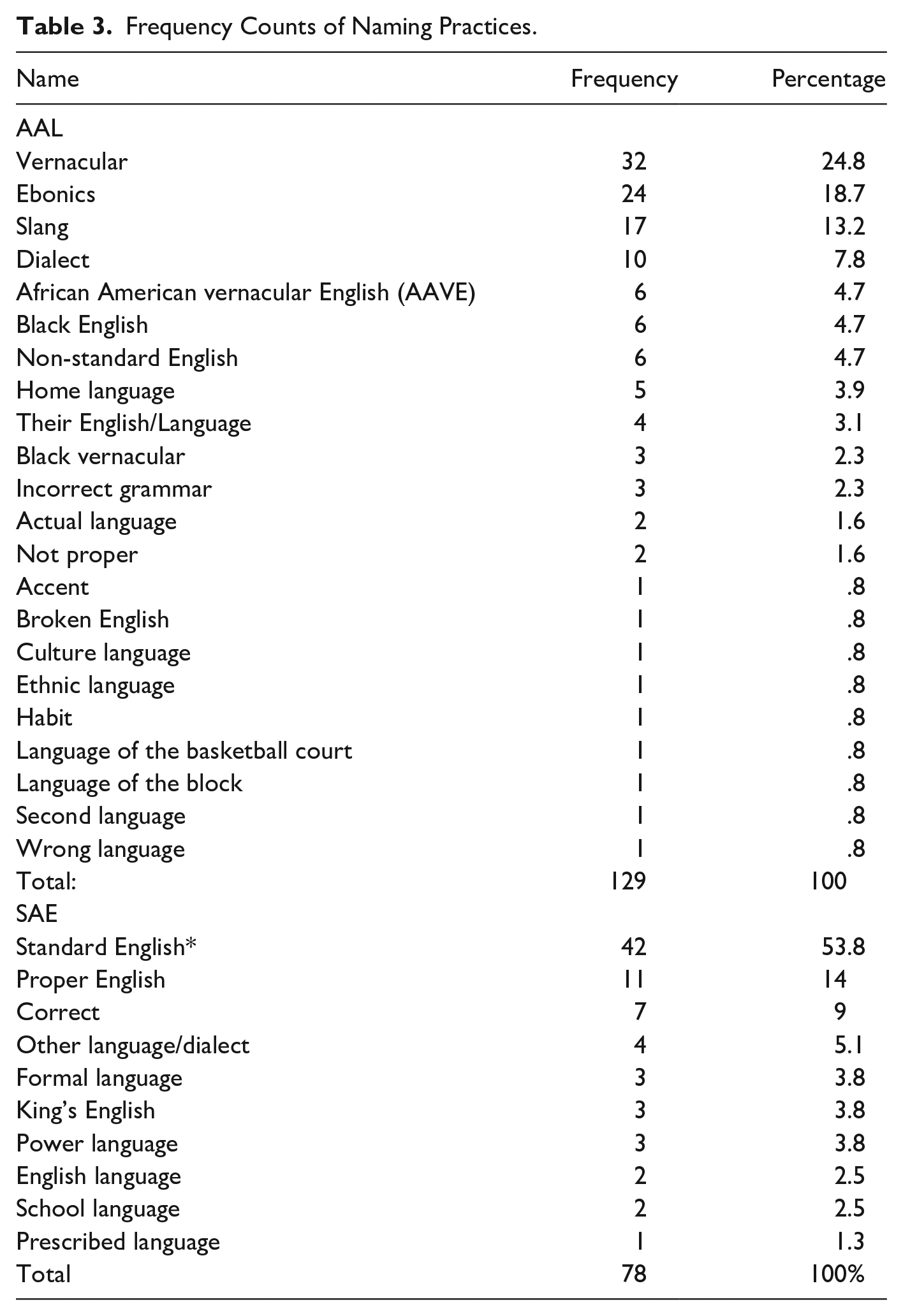
The variation within the names indicates that it was more difficult to find common ground on what to call AAL.
AAL contains a number of names that specifically point to race or skin color. This is consistent with Wolfenstein’s classic statement: Languages have skin colors. There are White nouns and verbs, White grammar and White syntax. In the absence of challenges to linguistic hegemony, indeed language is White. If you don’t speak White you will not be heard, just as when you don’t look White you will not be seen. (1993, p. 331)
However, the names for WME seem to be silent on the issue of race. With a clear majority of the names including “standard,” one can see that there is a sense of neutrality assumed with the language use. There is no coloring of the standard, and there is no affiliation to a particular group of people with the exception of two Black administrators mockingly referring to the “King’s English” three times over two focus groups.
Significantly, after “vernacular,” the next most used name for AAL specifically indexes color. One Black administrator who used the term Ebonics said “we call it Ebonics” indicating that she, as part of a corporate African American identity, approved of the term, though it is highly contested, and considered pejorative (Baugh, 2000). The third most used term, “slang” was used both as a name for AAL as well as a label applied to generational jargon. Therefore, when coding, we only considered the instances in which “slang” was used to name AAL as a deviation from WME. With 17 instances, this associates AAL as a subset of WME, and therefore makes a value judgment about the language.
Variation of naming AAL and WME
The naming practices, though significant, are complicated even more by the discursive practices of naming. That is, when studying language in interaction, the way things are said matters. In fact, the way things are said may be a more significant indicator of an ideological stance (or a contestation of an ideological stance) than the name itself. While there was no significant difference in the way the Black or White administrators named the language, there was a significant difference in the types of discursive markers used while naming AAL and WME.
The hedging and qualifying practices around AAL and WME revealed that there was more hesitation or backtracking when naming AAL than WME. Figure 1 shows that the frequency of times a participant paused, hesitated, or qualified a name of the language, while Figure 2 displays the percentage.
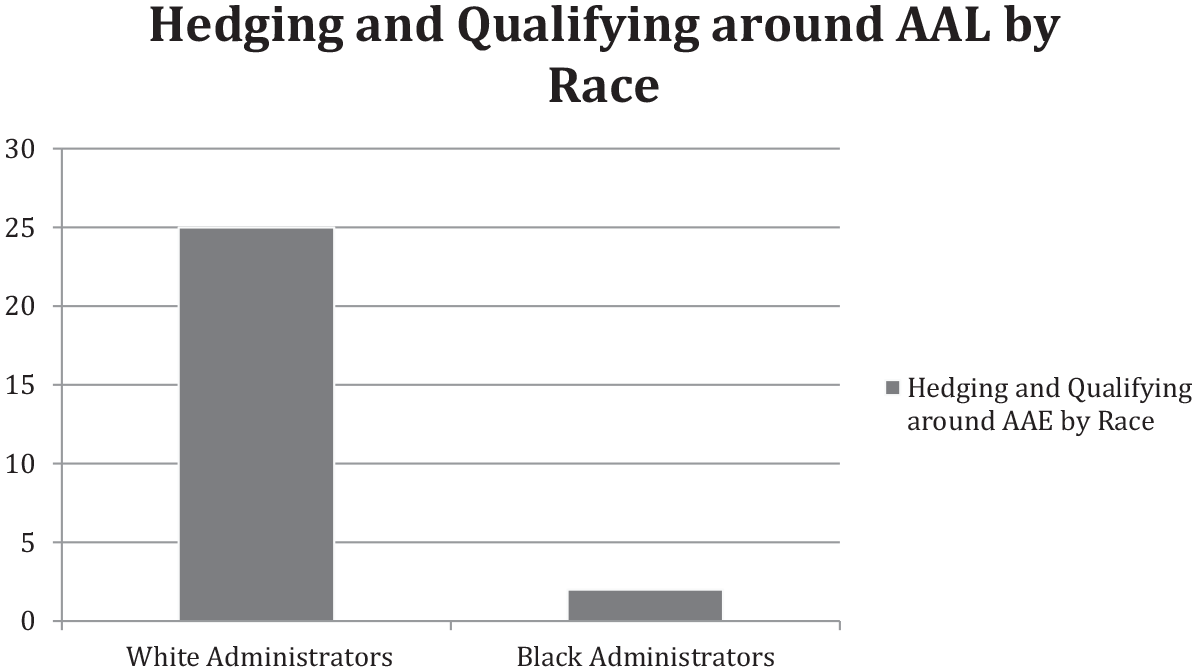
Number of hedging or qualifying markers used around naming practices distributed by race.
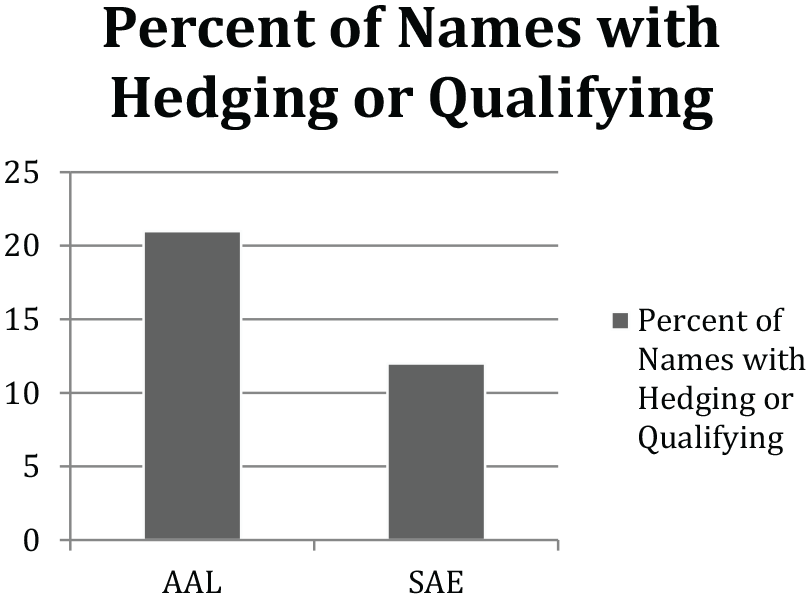
Percentage of names surrounded by hedging or qualifying markers.
As these graphs show, there was nearly twice as much hedging accompanying AAL than WME. This difference indicates a discomfort or uneasiness with naming AAL. This corroborates the significant variety and inconsistency of naming AAL. While the data indicates a significant difference between naming AAL and WME, we still are left to wonder why? Possible reasons will be taken up in the discussion of findings, but it is important here to note that there is a significant difference in these hedging markers based on race of the speaker (see Figure 3).
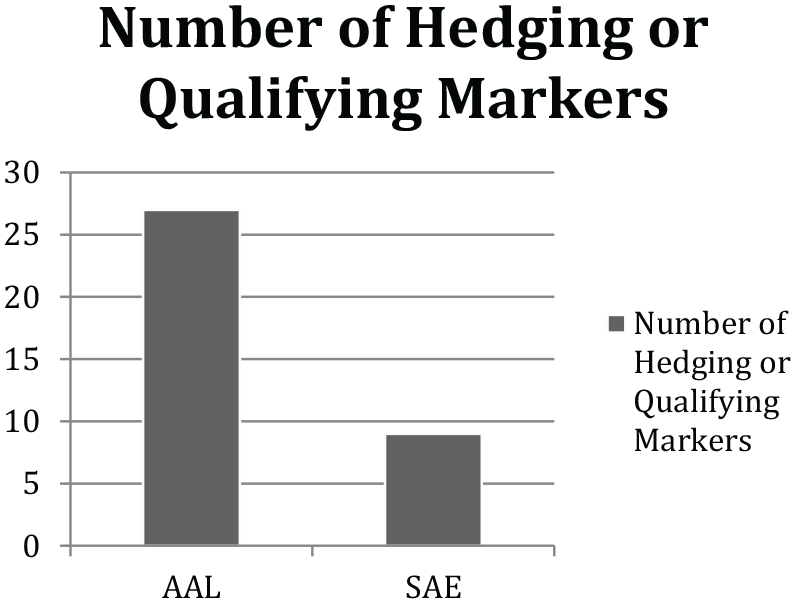
Number of names surrounded by hedging or qualifying markers.
This difference suggests that White administrators were more uncomfortable with naming AAL. During the interview there was more than one time where a participant explicitly stated “I’m not racist” or cited a Black professor or teacher to minimize the possibility of White supremacy, its legacy of racism, and an assertion of White innocence.
Discussion
Our findings reaffirm that language ideologies, and in particular raciolinguistic language ideologies, are contested. While language ideologies are generally implicit, this study shows the importance of conscious reflection to make them explicit. While participants, particularly White administrators, struggled with talking about AAL, they demonstrated awareness of societal stigmatization, and were often complicit in reifying those deficit stances in their own practice. In the first finding, administrators generally discussed AAL in a negative light, although this did differ based on who (teacher or student) was speaking AAL. The discussion was marked with the discourse of “political correctness” – the discussion framed AAL as a “home language” which should be valued, yet also as a deficit because it has no place in “mainstream society.” The administrators were generally in favor of “empowering” students by taking a structuralist stance on the merits of AAL use in the home and in some capacity in the classroom. They also thought it was important to give them access to the “language of power” (WME). They grappled with this tension and struggled to affirm AAL as a fully sovereign language. Thus, AAL was consistently subordinated in relation to WME. Lippi-Green, quoting James Baldwin, says: “It is not possible to empower a people and a culture and simultaneously reject their language as less than perfect or acceptable. As James Baldwin pointed out twenty years ago: ‘it is not the Black child’s language which is despised: It is his experience’ (1979, E19)” (2000b, p. 245).
Indeed, this is most evident in nearly every instance participant talk about parents or other adults using AAL. It was associated with low educational status and attainment.
Additionally, the participants in this study, by and large, have had little or no formal education that specifically addressed language. The preparation and professional development of urban school leaders needs to address language explicitly (e.g., a course on linguistics for administrators). We echo the calls for specific education on AAL for both teachers (Bowie & Bond, 1994; LeMoine, 2003) and administrators (McClendon, 2014). To be clear, the range of names used to talk about AAL should not necessarily be seen as problematic. When recognizing the full linguistic repertoires of speakers, and taking a raciolinguistic perspective (Alim et al., 2016; Flores & Rosa, 2015), naming only happens within particular theoretical and historical frameworks. It is likely that participants have had experiences not only with AAL and WME, but all of the translingual practices that occur in schools daily as well, many of those practices don’t have names like WME and AAL. It isn’t the variation of names that is of interest, but the willingness to give and commit to a name for AAL. This was evidenced in finding two in which the naming practices revealed a type of discomfort in talking about AAL. The markers of discomfort seemed to largely fall along racial lines, with White administrators hedging, dismissing, and demonstrating low modality much more frequently than Black administrators. This could be explained, in part, due to avoid being seen as racist (DiAngelo, 2011) or to a standardization ideology that makes recognition of varieties difficult (Lippi-Green, 2000a). This suggests implications for practice, as well as research. First, teachers and principals both need to be exposed to explicit education about language. There must be an emphasis on the metalinguistic competencies of pre-service and in-service teachers and administrators, that is, that teachers and administrators need to learn how to talk about language before we can expect policies and pedagogy to follow.
Beyond the need to talk about language, educational programs at all levels, including administrator preparation, must include pointed discussions about anti-racist languaging of language. White people’s fear of sounding racist (DiAngelo, 2018) allows for taking victimized stances when challenged, invoking color-blind ideologies, and leveraging “politically correct” speech. An explicit focus on challenging the racist roots of imperial-linguistic ideologies needs to be undertaken. Recently, anti-racist language pedagogies are being developed and researched in ELA classrooms (Baker-Bell, 2019, 2020). Similar approaches are needed in administrator education, though strong conceptual grounding is needed (Solomon, 2002). In particular, since educational administrators will also be language administrators via policy and instructional practice, understanding historical roots of linguistic discrimination (Santa Ana, 2004), and racist policies historically (Kendi, 2016), and how to actively subvert them (Kendi, 2019; Love, 2019), is necessary.
Conclusion and Implications
In this study, our conversations with White and Black urban administrators demonstrated why a deeper understanding of the African American Language is necessary for moving toward an anti-racist ecology and establishing linguistic justice for Black students (King, 2020). Conversations about AAL are an invitation to participate in the “alchemy that transformed ancient elements into a new language.” (Baldwin, 1997). It is more than an attitude shift or even awareness, it is a dynamic shift in human consciousness. The dynamic nature of its naming constitutes an internal struggle that has the potential to ultimately lead to individual awakening and collective action. What is needed is a genuine movement for educators to study language at the structural, ideological, and alchemical levels. An explicit focus on linguistics, at the structural level, is needed to provide administrators with a basic set of tools to talk about language by conducting comparative structural analysis of AAL and WME (Hudley & Mallinson, 2015). Administrators should engage in specific studies of the relationship between language and culture and understand implications of language form on identity.
The findings of this study suggest that cultural responsive education and reigning motifs of “culture” in education are not sufficient enough to deal with the complex linguistic environments in urban schools. “Culture” has become an overused construct and may no longer be able to achieve construct validity. In fact, by fronting language as a central construct in education, we can further move toward racial and linguistic justice models for education. This study generates many questions for future researchers to pursue especially in the context of professional development for urban administrators. Here are three immediate implications:
This study highlights the need for administrators to explicitly study language from a critical and raciolinguistic point of view. This means engaging with the systematic impact of slavery and segregation on everyday educational practices. Further, understanding AAL is an expression of solidarity with the pre-slavery historical context of the Black diaspora’s linguistic practices and identity.
There is a need for administrators to learn how to take an anti-racist stance especially in hiring and evaluation of teachers (Welton et al., 2019).
Future research could examine how White administrators assess and evaluate teachers who negatively discipline students for using AAL.
Supplemental Material
Appendix – Supplemental material for Administrating Language: The Language Ideological Voices of Urban School Administrators in Urban Education
Supplemental material, Appendix for Administrating Language: The Language Ideological Voices of Urban School Administrators in Urban Education by Aria Razfar, Joseph C. Rumenapp and Zayoni Torres in Urban Education
Footnotes
Author’s Note
Joseph C. Rumenapp is now affiliated with St. John’s University, Queens, NY, USA.
Declaration of Conflicting Interests
The author(s) declared no potential conflicts of interest with respect to the research, authorship, and/or publication of this article.
Funding
The author(s) received no financial support for the research, authorship, and/or publication of this article.

Supplemental Material
Supplemental material for this article is available online.
Notes
Author Biographies
References
Supplementary Material
Please find the following supplemental material available below.
For Open Access articles published under a Creative Commons License, all supplemental material carries the same license as the article it is associated with.
For non-Open Access articles published, all supplemental material carries a non-exclusive license, and permission requests for re-use of supplemental material or any part of supplemental material shall be sent directly to the copyright owner as specified in the copyright notice associated with the article.
