



Abstract
With the expansion of online instruction in K-12 education, how and what is taught in a single course has the potential to affect the learning of thousands of students. Our mixed method study applies a critical lens to examine the extent to which four widely used online high school courses are culturally relevant and responsive. Online lessons reflected a culture of power, emphasizing normative cultural narratives, retreating to symbolic use versus application, and presenting neoliberal ideologies as fact. We end with a discussion of how systems can be leveraged to improve the educational experiences provided to students enrolled online.
Keywords
Fourteen percent of secondary public school students in the United States received instruction online prior to the 2019 to 2020 school year (Gemin et al., 2015). Now, almost 100 percent of districts have moved instruction online under the recent Covid-19 crisis (Goldstein et al., 2020). Despite this, online courses represent an understudied trend in the education sector, where predominately for-profit companies develop and deliver courses to millions of students each year (Gemin et al., 2015). Further, the curriculum in these courses remains a “black box” for teachers, administrators, parents, and policymakers. This mixed method study expands understanding of the ramifications of this outsourcing of educational content through an examination of the curriculum integrated in four asynchronous, online high school courses. Findings establish the extent to which the courses studied perpetuate privilege by reinforcing the culture of power online.
The culture of power includes the ideas, attitudes, and activities that are regarded as normal or conventional and are often aligned with (and advantage) the cultural norms and practices of the social groups in power (Apple, 2018; Apple et al., 2009; Delpit, 1995; McLaren, 2015). We examined how social messages related to the culture of power are perpetuated, acknowledged, or disrupted in a fully online instructional environment through an in-depth analysis of curriculum in online learning spaces. This allowed us to identify in what ways students’ identities and experiences were (or were not) recognized, validated, and embedded as central to learning processes online (Ladson-Billings, 1995, 2014; Paris, 2012; Paris & Alim, 2014).
With the wide reach of online high school course-taking, how and what is taught in a single course affects the learning of students in thousands of classrooms across the country. By delving into the curricular content, instructional tasks, and assessment strategies within online courses developed by one of the largest online course vendors in the United States, we highlight elements of the hidden curriculum that are challenging to identify, examine, and generalize in traditional, face-to-face settings. It is by engaging with these building blocks of students’ educational experiences that critical educational research can systematically locate and dismantle the hegemonic norms and values embedded in the institution of schooling (Apple et al., 2009).
Through this research, we aim to further the literature-base on how to support students in recognizing and navigating sociopolitical factors in their daily lives through an in-depth examination of the curriculum and instruction in an urban school setting (Milner & Lomotey, 2014). Specifically, we work toward Gay’s (2014) call for research on the integration of culturally relevant pedagogy (CRP) at a larger scale than available in current research. We also push back against the trend towards increasingly standardized and limited community connection prevalent in the most popular asynchronous online course systems that reinforce a monocultural narrative, fail to engage students in critical reflection, alienate students belonging to groups marginalized by systemic inequalities, and limit opportunities for students to learn the cultural flexibility necessary to succeed in an increasingly globalized world (Ladson-Billings, 1995, 2014; Paris, 2012; Paris & Alim, 2014).
We believe this is the first study to examine CRP within an asynchronous, online learning context from an explicitly critical lens, allowing us to establish the degree to which the generally standardized, plug and play structure of online courses and cultural responsiveness are compatible. This research is particularly timely and relevant with the COVID-19 crisis precipitating a close to universal transition to technology-based learning, which faces many of the same challenges and limitations highlighted in the asynchronous, online courses studied. As such, we examine the following research questions.
What is the nature of cultural responsiveness and relevance in the online courses, specifically the extent to which they perpetuate, acknowledge, and/or disrupt the culture of power?
Where are the places where cultural responsiveness and relevance are and could be better integrated in asynchronous, online courses?
This study builds upon the potential of CRP to transform the educational experiences and outcomes of students, particularly those from historically marginalized groups (Au, 2012; Dee & Penner, 2017, 2019). We apply knowledge gained from traditional, face-to-face classroom settings to map the types of cultural responsiveness and relevance observed within the enacted curriculum developed by one of the largest online course vendors in the United States. In doing so, we document the inherent limitations and leverage points for integrating CRP within a standardized, online course structure employed by an urban emergent school district located in a large (but not major) city that operates with a scarcity of resources and serves predominately students of color and from lower socioeconomic backgrounds (Milner, 2012). We conclude with a discussion of the systems and structures that perpetuate the culture of power within the online courses and recommendations on how to facilitate disruption of the culture of power in these and similar courses.
The Context of an Expanding Private Sector in K-12 Curriculum and Instruction
Current neoliberal education policies emphasize the importance of privatization, such as through the incursion of online course vendors into the curriculum design and delivery space (Burch & Good, 2014; Lipman, 2013). Neoliberal ideology emphasizes the role of free markets in forcing companies to meet consumer’s needs while perpetuating claims such as false neutrality (i.e., the false notion that one can ever be unbiased or neutral) and color blindness (i.e., the belief that it is possible to “not see race,” which reinforces the racial status quo) (Bonilla-Silva, 2006; Lipman, 2013). Researchers caution that by allowing for-profit companies to provide direct instruction to students, children have become commodities (Boninger et al., 2017; Molnar, 2013). This is particularly true of students residing in urban centers who are disproportionately targeted for the educational services provided by for-profit companies (Apple, 2018).
Despite the false-neutrality and color blind-based claims of the neoliberal policies that have supported the proliferation of online course-taking, the recent COVID-19 crisis has laid bare and exacerbated structural inequalities in the United States. Specific to online courses, students face disparities in access to and the quality and quantity of digital devices and Internet connectivity in their homes based on racial/ethnic and class-based characteristics (Ryan & Lewis, 2017). Differential access to enriching educational experiences before, during, and after this time of crisis is also confounded by variability in factors such as parental availability, household stress, and health along those same racial/ethnic and class-based lines.
Further, there is growing evidence that high school students learning in asynchronous, online environments may learn at slower rates than similar students engaged in traditional, face-to-face instruction (Ahn & McEachin, 2017; Heppen et al., 2017). The declines in learning appear to be disproportionately experienced by students from historically marginalized groups (Ahn & McEachin, 2017; Heinrich et al., 2019). Due to the incentives for online course vendors to provide highly standardized products, succeeding in online courses often rewards conformity and discipline valued in working-class jobs over the proactivity and assertiveness that support post-secondary success (Apple, 2004; Bowles & Gintis, 1976/2011; Darling-Aduana, 2020; Darling-Aduana et al., 2019; Karp & Bork, 2014). In this way, online course-taking may represent a new form of tracking, providing students belonging to marginalized groups differential access to essential knowledge and skills.
Online courses are particularly vulnerable to the neoliberal policy landscape because of their potential to increase educational productivity through instructional efficiencies, reduced operational costs, and economics of scale (Bakia et al., 2012). The modularized, asynchronous, “absorb and assess” type online courses that are most profitable epitomize the neoliberal conceptualization of education as interchangeable inputs and outputs that fail to consider or adapt to local contexts or students (McLaren, 2015). At the same time, the continued emphasis on profits among for-profit vendors disincentivizes high-quality and responsive curriculum and instruction, which often require greater financial investments and reduces the potential for scalability (Burch & Good, 2014; Boninger et al., 2017). These incentives appear consistent with trends among the online courses provided by large-scale, third-party vendors, which are often distinguished by an overemphasis on memorization, alignment of content with dominant cultural norms and values, and little state oversight of curricular content (Molnar, 2013).
There are also financial considerations for school districts. Despite lower costs for online courses, schools often receive the same state funding per pupil, increasing profitability (Molnar, 2013). The extent to which school districts depend on local property taxes means that the school districts most likely to be swayed by more cost-effective online course systems are those with smaller tax bases. These are the same districts often serving a larger percentage of students from minoritized and lower-income backgrounds and in urban centers.
In other words, the structure of many online course systems perpetuates privilege through the enactment of the hidden curriculum by exposing students disproportionately from minoritized and lower-income backgrounds and in urban centers to educational experiences that require them to recite and remembers (Apple, 2004, 2018; Bowles & Gintis, 1976/2011; Darling-Aduana, 2020; Darling-Aduana et al., 2019; Karp & Bork, 2014). This combined with the prioritization of scalability through standardization among many low-cost online course providers has the potential to exacerbate the emphasis on normative values, assumptions, and expectations, resulting in disparate educational experiences and subsequent alienation by student identity (Apple, 2018; McLaren, 2015).
Applying a Critical Lens to Online Learning
To examine these concerns, we apply two frameworks to guide our examination of online learning: critical curriculum studies and culturally relevant pedagogy. We discuss each below.
Critical Curriculum Studies
Critical curriculum studies identifies ways in which the official knowledge contained in school curricula is a subjective collection of truths, often from the perspective of dominant social groups designed to support and provide legitimacy to the status quo (Apple, 2018; Ladson-Billings, 1995; McLaren, 2015). The dichotomy between the official, explicit curriculum established by state standards and this hidden curriculum—“the teaching of norms, values, and dispositions that goes on simply by. . . living in and coping with the institutional expectations and routines of school” (Apple, 2004, p.13)—results in students and communities belonging to non-dominant groups encountering curricular content and instruction that do not reflect or validate their lived realities (Apple, 2018; Au, 2012; McLaren, 2015). Student interactions with the instructional core of schools can either perpetuate or disrupt inequities based on the extent to which cultural hegemony is accepted versus identified and questioned (Apple, 2018; Apple et al., 2009; Ladson-Billings, 1995; McLaren, 2015).
Implicit and explicit bias and assumptions around life experiences, frames of references, and values in educational materials and curricula contribute to the alienation of students from historically marginalized populations (Au, 2012; Gay, 2010; Kohli et al., 2017; Ladson-Billings, 1995). In aggregate, the normative frames represented in most curricular content results in differential access to educational experiences that resonate with students based on their cultural background (Gay, 2010). Normative frames include the ideas, attitudes, and activities that appear conventional due to their alignment with dominant cultural norms (Apple, 2018). For instance, curriculum developers may believe a word problem about the incline of a ski slope may be interesting to students but depending on their background students may struggle with the problem because they may not have lived experience with skiing to construct the necessary equations to solve the problem. In this way through continual negative micro-interactional processes, social constructs are transformed into real disparities through mechanisms such as a decreased sense of belonging, learned helplessness, stereotype threat, and internalized oppression (Steele & Aronson, 1995; Tappan, 2006). These interactions are compounded and reinforced by instances of overt prejudice and explicit bias enacted in the classroom (Kohli et al., 2017; Seale, 2019).
While these patterns are present in traditional, face-to-face classrooms, the increased standardization and automation facilitated by the technology sector, as well as the lack of diverse voices at these tables, often contributes to greater transmission of dominant social norms and assumptions (Benjamin, 2019). Further, the material highlighted in an asynchronous, online course potentially has increased weight because there are fewer means for student-teacher interactions to adapt content to local contexts or make meaning of the content together (Au, 2012; Bondy et al., 2015). Therefore, perhaps to a greater extent than in traditional, face to face classrooms, content and delivery also shape how students view and interact with their teachers.
Culturally Relevant Pedagogy
In response to the hegemonic patterns in curricula described above, which may be exacerbated in but are not limited to online courses, researchers have proposed a number of institutional changes to curricular content, instructional tasks, and teaching styles to provide equal access to quality educational experiences and success to students from historically marginalized groups (Banks, 1993; Gay, 2010; Ladson-Billings, 1995, 2014). Importantly, CRP was designed to first acknowledge and then disrupt the culture of power present in schools as a social institution (Ladson-Billings, 1995; Gay, 2010). CRP is based on the premise that students learn best when taught within their cultural frame of reference (Delpit, 1995; Gay, 2010; Ladson-Billings, 1995). In culturally responsive instruction, teachers scaffold the knowledge, skills, and behaviors students will need to be successful upon a base of mutual respect and effective communication (Gay, 2010; Ladson-Billings, 1995). The goal of this form of teaching is for students to learn how to navigate both community and dominant cultural norms, without attaching greater value to one culture (Delpit, 1995; Gay, 2010; Ladson-Billings, 1995).
The goals of CRP require first an acknowledgment of the culture of power, followed by the active disruption of institutional and structural inequalities that reinforce the status quo (Gay, 2010; Ladson-Billings, 2014). Teachers have addressed this need by incorporating multicultural content within a critical framework to help students take an active role in understanding race, culture, and systemic inequalities in their communities (i.e., Dee & Penner, 2017; Gutstein, 2006; Ladson-Billings, 1995). Integrating CRP online often requires instructional strategies not commonly found in asynchronous courses including feedback from the instructor, connections with peers, and opportunities to establish trust, build relationships, and form community, and feel cared for (Bondy et al., 2015; Frye et al., 2010; Hsiao, 2015; Shevalier & McKenzie, 2012; Ukpokodu, 2008).
Further, Paris (2012) and Ladson-Billings (2014) have embraced the term culturally sustaining pedagogy to emphasize the importance of the critical and disruptive components of CRP in transforming systems to emphasize cultural pluralism and equality, which is essential for students from all backgrounds to succeed in an increasingly globalized world (Paris, 2012; Paris & Alim, 2014). We recognize across this literature a pedagogical path related to culture that may begin with competence, then move into relevance, responsiveness, and ultimately sustenance. We have mapped themes and examples across this path, but without capturing culturally sustaining pedagogies in the courses we observed, we instead frame discussion our findings in terms of cultural relevance and responsiveness.
Students—particularly those from historically marginalized groups—are less likely to be alienated from instruction when teachers integrate CRP (Aronson & Laughter, 2016; Gay, 2010). Studies have identified improved student engagement (Christianakis, 2011; Dee & Penner, 2019; Milner, 2011), psychological empowerment (Hipolito-Delgado & Zion, 2017), and deeper, more meaningful learning (Gutstein, 2006; Laughter & Adams, 2012; Morales-Doyle, 2017). Specific to achievement, students assigned to an ethnic studies course just below the threshold for assignment earned GPAs 1.4 points higher than students just above the threshold who were not enrolled (Dee & Penner, 2017). Students identified as Black and Latinx scored higher on standardized test scores in mathematics and demonstrated enhanced mathematical knowledge when lessons integrated history and content that acknowledged the socio-economic realities of their daily lives (Langlie, 2008; Martin, 2010). Similarly, students demonstrated improved reading comprehension when teachers integrated familiar cultural references and culturally relevant texts (Clark, 2017; Lee, 2007), while Latinx students in Arizona outperformed White peers when taught using a Mexican American Studies focused, social justice-oriented curriculum (Cammarota & Romero, 2009).
Methods
Data and Sample
Our findings draw on data from a multi-year, mixed methods study on the use of digital educational tools. All data were collected within an urban emergent district in the Midwest that contracted with one of the largest online course vendors in the country (Milner, 2012). This district operates with a scarcity of resources due to decades of city-wide disinvestment like that experienced in other Rust Belt cities and serves a population consisting predominately of students of color and from lower socioeconomic backgrounds who experience marginalization due to inequitable institutional structures and systemic inequalities (Paris, 2012; Milner, 2012). Although individuals experience structural inequalities for many reasons, including sexual orientation, language, and disability status, our study focuses on cultural identity tied to racial/ethnic background, socioeconomic status, and gender. We centered these identities as they appeared most salient to students and educators in the district studied. Further, we took care to not equate sharing the same sociodemographic characteristics with identity or culture, basing wherever possible assertions of shared assumptions, norms, and experiences on data collected through interviews, observations, and conversations (Paris & Alim, 2014).
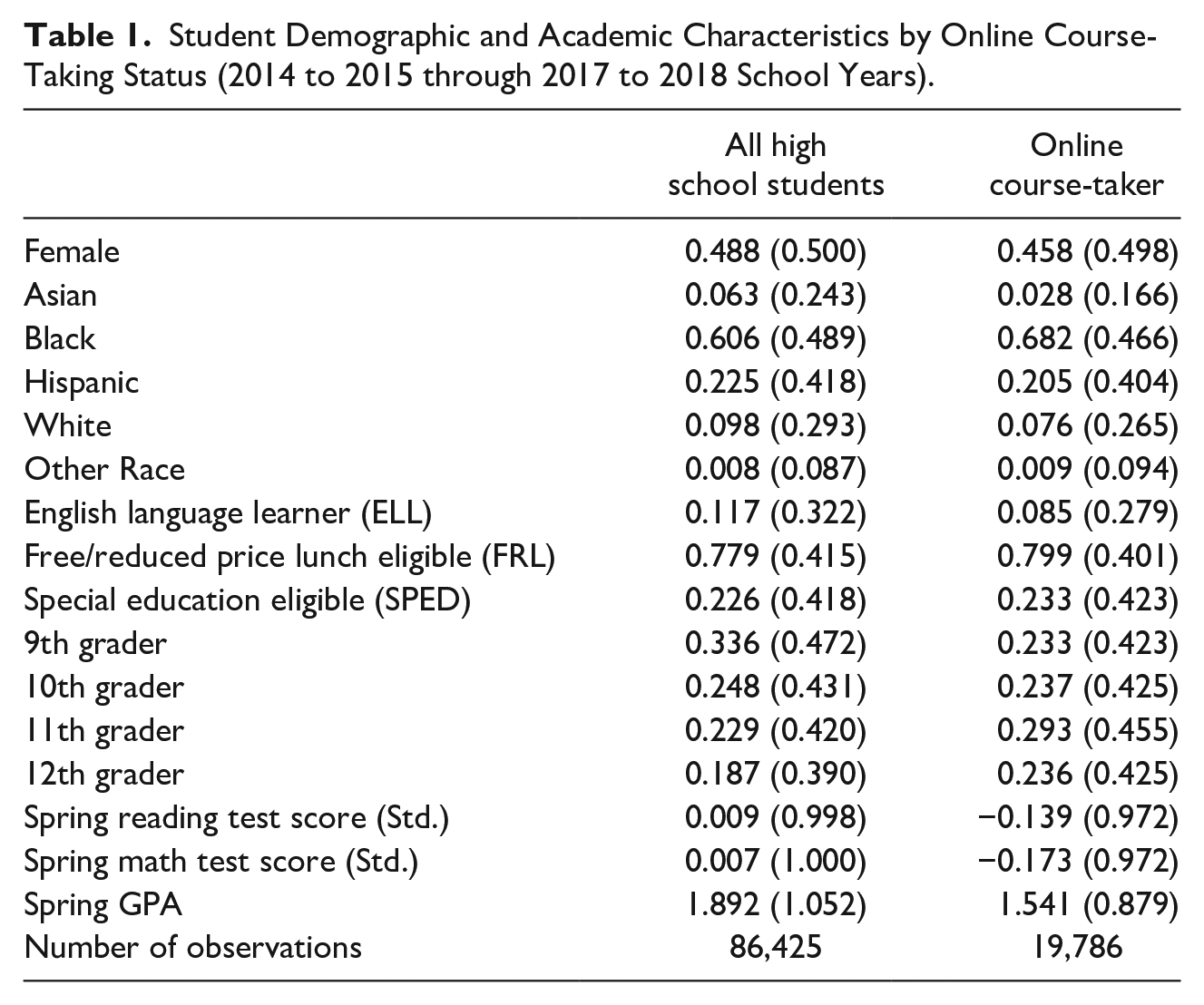
Data collection occurred during the 2014 to 2015 through 2018 to 2019 school years. We analyzed data collected from qualitative and quantitative coding of online course videos, activities, and assessments supplemented with findings from classroom observations. Table 1 summarizes high school student characteristics within the district during that timeframe. As shown below, online course-takers made up 23 percent of the sample with qualitatively similar student populations enrolled and not enrolled online. Exceptions included increased likelihood of online course enrollment among 11th and 12th grade students and those with lower scores on standardized assessments, which reflects the predominant use of online course-taking in the district for credit recovery. Across the district, 83 percent of students identified as either Black or Hispanic, and 78 percent of students qualified for free or reduced priced lunch.
Student Demographic and Academic Characteristics by Online Course-Taking Status (2014 to 2015 through 2017 to 2018 School Years).
The district provided researchers access to all third-party, vendor-developed online course content. We focused our analysis on the most frequently assigned course in each of the four core content areas: algebra 1, English/language arts (ELA) 9, citizenship, and physical science. We focused on these courses due to the large number of students enrolled and because we wanted to document differences across subjects. Within the district, these courses represented approximately 15 percent of all online sessions logged. We also relied on 200 classroom observations collected during the larger study.
Data Collection
We developed the Online Curricular Responsiveness and Relevance Protocol based on previous rubrics developed to evaluate CRP (i.e., Fiedler et al., 2008; Frye et al., 2010; Griner & Stewart, 2013; Hsiao, 2015; Siwatu, 2007). We kept items related to curricular content, structure, instructional strategies, and assessment, removing those related to relationship building or group belonging, which Hsiao (2015) identified as separate factors. Next, we divided the remaining items into three categories: elements that could never be facilitated by a standardized online course structure, elements that were always facilitated by the online course structure, and elements that varied by lesson. Although we summarized findings that emerged from course elements that were either always or never facilitated by the online course structure, we focused the observation protocol on those elements that varied. After adapting items to the online context, we distributed the observation protocol for expert review by eight scholars and educators with experience in online learning and/or CRP. We made revisions, additions, and deletions based on their feedback. The final protocol asked observers to rate the frequency that they observed key elements of curricular content, instructional tasks, and assessment strategies within each lesson. In addition to the rating scale items, observers also provided a detailed, written description.
The curricular content section focused on what was taught. For instance, items asked raters to evaluate the extent to which the module used normative examples—or those drawing from dominant narratives of White, male authority and power—versus ones reflecting multiple cultural backgrounds. Thus, these items quantified the extent to which the topics covered acknowledged or disrupted the culture of power. The second section focused on how content was taught. Sample items asked the rater to evaluate the extent to which the instructor used a variety of teaching methods to meet different learning needs or how often students were asked to apply their learning to an issue, context or problem beyond school. These types of instructional tasks designed to encourage higher-order thinking and application are a core component of attempts to support academic attainment and development of a critical consciousness. The third section focused on how students demonstrated understanding. For instance, did the module assess student learning using various types of assessment or integrate assessment strategies that incorporated culturally diverse content. Because assessments evaluate student performance, any assumptions regarding student background or worldview may result in differential performance that do not accurately capture differences in comprehension. The assessment strategies employed also communicate expectations and values to students that may influence how they interact with lesson content and perform instructional tasks.
We established interrater reliability through two training sessions where all raters observed and completed the observation protocol for the same lesson followed by a discussion and reconciliation of ratings. Members of the research team then individually coded each of the 29 to 37 lessons per course using the protocol. For each lesson, we reviewed the approximately 20 minute video-based lecture component, practice problems, assessment questions, and any supplemental assignments. All of the five research team members earned or are working towards a Ph.D. in an education field, and all but one team member had previous classroom teaching experience. We assigned raters to courses based on content-level expertise. We also facilitated reliability discussions during meetings held throughout the analytic process.
Observations in the school-based computer labs and classrooms where students had access to work on these online courses during the school day were collected using a research-based, well-tested observation instrument that enabled observers to evaluate the extent to which the integration of educational technology into an instructional session facilitated quality learning opportunities for students (Heinrich et al., 2019). Dimensions covered included the physical environment, technology and digital tools, curricular content and structure, instructional model and tasks, interactions, digital citizenship, student engagement, instructor engagement, and assessment/feedback.
Analytic Strategy
Informed by our theoretical framework, we coded in Dedoose all narrative descriptions gathered using our observation protocol. During an analytic process, the research team agreed upon initial thematic codes that were updated and refined through the coding process. We wrote analytic memos around content and strategies that either perpetuated, acknowledged, or disrupted the culture of power. Subsequent qualitative and quantitative analyses were then used to corroborate the validity and reliability of the resulting analytic themes across lessons. For instance, we used descriptive statistics of rating scale distributions to confirm our perceptions of the frequency of various curricular content and instructional activities across and within courses. We also used rating scale items to identify lessons that reflected either typical or exceptional alignment with CRP.
Positionality Statement
Our research team is composed of five education researchers specializing in education policy and digital learning. All members are cisgender, non-disabled women of various racial and ethnic backgrounds. Further, all but one research team member has previous experience as a K-12 classroom teacher. We believe the experiences gained through membership in and identification with these groups informs our interpretation of the world and our data. As researchers, we apply theoretical frameworks that acknowledge and explain how individual expectations, interactions, and norms are shaped by and contribute to larger social forces. In acknowledgment that any social science research is influenced by the lenses and biases researchers bring to the work, we actively worked to acknowledge and question how our interpretations were informed by our cultural identities, lived experiences, and community contexts. We confirmed the prevalence of themes by triangulating data across sources and methods. We also held analytic meetings where we discussed alternative interpretations and explanations that ultimately led to an agreement of themes across members of the research team.
Setting the Classroom Context: What did the Online Course Labs Look Like?
In the district studied, students were assigned to a computer lab classroom for one or more periods a day, which were staffed by one or more certified teachers; students could also choose to logon and complete lessons outside the school day. Teachers in the school-based labs primarily managed the logistics of the online courses (e.g., enrollment, unlocking tests), student behavior (e.g., keeping students on task), and technical challenges (e.g., internet access, headphones). Teachers also occasionally offered instructional support, most often in the form of tracking student progress and giving assistance on which quiz questions students needed to redo. In these classrooms, instruction occurred primarily through student interactions with the online platform, with the average student receiving fewer than 1 minute of instructional assistance from a live instructor.
The curriculum was highly structured and sequenced by the online course vendor with standardized content and structure delivered to each student. Content was completely housed and determined by the software. Each lesson consisted of the lecture video(s) followed by predominately multiple-choice based assessments or practice problems. While there were limitations to the type of interactions students could have with online course content given its structure, we occasionally observed students engaging more actively with course content. Examples of active learning tasks included virtual science labs and scaffolded math problems, where the remote instructor worked through a new technical skill with a student that students then applied on their own before proceeding. Students also completed extended reading and writing exercises as part of the ELA course.
After observing students interact with the online course interface, and particularly considering low rates of academic engagement, we grew interested in the actual course content being presented to students (see Darling-Aduana et al., 2019; Heinrich et al., 2019). Interviews with district teachers overseeing the online credit recovery labs and an initial review of course lectures raised concerns regarding the cultural responsivity and relevance of lesson content. Although we focused this study primarily on what is feasible within an online structure to disrupt the culture of power, we first briefly discuss the inherent strengths and limitations of the online instructional environment.
Culturally Responsive-Aligned Features Facilitated by the Online Course System
In developing the observation protocol, we identified course features that were either always or never present within the online course system. For instance, the online course system collected information on student comprehension of course content through frequent practice problems and quizzes, which might facilitate some element of differentiation. However, instructional modifications based on student responses were not accommodated within the online course framework, and most questions only required students to remember lecture content versus demonstrate deeper understanding or apply content. As a function of the standardized and asynchronous structure of the course, the remote instructors communicated the same expectations of success to all students. Expectations regarding appropriate classroom behaviors and what students needed to do to be academically successful were explicitly communicated. However, these expectations rarely exemplified the high academic standards stressed as part of CRP and were not responsive to students’ needs or cultural backgrounds.
The list of core culturally responsive and relevant components that the online course system could not facilitate was much longer. Courses were designed to be completed independently and did not facilitate collaboration. This limited the extent to which the online system could support the development of a community of learners. Courses did not gather information on students’ learning preferences, home lives, or cultural backgrounds, and there were no mechanisms to make adaptations based on this information. In sum, our review of these online learning environments suggests there are barriers to CRP embedded into the very structure of standardized, asynchronous digital learning platforms. The following sections examine the extent to which the course content was culturally relevant or responsive.
Perpetuating the Culture of Power: What Does it Look Like Inside the Online Courses?
Within the constraints of the online course system structure, we next examined the extent to which course content perpetuated the culture of power—the ideas, attitudes, and activities of cultural groups in power that are often regarded as common sense and rewarded in a way that perpetuates social reproduction (Delpit, 1995). Although the online course provider developed and delivered the curriculum for each student, elements such as cultural relevance varied by content area and lesson. Out of the four courses studied, the ninth grade ELA course integrated culturally relevant and responsive content most often, such as when encouraging deep dives into the lifestyles and values of Haida, Mao, and Massai societies through an examination of their mythologies. Instructional tasks only rarely required critical reflection. However, raters noted occasional lessons within the ELA 9 and physical science courses that integrated these practices. Among CRP-aligned instructional techniques identified in our protocol, the online course system most often provided opportunities for students to use prior knowledge, prioritized depth over breadth, and used a variety of teaching methods. In contrast, course content was least likely to make the culture of power explicit or provide skills to function within the culture of power. Low ratings on these items indicated that online course content rarely acknowledged or disrupted the presentation of normative academic knowledge.
We also identified several emergent themes in the narrative comments about each lesson that we confirmed using rating scale data. Normative values, perspectives, and visual representations were identified in 49 percent of citizenship lessons, 35 percent of algebra 1 lessons, 21 percent of ELA 9 lessons, and 17 percent of physical science lessons. In these instances, instructors presented dominant cultural narratives as fact without opportunities for critical reflection. Similarly, “real world” applications in word problems and other examples often assumed a White, middle-class life experience, such as receiving a new car upon turning 16 or experiencing positive police-community relations. The prevalence of this theme was also documented on rating scale items, with raters identifying only 29 percent of lessons where “the module use(d) content examples from multiple cultural backgrounds” sometimes or often. In addition, raters only identified the use of “examples that are taken from a diverse representation of everyday life” sometimes or often in 28 percent of lessons.
Qualitative analysis of online lesson content also documented positivist perspectives and an emphasis on abstract or symbolic versus applied understanding. A positivist framework assumes everything has rational explanations proven through narrowly defined concepts of evidence and knowledge. We identified similar trends in rating scale data, with only 24 percent of lessons sometimes or often incorporating “tasks that require students to apply their learning to an issue, context or problem beyond school.” We also observed a neoliberal bias to lecture examples. This content was characterized by an assumption and privileging of free-market capitalism. Additionally, content was coded as explicitly offensive in over 10 percent of citizenship lessons. As these themes emerged inductively from qualitative analysis, we did not have corresponding rating scale items to triangulate the prevalence of these themes across methods. The way each of these elements perpetuated the culture of power is discussed in greater detail below.
Normative Cultural Narratives
The most prevalent theme that emerged included failing to challenge dominant cultural narratives in course content, including ignoring the experiences of individuals other than White men. This was reflected through microaggressions in the instructional delivery of content. Many of these comments reinforced the narrative of American exceptionalism and the White male experience as both normative and the only one of importance. The following description of a representative citizenship lesson demonstrates how these concerns were realized.
When talking about the Constitutional Convention the teacher said, “The convention was a gathering of great men. Thomas Jefferson called them `a gathering of demigods.’” The instructor repeated this at the wrap up of the section with no counter-narrative of how many of these same “demigods” also owned slaves and argued to keep certain rights (voting, owning property, running for office) from entire groups of people based on their race, gender or class. The instructor referred to Washington numerous times as the “Father of the United States” and Madison as the “Father of the Constitution.” While talking about the Connecticut Compromise, there was a bullet on the “number of members based on free inhabitants plus 3/5 of the slave population,” which was described in mechanical terms, but not in terms of the ethical and moral implications this compromise represented. At the end, the instructor asked [paraphrased] How would your lives be changed if the compromises hadn’t happened, including would we still have slavery. In the same lesson, the Missouri Compromise was invoked. The instructor said it caused peace for a while without any discussion of for whom the Missouri Compromise caused peace and for whom it did not.
As noted within the lesson description, without any acknowledgment of his perspective or privilege, the instructor (who was a White man) presented a version of United States history based only on the experience of White men. His language conjured patriarchal imagery with repeated use of phrases such as “great men” and “Father of the United States.” The use of “demigods” to describe members of the Constitutional Convention represents a theme observed throughout the lesson of American exceptionalism and the presentation of history as founding myths versus facts that require critical reflection and analysis. Further, the emphasis on and lauding of White men within this lesson minimized the sociopolitical realities of centuries of slavery and the disenfranchisement of African Americans. Mentioning the Connecticut and Missouri Compromises without discussing the ethical implications of those decisions further marginalized the ancestral experiences of many Americans and failed to support students from dominant cultural groups in understanding how they continue to benefit from the same structural conditions that shaped these decisions.
Similarly, the following lesson presented dominant cultural narratives about taking land from Native Americans and internment camps in an insensitive way without critical reflection.
In talking about the Worcester v. Georgia decision, the instructor referred to the federal government as “giving” land to Native Americans in treaties. On a slide regarding the Korematsu v. U.S. decision and Japanese internment, the instructor said, “Now they’re not concentration camps, we weren’t hurting or harming the Japanese Americans. We’re treating them very, very well, but they are detainment camps.”
The use of the word “giving” to describe the seizure of Native American lands avoids challenging normative assumptions about American exceptionalism and morality. To describe what happened in Japanese internment camps as not harming or hurting human beings is inaccurate and ahistorical. In both instances, the instructor described a Supreme Court decision without reflection on the unethical and ultimately unconstitutional elements in that decision, while the use of pronouns (“we”) situated Japanese Americans as the other. Other examples of normative cultural narratives included the instructor describing post-Hurricane Katrina clean up as an example of a community coming together with no recognition of the long-lasting devastation experienced by marginalized populations in the Mississippi Delta.
Many examples of failing to challenge dominant cultural narratives were generated from the citizenship course, but there were a handful of excerpts from other courses as well. In science specifically, excerpts described science and reasoning as something done only by scientists (who are presented within text and images as all White men). In these excerpts, White men were presented as the center of enlightened policy, scientific discovery, and historical importance, as shown in the following excerpt.
Within the lesson, all images (Rodin sculpture of The Thinker, paintings behind the Enlightenment discussion) were White men. The instructor framed the entire lesson by saying “Every institution is based on the theories of those that came before us” but then only included Greek, Roman, and European philosophers.
Not only does the content above perpetuate that White men are solely responsible for scientific thought and reasoning, but the exclusion of individuals from other cultural groups limits the diversity of thought presented to students and fails to leverage the higher-order thinking that the presentation of alternative systems of thought could encourage. In a similar light and with similar ramifications, when summarizing characteristics of an epic hero on an epic journey in ELA, the only epic heroes highlighted were European.
Positivism and Abstraction
While the previous examples presented decontextualized facts or white-washed narratives, other lessons completely avoided potentially socio-politically relevant connections through the presentation of content as absolute truth. This positivist presentation was accompanied by comfortable or abstract examples. These instances reinforced the culture of power by failing to acknowledge its role in what is identified as academic knowledge and not preparing students to apply these skills to better understand and challenge the culture of power. In addition to not showing application to the lives of students from minoritized groups by avoiding potentially controversial (or socio-politically relevant) content, these strategies also protect students belonging to dominant groups from recognizing their privilege or learning how to navigate in an increasingly multicultural world (Paris & Alim, 2014). For instance, problems required students to analyze polling data on students’ favorite sports instead of using real-world data on topics such as voting, immigration, and healthcare. These occurrences were apparent most often in the physical science and algebra 1 courses (noted in 21 and 19 percent of lessons respectively).
Neoliberal Bias
We also identified a neoliberal bias in course content, particularly in the citizenship course but also observed in physical science and algebra 1 lessons. For instance, the discussion of budget deficits in one lesson was one-sided, attributing war, economic crises, and events such as oil spills as “something that happens” or acts of god, as opposed to acknowledging human or corporate culpability.
The lecture lists several reasons why a budget deficit may be necessary such as a war, economic crisis, or natural disaster (earthquakes, oil spills). The instructor explains wars as “something that happens” and oil spills as a natural disaster. . . The advantages of a balanced budget listed are that it helps the economy by lowering taxes. This is not necessarily true, and lower taxes may result in an unbalanced budget. Disadvantages of an unbalanced budget are emphasized, including that an unbalanced budget “raises taxes and reduces government aid programs,” which again is misleadingly simple. There is also an emphasis on international competition, that a balanced budget makes the dollar worth more against foreign currencies by stabilizing interest rates and inflation, lowering the price of imported goods, and increasing the value of government bonds.
The assessment questions in this lesson continue the emphasis on how deficits could negatively affect student’s daily lives (i.e., interest rates, inflation, price of imported goods), avoiding asking students to wrestle with the complexity of national budgeting. Other questions required students to indicate a pro-corporation stance to select the “right” answer when other options were technically correct. For instance, to answer one question correctly, a student needed to identify that offering corporations tax breaks could lead to increased property taxes in the long run as the tax breaks expire but the businesses stay (despite the possibility that businesses will not stay or will negotiate additional tax breaks in the future). Further, many word problems and assessment questions in math were related to consumerism, including buying products or other forms of economic participation.
Application of math and science to social, political, or historical problems was comparatively rare, and the environmental impacts of industry were overlooked, resulting in false neutrality in content consistent with neoliberal ideologies. For instance, one sample response to an assessment question required students to write something like “producing plastics benefits the economy by employing workers and helps the economy of every state by spending billions of dollars on shipping plastics products.” In the lesson proceeding this assessment question, the instructor did not discuss counterpoints, such as toxicity to humans or the environment, instead focusing on the “large quantity/low cost” ideology of consumption. The entire discussion of the “plastics economy” makes assumptions about the value of plastics and who it benefits. The emphasis on neoliberal thought and consumerism in these lessons, particularly in assessment questions, would likely lead to lower quiz grades among students with opposing perspectives and might actively alienate these students as well. Additionally, the decontextualization of facts represents a missed opportunity for students from both dominant and marginalized populations to grapple with conflicting facts and to demonstrate the real-life relevance of course content.
Discriminatory Content
Lastly, we highlighted particularly egregious content specific to the citizenship course. Many of these included the discussion of diversity or immigrants in a negative, assimilationist light and the perpetuation of racist and sexist narratives. For instance, in a section on current issues impacting American citizenship, the first bullet point listed was “increase in diversity.” The instructor explained that diversity reduced national unity. Later, the same instructor framed immigrants as a problem and described some immigrants as “illegal.” These statements provided a one-sided perspective on diversity and immigration, failed to acknowledge the historical precedence of immigrants and other diverse peoples in the United States, and reinforced any negative associations students might have with diversity by discussing it in generalities without supporting evidence.
In another lesson, the instructor legitimized racist narratives, dehumanizing African Americans.
On a slide titled, “Abolishing /slavery & The 13th Amendment” describing the Dred Scott decision, the teacher said, “The court initially said `Mr. Scott, you are not a citizen, you are a slave so therefore you do not have the right to be here in court.’ The instructor then went further and said, “You are property and therefore you can be taken anywhere (they) want because you are property. . . Slaves in Dred Scott were defined as property, as possessions, just like you might have a TV set in your living room.”
Above, the instructor repeated racist comments regarding the perception that African Americans were inhuman without acknowledging the inaccurate, racist beliefs underlying the Dred Scott decision. After making these comments, the instructor proceeded to the next slide without providing context for the statement or opportunities for reflection. The ignorance of this instructor regarding race relations in the United States extended to current events, as shown below.
A slide on natural citizenship showed pictures of Presidents Jackson and Obama. The instructor said that historians now think Jackson was born on a boat on the way from Ireland to the US then said the following about President Obama: “President Obama has a Hawaiian certificate of live birth, but there is a major controversy still going on with him because President Obama’s father is Ni, uh, Kenyan. Was born in Kenya. And President Obama has some school records from Indonesia that says he is a citizen of Indonesia, so there’s a lot of conflict. And this is being worked out in the Illinois state courts right now.” The instructor then goes into a review slide for the section, including a summary point about being a natural citizen where he again said, “That’s what we’ve got a controversy on our current president on.”
That the course not only gave airtime to the birther conspiracy theory but framed it as an open discussion that was unresolved perpetuated and legitimized a racist and xenophobic narrative. It’s also notable that the instructor only mentioned in passing that there is evidence that Andrew Jackson was not born in the United States but instead chose to focus on the birther conspiracy despite evidence to the contrary. The instructor went on to provide information, such as that Obama attended school in Indonesia, which is irrelevant to his place of birth but furthers the ultimate purpose underlying the birther conspiracy that Obama is culturally “not American” without explicitly calling out his race.
The instructor also played into gender stereotypes. When describing a scenario where there were two candidates for class president, the instructor stated: One of them is a girl. She’s very attractive. She’s real popular, got a lot going on upstairs, and you’re friends with her. The other one’s a guy. Again, he’s captain of the basketball team, great athlete, so highly, highly popular.
It is upsetting that the first characteristic mentioned about the female candidate is her attractiveness and that her intelligence is belittled by the colloquialism “got a lot going on upstairs.” The male candidate is also stereotyped as a popular jock. By playing into high school archetypes, the attempt at relating politics to students’ high school experiences was overshadowed by essentializing students in a way that likely alienated them.
Acknowledging the Culture of Power
While the previous section detailed patterns in how online courses perpetuated the culture of power, we also wanted to describe instances when the courses at least acknowledged (if not challenged) concepts like racism and other historical contexts. While these examples highlight the beginning steps towards what cultural relevance and an acknowledgment of the culture of power might look like in an asynchronous, online course setting, none come close to the ultimate goal of cultural sustenance and therefore, more often than not, reinforce the inherent limitations of the course systems observed.
Instances acknowledging the culture of power were few and far between, observed in one to 13 percent of lessons in a course. The four content areas and courses upon which our study focused each represented a different context and therefore opportunities for acknowledging the culture of power. For example, the physical sciences instructor briefly discussed the collaborative history of developing the periodic table but fell short by not delving deeper into the historical context in which the field of science was often made exclusive to White men. She discussed how elements were named and may use Latin names, but not why this occurred. In another example of a course acknowledging elements of the culture of power, an ELA lesson incorporated a biography of Maya Angelou where there was a brief (although not critically reflexive) discussion of racism and oppression. Similarly, the course included a detailed discussion of Pacific Island and American Indian cultures, diversifying understanding of literature beyond the White, Western canon. In addition to its somewhat more nuanced and diverse discussion of cultural communities, the ELA course went much further than others to identify and have students reflect on how culture and norms work. In one lesson the instructor asked students to reflect on their own culture and whether there were traditions that allowed the user to explain natural phenomena. Learning about different cultures and how to identify culture from myth is a skill that can help students’ function in the culture of power.
In comparison, one of the few examples of the citizenship course acknowledging the culture of power was when the teacher hinted at contradictions in the lives of the founding fathers during the last summary slide of a lesson with, “The founding fathers certainly weren’t perfect. We still had a lot of founding fathers who owned slaves. Women’s rights. Women didn’t get the right to vote, etc.” But instead of digging deeper into these contradictions and the systems of inequity they represented, he quickly countered the comment with, “But, men that were running the government, they had a very pure democratic idea,” softening, and thus minimizing, the valid concerns raised in the previous statement that acknowledged contradictions between the ideals and practices of early Americans.
In algebra, effort was made to make word problems relevant to students in a general sense. Questions asked students to calculate the total number of miles traveled, price paid for scarves and services, and taxi fare. In one instance, students were told: Mustafa’s soccer team is planning a school dance as a fundraiser. The DJ charges $200 and decorations cost $100. The team decides to charge each student $5.00 to attend the dance. If n represents the number of students attending the dance, which equation can be used to find the number of students needed to make $1,500 in profit?”
This, and similar, examples provide real-world application, require students to identify pertinent information, and use that information to correctly answer the question. When presenting graphs, sample data included the number of languages spoken at home, the ages of event attendees, and the number of daily phone calls received. Later, students were asked to examine a dot plot showing the exam scores for a 9th-grade class and a histogram showing the age of new social media users. The graphs were followed by questions that required critical thinking, such as “Why does the data presented provide important information? Who might be interested in this data?” However, the instructor answered these questions promptly without allowing students time to think, and similar questions were not asked outside of guided practice. Although these examples highlighted some of the positive practices observed, none came close to realizing cultural relevance and responsiveness.
Limitations
As this study examined only one online course vendor, despite widespread use, additional research is needed to document the breadth of curriculum and instruction provided by online courses. Further, our study sampled the online courses with the highest enrollment in a single, urban emergent school district, which does not preclude the possibility of more culturally responsive or relevant courses offered by the same vendor but in other courses and/or districts. Future research should also extend understanding of how students with different identities respond differentially to the curricular content identified as perpetuating, acknowledging, and disrupting the culture of power in both the short and long-term.
We Must Do Better: Opportunities to Disrupt the Culture of Power in Online Courses
Four million public school students in the United States enroll in online courses each year (Gemin et al., 2015). The rapid switch of almost 100 percent of K-12 schools in the United States to online and distance learning due to the recent Covid-19 health crisis makes this type of analysis even more critical (Goldstein et al., 2020). The content of these courses matters and can be easily overlooked by classroom teachers and district decisionmakers given that content is often accessed by students siloed in front of devices and outside of school. This is of concern, as online courses represent a growing, understudied trend in the education sector that provide predominately for-profit corporations with an often unrecognized influence on students’ educational experiences (Boninger et al., 2017; Molnar, 2013). Curricular relevance, responsivity, and ultimately sustenance are necessary to engage students in course content as well as a precursor to the development of critical reflection skills and the cultural flexibility needed to succeed in an increasingly globalized world (Au, 2012; Gay, 2010; Ladson-Billings, 1995, 2014; Paris, 2012; Paris & Alim, 2014). Failure to do so may contribute to not only reduced academic knowledge among students enrolled in online courses but also encourage conformity over proactivity in post-secondary pursuits (Bowles & Gintis, 1976/2011; Karp & Bork, 2014).
As the first examination of cultural relevance and responsiveness in online courses from an explicitly critical lens, this study extends prior research on online learning and other for-profit incursions into the education at a larger scale than available in prior literature (Boninger et al., 2017; Gay, 2014; Molnar, 2013). Findings can support policy makers, researchers, and educators in designing courses and educational environments that assist students in identifying and disrupting the culture of power in their daily lives (Milner & Lomotey, 2014). We hope our research-practice partnership work ultimately leads to the enactment of culturally sustaining pedagogies in online settings. Our findings also provide nuance to larger policy-level arguments on the disparate quality and relevance of students’ K-12 educational experiences in the United States, as the type of emergent urban school district studied is particularly susceptible to the incursion of for-profit companies into the instructional core with standardized, unresponsive “solutions” exacerbating educational opportunity gaps (Apple, 2018; Boninger et al., 2017; Molnar, 2013).
Drawing on the call to action laid out by Apple et al. (2009) for critical approaches to educational research, we set out to bear witness to the types of online instructional spaces typically only experienced by students and use our privileged positions as researchers to systematically examine the culture of power in these spaces. Specifically, we highlighted patterns in how the curriculum designed by one of the largest online course vendors in the United States often lacked cultural relevance and responsiveness, mirroring findings in traditional, face-to-face classrooms (Delpit, 1995). The content perpetuated the culture of power by presenting dominant cultural narratives as fact and centered the experiences and accomplishments of White men. This emphasis alienates students from minoritized cultural backgrounds by invalidating their lived experiences, resulting in psychological strain (Aronson & Laughter, 2016; Gay, 2010; Hipolito-Delgado & Zion, 2017; Steele & Aronson, 1995; Tappan, 2006). Lessons across subjects exhibited a pattern of teaching decontextualized information, which fails to identify—let alone challenge or begin to teach students how to navigate—the culture of power (Delpit, 1995). This type of false neutrality and color blindness minimizes the discomfort of individuals in power by failing to acknowledge the systems that benefit them through the attribution of societal failures to individuals, thereby reinforcing existing structural inequalities (Bonilla-Silva, 2006; Delpit, 1995; Lipman, 2013). Lessons also failed to provide consistent opportunities for critical reflection, such as through the one-sided examination of economic and environmental issues from a neoliberal perspective, which did not prepare students to succeed in an increasingly multicultural, globalized world (Apple, 2018; Au, 2012; Delpit, 1995, 2014; Paris, 2012; Paris & Alim, 2014). Further, the citizenship course perpetuated explicitly racist, sexist, and xenophobic narratives. As such, we identified several missed opportunities to name and describe the culture of power at work, including how hegemony and racism work in each course discipline.
As one of the most “upstream” stakeholders, vendors have sizable power, despite low current marketplace incentives, to change the nature of course content (Burch & Good, 2014). In contexts where online learning is necessary, students, practitioners, and communities must help content developers realize that making course content culturally aware, relevant, and responsive is critical to ensuring student engagement; it makes a better product. Vendors looking to improve the cultural responsiveness of coursework within the constraints of online learning platforms can do so by contextualizing the study of each subject and using applied examples, such as the statistics of racialized housing practices, that draw on themes related to the culture of power (Banks, 1993; Gutstein, 2006; Ladson-Billings, 1995). Instructional tasks should provide opportunities for student-directed learning, deep dives, and critical reflection (Apple, 2004; Au, 2012; Banks, 1993; Cammarota & Romero, 2009; Gutstein, 2006; Ladson-Billings, 1995, 2014; Laughter & Adams, 2012; Morales-Doyle, 2017). For instance, instead of just learning the text of the Bill of Rights in the citizenship course, the instructor could support students in an analysis of how the concept of freedom of speech has evolved over time and has been differentially applied to various populations of Americans. Relatedly, instructional activities and assessments must require critical thinking instead of solely remembering and reciting information from the lecture (Apple, 2004, 2018; Gutstein, 2006; Ladson-Billings, 1995; Molnar, 2013). Lastly, multicultural content must move beyond surface and shallow cultural examples to those that acknowledge and integrate diverse values, norms, and worldviews (Ladson-Billings, 2014).
There are also larger questions regarding inherent limitations of standardized, asynchronous online courses for instruction, as these types of educational environments struggle to facilitate collaborative or learner-driven activities that are an essential component of CRP (Bondy et al., 2015; Frye et al., 2010; Hsiao, 2015; Ukpokodu, 2008). For this reason, fully realizing CRP online will likely require integrating at least some opportunities for interactive learning and discussion (Bondy et al., 2015). This could be accomplished by supplementing with synchronous learning and/or adding communication tools (i.e., discussion boards, instant messaging, video chat) to the learning interface (Ukpokodu, 2008). Further, collaboration with students, educators, and local communities—and subsequent adaptations of content and instructional strategies to local contexts—would further support cultural relevance and responsiveness in online courses. In fact, our research team currently is in a partnership with district administrators and the vendor of online courses to draw on these study findings in an ongoing process of reviewing and redesigning course content. We are providing specific feedback to remove explicitly biased content, embed more cultural relevance, and explore ways (including through inquiry-based, blended instruction) to improve the cultural responsiveness of the courses. We are optimistic about the potential for this, and similar partnerships, between school districts, ed-tech vendors amenable to open dialogue about CRP, and researchers to improve the quality and cultural relevance of ed-tech content and structures.
Conclusion
Unlike traditional, face-to-face instruction where the district-selected curriculum or an individual teachers’ personal beliefs might affect a couple hundred students a year, millions of students in over 16,000 schools nationwide are exposed to the curricular content and underlying ideological assumptions presented by the vendor who developed the courses studied. Given the rapidly expanding role of online learning in our K-12 schools, these courses must be more responsive to the contexts and lived experiences of the students interacting with course material (Apple, 2018; Au, 2012; Ladson-Billings, 1995, 2014; Paris, 2012; Paris & Alim, 2014). Students deserve to, and the future of their communities requires that they, be treated as more than commodities (Boninger et al., 2017; Molnar, 2013). As this study illustrates, exposure to content is not enough without high quality instruction supporting the development of the critical reflection that fosters student engagement and intellectual skill development. This work should raise concerns that continuing to put students in front of courses, such as the ones highlighted, fails to provide students the fulfill the mandate of schooling to provide opportunities and skills essential for personal, intellectual, and community well-being.
Footnotes
Acknowledgements
We thank the William T. Grant Foundation and Mr. Jaime Davila for generous funding of this research; Ja’Dell Davis and Kathy Villalon for their research assistance; Vanderbilt University and the Wisconsin Evaluation Collaborative at the Wisconsin Center for Education Research, University of Wisconsin-Madison, for ongoing support of this initiative; Administrators and educators at our school district partner for their assistance in providing student record data and support of the project data analysis and fieldwork; as well as vendor staff members for their support in accessing data from the online instructional system. We thank both district and vendor collaborators for their willingness to participate in research for continuous improvement, as well as our peer reviewers of the manuscript.
Declaration of Conflicting Interests
The author(s) declared no potential conflicts of interest with respect to the research, authorship, and/or publication of this article.
Funding
The author(s) disclosed receipt of the following financial support for the research, authorship, and/or publication of this article: This work was supported by the William T. Grant Foundation.
