




Abstract
East St. Louis educators provide critical counter-narratives to Jonathan Kozol’s depiction of teaching and learning in East St. Louis, Illinois in Savage Inequalities. Teachers, educators, and administrators provide a complex view of urban schooling beyond deficiency, inadequacy, and despair. Findings highlight educators’ voices as they privilege “unnamed” forms of capital (such as aspirational, navigational, social, familial, and resistant) identified by Yosso (2005) that influence their practices. Ultimately, this study provides a comprehensive and unfettered account of the meaning of teaching and learning in urban communities.
Introduction
As an urban community, East St. Louis, Illinois is defined by its “connections to the people who live and attend school in its urban social context, the characteristics of those people, as well as the surrounding community realities where the schools are situated” (Milner, 2012, p. 558). Drawing on Milner’s (2012) typologies of urban education and sociopolitical contexts, East St. Louis can be characterized as an “urban emergent city—large cities in which schools are not as large as those identified in the urban intensive category, but where they do encounter some of the same scarcity of resource problems, but on a smaller scale” (p. 559). In East St. Louis, students, families, teachers and staff typically encounter hegemonic narratives where “failing” schools are situated in a binary, Black-White paradigm (Ladson-Billings, 2006; Love, 2004) and where funding for educational practices must be worthy of tax-funded resources (Katz, 1989; Lipman, 2004; Watkins, 2012).
As communities like East St. Louis suffered from school funding disparities in the 1980s and 1990s, many scholars were in a dialogical debate over whether or not money mattered for producing positive educational outcomes (Ferguson, 1991; Hanushek, 1989; Hedges et al., 1994). Enter Jonathan Kozol who used Savage Inequalities (1991) to highlight the neglect, deterioration, and inferiority of urban school districts brought on by unenforced desegregation plans and inequitable funding differences. Savage Inequalities informed U.S. citizens about the impact of such disparities by documenting inequalities and sharing narratives about the inequitable distribution of resources among different urban communities and schools in the U.S.
Kozol wrote Savage Inequalities from a social justice perspective in order to address the hypocrisy of equal schooling opportunities in the United States. Through his work on East St. Louis, he illustrated the impact of deindustrialization, corporate neglect, and political and moral disinterest on urban communities and urban schools. Despite Kozol’s structural analysis (and his overall good intentions), his journalistic and sensational narrative about East St. Louis is actually only one side of a much more diverse story. As a result, Kozol’s work inadvertently became a stock story that contributed to the caricaturization of East St. Louis because (1) Kozol did not privilege East St. Louis’ residents’ cultural knowledge and experiences, (2) Kozol did not privilege East St. Louis’ residents’ resiliency and sense of agency, and (3) Kozol’s seminal work about East St. Louis serves as the sole voice in urban education scholarship about East St. Louis.
Many factors pre-dated Kozol’s East St. Louis visit and, thus, his characterization of East St. Louis: (a) semi-skilled industries spurred Black in-migration; (b) increased wealth from capitalism led to greater corporate influences on city affairs, tax evasion policies, and environmental regulations; (c) Black in-migration and political gains led to White flight and property devaluation; (d) technological advancements led to deindustrialization and job losses for many Black residents; (e) a weakened tax base, housing market and job market fostered concentrated poverty; (f) historical corporate divestment and city reliance on county/state funding allowed county and state power brokers to wield their influence on city affairs including schools (Lumpkins, 2008; McLaughlin, 2002; Nunes, 1998; O’Malley et al., 2012; Reardon, 1998; Theising, 2003; see also Gadsden & Dixon-Roman, 2017). Ultimately, school funding was insufficient as student poverty increased in a changing, local economy (Darling-Hammond, 2000, 2004; Mirel, 1993; Rury & Mirel, 1997). Kozol intended to share the complicated story and contexts shaping education and life in East St. Louis, and he thoroughly did so. However, like many urban narratives of the time (Wilson, 1987), Savage Inequalities generated an underlying master narrative that residents lacked the agency, will, and interest to support their own communities and students. Savage Inequalities also branded East St. Louis and its schools as a virtual wasteland, allowing East St. Louis to be othered for a national audience languishing on the plights of the poor.
Utilizing Tara Yosso’s (2005) Community Cultural Wealth Model (CCWM), this research is an outpouring of our understanding that East St. Louis has been (and continues to be) storied in particular ways that contribute to dominant and deficit discourses about the city itself and its educational system (Gadsden & Dixon-Roman, 2017; Harper, 2015; Schaefer & Rivera, 2020). This study began in 2011 as an extension of our previous research which examined our educational experiences as four African American women critical scholars, who came of age in East St. Louis during the early 1990s. As students, we had not heard of Kozol’s book. However, we all encountered Savage Inequalities as a standard text in our undergraduate and graduate training. Our recollection, as East St. Louisans, was vastly different in comparison to what Kozol described in Savage Inequalities. We knew our educators brought “something” to the classroom that remained unnamed in Savage Inequalities. Although we published our perspectives, we wanted to carve a space for East St. Louis educators to give voice to their educational experiences. This research provides such space for those who were otherwise silenced in Savage Inequalities, to offer their voices and to express the community cultural wealth they harnessed in educating their students. While Kozol documented systemic failures of U.S. schools, our goal is to center educators’ experiences and accomplishments teaching and thriving in this community. We argue that Kozol fails to center the agency and community cultural wealth of East St. Louis educators and residents; we also argue that agency and community cultural wealth aided in providing educational opportunities (Achinstein et al., 2016; Acosta, 2018; Gibbs Grey, 2018). This paper shifts the research lens away from Kozol’s depiction of teaching and learning in East St. Louis. Instead, we purposefully render visible the voices of East St. Louis’ educators and illuminate their cultural knowledge, skills, and abilities unrecognized and unacknowledged in Savage Inequalities. This study is guided by the following research questions: (a) what unnamed structures influence(d) East St. Louis educators’ educational practices; (b) how do East St. Louis educators’ teaching and learning experiences compare and contrast with those depicted in Savage Inequalities; and (c) what does it mean for educators to teach and learn in East St. Louis?
Literature Review
Making East St. Louis
Late 19th century (1870s–1890s) industrialization created and sustained East St. Louis. East St. Louis’ proximity to the local coal mines and the banks of the Mississippi River propelled the city into a vital transportation and commercial area. As the city reached the height of industrialization during the 1920s, industry leaders created tax shelters through shell cities just outside the city’s boundary lines, resulting in less corporate tax revenue and an overwhelming reliance on property taxes (English, 1992; Federal Works Project, 1936; Rudwick, 1964; Theising, 2003). Ultimately, despite East St. Louis leading the way in manufacturing as home to major industrial firms, East St. Louis became the second poorest city in the U.S. (Federal Works Project, 1936; Rudwick, 1964; Theising, 2003). An infusion of federal funds and industry production during World War II renewed economic vitality. However, after World War II, manufacturers relocated elsewhere and technology changed the way industries functioned (Donahue & Glickman, 1977; Reardon, 1998). Large-scale changes in industry combined with state and federal renewal programs and transportation policies undermined the city’s economic base, leading a once vital transportation and commercial infrastructure to become obsolete.
By the 1960s, East St. Louis faced rapid deindustrialization, growing deficits, declining municipal services, and rising poverty levels (Mendelson, 1970; National Civic League, n.d.; Nunes, 1998). East St. Louis withered into one of the nation’s poorest cities due to a decline in the number of factories and the exodus of middle-class whites and blacks. Between 1950 and 1970, manufacturing employment in East St. Louis decreased and, by the beginning of 1970, the median income of East St. Louis’ residents was one of the lowest in the State of Illinois (Jordan, 1972). Despite its historic role in the U.S. economy, East St. Louisans experienced a depressed economy and high levels of poverty due to corporate greed, fiscal mismanagement, and financial crises.
The Text and The City
Jonathan Kozol’s (1991) Savage Inequalities brought national attention to the continuing inequities in the educational system by illustrating the hypocrisy of equal schooling amidst contexts that faced deindustrialization, corporate neglect, and political and moral disinterest. In illustrating the systematic and structural disparities in funding, teacher quality, and school resources, Kozol highlighted the city of East St. Louis as his first chapter (“Life on the Mississippi”). The setting is in the early 1990s as the city, and local school communities, were reeling from the long-reaching effects of deindustrialization and corporate neglect. Yet, in gathering information and insights, Kozol did not privilege educators’ localized ways of knowing and doing, which would ultimately provide more diverse perspectives to shape his descriptions of East St. Louis (Gadsden & Dixon-Roman, 2017; Milner, 2007; Tillman, 2002). For example, Kozol privileged the insights of outside journalists, social workers, and community workers to paint a picture of East St. Louis. Kozol opens “Life on the Mississippi” with this quote from his St. Louis Post-Dispatch reporter/tour guide, “East of anywhere often evokes the other side of the tracks. But, for a first-time visitor suddenly deposited on its eerily empty streets, East St. Louis might suggest another world” (Kozol, 1991, p. 9). This description of East St. Louis as foreign and undesirable permeates Kozol’s casting of East St. Louis, its residents, and its social systems as “other.” This othering of East St. Louis made it implausible to consider East St. Louis as a community of prideful residents, including teachers, who exchanged cultural wealth and joy.
Describing the infrastructure and economic prospects of East St. Louis, Kozol and the St. Louis Post-Dispatch reporter discuss lottery and the lottery facility, located in nearby Sauget, a town three miles from East St. Louis. The reporter states: So, people who have nothing to start with waste their money on a place that sells them dreams. . .The state is in the business of selling hopes to people who have none. The city (East St. Louis) itself is full of bars and liquor stores and lots of ads for cigarettes that feature pictures of black people. Assemble all the worst things in America—gambling, liquor, cigarettes, toxic fumes, sewage, waste disposal, prostitution—put it all together. Then you dump it on black people. (pp. 22–23)
Kozol’s usage of the reporters’ description of East St. Louis as a wasteland for America’s vices and ills, sticks with readers and blinds them to the community of people who live in and inhabit East St. Louis who are in stark contrast to this image.
Although, Kozol’s main goal in Savage Inequalities was to bring awareness to social injustices targeted at racially isolated communities, his narrative inadvertently contributed to a “savior mentality” whereas East St. Louis and other urban communities like East St. Louis seemingly needed to be rescued (Katz, 1989; Love, 2004; Matias, 2013; Siddle Walker, 1996). Kozol conveying this, notes: The ultimate terror for white people is to leave the highway by mistake and find themselves in East St. Louis. People speak of getting lost in East St. Louis as a nightmare. The nightmare to me is that they never leave that highway so they never know what life is like for all the children here. They ought to get off that highway. The nightmare isn’t in their heads. It’s a real place. There are children living here. (p. 24)
It is only through the white gaze that the predominantly Black East St. Louis might be saved from its marginalization and despair (Cammarota, 2011).
Kozol acknowledges and addresses the impact racial isolation has on East St. Louis and the effect on the city’s political, economic, and education systems. However, Kozol continues to devalue residents’ agency and commitment to the city.
With more efficient local governance, East St. Louis might become a better managed ghetto, a less ravaged racial settlement, but the soil would remain contaminated and the schools would still resemble relics of the South post-Reconstruction. They might be a trifle cleaner and they might perhaps provide their children with a dozen more computers or typewriters, better stoves for cooking classes, or a better shop for training future gas-station mechanics; but the children would still be poisoned in their bodies and disfigured in their spirits. (p. 51)
Kozol desired to raise outrage at the conditions in which low-income and minoritized residents are allowed to live, teach, and be educated. Yet, Kozol presented such statements in a sensational narrative that was actually only one side of a more economically diverse community. Unfortunately, Kozol’s narrative engenders an ecological fallacy about the identity and meaning of East St. Louis and its schools (Farmer-Hinton et al., 2013). Additionally, residents are caricaturized as deficient and hopeless, without much discussion of the collective agency, resources, and community cultural wealth of educators, residents, and institutions. Even with social justice intentions, Kozol’s narrative about East St. Louis was and is a “stock story” because Kozol’s voice is prioritized to shape an understanding of East St. Louis (Aguirre, 1999; Delgado, 1989).
Stock Stories and Counter-Stories
Despite being published 30 years ago, Savage Inequalities remains the primary depiction of what it means to teach and learn in urban settings like East St. Louis, Illinois. We do not believe Kozol intended to write a deficit discourse of East St. Louis or its educators, yet Savage Inequalities fostered narrow understandings among researchers and educators across the world. Savage Inequalities is considered a landmark, go to, critical contribution to the study of inequities in education. We agree that Kozol’s work was invaluable to the discourse, particularly because he did not shy away from many of the inequitable realities facing children. For example, Powell and Barber (2004) refer to Kozol’s use of “dramatic qualitative descriptions about conditions in urban schools” as inspiration for their own work, noting Kozol “was neither balanced nor dispassionate” (p. 34). In an early review of Savage Inequalities, Anderson (1993) stated the book was “of the quality of prize-winning books and will undoubtedly become must reading in many college and university classes” (p. 1).
As compelling as the depictions in Savage Inequalities were (and are), the book inadvertently fueled deficit discourses in an effort to help White people understand how their divestments are affecting children. The deficit discourse about urban residents has its roots in genetic inferiority theories and cultural deficit theories, which blame social inequalities on individual people and families instead of the socio-structural processes that select and sort people into predestined roles (Bowles & Gintis, 2002; Ladson-Billings, 2006; Lewis et al., 2008; Tozer et al., 2009). Deficit discourses about East St. Louis exist in local and national media [i.e., 89 Blocks (2017), Give Us This Day (2018), 60 Minutes, Time Magazine, The Phil Donahue Show] indulging a practice of victim-blaming by focusing on East St. Louis as a corrupt, crime-ridden city. East St. Louis is cast as morally and socially bankrupt and indebted to state agencies with a population of residents disproportionately receiving welfare (O’Malley, et al., 2012; Reardon, 1998). This deficit discourse discounts educators’ and students’ agencies and resilience as they taught and learned in the school system Kozol described as dismal and poorly equipped (Lewis et al, 2008). Anderson’s (1993) critique captures the importance of our own positionality as well as those of teachers from East St. Louis: Clearly, this book is not written for people who live in the inner city. . .since the book is filled with moving accounts of segregated and unequal education, it is easy to lose sight of important themes buried in the midst of such gripping examples. (p. 3)
Anderson’s assertions are correct. Savage Inequalities was not written for us. It was written about us. Still, there are particular, nuanced perspectives that should be centered to offer a more complete picture that does not solely point to misery and despair.
Our own re-storying of Savage Inequalities of what it meant to grow, live, and learn in East St. Louis led us to explore the experiences of educators in East St. Louis (Farmer-Hinton et al., 2013). By growing up in East St. Louis, we were privy to a counter-narrative of education and learning in East St. Louis that privileged resiliency, agency, and determination despite East St. Louis being cast as an impoverished, hyper-segregated, and disenfranchised community. We framed our personal narratives as a direct response to Savage Inequalities that challenged the perception of what it means to live and learn in East St. Louis (Farmer-Hinton et al., 2013). From this study, we discovered that educators were key in our personal and educational development, educational success, and future ambitions (Acosta, 2018; Foster, 1997; Hill et al., 2015; Siddle Walker, 1996; Zhu, 2020). In thinking about the impact of educators in our lives and our professional development, their voices were noticeably absent from Kozol’s narrative.
Critical Race Theory
To engage in counter-narratives, we relied on Critical Race Theory (CRT) to not only acknowledge the historical, social, and political contexts in which education exists, but to also illuminate how racism and white supremacy cyclically fuels schooling inequities. For example, in applying CRT, we understand how racism is so deeply ingrained and normalized in U.S. society that it is hard to recognize racism and challenge its effects (Bell, 2005; Delgado & Stefancic, 2001; Lynn & Adams, 2002; Solórzano & Yosso, 2001, 2002b). Therefore, CRT scholars have conceptualized color blindness and interest convergence to lay bare how neutrality and meritocracy maintains White supremacy and power (Bell, 1995, 2004). Bell (1995, 2005) illustrates, for instance, how efforts to improve civil rights or to address inequities have always been aligned with white interests in order to ensure that Whites are not harmed from these advancements and to disguise our racial caste system with meritocratic sentiments that anyone can achieve. Bonilla-Silva (2006) argues that colorblindness is a tactic that has the same goal as overt racism: maintenance of racial hierarchy and White privilege. Colorblindness is premised on four tenets: abstract liberalism, naturalization, cultural racism, and minimization of racism. The four tenets illuminate the function of Whiteness benefiting whites and whites receiving material gains by adhering to racial ideologies that reproduce their position (Bonilla-Silva, 2006, pp. 28, 29).
Importantly, CRT scholars are also committed to placing a central focus on the voices and experiences of people of color. Placing people of color at the center of racial discourse is an act of validation and provides a space where racism is re-contextualized in a manner that more accurately reflects their histories, voices, and experiences with the discriminatory policies and practices woven into the U.S. structure. Given the centrality placed on the experiential knowledge of people of color, their voices are often reflected in the form of counter-narratives and counter-stories that chronicle experiences to provoke both thought and action.
When Ladson-Billings (1998) asked, “What is Critical Race Theory and what’s it doing in a nice field like education,” she called attention to the under-theorization of race and racism in education. By ushering in CRT to education scholarship, Ladson-Billings and Tate (1995) required educators to examine the persistent inequities in schooling through a critical race lens. Interestingly, Ladson-Billings and Tate called for an interrogation into Savage Inequalities by noting, “While Kozol’s graphic descriptions may prompt some to question how it is possible that we allow these ‘savage inequalities,’. . .these inequalities are a logical and predictable result of a racialized society in which discussions of race and racism continue to be muted and marginalized” (p. 47). In keeping with the tradition of CRT, we acknowledge the role of race and racism in the educational experiences of former and current teachers and administrators who share their counter-narratives as Ladson-Billings and Tate (1995) suggested.
Methodological Framework
Counter-Stories and Counter-Narratives
In this study, we conduct and present research grounded in the experiences and knowledge of people of color. Counternarratives and the resulting counter-storytelling challenges the traditional research paradigms, texts, and theories used to explain the experiences of people of color; focuses on the racialized, gendered, and classed experiences of people of color; and views these experiences as sources of strength (Harper, 2009; Merriweather Hunn et al., 2006; O’Connor et al., 2007; Solórzano & Yosso, 2002b; Yosso, 2006). Through his master narrative, Savage Inequalities, Kozol essentialized and wiped out the complexities and richness of East St. Louis’ cultural life and engendered not only stereotyping but misrepresentations where East St. Louis educators could not recognize themselves (Montecinos, 1995). As researchers, we engage in counter-storytelling, the method of telling the stories of participants whose experiences were not told through the majoritarian story of Savage Inequalities, which distorted and silenced the voices and experiences of East St. Louis educators (Solórzano & Yosso, 2002a).
Solórzano and Yosso (2002a, 2002b) prioritize several objectives for this work. Counter-stories are designed to humanize marginalized voices. By humanizing and giving voice to marginalized communities, counter-stories provide new narratives, and a source of wisdom, for those whose belief systems operate in spaces and places where endemic racism is not challenged. Giving voice to marginalized communities also builds community among those “other-ed” by society and offers possibilities that challenge the offerings from spaces and places where endemic racism is not challenge (Solórzano & Yosso, 2002a, 2002b).
Through thoughtful and critical analyses that are sensitive to voice and critical of white supremacy in all its forms, counter-narratives offer a lens into understanding the lived experience of our participants, particularly the cultural and social meanings they attach(ed) to East St. Louis. Furthermore, through both counter-narratives and counter-stories we were able to explore and describe the lived realities, experiences, feelings, perceptions, imaginations, and thoughts of those living, working, and learning in East St. Louis during the time of Kozol’s visit. Through our narrative protocol, our participants offered autobiographical reflections of their lived experiences as educators in the East St. Louis school district—and their interrogation of their lived experiences within the context of a larger sociopolitical critique (Solórzano & Yosso, 2002a).
Community Cultural Wealth Model
We employed narrative inquiry and narrative analysis to interpret our participants’ stories, specifically, their texts (self-completed interview protocols and transcribed interviews) that told their stories. Narratives may be presented in a number of formats including life histories, biographies, personal memoirs, nonfiction literature, and interview transcripts (Patton, 2002). Our participants were given the choice of self-completing the interview protocol in the form of an autobiography or personal memoir or participating in an audiotaped semi-structured interview to allow a choice to how their stories were presented. Narrative inquiry, mainly concerned with storied texts, and narrative analysis allowed us to analyze stories of experience (Clandinin & Connelly, 2000). These experiences were categorized as narrative because a sequence and consequence of events were selected, organized, connected, and evaluated as meaningful for a particular audience (Riessman, 2005). Kozol’s presentation of East St. Louis in Savage Inequalities is the culminating event being evaluated and juxtaposed to educators’ teaching and learning experiences. Concentrating on participants storied texts, we used thematic analysis to code their narratives based on Yosso’s (2005) Community Cultural Wealth Model (CCWM) which proved a useful approach to theorize across participants’ narratives (Braun & Clark, 2006; Riessman, 2005).
Yosso’s model, grounded in CRT, critiques dominant discourses to reveal “the array of cultural knowledge, skills, abilities and contacts possessed by socially marginalized groups that often go unrecognized and unacknowledged” (2005, p. 69). She outlines several forms of capital where communities of color are and can be centered (e.g., aspirational, linguistic, familial, social, navigational, and resistant). By centering communities of color, each form of capital is framed in how people of color interpret and/or overcome systemic barriers. Of particular interest to us, is Yosso’s conceptualization of resistant, aspirational, navigational, social, and familial capital. Each of these forms of capital allowed us to design a narrative protocol based upon participants’ lived experiences as teachers as well as their tactics and sense of agency while serving their community. We considered Yosso’s “aspirational capital,” for example, as the way educators remain dedicated to teaching students well despite the “real and perceived barriers” that their students faced (p. 77). For our work, “familial capital” carried specific connotations of “kinship,” both real and fictive, that teachers offered to students and students’ families inside and outside of school (p. 79). We considered Yosso’s “resistant capital” as key to those educators living and working in East St. Louis who regularly interrogated systemic inequities as well as shared community pride with their school communities (p. 80). Lastly, we recognize Yosso’s conceptualization of “social capital” and “navigational capital,” which not only speak to the networks of support that educators offered their students within economically divested spaces, but also the strategies and agency that educators conveyed in order for their students to “maneuver” through racialized spaces and places (p. 80; see also Stanton-Salazar, 2011).
The CCWM, situated within a critical race lens, is appropriate because of its capacity to provide space for us to name racism as a key determining factor that has and continues to influence the policies and processes that negatively affect schooling in East St. Louis and subsequently educational experiences of educators and students. The CCWM proves useful in allowing us to address inequitable schooling in East St. Louis as part of a larger dominant script that promotes an ideology of cultural racism which blames people of color for the educational inequities they face rather than acknowledges white supremacy and racism (Bonilla-Silva, 2006). Five forms of capital outlined in the CCWM (aspirational, familial, social, navigational, and resistant) (Yosso, 2005) were valuable in allowing us to analyze how educators and administrators engage(d) in acts of agency and self-empowerment, to bring their stories to the center, to resist dominant and deficit ideologies, to insert perspectives to defend East St. Louis and its residents, and to tap into the cultural wealth attained through living, being schooled, and educating in East St. Louis.
Participants
Identified participants were current or former educators or administrators of the East St. Louis, Illinois school district who were either students or educators during Jonathan Kozol’s research visit to East St. Louis (1988–1990) who had also read or had other knowledge of Kozol’s text, Savage Inequalities. Through purposive sampling (Duncan, 2005; Fernández, 2002; Rodriguez, 2010), we initially approached 30 former East St. Louis educators with Letters of Invitation to participate in the study, which yielded four former teachers who agreed to self-complete an interview protocol. In addition to participants who were teachers and administrators during Kozol’s visit, we also invited current teachers and administrators who were students during Kozol’s visit. Through snowball sampling (Oliver, 2006), one former teacher provided contact information for three former teachers and three former administrators, of which one former teacher and one former administrator agreed to self-complete an interview protocol. From a newspaper advertisement in the East St. Louis Monitor, we received three current educators who agreed to be interviewed for the study. One of the current participating educators provided contact information for two additional teachers, both of whom consented to be interviewed for the study.
Through our sampling methods, the study yielded 11 educators who were either interviewed (six) or who self-completed (five) the interview protocol. Participants include eight African American women, three African American, and one Caucasian man. Our participants mirror the student population of East St. Louis and include mostly women, which represents teaching demographics, but also represents the teaching population during Kozol’s visit. The participants’ positions include one former administrator, five former teachers, two current administrators, two current staff members, and one current teacher. Participants’ professional experience as educators ranges from 5 to 35 years giving a breadth of knowledge and expertise that spans various points of time in the history of the East St. Louis education system. This wide range of experiences in educators’ narratives allows us to highlight how cultural wealth has been expended and received over time. Additionally, all participants were students in the East St. Louis school system and experienced receiving and bestowing community cultural wealth. See Table 1 for summary demographic information on participating educators.
Summary Demographic Information on Participating Educators.
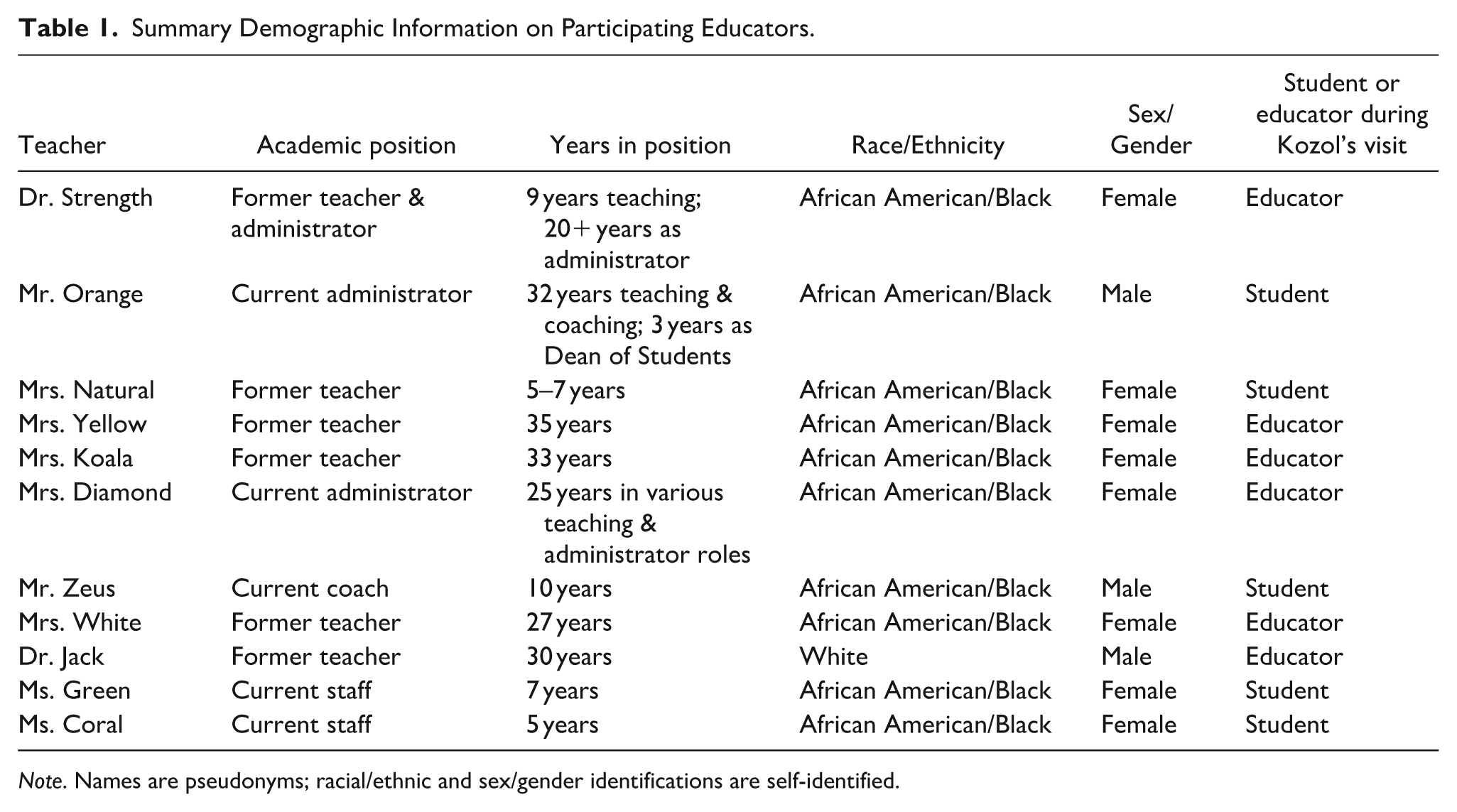
Note. Names are pseudonyms; racial/ethnic and sex/gender identifications are self-identified.
Data Collection
Interview protocol
To address the research questions, we created an interview protocol designed to gather information on participants’ thoughts and experiences with regard to the following questions: (a) what unnamed structures influence teacher and administrator practices in East St. Louis and (b) what are the key factors that influenced your decision to teach in East St. Louis? In reaction to Jonathan Kozol’s depiction of East St. Louis, we asked: (c) what did Kozol get right? (d) what did Kozol get wrong? As it relates to the community cultural wealth of East St. Louis, we asked: (e) what would you want Kozol to know about your experiences with students? (f) what would you want Kozol to know about your experiences with families? (g) what would you want Kozol to know about your experiences with fellow staff members? (h) what would you want Kozol to know about your experiences with community members and leaders? The narrative protocol also asked participants to respond to open-ended questions regarding their family background, school and community background, historical and contemporary knowledge of East St. Louis, professional and educational trajectories, and ways they address perceptions and reactions to teaching and learning in East St. Louis. These questions included: (i) how do you feel East St. Louis is perceived by others? (j) when did you realize or recognize an “outside perception” of East St. Louis? (k) how did you reconcile the “outside perception” with your reality of living and working in East St. Louis? (l) how have others reacted to the knowledge that you are from East St. Louis and/or work in East St. Louis? (m) how have you responded to this reaction? and (n) what influenced your decision to educate in East St. Louis?” The narrative questions allowed us to gain an understanding of what it meant and means to teach and learn in East St. Louis and how educators and students comprehend and reconcile their East St. Louis with the East St. Louis presented in Savage Inequalities.
Data analysis
Upon completion, we analyzed the narratives through an iterative process of reading and re-reading the narratives. We coded based upon topical areas covered in the narrative protocol, as well as Yosso’s (2005) Community Cultural Wealth Model (CCWM) (e.g., resistant, aspirational, navigational, social, and familial capital). We wanted to focus on both differences and similarities in participants’ stories, their reactions and responses to Savage Inequalities, while paying close attention to the nuanced ways in which they were both the recipients and donors of community cultural wealth. We also recoded when new key categories emerged. As a team, we reviewed and compared the analysis of other team members before conceptualizing emergent themes across the narratives.
Throughout this process we practiced trustworthiness by engaging in member checking with participants through email, face-to-face conversations, and phone calls to ensure we captured a true understanding of their experiences and reflections. We presented at a national conference with Mrs. Yellow, Mrs. Koala, and Dr. Strength to clarify themes and meaning, but also to honor their voices and make visible their contributions, which has not been done in previous research on East St. Louis. We also practiced reflexivity in this process by remaining aware of our own biases, as former residents and students of East St. Louis, and their influences on our interpretations of the narratives and identification of themes. We approached the analysis and interpretation of each narrative as standing on its own and having particular meaning for the author of each narrative. Our goal was not to present an unrealistic story that would suggest an essentialist experience of living, working, and existing in East St. Louis, but to fashion a narrative that centered and vocalized the voices of East St. Louis’ educators and their experiences of teaching and learning in East St. Louis.
Findings
“You Can’t Define My City”: Reactions to Savage Inequalities
Highlighting social injustices such as environmental, economic, and educational disparities, Kozol characterizes East St. Louis as “a repository for a nonwhite population that is now regarded as expendable” (p. 10). Kozol goes on to highlight “the misery of the community” (p. 10). Recognizing the role Savage Inequalities has in presenting a crippling and pitying image of East St. Louis to the world, Dr. Strength stated:
He described the town as a sort of third world area where people should be pitied. People felt so sorry for our students that one class of college students took up a collection and sent a check to our early childhood center. Another class of college students wrote and asked for pictures of the school where ‘sewerage’ filled the hallways.
Participants argued that by eliciting outsiders as his tour and cultural guides, Kozol was able to appropriate a lens and view of East St. Louis that best suited him and his case study. East St. Louis’ residents know that others seldom take the time to see East St. Louis and how it has successfully loved, nurtured, and shaped its residents. For many participants, their realities of East St. Louis are often at odds with what others think and believe about East St. Louis. In an act of resistant capital, Ms. Green stated, “You know, you can’t define me. Or you can’t define my city because I know what it is.”
In knowing their city, participants explained what East St. Louis means to them and what they would like others to know about their city. East St. Louis’ residents are acutely aware of East St. Louis’ problems and issues. Mrs. Yellow highlighted the current problems of East St. Louis:
The city needs to improve its infrastructure from improving its schools to repairing the streets and the sewers. The schools need to improve. The old infrastructure also needs to be rebuilt. The political system needs to be revamped. There is very little economic development. The tax money is not used wisely. There are very few businesses. Blacks used to own businesses, but many Blacks are afraid to own businesses because of the high crime rates.
In her awareness of East St. Louis’ problems, she is also able to juxtapose this awareness with a critique (as a form of resistant capital) of who gets to define East St. Louis and what this publicized narrative means for East St. Louis’ residents.
East St. Louis could not be the worst city in the United States. We have our crime, but it is not a ruthless city. Many of our crimes are over publicized. The same crimes may occur elsewhere, but the crimes are not given the media attention.
For Mr. Orange East St. Louis is a complex city with many challenges, but also with good, hard-working residents that balance those challenges.
We all understand that there are some areas in East St. Louis that, you know, definitely needs to be worked on, but as a family, raising your kids in East St. Louis I think we pretty much done our part. So, what people think about or perceive about East St. Louis, my situation with that is, come and live in East St. Louis. East St. Louis is exactly what it is. It’s a black community and we have our share of problems but we also have some good people in East St. Louis.
While East St. Louis has problems and issues, which our participants do not hesitate to discuss, they also acknowledge it is a city with overlooked wealth in its people, social institutions, and relationships.
As a life-long resident of East St. Louis, I’d like Mr. Kozol to understand that families, students, former staff members, community members and leaders do not feel that this city and its school district are lost causes. We have educated many successful people who reside throughout this country. However, I’m sure that as other communities, we have some who have not fared too well. But I submit that the majority of our students are honest, hard-working citizens with jobs and families (Dr. Strength).
For East St. Louis educators, East St. Louis is filled with “good people” who have a commitment to education, a love for teaching and learning, and a desire for academic success. It is this aspirational capital Kozol overlooked and study participants prioritize and acknowledge.
“As if We Were Their Children”: Familial and Navigational Capital
Education is extremely important to the teachers, administrators, and staff members in this study. Study participants who were reared and taught in East St. Louis discuss the impact of local familial capital (i.e., immediate, extended, and pseudo-familial capital) on their educational experiences and aspirations, and in their teaching. Study participants linked their families’ aspirations and expectations to their eventual educational outcomes and classroom practices. Yosso (2005) notes that families “model lessons of caring, coping and providing (educación), which inform our emotional, moral, educational and occupational consciousness” (p. 79). Even with varying levels of parental education (ranging from 8th grade dropouts to college degree recipients), study participants shared how their parents held high educational expectations for their children. Mrs. Koala told us:
Education was emphasized by my extended family and all members were held accountable and encouraged by every other member. It was a given that we make good grades, graduate from high school, and attend college.
For some participants, families provided general guidelines surrounding academic excellence.
Education was highly stressed. We went to school every day. We had time set aside for doing our homework. Our mother stressed making good grades, doing your best, and obeying the teachers.
Participants’ families provided a web of support grounded in the notion of self-worth. Participants also emphasized supportive familial relationships as navigational capital while they traversed a stratified and hierarchal East St. Louis city and school system.
Parents were not the only adults that impacted participants’ educational experiences. Mr. Zeus a current coach, shared the nurturing kinship connections he had with his teachers as an East St. Louis public school student.
. . .but just had great teachers. And the thing I remember most is the teachers connecting with me. They looked at me and not only me, but the classmates and students as if we were their children.
Mrs. Koala also shared the substantive interactions between her and her teachers as a student in East St. Louis.
Teachers and administrators interacted with me in meaningful one-on-one ways. There was always mutual respect between us. They were always approachable. They cared about me, but they never attempted to be my “friend.” There was always the line that separated the adult teacher from me the student.
As a result of familial capital, participants resisted stereotypes about being Black and living in East St. Louis and navigated East St. Louis’ racialized school system. In return, these educators leveraged those past experiences as resistant capital and passed such knowledge and messaging on to their students (us and many others) both formally, during class time, and informally, within mentoring relationships as navigational capital.
“Making Things Happen”: Aspirational Capital
The teachers and administrators in this study were not only on the receiving end of familial capital as youth in East St. Louis, but they extended familial capital in their professional lives as well. In the Community Cultural Wealth Model (CCWM), Yosso (2005) emphasizes that capital (familial, aspirational, navigational, resistant and social capital) “are not mutually exclusive or static, but rather are dynamic processes that build on one another as part of community cultural wealth” (p. 77). Through an exchange of familial and aspirational capital, educators in this study were able to make things happen in the classroom and the school building, often without building-level and district-level support. Mrs. White shared:
I was teaching at [school name] in the late 1980s. Most of the teachers at [school name] were genuinely concerned about their students and did everything within their individual power to provide a quality education for their students. The teachers worked together as a team within the building to address the needs of the students. The word “system” implies that there is an “organized something” in place to oversee the education of students throughout the district. To be honest, I am unaware of any such “organized” system being in place. The teachers at [school name] “made things happen” with little meaningful school district support.
Other examples of making things happen include meeting students’ socio-emotional needs. For example, Ms. Green spoke of her high school experiences in the East St. Louis school district, as experiences in which teachers and staff members went beyond the proverbial call of duty to teach lessons about aspirational capital and resilience amidst the reproduction of poverty.
When we were there, she was our English teacher. And she used to take us on outings, cultural outings. You know, they take us to the zoo. She took us to see My Fair Lady. I remember that, cause it’s such a long movie. But she took us because, there was a point to be made about the girl in the movie, coming from humble beginnings and being taught how to walk and how to act like a lady. She wanted to impress upon us that even though you might come from humble beginnings, that you could aspire to something bigger. A lot of our teachers were on that page. It was, you know, yes, you’re poor. Yes, you’re black. And yes, you come from the Projects [public housing complexes]. But it doesn’t stop there.
In Ms. Green’s current position, she supports her students as well. In establishing mentoring relationships, she emphasizes how to meet students’ basic and socio-emotional needs.
It’s just so much going on whereas sometimes they just need a safe harbor. And I try to offer that by keeping my door open as you saw this morning. I give money. I give encouragement. Whatever, you know, I think is needed, that’s what I really do.
Mrs. Diamond provides another example of making things happen for her students through East St. Louis’ networks. She believes in and works to give her students hands-on, career-related experiences. She uses her familial and social capital to make sure her students can translate their aspirations into outcomes.
A lot of my students want to go into education. They want to become teachers. So, I have what’s called A Students as Teachers Program. They do a 6-week internship at [a local school]. And they do the whole nine yards. They have to write their lesson plans. They have to go by the Illinois State Learning Standards. They give the tests. They teach the lessons. They grade the papers. They go take the students outside for recess. They have to eat with them in the cafeteria. They do everything that a normal teacher would do.
Teachers and administrators realized they were not teaching in an affluent area, but they did not see East St. Louis students as “at-risk youth” in need of rescue. They saw students as intelligent young people enthusiastic to learn and felt obligated and eager to teach them everything they could.
Teachers and administrators also discussed the need for students to feel welcomed and connected to their educators because connectedness pushed students to do well in school. As a former teacher, Mrs. Koala said:
Students needed to develop a relationship with the teacher. They wanted the teacher to like them and be concerned about them. They could sense whether or not the teacher was sincerely concerned about them. If they could “connect” with the teacher, they would work as hard as they could. If they felt that the teacher was not sincerely interested in them, they would slack off.
Mr. Orange told how he makes connections:
I like to treat a person the way that I would want to be treated. . .Because the most important thing is they know that I got their back. They know that I’m not trying to use my title. They know that I am THERE! FOR! THEM! They know that! They know that! It’s just that, you know, when you care about people and I care about these kids. These kids is my job. I’m not faking this. When I give ‘em a hug, I give ‘em a hug because I like them. I love them, you know what I’m saying. It’s not fake because I do it to my kids. I love to hug my kids. You know, come mere [sic]. You know what I’m saying? And there isn’t a hidden agenda. You know what I’m saying? There is no hidden agenda. It’s just real talk and real love.
These educators describe their student-staff relationships as intentionally established and reinforced between teachers, students, parents, administrators, and the community in order to help usher in academic and professional success.
“Countering Stereotypes through Resistance and Empowerment”: Resistant Capital
As shared thus far, East St. Louis teachers offered un-named resources that Kozol did not see. What was seemingly invisible to Kozol were the familial-like bonds, which allowed participants to pass along invaluable navigational capital (i.e., skills to maneuver through social institutions not created with communities of color in mind) and resistant capital (i.e., oppositional skills and behavior to challenge inequality; Yosso, 2005). Participants noted they did not “mince words” with their students; they countered stereotypes by talking about these issues within their classrooms and while on school-based excursions. Mrs. Yellow stated:
I countered stereotypes about teaching and learning in East St. Louis by having open class discussions, giving my life experiences, and simply stating that those were just stereotypes. Students from East St. Louis can be whatever they want to be. They can go to college, to the military, or to the job market.
In helping her students to counter “outsiders” stereotypes, Mrs. White stated:
I promoted academic achievement for my students, exposing them to more opportunities to compete outside of East St. Louis through speech and writing contests sponsored by Southern Illinois University-Edwardsville and Veterans of Foreign Wars and through Scholar Quiz competitions. My mission was to unseat stereotypes with truth.
As educators, participants were keenly aware that the perception of East St. Louis, its school systems, and its students are cast as underprepared and underperforming. So, educators forged ahead by offering their students access to opportunities that fostered resilience and determination through resistant capital.
“Moving as an East St. Louisan”: Navigational and Social Capital
Yosso (2005) connects resistance to stratified hierarchies with an ability to cultivate social capital. In this study, many of our participants were born and raised in East St. Louis, making them intimately familiar with the connection between resistant and social capital (i.e., resources operationalized within East St. Louis’ social networks despite the gaze of external actors). As current and former residents of East St. Louis, participants espoused a desire to work in East St. Louis to “pay it forward” and provide a network of social capital for their students. Mrs. Koala stated:
I have never wanted to work any place other than East St. Louis because this is my home, and one should always take care of home first. I am a part of the children. I understand them, and I love them. I am a Black woman who lives here in ESL. I am not an “outsider” on a “feel good” rescue mission to save “disadvantaged” students. I am a teacher who loves her students and her subject matter. Teaching here in ESL was never a job for me. It was and is my vocation. Teaching and community service go hand in hand. A teacher is a teacher 24/7; students are students 24/7. Living one’s life involves interacting with the people of the community 24/7.
Being community-centered led most participants to take an active and intentional interest in exposing their students to experiences that would enhance their social capital. Dr. Strength explained:
We were fortunate enough to take our students to museums, to major league baseball games, to symphony concerts to libraries, and on college tours. We were even able to expose students to employment possibilities in the utilities (water treatment) area. Some of the trips were for enjoyment. Others were to help students conceptualize other areas in which they could focus.
Mrs. Natural spoke about exposing her students to “. . . Upward Bound, TRIO programs, and various programs and events sponsored by the local fraternities and sororities.” These activities and experiences offered students’ exposure inside and outside of East St. Louis. Mrs. Koala explained:
Students had to be aware that there is a larger world outside of East St. Louis. They had to be exposed to all things of cultural or social value. Much learning takes place outside the classroom, and this is where many of our students have been shortchanged through no fault of their own.
The participants shared a form of empowering social capital, which Stanton-Salazar (2011) argues is important to help students in stratified hierarchies to navigate and rise above oppressive systems and structures. The multiple narratives of this study highlight how deeply residents are committed to their students achieving and aspiring despite seemingly insurmountable obstacles. The teachers and administrators in this study are among the adults providing varying forms of navigational and social capital as community cultural wealth to students in East St. Louis, the authors of this paper included. Working in East St. Louis and achieving professional goals meant participants were willing to resist popular images and beliefs about the city (aspirational and resistant capital).
Conclusion
When I first heard about Kozol’s Savage Inequalities, I thought about Nikki Giovanni’s poem “Nikki-Rosa.” The poet acknowledged hardships “if you’re Black”: “no inside toilet” and “father’s pain as he sells his stock/and another dream goes.” Yet, what made a difference in her life was “that everybody is together” regardless of adverse circumstances. Her major concern was that no white person [should] write about her childhood because the emphasis would be on what Giovanni lacked:
and I really hope no white person ever has cause
to write about me
because they never understand
Black love is Black wealth and they’ll
probably talk about my hard childhood
and never understand that
all the while I was quite happy.
Community involvement, trust, and care are all hallmarks of urban community schools where the needs of Black students are centered (Emdin, 2016; Noguera, 2015; Warren, 2017). By including East St. Louis educators’ voices, we see how educators employ community cultural wealth (familial, navigational, aspirational, social, and resistant capital); this counter-story also problematizes deficit perspectives where students of color in urban communities must be saved (Matias & Liou, 2015; Vera & Gordon, 2003). In the quote above, Mrs. White acknowledged the importance African Americans being allowed to give voice to their experiences.
Through voices, we learn how East St. Louis educators have their own agency. These educators offered prescriptions for other urban educators. First, these educators centered their own narratives about their lived experiences as urban educators. For them, East St. Louis is not just a city where they work. It is a city where they grew up, invested their time, and where they intended to collect their rewards (e.g., their students’ successes). While plagued by the systemic issues outlined in Savage Inequalities, East St. Louis educators highlight how their community cultural wealth sustained the schools, supported social development, and fostered a college going culture. These educators’ backgrounds and familial lineages in East St. Louis were an important part of their counter-stories. As youth, they were offered and became real-world case studies of community cultural wealth, which they utilized for their own students’ aspirational, navigational, resistant, familial, and social capital.
Second, and as Yosso (2005) notes, these forms of capital can intersect in important ways. Much of these educators’ narratives offered resistant capital as a primary lens that dictated their actions and agency. The educators were clear that East St. Louis has a long history of economic divestment and concentrated poverty, which is no fault of the students and families who inherited this city. Educators felt they needed to be clear with students that the messaging students received about their community should not dictate their core beliefs about their abilities nor their sense of pride about East St. Louis. This resistant capital was a tool overtly and covertly used in the curriculum, enrichment opportunities, and mentoring arrangements.
Third, with resistant capital as the primary lens (i.e., “You know, you can’t define me. Or you can’t define my city because I know what it is”), the educators utilized other forms of capital, in layers, in order to move students along a pathway of students’ own choosing (aspirational capital). For example, East St. Louis educators defined family more broadly than a household. These educators extended the notation of family to mentors and other community groups. The educators implied that residing in East St. Louis is a marker of kinship. In doing so, the educators are conceptualizing East St. Louis as a network where webs of support exist (social capital), even if those webs of support are not recognized by external agencies and actors. The teachers used collegial relationships (“made things happen”) or their sorority/fraternity and personal relationships to spread resources and norms to their students. Interestingly, the educators in our study used community pride as navigational capital along with individual agency. By doing so, educators showed students that being from East St. Louis, Illinois offers an identity beyond what outsiders can value.
While Kozol’s Savage Inequalities serves to raise our anger about disparities, the book misses how teachers, particularly African American teachers, are critical figures who place African American children at the center. The shared experiences of the administrators and teachers in this study interrupt the notion that educators in poor, predominantly African American communities are faced with the worst teaching experiences, worst students, and the worst chances for professional success (Ciuffetelli Parker & Craig, 2017). Instead, these educators conceptualized their own roles within a highly stratified system as brokers of the kind of capital that they themselves benefited from as youth.
We encourage other scholars to expand upon research that centers the voices of communities of color while simultaneously challenging the stock stories that have been used in place of our voices. While we have centered the voices of teachers and administrators in this article and discuss our collective experiences in another article (Farmer-Hinton et al., 2013), such work is only a small glimpse into the tremendous capital we have seen and experienced in East St. Louis. We have no doubt that places such as Camden, NJ, Detroit, MI, Chicago, IL, and numerous other urban cities are filled with people, organizations, and community cultural wealth that while unnamed, serve as the foundation for disrupting limited narratives about growing up, being educated, and succeeding. Last, but not least, we encourage researchers and educators to re-engage with Savage Inequalities, but to do so with companion pieces, such as this article and Farmer-Hinton et al. (2013). A more contemporary engagement offers the opportunity to place diverse narratives in conversation with one another while simultaneously revealing a much more complex and dynamic narrative.
Footnotes
Declaration of Conflicting Interests
The author(s) declared no potential conflicts of interest with respect to the research, authorship, and/or publication of this article.
Funding
The author(s) received no financial support for the research, authorship, and/or publication of this article.
Author Biographies
 ) Dr. Joi (as many fondly call her) is known locally, nationally, and globally as a facilitator of liberation, radical self-care expert and community healer. She is the author of the wildly successful book, Healing: The Act of Radical Self-Care, based on her transformative process the Orange Method (OM) of Healing Justice. She founded the OM Community Coach Certification Program in Healing Justice. She is a social entrepreneur, scholar, activist as well as a highly sought-after speaker and executive coach. Her work is deeply informed by growing up in East St. Louis, Illinois, and is grounded in healing justice.
References
Supplementary Material
Please find the following supplemental material available below.
For Open Access articles published under a Creative Commons License, all supplemental material carries the same license as the article it is associated with.
For non-Open Access articles published, all supplemental material carries a non-exclusive license, and permission requests for re-use of supplemental material or any part of supplemental material shall be sent directly to the copyright owner as specified in the copyright notice associated with the article.
