



Abstract
Using data from a participatory ethnography of an urban high school slated for closure, this article examines the impact of comprehensive transformation on the university-school partnership’s goal to change from a culture of underachievement and negativity toward a culture of collaboration and excellence. We explore these question/s: How do comprehensive changes in infrastructure, policies, leadership, and instructional practices shape school culture? What role do shifting power relations (generative frictions) and authentic trust play in developing shared ownership of outcomes? We argue generative frictions produced changes in culture that impacted changes in outcomes.
State takeover of schools in urban communities is the latest in a string of market-based school reform efforts some argue are designed to dismantle public education (Ewing, 2018; McWilliams, 2019; Morel, 2018). Research shows that even the threat of school closure has a profound impact on urban schools (McWilliams, 2019). The university/school partnership we describe in this article is one possible avenue to cope with the threat of closure while also working collaboratively for equity, authenticity, and excellence. Grounded in the everyday work of urban schools, we describe the processes, practices, and policies under-resourced urban communities, schools, and districts together with partner universities might consider as they engage in comprehensive school transformation that is accountable to its local community while also meeting state-imposed accountability requirements. We envision our work as a counternarrative to the hegemonic narrative of urban school closure as the solution. Closing the school was not an ethical option for the staff, students, and families.
The complexity of schools and school change under these conditions cannot be overstated. We believe this complexity is key to understanding what is needed to work for equity and justice in K-12 schools (Milner, 2012b). In what follows, we explain the research context and the partnership in ways that demonstrate that complexity. Our analysis shows how changes in culture impacted improvements in externally mandated demonstrable indicators (DI) required by the state. We do not claim a unidirectional, or causal, link between the changes we implemented and the changed numerics. Rather, we detail how dialogic exchange, authentic trusting relationships, and shifting power relations produced changes in culture that, in turn, generated further changes in the initiative that improved outcomes.
Educational Partnership Organizations (EPO) are legal reforms in New York State (Education Law 211e, 2014) that position a school as a “district within a district” with its own superintendent and unprecedented control over all aspects of running a school. It allows the EPO to act as superintendent for a “failing school” and as such, to “assume the powers and duties of the superintendent of schools for purposes of implementing the educational program of the school, including but not limited to, making recommendations to the board of education on budgetary decisions, staffing population decisions, student discipline decisions, decisions on curriculum and determining the daily schedule and school calendar. . .consistent with applicable collective bargaining agreements (n.p.).” In other words, the EPO is the superintendent and reports directly to the Board of Education and, further, is not subject to the school district superintendent unless specifically noted in the law or the agreement(s). The EPO was also named by the state as the independent receiver
1
which gave us even more authority over the school and comes with some additional funding and requirements. While led by the graduate school of education, it is important to note that the partnership is with the university
The partnership we describe here began with a Saturday afternoon phone call. In February 2014, the president of the school board called Larson at home to ask whether the university would be interested in partnering with Rochester City School District (RCSD) to stop East High School from closing. Larson was willing, but this sort of decision was not up to her. She facilitated the process of bringing this question to the university officials who could make this decision. We engaged in multiple conversations with the school board, the university’s school of education dean, faculty with expertise in running K-12 public schools, and with the university president that resulted in the university submitting a letter of intent to the state to serve as an EPO with East High School.
This article examines the relationships between the comprehensive transformation of practices and the initiative’s goal to change from a culture of underachievement and negativity toward a culture of collaboration and excellence. These transformative relationships are possible through the active use of generative frictions by all community members. Here, we seek to answer these questions: How do comprehensive changes in infrastructure, policies, leadership, and instructional practices shape school culture? What role do shifting power relationships (generative frictions) and authentic trust play in developing shared ownership of outcomes?
Transforming Urban Education
“Urban” has come to mean Black and brown communities in public discourses. Often, this is “code” for poor schools and dangerous neighborhoods that are based in racist stereotypes (Irby, 2015; Shaffer et al., 2018; Welsh & Swain, 2020). Some literature uses geography and associated demographics to define urban in ways that move away from coded racial designations (Green, 2017). Milner (2012a) articulated a set of three categories to help define urban education: urban intensive, urban emergent, and urban characteristic. While including geography, he also includes population numbers to delineate differences among the categories.
Rochester would fall into the urban emergent category in Milner’s typology. We fit this category due to population, however, following Welsh and Swain’s (2020) argument about the dynamic complexity of urban schools, we argue poverty, where relevant, should be considered as part of that complexity. Rochester has the highest child poverty (50.1%) and highest concentrated poverty (16.2%) for similar sized cities in the United States (Doherty, 2015). We rank second overall in percentage of the population living below the poverty line (32.9%). Noguera and Wells (2011) argue there is substantial evidence of how the consequences of poverty “impact the performance of a school in at least three important ways: (a) students’ academic and social supports outside of school; (b) conditions that influence students’ health, safety, and well-being; and (c) conditions that influence the ability of parents and schools to develop social capital” (p. 11). All the problems associated with poverty in urban intensive communities apply in our case: segregation largely due to historical practices of redlining; food insecurity; housing instability; parental (or other family member) incarceration; parent or family death (murder, state violence, suicide); systemic disinvestment in education, housing, and social services; crime; violence (family/state); health disparities; substance abuse; unemployment; and, endemic institutional racism. However, the story is not only about the devastations associated with poverty. The community has considerable assets in terms of interpersonal connections, historical and contemporary activism, artistic innovations, among other things. When trying to build equitable schools, we need to figure out how to mediate all the factors that impact children and youth or risk failure (Noguera & Wells, 2011; Rothstein, 2004). Addressing the complexity requires comprehensive approaches.
University Partnerships
Ironically, it is the case that the schools that are struggling the most are located in districts with highly regarded universities (Noguera, 2017). Universities used to be a resource for change in communities; however, as local community members noted, they have gone to sleep (Larson & Moses, 2018). We know from the literature on university/school partnerships that universities are uniquely positioned to use their resources and knowledge base to transform educational inequities (Harkavy & Hartley, 2009). University school partnerships offer promising research-practice contexts to bring about the kind of fundamental changes needed, particularly in urban communities (Quartz et al., 2017).
University/school partnerships are not new (Goodlad, 1991). Long-term university/school collaborations have resulted in the development of key components of authentic turnaround strategies (Bryk et al., 2010), significant gains in achievement and in sustainable relationships with families and communities (Officer et al., 2013), and important insights into how changes are interpreted across boundaries of language and culture (Penuel et al., 2013).
Partnerships can take the form of Professional Learning Schools that focus on teacher training, curriculum development, and service learning (Butler et al., 2021; Darling-Hammond, 2012; Eyler & Giles, 1999; Fahey, 2011; Goodlad et al., 2004; Kronick et al., 2011; Ladson-Billings & Gomez, 2001; Professional Development Schools, 1995; Walsh & Backe, 2013). These types of partnerships focus mostly on teacher and administrator preparation where the schools typically serve the university as a training site. The partnership we describe does more than this in that both partners seek collaborative transformation and growth (Jones et al., 2016) and includes a practice of humility on the part of the university to mediate hierarchical barriers common in such partnerships (Corbin et al., 2017).
Systemic approaches are more complex and require deeper involvement on both sides of the partnership (Walsh et al., 2009). Silbert (2019) analyzed the complexity of partnerships and partnering generally to critique and move past the traditional concepts of reciprocity and mutuality common in the partnership literature. They argue that these concepts obscure inequitable power relations between schools and universities. Focusing on the importance of dialogic relations in partnerships where power is unequal, they state that, “Strengthening partnerships across unequal contexts requires building a new language of collective empowerment based on asymmetrical reciprocity rather than on assumptions of equivalence” (Silbert, 2019, p. 12). Partners need to focus on building trusting relationships grounded in a politics of difference. In other words, difference is a value, not an obstacle. Building on previous work (Larson & Moses, 2018), we have come to call this relational work a process of dissensus—living in the difference by understanding that all knowledge people bring to the discussion counts in our process of re-envisioning the school. Furthermore, the generative friction analysis we present in this article analyzes power relations in ways that illustrate what is produced, on a continuum of positive to negative, and how what is produced facilitated change.
Recent work in university-school partnerships focuses on the complexity of problems schools encounter and argue that partnerships need to embrace that complexity (Noguera & Wells, 2011). Community schools have become a frequent strategy to address the complexity of partnerships and are commonly required by state departments of education for schools under review; this is the case with the EPO described in this article (Green, 2018; Holme et al., 2020). Valli et al. (2016) developed a typology of reforms that attempt to meet the complexity of issues that is helpful when thinking about the work we are doing. The category of Full Service Community School (FSCS) most relates to the partnership we are building. By centering student, family, and community involvement in decision-making, an FSCS emphasizes deep change in what is considered normative in addition to changes in structure, curriculum and pedagogy, and outcomes. Figure 1 below illustrates the ways in which culture change and reform initiatives were mutually constituted strategies to incorporate the complexity discussed in the literature.
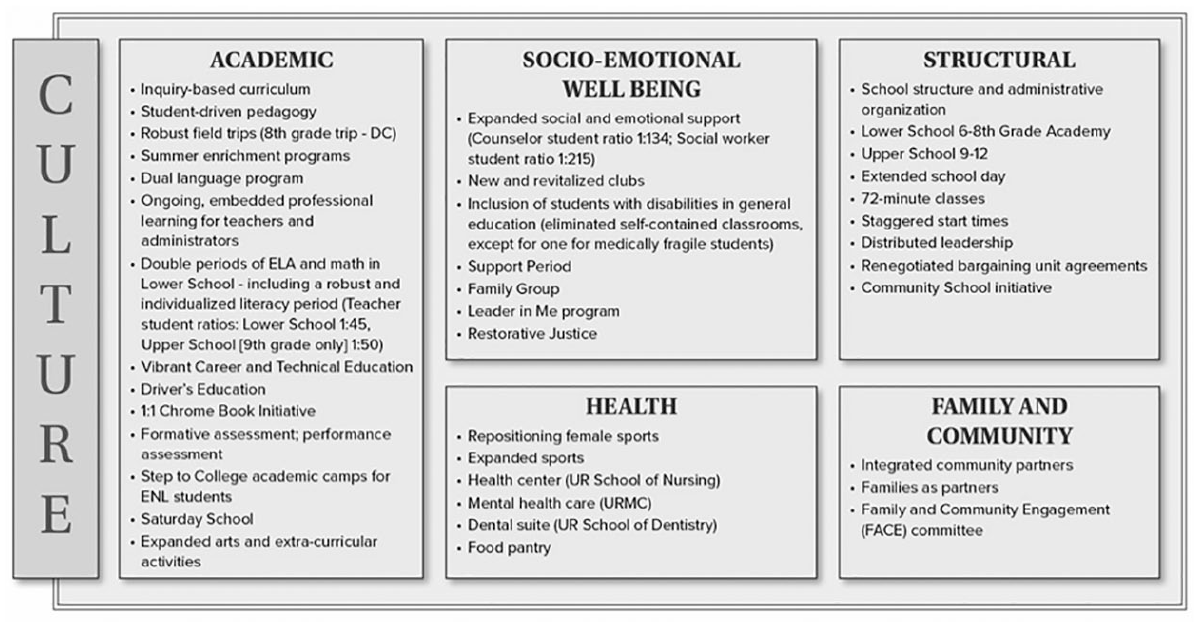
Changing everything.
What this figure helps us see are the ways in which different initiatives combined to address the complexities in difference and in power relationships we encountered. We needed a theoretical framework that could help us interpret this complexity.
Theoretical Framework
To understand and interpret the data, we used an interdisciplinary theoretical framework that draws on theories of change, culture, and power and that is grounded in an ecological model of school transformation (Bishop & Noguera, 2019). We conceptualize the process of change as dialogic democratic engagement (Bakhtin & Holquist, 1981; Kinloch, 2005) in which all parties struggle through success and conflict as committed social actors. Working through the daily machinations of a large urban high school requires trusting relationships that are achieved through the struggle to understand one another despite our many differences across a myriad of identity markers (race, class, education, gender, geography) and roles (teacher, administrator, student, staff, university faculty, parent/guardian). As such, we use the concept of dialogicality as a site of struggle and friction that fuels passion and action (Larson et al., 2017). Thus, our theory of change asserts that working through difference and building trusting relationships through dialogic engagements facilitates the kind of deep culture change needed for equity and excellence in education (Blankstein & Noguera, 2016).
The complexity involved in transforming schools necessitated a framework that could help explain that complexity. Bishop and Noguera (2019) describe an ecological framework for equity-based education policy that helped us frame what could be possible in transforming urban education. They articulate “broader conceptions of educational equity policy that include system design, classroom practices, resources, and out of school factors that, in turn, impact policy implementation intended to promote educational equity” (p. 125). A comprehensive approach could assist communities overwhelmed by the consequences of systematic disinvestment design schools that can address the complex academic, social, linguistic, and cultural issues urban schools face. This framework helped us interpret the comprehensive community school model we are implementing at East.
We theorize culture as practices that are mutually constituted between people as they participate in valued activities (Duranti, 1997; Nasir & Hand, 2006). Working against colonial notions of culture as something “other” people have (Bhabba, 1994), we define culture as a system of practices (linguistic, political, historical, social, material) in which human labor produces tools that both mediate their participation in social and material worlds and construct those worlds. Challenging individualistic notions of traits that belong to “others,” we focus instead on cultural repertoires of practice to account for the variation of practices in which people participate in a school (Gutiérrez & Rogoff, 2003).
Defining culture this way affords us an asset-based perspective that understands all people bring valuable repertoires of practice to their participation in schools which, in turn, help researchers to understand how people “live culturally” rather than isolating culture from participation in everyday life (Moll, 2000). Following Duranti (1997), any action in the world, including educational action, has inherently social, collective, and participatory qualities. Participation in these practices requires the explicit sharing of existing resources (belief systems, languages, the built environment, people) and their implicit assessment for the task at hand (Duranti, 1997). Given the complexity of urban schools, documenting the variety of cultural practices available and how those practices come together and change over time due to explicit efforts to reconstruct old, destructive practices presents a challenge. This conception of culture builds on the dialogic engagement needed to enact authentic change by viewing all participants as having equal potential to contribute to the ongoing culture change. Furthermore, a broader conceptualization of culture builds on research on school culture which tends to focus on leadership and other factors within the school (Deal & Peterson, 1990; Eilers & Camacho, 2007). Understanding the role school culture plays in education transformation documented in this literature is important and vital to understanding what is needed to change a deficit-oriented school culture that we seek to build on in our work (Higgins-D’Alessandro & Sadh, 1998; Louis, 2007; Waldron & McLeskey, 2010). We focus more broadly to consider the multiple factors that come into the school from the surrounding contexts.
To understand how social and power relations were transformed as the culture changed, we use Foucault’s (1990/1978) concept of power as a complex set of force relations in which power produces generative frictions (Larson & Moses, 2018). We use an analytics of power to trace how power relations were transformed given our understanding of change as a complex, dialogic process and culture as participation in activity. In previous participatory ethnography, Larson and colleagues used Ziarek’s (2001) concept of dissensus to describe working with and through frictions. Thus, dissensus is a practice to challenge stagnation and the building of relationships across differences based on trust and our shared commitment to justice. We build on this notion as we identify and interpret generative frictions around the EPO that produced deeper understanding and animated further changes in culture.
Foucault’s (1990/1978) move away from the mechanisms of power toward its pervasiveness enabled us to focus on the “everydayness” of power relations as participants worked to implement the new initiatives, build trusting relationships, and change the culture. Understanding power at this micro level was important for us to build our interpretation of how the EPO was lived by staff at the school in their everyday work. Together, these theories help us interpret how the EPO (an act of power) produced changing power relations which produced changes in the culture of the school. Figure 2 illustrates how these theories work together to produce a collaborative transformation focused on equity.
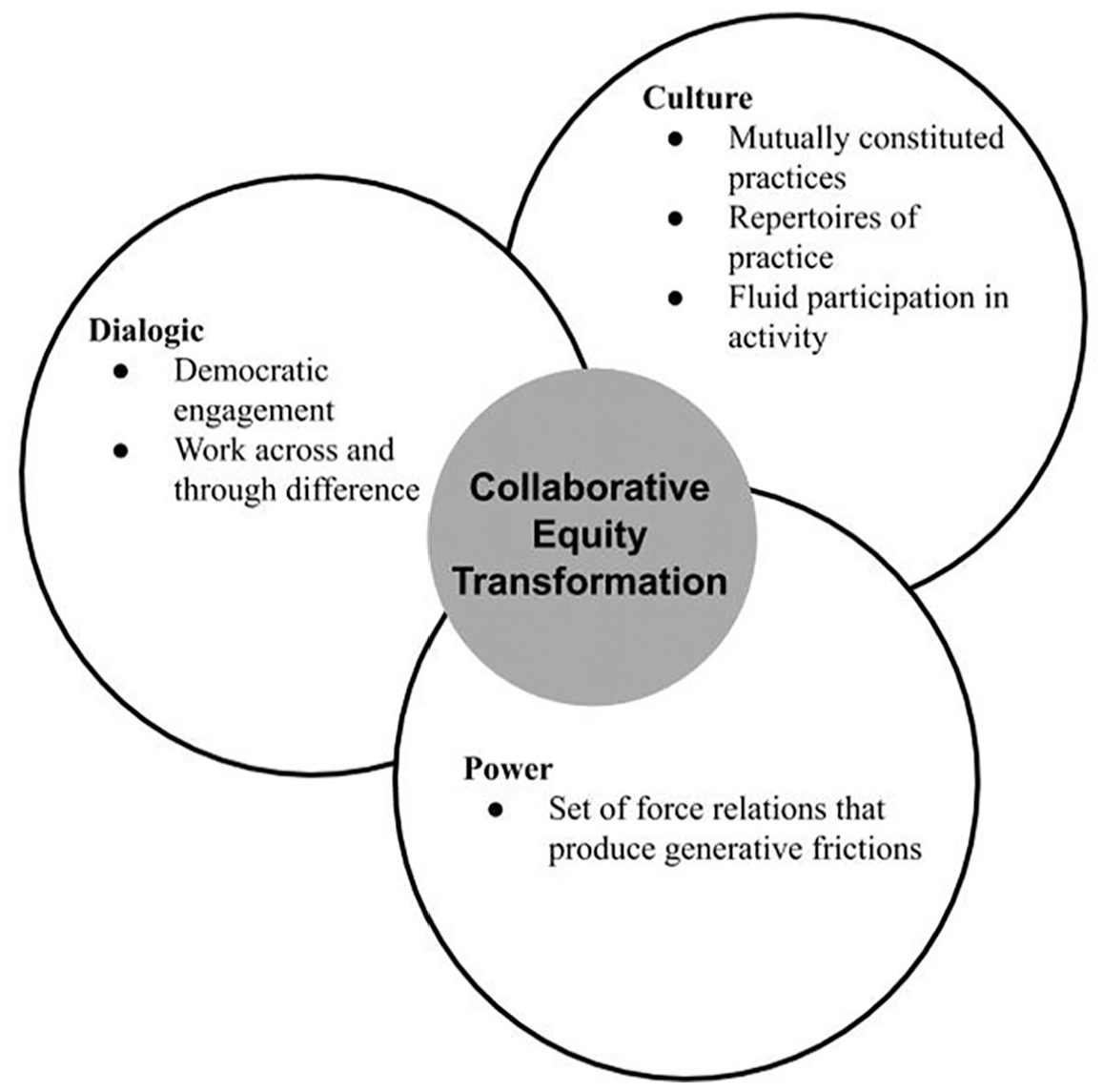
Collaborative equity transformation.
Bringing these frameworks together, data analyses revealed generative frictions related to overall culture change as follows: (1) resistance/all in; (2) old culture/new culture, (3) new ideas/status quo; (4) trusting relationships/betrayal; and (5) experiential knowledge/unknown knowledge (see Table 1). The overarching theme that ties all these frictions together was building trusting relationships; without these relationships, positive and ongoing culture change could not take hold.
Generative Frictions and Culture Change.
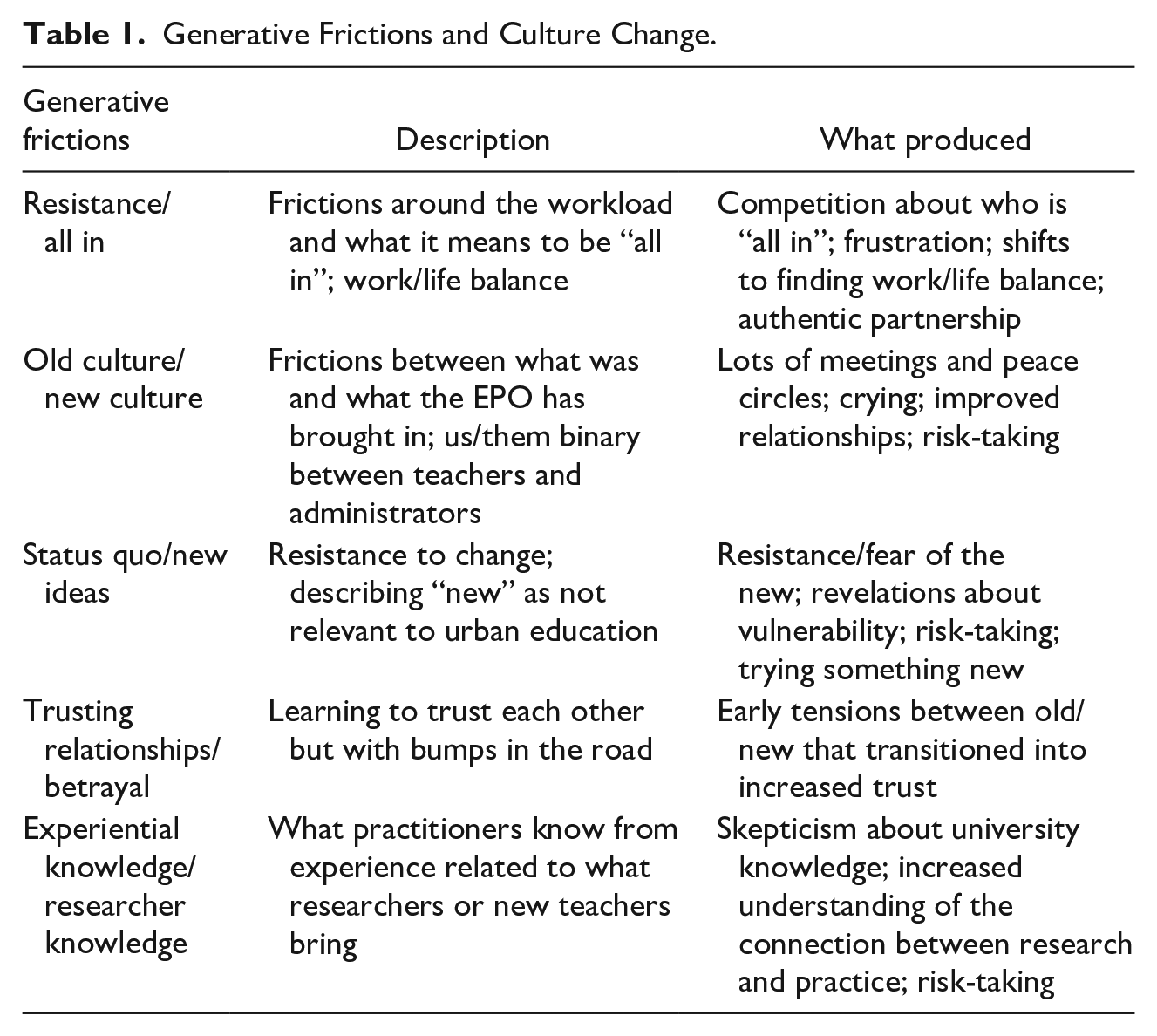
After describing our research context, we will present data that illustrates what was produced by these generative frictions.
Research Context, Methodology, and Data Corpus
Research Context
To write the EPO proposal we began a lengthy data gathering process. A leadership team of university faculty and school administrators met with community agencies, Rochester’s Mayor, parents, community members, teachers, administrators, and students. More than 2,000 stakeholders over the course of 6 months provided extensive input, including from approximately 1,200 students across grades 7 to 12 at the school in September 2014. We documented answers to questions about what students would like to see at East, what they thought needed changing, what classes they would like to take, and how we can better involve their families.
After collaboratively analyzing data gathered from meetings, interviews, and focus groups, the leadership team developed a full proposal that was submitted to NYSED in December 2014. The university was approved to serve as the EPO beginning July 1, 2015. We opened the doors to approximately 1,400 students in grades 6 to 12 September 8, 2015. The EPO plan was a 100+ page document plus appendices created by a team of university staff to guide the work of the partnership (see https://www.rochester.edu/warner/cues/home/east-epo/ for the full plan and all additional documents and union agreements). The EPO plan reflected the input of labor unions, community members (agencies and neighborhood groups), parents, students, and university staff. The plan provided a set of principles to address curricular, instructional and assessment changes, enhanced family engagement, strengthened community partnerships, teacher, and administrative leadership and university oversight.
In theory, the plan included the necessary steps to transform East. However, the plan failed to provide guidance for implementation and accountability for specific roles and titled positions within the organization. In fact, the plan did not include input from any of the current administrative (principals, assistant principals, directors etc.) team members who were hired after the EPO plan was approved (the superintendent was involved in early discussions but held a position in another district). Nelms, the EPO superintendent, argued that the success of the implementation relied heavily on the effective distribution of power within the school setting and implemented a distributed leadership practice in response.
A crucial aspect of developing the EPO was re-negotiating all four bargaining unit contracts: teachers’ union, administrators’ union, and two support personnel unions. The EPO would require a longer workday and other changes in the working environment that had to be agreed upon by all parties. All teachers and administrators had to apply to work for the partnership which meant agreeing to these contracts.
The EPO ended its last year of the initial 5-year agreement amid the COVID 19 pandemic. SED approved a 3-year extension in summer 2020. As of 2019, there are approximately 1,200 students in grades 6 to 12, 190 teachers and administrators. Current student demographics show that 55% of students identify as African American; 32% Latinx; 9% White; 3% Asian; 1% Other (distributed among American Indian/Alaska Native, Native Hawaiian or Pacific Islander, or two or more). 15% of the student population are English as a New Language Learners (ENL), and 14% are students with disabilities. 46% are female; 54% are male. 91% of students receive free lunch (a proxy for poverty). The 2019 demographics for teachers and administrators indicate they identify as 76% white, 10% African American, 11% Latinx; Asian American and Native American/Alaska Native each 1%; 2% do not specify racial identification. 65% identify as female, and 35% as male. When considering the intersection of race and gender, we see that 50% identify as white females and 26% white males; 2% African American females and 6% African American males; 8% as Latina and 1% as Latino. Gender identification among Asian Americans and Native American/Alaska Native are evenly distributed.
The Shock of Discovery
Before moving to data analysis, it is important to tell the story of our first year and the deep systemic dysfunction we uncovered in order for others to get a sense of the extent of the macro and micro level work needed. Going in, we all knew this would be hard work, but we did not expect organizational dysfunction in the extremes we found. In the first 6 months, we discovered inappropriate relationships between adults and between adults and students that resulted in legal consequences, misappropriation of funds, and student data manipulation. In addition to some illegal use of funds, we found that funding decisions were not aligned to the systemic issues which defined the school; therefore, few dollars went to classrooms, technology, professional learning, or parent engagement. We found seniors set to graduate that June who accumulated 22 credits, the state mandate for graduation, but failed to pass the five required examinations. It seemed students, staff, community, RCSD Board of Education (BOE), and families were misled regarding their graduation status due to the lack of data tracking relative to student performance. Based on the data that was provided by the school, we thought we inherited a projected graduation rate of 30% (the public number); in reality, it was 19%. What we discovered may have not been intentional neglect. Rather, the lack of data analysis as a systemic function led leaders to not account for students who had dropped out as part of their denominator. The rest of year 1 was about identifying and remediating systemic dysfunctional practices and setting up systems to ensure these problems were not repeated. Regardless of who led the school, taught classes or studied in our setting, sustained transformation was impossible if we did not address the structural and operational aspects of the school. We needed to balance the cultural changes we were attempting with the basic needs of students who needed to graduate, which we saw as an equity issue, as well as the state’s requirement of meeting demonstrable indicators (DI) for us to remain open.
Methodology
Building on participatory designs in qualitative research, we adapted participatory ethnography as a methodology that has been shown to be particularly well-suited for complex organizations (Darrouzet et al., 2009). We used a critical participatory stance to explicitly position the research as emancipatory and the researcher as a full participant in that emancipatory work (Paris & Winn, 2013). Following research methodologies of Participatory Action Research (Irizarry & Brown, 2014) and Community Engaged Scholarship (Holland et al., 2010), we sought to bring together the differing positionalities of university researchers, teachers, and administrators as practicing professionals and a critical view of culture and power (Eisenhart, 2018) to work toward equity and excellence in urban education. The co-researcher stance was an important position to take given the collaborative nature of the partnership between the university and the school, and the desire to authentically learn from each other. While the ethnography was not “action” research, we did follow an iterative cycle where data (primarily collected by Larson) were shared on an ongoing basis for collaborative analysis and identification of problems of practice (Gutiérrez & Penuel, 2014) that could be further investigated in the ethnography.
Larson was a professor at the University of Rochester who was one of the leaders of the partnership. She co-taught two classes at the school throughout the partnership: 9th grade English Language Arts (ELA) critical literacy unit and yearlong credit bearing elective on Hip Hop. With a full year sabbatical in year 1 of the partnership, she began the ethnography full time. In subsequent years, she spent 60% of her time at the school in research, co-teaching, and leadership capacities. Nelms was the Superintendent of the EPO and, as a faculty member at the University, was the director for the Center for Urban Education Success (CUES). In these roles, Nelms was responsible for implementing the school transformation plan while also mediating the relationship between the university, school, New York State Education Department (NYSED), BOE, and the Rochester community.
Data interpretation was done in iterative cycles, basing this process on what Freire calls praxis or the work of human activity which “consists of action and reflection: it is praxis; it is transformation of the world. And as praxis it requires theory to illuminate it” (Freire, 1972, p. 96). We used constructivist grounded theory (Charmaz, 2014; Saldaña, 2016) analyses to develop themes across the data and held focus groups to check their credibility and to teach participants about qualitative data analysis. A constant comparative process was used to develop the claims presented in this article. Once initial themes were identified, focus groups with participants provided confirmation of developing claims and identified new questions to research. First cycle coding identified in-vivo codes that were then collapsed into categories and themes in subsequent coding cycles and presented to participants in focus groups. In collaboration with Larson, school personnel (teachers—including union leaders—and administrators) analyzed then used the study data extensively to both track the school community’s perspective on the changes we implemented and to develop initiatives or policies that addressed concerns raised (See Figure 1 for the range of initiatives implemented).
Data corpus
Quantitative school data were regularly accessed from a variety of digital data systems that were compiled and organized by the school’s accountability administrator. These data were regularly gathered and analyzed throughout and between school years to inform adjustments and responsiveness to student needs for the whole school. School personnel identified areas for further research after which Larson would bring together relevant data for further collaborative analyses.
In addition to the traditional quantitative school data collected as part of everyday practice, we used ethnographic data collected as part of Larson’s long term participatory ethnography of the partnership. Larson observed nine teachers’ classrooms weekly during year 1, taking field notes and gathering documents. She interviewed each teacher at the beginning and end of year 1 and annually at the end of each year thereafter, while continuing to observe throughout the school. Unit and lesson plans were collected for observed teachers and from the two classes she co-taught. Administrators (n-8) were observed in various aspects of their workday and interviewed following the same pattern as teachers. Participants were shadowed for a full day at least once. The rich diversity of data sources provided triangulation of findings and include 6 years of data as follows: field notes of participant observation in classrooms, leadership and staff meetings, hallways, cafeterias, auditoriums, full day shadowing of key participants; formal and informal interviews; focus groups; documents including: unit and lesson plans, emails, news articles, meeting minutes; research and teaching memos; photographs; and, annual climate surveys of teachers, staff, students, and families, as well as the regularly collected school data. Primary qualitative data collection was done by Larson while school data were collected and shared by the accountability administrator. Future questions or areas of research focus were decided collaboratively.
A key limitation of the research is that no one person can document such complexity. In spite of Larson becoming a full participant in the school, she could not be everywhere at once. Her role was complex: researcher; parent (her son attended the first year and a half and graduated); co-teacher; co-founder of the EPO; ad hoc member of school leadership committees; co-chair of the Family and Community Engagement Committee. This complexity of roles both enabled rich data collection and caused confusion. The confusion was mediated by her persistent presence which led to increased trust and deepened relationships. Her regular presence facilitated deeper understanding of the relationship between research/practice for both herself as a researcher and for practitioners with whom she worked. For Nelms, a key limitation was the role distributed leadership played in shared decision making where responsibility is shared by all, but the ultimate accountability for successful implementation of the EPO plan was attributed to Nelms alone.
Changing Everything at Once
We did not follow traditional advice and make slow, incremental change (Elmore & Juli, 2007). We changed everything all at once. Bishop and Noguera’s (2019) ecological framework informs our analyses and helps us understand the myriad of factors needed for equity focused reform to take hold. Figure 1 illustrates examples of curricular and structural changes we implemented based on stakeholder input and state requirements for improvement as well as revisions or additions discovered through our data analysis cycles. We argue that these changes produced iterative shifts in the deep culture of the school.
When asked to transform schools, school personnel are often perplexed where to begin. Lessons learned in this study provide context for honoring the importance of shared leadership in developing process driven school transformation (Nelms, 2013). The process used for the EPO’s transformation began with a deep analysis of the data gathered prior to the EPO start date. The data provided a grounded context for what needed to change. We realized we needed to change, construct, and eliminate structures but, more importantly, had to get people ready for change. This meant we focused on establishing interpersonal accountability to ensure everyone was prepared to own the success and failure of the organization which implied changes in power relationships which we were able to explore through analysis of generative frictions. We saw a transition from struggles around who was responsible for what to a greater sense of shared responsibility over the first 3 years. One participant perceived this transition to shared accountability in a positive light: I think colleagues are starting to hold one another more accountable than they were willing to do before because they felt that was the leader’s job, but it’s not the leader’s job. It’s everyone’s job. If you’re coming together for a collaborative planning time and your partner hasn’t done their part, you shouldn’t wait for an administrator to say something. You should say something. I’m pleased with that. (Interview, May 2018).
The process of transformation was, and remains, fluid in that each year we learned more about what we were changing which often prompted us to make corrections during the implementation. We made these changes based on data (interviews, end of year surveys, and observations) collected and analyzed by various stakeholders (Family and Community Engagement Committee (FACE), Executive Committee, Union partnerships, students etc.). As we sought to interpret data collaboratively, we were able strengthen each other’s understanding about how to analyze, interpret, and use data to inform practice through professional learning opportunities with Larson.
The most prominent theme we found through this collaborative analytic process is the need for trusting relationships (Bryk et al., 2010). To make the kind of profound culture change we are attempting, we must build a context where it is safe to let go—to not be afraid to take risks and to work through frictions. We were working against the cultural model of a hero who saves the day (Copland, 2003). The hero was not the university, nor was it Nelms as the EPO Superintendent. We were working against the fear of letting competence work, making mistakes, and rethinking which implies shifting power relationships in ways that were more equitable. Additionally, we sought to let students authentically lead, which is something that is developing at East but that remains an explicit goal of the EPO. One adult participant noted the shift in accountability: I think this year has certainly been smoother than the first two for kids. I definitely see that we are making progress and that the culture and some of the expectations for what we’re looking to create are becoming ingrained with the kids, and the kids are starting now to push those expectations out to others (Interview, May 2018)
To accomplish this, we are building spaces for people to think about their own thinking, to be more thoughtful, and to construct a shared language around justice, equity, and accountability. For students, we have included a Family Group structure that is a dedicated time 30 minutes per day where students and staff meet in small groups to build relationships. Two adults and ten students remain in the same Family Group throughout the years in each school (6–8 in lower school; 9–12 in upper school). In this way, relationships grow and deepen which in turn increases trust and supports risk taking.
The implementation of restorative justice practices contributed to the change in culture around accountability across community members. Restorative practices also contributed significantly to building the trust needed to transform the culture from punitive to supportive. One story is a somewhat humorous example of how the shift to restorative justice has changed the school culture, particularly for students. In year 2, one young man emailed a principal over the weekend stating, “I need one of those circle things.” Evidently, there were some arguments circulating online that made him think there would be trouble at school on Monday, so he reached out. The principal met this young man at the bus on Monday morning and they set up a restorative circle with the parties involved. This collaborative effort resolved tensions in ways that constructed safety for the students. That the student contacted the principal to begin a restorative process indicates the trust students were beginning to feel.
Within the process of building trusting relationships, the generative frictions identified in Figure 1 occurred. There was apprehension about whether the university people actually understood what they were getting into which indexed where the trust level was at the beginning: I think there's a lot of people at the [university] that are getting involved in this program—in fact, if I had to guess, Joanne, I really feel like maybe even 90 percent or more of the people at the [university] that are all gung ho on this have no experience with urban education and that they're understanding of problems is very limited. And so I think there's going to be some shocks for many people to understand it's not as simple as blank and blank and blank, or that, um, they missed X, Y, and Z (Interview, July 2015).
There were shocks indeed. However, this participant’s openness to new ideas despite apprehension, or the generative friction around trust, produced space for collaboration, and learning. When university people did not leave despite shocks and mistakes, staff trusted a bit more and relationships deepened. In turn, researchers had to confront their own assumptions about what they believed about what teachers and administrators did or did not know. Once both groups realized they each understood important, yet different, things about our work, they worked out strategies that built on each other’s areas of expertise.
One of the generative frictions that surfaced early was the idea of “old East versus new East.” On the one hand, “old” East was what brought the partnership together in order to prevent school closure. Yet, after the rigorous hiring process where 60% of the teaching staff and 80% of the administrative staff were new, frictions emerged among those who returned. One exchange during an end of year 1 teacher focus group captured this feeling:
Interviewee 3: I’m really bothered by that term, and it’s starting to really bother me, like, a lot, and it’s bothered me a long time, but now I can’t really handle it anymore is that old East, because there’s this sense of—and I don’t know how I’m gonna, like, com—like, I’m gonna communicate this to someone, but I don’t know how yet. Like, I don’t know whether it’s a Let’s Talk anonymous—
Right.
- or my name, or in a faculty meeting when someone, like, laughs about it.
But we’re—I mean—
But the thing is, old East, there’s this, like, negativity. Old East, we’ve gotta be new. This is—that was the old East. We’ve gotta be—and that, like—
There was a lot about the old East that was good.
That offends every—40 percent of the staff—
Correct.
- every time you say it.
I’ve talked a lot with people—people about that—
(inaudible) is the worst at that.
In a sense that it must be painful to hear over and over.
It is. It’s really starting to, like, really get painful.
(Focus group, January 2016)
In this same conversation, the group noticed that the new teachers and administrators brought a renewed passion to their work and a sense of fun that they (the returning staff) felt they had lost.
Something that I’ve noticed, um, and I think it’s different. It might fall under one of these categories in building relationships, like, caring, or belonging, or that sort of thing, but like, the—the—just the general sense of enjoyment (Focus group, January 2016).
Thus, the generative friction between a feeling of resentment toward constantly being cast as “bad” when people talked about the old culture and this old/new dialectic produced both a renewed sense of enjoyment and a feeling of resentment.
By establishing a culture of shared decision making which also built space for power relations to shift, we began to better understand the conditions which led to previous systemic failure. What we discovered was, at times, shocking and would have never been discovered if trust had not been developed for stakeholders to tell the real story behind the school’s poor academic performance (Bryk et al., 2010).
Analysis of Cultural Shifts
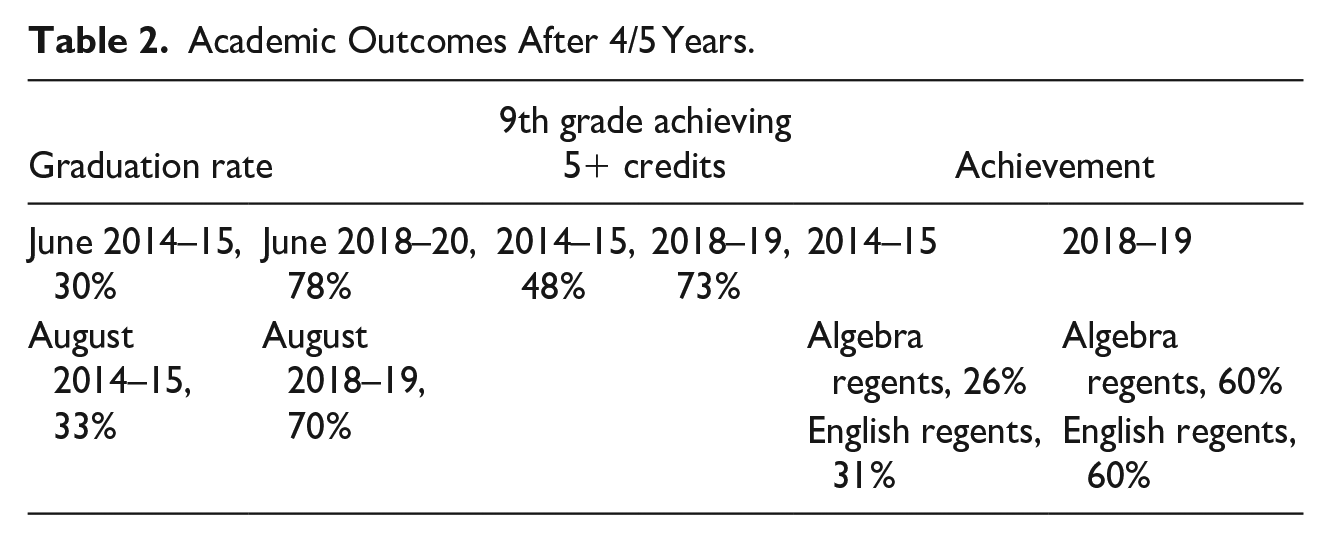
We have developed snapshots of the cultural shifts that demonstrated growth we have seen since year 1. We see these shifts as partially the product of the generative frictions in Table 1 given those frictions produced new ideas, changed power relations, and increased trust as relationships deepened over time. And we see these shifts as partially a product of the intersection of dialogic exchanges, culture, and power relations as highlighted in our theoretical framework. Finally, we see these shifts as connected to the full range of initiatives implemented. In particular, the shift to a distributed leadership model (Harris, 2004; Harris & Spillane, 2008; Leithwood et al., 2004; Spillane, 2008; Spillane & Healey, 2010) and the use of restorative justice practices (McCluskey et al., 2008; McCold, 2007; Winn, 2018) facilitated a wide range of individuals and groups taking responsibility for transforming the school. Table 2 is an overview of three factors for which we have seen improvement over the first 4/5 years: (1) graduation rate; (2) 9th grade advancement; and (3) achievement. We added in data for year 5 where available. School closure in spring 2020 due to the COVID 19 pandemic interrupted some data reporting. Our full data corpus reveals change and growth in more than these areas; however, for this article we focus on factors for which we are being held accountable by NYSED while under threat of state takeover. We argue these changes in outcomes required by the state were produced by the cultural shift from deficit ideologies and an environment of punishment to a growing asset-based culture and a shared commitment to equity.
Academic Outcomes After 4/5 Years.
Cultural Shift: Graduation Rates
A common practice in RCSD is to use two graduation cycles to calculate the graduation rate: June and August. NYSED uses the August rate to determine school effectiveness which is one reason this practice has emerged. NYSED graduation requirements are widely considered rigorous and challenging in the field of K-12 education because students are required to pass courses and five comprehensive exams. For the purpose of this study, graduation is considered a data point which indicates a culmination of transformative changes to the school. By August, students who need summer school have another chance to recover credits and pass state required exams. Schools have higher graduation rates when August is included. Our goal was to increase June graduation rates by ensuring high quality education and high expectations of our students so that the need for summer school was reduced. This would represent a culture shift from counting on summer school to fulfill requirements to doing so during the academic year—a shift from low expectations to high expectations.
As mentioned, our actual projected graduation rate for June 2016 was 19% when we uncovered systemic dysfunction in January. Administration and counselors worked hard to correct schedules, remediate missing academics, and provided targeted intervention during the day, nights, and weekends. The administrative team also met with parents and students to ensure they were accurately informed of their progress toward meeting graduation outcomes and to discuss a plan for doing so. By August of 2016, we had a graduation rate of 40%—a significant rise from the publicly known 30%, but a far cry from the actual 19% we uncovered. As of June 2020, our graduation rate is 78%, a significant improvement in 5 years.
Accompanying this rise in graduation rates is a cultural shift in how students see themselves and how the community sees the school. Graduation is no longer reserved for the few, but is possible for all students. The tone of the building has shifted from a negative, punitive environment to one where small and large successes are celebrated and where everyone feels welcome.
For me, I would probably say the change in the upper school kids' response to me from when I first [started], you know, ‘Bitch, who the hell are you?’ To now having those same kids that initially said all kinds of inappropriate things are now saying to peers, ‘Don’t talk like that,’ or, ‘She’ll help you if you’ll let her.’ Things of that nature (Interview, June 2016).
Accompanying the shift in tone was a deeper focus on instruction that contributed to the culture shift around seeing the students as capable of graduation rather than the low expectations previously in place.
I feel like the vast majority of the time when I'm in there, um, the very vast majority, teachers are teaching and kids are learning and there's a specific focus or plan in place. And I didn't necessarily feel that at—that was as consistent last year (Interview, June 2017).
Community discourses have mostly shifted to talk about how well the school is doing instead of about how terrible a place it was. Local newspaper reporting documented successes rather than failures, for example (Murphy, 2018). There are still people who criticize the partnership, mostly around false narratives about cost, but they no longer focus on poor performance.
Cultural Shift: 9th Grade Credits
We inherited a large number of students (over 400) who were stuck at 9th grade with zero credits who could not advance to 10th grade. We know from the literature that 9th grade is a key determinant of graduation and dropout rates (Neild et al., 2008; Wheelock & Miao, 2005). We created the “9th Grade Academy” and invested additional resources to both remediate the existing group of students and support on track students. To ensure students and families received accurate information regarding high school exit outcomes, two counselors were assigned to support the students in the Freshman class. In addition to counselors, two social workers were provided to address issues of trauma and social emotional needs which were identified by the lower school staff. We constructed courses and schedules so that lower school students (grades 6–8) could enter 9th grade with up to five high school credits. We partnered with Rochester’s Freedom School to support students who were 18 and older with zero credits to pass the National High School Equivalency Exam, or TASC (formerly GED). As of June 2019, 24 students who would otherwise have dropped out have achieved this goal and walked the stage at graduation. As Table 2 demonstrates, we have dramatically improved the percentage of students who end 9th grade with five credits or more.
Cultural Shift: Achievement
The EPO required almost complete rewriting of curriculum and a total overhaul of instructional strategies. Teachers were assigned mandated daily collaborative planning time and hundreds of hours of embedded professional learning to write curriculum using Understanding by Design (UbD) (Wiggans & McTighe, 1998). The collaborative planning time was a negotiated element of the bargaining agreement. Creating structures within the school day to build coherence among staff would create opportunities for sustained growth and improvement. We placed instructional coaches in all content areas who implemented regular coaching cycles drawing on Expeditionary Learning (n.d.) frameworks. The principals created the “22 5 80” and “22 9 80” campaigns to make sure all students and their families knew what they needed for graduation: 22 credits, 5 Regents exams with a score of 80 or higher (the indicator for college readiness) for a Regents diploma; and, 22 credits, 9 Regents exams with a score of 80 or higher for an Advanced Regents diploma. Table 2 illustrates the growth in Math and English Regents exam scores over 4 years as a result of system changes that addressed both remediation and acceleration.
The distributed leadership model challenged administrators to create a sense of efficacy by identifying poor performance, taking actionable steps toward improvement, and holding teachers and principals accountable for growth as the first step toward improving school culture (Nelms, 2013). Focusing on student achievement and quality instruction required the principals to guide and focus the work of teachers and our administrative team, including the superintendent, to meet the academic needs of students. Adopting and committing to performance standards, developing/adopting approaches to instruction and aligning curriculum, teaching and learning materials, and assessment with relevant standards ensured equity and access for all students.
The cultural shift associated with increases in achievement data falls along a continuum of celebration and disappointment, a generative friction. Teachers worked extraordinarily hard writing and revising curriculum yet, as one participant expressed, they still wondered why we were not doing better: I think, as far as meeting the goals of the EPO, we have done a tremendous job at getting closer to those to be honest. Unfortunately, the numbers don’t show it the way—you know we work really hard implementing all these things that we’re supposed to implement . . . it should be working better. How come I’m not seeing what I’m expected to see? Which there is some there, but not to the degree that we all expected, so that frustration, I can see it in the teachers, because we keep demanding more and more from them. The state, it’s right on top of us breathing, on top of us, so I think this year has been extremely stressful because of that (Interview, May 2018).
The threat of closure presented an intense pressure that all staff felt. SED visits the school regularly and changes in DI targets occur every year. Each change adds more pressure to teachers and administrators.
Some of what we could still do better included increasing attendance. In spite of multiple efforts (home visits and frequent phone calls home, for example), our attendance remains below EPO goals. While the lower school’s attendance rate hovers around 90%, upper school’s remains fixed around 84%, 1% below the DI. It is not surprising that staff feel like no matter how hard they work, there is still more to be done. On the other hand, in spite of the work that still needs doing, others are inspired by the shift from a negative to a positive culture: I mean, like, didn't even feel like the same place that we started at a year ago. Um, more pleased with the academic focus and the knowledge that kids have for what they need to graduate and what adults have, um, for what they need to graduate. Still see plenty of opportunities for, uh, attendance, student engagement, um, relevance, connections to—to real life with content. So then it appears that we're not really making progress when we are in my opinion. I mean, I see kids—I see kids that I seldom saw before, I see far more now (Interview, June 2017).
The transformation in culture we are attempting is complex and dialogically constructed between all the initiatives and changing the culture from a deficit-oriented, negative one to one that is focused on community assets, equity, and justice. The broad range of initiatives implemented prompted shifts in power relations which produced generative frictions. Working through these frictions produced further transformations. Using the ecological framework helped us make sense of how the iterative process of change, dialogic engagement around generative frictions, and new change facilitated addressing the wide range of needs that the full school community used to change the culture.
An Evolving Model
We have developed an emerging model of our practices that illustrates how generative frictions animate change in everyday interactions (see Figure 3). As the model illustrates, when trusting relationships are constructed, people engage in risk taking (making a leadership decision, trying a new pedagogy, taking leadership in an emerging idea). How the risk is experienced in terms of success/failure shapes whether confusion or coherence is constructed and the kind of trust that develops. This is an iterative, fluid cycle of experiences promoted by working through generative frictions produced by shifting power relations.
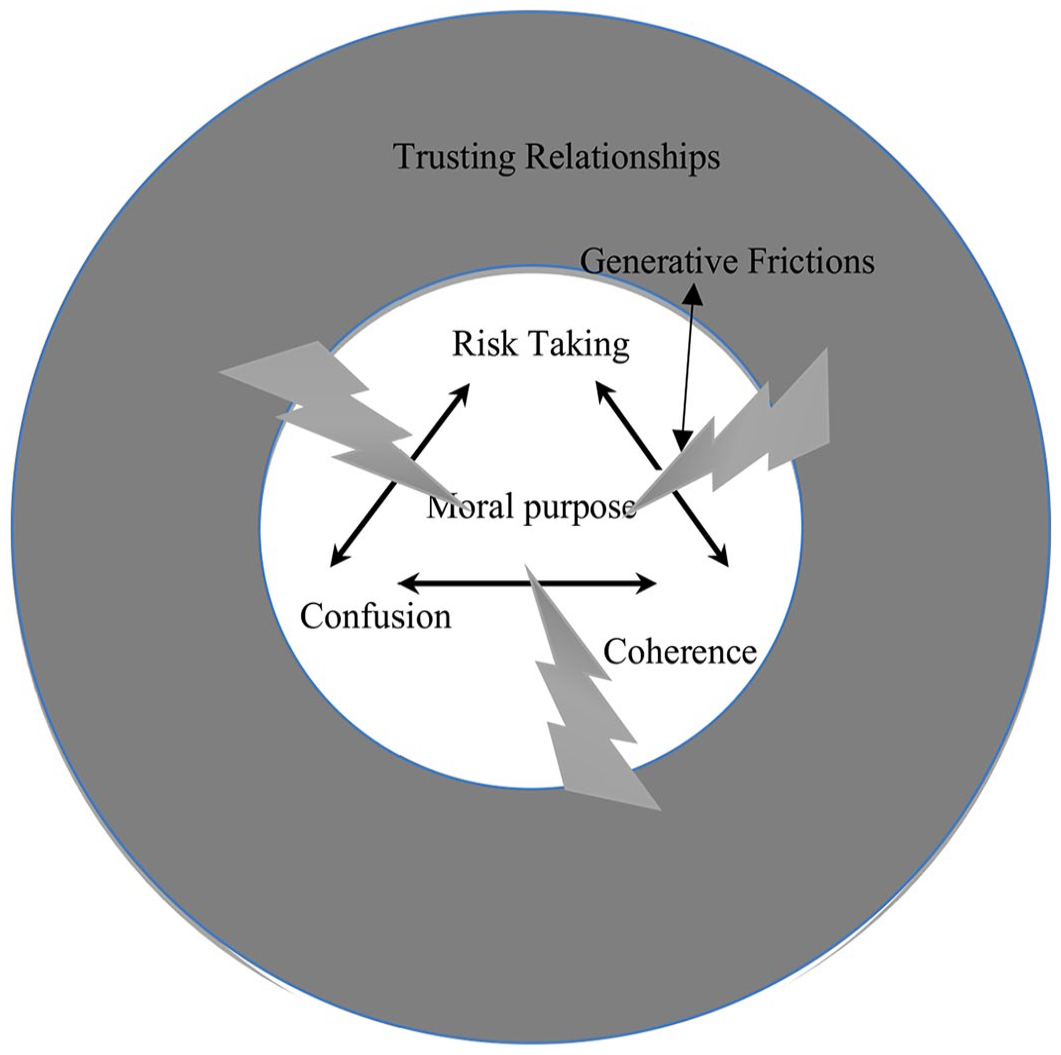
It’s all about relationships!
This model reflects our theoretical framework in several ways. To produce authentic culture change, power relations need to be shifted. We found this shift could not begin until trusting relationships were built among all stakeholders. Once this trust began to take hold, people were willing to take risks to change their beliefs and practices, to make mistakes, and to share those mistakes. The moral purpose of equity and excellence we began with in the EPO plan was enhanced and clarified as we co-constructed a mission and vision with all staff, students, and families—a process that took a full year in 2015 to 2016. Through these processes, power produced generative frictions as people experienced the continuum of risk-taking, confusion, and coherence. In this way, the shared practices of the shifting culture were co-constructed and continue to be co-constructed as our work proceeds.
Generative frictions help us to embrace and elevate the voices of all stakeholder groups in an attempt to uncover the root causes which may impede our collective effort to improve systems. However, it goes beyond surveys and questionnaires. The shift in ownership of decisions and outcomes plays an integral role in establishing what Sparks (2005) termed interpersonal accountability. Interpersonal accountability shapes a culture in which stakeholders share the successes and failures of an organization. The emphasis on developing a culture of excellence is what allowed the EPO to transform the lowest performing school, in the lowest performing district in New York State into one of the most successful schools in the RCSD.
Conclusion
This partnership continues to grow and change over time and will likely continue to do so; however, we have learned that the iterative process of trying something, reflecting on that attempt using multiple data sources, revising plans, working through generative frictions that result from dialogic exchanges amid shifting power relations, and trying again is dependent on trusting relationships. We brought together communities that had traditionally been at odds to rethink how urban education could be done: university researchers; administrators, including from area suburbs who did not have experience in urban education; community partners; teachers (including union leaders); students and their families; and staff who had not traditionally been included in this kind of work. We continue to learn as we develop deeper relationships and trust.
We still have much work to do, but we do think there are implications beyond East that can be stated now.
The emphasis on building trusting relationships in whatever context that seeks to develop equity and excellence in urban schools cannot be overstated.
A distributed leadership model can facilitate the shifts in power relations needed to transform school culture.
A focus on what power produces, positive and negative, is needed to interpret the changes as they begin and develop over time. Understanding conflicts, or generative frictions, as spaces for growth instead of stopping places facilitates trust and relationship building.
Having a clear plan with specified principles (the EPO plan) at the beginning was a crucial piece to begin the changes. Furthermore, bargaining unit contracts could be negotiated around these shared principles which proved critical to implementing changed policies and practices; without these agreements, we would not have been able to accomplish our goals. The university also needs multiple levels of agreement, from trustees to presidents, deans, and faculty across units.
Researchers need to be fully present in the everyday work of the school, working alongside administrators, teachers, students, and families to develop the authentic trust needed to take each other’s expertise seriously. And they need to stay even when it gets hard.
Universities need to authentically partner with schools for the benefit of the community, not just for credibility or the “optics” associated with saying that they are community engaged. Being community facing needs to be a core value of university missions.
Tenure and review committees need to value community engaged scholarship as more than “activism” or service and count this work for tenure and promotion.
We have described the complexity of transforming the processes, practices, and policies in one urban school under threat of state closure. While not all university/school partnerships will have the stars aligned in the ways we did, we do offer these guiding principles. By coming together to make a plan that held each partner accountable, we developed an “all in” commitment to each other and to our shared equity goals. We co-constructed the plan with groups that do not typically get asked in school reform efforts and worked together to push through difficulties, no matter what, in ways that did not put one group in charge—we were, and are, partners.
Footnotes
Declaration of Conflicting Interests
The author(s) declared no potential conflicts of interest with respect to the research, authorship, and/or publication of this article.
Funding
The author(s) disclosed receipt of the following financial support for the research, authorship, and/or publication of this article: The research reported here was partially funded by the Spencer Foundation #201600080
