




Abstract
This study examines how three teachers working at a South Central high school teach critically about race and place. While building on the “spatial turn” in social science, the article draws on Critical Race Spatial Analysis to advance literature at the intersection of race, place, and pedagogy. Additionally, the article utilizes cognitive mapping to understand the teachers’ senses of place and then, through a combination of interviews, observations, and document analysis, examines how they integrate racial-spatial ideas into their teaching. Positing a “critical pedagogy of race and place,” the study concludes with implications for future research and teacher education.
Keywords
Introduction
“Liquor liquor liquor! Urgent Care! Wendy’s! Little Caesars!” These are words I hear while riding on a public school bus from Biddy Mason High School (BMHS) in South Central Los Angeles. 1 I am sitting in the front, diagonal from the bus driver, doubling as a researcher and a chaperone on this field trip featuring three teachers and fifty students. The field trip is part of a ninth grade project entitled “Rebuild Healthy LA,” an interdisciplinary effort bringing together core subjects with the theme of public health. The voice from the opening quote is Ms. Lee, a Korean American biology teacher in charge of the field trip. For this part, we were taking a “slow drive” up a nearby street in order to have students note the different kinds of establishments that exist in South Central. The handout for this assignment asked them to keep track of “liquor stores,” “fast food eateries,” “green spaces,” and “health care facilities.” As the lead chaperone, Ms. Lee was tasked with announcing the establishments. She had previously attended the trip as an assistant chaperone, but this year she took lead, a role she admitted was difficult for her as someone who commutes to South Central daily from a faraway county. Her eagerness to point out the different establishments, as captured in the opening quote, represents her sincere efforts to do her job well. Nevertheless, the design of the lesson represents a problematic pedagogy of race and place—one that portrays the students’ home neighborhood as a quantifiable spectacle (Avila, 2004).
I use this opening anecdote to introduce my ethnographic project at BMHS, a public high school made up of smaller learning academies. Throughout the project, I have been primarily concerned with teachers’ sociospatial identities and the pedagogies of race and place they deploy, given BMHS’s location in South Central, a racialized community in the larger spatial imaginary of LA, and arguably urban America as a whole (Wiggins, 2016). But more than being a racialized community, South Central is also a community in racial transition as, on the one hand, Latinx residents now make up two-thirds of a population that was at one point 80% Black (Pastor et al., 2016), and on the other hand, the community is also facing impending gentrification that will lead to more demographic change. For both the students and teachers at BMHS, schooling in South Central represented a unique experience; many saw their efforts as part of a larger struggle for community uplift. In this article, I focus on that special significance for three teachers from BMHS, with the goal being to understand what South Central means to them and how that informs their educational praxis, with special attention to pedagogies of race and place.
Literature Review: Pedagogies and Dialectics of Race and Place
A review of the literature on critical pedagogy (Freire, 2005), asset pedagogies (Paris & Alim, 2014), and relationships of race and place 2 (Carpio, 2019; Cheng, 2013; McKittrick, 2011), reveals a robust theoretical and empirical foundation upon which this study seeks to build. The literature on critical and asset pedagogies has long informed my work, both as a researcher and as an educator of color who has taught in low-income communities of color. Freire (2005) precisely discerned what is at stake in pedagogical encounters between teachers and students in his analysis of “bank-clerk-teachers”; he writes that such teachers employ a “necrophilic” pedagogy that “transforms students into receiving objects” (p. 77). When paired with King’s (2017) race-infused notion of “epistemological nihilation,” we can understand how problematic pedagogies have the power to relegate Black and other students of color to a state of “non-being” (p. 212). The robust literature of asset pedagogies continue to guide schools in their attempts to counter these problematic pedagogies and replace them with the kind that affirm, revitalize, and sustain (Paris & Alim, 2014).
This article builds on this literature by centering the construct of “place” in the analysis of persistent racialized inequities in education. While place may be implied in vague references to “community” or “context,” there is need for greater analytical clarity in order to fully understand the challenges facing schools and communities (Noguera & Alicea, 2020). To incorporate this analysis, this article engages in conversation with place-focused scholars in sociology, geography, and ethnic studies. The article embraces the “spatial turn” in the social sciences and humanities (Carpio, 2019) by theorizing place as a powerful social force that shapes and structures social outcomes (Soja, 2010). The analysis herein is also framed by Lipsitz’s (2011) assertion that “it takes places for racism to take place” (p. 5). With that framing, it draws on work in ethnic studies that understands racial formation to be a regional phenomenon, rather than a national one (Carpio, 2019; Cheng, 2013). It also theorizes with the understanding that place has long been vital to the cultural production (Hunter & Robinson, 2018), cross-racial solidarity (Johnson, 2013) and futures (McKittrick, 2011) of communities of color. In taking this approach, it differs from others that simply meditate on the geographic concentration of racial inequities.
Importantly, scholars have merged literature on place with that in critical pedagogy (Ford, 2016; Gruenewald, 2003). Gruenewald (2003) offered what he called the “best of both worlds” by fusing place-based education with critical pedagogy. In doing so, he argues for a “critical pedagogy of place” that “aims to (a) identify, recover, and create material spaces and places that teach us how to live well in our total environments and (b) identify and change ways of thinking that injure and exploit other people and places (p. 9). Ford (2016) alternatively attempts “educationaliz[ing] theories of space” in order to provide a “pedagogy for space” (p. 177). Stated differently, Ford (2016) theorizes a critical pedagogy that directly serves spatial struggles. Neither of the aforementioned scholars center race, however. Like many of the scholars of critical pedagogy, there is a hegemonic Whiteness in their work that acknowledges capitalism, but not racial capitalism (Robinson, 1983).
Haymes (1995) and Kinloch (2010), both Black scholars, engage explicitly with race in their interrogations of teaching and place. For example, Haymes theorizes a “pedagogy of place for Black urban struggle” that ties critical teaching to racial-spatial resistance in ghettoized urban contexts. While conceptually rich, this literature (Ford, 2016; Gruenewald, 2003; Haymes, 1995) remains noticeably distant from the realities and insights of practicing teachers. Kinloch’s (2010) work, however, provides a refreshing exception to this trend. In her study of community-based literacies, Kinloch finds that teachers who incorporate race and place into their teaching enact a “pedagogy of possibility” in which they “collaborate with students to examine text-based, local, and/or global communities as a way to stimulate critical capacities that [. . .] support students’ educational advancement” (p. 186). Through my study in South Central, I build on the work of Haymes (1995) and Kinloch (2010) to conceptualize a “critical pedagogy of race and place” (CPRP)—that is, a politics and praxis of collective social action that seeks to liberate and sustain communities of color. A CPRP approach to teaching would center race in the analysis of what geographer Doreen Massey (1993) calls “power geometries,” or what refers to the power relations that actively shape and make places via processes of inclusion and exclusion. Such a pedagogy can be planned or unplanned, and would seek to unearth the “hidden histories” of the landscape (Johnson, 2013) and draw on the community’s “freedom dreams” (Kelley, 2002) to imagine a more emancipatory future in which race and place do not structure life opportunities.
Theoretical Framework
Critical Race Spatial Analysis (CRSA) is an important theoretical foundation for this research project. CRSA is an extension of Critical Race Theory (CRT) that seeks to interrogate racialized educational inequities from a “holistic framing” while asking “multiple, interconnected questions” about “historical, social, and spatial experiences” (Morrison et al., 2017, p. 4). Like CRT scholars, CRSA scholars develop their critical analyses by drawing on literature in relevant fields like sociology, geography, and ethnic studies. CRSA theorists also acknowledge that CRSA is not a panacea, writing instead that they “hope to address the limitations of a singular dimension analysis (e.g., only social or spatial or historical) and highlight the potential when using the spatial in conjunction with historical and socio-critical analysis” (p. 6). Education scholar Veronica Vélez, who first articulated the theory in a conference paper with Daniel Solórzano (2007), elaborates on the many facets of the theory in a recent research brief. There, Vélez (2017) explains the theory as “examin[ing] the role of race and racism in geographic and social spaces and work[ing] toward challenging racism and all forms of subordination within these spaces, particularly those within and connected to schools” (p. 1). She goes on to note six key facets of CRSA: (1) “foregrounding the color-line” to “understand[d] the relationship between race, racism, memory, and space”, (2) “challenging race-neutral representations of space,” (3) focusing educational research and practice on the sociospatial lives of people of color, (4) developing educational research and teaching strategies that advance antiracism both on and beyond the college campus, (5) employing an interdisciplinary approach to educational research and practice, and (6) taking up more critical approaches to maps and map-making (p. 3). In summary, CRSA understands race and space to be on the one hand, constitutive of enduring social inequities and on the other hand, a site of resistance against said social inequities. In this article, I draw directly on the ideas of CRSA scholars, as well as racial-spatial ideas of pertinent scholars in sociology (Hunter & Robinson, 2018; Lipsitz, 2011), geography (McKittrick, 2011; Ramírez, 2019), and ethnic studies (Cheng, 2013; Hernandez, 2017; Johnson, 2013).
Methodology and Research Design
Methodological Framework
This project is grounded in the methodological approach of Critical Place Inquiry (Tuck & Mackenzie, 2015). I draw specific guidance from Tuck and Mackenzie (2015) who point out how “discussions of place are located on the periphery in most social science inquiry, not as core components of the analysis or in the selection and development of a research methodology” (p. 9). So rather than limit my engagement with space/place to a section on “research context,” I center place in my work. Importantly, Critical Place Inquiry examines space/place as an agent in larger sociopolitical processes that affect the lives of all people, but especially people of color and working class backgrounds. Through a place-centered focus, scholars can understand the ways in which, for example, racial inequality, is both “geographically place-centered” and “spatially constructed,” (Milner, 2020, p. 152).
Case Study Design and Research Questions
To explore the dynamics of race, place, and pedagogy at BMHS, I utilized an embedded single-case study design (Yin, 2018). In this study, BMHS constitutes the overarching case, with three English and Social Studies teachers constituting the embedded sub units of analysis (Yin, 2018). The focus on teachers’ activity in integrating race and place into teaching at BMHS derives from a common case rationale (Yin, 2018), in which I sought to “capture the circumstances and conditions of an everyday situation [. . .] related to some theoretical interest” (p. 50). The three teachers in question were also chosen because there was one teacher from each of the small learning academies at BMHS. In presenting the insights from these teachers, I then provide analytical generalizations (Yin, 2018) from the case as a whole, which is BMHS. The inquiry was guided by the following research questions:
Q1—How do the sociospatial identities of BMHS teachers influence how they make sense of South Central’s geography and the larger dynamics of race and place affecting the community?
Q2—In what ways do teachers understandings of race and place, both locally and conceptually, inform their curricular and pedagogical strategies?
Research Site
BMHS opened its doors less than 10 years ago as part of efforts to mitigate the overcrowding of other South Central high schools. As part of its design, it is divided into three small academies focused on either technology (“Tech Academy”), business (“Business Academy”), or health (“Health Academy”). As one campus, BMHS boasts significant assets for its students, including specialized pathways, advanced placement courses, and community partners. The school also pays homage to the community’s long racial history by being named after a local resident of color, by choosing to refer to the community as South Central (as opposed to South LA or SOLA), 3 and by including hallway iconography of key Black figures and movements. Campus-wide, however, Black students represent only 20% of the student body, with slight variants across the three academies.
Researcher Positionality
Understanding that researchers are a primary instrument of qualitative studies (Ravitch & Carl, 2016), I continuously reflect on my researcher positionality and the different social locations that I carry with me into the field. Racially, I am a light-skinned Puerto Rican living and researching in a community made up mostly of Black, Mexican, and Central American residents. As such, I am constantly read as a racial-ethnic outsider because I do not look like the community and do not speak Spanish in the same way as the community. I live in one of the few remaining majority-Black sections of South Central and have experienced several incidences of anti-Latinx bigotry; the most striking example of this was when I arrived on my home street playing Puerto Rican music (reggaeton) and wearing a t-shirt supporting Hurricane Maria relief efforts. A group of phenotypically Black neighbors shouted loudly in my direction, “Somebody call immigration on that asshole.” This experience, which was early on in my time in the community, called my attention to a different regional racial geography (Cheng, 2013) than what I had been used to when living on the East Coast. On the one hand, I was upset to be both misidentified (in part because my shirt featured a large Puerto Rican flag) and subjected to anti-Mexican rhetoric that I associated with President Trump; on the other hand, I wondered why the racial tensions were so thick in South Central, as I had not experienced that living out east. Among the Latinx residents, I noticed that I was sometimes invisible to them, unless they saw my name or heard the way I pronounced a word of Spanish-origin.
In my work with BMHS, I had more control over what folks thought about me through constantly sharing my personal story as a Puerto Rican of working class background. As such, I never experienced any outright racial bigotry at BMHS. In order to account for my limited, but growing understanding of local racial-spatial dynamics, I sought out the perspectives of students, staff, and community members to ensure that I gleaned as complete an emic perspective as possible. Working closely with teachers and administrators of Black and Latinx origin endowed me with greater credibility with the youth as well. Eventually, as result of my work supporting BMHS programmatic efforts with my teaching and research expertise, I was invited to officially join a Black student support team; this work gave me a better sense of the experiences of Black students and staff on campus while making myself known and available as a resource to them. Finally, my physical proximity to BMHS has helped, as I frequent many of the same dining, commercial, and community spaces as do members of the BMHS community. This proximity proved especially useful when discussing and analyzing the cognitive maps of my participants.
Data Sources and Procedures
In total, four primary data collection methods were used: phenomenological interviewing (Seidman, 2013), participant observation, document analysis, and cognitive mapping (Lynch, 1960). These methods were strategically sequenced (Ravitch & Carl, 2016) to allow for space to build trust with both teachers and students, and then also to allow for data triangulation. The first method deployed was participant observation and this varied by teacher. Over the course of the study, I observed each teacher for a minimum of 20 hours, totaling about 85 hours of classroom observation in addition to another 155 hours of non-classroom ethnographic observations for a total of 240 field hours. My role varied from week to week and sometimes class to class, but as a former teacher, I assisted in any way that I was asked. Outside of the classroom, I met with different stakeholders and sat in on support meetings, student gatherings, and school events. I also hung out in popular spaces near the school. Lastly, I collected documents to analyze, including teacher PowerPoints, school documents, and student work.
After about 10 weeks of participant observation, I asked teachers for an official interview. While the teachers and I had many informal conversations prior, the formal interview was grounded in a phenomenological interviewing method (Seidman, 2013), which allowed me to gather focused life histories, memories of particular experiences, and reflections on the meanings of those experiences. During these interviews, which lasted about 90 minutes on average, teachers reflected on their own experiences with race and place throughout their personal and professional lives. Prior to beginning the interview, I gave teachers 30 minutes to create a cognitive map (Lynch, 1960) of South Central. The point of the cognitive mapping task was to see how they “imaged” the community they taught in and to discern how their understandings of South Central factored into their teaching practices. While I adapted Lynch’s (1960) protocol, Cheng’s (2013) deployment of his method to study race and place helped structure the probing questions and subsequent analytical strategies that I used. Follow-up interviews (one per participant) were then used to allow for member-checking, as well as to allow for any new questions that emerged after processing the transcripts.
Data Analysis Strategies
Data analysis was iterative and informed by the aforementioned literature review and theoretical framework on race, place, and pedagogy. While in the field, I habitually created researcher memos after all interviews as well as after key moments or critical incidents. Importantly, I analyzed the data during and after data collection via multiple complementary and discerning cycles of coding (Saldaña, 2016). In order to home in on the three aspects of Seidman’s (2013) interview protocol, I strategically used in-vivo, values, and affective coding strategies in the initial coding stages. As I returned to transcripts again later in the process, I reanalyzed them using focused and pattern coding strategies to refine emergent takeaways (Saldaña, 2016). Throughout this process, I utilized the qualitative analysis software Dedoose, which provided a system for organizing the data and sifting through codes. To analyze the cognitive maps, it was similarly a “reverberative process” (Saldaña & Omasta, 2018, p. 81) in which I took note of my first impressions of each map and then reexamined them to look for deeper meaning that spoke to research questions, other findings, and relevant literature.
Brief Life Histories of Participants
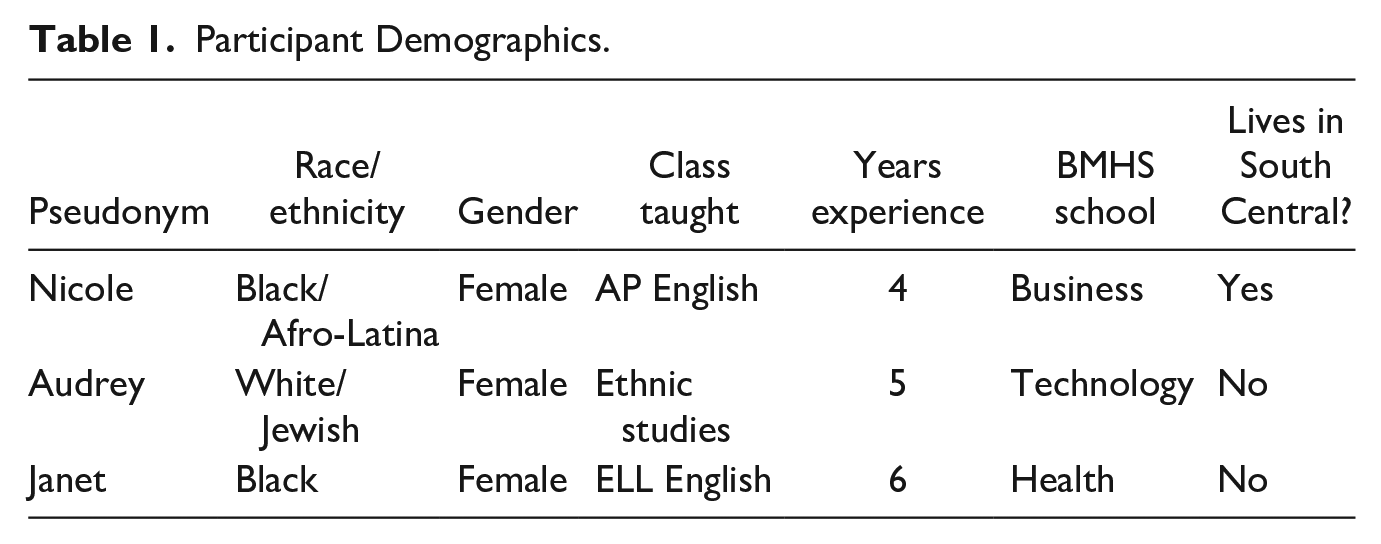
It is important to provide brief life histories of each participants so that their actions and reflections are better contextualized within their sociospatial lived experiences. Each brief life history offers important information on the professional experience of the teachers, as well as an encapsulation of their self-identification in their own words. Here is an overview of relevant participant information (Table 1):
Participant Demographics.
Overview of Research Findings
Next, I turn to presenting the main findings of this research project. Each one is associated with one of the two guiding research questions of the project. For reference, those research questions ask: (1) How do the sociospatial identities of BMHS teachers influence how they make sense of South Central’s geography and the larger dynamics of race and place affecting the community? and (2) In what ways do teachers understandings of race and place, both locally and conceptually, inform their curricular and pedagogical strategies? In each section, the findings for each question are sub-divided to highlight specific social insights and phenomena. These findings will then be synthesized in the “Discussion and Future Directions” section.
Finding #1—Cognitive Maps and Teachers’ Racialized Senses of Place
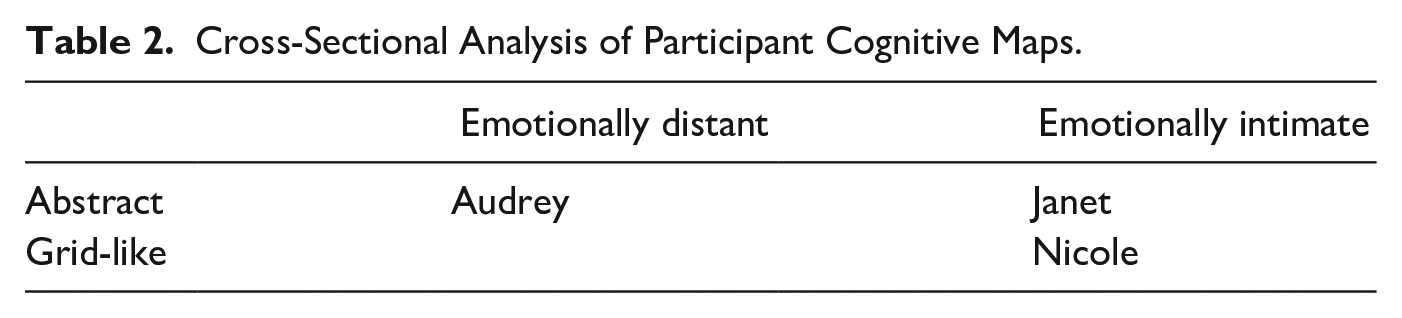
Building on Wendy Cheng’s (2013) study of race and place in the West San Gabriel Valley region of Southern California, I utilized cognitive maps as a tool to understand each of my participants’ racialized senses of place. In having each teacher complete the cognitive map, I was also able to gather a better understanding of their understanding of South Central’s social and physical geography, as well that of large racial-spatial phenomenon impacting the community. This analysis yields insights about sociospatial identities and how they inform relationships in and understandings of a given community (Table 2):
Cross-Sectional Analysis of Participant Cognitive Maps.
Teachers’ Differing Understandings of South Central Geography
As noted in the brief life histories, each teacher has a different racial-spatial identity that shapes their worldview and approach to teaching. To understand these different racialized senses of place, I draw on the theoretical insights from CRSA and other important racial-spatial theorists (e.g., Johnson, 2013, Lipsitz, 2011; McKittrick, 2011). It is important to note that two of three teachers (Nicole and Janet) have lived in South Central for some significant amount of time while maintaining kinship networks for which South Central is a key node. Beginning with Nicole, she is the only teacher who grew up in South Central and has continued to live in South Central as a teacher. This continual grounding in the community contributed to the creation of a cognitive map that was structurally specific while also emotionally inflected. Notice the delicate balance in her map below (Figure 1):
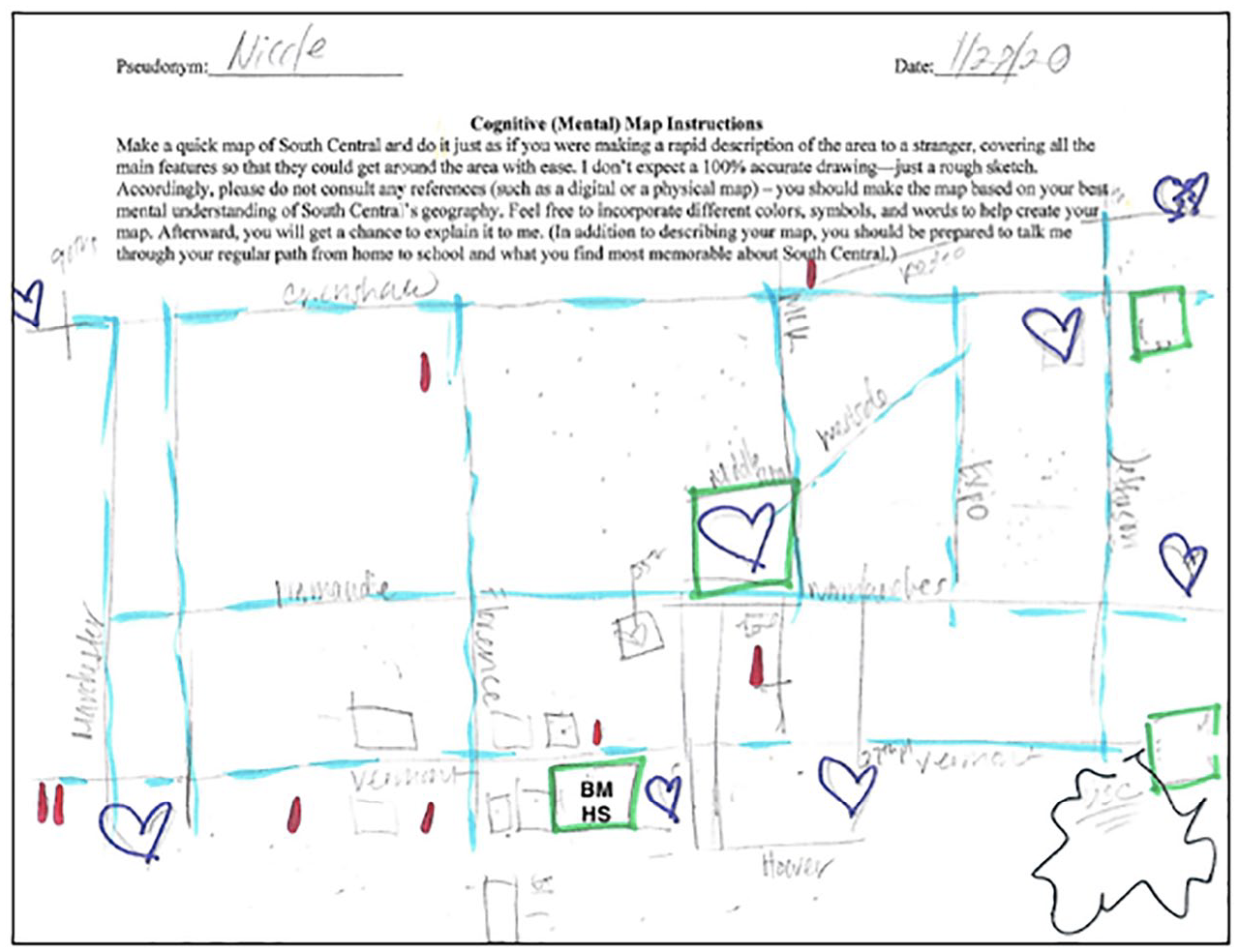
This is Nicole’s cognitive map of South Central.
Nicole’s map approximates a street-level grid-like view of the community, as seen by the references to many key streets that frame the borders of South Central. She then personalizes an otherwise official-looking map by emplacing herself and her experiences of love and pain directly onto the map. Upon closer inspection, we note her various “homes,” past and present, as marked by the presence of purple hearts. We also see several red drops on her cognitive map, which represent shootings that have taken place in particular areas, including one which denotes when she was shot as a child during a drive-by shooting. Seeing her map reminded me of a news story that similarly mapped out homicides (represented by orange dots) near various schools in South Central (Figure 2):
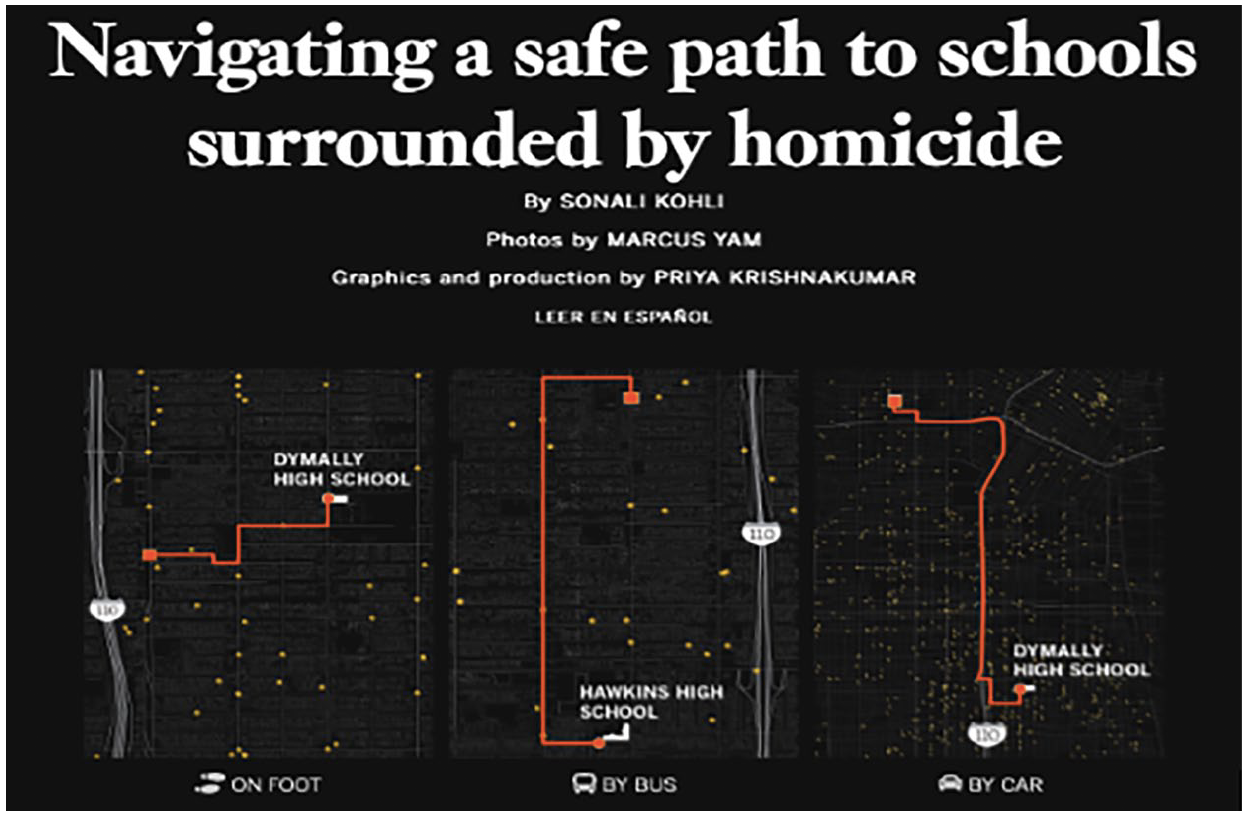
LA times map of homicides near South Central schools.
When I brought up the similarities between her map and the one featured above, 4 she responded by saying, “I think that I would say as equally as it is full of trauma and safety is a huge concern, there are so many places full of love [. . .] And I think that when LA Times reports on things like that, it overshadows the many places of love.” Nicole’s map thus operates as a form of “ground-truthing,” (Vélez & Solórzano, 2017, p. 22), which offers a more complex and humanizing view of this Black and Latinx community.
In comparison with Nicole’s emotionally intimate and traditional map, the cognitive maps of Audrey and Janet both appear to abstract and emotionally distant at first glance. Audrey, a White teacher who only drives into South Central when she is teaching, created the following map of the community. Before sharing it with me, she prefaced it by saying, “So just like full disclaimer, I don’t spend a lot of time in South Central outside of [BMHS] which is obviously an issue in and of itself because I think when you teach in a community, it’s good to live in it, know it, be a part of it. But when I moved to LA, my sister lived on the Eastside, so I moved there.” She is a good example of what Wyman and Kashatok (2008) call “triangle teachers” who “rarely venture beyond the triangular path between their homes, the school, and the local store” (p. 299). Here is her map (Figure 3):

This is Audrey’s cognitive map of South Central.
Her map includes only a few landmarks (BMHS being one of them), with no attempt at a larger street view. And importantly, her most personal connection to the community (excluding her work at BMHS) is the house of another teacher in this case study, (Nicole). When comparing Audrey’s map to Janet’s, many striking similarities exist (Figure 4):

This is Janet’s cognitive map of South Central.
As can be seen in Janet’s map, she (like Audrey) offers a more abstract map that highlights distinctive community places. For example, both Audrey and Janet include important tourist attractions such as the Los Angeles soccer stadium, the Natural History Museum, and the California African American Museum. After further inspection of the map, the similarities begin to break down. Audrey’s map focuses on her consumptive activities as a visitor to the community, highlighted by her inclusion of a favorite Salvadorian restaurant and local Starbucks branch as well as multiple murals that she drives by on her commute (e.g., “Forgiveness” and “S.C. Dreams”). Accordingly, Audrey’s map comes off as abstract and emotionally distant.
Greater inspection of Janet’s map reveals hers to be abstract, but emotionally intimate. Unlike Audrey, Janet would take local streets to get to BMHS from her current home in the West Los Angeles. However, Janet has not lived in the community since she was 4 years old, meaning she experienced South Central as an intimate visitor coming into the community. Nevertheless, Janet’s visits are grounded in a personal and familial history. Moreover, Janet’s map is a strikingly Black mapping of South Central. We see this in her references to: (1) Black civil rights sites (e.g., Watts Labor Community Action Committee), (2) Black businesses and associations (e.g., Earl’s Hot Dogs), (3) Black arts spaces and celebrations (e.g., Leimert Park), and (4) a Black museum (e.g., the California African American Museum). Thus what at first appears to be an impersonal, touristy map of South Central is one deeply in tune with the area’s long racial history as the capital of Black cultural production on the West Coast (Hunter & Robinson, 2018). Janet’s “chocolate” mapping (Hunter & Robinson, 2018, p. 4) must also be read as a refusal to traditional geographic mapping (Morrison et al., 2017), especially of South Central. In her interview, she said the borders of South Central were “fluid” and that it had “stretched”: “[A]ll of a sudden the boundary for South Central has stretched all the way to Crenshaw. South Central [used to not] go past Central or Avalon.” As she continued to interrogate the changing geography of South Central, she connected explicitly to a process of racialization: “And then this word ‘urban’ started coming into play, but after the Rodney King riots or the LA riots, all of a sudden wherever there were Black folks suddenly that became South LA, and that boundary got stretched all the way to Crenshaw” Here, we can hear Janet question the decision of outsiders to re-map South Central in ways that serve their racial interests (Vélez, 2017).
Teachers’ Analyses of Racial-Spatial Changes Affecting South Central
The ways in which the teachers did or did not capture salient elements of South Central’s geography is particularly noteworthy when investigating the extent to which they critically analyze the various racial-spatial phenomena that have shaped South Central. If we continue with Janet’s insights, her explanation of her cognitive map led to a critical conversation of not only South Central’s borders, but its naming altogether. When I asked her about the decision by city council to officially change the name to South LA, she said, “It’s like, ‘What was that, Were we hiding something?’” And when I followed up with the failed attempt to rebrand it further as “SOLA,” she noted though doing so was “cute,” it “sounded too gentrified.” Indeed, this attempt to brand a community has been referred to by Communication scholars as “verbal redlining” or “name gentrification” (Fuhrmann, 2018). Had the motion passed to rebrand South Central as “SOLA,” it would have become transmogrified into a trendy place brand not unlike WEHO (West Hollywood) in LA County or SOHO (South Hampton) in Manhattan. Writing about the effort to rebrand a Latinx community in San Francisco as NOPA (North of the Panhandle), Mirabal (2009) argues that renaming is a key example of the “deliberateness with which real estate agents, developers, and investors signal and initiate gentrification” (p. 16). Rebranding has the effect of creating a new narrative of the community that justifies a shift in consumptive practices, and ultimately a shift in who can afford to live in the community. Janet picked up on this symbolism in the acronym and dismissed it immediately as sounding “cute” but also “too gentrified.” Janet did not comment any further on gentrification, as she noticed it happening, but was not directly impacted by it.
When I asked Audrey the same question about the different name changes in South Central, her analysis departed greatly from Janet’s. It is important to remember that Audrey grew up in a sheltered White community and credited traveling outside that community with opening up her perspective. Though she experienced this transformation of perspective, in some ways she maintains a “White socio-spatial epistemology” that “operates non-relationally” and “underwrites private property and the construction and orderly maintenance of segmented social space” (Dwyer & Jones, 2000, p. 212). It was unclear to her growing up, for example, how the political economic benefits enjoyed in White suburbia are often directly tied to the dispossession of a minoritized, urban core (Barraclough, 2009). And in some ways, such a dialectic remains unclear to her today. When I asked her about the re-naming of South Central to “South Los Angeles,”, she didn’t make any connections to how that re-naming constituted a racial project to further the community’s “racial capitalist dispossession” (Ramírez, 2019, p. 3). When asked, she said: I don’t know why, South LA to me sounds like fishy. I don’t know why. And then maybe it did come from within the community. I guess city council is the community, but then who else was asked? [. . .] So then “SOLA,” I would imagine that it would be to take it back again. I wonder why it didn’t pass. I would want to know more. To me “sol,” the sun is positive. I don’t know.
There is almost an air of “ignorance is bliss” in her answer and we see that even more pronounced when she imagines the “SOLA” campaign to be a positive reclamation project grounded in a vague reference to the Spanish language rather than racial-spatial dog whistling for proponents of gentrification (Mirabal, 2009).
South Central’s status as one of the few remaining areas close to downtown that has not been fully gentrified was best understood by Nicole, a local resident who has struggled to find an affordable home there. She shared, “I think about how I’m looking to buy in this area and I can’t even afford to live in this area with my salary. So what does that say about property value in the area?” She added that she had been “actively looking” for 10 months and had not had any luck. At the same time, she began to notice others buying up land: “So even when I was driving [to the interview], I looked to the right at the light [. . .] I was like, ‘What the fuck? Right here? You’re going to build apartments right here?’ And it’s modern and stuff. And I look around like. . . But they know something we don’t know. Right?” For Nicole, then, one might say that she has a “critical epistemology of space and place born out of language, culture, experience, and resistance” (Hunter & Robinson, 2018, p. 26). And when I asked her how her race impacted her daily experiences in her community, she offered a powerful retelling of space from her perspective as a Black woman: I feel powerful. I feel like I can do what no White or Asian person can do in my community. Or even someone from a different country. [. . .] I feel like this is home. I feel like you’re afraid because you have this fear that you might lose your life, right? And that’s because the gangs, because people are upset, people are angry because you understand the crossfires happen. You understand that innocent victims are taken, that’s why you’re afraid. But if you take all that out, right, then you’re like, ‘I’m not afraid.’ So I’m doing both at the same time, and this is home and I can walk the street. And I know this, I know the owner here and I’m putting money in here. So it’s like for me as a Black woman, I just feel powerful in this space. I do. I do.
Nicole was able to articulate her own “black sense of place,” best understood as “a sense of place wherein the violence of displacement and bondage, produced within a plantation economy, extends and is given a geographic future” (McKittrick, 2011, p. 949). In other words, Nicole’s view of the anti-Black urbicide (McKittrick, 2011) in her community had left her not simply conscious of the struggle for “spatial entitlement” (Johnson, 2013), but also an active participant in it, thereby resisting a sense of disempowerment or social death. In her own words, “this is home and I can walk the street [. . ..] as a Black woman, I just feel powerful in this space.” Like Harlem in Valerie Kinloch’s (2010) study, Nicole views South Central as “home, as a space of survival, as a site of community practices and education, as an urban sanctuary, or cultural oasis, of Black life” (p. 11).
Finding #2—Teaching Critically about Race and Place
The second major finding focuses on the distinctive ways in which the three teachers integrated discussions of race and place in their critical teaching (Haymes, 1995). The differences in each classroom were connected to teaching styles, course content, and the teachers’ aforementioned racialized senses of place (McKittrick, 2011). As I offer snapshots of their practices, I also draw on artifacts and interactions with students as means of triangulating what I documented in my observations.
Teachers’ Planned Critical Pedagogies of Race and Place (CPRP)
While it is true that all three participants inevitably taught about race and place, given the “fatal coupling” (Lipsitz, 2011, p. 5) of the two constructs, they did so in qualitatively different ways. During the study, Audrey was the only teacher to plan lessons that explicitly engaged racial-spatial issues. This was a surprising finding because Audrey’s lack of intimate familiarity with South Central did not preclude her from teaching critically about race and place. In her ethnic studies class, she made sure to regularly build in opportunities for students to connect the class to South Central and their personal lives. As she put it in a follow up interview, “ethnic studies is a class where students. . . it’s a study of students’ own lives, their lives as evidence, like bringing in their lived experience as academic evidence to support a claim.” In my time with her, I was able to view three main units: on the design of neighborhoods, on social movements, and on immigration. Below is a PowerPoint slide she used on the first day of her neighborhoods unit (Figure 5):
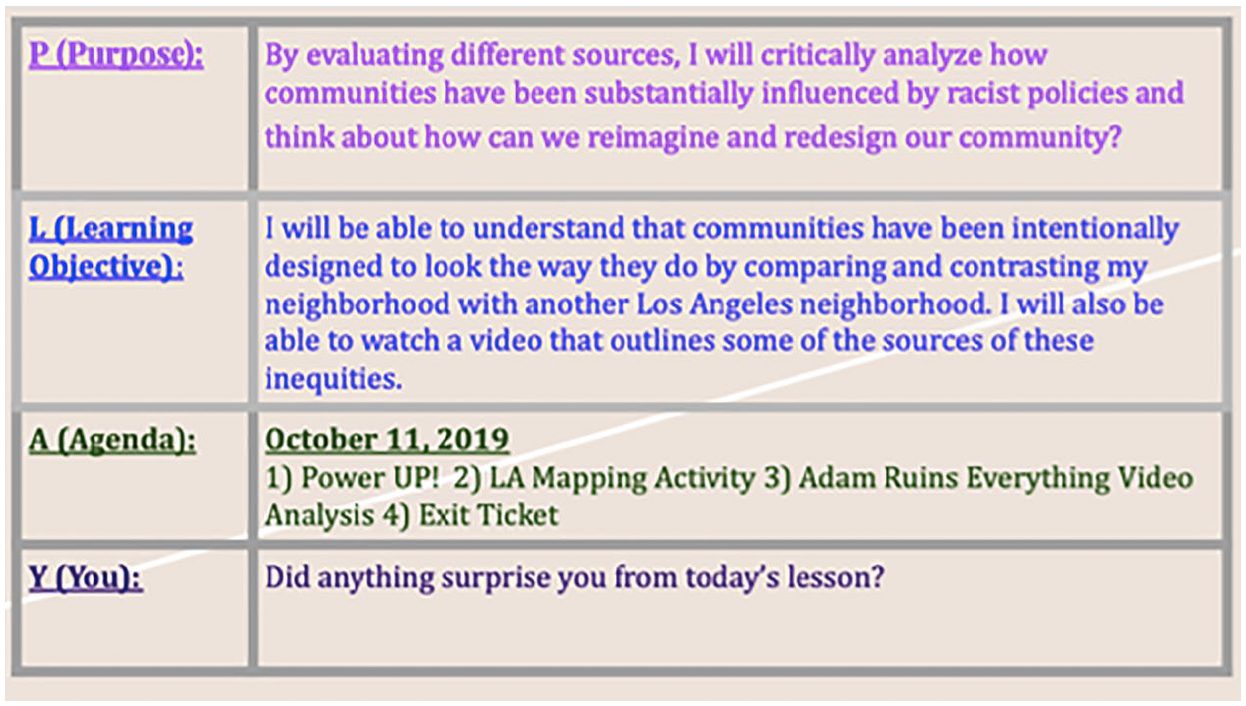
This is a screenshot I took of a PowerPoint slide created by Audrey.
Built into this particular unit is the assumption of a racial-spatial dialectic (Soja, 2010) or what has been described as the racializing of space and the spatializing of race (Vélez, 2017). In doing so, Audrey engaged multiple tenets of CRSA, including the imperatives of “foregrounding the color-line,” focusing educational research and practice on the sociospatial lives of people of color, and taking a critical approach to maps and map-making (Vélez, 2017, p. 3).
While Audrey does not dig into the intertwined relations of racial hierarchy, region, and political economy (Barraclough, 2009), she does create scaffolds for students to begin to think about those kinds of connections. She encouraged students to explore issues of race, income, and place through a mapping exercise in which students compare South Central with another community in LA (Figure 6):
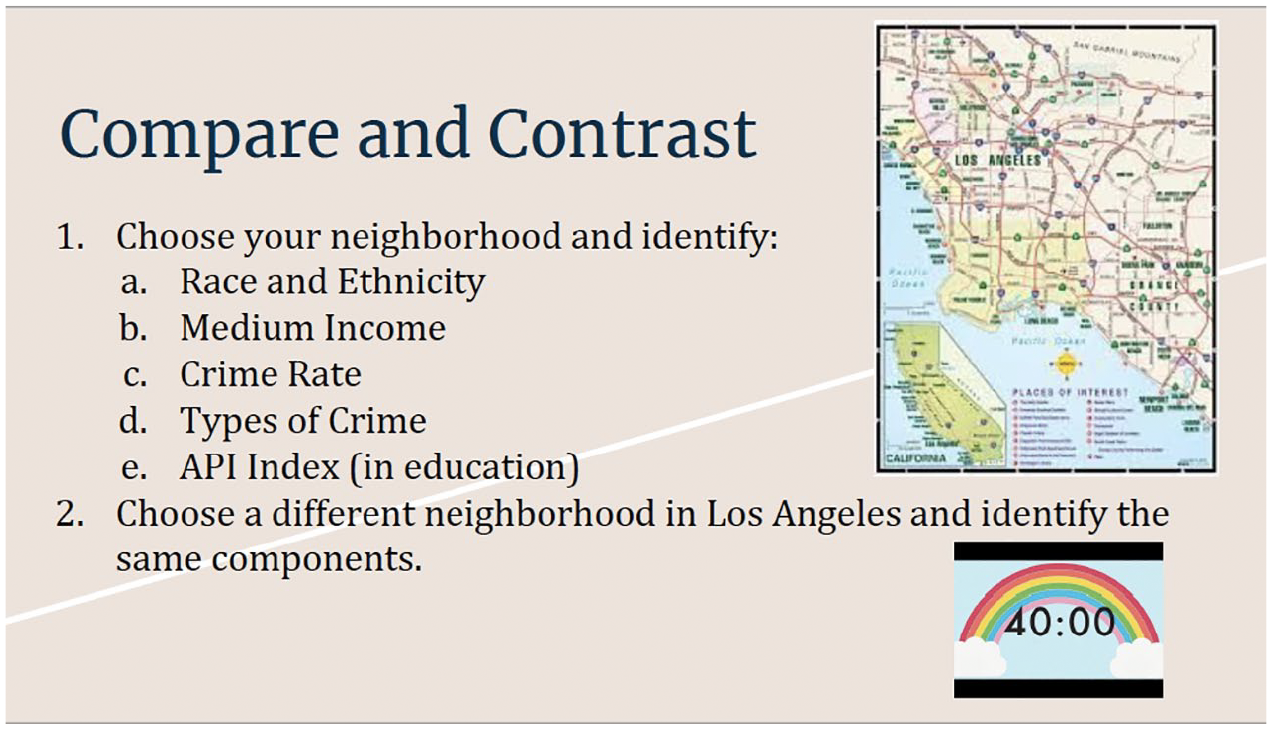
A screenshot of Audrey’s PowerPoint slide explaining the compare and contrast activity.
I appreciated this exercise because it allowed students to decide which communities and maps they wished to analyze through the critical lens of ethnic studies. I had also done a very similar exercise during my days as a teacher in the northeast. In both classrooms (mine and Audrey’s), students came to understand that “it takes places for racism to take place” (Lipsitz, 2011, p. 5).
At a later date during the unit, Audrey built on these early explorations of race and place by introducing key explanatory concepts like redlining and gentrification. During the lesson on gentrification, she used the following slide (Figure 7):

This is a screenshot I took of Audrey’s PowerPoint slide on gentrification.
While the source of the material may be suspect, the definition echoes the words of British sociologist Ruth Glass (1964), who originally coined the term; Glass wrote “One by one, many of the working class quarters have been invaded by the middle class [. . .] Once this process of ‘gentrification’ starts in a district it goes on rapidly until all or most of the original working class occupiers are displaced and the whole social character of the district is changed” (p. xvii). And Audrey’s addition of the image, which is an advertisement for “luxury condos,” reveals the ways in which impending gentrification catalyzes its own becoming through its emplacement in the landscape. One student, Eduardo, was especially engaged, as the following interaction revealed:
That reminds me of downtown and the arts shops. It looks gentrified.
What do you mean “looks gentrified?”
Like the materials they use and the people who go there.
And they are usually?
White, middle class, but I also saw Afro-Americans and Asians.
As can be seen in that brief engagement, Audrey does a nice job of providing probing questions to scaffold her student’s analysis. Importantly though, she does not take up the student’s insight about gentrifiers also being of color. She doesn’t, for example, wrestle with the question of Black gentrifiers, like those discussed in Pattillo’s (2007) analysis of Chicago, or even the Mexican American “chipsters” of Boyle Heights in LA (Huante & Miranda, 2019).
Teachers’ Unplanned Critical Pedagogies of Race and Place (CPRP)
All three teachers engaged in what I refer to as “unplanned critical pedagogies of race and place.” These pedagogies can take place in the context of planned CPRP, but are more likely to occur during unscripted conversations about race. First, we will return to an example from Audrey’s classroom and then we will move on to discuss the other two. In the earlier example of Audrey’s mapping exercise where students were tasked with comparing select social data across two communities, Audrey sometimes made unplanned suggestions as she made her arounds to different student tables. For example, she suggested to one table, “You might choose a place that you assume to look different. So I put in Beverly Hills and I can already see that there is a difference right there. You don’t have to choose Beverly Hills, you could choose Santa Monica, the Eastside, Los Feliz.” In providing this off-the-cuff (but nevertheless curated) list of possible contrasting communities, Audrey was broadcasting to the class her own racial-spatial imaginary (Lipsitz, 2011) of LA. I also noted in my fieldnotes that it was interesting she included the Eastside in her suggestions, as that was the same community that she lived in while teaching in South Central. As she continued to circulate, she added additional community suggestions to the curated list of essentially White places (Lipsitz, 2011) in LA:
“Miss, I don’t which community to use as a comparison.”
“What about Silver Lake? Or Malibu?”
(interrupting) “Miss, why is there no crime data for Santa Monica?”
“But there are a lot of poor people in Santa Monica.”
Why do you think that is?
“I saw it. We went on a field trip in the 9th grade to compare Santa Monica to South Central.”
“Why do you think that isn’t shown in the statistics?”
I feel like the homeless people move to Santa Monica but they don’t create the homeless, but like here in South Central they do.”
“But, Chris, that is an important observation that you should write down.
Clearly, the interaction went down many tangents as Audrey strived to engage her student’s questions while continuing to monitor the actions of other students at the same time. Still, notice Audrey’s unplanned CPRP in action and notice also that Chris shared he had been asked to compare South Central and Santa Monica in a previous course. This interaction provides great insight into the planned and unplanned CPRP that could be found on the campus of BMHS. In the context of social studies courses, at least, BMHS teachers facilitated students’ simultaneous engagement of historical, social, and spatial concepts (Morrison et al., 2017)
Nicole and Janet were less likely to engage in planned pedagogies of race and place, but did so through spur-of-the-moment comments. While observing Nicole’s class, I was present for two extended units: one on focused on developing oral arguments about social issues for the Mikvah challenge and one on developing AP writing readiness through a reading and analysis of Ta-Nehisi Coates’s (2015) Between the World and Me. In the first unit, Nicole often made connections to South Central while leading discussion on different readings of social issues. For example, after having the students read an excerpt from Sherman Alexie’s (2007) The Absolutely True Diary of a Part-Time Indian, Nicole encouraged her students to draw a connection between Native American experiences and South Central residents:
I don’t know if y’all are aware but most Native Americans are still on reservations. Sometimes they come to the mainstream culture, but most stay there their whole time and preserve their culture. Imagine that, never leaving your community. How many of y’all have traveled outside of LA?
(About 8/22 students raised their hands)
So some of you have had the chance to do that but many don’t leave their reservation, the community, for us that would be South LA
Here Nicole attempts to make a point about “spatial immobilization” (Johnson, 2013, p. xxi) as experienced in two different racially oppressed communities; in doing she calls attention to a persistent color line that exists in U.S. society (Vélez, 2017). Nicole may have also been referencing Christopher Emdin’s (2016) work, 5 in which he writes, “Like the indigenous, who have been relegated to certain geographic areas with little resources but still find a way to maintain their traditions, the neoindigenous in urban areas have developed ways to live within socioeconomically disadvantaged spaces while maintaining their dignity and identity” (p. 13). Regardless of the connection, both Nicole’s and Emdin’s analyses advance potentially problematic narratives about indigenous peoples. In Nicole’s case, she overlooks the thousands of indigenous peoples who live in the “settler colonial city” (Porter & Yiftachel, 2019) that is Los Angeles (Hernandez, 2017). In Emdin’s case, his deployment of the prefix “neo,” has the potential of suggesting that urban youth of color are the indigenous of the present, whereas Native Americans are the indigenous of the past (Porter & Yiftachel, 2019). Despite these critiques, Nicole does engage many elements of CRSA, including the emphasis on the continued significance of racial segregation as well as the foregrounding of the perspectives of communities of color. It mustn’t go unnoticed that she spoke in the first person about South Central, which was a key difference from Audrey’s teaching practice.
In Nicole’s unit on Between the World and Me, there were many times in which she cavalierly invoked place in an analysis of race. Throughout the unit, the class had many discussions about Coates’s commentary on the treatment of Black people in the United States. What is most striking is her discussion of spaces in the U.S. where Black people are free versus not. Consider the following interaction in which Nicole builds on Coates to have her students think about schools as carceral spaces for Black students (Annamma, 2018):
(quoting Coates) “‘The streets were not my only problem, if the school shackled my right leg, the streets shacked my left’ What does shackle mean?”
Trapped!
“Right, trapped. Slavery. The two places that he goes to the most trap him. [. . .] What does that say about schools in Baltimore?”
“They weren’t learning.”
“Right, they are not actually learning anything. So he is learning school doesn’t teach you, they just ask you to follow rules. [. . .] “Make sure you take note of that, school is about disciplining the body.”
This is a powerful guided analysis about race, space, and the carceral state. While she doesn’t name the notion of the school-prison nexus (Annamma, 2018), she is providing verbal scaffolds to get her students to think about the concept. She returns to the theme of Blackness, space, and freedom the following week when the class reads a passage about Black women feeling free in a nightclub. After reading the passage, Nicole leaves the class with an open question: “So when does he say the women feel free? When they are in the club, right? When they don’t have to worry about police or getting killed.” After not getting an immediate response, Nicole added, “So he’s noticing at the club that Black bodies are free so he is starting see the spaces or places that you are free in America as a Black person.” These two lessons are great examples of unplanned pedagogies of race and place, as Nicole extends the racial analysis of Coates to think about the significance of place. In centering Blackness and Black relations to place, Nicole teaches her students about the importance of place to Black struggle (Haymes, 1995) and Black futures (McKittrick, 2011).
Out of the three teachers, Janet was the least likely to deploy planned or unplanned pedagogies of race and place. This was a surprising finding, given how politically involved she had been in South Central. Her class, more than Audrey’s or Nicole’s, prioritized skill development through standard curricular and pedagogical practices; this may have been because Janet was teaching ELL students. During my time with Janet, I observed an extended unit on the form of the novel and the beginning of an interdisciplinary unit on public health in South Central. 6 The novel unit, while providing space for many of the newcomer students to share their migration stories, did not explicitly promote conversations about race and/or place. This began to change when Janet’s students started the public health unit referenced in the opening anecdote. As she prepared her students to think about “rebuilding healthy LA,” she shared readings about environmental issues, including a neighborhood impact report done for the construction of BMHS. After having students read an article about environmental justice, Janet brought the class together to discuss what they learned. In doing so, Janet shared, “You as human beings have the right to live where the environment is clean and safe. That is not old news. Unfortunately it still happens today. We have to build democracy wherever we are. We have to speak up because who will?” Using that as a segue, she then discussed how the next step would be to review the environmental impact statement for the construction of BMHS and told the students, “There was some harm that occurred when they built this school.” Having captured the class’s attention, one of the students asked her what she was referring to and Janet told a story of a contentious encounter she had in her home neighborhood: “I was in [West LA] and I had [BMHS] on my shirt and the lady said, ‘You’re from [BMHS]?’ [. . .] ‘You guys tore down my grandparents’ house.’ I was like, ‘Really? I’m so sorry’ but [. . .] What could I tell her?” In other words, the construction of BMHS resulted in the displacement of South Central residents and Janet pushed the students to consider that as part of the environmental “harm” done by their school. 7 While the races of those affected is implied by the well-known demographics of South Central, there was a lost opportunity to foreground the significance of race in this displacement. Still, Janet’s lesson introduced her students to important issues related to environmental justice and housing displacement in their home community.
Discussion and Future Directions
In this article, I explored the planned and unplanned critical pedagogies of race and place at BMHS, a progressive public school in the heart of South Central. Through providing brief life histories and exemplary moments from my time with each of my three teacher participants, I showed how their teaching was connected to their own relationships to race and place, along with their understandings of the area’s history. While I documented critical teaching practices in all three classrooms, there were important qualitative differences. For example, I showed how Audrey had a “White socio-spatial epistemology,” (Dwyer & Jones, 2000) which I contrasted with Nicole’s “black sense of place” (McKittrick, 2011). These different relationships to race and place were partially the products of their own lived experiences and their current interactions with race and place. Interestingly, while Audrey taught explicitly about the racial-spatial dynamics of gentrification (Vélez, 2017), Nicole had a deeper understanding of how those dynamics operated in South Central. And though Janet taught classes less directly tied to race and place, she also found ways to infuse her teaching with such conversations. In particular, Janet pushed her students to interrogate how the very construction of BMHS contributed to the displacement of Black and Brown families.
Moving forward, I seek to complexify understandings of pedagogy as it pertains to race and place. Many theories of race and pedagogy focus on relevancy or responsiveness to culture without paying particular attention to issues of race and place. Haymes’s (1995) aforementioned framework of a “pedagogy of place for black urban struggle” was the closest to such a framework, but his ideas were not grounded in empirical research with practitioners. Kinloch’s (2010) study of literacy teaching through a consideration of race and place remains a North Star in thinking about how to advance the literature on race, place, and teaching in generative ways. Through examining how three different educators critically taught about race and place, I showed how there can be a wide spectrum of examples of a “critical pedagogy of race and place” within one school setting. Such a pedagogy theorizes race and place as existing in a dialectical relationship and thus seeks to engender more grounded engagements with the contexts of schooling. Importantly, Nicole is a true example of a “home-grown” educator who is committed to community empowerment. But how do we approximate that level of consciousness and commitment for outsider educators like Audrey? In thinking about such a dilemma, it is crucial that we don’t simply reify essentialized notions of White teachers and non-White teachers. Here, I find the insights of Education Scholar Chris Emdin (2016) to be most useful. In his book, For White folks who teach in the hood. . . and the rest of ya’ll too, he reminds us that “there are both black and white people who can be classified as ‘white folks’—in that they maintain a system that doesn’t serve the needs of youth in the hood” (p. viii). Accordingly, we need to consider what is needed to train “white folks” to think more critically about race and place. In reflecting on his own journey as a teacher, Emdin shared, “The more deeply connected I became to the neighborhood where the kids came from, the more I began to understand the significance of context as a pedagogical tool” (p. 137).
Across urban public schools today, there is great need for more authentic and intentional inclusion of context into teaching and learning. Instead of there being a critical mass of home-grown educators or context-aware “reality pedagogues” (Emdin, 2016), there are far too many of the aforementioned “triangle teachers” who “rarely venture beyond the triangular path between their homes, the school, and the local store” (Wyman & Kashatok, 2008, p. 299). Accordingly, there is a need to provide more meaningful community-based experiences for teachers. Dominguez (2017) presents an example of a “decolonial” field experience known as “Aquetza,” which involved having preservice teachers live, teach, and learn in a summer residential and enrichment program for youth of color. Taking such an approach would help transform a “triangle teacher” into a “triangulating teacher,” who engages with the community to seek out multiple perspectives rather than clinging to racist, blanket explanations (Wyman & Kashatok, 2008, p. 300). Thus, a challenge going forward is determining how to imbed teachers into places like South Central without contributing to gentrification and dispossession (Ramírez, 2019). I call on teacher education programs and teacher training organizations to work with communities and social movements to provide the experience needed to be effective urban educators. That way, we can simultaneously tap into the community’s “funds of knowledge” (Moll et al., 1992) while also opening up pathways for more strategic alliances between schools and communities.
Footnotes
Acknowledgements
The author would like to thank Dr. Louis Gomez of the UCLA School of Education & Information Studies for his detailed feedback on the manuscript.
Declaration of Conflicting Interests
The author declared no potential conflicts of interest with respect to the research, authorship, and/or publication of this article.
Funding
The author received no financial support for the research, authorship, and/or publication of this article.
