



Abstract
This study examined the identity resources available to Black and Brown students who play football across space in their school, and how the resources were used to navigate situations of race, racism and identity. Natural conversations and participant observations detailed experiences, identities, and resistance as they moved through spaces within their school environment. Sociocultural learning theories frame their experiences through composite space narratives. Reframing what constitutes learning, who's considered an educator and what are considered educational spaces is necessary. Findings provide implications for identities being supported across space and the role of football coaches in facilitating learning.
Schools serve as physical spaces where learning takes place. Schools also have a challenging time supporting the intersectional identities of students, specifically those who carry racialized intersectional identities. These intersectional identities also experience compounding forms of violence, disrupting learning and development (Crenshaw, 1989). Although this is the case, there are spaces across schools that extend learning outside of the classroom and support the intersectional identities of Black and Brown students. This article has the goal of presenting the findings of a qualitative study exploring the ways Black and Brown students who play football make space for their intersectional identities in a predominantly white high school through learning and development. With that said, the results elicit mechanisms to promote a holistic approach to learning and development of the students within sports. Black and Brown students who play football are the center of the study, in part, because of the barriers these groups face within the context of their school and wider society with regards to racialized storylines and stereotypes (Snyder et al., 2012). According to Harris (2014), Black male students who play sports emphasized the role of the adults and peers in their lives when it came to their academic success and future planning. Thus, this article focuses on the roles of networks of learning and development within a geographical location of a school for these students, while centering the role of intersectional identity support and development across space by their coaches.
Furthermore, this study invites the conversation between Learning Sciences and Urban Education through the experience of Black and Brown male students who play football and introduction of theories and concepts. A body of literature supports the notion that learning, and identity are parallel processes inextricably linked to allow students to successfully form identities as they navigate predominantly white spaces in the context of school (Nasir, 2011; Nasir & Cooks, 2009). Black and Brown students broadly, and especially those who are athletes, are systematically excluded from spaces within school. Understanding the role of an activity is critical to understanding the possible scope of social knowledge, practices of knowledge construction, and meaning making, as well as the ways in which identities are intertwined with knowledge and knowing (Bang, 2015). The goal of this research aims to explain how Black and Brown students who play football seek out and create support across school spaces for themselves and their teammates, and how those supports are used to navigate situations of race, racism, and identity. In this article, Black and Brown students who play football must navigate how their identities are racialized in school through the mechanism of learning with, and in, the context of their football team.
The research questions that guide this study are:
How do adolescent Black and Brown students who play football seek out learning opportunities around race, racism, and identity across school spaces? How do identity resources across spaces outside the classroom support adolescent Black and Brown students who play football as they seek learning and identity development opportunities?
School routinely is a place of oppression and consistently perpetuates injustice and trauma to students daily (Love, 2019). The oppression of identities through racial storylines and stereotypes at the intersections of their identities affects the learning and development of youth. More specifically, young males of color face various types of oppression in the context of school that affect their ability to engage in a healthy learning environment that promotes positive development. Therefore, the mechanism of learning should be targeted as a place to promote healing through that process. Love (2019) discusses the concept of spirit-murdering in schools today for children who have darker skin. She highlights how spirit murdering is situated in colorism, racism, settler-colonialism, and systemic oppression. This concept is defined as the act of having students of color, their identities, imagination, culture, and epistemologies crushed as they engage in the school system, and schools deprive these students of support in these areas. Thus, a need to focus on how identities are supported across settings, both in youth seek out support and more knowledgeable others, or coaches in this article, support those identities.
Navigating Spaces in School
Using the word “urban” as a descriptor tends to come with connotations associated with Black and Brown communities. These connotations are used to communicate descriptions of unsafe neighborhoods, bad performing schools, and adds fuel to racialized narratives of space. Milner (2012) put forth three categories to situate and guide what urban education means: urban intensive, urban emergent, and urban characteristic. He provides examples through geography and population numbers as categories to define context. I would also like to add the renditions and ways urban spaces can be thought of through intersectional means to understand how space is used to oppress Black and Brown youth in schools and learning environments (McKittrick, 2011). Seattle would fall into the urban emergent category in Milner's typology. The school itself is situated within a higher socioeconomic class area. The school itself is almost 2,000 students with the population being 25% students of color. Many the males of color within the school play sports, and several of them play football. The demographics of the group included in this article are: 7 Black students, 4 mixed race students, 2 Filipino students, and 2 Native Hawaiian students ages 14–18, representing 16% of the male-identifying students in the school. Thus, justifying the ways this space of football allows room for the seeking and support of positive identity development for these students. Communicated by Adeyamo (2019) many use terms such as “student-athlete” casually, researchers, educators, and policymakers should be mindful of how such terms contribute to the U.S. societal perceptions of these students, and therefore I will be referring to these students as Black and Brown students who play football. Students of Color are racialized in school and thus are combating stereotype threats while trying to learn (Nasir, 2011). This distinction to how we refer to students who play sports shifts the narrative to understand how student-athletes are racialized, stereotyped and treated differently because they play sports. At the time of the study, there were two male identifying teachers of color within the school and seeing as there is also a lack of Black and Brown teachers within schools, coaches who carry those identities serve a unique role for youth in school (Milner & Howard, 2004). In contrast, the coaches consisted of 8 male identifying coaches of color. Spaces that fail to acknowledge the intersectional identities of students feed into discrimination.
Understanding the ways in which youth navigate across these different epistemological expectations pertaining to the justice associated with their identities is increasingly helping to construct better learning environments and social justice teaching that support their navigation and utilize the resources constructed in community contexts to enhance students’ school learning (Bell et al., 2009). Highlighting the experiences of students of color as they navigate spaces allows for keen insight into creating systems changed by the design of a learning environment. Therefore, the concept of the Third Space (Gutiérrez, 2008) provides a unique framework from Learning Sciences to understand how sociocritical literacy and the zone of proximal development allow for the learning and identity formation to take place for social justice teaching and learning. Within the Third Space, we can showcase how Black and Brown male students who play football navigate across settings to engage learning to further support their intersectional racial and gender identities in school. I used a geographic metaphor called the Shoal (see King, p. 4, 2019) to frame my thinking around the network of Third Spaces where learning and identity development takes place through engagement in football for the Black and Brown male students within this study. Therefore, extending the understanding of the Third Space to consist of spaces across settings for social justice teaching and learning within urban education. Lastly, there is no literature discussing the role of sports coaches in facilitating the social justice teaching and learning of student-athletes within the context of high school football.
Framing the Literature
Sociocultural Theories of Learning and Identity
Spaces are racialized, thus the identities associated with those spaces and places being racialized. An identity associated with a place that is racially oppressed is learned and causes stress and/or trauma to be off and affiliated with that place. A healthy identity through a place is learned and being rendered of having a place is healing. Combatting that trauma begs the question for how learning allows for cultural learning pathways of racial identity development through concepts of place and space. Through community-based research methods, I will continue working with folks to co-design these spaces to promote positive development and revolution through cultural ways of healing through learning. The concept of the Third Space (Gutiérrez, 2008) (focusing on zone of proximal development and sociocritical literacy) coupled with Nasir's original work on learning, identity and sports (Nasir & Cooks, 2009; Nasir & Hand, 2008) and newer conceptualizations of the links between cultural learning pathways and identity (Nasir et al., 2020) guide the importance and focus on positive identity development in school spaces. In schools, identities are racialized; they inhibit positive associations with those identities (Snyder et al., 2012). Also, chronic stress from oppression causes trauma, for example racial stress over generations caused by racism and oppression policies built on racism disrupts learning experiences (Anderson & Stevenson, 2019).
By using the concept of the Third Space, I am focusing specifically on the two components of the zone of proximal development and sociocritical literacy to frame how the youth's learning and identity is facilitated by networks of Third Spaces. This framework allows for the inquiry into mechanisms of learning theory and how learning can support the development of intersectional identities, specifically racialized identities associated with place and space. Understanding socio-spatial relationships allows us to theorize how learning & place are linked, (developing new theories of learning and highlighting the ways sociocultural factors facilitate learning).
In essence, as youth engage in sociocritical literacy learning experiences pertaining to their identities within school, they can start to enact resistance on behalf of their identities from the oppression experienced through school. Within a Third Space, specifically what I am deeming as the liminal spaces within a school, are where coaches have a unique role of supporting the students. As (Shange, 2019) details, such spaces can be thought of as the hallway, cafeteria, classrooms outside of its original use, and in this context, the field. Furthermore, identity is situated as a potential protective factor in development (Spencer et al., 2020). In the case of this study, understanding and concluding racial and place-specific identity as a protective factor would solidify the methods of learning and inquiry to heal and restore identities that are oppressed through space, specifically school space.
Race, Identity and Learning
Identity supports the learning and development of people as they move through their everyday lives and in communities they engage with in both school and sports. The role of sociocultural learning as a mechanism to address the oppression of identities causing chronic stress and thus trauma is a gap in the literature. The oppression of identities can be mediated by sociocultural theories of learning and identity. For example, Kelly (2020), highlighted the role of creating a space of intersectional identities within a school using the concept of the homeplace. This creation of a space for intersectional identities facilitates the learning environment allowing itself to be situated as a process by which students learn and develop identities based.
In Racialized Identities (Nasir, 2011), different resources are used to understand how individuals experience learning, form identities, and make sense of their position in a particular space. Understanding the plurality of identities in education should inherently encompass promoting identities by understanding histories (highlighting the importance of the student's own cultural histories and their present/evolving stories) and the ways they have been pathologized in society while working towards supporting identities through learning. In schools that lack racial and ethnic diversity, students often find it difficult to engage with culturally revitalizing/sustaining content, both academically and socially (Paris & Alim, 2017). The resources used are directly linked to a sense of identity through learning, and therefore it is necessary to identify the resources available for identity development across settings.
As students are performing a practice in sports and school, they develop identities salient towards the practices being conducted, i.e. playing football, learning a subject. Nasir and Cooks (2009) define identity to be one viewing participation in the practice as an integral part of who one is, and this is what they hold to be practice-linked. Similarly, Nasir and Cooks (2009) introduce the connection between learning and identity within sports. They illustrate how making resources available within a learning context facilitated the positive development of identities, particularly with learning to become a hurdler for Black youth, and the specific resources that allow for that to happen, such as the runners’ blocks used in track. Nasir and Hand (2008) theorize around how mathematics learning and identities for Black youth can be facilitated within the sport of basketball, providing justification for sport as a learning setting for social justice topics associated with intersectional identities. These studies lend themselves as ways to conceptualize the role of raw, alterable space as a resource for youth to use to both learn in and develop identities through relationships with their coaches. The links between race, learning and identity development are coupled with the facilitation by those taking up a culturally sustaining pedagogical approach in their coaching praxis can promote positive development and sociocritical literacy for the interest and concerns youth may inquire about in a sports context.
Making Space for Learning
The Role of Coaches in Learning Settings
Coaches play a significant role in the development of Black and Brown students who play sports. Bissett et al. (2020) found the coach as having a unique role in supporting athlete mental health, encouraging care-seeking behaviors, and facilitating team culture. As a component of promoting the mental health of players, coaches are needing to attend to the intersectional identities of their players. These significant others are also outside the home and imply the importance of peers, family members, teachers, and coaches (Carey, 2019). Thus, learning about their interests and concerns to their identities can be facilitated by said coaches. There is an importance of salient identities as one moves across context and settings in the context of school (Crenshaw, 1989). For example, Black and Brown students who play sports must navigate their race in how it is racialized in school and on a sports team. As these students move spaces, they are afforded identity resources aided in their identity and learning development. Spaces that fail to acknowledge the racial, gender, religious, cultural, and socioeconomic etc. identities of students feed into discrimination. Therefore, sociocultural context of racial oppression is crucial for understanding racial dynamics, particularly the way that current inequalities are connected to earlier, more overt, practices of racial exclusion in the context of education (Ladson-Billings & Tate, 2016). In the context of this study, coaches illuminate how Black and Brown students who play football navigate situations of race, racism, and identity across and in-between spaces with their support and care.
Learning Pathways Facilitated by Sports Spaces
To add to the sociocultural learning theories framework, I will be using to make sense of the data, I will be focusing on the work of Nasir and Cooks (2009) work on identity resources and the ways culture, learning and identity occur within sports spaces. Development has also been found to start with a focus on interests and concerns (Bell et al., 2012). This includes personal and collective interests (sports and/or social issues) thus promoting the evolution of learning over time. Learning pathways also result from personal or shared concerns, challenges, or desires (e.g., in relation to a pressing circumstance, threat, or opportunity) (Bell et al., 2012). As students consent to sports learning spaces, they further engage with other types of learning because of the identity resources afforded to them within the sports affiliated spaces. Allowing for the exploration of sociocritical literacy through the ZPD facilitated by coaches by leveraging their relationships with students and the sport.
In this framework, both interests and concerns can be the catalyst for goal-directed learning and a practice, thus leading the individuals through learning experiences developing new interests and concerns. Being able to pursue interests pertaining to identities, allows students the opportunity to center their identities in their learning, and this is facilitated by sociocultural factors, or resources that are afforded within a learning environment. Specific identities held or pursued by an individual might be in conflict, or they may relate to challenges that complicate the learning process. Taken together, these dimensions (interests and concerns, coordinated participation, social relationships, and identity resources) highlight the learning outcomes of central interest to the cultural learning pathways framework, and they highlight specific learning processes associated with these outcomes as represented on the left side of figure (Bell et al., 2012). This development takes place through within the in-between spaces across school and football settings. Identity is not singular or static, rather, identity is a process and multi-faceted. To reduce racial stress and learn how to heal in the educational context to promote positive wellbeing, coordinating identities across context is necessary.
In settings across school, belonging is dynamic, and a lack of belonging threatens the identities of students of color as they learn and thrive. bell hooks (1990) suggests that African Americans have historically believed that constructing a homeplace had a radical political dimension, and this homeplace allows for black bodies to be fulfilled and whole. The concept of a homeplace is used and derived for Black and Brown women and femmes (see Kelly, 2020; Player & González Ybarra, 2021). This concept in the literature provides justification for understanding how spaces of resistance that support intersectional identities can facilitate learning and identity development. Places of learning have the potential of having elements of a homeplace, by disseminating antiblackness and oppressive norms, or working the other way and perpetuating these negative stereotypes. For Black and Brown males who play football, the context of the sport starts to serve as their homeplace as their intersectional identities are supported and they can be in community with one another. This dichotomy also opens the door for how male specific spaces can support positive development and the exploration of identities through learning. Places of learning have the potential of having elements of a homeplace, by disseminating antiblackness and oppressive norms, or the antithesis to homeplace by perpetuating these negative stereotypes. There are multiple factors that contribute to the resistance to oppression within a school setting, and the support of identities within and across spaces is where this study is focused. As students gain a sense of belonging, they can create a homeplace in their space of learning through the learning and identity processes afforded by those who deem the student's matter, allowing them to work towards resisting the oppression of their identities in the context of school. For the sake of this study, I will focus on the role of spaces and places in how students navigate situations of race, racism, and identity across settings in school.
Research Context & Methodology
For this study, I followed a critical ethnographic approach (Carspecken, 2013) where I collected multiple forms of data to understand the experiences of the 15 Brown and Black (cis-gender, male identifying) students who play football who participated in the study. At the time of the study, these 15 students represented 16% of the males of color within the school. The school had (and continues to have) many instances of racism and race related conflict targeted at students of color to the point where they feel a lack of belonging at school. Therefore, I conducted participant observations in the school context (classrooms, meetings, intergroup dialogue) and on the football field. I also held individual natural conversations with the participants as well as four group sessions where we discussed our personal histories and told stories about our past, present and futures. As a coach, I often field questions and have conversations in transition, this poses a unique opportunity to have discussions surrounding race with fluidity instead of it having a sheer designation for the conversation itself.
I began with the initial research exploring how Brown and Black students who play high school football navigate situations of race, racism, and identity across settings and how they experience belonging across space in school; seeking to understand student's experiences across school settings. I regularly had a structured approach to data collection and analysis, ultimately leading to saturation (Bhattacharya, 2017). Grounded theory as a method promotes learning about participants’ lives, along with regularly interacting with the data and developing theory as the inquiry process goes on (Charmaz & Thornberg, 2020). This approach is situated strongly for this study. As a base the key characteristics of the qualitative study are: (1) seeking to understand how people interpret their experiences, (2) meaning in how people understand their worlds, and (3) understanding the tone that people attribute to their experiences. This connects directly to my motivation to use this method for our study. Firstly, I conducted participant observations over 17 months, constantly reflecting on the insider-outsider dilemma as a coach and researcher (Villenas, 1996). Secondly, I collected natural conversation data from all students over 12 weeks. The natural conversations occurred in passing walking from meetings to practice, during practice and informally when students would leave class for various reasons and hang by the coach's office or had a free period (thus not in class). Thirdly, four group sessions took place over the course of two months where an identity mapping activity in the first session led to counter narrative storytelling (Solórzano & Yosso, 2002) in subsequent sessions. As these various methods were conducted, identifying the themes in the student's experiences across settings in school to support their sociocritical literacy learning and intersectional identity development occurred. Additionally, grounded theory coding techniques were applied to the various forms of data to be collected and allowed an in-depth analysis of the ways Black and Brown students who play football seek out and create spaces for their intersectional identities.
My Role as a Coach Scholar
As a participant-observer, I must note my positionality and the cultural self-reflection in critiquing the current research space (Milner, 2007). Through my own development and story, I have been fine tuned to pay attention to the current context, which has also led me to coaching as a site of research. Therefore, there is a need to discuss my positionality in the context of the study and the participants (Milner, 2007). Within the context of this study, and the questions I am asking, I must provide context into who I am within the study and context. First, I am a position coach at the school within the study and was privileged to be a part of and facilitate the spaces within the study. I am a Black-biracial former student who played collegiate football. I personally find myself holding and making space for myself and the intersectional identities I carry. I was born and raised in a predominantly white part of Phoenix, Arizona, where I grew up, faced a lot of racialized and gendered narratives around being a Black male. I left home to play football in college in Philadelphia for school. As a low-income Black male who plays football within the context of a higher SES and academic school, I was dumbfounded with how little spaces I felt comfortable in to explore the content I cared about, which at the time were learning, understanding who I was and supporting others. While in high school and college, I experienced several microaggressions pertaining to my race, class background and the sport I played and the intersections compounding traumatic experiences within that context. After my first two seasons of playing, I was medically retired and crashed into discovering passions and interests outside of sports. Thus, I started on my own personal learning journey that allowed me to build sociocritical literacy and develop positive identities associated with my race, gender, class and heal those identities that were suppressed or oppressed at times in football.
As I subscribe to my own map of methods that include social justice teaching and learning, development of positive identities, and facilitation of interests and concerns of youth as a mentor or knowledgeable other, I employ these tactics within my own coaching pedagogy and work. I, myself, have learned to fuse elements of Culturally Sustaining Pedagogy, with Learning Sciences theories and concepts of learning and development for intersectional identity support, as I conduct research, coach, and move through my work. Often operating from the combined framework of bell hooks (1996) and culturally sustaining pedagogy (Paris & Alim, 2017), I have taken up the methods and practices into my coaching pedagogy.
Data Collected
Over the course of 17 months, I coached the football team, supporting several Black and Brown students who play football by providing a space to facilitate learning and development. I took an ethnographic approach to data collection consisting of participant observations and field notes, natural conversations, and eventually co-creating a space, or homeplace, to storytell and make sense of their experiences with identity, race and racism for group storytelling sessions. Over the span of 17 months, I conducted participant observations, 15 individual natural conversation interviews, and 4 group storytelling sessions with the full group of participants.
With regards to the participant observations, as a coach of the Black and Brown students who play football I am working with, I observed them over the course of 17 months. My observations were guided by Nasir and Cooks (2009) identity resources framing to allow a framework to guide my field notes. I participated in their setting as a coach, since many of our conversations on race or racism they experience happens on the move at practice, in the weight room or after school transitions. As such, I recorded the resources afforded to them within each space on my phone during practice, meetings, and the time I spent within the school before and after practices. The practice of blurring the lines between educator (or coach) and learner (or player) is essential to building relationships and deconstructing power barriers in schools and on the field (Cooper & Miness, 2014; Newcomer, 2018).
As an alternative to traditional interviews, natural conversations compliment the participant's observations by removing the formality of interviews and rather appear as if two people are just talking (Bhattacharya, 2017). These natural conversations occurred on a weekly basis over the course of a 2019 football season (roughly 12 weeks). Based on the foundations and relationships I set up with the Black and Brown students who play football I coach; open communication is one of the main pillars. Being able to talk back and forth with them, communicate feelings or issues across space is part of my coaching pedagogy. The relationships in this ethnographic study are essential to this context. These conversations generally took place within four locations: the football field, the weight room, an after-hours classroom, and outside of the security office which is in the main lunchroom area. The Black and Brown students who play football received the field notes and conversations I took with them to be used during the listening sessions. This builds on the fact of myself being a contributing member to the context and group of Black and Brown students who play football I am working beside.
As an approach to the four group storytelling sessions, we worked towards recognizing difference as a resource for learning, processing the possibilities and values of others as ways to promote sharing and personal voice (Kincheloe & Tobin, 2015). The group storytelling sessions were held within the school and after the football season. The goal of the flow for the sessions was building off previous speakers and what they are saying, asking for constructive comments instead of holding one voice over another, thus disrupting the power in the space. As a result, a sense of community allowed for opportunity to arise in the space, which also resists the atmosphere these students found while at school.
Data Coding Technique
To extract themes that emerged from participants’ experiences across space, I used inductive and iterative analytic approaches guided by grounded theory to highlight routines and conflicting information that comes up from data collected (Merriam & Tisdell, 2016). I started with an open coding strategy (Merriam & Tisdell, 2016) to connect the data that are relevant to the purpose of the research. More specifically, I categorized codes as descriptive to highlight main buckets of content, and in vivo to center participants’ own language about their experiences (Saldaña, 2013).
Next, the analysis consisted of analytic coding (Merriam & Tisdell, 2016) to draw larger themes across previous codes. Following the grounded theory technique and coding methods, implored code mapping and operational model diagramming to showcase the connections and relationships between the codes as they emerge into larger concepts and themes (Miles et al., 2014; Saldaña, 2013). Through member checking, adjusting, adapting, and refining, I moved rigid codes to fluid concepts and themes developed from theories (Merriam & Tisdell, 2016; Saldaña, 2013). In this way, I was able to focus on the ways methods from participants are emerged to honor the ways method-making is used as a form of resistance in learning settings (McKittrick, 2021).
In order to accurately represent the participants, I aim to build composite counter stories to humanize empirical data while putting forth a theoretically grounded and intertwined argument. Following a framework proposed by Martinez (2014) a composite counter story “as methodology thus serves to expose, analyze, and challenge stock stories of racial privilege and can help to strengthen traditions of social, political, and cultural survival and resistance” (p. 38). Building off that notion, I’ve aimed at building composite space narratives to form vignettes that detail experiences as the participants engaged in settings across school. The vignettes call attention to three significant Third Spaces that allow for development and sociocritical literacy with the assistance of a coach. I made the decisions to build composite space narratives, focusing on the liminal spaces that served as figurative identity resources for the Black and Brown students who play football to build identities and learn. In these spaces they were able to both build relationships within the ZPD, build sociocritical literacy around topics of race and ethnicity, and work through this, resist the interweaving oppressions within the school pertaining to their identities.
Composite Spaces of Learning and Development
Situated in cultural geography and carried forward into learning sciences, spaces can facilitate social justice learning and development past the classroom (Lefebvre & Nicholas-Smith, 1991). Being able to use the concept of the Third Space to track cultural learning pathways and identities across settings allowed for a reliable and consistent method to compare the various spaces. The liminal spaces between school and football (outside the coach's office, with teachers who support the team, the field, weight room etc.) allow Black and Brown students who play football to be seen holistically, supporting their athletic, academic, gender, cultural and other social identities, while being afforded the opportunity to center those identities. These liminal spaces are justified through the context of the Shoal as presented by Tiffany Lethabo King. The Shoal is defined as a geographic metaphor for an offshore geologic formation that is neither land nor sea and ultimately an ambiguous space who's use is determined by those within that space (King, 2019). This served as a guide as I thought through the spaces between school learning and football learning, and where the learning occurred between them. Students experiencing these liminal or in-between spaces, and the relationships with the coaches can learn about their identities as they solidify their personal selves in, and across, space and time. How these places become a refuge and places of resistance. Space as causing alienation or belonging, space is not neutral for learning, the space that race makes. Therefore, three composite space narratives are presented and detailed through the character of Desean. Desean is based on the participants, their responses, observations, in conjunction with literature and what took place within these liminal spaces, supporting the analysis of these spaces for learning and development.
Outside the Security Office
We were sitting in the area outside of the security office (where most of the coaches congregate before practice) as Desean walked up and seemed to be carrying some emotional weight. The space itself is where the students who play football eat daily for lunch, it also serves as a place for them to congregate when they are not in class, whether that be because they skipped, they had a free period or they wanted to say hi to coaches while going to the bathroom. Several the coaches who work within the school would meet in the office as one of the coaches is a security guard and the office is big enough to host several bodies, while also regularly being filled with snacks and water. The young men would also come to this space regularly to catch up with coaches who came to school early before practice, like myself, and we would play chess, draw, share stories and cultivate relationships while discussing the past, present, and future.
Desean frequented this space, we often chatted about life, school, and his love for poetry and writing during these brief interactions before practice. During the year, Desean had been experiencing hardship at home. This showed up in the classroom as a perceived lack of motivation and drive to do well, oftentimes being discredited by teachers as they wrote off his experiences at home (see Solórzano and Ornelas, 2004). The week prior to this interaction, Desean had been visiting his dad for a week as he was passing away. This student was encouraged out of a course without inquiring into how a student was doing, being given the benefit of the doubt, offering greater support. As we engaged in this conversation, I kept noticing the significance of this space for conversations to take place where students could express themselves and make sense of their experiences.
Ultimately, this teacher failed to attempt to support the student in different ways that would be most beneficial to him. A talented writer (published and award winning), a student athlete wanting to pursue poetry and social work in college. This type of policing communicates to the student their abilities, and accomplishments outside of course content are not valued (Lewis & Diamond, 2015). This also reinforces how often student athletes (Black and Brown) are racialized and only seen as valuable when it comes to sports. People/teachers are “surprised” when Black athletes have other amazing talents. As Desean and I talked, we were able to figure out a way for him to continue pursuing his dreams of studying poetry in college while I sat and read through his quick poems, he had been writing in a notebook I had given him at the beginning of the season.
Not only does the space football provides, and those affiliated with it, affirm the dynamic intersectional identities of the student athletes, they also provide solace for learning. As the Black and Brown students who play football carry these spaces with them where they go within the school context, they also engage with people across different places, allowing them to feel grounded in a similar environment. Therefore, a culture of belonging is created across sites within the school, and these sites are associated with the football program in this context. Desean described this in detail during one of our conversations when I asked him about the role football plays in his life and football: “Yeah. And, that's what the football team does. It makes sure you're on … make sure you always get your stuff done, too. I always make sure I get my stuff done. Same with my grades. I always make sure I get everything done”
and in the context of coaches, “I think with all the culture … Instead of on the field, they try to make us better men, like all you guys try to make us better people, like a better person. The coaches, I feel most welcome. I really don't talk to people in school.”
In the same way spaces can provide solace and belonging for students to learn, they can also take and oppress. This is something to acknowledge for how spaces allow for or take away from the positive development of the Black and Brown students who play football. Learning in an oppressive environment has negative effects on the wellbeing of the Black and Brown students who play football as they move through settings in school. I must note my own bias in telling this story, as when Desean graduated, he noted he wanted to continue to pursue the work mentioned above but in the context of following the work I currently do, to support students like the way I’m able to do.
The Field
School fields are generally situated near the locker rooms within a school, generally making it easy access for those participating in athletics to get out for practice. The field for this school was just that. After our players finished school, they would hover around the doors leading out to the field, approximately 40 yards from the doors was the entrance to the field itself. On their way, they would pass a shed that contained all our equipment (balls, cones, pads, bags etc.) they were asked to carry on their way out. Many of our players would get out early to play catch, do their individual warmups or catch up with the coaches and other players about their day. This informal time served a significant purpose, as a space and place to build relationships, trust and check in on the day-to-day things that proved challenging for both the players and coaches. As players filtered out to the field, coaches would be showing up, coming from work, class, childcare duties, and rest, while the coaches who worked in building would be finishing up their teaching or work duties for the day.
On a day towards the beginning of the season, Desean was sitting and leaning up against the goal post. He's generally the first person out to practice, greeting coaches and talking about his love for writing, art or concerns he had for the team and practice for the day. As the emotional leader on the team, Desean generally would be checking in with people as they moved over to the field, yet he had physically removed himself from the group. As I reached the field after parking my car, I greeted several players and coaches to get caught up for the day and prepared for drills in practice. In the time I parked my car and walked to the field and got caught up, I saw each coach who was around walk up to Desean and see how he was doing. I then walked over to see how he was doing, and as I walked up and started to talk to him, I noticed he had his head down as he was hugging his knees, seemingly experiencing some type of sadness. So, I sat down next to him and asked what he was doing. With tears in his eyes, he simply replied “I’m okay coach, I got broken up with today after school. It's stupid.” I proceeded to provide some comfort and condolences for that experience and shared some of my own experiences with breakups and relationships. and he continued to share “I wanted to come out here and get some time before practice” thus, I opted to give him a hug and go back to the coaches so he can process his feelings. As I made my way back to the coaches, I immediately was astounded by the veracity coaches had to go support a player who was visibly feeling something intense, and how the comfort of allowing for that processing and allowed space for Desean to understand that feeling and showcasing emotions is okay, and something he doesn’t have to go through alone. The role of coaches in supporting the learning of emotional processing and regulation is paramount as we support young men of color who are often socialized to not feel or process their feelings in a productive way. During this time, we as coaches conversed on how to best support Desean during the hardship, he was experiencing on top of the other knowledge we had about what he experienced regularly at home and in school.
Additionally, at another practice during the middle of the season Desean
Classroom After-Hours
Schools are regularly a place where trauma exists, persists, and is ignored. I had hesitation in hosting a session space with the players located at the school where they expressed so many experiences of racism, distaste, violence and nasty interactions with teachers, students, and staff. As I conversed with the players, they generally felt it was easier with their schedules and commuting to stay at the school and to have the group sessions directly after the weightlifting sessions they were attending from 5–7 pm. To ensure they would show up I made it a point to order pizza based on their requests and favorites, making for a better time and grounding approach to building community over food. The group sessions themselves came about after checking in with the 15 young men of color about how they wanted to continue the individual questions we were having outside the security office and on the football field. Thus, we coordinated using one of the coaches, who also was a special education teacher, rooms in a wing of the school where the players don’t regularly go. This in and of itself served as a breather for them in many ways, they weren’t in their usual classrooms, got to get away from them and start fresh on a learning journey within a new space.
Within the classroom, the setup was catered to a group conversation. With a large table in the middle of the classroom, the 16 of us present were able to cram closely around the table as pizza and boxes were being passed and pieces of pizza negotiated for people's favorites. As we started to discuss, we centered our conversations on what the players experienced within the school and their relationships between their teachers and peers. To no surprise, many of the young men of color felt little to no safety or comfort in school. When prompted to discuss the safest place in school they harmoniously exhaled “football” and “this room right now”. After these grounding conversations to establish some links across the experience of safety and because of the multicultural group within the room, I shifted our time towards getting to know one another past football (some of them already knew each other well).
As an example of the discourse taking place within the space we conducted an activity called identity mapping, taking a piece of paper, and illustrating, writing, and representing the various identities they hold. After I modeled and shared my own map, they shared theirs:
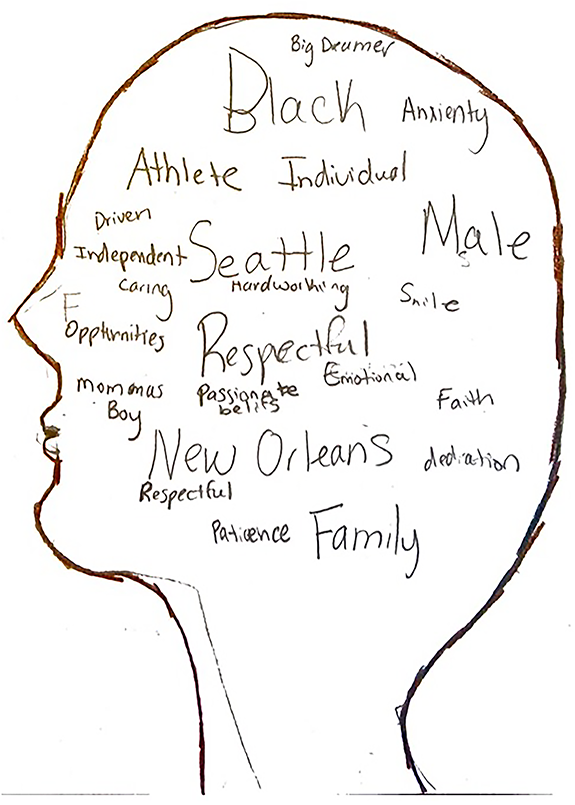
Coach: “[After sharing my own identity map] Let's go around and share some of our drawings and what they mean, let me see what yall got.”
Desean: “I got you coach. What I drew was the big words for more things you would see. And if you didn't know me, well if you knew me, then really know me. And the smaller words are things that you probably must be a little closer with me to know about me. One thing I wrote down was smile because I get this a lot where I smile a lot, but like I don't really like … At first I didn't really see it and then I started thinking about it. I do smile a lot. Something, some things that you wouldn't know is that I'm a big dreamer. I don't like telling people my dreams. I like to keep them to myself because I feel like dreams are something that you must. It's like I don't really know how to put it in words. But like I don't like sharing my dreams at all. It's just something about that. I'm also very independent, like I'll have my moments where I don't want to be with people. Or I like to be alone a lot. Opportunities, I'm in a good position in my life right now. My dad provides a lot for the family and my mom. And they make sure me and my sisters’ life is like allow us to do things that moving here from new Orleans. I’m also a very emotional person. I tend to put a lot of emotion into things I do, and it's sometimes good, sometimes bad. It's just I'm just an emotional person. Yeah.”
Additionally, we discussed larger topics associated with the sociopolitical climate at the time, the looming threat of deportation, the Trump presidency threatening their identities and the neoliberalism they experienced at a ‘liberal’ school where they regularly didn’t want to be outside of football. At one point in one of our later sessions, one of the students in the group stopped me and said, “we want to hear each other's stories and not just the bad stuff, we want to learn about each other and hear the good stuff too so we can support each other better.” Thus, we set off on a journey that had pairs and individuals within the group sharing their cultural histories of migration, immigration, cultural practices, international sports, food, and language. These stories centered around their interests in learning the complexities of their intersecting identities and histories across cultures. The sociopolitical healing of youth pertains to their identity and development through learning about specific topics (Carmen et al., 2015). As a coach, I have a role to facilitate the mental wellbeing of my players, including their motivation to learn about sociopolitical topics (Bissett et al., 2020). Towards the end of our last session, we started to organize around the design of a credit retrieval program where the young men of color would be able to build a project and presentation about their histories in the context of language, migration, politics, and other humanities subjects to receive credit for a class they may have not gotten credit for at some point in their high school career. Shortly after this conversation, we received word on school closures from COVID-19 and scrambled to support each other in different ways. Below are the art pieces the young men of color designed when asked what the space meant to them, representing the collective fire being lit by the group to resist the oppressions of the school, and the ceremonial greeting of breathing in each other's breath as a sign of care in Native Hawaiian culture between a Polynesian man and Black man respectively.

Analysis of Learning and Identity in Liminal Space
Through the inductive process, I found that coaches serve as a catalyst for facilitating interests and concerns to jumpstart cultural learning pathways and this learning occurs in the liminal spaces between school and football. Educators and coaches should continue to work within the Third Space between school and football situating and extending place as more than a material object that allows for nuance. The liminal spaces between school and home were within a network-connected through space outside the security office, the football field, and the classroom after-hours. Formalizing our conversations added depth to our understanding and deepening of the concerns the students had and this also helps us move to a more holistic understanding of learning and development that transcends the understanding of interests and concerns but rather moving towards transformative justice and systemic change. The trust developed in these liminal spaces in the context of this study allowed for interests and concerns to develop into conversations, learning and identities across settings.
Enacting Resistance Through Learning & Development
As these students who play football, along with many others, navigate situations where they are confronting race, racism and identity across settings, they indeed enact resistance in creating homeplaces facilitated by coaches. They also do this by enacting learning opportunities as they navigate the scenarios dealing with racism to better understand why the systems inflicting have power. Through this, they are developing an identity surrounding the cultivation of critical knowledge and literacy to better understand various representations of themselves, society and vice versa. This cyclical process is best highlighted by the various learning and developmental resources afforded to the students across settings provided by the coaches in the form of space (Nasir & Cooks, 2009). Also, the students have been able to co-create a setting, within a generally oppressive context, that allows for them to feel as if they belong, thus creating a homeplace in a school setting.
Our study provides insight into how relationships and interests or concerns serve as a catalyst to facilitate cultural learning pathways towards liberation and resistance in the context of a school. The role of coaches in facilitating sociocritical literacy and identity development in the context of learning supports civic education discourse and education (Spencer et al., 2020). This can lead to healing identities through civic action and engagement as presented by Ginwright (2018) through Healing Centered Engagement. The purpose of Cultural Learning Pathways in addressing trauma is to provide a way to address oppressive narratives to understand the ways the law and policy perpetuate trauma. Highlighting current structures in place that contribute to injustice and racism in school is a way for students to communicate how they move towards dismantling these power structures (Ginwright, 2015).
In Desean's case, the Field represents a dynamic and metaphoric space occurring during practice that provides time to inquire about literacy associated with social justice. Similar to the Shoal that is ever-changing, this type of inquiry is condensed and strategically occurring. As an adolescent, he is enacting resistance by checking in and gauging interest or concern about a topic. As he negotiates his own racial identity during this occurrence, he's learning adaptive mechanisms to process this racism as he develops a more secure racial identity. This situates identity as a protective factor as detailed by (Spencer et al., 2020). This space is both ambiguous and as he started to problem solve and figure out how to navigate this situation of race and racism. The Third Space, therefore, highlights the way learning takes place based on interest and concerns, while also showcasing the physical dynamism of the space of football and how learning facilitates resistance.
Coaches as Facilitators of Belonging in School
As students gain confidence and trust in their relationships with coaches, they’re able to learn what's valued and good in a space. For example, Black and Brown racial and ethnic identities being supported, cherished and celebrated in space allows for the students to develop an understanding that their holistic selves matter. Not just their physical selves, but rather their intellectual, emotional and future selves can be provided space to flourish and explore through sport. As a former student-athlete through college, sports spaces have supported my experiences with belonging both positively and negatively (Beamon, 2014; Intosh & Martin, 2018; Singer, 2005). In the context of this study, we saw through the student's experiences how these intersectional identities are promoted, celebrated, and centered for their development and growth across space associated with football. Students displayed the ability to use the learning pathways in a positive manner as they maneuvered from an oppressive space that elicits trauma, which was countered by their association with the football team, and specifically coaches. This ability to take these skills and exercise resistance across time and space displays the sociocritical literacy and learning that occurs. After the initial interviews and discussions around race, the students expressed the desire to create their own space specifically for young men of color to share their stories with coaches and each other. The students wanted to learn how to support one another, why certain conversations around race were not being had in school, and where they could have them. This ability to have these conversations in a space, especially in the context of school, allowed them the ability to better understand their place in a system to then work against it and highlights their development of a dynamic homeplace. Not only was the space a dynamic and ever-moving place, but it also shifted over time into a more structured, or material, space, thus illuminating ways for educators to better understand how and where learning takes place.
A case for the need to belong to a learning space also presents itself as a method of engaging young men of color. The context of football for these young men of color allowed them the space to explore social justice topics associated with their intersectional identities in a school and sociopolitical climate that did not want them to succeed (Howard, 2008). Many of these students are doing their schoolwork to get through, and their true love lies with the football team. I would argue their love for the football team extends past the game of football, as it is a means by which the students create relationships with depth between themselves and the coaches, the school broadly and one another in liminal spaces. They understand how they're being held accountable; they exercise self-determination in a space. The football team affords students the time and space to take risks while simultaneously understanding their racial, ethnic, religious, language, trauma, SES, place, gender, sexuality, academic and intersectional identities matter to the coaches and people associated with the program. They belong and are allowed to be themselves, and their whole selves as we facilitate their development as young people. They are learning who they are while safely trying to figure out who they are, and several of them aim to resist oppressive structures to develop counter-stories to their racialized selves.
This homeplace is facilitated by the coaches in the context of this study, and therefore we need to better understand the roles of coaches and other adults in learning settings (school maintenance staff, security guards, office staff) as they support students holistically in and out of school. Huerta et al. (2020) noted the qualities of the most impactful teachers “who make a real effort to get to know them as individuals, learn about their out-of-school lives, and build the kinds of positive relationships” (p.31). Coaches carry these qualities regularly and especially shown in the case of this study. Not only do the coaches on staff directly represent the racial and ethnic identities of the young men situated in this study, but our core pedagogy as a staff is also to center the relationships we have with our players and getting to know them outside of the sport they enjoy.
Conclusion
Furthermore, continuing this conversation from the perspective of the coaches, to better understand the ways they intentionally engage with the students who play football would be worth exploring. This also adds to the way young men, and specifically young men of color, navigate and become emotional beings as an area of research missing from the learning sciences and urban education at the current moment. As students gain a sense of belonging, they can create a homeplace in their space of learning as they work towards the ability to resist the oppression of their identities in the context of school and healing (Anderson & Stevenson, 2019). These players and coaches have been able to create a culture that affords those pathways to each, and every individual involved that allows them to experience the development of a positive sense of self while in community with others.
This study highlights the dynamic range of how identities interact within places, and how places and spaces themselves are dynamic and active. Furthering the work in urban education, the application of sociocultural theories of learning and development account for the recognition of intersectional identities across time and space (Crenshaw, 1989), supporting Black and Brown student's liberation. This study also highlights the disconnect we often see between the school and athletics and calls for more collaboration within schools to support students’ development and continued learning to connect the spaces across the school. As educators and coaches, we support the role of various types of learning, tapping into the interests and concerns of students and this study highlights a justification for how to deepen that learning to move past interests and concerns to care and systemic change through learning. Although we as educators may already regularly identify these liminal spaces, I found there to be progress in my own development in facilitating this learning and how to identify and promote it, as our interests and concerns should be grounded in that.
Footnotes
Declaration of Conflicting Interests
The author(s) declared no potential conflicts of interest with respect to the research, authorship, and/or publication of this article.
Funding
The author(s) received no financial support for the research, authorship, and/or publication of this article.
