



Abstract

In the mid-1990s, we (Daniel and Dolores) had numerous conversations about Dolores's dissertation research on women's resistance in the 1968 East Los Angeles Blowouts 1 where we unpacked the way resistance had been conceptualized in much of the sociological literature. We believed that the resistance literature of the time was marred by its own theoretical and conceptual limitations. That is, those early resistance models focused on how students’ resistant behavior implicates students even further in their own domination, and there was little if any attention to raced gendered forms of resistance (Foley, 1990; MacLeod, 1987; Willis, 1977). Based on our experiences, Dolores's research on the Blowouts, and Danny's early research on Paulo Freire and oppositional behavior, we felt the need to theorize oppositional behavior that was a response to racialized, gendered, and/or class oppression and to more accurately explain the myriad manifestations of school resistance for Youth of Color, Women of Color, and more specifically Chicana and Chicano students.
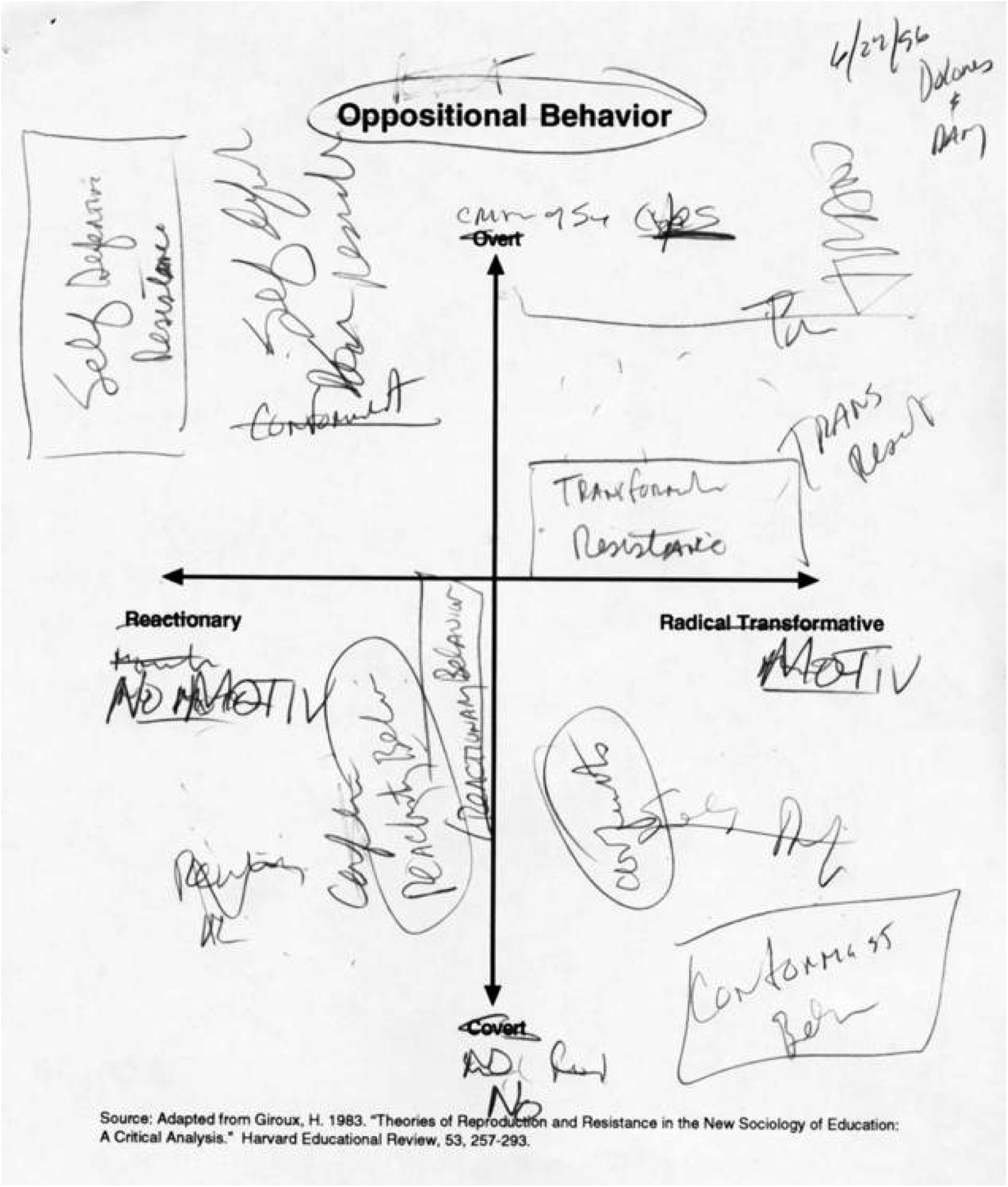
In June of 1996, as part of many theoretical exercises, we sat in Danny's UCLA office reflecting on and analyzing the oppositional behavior of Youth of Color. We contextualized these behaviors along two intersecting dimensions—one's critiques of social oppressions and one's motivation for social justice. Adapting and extending the work of Giroux (1983), what emerged was the working diagram below. We continued to dialogue and theorize with Students and Scholars of Color, and we slowly modified and edited this diagram into the one that was published in Urban Education in 2001 (Solorzano & Delgado Bernal, 2001). Although we include this in our manuscript (Hannegan-Martinez et al., 2022), we find it important to include in the introduction as well, as it illustrates not just the genealogy of this work but the critical reflexivity necessary for doing research with Communities of Color (Figure 1).
Oppositional behavior.
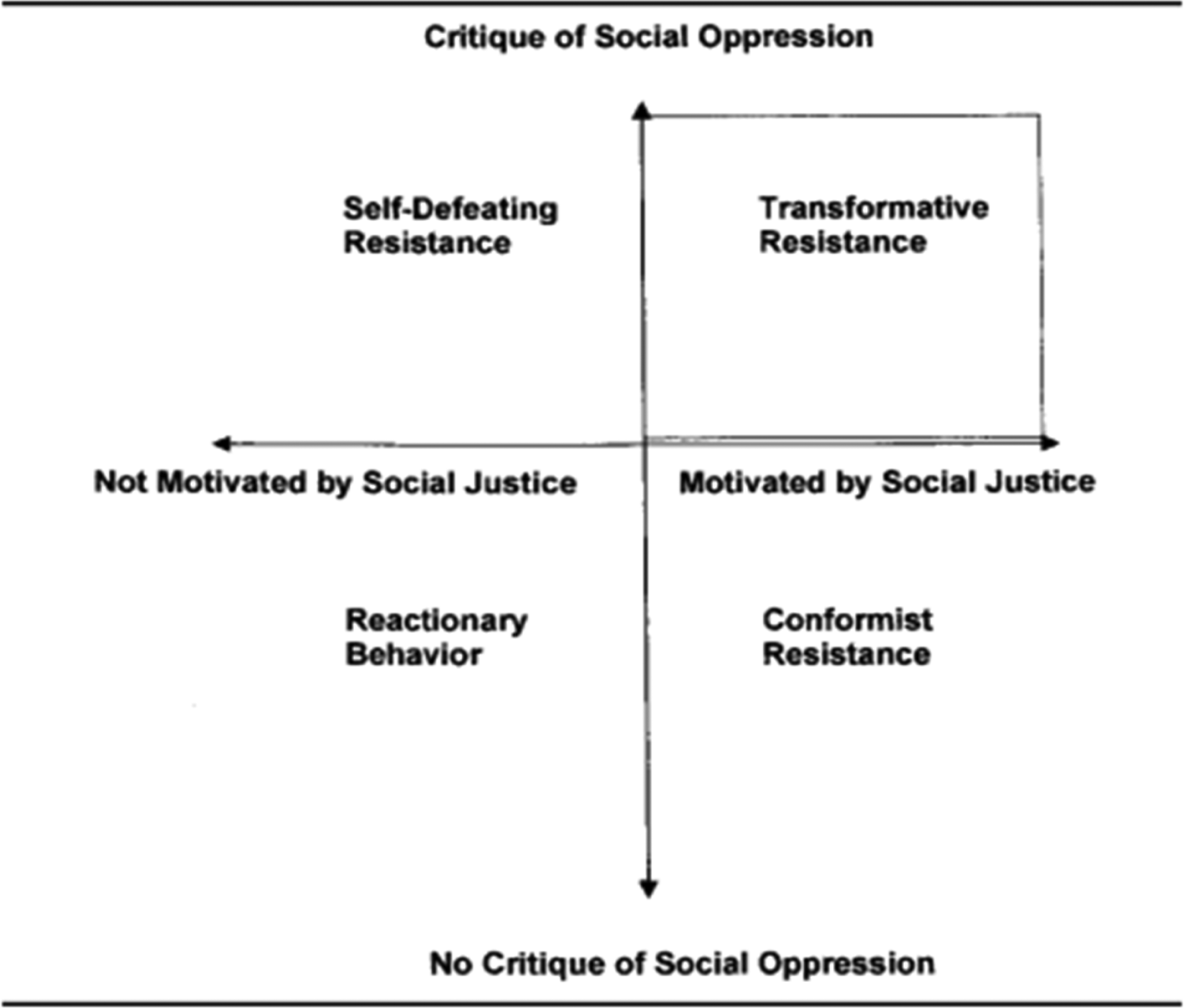
The published diagram below points to four quadrants that we referred to as (a) reactionary behavior, (b) self-defeating resistance, (c) conformist resistance, and (d) transformational resistance. We stated in the original article that, “The distinction between the four behaviors is not static or rigid, nor are these behaviors inclusive of all types of oppositional behavior.” We intended for the quadrants and the behaviors represented within them to be fluid and to aid in understanding why young people engage in different forms of oppositional behavior (Figure 2).
Critique of social oppression.
In the nearly two decades since publication, many scholars, teachers, and students (including middle school and high school students) have built upon, extended, and altered the diagram and our conceptualization of transformational resistance. Specifically, our experiences as a high school teacher (Sharim) and elementary school program coordinator (Sylvia) left us with many questions about how resistance was currently understood, framed, and could be nurtured in the classroom. For both of us, this inspired questions around how current discourse of resistance could be expanded to account for and honor the complexities of how Students of Color survive toxic and traumatic conditions both in and outside of school. I (Sharim) approached Danny and after many discussions, we convened with Dolores and Sylvia, who were having their own conversations about resistance and after meeting, the four of us discussed how so many educators have further developed and expanded on the ideas that Dolores and Danny laid out in new and innovative ways within their respective institutions and larger communities. For this reason, and in light of the many forms of resistance Students of Color 2 continue to engage in given the current racial and political climate, we decided this discussion requires a special issue.
In this special issue, we celebrate and honor the work of scholars and educators who are contributing to the field of urban education through their commitments to understanding, complicating and expanding upon theories of resistance within Communities of Color across the K-post secondary spectrum. To build upon Tuck and Yang’s (2011) questions of “What does resistance do? Does it do what we think it does?” (p. 521), the following manuscripts interrogate and imagine what transformational resistance can look like today across different urban and educational contexts.
In the first manuscript, the four of us begin by challenging misconceptions of the transformational resistance framework and extend it to consider how we might honor oppositional behaviors that are deemed undesirable by larger society and recognize the possibility for transformation within them. In the same vein, Morales and Mendoza Aviña theorize the notion of a “Ratcheta/x resistance” and explore how it might be nurtured with elementary-aged youth. Lopez, Dueñas, and Lopez move us into the high school classroom to consider the role of curriculum in developing young people's “internal transformational resistance.” Similarly, Camangian and Stovall use the high school classroom to cultivate a “People's pedagogy” as a form of critical race praxis that can be used to cultivate a revolutionary resistance with youth. We conclude with Tanksley who challenges us to consider the role of the digital space in resistance movements such as Black Lives Matter.
In the wake of youth-led national and international uprisings responding to the murders of Black people and a global pandemic that moved schooling into a digital space, we place these manuscripts in conversation with one another to help us consider how we understand resistance, how we nurture it across the K-post secondary spectrum, what we grow it towards, and perhaps timeliest of all—how we use the digital space as a tool towards liberation. Ultimately, we hope this special issue will serve as a bridge between theory and practice by helping us all—teachers, youth workers, teacher-educators, educational researchers—to (re)imagine what it means to honor, engage and nurture a resistance amongst Students of Color that can transform our classrooms, schools, and communities.
Footnotes
Declaration of Conflicting Interests
The author(s) declared no potential conflicts of interest with respect to the research, authorship, and/or publication of this article.
Funding
The author(s) received no financial support for the research, authorship, and/or publication of this article.
