



Abstract
This article addresses tensions between how researchers have conceptualized and operationalized adolescent reading motivation and how a group of Black girl readers perceive and enact reading motivation. Through a grounded theory approach, this qualitative study offers an initial exploration into mapping a race-reimaged reading motivation construct by centering the views, through artifact-elicited interviews, and experiences, through classroom observations, of a group of adolescent Black girl readers. Findings point to a need to reconceptualize reading motivation so that researchers and practitioners are equipped to recognize Black girls’ reading motivations.
Black girl readers embody the legacy of Black literacy. Facing political and institutional obstacles across geographical and sociopolitical contexts, Black communities have persisted in sustaining literacy traditions (Belt-Beyan, 2004). When denied access to literacy opportunities, they created their own (McHenry, 2002). These fugitive learning practices (Patel, 2019) represent an intergenerational dedication to literacy that resists mental and physical colonization.
Historically, Black readers maintained intellectual, social, and cultural motivations for reading. However, researchers investigating adolescent reading motivation have taken color-evasive approaches (Jones, 2022a), avoiding discussions of race (Annamma et al., 2017). Much like literacy classrooms center the voices, knowledge, and experiences of white people (DeBlase, 2003), reading motivation research has prioritized perspectives, participants, and measures that assume white as “normal” (Jones, 2022a). Exploring other students’ reading motivations (e.g., Castillo, 2020) through this framing inadvertently centers whiteness and limits our understanding of reading motivation for the increasingly diverse students (de Brey et al., 2019) in urban and urban characteristic (Milner, 2012) classrooms.
Culturally homogenized reading motivation research reflects larger trends in school-based articulations of literacy, which seldom reflect the ways urban youth read, write, and use language (Kirkland, 2021). The narrowing of sanctioned literacy curriculum and practices, often the result of external pressures (e.g., district mandates, standardized testing) disproportionately impacts urban schools (McNeil, 2000) and is in opposition to the literacy practices most meaningful to urban youth. Like urban literacies, “the literacy practices of reading, writing, and beyond that uplift, connect, and illuminate what students bring to school or use out of school” (Perry & Cooks, 2018, p. 6), reading motivations that diverge from those articulated in the research may go unnoticed or dismissed “unless teachers purposefully and intentionally search, appreciate, and incorporate them into educative and community practices” (Perry & Cooks, 2018, p. 6).
Amidst curricular silencing (Boston & Baxley, 2007), Black girls often engage in ways of knowing (Evans-Winters, 2005) and literacy practices that are restricted (DeBlase, 2003) or ignored within schools (Muhammad & Haddix, 2016). Ignoring race in theory development and instrument design creates a misalignment between researchers’ definitions and Black girls’ enactment of reading motivation. Jones (2020) found that reading motivation survey items privileged competition, teacher-directed learning, and imaginative text genres, whereas Black girls were motivated by collaboration, student-led learning, and realistic text genres. This misalignment generates deficit narratives, signaling the need to center Black girls’ perspectives and experiences in reconceptualizing the construct.
This study is built on the premise that, although reading motivation is important for literacy learning, current conceptualizations center whiteness and marginalize readers whose motivations differ. Centering those who have been marginalized allows for more responsive conceptualizations to emerge and addresses the urgent need to understand urban literacies from students’ perspectives (Kirkland, 2021). By eliciting Black girls’ views on reading motivation and analyzing their enactments of motivation in a summer reading class, this study seeks to answer the research question: “How do Black adolescent girl readers describe and enact reading motivation?” Black girl readers’ motivations must be represented within the construct itself. Reconceptualizing reading motivation in this way disrupts hegemony in literacy research, resists perpetuating deficit narratives, and supports humanizing pedagogies that center Black girls (Camangian, 2015).
The purpose of this study is to identify trends in Black girls’ reading motivations as an initial exploration into mapping a race-reimaged construct of adolescent reading motivation. Race-reimaged constructs are traditional constructs that have been reconceptualized to include racially influenced, sociocultural perspectives (DeCuir-Gunby & Schutz, 2014). I begin by describing how my positionality impacts the research. Next, I review relevant literature, including historical perspectives on Black readers, critiques of motivation theories, reading motivation research, and how research on Black girls’ literacy practices addresses motivation. I then explain the theoretical framework and study design, followed by the study findings which describe facets of reading motivation for this group of Black girl readers. I conclude by discussing the affordances of centering Black girls and offering suggestions for moving reading motivation research toward more equitable outcomes.
Positionality
As a white, middle-class woman who is an educator, researcher, partner in an interracial marriage, and mother of a Black girl, my positionality allows me to simultaneously benefit from systems of power and engage in critical research aimed at disrupting them. This also creates seen, unseen, and unforeseen dangers (Milner, 2007) throughout the research process. “Seen” dangers are anticipated harms that emerge from my research decisions, whereas “unseen” dangers are implicit or hidden by my positionality and “unforeseen” dangers are unexpected or outside the bounds of the study.
For eight years I taught middle-school English Language Arts (ELA) in an “urban intensive” (Milner, 2012) school serving predominantly Black students. My experiences afford me a nuanced understanding of how reading motivation is portrayed to teachers, yet my internalization of normative perspectives poses a “seen” danger. To mitigate this danger, I seek out critical perspectives, including motivation research by critical scholars of color.
As a white researcher working with Black participants, I acknowledge the “seen” danger of perpetuating damage-centered research (Tuck, 2009). In previous work (Jones, 2020), I uncritically employed an existing instrument to measure Black girls’ reading motivations. This study, which showed the instrument was not capable of capturing the girls’ motivations, led me to question how adolescent reading motivation has been theorized. Critically reviewing adolescent reading motivation literature (Jones, 2022a) better enables me to design research that affirms participants. However, this criticality poses “unseen” and “unforeseen” dangers. An “unseen” danger is that I may overlook data that aligns with normative conceptualizations. To address this, I code data that both disrupts and upholds the norm. My critical perspective also creates the “unforeseen” danger of readers dismissing the research as confrontational toward a prominent field of study. I attempt to circumvent this danger by emphasizing how this work seeks to move reading motivation research toward increased inclusivity.
As the mother of a Black daughter, I have become more attuned to the Black girl reader she is becoming. I see how the Black readers in her life, including her father and grandmother, and the historical legacies of Black readers shape her. As she grows into her own Black girl reader identities and practices, I want her motivations to be valued. My mother–scholar identity adds purpose to my work. It also presents the “unseen” danger of framing my analysis through the lens of my experiences with my daughter. I address this by drawing on the theoretical and pedagogical work of Black women scholars, returning to it repeatedly throughout data analysis. I aim to apply frameworks offered by Black scholars as an act of solidarity toward providing a more complete understanding of the phenomenon.
Literature Review
Centering Black girl readers to reconceptualize reading motivation necessitates bringing together multiple literatures. First, I explore the histories of Black readers, illustrating practices that should be considered in reading motivation. Next, I highlight critiques of motivation theories, pointing to the dangers of inattention to race in research, and then explore this within adolescent reading motivation research, specifically. I conclude by discussing what research about Black girl readers suggests about motivation, even when it is not a stated focus of the study.
Black Readers’ Literacy Legacies
Muhammad (2020) argues there is a “lack of attention in research, policy, and practice given to how communities of color have historically developed literacy and how elements of these historical findings can be transferred into contemporary spaces” (p. 37). I leverage Muhammad's argument that starting with Blackness is productive for understanding ways to improve literacy education for all. Historical narratives regarding Black communities’ literacy practices (Belt-Beyan, 2004; McHenry, 2002; Porter, 1936) and Black literacy frameworks (Muhammad, 2023; Muhammad & Haddix, 2016; Tatum & Muhammad, 2012) offer more expansive visions of reading motivation than what current conceptualizations recognize, including the desire to become skilled readers, develop knowledge about wide-ranging topics, express identities, and (re)claim a place in society.
Historically, Black communities created ways for individuals with varying skills to read together (McHenry, 2002) in both formal (e.g., community schools, literary societies, reading rooms) and informal (e.g., homes, churches) environments. To support literacy development, Black readers utilized collaborative pedagogies that followed a developmental progression and emphasized meaning-making. Holistic practices, including reading aloud, using everyday texts (e.g., newspapers), modeling literacy skills, engaging in critical feedback, and practicing reading, writing, and oracy as interconnected (Belt-Beyan, 2004; McHenry, 2002) supported skill development. Oral reading practices were considered a democratic means of sharing texts regardless of individuals’ skills (McHenry, 2002). Reading in Black literacy communities continues to be collaborative, involving a co-construction of knowledge (Jones, 2020; Muhammad & Haddix, 2016) through collective engagement with texts (Tatum & Muhammad, 2012).
Black readers were motivated by intellectual development. Historically, Black readers viewed literacy as improving their mental condition (Porter, 1936), offering freedom from ignorance and control over their inner self (Belt-Beyan, 2004). Groups engaged in learner-directed study, leveraging individual and collective agency to pursue topics of interest, whether academic (e.g., math, science, etc.) or related to current events (e.g., news, social issues, etc.). Public engagement via newspapers and lectures was highly valued for supporting community betterment (Porter, 1936).
Black readers were also motivated to know themselves. Literacy allowed Black readers to see themselves more fully and give voice to their experiences (McHenry, 2002; Porter, 1936). They were motivated to read and write to instill pride, racial solidarity, and racial consciousness. Facing racism and oppression, self-affirmation and self-expression are distinctive motivational factors for Black readers. Thus, identity remains central to Black literacy, as engagement affords opportunities to come closer to selfhood (Muhammad & Haddix, 2016).
Finally, Black readers were motivated for social reasons, including resisting oppression and creating change. They viewed reading and writing as opportunities for demanding full citizenship, developing political consciousness, and engaging in dialogue around social justice issues (McHenry, 2002; Porter, 1936). Literacy was a form of cultural capital and a tool for liberation because “the ability to read was not an end in itself; it was part of a larger process of training individuals to claim the authority of language and effectively use it to participate in reasoned and civil public debate” (McHenry, 2002, p. 102). Black readers have always been motivated by the transformative potential of literacy. Aligned with these traditions, scholars argue that Black literacy is tied to criticality through a need for social transformation (Muhammad & Haddix, 2016) and the improvement of the Black community (Tatum & Muhammad, 2012).
Critiques of Psychological Motivation Theories
If constructs will be used to understand Black readers’ motivations, researchers must attend to race, in terms of both sociopolitical contexts and lived experiences, when developing them. Amidst broader pursuits to decenter whiteness and (re)center marginalized communities, motivation scholars are critiquing foundational theories, employing Critical Race Theory to highlight the implications of models failing to consider race in analyzing the phenomenon.
Critical scholars (e.g., DeCuir-Gunby & Schutz, 2014; Henrich et al., 2010; Matthews & López, 2020) have problematized the assumption that constructs, such as motivation, are culture-free and applicable across populations. Foundational motivation models, which were developed and normed with predominantly white, middle-class samples (Henrich et al., 2010), implicitly frame motivation according to white values. Researchers using them with other groups often draw attention to differences compared to the expected “norm” (DeCuir-Gunby & Schutz, 2014) and, when researchers are racially disconnected from participants, explain these differences as deficiencies (Matthews & López, 2020).
When motivation researchers consider race, they treat it as a categorical, independent variable (DeCuir-Gunby & Schutz, 2014) and include it for descriptive purposes, explanatory purposes, or comparative purposes. Although examining differences between racial groups can be productive because individuals may share a common racialized experience, it presents an incomplete story. Treating racial demographics as categorical variables prevents researchers from considering the sociocultural histories and experiences of identity groups. Describing group differences without considering broader sociocultural contexts reinforces stereotypes and narrows the theory's potential to support a full understanding of human behavior (Matthews & López, 2020).
Categorizing individuals also suggests identity groups are monolithic, ignoring within-group variability (Urdan & Bruchmann, 2018). Because quantitative analyses rely on large sample sizes to maintain statistical power, intersectional identities are often overlooked. Given these research traditions, Black readers’ diverse experiences, including those evidenced by the history of Black literacy practices, are missing from widely accepted models of motivation. Leveraging these critiques of motivation, broadly, to explore adolescent reading motivation, specifically, highlights areas where more nuanced understandings are needed.
Reading Motivation
Critical perspectives toward motivation have not yet been taken up in reading motivation research; scholars continue to uncritically draw on psychological theories. Through these theoretical lenses, researchers argue that motivated readers read more extensively (e.g., Wigfield & Guthrie, 1997), demonstrate improved achievement (e.g., Becker et al., 2010), and use higher-order comprehension skills (Taboada et al., 2009). This research, along with research suggesting students’ reading motivation can be influenced by instruction and classroom contexts (Nolen, 2007; Urdan & Schoenfelder, 2006), consequentially gets taken up by educators and policy makers to inform school-based literacy.
Reading motivation research reflects a problematic cycle: researchers have theorized reading motivation with white readers in mind, designed instruments using predominantly white samples, used those instruments empirically to compare racial groups, and drawn racialized conclusions when Black readers do not perform like their white peers (Jones, 2022a). There are a limited number of studies that specifically attend to the reading motivations of Black readers. Some present Black readers as unmotivated (e.g., Guthrie et al., 2009), while others suggest Black readers are motivated in ways that conflict with school-based literacy (e.g., Mucherah & Yoder, 2008; Whitney & Bergin, 2018). These conclusions leave significant gaps for more affirming research.
Although cognitive perspectives dominate reading motivation research, (Conradi et al., 2014; Jones, 2022a), some researchers have taken a sociocultural, situated perspective (e.g., Moje et al., 2008; Nolen, 2007), which alters the research goals, shifts the unit of analysis, focuses on the role of identity, and accounts for differences in meaning (Nolen et al., 2015). Researchers working from these perspectives are more likely to focus on understanding Black readers’ motivations rather than comparing them to their white counterparts or narrow achievement outcomes (e.g., Jones, 2022b; Moje et al., 2008; Nolen, 2007). These studies offer insights into how readers’ identities shape motivation. Moje et al. (2008) found that Black students reported reading for pleasure more frequently than others, often as a form of self-expression or self-improvement and within the context of raced/gendered affinity groups outside of school. Jones (2020, 2022b) found that understanding their own identities and the identities of others was a distinct motivation for Black girls to read. These findings highlight the importance of centering readers’ voices and creating space for ideas to emerge that have not previously been represented in the research.
Currently, there are calls for disrupting racist practices and advancing racial justice within literacy research (Milner, 2020; Willis et al., 2021). This study seeks to respond by moving beyond practices that perpetuate deficit narratives about Black girls’ reading motivations. If Black readers are performing differently than their white peers in reading motivation studies, this presents an opportunity to interrogate how reading motivation has been conceptualized. Over a decade ago, Guthrie et al. (2009) identified this as a possible explanation of the racial differences they observed: The language used to represent intrinsic motivations has not been empirically derived from grounded studies with African American students, which may imply that the questionnaires are less well adapted to African American students. A weakness of this study is that we did not construct motivation questions from grounded interviews with African American students, and did not pilot the measures to assure their cultural validity. (p. 17)
Black Girl Readers
Considering the theoretical and epistemological constraints of how reading motivation has been studied, research explicitly focusing on Black girls’ reading motivations is scarce (e.g., Jones, 2020, 2022b). However, research about Black girls’ literacy practices (see Muhammad & Haddix, 2016 for a more complete review) can offer insights into reading motivation and related concepts (e.g., engagement, attitudes, etc.), generally by referring to self-efficacy (Bandura, 1977) and value (Eccles et al., 1983).
Self-efficacy reflects students’ beliefs about their abilities, answering the question: “Can I be a good reader?” Research on Black girls’ literacy practices attends to self-efficacy by highlighting the importance of what is read, suggesting that texts as mirrors (Bishop, 1990), which reflect readers’ identities and lived experiences, are motivating. In their study with gifted Black girls, Ford et al. (2019) posit that engaging in bibliotherapy with texts readers identify with culturally supports the development of positive self-efficacy and engagement. Other studies suggest interacting with positive textual representations enriches literacy experiences, including making connections and thinking critically (Boston & Baxley, 2007), and fosters positive attitudes toward reading (Baxley & Boston, 2010). Because Black girls are not a monolith, heterogenous textual representations are important, offering opportunities for readers to learn about themselves and others (Jones, 2022b). Varied representations of diverse Black girl experiences provide readers opportunities to connect with portrayals that reflect their experiences, negotiate those that are different, and challenge those that are negative (Muhammad & Haddix, 2016). Researchers commonly recommend the use of mirror-texts, often implying a positive impact on motivation.
Research also shows how Black girls are asked to read may shape their self-efficacy. Researchers emphasize the importance of choice (Baxley & Boston, 2010) and note feelings of ownership impact readers’ self-efficacy (Boston & Baxley, 2007). Culturally relevant pedagogy, including instruction that values literacy practices built on relationships, communal connectedness, and community support (Boston & Baxley, 2007; Muhammad & Haddix, 2016), is a common recommendation. Instructional contexts such as book clubs promote skill development (e.g., critical discussion, higher-order thinking) and allow Black girls to voice issues that are personally meaningful. Researchers suggest that choice and culturally responsive instruction allow Black girl readers to see themselves as capable and become more motivated readers.
However, self-efficacy does not automatically produce engagement. Even if students believe they can, they may disengage if they do not find value in the task. Value answers the question: “Do I want to be a good reader, and why?” Research on Black girl readers addresses value by describing tensions between “text-centered, teacher-based” instruction (DeBlase, 2003) and Black girls’ “subversive literacies” (Kelly, 2020). “Text-centered, teacher-based” instruction reflects the tendency for instruction to focus on readers’ ability to acquire information from text, rather than their experience of a text, because students are evaluated on discreet skills (e.g., knowledge of literary conventions, providing text-based interpretations). This poses a problem when Black girls value initiating meaning for themselves (Boston & Baxley, 2007; Jones, 2020). In response, they may critique pedagogical strategies, including questioning text selection and teacher-approved interpretations (DeBlase, 2003), or remain silent to navigate classroom literacy structures (Kelly, 2020). Researchers recommend increased alignment between what type of reading is valued, thus improving reading motivation.
Altogether, the literature reviewed shows that although Black readers have, for generations, been motivated to read for personal and communal reasons, dominant approaches to studying reading motivation have created epistemological and theoretical gaps that prevent these motivations from being recognized. While scholars have engaged in research that affirms Black girls’ literacy practices, reading motivation is addressed only implicitly and by referencing concepts (e.g., self-efficacy, value) that have been critiqued for centering whiteness. Situated at the intersection of these literatures, this study aims to contribute to each by offering evidence of the connection between Black girl readers’ motivations and historical practices, expanding epistemological and methodological approaches to studying reading motivation, and describing elements of Black girls’ motivation for inclusion in a reconceptualized construct.
Theoretical Framework
This work is grounded in Black Girlhood Studies (BGS; Brown, 2013; Halliday, 2019), Historically Responsive Literacies (HRL; Muhammad, 2023), and Black Girls’ Literacies (BGL; Muhammad & Haddix, 2016) to support designing for and studying Black girls’ reading motivations. Together, these theoretical frameworks support the goals of this work, including for whom it is designed, in what context(s), and toward what purpose(s) (Figure 1). Furthermore, drawing on theories informed by the lived realities of Black women aligns with recommendations for pursuing racial justice in literacy research (Willis et al., 2021).

Theoretical framework.
Black Girlhood Studies
BGS responds to education discourse ignoring Black girls’ voices and experiences. The intersections of heteronormative, patriarchal, racist, and sexist oppressive structures create obstacles for Black girls and frame them as “a problem to solve” (Brown, 2013, p. 103). Although Black women and girls share racialized and gendered identities, relying on Black feminism to theorize Black girlhood risks perpetuating Black girls’ adultification (Smith, 2019). BGS combats the lack of theorizing specific to Black girls, resulting in over-essentialized descriptions, by embracing the complexities of Black girls’ lived experiences (Brown, 2013).
In educational studies, BGS centers Black girls’ experiences, creates language identifying those experiences, and promotes pedagogical approaches celebrating them as “co-creators of knowledge, co-witnesses of their genius, and co-conspirators of freedom” (Owens et al., 2017, p. 119). This requires eliciting their voices as experts of their own experiences, valuing their lived experiences as knowledge, and taking an asset-based orientation. Brown (2013) urges scholars to “centralize Black girlhood for the purpose of theorizing and documenting the necessity of Black girls’ critical thought and how it often challenges both the institutions that govern their lives and also the academic constructs and ideas so often implicated in policy making” (p. 228). This study upholds these commitments by assuming Black girls are motivated readers, positioning and validating their reading experiences as knowledge, and recognizing them as experts on their reading motivations.
Historically Responsive Literacies
While BGS supports theory development, HRL (Muhammad, 2023) offers a pedagogical and instructional model. HRL centers historical Black literacy practices, translating them into contemporary educational spaces through five learning pursuits: identity, skills, intellect, criticality, and joy.
Pursuing identity means learning about yourself and others. To pursue identity, educators must consider how curriculum and instruction foster student learning about individual, family, cultural, and community identities. This includes acknowledging that identities are multifaceted, layered, and malleable.
Pursuing skills means developing the cognitive abilities required for content area mastery. Developing skills is synonymous with developing expertise in what educators deem important to students’ learning. For reading, skills include those necessary to decode, comprehend, respond to, and critique text.
Pursuing intellect means building academic knowledge across disciplines. Intellect is connected to the concepts and themes taught in a lesson or unit and privileges contextualizing learning through real-world application. Students become “smarter” about something and act on the knowledge they have gained.
Pursuing criticality means thinking about power, equity, and disrupting oppression, reflecting the transformative potential of education. Criticality builds students’ sociopolitical consciousness so that they are empathic, critical thinkers rather than passive consumers of information. Students learn to question, examine multiple perspectives, and develop their voice.
Finally, pursuing joy means developing a love for self and humanity. To elevate joy, educators must consider what opportunities students have to experience wonder and beauty through play, imagination, music, and art. Joy also necessitates including truthful, complete narratives and representations of diverse people.
The pursuits build upon one another. When students know themselves, they can confidently engage in learning new skills. With these skills, they can gain new knowledge and think critically about it. They can find beauty in what they learn about themselves, others, and the world. In this study, HRL informs my understanding of the holistic nature of students’ literacy engagement and how these pursuits afford diverse reading motivations.
Black Girls’ Literacies
While BGS aims to fill theoretical gaps rendering Black girls invisible or homogenized, BGL (Muhammad & Haddix, 2016) addresses the scarcity of scholarship on Black girls’ sophisticated literacy practices. BGL outlines six elements reflecting the “specific acts in which Black girls read, write, speak, move, and create in order to affirm themselves, the(ir) world, and the multidimensionality of … Black girlhood” (Price-Dennis et al., 2017, p. 5). Black girls’ literacies are:
Multiple—engaging in reading, writing, speaking, listening, thinking, and embodiment. Tied to identities—exploring identities and (re)shaping how they see themselves and others through literacy. Historical—engaging in literacy practices connected to the histories of Black women. Collaborative—working together to advance literacy. Intellectual—using literacy as a means of seeking new knowledge. Political/critical—using literacy to make sense of social (in)justice.
In this study, BGL informs my understanding of the various ways Black girls engage in literacy and how these practices may shape or be shaped by their motivations.
Although these three theories approach educational research and practice differently, including for whom they are designed, in what context(s), and toward what purpose(s) (Figure 1), integrating them allows me to take up elements of each to design this study. BGS and BGL support the primary research goal: theorizing Black girls’ reading motivations by centering their perspectives and experiences. BGS and BGL informed my use of artifact-elicited small group interviews, a methodologically novel approach to theorizing reading motivation that centers participants’ interpretations. Interviews were integral to data collection and analysis. Emergent themes informed analysis of additional data sources, privileging participants’ perspectives throughout the analysis process. BGL and HRL focus on literacy in K-12 instructional contexts, shaping curriculum design and student engagement. Captured in the observational data, curricular elements were analyzed for how they afforded or constrained the reading motivations described in interviews. This study also leverages the argument, made by BGL and HRL, that models centering Black girls are relevant for all readers. A study designed to explore Black girls’ reading motivations can improve our ability to recognize the motivations of all readers.
Study Design
In pursuit of a race-reimaged construct of reading motivation, rather than relying on constructs developed with different groups of readers, I designed this study to answer the question: “How do Black adolescent girl readers describe and enact reading motivation?” Centering participants’ experiences advances racial justice in literacy research by respecting “each person as a fellow human, whose language and literacy are wholly complete without white interference” (Willis et al., 2021, p. 22) and attends to participants’ reading motivations as embedded in their environment, reflecting locally-contextualized social, historical, and cultural scripts (Kirkland, 2021).
I conducted this qualitative study in partnership with Chance to Climb, Inc. (CTC; names are pseudonyms), a nonprofit organization offering summer enrichment programming for fourth- through sixth-grade students in an ‘urban emergent’ (Milner, 2012) city in the southeast U.S. The urban context, as defined by the size of the city, the demographics of the students in schools, and the resources available, forms the larger sociopolitical landscape. At the time of the study, the city had experienced a 20% population growth and rapidly increasing student diversity over ten years. Meanwhile, the city's schools were also being subjected to the narrowing of curriculum common in urban districts (McNeil, 2000), including focusing resources on mandated scripted reading curriculum. CTC operated within this larger context, making decisions about student recruitment, staffing, and instructional programming to meet these changing needs.
I collected the data in 2019 during my second summer as a CTC reading teacher. During the four-week program, each class (two fifth- and two sixth-grade cohorts) met daily for 45-min. Following a book club structure, we collectively read and discussed texts. The curriculum used components of BGL (Muhammad & Haddix, 2016) to center Black girls’ literacy practices (Figure 2).
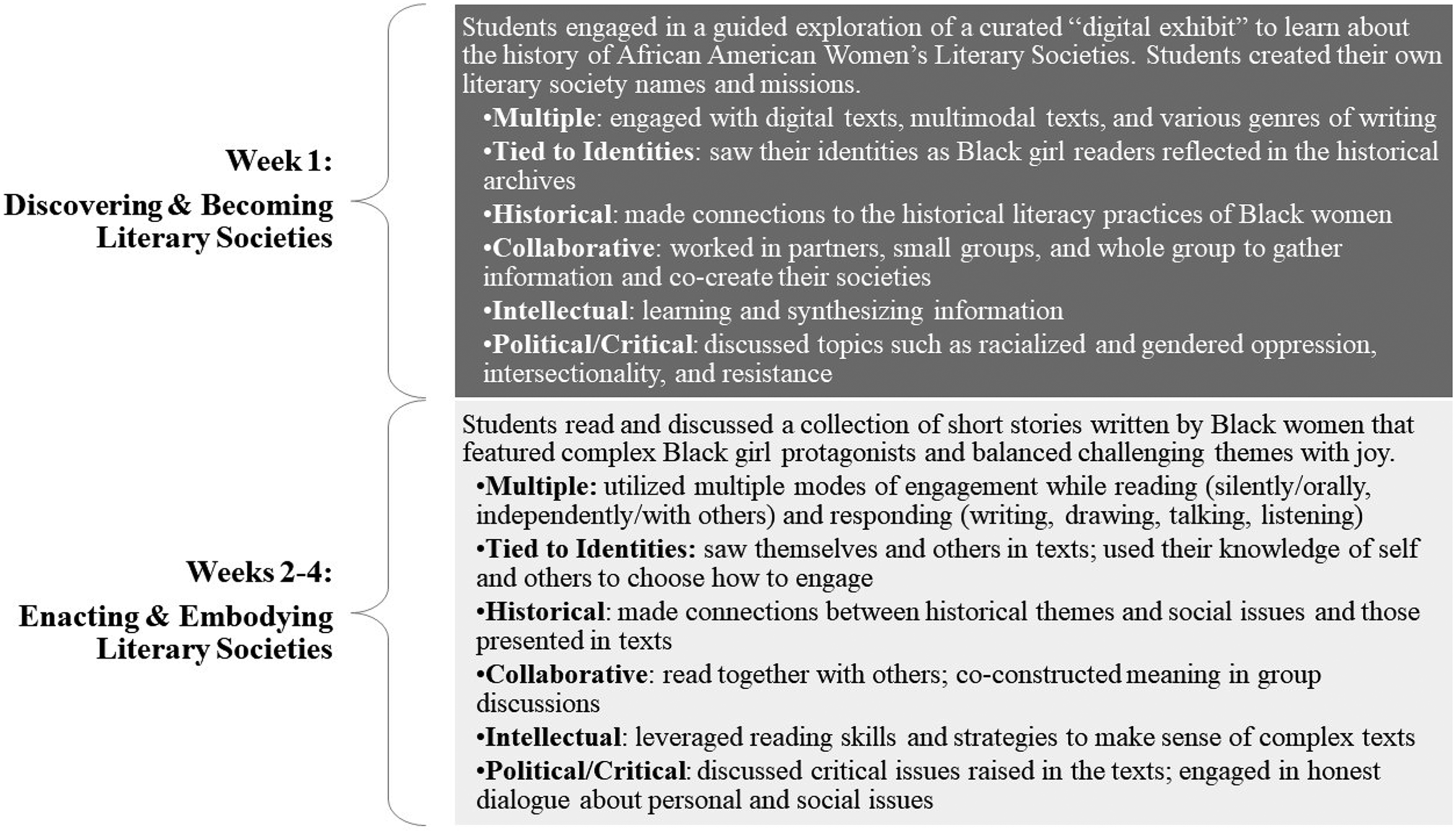
Design of CTC summer reading class.
During the first week, students studied the history of African American Women's Literary Societies, with each cohort co-creating a mission statement outlining their literacy vision. The remaining weeks involved shared engagement with text. Students chose how to read (independently, with peers, or with a high-school volunteer) and respond (sharing questions, reactions, big ideas, or images). Students led discussions, leveraging their reading experiences. The instructional context, designed around BGL, affords opportunities to understand Black girls’ reading motivations beyond the constraints of instructional settings typically designed to uphold white normative literacy practices (DeBlase, 2003).
Participants
Participants (17) were students in my 2019 CTC reading classes. Sixth-graders (9) were in my 2018 reading class, whereas fifth-graders (8) were new. Nearly all participants identified as Black/African American (13). Two students who identified as multiracial during the consenting process also self-identified as Black during academic and social conversations. To maintain my commitment of centering Black girls, only the data from students who identified as Black/African American and multiracial/Black were analyzed (15). Nine participants agreed to a small-group interview. Figure 3 introduces interview participants, detailing their self-identified race, grade, history with CTC, reading engagement, and personality, as described by the student, her peers, or my observations. While they share a common identity as Black girls, recognizing their individuality reflects BGS's tenet of honoring complexity.
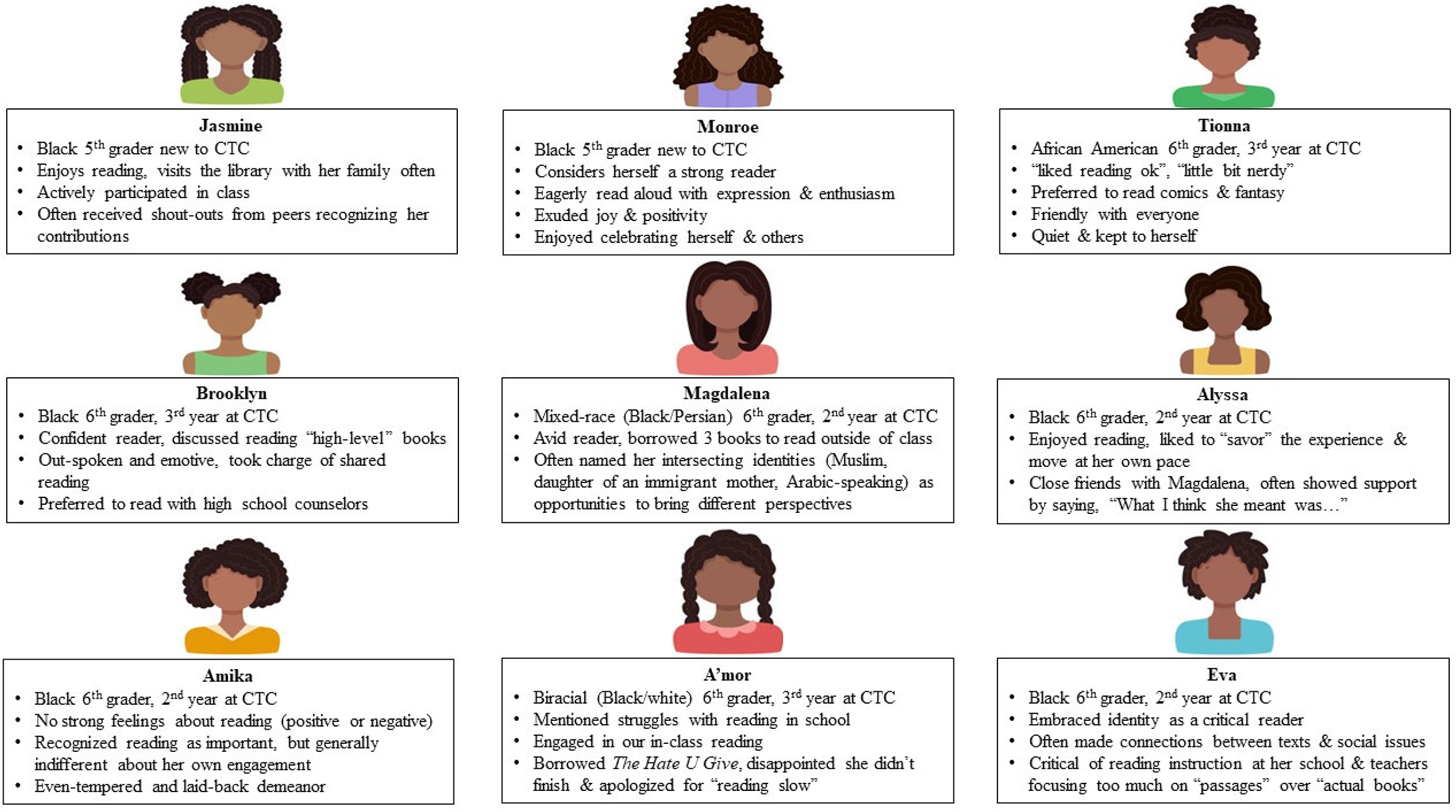
Introductions to participants.
Data Collection
I collected two sets of qualitative data. The first includes three artifact-elicited small-group interviews to elicit participants’ perspectives on reading motivation. The second includes field notes, 32 class video recordings, and student work capturing participants’ enactments of reading motivation. Together, the data represents the “reflecting self” and the “experiencing self” (Kahneman & Riis, 2005). The “reflecting self” is the part of us that reflects on our experiences and considers possible future experiences. The interview data captures participants’ reflections on what has motivated them or what could motivate them. The “experiencing self” is the part of us that lives in the moment and interacts with our context. The observational data captures how participants “experience” reading motivation. Data capturing both the “reflecting self,” through interviews, and the “experiencing self,” through observation, allows nuanced themes to emerge.
Participants’ Perspectives
To understand participants’ perspectives on reading motivation, I conducted artifact-elicited interviews. Artifact-elicited interviews use visual, verbal, or written stimuli to encourage participants to talk about their ideas (Barton, 2015). They are useful for exploring topics that may be difficult to discuss, including abstract concepts like reading motivation. Using artifacts can make the interview more comfortable and reduce power imbalances (Barton, 2015), support respondents in working together to explore topics (Collier & Collier, 1986), and more authentically reflect participants’ conceptual categories.
The “artifact” was items from the Motivations to Read Questionnaire (MRQ; Wigfield & Guthrie, 1997) and the Adolescent Motivations to Read Profile (AMRP; Pitcher et al., 2007), instruments which are commonly used with adolescent readers in research and practice. I selected these for two reasons. First, based on prior work (Jones, 2020, 2022b), I anticipated they would be provocative, giving respondents something to “talk back to,” raising tensions between the items and the girls’ ideas and presenting opportunities for deeper group discussion. Second, they provided accessible language that participants could use to discuss the abstract concept of reading motivation.
Following a semi-structured protocol, I presented participants with items, posing questions about their interpretations (e.g., “Based on these items, what message is being sent about reading and what it means to be a reader?”) and alignment with their own beliefs (e.g., “If you could revise the items to send a different message, how would you change them and why?”). I intentionally framed interview questions to invite all perspectives, not only those that were critical. The purpose of using the surveys was not to determine participants’ agreement with them, but to provide an engaging and accessible entry point into conversations about reading motivation.
I conducted interviews in small-group settings (3 groups, 3–4 participants each, lasting 45–60 minutes). The group dynamic can generate a greater range of responses by stimulating participants’ thinking and encouraging elaboration (Currie & Kelly, 2012). With children, group interviews offer “think time” while others speak, supporting greater reflectivity and more natural participation (Lewis, 1992). All consented study participants were given the opportunity to join an interview. Rather than selecting group members myself, I invited each participant who agreed to the interview to suggest a friend to join them. Research suggests (e.g., Currie & Kelly, 2012; Lewis, 1992) friendship groupings are an important criterion for selecting interview groups, allowing children to give fuller responses when engaging with peers they like. If the friend declined, the interviewee recommended someone else. Half of participants (9 of 17) engaged in at least one interview, and each had at least one friendship pairing in their interview group. Interviews were video recorded and transcribed using Rev transcription services, followed by manual verification.
Participants’ Enactments
To capture students’ enactments of reading motivation, I collected class videos, student work, and field notes. I video-recorded 32 classes (20–40 minutes each) to capture students’ reading experiences and discussions. All video data was transcribed using Rev transcription services, followed by manual verification. Student artifacts represented collective and individual work. Collective work included each cohort's literary society mission statement posters and “graffiti walls” where students recorded big ideas and lingering questions for the shared texts. Individual work included students’ annotated text copies. Daily field notes captured interactions with students outside of class that seemed relevant to their in-class engagement and my in-the-moment personal and pedagogical reflections.
Analysis across data sources facilitates triangulation of emergent findings, lending credibility to the study. It also reflects the multiplicity of Black girls’ literacy practices (Muhammad & Haddix, 2016) by attending to speaking/listening, embodiment, writing, and creative expression in individual and collective formats.
Data Analysis
Using NVivo, I analyzed the data in two phases. First, I analyzed the interviews to determine students’ descriptions of reading motivation. Second, I used what emerged from the interviews to analyze the observational data and determine how students enacted their ideas of reading motivation. Figure 4 depicts the complete process.
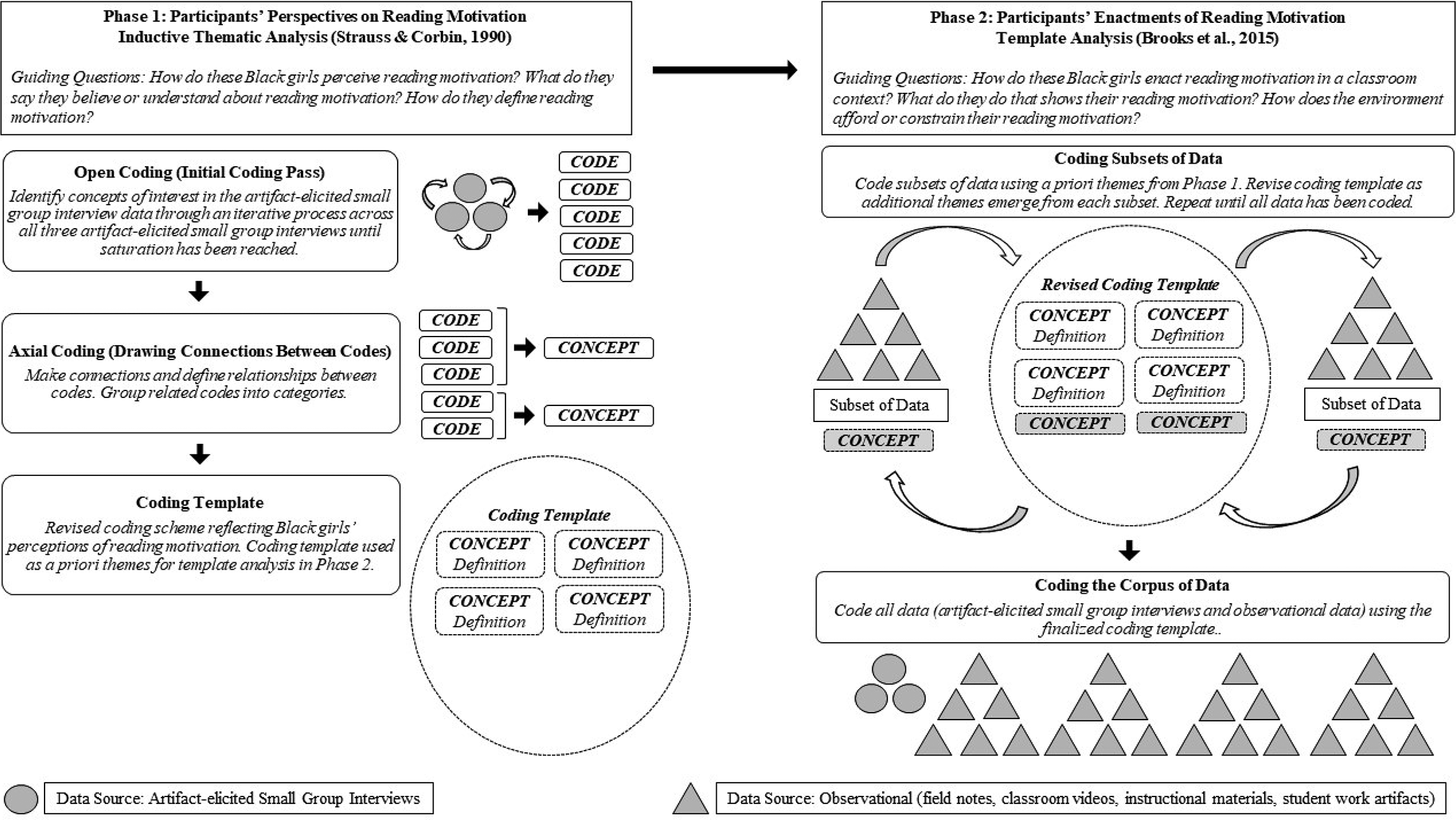
Data analysis process.
Through inductive thematic analysis using the constant comparative method (Strauss & Corbin, 1997), I analyzed the interviews to determine how participants describe reading motivation. Three questions guided this process:
How do these Black girls perceive reading motivation? What do they say they believe or understand about reading motivation? How do they define reading motivation?
Although analysis of the interviews relied on my interpretations of interviewees’ conversations, I used participants’ language to label emergent concepts during open coding, thus working to prioritize their perspectives. Through multiple iterations, I grouped similar codes into categories and recoded. For example, “pushing yourself” and “work harder” were initial codes representing how participants discussed “effort.” When possible, I used the girls’ language to name categories. When a succinct category label did not appear in the interview data, I drew on my interactions with the girls in other contexts (e.g., class, free time, etc.) to create labels that I thought reflected terms they might have used (e.g., “outcomes”).
I then used axial coding to connect categories, continuing to prioritize using the girls’ language to create code names. For example, “effort” related to two other categories, “outcomes” and “progress/growth,” because they addressed ideas about proficient reading. These were grouped together as “ability and meaning-making.” This resulted in a coding scheme reflecting these Black girls’ perceptions of reading motivation, which I used for the second data analysis phase.
To analyze the observational data, I conducted template analysis (Brooks et al., 2015) using the final interview coding scheme, allowing me to examine the data through the lens of the participants’ ideas. Three questions guided this process:
How do these Black girls enact reading motivation, as they described it, in a classroom context? What do they do that shows their reading motivation? How does the environment afford or constrain their reading motivation?
I coded a subset of the observational data for evidence of the interview codes, such as “effort.” For example, moments when students volunteered to participate, exceeded work expectations, or gave peer shout-outs for “working hard” supported what students described in interviews and were coded accordingly.
I also revised the template to reflect new codes that emerged. For example, a new code, “reading strategies” emerged from the observational data that had not initially been coded in the interview data. Evidence of students using reading strategies to make meaning from text fit the “ability and meaning-making” category. I used the revised coding template to analyze the next subset of observational data, repeating this cycle until all observational data was coded. I determined the final template and conducted a second round of coding on all data, including the small-group interviews, to ensure consistency across the corpus.
Given logistical constraints (e.g., program timing, participant age, participants returning to schools across the city) and the impact of COVID-19, I was not able to conduct member-checks for the completed data analysis as intended. However, iteratively analyzing the interview and observational data maintained a focus on participants’ perspectives, revealing nuanced, expansive, and novel facets of reading motivation.
Findings
Analysis supports three trends in how this group of Black girls described and enacted reading motivation. First, their reading motivation was meaning-oriented, encompassing participants’ views on effort, growth, using reading strategies, and pursuing multiple outcomes (e.g., school-based outcomes, like grades, and broader outcomes, like self-expression). Students were motivated to read to make meaning from text and believed that these elements were necessary to do so. Second, their reading motivation was collaborative. Participants were motivated to read to cultivate community by reading to and with others. Finally, their reading motivation was liberatory. They read to understand themselves, others, and issues of social justice.
Meaning-Oriented
Becoming readers who successfully make meaning from text motivated the girls. In interviews, they discussed putting forth effort, prioritizing growth, using reading strategies, and achieving desired outcomes as essential aspects of reading for meaning. Their perspectives, which were also reflected in their class engagement, are more nuanced and expansive than what is currently reflected in reading motivation research.
Effort
Throughout interviews, participants frequently discussed reading motivation as putting forth effort to make meaning from text. The artifact-elicitation technique created opportunities for participants to share their views on relationships between effort, meaning, and motivation. When discussing the survey item “I am willing to work hard to read better than my friends” (Wigfield & Guthrie, 1997, p. 432), they generally agreed with the idea of “pushing yourself” and “working hard,” while disagreeing with being “better than” someone. Jasmine commented, “They [motivated readers] are trying to push themselves to get better.” Eva complicated simplistic notions of effort, saying, “You need to push yourself further for better accomplishments … You mess up a little and you are right a little, but that means that you keep on pushing.” For her, effort is not a linear path to success. It often involves moments of struggle.
They also critiqued overemphasizing effort. Alyssa said, “That's another sign of pushing ourself [sic] too much and … expecting yourself to be good. But sometimes it's not always like that because there's people in the world who are working really hard to get there [recognized as a strong reader] and other people who are just right there just not doing anything.” Alyssa argues that effort matters, but you can “push” yourself too much. She also names inequitable systems, saying that outcomes are not inherently the result of individual effort.
In class, students enacted effort by initiating participation, exceeding work expectations, and “shouting out” others’ efforts. Within the book club structure, conversation was student-driven. Students made their effort visible by initiating participation. This occurred orally, when students volunteered to read aloud, start discussions, or ask questions, and in writing, when students annotated texts while reading or took notes during conversations.
Although not prevalent in the interviews, students also enacted effort by going beyond expectations. For example, in addition to the texts we read together, students were able to borrow additional books for independent reading outside of class time. Thirteen of the 15 participants borrowed at least one book; Magdalena and A’mor each read multiple books.
Finally, each class ended with “shout-outs.” They often named working hard, “Shout out to Maya for giving good pieces of evidence and working hard today,” and participating, “I have a shout out for Alyssa because she started a conversation well and then she asked questions for us to start talking about.” Student-initiated “shout-outs” revealed what students valued and wanted to reinforce. However, effort is just one dimension of meaning-oriented reading motivation. Students believed that effort supports readers’ growth in their meaning-making skills.
Growth
During artifact-elicited interviews, participants were presented with items including “I try to get more answers right than my friends” (Wigfield & Guthrie, 1997, p. 432) and “When my teacher asks me a question about what I have read, I can never/have trouble/sometimes/always think of an answer” (Pitcher et al., 2007, p. 382), prompting conversations about growth. Eva discussed why getting “right answers” is important for growth: “When you try to get more right answers there's a better opportunity of getting me higher than what I am [in reading ability].” She continued by sharing how getting “right answers” provides information to teachers and parents so that they can support you. Eva's comments connect growth and effort because knowledge of reading skills allows for making intentional effort.
While discussing growth, participants acknowledged differences in readers’ abilities. A’mor said, “Others might not have the same traits and reading skills as you” but noted they just need an “opportunity.” She suggests that individuals may have different abilities but, if given opportunities, all readers can develop their skills. Eva, who talked about “moving higher” and reading levels, was also sensitive to how skills are valued: “There's no such thing as a bad reader … no matter what level you’re on.” She recognizes a developmental trajectory of reading but argues it should not be used to label readers as “good” or “bad.”
In class, students enacted growth by collaborating to clarify misconceptions. We read complex texts and sometimes students’ comprehension faltered. When this happened, the girls worked together to make repairs. For example, while reading “Half a Moon” (Watson, 2019) there was confusion about whether both characters knew they were half-sisters. The girls grappled with this by sharing multiple perspectives, rationales, and text evidence to improve their comprehension: If Brooke doesn’t know that Raven is also her dad's daughter, then I don’t know if Raven is gonna tell Brooke [that she is her sister]. I think, yes [Brooke knows], because Raven and Brooke are avoiding each other, and you wouldn’t avoid somebody for no reason. And they, I think it says, Brooke is avoiding her and not making eye contact. But Brooke knows her only as a person and not as her father's daughter. Because why would you wave at someone who is your half-sister and, like, “Hey, half-sister!”. Wouldn’t it be weird? Well, I think … to not have a connection with your half-sister? Like, you would want to know someone who you’re related to.
Reading Strategies
Along with effort and growth, meaning-oriented reading motivation necessitated using reading strategies (e.g., visualizing, predicting, etc.). When presented with survey items including “I make pictures in my mind when I read” (Wigfield & Guthrie, 1997, p. 432) and “When I come to a word I don’t know I can almost always/sometimes/almost never/never figure it out” (Pitcher et al., 2007, p. 381) in interviews, the girls identified reading strategies they use when they are motivated to read for meaning. Monroe discussed visualizing and making connections: “When I read books that are fantasy or something, I imagine myself like that … a superhero … I would think of myself with those powers and what I would do with them.” Jasmine discussed summarizing: “when you put the whole book together to create a summary.” Although discussion of strategies was infrequent, their comments show a connection between using strategies and making meaning.
Observational data included extensive examples of strategy use. Students used their strategy repertoires authentically toward our goal of making meaning; there was no specific instruction in or expectation for using specific strategies. Students’ text annotations and conversations in which they ask questions, make connections and predictions, infer, and visualize, reflect their own individual and collective motivations to do so. Table 1 provides examples of students’ strategy use.
Students’ Strategy Use.

Participants applied strategies in dynamic ways. They used questioning to name moments of confusion and seek clarification (e.g., “I am confused. If he is a superhero why is he acting like a villain?”), to explore layers of meaning (e.g., “Does her family expect her to go to a Black college?”) and to extend the text (e.g., “Will Brooke and Raven still have a good relationship after camp?”). They made connections that supported deeper textual understandings (e.g., “defending her should have been her first instinct”). When multiple students shared connections, students were able to talk across their similarities and differences. They made predictions and checked their comprehension by confirming (e.g., “I knew it!”) or revising predictions. Drawing inferences supported raising social critiques, as these themes were often implied (e.g., “I think your roots mean, like, family, where you came from”). These examples represent a fraction of the generative ways students employed reading strategies as they engaged with texts and each other.
Outcomes
The meaning-oriented reading motivation these participants describe includes putting in effort, growing as a reader, and using reading strategies to achieve an outcome, which they identified as “being a good reader” during interviews. When asked how they know if they are a good reader, they named school-based outcomes. Jasmine said, “I always usually make A's in reading.” Tionna said, “I’m a good reader because since Kindergarten, I always got my sight words instantly. And I was always on like a P or Q in second grade.” Based solely on the interview data, it would appear participants desire to make meaning from text to achieve school-based outcome measures.
Our class, however, did not rely on these measures. Students’ meaning-making was motivated by different outcomes. While exploring African American Women's Literary Societies (Figure 2), the girls discussed why reading is important. This activity afforded students the opportunity to analyze Black readers’ goals, historically, and consider their own goals. Using these discussions, they crafted mission statements to guide their literacy work in our class, which demonstrate a different vision of outcomes:
“We believe we can read and write to be independent, express ourselves, and resist negative images.” “We believe we can read and write toward a more equal society.” “We believe in speaking our truth and hearing others’.”
Their mission statements expressed goals of understanding and expressing themselves and transforming society. In crafting these mission statements, the girls enacted meaning-oriented reading motivation by focusing on outcomes beyond grades and reading levels.
Centering these Black girl readers’ perspectives and experiences demonstrates the centrality of meaning-oriented reading motivation. This suggests a unique domain of reading motivation that can be described as putting in strategic effort and using reading strategies to support growth in your understanding of yourself, others, and society through text.
Collaborative Reading Motivation
The girls were motivated to read to collaboratively make meaning from text, centering collective experiences. In interviews, participants discussed collaboration as reading to others, in an instructive way, and reading with others, in a conversational way. In class, they demonstrated collaborative motivation in how they read and examined texts.
When presented with survey items targeting social aspects of reading (Wigfield & Guthrie, 1997), such as “I like to help my friends with their schoolwork in reading” (p. 432) and “I talk to my friends about what I am reading” (p. 432), participants discussed two forms of collaborative reading. In tutor/tutee relationships, one reader supports another. Jasmine described “helping others read and then some of the others are helping you read when you read to them,” framing this as a mutual, dynamic relationship. There is not one “expert” or “novice”; instead, readers can position themselves (and be positioned by others) in these roles in various situations.
They also discussed collaborative reading as sharing texts together. A’mor noted how reading together broadens participation because “everybody has a chance to speak up for theirselves [sic] and talk about … reading something. Everybody can participate in it,” highlighting how shared reading values all voices. It also creates opportunities for participation because readers can respond to texts and others’ ideas. Magdalena added that collaborative reading can offset individual difference because “if we weren’t all on the same pages … it didn’t really matter because we all had a conversation.” Eva summarized both perspectives by saying, “It think it's all about being a community with reading. Like, you know how we’re a literary society and stuff? Like, how we read together, and we help each other out with words and stuff like that?” Eva's use of the conjunction with is noteworthy because it signals the act of reading as contributing to the community. Rather than being a community around reading, where reading is a central activity, or being a community through reading, where reading is point of connection, being a community with reading means that the reading itself (e.g., texts, authors, etc.) contributes to the community.
Eva's comment reflects a resistance to competition prevalent in survey items (Wigfield & Guthrie, 1997). In every interview, when presented with items like “I try to get more answers right than my friends” (p. 432) and “I like being the only one who knows an answer in something we read” (p. 432), participants critiqued the focus on competition. Magdalena commented on the suggestion “that we’re only reading because we want to be better … than someone else.” Amika added, “I don’t agree with this because when we’re reading, I didn’t wanna read to be better than everyone else.” Eva shared, “You don’t have to out-do anybody … it's not a competition.” Participants argued that these items conflict with their ideas of reading motivation.
The girls enacted collaborative reading motivation in how they read and discussed their reading. Students built a collaborative, community-based reading experience. Each day, most girls chose to partner read. They took turns reading the text, pausing to talk throughout. These conversations were both “helping” conversations and “discussion” conversations, as described in the interviews. While reading with her partner, Devin was stuck on a word. She sought help, so her partner re-read the previous sentence. Devin summarized what was read, and her partner offered a definition. Together, they used this co-constructed word knowledge to support deeper text comprehension. This interaction is one example of partner reading as a collaborative, supportive structure. In whole-group discussions, participants enacted collaborative reading motivation by giving feedback, asking clarifying questions, and building on the ideas of others. They took a collective, rather than individualized, stance so that they could build textual understanding together.
When this group of Black girl readers discussed reading motivation, they privileged the collective over the individual. Collaboration involved reading to others and with others. The goal of their reading was to arrive at a collectively constructed understanding of the text. They enacted this perspective in how they read and engaged with texts. Thus, in reconceptualizing reading motivation, collaboration should be considered as a unique domain.
Liberatory Reading Motivation
In addition to being meaning-oriented and collaborative, reading motivation was also liberatory. Participants were motivated to read to understand themselves, others, and society. I use the word liberatory to represent how this act of self-discovery and criticality can be freeing for Black girl readers whose literacy practices are often not valued in classrooms (Muhammad & Haddix, 2016). When sharing their perspectives in interviews, the girls discussed making connections between reading, their own lives, and others’ lives. In class, they demonstrated liberatory reading motivation by addressing social justice in their conversations.
In the artifact-elicited interviews, presenting items measuring students’ value of reading (Pitcher et al., 2007), including “reading a book is something I like to do” (p. 381), afforded participants the opportunity to discuss why they enjoy reading. A common theme was reading mirror texts (Bishop, 1990) in which they could see themselves. Tionna said, “you can be in the book, see yourself in the book,” addressing the importance of textual representation. Seeing girls like them, with similar identities, interests, and life experiences, motivates them to read. Eva described seeing herself in texts as a catalyst for collaborative reading: You can find connections in books to your own life and when you share those books with your friends, they might get that book and be interested in it and can share similarities in the book and y’all can come together and just talk about what y’all thought about it.
Participants also described reading to discover life lessons, helping them understand themselves and others. Jasmine said reading “helps you learn a life lesson … Once you read the book, then you start to think of yourself like maybe I shouldn’t do this and stuff like that.” Similarly, Tionna mentioned that books “make you think about how other people feel” because “you can put yourself in their shoes,” emphasizing how texts can build empathy. A’mor and Alyssa added the idea of expressing different perspectives: We’re all different people that all have different opinions for many different reasons. Yeah, so we speak out and we work as a community. We have a privilege, so we can use that privilege.
In forming their literary societies, social justice was integral to their vision of themselves as readers. Through exploring African American Women's Literary Societies, they encountered ideas and language suggesting justice-oriented reading motivations. Their mission statements included commitments like:
“We believe in showing empathy toward others and working together to deepen our understandings.” “We believe being an African American girl is a privilege, and we should use that privilege to fight for our rights.” “We believe we have the potential to make a difference in our community because we push for solutions.”
They used liberatory language and concepts they discovered in their historical research, such as privilege, rights, and justice, to craft unapologetic statements of their beliefs about being Black girl readers.
They lived their commitments by discussing issues of social justice. The content of the featured texts afforded opportunities for these types of conversations; however, the girls had the individual and collective agency to take up these opportunities. Rather than interpret the short story “Oreo” (Colbert, 2019) as simply about not fitting in at a family reunion, they instead brought a critical lens to their reading and took up themes of racialized identities, gentrification, and the legacy of Historically Black Colleges and Universities (HBCUs). Across the texts, the girls discussed these issues, as well as class privilege, racialized beauty expectations, and police violence.
The girl's conversations about “Oreo” exemplify how they engaged with social justice concepts. Throughout the story, the girls repeatedly returned to the idea of what it means to be Black. In the beginning of the story, they grappled with why the main character, Joni, wouldn’t tell her parents about her acceptance to Spelman. The girls shared their interpretations, “she doesn’t think that she’ll fit in at a Black college,” using textual evidence to support these developing ideas, “she has mixed emotions about college because it's a HBCU and her dad, on page 113 it says ‘Sometimes my father said Black like it's a bad taste in his mouth.’” They further drew on ideological, textual, and personal experiences to make sense of what it meant for someone to say “Black like it's a bad taste in his mouth”: I also think they live in an all-white neighborhood … I think the dad chose where they live because he says ‘Black’ like it's a bad taste in his mouth, so I think he wanted his kids to be around more white people. And maybe he thinks that Black people are bad? So he's not like, ‘Oh yeah, I’m Black!’. He's kind of hiding it.
The threads of this conversation traversed multiple days and texts. Students made connections to the character in “Half a Moon” who was bullied for having expensive clothes and luxurious hairstyles. They also saw themes of racial identity in the short story “Super Human” (Yoon, 2018), when news reporters focused on X's race over his heroism. The girls also made connections between social issues addressed in the text and their own lived experiences, allowing them to make the political personal. Students were motivated to read and talk about race, identity, and privilege. While not every conversation addressed social justice themes, those that did often afforded richer discussion and livelier participation as students debated one another, shared personal stories and connections, and issued calls to action.
This group of Black girl readers shared liberatory perspectives on reading motivation, naming reading as an opportunity to understand yourself, others, and the world. They enacted this perspective by centering social justice in their engagement with texts.
Discussion
This study draws on Black Girlhood Studies (BGS; Halliday, 2019), Historically Responsive Literacies (HRL; Muhammad, 2023) and Black Girls’ Literacies (BGL; Muhammad & Haddix, 2016) to understand how a group of adolescent Black girl readers describe and enact reading motivation. Artifact-elicited interviews and observations centered Black girls’ voices and experiences. Study findings reflect an asset-based orientation, assuming that Black girls are motivated readers, and offer language to describe their motivations as meaning-oriented, collaborative, and liberatory. In this discussion, I revisit each finding to highlight the affordances of centering Black girls in the study design and suggest ways to move reading motivation research forward.
Black Girls’ Meaning-Oriented Reading Motivation
Privileging their voices and experiences allowed for participants to name meaning-making as a motivation for reading. They framed meaning-oriented reading motivation as putting forth effort and using reading strategies to grow as a reader and understand the text, themselves, and the world. Identifying meaning-oriented reading motivation allows for Black readers’ pursuit of skills and intellect to be valued within the construct of reading motivation.
HRL (Muhammad, 2023) posits that skills are central to how we do school. However, while skills are essential, Black readers have historically developed skills in service of more ambitious goals (McHenry, 2002; Muhammad, 2023). These readers maintain this tradition. Alyssa raises structural inequities that disrupt ideas of individual effort guaranteeing success. Eva acknowledges a developmental trajectory of skills but maintains that, regardless of where readers fall along this trajectory, there aren’t “bad” readers. They simultaneously note the importance of skills and resist using skills to rank students. They attend to skills through their use of reading strategies. Students had the agency to decide what skills to use, when, and for what purposes. They were motivated to use reading skills to support meaning-making rather than demonstrate mastery.
Meaning-oriented reading motivation also reflects the focus on intellectualism present in both HRL and BGL (Muhammad & Haddix, 2016). HRL posits that students must develop their understanding of diverse topics. Historically, Black readers developed their intellect to resist societal stereotypes that they were incapable of rigorous learning (McHenry, 2002; Muhammad, 2020). BGL argues that Black girls’ literacies are intellectual because they are grounded in discussions that support thinking deeply.
Meaning-oriented reading motivation, as conceptualized by this group of Black girls, shows the importance of intellectual purposes for reading. Students who read additional books outside of class, like Magdalena and A’mor, demonstrated their motivation to read as an intellectual pursuit. They self-initiated opportunities to challenge themselves and engage with texts aligned to their interests. Students’ annotations and discussions suggest that reading complex shared texts was intellectually energizing. Achieving the outcomes they identified in their mission statements requires intellectual development. The girls expressed the importance of reading to make meaning and get smarter about something. This finding points to a needed expansion of current conceptualizations of reading motivation. To fully capture Black girls’ reading motivations, their self-directed pursuit of skills and intellectualism must be considered.
Black Girls’ Collaborative Reading Motivation
By centering Black girls, this study recognizes their collaborative reading motivation, resisting an emphasis on competition prevalent in research that has centered white, middle-class readers (Jones, 2022a) and upholding the perspective put forth by BGL (Muhammad & Haddix, 2016) that Black girls’ literacies involve co-constructing knowledge. Students engaged in collaboration by reading and talking with others to make sense of text, themselves, and the world. By frequently reading in partnerships, the girls enacted reading as more than an independent, solitary act. They moved beyond trading books or telling friends about what they read; they read with one another. They collaborated in how they interacted with texts and each other.
Collaborative reading motivation resists the idea of competition as motivating. When presented with survey items emphasizing competition in the artifact-elicited interviews, the girls rejected this notion and questioned its inclusion. Magdalena questioned, “So, is this what an adult thinks?” During class, there was no evidence of competition. Students participated in the ways that best fit them, which supported high engagement and community recognition in “shout outs.” This finding points to a significant gap in prominent conceptualizations of reading motivation. Without valuing collaborative reading motivation, it is more difficult for researchers and teachers to recognize Black girls’ motivation.
Black Girls’ Liberatory Reading Motivation
Black girls’ liberatory reading motivation reflects commitments to identity development and criticality essential in Black literacy frameworks. Youth need opportunities to explore their own and others’ identities (Muhammad, 2023). Historically, Black readers learned about their individual and collective Black identities as they learned to read, write, and speak (McHenry, 2002). Thus, HRL and BGL (Muhammad & Haddix, 2016) argue that literacy and identity development are inseparable.
Reading motivation that centers identities is liberatory because Black girl readers’ identities and literacy practices are often ignored or devalued (Muhammad & Haddix, 2016). In interviews, participants discussed how seeing themselves in texts motivated them to read. Students valued text-to-self connections, as evidenced by their annotations and conversations. However, their liberatory reading motivation explicitly connected learning about themselves and others to creating social change. As evidenced by their mission statements and their engagement with discussions of social justice, they read not only to understand themselves, but to use these understandings to resist and (re)frame negative images of Black girls. They read not only to build empathy for others, but to build solidarity across groups of people. Black girls’ liberatory reading motivation integrated identity and criticality.
Criticality features prominently in HRL and BGL. Students who are engaging critically are reading, writing, and thinking in ways that seek to understand power, justice, and oppression in society (Muhammad, 2023). Historically, Black readers engaged in literacy to (re)define their identities, resist oppression, and agitate for social change (McHenry, 2002). These purposes remain relevant, as adolescents navigate a world that continues to oppress groups of people and actively spreads misinformation that fuels polarization and conflict. BGL describes Black girls’ literacies as tied to power, (mis)representations, and the need for social change.
The liberatory reading motivation expressed by participants in this study centered criticality. The girls voiced their commitments to social justice and were motivated to read to fulfill those commitments. Their reading motivation was action-oriented; reading was not a passive activity in which they absorbed information about social issues, but an active process through which they made sense of and interrogated them. Criticality emerged authentically through the affordances of the topics presented in the texts, embracing the historical practices of African American Women's Literary Societies, and the trust they built as a community. This finding points to another gap in the conceptualization of reading motivation. Black girls are more likely to be seen as motivated readers when their liberatory practices are acknowledged.
Implications
Study findings suggest the importance of identity, collectivity, and criticality to Black girl readers, yet these constructs are absent from established conceptualizations of reading motivation. Scholars who take a situated sociocultural perspective (e.g., Moje et al., 2008; Nolen, 2007) argue that reading is situated in social networks, allowing for racialized and gendered identities to be enacted, and that reading is a form of self-expression and self-improvement. However, these ideas are not consistently represented in the reading motivation literature. There is no domain that attends to students’ motivations to read to discover themselves and develop empathy for others. There is no domain for students’ motivations to read to interrogate power, privilege, and oppressive systems. Thus, meaning-oriented, collaborative, and liberatory reading motivations are novel contributions with the potential to recognize Black girls as highly motivated readers in ways current constructs are not equipped to do.
This study intended to address tensions between how adolescent reading motivation has been conceptualized and how a group of Black girl readers described and enacted reading motivation during a summer reading program, demonstrating the possibilities of taking a race-reimaged approach (DeCuir-Gunby & Schutz, 2014) to developing a more culturally responsive reading motivation construct. Taking a race-reimaged approach goes beyond using race as a demographic; all aspects of the research study are informed by race-influenced research and theories. In this study, I employed Black Girlhood Studies (Halliday, 2019) as a theoretical framework, leveraged critiques of psychological motivation theories made by critical race scholars, and designed a reading curriculum grounded in the Black Girls’ Literacies Framework (Muhammad & Haddix, 2016). A race-reimaged approach focuses on how sociocultural perspectives can be applied to traditionally sociocognitive constructs. In this study, I invited participants to share their perspectives on reading motivation through artifact-elicited interviews. Using a race-reimaged approach resists comparing racial groups; it focuses on a racial group's experiences. In this study, I used participants’ descriptions of reading motivation to frame analysis of their enactments of reading motivation.
The findings from this study have implications for research and practice. First, they suggest the need to expand existing conceptualizations of reading motivation to include domains that reflect Black girls’ meaning-oriented, collaborative and liberatory reading motivations. They also suggest that Blackness, itself, is a varied construct. The individual intersectional identities and literacy experiences of participants (Figure 3) shaped the findings. Given the small number of girls included in this study and the unique instructional context (e.g., summer, out-of-school enrichment class), more extensive qualitative research is needed to support the trends identified and explore alternatives. Additional attention should be paid to exploring variations within Black identities (e.g., Black girl LGBTQ + readers, Black girl multilingual readers, Black girl readers from different socioeconomic backgrounds, etc.).
Second, findings suggest the need for practitioners to investigate their students’ reading motivations in a more grounded way, rather than relying on well-known theories and prevalent survey instruments. Practitioners can engage in practices like the artifact-elicited interviews, presenting students with statements about reading motivation and facilitating discussion. This would provide insight into how students conceive of reading motivation and will honor perspectives that may differ from or conflict with those commonly accepted. This study offers an example of the power and possibility of centering Black girls in literacy research and practice.
Footnotes
Acknowledgments
I would like to thank my colleagues who have supported this work and offered assistance and feedback throughout the research and publication process, especially Dr. Amanda Goodwin, Dr. Nicole Joseph, Dr. Liz Self, Dr. Gholdy Muhammad, and Dr. Lauren Vogelstein.
Declaration of Conflicting Interests
The author declared no potential conflicts of interest with respect to the research, authorship, and/or publication of this article.
Funding
The author received no financial support for the research, authorship, and/or publication of this article.
