




Abstract
The pathway to college is a fluid, multi-step process that begins with aspirations. As the environmental context for students shifts, so too might their aspirations. In this article, we examine how school personnel in one urban high school utilized community cultural wealth to nurture students’ college aspirations amid the significant uncertainty and disruptions caused by the COVID-19 pandemic. Findings reveal that the strategies enacted by stakeholders played a vital role in protecting students’ college plans, which enabled them to sustain and actualize their future goals. Implications offer an expanded approach to fostering college pathways for Black students.
Keywords
A students’ pathway to college is a multi-step process that begins with aspirations. Although students typically begin forming expectations about college around middle school, much occurs between aspiring to attend college and ultimately applying and enrolling (Cooper, 2009). College-aspiring students require both academic readiness (Conley, 2012; Duncheon, 2021; Royster et al., 2015) and financial preparedness (George-Jackson & Gast, 2015; Reavis, 2022). They need access to conditions that not only empower them to envision postsecondary education as a possibility but also enable them to take meaningful steps toward realizing this goal. Many students begin school with high college aspirations, but postsecondary ambitions also change over time (Britton, 2019; DesJardins et al., 2019). Ultimately, whether students enroll in college is largely contingent upon proximity to resources and structural supports that help them to sustain and actualize their aspirations.
For Black and other historically disenfranchised communities, the pathway to college is more likely to be riddled with potholes (Roderick et al., 2011), as these students often face societal and institutional inequities that may constrain or derail their educational plans altogether (Cox, 2016; Kurlaender & Hibel, 2018). For instance, despite the critical, intervening role that schools can play in fostering educational success and college opportunity, Black students frequently attend segregated K-12 schools with underresourced college counseling services that contribute to stark disparities between aspiration and postsecondary enrollment (Gast, 2021). In a recent study of a California public school district, 70% of Black high school students had aspirations to attain a 4-year college degree, yet only 24% enrolled in a postsecondary institution within 1 year of high school graduation (EdTrust-West, 2024).
While long-term impacts of COVID-19 are unknown, available data suggests the pandemic's disproportionate impact on Black families “exacerbated many of the social, economic, and health inequities that already existed,” with potential consequences for Black students and their college-going trajectories (Grooms & Childs, 2021, p. 148). Not only did Black communities face higher rates of COVID-19 illness and mortality (Muñoz-Price et al., 2020), but research also shows Black students often assumed expanded familial roles such as caregiving for siblings—a reality that had significant implications for their academic achievement and emotional well-being (Darling-Hammond et al., 2020; Kuhfeld et al., 2020; Ladson-Billings, 2021; Yeh et al., 2024).
At the same time, schools with majority-Black student enrollments were more likely to stay closed for longer periods of time (Kamenetz, 2023), and racial disparities in access to robust technological infrastructure and adequate staffing needed to support distance learning collectively reduced equitable opportunities for advanced coursework, disrupted college advising, and contributed to declines in college application submissions and FAFSA completion rates (Savitz-Romer et al., 2021). In 2021, 22.3% fewer Black first-year students were enrolled at 4-year public colleges than in 2019—the biggest decline for any racial group (McMurdock, 2021). During the height of the pandemic, economic hardships caused 45% of Black and Latine students to cancel their postsecondary plans compared to 38% of White students (Ahn & Dominguez-Villegas, 2022); students forced to delay college plans are also less likely to complete that degree (Bozick & DeLuca, 2005). These widening disparities come as Black students are already underrepresented in higher education (Chapman et al., 2020). In response to COVID-19 disruptions, how did schools help Black students prepare for and make decisions about college attendance?
In this article, we examine how adults at Westside High (WH), a majority-Black public school located in a large school district, utilized community cultural wealth to nurture college-going pathways during the COVID-19 crisis. Much of the scholarship on U.S. public schools—often labeled “urban,” and serving majority-Black, Brown, or immigrant student populations—emphasizes deficit narratives of low college attendance, underperformance, and lack of community and family support (Gadsden, 2024; Jacobs, 2015; Watson, 2011). We approach our analysis through an asset-based lens that centers the high school community's strengths to “counter the pervasive perspectives that accompany most discussions of urban education” (Welsh & Swain, 2020, p. 6). We find that WH had established strong, culturally relevant college-going norms prior to the pandemic—a foundation that allowed adult stakeholders to effectively support students in maintaining and actualizing their educational aspirations during a period of disruption.
This study has implications for schools supporting Black and other communities underrepresented in higher education. It underscores the considerable assets that exist within this school community and the meaningful contributions of teachers, administrators, and staff (Milner, 2012a). It also expands our knowledge of adult stakeholders within the early stages of the college choice process. Understanding educational aspirations and how adults strategically respond to environmental shifts may enhance the structuring of resources and interactions that facilitate students’ access to the appropriate postsecondary pathway.
Literature Review
An expansive body of research has examined adolescents’ aspirations for college. Here, we discuss two dimensions of this literature relevant to Black students: (1) the contextual nature of formation for college-going aspirations; and (2) how aspirations may change or evolve.
College choice models, which draw on economic and sociological perspectives, tend to emphasize the formulation of college aspirations as early as middle school, suggesting that students must first decide if they desire to go to college prior to decisions about application and enrollment (Cooper, 2009; Hossler & Stage, 1992). While this temporal perspective helps to define the process by which students develop college aspirations, it offers limited insight into particular dynamics that may shape Black students’ college planning. First, these models are based on white students' experiences and conceptualize individual characteristics as highly influential in students’ aspirations (Farmer-Hinton, 2008; Hossler & Vesper, 1999). Thus, the models largely ignore historical and broader socio-political contexts, such as how “urban processes” (i.e., neighborhood or school segregation and the failure of school reform efforts) limit resources and constrain students’ perceptions of educational opportunity (Farmer-Hinton, 2008, p. 128). Second, studies have focused disproportionately on the initial development of college aspirations; however, given the structural barriers that Black students face, efforts to help them maintain and actualize their aspirations in the face of disruption warrant greater attention.
Contextual Influences in the Formation of Aspirations
More recent conceptualizations of college choice have placed greater emphasis on how historically marginalized students access and decide on a postsecondary pathway. This body of research tends to emphasize a culturally relevant approach (Freeman, 2005; Kolluri, 2022), examining intersections of individual background and external factors. In Chapman et al.'s (2020) study of Black high-achieving students in California, the proposed model for college choice highlights how “historic events and present-day contexts of race and racism” influence Black students and their families (p. 17). Another perspective emphasizes schools as sites for transmitting college aspirations for racially minoritized groups (Bryan et al., 2017). That is, Black students frequently rely on their schools for college guidance because such resources are often limited in family and community networks (Choy et al., 2000).
The role, perils, and promise of urban schools
The concept of “urban” in education is multifaceted and dynamic, rooted in complex social, economic, political, and geographical contexts in which schooling occurs (Buendía, 2011; Milner, 2012a, 2012b; Welsh & Swain, 2020; Young et al., 2024). Schools in these contexts are often situated in large, densely populated districts that encompass cities and surrounding areas, serving significantly more students and facing higher rates of overcrowding than those in lower-density regions (Welsh & Swain, 2020). Historically, the term urban has been misused in ways that promote deficit-based ideologies, framing schools and students in terms of lack and dysfunction, with a focus on individual deficiencies. Often, urban becomes a coded reference for race—particularly Black—“ghetto,” failure, or low-resourced communities (Noguera & Alicea, 2021; Welsh & Swain, 2020). In this analysis, we align with the critical imperative to redefine urban education in ways that move beyond euphemisms or deficit framings. Instead, in conceptualizing urban, we understand it as reflecting the interconnected nature of structural and oppressive inequalities that shape schooling contexts (Milner, 2012a; Milner & Lomotey, 2021). Urban education must also be understood within the framework of what Ladson-Billings (2006) calls the education debt—the cumulative result of historical and ongoing injustices in public education. To understand urban education also means thinking carefully about how to “bridge the realities of people, policies, and practices both outside and inside-of-school landscape” (Milner, 2012b, p. 1023).
Anti-Black racism, economic inequality, and failed public policy have all contributed to the persistent marginalization of schools located in urban contexts (Anyon, 2014; Ladson-Billings, 2006; Milner, 2015). Decades of research have shown that the primary threats to educational opportunity in urban spaces stem from inequitable funding and a chronic lack of material resources, including curricula, facilities, technology, and social services (Hudley, 2013; Kozol, 1991; Ladson-Billings, 2006). Many urban schools are without vital organizational structures and often face shortages of Black educators and high-quality, culturally affirming teachers and staff (Darling-Hammond, 2006; Ladson-Billings, 1995; Milner, 2006). Resource constraints can be a source of great peril for Black students’ aspirations.
However, majority-Black urban schools can also hold great promise in supporting Black students’ postsecondary pathways. Teachers not only engage students academically but also play the role of “counselor, encourager, benefactor, and racial cheerleader” (Watson et al., 2016, p. 984). Schools with a majority- Black student and staff population have been regarded as vital extensions of the Black community that provide refuge, cultural affirmation, and a sense of family (Brooms, 2017; Ladson-Billings, 2022; Powell, 2017; Siddle Walker, 1996). In a study of college aspirations among 10 young Black male high school students at an urban school in Chicago, Warren and Bonilla (2018) found that the extent to which their participants interpreted interactions with adult stakeholders as “caring” had positive implications for students’ college aspirations. These findings are consistent with other studies, which, through students’ voices, reveal how Black educators’ advocacy and embodiment of family can help college become a realistic pursuit (Brooms, 2017; Greer & Webb, 2020; O’Connor, 1997).
Surprisingly few studies center on the perspectives of school personnel—teachers, counselors, and others who interact with students and provide critical support. In a notable exception, Martinez et al. (2024) examine how 12 teachers across three majority-Latinx urban high schools contribute to their school's college-going culture. Presenting a counter-narrative to deficit frames of urban schools, the s illuminate the “(com)passion” involved in efforts to support students. We expand on this strengths-based notion of urban schools by exploring how a majority-Black urban high school facilitates students’ college pathways in the face of significant COVID-related disruptions. We extend the empirical literature by offering an understudied area of aspirations: the perspectives of adult stakeholders, thereby moving beyond the vast majority of studies that only theorize college aspirations from the student voice. By situating our study within the context of the global pandemic, we also offer an important examination of the stability of students’ college aspirations.
Changes in Students’ College Aspirations
Accounting for the role of school and social contexts in which Black youth are embedded suggests the possibility that college aspirations are malleable and conditional. Recent evidence from quantitative analyses of state-level data illuminate stability as well as patterns of increase and decrease in high school students’ college aspirations.
Gao and Eccles (2020) examined “college-related career aspirations” from 7th to 11th grade for Maryland adolescents and found that changes in aspirations were, in part, driven by school counselors and teachers who support the development of students’ goals. DesJardins et al. (2019) found similar evidence of instability in their analysis of aspirations among Indiana high school students. In a Massachusetts study, nearly 80% of Black students aspired to attend a 4-year college in 10th grade, but these same respondents had the lowest college enrollment rate among all racial groups in a subsequent analysis (Britton, 2019). This finding supports previous research on the aspiration-attainment paradox—a significant difference between the formation and actualization of aspiration– among Black students (Carter, 2001).
For many Black students, the decision to go to college is not linear but a dynamic process that may change over time based on a number of factors often connected to the social context, including family background, school environment, and anti-Black racism (Chapman et al., 2020; Freeman, 2005; Gast, 2022; Slay, 2017). Complex and evolving higher education policies, such as college admissions and financial aid, also affect where and if students apply (Klasik, 2012).
Large-scale disruptions and students’ college planning
Research suggests large-scale disruptions (e.g., hurricanes, floods, earthquakes, and health pandemics) can exacerbate these complexities, affecting students’ academic outcomes, capacity to manage college application activities, and eventual enrollment in college (Rodriguez et al., 2021; Sacerdote, 2012). Findings from interviews with juniors and seniors who relocated to Florida after Hurricane Maria highlight how the abrupt change in students’ access to familiar sources of college-going support—both staff from their home school in Puerto Rico and college counseling strategies they had grown accustomed to—may have resulted in some students, including “high achievers,” being pushed into the 2-year colleges.
The impact of these disruptions is often most pronounced in marginalized communities due to the existing inequities they face (Ford et al., 2021; Wang, 2024). Even small-scale disruptions such as unforeseen shifts in family employment and health can have far-reaching implications for students’ college-going. Cox's (2016) 3-year longitudinal study of low-income Black and Latine students at two “inner city” high schools suggests not only are racially and socioeconomically minoritized students more likely to experience obstacles and interruptions to their postsecondary plans, but such occurrences have disparate impacts on their postsecondary trajectories because they severely challenge students’ capacity to negotiate critical college-going tasks.
While research on COVID-19 and Black students’ college planning is limited, available evidence suggests the pandemic has had similarly negative implications for students’ pathways into college (Flanagan et al., 2021; Rowan-Kenyon et al., 2022). In a national survey of youth experiences during the COVID-19, nearly 80% of 11th and 12th graders reported the pandemic impacted their college plans “at least a little bit” with nearly 20% saying their plans were impacted “a great deal,” In a separate study, researchers found that the pandemic impacted counselors’ efforts to adequately focus on college planning, which in turn influenced students’ decision-making (Rowan-Kenyon et al., 2022). Counselors noted that many of their students had elected to take a gap year.
In summary, college choice is a fluid and fragile process. As the environmental context for students shifts, so too might their aspirations and ability to complete essential college-going tasks. There is a need to understand how COVID-19 and future educational disruptions may affect students’ decision-making and college trajectories, particularly in majority-Black schools where the effects of such disruptions may be especially acute. Recognizing the role that schools play in postsecondary access and opportunity, we illuminate the strategies that have been employed by one urban high school that may be instructive for efforts to reimagine how to support and maintain Black students’ college-going aspirations in the era of COVID-19 and beyond.
Conceptual Framework
We draw from two conceptual frameworks—Perna's (2006) model of college access and choice and Yosso's (2005) conceptualization of community cultural wealth (CCW)—to understand the college-going strategies, resources, and supports developed in, nurtured by, and tied to the school, culture, and community at Westside High School. Perna's (2006) model depicts college choice as four nested contexts that collectively influence students’ cost-benefit analyses about whether and where to enroll in college: (1) habitus, which reflects individual attitudes about college; (2) school and community describes educational resources such as academic preparation, counseling, and institutional agents that may either facilitate or serve as a barrier for college choice; (3) higher education recognizes functions of postsecondary institutions, including the evolving changes to college admissions policies resulting from the pandemic; and (4) social, economic, and policy depicts conditions and policies such as a recession or racial uprising. While helpful for illuminating the various forces shaping college access and choice, the current conceptualization of Perna's contexts does not sufficiently account for racial inequality in college-going and educational disruptions amplified by the pandemic. We combine Perna's (2006) model of college choice with community cultural wealth (Yosso, 2005) to advance theorizing of how various institutional agents—the majority of which are people of color within a school community—have shaped Black students’ college pathways.
Community Cultural Wealth
We leverage CCW to center the “skills, abilities and contacts possessed by socially marginalized groups that often go unrecognized and unacknowledged” in analyses of predominantly Black schools (Yosso, 2005, p. 69). Grounded in critical race theory, which Gloria Ladson-Billings and William Tate used as a conceptual tool for theorizing race and understanding school inequity, CCW centers communities of color and draws from previous scholarship that complicated traditional sociological and anthropological deficit theories of culture, ethnicity, and race. Collectively, this research challenges the conceptualization of Bourdieu's (1986) cultural capital, which conceived of cultural resources held by the dominant group as more valuable (according to privileged groups) and ultimately more consequential in shaping students’ trajectories.
In brief, Yosso (2005) describes six interconnected dimensions of capital. Aspirational capital, the focus of the current paper, describes the ability to maintain future educational hopes despite the presence of real or perceived barriers. Familial capital refers to knowledge of and commitment to one's culture and community. Navigational capital draws on the skills that help students maneuver through dominant educational institutions, processes, and cultures. Resistant capital includes the knowledge and skills that are developed through resistance to and challenges of forms of inequality. Social capital is conceptualized as the networks, social contacts, and community resources that provide instrumental and/or emotional support. Finally, linguistic capital refers to the skills that are attained through communication in multiple languages.
A vast body of research has explored these forms of capital and their connection to students’ educational experiences, outcomes, and trajectories, including the formation of college aspirations (Brooms & Davis, 2017; Brown et al., 2022; Gao & Adamson, 2022; Holland, 2017; Jayakumar et al., 2013; Liou et al., 2009), but few studies of CCW incorporate the perspectives of multiple stakeholders, such as community members and institutional agents, who often provide, nurture, or activate the cultural resources essential to students’ well-being and success (Liou et al., 2009). In addition, critical scholars have called for the need to extend the community cultural framework in key ways, including exploring how cultural resources are “activated or mobilized” (Acevedo & Solórzano, 2023; Espino, 2014; Rios-Aguilar & Deil-Amen, 2012). Relevant to our current paper, Acevedo and Solórzano (2023) framed CCW as a “protective barrier against the risk factors of everyday interpersonal and structural racism” (p. 2). We borrow from this reconceptualization of CCW, exploring school personnel's activation of cultural assets in support of Black students’ college-going in a period of crisis when students’ needs may be unusually high.
Case Study Methodology
This article is part of a larger multi-site case study of college-going in the wake of COVID-19 among Black students at three high schools in a metropolitan area of California. Case study methodology involves an in-depth study of bounded systems that reflect phenomenon on any number of dimensions. With a goal to understand how “contextual conditions” shape outcomes, experiences, and meaning-making related to Black students’ college-going (Yin, 2018, p. 194), we selected research sites based on schools that either serve a majority-Black student population or where school or district leadership expressed an explicit commitment to fostering educational opportunity for Black students. While specific practices were not fully known at the time of site selection, we intentionally selected Westside High (WH) because the leadership articulated explicit commitments to Black students’ educational opportunity; subsequent data collection revealed that these commitments were realized through long-standing practices that were successful in supporting students’ college-going journeys. The current paper shares findings from this high school. Below, we discuss the school and community context and outline the methods of data collection and analysis that guided the current study.
School and Community Context
Westside High is a medium-sized, “urban emergent” high school with an enrollment of 350 students (Milner, 2012a). Like many schools in urban enclaves, Westside has been shaped by years of neighborhood disinvestment, demographic shifts due to gentrification, and district-led reorganizations (Williams et al., 2022). Once widely considered a “powerhouse” and one of the city's most influential high schools, it has faced mounting pressures that threaten its existence—including the proliferation of charter high schools and declining enrollment from nearly 1,000 students four decades ago, to 350 students today. Located in a city of roughly 450,000 residents, Westside exists within a context of significant demographic transformation. Since 1980, the proportion of Black residents has steadily declined. At the time, Black residents were nearly half of the city's population of 47%. By 2010, that number had dropped by 25 percentage points, and today, Black residents comprise just 20% of the population (U.S. Census Bureau, 1980–2020).
These changes—driven by rising housing costs, job scarcity, concerns about public safety, and ongoing gentrification—have reshaped not only the broader community, but also the student body and public perception of the school (see Williams et al., 2022). School leaders acknowledge that ongoing violence in the neighborhood has further harmed Westside's reputation—complicating efforts to retain students and attract the resources needed to serve them well. Most recently, incidents of crime that have happened within the neighborhood are often associated with the school, even if the incident did not involve members of the school community. Reports of such incidents are significant because they reinforce negative narratives about the school's safety.
A review of Westside's demographic characteristics and college-going rates reveals its uniqueness and is part of our reason for selecting it as a case. The legacy of the school is historic, with Black student enrollment at 78% of its student body; it remains one of the only predominantly Black high schools in the district. In addition, nearly 90% of Westside students are eligible for free-and-reduced priced lunch (California Department of Education, 2022). Still, WH has outperformed state-level averages of college-going. In 2021, 42% of the student body at Westside completed the A-G course sequence requirements 1 and met the eligibility requirements for admission consideration to a CSU or UC system-institution—a rate that is approximately 11 percentage points higher than the statewide average. Additionally, 35% of Westside High School students in 2021 completed at least two semesters of academic or Career Technical Education subject college credit courses (California Department of Education, 2022).
These patterns may be attributable to the robust college-going infrastructure that WH had built over time, including two full-time staff members (a manager and coordinator) employed by the school as well as three part-time college advisors employed by local college access organizations who staffed the school's Center for College and Career Pathways (CCCP)—a resource available to WH only. Together, part-time advisors ensured the Center was staffed every day of the week. While it is not uncommon for any school to have college advising support, the depth of WH's staff was unusual given its declining enrollment and constrained financial resources. But with limited support from the district, WH had learned how to find its own resources to support students—applying for grants to initially fund the manager position and cultivating partnerships with local colleges and nonprofit organizations. The school leadership and staff collectively were committed to promoting a culture of college-going. For more than 20 years, WH has provided not only scholarships for graduating seniors but ongoing financial support for alumni pursuing postsecondary education.
Indeed, we learned that in the presence of significant challenges over its storied existence, Westside faculty and staff have managed to piece together a robust college-going infrastructure within the school—one that we would expect to find in a high school abounding in financial resources rather than one that has repeatedly been on the brink of closure due to declining enrollment.
Data Collection
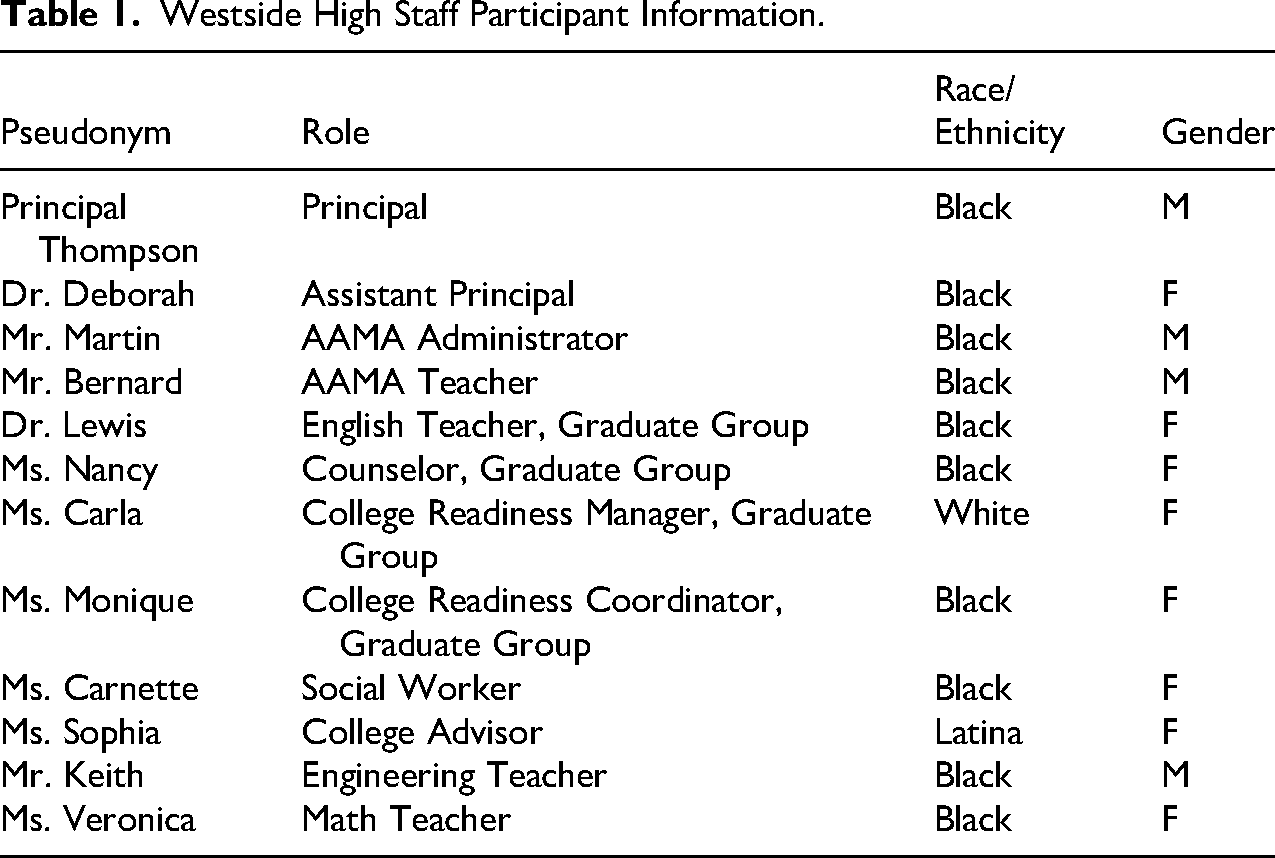
Over the course of 1 year, and with the help of a school partner, we used criterion and snowball sampling to recruit 23 participants (11 students and 12 adults). This analysis focuses on 12 adults, summarized in Table 1, to understand the broader influence of the COVID-19 pandemic on the college-going of Black students (Merriam, 2009). During multiple site visits to the school, we conducted semi-structured interviews that lasted 30–60 min. These interviews focused on a variety of topics, including the historical, social, and economic context of the school and surrounding community; college-going culture; pandemic responses, including strategies enacted by the school to support students’ college pathways; and student participants’ experiences as they developed their post-high school plans. Observations and artifacts, while not a primary source of data, contextualized participants’ responses.
Westside High Staff Participant Information.
Data Analysis
Our analytic approach involved a multi-step process that included both inductive and deductive analysis (Charmaz, 2014; Saldaña, 2009). Throughout data collection, our four research team members engaged in peer debriefing and reflective memo-writing to capture initial impressions and questions contemporaneously. These conversations helped to reveal the unique characteristics of Westside High—particularly its embodiment of myriad forms of capital—that we believed warranted exploration as a single case study. Once data collection concluded, both co-s and one graduate research assistant began the analytic process by reading transcripts and writing researcher memos that explored emergent themes across participant groups at Westside High. This analysis was then used to develop inductive codes reflecting these emergent themes and connected to college choice as well as deductive codes reflecting forms of capital outlined in CCW. Next, using Microsoft Excel and team-based coding (MacQueen et al., 1998), two members of the team re-read the transcripts, applying preliminary codes to interview data. This process helped to systematically confirm and establish themes illuminating how members of the WH staff engaged in college-going efforts within the COVID-19 context. As the nature and process of supporting students’ aspirations for college emerged as a salient theme, we made meaning of our participants’ perspectives and experiences by weaving together aspirational capital and other relevant literature. Our analytic strategy facilitated a rich set of findings, which we discuss below.
Trustworthiness and Positionality
Our efforts to enhance the rigor and trustworthiness of our findings focused on a set of strategies that included data triangulation, peer debriefing, and investigator triangulation (Lincoln & Guba, 1985). Interviews with staff in different positions helped with data triangulation, ensuring our understanding of students’ college-going was drawn from a diverse set of perspectives. We engaged in debriefing sessions immediately after fieldwork and on a biweekly basis throughout data analysis. These sessions afforded our team the opportunity to discuss emergent themes and disconfirming evidence. Finally, investigator triangulation, or the diverse perspectives represented in our team, also promoted trustworthiness. As authors, we drew upon our intersectional background and lived experiences as Black women, researchers of Black students’ college choice, and previous residents of urban cities, while also being mindful of our own positionality (Milner, 2007). One resides in California, and her insider status was invaluable (Dwyer & Buckle, 2009) in establishing a relationship with the school site. We drew on these aspects of our identities and experiences in data collection, analysis, and interpretation of our findings.
As researchers committed to educational justice, we approach this work with care and recognition that research in urban contexts is not neutral or detached, but deeply relational and political. We understand our role not only as a researcher but also as accountable to the people and places we write about. This means centering the lived realities of students, families, and educators while interrogating the structural conditions that shape their experiences.
Study Limitations
As with any research, our study has limitations. First, because our study was motivated by the impact of COVID-19 on Black students’ college-going, we did not collect data at WH prior to the pandemic. Doing so may have deepened our understanding of the school's baseline college-going culture prior to the disruptions it faced. Second, while we interviewed each of the stakeholders supporting college-going at WH, the inclusion of observational data may have offered additional insight into the school's culture and strategic efforts to support students’ college aspirations.
Findings
Our analysis reveals how members of the WH community leveraged organizational assets that helped students form aspirations for college, maintain educational aspirations, and actualize these aspirations, even in the presence of disruption and “concentrated disadvantage” (Jack, 2019). The existence of the school's college-going culture and infrastructure enabled adults to develop strategic responses that mitigated the impact of the COVID-19 pandemic on students’ postsecondary plans and served as a protective factor against the risk factors of racial and social inequalities (Acevedo & Solórzano, 2023).
Cultivating Aspirations: Pre-Pandemic Foundations
Long before the pandemic crisis, WH had established a foundation for college-going that, at its core, worked to counter messages their students might internalize about the implausibility of attending college. As we discuss below, these messages were deeply woven into the school's routines and pervaded its physical environment. Ultimately, embedding these messages about college created a foundation for normalizing postsecondary education as an expected pathway—even amid difficult circumstances and unexpected crises.
Normalizing college through visual cues
At WH, efforts to help their students form aspirations for college began at the very start of their high school journey by leveraging cues in the school environment. The work of helping students develop college aspirations involved uprooting messages they were likely to receive about the improbability of attending college based on their social identities, limited college knowledge, and the physical realities of their daily lives. One administrator described Westside as the “lean on me school,” referring to the iconic movie where actor Morgan Freeman is appointed principal of a “decaying inner-city school” plagued by violence. Indeed, Westside's campus is dated and, from the outside, the campus “looks like a prison,” to use the words of one teacher. However, once inside the school, there is a clear and unmistakable message that is projected in every hallway, on every floor: students who attend WH go to college. Adorned on the walls and hanging from the ceilings were, by our estimates, well over a hundred banners and pennants from a wide swath of 4-year institutions—including those located throughout the state and region, Ivy League colleges, land grant campuses, and Historically Black Colleges and Universities (HBCUs).
In addition to these visual representations of college, a range of short affirmations, including “I can go to college” and “We are college bound,” were affixed to walls and classroom doors, while the following words were painted in bold colors in mural-like form across students’ lockers: college ready, SAT, A-G requirements, and personal statement. We were told that by seeing such phrases, school leaders hoped students would internalize messages about their readiness for postsecondary education. At the same time, these images, murals, and words were intended to increase students’ awareness of the requirements for high school graduation and admission into California's 2- and 4-year public institutions. Above all, the consistency and frequency with which students were presented with messages about college reinforced it as something that was normative, revealing one of Principal Thompson's aims: “Every chance we get, we talk about [college].”
These visual college cues throughout the school were complemented by “College Wednesdays,” in which teachers were encouraged to wear shirts from “their college or any college.” Unlike the banners and pennants hanging in the hallways, “College Wednesdays” introduced students to different schools by leveraging the individual college experiences of its faculty. As Principal Thompson explained, “So the teachers will wear shirts from their college or any college, so we [sic] putting that in our kids’ mindset that I gotta go to college.” But it was clear that the utility of this informal practice extends well beyond mere exposure. “College Wednesdays” represented a collective, unified effort, which staff bought into, amplifying its significance to students.
The longstanding practice was especially important in the aftermath of the pandemic, as the school navigated financial constraints and worked to restore a family-like culture that was complicated by remote learning. The initiative was entirely free, bearing no cost for the school or its staff to participate. Its accessibility to students and staff alike was important given the school's ongoing budget constraints and the limited income of many of Westside's students and their families. Most notably, however, “College Wednesdays” provided an informal, low-stakes opportunity for students and school staff to engage with one another around the idea of college. According to Mr. Martin, a WH alumnus who led a Black male initiative at the school, it was remarkable that something as simple as wearing college t-shirts could play an important role in the school's broader efforts to cultivate students’ college aspirations.
Supporting and Sustaining Aspirations
Shaping students’ aspirations for and dispositions about attending college through informal practices was a foundational first step in the college-going process. But there was also a recognition among WH staff that for their students, many of whom would be first in their families to attend college, additional formal structures would be needed to actually get them there. The school's full-time and part-time staff focused on college-going utilized approaches that centered on intensive, individualized support, which assisted students with tangible steps necessary for admission to college, moving them beyond aspiration formation.
Providing individualized support
A clear hallmark of the WH's college and career readiness efforts was the school's capacity to provide individualized support. With oversight from Ms. Carla, the school's manager of college and career readiness, the college advising “support system” reflected important characteristics that seemed well-suited for helping WH students through the chaos caused by the pandemic. We noted, for example, that staff took a proactive approach, reaching out to students first, rather than placing the burden on the shoulders of students to seek out help. Sixty seniors were split among three CCCP part-time advisors. Their strategy involved pulling individual students out of class to introduce them to resources available in the center and having an initial one-on-one conversation about their post-graduation goals. The information gathered from these interactions helped the advisors keep a pulse on students’ trajectories and college activities, including “if they’ve applied to any scholarship, if they’ve applied to any colleges, and ultimately what's their final destination.” Meanwhile, Ms. Monique, the college and career readiness coordinator at Westside, revealed that immediately following the second wave of the pandemic, she reviewed every senior's academic profile to determine their eligibility for admission to California's public colleges and universities: At the start of the school year I just went through every single senior transcript and we … tier students so that we can provide the proper support. So, if you're UC eligible, there's one group ‘cause the UC application's the hardest, and it has to be started the earliest, so they have the maximum time to work on it. If you're CSU eligible, that's a different group ‘cause the application is much easier.
Despite an existing narrative of urban schools as overcrowded and under-resourced, WH was able to offer individualized college and career advising in part because of their organizational structure. By leveraging part-time advisors from external groups, WH optimized the capacity of their staff to support their students—an organizational resource that underserved schools often lack. Further, the unusually large number of staff dedicated to college advising, along with the low and declining student enrollment, created a staff-to-student ratio that allowed for “one-on-one support.” The school's lone counselor, Ms. Nancy, commented that at most public schools, the student-to-counselor ratio of 500 to 1 is “unimaginable” and makes it nearly impossible for counselors of any kind to meet with all of their students. But at WH, 350 students were divided amongst a team of individuals, and at any given time, seniors could receive intensive support from these varied sources.
The staff's keen awareness of students’ unique needs represents an additional example of their individualized approach. Ms. Sophia, who worked in the CCCP, noted that WH students “come in already caring a lot about their future, they just don’t know how to get there”—a sentiment that was shared amongst others we interviewed. She elaborated further on her organization's rationale behind their approach to advising: Our general mission is … getting them informed about college if they don't know about it, … getting them to where they need to be to actually attend college and all those steps in the process. And those mental barriers and those family barriers, and the language barriers and all those things that kind of get in the way. Because these are typically low-income, historically marginalized communities that have many things impacting them, going there, getting those prepared as possible, knowing on the formation, knowing the definitions of different things.
Adapting to uncertainty and disruption
Offering students the assistance they needed to continue taking steps toward college was increasingly difficult amid the pandemic. The school's shift to remote learning meant that advisors had to find alternate ways to meet with students, which seemed impossible at times. Ms. Nancy recalled, “I would schedule a Zoom and they wouldn’t show up, or they show up at the wrong time. The wrong day.” She and others learned to be more persistent in their efforts, as they recognized that school was not always top of mind for students while they worked from home.
Another challenge arose regarding opportunities for students’ extracurricular engagement. Since the quarantine prevented a large share of students, particularly rising juniors and seniors, from being able to intern, staff were concerned about what this could mean for students’ college opportunities. Ms. Monique elaborated on the barriers these circumstances posed: They don't have anything to put for activities because there was a whole year and a half where you couldn't be on a sports team, there weren't clubs … Nobody was doing internships, you couldn't even really work a job; if you were working a job, it was something to support your family for survival, it wasn't a career-building, interest-building type of thing. So, a lot of the experiences that students typically have that expose them to different things they might be interested in or good at were gone through the pandemic and so there's tons of students who were like, “I didn't do anything.”
Developing a strategic response to the closure of college campuses represented one of the more significant barriers WH staff had to navigate. Many of our conversations revealed that campus tours and college fairs were essential for supporting college planning. Acknowledging that students often had little first-hand knowledge, WH college and career staff coordinated campus visits, which they believed were especially critical for maintaining students’ aspirations. That is, the presence of college cues around the school, while important, presented “college” as an abstract idea, providing little insight into what it actually meant—the social and academic aspects of being a college student, the financial costs, and even the requirements necessary to gain admission. In comparison, Ms. Nancy shared that tours demystified “college,” making it become “real” to students. The opportunity for WH upperclassmen to “see the dorms, get to eat in the student cafeterias, and get to meet other students” was consequential, as the tours provided the kind of exposure that “can flip a switch on” with respect to the college-going process. Students are often left motivated to take the necessary steps to gain admission to college. Therefore, the loss of these in-person experiences due to the pandemic was significant.
Like the shift toward remote internships, WH staff worked to pivot quickly to virtual programming aimed at minimizing the negative impact of campus closures on students’ college-going. At the start of the pandemic and continuing through the second wave, Ms. Monique and Ms. Carla built a robust calendar of virtual college recruitment events. To help maintain students’ interest in and exposure to college, these virtual events were planned for nearly every week during school hours and were required for seniors. Reflecting on their approach, Ms. Monique said, “I think virtual tours definitely are something innovative that we chose to take advantage of and bring it to students, it wasn't opt-in, it was, we're coming to these [class] periods and this is what we're doing.”
Virtual tours helped to support students’ aspirations for college in at least two ways. First, virtual visits became important for juniors and seniors as information about college admissions processes was constantly evolving. For example, some in-state colleges were changing application deadlines from a systemwide date to dates specific to their campus. At the same time, college admissions practices outside of the California system were shifting rapidly as institutions moved to variations of test-optional policies. Therefore, the opportunity to speak with admissions officers through virtual visits was an important way for upper-class students to gain access to an ever-changing college admissions environment. Second, these tours exposed students to a larger set of colleges than WH would have been able to visit in person. As Ms. Monique noted, “money-wise, we could never really afford to take all 60 at a time, whatever seniors, on trips, or if we did, it wouldn't have been to 15 campuses.” WH staff facilitated virtual tours of schools in areas of California that had been cost-prohibitive due to distance. Although an imperfect replacement for in-campus visits, “when done well,” they increased students’ interest in learning more about college and, in some instances, influenced their decision to submit applications.
In fact, as virtual programming quickly became normalized as a means for meeting and engaging, WH teachers also began to leverage remote opportunities. They invited WH alumni currently enrolled in college, college graduates, and high-profile speakers, like professional athletes and everyday citizens in different fields. Depending on the teacher we spoke with, these virtual conversations served different purposes. For instance, Dr. Lewis, an English teacher and alumna of the school who had been on staff for more than 40 years, coordinated a virtual visit with the president of an HBCU. She also focused on helping WH students to understand the various pathways to college and facilitated conversations with her former students about college life. Mr. Bernard, a coordinator with the school's male achievement initiative, used virtual programming to expand students’ notion of success and possible careers: I just try to bring in people, some young, some old, so they can see that it's well achievable at a young age. Everybody don't have to be professional NBA basketball players, NFL players. You can be a firefighter, you can be paid decent money, you can be a doctor and get paid decent money.
Actualizing Aspirations: College Guidance Strategies
The aforementioned aspects of Westside's college-going culture in and of themselves, while important, were still not enough to help students reach the goals they had previously articulated. We observed how WH faculty and staff utilized existing structures and created new ones as they helped students sustain and actualize their aspirations for college amid pandemic disruptions.
Leveraging existing structures
Staff leveraged existing structures in order to help students in the final phase of the college-going process (i.e., applying to college and filing FAFSA). For example, the senior English seminar taught by longtime teacher, Dr. Lewis, “embedded” various aspects of the college application process by tying key activities to course assignments. As Ms. Nancy explained, “there's time set aside in that class for students to go online and apply for colleges and to complete the Common App, things like that. That's part of their curriculum.” The structure of the course provided students with time and guidance on complex tasks necessary for college admission, from writing application essays to completing the FAFSA. Importantly, it also helped to concretize vague or more generalized aspirations such as “I am going to college.” Even if students had little desire to attend college, in order to receive a passing grade, it was inevitable that they would learn about the college-going process and take critical steps toward applying. This curricular approach was helpful for mitigating the barriers that minoritized students often face in navigating the complexities of college admission (Klasik, 2012). It also addressed the sense of overwhelm and disengagement that some students experienced during the pandemic.
The Graduate Group, a committee of staff aimed at ensuring students were positioned to graduate high school and meet the A-G requirements (an important prerequisite for admission to California's public universities), represented a second existing tool WH utilized to support its students, particularly in the latter half of the college-going process. The group was led by Ms. Carla, the manager of college and career readiness, and included Ms. Monique, the coordinator, Ms. Nancy, the academic counselor, Dr. Lewis, the senior seminar teacher, and a CCCP college advisor. The group's approach was collaborative and centered on targeted interventions. Although each person was assigned a particular set of students, it was evident from our interviews that there was a collective interest in the well-being of each student, as Ms. Monique explained, “You might be the primary person checking in with this student, but if [there is] somebody else you see in the hallway…they’ll ask you also. It's not like, “Oh, I can’t talk to that student. That's Ms. Monique's student.” The touchpoints students received from “multiple adults over and over and over again” were the result of weekly meetings on Monday mornings that involved group-based discussions about students who “were in trouble” academically or those who “need extra assistance” or other forms of intervention. The idea, we were told, was to ensure that there were no students who slipped through the crack.
The needs among upperclassmen in the wake of the pandemic were so great that even with a robust group of advisors in place, the Graduate Group decided to singularly divert their attention to supporting seniors, at least temporarily. One team member likened these efforts to “triage” while another described it as “all hands-on deck.” Reflecting on her contributions, Ms. Monique noted that sometimes this meant “literally sitting next to a senior as they do the FAFSA, as they do a college application, as they write for a scholarship. I’m just sitting there… making sure they answer the questions accurately, don’t miss any steps.” Without the collective intervention of the graduate team and the “one-on-one support” they offered to upperclassmen, it was clear that many WH students would have been worse off.
Innovative college-going supports
Working with students to actualize their aspirations for college also meant being responsive to how the pandemic caused their college plans to shift (DesJardins et al., 2019). In 2021, approximately 35% of WH graduating seniors committed to a 4-year institution, 56% planned to attend a 2-year college, and 10% entered the workforce. Members of the Graduate Group were adamant that these figures were “low” given the typical college-going patterns at the school in recent years. Comparing the 4-year and 2-year rates, Ms. Nancy noted that “normally it would be more in the high 60s. It would be almost reversed.” She recalled a conversation with a student that reflected a great deal of concern about cost and in-person classes during the pandemic—a common sentiment amongst the students: Well, I think initially a lot of that came from, ‘Why am I gonna pay all this money for a school that's outta state and it's on Zoom.’ lot of them still aren't open to on-campus. So that's the reality that students are dealing with right now.‘I wanna go to Morehouse, but it's online. So I'm not really going to Morehouse. I'm sitting in my house [laughter] going to Morehouse. Why am I paying all this extra money? I can go to school here. Get in-state tuition, get the scholarships, whatever comes along with that and stay in my house’.
Westside staff were both cognizant and supportive of the shift in students’ plans. Although WH leaders had a lot of pride in the school's college-going culture and track record of sending students to 4-year institutions, they did not position community colleges (CCs) as less than, but instead as a legitimate option. In speaking about his conversations with students, Mr. Martin recalled, “I told some of the kids, ‘It's okay if you still want to get to Stanford or Spelman or Florida State or Berkeley or whatever, you can still get there.’” Mr. Martin and others framed the community college pathway as a plausible alternative that did not preclude the opportunity to attend a 4-year institution in the future.
In fact, because of this growing interest in community colleges among their students, WH staff adapted a district-wide initiative, Community College Week, that focused on how to navigate the process of enrolling in a local California community college. Recognizing the gap in students’ knowledge about local community colleges, in part because of the predominant focus on 4-year institutions, Ms. Monique and Ms. Carla were motivated to recreate and institutionalize the week of programming after it was sunset by the district. One day of the week was dedicated to creating a hands-on, one-stop shop where CC-interested students sat in a room with computers, and staff helped them “do their community college steps,” like creating an account or calling the CCs with specific questions. The week was meant to support two main groups of students: one group that had already “signed on for a community college” because of ineligibility for 4-year colleges and a second group that had only recently decided against attending a 4-year college even if they were eligible for admission. Not only was the adaptation of the initiative an effort to increase students’ understanding of the pathway to community college through hands-on support, but it was also a strategic response to the shift in students’ college plans as a result of the pandemic. Indeed, the mobilization of human capital and resources involved in recreating Community Colleges Week is emblematic of WH's broader commitments and capacity to help their students maintain hopes and dreams for the future, even in the face of real and perceived barriers.
Discussion
The findings represent a counter-narrative to the discourse that majority-Black schools located in urban contexts inadequately prepare their students for a college pathway. Our analysis examined the critical role that adult stakeholders play in forming college aspirations for Black students and the strategies employed to help them actualize and maintain their aspirations during a period of significant disruption. Situating these findings within the broader literature on large-scale disruptions highlights how the COVID-19 pandemic intensified existing inequities in students’ college-planning processes (Rowan-Kenyon et al., 2022). Prior research demonstrates that disruptions such as natural disasters and economic instability can derail students’ postsecondary trajectories by fracturing access to trusted sources of college knowledge and institutional support (Ford et al., 2021; Rodriguez et al., 2021). In contrast, WH's established college-going infrastructure functioned as a form of protection for students against the uncertainty and organizational chaos that often accompany periods of crisis. We uncovered how the participants collectively leveraged community cultural wealth to navigate barriers to expand college opportunity.
Consistent with prior scholarship, our findings underscore the importance of school context in advancing college access, especially for first-generation college students who rely on their schools as the primary source of college knowledge (Holland & Farmer-Hinton, 2009; Martinez et al., 2024; Reavis, 2017). Staff and teachers at WH shared a collective commitment to fostering students’ college aspirations and preparation, which was in place long before the disruptions caused by COVID-19. They established an environment at the beginning of a student's high school journey, where college-going was the norm. Informal structures, such as visual college cues and engagement in “college talk” (Bryan et al., 2017; McClafferty et al., 2009) with college-educated adults, facilitated consistent access to information about a range of postsecondary options and proved critical in developing students’ college aspirations (Hill et al., 2015; Knight & Duncheon, 2020; Warren & Bonilla, 2018).
WH's success in nurturing students’ aspirations was further activated by the existence of a comprehensive, college-going infrastructure—an organizational resource that runs counter to majoritarian narratives of urban schools and past studies that center traditional markers of cultural capital. At WH, the well-established CCCP was staffed with advisors affiliated with external college access initiatives. The professional staff at WH also had the human capacity to support students based on their individual needs. Unlike the average student-to-counselor ratio in the state of California of 464:1 (ASCA, 2024), the total student population of 350 at WH made way for educators to take the time required to establish authentic, caring relationships with students and their families (Martinez et al., 2024). A key component in fostering college readiness for Black students in urban contexts is establishing a culturally relevant education rooted in an ethic of care. This is where educators understand and validate the identities and daily lived experiences of students within the college preparation process (Holland & Farmer-Hinton, 2025; Knight-Manuel et al., 2019).
Staff at the CCCP were committed to the educational achievement of all students, regardless of the challenges they may have experienced in their home or community environments. For example, educators proactively contacted upperclassmen to initiate one-on-one conversations about post-graduation goals and eligibility for in-state admissions to public colleges and universities. Additionally, the Graduation Group arranged in-person meetings to support seniors’ completion of final projects and college applications. This was important for students who experienced challenges with remote learning and needed the final push to actualize their college aspirations. These organizational practices affirmed the importance of school-based social capital in advancing students’ college-going efforts (Holland & Farmer-Hinton, 2009; Martinez et al., 2024).
Challenges brought on by the pandemic activated efforts for school staff to adopt strategic interventions that provided individualized resources for students who were at risk of not pursuing postsecondary education. For example, virtual college tours helped maintain students’ aspirations by expanding their knowledge of postsecondary options. As admissions and recruitment practices shifted online to comply with state and federal mandates, these tours enabled students to explore a wider range of colleges. Additionally, several WH students engaged in virtual internships, which were adapted for distance learning. Access to internships and mentors plays a crucial role in shaping long-term college and career trajectories (Adjapong et al., 2016). Together, these strategies enhanced students’ perceptions of college as a viable option during a period of uncertainty.
As some students shifted their initial plans of starting at a 4-year college to attending a 2-year institution due to the uncertainty of the higher education landscape, school personnel adapted a district-wide initiative, Community College Week, that helped WH students better navigate the application process for entry into California community colleges. With research that points to the challenges that minoritized students often face in navigating CCs (Bahr et al., 2015), implementing this hands-on intervention guided students into an alternate pathway, helping to protect their postsecondary aspirations and empowering them to transition successfully.
Implications
The contributions of this study offer theoretical and practical implications for the processes that nurture college aspirations during a critically challenging period. By centering our analysis on the perspectives of adult stakeholders, we underscore the significance of agency in the Black community, including how cultural assets were “activated and mobilized” (Rios-Aguilar & Deil-Amen, 2012). Institutional agents relied on aspects of their community cultural wealth to navigate the challenges surrounding the pandemic. We contend that the strategies enacted by the WH community played a vital role in protecting students, effectively mitigating some of the harm arising from the impending ramifications of the pandemic (Acevedo & Solórzano, 2023). We do not suggest that the consequences of the pandemic did not present challenges for this community, but posit that stakeholders were able to disrupt the intensity of those challenges, allowing students to sustain and actualize their future goals, hopes, and dreams (Yosso, 2005).
An examination of adult perspectives also shifts the conversation away from a student-centered analysis of aspirations, which is found in much of the existing college choice literature. Traditional conceptualizations of college aspirations are examined from the student's perspective as a rigid, linear process suggesting a unidirectional pathway—where students either aspire toward higher education or they do not (DesJardins et al., 2019). However, for students who encounter abrupt changes in their environmental contexts, college aspirations are far more dynamic. They are fluid and complex, often evolving throughout a student's high school journey (Britton, 2019; Cox, 2016; Gao & Eccles, 2020). Our findings acknowledge the non-linearity in postsecondary decision-making and account for unexpected shifts and environmental conditions, such as large-scale disruptions, that are absent from well-established models of college choice (Cox, 2016; Rodriguez et al., 2021). Accordingly, schools serving Black students must be equipped not only to cultivate aspirations in stable conditions but also to sustain and protect those aspirations during periods of crisis through deliberate, student-centered practices grounded in individualized care, such as proactive one-on-one advising.
We also challenge traditional conceptualizations of college choice, which have long theorized that longer-term planning and early access to information are highly predictive of college enrollment and success (Hossler & Vesper, 1999). Indeed, one's access to early college knowledge is a major step that places students on a trajectory to enter higher education (Conley, 2008). Yet, it is anchored by a set of assumptions that most often describe traditional forms of capital and how advantaged students and their schools navigate college planning (Bryan et al., 2017; Cox, 2016; Reavis, 2017; Roderick et al., 2009).
Our study advocates for a more nuanced understanding of college aspirations that recognizes the complex realities faced by Black and other underrepresented student populations in higher education. School and district administrators, particularly those in urban communities, understand that students’ aspirations, behaviors, and decisions are inextricably linked to the environments in which they live. Validating the lived experiences of students and their families begins with establishing caring relationships (Holland & Farmer-Hinton, 2025; Warren & Bonilla, 2018). Equally important is that adults believe every student deserves early and frequent positive interactions with college-educated adults, along with strong encouragement that college is attainable.
Helping students actualize their future goals, whether it is higher education or another pathway, must go beyond “cheerleading.” Moving from aspirations to realization requires a collaborative effort from all adults. Everyone must contribute to nurturing students’ well-being and success. Each member of the school plays a vital role in proactively addressing the needs of individual students, helping them navigate barriers to graduation and postsecondary access, even amid uncertainty. Effective educators working with traditionally underrepresented students should adopt a strengths-based approach in their interactions and advising. This means activating resources that help protect students, so they feel empowered to navigate structural inequities rather than adhering to a deficit model that emphasizes individual shortcomings.
Conclusion
This study presents a broader approach to theorizing the college pathways for Black students by incorporating the perspectives of multiple stakeholders and institutional agents. These individuals play critical roles in providing, nurturing, and activating the resources essential to supporting students’ well-being within their respective environments and protecting their aspirations for college amid significant disruptions. Traditional models of college choice often place the individual student at the center of analysis; however, the role of the school environment is equally important. Schools are often forced to respond to evolving policy changes that require them to adjust their organizational practices to meet the needs of individual students.
Continued structural and organizational analysis of college choice is important. Future research should examine the various contexts that students navigate and highlight the role of Community Cultural Wealth (CCW) as a protective factor, centering the voices of key agents in the college choice process. In this article, we underscore the importance of Black personnel who, even while navigating a broader socio-political landscape marked by concentrated disadvantage, serve as vital sources of cultural wealth that can facilitate a college-going pathway for Black students.
Footnotes
Acknowledgments
We extend our warmest gratitude to Luis Leyva, Chezare Warren, and Leonard Taylor for their generative input on earlier versions of this manuscript. We also thank Christine Dickason, Shaleda Newson, and Destiny Walker for their brilliant research assistance.
Consent for Publication
Informed consent for publication was provided by the participants involved in this study.
Consent to Participate
The human subjects involved in this project were adequately informed about the research, provided written assent or consent, and participated willingly in the study
Data Availability
Findings shared in this study are derived from qualitative data collected by the s and research assistants. Due to the sensitive nature of the information collected and per Institutional Review Board (IRB) guidelines for research involving minors, these data are not publicly available. De-identified analysis documents may be available to researchers with a legitimate interest in the research study, subject to the approval of the IRB at Vanderbilt University and Saint Mary's College of California.
Declaration of Conflicting Interests
The authors declared no potential conflicts of interest with respect to the research, ship, and/or publication of this article.
Ethical Considerations
The project has been approved by the Human Subjects/Institutional Review Board at Vanderbilt University and Saint Mary's College of California.
Funding
The authors disclosed receipt of the following financial support for the research, ship, and/or publication of this article: This work was supported by the Spencer Foundation (Grant No. 202100259).
