




Abstract
Suburbanisation is the most typical characteristic of the spatial distribution of the population in many countries of central and eastern Europe. Furthermore, a characterisation of residents is of key importance in explaining the process of suburbanisation. The study contributes to an understanding of post-socialist suburbanisation by clarifying the motivations and groups behind the population shift to the suburbs. The analysis is based on an extensive survey of the Rīga metropolitan area, Latvia. The results show that suburbanisation is a socially polarised process and that those with high and low social status are more likely to move to the suburbs than those with middle social status. Similarly, the motivations behind suburban in-migration present a distinctive and complex portrait of the on-going suburbanisation processes. Housing choice was found to be a key motivation for suburban migrants.
Introduction
Researchers have claimed that suburbanisation in central and eastern Europe (CEE) at the end of the 20th century and beginning of the 21st century was one of the most visible processes of socio-spatial restructuring, especially in the hinterlands of capital cities (Ravbar, 1997; Timár and Váradi, 2001; Brown and Schafft, 2002; Tammaru et al., 2004; Sýkora and Novák, 2007). Indeed, the suburban zone of the Latvian capital city of Rīga has been no exception in terms of rapid development. However, despite the widespread nature of suburbanisation in CEE, relatively little is known about the motivations, composition and destinations of suburbanisers (Borén and Gentile, 2007; Leetmaa and Tammaru, 2007). In addition to the motivation to move where the jobs are, there are other motivations based on stages in the life course, the housing market and the presence of amenities. However, motivations to migrate are not related just to current changes; they are also rooted in the legacy of housing construction and urbanisation during the state’s socialist period.
An important issue that needs to be considered is the nature of the contemporary suburbanisation process in CEE in comparison with the process in western Europe and North America (Szelényi, 1996). The models of urban change that we find in the literature are based on what has happened in the West, but they are often used as a benchmark for studying suburbanisation in CEE. The urban life cycle model (van den Berg et al., 1982; Klaassen et al., 1981) and the differential urbanisation model (Geyer and Kontuly, 1996) have been the most influential in guiding contemporary urban research in CEE (Kontuly and Tammaru, 2006). Many of the features of the ‘Western-style’ suburbanisation that is described in these models now seem to be taking place in CEE (Sýkora, 1994; Kok and Kovács, 1999; Brade et al., 2009; Leetmaa et al., 2009). The development of cities in the countries of CEE, especially the on-going suburbanisation, could thus be seen as part of the common model of urban change which, in comparison with what has happened in western European countries, has been ‘deferred’ or ‘interrupted’ by the period of central planning (Tammaru, 2001; Leetmaa and Tammaru, 2007).
However, in addition to the similarities in urban change between western and eastern Europe, features of urban change specific to CEE have been observed (Ladányi and Szelényi, 1998). These include inherited housing stock and socio-spatial population distribution from the socialist period, demographic decline, depopulation, rapid economic restructuring and related adjustments in the labour market, property restitution and many other factors that are important in the context of contemporary suburbanisation in CEE (Nuissl and Rink, 2005; Blinnikov et al., 2006; Hirt, 2007).
The aim of this paper is to contribute to the understanding of post-socialist urbanisation by clarifying the motivations behind the population shift from core cities to the suburbs in the urban region of Rīga, the capital city of Latvia. Latvia has undergone intense urban transformation and migration change, including intensification of the suburbanisation processes. Rīga is seven times larger than Latvia’s second city, Daugavpils, and it is the largest city in the Baltic countries of Estonia, Latvia and Lithuania. At the end of 2007, the total population of Rīga and its metropolitan area was 1 151 112. Rīga also represents an extreme example of an increase in population concentration in the suburban hinterland.
Formation of Metropolitan Areas, Suburban Growth and Population Sub-groups Responsible for Suburbanisation during the Transition Period
Suburbanisation in the former socialist countries in Europe has been less extensive than in Western countries, with cities remaining spatially very compact and densely populated (Bertaud, 2006). An important distinction between socialist and capitalist cities was the lack of suburban periphery in socialist cities (Häußermann, 1996; Hirt, 2007). Under socialism, suburban zones expanded mainly because of in-migration from rural areas and towns outside the urban regions (Kostinskiy, 2001). The development of suburban areas occurred in the wider context of underurbanisation. Priority was given to the extensive development of industry in cities, with improvements in the urban environment—particularly in the housing and service infrastructure—always lagging behind need (Sjöberg, 1992; Szelényi, 1996). This led to the emergence of various extra-urban settlements in the environs of large cities that became crowded with people from other parts of the country seeking jobs in the urban industrial sector (Konrad and Szelényi, 1974). From the 1970s onwards, this process also characterised the development of the Rīga metropolitan area (Filimonenko, 1991; Department of Human Geography, University of Latvia, 2004). In this context, we should also note that certain studies on Estonia have found that suburban in-migration resulted from the increased attractiveness of agriculture in the late Soviet period (Marksoo, 1992; Tammaru, 2001), a phenomenon unknown in Western countries (Leetmaa and Tammaru, 2007). As in Estonia, a whole series of successful collective and state farms with high-quality residences emerged in the environs of Rīga, which provided employees with better homes than those available to urbanites employed in industry (Ku¯le, 2009; Krišja¯ne and Be¯rzin¸š, 2009).
In the Baltic states, and particularly in Estonia and Latvia, the high numbers of immigrants shaped the urbanisation and industrialisation process in the 1960s and 1970s (Bauls and Krišja¯ne, 2000; Tammaru, 2001). Some of those immigrants—mostly Russian-speaking—left the Baltic states after the restoration of independence in 1991. This partially relaxed the housing market in the large cities and reduced urban crowding, and might have reduced the potential for suburbanisation that had accumulated during the years of central planning (Kontuly and Tammaru, 2006; Leetmaa, 2008).
Most researchers on the post-Soviet era have argued that, during the first decade of the transition period, the characteristics of suburbanisation were principally different than in Western countries. People of lower socioeconomic status left the cities to find cheaper housing elsewhere (Ladányi and Szelényi, 1998; Kok, 1999; Kulu and Billari, 2006). Other people left the cities because the restitution policy enabled them to become landowners elsewhere (Markausa, 1997). Still others returned to the suburban homes from which they had once departed in order to find jobs in the cities, especially when they became unemployed in the course of transition. All of these factors contributed to suburban in-migration, thus shaping the nature of the suburbanisation process in CEE in the 1990s (Szelényi, 1996; Markausa, 1997; Ott, 2001; Tammaru, 2005).
The process of suburbanisation developed more rapidly in the 2000s along with the increase in individual wealth, supply of new housing and availability of mortgages (Leetmaa et al., 2009). People who lived in Soviet-era prefabricated apartment buildings were increasingly able to improve their living conditions by moving to suburban areas (Borén and Gentile, 2007). As with Western-style suburbanisation, primarily upper- and middle-class households moved to suburban areas in search of a higher quality of life, driven by the desire to satisfy the dream of owning a detached house (Sýkora and Cˇermák, 1998; Sailer-Fliege, 1999; Nuissl and Rink, 2005; Hirt, 2007; Tammaru and Leetmaa, 2007).
Suburban Growth and Spatial Structure of the Rīga Metropolitan Area
The Rīga metropolitan area (RMA) emerged in the 1970s, but it has never existed as an administrative or statistical unit (see Figure 1). The suburban area of Rīga, known as ‘Pierīga’ in Latvian, is a far larger territory than the functional metropolitan area. The total population of the RMA increased from 1 044 606 during the 1970s to 1 226 814 at the end of the 1980s (Filimonenko, 1991). Latvia has experienced emigration and natural decline since the early 1990s. Despite this, the population of the RMA has not diminished by any substantial degree since the late 1980s. In 2007, the total population of the RMA was 1 151 112, including 428 627 suburban residents.
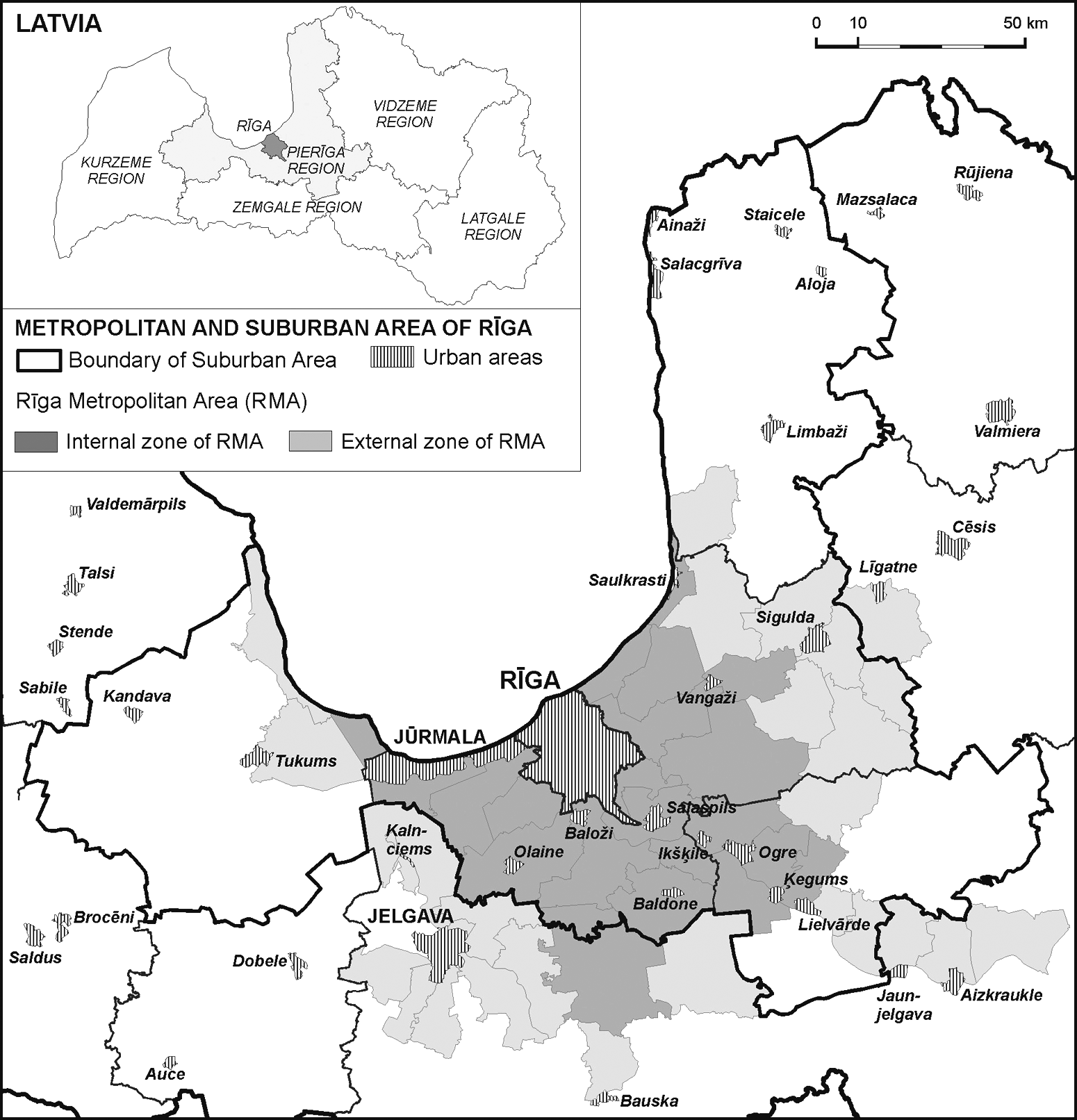
The spatial structure of the Rīga metropolitan area.
Substantial increases in population have been recorded in those municipalities that are immediately adjacent to the city of Rīga (40 per cent population growth in the 2000s). The suburban region is the only area that has had a positive net migration compared with all of the regions of Latvia, but 80 per cent of that positive trend has been provided by the city of Rīga. Urban residents move to suburban areas in order to improve their housing conditions, but continue to work in Rīga. Similar processes have also been observed in Estonia (Tammaru, 2005).
Hypotheses
Previous research has shown that post-socialist suburbanisation has been affected by deep structural changes in the economy and society in CEE. Economic changes (increased consumption, reinstituted property rights, housing privatisation and increased availability of mortgage loans and demand for new homes) have had an effect on many of the processes related to urban change. In geographical terms, that urban change is most evident in suburban areas. Analyses of previous studies related to suburbanisation in CEE show that suburbanisation is socially polarised and very diverse in nature. The foregoing leads us to formulate four hypotheses whereby we seek to determine whether the propensity to suburbanise differs across the various socioeconomic and demographic groups in the RMA.
Hypothesis 1. People with high social status according to ranking by education, occupation, and income are more likely to be suburban in-migrants than people with low social status.
For the purposes of comparison, we examine the characteristics of long-term residents (stayers) in Rīga with those of migrants from other parts of the country. An important aspect of our research relates to comparing suburbanisers with stayers (i.e. those suburban residents who have lived in the RMA for more than 10 years). With this in mind, we formulate the following hypothesis
Hypothesis 2. Differences between suburbanisers and long-term residents will be more pronounced among groups with high social status and less pronounced between groups of different gender and ethnicity.
We wish to ascertain any differences that exist between suburbanisers and other suburban in-migrants, as well as those who have chosen Rīga as their migration destination. From an examination of the suburbanisation processes in Estonia (Leetmaa and Tammaru, 2007) and Latvia, we may conclude that increases in migration in the suburbs are the result of people moving out of the core cities, whereas centripetal migration flows have resulted from a nation-wide concentration of the settlement system. When comparing these groups of migrants, it is important to elucidate the motivations for migration, to identify differences and to see whether suburbanisation in the RMA is based on elements that are typical of Western-style suburbanisation. Given the foregoing, we formulate the following hypothesis
Hypothesis 3. Suburbanisers who are migrants from the city of Rīga differ significantly from those suburban in-migrants who arrive from other regions of the country. The probability of suburbanisation is more related to amenities and housing motives, whereas urban migration towards the city of Rīga is determined by education and employment motives.
In addition, we investigate whether the social polarisation that is typically described in CEE research is characteristic of suburban groups of in-migrants. Statistical data about changes in population number in the RMA show that the areas closest to Rīga are far more attractive places to live, because they allow people to satisfy the twin desiderata of a good workplace and a good home
Hypothesis 4. There are differences between suburban in-migrants living in the internal and the external zones of the RMA. The probability of moving to the internal zone of the RMA is higher for more homogeneous population groups—younger people, families with children of pre-school age, people with higher social status (income, education and employment) and homemakers, as well as people who wish to improve their housing and living conditions.
Research Data, Main Variables and Methods
Data Analysis
The main data used in the paper are taken from a survey study called ‘The geographical mobility of the labour force’, conducted by the University of Latvia in 2006. The original survey had 8005 respondents in Latvia who were aged 15 to 65. According to information from the Central Statistical Bureau of Latvia (CSB) there were 1 629 197 people in this category of residents in 2006. The sample was stratified by age and settlement groups (Krišja¯ne et al., 2007).
Initially, during the survey, interviewers visited 14 111 addresses. Potential respondents were found at 11 680 of these addresses. At 2067 of the addresses, there were only people whose age was not in the acceptable range; they were not part of the general sample and were therefore not interviewed. Of the potential respondents, 1500 refused to answer. The response rate was 66.5 per cent. The sample consists of 8005 respondents (800 parts of the sample with 10 respondents in each) and was divided up into two parts: 1001 respondents from Rīga and 7004 from the rest of Latvia. The populated areas in Latvia’s regions outside the capital city of Rīga were divided up into the following settlement groups: urban municipalities and three categories of rural municipalities according to geographical location, proximity, population density and settlement type. For each region, the proportion of people living in each of the aforementioned types of populated area were calculated. The municipalities were divided up to ensure a proper distribution between those who lived in the centres of municipalities and those who lived on detached single-family farms.
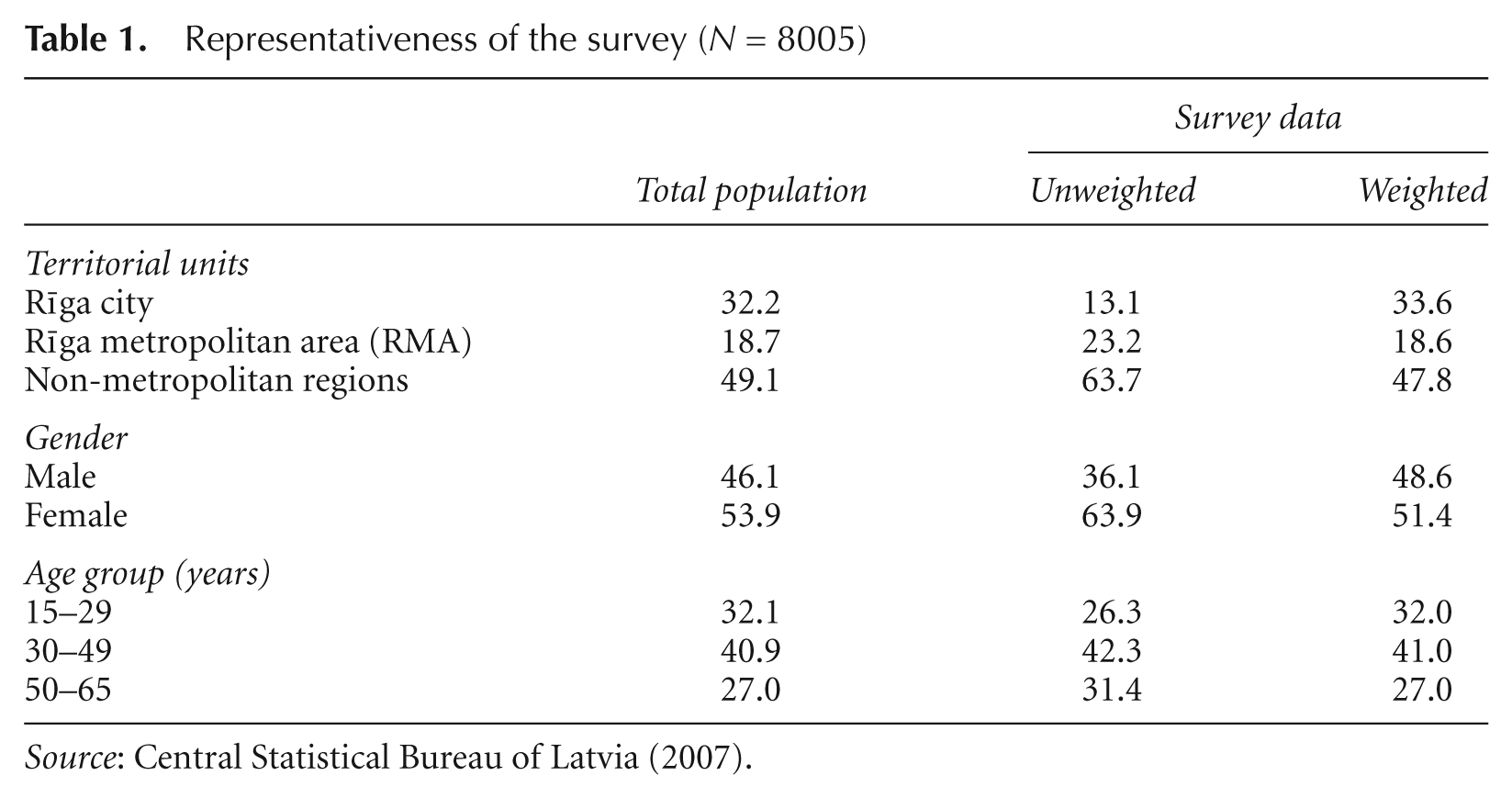
Respondents were asked questions about changes in their place of residence over the previous 10 years and motivations for the moves. On the basis of the results, respondents were divided in two main groups: movers and stayers. In this study, migrants or movers are those residents who have changed their place of residence by moving to a different municipality over the previous 10 years. The survey found that 15.2 per cent or 1220 respondents had changed their place of residence and that 49 per cent of those had done so during the past three years. Our analysis is based on weighted data (see Table 1).
Representativeness of the survey (N = 8005)
We must state that migration data which are seen in statistics quite often do not reflect actual movements (Sjöberg and Tammaru, 1999). Our data have several advantages over the official sources. First, in contrast to the census data, our survey provides information on the motivations for migratory moves. Secondly, from 2003, the registration of residential changes ceased to be compulsory in Latvia; our data allow us to track the actual moves of people and this provides us with the exact timing of the last change of place of residence. Unfortunately, our data do not include all changes of residence; for instance, we do not know how often the respondent has moved house or whether they have returned to a previous residence over the course of the past 10 years. For this reason, we used data about the last move.
Variables
Our analysis focuses on the main demographic (gender, age, ethnic groups) and socioeconomic (family status, education, employment status, income level) population groups. Life-course events are especially important in explaining individual migration behaviour, because migration is much more likely to occur in conjunction with major events in one’s life, such as marriage, childbearing, entrance into the labour market and divorce. (Halfacree and Boyle, 1993; Fischer and Malmberg, 2001). Analyses of life-course indicators in Western countries emphasise the fact that increased mobility is seen among younger people and those of a higher social status (education, income, profession) (Courgeau, 1985; Detang-Dessendre et al., 2002). We have also used variables related to population mobility, such as motives for migration and community. This complex approach is one of the best models to use when discussing the movement of residents, because it describes both personal and contextual indicators (Cadwallader, 1989; Stillwell, 2008).
In total, 341 respondents became suburban in-migrants (i.e. they arrived in the RMA) over the past decade. Each respondent’s immediately preceding place of residence is important because this enables us to determine the area from which they came. We identified suburbanisers from the city of Rīga (N = 138), other suburban in-migrants (N = 106) and respondents who moved house between different municipalities within the RMA (N = 97). They are all part of the overall flow of suburban in-migration. As a result of this, we can clearly differentiate between suburbanisers and other suburban in-migrants. We can also differentiate between intrametropolitan migration and interregional migration flows. We have also described those who have moved to Rīga, in order to clarify the characteristics of respondents involved in suburbanisation and those involved in in-migration towards the city (urban migrants).
Unfortunately, respondents sometimes have imperfect recall when asked about their motivation for a move 10 years ago. It is also possible that respondents moved house more than once during the course of the decade. We tried to address this issue, as already mentioned, by asking only about the last move over the past 10 years. Imperfect recall can also have an effect on the interpretation of results.
Table 2 presents the composition of the research population based on the available data. The following points are noteworthy. First, the proportion of women among suburban in-migrants is nearly one-fifth higher than that of men. Secondly, more than 60 per cent of those who moved to the RMA say that their income level is low. Other indicators do not show substantial differences: those most likely to have moved include younger people, most of whom are single, without children and have a higher education. The dominant group of suburbanisers is made up of ethnic Latvians. Suburbanisers are also more likely than others to have a live-in partner and the same is true among those who have children of pre-school age. In this group, we find a higher level of education, professional status and income. Most of those who arrived from Rīga became commuters, because they continued to work in the city.
Research variables (percentages)

In addition to changes in family circumstances, motivations related to a move to the RMA are often based on housing issues. This is particularly true for suburbanisers from Rīga. In contrast, employment and education were identified as principal motives for a new home by those suburban in-migrants who arrived in the RMA from other regions in the country. These people have moved closer to the main centre for employment and education in Latvia—i.e. to the capital city of Rīga.
Interestingly, the third most often cited motivation among those who have moved out of Rīga and into other parts of the RMA is the search for a less expensive lifestyle. This finding supports the argument that economic hardship, which is typical of transition periods, is still characteristic of and reflected in suburbanisation (Ladányi and Szelényi, 1998).
Methodology
We use logistic regression in the data analysis. The dependent variable—interregional and/or intraregional migration—is represented by the dummy variable, which is assigned the value of one (Y = 1) for migrating and the value of zero (Y = 0) for staying. The set of independent variables includes individual characteristics. The regression equation can be formalised as follows
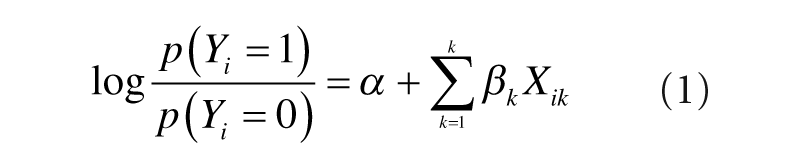
where p(Yi=1) is an individual’s i = 1, ... I probability of suburbanising from the city of Rīga; p(Yi=0) is an individual’s i = 1, ... I probability of remaining in Rīga in model 1; α is a constant; Xik is the set of individual characteristics; and βk is the set of parameters to be estimated, with K variables. Models 1 and 2 test Hypothesis 1—i.e. whether it is true that people with high social status are more likely to be suburban in-migrants. For this reason, the characteristics of suburbanisers and suburban in-migrants will be compared with those of stayers in the places of emigration.
Model 3 tests Hypothesis 2—i.e. whether differences between suburbanisers and long-term RMA residents relate to socioeconomic or ethnic and demographic indicators. Models 4 and 5 analyse differences between suburbanisers and urban migrants to Rīga, as well as differences between suburbanisers and other suburban in-migrants. This allows us to test Hypothesis 3—i.e. that the probability of suburbanisation is more related to amenities and housing-related motives, whereas centripetal migration is determined more by education and employment. We use model 6 to determine whether there are differences between those who have immigrated into the internal or the external zone of the RMA in order to test Hypothesis 4.
Comparing Suburban In-migrants and Stayers
The data analysis concentrated on a comparison of suburban in-migrants and long-term residents (stayers) in the RMA on the basis of sources of migration: from Rīga (model 1) and from non-metropolitan regions (model 2). In model 3, suburbanisers are compared with long-term suburban residents in the RMA. Thus p(Yi=1) is the probability that an individual i = 1, ... I previously lived in Rīga (models 1 and 3) or in a non-metropolitan region (model 2); p(Yi=0) is the probability that an individual i = 1, ... I remained in Rīga (model 1) or in a non-metropolitan region (model 2), insofar as residents of the RMA who have not changed their place of residence are concerned (model 3).
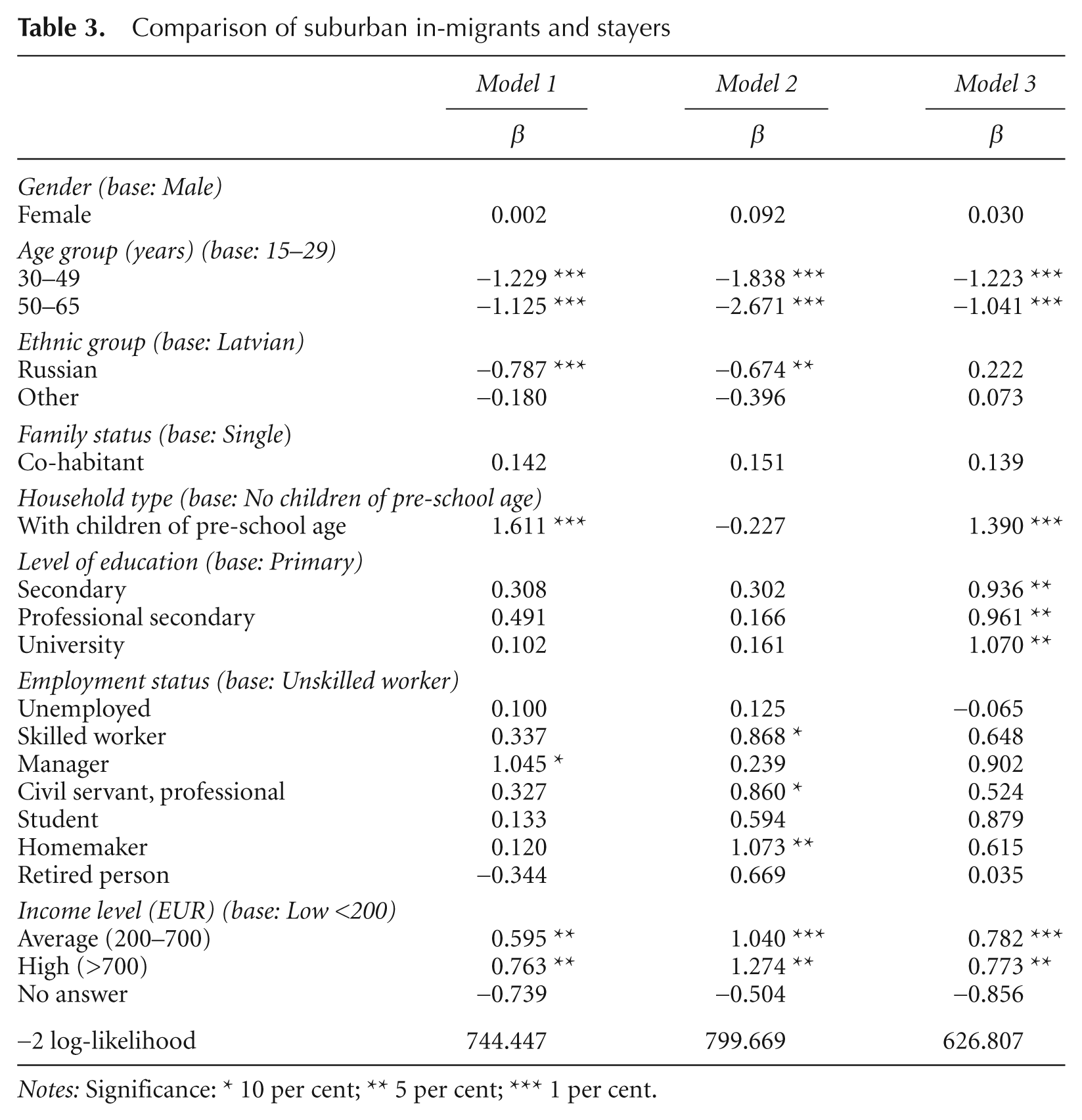
The results of the binary logistic model compare suburbanisers and stayers in Rīga (model 1). From the results presented in Table 3, we can see that younger people are more likely to leave Rīga than their elders. Similar results are seen when we compare suburban in-migrants and stayers in non-metropolitan regions (model 2) and when we compare suburban newcomers and long-term suburban residents in the RMA (model 3).
Comparison of suburban in-migrants and stayers
Notes: Significance: * 10 per cent; ** 5 per cent; *** 1 per cent.
It is also true that over the past 10 years, Latvians have been more likely to be migrants than stayers. Russians are less involved in suburban in-migration than stayers (see Table 3). Those who leave Rīga are mostly people with children of pre-school age, in comparison with those who have stayed in Rīga or the RMA. Accordingly, households with pre-school children are more likely to move to the suburbs. Suburbanisers who have a higher level of education are also more likely to move than those who are poorly educated. This may be attributed to the fact that urban residents, particularly in the capital city, have always tended to be more highly educated. Moreover, these educated suburbanisers also earn more. All in all, the probability that suburban in-migrants will move to the RMA increases as their income increases. Employment status marks out just one group among suburbanisers—managers. This is a professional group, some members of which may well be more highly educated and earn more than the average. Civil servants, professionals and homemakers from non-metropolitan regions are more mobile than others. The fact that this is true of homemakers suggests that there might be gender-based migration and it might also indicate why the proportion of women has been higher than that of men among suburban in-migrants in particular (see Table 3). The gender aspects of suburbanisation have not been studied in Latvia. Other authors (for example, Hirt, 2008) have analysed the effects of gender on post-socialist suburbanisation and they have found that women who suburbanise are more dependent on their male partners than those who do not.
A comparison of movers and stayers also shows that older people (30–49 and 50–56) are less likely to become suburban in-migrants than others. This was confirmed in all of the models (see Table 3). In summary, families with children and people with a high and average level of income are more likely to move to the suburbs. This confirms Hypothesis 1—namely, that suburban in-migration in the RMA attracts wealthier groups of residents and is often linked to upward social mobility (see, for example, Fielding, 1992). This finding shows that suburbanisers in Latvia have Western-style characteristics. Hypothesis 2 is also confirmed; there is no significant difference in the probability of suburbanisers being different from long-term suburban residents by gender or ethnicity. Here, too, suburbanisers tend to have a higher social status.
The Composition of Suburban In-migrants and Their Motivations
The next models describe those who have moved into the RMA and their motivations for the move. Models 4 and 5 compare suburbanisers (those moving from Rīga to the RMA) and urban migrants (those moving to Rīga from the RMA), as well as those who have moved to the RMA from other parts of the country. Thus p(Yi=1) is the probability that an individual i = 1, ... I previously lived in Rīga (models 4 and 5) and p(Yi=0) is the probability that an individual i = 1, ... I previously lived outside Rīga (model 4) or previously lived in a nonmetropolitan region (model 5). Model 6 analyses differences between in-migrants in the internal and the external suburban zones of the RMA. Here, our definition of suburban in-migrants also covers people who have moved from one place (municipality) to another within the RMA. Accordingly, p(Yi=1) is the probability that an individual i = 1, ... I moved to the internal zone; p(Yi=0) is the probability that an individual i = 1, ... I chose a residence in the outer zone.
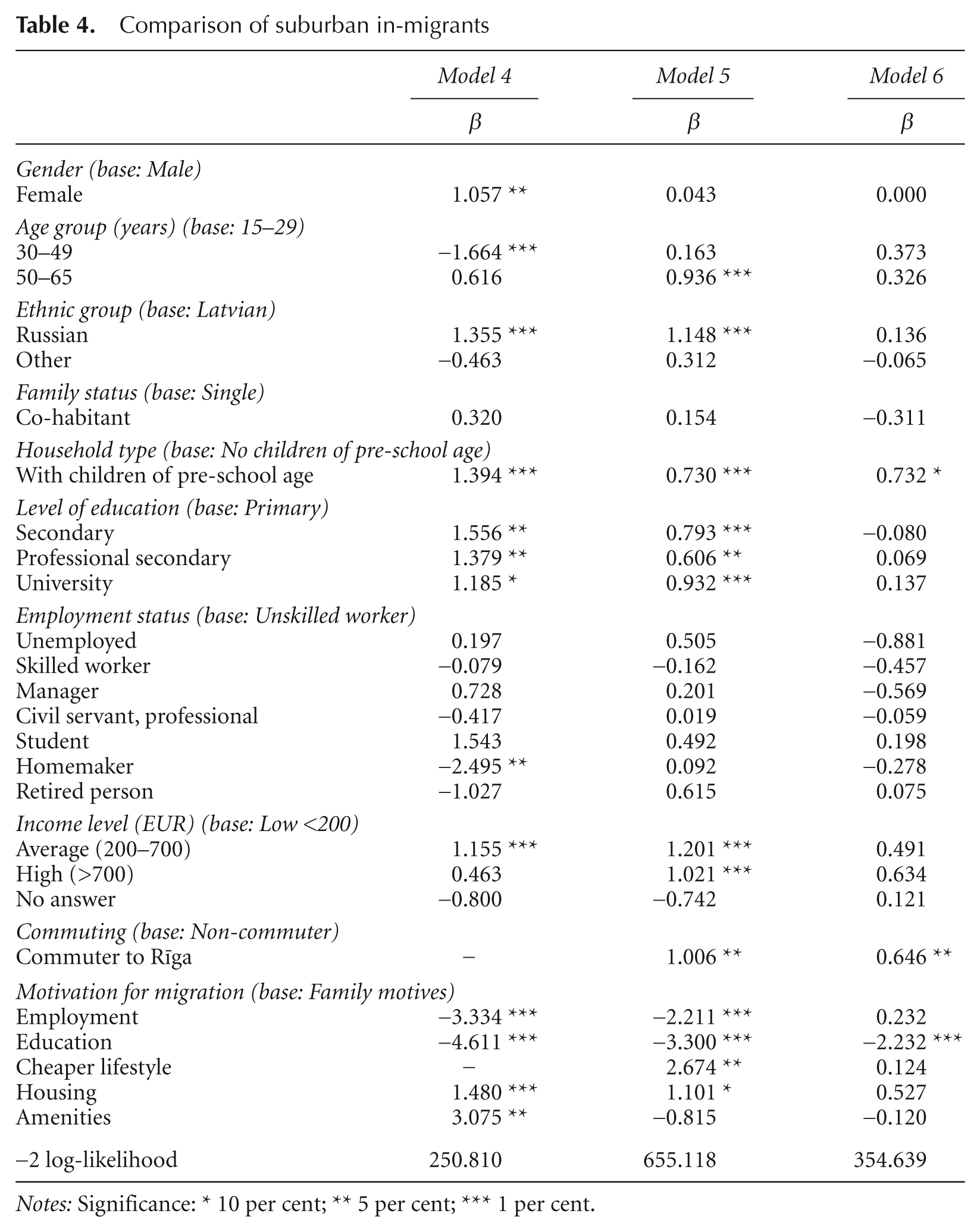
Model 4 shows us that suburbanisers are more likely than urban migrants to Rīga to be women, Russians and representatives of families with pre-school-age children, as well as people with a higher level of education and average income (see Table 4). Similar characteristics are seen in model 5, which compares the probability of a move among suburbanisers and other suburban in-migrants. In this case, there were no statistically significant results with respect to gender. The results of this model also show that people from different age-groups have migrated. Unlike other suburban in-migrants, the suburbanisers who are more likely to move house are people who are approaching retirement age. This can be explained by virtue of the fact that interregional migration to Rīga and the RMA is usually connected with work and education, and these motivations to move are typical of younger people. The increased proportion of Russians among suburbanisers can be attributed to the concentration of Russian-speakers in large cities. This differs from the discussion earlier in the paper about movers and stayers. The probability of Russian-speaking suburbanisers leaving Rīga is considerably higher, therefore, than their moving from other regions of the country to the RMA. Another typical characteristic of suburbanisers is involvement in commuting, which means that there is a greater probability that they will be commuting to Rīga.
Comparison of suburban in-migrants
Notes: Significance: * 10 per cent; ** 5 per cent; *** 1 per cent.
The probability of becoming a suburbaniser in the RMA is greater for women, Russians and families with pre-school-age children. A higher social status (a better education and higher income) is also characteristic of people who have moved to the RMA. We can say therefore that suburbanisers are a fairly homogeneous group in comparison with other suburban in-migrants and urban migrants. The only differences are seen in gender and age. The results of model 4 suggest that female suburbanisation in Latvia is not at all related to job losses or limited access to services in the city.
The aforementioned group of people of pre-retirement age also has a specific set of characteristics when it comes to suburbanisation (model 5). These are people for whom the motivation for a move is the search for a less expensive lifestyle. However, it should be noted that this motivation was not cited by any of the urban migrants. This suggests that there is polarisation among social groups in the world of suburbanisers. There is Western-type suburbanisation, but there is also what could be called a ‘post-socialist exodus’—a term that refers to the economic difficulties typical of the transition period that relate to urban life (higher costs, difficulties in finding jobs, etc.).
Migration processes within the RMA confirm both intrametropolitan deconcentration and interregional concentration of migrants in the RMA. Models 4 and 5 confirm that the groups involved in these processes differ, particularly in terms of motivations. There is a greater probability that centripetal migration occurs as a result of people moving for reasons of work and education. Housing, in contrast, is an important motivation for suburbanisers. Homes and the related improvement to living conditions have been studied by other researchers, who found that there are Western-style signs of suburbanisation in Latvia. However, in the case of this study, we do not have information about housing type; hence, we are unable to establish whether the suburban population is expanding in line with the construction of new homes or whether this expansion is directed towards existing housing in older suburban settlements. This suggests that further research should be carried out on the housing conditions in the RMA in order to clarify this aspect of suburbanisation.
When we analyse the results obtained in the various models, we see that the RMA offers better living conditions and natural amenities than Rīga. Conclusions related to amenity-driven migration towards the RMA have been presented in a recent study (Be¯rzin¸š and Krišja¯ne, 2008).
In the current study, we found that families with children are more likely than other groups of residents to move to the internal zone of the RMA, and it is a characteristic of this group that they commute to and from Rīga. Our analysis of other demographic and socioeconomic characteristics of the groups of migrants in the RMA zones did not show statistically significant differences. However, those in the internal zone certainly did not move for reasons of education. This conclusion is drawn because, in the internal zone, there are general education schools in each local government territory, but there are hardly any other educational institutions. In contrast, in the external zone, we find Latvia’s third-largest university in terms of student numbers—the Latvian Agricultural University, which is based in the city of Jelgava. Other motivations for a move did not indicate that the internal zone of the RMA is more attractive than the outer zone. The hypothesis related to the attractiveness of the internal zone was not confirmed and, in most cases, there were no statistically significant results in terms of differences between the two zones. Neither did we confirm that the residents who choose to live in the internal zone are more likely to comprise a more homogeneous group than others.
Discussion and Summary
As a phenomenon, suburbanisation has led to population changes in most of the countries in CEE. Suburban growth during transition in these countries is linked with the development of new residential areas and considerable in-migration flows. The hinterlands of capital cities, in particular, have the most dynamic development in terms of urban systems. Changes in society and the economy in Latvia, as in other countries of CEE, have affected migration flows and the conditions under which people move house. During the past decade, the RMA became the epicentre of suburban development in Latvia. This happened despite the overall population decline in Latvia due to natural decline and labour emigration.
Analysis of statistical data shows that suburban development is related to intrametropolitan deconcentration, whereas centripetal migration flows have responded to the spatial population concentration around the capital city. In order to understand these processes, it was important to determine migration trends by population sub-group and also to examine the migration motivations of suburban in-migrants in the RMA. The survey that was used for this purpose offers representative and explanatory data about intrametropolitan and interregional migration in the process of suburbanisation.
The survey data show that, over the past decade, migration from Rīga to its suburban areas has been a socially diverse process. The people who are most likely to move are young, well-off people with a higher level of education and generally better-qualified individuals, as well as elderly people with low socioeconomic status. Growing social polarisation is a typical feature of post-socialist suburbanisation. In this study, we found that, in recent years, younger and more affluent people with higher social status have decided to live in the suburbs. This may be linked to the overall national economic growth, the availability of mortgages and the development of new residential areas (field settlements) around Rīga, as well as the infill and expansion of the existing suburban settlements. All in all, suburban in-migration in the RMA is defined both by classical suburbanisers in accordance with the traditional concept of Western-style suburbanisation and by the economic hardships encountered during the first half of the 1990s in the transitional period. However, we found no differences with respect to gender or ethnicity between suburbanisers and long-term suburban residents.
All of the results were based on several binary logistic regression models, which allowed us to compare suburbanisers with stayers and long-term suburban residents, as well as other suburban in-migrants. When we compared different groups of migrants, we found that the probability of becoming suburbanisers was higher not only for people with a higher social status, but also for women, Russians and families with pre-school-age children. The movement of women to suburban areas, according to our study, is connected with employment, but this is not directly related to women being pushed out of the labour market or having limited access to services that are available in the city. There is clearly a need for further in-depth studies in order to clarify how differences that are due to gender manifest themselves in suburbanisation in Latvia.
It is also clear that different population groups moved to different suburban destinations but, due to a lack of adjustable high-quality data, it was not possible to estimate the housing effect and specific suburban destinations when analysing the population sub-groups. This aspect could not be studied thoroughly here, because the spatial results are presented as aggregate data; the only separation is that between the internal and the external zone of the RMA. Nevertheless, the survey does allow us to evaluate various motivations for moving house. According to the results, motivations that are related to housing are very important for suburbanisation in the RMA. The role of housing as a motivation to suburbanise has been broadly analysed in studies focused on other countries in the CEE. In the case of the RMA, too, residential suburbanisation is the most visible and voluminous manifestation of this process.
The search for a cheaper lifestyle was a particularly important motivation to suburbanise. In the case of the RMA, this confirms the aforementioned polarisation among different social groups in the processes of suburbanisation. Another important motivation was better living conditions and amenities in the RMA. This motivation for moving was particularly prevalent among suburbanisers who left Rīga. Amenities in this context relate not just to the environment, but also to the existence of an appropriate infrastructure and available services, such as kindergartens, leisure facilities and shopping.
Social polarisation, changing settlement structure and demographic behaviour are among the crucial consequences that result from the suburbanisation process. Suburbanisation in the RMA has both negative and positive effects on the source locations and destinations affected by suburban migration. The out-migration of the younger and economically active population encourages the decline of Latvia’s non-metropolitan regions, while the suburban municipalities are experiencing a strengthening of their demographic and socioeconomic capacity. Our study, if compared with previous research about the spatial outcomes of suburbanisation in the RMA (which is based primarily on the commuting threshold), does not indicate any considerable differences among population sub-groups. However, there are distinct differences in people’s motivations to move, because suburbanites in the RMA are more likely to move specifically for housing reasons. The most important consequence of residential suburbanisation is that of increased commuting to Rīga. This phenomenon was seen in this study, especially insofar as the internal zone of the RMA is concerned, as well as in other recent studies (Be¯rzin¸š and Krišja¯ne, 2008). We suggest that further research on the RMA suburban areas should focus on determining the nature of the relationship between housing motivation and the choice of specific suburban destinations, living conditions, housing stock and social status.
Footnotes
Acknowledgements
The authors would like to thank Tiit Tammaru, Michael Gentile, Artjoms Ivlevs, Andris Bauls and two anonymous referees for their valuable comments on this paper. The paper was supported by Project No. 2010/0202/2DP/2.1.1.2.0/10/APIA/VIAA/013 (of the University of Latvia).