




Abstract
Many poor neighbourhoods, home to both socially disadvantaged populations and to foreigners, are characterised by a strong perception of insecurity. The purpose of this article is determine the origin of this perception. To do so, two possible causes are dissociated: racial prejudice and racial proxy (the ethnic minorities are perceived in terms of the negative social characteristics that are often associated with them). More specifically, it is shown that the ‘ethnic’ variable captures the effects of an overconcentration of poverty, approximated here by the concentration of unemployment, but that these two variables act separately. This result should be taken into account in the policies implemented by public authorities and local actors. In this study, an original methodology is applied based simultaneously on individual geocoded data, the proportion of foreigners, the unemployment rate at the neighbourhood level and an indirect indicator of perceived insecurity.
1. Introduction
For the general population, poor neighbourhoods are often seen as unattractive places to live, associated with negative externalities: noise, vandalism, robbery and insecurity (Smets and den Uyl, 2008; Lagrange, 2001). A perception that the neighbourhood is dangerous generates psychological problems, with consequences for physical health (Aneshensel and Sucoff, 1996; Hill et al., 2005; Schieman and Pearlin, 2006). A perception of insecurity is also the strongest motive for residents to move out, thus accentuating urban segregation (Taub et al., 1984; Quillian and Pager, 2001).
One of the surprising results of a previous study, however, was the variety of opinions expressed by residents of poor neighbourhoods, ranging from emotional satisfaction to violent rejection, the main reason given for the latter being insecurity (Pan Ké Shon, 2007). In practice, around 10 per cent of the population of poor neighbourhoods complain spontaneously about insecurity (see sub-section 3.2) and report that they want to move out, although only a fraction of them actually do so. Since poor neighbourhoods are highly heterogeneous, we might assume that the most positive opinions of working-class neighbourhoods would be expressed by relatively advantaged residents or from inhabitants who develop affective ties with the neighbourhood (Pan Ké Shon, 2007). 1 Hence, one might expect inhabitants’ dissatisfaction to increase in line with the degree of social disadvantage.
Throughout Europe, certain social problems tend to be perceived or presented as problems of insecurity linked to illegal immigration or young people ‘of immigrant origin’ (Palidda, 1999; for France, see Mucchielli, 2003). We also know that inhabitants of poor neighbourhoods are more likely to complain about insecurity (Lagrange, 2001; Pan Ké Shon, 2007) and that many of these neighbourhoods in Europe are home to socially disadvantaged populations, including immigrants such as Africans, mostly North Africans in France (Blanc, 1991). Quillian and Pager (2001), for example, find that the racial composition in the US has a stronger influence on a perception of insecurity than objective indicators. However, the US is not Europe and the ‘ethnic’ composition of disadvantaged neighbourhoods in the US differs from Europe due to differences in the historical relationships between the mainstream population and minorities. Although the ethnic minorities in the US and in Europe are not identical, they nonetheless share similarly disadvantaged social (SES, unemployment) and residential situations. In this sense, studies from both the US and Europe provide a valuable source of new insight.
The question we will seek to answer is the following: are inhabitants of poor neighbourhoods more likely to complain about insecurity because there are ‘too many foreigners’ (racial prejudice), or because the foreigners are a racial proxy of poverty (there are too many socially disadvantaged people in the neighbourhoods)? For this purpose, we use data from the 1999 French census merged with the Vie de quartier survey. Census data are used to calculate the proportion of foreigners and the unemployment rate at the neighbourhood level. The unemployment rate serves as a proxy of social disadvantage, while the proportion of foreigners indicates their level of presence in the neighbourhood.
2. Insecurity: Racial Proxy or Pure Discrimination Hypotheses?
As is often the case, especially in Europe and in the US, many disadvantaged neighbourhoods have a high concentration of both socially disadvantaged populations and of ethnic minorities. A connection is often made between the perceived insecurity of inhabitants in poor, ethnically mixed neighbourhoods and the concentration of disadvantaged populations. This connection stems from a perception that there are ‘too many’ foreigners—i.e. that a ‘tolerance threshold’ has been exceeded. This notion is not new, and in France was first proposed in the 1960s (de Rudder, 1991), while in the US the similar concept of a ‘tipping point’ appeared in the literature of the 1950s (Duncan and Duncan, 1957). According to de Rudder, the approaches used by two American scholars may have been the unintentional source of the ‘tolerance threshold’ concept used in France. The first used a ‘social distance scale’ to measure distances between ethnic groups (Bogardus, 1925); the second introduced the notion of a ‘tipping point’, which can be likened to a ‘critical threshold’ of Black inhabitants in a neighbourhood (Grodzins, 1957). So long as this threshold is not reached, Black inhabitants can lived dispersed across the urban territory, but beyond the tipping point a process of ghettoisation takes place (de Rudder, 1991). In France, the notion of a ‘tolerance threshold’ expresses the idea that beyond a certain proportion of foreigners negative externalities in the form of tensions and conflict will occur between the French and foreign populations, resulting in a perception of insecurity. The tolerance threshold is not a specifically French hypothesis. It is put forward in several other European countries as a ‘moderate’, supposedly non-racist justification for policies which nonetheless aim to limit the proportion of foreigners in certain buildings or neighbourhoods. This is the case in Belgium, for example (Kesteloot, 1986). This tolerance threshold which, if exceeded, also supposedly generates a stronger perception of insecurity, could thus be seen as a xenophobic mechanism—i.e. a racial aversion (Massey and Denton, 1993), which conveys the message that the environment is hostile. It could thus serve to explain, in part at least, the phenomena of tipping point, White flight or White avoidance observed in ethnically mixed neighbourhoods of the US (Duncan and Duncan, 1957; Clark, 1996). American scholars have stopped looking for a hypothetical threshold applicable to all the situations encountered (Bråmå, 2006).
Be it in Europe or the US, we observe that the problems of poor neighbourhoods arise from a combination of three factors: segregation, ethnic minorities and insecurity. There are two opposing hypotheses to explain inhabitants’ perceived, and often subjective, perception of insecurity in poor neighbourhoods. According to the first, it is a question of racial prejudice (Bobo and Zubrinsky, 1996) that for many scholars is an evident reality (for example, Farley et al., 1994; Bobo and Zubrinsky, 1996). An alternative to this hypothesis of a xenophobic mechanism that generates insecurity might be the existence of a link between the spatial concentration of poor populations and the resulting crime that in turn creates insecurity (Mucchielli, 2003; Harris, 1999, 2001). If this were the case, the origin of the perception of insecurity would be the concentration of poverty and not the foreigner (ethnic population) tolerance threshold. The perception of insecurity may thus arise from the confusion in people’s minds between ethnic minorities per se and the disadvantaged social characteristics frequently associated with them (racial proxy) such as poverty and related social problems, including insecurity (Taub et al., 1984; Harris, 1999, 2001). So which of these hypotheses—racial proxy or pure discrimination—is correct? This fundamental question also arises in Europe for immigrant populations, often from the former colonies.
David Harris aptly remarks
If whites avoid blacks because they are black, then stable integration is unlikely; no matter what policy is pursued, whites will still object to living near blacks. Alternatively, if whites avoid blacks because of characteristics associated with being black, then stable integration can be achieved through policies that promote racial integration while minimising undesirable non-racial characteristics (Harris, 1999, p. 462).
Clearly, the answer to this question is essential for the public authorities and local actors involved in implementing social measures. Indeed, if the French inhabitants feel unsafe because their neighbours are foreigners or assimilated as such, then policies to promote social integration are not only bound to fail, but may even heighten the perception of insecurity. Long-term measures should seek to combat ethnic stereotypes. Moreover, the traditional law-and-order approach appears to be ineffective. Krivo et al. observe that those who focus on punishing delinquents as a means to solve the insecurity problem but who neglect or oppose the programmes aiming to reduce the structural problems underlying criminal violence, do so at their own cost (Krivo et al., 2009, p. 1793), since insecurity spills out beyond the frontiers of poor neighbourhoods to affect others. Conversely, if the French population feels unsafe because of the concentration of poverty, which often affects foreigners, this perception of insecurity can be countered by measures to reduce the spatial concentration of unemployment (education, employment, social mixing). In this case, efforts to alleviate social disadvantages in poor neighbourhoods would result in the better social integration of ethnic minorities. When examined more closely, this problem is not a simple binary issue. Quillian and Pager (2001), for example, challenge the hypothesis with apparently profound pessimism. In their view, Whites feel insecure in their neighbourhood because of the presence of ethnic minorities, beyond any real link between insecurity and ethnic minorities, so racial composition will affect the perceptions of insecurity. These perceptions, actually based on the social context but influenced by the racial context, can no longer, therefore, be considered as racially neutral. We will show that this pessimistic rationality does not, in fact, correspond to the French observed reality.
3. Data, Measurement and Methods
The strategy adopted here is both simple and complex. As foreigners tend to be victims of both poverty and discrimination, multivariate procedures are needed to tease out the specific roles of one or other type of disadvantage. To do this, the proportion of foreigners and the unemployment rates are calculated for each neighbourhood using data from the 1999 French census and are then introduced into Vie de quartier survey. Multinomial logistic models are used to separate the effects of proportions of foreigners and of unemployment by social category of the neighbourhood. They thus reveal the likelihood of complaining of insecurity (i.e. being an Insecure inhabitant) as a function of neighbourhood unemployment rate after controlling for individual sociodemographic variables, those of the neighbourhood and its proportion of foreign residents.
3.1 Source
In order to answer our questions, we used data from the INSEE Vie de quartier survey. The information was collected in 2001 from 12 000 people representative of the French population. The main themes were housing and the local environment. The survey data were associated with contextual variables at the scale of the city block (IRIS), such as the unemployment rate and the proportion of foreigners, taken from the census of 1999. An IRIS is a geographical unit used by INSEE comprising roughly 2000 residents and which often corresponds to a city block.
The ‘ethnic minorities’ indicator
The terms ‘foreigners’ or ‘ethnic minorities’ are used indifferently for the sake of simplicity. It is prohibited by the French Conseil constitutionnel to identify minorities by their skin colour, self-reported or otherwise, in statistical surveys. In practice, due to the lack of census information on parents’ origins which would have enabled us to take account of ‘second generations’, the indicator used here is the residents’ nationality. These second generations, most of whom are French nationals (97 per cent), are associated with an African identity. Ethnicity is based on the attribution of a national or ethnic origin to a group by the dominant population on the basis of real or imagined physical or cultural traits. Statistics show a close correlation between the presence of foreigners, the presence of ‘second generations’ and their concentration in disadvantaged neighbourhoods. For example, among people with two French parents, 8 per cent lived in disadvantaged neighbourhoods in 2006, compared with 30 per cent for those with at least one African parent (Employment survey, 2006). Moreover, the partial non-response to the question of father’s nationality is 7 per cent higher in the disadvantaged neighbourhoods (17 per cent out disadvantaged neighbourhoods versus 24 per cent in), probably indicating that the proportion of Africans or persons perceived as African is actually above 30 per cent in disadvantaged neighbourhoods. In this sense, African nationality in disadvantaged neighbourhoods, although restrictive and unsatisfactory, contains more information than its nominal value suggests.
3.2 Indicator of Insecurity Used
There are currently several competing theories to explain the perception of insecurity. For some, it is the product of victimisation (Bannister and Fyfe, 2001; McPherson, 1978). A less obvious explanation is that insecurity arises from an absence of social control—i.e. individuals’ inability to prevent victimisation or to face its consequences—which results in a sense of fear. Under the environmental thesis, fear is incorporated in the physical and social morphology of public space and depends on its degree of familiarity (Bannister and Fyfe, 2001; Quillian and Pager, 2001). For yet others, the perception of insecurity as represented by anti-social behaviour depends on two interpretation processes. The first is based on observing a particular phenomenon to assess the level of disorder—idle young people on the street, for example. It may potentially also be the presence of foreigners. The second is linked to a deeper anxiety relative to the state of society in general and the characteristics of the neighbourhood in particular (Mackenzie et al., 2010). These theses have been developed in France by Robert Castel. With regard to sensitive neighbourhoods, he observes that “Social and civil insecurity intersect here and are mutually sustaining” (Castel, 2003, p. 53). It is important to separate perceived insecurity and actual insecurity, however, (see Mackenzie et al., 2010).
Closed questions on insecurity do not capture the full content of respondents’ answers or identify the different ways in which insecurity is experienced by different social groups. To overcome this problem, we examine the reasons for complaining about insecurity given in answers to an open question of the French Vie de quartier survey. This initial analysis enables us to classify the various reasons given and to understand more clearly how they differ between poor and affluent neighbourhoods. Using textual analysis tools to perform a statistical breakdown of answers, we establish a typology of residents, including a category of residents who complain spontaneously about insecurity.
The survey concluded with an open question encompassing all the themes covered in the interview: “Can you tell me in a few words what your neighbourhood represents for you?”. The benefit of an open question is that it reveals the respondents’ attitudes to the neighbourhood without prompting their answers and without making any preconceived assumptions (Pan Ké Shon, 2007). The group which associates the neighbourhood with insecurity constitutes our insecurity variable. It has the advantages of not being induced by a direct question and of including information on reasons for insecurity. Although this indirect indicator is clearly not disconnected from the reality of crime in the neighbourhood, it is a measure of perceived insecurity only. It nonetheless selects people for whom insecurity is such a big problem that it colours their overall opinion of the neighbourhood. For others, who are less sensitive to crime because of their individual characteristics, their tolerance of crime or because they live in a very calm neighbourhood, insecurity is not a real problem.
The method used here provides an accurate indication of what is meant by the perception of insecurity. The descriptions for Insecure residents in disadvantaged neighbourhoods clearly show the reasons for insecurity that were expressed (Table 1). Many of the reasons are predictable. Residents express a non-specific fear of the neighbourhood and of some of its inhabitants, linked to physical or verbal violence, drugs, thefts, vandalism, anti-social behaviour and the presence of idle youths. Residents may fear for their children and their anxiety may also reflect other concerns, notably the poor reputation of the children’s school. Of course, these are representations of insecurity, and sometimes of the inhabitants’ personal experiences, and not a factual summary of crimes committed, and even less a social analysis of causes. This representation of insecurity consists in fear of assault, of theft, of verbal abuse—i.e. crimes that have been or might be committed at the place of residence, but also elsewhere.
Examples of descriptions used by Insecure persons in poor neighbourhoods
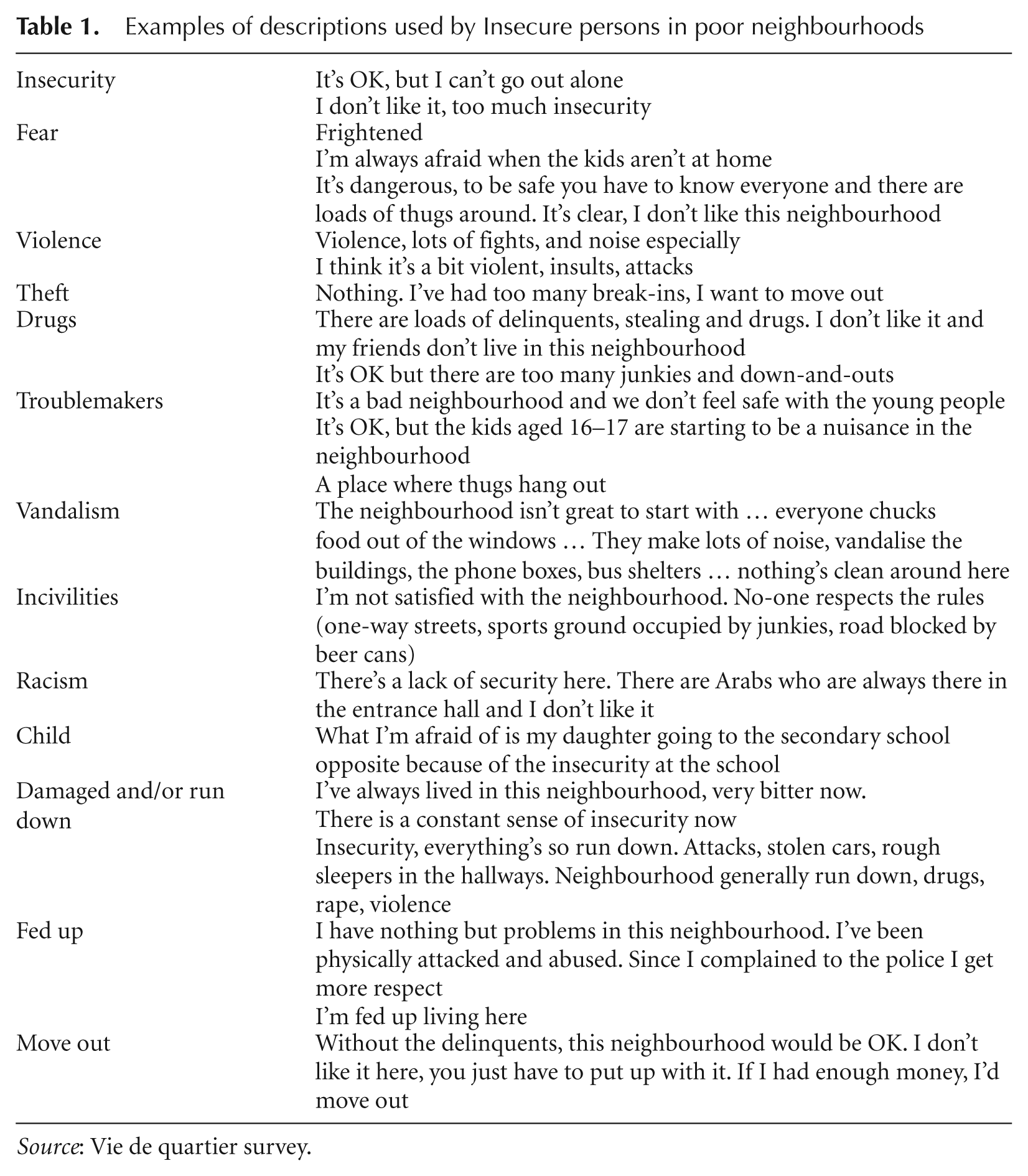
Source: Vie de quartier survey.
Insecure residents frequently complain bitterly about the decline of the neighbourhood over the years. The word ‘dégradé’ (damaged or run down in English) is often used. The theme of deterioration in disadvantaged neighbourhoods needs to be viewed in the context of social changes in the residential environment over recent decades. In the 1970s, social housing neighbourhoods had a positive image, as they provided working- and middle-class citizens with homes that complied with standards of modern comfort. Today, the middle classes in these neighbourhoods have been replaced by less affluent inhabitants and by African immigrants. The respondents’ answers reveal a nostalgia for the past and a shrinking of their social network over time. In their eyes, what was once familiar has now become foreign and potentially hostile. The most affluent neighbours and friends have gone. These once-attractive, brand new neighbourhoods have become run down and socially stigmatising. Little by little, the old world has been replaced by a new social reality where young people ‘hang around with nothing to do’ and the homeless ‘doss down’ in the entrance halls. It is not the fear of becoming socially declassified oneself which is conveyed indirectly here, but rather the visible result, literally on one’s doorstep, of an anxiogenic transformation of the world. The conclusions drawn from our insecurity indicator are similar to those relating to anti-social behaviour recorded by Mackenzie and colleagues (2010).
3.3 Resident Typology
Initially, the file contained 4605 different hapax legomena (basic lexical units distinct from other words in the corpus) of more than two characters out of a total of 108 919 words. The number of different words was reduced by grouping terms with the same root under a single word. For example, the words habitude, habitudes, habitué, habitués, habituée, habituées, habituer—which all relate to ‘being used to’ something—were grouped under habitude (habit). Next, synonyms and similar expressions were grouped under the same keyword. For example, the generic item ‘horrible’ (4 occurrences) groups terms which are not identical—‘rotten or trash’ (15 occurrences), ‘hell’ (7), ‘I hate it’ (1),‘no future here’ (3), ‘dump’ (2), ‘bad neighbourhood’ (2), ‘awful’ (7), ‘better to keep out’ (2), ‘it makes me sick’ (1), ‘fed up living here’ (6), ‘I can’t stand it any more’ (4), ‘really dangerous’ (1), ‘a shithole’ (2), ‘disgust’ (3), ‘terrible’ (2)”—but which all express, to varying degrees, aversion to the neighbourhood. This important keyword was brought to light by grouping terms with low occurrences that otherwise would not have been taken into account. Several key words could appear in the same sentence. For example, satisfaction could appear alongside insecurity and nuisance in a single inhabitant’s answer. All the items from a single respondent were used in the statistical analysis. The corpus was thus reduced to 102 items to facilitate statistical processing. The typology of residents is the result of an ascending hierarchal classification of the items contained in the responses of each respondent. It is thus constructed at the individual level on the basis of the recorded items. The aim was to maximise keyword variance between the groups of items and minimise it within each group. Six distinct types of resident emerged from this hierarchical classification: ‘advantaged’ (6 per cent of the population) who appreciate the assets of their neighbourhood; the ‘generally satisfied’ (44 per cent) who express overall satisfaction; the ‘settled’ (12 per cent) who maintain a strong affective relationship with their residential environment; the ‘withdrawn’, characterised by relationship problems, isolation and lack of activity (5 per cent); the ‘indifferent’, who show an explicit detachment and a lack of affinity with their place of residence (29 per cent), and the ‘insecure’ who associate their neighbourhood with insecurity and nuisance (4 per cent).
3.4 Socioeconomic Neighbourhood Typology and Social Disadvantage Indicator of Neighbourhoods
For the sake of simplicity, we group the social profiles of all French neighbourhoods into four basic categories: affluent, affluent-average, average-poor and poor, using French territorial divisions. The neighbourhoods comprise three blocks totalling 6000 inhabitants. Then we verify the robustness of the results obtained by replacing this socioeconomic typology of neighbourhoods with a second typology defined this time by the distribution of unemployment rates aggregated at the single block level. The results are largely unaffected by the geographical breakdowns used. The perception of insecurity in the 3-block neighbourhoods is only slightly lower than in those with just one block.
Socioeconomic neighbourhood typology
This is a socio-spatial analysis tool made available to researchers by Martin-Houssart and Tabard (2002). It is based on data from the French census of 1999 ranking 7571 geographical units of approximately 6000 residents by occupation matched against their employer’s economic sector and their employment status. The method used to establish the typology consisted of successive automatic classifications on the axes of the factor analyses relating to the labour force participation and occupation/sector table of the geographical units (see Pan Ké Shon, 2007). This typology ranks neighbourhoods socially since the concentrations of occupational categories and unemployment are a measure of socio-spatial polarisation. It also indicates the territory’s economic specialisation (agriculture, manual trades, industry). Here, for the purposes of clarity, the number of socioeconomic neighbourhoods was reduced to just four. ‘Affluent’ neighbourhoods are occupied by people in higher-level occupations (private and public sectors), ‘affluent-average’ neighbourhoods by people in intermediate occupations, ‘average-poor’ neighbourhoods by industrial and craft workers, and ‘poor’ neighbourhoods by the lowest income groups. Rural neighbourhoods were excluded because of their highly specific nature.
Social disadvantage indicator of neighbourhoods
The value of using the unemployment rate as an indicator is that it encapsulates individual and social vulnerability and risks of breakdown. Unemployment, for example, makes individuals vulnerable through a combination of losses: loss of income, loss of work relationships (Blanpain and Pan Ké Shon, 1999), loss of structure, loss of self-esteem and loss of social status, (Lazarfeld et al., 1932/1972; Castel, 1995; Schnapper, 1981; Pan Ké Shon, 2010). Unemployment is therefore the best reflection of the social disadvantage of the residents in a neighbourhood. It reveals the groups least equipped to find a job: young people, those over 55, those with low or no qualifications, foreigners (who can also suffer discrimination) and lower socioeconomic categories. Naturally, these groups are not socially disadvantaged as such. Being young or foreign is not an intrinsic disadvantage, but it may be empirically observed that these groups are at greater risk of unemployment. The unemployment rate is used to distinguish areas where disadvantaged groups are concentrated. The implicit assumption of this typology is that neighbourhoods are a spatial representation of social inequality. The unemployment rate in a neighbourhood is doubly informative. It represents the proportion of people with a precarious position in the job market and hence indicates a degree of spatially concentrated social vulnerability. Yet it tells us more than just that. It can be seen more generally as a proxy of the social difficulties encountered by inhabitants of a neighbourhood, given that unemployed persons tend to live in families who share similar characteristics and that neighbourhoods tend to bring together individuals with comparable social profiles.
Furthermore, the proportion of disadvantaged individuals, measured by the number of unemployed, is not only highest in the least desirable neighbourhoods, but it also generates negative externalities, such as insecurity and a sense of insecurity. French urban blocks can be divided into four categories based on the distribution of unemployment. Neighbourhoods are described as: affluent (1st to 3th decile of unemployment); affluent-average (31st to 65th centile); average-poor (66th to 95th centile); or poor (above the 95th centile). This typology is therefore a more direct categorisation of socio-spatial inequalities than the socioeconomic neighbourhood typology, based on the hierarchical aspect of the status of occupations. Their logic is similar to the UK SES. Moreover, their geographical units consist of three blocks versus only one for the unemployment classification (an average of 6000 residents versus 2000). Note that smaller geographical units have a more homogeneous population and therefore tend to show a higher concentration of social disadvantages. By using these two typologies, we can test two different spatial breakdowns of the neighbourhood, and then confirm our results by testing them on distinct groups of neighbourhoods.
3.5 Methods
Specific items
The items that appear much more frequently among one type of residents than among the others are considered to be specific. A second level of specificity is achieved using an index that compares the frequency of items that are specific to the same type of residents in poor neighbourhoods and in affluent neighbourhoods.
Multinomial logit models
The aim is to evaluate the probability of belonging to one of the six types of resident and to reveal what causes people to complain of insecurity, to be indifferent from their neighbourhood, to withdraw or, on the contrary, to appreciate the neighbourhood’s advantages, to be generally satisfied or to be attached. The typology of the residents, based on their answers to the question of how they feel about their neighbourhood, reflects the type of relationship they have with their neighbourhood. The socioeconomic and socio-spatial inequality typologies of neighbourhoods indicate the likelihood of belonging to a type of resident (i.e. of having a particular relationship with the neighbourhood) depending on whether the neighbourhood is affluent, average-affluent, average-poor or poor. These models are controlled by neighbourhood social type, dwelling type, amenities, problems reported as serious, ethnic composition (percentage of foreigners) and social make-up (unemployment rate), household, local social interaction with relatives, friends and neighbours, length of residence, socio-demographic characteristics of the resident, etc. According to the literature, all these characteristics influence the residents’ attitudes towards their neighbourhood.
4. Results
4.1 Heterogeneity and Inequalities in the Relationship with the Neighbourhood
Of course, residents of poor neighbourhoods do not all have negative feelings towards their neighbourhood, although those who complain are more numerous in poor neighbourhoods than in affluent ones. This intuitive result remains true for both neighbourhood typologies used: socioeconomic and aggregate unemployment rate (Table 2). Thus, as unemployment increases in neighbourhoods, or as neighbourhoods become more disadvantaged, there is a decrease in the number of residents who emphasise the advantages of the neighbourhood (type ‘advantaged’), and particularly of those who say they are satisfied without being specific (type ‘generally satisfied’).
Types of resident by types of neighbourhood (percentages)
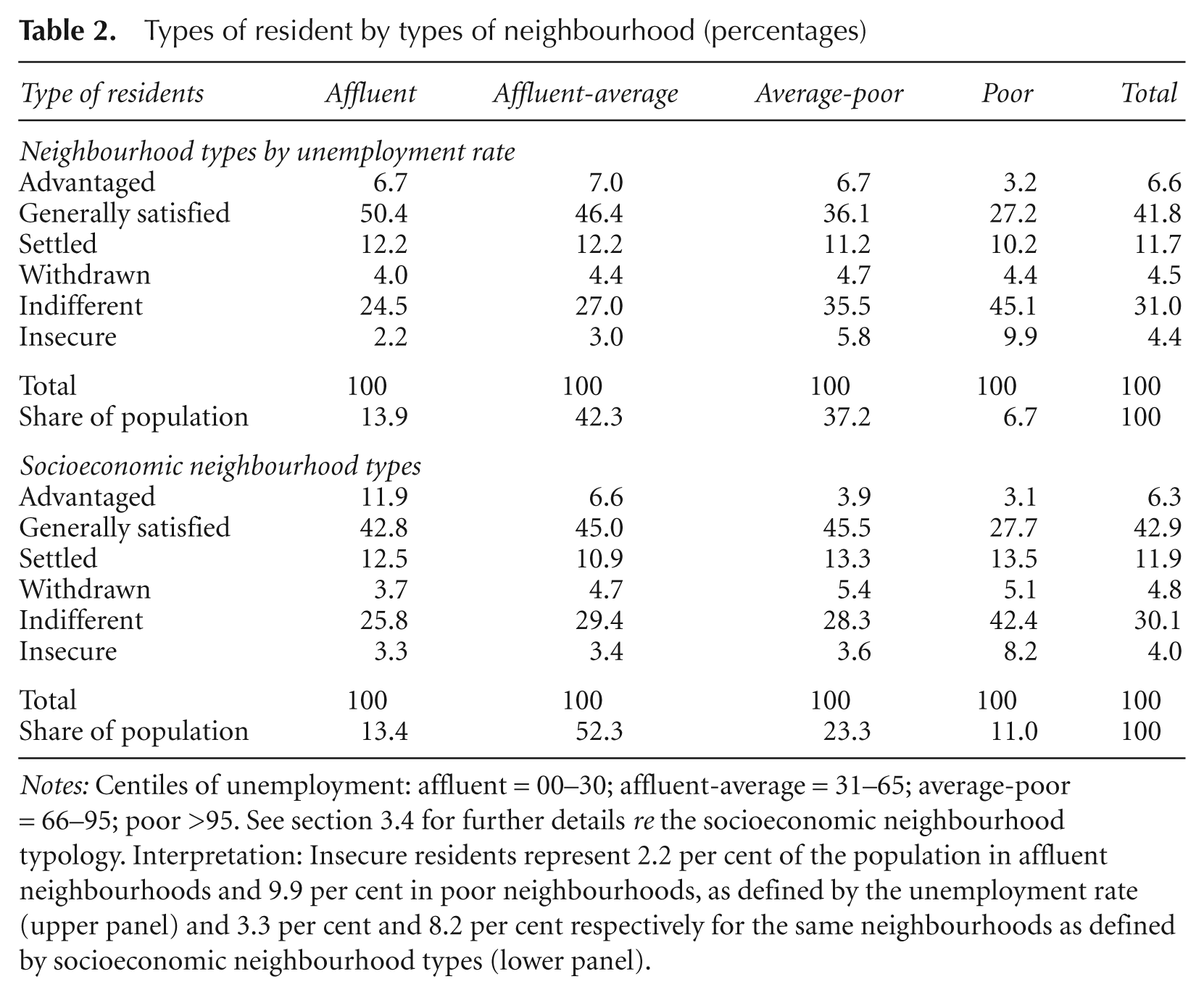
Notes: Centiles of unemployment: affluent = 00–30; affluent-average = 31–65; average-poor = 66–95; poor >95. See section 3.4 for further details re the socioeconomic neighbourhood typology. Interpretation: Insecure residents represent 2.2 per cent of the population in affluent neighbourhoods and 9.9 per cent in poor neighbourhoods, as defined by the unemployment rate (upper panel) and 3.3 per cent and 8.2 per cent respectively for the same neighbourhoods as defined by socioeconomic neighbourhood types (lower panel).
Conversely, the proportion of residents who are ‘indifferent’ or ‘insecure’ increases steadily, reaching almost 10 per cent for the latter in poor neighbourhoods, four to five times more than in affluent ones. If residents of poor neighbourhoods do not complain more often about their neighbourhood, could this be due to an undemanding attitude to their living environment? Have they incorporated modest residential standards which make them less ‘hard to please’, notably by comparison with more affluent residents living in the same neighbourhoods. In addition, their sense of familiarity with their living space is strengthened by the presence of friends and relatives. However, it has already been shown that, even after controlling for duration of dwelling occupancy and the presence of family and friends in the neighbourhood, complaints about insecurity in poor neighbourhoods do indeed exist, but are limited in number (Pan Ké Shon, 2007). There is a clear correlation between perceived insecurity and degree of neighbourhood disadvantage, as proxied by the unemployment rate. For the purposes of this study, we note that being an Insecure inhabitant is linked to the social stratification of neighbourhoods, and even more so to the concentration of unemployment.
To give ‘substance’ to the experiences of Insecure inhabitants, it is useful to observe the content of their opinions in affluent and poor neighbourhoods. This can be done quite simply by extracting and comparing their very specific items. Specific items are those which feature most often in the answers of one type of inhabitant with respect to all other types. A second level of specificity is obtained via an index expressing the ratio of the frequency of specific items of a single type of inhabitant to the frequency of these same items among residents of affluent neighbourhoods. It gives a clear indication of the particularity of insecurity in poor neighbourhoods. Not surprisingly, the items relating to insecurity are expressed more frequently in poor neighbourhoods than in affluent ones (Table 3). The ‘insecurity’ item occurs 530 times per 1000 in a disadvantaged neighbourhood—i.e. 1.5 times more often than in an affluent one. The ‘move out’ item, expressing an explicit desire to flee, has an index of 110 per 1000 in poor neighbourhoods but is totally absent in affluent ones. Inhabitants of poor neighbourhoods complain 5.5 times more often about troublemakers of various kinds: ‘delinquents’, ‘louts’, ‘yobs’, ‘layabouts’, ‘gangs’, ‘kids hanging around’ (in the respondents’ words). They twice as often report not liking their neighbourhood, think that it has got worse over time and has become run down.
Specific items of residents of poor neighbourhoods

Index of items poor/affluent.
The frequency of this item is 110 in poor neighbourhoods.
Key: the item ‘close’ is the one most frequently cited by advantaged residents. It comes up 356.8 per 1000 times in their responses and is 0.8 times less common (specificity index) in poor neighbourhoods than in affluent neighbourhoods. Among Insecure residents, the ‘insecurity’ item occurs 353.8 times per 1000 in affluent neighbourhoods and 1.5 times more often in poor neighbourhoods. See text for further details re methodology.
The most frequent specific items among Insecure inhabitants of affluent neighbourhoods concern nuisances and, paradoxically, are associated with positive items such as ‘peaceful’, ‘pleasant’, ‘good’, ‘feel good’, ‘beautiful’, ‘lively’. In fact, inhabitants’ perceptions of what is desirable in a neighbourhood can be combined with a level of insecurity which is better tolerated when inherent to the very character of the locality. For example, neighbourhoods with cinemas, bars, restaurants and concert venues, such as Pigalle in Paris, are sought-after districts, despite the potential insecurity linked to residual prostitution. One can reasonably assume that the inhabitants of these districts live there by choice and not by obligation. Moreover, the relative insecurity is intrinsic to the neighbourhood’s lively atmosphere. In addition, there is a selection effect in affluent districts, since inhabitants who dislike the neighbourhood soon move away, leaving a higher proportion of satisfied residents. This thematic analysis of the opinions of Insecure inhabitants shows that the perception of insecurity is not the same in poor and affluent neighbourhoods. In poor neighbourhoods, residents feel severely threatened by insecurity, by the presence of potentially aggressive ‘gangs’ of youths, to the extent that they report a desire to flee or to move away. In affluent neighbourhoods, on the other hand, insecurity is associated with nuisance, and simultaneously positive opinions about the neighbourhood show that insecurity is perceived more as an annoyance than as a real threat.
4.2 Perception of Insecurity Increases with the Neighbourhood Unemployment Rate
Multinomial logit models can be used to assess the probability of belonging to one of the five types of resident rather than the sixth type, the ‘generally satisfied’, used as a reference. What interest us here are the characteristics associated with the probability of belonging to the Insecure inhabitant type. Model A is controlled by the degree of affluence of the neighbourhood, the surroundings, the type of housing (apartment blocks, social or private-sector housing, individual houses), central or suburban location, local amenities, problems reported as worrisome in the neighbourhood, local sociability with relatives, friends and neighbours, duration of residence in the dwelling, socio-demographic characteristics of the resident (age, educational level, type of household, employment status). Models A, B and C use the socioeconomic neighbourhood types (see section 3.4). Model B adds the proportion of foreigners in the block and model C adds the unemployment rate (Table 4). The addition of the latter two variables makes it possible to measure what this new information contributes by comparing the results of the different models, and to observe the variables that had previously obscured them. It is thus possible to observe the impact of the presence of foreigners and of unemployment rates in the neighbourhood on the likelihood of being an Insecure inhabitant.
Probability of belonging to one of the types of resident (unordered multinomial logit model, reference category: generally satisfied)

Notes: Models A, B and C use socioeconomic typology of neighbourhoods: affluent, affluent-average, average-poor, poor neighbourhoods. After controlling for all characteristics of the model (model A) for a poor neighbourhood, the risk of belonging to the group of Insecure inhabitants is 0.73 higher than for the reference category. After adding the numerical variable of the proportion of foreigners per block (model B), the risk of being insecure falls slightly from 0.73 to 0.63. By adding the numerical variable of unemployment rate to the previous model (model C), the risk disappears. Models D and E use typology of neighbourhoods based on the unemployment rate in the block: low, middle-low, middle-high, high. After controlling for all characteristics of the model (model D), the risk of being insecure in a poor neighbourhood is 1.4. This higher risk is explained by the more limited socio-spatial breakdown (2000 inhabitants) and by the typology based on distribution of unemployment. By adding the proportion of foreigners (model E), the risk decreases by only 0.16. # indicates that the estimates are insignificant at conventional levels; * <0.05, ** <0.01, *** <p. 0.001.
Models D and E replace the four socioeconomic types of the neighbourhoods with four other types based on the distribution of unemployment rate. The affluent neighbourhood is described as 1st to 3rd decile of unemployed; affluent-average as 31st to 65th centile; average-poor as 66th to 95th centile and poor above the 95th centile. The 95th centile threshold corresponds to the lower limit of the unemployment rate in neighbourhoods classified as disadvantaged (zones urbaines sensibles or ZUS) by the French administration in 1999. The percentage of foreigners at the block level is added in model E.
A comparison of the results of models A, B and C shows that, after controlling for other factors, the effect of living in average-poor and poor neighbourhoods on the probability of belonging to the Insecure resident type in models A and B decreases sharply in average-poor neighbourhoods and disappears completely in poor neighbourhoods when the unemployment rate is introduced in model C. In other words, the probability of being Insecure is mainly an effect of the unemployment rate in average-poor and poor neighbourhoods. The apparent explanatory power of the proportion of foreigners is in fact due to the concentration of unemployment.
This result is strongly confirmed by models D and E which are based on the distribution of unemployment. Model D is the basic model and model E adds the percentage of foreigners per block and the percentage squared. According to these models, living in an average-poor neighbourhood, and even more so in a poor neighbourhood—i.e. neighbourhoods with high unemployment rates—leads to high probabilities of being an Insecure resident. Adding the percentage of foreigners in the block has a residual impact on the likelihood of being an Insecure resident. The probability of being an Insecure inhabitant in a poor neighbourhood is 11 per cent (model A). Introducing the percentage of foreigners brings it down to 10 per cent (model B) for a specific effect of 0.3 per cent per percentage point of foreigner presence. For models D and E, the rates are 19 per cent and 17 per cent respectively, for a specific effect of 0.2 per cent. This leads to a conclusion that the perception of insecurity in popular neighbourhoods is not induced by a higher proportion of foreigners but by a higher rate of unemployment per block. This signifies that the effects habitually captured by the ethnic variable are, in reality, due to the residents’ less favourable social characteristics.
5. Discussion and Conclusion
The protocol adopted here avoids both the direct questions which bias respondents’ answers and the oversimplification of types of inhabitants in poor neighbourhoods. Robust results have been obtained to answer our initial question. The perception of insecurity can legitimately be attributed to the high unemployment rate in poor neighbourhoods, rather than to a high proportion of foreigners. It is thus the racial proxy which generates perceived insecurity (Harris, 1999) and not pure discrimination (Bobo and Zubrinsky, 1996). A recent North American study confirms our results by showing that the risk of homicide is determined by two main factors: concentrated disadvantage and community instability (Krivo et al., 2009). Foreigners are also more frequently unemployed and these two dimensions may be associated in the minds of the native population (Quillian and Pager, 2001). In this sense, attempts to differentiate between racial prejudice and racial proxy would be quite pointless. Counter to this hypothesis, we have shown that ethnic minorities and the racial composition of a neighbourhood act independently on the perception of insecurity among native inhabitants. These results argue in favour of public policies aiming to improve the social conditions in disadvantaged neighbourhoods and suggest that such policies would not be structurally predestined for failure. Sampson et al. (2005) have shown convincingly that, contrary to popular belief, the propensity among immigrants to the US to commit violent acts is lower than that of the second generation, and well below that of Whites, after controlling for a wide range of individual, family and contextual variables. If transposable to France, this result would be consistent with our own findings.
The public policy aimed at reducing insecurity in poor neighbourhoods is traditionally guided by three central issues: law-and-order, immigration and job creation. In 2002, Lionel Jospin, the Socialist prime minister of France at that time, admitted to having been ‘naive’ to think that bringing down unemployment in those neighbourhoods would simultaneously solve the problem of crime. His successors reinforced the traditional ideological stance of the right. The shift towards ‘authoritarian populism’, pointed out by Hall (1980) for the UK and Castel (2003) for France has gained ground in France since 2007 and is spreading across Europe. Counter to this trend, our results suggest that public action should be focused on reducing the numbers of unemployed people in disadvantaged neighbourhoods. However, to avoid future disillusionment, more than a time lapse is needed between job creation and a reduction in insecurity. Until the sudden economic downturn due to the international crisis in 2008, the recent period was a good example of improvements in employment. However, the difficulties encountered in reducing unemployment and the temporary nature of the improvements achieved suggest that this approach is too closely dependent upon economic cycles to constitute a long-term or unique solution. Moreover, unemployment is no more than a proxy for the social disadvantages of a neighbourhood. In reality, actual deprivation is multidimensional: poverty, immigrant populations confronting a sometimes different system of values, low educational levels which make it difficult to adapt in times of economic crisis, racial discrimination that damages self-esteem, family problems (large families, single-parent families), etc. Another alternative option, therefore, is to increase social mixing in the most disadvantaged neighbourhoods, an approach which depends upon political will at both national and local levels (Oblet, 2007). Note that the main advantage of social mixing lies in the fact that its opposite—segregation—impedes the educational achievement of children, jeopardises their future and contributes to the reproduction of inequalities (Maurin, 2004).
This latter solution should be preceded by an analysis of the concept of social mixing and the potentially perverse ways in which it can be used. Many scholars point out that it has been transformed into an instrument of ethnic discrimination in the allocation of social housing. Here again, social mixing is based on the idea of a foreigner ‘tolerance threshold’ (see notably Tanter and Toubon, 1999; Tissot, 2005; de Rudder, 1991) intended to ensure that individuals of different national origins can live peacefully together. For example, this tolerance threshold is applied for social housing in France, with official recognition dating back to 1973. Memo 72-60 de 1973 of the Ministry of Infrastructure and Housing recommends to “avoid, wherever possible, exceeding a proportion of 15 per cent of foreign families in social housing” (de Rudder, 1991, p. 160). In practice, most scholars agree that this idea has no scientific basis and that the tensions arising between natives and foreigners occur primarily during periods of economic crisis (Lakehal, 2005). This threshold is thus not a precise instrument of analysis but rather an ideological notion with no empirical grounding and curiously disconnected from the economic and political contexts which influence the values adopted by individuals and their perceptions of the environment. This study demonstrates, in the French context, that the notion of a foreigner tolerance threshold generating a perception of insecurity in disadvantaged neighbourhoods is quite unfounded.
The proportion of foreigners still has a small effect on the risk of feeling insecure in the neighbourhood. A 1 per cent increase in the presence of foreigners corresponds to a 0.2 per cent increase in individuals expressing a sense of insecurity, both in one-block and three-block neighbourhoods. The weak link between insecurity and the proportion of foreigners in the block suggests potentially different things. First, beyond the social disadvantage of the neighbourhood, a residual level of racial prejudice may persist, causing certain inhabitants to perceive their neighbourhood as more insecure as the presence of ethnic minorities increases. Secondly, other unfavourable characteristics may be linked to foreigners without being captured by unemployment rates, in which case foreigners’ status would be a proxy of a different phenomenon. Thirdly, could it be due simply to the sense of insecurity felt by ethnic minorities themselves, who are the targets of racist abuse and attacks? In practice, France differs from the UK in this respect. The riots that have taken place in France up to now, including those of 2005, are not interethnic clashes between White racist groups inspired by far-right ideology on the one side and ethnic minorities on the other, as was the case in Oldham, Burnley and Bradford in the summer of 2001 (Amin, 2003). There is little evidence of a sense of fear or insecurity among ethnic minorities linked to racist attacks in France, although a few isolated cases occasionally hit the headlines. 2 Intercountry European comparison of segregation and perceived insecurity according to ‘race’ or ‘class’ has major heuristic potential with regard to the immigration policies of each country. Such comparisons are yet to be made, but we believe that the ideological models deeply anchored in our collective unconscious—integration in France and communitarism in the UK—clearly affect the way in which the various populations perceive each other.
The distress of populations confronted by insecurity is a real problem and a legitimate social concern. However, the phenomena of interest to us concern only a small minority. According to the two neighbourhood classifications and the indicator of insecurity that we have used, insecurity in poor neighbourhoods concerns between 8.2 per cent and 9.9 per cent of their inhabitants—i.e. between 0.66 per cent and 0.9 per cent of the population as a whole. In this sense, public policies to address the issue of insecurity should not take priority over other forms of action in disadvantaged neighbourhoods.
The higher unemployment rate in a neighbourhood can generate both insecurity due to poverty-related delinquency and social insecurity. Our results show that a degraded environment engenders fear and attracts troublemakers: small gangs, idle youths and absence of infrastructures (Tables 2 and 3) are more commonly characterisitic of areas where poverty is concentrated. Yet the methodology used does not enable us to confirm or refute the hypothesis of social insecurity (Castel, 2003). Future research should focus on the simultaneous combination of quantitative analysis (notably persons complaining of insecurity by level of neighbourhood poverty) and analysis through interviews. There are different categories of inhabitants who are ‘predisposed’ to a strong sense of insecurity: the young, the inactive, persons living in alone, former high-earners who have dropped down the social ladder, etc. A greater understanding of how their perception of insecurity is influenced by changes in the welfare state would shed new light on the phenomenon. This calls for longitudinal studies to measure how perceptions change as a function of the prevailing social and economic climate.