




Abstract
Workers earn incomes that are significantly higher in large metropolitan areas as compared with other locations in the urban hierarchy, reflecting both agglomeration economies and variation in the composition of skills and abilities across space. What benefits accrue to in-migrants to large urban areas? Fielding’s concept of the escalator region provides one way to evaluate the role of large metropolitan areas vis-à-vis the labour market, occupational mobility and migration. The purpose of this paper is to evaluate whether young adult migrants to Toronto aged 20–29 receive income benefits that are higher than those associated with other migrants or stayers. Results indicate that Toronto in-migrants receive an income benefit consistent with a productivity effect that is greater than the income benefit received by migrants elsewhere in the system or those who did not migrate. However, it does not appear that migration leads to an acceleration in income gains.
1. Introduction
Workers earn incomes 1 that are significantly higher in large metropolitan areas as compared with other locations in the urban hierarchy (Combes et al., 2008, 2011; Yankow, 2006), a finding that holds across nations and time. Glaeser and Maré (2001), for instance, noted a 33 per cent income advantage for large urban areas as compared with non-urban areas. In Canada, earnings in large metropolitan areas are more than 25 per cent higher than in many rural parts (Beckstead et al., 2010). These income disparities reflect agglomeration economies and variation in the composition of skills and abilities across cities and rural areas (Combes et al., 2008; Yankow, 2006). Most importantly, education, and especially post-secondary education, appears to account for a large portion of urban–rural income differences, with large urban areas having a much higher share of degree holders as compared with rural areas, reflecting in situ growth of degree holders, internal migration and immigration (Brown et al., 2010).
Two related questions flow from these observations. First, why do more highly skilled workers concentrate in larger cities? Secondly, and the topic of the current paper, what income benefits accrue to in-migrants to large urban areas? Fielding’s (1992, 1995, 1997) concept of the escalator region is useful in evaluating the role of large metropolitan areas vis-à-vis the labour market, occupational mobility and migration. Escalator regions are thought to propel the socioeconomic status of young interregional migrants at a faster rate than other regions. In this framework, young people are drawn to large metropolitan areas at the start of their working lives. Because of the variety and quality (i.e. higher level) of local employment opportunities in larger metropolitan areas, it is possible to progress up the career structure comparatively quickly. Nearing retirement and the end of their careers, and after benefiting from relatively high salaries and often considerable accumulation of wealth in the form of home equity, the former in-migrants become out-migrants.
The association between earnings growth and migration to an escalator region may be related to increased density, which lends itself to greater productivity (Krugman, 1991; Combes et al., 2008) and learning (Rauch, 1993; Glaeser, 1999; Glaeser and Maré, 2001; Bacolod et al., 2009). Glaeser and Maré (2001), for instance, find that the income gains due to migration are not instantaneous, but take several years, suggesting that income gains stem primarily from learning rather than productivity effects. It has also been argued that larger labour markets have greater demand for specialised skills (Kim, 1989) and provide better labour matching (Helsley and Strange, 1990; Wheeler, 2001; Andersson et al., 2007). Workers with specialised skills will have an incentive to move to larger urban centres because of potentially greater income gains from a better match between their skills and the job tasks required by firms. These gains will be particularly important for households with more than one worker with specialised skills (Costa and Kahn, 2000). Larger labour markets may also be functionally specialised in high-order managerial and professional functions (Duranton and Puga, 2005; Florida, 2002). Of course, workers may not only be attracted to larger urban areas because of potential income gains: these areas may also provide consumption opportunities (Lee, 2010), greater social links and mobility, and other amenities (Florida, 2002) that may be particularly attractive to younger and/or more highly skilled workers.
In the Canadian context, the Toronto census metropolitan area (CMA)—a region that has a population in excess of 5.1 million (2006) and covers nearly 6000 square kilometres—is likely to fulfil the role of a national escalator region. It has a highly diversified economy, with major financial (Drummond et al., 2002), high technology (Beckstead et al., 2003) and manufacturing sectors (Brown and Baldwin, 2003) and is a leading centre for head offices (Beckstead and Brown, 2006). Toronto is the primary destination for immigrants to Canada (Schellenberg, 2004), who constitute an important source of population and employment growth. While other metropolitan areas may have similar characteristics across one or two of these dimensions, 2 none is comparable across all of them.
We evaluate the escalator hypothesis through migratory patterns of young adult workers and through changes to income associated with migration, using Toronto, Canada, as an example. The paper will evaluate whether young adults (aged 20–29) in-migrate to Toronto and receive income benefits that are higher than those associated with other migrants or stayers. A full evaluation of the escalator hypothesis requires an analysis comparing pre- and post-migration incomes of those to the escalator region and a comparison group, as well as an assessment of whether this group experiences either a jump in income and/or accelerated income growth post-migration. We use both cross-sectional as well as longitudinal datasets in order to quantify the income rewards of migration and to tease out these effects, along with propensity score matching techniques to deal with selectivity.
2. Escalator Regions, Migrants and Income Effect
While moving to large metropolitan areas may be triggered by job opportunities, what are the benefits of migration in terms of income? In general, people with higher educational attainment receive greater economic rewards and experience greater occupational mobility as a result of migration and are more likely to make long-distance moves (Stalker, 2000). Moreover, migration research has demonstrated the link between geographical and occupational mobility (Fielding, 1992; Dunford and Fielding, 1997; van Ham, 2001, 2002). This occurs not only through the independent movement of workers between regional labour markets, but also as a consequence of career mobility in the internal labour markets of transnational organisations with multiple sites (head office and branch locations) (Koser and Salt, 1997). In fact, the literature associated with the productivity of cities predicts that migrants will receive immediate wage gains on moving to large metropolitan areas, regardless of ability (Glaeser and Maré, 2001).
Individuals with higher educational attainment tend to receive greater fiscal rewards and greater occupational mobility due to migration and are more likely to engage in long-distance migration (Stalker, 2000). It is well known, for example, that migration tends to be selective of the better educated. Concurrently, greater employment opportunities are available for the better educated, implying that those with higher educational attainment are most likely to participate and benefit from migration, echoing neo-classical migration theory. Migration research has long demonstrated the link between residential and occupational mobility, with more rapid career progression achieved through residential mobility (Fielding, 1992; Dunford and Fielding, 1997; Findlay et al., 2009; van Ham, 2001, 2002). In essence, mobility may be rewarded with income growth, skill advancement, greater job opportunities, job advancement and occupational change, and/or improved social mobility (Fielding, 1992; Dunford and Fielding, 1997). This could occur through the movement of labour between regional labour markets, but could also be due to mobility within the internal labour markets of transnational organisations with multiple sites of activity (i.e. head office and branch locations) (Koser and Salt, 1997). Finally, the literature associated with the productivity of cities predicts that recent migrants will receive immediate income gains upon moving to large metropolitan areas, irrespective of ability (Glaeser and Maré, 2001). Further, there is no reason to assume that these are mutually exclusive outcomes, such that occupational mobility could occur at the same time as personal or social mobility.
While migration into large metropolitan areas may be triggered by initial job opportunities for new entrants to the labour market, are there other longer-term benefits to migration? For instance, are there benefits to migrants in terms of income if they select escalator regions as opposed to other large metropolitan areas? If migrants accrue a benefit because of their mobility, how does it compare with those that move elsewhere and those that do not move (stayers)? Does destination within an urban–rural hierarchy impact income growth? While the outcome of migration to large urban centres can be measured through such effects as occupational advancement and social mobility (as the escalator literature typically measures), income benefits are also a clearly tangible and measureable outcome effect. Focusing on the migration of young adults who are in the formative stages of their careers, we can evaluate the escalator hypothesis through changes to income associated with migration to large urban centres. That is, if incomes are higher in large urban centres, do in-migrants experience an income advantage (Glaeser and Maré, 2001)? For example, the income of migrants into escalator regions would be expected to increase faster than incomes of migrants to other locations including other large metropolitan areas, individuals who stayed in the escalator region and those who stayed elsewhere. This income differential is likely to be associated with productivity and/or learning effects. With respect to productivity, workers may be able to earn more because firms in larger urban areas are more productive, better matching between workers’ skill and job tasks facilitated by larger urban labour markets, and/or higher prices for their output.
Large cities are also likely to enhance the accumulation of human capital through learning. The incomes of migrants into escalator regions should increase faster than migrants to other locations along with individuals who stayed in the escalator region and/or who stayed elsewhere. Indeed, Glaeser and Maré (2001) find that migrants entering large cities experience a substantial income premium which is not associated with omitted ability correlates (i.e. that migrant workers are not ‘better’ in some unmeasurable way). That is, better workers are not attracted to a city simply by luck or by non-work-related advantages. Instead, the income premium reflects a combination of an income level and an income growth effect.
Wage gains associated with migration can be both (near) immediate and gradual. Figure 1 illustrates the potential income effects of migration into an escalator region. 3 For example, the individual may see increases in productivity only (A – D’), leading to a jump in income post-migration following a discontinuous increase in income at the time of the migration, but no change in the slope (i.e. growth rate) of income post-migration. 4 In nominal terms, the individual’s marginal revenue product increases, either because they are more productive, or because the price of the product they produce is higher. 5 Immediate (productivity) gains may stem from obtaining a job in a more productive firm and/or a better match between worker skills and abilities and job tasks. These gains are expected to be greater in large metropolitan areas because firms are more productive and more specialised. More productive firms are able to pay higher wages. More specialised firms demand a more specific set of skills on the part of workers that, in turn, implies workers are more likely to find a better match between their skills and job tasks.
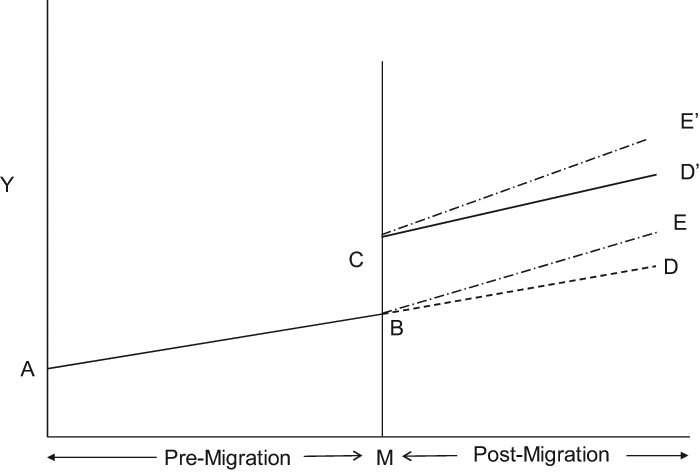
Theorised pre- and post-migration income effects to an escalator region.
Migrants may also experience wage gains stemming from processes that are more gradual, reflective of learning effects (A – E). In large metropolitan areas, workers will tend to encounter more people from whom they can learn (Glaeser and Maré, 2001). Furthermore, because workers and firms are often not fully aware of each other’s capabilities, the process of matching worker skills and abilities with job tasks is often imperfect. As a result, workers may have to engage in a series of matches before they find the right one. The thick labour markets that characterise large metropolitan areas are expected to accelerate this process, leading to more rapid wage gains over time. Of course, the learning process may be tied to the rate at which workers switch between jobs. Switching between organisations offers workers the opportunity to learn from new people and, more broadly, new business cultures. Therefore, the process of learning and switching may be endogenous: as workers gain experience within an organisation they may exhaust their learning opportunities and this prompts a move to a new organisation—switching promotes learning and learning promotes switching. Learning effects may also be delayed by age of the migrant or by duration of residence effects in the destination, particularly in dual-earner households where one partner may experience declines in earnings given disruptions to labour force participation and employment. Cooke et al. (2009), for instance, found that women’s earnings (in so much that they are often ‘tied’ migrants) fall with migration and recover slowly afterward. Similarly, Clark and Withers (2002) noted that migration reduced employment amongst married women by over 20 per cent, with the recovery to pre-migration wage levels taking approximately one year. Migration may also sever job-specific skills in the origin that cannot be transferred to the destination (Bonney and Love, 1991) and tied migrants may be underemployed relative to their skill levels after migration (Markham, 1986).
Finally, moving to a large metropolitan area may result in a discontinuous increase in wages as well as an increase in the rate of wage growth. That is, the migrant experiences wage increases tied to both productivity and learning effects (A – E’), which links to Fielding’s broader concept of the escalator region—that some regions provide conditions that are suited to accelerating the career progress of workers, motivating individuals to seek out these regions early in their career.
All of these effects can be traced to the externalities that arise from the concentration of workers and firms in one place. Higher firm-level productivity is linked to these large urban economies (see Puga, 2010), as is the concomitant specialisation of firm-based tasks and worker skills that improves the quality of the initial match and the consequent post-migration upward step in wages (see Kim, 1989 and 1990). It is also this concentration of workers and firms that facilitates the slower process of learning and matching. Distinguishing between the step and the escalator speaks to whether cities provide not only an initial productive advantage stemming from a one-time improvement of worker productivity or whether cities also facilitate a dynamic that accelerates wages over time through the entwined processes of learning and matching.
We test these ideas using the Toronto CMA as an example. One of the key confounding issues, however, is migrant self-selection and their unobserved characteristics. Rather than representing a random sample of the population, individuals who migrate are also likely to be the ones who expect to experience the greatest gains from migration because of their superior skills and abilities, making casual observation of the outcomes associated with migration problematic (Nakosteen and Zimmer 1980). Selection bias is addressed by employing propensity score matching techniques. Finally, much of the work to date testing the escalator hypothesis has focused on metropolitan areas in the UK (and specifically London and the South East). By using Toronto, we are able to test whether concepts from the escalator hypothesis hold in a different context.
3. Data and Methods
This research evaluates the impact of income change due to migration into Toronto among young labour force migrants. In the absence of the long-term longitudinal data that follow individuals and their occupational and residential transitions that is needed to evaluate the escalator hypothesis, the paper uses three complementary data sources: the master (20 per cent) file of the 2006 Canadian census; the 1993, 1996 and 1999 panels of the Survey of Labour Income and Dynamics (SLID); and, the Longitudinal Administrate Databank (LAD) covering the period 1982 to 2006. The census file is a large, nationally representative database that provides a ‘snapshot’ of the population on census day. SLID is a longitudinal survey with each panel collecting labour market and income information over a six-year period representing approximately 30 000 households in each panel. In addition to labour market activity and income information, SLID collects information on household location, socioeconomic and demographic characteristics. SLID files allow the longitudinal analysis of change in residential location and income, enabling the income of migrants and stayers to be compared while controlling for fixed effects such as gender. The LAD file includes nearly 5 million tax-filers in 2006, representing a 20 per cent longitudinal sample of all tax-filers and their families. Including income (adjusted to a 2006 base year) and (limited) demographic, mobility histories can be constructed and linked to income data to construct detailed histories of migrants and stayers. Once selected, tax-filers remain in the sample even if they do not file tax returns in subsequent years.
Since the intent is to gain insight into the effect of migration on income, migrants are distinguished by those who migrated into the Toronto CMA over a prescribed interval (either the five-year interval defined by the census or between years t and t + 1 in the SLID and LAD). Migrants (and stayers) must have reported a place of residence in Canada at the start of the interval (inclusive of the foreign-born), were not full-time students and reported earned income before and after migration. In addition, individuals may have migrated into other large, medium or small urban areas, as well as into rural areas. 6 Other large urban areas include CMAs with a population greater than 500 000 (Montreal, Vancouver, Ottawa, Winnipeg, Quebec City, Calgary and Edmonton, except Toronto). Medium urban areas include CMAs with populations between 100 000 and 499 999. Small urban areas take in census agglomerations (CAs) with a population greater than 10 000. Rural is defined as non-CMA/CA census sub-divisions. Stayers are defined as those who: stayed in Toronto over the defined period; or, stayed elsewhere in Canada over the interval.
Census files are used two ways. First, the mean earned incomes for the set of migrants and stayers are calculated. The census sample is restricted to individuals aged 20–29 (at the end of the census interval) who are not institutionalised and reported earning an income in 2005. The focus on the young cohort represents those most likely to migrate for employment reasons and ‘onto the escalator’. The choice of the 20–29 age-group is also consistent with the escalator theory, capturing a cohort that is at the start of their career and therefore quickly developing income growth, a portion of which could be ‘supercharged’ by moving to cities such as Toronto where the economic structure is richest.
Secondly, multiple regression (OLS) is used to evaluate the correlates of income (log earned income in 2005) and to assess the income advantage associated with migration, defined by

where, W k is the log of earned income for individual k; X k is a vector of individual characteristics (degree holder status, age, gender, knowledge worker status, employment status (self-employed/employed), visible minority status and full-/part-time status); and U k is a set of dummy variables capturing migrant and stayer statuses. Equivalent models are estimated for those migrating into Toronto contrasted with those who stayed in Toronto over the census interval.
The SLID sample focuses on employed individuals aged 20–29 (by end of panel) 7 who reported earned income, with migrants including anyone that moved between year t and t + 1 in any of the panels. To allow for sufficient sample size, the three panels were merged to form one composite ‘panel’. Individuals who are institutionalised (i.e. residents of long-term care facilities) were excluded from the sample, as were residents of Canada’s three northern territories. Two income measures are calculated (see Table 1): difference in after-tax income between the beginning and end panels (income in year 6 – income in year 1) by migrant status; and, average pre- and post-migration 8 income. 9 Following Glaeser and Maré (2001), a first-difference model is used to estimate the difference in the log of after-tax income of migrants and stayers, removing individual and time-invariant omitted ability bias (Bradley et al., 2009)

where, ΔW k is the difference in the log of income between year 1 and year 6 for individual k in each panel; λ is a dummy variable corresponding to the SLID panel (1, 2 or 3); and Γ is a set of dummy variables capturing the range of migrant and stayer statuses.
Income measures by data file
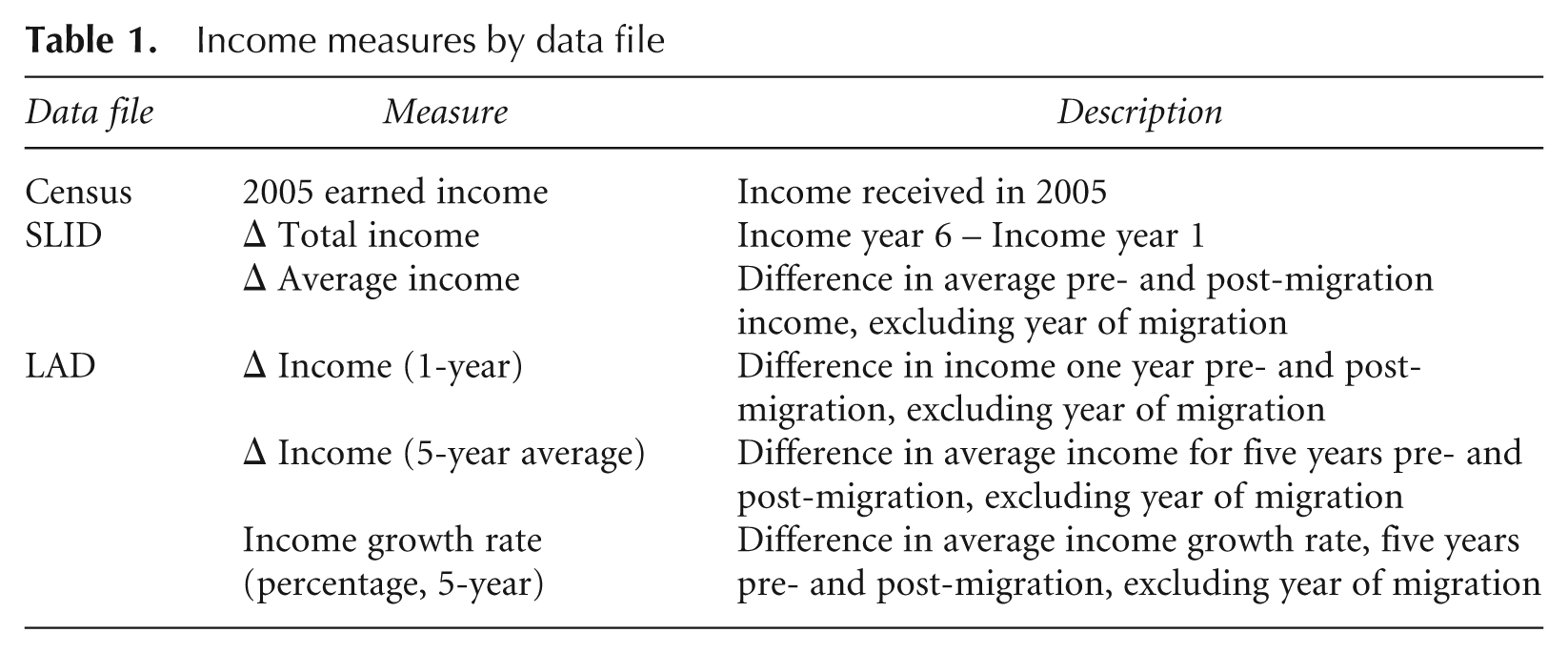
Analysis based on the LAD files consists of evaluation of the mean difference in individual employment income measured by: 1-year pre- and post-migration; 5-year average income pre- and post-migration; and, 5-year rate of income growth pre- and post-migration (i.e. difference in rate of income growth 5 years prior to migration and 5 years post-migration), excluding the year of migration. Focusing on the change in income immediately after migration asks whether there appears to be a discontinuous change in income level associated with migration and therefore evaluates the potential for productivity effects associated with migration. Conversely, the rate of growth in income following the migration evaluates learning effects: did migration into Toronto result in increased learning (rewarded by faster income growth) as compared with an equivalent migration elsewhere or with stayers?
Nominal earned income (as opposed to real earned income) determines whether income increases are associated with productivity or learning effects, irrespective of place. Real income is inappropriate since much of the variation in real (purchasing power parity) incomes stem from differences in shelter costs 10 that are partially driven by the capitalisation of higher incomes in land prices. Thus, while real incomes capture housing price differences (see for example, Korpi et al., 2011), real income measures would also obscure the productivity-enhancing effect of escalator regions.
4. Results
Table 2 reports income based on the three data files. Census results reveal a benefit for in-migrants to Toronto, with in-migrants reporting an income of $29 486, a value exceeding all other incomes regardless of migrant or stayer status. In fact, almost all migrants—whether into other large urban areas or rural areas—appeared to receive greater income benefits as compared with stayers. For instance, migrants into other large urban areas (excluding Toronto), migrants into small urban areas and migrants into rural areas all reported incomes higher than individuals who stayed in Toronto, with a mean income of $23 406. Other stayers—or those who stayed in the same location between 2001 and 2006 (excepting residents of Toronto)—earned just $21 889 in 2005, significantly less than migrants.
Pre- and post-migration income differences by migration status ($): migrants aged 20–29

Notes: Values based on migrants resident in Canada at start of interval and reporting an earned income. Δ total AT income = income in year 6 – income in year 1 of SLID. Δ average AT income = change in average pre- and post- migration income, 5 years pre- and post-migration. LAD values normalised to 2006 and based on individual total income.
For the SLID, values reported indicate the mean difference in: after-tax income between the beginning and end panels by migrant status; and, average pre- and post-migration after-tax income. For the former, migrants into the Toronto CMA experienced the largest increase in income ($18 469), an increase that was greater than for those who stayed in Toronto ($13 f818). While those who stayed in Toronto also experienced increased income, the jump was not as substantial. Migrants into other urban areas also experienced increases in income, but not as large as if they had migrated into Toronto. For example, individuals who moved into other large metropolitan areas (excluding Toronto) saw their income increase by $12 692 and migrants into small urban areas saw incomes increase by $12 991 over the same period. In contrast, the smallest increase in income was associated with individuals who moved to rural areas ($9 752). Hence, migration into Toronto appeared to provide the greatest monetary gain. For the latter (difference in average pre- and post-migration income), similar results are noted. That is, migrants into Toronto demonstrated a clear income advantage of $12 207. Migrants into other urban areas also benefited relative to either ‘other stayers’ or those who migrated into rural areas, with a difference of only $5511 between average pre- and post-migration incomes.
Results based on the LAD file demonstrate similar patterns. Once again, migrants into Toronto report the largest income difference compared with other stayers and migrants. In fact, migration into most urban areas appeared to confer an income advantage, with the greatest advantage for Toronto-bound migrants. For instance, a migrant into Toronto observed a difference of $15 300 when incomes 1-year pre- and post-migration are compared. Those who stayed in Toronto experienced an increase of just $4200 in the same period, while migrants into other large urban areas had an income gain of $7100. Differences in pre- and post-migration incomes generally decreased with movement down the urban–rural hierarchy. Migrants into rural areas reported the smallest income difference ($3000).
We extend this by considering: the difference in average income 5 years pre- and post-migration; and, the difference in the growth rate of income 5 years pre- and post-migration. In both cases, individuals must have reported a taxable income 5 years pre- and post-migration. In the first instance, in-migrants to Toronto reported the largest income difference ($29 000). Once again, migrants into other large urban areas appeared to gain an income advantage ($15 800) compared with those who stayed in Toronto reporting a difference of just $12 700. Migrants to other urban areas reported approximately the same income difference as those who stayed in Toronto and migrants into rural areas reported an income difference of just $11 000.
Secondly, migration into Toronto does not appear to convey any particular advantage in terms of the difference in the rate of income growth (1.7 per cent) relative to those who stayed in Toronto (1.7 per cent). That is, migrants into Toronto and those who stayed essentially experienced the same income growth rates. In fact, migrants into other large urban areas experienced somewhat faster growth (1.9 per cent), while the growth rate was significantly more for migrants into small urban areas (3.3 per cent). Migrants into rural areas had the smallest growth rate (0.6 per cent) over the 5-year interval.
Overall, migrants into Toronto appear to benefit monetarily as compared with other migrants or those who stayed, evidenced by substantial jumps in income. However, given that income growth rates for migrants into Toronto were comparable with those who stayed, the increase in income associated with migration into Toronto is more consistent with productivity effects than learning effects. The remainder of the paper addresses the robustness of these findings to the entangled influences of omitted variable and selection bias.
4.1 Multivariate Results
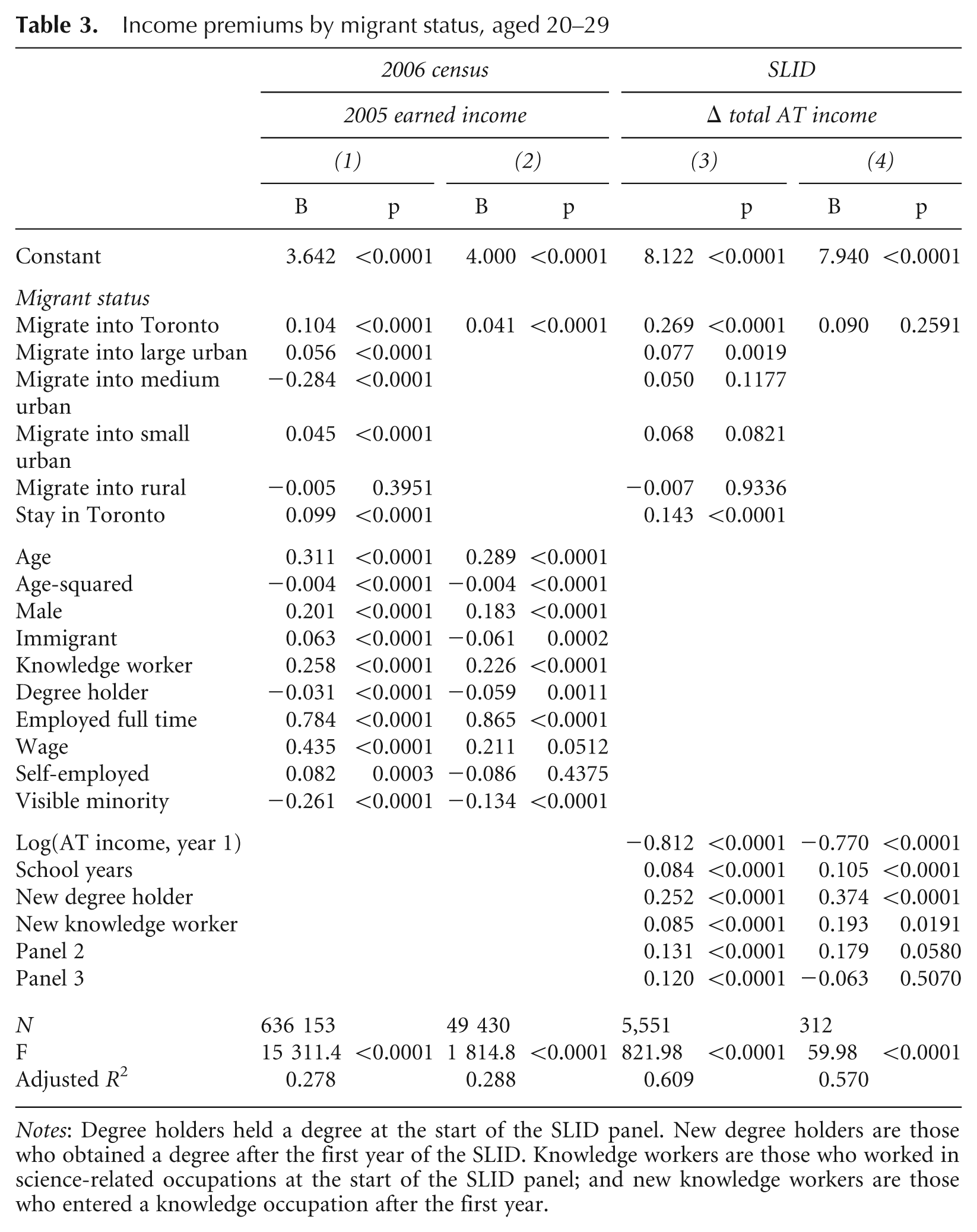
Differences in income by migrant status may simply reflect the intertwined effects of unobserved abilities and skills and selection. Income gains from migration to Toronto may be driven more by the harvesting of workers with superior skills and abilities than any role that Toronto might play as an escalator region. For this reason, we turn first to the multivariate analysis of income level and income growth, using the 2006 census and SLID files respectively (Table 3).
Income premiums by migrant status, aged 20–29
Notes: Degree holders held a degree at the start of the SLID panel. New degree holders are those who obtained a degree after the first year of the SLID. Knowledge workers are those who worked in science-related occupations at the start of the SLID panel; and new knowledge workers are those who entered a knowledge occupation after the first year.
Based on the census, 11 the premium gained for moving to Toronto was about 10.4 per cent, or essentially the same as the premium for those who stayed in Toronto (about 9.9 per cent) (column 1). However, migrants moving to Toronto received a larger premium than other migrants, while migrants into medium urban areas reported a lower income relative to non-Toronto stayers (the reference category), echoing Adamson et al. (2004) who noted similar results for return to skills in the case of American cities. Although the income benefit of these migrations was less than if they had migrated to Toronto, their incomes were still higher than if they had not moved. Other correlates of earned income behaved largely as expected, with higher incomes associated with older ages (with income increasing but at a declining rate), knowledge workers, the self-employed and males. Some of the largest effects on income are associated with full-time workers and wage earners. Conversely, visible minorities reported lower incomes. Surprisingly, degree holders were also associated with lower earnings, although this may be because of lost experience resulting from education-delayed entry into the workforce for these young workers and that the effect of knowledge worker status on incomes is taken into account. 12 The model reported in column 2 compares reported incomes amongst in-migrants to Toronto relative to those who stayed in Toronto. Similar to the results presented in column 1, migration into Toronto conferred an income advantage, with in-migrants benefiting from an income premium of 4.1 per cent relative to those who stayed in Toronto.
The third and fourth columns present first-difference model results evaluating the effect of migrant status on the change in income based on the SLID. Differencing addresses the influence of fixed, unobserved characteristics of migrants and non-migrants (for example, abilities) that might bias estimates of the Toronto income premium derived from the census. Included in both models are the change in a set of migrant characteristics thought to influence income growth (for example, degree holder status), initial income levels to take into account regression to the mean, a set of migrant status variables and controls for the panels.
The SLID results reinforce the census results, with individuals who migrated into Toronto experiencing an income premium. While migrants into other large urban areas also experienced a significant increase in income relative to non-Toronto stayers, the income premium for Toronto in-migrants exceeded that of all other migrants (column 3). Turning to other effects, individuals who received a bachelor’s degree over the panel (degree change) and new knowledge workers experienced a larger increase in income, regardless of migrant status. Likewise, increased number of years in school was associated with greater income benefits. As expected, the coefficient on initial income levels is negative and significant. Column 4 contrasts Toronto in-migrants to those who remained in Toronto over the panel. In this case, the change in income, while positive, was not significant, suggesting that migration does not confer an income advantage relative to Toronto stayers. However, this is not entirely surprising, given the smaller sample size and the less efficient first-difference estimator.
4.2 Accounting for Selection
In estimating the returns to migration, the problem that we are faced with is that migrants (the ‘treated’) may be self-selective. That is, gains in earnings may not be due to productivity and/or learning effects, but workers with unobserved skills and abilities being more likely to migrate. Consequently, the estimated effect of migration can be biased if the selection mechanism is correlated with the outcome, such that migrants are endowed with attributes that make them more mobile, and ultimately more productive, in alternate locations.
To account for this problem, propensity score matching is used to control for migrant selectivity (Ham et al., 2004; Moilanen, 2010; Rosenbaum and Rubin, 1983), while estimating the effect of migration into Toronto on income growth. We let D = 1 if an individual migrates and D = 0 otherwise, with the income outcomes defined as Y1 and Y0. We wish to estimate the average treatment effect on the treated (ATT)

The first term on the right-hand side is observed, but we do not observe the income gain migrants would have experienced had they not migrated
Propensity score matching assumes unconfoundedness:
The choice of conditioning variables for inclusion is associated with increasing/decreasing migration propensity, as indicated by the literature. The matching procedure balances the observed covariates between migrants and stayers 13 to make the distribution of the counterfactual outcome of migration the same as for the group of stayers. As noted, the LAD and SLID files are complementary and, while both are longitudinal, they differ in the set of conditioning (independent) effects. SLID provides an expanded set of conditioning variables, including educational attainment (less than high school, high school graduate and degree holder), whether an individual is a ‘knowledge worker’ (individuals in science, education or other ‘creative’ occupations) and origin location. SLID data also allow the construction of variables capturing whether an individual received a degree over the period or became a new knowledge worker over the period. The LAD is advantaged because it provides more information on the trajectory of migrant incomes over time, although it is disadvantaged by its comparatively limited set of demographic measures for migrants (for example, age, gender, language, immigrant status, visible minority status and family type, but not education or marital status). It is also better able to parse income gains associated with migration into learning and productivity effects given the ability to measure income growth rates, while the SLID is only able to capture the combined effect of learning and productivity on incomes. It is therefore worthwhile pursuing the propensity score matching for both datasets in order to take advantage of their complementarities. In both cases (SLID and LAD estimation), the log of initial income levels are included to take into account regression to the mean.
New knowledge worker and new degree holders represent potentially important conditioning variables, but they may also be problematic. Changes in worker occupation and educational status may represent important differences between the treated and untreated groups, particularly for young workers. However, the decision to obtain a degree or change occupation may be affected by the decision to migrate. It would not be unreasonable to expect the decision to migrate to Toronto to lead a migrant to change their occupation and/or to obtain a degree. If true, then the unconfoundedness assumption would be violated, an issue we return to in the results.
Logit models are used to calculate the propensity scores,
Table 4 reports the propensity score coefficients based on the SLID data. 15 Migrants to Toronto benefited from an income advantage. In each model, the income gains (ATT) are significantly higher for migrants as compared with migrants who moved elsewhere in Canada’s urban system, as well as relative to non-Toronto stayers. On average, Toronto migrants earned an additional $4100 compared with those who moved elsewhere. Relative income gains are about the same when pre- and post-migration income of migrants to Toronto is compared with other migrants ($4134) or stayers ($4269) and when end and start income are compared ($4968 relative to other migrants and $5039 compared with stayers). These additional income gains are non-trivial: compared with other migrants, migrants to Toronto increased their incomes by an additional $4100 or 52 per cent ($12 079 versus $7946).
SLID propensity score matching estimates of the effect of migration to Toronto on earned income relative to other migrants and non-migrants ($)

Notes: For all models, the average treatment effect on the treated (ATT) is significant at the 5 per cent confidence level or below. The restricted model excludes new knowledge worker and new degree holder.
Also of interest is the difference between the ATT and the unmatched income differences. In all cases, the ATT is lower. Hence, part of the measured income effect derived from migration can be attributed to correlation of the decision to migrate with other characteristics of migrants that influence income gains. Whether all of the selection bias has been accounted for is open to question and we therefore cannot attribute all of the remaining income gains to productivity and learning effects, but there are patterns in the results that are comforting. In particular, the magnitude of the selection effect is greater when the income gains of migrants to Toronto are compared with stayers as opposed to other migrants. This is an intuitive result, as we would expect migrants to Toronto to have more in common with other migrants than stayers. Furthermore, after matching, the gains from migration were the same regardless of the comparison group (i.e. other migrants or stayers). These findings would be expected if the model were effectively controlling for selection.
Since the inclusion of new knowledge workers and new degree holders may violate the unconfoundedness assumption, a set of models was estimated with these excluded. Their exclusion increases the value of the ATT, particularly when stayers are used as a control group (not shown). 16 As a result, the intuitive results of the full model no longer hold, because the ATT across comparison groups now differ markedly. The full model, therefore, is preferred because it provides more conservative estimates of the ATT that meet our expectations. However, this is a preference that is tempered by the problematic nature of these two variables. As a result, the greatest emphasis should be placed on the gains from migration to Toronto as measured by the difference between average pre- and post migration income in comparison with other migrants. It is here that selection appears to have the weakest influence on the results and the results are the least sensitive to the model chosen.
Analysis based on the LAD data files reinforces the income benefits of migration. While reducing the number of potential covariates associated with migration and income, the LAD provides greater longitudinal detail and sample size. Once again, migrants to Toronto received a substantial income benefit (Table 5), receiving an income advantage consistent with productivity effects when incomes were contrasted one and five years pre- and post-migration (models 1 and 2). For instance, in-migrants to Toronto received an income advantage exceeding $8600 just one year after migration as compared with non-Toronto migrants. The income advantage also remains over longer periods: when income five years pre- and post-migration is considered, migrants to Toronto have nearly a $16 500 income advantage when compared with other migrants.
LAD propensity score matching estimates of the effect of migration to Toronto on earned income (selected models)
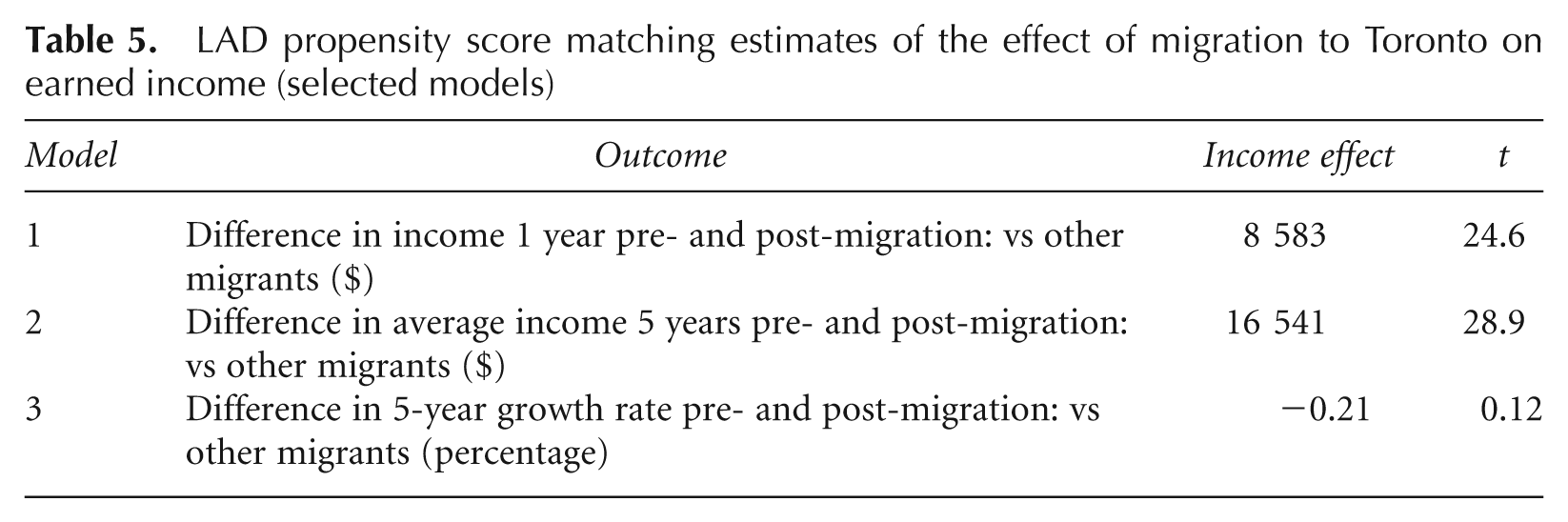
While there is an immediate post-migration level effect (model 3), the propensity score results do not show a significant effect in terms of income growth rates. That is, income does not appear to grow significantly faster if an individual migrated to Toronto as compared with other migrants, relative to their pre-migration income growth rate. Once again, therefore, the increase in income associated with migration into Toronto does not appear to reflect learning effects, but only a productivity effect.
5. Conclusions
This paper has explored the income gains or differences of migrants into an escalator region relative to migrants to other destinations within the Canadian urban hierarchy as well as stayers, using Toronto as an example of an escalator region. Our conclusions are reinforced by the use of three complementary data files, including the LAD that allows both productivity and learning effects to be evaluated, the use of propensity score matching methods to account for migrant selectivity and that provides an innovative way to evaluate income gains associated with migration, and the use of first-differencing with the SLID and LAD files which serve to remove individual and time-invariant omitted ability bias.
Consistent with both the escalator theory and income growth theory, migration into Toronto is associated with an income premium, such that in-migrants receive an income benefit that exceeds income benefits associated with migrations to other urban areas and/or staying. That is, while migrations to other large, medium or small urban areas are also often associated with income benefits, the benefits of migrating to Toronto appear to be greater. Income gains or income differences for migrants into smaller urban areas are, in general, modest and may be coincident with job changes, an effect that has also been associated with income premiums (Topel and Ward, 1992). In effect, it would appear that income growth was accelerated by migrating into Toronto—a productivity effect. There is less evidence that there is an additional learning effect. Perhaps to push the metaphor too far, Toronto may be functioning more as an elevator than an escalator.
Several outstanding questions remain, including why have we not identified a strong learning effect when other researches (for example, Glaeser, 1999; Glaeser and Maré, 2001) have found one? The answer remains elusive. It may be, for instance, that only certain types of worker benefit from migration and the learning effect is being averaged out across the broader migrant pool. It may also be that learning effects are dominant amongst those more entrenched in the labour market—wage earners and full-time employees. Additionally, why do Toronto’s in-migrants receive such positive income benefits, exceeding those of migrants into other urban areas? In part, wages benefits may reflect increased productivity, premiums associated with the demand for specialised skills, the ability to provide better labour matching, the concentration and diversity of high-order managerial and professional functions found within large urban areas, and employment options perhaps not found elsewhere in Canada. In this way, Toronto could act as an escalator for some and not for others. Likewise, occupational change and promotion potentially play a significant role and the concurrent changes would be worth exploring. Yet, which factor(s) plays a more important role in setting income levels? Do other large metropolitan areas such as Vancouver, Calgary or Montreal serve as regional escalators or for particular occupations? Similarly, where does gender, in as much that women and men still operate in different labour markets, affect income growth?
Footnotes
Acknowledgements
The authors wish to acknowledge the support of colleagues in the Economic Analysis Division at Statistics Canada and the analytical help of Philippe Gougeon, Statistics Canada.
Notes
Funding Statement
The first author was supported by a Tom Symon’s Research Fellowship while at Statistics Canada.