




Abstract
Research on iconic architecture has typically explained its popularity with reference to global political-economic trends like neo-liberalism and urban entrepreneurialism, but the role of the immediate clients has often been overlooked. Quantitative analysis demonstrates that the majority of these clients are public cultural institutions. In order to explain the affinity between this organisational form and iconic architecture, this paper develops a model of the public institution based on its need to establish public legitimacy and attract outside support. To develop this model further, the paper presents a comparative case study of two museum expansion projects in Toronto: Daniel Libeskind’s Royal Ontario Museum and Frank Gehry’s Art Gallery of Ontario. The study addresses the underlying motivations behind the projects, the role of global political-economic trends and how the unique logic of the public institution structured the development process itself.
In the spring of 2003, the Royal Ontario Museum (ROM) in Toronto began to demolish its north wing—a modest glass and concrete terraced structure built in the early 1980s. Over the next four years, a new building emerged with a jagged crystalline exterior that towered several storeys over the sidewalk. Designed by architect Daniel Libeskind, the ROM ‘Crystal’ is characterised by its aluminum skin and the fact that none of its walls meets at right angles. A few blocks away, a similar transformation was taking place at the Art Gallery of Ontario (AGO) which replaced its brown brick façade with a curved glass ‘visor’ and a bright blue titanium tower with spiralling staircases extending into mid-air. These attention-grabbing features (see Figure 1) were designed by Frank Gehry, perhaps the best-known living architect in the world.

The Royal Ontario Museum (above) and the Art Gallery of Ontario (below).
While unprecedented in Toronto, these projects do fit into an international trend of iconic architectural development that has come to be termed “starchitecture” (perhaps more so by critics than supporters) (McNeill, 2009; Rochon, 2009). In its physical form, starchitecture is defined by spectacular and iconic buildings designed primarily to attract attention on an international scale (Kaika and Thielen, 2006, p. 66; Evans, 2003; Plaza, 2008). Its practitioners are characterised by their celebrity status and public personas associated with artistic genius, aesthetic innovation and personal quirks (McNeill, 2005, 2009). Despite public debates over its death in the face of the 2008 global recession (McGuigan, 2010; Glancey, 2009), there is little evidence that iconic architectural developments are actually on the decline.
Scholarly explanations for the popularity of iconic architecture often propose a ‘neo-liberal thesis’ that points to global political-economic trends and the advancement of a market logic into the governance of cities (Kaika and Thielen, 2006; González, 2011; Sklair, 2005; Evans, 2003). Surprisingly, very little attention has been given to the primary clients of iconic architecture: public cultural institutions such as the ROM and the AGO. Since they are not tied directly to the market (DiMaggio, 1982, p. 38), the central role of public institutions presents some complications for the neo-liberal thesis. Why has there been such an affinity between public institutions and iconic architecture? What is at stake for these institutions? And how do they relate to larger trends of neo-liberalism? I attempt to answers these questions through a comparative case study of the ROM and AGO expansion projects.
The paper proceeds in four sections. First, I review the existing literature on iconic architectural development, focusing specifically on the neo-liberal thesis. Secondly, I address the question of who actually builds starchitecture using a dataset of iconic buildings that provides evidence for the primary role of the public cultural institution. Thirdly, I draw on organisational theory in order to sketch briefly a sociological model of the public cultural institution. These organisations, I argue, depend primarily on establishing ‘public legitimacy’, which allows them to attract the outside support and donations necessary to sustain themselves. I further argue that iconic architectural development should be seen as a strategy of managing and building public legitimacy in an era of neo-liberalism.
The final and largest section of the paper presents findings from my study of the ROM and AGO expansion projects. The analysis is framed around two major questions. First, how did two organisations with very different dilemmas end up adopting the same strategy of iconic architectural development? While the ROM was facing a decline in its public profile, the AGO was attempting to secure a major art donation. Nonetheless, larger macro-level factors that included neo-liberal policies and global networks of élites made iconic architectural development a seductive strategy for both institutions. Secondly, how did the need to build and maintain public legitimacy constrain and enable the two museums during the development process? In answering this question, I compare the implications of the ROM’s public architectural competition with the AGO’s decision to hire Gehry behind closed doors. Both strategies led to unanticipated legitimacy ‘crises’ (Suchman, 1995). Examining the origins and eventual resolutions of these crises helps us to understand how the organisational logic of public institutions structures the development process.
The primary goal of this paper is to examine the unique role of public institutions as independent players within cities that interact with but are not determined by the larger global forces of neo-liberalism. However, this organisational perspective also offers more general insights into the role of ideas in urbanisation. I introduce concepts such as ‘legitimacy’ (Suchman, 1995) and ‘institutional logic’ (Friedland and Alford, 1991) that help to improve our understanding of how the material resources and political power required for iconic architectural development are tied into symbolic systems.
Accounting for Iconic Architecture: The Neo-liberal Thesis
David Harvey, whose work is foundational to urban political-economy, has described neo-liberalism as a theory and set of practices designed to “bring all human action into the domain of the market” (Harvey, 2005, p. 3). 1 As the market-based policies of neo-liberalism began to replace welfare state programmes in the late 20th century, Western cities that rely on funding from upper levels of government were forced to search for new sources of income in the private sector. Competing for private funding, Harvey argues that cities shifted from a managerial model of governing focused primarily on the amelioration of living conditions to an entrepreneurial model aimed at creating speculative investment opportunities for private capital (Harvey, 1989). Rephrased in organisational theory, neo-liberalism represents a shift in what Friedland and Alford call ‘institutional logic’, which they define as “a set of material practices and symbolic constructions which constitutes [the] organizing principles” of an institution (Friedland and Alford, 1991, p. 248). Institutional logics provide individuals and organisations with acceptable paths of action and cognitive tools required to make sense of their situation (Vaughan, 2002). In this case, the governance of cities has shifted from one based in the logic of democracy and state bureaucracy (i.e. managerialism) towards the logic of the marketplace (entrepreneurialism).
In order for urban entrepreneurialism to work, its proponents must identify a viable marketplace. Due to the decline of the industrial sector in the West, entrepreneurial strategies have largely targeted the cultural economy, which includes tourism, retail and cultural production (Zukin, 1995). Culture plays a central role not only because it is a growing sector (Markusen, 2006; Scott, 1997), but also because it is thought to stimulate local economic growth more widely (Florida, 2002; Miles and Paddison, 2005). City governments have sought to revive their declining industrial landscape by investing in speculative development projects that produce spectacular and cutting-edge cultural destinations that include shopping malls, art districts, casinos and unique streetscapes (Voyce, 2006; Mommaas, 2004; Hannigan, 2007; Sandercock and Dovey, 2002; Julier, 2005).
Starchitecture is perhaps the most high-profile form of cultural entrepreneurialism. Frank Gehry’s Guggenheim Museum in Bilbao, Spain, is held up by urban planners, media commentators and business interests as an exemplar of how investment in landmark cultural sites with unique and compelling architecture can act as a catalyst for general economic growth within an entire city (i.e. the so-called Bilbao effect) (Plaza, 2008; González, 2011; Evans, 2003; Shoval and Strom, 2009). The appeal of starchitecture can only be fully understood in the context of global networks of corporate, state, professional and media actors that form an international organisational field, encouraging cities to get involved in global competition over producing the best architectural icons (Sklair, 2005; McNeill, 2005; González, 2011). The role of these networks highlights the fact that starchitecture is a fundamentally global phenomenon (Evans, 2003; Shoval and Strom, 2009).
Who Builds Starchitecture?
While the neo-liberal thesis and existing literature have focused more on the macro political-economic conditions that underlie iconic architecture, it is important that we do not lose sight of the immediate parties that actually hire celebrity architects and finance their unique buildings. In fact, from a client’s perspective, there are many reasons to believe that starchitecture is a particularly unattractive form of development. It is more expensive. Its unique designs are more risky to build and their outcomes less certain. High-status architects are less dependent on any one client which gives them more personal leverage on projects. So who are the clients who choose starchitecture despite its many drawbacks?
To answer this question, I have compiled a dataset of iconic buildings categorised by development type (for example, public art museum, private residence, corporate headquarters). These buildings were gathered from the selected works listed for all of the winners on the official Pritzker Prize website (Hyatt Foundation, 2011). Although not an exact measure, the prize is a concrete indicator that is often used to operationalise the vague concept of ‘starchitect’ (Fuerst et al., 2011; McNeill, 2005, p. 502). Figure 2 provides a breakdown of the buildings by development type, dividing them into public, commercial and other. 2
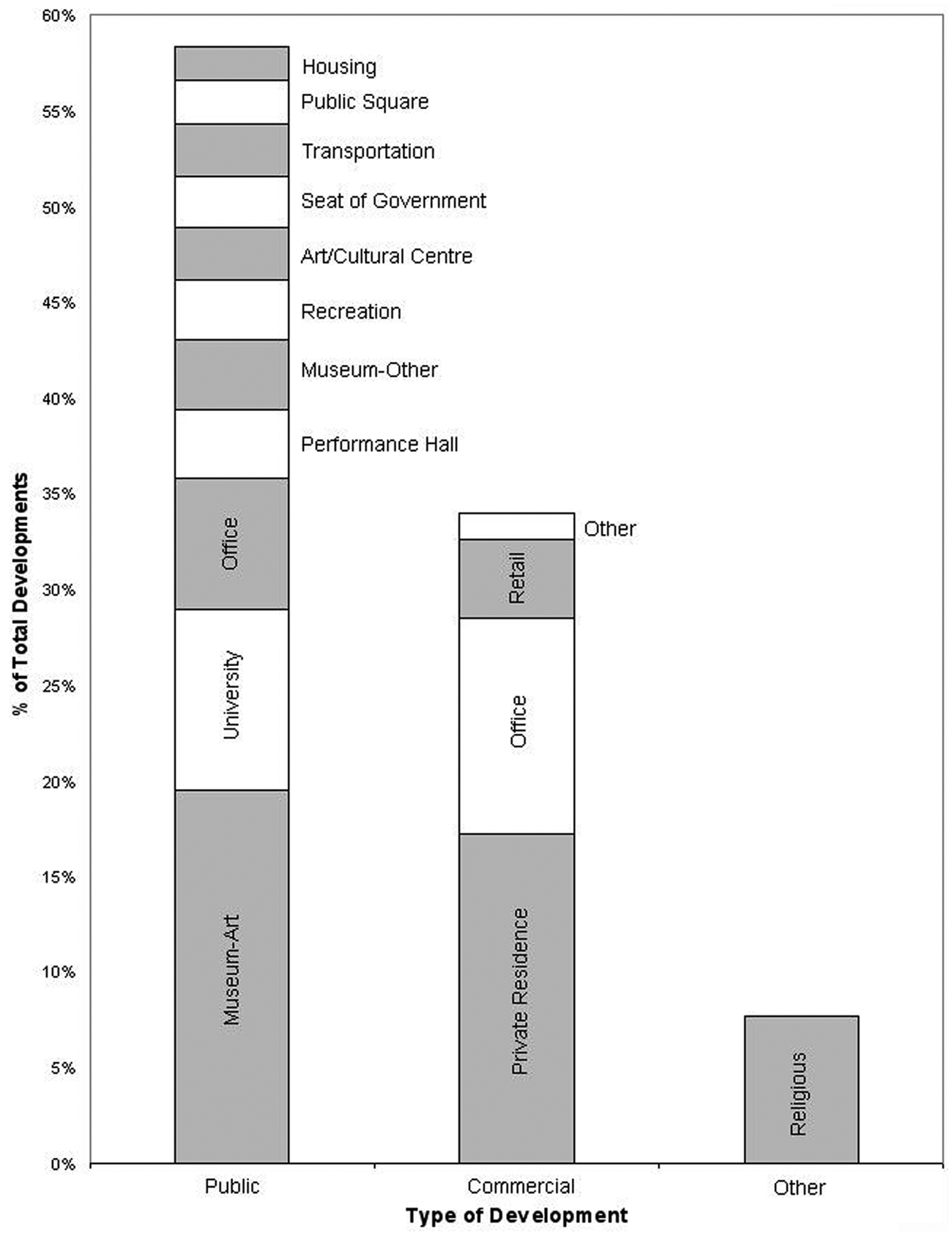
Developments featured in the portfolios of Pritzker Prize winners as listed on the official Pritzker Prize website (Hyatt Foundation, 2011), organised by development type.
It is evident from the data that iconic architecture is clearly a public-sector activity, particularly among cultural institutions that commission museums, performance halls and other cultural spaces. However, starchitects are also hired to design more mundane public spaces like government offices, housing and transport hubs. The much lower number of commercial developments is also notable given that iconic architecture has been characterised as representing the interests of private capital and the market. If this was the case, we might expect a larger proportion of buildings designed for retail, corporate headquarters or condominiums. At least among Pritzker Prize winners, there is little support for this claim. What these results tell us is that the private sector’s involvement in iconic architecture is indirect.
The ability of the neo-liberal thesis to explain these results is clearly limited. Public cultural institutions do not generate profit for investors. The hope of stimulating the local economy through a ‘Bilbao effect’ may provide some indirect benefits, but it would be a stretch to think that it is their primary concern. Thus, to understand the role of the public cultural institution in supporting the starchitect phenomenon, we must go beyond the neo-liberal thesis and examine this unique organisational form in more detail.
The Public Cultural Institution
Public institutions—cultural or otherwise—are organisations oriented primarily towards the institutional logic of democracy, not markets. Their existence as organisations is not tied to profitability, but to a belief among an outside population that they serve a general public interest.
3
This phenomenon, which can be called ‘public legitimacy’, allows public institutions to attract support and donations from outsiders without offering any immediate or significant returns. Organisational theory defines legitimacy more broadly as
a generalized perception or assumption that the actions of an entity are desirable, proper, or appropriate within some socially constructed system of norms, values, beliefs, and definitions (Suchman, 1995, p. 574).
Within democratic systems, public institutions live and die by their ability to build sufficient public legitimacy and attract outside support, be it from the government, wealthy patrons or more grassroots populations (Boin and Christensen, 2008). In the cultural sector, public legitimacy is typically associated with the production, preservation and exhibition of cultural forms that are seen as having value beyond private consumption (for example, fine arts rather than popular culture).
Sociological theory typically depicts legitimacy as being taken-for-granted or habitualised (Boin and Christensen, 2008; Johnson et al., 2006; Berger and Luckmann, 1966). This assertion, however, masks the fact that legitimacy often requires active management in order to be sustained (Suchman, 1995), particularly in the cultural sector where public institutions face ambiguous goals, competition from other cultural producers and unstable funding arrangements. The result of this is that cultural institutions are required to make continual, explicit claims to public legitimacy. Legitimacy management should therefore be seen as fundamental to the organisational logic of the public institution, constituting a set of ‘front stage’ practices that need to be balanced carefully with the ‘back stage’ practices involved in managing any complex organisation (Goffman, 1959; Boin and Christensen, 2008, p. 275).
Of course public institutions are as much defined by who accepts their legitimacy as they are by the establishment of that legitimacy in the first place. Support for public institutions in North America can be traced from their founding by the urban bourgeoisie in the 19th century (DiMaggio, 1982), to the welfare state in the early 20th century (DiMaggio, 1986; Peterson, 1986; Cavendish, 1986) and, finally, to the corporate sector and non-governmental foundations as government funding has been cut back (Alexander, 1996b). Internal changes within public cultural institutions have mirrored their shifting support base. The early charismatic impresarios were eventually replaced by a professional class of arts administrators (Peterson, 1986; DiMaggio, 1986), and more recently cultural institutions have been pressured to adopt more business-oriented practices (Oakes et al., 1998). Furthermore, because notions of the public good vary across social groups, public legitimation is necessarily a contested process that often forces public institutions to reconcile or select among competing expectations (Cavendish, 1986; Alexander, 1996a).
Despite their reliance on outside funding and support, evidence suggests that public institutions do maintain a significant level of organisational autonomy (Alexander, 1996a). Therefore, it is important that we regard them as independent players, actively managing their public legitimacy in a changing environment (Alexander, 1998). Rather than proceeding in the abstract, the remainder of this paper further explores the relationship between the public cultural institution and iconic architectural development through a comparative case study of the ROM and the AGO.
Methodology
Comparative case studies have proved useful in the study of culture-led urbanisation (Julier, 2005; Sandercock and Dovey, 2002; Gómez, 1998), particularly because they allow us to focus on some analytical dimensions while holding others constant (Ragin, 1987). The cases of the ROM and the AGO provide an important opportunity to study architectural development at the organisational level, since the two museums exist largely within the same political-economic context. Both the ROM and the AGO are situated in the same political district, both are agencies of and are largely funded by the government of Ontario and both are situated within similar international networks of academia, museum administration, philanthropy, architecture, tourism, etc.
The research for this study was conducted from 2008 to 2011. By point of comparison, planning of the expansion projects began in the early 2000s and major construction occurred from 2003 to 2007 for the ROM and from 2005 to 2008 for the AGO. The study involved 40 formal interviews with people directly involved in the development projects either as members of the museums or of the local community. The internal members of the museums include each of the directors as well as board members and senior staff (N = 16). The external participants I spoke with included residents who actively involved themselves in the development process through consultation sessions or by organisation opposition groups (N = 14). I also spoke with leaders of local organisations in the area that include universities, businesses, churches and non-profit groups (N = 7). Finally, I spoke with local politicians who were directly involved with the projects (N = 3). The interviews were semi-structured with questions pertaining to: recounting the expansion project and personal involvement; and, expressing personal opinions of the buildings and the development process. Additionally, my research included observation and informal interviews in and around the museum and at relevant public meetings and an analysis of media reports on the projects from 2000 to 2011.
The discussion of my findings is framed according to two issues. First, I address the underlying motivations for the projects on the part of the two museums and, secondly, I look at how the organisational characteristics of the museums, particularly their reliance on maintaining public legitimacy, structured the development process itself.
The Decision to Build New Museums
Confronting Dilemmas
Despite engaging in remarkably similar expansion projects, the ROM and the AGO started in very different situations. For the ROM, the decision to expand was based on a general perception among its leadership that it was on the decline in public life. Indications of this decline included government funding cutbacks in the 1990s, stagnant attendance levels and internal strife over the direction of the museum (Hume, 2001; Ross, 1999). In 2000, the board of trustees took the unprecedented step of hiring a former newspaper editor named William Thorsell to be their new director, handing him a mandate to boost the ROM’s public profile. Thorsell’s plan was for a high-profile architectural project that would help to bring public attention back to the ROM, exciting both potential visitors and donors.
The AGO, having undergone an expansion in the early 1990s, was in no rush to expand again. Nor was there similar dissatisfaction over the position of the AGO in public life. However, opportunity arose when the late billionaire businessman Kenneth Thomson offered to donate his extensive private art collection to the gallery (estimated at $300 million CAD) with an additional $70 million towards a new building to accommodate the art (Adams, 2002). AGO director Matthew Teitelbaum took the opportunity to plan a far more extensive renovation project that would rearrange all of the AGO’s existing galleries and address some perceived shortfalls from the earlier expansion.
Given the different dilemmas they faced, why did both institutions choose to pursue iconic architectural development? On their own, neither of these dilemmas required signature buildings designed by internationally renowned architects. The ROM could have attempted to raise its public profile in any other number of ways. The AGO could have created more space in line with its recent expansion, designed by a local firm. To understand the appeal of iconic architecture, we need to look at the broader context.
Opportunity Structure
As mentioned before, macro-level trends such as neo-liberalism and culture-led urbanisation should be seen as contextual factors that facilitate iconic architectural development rather than acting as a primary motivator. These two forces contributed to an ‘opportunity structure’ for the ROM and the AGO, defined as “specific configurations of resources, institutional arrangements and historical precedents for social mobilization” which facilitate and constrain collective social action (Kitschelt, 1986, p. 58). In this case, two specific arrangements made iconic architectural development a particularly appealing strategy. First, the Guggenheim Bilbao and other works of starchitecture provided a highly visible model of ‘success’ for public cultural institutions around the world. Secondly, neo-liberal policies being implemented by the Ontario government made subsidies available for privately funded projects.
The first aspect of the opportunity space relates to impact of the ‘Bilbao effect’ on the organisational field of museums. 4 This field is highly international in character, with museum administrators and staff moving from city to city throughout their careers and being plugged into transnational academic and professional networks. Furthermore, museums also compete nationally and internationally for exhibitions, visitors and funding. As a result, the ROM and AGO leadership evaluate their organisations and plan strategies with reference to international rather than local trends. This characteristic of the field means that there is an affinity between museums and iconic architectural development which, as argued earlier, occurs at a global level.
Along with famous artefacts or works of art, new forms of iconic architecture can be used as a resource by museums to distinguish themselves at an international level. Although the ROM and AGO leadership made a great effort in their public statements and in my interviews to avoid giving the impression that they were chasing trends, it was nonetheless apparent that they were both evaluating their own museums according to the perceived success of the Guggenheim Bilbao and other recent iconic structures. Such evaluation was evident when I asked Thorsell why he wanted to undertake an architectural expansion
I was at the Beaubourg, the Pompidou Centre in Paris in ’78 just after it opened. It was the big new hot breakout of what museums were at the time. So I went to all of the openings: the new Louvre, everything that was going on in London, and of course in New York … So I guess that’s why when I looked at the ROM, it was pretty easy for me to look at it and say “oh, here’s something that’s 15 years behind the time”. You know sort of what needs to be done.
Given that the mandates of public cultural institutions tend to be ambiguous enough to “accommodate a range of conflicting purposes and changing ends” (DiMaggio, 1982, p. 39), the museums Thorsell mentions provide a highly visible and compelling model for the ROM and the AGO to evaluate their present condition and plot out their future goals—a phenomenon that DiMaggio and Powell (1983) call ‘mimetic isomorphism’ (also see González, 2011, p. 1411). 5
What is even more important is that, in addition to museum leadership, major stakeholder groups are also subject to the same isomorphism. Those members of the outside public who tend to be most visible to museum leadership—their board members, people who attend cultural events, journalists—also tend to follow international trends in architecture. These groups reinforce the pressure that museums are under to pursue starchitecture. In this environment, hiring celebrity architects to design iconic buildings becomes useful for winning the support of these outside groups. As Teitelbaum recounted in explaining his decision to hire Frank Gehry
A group of Toronto citizens, some of whom were on our board wanted Frank [Gehry] to do the opera house and that fell apart. There was a big story in Toronto Life [magazine], maybe six months before Thomson and the AGO got really into the conversation. There was profile for Frank. He came to give a talk; 1200 people came. This was even before we got involved with him. There was just a feeling around him. You have to remember of course that when we started it was only five years after Bilbao opened.
Although its actual achievements are the subject of debate (Plaza, 2006, 2008; Gómez, 1998), the social construction of the Guggenheim Bilbao as an international ‘success story’ provides a model for all other public institutions. It is this isomorphism that is perhaps the real ‘Bilbao effect’.
The second element of the opportunity structure was the neo-liberal policies implemented by the government of Ontario during the rule of the right-wing Progressive Conservative Party from 1995 to 2003. These policies fit the roll-back, roll-out process described by Peck and Tickell (2002) whereby severe funding cuts to public programmes are followed by new state-building initiatives designed to extend and promote the capitalist market. Following this process, the ROM and the AGO saw their basic operational funding cut back significantly over the 1990s (Jenkins, 2009). However, in 2000, the provincial government introduced a programme aimed at reinvesting in public infrastructure through partnerships with private-sector investors (Ontario SuperBuild Corporation, 2000). The programme directed public subsidies towards projects with major private financial support. Having extensive networks of private donors, the ROM and the AGO were both in a position to conform to the requirements of the programme and successfully acquire public subsidies (roughly $30 million each) (Jenkins, 2009).
It is important here to make a small but significant distinction between the public–private partnerships (PPPs) often associated with neo-liberalism and the more traditional model of private funding that characterises public institutions like the ROM and the AGO. PPPs under neo-liberalism are typically described as consisting of a public agency and for-profit investor combining their funds into a single project that will produce some public good (for example, a new public park) as well as a profitable return for the private investor. This form of development has been criticised for tying public assets to private profit, and for relying on speculative schemes that leave the public sector holding the bill in the event of failure (Harvey, 1989; Hannigan, 1998). The role of profit is central to this model of the PPP since it provides both an incentive for private investment as well as an avenue for the marketisation of the public sector under neo-liberalism.
By contrast, the ROM and the AGO conformed to a more traditional funding arrangement for public institutions where government subsidies are combined with private support ranging from multimillion-dollar gifts from wealthy philanthropists to much smaller donations from broader segments of the public. As described earlier, a defining characteristic of public institutions is that this private-sector support is rooted in public legitimacy rather than profit. This distinction is important because it means that the ROM and the AGO were relatively insulated from the market logic driving the provincial government’s policies. 6 At the same time, they were heavily dependent on the logic of public legitimacy. The implications of this dependency on the development process itself will be discussed in the next section.
The Structure of the Development Process
While public legitimacy played a much larger role for the ROM than the AGO as an underlying motivation, both institutions were bound by the logic of public legitimacy during their expansion projects. In order successfully to complete their projects, the institutions relied on the support, or at least the tacit approval, of a broad collection of stakeholders—broader than their leaders initially realised. In order to demonstrate how the ROM’s and the AGO’s dependence on public legitimacy structured the development process, this section compares the implications of the different strategies adopted by the two institutions in rolling out their projects. The ROM opted for a ‘front stage’ strategy involving an open, public competition, while the AGO’s ‘back stage’ approach was to keep their expansion plans quiet until they had hired their architect and finalised the design. Both strategies were ultimately successful in producing completed projects, but both also encountered moments of ‘legitimacy crisis’ that required making concessions to outside groups (Suchman 1995).
The Royal Ontario Museum
The ROM’s decision to undertake a public competition is reasonable given their need to build public legitimacy. The nature of the architectural competition makes it an appealing tool in this pursuit. As Larson explains,
[The architectural competition] is there to underscore the importance of the project about to be undertaken. The competition in itself-helps turn the desired building into a monument before the fact: Publicity and public-ness, the fact of being public, becomes an integral part of the project’s extraordinary symbolic essence (Larson, 1994, p. 478).
However, it is not just the open spectacle of a competition that helps it to attract the attention of the public. The competition is also a ritual that celebrates the architectural process as an artistic endeavour rather than a technical exercise. In a ‘denial of economics’, it puts distance between the basic functional requirements of the client and the abstract creative process of the architect (Bourdieu, 1993; Larson, 1994, p. 478). In this way, the competition symbolically transforms the architect into an artist, the client into a patron and the building into a piece of art with qualities that far surpass its actual material form or functional purpose. The eventual winner, Daniel Libeskind, embodied the role of artist both in his winning design and in his quirky public persona (McNeill, 2009, pp. 59–62).
The ROM’s competition was supplemented with public lectures and exhibitions that were intended to lay the design process out in the open and draw the public in (symbolically) as participants. Thorsell wanted to create what he called a ‘landscape of desire’ that would excite people and attract their support. In his public statements, he encouraged people to see the future of the city tied to the success of the ROM’s expansion. The strategy was successful in so far as the ROM was able to meet its initial fundraising goals and the expansion became a mainstay in the pages of the local papers. The ROM’s expansion also drew some attention from the international media, which is often seen as integral to the success of iconic architecture (Sklair, 2005). Furthermore, the ROM was able to avoid any opposition among highly active residents’ groups for the unprecedented building. While the residents did not necessarily approve of the design, those I spoke with felt sufficiently consulted throughout the initial expansion process that they did not challenge it.
The drawback to the ROM’s strategy came as the project transitioned from the design to construction phase. The competition and the promotion of Libeskind and his crystal put the abstract idea of a building into the minds of the public, creating expectations that the ROM would have a hard time reproducing in material form. Research has shown that legitimation is often contingent on the confirmation or violation of these ‘expectation states’ (Ridgeway and Berger, 1986; Zelditch, 2001). The crystal was eventually completed over a year behind schedule, almost $100 million over budget and with significant changes to the original design (Nuttall-Smith, 2008). These violated expectations became a source of ridicule among the local residents I interviewed and, perhaps more importantly, in the press which potentially tarnished the new building’s reputation among the larger, global audience.
However, by far the most fundamental challenge to the ROM’s legitimacy came when they revealed ‘phase two’ of the expansion: a 46-storey condominium to be built on the ROM’s property that would include space for new museum offices and revenue to pay for phase one. In contrast to the roll-out of the crystal, the ROM had been quietly working with a private developer on the condo proposal. Once the proposal was revealed to the public, Thorsell offered a ‘normalising account’ that used architectural merit to reconcile this commercial development with the ROM’s public legitimacy (Suchman, 1995, p. 598). He called the condo a “great gift to Toronto” and a “fitting bookend and balance” to Libeskind’s crystal (quoted in Adams, 2005). The architect of the condo (not Libeskind) compared his design with famous iconic structures such as the bell tower in Venice’s Plaza San Marco (Adams, 2005).
Despite these strategies, local residents, politicians and even major donors saw the condominium as a clear violation of public legitimacy that would transfer public land into private hands. Unable successfully to reconcile the condominium project and its public legitimacy, the ROM instead was forced to abandon the project and sell off the land to the neighbouring University of Toronto in order to gain back some revenue.
The condominium proposal represents a clear instance of a neo-liberal public–private partnership tied to profit and the intrusion of market logic into the internal operation of the public institution. However, by introducing a for-profit scheme into their expansion project, the ROM undermined the very resource on which they were most dependent: public legitimacy. Engaging in commercial activity, such as real estate development or retail, has tempted and continues to tempt public institutions that struggle to meet their budgetary constraints. Nonetheless, the events surrounding the condominium incident demonstrate how the democratic logic under which these institutions operate—that is, their need to appeal to the public good in order to attract outside support—structures and restricts possible commercial activity.
The Art Gallery of Ontario
In contrast to the ROM, the AGO kept their initial expansion plans quiet. With a major donor and the world’s most famous architect already on board, Teitelbaum saw little reason to disrupt the delicate planning process by going public, especially since the final form of the donation and the new building were still being worked out. From an architectural standpoint, this allowed the design process to be more flexible in dealing with constraints, compromises and rejected ideas for the AGO than it had been for the ROM. In fact, Gehry was sent back to the drawing board at least once. This would have been inconceivable for the ROM after having publicly committed to Libeskind’s crystal.
While the process may have worked better from a design perspective, in attempting to keep public scrutiny at a distance the AGO neglected to manage its legitimacy. As rumours of a potential expansion project started to emerge in the press, local residents who were weary after the last expansion began to organise an opposition movement. Absent any official plans released by the AGO, residents were free to speculate on how the new building might disrupt the neighbourhood, from blocking out the sun to encroaching on a neighbouring park. Like the ROM, the AGO could ill afford to confront political opposition head on. Although the residents were unlikely to have stopped the expansion project, their opposition may have caused costly delays and complications. More importantly, the residents and an increasingly critical press drew negative attention to the project at a time when the AGO was counting on outsiders to make significant financial contributions and pull political strings in order to approve the project.
Faced with this crisis, the AGO adopted a strategy of public ‘incorporation’, aimed at bringing their critics into the development process (Suchman, 1995, p. 578). Among other things, they undertook a series of consultation sessions with the residents, bringing in members of Gehry’s firm to take questions and suggestions. As the design was mostly finalised at this point, the impact of the consultation sessions should be seen as more symbolic than material. Nonetheless, the sessions gave residents an opportunity to vocalise their concerns and for the AGO to dispel fears. By the end of the expansion, even the most adamant opponents admitted that the AGO was having a positive impact on the community.
Thus, a development project that started out far more anti-public than the ROM’s open competition ended up establishing stronger local community relations due to their strategy of public incorporation. The important thing to note is that this transition did not take place due to the benevolence of the individuals running the AGO, nor because the AGO was not powerful enough to overcome local opposition. Instead, it was the unique organisational characteristics of the public institution that forced the AGO to enter into discussion with outside groups. Only once the AGO had secured a minimal level of public legitimacy among local residents could it proceed without having its expansion project thrown into question.
Conclusion
The main goal of this paper was to re-examine the familiar topic of iconic architectural development from an organisational-level perspective focused on the role of the client. In doing so, I identified a major driver behind this architectural trend that has so far received little attention: the public cultural institution. The account the ROM and AGO expansions provides an opportunity to examine the affinity between public institutions and iconic architectural development by focusing on two questions: what factors led the museums to undertake their ambitious projects and how did the organisational characteristics of the public institution structure the development process?
The perspective adopted here overcomes the limits of the neo-liberal thesis, demonstrating, for instance, that neo-liberal policies and global networks of élites do not necessarily provide underlying motivations behind iconic architecture, but rather contribute to an opportunity structure that makes these development projects seem advantageous to individual organisations. Furthermore, the analysis identifies how the need to establish public legitimacy structures the development process and may, in the case of the ROM’s abandoned condominium plan, contradict market rationality and the pursuit of profit.
Another insight that can be drawn from this analysis relates to the symbolic dimension of architecture. Existing research in this area has focused on the role of cultural traditions and identity in struggles over architecture (de Frantz, 2005; Molnár, 2005; Le Galès, 1999), as well as the role of new ideas in altering the course of development (McGovern, 2009). Through the concept of public legitimacy, this paper offers a new approach to the symbolic dimension of architecture, one concerned specifically with perceived notions of success and acceptability among the clients of architecture and their external stakeholders. I have attempted to show not only that these ideas are important to the outcome of urban development, but also that their importance relates to how they are embedded in institutional logics and symbolic systems (Friedland and Alford, 1991; Sewell, 1999). The ROM’s competition and the AGO’s consultation sessions were in many ways strictly symbolic rituals embodying ideas rather than having direct material significance. They did not transfer significant power over the development process to the outside community. Nonetheless, they played an important role in the completion of both development projects because they helped the museums to generate public legitimacy, bringing them in line with the institutional logic of democracy and establishing support, or at least approval, among the outside groups on whom they depend.
Finally, an organisational analysis improves our understanding of the role of power and resistance in culture-led urbanisation. Research in this area has often focused on how these development projects privilege the interests of global capital and often alienate local communities (Evans, 2003, p. 432; Sklair, 2005; Ho, 2006; Friedmann, 2007). The cases of the ROM and the AGO largely confirm this outlook. Both projects were guided by global trends and international networks of professionals and wealthy donors. However, I have also shown that, due to their reliance on public legitimacy, the two institutions were particularly vulnerable to targeted opposition by local residents. The effectiveness of these resident groups is not generalisable to all cases of culture-led development. Nonetheless, they serve as an example of how the influence of community groups can extend beyond their political-economic position.
The cases of the ROM and the AGO were selected because they are in many ways representative of major culture-led development projects in general. The analysis was also framed around issues that can be generalised across many different cases. However, these are just two cases in a single city and additional research would be useful in further developing this perspective. As mentioned earlier, public institutions are strongly characterised by their major supporters. The actions of government-backed institutions like the ROM and the AGO may differ significantly from public institutions who receive support primarily from private donors, the corporate sector or smaller grassroots communities. Furthermore, this paper did not focus specifically on the make-up of the community groups that challenged the ROM and the AGO. We know that the class, racial and ethnic make-up of local communities affects their ability to influence and resist market-driven development projects (Logan and Molotch, 1987; Betancur, 2011), but it would be worth investigating how these inequalities translate to development projects led by public institutions.
Despite reports of its death (McGuigan, 2010; Glancey, 2009), starchitecture and other cultural mega projects continue to change the landscape of cities, providing opportunities to struggle over physical space, but also to struggle over how we define ourselves as a public. While architectural trends may come and go, the need to improve our understanding of these social and political dynamics is as relevant as ever.
Footnotes
Notes
Funding Statement
Funding was provided through a doctoral fellowship from the Social Sciences and Humanities Research Council of Canada.