




Abstract
The objective of this contribution is to set out a theoretical context and then to investigate empirically Germany’s functional urban hierarchy based on the relational geography of the knowledge economy. Starting from a conceptual background that brings together the locational behaviour of multibranch, multilocation firms with a value chain approach, it looks at the extent to which this hierarchy is associated with the networking activities of advanced producer services and high-tech firms. The results provide evidence that the functional urban hierarchy in the German space economy is steeper than is claimed by the federal government. A maximum of six polycentric mega-city regions—Munich, Rhine-Main, Hamburg, Rhine-Ruhr, Stuttgart and to a lesser extent Berlin—can be regarded as strategic nodes in the global knowledge economy. A non-nested hierarchy with overlapping and trans-scalar urban networks challenges the traditional view of a nested hierarchy as an organising principle of space.
1. Introduction
The starting point and the main motivation of this paper is the question of how to interpret global trends in spatial development in the context of the knowledge economy. For several reasons, Germany is a particularly interesting case to analyse. Within Europe, Germany is the biggest economy in global terms: it is the third-largest manufacturing producer after the US and Japan, the third-largest commercial service exporter and the third most important source of foreign direct investment (Dicken, 2007, p. 42). In comparison with most countries in Europe, Germany is characterised by a dense network of small and medium-sized towns, augmented by a dozen larger centres with a population over half a million (Blotevogel and Schmitt, 2006). However—as Dicken (2007) indicates—for a long period of time, Germany’s GDP growth has been below the world average and it still faces problems in integrating the former East Germany into the world economy.
Against this backdrop, spatial development policies in Germany have been reformulated in recent years in order to find a balance between spatial cohesion and regional competitiveness. In 1995 the Standing Conference of Ministers Responsible for Spatial Planning decided to determine six mega-city regions—Berlin-Brandenburg, Hamburg, Munich, Rhine-Main, Rhine-Ruhr and Stuttgart—as “engines of social, economic and cultural development”, whose “eminent functions … extend well beyond national borders” (MKRO, 1995, p. 27). Later, five more mega-city regions were added: the Saxony Triangle, Nuremberg, Bremen-Oldenburg, Hanover-Braunschweig-Göttingen and Rhine-Neckar (MKRO, 2006). The implementation of these mega-city regions, however, is not the result of analytical evidence. Rather, it is the outcome of a political negotiation process, embodying the hope to set in motion a self-fulfilling prophecy in terms of regional economic development.
The purpose of this study is to investigate the functional urban hierarchy in the German space economy from an analytical perspective and—based on this information—to evaluate its impact on the politically designated mega-city regions in Germany. The main question is whether the 11 German mega-city regions indeed have the international importance that is ascribed to them for political reasons.
The paper is structured in six sections. After the introduction, we provide a theoretical concept that explains the emergence of polycentric mega-city regions and functional urban hierarchies in the context of the knowledge economy. The latter is defined as an interdependent system of advanced producer services (APS) and high-tech firms. Then, we illustrate the empirical research design by combining three analytical methods: Taylor’s interlocking network model, a value chain approach and a qualitative network analysis. Based on this methodology, we then present the main findings: the emergence of functional urban hierarchies and localised systems of value chains in the German space economy. Finally, we conclude by synthesising the main findings and putting them into Germany’s political and socioeconomic context.
2. Functional Networks, Urban Hierarchies and PolycentricMega-city Regions
The contemporary academic debate raises fundamental questions about how we conceptualise spatial development and interpret functional urban hierarchies (Taylor et al., 2010). Recent empirical work underlines the necessity to investigate the interconnectedness of knowledge-intensive economic activities across different geographical scales (Hoyler, 2011; Lüthi et al., 2011). Only a multiscalar analytical approach using a triangulation of quantitative and qualitative research methods is able to explain the development of cities as nodes in the global economy. These nodes have specific functions that are connected with particular urban qualities. They are morphing into large polycentric mega-city regions, characterised by a series of cities and towns physically separated but functionally networked, and drawing enormous economic strength from a new functional division of labour (Hall and Pain, 2006, p. 3). As the increase in the overall number of such high-quality locations is limited, a functional urban hierarchy takes shape based on the activities and relations of the knowledge economy.
In line with this new way of relational thinking, we argue that the inter-relationship between the functional and the spatial logic of the knowledge economy is the main driver for the emergence of polycentric mega-city regions and urban hierarchies. Clearly, the economies in polycentric mega-city regions include much more than only the activities of the knowledge economy. They cover a wide variety of topics from culture, politics and trade through to communication, technology and science. Nevertheless, we argue that, within this range of topics, the knowledge economy plays a critical role. Krätke (2007) for example shows that increasing activities of the knowledge economy lead to growing numbers of workplaces particularly in cities and metropolitan regions. Similarly, Castells (2000) demonstrates that knowledge-intensive advanced services have substantially increased their share of employment in most countries and that they display the highest growth in employment and the highest investment rates in leading metropolitan areas of the world.
Figure 1 depicts schematically the inter-relationship between the functional and the spatial logic of the knowledge economy at the micro, meso and macro scales. In the following sections, we shall deal with these conceptual scales in greater detail.

The mega-city-region model (authors’ illustration).
2.1 Micro Scale: The Knowledge Economy
A key driver behind the development of spatial hierarchies is the functional logic of the knowledge economy. Firms that are engaged in innovation processes need constantly to create new knowledge and to manage these knowledge resources in an appropriate organisational structure. Knowledge creation requires both tacit and explicit knowledge since tacit insights are needed to interpret explicit knowledge meaningfully (Lambregts, 2008). One of the most important aspects of knowledge creation is to establish intrafirm and extrafirm organisational structures in order to improve the transfer of information within and between companies. Intrafirm structures provide an internal framework in order to identify, communicate and transfer information between different business units. Extrafirm structures, on the other hand, intend to integrate external knowledge sources in order to increase efficiency and performance (Picot and Scheuble, 1999). In making this choice, most corporations in the knowledge economy develop their location networks as part of their overall business strategy. Thereby, they can split their activities into units and localise them in the most favourable places in terms of local knowledge resources and industrial culture (Dicken, 2007).
2.2 Meso Scale: Agglomeration Economies
The functional logic of the knowledge economy has significant impacts on agglomeration economies. Organisations can facilitate their innovation process by co-locating with other firms and institutions. According to Porter (2000), this local clustering of economic activity affects the competitive advantage of firms by increasing their productivity, driving the speed of innovation and stimulating the formation of new businesses. The result of this clustering process is geographical proximity, which enables regular personal communication and the exchange of tacit forms of information, based on urbanisation and localisation economies. According to Howells (2000), this leads to the tendency for localised knowledge pools to develop around specific activities, which influence the communication, scanning and learning patterns, as well as the sharing of localised knowledge and the innovation capabilities of knowledge-intensive firms.
2.3 Macro Scale: Global Network Economies
The functional logic of the knowledge economy has significant impacts not only on agglomeration economies, but also on global network economies. Companies spread their activities globally in order to source inputs and gain access to emerging markets (Porter, 2000). This strategy of global sourcing leads to relational proximity between economic actors, supported by a well-developed transport and communication infrastructure, such as fast and frequent trains and flights, plus easy access to interactive communication systems. This global information exchange brings an enormous number of potential suppliers and customers within the reach of knowledge-intensive firms, without demanding enduring co-location and local embedding (Amin and Cohendet, 2004).
2.4 The Emergence of PolycentricMega-city Regions and FunctionalUrban Hierarchies
Local clustering and global sourcing are compatible and mutually reinforcing business strategies. The interplay between these processes is strongly subject to increasing returns making polycentric mega-city regions into essential spatial nodes and engines of today’s global economy. Because they are the locations of leading-edge knowledge in specialised activities, much information is transferred between them (Simmie, 2003).
An essential feature of mega-city regions is that in different degrees they are polycentric. We argue that polycentric mega-city regions are the outcome of a spatial up-scaling of agglomeration economies and a spatial concentration of global network economies, driven by the supply and the demand for high-quality urban attributes. On the supply side, the achievements realised in transport and telecommunication technologies drive the expansion of urban landscapes. The costs of several modes of transport and communication have drastically declined and, in some cases, speed and reliability have significantly improved (Hall, 2009), leading to a rapid decentralisation of economic activities, increased mobility, multiple travel and complex cross-commuting patterns (Davoudi, 2003, p. 981). On the demand side, the spatial requirements of knowledge-intensive firms drive the concentration of global network economies in large-scale urban settings. Knowledge-intensive firms are looking for high-quality infrastructures such as universities with a good reputation, large settlements of leading global companies, proximity to international gateway infrastructures like airports or high-speed train nodes, as well as the availability of specialised knowledge, the presence of competitors, business partners and customers (Porter, 1990). The interplay between these processes results in a highly polycentric metropolitan system, characterised by accelerated growth in and around smaller cities and towns within the wider metropolitan orbit of one or several big cities (Hall, 2004). These polycentric mega-city regions represent a rescaling of the strategic locations of the knowledge economy, by which firms reap the benefits of both agglomeration economies and global-scale production networks and thereby reinforce hierarchical tendencies on a new spatial scale.
In this context, the main interest of this contribution relates to the question to what extent the functional urban hierarchy in Germany reflects the normative goals of the German spatial development policy. How has the globalisation of economic activity affected the German urban system? Which are the leading polycentric mega-city regions from a relational or network point of view? Recent studies reveal a rather polycentric urban structure in the German space economy by adopting a global perspective to investigate the position of German cities in the world city network (Hoyler, 2011). In this paper, we investigate whether this also applies when using data collected in a ‘bottom–up’ approach. In the following section, our methodological approach will be explained in greater detail.
3. Research Methodology
Regional theory increasingly tries to understand the roles that individual places play as nodes in the wider national and transnational networks of the knowledge economy (Simmie, 2003). It introduces new lines of thinking about space and place that understand regions as unbounded and relational spaces stretching over different geographical scales (Pike, 2007). Thus, we put the knowledge economy and its network activities at the core of the methodological framework. We do not consider geography first. Rather, we start with the spatial behaviour of knowledge-intensive firms in order to examine the nature and geographical extent of the intrafirm and extrafirm linkages they have, and to evaluate how they interconnect cities and towns. By doing this, there is clearly the necessity to combine both quantitative and qualitative research approaches. In this contribution, we use a combination of three different methods.
3.1 The Interlocking Network Model
In order to reveal the intrafirm networks of the German knowledge economy, we apply the interlocking network model developed by the Globalisation and World Cities (GaWC) Research Network centred at Loughborough University (Taylor, 2004). The model was originally developed to measure the connectivity between global cities based on the world-wide organisational structure of multibranch, multilocation APS firms. The model uses a proxy—intrafirm networks of multibranch, multilocation enterprises—to estimate potential flows of information between cities and towns. In this study, the model is adapted to measure potential relations between agglomerations within and beyond the German space economy, for both APS and high-tech firms. These sectors are operationalised on the basis of the international NACE codes at a four-digit level. Here, we refer to the classification proposed by Legler and Frietsch (2006). Based on this information, we selected the biggest APS and high-tech firms in terms of employment size in Germany. The firms have to be multibranch, multilocation enterprises with at least one office location in Germany. As the size and the geographical spread of these corporations increase, intrafirm networks between their geographically dispersed parts are becoming highly significant (OECD, 2008). At this point, it has to be noted that the size of the firms in our sample varies considerably due to different industry structures, ranging from large international accounting companies with over 1400 locations to rather small and medium-sized enterprises (SMEs)—for example, law firms—with fewer than eight office locations world-wide. In order to identify these firms, we used the dataset of the commercial data provider Hoppenstedt, which includes over 245 000 profiles of Germany-based companies as well as their NACE codes and employment figures. The result of this selection process is a basic set of 270 APS and 210 high-tech companies. By analysing these companies’ websites, all office locations are rated at a scale of 0 to 5, based on the importance of an office in the overall intrafirm network of the company. A location that houses a company’s headquarters scores 5. A location that houses a standard office scores 2. If there is a clear indication that an office has a special relevance within the firm network, the scoring is upgraded to 3 or even to 4. If the overall importance of an office is low, the scoring is downgraded to 1. This exercise took from December 2008 to May 2009. The scoring matrix is used to run the algorithm of the interlocking network model and to estimate the connectivity of German agglomerations at different spatial scales. A detailed formal specification of the interlocking network model is presented in Taylor (2004).
3.2 The Value Chain Analysis
A second approach to reveal the relational geography of the knowledge economy is the value chain analysis, a concept established many years ago in industrial economics and in the business literature. It has been used most prominently by Michael Porter and received much attention in the management community (Porter, 1990). According to Henderson et al. (2002), its main value lies in the emphasis of the sequential structure of interconnected economic activities. In its most basic form, a value chain is the process by which technology is combined with material and labour inputs, and then processed inputs are assembled, marked, and distributed (Kogut, 1985, p. 15).
Referring to this definition, we use the chain metaphor to determine a stylised value chain with the elements ‘research and development’, ‘processing’, ‘financing’, ‘marketing’, ‘sales and distribution’ and ‘customers’. We recorded the spatial distribution of these value chain elements by means of a web survey. In the first section of the survey, information was gathered about the firms’ business location and their branch activity. In the second section, the responding firms had to localise their business activities along the stylised value chain. Finally, the respondents were asked to give information about the size of their firm and the function they occupy in the company. The survey ran between January and March 2010. The link to the questionnaire was e-mailed to 3541 knowledge-intensive firms in Germany; of these, 391 responses have been used for the final analysis. A considerable number of the responding firms are SMEs: 213 firms have fewer than 250 employees; 101 firms have 250 employees or more; 77 firms did not report any employment figures.
3.3 Qualitative Network Analysis
In addition to the quantitative network analysis, our research design includes a series of in-depth face-to-face interviews with managing directors of knowledge-intensive firms. The interview method provides important qualitative evidence complementing the quantitative data gathered by the two other empirical approaches. The standardised question framework focused on three aspects: first, the firm’s organisational strategy and location dynamics; secondly, personal networks, interactions and communication habits of the interviewee as well as the role of geographical proximity; and thirdly, regional, national and international networking activities along the value chain. In total, 26 interviews were conducted between August and October 2010. The interviews covered all the major economic areas in Germany and considered both APS and high-tech firms.
3.4 Multiscale Analysis
A particular advantage of this methodology is that it allows analysing the connectivity patterns of Germany-based firms at different spatial scales. Our main focus is on Germany and its adjacent agglomerations in neighbouring countries. At this scale, the analytical building blocks are 338 Functional Urban Areas (FUAs)—or agglomerations—as defined by ESPON (2004). FUAs refer to a series of municipalities that are clustered together according to their functional interrelations in terms of the daily operations of people and enterprises, based on accessibility and geographical proximity (ESPON, 2004). ESPON (2004) defines a FUA as having an urban core of at least 15 000 inhabitants and a total population of over 50 000. For each FUA core, the potential area is calculated that can be reached within 45 minutes by car, which corresponds to a zone within which daily travel to work is most likely to occur (ESPON, 2004). This implies that the FUA is conceptualised as a functional entity rather than an administrative territory limited to the central city.
The application of this approach raises the question whether the shape and the size of the FUAs affect the results of our connectivity analysis. This phenomenon is called the modifiable areal unit problem (MAUP). Although Openshaw and Taylor (1981) showed that the forming of spatial entities might considerably influence the analytical findings, Briant et al. (2010, p. 287) recently showed that the magnitude of the distortions arising from the MAUP is much smaller compared with statistical specification issues. Hence, we assume that our research is not biased by the MAUP.
Even though our analysis focuses on the German space economy, we should be aware that the German FUAs are not a self-sustaining urban system. In today’s global economy, many business activities are controlled by key actors being spatially distant from the locations where the production process actually happens (Dicken et al., 2001). In order to take this global reach into account, 2926 agglomerations from all continents and numerous countries all over the world are integrated into the network analysis. The selection of these agglomerations is based on the world-wide locations of our basic set of 270 APS and 210 high-tech companies of the interlocking network analysis.
4. Functional Urban Hierarchy in the German Space Economy
Germany has a long-standing tradition of research on hierarchical urban systems. Walter Christaller’s (1933) central place theory had and still has a considerable influence on Germany’s academic and policy debate (Christaller, 1933; Blotevogel, 1996; Taylor, 2011a). However, many studies on functional urban hierarchies concentrate on measuring data on city attributes, such as population, employment or headquarter totals. Yet, as Taylor (1997, p. 323) has pointed out, attribute data can never show hierarchical structures. What is needed, then, is a relational approach, one that investigates how cities and towns co-operate as well as compete in the global circuits of information flows. Taylor’s specification of an ‘interlocking network model’ is perhaps the most prominent concept following such an approach. It provides one possible way to analyse relational data based on a theoretically coherent conceptualisation (Thierstein et al., 2011).
Figure 2 shows the result of the interlocking network model based on the intrafirm networks of the biggest APS and high-tech companies located in Germany. The X axis displays the top 15 agglomerations in Germany with the highest connectivity values, while the Y axis shows the total connectivity relative to the top FUA. The bars illustrate the sum of employees and inhabitants, showing the complementarities and dependencies between urban size and network connectivity. The curve progression for both APS and high-tech indicates a relatively polycentric national urban pattern. In the case of APS, there is a top group of six FUAs: Hamburg in the first position, followed by Frankfurt, Munich, Berlin, Stuttgart and Düsseldorf. The high-tech connectivity, on the other hand, forms a top group of four agglomerations, with Munich in the first position, followed by Stuttgart, Hamburg and Berlin.
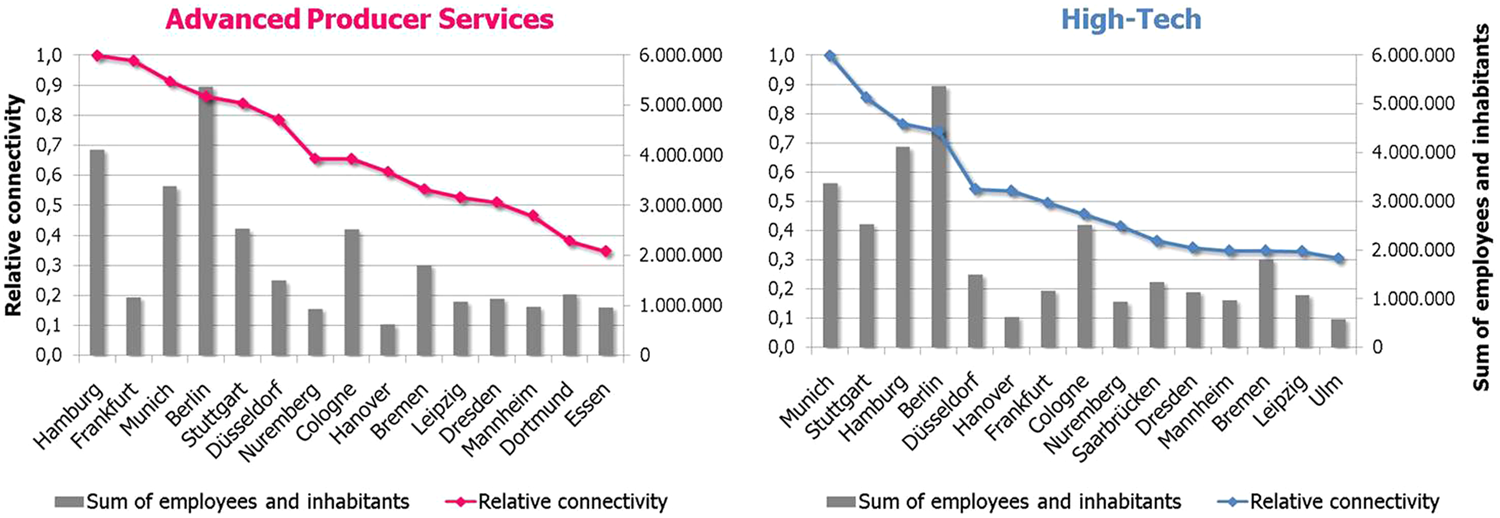
Functional urban hierarchy based on APS and high-tech connectivity (authors’ calculation).
Overall, the interlocking network analysis in Figure 2 reveals a relational geography of APS and high-tech connectivity in Germany that is quite polycentric in character, partly influenced by the federal government structure. No European country shows such functionally polycentric urban patterns (Taylor et al., 2011). In France, for example, data on network connectivity collected in 2008 confirm a highly monocentric urban pattern with Paris as the undisputed primary city. With a proportionate connectivity of 22 per cent of that of Paris, Lyon ranks second, followed by Marseille and Strasbourg (Pain and Ardinat, 2011). A similar primate urban structure can be observed in the UK, with its London-headed urban hierarchy. Manchester ranks second with 22 per cent of London’s connectivity, followed by Edinburgh and Birmingham with 21 per cent (Taylor, 2011b). However, polycentricity is not a clearly defined concept. The transition from monocentric to polycentric urban patterns is smooth and depends on the frame of reference. Taking the 11 politically designated mega-city regions as a benchmark, the functional urban hierarchy in Germany proves to be steeper than is claimed by the federal structure and many policy-makers. A maximum of six FUAs—Munich, Frankfurt, Hamburg, Düsseldorf, Stuttgart and Berlin—can be regarded as important gateways in the German knowledge economy. These are also the leading core cities of the six mega-city regions initially defined by the German spatial development policy in 1995 (seesection 1).
In some cases, Figure 2 also illustrates a pronounced gap between the mere size of a FUA—measured by the sum of inhabitants and jobs—and its total connectivity. Generally, two spatial patterns emerge. On the one hand, the biggest German FUAs—Berlin, Hamburg, Munich, Stuttgart and Cologne—always rank within the first eight agglomerations in terms of total connectivity. It seems that a certain critical mass has to be reached in order to generate a minimum degree of connectivity. According to van Winden et al. (2007), the sheer size of an agglomeration matters particularly as an attraction factor for knowledge-intensive companies because it ensures the availability of cultural and social amenities as well as specific infrastructures like international schools or hub airports. Critical mass, however, is not enough to get to the first position in the connectivity ranking. In the APS sector, for example, Berlin is only ranked fourth, even though it is by far the biggest agglomeration in Germany. Frankfurt, by contrast, ranks second, even though it is rather small in terms of inhabitants and jobs.
All in all, the research findings show that morphologically polycentric urban structures are not necessarily associated with functional polycentricity. This discrepancy challenges the traditional perspective of a nested hierarchy as an organising principle of space. In order to analyse this finding in greater detail, Figure 3 illustrates the connectivity patterns of Munich and Hamburg at three hierarchical levels, based on the intrafirm networks of the APS sector. The thickness of the links illustrates the connectivities between the FUAs, related to the highest interlock connectivity within Germany: the connection between Munich and Hamburg. The Figure shows an overlapping and trans-scalar spatial pattern, without evidence of a spatially nested hierarchy. Knowledge-intensive firms in all parts of Germany connect directly with the primary cities on the highest level of the functional urban hierarchy by simply bypassing tertiary or secondary cities.
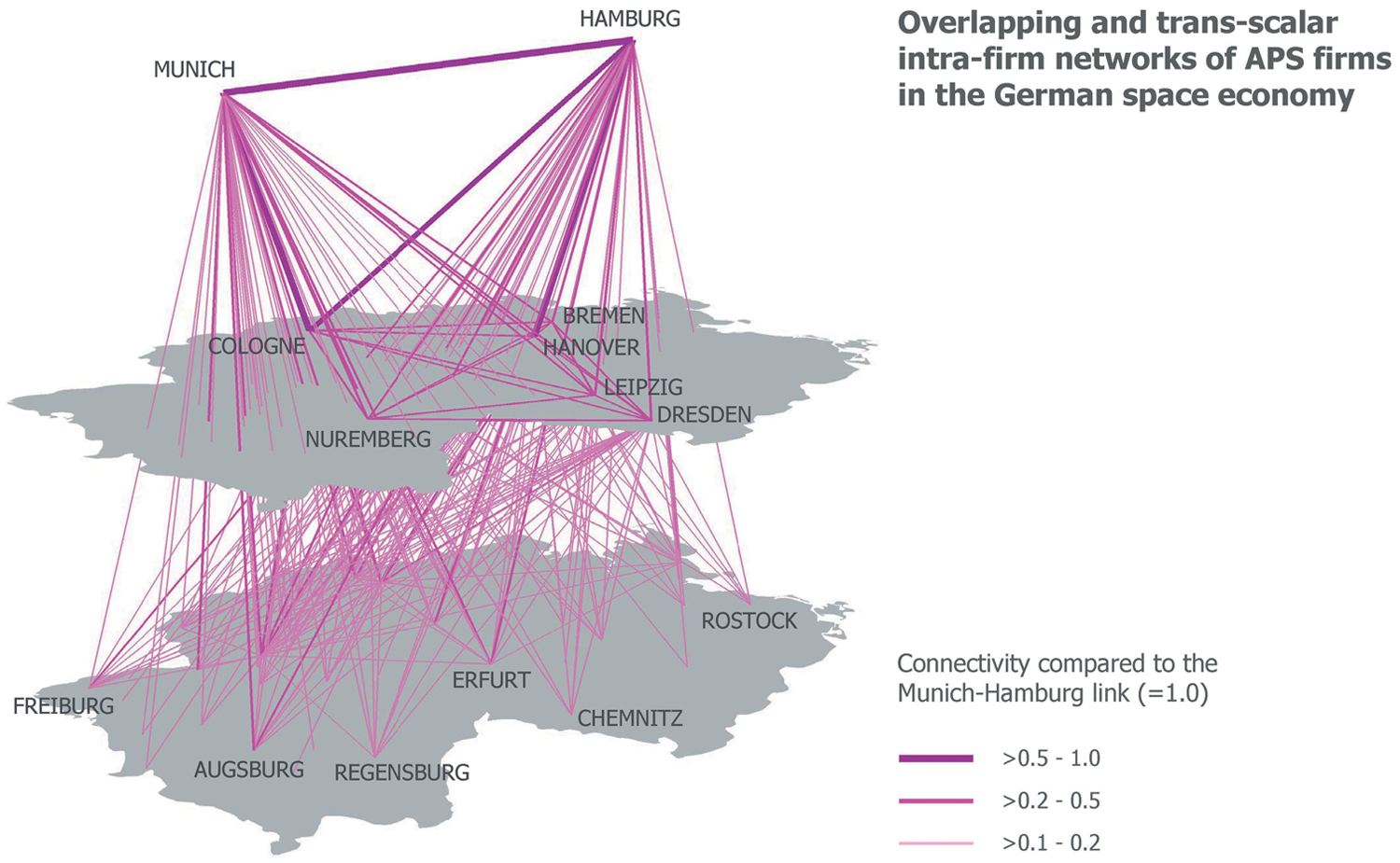
Overlapping intrafirm networks of APS firms in the German space economy (authors’ calculation; cartography: Anne Wiese, Michael Bentlage).
Overall, this empirical evidence suggests that the traditional ‘central place theory’—as proposed by Christaller (1933)—tends to be complemented or even replaced by a ‘central flow theory’ (Taylor et al., 2010). According to Taylor et al. (2010), Christaller’s central place theory describes a vertical spatial structure linking an urban place to its hinterland. The central flow theory, on the other hand, reveals a horizontal spatial structure linking an urban place beyond the city’s hinterland to locations on different spatial scales. In other words: the relational processes of the central place theory are modelled as an urban hierarchy, whereas the relations of the central flow theory are modelled as an urban network. This clearly indicates an important conceptual milestone, away from the traditional central place paradigm towards a more complex and multiscalar relational perspective.
As we have seen, urban size is a necessary—but not a sufficient—condition to reach a minimum degree of connectivity. The larger the agglomeration, the greater the number of company locations and therefore the higher the total network connectivity. However, it could even be argued that the direction of causality is reverse: connectivity is a basic requirement for agglomerations and their economies to emerge in the first instance. In order to learn more about this causality, further investigations are needed, a point that is at the very top of our research agenda. Nevertheless, in order to assess the importance of urban size, Figure 4 shows the total connectivity of an FUA in relation to its sheer size—defined by the sum of inhabitants and jobs—compared with all other agglomerations shown in the Figure. The solid circle illustrates the connectivity value for the FUA; the black ring shows the sum of its inhabitants and jobs. A solid circle larger than the black ring indicates a higher connectivity than would be expected in terms of inhabitants and jobs; we call it a surplus of significance. A solid circle smaller than the black ring indicates a lower connectivity than expected in terms of inhabitants and jobs; we call it a deficiency of significance.
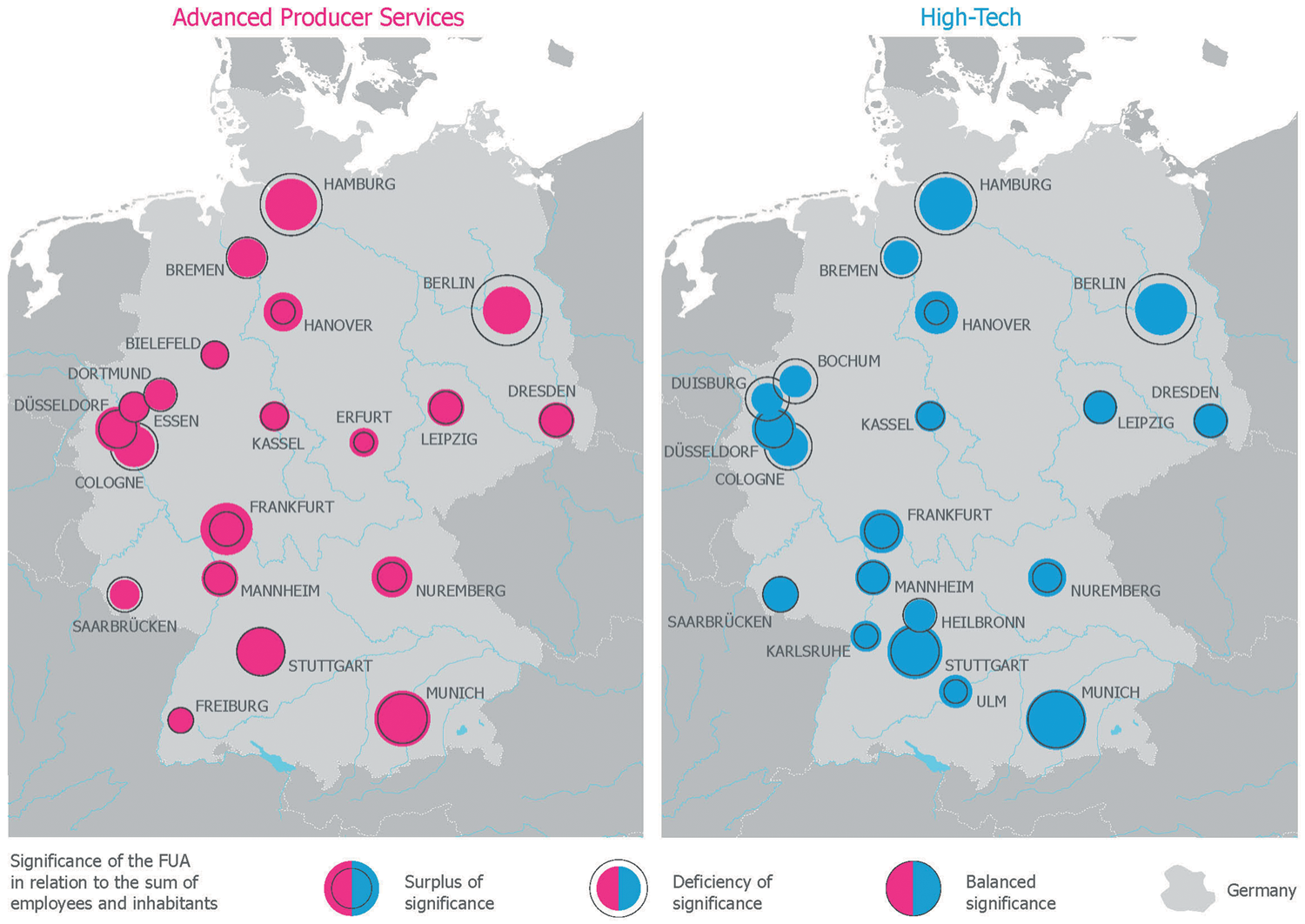
APS and high-tech significance of German FUAs in comparison with each other (authors’ calculation).
In the APS sector, Hamburg shows the highest total connectivity in absolute terms, followed by Frankfurt, Munich and Berlin. In relative terms, however, Hanover stands out as the best-connected agglomeration, followed by Frankfurt, Erfurt and Nuremberg. Despite its small size, Hanover indicates above-average integration in potential information flows of multibranch, multilocation enterprises of the knowledge economy. Our APS records show that many insurance companies have significant office locations in Hanover—for example, the Hannover Re Group, the Concordia insurance company and the VHV insurance Group.
In the high-tech sector, the secondary agglomerations of Ulm, Karlsruhe, Duisburg and Bochum have found their way into the top 20, taking the place of Freiburg, Erfurt, Essen, Dortmund and Bielefeld. Again, Hanover shows the highest surplus of significance, followed by Ulm and Nuremberg. The FUA of Nuremberg, for example, is highly integrated into international high-tech networks through companies like Diehl, Triumph-Adler and Grundig. These companies tend to benefit from the presence of various research institutions in the Greater Nuremberg area—for example, from various institutes of the Fraunhofer Society and the Max Planck Society. This example shows that high-quality establishments for the creation of new knowledge are important centres of attraction for globally active, knowledge-intensive firms, and therefore make a crucial contribution to the global connectivity of cities and agglomerations.
Particularly striking in both the APS and the high-tech sector is Berlin’s distinct deficiency of significance. The FUA of Berlin demonstrates a relatively low degree of connectivity, even though it is much bigger than Hanover or Nuremberg in terms of inhabitants and jobs, and even though it has gained significantly as a location of political decision-making after unification. Again, it is important to note that Berlin’s deficiency of significance relates to large, knowledge-intensive companies. SMEs and creative industries are not the primary focus of this paper. Indeed, the elaboration of Berlin’s importance in terms of international networks of the creative industry would be a very interesting field of research. However, in terms of the knowledge economy, we hardly expect that the German urban system with its existing functional and sectoral specialisation will undergo a complete restructuring any time soon. Similarly, Geppert (2005) argues that Berlin ranks currently far behind in the hierarchy of major European agglomerations. His analysis shows that the European functional urban hierarchy was very stable between 1995 and 2000. There were only a few shifts in the rankings and these were largely influenced by nation-based macroeconomic factors (Geppert, 2005). According to Taylor, Berlin belongs to those German cities which gained from the industrialisation of core zones in the modern world-system between 1850 and 1900 (Taylor, 2011a, p. 140). Today, however, Berlin indicates a lack of headquarters in the knowledge economy, even though it displays a high density of R&D employment, but this—in contrast to Munich, for example—is mainly the result of publicly funded research institutions (Jähnke and Wolke, 2005).
The main opportunity for Berlin lies in its attractiveness as a place of residence for highly skilled employees. An interviewee of a consulting company, for example, stated that Berlin is the biggest branch office in Germany in terms of the number of consultants, simply because many employees want to live in Berlin or spend their weekends there. Obviously, people want to work in Berlin—where they are formally employed—but the actual business projects and mandates are outside Berlin. Thus, on the input side of the innovation process, Berlin has a considerable number of talents from universities and research institutions. On the output side, however, there is a lack of economic opportunities to turn the potential of the people’s creativity into economic value. Berlin will only succeed if it is able to transform its strength as a buzz place in the cultural and creative industry beyond the input side into a more innovation-driven localised system of value chains. For policy-makers, it will be important to support the functional linkages between knowledge-intensive firms, research institutions and universities—for example, by providing high-quality physical infrastructure in order to ensure regional and international accessibility. Government strategies should improve the co-operation between municipalities, cities, planning regions and federal states—for example, with regard to synergies when dealing with transport infrastructures or in the management and promotion of locations.
5. Localised Systems of Value Chains in the German Space Economy
The analysis so far has outlined the structural organisation and spatial impact of intrafirm networks within and beyond the German space economy. Now, we present the results of the extrafirm analysis, which is conceptualised by a value chain approach and realised by means of a web survey (see section 3). Figure 5 maps the result of the web survey, aggregated according to the 11 politically designated mega-city regions in Germany. Each mega-city region displays a stylised value chain—as presented earlier—with the elements ‘research and development’, ‘processing’, ‘financing’, ‘marketing’, ‘sales and distribution’ and ‘customers’. The font size of these elements illustrates the amount of value-adding activities as stated by the responding APS and high-tech firms. In total, 331 firms indicated 1346 value-adding activities in at least one German mega-city region. The locations with the highlighted terms in one element of the value chain cover over 50 per cent of the corresponding value-adding activity. For example: the polycentric mega-city regions of Munich, Rhine-Ruhr and Hamburg together cover over 50 per cent of the marketing relations generated by the responding firms.
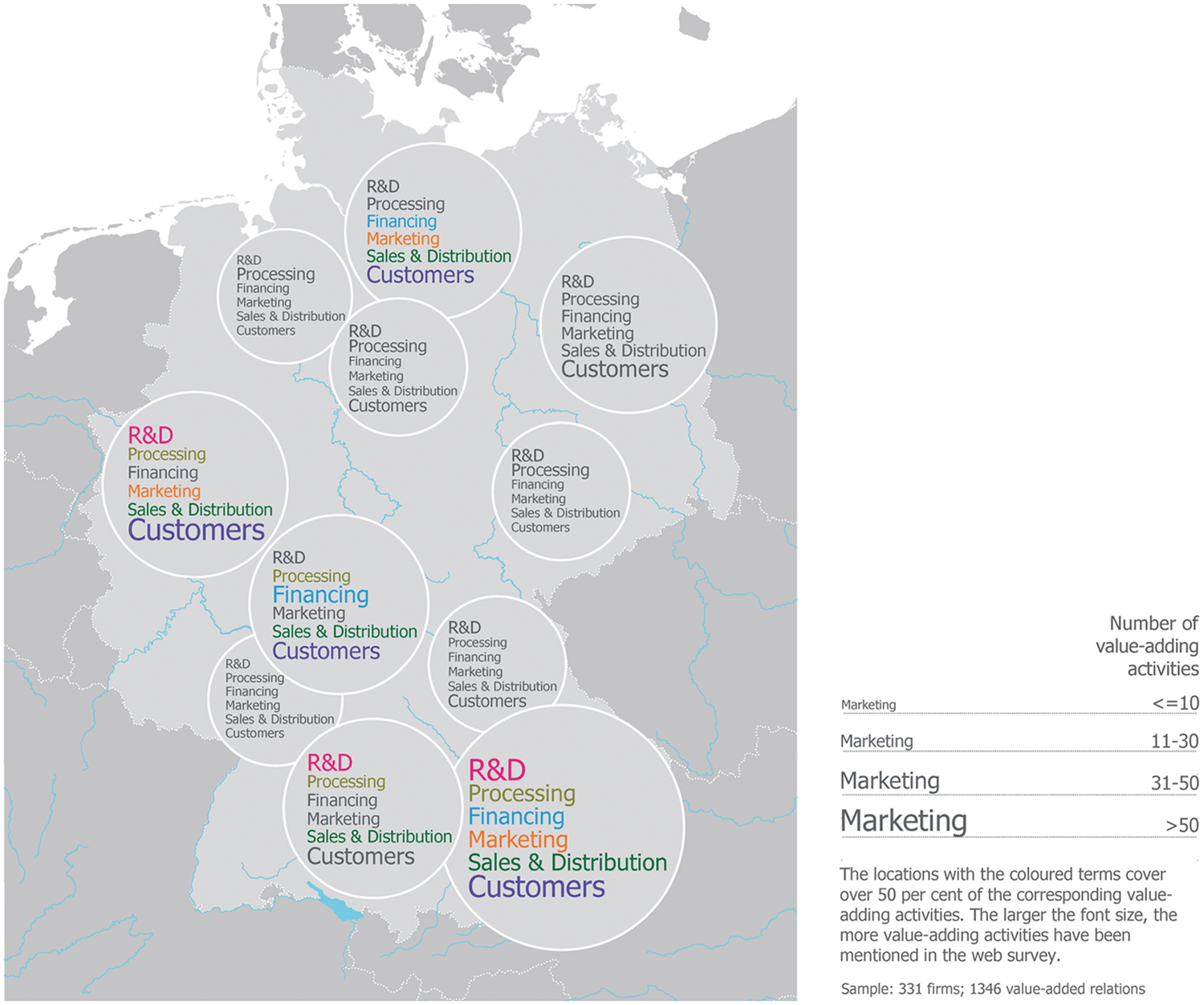
Value-adding activities in German mega-city regions (authors’ calculation).
Figure 5 reveals a rather concentrated spatial pattern of value-adding activities in the German space economy. Over 70 per cent of the entries in the web survey are allocated to only five polycentric mega-city regions: Munich, Rhine-Ruhr, Rhine-Main, Hamburg and Stuttgart. Financing shows the highest spatial concentration: 57 per cent of the financing activities are concentrated in Munich, Rhine-Main and Hamburg. A similar pattern can be observed in marketing and R&D: 52 per cent of the marketing activities are allocated to the mega-city regions of Munich, Hamburg and Rhine-Ruhr; 51 per cent of the R&D activities are concentrated in Munich, Stuttgart and Rhine-Ruhr. ‘Customers’ and ‘sales and distribution’, on the other hand, tend to be relatively evenly spread over the German territory. This shows the fact that activities in customer support need to be as close as possible to the firm’s regional markets. They have to be sensitive to local conditions in order to feed back the relevant information to the corporate structure of the company and to tailor the products to the specific taste of the local market (see also Dicken, 2007).
All in all, Munich and Rhine-Ruhr seem to be the top polycentric mega-city regions in terms of the number and the diversity of value-adding activities, followed by Frankfurt, Hamburg and Stuttgart. In these mega-city regions, many elements of the value chain are strongly represented, making them highly diversified localised systems of value chains. Companies located in these areas are potentially able to source many elements of their value-added activities within their own polycentric mega-city region, which confirms the crucial importance of urbanisation economies as competitive advantage for knowledge-intensive firms.
However, Germany’s top mega-city regions should not be interpreted as self-contained urban systems. The increasingly rich and diversified infrastructure of global travel and communication tends to qualify the assertion that firms have a strong tendency to locate close to one other because of frequent interactions requiring face-to-face contact. Geographical proximity helps, but is neither a necessary nor a sufficient condition for knowledge creation to take place (Boschma, 2005).
Our interviews confirm that geographical and relational proximity should be seen as essentially complementary and interdependent. Geographical proximity is of significance especially in the context of customer support and in joint projects with external business partners. In Germany, customer relations appear to be particularly regional in nature. Some interviewees attribute this to Germany’s federal structure and regional business culture.
Relational proximity, on the other hand, is based on accessibility and the organisational ability of firms to facilitate interactions, but also on more subtle conditions such as cultural and institutional thickness. It is needed to control uncertainty and opportunism in the knowledge creation process (Boschma, 2005). It creates a sense of belonging and provides a powerful instrument for long-distance co-ordination (Torre and Rallet, 2005). Our interviews show that organisational proximity is particularly important where different cultures are working together. Conflicts often arise from language difficulties and different perceptions of responsibilities. Furthermore, almost all of the companies questioned argued that global knowledge sourcing together with the necessity for face-to-face contacts with business partners and customers give rise to intensive travel. International hub airports are therefore frequently referred to as a central gateway infrastructure, providing the basis for global business activities.
All in all, the production and application of knowledge in the value creation process seems to require agglomeration economies in the form of dense and diversified regional markets, organisational and cultural proximity as well as good accessibility at the regional, national and international scales. Polycentric mega-city regions with well-developed communication and travel infrastructures—such as Rhine-Main, Munich and Rhine-Ruhr—tend to meet these requirements best.
6. Conclusion
In conclusion, the empirical analysis of the German knowledge economy reveals a relational geography of APS and high-tech connectivity that is polycentric in character, especially compared with the UK or France, where London and Paris dominate the functional urban hierarchy at the national scale (Taylor, 2011b; Pain and Ardinat, 2011). However, taking the 11 politically designated German mega-city regions as a benchmark, the functional urban hierarchy proves to be steeper than is claimed by many policy-makers. A maximum of six polycentric mega-city regions—Munich, Rhine-Main, Hamburg, Rhine-Ruhr, Stuttgart and, to a lesser extent, Berlin—can be regarded as strategic nodes in the knowledge economy with international importance. These regions show an outstanding strength in highly knowledge-intensive activities. Companies located in these areas benefit from a localised system of value chains, in which urbanisation and localisation economies reduce economic uncertainty and facilitate the transfer of tacit knowledge.
It has to be acknowledged that the functional urban hierarchy in the German space economy is framed in a specific political and socioeconomic context. The composition of social, cultural, political, legal, educational and economic institutions is an important factor, which defines the nature of innovation systems at the national and regional scales (Lundvall, 1992; Cooke, 1992). In this respect, Germany’s federal government structure is a crucial underlying condition. Since the approval of the Spatial Planning Law in 1965, the federal government has sought to achieve a balanced geographical development in order to provide equivalent living conditions throughout the German territory (German Bundestag, 2010). In order to avoid excessive urbanisation, a system of central places has been established based on Christaller’s central place theory. Until the end of the 1980s, there was no political will to ascribe an international strategic role to bigger cities, as there was a fear of regional disparities and geographical injustice. Although a certain paradigm shift towards metropolitan development can be observed in recent years, the aim of a balanced spatial development is still strongly anchored in the minds of many policy-makers. This is also apparent in the normative debate surrounding German mega-city regions. In particular, the increase from six to eleven mega-city regions in 2005 was heavily driven by regional policy goals (see Blotevogel and Schmitt, 2006).
However, it is not only the federal political system that has a decisive influence on the development of the German urban system, but also the general macroeconomic conditions—for example, the strong orientation of the German economy towards exports. The financial crisis, which began in autumn 2007 and turned into an economic crisis, nicely illustrates the strength of well-established mega-city regions in economically turbulent times. The crisis had a particularly serious effect on the economically prosperous regions in southern Germany, which is shown by the regional distribution of business and workforces hit by short-time work and the unemployment trends from June 2008 to June 2009 (Schwengler and Loibl, 2010). The most recent studies, however, indicate that the same regions have survived the economic crisis largely unscathed (BBSR, 2009). Leading innovative companies, strong research institutions and a highly qualified workforce are among the central factors behind this success. Hence, those polycentric mega-city regions which are able to combine agglomeration economies and global network economies in a multiscale innovation and production system—complemented by top-quality urban amenities—tend to be better placed to reinvent them constantly in order to cope with economic flaws.
All in all, spatial development processes in Germany seem to stand between the conflicting priorities of the functional logic of the knowledge economy and the territorial logic of the government system. The functional logic of the knowledge economy encourages the spatial concentration of advanced economic activities in a minority of polycentric mega-city regions, which connect urban places beyond the cities’ hinterlands directly with primary cities all over the world. A non-nested hierarchy with overlapping and trans-scalar urban networks thus challenges the traditional perspective of a nested hierarchy as an organising principle of space. The territorial logic of the government system, on the other hand, aims to provide equivalent living conditions throughout the federal territory, by striving for a balanced urban system of several more or less equivalent and almost evenly distributed mega-city regions. Against this backdrop, it is recommended that policy-makers recall the analytical roots of the mega-city region approach, which is by definition not suited to pursuing a spatial strategy with blanket coverage. For Germany, this requires a reinterpretation of the basic principle of equivalent living conditions throughout the federal territory. It seems to be reasonable that the hierarchical perspective should be reintroduced into the political debate on German mega-city regions. Prosperous economies are based on workable mega-city regions in the first place, no matter whether there are six or eleven of them.
Footnotes
Funding Statement
This work was supported by the German research Foundation DFG (grant number TH 1334/1-1).