




Abstract
This paper examines how growing conservatism among Muslims in Malaysia has been manifested in the architecture and urban design of Putrajaya, Malaysia’s new capital. Rather than drawing on vernacular design traditions or developing a design idiom that recognises a religiously and ethnically diverse population, the state has recently adopted a fantasy Middle Eastern style for secular national buildings in Putrajaya. In this paper, recent architectural change is examined as a manifestation of social, political and religious trends as well as a demonstration of how Putrajaya’s design can reinforce existing social hierarchies and legitimise the ideological agenda of the state. It is suggested that there are various reasons for the adoption of ‘High Islam’ that relate to broader transnational religious change, Malaysian identity politics and nation-building, and lingering influences of the colonial occupation.
Introduction
In recent years, there has been growing interest in academia, the media and political discourse concerning the emergence of a growing transnational pan-Islamic movement. Scholars of South-east Asia have examined the Islamic resurgence primarily through political movements (Muzaffar, 1987; Mutalib, 1990, 1993; Jomo and Cheek, 1992), shariah law (Henderson, 2003; Mir-Hosseini, 2006; Lee, 2009; Sani et al., 2009); madrasa schools (Lukens-Bull, 2000; Daun et al., 2004; Daun and Arjmand, 2005); and terrorist networks (Abuza, 2002; Ramakrishna and Tan, 2003; Smith, 2005; Croissant and Barlow, 2007). The ways in which this transnational pan-Islamic trend has been manifested materially in architecture and urbanism have been less examined to date (Rasdi, 2005; King, 2008; Goh and Liauw, 2009; Moser, 2012a).
South-east Asia is home to a significant portion of the world’s Muslims, with Malaysia and Indonesia alone having a combined total of over 210 million Muslims (Effendy, 2003). Since the introduction of Islam into South-east Asia in the 13th century, Muslims in the region have developed rich and varied vernacular styles of mosque architecture using local materials and building methods (Rasdi, 2000). After long periods of colonisation and modernisation, in recent years there has been a dramatic shift in urban design and architecture in which a generalised and imagined Middle East is drawn upon for inspiration. State officials and the designers they employ have largely abandoned both vernacular styles and International Modernism, which held sway in the post-colonial 20th century, in favour of recognisably Middle Eastern architectural elements that include fantastical domes and arches. These are used in both mosques and secular buildings (shopping centres, bridges, hotels, landscape architecture) and, more significantly, in state architecture. Despite the region’s sizeable Muslim populations and many recent large urban developments, there is a paucity of research that examines and theorises the influence of global pan-Islam on architecture and urbanism in Malaysia.
Architecture and urban design are powerful media for expressing ideology due to their highly visible and symbolic nature. The primary objectives in master planning capital cities are to construct, communicate and normalise national identity to the citizenry. Not only are cities “the medium by which the powerful express their influence” (Kong, 2008, p. 26), capital cities in particular reveal how the state imagines itself or how it aspires to be, as well as how it wishes to be seen by others (Rasdi, 2000, 2007; Imran, 2008).
This article takes an interdisciplinary approach to understanding the widespread cultural phenomenon of ‘Islamicisation’, the shift towards a more fundamentalist identity that extends into various spheres of life, as it is made material through architecture and urbanism. Examining this shift requires engaging a range of literatures relating to urban studies, religious studies, Islamic architecture, cultural geography and South-east Asia area studies. In this paper, I critically examine the circulation of ‘High Islam’, a hierarchical construction of Islam, and how it is manifested in built form. I examine this emerging trend of ‘High Islam’ in the context of Putrajaya, the recently built master-planned new capital of Malaysia.
An investigation of Putrajaya yields insights into social and religious change in Malaysia and can be placed in the broader context of international change. First, this paper seeks to provide an understanding of how urban change is linked to shifting priorities of the ruling élite. Secondly, I aim to place urban development in a Malaysian seat of political power within a broader context of social, political and religious change in the country. Thirdly, through an examination of current trends in architecture and urban design, embedded and normalised hierarchies of race and religion dating back to the colonial era are revealed. Finally, this paper examines how a particular version of national identity has been constructed and normalised through styles of imported and reinterpreted architecture and urbanism.
South-east Asian Vernacular Muslim Architecture
South-east Asia has a rich and varied architectural history that reflects the multitude of cultures, religions and ways of life. Unique vernacular styles of religious architecture have emerged over the centuries using available materials and local construction techniques developed in response to the tropical climate (Rasdi, 2000, 2007; Imran, 2008). Over the course of nearly two millennia, the region has absorbed and transformed many outside influences (such as language, religion and material culture) resulting in a regional culture that has been characterised by South-east Asia scholars as highly syncretic (Reid, 1993a). Architecture in the region reflects South-east Asia’s position as a crossroads and displays an extraordinary diversity of religious beliefs and range of cultural influences (Waterson, 1990/1998).
Islam entered South-east Asia in about the 13th century and, like other religions in the region, adapted the tiered pagoda form to suit the needs of Muslim prayer. As a tropical jungle region straddling the equator, wood was found in abundance and cities were traditionally built entirely out of timber. There were traditionally no domes in South-east Asian mosques and it was not until the colonial era that the first dome was constructed by the Dutch (O’Neill, 1994). The tiered roof mosque style is found across the Indonesian archipelago and the Malay peninsula and entered the region through vast and complex intraregional and extraregional maritime trade networks. As pointed out by Imran (2008), vernacular mosque types developed from pre-existing pavilion forms found in earlier Hindu and Buddhist dynasties in the region, as evidenced by carvings found on 8th–13th-century temple reliefs in central Java, variations of which are found across Asia. Vernacular mosques found in South-east Asia can generally be characterised by their wood construction, tiered pyramidal roof forms and pavilion-on-plinth construction, although there is regional variation within this basic template (Rasdi, 2000; Imran, 2008) (see Figures 1 and 2).
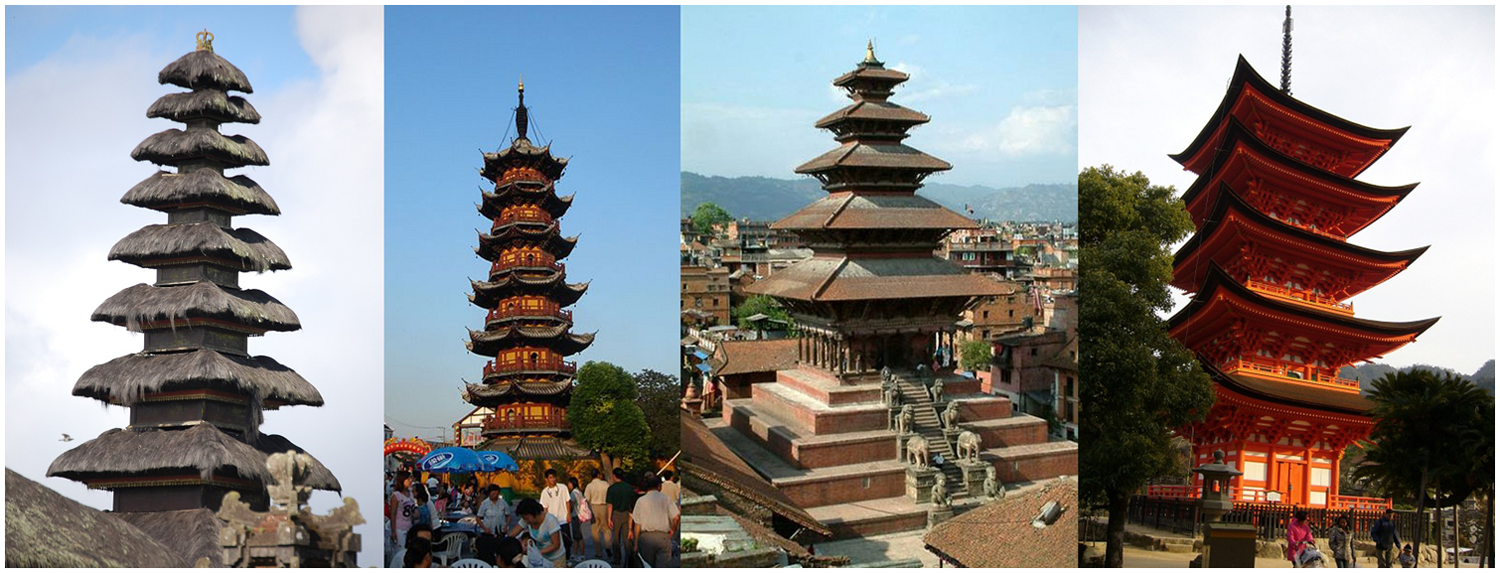
Wood structures with tiered pagoda roofs were adopted by all major religions in South-east Asia (Photos: Author).
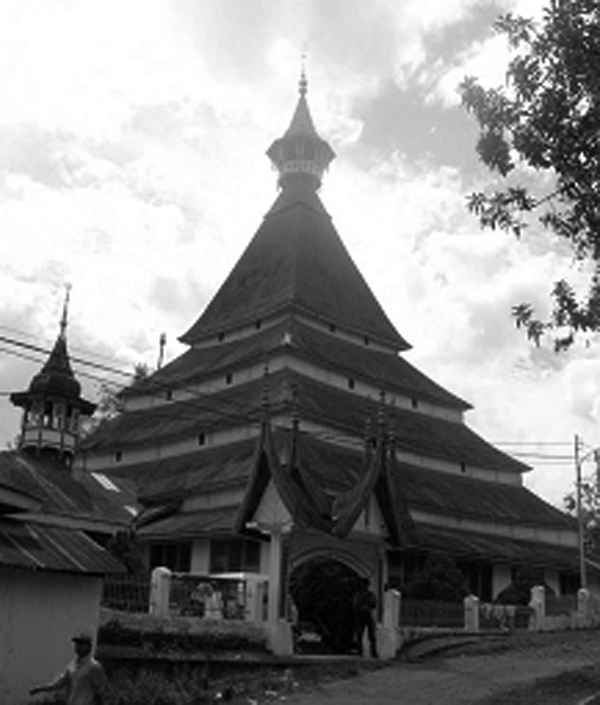
Vernacular mosque architecture: Limo Kaum, Minangkabau, Indonesia (Source: Imran bin Tajudeen).
Colonial South-east Asian Cities: Segregation and Orientalisation
Colonial cities in South-east Asia can be characterised by their racial, cultural, social and religious pluralism (Reid, 1993b; Yeoh, 1996; Evers and Korff, 2000). The colonial city contained a diversity of peoples, including colonialists, immigrants and indigenous people derived from vastly different societies, each with its own engrained cultural habits, civil traditions and institutionalised practices. The colonial city is the exemplification of what J. S. Furnivall has called a ‘plural society’—that is, one where Different sections of the community live side by side, but separately, within the same political unit … Each group holds by its own religion, its own culture and language, its own ideas and ways. As individuals they meet, but only in the market place, in buying and selling … Even in the economic sphere there is a division of labour along racial lines. Natives, Chinese, Indians and Europeans all have different functions, and within each major group, subsections have particular occupations (Furnivall, 1948, pp. 304–305; quoted in Yeoh, 1996, p. 21).
At the core of colonial ideology was the notion that communities were capable of being ranked on the basis of their supposedly inherent racial attributes, an assumption which served to justify the subjugation of ‘natives’ to White superiority (Alatas, 1977; Yeoh, 1996; Lim, 2004). In the case of colonial cities in the Malay world, the Europeans were seen as inherently suited to being administrators, the Chinese for trade, the Indians for coolies and the Malays as thriving in rural settings. Chinese and Indians, therefore, were allotted special districts in the cities, while Malays were provided with rural reservations as part of the Malay Reservation Enactments in the 1930s. 1 The stark asymmetry of power along with assumptions about racial qualities were imposed and perpetuated through the colonial urban landscape, characterised by segregated European and indigenous quarters with their own distinct type of economic activities, land use patterns and architectural styles (Ross and Telkamp, 1985). British colonial planning manifested many of the racial and cultural assumptions held by Europeans at the time and the planning approach produced a hierarchically ordered ethnicised urbanisation (Hirschman, 1986). As a result, Malays became marginalised from cities and, therefore, from commercial activity, which was increasingly controlled by the growing Chinese population. Kuala Lumpur, Tanjung Pinang and other cities in the region were shaped by Chinese buildings that accommodated their commercial activities (Bunnell and Das, 2010).
While the British imported Chinese and Indians and attracted them to the Malay peninsula with various incentives, Malays were recognised as the people with some claim to the land (Thompson, 2007). In recognition of the Malay sultanates in whose name the colonial powers were to rule, the British strategically appropriated Islam through building in the ‘British Raj’ or ‘Mohametan’ style. Elaborate buildings for the colonial bureaucracy were constructed in the late 1800s in the colonial capital of Kuala Lumpur, reflecting the orientalist fantasies of the colonial British in Asia (King, 2008) (see Figure 3).

Orientalism in Kuala Lumpur’s British Raj architecture (Photo: Author).
The fantastical Islamic architecture in colonial Malaya was inspired by Mughal architecture, much admired by the British in their colony of India. British architects, fresh from designing for the colonial bureaucracy in India, came to Malaya to construct government buildings featuring bulbous domes, pointed arches and verandas but also classical pediments topped with suitably ‘Islamicised’ ogee arches and an eclectic assemblage of north Indian ‘Saracenic’ details. Significantly, the ‘Mohametan’ buildings created by the British exhibited no characteristics of Malay space and architecture, and were eclectic amalgamations of a variety of real and imagined ‘Islamic’ architectural styles.
The Post-colonial Quest for National Identity
In the racially and politically complex new nations formed through colonialism in South-east Asia, leaders sought architectural styles that would unite the citizenry and symbolise the nation’s future. There could be no references to the representations of colonialism—neither neo-classical nor British Raj forms such as domes, and no art deco, which was associated with the Chinese. Malaysian nationalist architecture is intimately tied to changing political forces and has undergone several phases since Independence, of which I will provide a brief overview in the following sub-sections.
International Modernism
Many young South-east Asian architects in the 1950s and 1960s rejected the idea that Malaysian architecture should be defined solely through traditional forms. They eagerly followed international architectural movements and the architecture built immediately after independence displays a clear affinity to the International style in its geometries. 2 However, as many scholars have pointed out, the architecture during this time generally strived to be sensitive to the multiethnic population and the equatorial climate through the use of decorative sun-shading and landscape settings in a ‘tropical’ idiom (Tay, 1989; Holod and Khan, 1997; Rasdi, 2005; Kien, 2007; Goh and Liauw, 2009). The International style marked a clear break, not just from explicit references to an imagined and exoticised past, but also from ethnocentric allusions and nationalistic hyperbole, in contrast to the neo-traditionalism that would follow (King 2008).
One of the most widely admired examples of the International style in post-independence Malaysia is the Masjid Negara, or National Mosque, finished in 1965 (Figure 4). Similar to contemporaneous mosques such as Pakistan’s National Mosque, the Masjid Negara represents a clear stylistic break from the past and borrows neither from the tiered roofs of the traditional vernacular nor from the British Raj ‘Mohametan’ style (Yeang, 1992; Rasdi, 2005, 2007; Kien, 2007). The Mesjid Negara and other examples of International-style nationalist architecture built in the 1960s are admired by architecture scholars for their sensitivity to the local climate and socially inclusive style that does not alienate segments of the population based on ethnicity or religion (Rasdi, 2005). This first phase of national architecture reflects the spirit of an optimistic post-independence nation, aware of and responsive to its multiethnic population. Furthermore, it demonstrates the unique status of Islam, which occupied only a ceremonial role in the years following independence (Goh and Liauw, 2009).
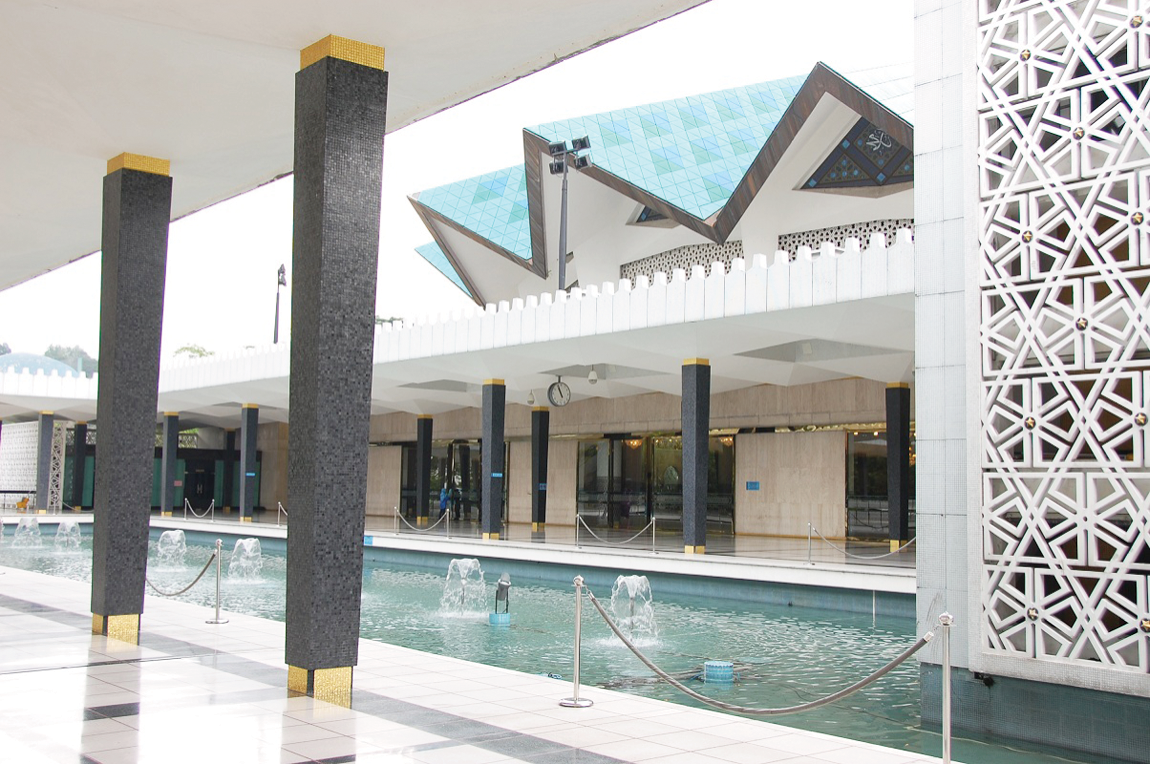
International modernism in Kuala Lumpur’s Mesjid Negara, or National Mosque (Photo: Author).
As King (2008) points out, the problem with the International-style symbols of the nation from the 1950s and 1960s was that it was only ‘International’ by adoption. The style came to be seen as Western, linked to colonial or neo-colonial, American, corporate-capitalist discourse, representation and practice. Further, King (2008) suggests that the International style emerged in Malaysia during the Cold War and radical nationalists did not wish to be affiliated with either side.
Drawing on the Vernacular
Malaysia’s economic liberalisation in the 1980s resulted in an influx of foreign investment as well as Western architects, both of which had a significant impact on the building industry and urban skylines (Goh, 2002). As a reaction against the rapid internationalisation of Malaysian cities, the ‘Western’ roots of modernism and the perceived placelessness of architecture during this period, some architects, supported by government officials, sought a style that would be more able to reflect local culture (Nas, 1993; Kusno, 2000, 2002; Goh and Liauw, 2009).
A Malaysian national style was attempted through two completely different strategies. The first I call the ‘giant house’ approach, in which the size of a vernacular timber-construction house is dramatically increased. The materials are changed and the function is completely different, yet the building is recognisably local. This can be seen in a variety of state buildings in Malaysia, including government offices, national banks and museums (Figure 5). 3
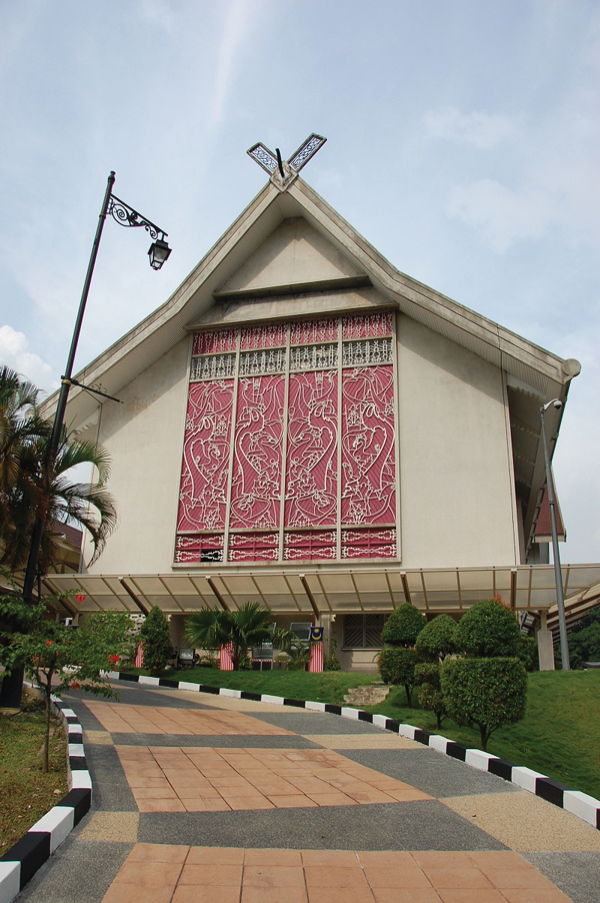
The giant ‘traditional’ house form of Muzeum Nasional, Malaysia’s national museum (Photo: Author).
The second approach draws on local cultural artifacts for architectural inspiration and takes a recognisably Malay cultural object and supersizes it into a skyscraper. For example, the LUTH building (Lembaga Urusan Tabung Haji) of 1986 (Figure 6), home to the Malaysia Muslim Pilgrims’ Fund, adopted a waisted form that is meant to represent either a gendang, a traditional Malay drum, or a bubu, a type of fish trap. It also displays five non-structural ‘pillars’ on its façade, reputed to represent the Five Pillars of Islam. The National Mosque and the LUTH building attempted to develop a distinct Malaysian Muslim idiom, in contrast to the late 1990s and 2000s when inspiration for Islamic architecture came primarily from Arab sources (Yeang 1992). Another attempt to express traditional Malay culture in modern architecture can be seen in the Menara Telekom (Telekom Tower), the high-tech high-rise based on the form of a bamboo shoot. Finally, the Menara Maybank (Maybank Tower), built in 1987 from the design of a 1979 competition, is based on the form of a Malay keris or traditional ceremonial dagger.
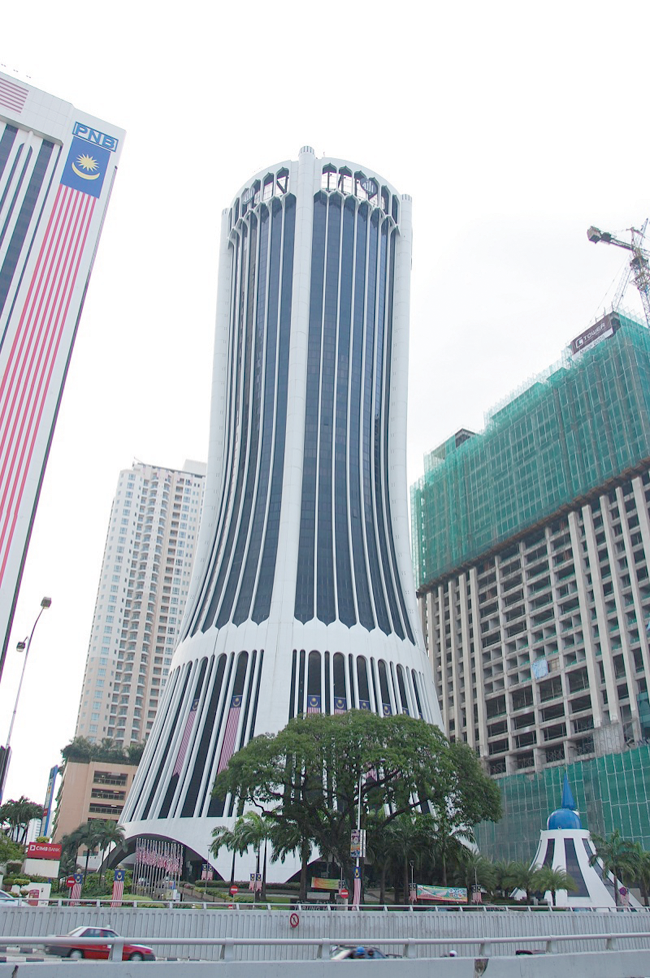
An attempt at drawing on indigenous culture for inspiration: the LUTH Building (Photo: Author).
Turning to a Middle Eastern Imaginary
In the late 1980s and 1990s, state architecture turned not to the British Raj, to International-style modernism or to the vernacular, but to a pared-down Middle Eastern aesthetic, in step with the changing national status of Islam from ceremonial to official religion. One of the earliest examples of this is the Sultan Salahuddin Abdul Aziz Shah Mosque in Shah Alam, a planned city built as the capital of Selangor province in the 1980s and a precursor to Putrajaya. The mosque was built to accommodate up to 24 000 worshippers, was said to be the largest in the country and to have the world’s tallest minarets. Significantly, the Sultan Salahuddin Mosque broke with Malay tradition in rejecting vernacular mosque architecture in favour of a modernised Ottoman Turkish style complete with four minarets.
While an Islamic aesthetic was tentatively explored in the 1980s in such projects as the LUTH building, it was only in the 1990s that the state adopted a recognisably Islamic imaginary to represent the nation. A significant project that announces this turn to ‘Islamic’ styles of representation are the Petronas Towers. Once the tallest buildings in the world, the Petronas Towers, designed by Cesar Pelli, are based on geometries that are recognisably Islamic, yet do not overtly imitate a particular tradition.
The Islamic styles adopted recently by the state are distinct from the ‘Indo-Saracenic’ Raj style promoted by the British and, in the context of Malaysia, mark a dramatic break that, along with the Sultan Salahuddin Mosque, set the template for a variety of new buildings that adopt a generic Middle Eastern idiom. The new Islamic national style can be characterised by its referencing of recognisable features derived from various classic sources of Islamic architecture including Arab, Ottoman, Mughal, Moorish, central Asian, Iraqi and Persian. The commonality across these adopted styles is that they are all exclusively foreign, are considered to be from the most sophisticated Muslim cultures and are classic examples commonly featured in illustrated text books of ‘High Islamic’ art and architecture (Michell, 1978; Blair and Bloom, 1994; Hillenbrand, 1994, 1999, 2003; Petersen, 1999; Carey and Chapman, 2010; Mozzati, 2010; Fuess and Hartung, 2011).
As Goh and Liauw (2009) point out, the events of 11 September 2001 and the subsequent tide of global Islam have had a profound effect in Malaysia, producing a new Islamic orthodoxy that has influenced many spheres of life including politics, law and education, as well as architecture and urban design. In this context, Islam has been expanded from a religion and cultural marker to evoking a primordial sense of Malayness.
As the new capital city, Putrajaya is the pinnacle of the new fantasy Middle Eastern expression and a key manifestation of the merging of Islam with Malay identity that occurred under Mahathir. Situated on former oil palm and rubber plantations 30 minutes from Kuala Lumpur by high-speed train, Putrajaya is built around an artificial lake and was designed to accommodate 350 000 residents, largely civil servants, workers and their families. Currently, nearly 100 000 people have moved to Putrajaya and all the federal government ministries, including the Prime Minister’s office, have been relocated from Kuala Lumpur. What is significant about Putrajaya is that it is entirely designed and executed by Malaysians, albeit Malaysians educated overseas (Lepawsky, 2005), unlike previous mega projects which enlisted foreign expertise. It is a home-grown effort at nation-building and the culmination of the ‘High Islamic’ style.
Sitting on a piece of land that juts into the lake, Putrajaya’s Putra Mosque is the most visible and iconic landmark in the city (Figure 7) and is a prime example of the ‘High Islamic’ fusion architecture that the Malaysian state has adopted: the minaret is a replica of that in Baghdad’s Sheikh Oman Mosque, a basement wall is similar to Casablanca’s King Hassan Mosque (Putrajaya Holdings, 2003) and other elements are taken from Arabian, Egyptian, Persian and Turkish sources. Below the mosque is what is curiously named the ‘Souq’, which in the Arab world refers to a colourful bazaar next to a mosque, but which in Putrajaya’s case is in fact a Middle-East-themed indoor shopping centre and food court. The ‘Souq’ is designed to imitate the feel of the bazaars and markets of the Arab world through theatrical lighting, faux lanterns and displays of vaguely Arabian-looking props that decorate the passageways and the spaces between high-end tourist-oriented boutiques.
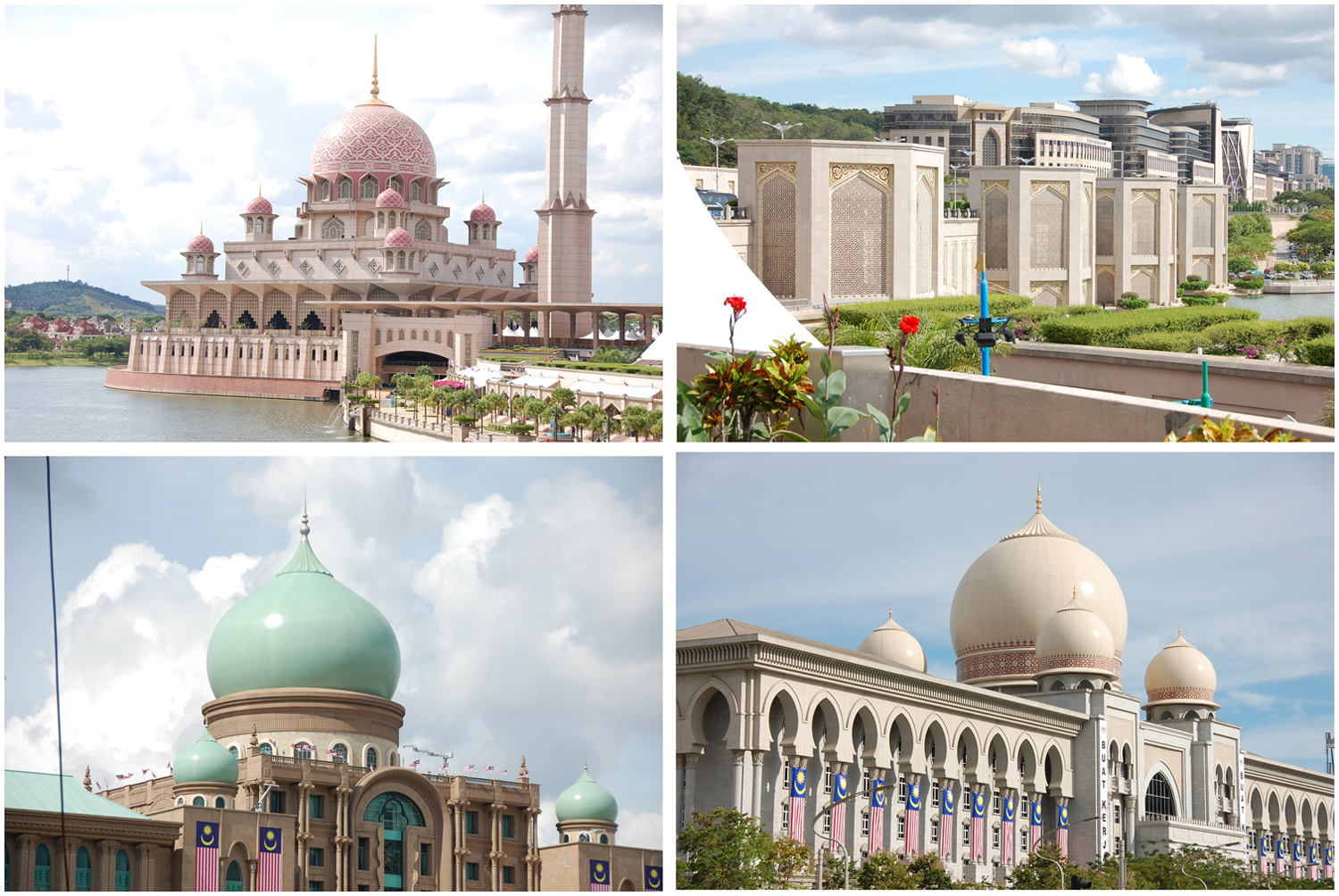
The complete absence of vernacular Muslim architecture: Putra Mosque; an imitation of Isfahan’s famous Khaju Bridge; the Prime Minister’s office; and the Komplex Kehakiman, or Palace of Justice (Photos: Author).
Despite the many rich design traditions, wood carvings and building methods from the region, very little of this heritage has been integrated into Putrajaya. Instead, it is fantastical domes, arches and minarets that dominate Putrajaya’s skyline and geometric Islamic motifs that embellish government buildings, shopping centres, bridges, sidewalks and parks. Significantly, of all the historical architecture in the Middle East, Putrajaya reproduces Islamic symbolism in a decorative pastiche and ignores the brilliant microclimatic engineering developed over the centuries to provide protection from the heat (Moser, 2010). Furthermore, while official plans for Putrajaya include spaces for other religions, Putrajaya currently has no religious structures other than mosques, a striking contrast from Kuala Lumpur which has Chinese temples, Hindu temples and churches. It is a distressing detail that represents a fundamental shift in identity politics and a calculated ascendancy of Malays/Islam over both colonialism and the Chinese.
Understanding the Shift towards ‘High Islam’
The general adoption of a generic Middle Eastern identity has been referred to by some scholars as ‘pan-Islamic’ and ‘neo-Islamic’, although there has been little critical reflection on those terms. I suggest that the term ‘High Islam’ more effectively conveys the implicit hierarchy that positions Arab Islam as more ‘authentic’ and ‘pure’ than South-east Asian Islam. While the term ‘pan-Islam’ captures the international spread of Muslim beliefs and practices, it suggests a level of homogeneity among Muslims and seems to imply the existence of an uncontested set of ‘Islamic’ symbols. I argue that ‘Islamisation’ and the adoption and circulation of overtly Muslim symbolism is, in fact, a highly uneven and politicised process, as not all symbols of Islam are recognised or are valued equally. ‘High Islam’ reflects a fascination with connections to, or at least imagined connections to, great Islamic civilisations. The recent adoption of ‘High Islamic’ architecture in Malaysia reveals a hierarchy that positions South-east Asian Islamic architecture, and by extension, South-east Asian Islam, as inferior to its Arab counterparts. It is important to note that the new ‘High Islamic’ style is aspirational; it represents an effort to be associated with the dignity, history and grandeur of ‘important’ Islamic civilisations. In Malaysia, ‘High Islam’ can be used to refer to the adoption of the architectural idiom of a more ‘superior’ Islamic culture by one that is ‘inferior’, a key dynamic of current Malaysian state architecture suggested by Malaysian architecture scholar Rasdi (2005).
Despite Malaysia’s rapid adoption of ‘High Islam’ in state buildings, it is a phenomenon that has received little scholarly attention to date. Several scholars have offered brief explanations for this sudden and dramatic shift, yet have not provided a sustained critical analysis of the various reasons for this sudden change. In their excellent essay ‘Post-colonial projects of a national culture’, Goh and Liauw (2009) relate Putrajaya to nation-building, Malaysia’s political culture and changing conceptualisations of the nation. While their essay is not intended as an exploration of the strange and unprecedented turn to suddenly adopting generic Middle Eastern forms, they briefly explore reasons behind the turn to a Middle Eastern idiom, which they attribute to a reflection of Malaysian identity politics and the post 9/11 enmeshment of Malaysia in global Islam. Columbijn (2005) proposes that this shift represents a renewed interest in the British Raj style, while King (2008) considers it an attempt to escape the experience of colonialism and rewrite the colonial past and a search for identity against an increasingly powerful China. I suggest that reasons for this turn towards ‘High Islam’ deserve further investigation beyond what scholars have described to date and should be connected to a series of international and internal factors, some of which are tied to changing identity politics in Malaysia and broad social and religious changes in the Muslim world, while others are reproductions of deeply embedded values dating back to the colonial era. In what follows, I provide a critical analysis of the variety of forces that have laid the groundwork for and contributed to the architectural trend of ‘High Islam’ in three main spheres: broad transnational trends in the Muslim world, internal Malaysian politics and the lingering hierarchies of the colonial era.
Muslim Hierarchies, Arabisation, the ‘Purification’ of Islam: Transnational Trends in the Muslim World
It is important to place Malaysia’s turn towards adopting a Middle Eastern architectural idiom within broader transnational changes in the Muslim world. In many respects, changes in Malaysian architecture and urbanism are a manifestation of a greater cultural turn in Malaysia towards the Middle East that is also affecting tertiary education, politics, law, food, fashion and banking. This turn can be largely attributed to the growing conservative movement within Islam which took root following the rise of the Wahhabi movement
4
in Saudi Arabia and the Iranian revolution, both of which had reverberations in Muslim regions of South-east Asia (Muzaffar, 1987; McAmis, 2002; Effendy, 2003). At the end of the 20th century, the dominant type of Islam practised in Malaysia (and elsewhere in South-east Asia) can be classified as ‘folk Islam’, meaning that it retains pre-Islamic elements (McAmis, 2002). The resulting ‘Islamic resurgence’ sought to re-establish Islamic values, Islamic practices, Islamic institutions, Islamic laws, indeed Islam in its entirety, in the lives of Muslims everywhere. It [was] an attempt to re-create an Islamic ethos, an Islamic social order in the vortex of which is the Islamic human being, guided by the Qur’an and the Sunnah (Muzaffar, 1987, p. 2).
The adoption of an imagined Middle Eastern Islamic culture is not a new phenomenon to the region. Borrowing from and imitating aspects of Middle Eastern and specifically Arab culture have occurred at various times and places and in a variety of ways in the region. The Sultan of Riau’s court on Pulau Penyengat, for example, adopted an interpretation of Arab dress complete with turbans and robes 5 in the 19th century (Figure 8). Likewise, the Sultan’s various architectural projects from the 19th century featured round, Middle-Eastern domes, created buildings that sat on the ground rather than the vernacular tradition of being elevated on stilts and were made of stone and concrete rather than of carved wood and other indigenous materials.
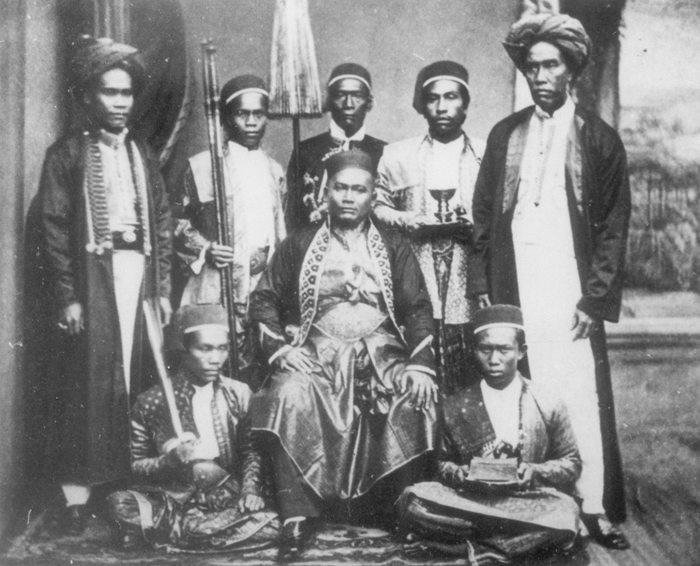
The Sultan of Riau and his retinue dressed up for this photograph in Arab robes and turbans, 1861 (Source: Pulau Penyengat Archives, Riau Islands Province, Indonesia).
This fascination with and admiration for Arab culture is found in countless other examples in the Malay world. Muslims in the region enthusiastically trace their roots back to an Arab ancestor. 6 There is a glorification of Arab culture around the Muslim fasting month of Ramadan, when Malays purchase imported Egyptian dates and television commercials around Ramadan often show a Malay family waking up early to break the fast dressed in local interpretations of Arab clothing. Furthermore, during Ramadan, McDonald’s restaurants serve a ‘Paket Ramadan’ meal which, in addition to the local staple of rice, includes vaguely Arab touches like chicken with ‘Middle Eastern’ seasoning, and tea instead of a soft drink. Such examples reveal a widespread perception of a close, and at times interchangeable, relationship between Arab culture and Islam.
Despite the vast distance, South-east Asian Muslims have long been diligent in making the Hajj (pilgrimage to Mecca), with numbers of pilgrims from the colonial-era Malay world fluctuating along with rubber prices (von der Mehden, 1993). Malay students have long studied Arabic and pursued programmes of Quranic study in Cairo and Saudi Arabia. Malay visitors to the Middle East have surely been impressed with the great Arab mosques and have been eager to replicate what they see upon their return home. Here again it is important to note that many Malay visitors to the Middle East conflate Arab culture with Islam and thus interpret the domes and arches of vernacular Arab architecture as the ‘true’ Muslim architecture.
In Islam, the act of reciting the Quran in Arabic is holy, automatically positioning native Arabic speakers as inherently more ‘Islamic’. According to Cummings (2001), uttering Arabic and possessing spiritually potent religious manuscripts in Arabic were key factors attributed to the spread, reception and structure of Islam. Regions that speak Arabic as a mother tongue have linguistic authority over Muslims in South-east Asia as reading an Arabic Quran is part of the obligatory prayers and therefore disadvantages non-Arabic speakers. As von der Mehden (1993, p. 2) suggests, there has never been the expectation that Islam in South-east Asia would or should be a major intellectual force in the Muslim world; he argues that there is “no question among Muslims in both regions as to which was superior in terms of knowledge and authenticity”.
Globalisation and its ‘shrinking’ effect on the world has had an impact on South-east Asian Islam, particularly since the 1990s. The increased affordability of air travel combined with a growing middle class in Malaysia has resulted in not only more Malaysians able to make the Hajj but also in the growth of tourism to the Middle East. Improved telecommunications have lent a feeling of global connectedness and the rise of Middle Eastern media, including the Emirates-based news channel al-Jazeera, enables Malay Muslims more easily to imagine being part of a broader Muslim world. Globalisation has also meant an increase in the movement of transnational migrant labour. Beginning in the early to mid 1990s, there was a dramatic growth of South-east Asian migrant workers to the Middle East, the majority of whom were females working as maids and nannies (Ehrenreich and Hochschild, 2002). This dynamic serves to reinforce the hierarchy of Muslims, positioning South-east Asian Muslims as marginal and Arab Muslims as central: not only are South-east Asians less ‘authentic’ Muslims, but they are part of a global ‘servant class’ that works in the service of Arab Muslims.
Architecture as a Reflection of the Islamicisation of National Politics
An examination of national politics in Malaysia provides important insight into the recent ‘Islamic’ turn in architecture and urban design. Due to colonial policies that attracted large numbers of immigrants (Chinese and, to a far lesser extent, Indians) to South-east Asian colonies, the current population reflects colonial-era immigration patterns with Muslim Malays constituting approximately 61 per cent of the population, Chinese 24 per cent, Indians 7 per cent and others 8 per cent. In a country that has been dominated by British and Chinese interests, the Malay ruling élite have created policies to (re-)establish Malays as the most powerful ethnic group in the region.
The Islamic resurgence in Malaysia is also a basis for the Bumiputra/non-Bumiputra dichotomy
7
Islam gives the Bumiputra an identity that is similar to the Malay/non-Malay dichotomy. Resurgence has given meaning and identity to the Muslim/non-Muslim division in Malaysia. Ethnic identity is protected by religion. Even those opposed to the Bumiputra/non-Bumiputra and Malay/non-Malay dichotomy are committed to the Muslim/non-Muslim identity for all citizens. This identity is almost interchangeable since all Malays are Muslims and the majority of Bumiputras are also Muslims. (Muzaffar, 1987, p. 23).
Re-establishing Malay/Muslim/Bumiputra dominance is problematic because all of these categories are constructed from a contemporary imagining of historical Malays as a homogeneous, united entity, when in fact in as late as the 19th century Malays “were concerned primarily with their differences rather than their shared features” (Milner, 1995, p. 14). As mentioned earlier, Malaysia has a diverse range of regional vernacular styles that can be seen in housing, mosques and other traditional buildings. While diversity is ostensibly celebrated by the state (at least in tourism pamphlets), Malaysia’s diversity poses a challenge when it comes to representing the nation architecturally. From province to province, there is much vernacular architectural diversity across Malaysia’s many sultanates, and various cultural groups within the ‘Malay’ umbrella have developed distinct styles and identities over the centuries ( Lim and Tay, 2000; Rasdi, 2000, 2005, 2007). By strategically adopting a generic ‘Islamic’ style, Mahathir attempted to unite all Muslims and avoid favouring any one Malay group within Malaysia, while alienating non-Muslim (especially Chinese) Malaysians.
There is a powerful narrative of loss and humiliation 8 that is keenly felt and perpetuated by political leaders in Malaysia, and indeed throughout the Muslim world, that provides fertile ground for the reinvention of pre-colonial identities. According to Malay nationalist rhetoric, a glorious era of Malay economic and cultural dominance was disrupted by colonialism and the on-going presence of the Chinese. Former Prime Minister Mahathir has been a vocal critic of the British presence in Malaysia and what he considers to be the nefarious influence of ‘the West’ on Asia. In this way, ‘High Islam’ can be understood as part of a never-ending endeavour to escape the humiliation of colonisation, a response to the global hegemony of ‘the West’, an attempt to show a strong Malay identity, to distance Malays from their colonial past and to wrest the urban environment, particularly the nation’s capital, from Chinese control. In linking itself to great Islamic civilisations, Malaysia also positions itself as part of a long succession of powerful, sophisticated and, most important, non-‘Western’ civilisations. It is an attempt to claim a different future, linked to some idea of a pan-Islamic world in which Malaysia can claim its place as a leader (King, 2007). In the context of a new capital, the generalised Islamic style has become a metonym for the nation and synonymous with a glorious past of powerful sultanates that were once centred around international trade ports in the Malay world.
The Malaysian government perceives fundamentalist Muslims to be a real threat to its power and to its policies of development and democracy. The government has responded to increasing ‘Islamicisation’ as “both a challenge and an opportunity” (Camroux, 1996, p. 852), using strategies of accommodation and co-option to consolidate and maintain political power. Many of the decisions to ‘Islamicize’ aspects of national culture are a response to PAS (Parti Islam Sa-Tanah Melayu, the All-Malaysia Islamic Party), the main opposition party which supports the formation of an Islamic state. PAS considers itself to be the only pure advocate of Islam while UMNO, 9 the ruling political group, is deemed ‘impure’ and ‘contaminated’ with non-Muslim ideology. As PAS points out, UMNO has failed to establish an Islamic state and has not implemented shariah and therefore considers UMNO to be outside Islam, even going so far as to call UMNO members kafir, or unbelievers (McAmis, 2002). In order to appeal to PAS supporters, UMNO strategically refers to itself as ‘the protector of Islam’ and claims to be the vehicle for Muslim values. As McAmis (2002, p. 84) suggests, in order to lessen the threat of fundamentalist Islam from PAS and other resurgent agendas, “the Malaysian government under the majority UMNO leadership has continued to favour pro-Islamic policies and encourage Islamic practices”. Under UMNO, the government has established an Islamic bank and the International Islamic University, recognises Muslim holidays as national holidays and is increasingly involved in international Muslim organisations and meetings. 10 Furthermore, as I argue, the government has transformed the material expression of national identity through the recent creation of numerous ‘Islamic’ buildings and through the construction of a new ‘Islamic’ capital. In favouring the Muslim majority, the government has discriminated against the Chinese and Indian minorities who constitute 40 per cent of the population and make a substantial contribution to the national economy (Mutalib, 1990).
Other major ‘Islamic’ projects have been built by the ruling party in key states in an attempt to attract supporters of Islamic parties. 11 A recent example is Taman Tamadun Islam, the ‘Islamic Civilisations Theme Park’ in Terengganu state on the north-east coast of peninsular Malaysia, a region that is primarily Malay with strong Islamic political parties and citizen groups. Taman Tamadun Islam is the brainchild of former Prime Minister Abdullah Badawi and was originally intended for Kuala Lumpur. However, the project was strategically shifted to Terengganu in an attempt to appeal to PAS voters and to make the ruling party appear more sympathetic to conservative Islam. The theme park is built on an island in the main river of Kuala Terengganu, the state capital, and consists of 21 impressive reduced-size replicas of a selection of architecture from the ‘great’ Islamic civilisations, including the Taj Mahal, the Suleyman Mosque (‘Blue Mosque’) in Istanbul, the Mohammed Ali Mosque in Cairo, the Al-Haram Mosque in Mecca, as well as newer mosques in South-east Asia,12,13 As a result of many lavish ‘High Islamic’ projects constructed in recent years, the national landscape of Malaysia appears to be increasingly ‘Islamic’, although this perhaps says more about the state’s political strategies than about faith.
Putrajaya’s Racialised Landscapes: A Postcolonial Legacy
Over 40 years after independence, colonial British values and ideology continue to play a role in shaping the urban landscape in Malaysia as well as the self-perceptions of the citizenry. As post-colonial theorists argue, the colonial experience does not simply end immediately after the end of colonial rule, but can be perpetuated in various cultural practices and beliefs. In Malaysia, many colonial assumptions about race have been internalised and are manifested in the design of Putrajaya.
Putrajaya is clearly intended to be read against the colonial/Chinese city of Kuala Lumpur (King, 2008) in a way that racialises the urban landscape, reproducing hierarchies, impenetrable boundaries and the social and economic order based on race that characterised colonial planning (Hirschman, 1986) as well as perpetuating colonial racial categories themselves (Malay, Chinese, Indian) (Hirschman, 1987). Where Kuala Lumpur has large colonial and Chinese districts set within an unplanned jumble of dirty and narrow streets, Putrajaya is clean and orderly, with wide roads and is liberally peppered with Islamic symbolism. The overall effect is an intended contrast between an ordered new Malay city and the relatively chaotic colonial/Chinese city and echoes earlier colonial-era urban practices of constructing new, orderly European districts of the city apart from and in contrast to older, non-European districts (for example, New Delhi vs Old Delhi). Furthermore, the colonial-era urban practice of racial enclaves is perpetuated in the design of Putrajaya. Putrajaya’s emphasis on Muslim identity to the exclusion of non-Muslims means that there are no spaces in the master plan for the practice of any other faiths and, to date, no Chinese temples, Hindu temples or churches have been built (Moser, 2010). Planners in Putrajaya are currently discussing the possible creation of distinct neighbourhoods for various cultural groups—namely, a Chinatown and a Little India. This unfortunately recalls policies of spatial segregation based on racial identities found throughout colonial Asia and Africa (Ross and Telkamp, 1985) and is not exactly a model of sensitive and socially inclusive urban planning to which Putrajaya, as the capital of religiously and ethnically diverse democracy, ought to aspire.
High Islam: A Unique Turn
Many Muslim countries around the world are adopting a neo-traditional architecture that recalls great Muslim civilisations (Moser, 2012a). For example, Turkey’s official neo-Ottoman national style for new mosques seeks to reproduce the geometries and silhouettes of Ottoman domes and minarets while using contemporary construction techniques. In other countries with little of their own tradition of great Islamic architecture upon which to draw, architects and contractors from elsewhere in the Muslim world are imported along with foreign styles. For example, in Kazakhstan where people were nomadic until the Soviet occupation, there is little vernacular architecture to draw on in nation-building. The Kazak state is therefore importing Turkish architects and contractors resulting in a proliferation of neo-Ottoman-style mosques.
‘High Islam’ in Malaysia, however, must be distinguished from the general neo-Islamic trends emerging in many new Muslim cities (Moser, 2012a). It also must be distinguished from colonial ‘Mahometan’ architecture and from other cross-cultural borrowing, such as the early American emulation of Greek architecture, as recent developments in Malaysia make material a unique set of power relations.
First, Malaysia has a rich history of sophisticated vernacular architecture—including Muslim architecture—from which to draw. 14 While there has been some experimentation with adopting vernacular elements (for example, the ‘giant house’ approach), drawing on interpretations of an indigenous past for state projects has largely been rejected in favour of importing a foreign ‘High Islamic’ style. 15 Unlike Kazakhstan or early America, Malaysia has a long architectural history and does not need to invent a national architecture for want of a vernacular style. While early American nationalists adopted Greek architecture and imagery, it is significant that they neither pretended to be genetically related to Greeks, nor did they follow the ancient Greek religion. Rather, it can be seen as an attempt for a fledgling new nation to appear stable and timeless through visually attaching themselves to particular philosophic ideals of the Greek empire. This is a stark contrast to the Malays who not only emulate ‘superior’ Arab civilisations through culture and the built environment, but popularly seek to connect themselves genetically with the Arab world.
Secondly, it is interesting to note that, while Putrajaya represents an attempt by the Malaysian government to distance the country from ‘the West’, they looked outside Malaysia for an architectural style to represent Malays just as the colonial British adopted the north Indian Mogul style for their Malay colony. This reinforces an implicit hierarchy that positions Arabs, Moguls and Moors as the great Islamic civilisations, which are perceived as more admirable and advanced than those of the local sultanates and historical Hindu and Buddhist civilisations in the region such as Srivijaya. In other words, in asserting their national identity, there is an implicit understanding that Islam and its architectural manifestation in the Malay world is inferior, as suggested by Rasdi (2005) in his discussion of Malaysia’s national ‘inferiority complex’ in his book, Malaysian Architecture: Crisis Within, and that the ‘real’ Islam is located elsewhere. In effect, through circulating imported architecture, the Malaysian government is dismissing indigenous culture and local interpretations of Islam as the British had done a century before.
As mentioned, there are also implicit understandings of racial inferiority embedded in the rejection of the vernacular and the prioritisation of ostentatious new mega projects. This can also be seen in national discourse about overcoming what Mahathir believes is the hereditary inferiority of Malays to the Chinese and the belief in eugenic conceptualisations of race (Alatas, 1977). While these notions have largely disappeared in Europe, they are being perpetuated in the former colonies, members of whom have deeply internalised their place in an imagined racial hierarchy.
Thirdly, ‘High Islam’ differs from other cross-cultural borrowing in that it can be understood as a form of self-orientalisation. As Lau (2009) argues in the context of post-colonial literature in India, the formerly colonised often perpetuate ‘Orientalism’ (Said, 1978/1995) through making themselves appear exotic. Not only is the Malaysian government’s adoption of a foreign ‘Islamic’ architectural idiom similar to what the British did in Malaysia, the way in which Middle Eastern architecture has been homogenised, exoticised, objectified and reduced to a superficial pastiche recalls the ‘Mohametan’ architecture of British Kuala Lumpur. The key difference is that during the colonial era it was part of colonial Orientalism that served to ‘other’ the non-Whites while the Malaysian government seems in fact to seek to join the side of the ‘Orientals’.
Transnational Implications
While Putrajaya has been widely criticised by scholars and the media, the city is widely viewed as a success story by government officials in Malaysia, Indonesia and the wider Muslim world as a model for balancing religious identity with modernity and high-tech ambitions (Moser, 2010, 2011, 2012a). Putrajaya is an important new symbol for Malaysia and aspects of it are being imitated closely in several cities in Malaysia. In fact, many ‘little Putrajayas’ are currently springing up around the country as regional state-level officials look to Putrajaya as the new standard for Malay(sian) urbanism (Rasdi, 2005). Many aspects of Putrajaya are replicated in Nusajaya, a new city started in 2007 by Abdullah Badawi, Mahathir’s successor and rival. Designed as the new capital of Johor province, as a catalyst for high-tech industries and as a travel destination for the global élite, Nusajaya aspires to compete with Putrajaya’s grandiose Islamic symbolism and the Multimedia Super Corridor, 16 one of Mahathir’s mega projects.
Several new Indonesian cities that serve as seats of political power have also been modelled, to varying degrees, after Putrajaya. After the devastating tsunami of 26 December 2004 that destroyed much of Banda Aceh, the capital of Aceh province on the northern tip of Sumatra, the Malaysian government offered their planning expertise complete with the assistance of Putrajaya’s developer, in the city’s reconstruction (Nah and Bunnell, 2005). Officials and designers from Indonesia’s recently formed Riau Islands Province also clearly looked to Putrajaya as a source of inspiration for Dompak, the new provincial capital. Government officials working on Dompak have visited Putrajaya multiple times over the past few years and claim that Dompak will be “more beautiful and more grand than Putrajaya” (interview with government officials in Tanjung Pinang, June 2008). Official government material also rather unambiguously (if confusingly!) proclaims Dompak to be the ‘Singapore and Putrajaya of Tanjung Pinang’ (Moser, 2012b). Dompak and nearby Senggarang, a village being developed as a new home for some branches of the provincial government in an attempt to relieve the congestion of Tanjung Pinang, have adopted the generic ‘High Islam’ architectural style of Putrajaya. Rather than the conventional government style of topping a modern concrete building with a local Malay-looking roof, many new secular government buildings in Dompak and Senggarang have Arab-looking arched windows and are topped with domes, a style never before seen in government architecture in that region. While still in the early stages of construction, it is clear Dompak and Senggarang are looking primarily to Putrajaya as a template, rather than to Jakarta or to any other regional Indonesian city.
Putrajaya’s impact is also being felt throughout much of the Muslim world in such regions as Africa and central Asia, where it is seen as a model progressive ‘Islamic’ capital city that is grounded in religious values that are expressed in a recognisably Islamic idiom. In recent years, officials, planners, architects and students from Africa and central Asia have travelled to Putrajaya to view the city. Regardless of whether Malaysia achieves its goal of becoming a ‘First World’ country or not, Putrajaya has become a template for many leaders in the Muslim world who have been ‘seduced’ (Bunnell and Das, 2010) by the idea of Putrajaya and by what they perceive as its appropriate balance between progressive ideas, tradition and religious values.
‘High Islam’ and Everything After
For all the supposed novelty of Putrajaya and other ‘High Islamic’ projects in Malaysia, they reproduce colonial-era hierarchies that ultimately position South-east Asian Muslims as inferior to and less truly ‘Islamic’ than Arab Muslims. Furthermore, despite the state’s ostentatious and costly new capital built to liberate itself from its colonial past and to create a more ‘authentic’ national identity based on traditional culture and religion, Putrajaya perpetuates colonial-era racialised urban landscapes.
It is early to predict how much staying power ‘High Islam’ has as a symbol of Malaysian national identity. On the one hand, Putrajaya’s power of seduction is still strong and its image as a progressive Islamic city that balances modernisation and high-tech development with traditional religious values is proving influential in Malaysia, in the region and in the wider Muslim world. Malaysia has experienced an increase in more conservative and ‘Arabised’ interpretations of Islam at the expense of the traditionally syncretic Islamic practices of South-east Asia, creating a receptive audience for ‘High Islam’ (Ghoshal, 2008). The tensions between militant Islam and more moderate Islam are being played out in a variety of scenarios in Malaysia, from the debates surrounding shariah law and bands of citizens working as religious ‘police,’ to the music events in Malaysia from which Muslims are controversially banned or which are cancelled entirely for fear that foreign pop stars will corrupt ‘Muslim values’ (Mohamad, 2009; Kent, 2005; Werman, 2009; Nathan and Kamali, 2005). As I have pointed out, these tensions are also manifested in the built environment and, although mega projects of ‘High Islam’ cost billions, there has been surprisingly little widespread public debate concerning how the nation is being represented. This seems to suggest that there is some normalisation of these mega projects and the national vision they represent. Having spoken to many government officials and citizens about Putrajaya, at this early stage Malays have a fairly high degree of enthusiasm for Putrajaya and other state ‘High Islamic’ projects.
On the other hand, given Malaysia’s history of experimentation with architectural nation-building, a new style is likely to emerge that replaces ‘High Islam’. The style has already received some sharp criticism in the media and by a few Malaysian scholars who have criticised Putrajaya as being a pastiche of “big domes, arches and expensive ornaments” that fails to embody deeper Muslim values of community and humility (Rasdi, 2005, p. 19). Furthermore, some commentators consider Putrajaya’s architecture to be culturally inappropriate and designed more for tourists than the faithful and for a kingdom rather than a multicultural democracy which Malaysia claims to be. 17 Regardless, the turn to ‘High Islam’ represents an influential movement that brings together architecture and Islam for social and political purposes and reveals complexities of nation-building, racial dynamics, broader trends in transnational Islam, a conscious rejection of ‘the West’ and, at the same time, the lingering legacy of colonialism.
Footnotes
Acknowledgements
The idea for this paper was hatched at the National University of Singapore during the author’s PhD studies and the author wishes to thank her mentor and supervisor, Lily Kong, who, with her characteristic patience and good humour, allowed the author to be distracted by Putrajaya, a topic and place completely unrelated to her research. While at the Massachusetts Institute of Technology, the author received substantial feedback from Nassar Rabbat, James Wescoat and Igor Demchenko on an earlier version of this paper. Xiangming Chen, at the Center for Urban and Global Studies at Trinity College, created a warm and intellectually stimulating research environment. The author also wishes to thank Michael Hendricks, Tim Bunnell, the Editor and three anonymous referees, who provided constructive feedback that helped to strengthen the paper.
Notes
Funding Statement
The author wishes to acknowledge the receipt of a post-doctoral fellowship from the Aga Khan Program for Islamic Architecture at the Massachusetts Institute of Technology and also the generous funding received from a Paul E. Raether post-doctoral fellowship at the Center for Urban and Global Studies at Trinity College, Hartford, Connecticut.