



Abstract
Over the past decade, Mumbai has increasingly been understood as representative of new forms, trajectories and processes of 21st-century urbanism. This has been a welcome rejoinder to a continued predominance of North American and European cities within international urban research and debate. Yet it is important to query what theory cultures and geographical imaginations have been mapped onto Mumbai in this recent emphasis on the city. This paper argues that, unless Mumbai’s specificities and grounded realities are used to disrupt and reframe existing urban analysis, there is a risk of replicating the comparative perspectives and visions of élite policy-making. This does not mean conferring paradigmatic status on Mumbai or isolating Mumbai as an exceptional form of contemporary urbanism, but instead generating new theoretical dialogue and opening up new channels of urban research and policy formation within a wider world of cities.
We increasingly find ourselves trapped between the technocratic metropolis and its critique both formulated by perspectives emerging from the west. Moreover the city [Mumbai] is changing so rapidly and in such unprecedented ways that in many ways western examples of development remain absurd and irrelevant to our context. Thus it is critical that we understand our context much more closely and in a much more nuanced as well as diverse way in order to intervene in it relevantly (Pankaj Joshi et al., 2008, p. 17).
Certain cities have always been portrayed as exemplary cities of their era, acting as metonyms, prototypes and paradigms for contemporary urban dynamics (Brenner, 2003). Famously, Paris was the ‘capital of the 19th century’ for Walter Benjamin (1999), while Los Angeles performed a similar role in the late 20th century for Scott and Soja (1986). Over the past decade, new cities are being proffered for 21st-century exemplary status. These are no longer to be found in Europe and North America but in the so-called mega-cities of the global South (Koolhaas, 2002; Davis, 2006; Lees, 2012). For Michael Keith (2007, p. 6), Shanghai has been “the focus of representational hype in recent years in writing, film and art” and has “been held up to represent the future of cities”. For Neil Smith
Cities like São Paulo and Shanghai, Lagos and Bombay, are likely to challenge the more traditional urban centers, not just in size and density of economic activity—they have already done that—but primarily as leading incubators in the global economy, progenitors of new urban form, process, and identity (Smith, 2002, p. 436).
This paper critically considers Mumbai’s role in this metonymic and prototypical urbanism of a new urban age. 1 Whereas the city failed to register in a 2000 meta-geography of ‘world cities’ (Beaverstock et al., 2000), the city has now acquired an international cultural cachet and academic prominence. The paper details this rise in the fashionability and prevalence of Mumbai across popular and academic Anglophone contexts. For example, in July 2010, Mumbai was voted ‘the Greatest City on Earth’ in a debate broadcast by Radio 4, the intelligent speech radio station of the BBC. It surveys a growth in Western architectural and aesthetic engagements with Mumbai over the past decade and a shift within urban studies so that Mumbai has moved from a relatively marginal position to a situation where it is increasingly central in theory, practice and imagination. The paper relates this rise to Mumbai’s size and demographic growth, its increasing connections to global circuits of capital and cultural exchange as well as new theoretical and policy interest in the ‘slum’ and cities of the ‘global South’.
At the same time, the paper considers some of the conceptual, geographical and political limitations to the way this stronger international spotlight on Mumbai has often, although not always, been directed. It identifies an overemphasis on global flows and forces, a use of Eurocentric notions of urban restructuring, a restrictively selective choice of case study locations, an insufficiently critical exploration of comparative registers and a lack of attention to how urban research is presented and disseminated. The paper urges greater sensitivity to Mumbai’s range of distinctive urban spaces, cultural idioms and lived experiences, and their often chaotic and unknowable characteristics. It is suggested that it is through these that Mumbai opens up important new and alternative ways of understanding, theorising and planning contemporary cities.
In pursuing these objectives and arguments, the paper draws on the work of post-colonial critiques of urban studies (Robinson, 2006; Roy, 2009a) and sociological and historical theory (Connell, 2007; Chakrabarty, 2000) but roots these through a particular urban territory and an exploration of the way urban change in Mumbai has been imagined and theorised across the global South and North. The paper details a wide array of recent research on Mumbai, across urban geography, anthropology, sociology and history, and deploys findings from my own archival, empirical and ethnographic engagement with the city to challenge certain framings of urban restructuring. Importantly, it focuses not just on urban studies but considers the role of cultural images and artistic practice in the “fictional technologies” (Roy, 2011b, p. 225) constituting contemporary urbanism. Through this sustained focus on the new international visibility of Mumbai, the paper aims to problematise its positioning as “the metonymic megacity” (Roy, 2011b, p. 225), and to open up new critical directions for research into the politics and practice of urban comparisons and worldings.
Twenty-first-century Urbanism: Mumbai as New Archive and Resource
Two overlapping strands can be discerned in heightened international attention on Mumbai over the past decade. First, cultural practitioners and promoters have increasingly used Mumbai as a creative source and stimulus, often within explicitly comparative curatorial frameworks. A significant example was the Century City exhibition at the Tate Modern Gallery in London in 2001 where nine cities were chosen to represent cultural dynamism during different decades of the 20th century. Two cities were selected to portray the 1990s: Mumbai and London (Blazwick, 2001). These were arranged side-by-side in the large turbine hall of the gallery, where noise from hand-painted shutters raised every twenty minutes and a ‘Bollywood’ movie house made the Mumbai section far more prominent (Harris, 2005). Another comparative and international artistic use of Mumbai was the 2006 exhibition Londres, Bombay by the British film-maker and cultural historian Patrick Keiller. This was a moving-image reconstruction of the main train terminus in Mumbai using 30 video projectors with each projection corresponding to that of camera viewpoints in the station. It formed part of a three-month celebration of Mumbai in Lille, in Northern France (Zweibum and Marchandise, 2006). 2
Images and representations of Mumbai, especially those associated with its film industry, have also featured in a seeming growth of enthusiasm in Western cities for all things ‘Indian’ (Dwyer and Jackson, 2003). The musical Bombay Dreams, composed by A. R. Rahman, ran in London between 2002 and 2004, before transferring to New York until 2005. One of its scenes, also depicted in an iconic 2005 photo by Sebasião Salgado, featured a large water pipe on stage running through a slum—pre-empting an image now widely used to represent infrastructural disparities in Mumbai. Within popular literature, the 2003 novel Shantaram by the Australian author Gregory David Roberts and Maximum City by the New-York-based Sukheta Mehta (2005), an acclaimed amalgam of travelogue, biography and interviews, have also played a major role in raising the profile of the city. 3 Cinema in Mumbai, an inherent part of the city’s everyday fabric, has always resonated internationally (Mazumdar, 2007, p. xvii). However, the 2008 release and Academy Awards for Slumdog Millionaire, by the British director Danny Boyle, have thrust representations of Mumbai’s vibrancy and squalor into a much wider imaginative world, not least in framing visions of what Ananya Roy (2011b) calls ‘slumdog urbanism’.
The second strand of international attention, which has gathered momentum towards the latter part of the past decade, has been a new enthusiasm for Mumbai from globally mobile professionals with interests in architecture—and urbanism more generally. Particularly influential in bringing Mumbai into greater dialogue with wider streams of urban debate and discussion has been the Urban Age project. Based at the London School of Economics and funded by Deutsche Bank’s Alfred Herrhausen Foundation, this project flew a travelling band of international experts to Mumbai in November 2007. This resulted in Mumbai featuring alongside cities such as London and New York in a 2007 exhibition entitled Global Cities. The Urban Age’s Director, Richard Burdett, was also the Director of the Venice Architecture Biennale in 2006, where Mumbai was selected as one of 10 world cities to highlight important trajectories to twenty-first century urbanism.
Mumbai has similarly been the venue for a number of new architectural educational visits, including from the Graduate School of Architecture, Planning and Preservation at Columbia University New York, the Katholieke Universiteit Leuven in Belgium, the Development Planning Unit at University College London and the Delft University of Technology in the Netherlands. Students’ projects on these visits have frequently focused on an area of Mumbai called Dharavi and location for several scenes from Slumdog Millionaire (Figure 1). This has parallelled new-found interest in Dharavi from international magazines such as The Economist, Time and National Geographical in 2007, and from two one-hour television programmes in 2010 entitled Slumming It presented by the British designer Kevin McCloud. The recent Mumbai-centric focus within popular coverage of urbanism is perhaps best encapsulated by the claim in 2009 from Prince Charles, the British heir apparent, that the “world has much to learn” from places such as Dharavi (Booth, 2009).
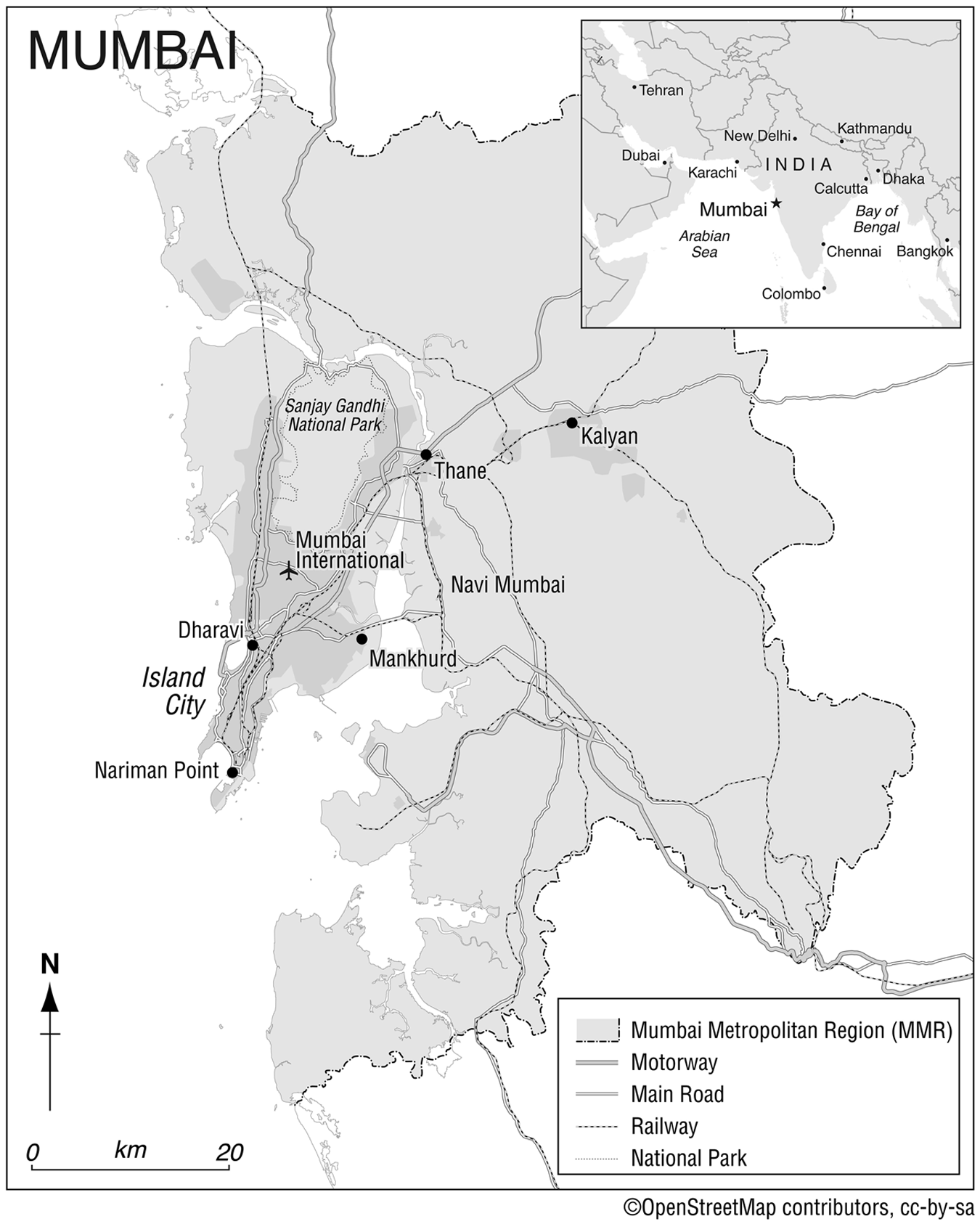
The Mumbai Metropolitan Region (cartography by Miles Irving).
Mumbai Central: New Currencies and Relations of Global Urbanism
Why has Mumbai become increasingly prominent within curatorial interventions and global urbanist imaginations? A key reason must be Mumbai’s sheer size, as demonstrated by the array of comparative diagrams and charts shown at the 2007 Global Cities exhibition in London. It is estimated by the United Nations that the Mumbai metropolitan region will be the third-largest urban agglomeration in the world by 2025 with over 25 million people and there are some predictions of 40 million by 2050 (United Nations, 2009; D’Monte, 2008, p. 29). Mumbai’s density of population is also ‘unusually high’ with an average of 27 000 people per square km and up to 100 000 per square km in some neighbourhoods (Urban Age, 2007).
Nonetheless, there are many other ‘mega-cities’ of the global South, whose populations are often growing faster, which have not enjoyed the same international limelight, such as Karachi in Pakistan and Dhaka in Bangladesh. What has also been significant is Mumbai’s role as the thriving commercial and financial capital of an increasingly important nation-state within a new multipolar global economic landscape. It is estimated that Mumbai’s gross domestic product may exceed that of Thailand and Hong Kong by 2030 (Goyal, 2010). India’s rapidly rising economic status was demonstrated by the UK’s newly elected Chancellor of the Exchequer, George Osborne, undertaking one of his first overseas visits to Mumbai in July 2010 where he rang a gong to start the day’s trading on the Bombay Stock Exchange. Over the past two decades, Mumbai’s property market has enjoyed significant new interest and speculation from foreign real estate investors such as Goldman Sachs and Lehmann Brothers (Financial Express, 2008). During the summer of 1995, rents in the main business district, Nariman Point, were famously the highest in the entire world (Nijman, 2000). The wealth and dynamism represented by Mumbai’s new high-rises, financial districts and flyovers has accordingly been forefronted in accounts of the speed and scope of new processes of globally orientated urban restructuring (see, for example, Smith, 2002; Whitehead and More, 2007; Harris, 2008, 2011).
Mumbai’s increasing centrality, however, has not simply been connected to new landscapes of ‘neo-liberal’ urban economic growth. What has also been significant is a marked increase and acceleration in flows of people, ideas, goods, images and symbols between Mumbai and the West over the past 20 years. Mumbai has been a key node in shaping what the Bombay-born anthropologist Arjun Appadurai (1996) refers to as overlapping and disjunctive global ‘scapes’. These ethnoscapes, mediascapes and ideoscapes—shaped by technological advances, the English language and greater international travel—have meant that representations, dreams, experiences and fantasies of Mumbai have been brought closer to audiences and markets overseas. From art biennials and Bollywood songs in Jamaican dancehall music, to Oscar ceremonies and images of burning hotels, Mumbai increasingly reaches into the lives of people world-wide. It has also meant that important in-depth scholarship on Mumbai, especially the longitudinal coverage provided by the three-volume Oxford University Press series published in India between 1995 and 2003 (Patel and Thorner, 1995a; 1995b; Patel and Masselos, 2003), has circulated more widely in international urban research (Weinstein, 2007).
Mumbai’s increasing international prominence has also been shaped by heightened interest and concern for the mega city ‘slum’ over the past decade, especially from The World Bank and the United Nations Human Settlements Programme. With daunting statistics regarding the number of people without access to proper housing, Mumbai is a clear exemplar of Mike Davis’s (2006) ‘planet of slums’ and dystopian pronouncements on global capitalist expansion. As Suketa Mehta (2004, p. 3) declares in Maximum City, “Bombay is the future of urban civilization on the planet. God help us”. Yet Mumbai’s slum settlements have also played a key role in understandings and appropriations of informality as a vibrant and inventive terrain of organisation, livelihood and politics (Rao, 2006; Roy, 2011b). There has been a new fascination with the fluid landscapes and blurred worlds of slums that often challenge and defy conventional notions of Western planning and urban design. As Dasgupta comments
The idea of the total, centralised, maximally efficient city plan has long since lost its futuristic appeal: its confidence and ambition have turned to anxiety and besiegement, its homogenising obsession … induced counter-fantasies of insubordination, excess, and life-forms in chaotic variety. Such desires flee the West’s surveillance cameras and bureaucratised consumption to find in the Third World metropolis a scope, a speed, a more fecund ecology (Dasgupta, 2006).
This turn to cities of the global South as a new urbanist fix accounts for much of the recent international architectural interest in the ‘fecund ecologies’ of Dharavi.
Mumbai has been part of an incipient ‘Southern turn’ in urban studies in which mega-cities of the global South have been proclaimed as incubators of future urbanism and at the leading-edge of processes of globalising modernity (Zeiderman, 2008). For example, seemingly refuting his previous emphasis on Los Angeles as where it all ‘comes together’, Ed Soja suggests that
We can learn as much if not more from understanding what is happening in Mumbai, Delhi, Singapore, and Shanghai than we can from Los Angeles, New York, London, and Paris. Euro-centric perspectives on the city are among the most outdated and anachronistic (Soja, 2007, p. 17).
Importantly, this new scholarly focus on cities of the global South has coincided with what Gyan Prakash (2002) terms an ‘urban turn’ in South Asian studies. In contrast to a nationalist focus on the village as the archetypal site of post-colonial India, a new self-consciousness about cities such as Mumbai as an object of enquiry has emerged (see, for example, Joshi et al., 2008; Prakash, 2010).
Mumbai of/from the North
This ‘Southern turn’ towards cities such as Mumbai is a welcome rejoinder to and recalibration of a parochial and asymmetric predominance of North American and European cities within international urban research and debate. It suggests there has been a significant acknowledgement of the need to draw insights from a much wider array of urban localities, experiences and agencies into the generation of theoretical reflections and analytical perspectives. This contrasts with a prior tendency to assume that cities such as Mumbai were ‘off the map’ within certain rankings, categories and hierarchies of global urbanism (Robinson, 2002). And it begins to challenge a previous widespread portrayal of urban centres in the former ‘third world’ through an orientalist emphasis on the exotic and irrational, or through a developmentalist lens as requiring modernisation (Robinson, 2006). It suggests that cities of the global South are not only finally emerging out of the ‘shadows’ of urban studies but are also disrupting dominant narratives and categories of urban research (including the very category of the ‘global South’).
Yet it is important to query what theories and geographical imaginations have been mapped onto Mumbai in this recent growth in international coverage of the city. There is a danger of deploying ‘theory cultures’ (Mufti, 2005, p. 475) that, although relational, emergent and contested, are developed and formulated with reference to Western viewpoints, perspectives and assumptions often very different from those of Mumbai (Connell, 2007). This section will highlight five problematic (if far from universal) aspects in the recent framing and analysis of urban change in Mumbai: an overemphasis on global flows and forces; a use of Eurocentric notions of urban restructuring; an often restrictively selective choice of case study locations; an insufficiently critical exploration of comparative registers; and, a lack of attention to how urban research is presented and disseminated. It is argued that these issues not only frequently prove analytically deficient but can also unintentionally reaffirm or reinforce élite ‘world class’ visions of Mumbai.
First, recent urban development in Mumbai has often been framed through the abstract analytical device of the ‘global’ rather than through in-depth studies of the myriad, messy and ever-changing popular and political worlds of Mumbai. Processes of gentrification have been seen as the response of “global forces” (Atkinson and Bridge, 2005, p. 6), real estate speculation has been understood as stemming from “global competition” (Smith, 2002, p. 447) and new spaces of upmarket consumption and large redevelopment projects have been viewed as the product of “supermodern global aesthetics” and “hypermodernity funded by global capital” (Chalana, 2010, pp. 25 and 29). These analyses importantly recognise new flows of investment and investors into Mumbai, especially after liberalisation reforms of the Indian economy in 1991. Yet they risk asserting a dichotomy in which an abstract and remote ‘global’ is positioned against a concrete and authentic ‘local’ (Massey, 1994). As well as being shaped by the influence of global capital, processes of urban development in Mumbai have also been mutually implicated and articulated in middle-class attempts to disassociate themselves from Mumbai’s expanding underclass (Fernandes, 2004), dealings of specific nexuses of politicians, builders and criminal syndicates (D’Monte 2002; Weinstein, 2007) and settler claims, aspirations and mobilisations to slum rehabilitation projects (Anand and Rademacher, 2011). As art curator and critic Ranjit Hoskote argues
in Bombay/Mumbai, the convenient shorthand term local/global has not described a smooth interface so much as it has marked a ragged border between several sets of opposed classes, interests and milieux (Hoskote, 2007, p. 263).
Secondly, models and narratives of socioeconomic restructuring from what Bunnell and Thompson (2008, p. 1518) call “Euro-American studies” have, as Appadurai (2000, p. 627) suggests, “no clear place” in the Mumbai context. Although there has been a significant growth over the past 30 years in financial and business services and cultural industries, and the widespread closure of mills, docks and factories, descriptions of Mumbai as ‘post-Fordist’ (for example, Banerjee-Guha, 2006) or ‘post-industrial’ (for example, Rao, 2007a; Shannon and Gosseye, 2009, pp. 160–178) are not sufficiently nuanced. 4 Post-Fordism implies that Bombay’s composite textile mills and post-Independence industrial expansion assumed primarily a ‘Fordist’ character (for example, Whitehead and More, 2007, p. 2428). This assumption, as yet to receive a full academic critical analysis, overlooks the long history of casualised and sub-contracted labour in the textile industry, the presence of large urban slum economies from the 1930s and the policy of locating more of the larger nationalised ‘Fordist’ industries in smaller urban areas in Maharashtra such as Pune (Chandavarkar, 1994; Sharma, 2000). The depiction of contemporary Mumbai as a ‘post-Fordist’ city can also be challenged in an implicit equation of Western forms of flexible production with Mumbai’s ‘informal’ sector. New forms of production in Mumbai tend to be what Mike Davis (2004, p. 24) calls “informal survivalism” rather than a ‘post-Fordist’ notion of a versatile and artisanal workforce (for example, Piore and Sabel, 1984).
The description of Mumbai as ‘post-industrial’ can similarly overlook the specific colonial social, technical and geographical conditions under which industrialisation took place in Bombay (Pendse et al., 2011, p. 4). It can also fail to acknowledge how the majority of the city’s industrial production and employment has not necessarily declined. Many of the city’s employers have turned to sub-contracted units in Mumbai’s vast slums, beyond the gaze and costs of unionised labour. The journalist Darryl D’Monte (2002, p. 93) estimates that between 1977 and 1987, employment in the unorganised sector grew four times as fast as factory jobs, with 70 per cent of all industrial employment taking place in units not registered as factories by 1991. Nor has there been a comprehensive deindustrialisation of the central city, with several textile mills continuing to operate even after recent fires (Finkelstein, 2011). Also to some extent manufacturing has not disappeared, or even ‘informalised’, but has instead decentralised. As the effective economic boundaries of the city expand ever outwards, industry has dispersed away from its traditional heartlands at the centre of the city—now prime real estate—to a series of lower-cost townships in Mumbai’s hinterland (Bhatt, 1998). By 1998, Greater Mumbai possessed only 37 per cent of all of Maharashtra’s large- and medium-sized industrial units, compared with 61.3 per cent in 1964 (BMRPB, 1974, pp. 180–184; Bombay First, 2000, pp. 52–53).
Thirdly, certain spatial forms and locations have been deemed more relevant and central in exploring contemporary Mumbai. These are frequently areas of Mumbai’s Island City, such as its administrative and commercial districts, docks and mill-lands, whose spatial logic and built form were initially shaped by investment, design and planning decisions taken during the British colonial era (for example, Harris, 2008; Mehrotra, 2004). Given historical commonalities in urban landscape, architecture and morphology, these most readily accommodate research language and intellectual tools developed in relation to Western contexts, such as ‘gentrification’ and the notion of ‘cultural significance’ in heritage policy. In contrast to the Island City, Mumbai’s urban fringe and townships in the metropolitan region are rarely foregrounded in academic accounts as they less easily relate to existing concepts, models and categories deployed in Eurocentric urban literature. This is despite areas on the edge of Mumbai such as Mankhurd becoming increasingly central to how Mumbai operates, especially in terms of the dispersal and dumping of people, waste, rubble, development projects and agriculture from more valuable parts of the city (Rao, 2008; Bjorkman, 2010).
Areas chosen for research in Mumbai also tend to be the most visible sites in terms of their location, media profile and entrepreneurial credentials. As already mentioned, Dharavi in particular exerts a hold in the recent international focus on Mumbai (for example, Nijman, 2010; Brugmann, 2009). This is not only because of its significant size, subsumed under the rubric of the ‘largest slum in Asia’, but because of its central geographical position and its visibility and accessibility from most road and rail connections into the Island City. It also stems from its concentration and diversity of informal employment opportunities, its export trading links with the West and its role as an urban ‘asset’ located in close proximity to the Bandra-Kurla business district. This international focus on the clearly defined ‘slum’ territory of Dharavi has importantly helped to contest redevelopment proposals (Patel, 2009, p. 286). Yet there are numerous examples of urban informality across Mumbai which, as in Slumdog Millionaire, tend to be metonymically subsumed into the “singular composition” of Dharavi (Roy, 2011b, p. 225). These are often just as socio-spatially complex (for example, Nijman, 2008; Cooper, 2011; Bjorkman, 2012) yet do not possess many of Dharavi’s legal, economic and geographical advantages—indeed, Dharavi is seen by many as a ‘five-star slum’. These areas also, unlike Dharavi, do not always provide the vantage-points for a spectacular visual repertoire of endless rooftops and towering shacks bisected by large pipelines.
Fourthly, the tracks of engagement by Western academics with Mumbai often replicate and reinforce the routes, imaginative geographies and comparative registers of élite policy-making. In the same way that Mumbai has been identified as rapidly ascending ‘global city’ tiers or acting as the next stop in a global ‘diffusion’ of gentrification processes (Taylor et al., 2002; Atkinson and Bridge, 2005), commercial, cultural and political élites have become increasingly obsessed with inducing urban landscapes and developing urban infrastructure commensurable with India’s role as a new global economic power. For Partha Chatterjee (2003, p. 181), the “idea of the new, post-industrial, globalized metropolis began to circulate in India some time in the 1990s”. In particular, a report entitled Vision Mumbai: Transforming Mumbai into a World-class City, commissioned by the business pressure group Bombay First and produced by the transnational management consultants McKinsey’s in 2003, has acted as a de facto manifesto among regional and national policy-makers for moving Mumbai up a ‘global city’ aspirational hierarchy.
The “performative force” (McFarlane, 2010a, p. 737) and political significance of this document has been reaffirmed by its foregrounding in recent work on urban policy mobilities and interurban referencing (McCann and Ward, 2011, pp. 177–178; Roy, 2011a, pp. 264–265). Although these authors make important points on the Asian comparative imaginaries embedded in the report (but neglect its emphasis on Cleveland in the US), this coverage fails to convey how the corporate emphasis on asserting Mumbai’s ‘world class’ status has a longer genealogy. The industrialist Sohrab Godrej (1983, p. 60), for instance, wrote in 1983 how “there is so much for Bombay (city) to learn from Singapore (as a city)” (see also, EPW, 1981). There has also been a lack of probing into the influence of international expertise in setting up Bombay First, including Judith Mayhew, Policy Chairman at the City of London, who was invited to Mumbai in 1997, and Saskia Sassen, author of The Global City (1991), who visited in 1994 (Times of India, 1997; Joshi, 1994). 5 Other significant documents and initiatives have also been neglected, including a prior McKinsey’s report in 1993 envisaging Mumbai as a global financial centre by the turn of the century, the launch of the Mumbai Transformation Support Unit (MTSU) in 2005 6 and the recruitment in 2010 of Singaporean consultants Surbana International by the Maharashtra State Government (with advice from Bombay First) to conceive a ‘concept plan’ for Mumbai in 2052.
As well as insufficiently exploring élite visionings of the future city, the comparative imaginations engendered through greater international attention on Mumbai, especially those involving dystopian portrayals of the city, can create problematical renderings of the city as temporally ‘backward’. Suketa Mehta (2004, p. 23) in Maximum City suggests that Mumbai “is an imitation of a western city, maybe Chicago in the 1920s”, while another widespread historical comparison that has been made is with the slums of New York or London during the late 19th century. The Swedish aesthetic theorists Engqvist and Lantz (2008, p. 11), for instance, compare Dharavi in 2006 with Jacob Riis’s New York during the late 1800s, through two photographs arranged adjacently on the page. While a common trope is to describe Mumbai’s slums as ‘Dickensian’ after the British Victorian novelist (Colebatch, 2009; see also, Gandy, 2009; Davis, 2006, p. 11)—perhaps, as Gareth Jones (2012) speculates, because there are few suitably lyrical ethnographers of the contemporary urban scene. 7 Given the shared stark social inequalities, often set within remnants of Victorian neo-Gothic architecture, these historical allusions and comparisons seem apt. However, as with the practice and performance of colonialism, assigning certain spaces and people to a temporal (albeit fictional) past can make it easier to justify and implement drastic and often violent interventions. Such interventions have been a common if underreported feature of Mumbai’s globally framed reshaping over the past decade. In 2004/05, the year after the publication of the Bombay First Vision Mumbai report, the state government demolished an estimated 90 000 hutments, and rendered 400 000 people homeless—described in some sections of the media as ‘Operation Shanghai’ (Ghadge, 2008).
Fifthly, the growth in coverage of Mumbai has tended to be directed by experts and practitioners based in the global North, with outputs targeted to audiences outside India or within the English-speaking élite of the city. For example, art exhibits about Mumbai and Mumbai artists are shown across the world but rarely, if ever, are routed to Mumbai (for example, Madden, 2010). Impressively produced books about the city such as Reclaiming (the Urbanism of) Mumbai are published in the US and Europe, but remain difficult to access in India (Engqvist and Lantz, 2008). The concluding workshop of the Urban Age ‘Learning from Mumbai’ series, held in London in July 2007 and organised by Richard Sennett, consisted of nearly 30 participants talking authoritatively about the city without reflecting on their reliance predominantly on secondary research materials and the fact that the majority of this group had never actually visited the city. 8 This is not to argue that only people from Mumbai should research or represent Mumbai. Yet there are dangers that result from restricted experiences and understandings of the city, or only a one-way transfer of ideas and visions. Perhaps most importantly, this situation acts to reinforce power differentials in the production of knowledge about cities and urbanism. The 2007 Global Cities exhibition at the Tate Modern gallery, which featured Mumbai as one of its case study cities, was notable for the fact that it was only shown in London. Mumbai may be climbing apace up a perceived hierarchy of ‘global cities’ but it remains marginal in defining or controlling what this term actually means or implies.
Learning and Unlearning from Mumbai
What explicit strategies can be identified that help to steer away from inadvertently replicating and reinforcing élite agendas while still offering opportunities to frame, document and imagine Mumbai within wider debates about contemporary urbanism? Drawing on a range of recent research on the city, this section suggests, first, that it is important to investigate and learn from Mumbai’s particular socio-spatial, cultural and political formations of urban modernity—rather than to assume any convergence in processes and practices of urban change. Secondly, the section argues that it is productive to use Mumbai as a crucible and laboratory for contemporary urban research, both in disrupting and reframing Eurocentric theory cultures and in experimenting with methodological and analytical frameworks.
A key approach is to challenge conceptions of Mumbai as only a replicator or mimic of urbanisms fashioned elsewhere, whether in 19th-century Manchester or London or 21st-century Shanghai or Singapore (Robinson, 2006). This involves greater acknowledgement of, and engagement with, Bombay’s specific socio-spatial formations of urban modernity and with the fundamental disjunctions into social experience and urban form shaped by colonisation. However, in comparison with the flurry of work exploring Mumbai as a world-class ‘global city’, there is currently a dearth of research investigating Bombay’s 20th-century metropolitan institutions, housing and land dynamics and geographies of industrialisation (although see Chandavarkar, 1994). This means that terms such as ‘neo-Hausmannite’ (Gandy, 2008, p. 125), with its temporal equation to 19th-century Paris, are deployed rather than concepts that reference Bombay’s distinctive histories of slum clearances and processes of ‘spatial elimination’.
Likewise, there needs to be better recognition of Bombay’s cultural modernities and the city’s role as the “ur-modern metropolis in India” (Prakash, 2010, p. 10). Charanjit Singh’s 1982 album, Synthesizing: Ten Ragas to a Disco Beat, produced in Bombay, is instructive in this respect. This was perhaps the first example of a musician combining sequenced electronic rhythms with the so-called acid sound of a Roland TB-303 machine—a combination that has proved highly influential in popular electronic dance music over the past 30 years (Reynolds, 1998). When the album was re-released by a Dutch record label in 2010, many people in Europe were unable to conceive that this style of music has important origins in Bombay rather than in Western hubs of contemporary electronic musical innovation such as Düsseldorf, Chicago or Detroit, and doubted its authenticity. 9
Mumbai similarly needs to be understood as a potential source of learning in terms of urban politics and planning. The experiences of riots in January 1993 in the context of a city that had become “fragmented, economically developed, antagonistic, and shorn of an encompassing consensus” (Masselos, 1995, p. 199) can be instructive for thinking through events in London during August 2011 (Hatherley, 2011). Likewise, Mumbai’s experiences of multisited and mediatised terrorist events since 1993, pre-figuring similar outrages in London and Madrid over the past decade, offer insights into the spatial performance and representation of urban terror (Rao, 2007b; Pieterse, 2009). Although Mumbai’s extreme inequalities, communal violence and severe housing shortage do not mark the city out as a model for the 21st-century city, there is a need to ‘see from the South’ and examine what Vanessa Watson (2009) calls the ‘rationalities of survival’ employed by the urban poor. These unsettle taken-for-granted assumptions about techno-managerial and marketised systems of government administration and service provision, and reveal different forms of global cosmopolitan modernity (McFarlane, 2008a). Mumbai’s crowded and seemingly chaotic streets containing a wide diversity of linguistic and religious groups also offer significant lessons for the evolution of convivial public spaces. It has been noted that, in sharp contrast to New Orleans in the US, the flooding in Mumbai during the summer of 2005 demonstrated the city’s capacity for acts of generosity (Anjaria, 2008).
A second related approach is to use contemporary Mumbai’s dynamic, heterogeneous and multilayered practices, geographies and temporalities to ‘provincialise’ taken-for-granted assumptions around particular Eurocentric theory cultures and empirical investigations (Chakrabarty, 2000). In terms of built form, Mumbai offers counterpoints to architecture as spectacle and reframes the “archetypal postmodern architectural experience” around the shanty slum (Masselos, 1995, p. 212). In terms of urban redevelopment, Mumbai’s “sharp-edged forms and processes of socio-spatial upgrading” help to uncover the stark political and cultural impacts of so-called third wave gentrification (Harris, 2008, p. 2423) and the largely underacknowledged role of criminality in land and property development (Weinstein, 2008). In terms of theorising relations of everyday urban life, Mumbai opens up new dimensions around the role for rumour, transience, charisma and excess (Appadurai, 2000; Hansen and Verkaaik, 2009). And in terms of urban infrastructure, Mumbai demonstrates, against notions of ‘a modern infrastructural ideal’, how urban fabric has always been fragmented and splintered, and continues to play a highly visible role in urban politics, not least around infrastructural improvisation and repair (McFarlane, 2008b, 2010b; Gandy, 2008).
In this contesting and reframing of existing claims and assumptions within urban theory, alternative research strategies and methodologies have often been pursued. First, addressing a “problem of practice” in Anglophone urban and regional research (Bunnell and Maringanti, 2010, p. 417; see also, Jones, 2012), ethnographies in Mumbai have disrupted ontological understandings and mappings of urban subjects and spaces (Roy, 2011b). For example, rather than relegating the hustle and bustle of entrepreneurial street-life in Mumbai to a residual category of ‘informality’, this has been understood as centrally implicated in the functionings of the state and the city’s capitalist modes of production (Rajagopal, 2004; Anjaria, 2006). Similarly, recent research on ‘vertical urbanism’ has shown how the construction of seemingly ‘formal’ buildings and structures of concrete, steel and glass in Mumbai have often been negotiated in similar ways to slum settlements, not least through the later addition of an extra storey—including on the roofs of the Mumbai Metropolitan Regional Development Authority’s office buildings (Figure 2).

Roofs of Mumbai Metropolitan Development Authority (MMRDA) buildings at Bandra-Kurla Complex and Nariman Point. (Photo: author).
Secondly, comparative frameworks of research between Mumbai and cities such as London, Glasgow, Shanghai, Beirut and Tokyo have helped to explore, reveal and contrast colonial urban legacies, increasingly fragmentary and polarised metropolitan spaces, and complex regimes of urban citizenship (Harris, 2008; Hazareesingh, 2009; Weinstein and Ren, 2009; Roy, 2009b; Echanove, 2010). Moreover, the diversity of the metropolitan region and the links and contrasts between localities have required forms of intra-urban research (Hansen, 2002). Thirdly, there has been a need to accept that existing academic language, writing styles and conceptual categories cannot always accommodate the chaotic, contradictory and unknowable qualities of urban space and relations of power in Mumbai (Rushdie, 1991, pp. 22–23). Often it is through popular film and contemporary art practice that experiences in Mumbai are archived (Mazumdar, 2007) or assembled as “multiple, improvisational, self-renovating modernisms” (Hoskote, 2010, p. 192). Key examples include films such as Ram Gopal Varma’s Company (2002) and Anurag Kashyap’s Black Friday (2004) and paintings by artists such as Sudhir Patwardhan and Gieve Patel (Rao, 2011; Zitzewitz, 2009). In this respect, it is instructive that international art exhibitions over the past decade seemed to have preceded much of the recent international architectural and urbanist engagement with Mumbai (Harris, 2005).
Conclusions
This paper has charted a greater focus on Mumbai over the past decade within Anglophone coverage of contemporary urbanism across popular and academic contexts. It has argued that this is to be welcomed as it has opened urban theory and debate to more sustained engagement with experiences and issues from a wider world of cities beyond those of the global North. However, it is important to reflect on how Mumbai’s rising international profile and visibility have been framed and enacted within particular global circulations of people, ideas and images, including those relating to cities and urbanism. There can be a danger that certain theories, geographical predilections and comparisons are mapped onto Mumbai without their relevance and suitability being queried. Unless Mumbai’s specific histories and grounded realities are used as the basis for constructing and challenging urban theories, models and policies, there can be a risk of reinforcing or replicating élite efforts to reshape Mumbai—often violently—as more comparable with visions and understandings of the archetypal ‘global city’.
Nevertheless, in order to furnish such engagement with Mumbai’s particular modernities and learning opportunities, global disparities in the production of knowledge and intellectual capital about cities and urbanism need to be urgently addressed (Robinson, 2003). This, however, does not necessarily mean simply adding a few Mumbai-based researchers and organisations to a wider global urbanist ‘pot’. Instead, as Connell (2007, p. 227) suggests for social science more broadly, “it requires a retooling that will be arduous and perhaps also expensive”. It necessitates ensuring that research outputs, books and cultural products have an opportunity to circulate through Mumbai, with care taken so that material is translated into and from vernacular languages. It requires paying attention to how ‘theory cultures’ and pedagogic traditions are constructed and contested, and how modes of writing on cities such as Mumbai can use terminology and styles inaccessible to the subjects they seek to describe and analyse. And it requires encouraging and instigating exchange visits where Mumbai-based students, artists and researchers from a range of social groups also have an opportunity to document cities such as London. In this way, cities of the global North will begin to be assessed and theorised from new perspectives, such as in the first original book in Marathi about London as a global city (Mahajan, 2010).
Nevertheless, although Anaya Roy (2009a, p. 820) urges that “the centre of theory-making must move to the global South” it is important that cities such as Mumbai (or Lagos, Johannesburg, Mexico City and Shanghai) are not positioned as new paradigmatic cities for understandings of 21st-century urbanism or assume ‘metrocentric tendencies’ (Bunnell and Maringanti, 2010). Not only might this repeat an overemphasis on superlatives and universalising categories within the paradigmatic urbanism of the global North (Beauregard, 2003), it could act to restrict urban research elsewhere in India and South Asia. A focus on Mumbai has a key role in exploring, interrogating and remixing the narratives, categories and politics of the contemporary urban experience. Yet it will be necessary to further critically examine how and why Mumbai has become far more prominent within international coverage of contemporary urbanism, while recognising that the city is part of a much wider region and world of urban imaginations, materials, performances and actions.
Footnotes
Acknowledgements
Thanks to Pushpa Arabindoo, Lisa Bjorkman, Reid Cooper, Matthew Gandy, Sulakshana Mahajan, Jenny Robinson and Rahul Srivastava, and three anonymous referees, for their comments and suggestions on this paper. All errors and inconsistencies are the author’s.
Notes
Funding Statement
This research was funded by the UK Economic and Social Research Council