




Abstract
The nature of emergency preparedness is that problems are seldom immediate and continuous, and effective emergency planning requires the involvement and sustained commitment of multiple organisations and their personnel. It is proposed that the level of participation by local organisations in formal regional planning activities is related to the social position their managers play in local planning networks. Local organisations embedded in bonding structures may choose to be active in regional planning initiatives in order to establish close contacts with others they believe can provide them with valuable planning information. Alternatively, organisations may choose to be more active participants in region-wide planning activities because this role supports their bridging activities by providing them with greater control over information about the activities and resources of the different jurisdictions in the region. These propositions are examined through an analysis of the participation by officials from 73 local governments in two regional committees designed to promote emergency preparedness planning throughout the Dallas–Fort Worth–Denton, Texas, metropolitan area. The analysis provides strong support for the proposition that the organisations in bonding structures in this network have a more active role in the work of these two committees.
Introduction
Contemporary emergency management planning presents a dilemma to local public officials.
On one hand, emergency response requires meticulous organization and planning, but on the other hand, it is spontaneous. Emergency managers have to innovate, adapt, and improvise because plans, regardless of how well done, seldom fit circumstances. Blending these conflicting needs is no easy task (Waugh and Streib, 2006, p. 132).
The fragmented structure of most metropolitan areas in the US further complicates this dilemma. Poorly defined lines of authority, where the responsibility and authority for comprehensive planning in emergency management are often held by appointed and elected officials from different departments and units of government, impede effective disaster and emergency response planning (Waugh, 1994; Patton, 2007; McEntire and Dawson, 2007). Regional planning processes must also overcome political obstacles that lead to strategic and tactical planning that is poorly conceived. The nature of emergency preparedness is that problems are seldom immediate and continuous, and effective emergency planning requires the involvement and sustained commitment of multiple organisations and their personnel (Kiefer and Montjoy, 2006; Waugh and Streib, 2006; Lindell and Perry, 2007).
Yet, even if local public officials can overcome the problem of collective action and engage in region-wide planning activities, the benefit of these activities to each organisation is reduced by the costs of maintaining the collective effort. For instance, in order to integrate and co-ordinate emergency planning, these officials must spend time and energy in emergency training and exercises, and in attending regional meetings and workshops. Yet, it is uncertain whether participating in the joint activities will be useful to the individual participants. Even if the pay-offs from effective planning were symmetrical and each jurisdiction would be made equally well off by regional planning efforts, these activities are undermined when some members of the region are able to secure the benefits for free (Bates, 1998; Ostrom, 1990). Uncertainty about the commitment of the others to fully contribute their time, energy and skills to emergency and disaster planning for the region increases the costs of these efforts.
What factors explain how local government officials balance the collective and individual benefits from participating in regional preparedness planning activities? One explanation comes from the emerging literature on institutional collection action (ICA) (Feiock, 2009). Research on ICA problems emphasises the importance of reducing uncertainty when tactics involve intergovernmental co-operation and co-ordination (Koppenjan and Klijn, 2004; Andrew, 2009; Carr et al., 2009; Feiock and Scholz, 2010). Social networks create a structural environment that creates opportunities and constraints upon the social interactions among their members. Thus, from a network perspective, the strategic behaviour of organisations seeking to reduce the cost of acquiring the information necessary to make good decisions and implement planned activities is central to the success of their participation in collective activities (Feiock and Scholz, 2010).
The social relations developed through network relationships help organisations to reduce uncertainty and resolve co-ordination problems, but these relationships can be costly to maintain and produce uncertain benefits (Burt, 1997; Granovetter, 1973; Feiock, 2009). Communication networks are critical for obtaining the information needed to manage the uncertainty of collective action, because the social position of its employees within the network affects the ability of an organisation to obtain vital information and the cost at which this information is obtained (Monge and Contractor, 2002). The literature on social networks suggests two potential strategies for dealing with the costs and uncertainties of social relationships (Berardo and Scholz, 2010; Nan, 2001). One strategy is to establish strong connections to a few close colleagues or partners that have extensive linkages to many others in the region. This ‘bonding’ strategy gives the organisation access to the information obtained by these close contacts. A second strategy is for the organisation to play a ‘bridging’ role that facilitates the flow of information across the region by linking with officials from other organisations who might be disconnected from parts of the network. This role gives the organisation greater control over information about the range of activities and resources of the other organisations within the network.
Despite the increasing attention paid to the importance of intergovernmental co-ordination and communications among administrators (Kettl, 2002; McEntire and Dawson, 2007; LeRoux and Carr, 2010), analyses examining the use of network communication strategies that help to mitigate the risks and uncertainties typically present in planning for emergencies have yet to appear. We fill this gap through an analysis examining the link between the social position of local government officials in local emergency management networks in the Dallas–Fort Worth–Denton, Texas, metropolitan area and their participation in the activities of two committees organised by the North Central Texas Council of Governments (NCTCOG) to work on emergency mitigation and preparedness planning for the region.
The Dallas–Fort Worth–Denton metroplex is a densely populated and highly fragmented region containing nearly six million residents and approximately 200 municipal governments. In 2003, the US Department of Homeland Security (DHS) designated the area as one of several Tier II Urban Areas Security Initiative (UASI) regions. A UASI designation entitles the region to apply for funding from the DHS to support emergency preparedness and response activities within the region. These two committees, the Regional Emergency Preparedness Advisory Council (REPAC) and the Emergency Preparedness Planning Council (EPPC), play an important role in allocating the federal resources received through the UASI programme.
We propose that social position has consequences for the cost of acquiring information and that the role played by individual actors in a local emergency management network helps to explain how engaged their organisation will be in the activities of region-wide planning committees. We examine this proposition by combining information about the social position of 126 emergency managers, first responders and other local public officials from 73 local governments in the North Texas region revealed through a network analysis of their communication patterns with survey data indicating the extent of their participation in the two committees engaged in emergency preparedness and planning throughout the region. Our analysis confirms that the social position of the officials in this network is associated with their level of participation in the regional committees. Local government personnel involved in bonding structures in the network are also more active in the planning committees. In contrast, participation by these governments in these regional planning committees is unrelated to whether or not their personnel served as bridges in the network.
Incentives for Participating in Regional Emergency Planning
Scholars are increasingly stressing the importance of collaborative planning in emergency management (Somers and Svara, 2009; Waugh and Streib, 2006; Patton, 2007) and the need for active involvement of elected and appointed officials in the process (Kiefer and Montjoy, 2006; Lindell and Perry, 2007). These scholars contend that minimising the effect of disasters requires a collaborative planning process whereby potential hazards affecting the region are identified collectively, vulnerability to hazards is assessed and a consensus reached on how to minimise the effects of these hazards (Lindell and Perry, 2007; Patton, 2007; USGAO, 2004).
For regions vulnerable to disasters and emergencies, there is a collective good to be gained from broad participation by local governments in emergency preparedness and disaster response planning (ICMA, 2006; Somers and Svara, 2009; Andrew and Kendra, 2012). Broader participation in these activities is expected to make the entire region more prepared and better able to respond successfully to major emergencies (Kettl, 2002; Caruson et al., 2005; Kapucu, 2006). Emergency managers, first responders and elected officials are motivated to participate in regional planning activities to gain access to information related to technical concerns, external funding sources and state and federal legal requirements (ICMA, 2006). State and federal requirements are often complex and planning activities organised through ad hoc committees, working groups and training exercises can provide managers with important information for organisational decision-making and network learning. This, in turn, allows them to develop previously unexplored opportunities together and to co-ordinate their joint efforts effectively (Moynihan, 2008).
High levels of interdependence provide strong motivation for local governments to engage in collective action; yet unless co-operation is mandated by an external authority, all forms of joint activities involve collective action dilemmas. Local governments have an individual interest in not expending scarce resources on these activities, because the planned-for disasters and emergencies may not materialise. And even if these events do ultimately occur, the region may be able to respond effectively to the emergency if a sufficient number of the other agencies in the region have actively participated in these activities. For organisations, the costs of establishing and maintaining interorganisational relations can be high when effective monitoring and enforcement mechanisms are absent. These problems are particularly acute in the area of emergency mitigation and preparedness, because the commitments stipulated for local governments in planning documents may be unrealistic and the elements required not tested (auf der Heide, 1989; Kiefer and Montjoy, 2006; Andrew and Kendra, 2012). Furthermore, the indivisible nature of emergency functions means that exclusion is almost impossible, making it difficult for participants to agree on the level of benefits to be divided or how the costs will be shared. For all of these reasons, the incentives for organisations to free ride on the work of others in the region can be strong.
Examining efforts to ensure that the region is adequately prepared for emergencies and disasters provides a lens to examine how officials strike this balance between collective and individual interests. While scholars have examined interagency communication networks in time of crisis (Kapucu, 2006; Moynihan, 2008), the extent to which the involvement of local governments in these regional activities can be explained by the communications network among their personnel has not been considered in previous work.
Self-organised Network Structures and Communication Patterns
The research literature on social networks has identified two general network structures that may be useful in explaining the motivation of local public officials to participate in the formal emergency planning and response activities organised by regional authorities. Bonding structures create multiple sources for the same information by utilising direct and indirect sources within a network. Indirect sources stem from actors making links to others that have ties to actors that are not directly linked to the initial actor. In contrast, bridging structures create paths that most individuals in a network must use to exchange information with actors not directly linked to them. This structure features a central actor transmitting information between actors not directly linked to each other (Choi and Brower, 2006; Andrew, 2009; Berardo and Scholz, 2010). These two general structures have different consequences for the nature and cost of information acquisition and may affect the motivations for participation in region-wide emergency planning activities by local managers.
Bonding Effects: Building Trust and Acquiring Information
Analyses of bonding relationships typically explain the development of these structures in terms of the associational benefits of closeness and the increased credibility of information being transmitted between members (Burt, 1997; Leonard, 2004). Kendra and Wachtendorf (2004) contend that, when actors feel a strong sense of obligations and duties, they are more engaged in activities that support these values. The benefits of closeness rests on the extent to which members recognise that certain actions or inactions are socially enforceable through group norms and reputational consequences, even though performing these activities may impose costs to the individuals (Wasserman and Faust, 1994). Additionally, bonding permits the members to have multiple avenues for vital information from actors across the network, thereby reducing the risk introduced by any one of these relationships. In a closely knit group, the social structure provides extensive monitoring mechanisms, facilitates mutual reciprocity and trust, provides richer information about potential partners and creates stability by transforming short-term interactions into repeated games (Leonard, 2004; Berardo and Scholz, 2010).
Figure 1 displays a hypothetical network of nine actors. In this network, actor F connects to actors D, A and I in three different ways. This redundancy reduces the risk that actors B, E or G will withhold or otherwise fail to provide the information actor A needs. By relying on these close contacts, actor F can obtain needed information at lower costs than by randomly searching the network for those with the necessary information.
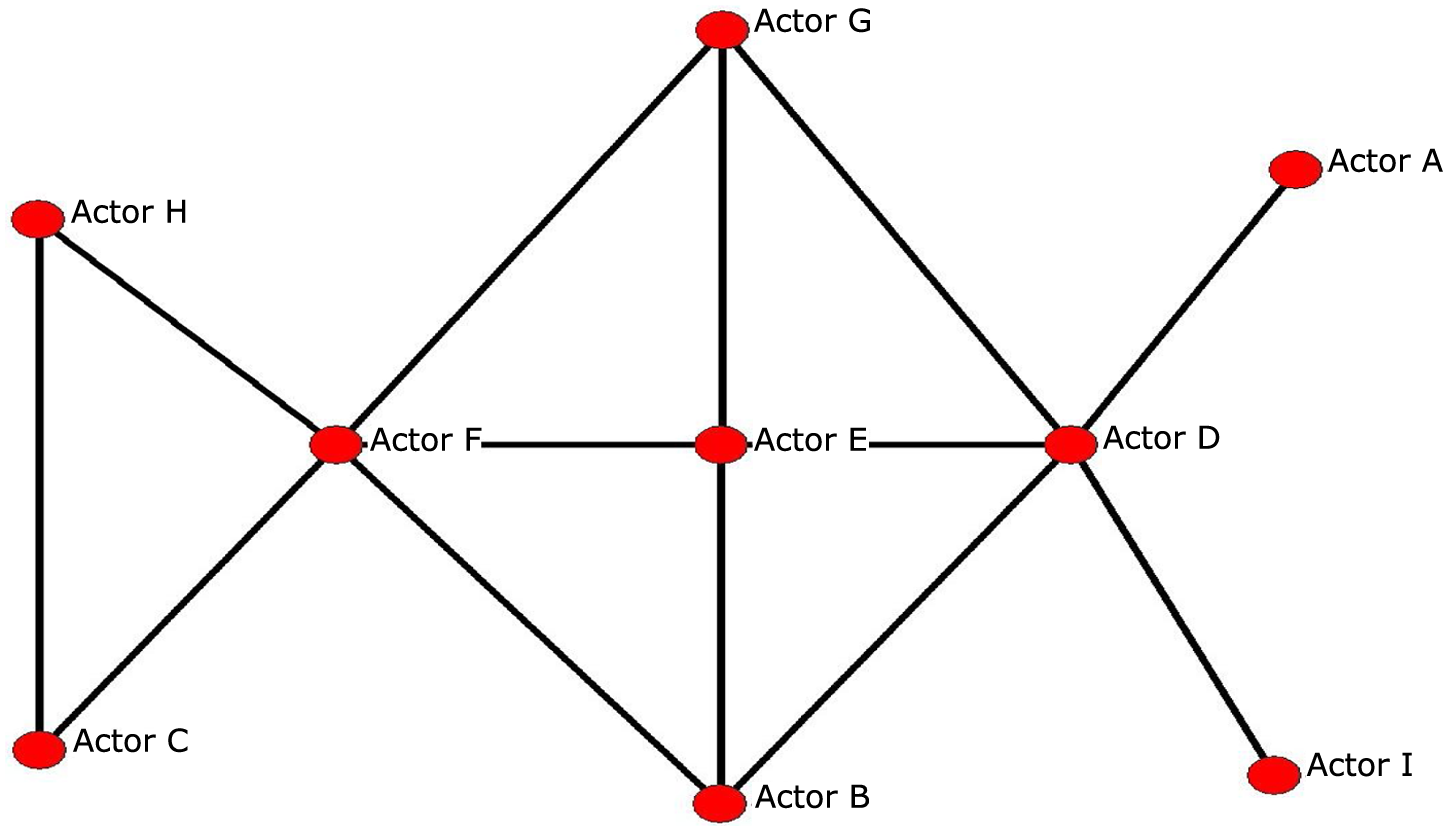
Hypothetical network of nine actors
We propose that the use of bonding structures may affect the participation of local organisations in region-wide emergency planning activities in two different ways. First, local actors embedded in bonding structures may choose to participate in regional planning activities to gain the advantages that bonding relationships provide for internalising a sense of the collective good as an important goal for the group (Coleman, 1988; Putnam, 1995; Nan, 2001). Involvement in region-wide planning activities may contribute to the good of the group because the information gained through active participation in regional planning improves the group’s preparation. Moynihan (2008) finds that the close professional relationships created through repeated interpersonal contacts and active participation in regional planning activities improve network learning and the effectiveness of local emergency plans during disasters. These close relationships also help first responders and managers to improve their operating procedures and planning processes (Tierney and Trainor, 2004; Somers and Svara, 2009).
However, it is also plausible that local officials engaged in bonding relationships may not need to participate in formalised regional planning activities to obtain information. For the individual manager, the closeness provided by bonding creates opportunities to build the trust, reputation and credibility necessary to collaborate effectively with other managers to plan for emergencies and disasters. As a consequence, actors using a bonding strategy may choose to be less active in the region-wide initiatives because they do not need to establish direct links with large numbers of other actors in the region to gain crucial information regarding emergency management activities. Local officials may seek this type of role when they want to limit the resources they expend on regional planning activities.
Bridging Effects: Information Accessand Control
The presence of bridging structures has different implications for the flow of information within the network. By occupying a central position in a network, an actor is able to control information because the bridge created between otherwise disconnected stakeholders puts her in a better position to participate and negotiate in decision-making processes (Granovetter, 1973; Nan, 2001). This position as information ‘broker’ permits an actor to bargain for the interests of her organisation and creates an opportunity to actively shape the information transmitted through the network. Once established, structural bridges can be an important source for information that local public officials can utilise to reduce the harm to their community when emergencies happen (Choi and Kim, 2007). Also, organisations serving as bridges have a status in the network that encourages other organisations to pursue connections with their staff in order to gain information (Wasserman and Faust, 1994; Choi and Brower, 2006). Local governments playing bridging roles will be in a better position to reduce the risk to their community and respond effectively should a disaster strike (Andrew, 2009).
Returning to Figure 1, actor D is the most important bridging actor in this network. Actor F also plays this role in this network but to a lesser extent than actor D. It is relatively easy to see that the deletion of either of these actors would substantially change the way information flows through this network. For instance, if actor D is removed from the network, actors A and F are no longer linked. If this link is used to transmit important information, advice, or other resources critical to planning and responding to emergencies, the loss of actor D impedes the ability of A and F to do their jobs effectively. This fact makes actor D a very important actor in the network.
We propose that, when local public officials bridge otherwise unconnected parts of the network, they are more likely to engage in region-wide planning activities. Active participation in regional planning activities provides crucial planning information that the organisation can then disseminate through the network.
Research Design and Data Description
We examine these propositions with a study of first responders, emergency managers and various other local public officials working in the North Central Texas region. The North Central Texas Council of Governments (NCTCOG) focuses on preparing the region to respond to disasters and routine hazards, such as severe weather, hazardous materials, large fires and ice storms. The organisation also plays an important role in the region by providing a venue to address collective concerns about emergency planning activities. NCTCOG facilitates region-wide emergency planning by co-ordinating monthly meetings for local emergency managers, organising workshops on funding opportunities and scheduling training exercises (USGAO, 2004). NCTCOG’s regional planning activities also include preparing and responding to indirect threats from potential hurricanes along the Texas coast. These activities include providing temporary shelters for evacuees, as was the case in the Hurricane Rita and Hurricane Katrina disasters, and responding to requests for aid from communities outside the region under the State Mutual Aid agreement.
Two NCTCOG committees work to improve the emergency planning and preparedness of local governments across the region: the Regional Emergency Preparedness Advisory Council (REPAC) and the Emergency Preparedness Planning Council (EPPC). We examine the engagement of local public officials in the activities of these two committees because of the committees’ work to facilitate regional decision-making and evaluate the benefits of local projects intended to improve the region’s capability for joint planning and response. REPAC has the authority to review, score and rank local project proposals according to Department of Homeland Security (DHS) guidelines.
1
For instance, UASI guidelines encourage interjurisdictional co-operation on projects and REPAC is charged with evaluating proposals in terms of this objective. Similarly, EPPC provides policy direction and oversight functions to the development and maintenance of a coordinated and integrated regional approach to emergency management planning and response systems (EPPC, 2009, p. 1).
Data Collection
The communication network utilised by the local public officials in this region was identified using a snowball sampling strategy. A list of participants in the NCTCOG-organised Regional Emergency Managers Network was obtained from a source in NCTCOG’s emergency preparedness department. Forty-eight local government officials were contacted in the summer of 2007 and asked to name up to three individuals they regularly contacted about emergency management activities. This process ultimately generated a list of 225 individuals who were then sent a questionnaire between November 2007 and June 2008. Completed questionnaires were received from 126 individuals from 100 different organisations.
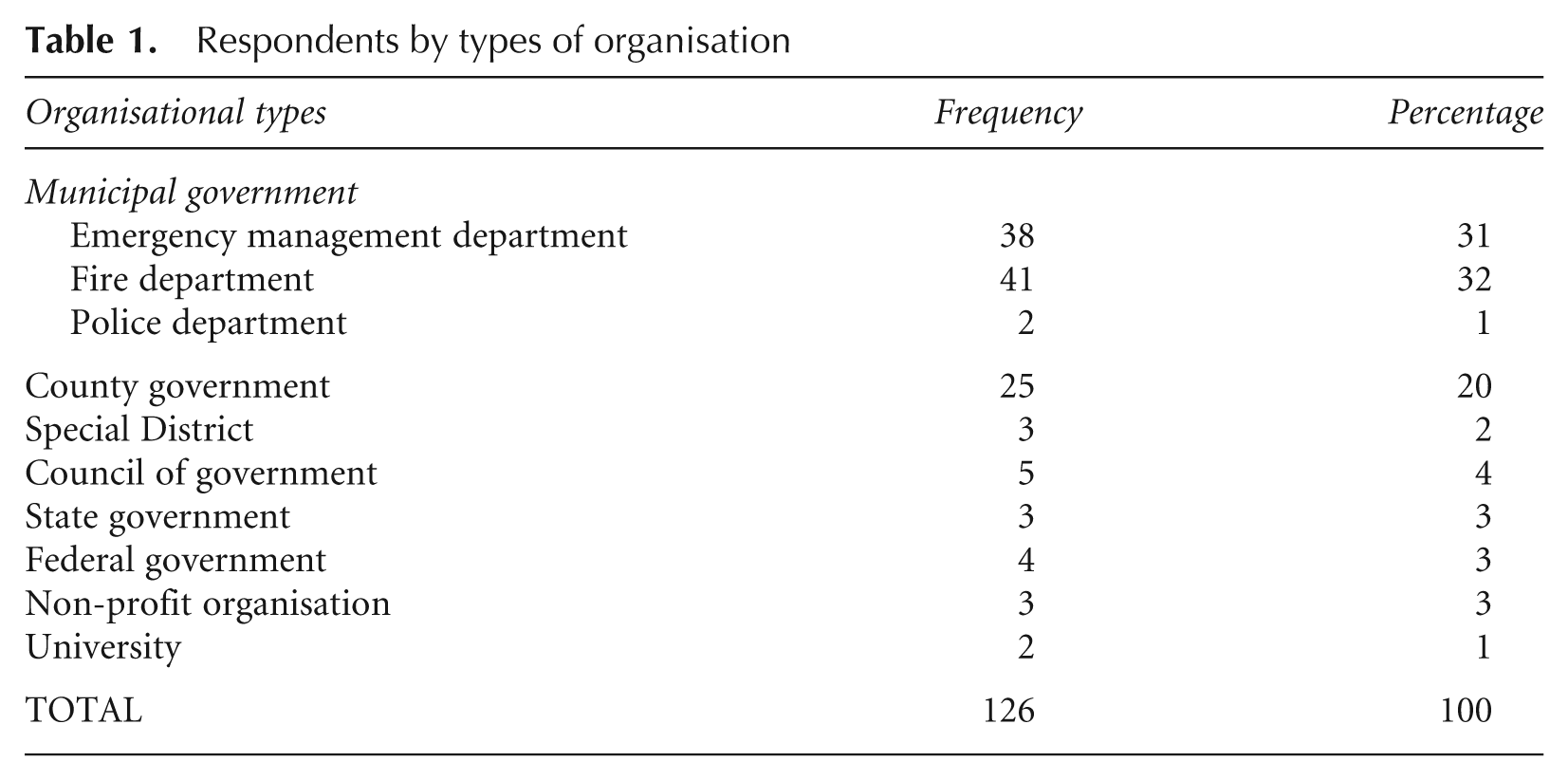
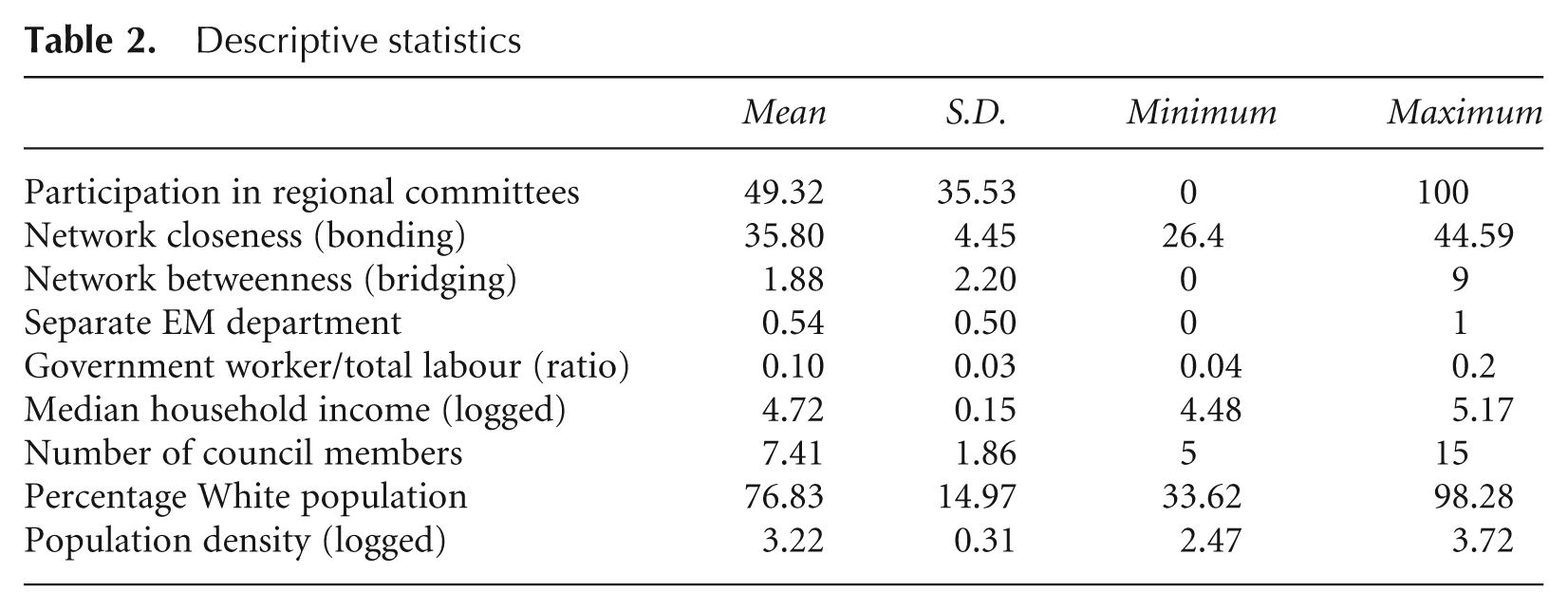
Our focus in this study is on the linkage between social position of local governments in interorganisational networks and their involvement in efforts to prepare the region for emergencies and disasters. However, the information on the structure of the local communication network and participation in the regional committees comes from surveys of the linkages among individual public officials in the region. Thus, the network centrality measures calculated for each participant in the network working for the same local government are averaged to create a single centrality score for the organisation. The responses from the individuals indicating the extent of their participation in the two regional committees are combined in the same way. Table 1 presents the distribution of the respondents by organisational type and Table 2 provides descriptive statistics and a brief description of the measures for each variable in the model.
Respondents by types of organisation
Descriptive statistics
Measuring Participation in Regional Emergency Planning
The dependent variable in this analysis is the level of participation in the two NCTCOG committees by the local public officials examined in this study. The variable is an index developed from their responses to the following survey question: “Regarding regional coordination in the North Central Texas MSA, how actively involved are you in the activities of the following regional partnerships?” We examined their responses to two of the options presented in the questionnaire: the Emergency Preparedness Planning Council (EPPC) and the Regional Emergency Pre-paredness Advisory Committee (REPAC). The respondents were directed to indicate their involvement in the regional committees in terms of the following scale: 0 (not at all) to 4 (very much). For each respondent, their answers were summed to create a single response ranging from 0 to 8. The summed scores were then divided by 8 and multiplied by 100 to create a highly reliable index of participation (Cronbach’s α = 0.848), ranging from 0 and 100. Higher scores on the index indicate greater involvement in the activities of these two regional planning organisations.
Measuring the Social Position
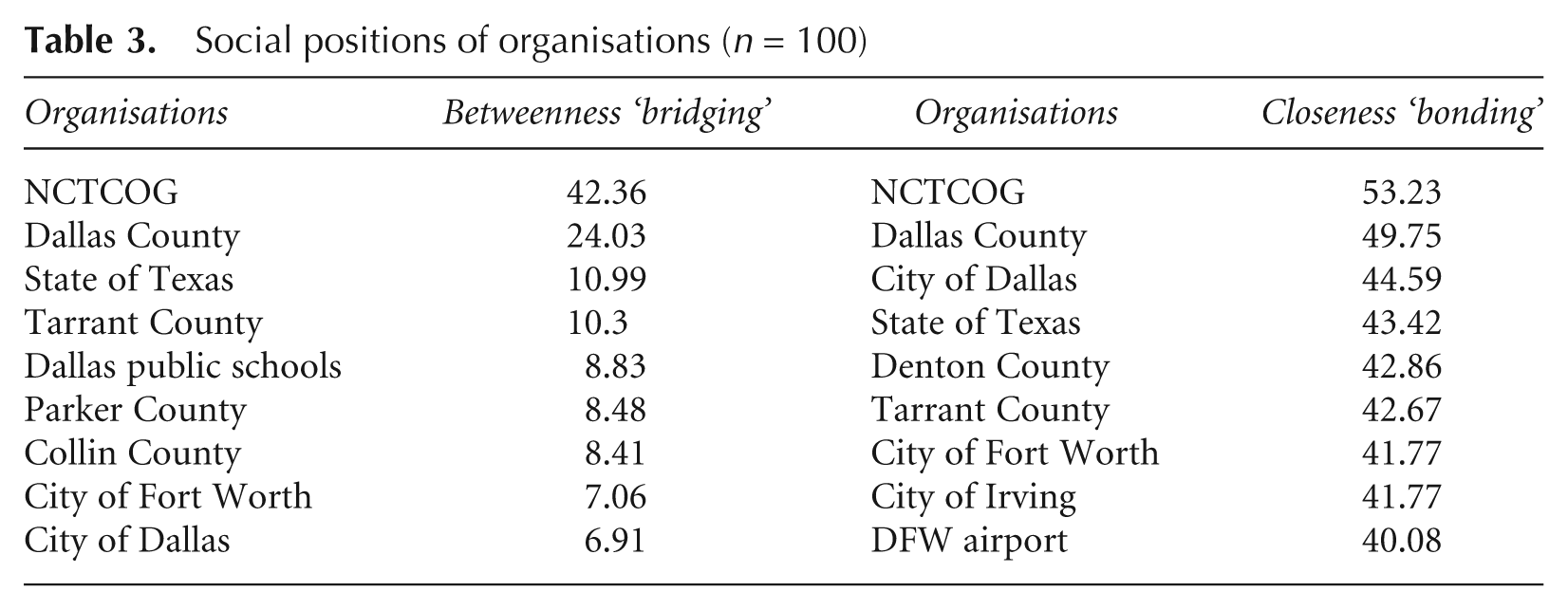
The theoretical variables of primary interest in this study are two measures of social position calculated from a structural analysis of the communication network revealed by the survey. 2 The indices of actor closeness centrality and actor betweenness centrality are calculated using the centrality routines in UCINET 6.0 (Borgatti et al., 2002). Table 3 presents the betweenness and closeness scores for the nine most central organisations.
Social positions of organisations (n = 100)
Bonding effects
The presence of bonding network structures is measured using the actor closeness index (Wasserman and Faust, 1994). 3 The index indicates how quickly each actor can connect to other actors in the network by analysing the distance of the actor from all others in the network. 4 The index effectively captures the basic idea of bonding network structures. Intuitively, the lower the number of direct and indirect ties needed to reach all others in the network, the greater the manager’s closeness centrality. The actor closeness index is standardised so that the index ranges from 0 to 100 and the score is comparable with centrality measures calculated for other networks (Wasserman and Faust, 1994). Values closer to 100 indicate that the manager is able to communicate with all the other members of the network more quickly than the network actors with lower closeness centrality scores.
Other scholars, mostly in the strategic management literature, have used closeness centrality to examine similar questions. For example, Soh et al. (2004) used closeness centrality to analyse the linkage between actor centrality in interfirm alliance networks and changes in the investments made by the firms in research and development.
Bridging effects
The presence of bridging network structures is measured using the actor betweenness centrality index (Wasserman and Faust, 1994). 5 This index effectively captures the basic idea of bridging structures by quantifying the strategic importance of each actor in the network. For each actor in the network, betweenness is based on the probability that the shortest paths between any two other actors pass through them. 6 The actor with the greatest betweenness score has the most influence over what information flows within the network. The actor betweenness centrality index is standardised so that the index ranges from 0 to 100 and the score is readily comparable with the centrality measures calculated for other networks (Wasserman and Faust, 1994). Values closer to 100 indicate that the actor has relatively greater influence over other actors in network.
Several other scholars have used betweenness centrality to examine similar questions. Cross and Cummings (2004) used bet-weenness centrality to assess the linkage between social position and individual performance in knowledge-intensive work. Barley et al. (1992) examined the characteristics of firms that led to higher betweenness centrality in strategic alliances in the commercial biotechnology industry. Finally, Choi and Brower (2006) used betweenness measures to examine the linkage between interpersonal connectedness of organisations engaged in emergency management and differences among the organisations in interpretations of formal plans.
Control Variables
Finally, the models include several variables to control for the variation in the participation index arising from differences in the institutional structure of the local governments and the demographic composition of their populations. Variables capturing differences in the institutional structure of the local governments include measures indicating if the jurisdiction has a separate emergency management department, its number of council members and its capacity for emergency planning and response, measured simply as the ratio of government workers to the total labour force in the community. The variables accounting for differences in the demographic composition of these jurisdictions include median household income, the percentage of residents who are White and the population density of the community.
Findings
The model examining the index of participation in the two committees is estimated using ordinary least square (OLS) regression and the findings are presented in Table 4. 7 Information on the network members from organisations other than local governments is excluded, leaving 73 local governments in the analysis.
Local Governments Involvement in Regional Emergency Planning Committees

Notes: p <0.10; **p <0.05; ***p <.001.
The analysis supports the proposition that the use of bonding structures is associated with increased participation in these two committees. Those local governments with higher closeness centrality scores reported statistically greater involvement in the activities of these committees. 8 This finding is consistent with the argument presented by Kendra and Wachtendorf (2004) that, when emergency managers feel a strong sense of group obligations, they are more engaged in activities that support these values. Involvement in activities focused on preparing the region may contribute to the good of the group because the information gained through active participation in regional planning improves the groups’ preparation.
The proposition that organisations playing bridging roles in the network are more active participants in region-wide planning activities is not supported by the analysis. This proposition is rooted in the belief that some local governments may use the involvement of their staff in regional forums as a means to secure information that can be used to support their role within the network as an important source of information useful for disaster mitigation and response planning. However, despite the potential benefit of this information to their bridging role, the managers in the local governments in this network were not more engaged in the work of these committees than the officials from organisations not acting as bridges within the network.
Finally, the control measures included in the models affect participation in fairly predictable ways. Local governments with generally greater planning capacity were more active in the work of these two committees, as were local governments with separate emergency management departments. Local governments with denser and more homogeneous populations were also more active in these two committees.
Discussion
Despite calls from practitioners and scholars about the importance of intergovernmental co-ordination and communication (Kettl, 2002; McEntire and Dawson, 2007; Waugh, 1990), analysts have not systematically explored the factors explaining the variation in participation by local governments in the activities of region-wide planning committees, particularly for emergency mitigation and preparedness planning. Network analysis provides a means to examine how the relationships among local government officials may encourage participation from local organisations in this important collective activity. The effect that the intersections of these personal contacts and information exchanges have on the success of collective action at the regional level has been overlooked in previous research on this topic.
Previous research has shown that the effectiveness of regional emergency planning depends on the level of participation by first responders and emergency co-ordinators in regional committees or working groups composed of experts from local governments (Comfort, 1988; Caruson et al., 2005; Kapucu, 2006; Petak, 1985). Our analysis of the communication network among local government managers in the Dallas–Fort Worth–Denton metroplex indicates that close relationships among the actors in these local networks may increase their participation in the work of these regional organisations. Our findings suggest that the process of preparing for disasters in the NCT region is facilitated by two or more local governments working closely together. We think this occurs because this closeness generates familiarity, trust and confidence among the actors within these organisations.
Bonding relationships are the critical “human infrastructure that facilitates successful implementation” of regional planning activities (Harris and Clements, 2007, p. 488). Regional organisations provide forums for information exchange, dissemination of best practices and support network learning (Moynihan, 2008). The support services provided by these organisations allow managers to articulate their concerns, assess the feasibility of planning strategies and obtain guidance on technical issues related to the regulations and standard operational procedures often mandated by state and federal governments (LeRoux, 2008; Wolf and Bryan, 2009). The repeated routine interactions from these relationships are important for creating the familiarity and trust essential in crisis and an awareness of the different capabilities that allow actors to anticipate others’ needs. Local governments reduce the potential for negative consequences of disasters when their staff work together to identify potential hazards and effective strategies for mitigating risks from these hazards (Kreps, 1991; Kendra and Wachtendorf, 2004). In our view, the importance of bonding relationships to effective regional emergency management planning cannot be understated.
Suggestions for Future Research
We hope others can build upon our work by exploring ways to encourage the formation of these close-knit relationships among local governments by identifying the barriers to the development of these relationships. Finding ways to establish close bonding relationships among groups of local governments may serve to improve preparedness across the region.
The findings we report in this study are significant, but based on an analysis of a single network. Also, egocentric designs rarely capture entire networks due to resource constraints and gaps created by non-responses (Scott, 2000). 9 The name-generator data collection procedure used in egocentric network studies is an excellent way to identify the core network around a set of specific actors, but these actors will have other important relationships that are not captured through this process. The relationships captured in this study were limited both in terms of the number of communication links (up to three people per respondent) and the subject of the communication (emergency management activities). Thus, at best, this study provides a partial description of the relationships important to these actors and a more comprehensive measurement of their networks may have revealed different insights. We encourage others to build on our work by replicating our study in other settings and with research designs that seek to identify more extensive networks. 10
Footnotes
Acknowledgements
Earlier versions of this research were presented at the 10th meeting of the Public Management Research Conference in Columbus, Ohio, in October 2009 and the annual conference of the Southern Political Science Association in New Orleans, Louisiana, in January 2011. We appreciate the assistance provided by Pamela McGehee during the data collection.
Notes
Funding
This research was partly funded by the Paul A. Volcker Endowment for Public Service Research and Education.