




Abstract
Drawing upon collaborative planning theory and on the work of Lefebvre and de Certeau, this paper explores the multistage governance arrangements leading to the employment of temporary uses as an instrument for regeneration in a context of economic crisis. It contributes to a thorough understanding of the relations between the power hierarchy and the strategy/tactics developed through a more or less inclusive collaborative process from place-shaping (weak planning) to place-making (masterplanning). By decrypting the different paths that can be taken by the collaborative process, the paper demonstrates how temporary uses on differential spaces shape space from a use value point of view, influence and challenge the distribution of power and enable (temporary) occupants to acquire and sometimes sustain a position in the place-making process.
1. Introduction
This paper critically examines the proliferation of temporary use developments in derelict sites that have developed since the 1970s as a by-product of deindustrialisation and its associated urban and socioeconomic transformations. The use of such sites can be defined as a set of practices with short-term return developed in a context of economic, urban or political disorder in a more or less unplanned way. Their life-span varies from a couple of months to several years. While shorter-term uses are common, longer temporary uses are more unusual and relate to a blurred vision of redevelopment resulting from a set of deadlocks. For example, such uses include Lausanne’s Flon development which had a range of artistic, cultural, leisure and commercial activities (Andres, 2008; Andres and Grésillon, 2011). Created in easily transformable former warehouses and garages, temporary uses were fostered by cheap rents and short leases; the opportunity resulted from a series of deadlocks in the planning system leading to an alternative transformation of the district for approximately 10 years. Temporary cultural uses also flourished in Marseille during the 1980s and 1990s in former industrial buildings due to the severe crisis in the city’s economy and property market (Andres, 2008, 2011). Such cultural developments were facilitated by both an oversupply of abandoned buildings and by financial incentives offered by the municipality. In partnership with experienced artists, a cultural project known as La Friche was developed. It progressively became a well-known flagship facility influencing the cultural landscape of Marseille and its urban regeneration.
To date, interest in temporary uses has been addressed through two main areas of study: cultural spaces and squats (Groth and Corijn, 2005; Chatterton and Hollands, 2003; Pruijt, 2003); and temporary economic and cultural activities in abandoned areas (Haydn and Temel, 2006; Oswalt, 2005; Overmeyer, 2007; Urban Unlimited, 2004). Only limited research (primarily in Germany) has questioned the potential contribution of temporary uses in a long-lasting process of urban regeneration as in Lausanne or Marseille. Those that did (Urban Catalyst, 2003, 2007; Overmeyer, 2007; BMVBS and BBR, 2008) explored the nature of temporary uses and their mechanisms for establishment. They stressed the technical skills of temporary actors as well as their self-initiative and creative spirit (Urban Catalyst, 2007 and Andres, 2011). However, the extent to which temporary uses involve the specific distribution of power between sets of stakeholders within a collaborative process of transformation has not been fully examined. Looking at such temporary uses is increasingly topical in a context of austerity where former models of regeneration and development are challenged due to a changing real estate market and economy. Besides being in-between solutions further to various deadlocks and crisis, temporary uses can also stimulate the economy (i.e. giving free spaces to people in the hope that they can develop a profitable business and thus expand and pay tax) or renew the urban environment.
This paper fills a gap in the literature by exploring the multistage governance arrangements that lead to the employment of temporary uses as an instrument for regeneration. From a theoretical point of view, it acknowledges the political, dialectic and complex nature of the planning process embedded in the problematic management of actors with distinct powers and interests and stresses the role of power relationships and conflicts in place-making (Healey, 1997, 1998). Drawing upon collaborative planning theory (Healey, 1997, 1998) and on the work of Lefebvre (1991) and de Certeau (1984) on the political nature of differential spaces and practices of everyday life and its more contemporary interpretations (see Round et al., 2008 and 2010), this paper contributes to the reinterpretation of the institutional dynamics of urban change in diverse and conflict-ridden societies. Reflecting on Brand and Gaffikin’s argument (2007, p. 283) that collaborative planning provides an “inclusive dialogic approach to shaping social space” while featuring contemporary issues including “reduced certitudes and predictabilities … and … new modes of governance that acknowledge the need to involve multiple stakeholders”, this paper argues that temporary uses take place in singular and differential spaces (different from formal spaces) in a context of weak planning (as opposed to masterplanning) and that a range of tactics and strategies are developed questioning the power distribution alongside the multistage transformation and governance process.
This paper therefore questions the extent to which the relations between the power hierarchy and the strategy/tactics developed in the temporary use of space shape a long-term collaborative process which can be more or less inclusive. Furthermore, it demonstrates how temporary uses impacting urban regeneration include a subtle shift between a range of coping (or defensive, see Round et al., 2008) space-shaping strategies and tactics to a set of development-led (offensive, see Round et al., 2008) place-making strategies. This shift relies on the transition of power relationships from a context of crisis (weak planning) to a period of stability (masterplanning). Whereas coping strategies and tactics are developed as a form of resistance to a context of disruptions, offensive strategies are formalised with the purpose of redeveloping the site while ensuring the legacy of temporary uses. The transformation of Flon and La Friche are employed to support the discussion. Before exploring these examples, the paper sets up the conceptual and theoretical framework and concludes with a critical discussion on the lessons raised by both case studies and reflects on the theoretical contribution of the analysis.
The results presented in this paper are based on empirical research from a funded project conducted in France and Switzerland from 2004 and 2008 (Andres, 2008) and regularly updated in the following three years through the participation in seminars, conferences and regular fieldtrips to both cities. This research included the collection and the analysis of both secondary and primary data in the form of documentary reviews (a range of reports published by public bodies, academic papers, laws and acts, planning guidance and frameworks), semi-structured interviews and participant observation. A total of 51 interviews were conducted in Marseille and 44 in Lausanne between 2005 and 2007; 10 additional interviews in each city were added in 2009/10 to update the results. All interest-groups and users were covered in the interviews, including current and former policy-makers, planning officers, cultural users, business tenants and residents, representatives from public bodies (for example, the Délégation Régionale des Affaires Culturelles in France), community groups, local journalists and academic experts.
2. Foundations of the Conceptual and Theoretical Framework
2.1 Urban Brownfields: Differential Spaces for Temporary Practices
Healey argues that planning, as a governance practice, aims to address the difficulties created by the complex co-locations of activities and their relations and the impacts these co-locations generate across space–time. It is a practice that is not merely concerned with managing existing relations but with imagining and opening up future potentialities (Healey, 2007; cited in Healey, 2009, p. 277).
Looking at temporary uses in periods of change is a means of imagining future transformation opportunities. Although temporary uses can settle in a vast range of spaces, those influencing the regeneration agenda are commonly developed in derelict sites. These spaces provide different spatial realities derived from complex urban changes. Temporary appropriations challenge their transformation by questioning the stakeholders’ co-location in the governance process. To stress the distinctiveness of this environment, the concept of “differential space” (Lefebvre, 1991) is used.
Henri Lefebvre (1991) developed his argument on the social and political nature of space in the context of social and economic changes (the 1960s and 1970s) when the ‘urban issue’ was at the core of the political agenda (Dikeç and Garnier, 2008). For Lefebvre, space is at the origin of and is leading a transformation process. However, whereas space can be defined in terms of its operational and instrumental role, it also allows some leeway to generate emancipative actions as a place of conflicts and as the central object of political struggle (Brenner, 2000, p. 373). In this context of conflicts, appropriations are possible and challenge the operational, instrumental and controlled nature of space (Lefebvre, 1991, p. 410). From a planning perspective, such conflicts make more complex activities and stakeholders’ co-location as well as question the collaborative governance process.
Developing the argument of conflict and complexity further, the concept of differential space stresses the importance of space’s heterogeneity. Such spaces are opposed to an orderly vision of the city and relate to the right to be different (Lefebvre, 1991, p. 64). They sit within a focus on everyday life pointing out the importance of spontaneity, difference and disorder (Madanipour, 1996). This position is concomitant with that of de Certeau (1984, 1993), whose main argument is to concentrate on everyday life, as opposed to an abstract visualisation of the city. As noted by Dikeç and Garnier requestioning the spatial dimension of policies and the political dimension of space … is still topical to understand the new figures of power on space in the context of a complex contemporary urban environment (Dikeç and Garnier, 2008, p. 14).
This period still witnesses an even greater intensification of the contradictory processes of globalization, fragmentation and reterritorialization to which Lefebvre drew attention over two decades ago (Brenner, 2000, p. 361).
Derelict areas when hosting temporary uses can be characterised as differential spaces (Ambrosino and Andres, 2008); they allow various appropriations as they are submitted to a transformation trajectory, from the moment their initial activity has been interrupted. During this time-gap, these disconnected spaces are different and not ordered by a planning strategy which itself lacks clarity. This period ends with a redevelopment project questioning the future of these initiatives. Looking at these differential spaces allows the questioning of the spatial dimension of everyday power relationships, specifically between landowners, local authorities and temporary occupants as well as the complex colocation of these stakeholders and activities. It stresses the tensions in the more or less collaborative production of space between users who appropriated space and other actors, supposedly controlling the same space. These tensions take place during the transformation trajectory of these derelict spaces from a period of weak planning to a stage of masterplanning.
2.2 Weak Planning, Masterplanning and temporary uses
Temporary uses are encouraged by a context of weak planning (Urban Catalyst, 2007) or a ‘watching stage’ (Andres, 2011) which refers to a period during which the desired future for an area cannot be accomplished. Local authorities and landowners, despite having an ideal vision of redevelopment (particularly from a financial perspective), cannot achieve it. Whatever the national planning framework is, it relates to the particular circumstances of a neglected space for which the change of uses (through the adoption of a new plan) is not possible due to a set of deadlocks: a weak property market (economic crisis or oversupply of derelict land), the financial non-viability of a redevelopment project (for various reasons including decontamination costs), strong disagreements between stakeholders or planning restrictions particularly towards land use modification. It can be argued that weak planning is a planning sub-system based on its temporary status. It is defined by its complex, fluid, flexible and permissive character typical of a context of crisis and disorder in the economy, in the city and in the land use and development process. It is characterised by its lack of co-ordination, strategic guidelines, clear objectives and control by any higher authority (Couch et al., 2005).
Weak planning is particularly fruitful for the appropriations of differential spaces as the boundaries between legal/formal and illegal/informal activities are blurred—as are the distribution of powers between the different stakeholders. While local authorities and market operators (landowners and developers) are in a standby position, temporary occupants for a short period of time are transferred the power and ability to shape the space. Such a temporary transfer is acknowledged most of the time and is often well thought of by decision-makers. Weak planning is therefore opposed to masterplanning which relates to the process of designing and implementing a development vision for the site and beyond; it involves an entrepreneurial approach in which power in place-making (Healey, 1998) has been reattributed to key decision-makers (particularly developers). The transition from place-shaping to place-making and its implications are indeed fostering tensions.
Whereas top–down masterplanning relies on the ideas of permanence, stability, linearity and control and often has no means of developing non-commercially exploitable areas, more unplanned temporary uses can enable flexible, innovative and bottom–top approaches which are not exclusively related to monetary values (Urban Catalyst, 2003). Temporary uses are connected to a set of restrictions and incentives. Restrictions refer to deadlocks, whereas incentives include cheap rents, fewer constraints in term of maintenance, flexibility of uses and modularity of space (Drake, 2003), as well as dedicated funding and temporary leases. Hence, considering and supporting temporary uses is acknowledged as a tool to prevent vandalism and potentially revalorise land value (BMVBS and BBR, 2008); it can also be assumed that it may launch a process of cultural regeneration (Urban Catalyst, 2003; Andres, 2008).
The transition from weak planning to masterplanning not only involves the formal shaping of a regeneration programme, but also the setting up of a formal collaborative process. Tensions and conflicts appear as power shifts from temporary place-shaping users to formal place-making decision-makers. This process challenges the distribution of powers between various stakeholders. It raises the need to recognise local knowledge by “widening stakeholder involvement beyond traditional power elites” (Healey, 1998, p. 1531). This local knowledge is there in the hands of the temporary occupants. Obviously this shift questions how non-empowered actors manage to express their views and defend their ideas in a context where flexibility and spontaneity are no longer welcome. In this regard, the distinction between strategies and tactics developed by de Certeau (1984) provides another dimension to the discussion.
2.3 Defensive and Offensive Strategies and Tactics
Drawing on Giddens’ structuration theory, Healey (1997) argues that the iterative, dialectical and reflective nature of the collaborative planning process involves the creation of an arena where all voices can come together. It allows changes while also making it possible to “overcome the gravitational pull of existing powers” (Brand and Gaffikin, 2007, p. 286). However, while this notes the importance of power relationships, the hierarchy of power in the uses of temporary spaces is not fully explored, nor is the nature of the actions they involve. De Certeau’s argument (1984) on the difference between tactics and strategies fills this gap.
Whereas strategies are developed within a process of calculation or manipulation of power relationships, tactics are ‘calculated actions’ which “play on and with a terrain imposed on it and organized by the law of a foreign power” (de Certeau, 1984, p. 37). In other words, “a tactic is determined by the absence of power just as a strategy is organized by the postulation of power” (de Certeau, 1984, p. 38). Tactics and strategies differ from each other due to their scope and the process by which they are formalised and implemented. Strategies are related to determinism and regulation. They have an explicit aim in the production of space and the realisation of a set of objectives and of a specific action plan. Tactics are much more unco-ordinated; they have “no proper locus” and are not related to any general strategy. Tactics operate “in isolated actions, blow by blow”; they “take advantage of opportunities and depend on them” (de Certeau, 1984, p. 36). The ideas of adaptability and flexibility are central here as one of the key features of tactics is to be “mobile” (p. 36). Additionally, whereas a strategy does not need to demonstrate its use and veracity, a tactic needs to prove its efficiency over time.
Various researchers have used the work of de Certeau to question strategies and tactics particularly in relation to the analysis of everyday informal practices and power relationships. Round et al. (2008 and 2010), drawing on the work of Allen (2004) have noticed that people can be simultaneously operating a range of tactics and strategies. Discussing the informal economy in Ukraine and particularly the wide range of tactics developed in response to the country’s economic marginalisation since the collapse of the Soviet Union, Round et al. demonstrated that two forms of strategy can be noted defensive strategies employed to ensure that tactics can be maintained and offensive strategies which aim to expand the control of economic spaces (Round et al., 2008, p. 175).
Following de Certeau’s arguments, this paper argues that strategies are a synonym for conformity, rationality and interventionism. By producing a vision with a set of objectives for a space, it creates an action plan for space transformation. Strategies are put forward by stakeholders who have a landownership power and a decision-making power on the development process and on place-making. On the other hand, tactics are much more spontaneous and non-determinist (with an absence of or fuzzy locus). They are based on the re-use and on the non-possession of space whose regulation and control is ensured by other stakeholders. Tactics do not imply a long-term vision as they are based on evolving and opportunist practices. They are intrinsically temporary, mobile and flexible. They need to demonstrate their validity and their use to be acknowledged as such. However, in a similar fashion to Round et al.’s (2008) findings, this paper considers that these tactics can evolve towards strategies if power is given with regard to the future and long-term development of the space.
Strategies and tactics are not automatically attributed to the two main sides of the transformation process: decision-makers versus temporary occupants. The complex interaction between these actors and their impact in shaping and reshaping spaces are noticeable in the iterative characteristic of collaborative planning. Strategies and tactics performed as such evolve and can be developed by the same actors in the arenas that are consequently constructed. This distinction can be explored further in a context of transition between weak planning and masterplanning. It can be argued that the context of weak planning favours defensive strategies and tactics. These coping practices are questioned during a transition process; they lead to further offensive strategies and, in some cases, to defensive tactics. Such power relationships are concomitant to the interactions between the actors and the political, social, economic and urban context. Drawing on this discussion, Figure 1 summarises the conceptual framework used to discuss the transformation of temporary uses.
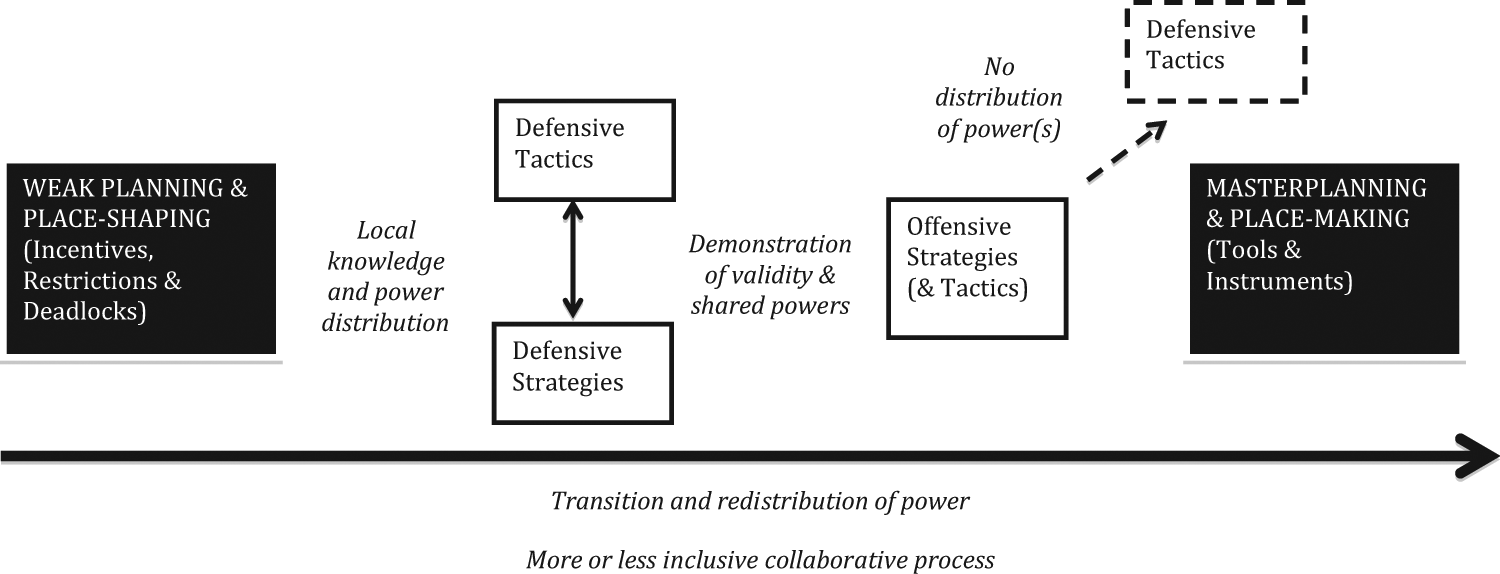
The conceptual framework for the trajectory of transformation of temporary uses on differential spaces.
3. The Transformation of Flon: From Marginalisation to Gentrification
Flon is a derelict industrial district in the city centre of Lausanne located 150 metres from the historical core. This private property of 5.5 hectares was initially erected as a storage yard in the 19th century. It started to be underused in the 1950s (Racine, 1999; Andres, 2008, 2010) before finally being redeveloped during the 2000s. Table 1 points out the key dates of its transformation. Following the rejection of a first masterplan in 1986 (Ville de Lausanne, 1986) in a local referendum, the city council, in consultation with the owner, launched an architectural competition leading to a new masterplan (Ville de Lausanne, 1993). This time the proposal was not supported by the owner or the tenants. In order to avoid any further popular rejection, the municipality decided to reject the plan. Six more years passed before the current project of redevelopment began.
Key dates in the transformation of Flon

3.1 Planning Deadlocks, Conflicts of Power and Opportunities for Temporary Uses
Flon denotes an unusual situation of weak planning which existed until 1999 and is typical of Lefevre’s space of political struggle. Despite a constant demand for developable land, its redevelopment was on hold for almost 50 years because of on-going planning disputes between the private owner (LO Holding) and the city council. The district was classified as an industrial area; a change of land use into a mixed-use neighbourhood required a consensual agreement formalised in a masterplan ( known as a plan partiel d’affectation). Until the end of the 1990s, opposing visions of the economic outcomes of the development and its general design between LO, the municipality and the tenants/civil society 1 blocked any formal redevelopment (Racine, 1999; Andres, 2008; Ville de Lausanne, 1999). The respective powers of landownership and decision-making were cancelled out.
In this context, temporary activities were considered by the landowner as an interim solution to draw short-term incomes. These activities significantly challenged the operational, instrumental and controlled nature (Lefebvre, 1991) of the district which was significantly different from any other parts of the city. Its differential status as defined by Lefebvre (1991) was perceived as unordered and provocatively “non-Swiss”
2
by the tenants. At that time, incentives for temporary uses were economic (cheap rent and favourable central location) and legal (flexible leases with no restrictions towards changes made to warehouses). Interviews have demonstrated that plans towards the potential outcomes of these uses were not formalised by LO Holding when authorising these leases. This tactic was aimed exclusively at securing incomes. A wide range of temporary tenants settled (clothing and shoe shops, bars, nightclubs, art galleries). In this weak planning context, deprived of any entrepreneurial approach or power in place-making (Healey, 1998), the owner did not exercise any control or restrictions on the appropriations. As described by one of these temporary tenants The landowner was OK to rent some units at very interesting prices as long as people agreed to do up their spaces (installing heating …). We had the authorisation to paint the façades, to organise barbecues.
3
The city council on the other hand had no power to interfere in the development of these temporary uses. In this environment, favouring what de Certeau (1984) refers to as a process of taking advantage of opportunities, temporary occupants quickly developed a set of tactics leading to organic community-led regeneration. As the negative image of the site shifted towards a more positive representation of Flon, the temporary tenants driven by their feeling of being part of an innovative and alternative experiment, started to build a ‘village in the city’ named the “Flon-Flon”. Local events (for example, an open cinema; see Figure 2) were organised and a set of communication tools were used to promote Flon (for example, the creation of a local newspaper). The attraction of the district grew. It became well-known for its alternative character as the ‘little Soho of Lausanne’ (Peclet, 1994).

The open cinema.
3.2 Dilemmas of Individual Tactics versus a Consensual Regeneration Strategy
The success of temporary uses in rebranding the area was a catalyst for transition. In 1998, LO Holding and the city council started to acknowledge the outcomes of temporary uses and made a point of ending the area’s marginalisation (with its associated illegal activities, notably drug dealing and drug use). LO Holding shifted its vision from a tactic with financial outcomes to an offensive strategy of redevelopment collaboratively discussed with the municipality. The outcome of its ‘postulation of power’ (de Certeau, 1984) and regulated vision was a development plan (PPA) (Ville de Lausanne, 1999) approved in 1999. The municipality and the landowner agreed to take benefit of the temporary uses’ outcomes to foster a long-term profitable regeneration (Groupe LO, 1998; Ville de Lausanne, 1999). In contrast to previous periods, there were no leadership conflicts and power was more clearly distributed. The city council approved the general development features and provided the landowner with leeway to fulfil their economic objectives: “the credo was not to be directive”. 4 This satisfied LO as the PPA was “a good plan with a very good flexibility of development”. 5
This arrangement nevertheless involved managing the legacy of temporary uses, particularly the trendy image of the district, while securing civil consent. The plan aimed to respect “the double vocation of the district: a perfectly central area and a slightly unusual space with a particular cache” (Groupe LO, 1998, p. 2). A balance between the little Soho and the new Flon was sought out to transform the area as a place for cultural, creative leisure and trendy activities. With this purpose, the strategy of the owner followed a very controlled yet collaborative process including collective and individual meetings aimed to make voices heard whilst limiting conflicts. “We played the card of the community and the marginalisation of the nasty ones and this worked”. 6 Apparently collaborative, the process was supposed to widen what Healey (1998) describes as an arena involving more actors than traditional power élites. The negotiation was actually based on “respect and a bit of pressure if needed. The aim of the struggle was to reach conciliation”. 7 Through this, the municipality/LO Holding coalition prevented tenants from defeating their scheme as the plan, on paper, appeared as “respectful of the Flon-Flon while looking at the future”. 8
However, once the plan was approved, tenants started to face pressures due to the implementation of the “Flon Vision 1 and 2” (Groupe LO, 2005) and the progressive economic gentrification of the district. To keep their voices heard, the remaining tenants 9 used their internal and external networks, as well as substantial press coverage to pursue the promotion of Flon and consequently their activity. They also used legal pressures (slowing down the development process) to negotiate with the landlord and defend their individual interests through individual defensive coping tactics.
A shift from collective offensive tactics relying on organic, community-led regeneration to individual and ad hoc defensive tactics therefore occurred. Yet these tactics failed to shift into strategies. Temporary occupants failed to be formally empowered as the development locus evolved from one which preserved the alternative image to one which fostered a creative and high-spec district. Typically, drawing on Round et al.’s (2008) conclusions, their offensive strategy aimed at expanding the control of this highly profitable economic space. As explained by LO Holding We collected enough benefits from the traditional Flon that we can still sell it with this identity which is now more and more declamatory and less a reality.
10
This strategic redistribution and displacement of tenants and the area’s gentrification are unsurprisingly criticised, but are accepted by former temporary tenants I am disappointed about the district. It is becoming a sterilised and a has-been district. However, from a commercial point of view, I have no regret.
11
4. La Friche: Fuzzy Boundaries, Empowerment and Cultural Regeneration
Marseille’s La Friche is a cultural space located in a former tobacco factory whose activity ceased in 1990. Located in an industrial district, the 8-hectare factory is divided into three units. Unit 3 (La Friche) includes some warehouses, parking and a set of buildings. La Friche’s transformation resulted from an initial temporary re-use in 1991 which was quickly sustained by the inclusion of the factory in the 313-hectare regeneration project Euroméditerrannée. It progressively evolved within a succession of development strategies as a key cultural facility for Marseille (see Table 2). Unlike Flon, La Friche is not a district as such and its transformation evolved more quickly towards masterplanning through a more collaborative process.
Key dates in the transformation of La Friche
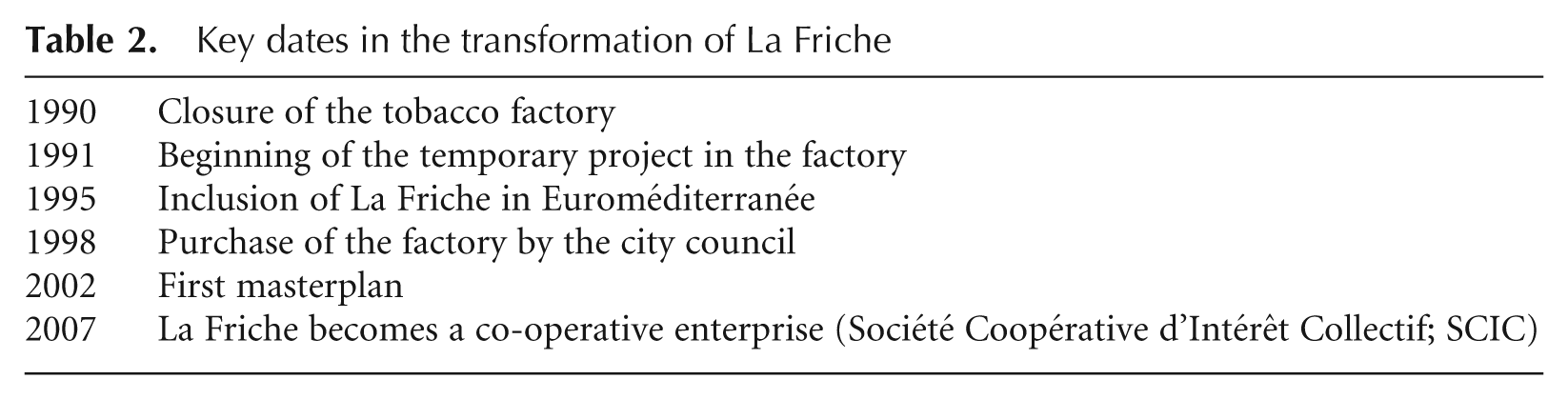
4.1 Crisis, Brownfields and Temporary Uses
During the early 1990s, Marseille was unable to cope with the economic, social and urban impacts of its industrial decline leading to a rise in unemployment, a loss of population and a deterioration of its image (Peraldi and Samson, 2005; Donzel, 1998). Likewise, the real estate market was unable to respond to the oversupply of brownfield sites. Such a weak planning context was favourable for the development of temporary uses on differential spaces. However, unlike other shrinking cities such as Manchester, Liverpool and Berlin (Oswalt, 2005; Couch et al., 2005), the city council played an active role in supporting temporary uses in order to limit the impacts of dereliction (Peraldi and Samson, 2005; Andres, 2008). Unlike those in Flon, these spaces were not central objects of political struggle as described by Brenner, but provided an alternative to what Lefebvre (1991) describes as an orderly vision of the city. Through this defensive and small-area strategy, incentives were a freedom to choose the most appropriate differential spaces and indeed a political and financial support. A set of restrictions were also applied particularly with regard to site regulations and constraints (for example, contamination) as well as landownership.
In 1991, the site offered a favourable environment for the development of temporary uses. The landowner strategically considered temporary leases as a cheap way to guard the area and speculate about its possible purchase by the city council by postponing his entrepreneurial approach. Supported by the municipality and the owner, who both then delegated their power of place-shaping, temporary cultural occupants created the association known as Système Friche Théâtre (SFT). From 1992, they developed a set of offensive tactics which soon became a formal strategy built on the idea of “alternative economic culture”. 12 From this period, SFT demonstrated its ‘postulation of power’ (de Certeau, 1984) in place-shaping and place-making. Its key objective was to transform the temporary experiment into a sustainable project and then to pursue its growth and recognition. In less than three years, La Friche gained a local, national and international visibility (Mission de Préfiguration Euroméditerranée, 1995; Ville de Marseille, 1997). The shift from tactic to strategy was operationalised through the use of local, national and international networks, as well as key well-known personalities (for example, the architect Jean Nouvel became president of La Friche from 1995 to 2002) which sustained the place-shaping power delegation (Andres, 2011).
4.2 La Friche: a Flagship Project Sustained through a Long-term Collaborative Process
The transition from place-shaping to place-making was concomitant with the integration of La Friche in Euroméditerranée. In response to this, SFT developed a wide strategy of development: “a cultural project for an urban project” (SFT, 1996). However, this strategy essentially tackled the development of the cultural project, rather than of the area as a whole. The transition towards masterplanning involved a progressive power redistribution between the municipality, Euroméditerranée and the landowner (until the sale of the unit in 1998). Whereas SFT remained a key interlocutor, the market operators regained their role in redeveloping the two other units of the factory with new facilities dedicated to cultural and creative industries. The creation of this new arena typically contributed to what Brand and Gaffikin (2007) refer to as an overcoming process of gravitational pulling powers in a collaborative perspective.
Such a sustained collaborative process based on a shared distribution of power between stakeholders with distinct objectives is unique. It rests on the use of La Friche as a flagship project for Marseille as well as the success of the project in being a leading ‘cultural brownfield’ in France and in Europe (Andres and Grésillon, 2011). However, the collaborative process has not been straightforward and SFT was forced constantly to demonstrate the outcome of their project and to repostulate their power in place-making. This was made through a set of initiatives (first cyber café, for example) and various cultural events and local partnerships (for example, with schools) (Andres, 2011). La Friche’s voice was therefore heard widely in the arena of cultural and urban development (Ville de Marseille, 1999, 2001). The juxtaposition of these actions in addition to the project’s growing visibility was finally acknowledged by the municipality: “La Friche has produced an overall project that is not only a bohemian artistic project: it contributed to the urban and economic renaissance of the city”. 13 The unit was bought in 1998 by the city council. Whilst power in place-making became shared between the city council and SFT, the nature and components of the collaboration and of the overall strategy of redevelopment were not. The first step was the adoption of a local masterplan (l’Air de ne pas y toucher, Bouchain, Système Friche Théâtre, 2002, 2005) aimed at preserving the unique character of La Friche (literally meaning in French ‘brownfield’). The second consisted of the transformation of the association SFT into a co-operative enterprise in 2007. A 40-year lease was signed with the municipality who thereby transferred all powers to the ex-temporary occupants (Ville de Marseille, 2007a, 2007b, 2008).
This evolution was the final outcome in the recognition of the value of the project and its utility for the city council. “It ensures a sustainable development to the project with more reliable legal guarrantees and a viable economic functioning”.
14
Furthermore Even if the city council is still involved in the project, it gives much more opportunities to La Friche to access to further funding opportunities and be more free to finance its project of development.
15
On the other hand, the city as a whole continues to benefit from the recognition of La Friche which, for example, is one of the key cultural facilities of Marseille Provence 2013 European Capital of Culture. It is “a hub of creativity representing an urban community whilst still maintaining its status as a cultural incubator” (Marseille Provence 2013, 2008). Therefore, despite the fact that this (initially) temporary experience has had few effects on the local redevelopment of the district, it has highly impacted the cultural and urban development of Marseille through a long collaborative (Healey, 1998) and offensive (Round et al., 1998) process of shared power and strategies from place-shaping to place-making.
5. Discussion and Conclusion
The transformations of Flon and La Friche are typical of two distinct trajectories of regeneration that can overall be considered as successful, even if not without their downsides. In both cases, temporary uses have been a project-proof tool (Urban Catalyst, 2007) to develop a strategy of economic and cultural development. However, although criticised for its economic gentrification, the benefits of Flon regeneration on the overall city centre are noticeable. These outcomes are far less explicit for La Friche. The cultural regeneration even created a stronger division between the former factory and the industrial district (Andres, 2011; Bertoncello, 2006). However, the role of La Friche in the cultural development of Marseille has been significant.
Indeed, the legacy of temporary uses and the footprint of the differential spaces in both cities have been singularly different due to a set of factors. First, the different localisation (central versus peri-central) and the nature of the ownership (private versus public) have of course impacted the trajectory taken by both cities. Flon has followed a common path of economic gentrification
16
typical of central and upper-middle-class areas with a bohemian character and initially low-rent properties (see Hackworth and Smith, 2001; Lees, 2000 and 2003; Ley, 1996 and 2003; Smith, 2002; Wyly and Hammel, 2001; Cameron and Coaffee, 2005). It is exemplary of the third wave of gentrification that pioneers a comprehensive class-inflected urban re-make … including recreation, consumption, production and pleasure as well as residence (Smith, 2002, p. 443).
In comparison, the transformation of La Friche has generated an increasing gap between the former factory highly subsidised by public/private funding and the working-class district left outside urban policy funding until 1999 (AGAM, 2003). Gentrification, although not impossible, will take much more time (Bertoncello, 2006; Andres, 2011).
Secondly, the distribution and balance of power in the shift from place-shaping to place-making in Marseille and the way SFT has been able to develop and implement a development strategy (as opposed to a tactic of organic-led regeneration) has impacted the nature of the collaborative masterplanning process. Both differential spaces have been spaces of contrasting frictions and conflicts: very limited in Marseille yet overwhelming in Lausanne. In both spaces, power distribution was channelled by a small number of empowered stakeholders in a strategically constructed but collaborative process. La Friche’s voice and its local knowledge have rapidly been acknowledged as an asset leading to a progressive transfer of place-making power. In Flon, there have never been any intentions to empower tenants. On the contrary, the strategy of attracting new tenants (such as La Fnac) was a way to build a counter-group of non-conflictual tenants. Referring back to de Certeau’s theory (1984), the transformations in both La Friche and Flon have been guided by the calculation and manipulation of power relationships. Whereas calculation has been central in Marseille, manipulation and control have been crucial in Lausanne.
The paper therefore brought another theoretical framework to the analysis of the process of empowerment and the explanation of the way power is used and exploited by stakeholders in different public policy arenas; as such this is not so innovative as developing new frameworks has been “a key and common aspect of the debate of participation and collaboration in planning” (Bailey, 2010, p. 317). However, much of the previous work on partnership, empowerment and participation in planning (see for example, Atkinson, 1999; Brownill and Carpenter, 2007; Bailey, 2010) has focused on the end-point of the collaborative process; it has questioned public participation and participatory democracy once a matter was already set up in the agenda of public policies. By looking at temporary uses and arguing that the weak planning context interferes in the transformation of the differential spaces by: starting to shape the space particularly from a use value point of view; influencing and challenging the distribution of power; and, enabling (temporary) occupants to acquire and sometimes sustain a position in the place-making process, the paper has informed the different paths that can be taken by the collaborative process.
The evolution of La Friche denotes a position of inclusivity (Ansell and Gash, 2007; Andres and Chapain, 2012) towards the former temporary occupants and a co-construction of the cultural regeneration project based on the local knowledge of these actors and their ability to demonstrate the relevancy of their place-shaping actions and place-making strategy (and be empowered as such in both cases). The transformation of Flon, on the other hand, arises from the common use of temporary activities in regeneration and gentrification within a far less collaborative process. Tenants’ voices were heard but not listened to and they were barely empowered within the process except in the short period at the beginning when they catalysed the change and had the freedom to use and shape the district and warehouses to their own ends.
The inputs of the everyday life theory and the social and political nature of space therefore bring to the collaborative theory insights to grasp the complexity of the actors’ hierarchy and power distribution when evolving in a context of non-conformity and flexibility. It informs the participatory planning debate, but through the analysis of end-users who have already been active in shaping the transformation of such differential spaces from the beginning of their transformation trajectory. Bridging these theories while looking at temporary uses enriches the everyday analysis of how, in the current economic context, ideas for setting-up ‘pop up’ or ‘meanwhile’ 17 projects and activities (such as temporary shops and cafés in British shopping malls and high streets) are opportunities worth exploring. Such initiatives typically point out how the legacy of temporary uses has been acknowledged when defensive tactics shift to offensive strategies once the cultural capital of these tactics has been noted and these ideas have been used as a transformative catalyst.
Footnotes
Notes
Funding
Part of this research was funded through a PhD Studentship offered by the French Ministry of Research.