




Abstract
With the ageing of populations in Europe, one can expect new pressures on the existing housing stock to accommodate those older individuals with mobility problems; at the same time, housing assets are expected to be called upon to guarantee financial security for older homeowners. The accessibility and suitability of housing, and the financial security that housing provides, may exert an independent influence on well-being; to what extent either factor prevails in influencing well-being has important policy implications. This paper empirically examines the impact of investment and environmental housing influences on satisfaction with housing in a population of older people. Data are used from the European country which had the greatest number of homeowners at the time of the survey (Spain), and where at the same time older people rely heavily on informal caregiving. Robust evidence is presented to suggest that satisfaction with housing in old age is indeed independently associated with environmental influences. Although homeownership does improve well-being related to housing, home equity does not exhibit a significant and independent effect.
1. Introduction
Housing is a potential source of both material and environmental well-being (Rossi and Weber, 1996; Rohe et al., 2001) insofar as it encompasses both consumption and investment (and capital accumulation) effects. A possible source of market failure arises when the genuine sense of well-being that individuals derive from their housing is affected by house prices. Paradoxically there is scarce empirical literature on the relationship between housing-related well-being resulting from its consumption (or as we refer to it here, environmental) and financial (or investment) influences. This is a policy-relevant question that deserves further attention. In part, this paucity of empirical research results from the difficulties in measuring well-being directly and from the limited quality data on housing-related satisfaction and housing characteristics. Instead, scholars follow a revealed preference approach whereby utility from housing is inferred from individual choices. However, if an individual’s behaviour results from the interaction between preferences, expectations and the environment defining the decision-making context (Guiso et al., 2006), then a change in environmental conditions will influence well-being without necessarily affecting preferences.
One empirical strategy to identify and measure the determinants of housing-related well-being is to examine the sources of the heterogeneity in housing satisfaction drawing upon survey data. This is an increasingly popular empirical strategy 1 given that housing satisfaction, as we show in this study, is a highly sensitive measure of existing improvements in certain valued housing characteristics (such as space, location, neighbourhood). 2 More importantly, housing satisfaction is the highest-ranked dimension of self-reported life satisfaction in most European countries (Domanski et al., 2006). However, as we hypothesise in this study, environmental characteristics such as (sufficient) space, (suitable) floor level and (adequate) number of rooms are among the most important determinants of housing-related well-being. Simultaneously, housing-related well-being could just reflect homeownership or investment effects. 3
To date, there is limited empirical evidence on the factors underpinning housing satisfaction, especially among older individuals, who make relatively more intense use of housing services. European-wide evidence reveals that about 16 per cent of older people are dissatisfied with their housing, although older people living alone tend to be more satisfied than their younger counterparts (Whitten and Kailis, 1999) in many parts of Europe, with the exception of Greece, Italy and Portugal. This suggests that the issue of housing satisfaction is non-trivial, although important socio-environmental influences (Chen and Spector, 1991) that appear to be highly significant for older individuals might hypothetically explain and trigger different levels of housing-related well-being. Theoretical explanations of such factors are not yet highly elaborated and could be informed by evidence. More specifically, we examine the influence of two alternative sources of housing satisfaction as follows. Given the ‘environmentally protective role’ that housing arguably has in old age, we hypothesise that housing-related well-being results from environmental effects—namely, housing characteristics such as the existing dwelling space, floor, flat or housing structure. 4 Importantly, one can separate ‘objective conditions’ (such as space, tenancy, quality of local environment) and psychosocial factors (positional elements) that underpin people’s expectations on the basis of their previous dwelling and other people’s dwellings (Frank, 1985). 5
In addition to pure environmental determinants of well-being, another explanation for housing satisfaction amongst homeowners is that ownership may be conveying a pure ‘investment effect’, which provides a potential source of perceived financial security to individuals. Such an investment effect is particularly relevant given that older individuals are more likely to be owner-occupiers and tend to prefer ageing in place (Costa-Font et al., 2009). Indeed, in most European countries, housing has traditionally been the main means to accumulate equity (Smith and Searle, 2010) and there is some evidence that the vast majority of personal savings consist of housing equity (Venti and Wise, 1991). This feature is most relevant in the European context because Europeans (and especially southern Europeans) exhibit a comparatively higher preference for homeownership; hence, arguably investment effects might be more important in explaining housing-related well-being. Specifically, in Spain, housing wealth has traditionally been used as a way to self-insure against financial hardship in old age (Costa-Font et al., 2010a, 2010b). Some illustrative evidence of these patterns is shown in Figure 1, which highlights the fact that countries with a higher percentage of homeownership exhibit slightly higher levels of housing satisfaction, although aggregate data that does not control for relevant covariates exhibits a small correlation. Similarly, when the same older (65 and over) respondents are examined separately, it appears that countries where there are lower levels of homeownership in old age display consistently lower levels of housing satisfaction and the slope of such a relationship is located higher than for the rest of the population (see Figure 1).
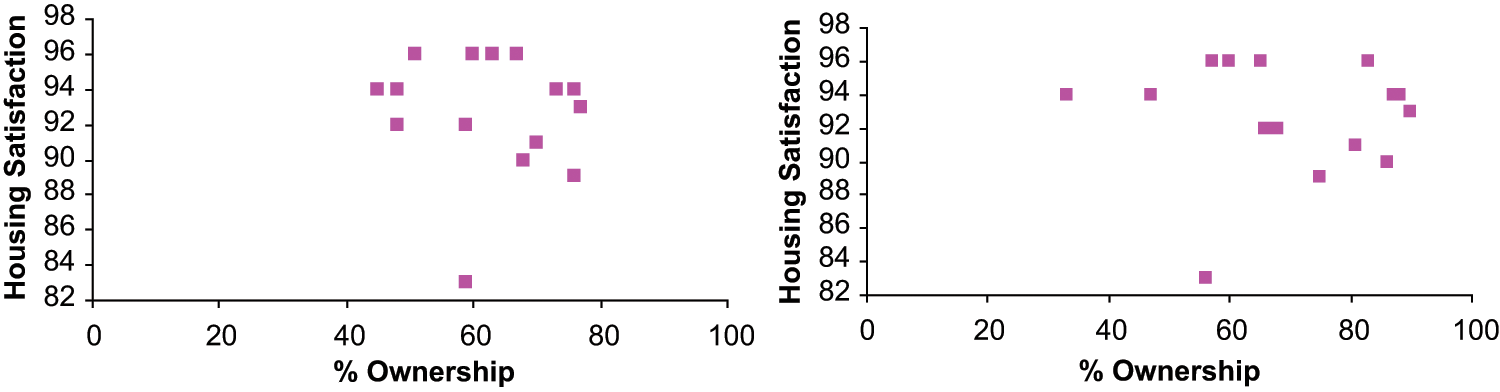
Housing satisfaction and ownership in EU-15 in 2003. Left: All groups; Right: 65 and over.
This paper takes advantage of a new database from Spain to examine the influence of environmental determinants of housing-related well-being (housing satisfaction) among older people, alongside investment explanations (namely, homeownership and housing wealth). The latter are especially important among older age-groups as older people’s socioeconomic differences are mainly due to differences in wealth arising from disparities in housing assets, rather than the fairly standardised pension systems. 6 Older people are also more likely to have finished paying their mortgage and therefore the impact of homeownership can be clearly separated from the likely stressful effects of mortgage payments. 7 Therefore, housing can be expected to act as a form of self-insurance for needs in older age, primarily though the development of specific financial instruments (such as home reversion). 8 Furthermore, we carry out an examination of the full sample with and without controlling for cohort effects. Some studies have found important cohort differences—for instance, as over 75 per cent of households with middle-aged heads are homeowners in Canada and the US (Jones, 1995), one would expect such cohort effects to be important in other countries as well. More specifically, in this study we examine whether housing well-being is associated with the environmental characteristics of respondents’ housing after controlling for market value and ownership. Results are suggestive of a critical influence of major socio-environmental sources of housing satisfaction. Whilst homeownership is found to be a significant source of housing satisfaction, housing wealth is not.
The structure of the paper is as follows. Section 2 contains a conceptual framework. Section 3 describes the resulting data. Section 4 reports the results and section 5 is devoted to the concluding comments.
2. Background
2.1 Housing Investment and Ownership
Homeownership is increasingly acknowledged to exert some important enhancement of individuals’ well-being, especially in old age. Rossi and Weber (1996) find a positive correlation between homeownership and both happiness and physical health, although it is important to differentiate housing-specific satisfaction from life satisfaction or happiness. One reason why homeownership might be influential lies in its possible interaction with environmental sources of housing satisfaction. Consistently, European Union (EU) data reveal that privately owned dwellings usually tend to comprise a larger number of rooms and are less likely to suffer from housing-quality limitations (Hoekstra, 2005). This is a plausible explanation for the stylised fact that owner-occupiers are generally more satisfied with their dwelling (Hoekstra, 2005).
A second line of inquiry that has motivated some discussion in the field suggests that homeownership can exert a counter-influence in the form of indebtedness arising from holding mortgages. For instance, having to make periodic payments can cause anxiety (Nettleton and Burrows, 1998). However, more recent research has indicated that distress is higher among renters and lower among homeowners without mortgages (Cairney and Boyle, 2004). More specifically, EU evidence suggests that ownership status explains roughly 5 per cent of the variation in housing satisfaction (Domanski et al., 2006). One explanation for this is the role of housing in enhancing capital accumulation in the course of a lifetime. Therefore, it is to be expected that a higher rate of ownership will be found among older respondents.
The main criticism made of these sorts of studies is that they do not control for dwelling value, individual income and socioeconomic status. Self-selection (Dietz and Haurin, 2003), whereby self-confident individuals, who suffer less anxiety, are more likely to become homeowners, is also an issue. Another important mechanism to examine is the effect of the physical design of the dwelling space, which affects the home environment and eases mobility and movement around the dwelling, along with other psychological benefits that permit individual development (Imrie, 2004).
Comparative European data recently made available have provided evidence on housing satisfaction across countries, suggesting evidence of a link between housing satisfaction and homeownership (Rohe et al., 2001; Rossi and Weber, 1996). Hoekstra (2005) finds that southern European countries exhibit lower satisfaction levels, 9 although Spanish respondents showed a higher level of housing satisfaction than other southern European countries, such as Italy, Portugal or Greece. Poor housing quality, measured as ‘the number of problems the dwelling has’, is found to reduce housing satisfaction, while the number of rooms is positively associated with greater housing satisfaction. Especially important is whether housing satisfaction endures in old age, when health-related needs might require making improvements to the dwelling. Spain and other southern European countries are going through a population-ageing process, in which individuals aged 80 or over are beginning to make up a large proportion of the population. Therefore, given that housing needs change over a person’s lifetime, examining dwelling-related satisfaction among older people has become an important public policy issue.
Whether the role of homeownership gives rise to better access to care in old age is far from certain. Ownership might prevent individuals from being housed within a suitable care environment, reducing housing satisfaction. This is especially the case if older individuals prefer a less suitable but familiar environment, given their needs (Forrest et al., 1990). On the other hand, individuals nurture a specific identity regarding their dwelling (Rohe and Stegman, 1996) and homeownership provides financial security, as housing is an asset through which savings can be accumulated. Another mechanism whereby ownership could have an effect is through improving self-esteem and health (Rohe et al., 2001). This explains why some older people are often found to have low income and a disproportionately high wealth (Hancock, 1998), as housing assets are used to finance consumption in old age, especially amongst the most affluent. 10 However, the effect of homeownership varies depending on the size of the mortgage payments (Ford et al., 2001), the neighbourhood and the income group to which the individual belongs.
Other potential caveats of homeownership are, on the one hand, the uncertainty associated with varying house prices (Venti and Wise, 1989) and the apparent trade-off between homeownership and expansion in welfare services, in particular pension systems (Castles, 1997). Indeed, policies in countries like Spain have provided incentives for homeownership (such as tax relief on mortgage payments) but promotion of social housing has been very limited (Castles and Ferrera, 1996) and concentrates on the owner-occupied sector. Interestingly, Figure 1 reveals a negative association between housing satisfaction and homeownership across the EU-15, but this trend reverses to become positive when older people are examined separately.
Housing equity is certainly one of the main sources of intergenerational transfer in Spain. Housing ownership is considered to be a marker for other characteristics, proxying for social position in old age (Macintyre et al., 2003). However, some evidence reveals that, paradoxically, housing tends to be less accessible for older cohorts compared with younger people, and about 25 per cent of dwellings do not fulfil minimum accessibility conditions (Bosch, 2005).
Behavioural researchers emphasise the so-called personal environment approach, whereby an environment that initially meets personal needs may become unsatisfactory as personal abilities decline (Lawton, 1980; Sherman, 1988). Economists in social policy identify investment effects related to the fact that housing assets are commonly used in old age to finance long-term care (LTC) services. 11 Public assistance for LTC is provided by local authorities, but is subject to significant means tests which commonly take into account income and need. In countries such as Spain where the family still plays a central role (unlike other central and northern European countries where financial independence is a key value), a person’s house is often the main asset to which the individual and the family can turn for financial protection, especially in areas where social protection is not universal, such as LTC.
2.2 Housing Satisfaction in Old Age
Housing satisfaction depends on social exclusion through the interplay of different mechanisms that include health and disability, neighbourhood quality and security. Indeed, housing satisfaction is influenced by housing characteristics such as perceived safety, structural quality and household size (Hwang et al., 1999).
Several studies already provide evidence of a significant and robust association between type of housing tenure—including ownership and renting in the public and private sectors—and mortality and morbidity in Britain (Sundquist and Johannson, 1997; Macintyre et al.; 1998; Macintyre et al., 2003), or chronic illness (Gould and Jones, 1996). Only a few studies look at the associations between housing regeneration and neighbourhood conditions and health (Thompson et al., 2001; Macintyre et al., 1998; Macintyre et al., 2003). Indeed, important housing characteristics, such as the amount of individual space, have been shown to have an effect on health and are intuitively associated with overall individual satisfaction (Moloughney, 2004). Dwelling space and physical design affect the home environment and allow ease of mobility around the dwelling along with other psychological benefits that permit individual development (Imrie, 2004), especially among older people, who might spend more time at home. 12
The set of characteristics concerned with dwelling space and neighbourhood quality are reflected in house prices. In disentangling the specific effects of housing on well-being, the influence of neighbourhood effects emerges as an essential factor, as it affects aspects which directly or indirectly affect individual satisfaction, such as socialisation, noise and air quality. It is unclear whether homeownership is simply a measure of individual wealth or whether it exerts a direct influence on individual health. Indeed, housing and neighbourhood quality are associated with a number of health outcomes such as respiratory symptoms and limited functioning (Packer et al., 1994). Furthermore, psychological disorders are found to be more prevalent among public renters than owner-occupiers (Lewis and Booth, 1992).
It has been argued that residential segregation has an increased effect on certain population groups such as older people facing mobility limitations. Overcrowding is associated with a higher probability of violence, and infection (Wallace and Wallace, 1998). Yet the specific characteristics of tenure might need to be separated from those of housing ownership. Homeownership is a measure of social status that is at least as important as that of income. Also, unlike income, this form of wealth accumulation has considerable effects on other generations as well. On the other hand, housing ownership determines individual settlement security (meaning lack of dependence on a third party to remain in a place), in addition to extra financial security should need arise, as is the case for services excluded from welfare coverage. With regard to people renting their home, rent control may guarantee settlement security, especially for older people in countries like Spain, where rent controls are in place. However, dwelling ownership is widely conceived as a more secure and common mechanism for asset accumulation.
Previous evidence on the determinants of housing satisfaction in old age is limited. A Joseph Rowntree Foundation study (1995) found that satisfaction was higher amongst homeowners in Scotland. Amongst older men, satisfaction appeared to be influenced by the neighbourhood and the physical quality of the house. However, age (progress through retirement) and dwelling size did not appear to be significant predictors. Evidence from studies of housing satisfaction in Spain is scarce, especially among older people. We have identified only one study, which focuses merely on council residents in Spain (Amerigo and Aragoneses, 1990).
In 2000, 16.9 per cent of the Spanish population was over 65 years of age. The Spanish Institute for Complementary Social Services (IMSERSO, 2002) estimates that by 2050 this figure will have risen to 31.1 per cent. Whilst one must bear in mind that older people constitute a heterogeneous group and are subject to significant change, this ageing effect implies higher exposure to disability. On the other hand, there is evidence to suggest that an increasing proportion of older people are healthy and relatively affluent, which challenges the commonly held view that older people are frail and economically weak. The Spanish Observatory of Old Age estimates that, in Spain, there are 240 000 institutional beds and approximately 3 per cent of older people are in institutional care, although this figure is four times higher for those aged 80 and over (IMSERSO, 2002).
Various dimensions affect social position in old age: age (socioeconomic status declines with age); region (there are marked differences in purchasing power across Spanish regions); and environmental factors (IMSERSO, 2002). Less than 1 per cent of individuals aged over 70 are in the labour market and this figure is under 0.2 per cent for women. Some scholars estimate a significant reduction in the savings rate due to the ageing process. The study Ageing, Housing and Urban Development (OECD, 2003) highlights the significant challenges to housing conditions owing to the changes in demographic structure and makes it clear that policies should be sensitive to the new habitat requirements of the ageing population. In Spain, housing assets comprise a significant portion of the family’s wealth: 82 per cent of older-age people are homeowners (IMSERSO, 2002); 88 per cent of older people live in their own homes; and 12 per cent live with their children. Furthermore, in old age, people are less likely to be paying a mortgage, as mortgages usually last between 20 and 30 years. Therefore, the effects of housing tenure can be observed more clearly. 13
3. Data and Empirical Strategy
3.1 The Data
The study uses data from a unique survey that has been published and made available by the Institute Edad & Vida, a non-profit organisation devoted to promoting research on old-age dependency and ageing in general (Elvira et al., 2005). This institution commissioned a survey to examine individual attitudes in the event of old-age dependency and gave the authors the opportunity to participate in its design. 14 To that end, a questionnaire was designed and a set of computer-assisted telephone interviews took place between September and November 2003 based on a representative Spanish population sample of 729 individuals aged 55 and over as recommended by some studies (Heywood et al., 2001) and in line with several surveys focused on the elderly in Europe. The resulting data are of reasonable quality and statistically compare favourably with available evidence from publically commissioned surveys. The survey contains data on dwelling characteristics and location, lacking in previous datasets, which allow us to estimate the dwelling value. The obvious advantage of employing a self-designed survey has been to add items and questions that do not usually appear in available representative surveys. It was possible to measure the attitudes and preferences of older people on a variety of issues, such as housing satisfaction. Health status was gauged using continuous measures. The survey data include a specific list of disabilities and dependencies, which allows us to control by individual-specific housing needs, and contain records on the specific characteristics of every individual’s dwelling.
Table 1 contains a description and definitions of the data, which we briefly describe here. The mean age of our survey respondent was 67.6 years, where 28 per cent were in the 55–60 age range, and 11 per cent were 80 or older, suggesting that the majority were in the 60–80 range, as expected. 15 Of those interviewed, 65.3 per cent were female and the remaining 35 per cent men; 65 per cent were married and the remainder were widowed, separated or divorced. Literacy is limited to 44 per cent who had completed primary education, and only 39 per cent had finished high school. However, 84.3 per cent stated that they owned their dwelling and 3.4 per cent said they lived in someone else’s property, while only 12.1 per cent lived in a rented flat. When asked about their future concerns, housing hardly ever (0.7 per cent) emerged as an issue. Instead, health (79 per cent) and family (19 per cent) appeared as priorities. This was due to various factors, hypothetically including the fact that most of them had already paid for their home and they are well settled, although whether they are indeed satisfied or not is an empirical question to examine in further sections. In terms of needs, 62.5 per cent reported two of the nine considered ADL limitations and only 32.2 per cent received any form of help: 14.7 per cent from family, 13.6 per cent from their partner and 3.4 per cent from a professional caregiver. Some 55.6 per cent lived on their pension and 21 per cent reported their income. Interestingly, 58 per cent were not able to save the income they received.
Descriptive statistics
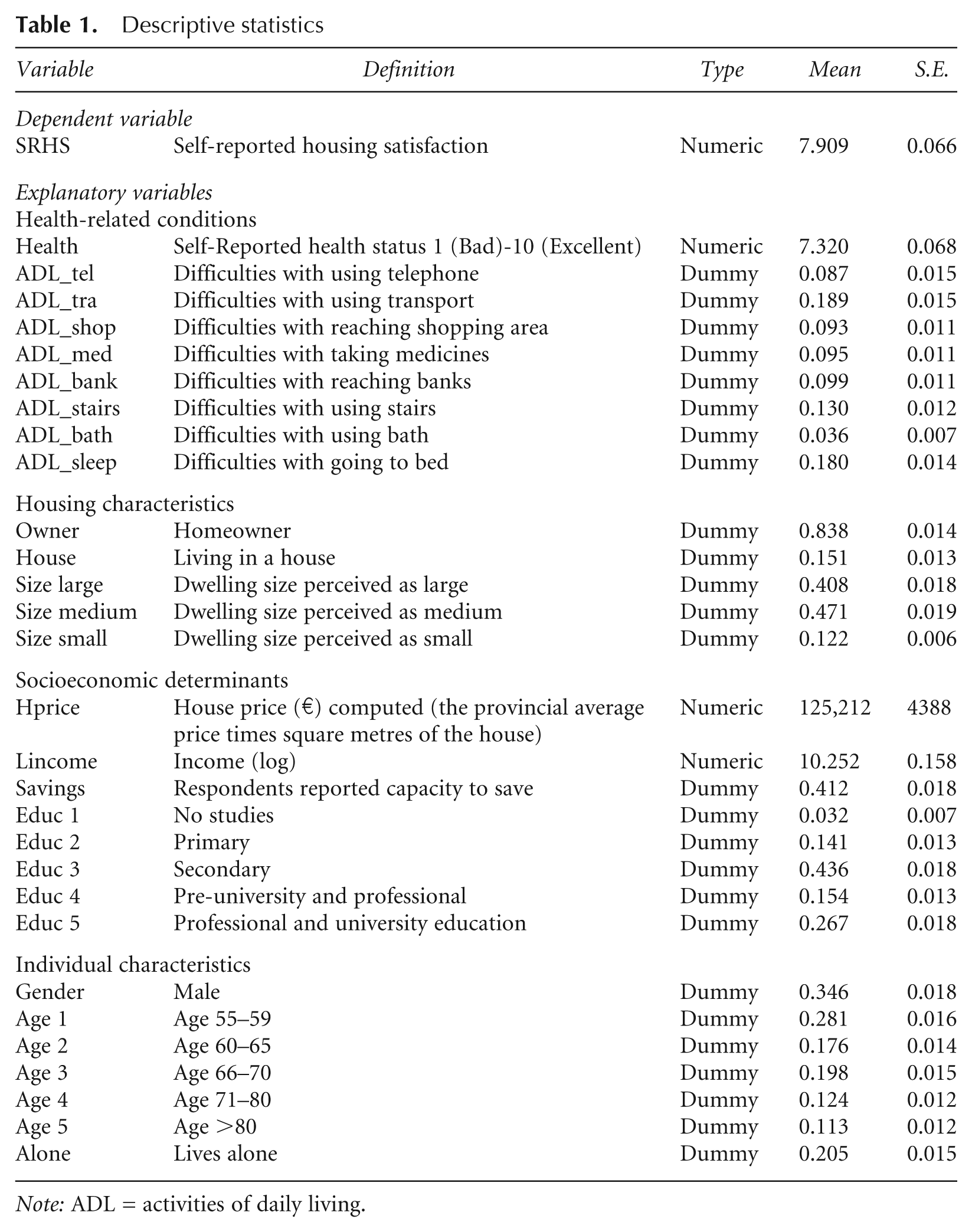
Note: ADL = activities of daily living.
Importantly, the mean size of individual dwellings was 102.3 square metres, with 3.3 bedrooms. When asked about their willingness to change dwelling, 55 per cent of those interviewed asserted that they would not change and the mean satisfaction index (on a scale of 1 to 10) was 7.91. However, whilst this figure was 8.1 for homeowners, it went down to 6.9 for renters (p <0.05) when no other characteristic is controlled for. Only 20 per cent of the sample consisted of individuals living alone. In the hypothetical event of old-age dependency, 78.1 per cent said they would prefer to live at home, 16.3 per cent in a nursing home and 5.6 per cent in a relative’s home. The last group had received less formal education and were mostly over 75. 16 However, barely 51.7 per cent said they would not be willing to sell their homes in order to gain access to long-term care, whilst 26 per cent said would be willing to do so.
Among the potential caveats of the data lies the fact that panel data are not available and hence inference cannot be regarded as causal. Additionally, subjective well-being may not be totally immune to the process of individual adaptation to specific contexts. Indeed, adaptation to adverse environments can lead people to accept inferior circumstances (Elster, 1982; Sen, 1999).
3.2 Modelling Self-reported Housing Satisfaction (SRHS)
Drawing on the previous conceptual framework, it can be assumed that there is a reported housing-related well-being function

where, SRHS is a satisfaction scale; u(.) represents a person’s true well-being, or utility observable only to the individual; ϖ(.) is a non-differentiable function relating to actual reported well-being; h i refers to individual health and need-related conditions; x i represents housing-related characteristics; y i represents real income and wealth; z i is a set of demographic and personal characteristics; and η is an error term covering people’s unobserved cognitive biases and also the inability of human beings to elicit their satisfaction or any other measurement error.
Accordingly, the linear specification was estimated as follows

where, β k are the coefficients for each of the relevant covariates; and µ i is the individual coefficient for specific error in reporting satisfaction level.
Given that the information on satisfaction is observed on a continuous scale between 1 and 10, a truncated regression is used. Alternative specifications include ordered probit/logit, which yielded similar results, although they were more difficult to interpret and are not presented here. Furthermore, a set of interactions was included in the original specifications, although none appeared to be significant. On the basis of the previous section, a set of hypotheses or expected results can be established using the literature review.
With regard to SRHS, health was assumed to be significant as a key control to measure individual well-being, so that when people are sick or dependent in old age their perception of housing satisfaction declines. Similarly, environmental and home-related characteristics are taken into account and investment variables measuring the impact of wealth and income on satisfaction, were expected to exhibit positive effects, although evidence on self-reported well-being casts some doubt on the influence of such variables (Easterlin, 2001; Frey and Stutzer, 2002, 2005).
4. Results
4.1 Preliminary evidence
Figure 2 displays housing satisfaction estimates among individuals of different age-groups; complementing Figure 1. Importantly, the data describes an almost constant pattern all the way long the age range. Unexpectedly, it is a found non-monotonic pattern of satisfaction which increased with age, especially among women. However, overall, the age and gender patterns were inconclusive, and indicated the need for further analysis and the introduction of additional controls. Indeed, estimates in Table 2 suggest that, although women tend to exhibit higher SRHS than men, an individual’s age does not appear to significantly exert a linear influence in SRHS. Sources of variation in SRHS have to be investigated beyond demographics. In doing so, Figure 3 reveals that homeowners tend to be more satisfied than renters (positive association) as previously descriptive statistics revealed.

Housing satisfaction in Spain, by age group.
Housing satisfaction in Spain, by age and gender
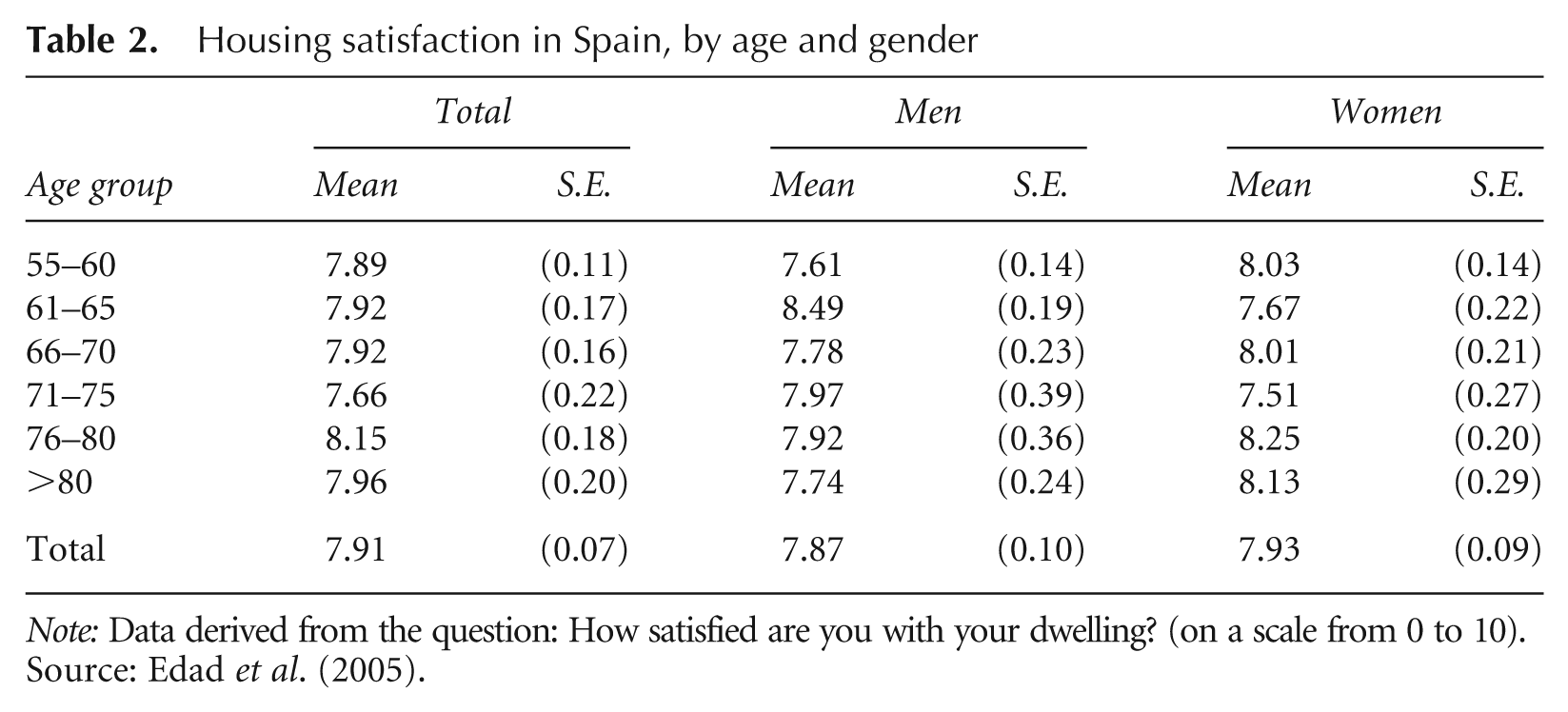
Note: Data derived from the question: How satisfied are you with your dwelling? (on a scale from 0 to 10).
Source: Edad et al. (2005).

Housing satisfaction and ownership among Spanish regions (autonomous communities).
4.2 The Determinants of Housing Satisfaction in Old Age
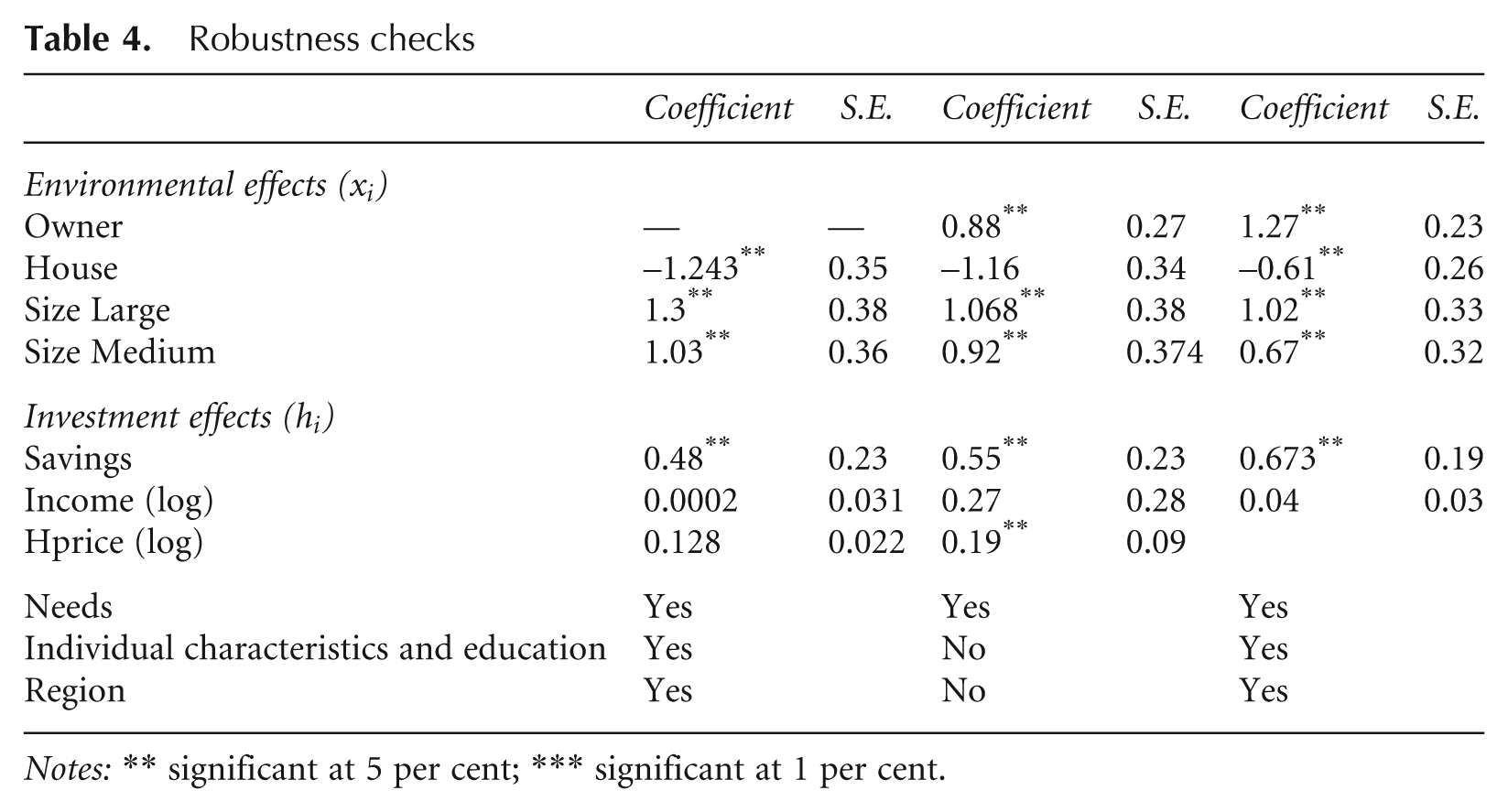
Table 3 reports the results of the outlined determinants of SRHS, both adjusted and unadjusted for regional effects. The two specifications contained the four main determinants specified in equation (2). Several checks for robustness were tried, the results of which are explained within Table 4. Other specifications were run and were not found to differ from previous results. Diagnostic tests suggested that the explanatory power was acceptable and that regional controls were statistically significant, probably conveying the effect of unobservable variables.
Self-reported housing satisfaction (SRHS) in old age (OLS regression results)
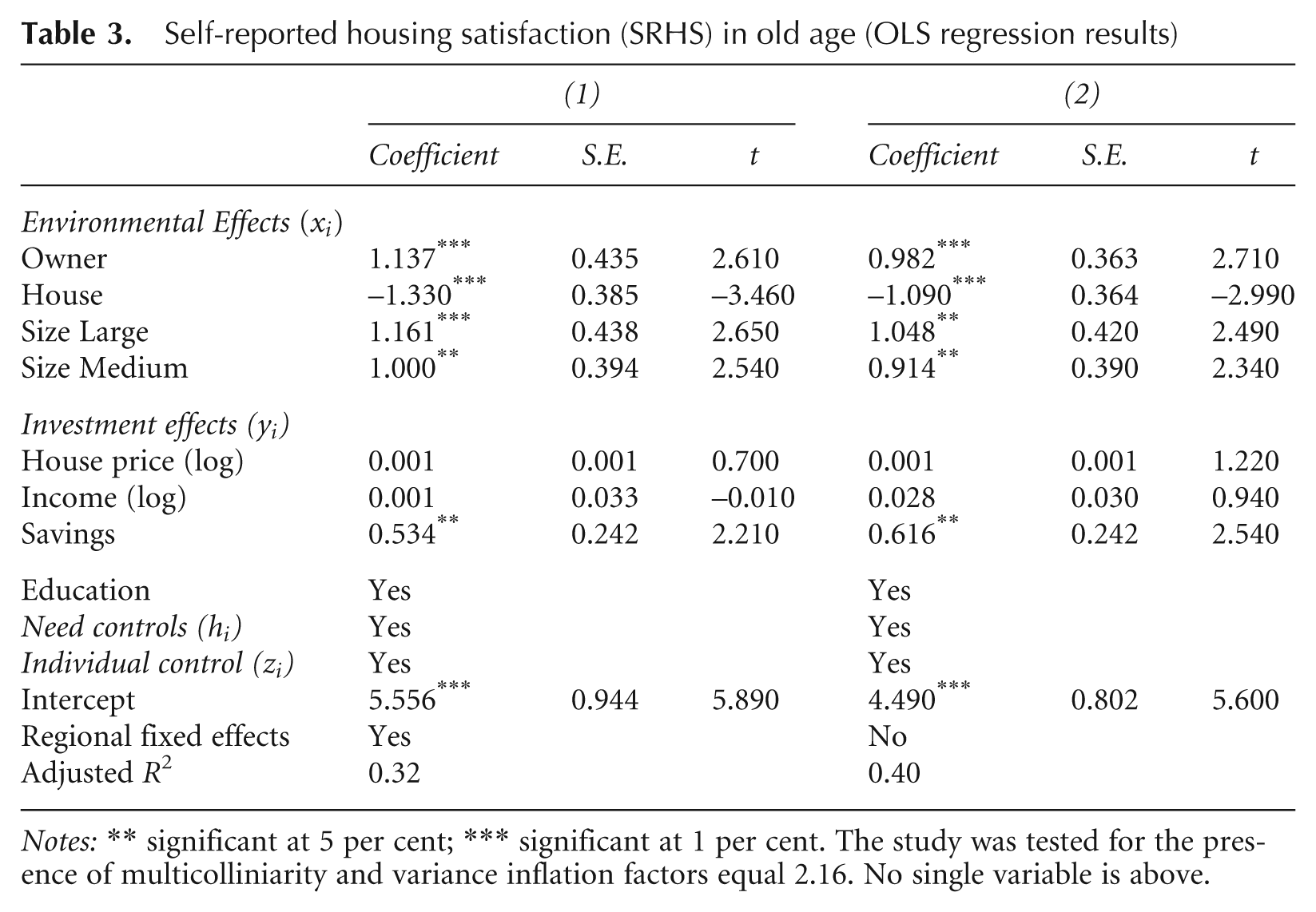
Notes: ** significant at 5 per cent; *** significant at 1 per cent. The study was tested for the presence of multicolliniarity and variance inflation factors equal 2.16. No single variable is above.
Robustness checks
Notes: ** significant at 5 per cent; *** significant at 1 per cent.
As expected, health and need controls were highly significant and suggest that well-being in old age can be significantly influenced by the existence of dependency, although the coefficients are not reported here in order to keep focus. They show that SRHS increased with self-reported ill health, suggesting the effect of need-related or health-related reasons for feeling satisfied with one’s housing.
Environmental factors broadly defined appear as key determinants of SRHS. Homeownership revealed a positive coefficient close to unity, suggesting that a 1 per cent increase in homeownership would lead to a 1 per cent increase in housing satisfaction. This result did not come as a surprise and was consistent with previous aggregate evidence, although it was reinforced here after controlling for a set of relevant covariates. Interestingly, people who lived in a house (rather than a flat) were less likely to be satisfied. This is consistent with the argument that houses (as opposed to flats) generally pose more barriers to mobility due to the presence of stairs as well as the specific characteristics of ‘houses-only’ neighbourhoods in Spain. An important environmental dimension—namely, space, was highly correlated with SRHS, as people’s perceptions of having medium and large dwellings both improved in roughly the same magnitude, with a 1 per cent increase in SRHS. Therefore, house-specific characteristics, especially amount of space, lack of barriers (for example, stairs) and (as expected) ownership, should be viewed as key factors in determining satisfaction with one’s dwelling in old age.
Unexpectedly, few investment variables appeared to be significant determinants of SHS in old age. Indeed, income is systematically an insignificant variable and the value of housing assets did not increase SRHS, which would contradict the hypothesis that investment effects are important for housing well-being in old age. The exception to this was the influence of individual savings, which in old age may signal capacity to invest in housing conditions. This finding indicates that, in the event of old-age dependency, people who have accumulated savings would appear to be less likely to sell or remortgage their dwelling to pay for care costs, and hence are more likely to have a greater preference for ‘ageing in place’(Costa-Font et al., 2009). Finally, socio-demographic variables were not significant, suggesting that, once age-related effects are taken into account, age and gender differences no longer explain SRHS. Hence, we do not report them here. Table 3 only indicates whether such variables have been controlled for.
Table 4 provides three different specifications to test the effect of excluding homeownership from the regression, the effect of region, of individual characteristics and of declining house prices on the income coefficient. Importantly, all three specifications suggest that environmental effects remain as the most significant covariates in explaining housing satisfaction, whilst the only variable that appears to correlate with HRHS is individuals’ self-reported savings. Excluding regional effects makes the housing price variable a significant predictor of housing satisfaction, because house prices vary by region. Importantly, an individual’s income remains as an insignificant determinant of housing satisfaction even when house prices are excluded from the regression.
5. Conclusion
This study has sought to examine the influence of two major factors hypothetically driving housing-related well-being (housing satisfaction) in old age, namely: investment effects, which provide individuals with a sense of financial security; and ‘environmental’ and dwelling characteristics that trigger other psycho-social effects. The relevance of this question lies in the fact that house prices might not necessarily encompass improvements in well-being in old age because older individuals are less likely to think of selling than younger counterparts, which can be regarded as a potential market failure. Furthermore, given that housing satisfaction can induce housing mobility, it can in turn influence the demand for social services and, more specifically, for home care (Costa-Font et al., 2009).
There are two important results from this study. First, regression analysis suggests that the value of a property is not a relevant determinant of housing-related well-being (SRHS), which in turn depends on the level of savings held by an individual, rather than income. Secondly, housing-related well-being is highly sensitive to changes in the environmental effects underpinning housing characteristics such as size, and especially the nature of the dwelling, as higher levels of satisfaction were found among those in flats rather than houses.
As in other Mediterranean countries, the welfare state in Spain is still incomplete and relies heavily on owned property and in-home care for the elderly (Barlow and Duncan, 1994; Izuhara, 2005). Hence, investment in housing would appear as an area in which to stimulate intervention if the government goal is to expand well-being in old age. The results are robust to different specifications and suggest socio-environmental effects, including housing tenure, to be the main determinants of housing satisfaction. Consistent with the findings of Rowlingson and McKay (2005), the study found that housing characteristics such as the amount of space and the existence of stairs were important in explaining housing satisfaction. As with previous evidence (Domanski et al., 2006), homeownership appears to be a key determinant of SRHS, but not housing equity. How this might be explained is open to debate. It is not clear whether homeownership provides a sense of ‘achievement’ and self-esteem, or results from country-specific economic circumstances or is the logical response to housing market conditions. However, in light of the results obtained, certain forms of housing tenure can be regarded as increasing people’s well-being and sense of security. One feature that must be mentioned is that housing tenure is often constrained by the availability of rented accommodation, and such constraints might induce individuals to become homeowners. However, whilst the latter is generally true, it is less true of people of an older age, given that the chances of finding rented accommodation increase with an individual’s life-span. Other interpretations of the results might include the possibility that these market values of housing might not fully take into account some environmental effects, or perhaps that some of these effects were not observable and therefore not fully captured in our analysis.
Finally, this study included a wide range of housing-specific characteristics and det-ected the influence of several factors, such as amount of space and house type compared with flat type. The findings are consistent with the idea of housing satisfaction in old age as indicating an underlying preference for ‘ageing in place’. This means that, for health and safety reasons, the authorities may need to guarantee assistance to older people in carrying out house repairs and making improvements in socio-environmental conditions that enable them to remain in their home for longer (Terry and Gibson, 2006). However, further evidence might be required using longitudinal databases to complement and expand on these results.
Footnotes
Acknowledgements
The author is especially grateful to Catherine Henderson, Azusa Sato and the careful comments of five referees, as well as the Editors for their editorial suggestions, which have helped to improve the paper substantially.
Notes
Funding
This research received no specific grant from any funding agency in the public, commercial or not-for-profit sectors.