




Abstract
This article examines the role played by urban gardens during historical collapses in urban food supply lines and identifies the social processes required to protect two critical elements of urban food production during times of crisis—open green spaces and the collective memory of how to grow food. Advanced communication and transport technologies allow food sequestration from the farthest reaches of the planet, but have markedly increasing urban dependence on global food systems over the past 50 years. Simultaneously, such advances have eroded collective memory of food production, while suitable spaces for urban gardening have been lost. These factors combine to heighten the potential for food shortages when—as occurred in the 20th century—major economic, political or environmental crises sever supply lines to urban areas. This paper considers how to govern urban areas sustainably in order to ensure food security in times of crisis by: evincing the effectiveness of urban gardening during crises; showing how allotment gardens serve as conduits for transmitting collective social-ecological memories of food production; and, discussing roles and strategies of urban environmental movements for protecting urban green space. Urban gardening and urban social movements can build local ecological and social response capacity against major collapses in urban food supplies. Hence, they should be incorporated as central elements of sustainable urban development. Urban governance for resilience should be historically informed about major food crises and allow for redundant food production solutions as a response to uncertain futures.
1. Introduction
Urbanites’ dependence on rural resources has been appreciated at least since The Wealth of Nations (Smith, 1776/1977). Smith’s pioneering book notes the “great and ready” market of the town for the “rude produce of the country”. At the time of Smith’s writing, distinctions between rural and urban areas were, however, of relative degree. Clear delineations between urban and rural areas did not emerge until the 19th and 20th centuries, reinforced by urban and regional planning, and with them increasing vulnerability of urbanites to food shortages. For instance, as recently as the Great Wars of the 20th century, millions suffered from food shortages when international trade broke down and supply lines to urban areas were severed. Challenging though this situation was, it could have been much worse. Practical knowledge of farming practices and ample green space allowed urbanites to grow much of their own food and avoid mass starvation.
Twenty-first-century urbanites occupy a much more vulnerable position due to the double processes of space–time compression and capitalist urbanisation. Space–time compression refers to those socioeconomical processes which serve to accelerate the pace of time and reduce the significance of distance (Harvey, 1990). These include technological innovations (telephones, Internet), cheap and efficient travel (rail, cars, jets) and global economics (opening new markets, speeding up production cycles and reducing the turn-over time of capital). The pace at which modern urban life proceeds and the insignificance of geographical barriers are qualitatively different in terms of their intensity and scope compared with even 50 years ago (Sassen, 1991), creating the perception that local food sources are obsolete. Cities sequester food from the farthest reaches of the planet via a fragile global food system where energy costs are escalating and marginal returns from fertilisers and pesticides are diminishing, while environmental problems, such as water degradation, topsoil loss and biodiversity loss, are accumulating at sites of food production (for example, Deutsch, 2004; IAASTD, 2009; Fraser and Rimas, 2010; Steel, 2010). While global connectivity between cities and remote food supplies can decrease cities’ vulnerability to food shortages during crises of medium severity (Ernstson et al., 2010b), the sudden severance of supply lines into cities poses major threats to urban food security (Barthel, Folke and Colding, 2010; Barthel and Isendahl, 2012; Parker et al., 2013). Insights from cities in eastern Europe and Cuba after 1989 (Wright, 2009; Round et al., 2010) and current food shortages in Athens following the euro crisis provide dramatic reminders about the vulnerable position of city populations, in conjunction with volatile financial systems, conflicts and, perhaps increasingly, by resource scarcities and climate change.
Urban food production depends on two crucial resources: a viable urban ecosystem with sufficient land for cultivation and practical knowledge of how to grow food. Both need to be bolstered to provide meaningful food security. However, the drivers of space–time compression and accelerating property prices tend to remove public green space from urban landscapes, while agricultural areas near cities are transformed and used for other purposes (Lee and Webster, 2006; Ernstson, 2013; Colding and Barthel, 2013). Concomitantly, local and tacit knowledge related to agriculture is disappearing from metropolitan landscapes, creating an ‘extinction of experience’ of human–nature interaction and a collective ‘forgetting’ of how to grow food (Pyle, 1978; Miller, 2005; Barthel, Folke and Colding, 2010; Barthel, Sörlin and Ljungqvist, 2010; Ernstson et al. 2010a).
Thus, space–time compression and urbanisation confer benefits, but also lead to the loss of urban green space and of practical knowledge related to food production, significantly increasing the potential urban food shortages in times of major crises. Given these challenges, how can shortages be avoided and urban agricultural practices and cultures be fostered? Urban vulnerability to food shortages can be lessened by: creating and fostering urban gardens and the social networks, practices and artifacts required to transmit knowledge of food production; and, engaging in collective social action to protect the urban spaces wherein such knowledge can be created and transmitted and food grown. This article thus contributes to recent scholarship on sustainable urban governance by identifying the social mechanisms and practices whereby knowledge of food production can be cultivated and sustained and urban green areas preserved and reimagined as food production sites.
Section 2 details the history of allotment gardening in western Europe and North America, describing its origins and demonstrating the role of allotments in responding to urban food crises in the 20th century. Section 3 describes how social-ecological memories required for urban food production are stored and translated across time and space in urban gardens, and outlines a number of important ways in which these memories and the social and physical infrastructure which support them may be strengthened. Section 4 describes the importance of urban socio-environmental movements for maintaining urban green space and suggests strategies by which members of these movements may increase their ability to protect urban green space for food production. We close with a general overview.
2. Allotment Gardens as Pockets of Resilience
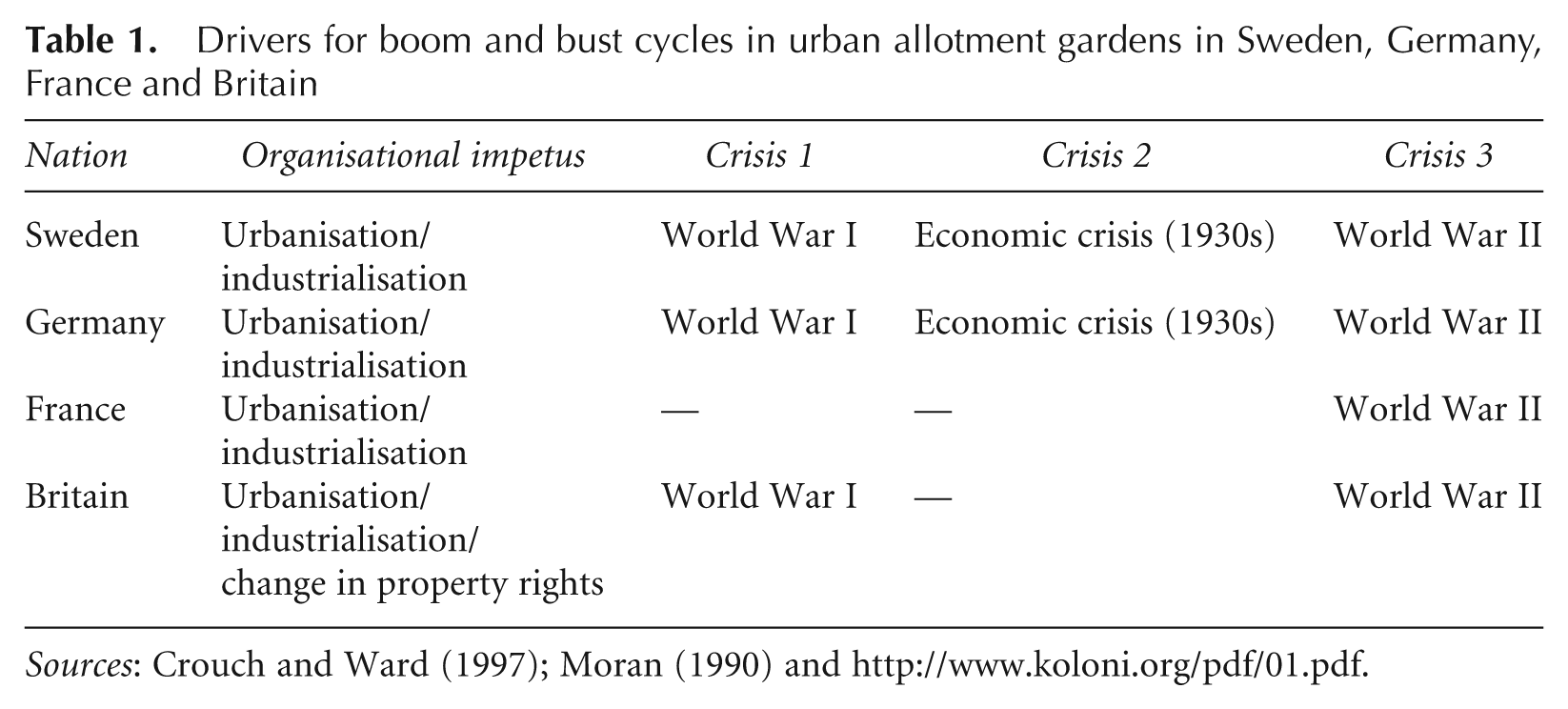
Urban allotment gardens in the Western world originated primarily in response to food shortages during the transition from feudal agrarianism to urban industrialism (Table 1; Barthel, Parker et al., 2013). In Sweden, for instance, allotment gardens helped to ameliorate social problems resulting from mass migration from the countryside to urban areas, such as food shortages and meagre living conditions (Barthel, Parker et al., 2013). British allotment gardens share the same origins. From the 17th through to the 19th centuries, vast areas of previously communal sites for food production, fuel gathering and grazing were privatised and enclosed (Moran, 1990; Humphreys, 1996; Select Committee, 1998). By 1850, approximately 88 per cent of farm labourers had no personal ownership over the lands they tended. This ‘great enclosure’ dissolved the ‘commons’, along with the ancient system of local food production, leaving the poor to live at or below subsistence levels. This suffering catalysed collective social movements, leading to the passing of laws allocating space for urban allotment gardens (Crouch and Ward, 1988/1997). Allotment gardens have since served as important buffers against urban food shortages (Barthel, Folke and Colding, 2010). 1
Drivers for boom and bust cycles in urban allotment gardens in Sweden, Germany, France and Britain
Sources: Crouch and Ward (1997); Moran (1990) and http://www.koloni.org/pdf/01.pdf.
Across Europe, the impetus for allotment gardening was primarily food shortages. Also ubiquitous are the rise and fall of allotment gardening preceding and following food shortages caused by economic and political crises. This trend is most notable during World War II. Although Sweden was not directly involved in the war, related food shortages resulted in a rapid increase in allotment gardening, rising from 30 000 gardens prior to the war to 130 000 during its peak, producing approximately 10 per cent of all vegetables consumed (Barthel, Parker et al., 2013). In Germany, the number of allotment gardens rose from a few hundred in the 19th century to 450 000 during the economic crises of the early 1930s to 800 000 at the war’s end.
The best country-level data relate to the British experience, where ‘boom and bust’ cycles are apparent. Figure 1 shows the number of allotment gardens in Britain from 1873 through to 1978. Two major peaks are apparent. The first occurred during World War I, when supply lines to outside food sources were severed and the Kaiser threatened to “starve the British people until they, who have refused peace, will kneel and plea for it”. Facing mass starvation, the government permitted urban lots, parks and sports fields to be converted to gardens through its “Every Man a Gardener” campaign. The number of allotment gardens rose meteorically from 600 000 to 1 500 000, providing Britons with 2 million tons of fresh vegetables by 1918 (Crouch and Ward, 1997; Select Committee, 1998). The World War II “Dig for Victory” campaign generated another explosion of gardening. By 1942, one out of every two manual workers had an allotment garden (Crouch and Ward, 1997). The number of allotment gardens rose from 800 000 prior to the war to 1 400 000 during its peak, providing British citizens with 1 300 000 tons of food (Humphreys, 1996; Select Committee, 1998).
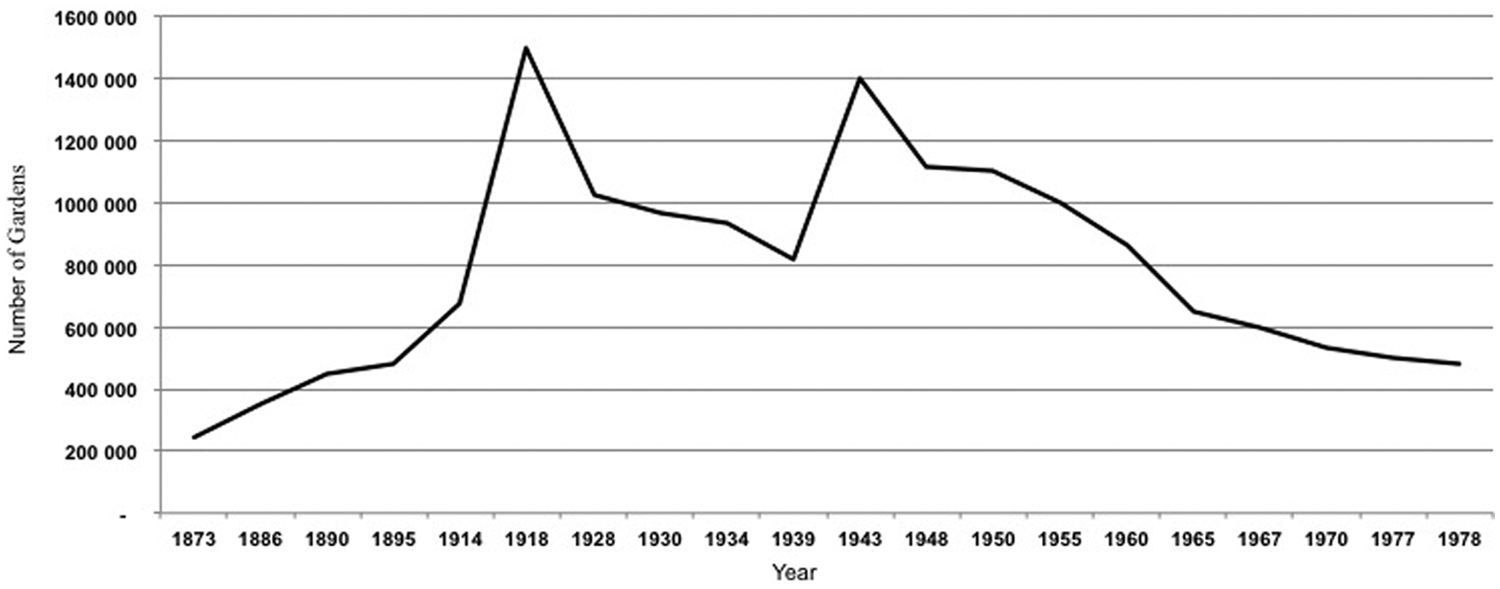
Trends in British allotment gardening, 1873–1978. Sources: Humphreys (1996); Crouch and Ward (1997); Select Committee (1998).
In sum, allotment gardens originated in food shortages and socio-environmental crises, and were major sources of resilience for Western cities major crises. 2 However, the past 50 years have witnessed considerable public neglect of the spaces required for urban food production and the political means of protecting them. We next consider the importance of allotment gardens for transferring knowledge of food production practices and of an active civic society for preserving the space to do so.
3. Allotment Gardens and Social-ecological Memories
There are around 3 million allotment gardens in Europe (Barthel, Parker et al., 2013). In an urban environment, allotment garden areas appear as lush, flower-rich landscape patches, often containing fruit trees and small chalets. European allotment gardens are often considerably old, some having been in existence for over a century. Property rights are often long term (up to 25-year contracts) and organised hierarchically, with individual management rights for each plot embedded in rules-in-use of local garden communities and broader urban land use regulations. Allotment gardens can be broadly described as representing knowledge ‘legacies’ of traditional household gardening practices, where the users’ gardening knowledge has been passed on and socially retained for a considerable time (Barthel, Folke and Colding, 2010). Allotment gardens thus also serve as important sites for conferring practical knowledge of urban agriculture, a topic to which we now turn.
3.1 Social Memory and Human Behaviour
Urban gardens play a critical but rarely appreciated role in ensuring urban food production and associated ecosystem services. They provide a unique and distinctively effective means of retaining and transmitting collective memories of how to grow food and manage the regulatory ecosystem services required to do so.
Collective memory—memories or knowledge shared by members of a distinct social group—is maintained and fostered in social groups such as communities, settlements, professional groups and religions (Halbwachs, 1952/1992; Connerton, 1989; Climo and Cattell, 2002; Misztal, 2003). The study of collective memory has recently become a focus of several fields, linking processes of remembering and forgetting to modes of retention and loss within their historical, cultural and political contexts. The literature indicates that, while only individuals can be said to remember sensu stricto, individual memory processes are socially derivative and facilitated by supra-individual means such as sharing stories, artifacts, symbols, rituals and written accounts. This work is especially relevant to our discussion as it demonstrates that social and ecological crises can render memories indelible or, in certain contexts, can entirely suppress them (Crumley, 1994; Nazarea, 1998; Mcintosh et al., 2000; Barthel, Crumley et al., 2013).
We prefer the term social-ecological memory (Barthel, Folke and Colding, 2010) because it explicates the inherent feedback loops between human actions and ecological processes. Social-ecological memory is the combined means by which knowledge, experience and practice of ecosystem management are captured, stored, revived and transmitted through time (Barthel, Folke and Colding, 2010). For instance, the diverse social-ecological memories of landscape stewards play an important role in ecological resilience as such knowledge helps to renew and reorganise the capacity of social-ecological systems to generate ecosystem services like food in times of turbulence (Berkes and Folke, 2002).
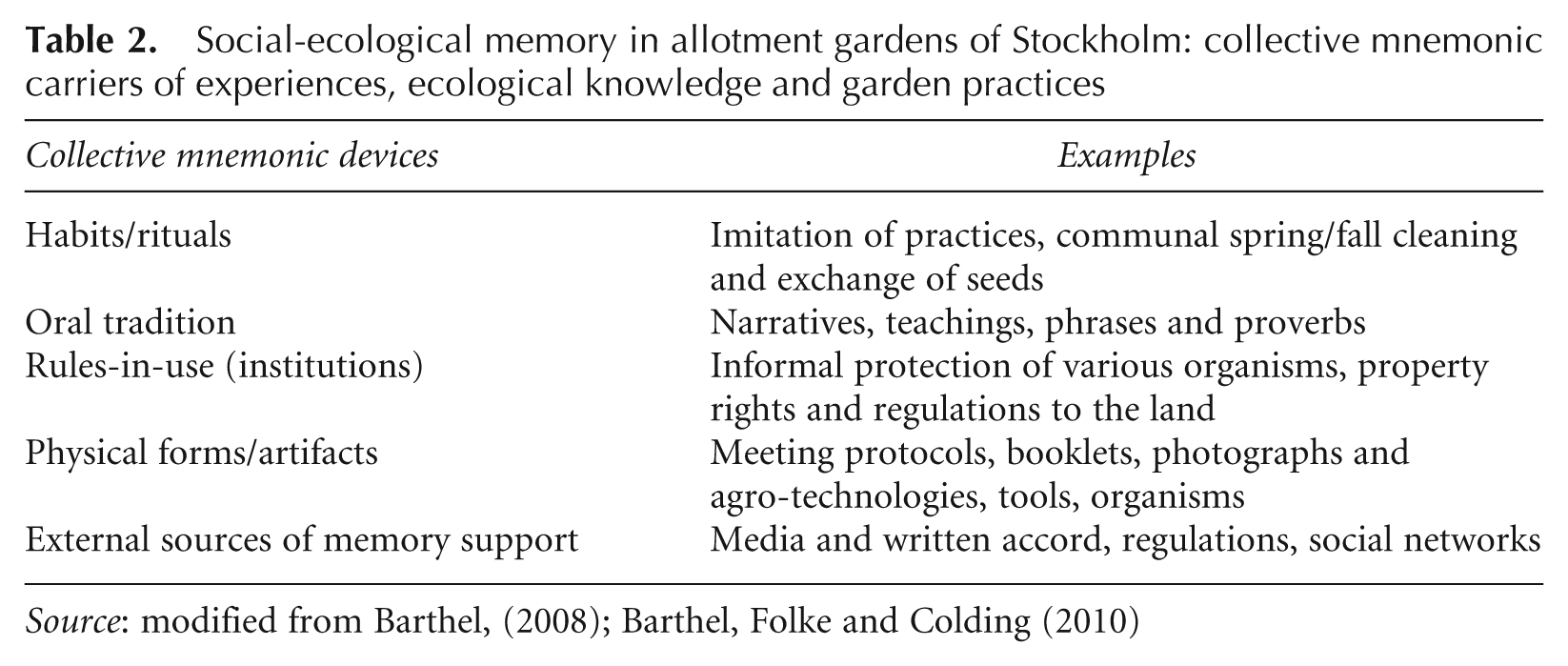
Community engagement in allotment gardens over time results in a shared history (Wenger, 1998; McKenna et al., 2008) and in artifacts, locally adapted organisms and landscape features (Barthel, Folke and Colding, 2010). These tend to outlive the repertoires of practices that first shaped them and function as carriers of experiences, practices and knowledge. For instance, in traditional agriculture, a small percentage of one year’s harvest is often saved for the next planting. Over deep-time evolution, this creates locally adapted varieties of crops co-evolved with human practices and local environmental conditions (Fraser and Rimas, 2010). Social-ecological memories of fluctuating local environmental conditions and societal adaptations are carried forward through time by locally adapted crops, landscape features and agro-technologies like gardens, as well as by habits, oral traditions, written accounts and self-organised systems of rules (Barthel, Folke and Colding, 2010). Such carriers of social memory (Table 2) are constantly shaped by social participation and environmental dynamics, and they incorporate many small, almost imperceptible variations created by constantly changing contexts (Scott, 1988; Wenger, 1998). In time, the double processes of participation and reification form a shared memory of a changing physical environment, socioeconomic fluctuations linked to it and local responses to such fluctuations (Barthel, Folke and Colding, 2010). In Stockholm allotment gardens, collective mnemonic devices include physical objects in the gardens, exchange of seeds and recipes, mimicking of bodily practices, self-enforced rules and a semi-annual magazine. Oral traditions are also important and include teachings by elected mentors and the everyday exchange of experiences and ordinary gossip, which result in a shared jargon, metaphors and proverbs. Newcomers tap into garden practices primarily by taking part in such conversations (Barthel, Folke and Colding, 2010).
Social-ecological memory in allotment gardens of Stockholm: collective mnemonic carriers of experiences, ecological knowledge and garden practices
Source: modified from Barthel, (2008); Barthel, Folke and Colding (2010)
Part of the ecological knowledge carried in social-ecological memory is tacit (Polyani, 1966; Sensiper, 1998), expressed in habits and behaviour to fit the particular environmental situations of the gardeners (Misztal, 2003; Nazarea, 1998). Examples include the common practice of protecting insectivorous bird habitats and supporting pest regulation (Mols and Visser, 2002; Andersson et al., 2007), practices that are tacitly carried forward in time. These findings are in line with the literature on rural community-based conservation, which has focused primarily on the roles of oral traditions, beliefs, ceremonies and ritual practices in transferring sound ecological management practices (Berkes, 1999; Berkes et al., 2003).
3.2 Collectively Improving Urban Gardens and Food Provision in Cities
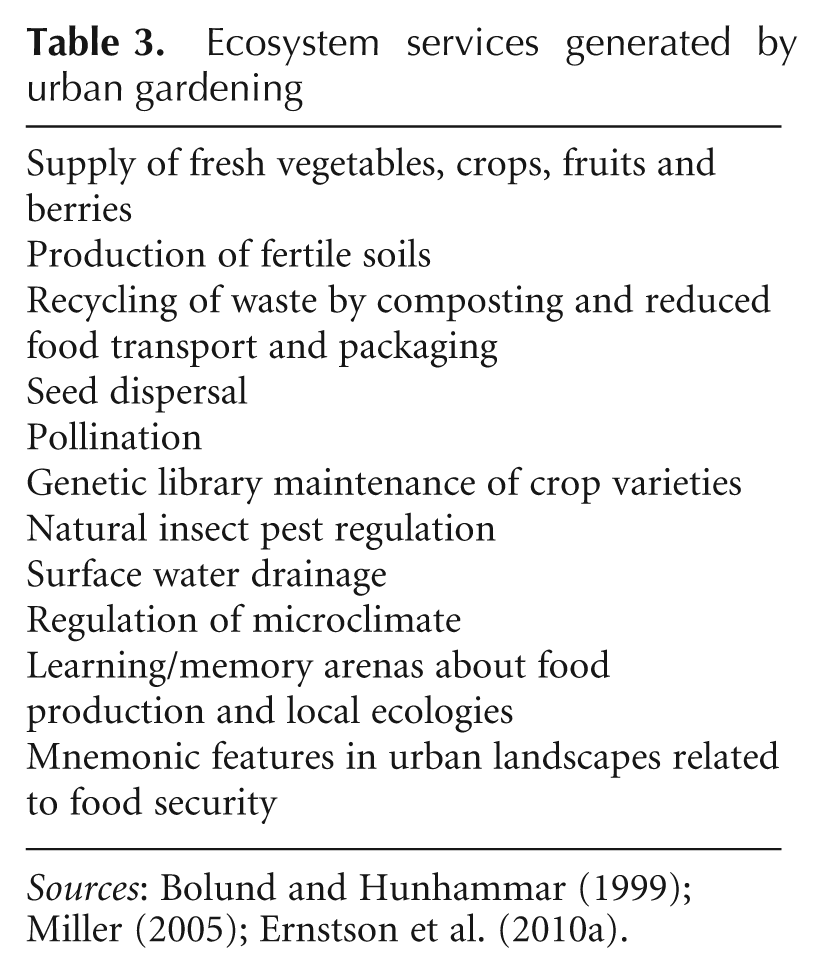
In providing and preserving collective social-ecological memories, urban gardening counteracts a social forgetting about our dependency on social cohesion and on local land. Collectively managed gardens serve as living libraries for transmitting information about a portfolio of locally adapted practices and plants, about soil fertility, micro climate and local populations of ecosystem service providers (Table 3). Allotment gardens also complement public urban space and parks by helping processes of place-making in neighbourhoods (Bendt et al., 2013). The latter are critical for building the social capacity for protecting and nurturing urban green space—a theme to which will we return shortly.
Ecosystem services generated by urban gardening
Despite the ecological and social benefits conferred by allotment gardens, urban governance practices are insufficient to support the extent of social-ecological memories required to produce a sufficient amount of food in times of crisis (Barthel, Parker et al., 2013). Garden memories are fragile and vague compared with the powerful forces of daily demands, desires and impressions. Dominant urban experiences and values are shaped by a constantly changing mix of the ‘silent’ waves of influence through social-ecological memories and the ‘loud’ frequencies on which other values rest—for example, those connected with industry, trade and mass consumption. Perhaps the most powerful erasure of memory in this constantly changing mix is the passage of time. New and more robust methods must be developed to transfer these critical forms of ecological knowledge to the future.
Transmission of collective memories, both formal and informal, can been supported by governance in many ways. Stories, songs and poems are passed from one generation to the next; visual and mnemonic cues are left in landscapes; laws and regulations transmit behaviour; the embodiment of everyday practice is taught through the cadence of work; every written record is a ‘message in a bottle’ from the past (Barthel, Crumely et al., 2013). Mentorship training, where older experienced gardeners teach the younger, is especially important for transmission of embodied and tacit knowledge. A diversity of garden typographies helps to attract different age-groups and ethnicities (Bendt et al., 2013). This, combined with the sharing of experiences between gardens, helps to transmit experiences and memories between cohorts and cultures (Berkes et al., 2003). External support for the sharing and banking of seeds is important for securing locally adapted plants as memory carriers. However, the most central aspect of sustaining the ability to grow food is the physical presence of collectively managed urban gardens since they serve as physical mnemonic cues. Without physical spaces in urban landscapes for agriculture and horticulture, memories of how to produce food have nothing on which to work. Carriers of experience-based and practical knowledge simply dissolve. Urban gardens mitigate illiteracy related to practical knowledge of how to grow food among urban populations (Barthel, Folke and Colding, 2010; Bendt et al., 2013). Green space that can be used for agriculture must be safe-guarded for such tacit knowledge to exist in cities.
Since space is often the limiting resource in cities, and always contested, the local resilience of such gardens must be understood in relation to the power landscapes of cities. Considering the strong real estate interests and political forces that dominate urban space today (Lee and Webster, 2006; Harvey, 1996), such garden initiatives need support in terms of legal structures and property right solutions (Barthel, Folke and Colding, 2010), but human agency and skills are also needed. In Stockholm, allotment garden associations have created a city-wide umbrella organisation to navigate urban decision-making and power dynamics (Ernstson et al., 2010a). The Allotment Union is positioned as broker between individual garden associations and the city government, representing the interest of each garden in the negotiations with the city about leaseholds and fees (Barthel, Folke and Colding, 2010). Included in governance support for gardens must be ethical discussions about which groups in society could most benefit from enhanced local food security. These issues are considered in the next section.
4. Food Strategies in Urban Powerscapes: Urban Environmental Movements
Accommodating urban gardening and food production in cities requires negotiating between various interests wielding differential levels of power to defend their claims to urban space. This negotiation is material in its contestation of physical space, cultural through the construction of alternative imaginaries of urban land use and political through engagement with decision-making processes. Informative in this respect is scholarship on social movements, here defined as sustained collective action across space and time among autonomous civil organisations engaged in social conflict and sharing common objectives and methods (Diani, 2003). Social movements are heterogeneous, themselves composed of multiple organisations and social networks engaging in internal conflicts and struggles (Diani, 2003).
Others have focused on urban planning to increase urban food security, arguing that the urban food system should be of equal importance as such basic urban services as transport, sewage and water (Pothukuchi and Kaufman, 2000; Born and Purcell, 2006). 3 While important, we emphasise that one also needs to move outside a planning and techno-managerial discourse and situate food security as a political question. An active civil society is necessary for mobilising people and resources to protect urban green space, sustaining the knowledge of how to grow food and re-imagining the city as being a place of food production.
4.1 Urban Social Movements and the Protection of Urban Green Space
Castells’s work on ‘urban social movements’ is useful for considering the role of civil society in struggles for the more just distribution of collective resources such green space (Castells, 1983). For Castells, such struggles must shift scales and span multiple interest groups, move beyond single neighbourhoods and wed together grievances or interests into broader claims capable of challenging existing forms of urban reproduction and planning regimes (see also Harvey, 1996; Diani, 2003). In relation to food, urban ecosystems that can be used to build food security, like in Britain during the wars, are prime example of public goods—i.e. the use of such cannot be treated as solely within the interest of private land holders or the state. Walker (2007) has also eloquently demonstrated the capacity of civil society to effectively structure urban space in his history of struggles over urban land use in post World-War-II-San Francisco. He contends that San Francisco’s high ratio of urban green space for farming, recreation and nature reserves resulted from an active civil society contesting short-sighted economic land uses proposed by industrialists and urban planners. Accompanying struggles over urban space are also struggles over urban identity. This is exemplified by ‘garden movements’ which plant fruit trees, establish mobile gardens or, as ‘guerilla gardeners’, throw ‘seed bombs’ into what activists view as badly used open spaces. Such actions highlight the issue of local food production and are also aimed at creating a new identity for the city as an organic entity.
Taken together, a social movement perspective can shed light on how urban space devoted to food production and the regulatory ecosystem services required for it can be protected and revived. The protection of the Stockholm National Urban Park provides an illustrative empirical example (Ernstson et al., 2008; Ernstson and Sörlin, 2009; Ernstson, 2011). This struggle arose from public discontent regarding the planning of large infrastructure projects in Stockholm. Around 1990, a small set of activists began working to mobilise existing civic organisations to create a civic alliance—partly institutionalised under an umbrella organisation—to protect what they referred to as The Ecopark. By 1995, political pressure had culminated in parliament officially protecting a 27 square kilometre park composed of green areas and waterways previously viewed as separate entities.
Two main factors have been identified to account for the success of this movement. The first is the emergence of a core–periphery social network structure among these civic organisations which engendered network-level mechanisms of protection (Ernstson et al., 2008; Ernstson, 2011). This network structure had a nucleus of six civic organisations. These tightly networked activists quickly learned laws, regulations and how to intervene effectively in the planning process, enlisting lawyers, landscape architects and journalists. Political connections allowed them to detect exploitation plans early in the planning process and rally effectively against them. Peripheral organisations such as allotment gardeners, boating clubs, scouts, horse riding and ornithological clubs served as monitors for smaller threats such as parking lot construction. Their information was then transmitted to the more influential core organisations that were better able to affect protection.
The second factor was the articulation and framing of a ‘protective’ narrative around the green areas which expressed their values (Ernstson and Sörlin, 2009). This narrative contained two dimensions—a spatial dimension integrating previously discrete areas into a whole, and interrelating cultural history with conservation biology. The creation of the coherent narrative was accomplished by using artifacts produced by biologists and cultural historians that helped to weave areas and themes together, and by creating social arenas through which this narrative could be transmitted. For instance, university scholars and civil servants were mobilised to perform bird surveys and habitat assessments, which in turn produced maps that activists used for strengthening the notion that various park areas were ecologically connected. Historical maps were used to demonstrate that green areas on both sides of a lake were culturally and historically connected, and that new buildings would disturb the intention of the original landscape design. The narrative was spread to other social arenas and integrated into texts, speeches and small-talk that reached new audiences and mobilised more people. Together, these tactics created a broader identity for the park, which allowed linking previously separate groups into a more unified struggle, to fight off exploitation plans, as they could now be referred to what was increasingly deemed ‘The Ecopark’.
The case of the Stockholm National Urban Park illustrates four important roles that urban environmental movements can play in protecting green space that can be used for food production and gardening, or protecting space for generating ecosystem services of importance for such activities (Table 4). First, such movements can counter shorter-term and profit-driven interests on urban land through their engagement in place-based struggles. This was clear in the case of the National Urban Park, where activists halted the development of urban land intended for roads, hotels and conference centres.
The roles and strategies for building urban environmental movements to protect urban green space, increase urban food production and address food security, particularly in the face of major crises
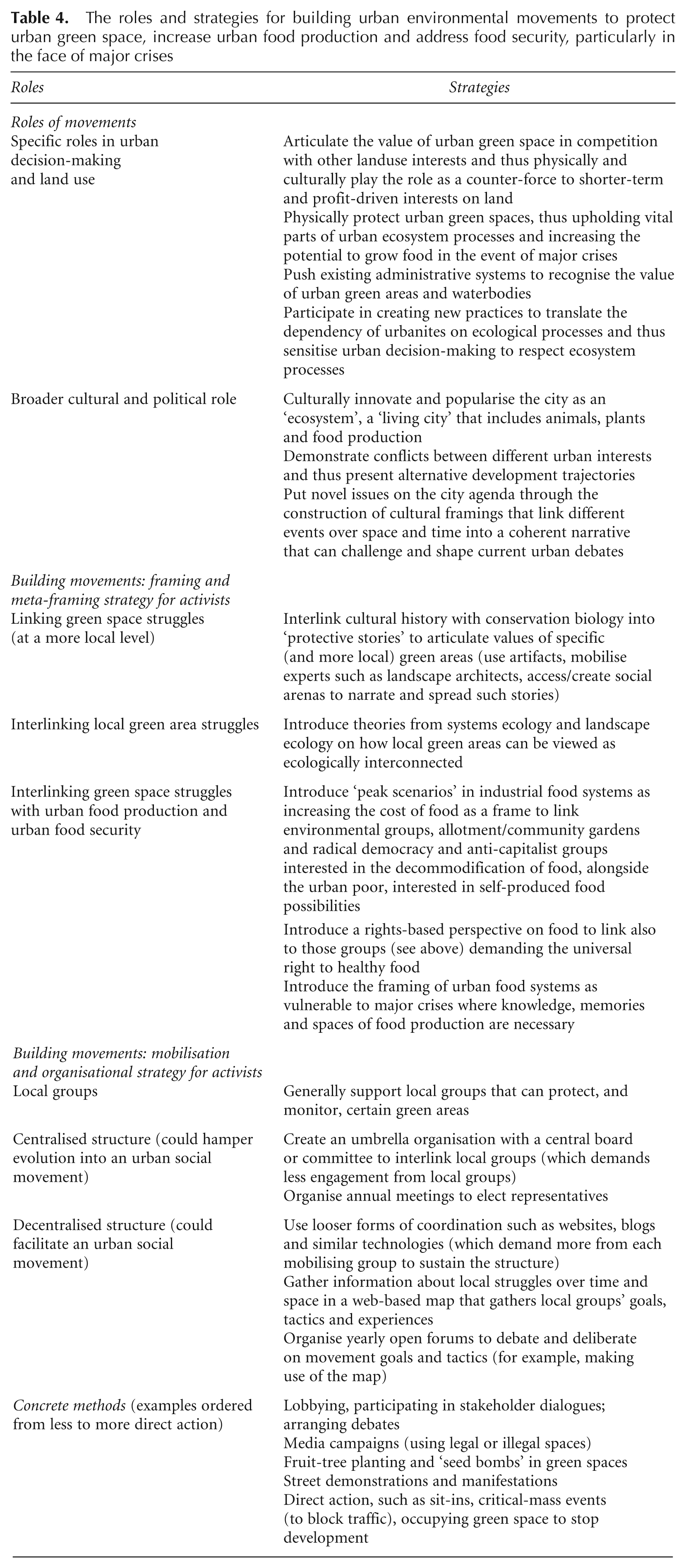
Secondly, through their intervention in the planning and use of urban space, environmental movements participate in shaping ecosystem processes and services (Ernstson, 2013). This is done through the protection of areas such as nature reserves, urban parks and designated spaces for urban farming and allotment gardening, effectively placing certain areas outside the ‘normal’ consumption of urban space. From an ecosystem viewpoint, this form of protective capacity increases the quality of ecological corridors through the city for various ecosystem service providers such as insectivorous birds and wild bees (Ernstson et al., 2010b; Ernstson, 2012), which enhances actual and potential food production (see Table 4).
Thirdly, urban environmental movements can push existing administrative systems to recognise the value of urban green areas and water bodies. These movements can serve to sensitise decision-makers to the dependency of urban people, plants and animals on ecosystem processes. In this sense, these movements participate in a politically contested process of ‘programming’ their arguments regarding the protection of urban green space into the institutions and value systems that guide urban governance (Table 4).
Finally, movements engage in cultural innovation by challenging longstanding ideas of how we should understand ‘the city’, its identity and for what and whom it exists. Movements have the ability to bring new and lay narratives into public debates that can help to express the connectedness and dependency of urban dwellers on ecosystem services such as local food.
4.2 Strategies of Environmental Movements for Urban Food Production
More broadly, the strategies of forming urban environmental movements aimed at protecting green areas and promoting food security may be distilled into two primary activities (Table 4): how activists frame their issues and goals (Benford and Snow, 2000), and how they mobilise resources to take action (McCarthy and Zald, 1977; Diani, 2003). Furthermore, these activities inherently also produce the scale of collective action—local, city-wide and beyond—and its capacity to generate systemic change in planning and governance.
Framing is the process whereby social movement participants develop a collective understanding of a social problem and of what needs to be done to solve it, while also providing legitimation of the movement’s claims and methods (Benford and Snow, 2000). Framing thus results in including some people (those agreeing upon goals and methods), while excluding others. Framing is often performed by social movement leaders but rests upon a collective base and existing knowledge structures. For groups physically engaging in food production and gardening, framing could be part-and-parcel of the formation of social-ecological memory, as described earlier.
For a broad environmental movement around urban food security, framing would need to include the protection of sufficient urban green space to provide food for a large population, while retaining knowledge and social-ecological memory for food production. This in turn would require multiple interest groups to collaborate in producing a ‘meta-narrative’ that manages to link or balance their individual interests into a commonly articulated ideological framework (Snow and Benford, 1992). Here we describe a framing strategy that includes wider and wider groups towards a meta-frame for food security, being the broadest and most systemic issue addressed here. 4
When only focusing on the protection or restoring of local green space (and not food production per se), local interest groups could be interlinked with city-wide conservation groups, as was the case in the Stockholm National Urban Park. Further to strengthen such scale shifts among conservation groups, activists could draw upon expert and lay knowledge about ecological connectivity between urban green areas. This could come to downplay social differences among participants and promote a cohesive identity and shared conception of the situation. However, in order also to mobilise groups outside the conservation camp, meta-frames could be constructed around broader political issues such as economic ‘degrowth’ and the growing awareness about how the ‘peak’ scenarios of oil and phosphor could increase food costs. This would serve to integrate environmental groups with allotment and community garden associations, thus starting to integrate groups supporting social-ecological memory. Moreover, appeals to social justice could attract more radical groups aiming to decommodify food as well as mobilising the poor. Finally, to construct a meta-frame that explicitly integrates food security, activists would need to combine appeals to social justice for poor urbanites (who always tend to suffer in food crisis situations), while promoting an awareness of the vulnerability of many urban systems to major crises (in which urban functions break down, influencing all citizens).
In terms of resource mobilisation (Table 4), a number of studies point to the need to support local groups capable of protecting and monitoring green areas while creating interlocks between them in the form of a more encompassing umbrella organisation, which comes to occupy a more central position (Diani, 1995; Ansell, 2003; Ernstson et al., 2008). This provides a functional division of labour among movement participants in which some become ‘experts of resistance’ while others serve to protect, monitor and develop fine-tuned knowledge of local green areas (Ernstson et al., 2008). Such core–periphery network structures reduce social distance between groups while the collaborative structure demands little input by most, thus remaining stable over time. However, in centralising the power to speak on behalf of the movement, an outcome of this strategy can make it difficult to incorporate more radical perspectives into the movement.
Other, more horizontal and decentralised organisational structures could instead be nurtured through developing shared resources such as websites, blogs, web-based maps and similar technologies. This would lend more autonomy to participating groups, increasing the diversity of framings and the repertoire of action—from lobbying and stakeholder dialogues to street demonstrations and direct action such as sit-ins and occupations of urban green space to halt development. Furthermore, by letting experienced activists, and researchers, share information about historical struggles over green space, activists and the public can learn about spatial and temporal patterns of protests in their city, creating sentiments of unity. Other more hands-on strategies are given in Table 4.
5. Conclusion: Gardens, Green Space and Governance
This paper has highlighted an often forgotten issue in the governance of urban food security—the role of green space inside cities as a complement to global food systems when such are temporally disturbed due to armed conflicts, resource scarcities, environmental shocks or volatile financial systems. We have considered the potential of urban allotment gardens for safeguarding and transmitting knowledge of how to grow food and of urban environmental movements for protecting green space from development and for re-imagining cities in which such gardening occurs. We have done so through historical analyses indicating the importance of urban gardening for coping with major crises during the 20th century and through in-depth analyses of contemporary case studies of urban allotment gardens and urban social movements in Stockholm, Sweden. We have emphasised the importance of the ecosystems on which these processes play out so as to highlight the dependency of urbanites on the ecosystem services.
One major conclusion from this paper is that governance for urban resilience must learn from history when planning to avoid crisis. The allotment movements were ignited by philanthropists of their time when trying to improve living conditions for the urban poor. They met considerable resistance, but their work surprisingly showed their full potential as resilience-builders during the great wars of the 20th century when practical knowledge of how to produce food was transmitted from allotment gardens across cities of the Western world. This occurred less than 70 years ago.
These analyses evidence the power of urban gardening, environmental movements and associated social and political processes for enhancing the resilience of urban people with respect to uncertainties, complexities and major crises. Urban allotment gardens, the artifacts they contain and the social processes they enable, serve as collective mnemonic devices for transferring long-term social-ecological memories of how to grow food and successfully navigate food shortages when cities become divorced from the global economy in times of crisis. Feedback loops between social groups and ecosystem processes in allotment gardens continually reinforce such knowledge while also transforming the urban system in which they are embedded by creating locally adapted organisms and landscape features. This knowledge and these practices serve to renew and reorganise the capacity of urban social-ecological systems to generate food and associated ecosystem services that regulate food production. Social-ecological memories are hence one factor limiting successful food production in cities. New governance measures may need to be developed, to enhance the capacity of urban gardens to capture, store and transmit practical knowledge of food production into the future.
The other major factor limiting the efficacy of urban gardening for meaningful levels of food production is a lack of sufficient space for doing so. Urban green spaces are valuable public commodities and so competition among powerful interest groups to develop these lands is strong and highly politicised. While city planning has been championed as the main vehicle by which to save arable urban spaces, it too is a highly politicised process heavily influenced by vested interest groups. Political civic society groups are often unrecognised elements in the urban governance for food security. For this reason we emphasise the importance of political and civic actions in the form of urban environmental movements for preserving existing ecosystems, crafting new ones and linking them into larger, spatially connected landscape ecologies and to issues of social justice. This means not just the protection of existing urban gardens, but also preserving larger tracts at the urban periphery (Barthel and Isendahl, 2012; Moustier, 2007). The ability of social movements to preserve and revitalise such urban landscapes depends both on the network structure of their associations and on their ability to craft meaningful interpretative frameworks that can be popularised to mobilise social, cultural and economic capital to sustain collective action. This political turn is a potential addition to the resilience theory, since our subtle considerations of the roles of political agency and the nature of controversy highlight forces underlying the emergence of popular perceptions about cities, underlying frames used in urban decision-making, and therefore move future trajectories in social-ecological systems.
Current environmental movements that work to protect ecosystems in cities—for example, parks, trees, meadows and forests—safeguard (maybe unintentionally) future insurance values. Many such ecosystems can be converted to horticulture and agriculture in response to future food shortages. Additional environmental history studies are needed to analyse the roles of gardens and agriculture as urban functions in different historical time windows of crises, and in different cities, in order to assess the true insurance value of fertile urban gardens. Our perspective highlights that the governance of resilience must allow for seemingly sub-optimal or redundant solutions—like the obsolete urban gardens in relation to the effective global food systems—which follows from resilience thinking since redundancy, as principle, is a fertile ground for a diversity of responses to uncertain futures (Gunderson and Holling, 2002).
Footnotes
Funding
The authors acknowledge the Swedish research council Formas for providing funding for this research, including the following grants for SUPER, “Sustainable Urban Planning for Ecosystem Services and Resilience” and for “Kunskap för byggande av urban resiliens” and for MOVE on “Socioecological Movements and Transformative Collective Action in Urban Ecosystems”.